Your Students Don’t Use LLMs Like You Wish They Did
Proceedings of the 64th Annual Meeting of the Association for Computational Linguistics (Volume 1: Long Papers), pages 19146–19170
July 2–7, 2026 ©2026 Association for Computational Linguistics
Your Students Don’t Use LLMs Like You Wish They Did
The University of Sydney
{skob7546, matthew.clemson, angela.sun, jonathan.kummerfeld}@sydney.edu.au
Abstract
摘要
Educational NLP systems are typically evaluated using engagement metrics and satisfaction surveys, which are at best a proxy for meeting pedagogical goals. We introduce six computational metrics for automated evaluation of pedagogical alignment in student-AI dialogue. We validate our metrics through analysis of 12,650 messages across 500 conversations from four courses. Using our metrics, we identify a fundamental misalignment: educators design conversational tutors for sustained learning dialogue, but students mainly use them for answer-extraction. Deployment context is the strongest predictor of usage patterns, outweighing student preference or system design: when AI tools are optional, usage concentrates around deadlines; when integrated into course structure, students ask for solutions to verbatim assignment questions. Whole-dialogue evaluation misses these turn-by-turn patterns. Our metrics will enable researchers building educational dialogue systems to measure whether they are achieving their pedagogical goals.
教学类自然语言处理系统通常用参与度和满意度调查来评估,这些充其量只是在替代“是否达到教学目标”。我们提出六项计算指标,用于自动评估学生与人工智能对话中的教学对齐。我们用四门课、500 段对话、12,650 条消息来验证这些指标。用它们可以看出一种根本性的错位:教师把对话导师设计成持续的学习对话,学生却主要用来抽取答案。部署情境是用法模式最强的预测因素,强于学生偏好或系统设计:当人工智能工具是可选的,使用会集中在截止日期附近;当被嵌进课程结构时,学生会直接索要与作业题目原文对应的解答。整段对话一次评估会漏掉这些逐轮模式。这些指标将帮助开发教学对话系统的研究者,衡量系统是否真正达到了教学目标。
1 Introduction
1 引言
Looking at 10 recent ACL papers that tested LLM educational systems with real students, 9 relied on satisfaction surveys and self-reported learning gains, without verifying whether students actually used the system as intended. This mismatch is an issue because extensive educational psychology research has shown that students are systematically poor judges of their own learning, suffering from metacognitive biases like the “illusion of fluency” that cause them to mistake ease of interaction for depth of understanding (Koriat and Bjork, 2005).
我们查看了 10 篇近期用真实学生测试大语言模型教学系统的 ACL 论文,其中 9 篇依赖满意度调查和自我报告的学习收获,并没有核对学生是否按设计使用了系统。这种错位之所以成问题,是因为大量教育心理学研究表明,学生对自己学得怎样的判断系统性地不准,会受到“流畅错觉”这类元认知偏差的影响,把互动轻松误当成理解加深(Koriat and Bjork, 2005)。
This paper introduces a computational framework for measuring what actually happens when students interact with educational AI systems. We introduce six metrics that capture distinct dimensions of behaviour: conversational engagement, learning orientation, scaffolding resistance, assignment dependency, crisis-mode behaviour, and usage concentration. These metrics provide a novel evaluation infrastructure for validating and analysing educational systems against their intended pedagogical function.
本文提出一套计算框架,用来衡量学生与教学人工智能系统互动时实际发生了什么。我们提出六项指标,分别刻画不同的行为维度:对话参与、学习取向、脚手架抗拒、作业依赖、危机模式行为,以及使用集中度。这些指标为对照既定教学功能来验证和分析教学系统,提供了新的评估基础设施。
Through analysis of 12,650 messages across 500 student-AI conversations from four courses, we uncover a fundamental misalignment between pedagogical design and student usage patterns. When AI tools are optional, usage concentrates around exam deadlines as crisis management, with 59% of all semester interactions occurring during a single exam week. When integrated into course structure, students frequently paste assignment questions directly to obtain solutions. These answer-seeking behaviours are masked in whole-dialogue evaluation, but clear in our turn-by-turn analysis. Deployment context shows stronger association with these problematic usage patterns than student preference or system design.
通过对四门课上 500 段学生–人工智能对话、12,650 条消息的分析,我们发现教学设计与学生用法之间存在根本性错位。当人工智能工具是可选的,使用会作为危机应对集中在考试截止日期附近,全学期互动中有 59% 发生在同一个考试周。当被嵌进课程结构时,学生常常直接粘贴作业题目来获取解答。这些求答案行为在整段对话评估里会被掩盖,但在我们的逐轮分析中很清楚。与这些有问题的用法相关更强的,是部署情境,而不是学生偏好或系统设计。
Our framework brings established educational data mining insights into computational dialogue assessment, enabling NLP researchers to move beyond satisfaction surveys toward evidence-based evaluation. We demonstrate that our metrics expose pedagogical failures invisible to standard engagement and satisfaction measures. Crucially, while student preferences for efficiency remain constant, deployment context determines whether these preferences lead to productive engagement or system gaming. External validation on RECIPE4U, a dataset with per-response satisfaction ratings, confirms that satisfaction does not correlate with pedagogical alignment. Our metrics will enable NLP researchers to develop and analyse systems that are truly educational, not just fun to engage with.
我们的框架把教育数据挖掘中已有的洞见带进计算对话评估,使自然语言处理研究者可以越过满意度调查,走向有证据的评估。我们表明,这些指标能暴露标准参与度和满意度衡量看不见的教学失败。关键在于,学生对效率的偏好是不变的,但部署情境决定了这种偏好会走向有成效的参与,还是去“钻系统空子”。在带有逐条满意度评分的 RECIPE4U 数据集上的外部验证确认,满意度与教学对齐并不相关。这些指标将帮助自然语言处理研究者开发和分析真正有教学作用的系统,而不仅仅是用起来有趣。
2 Related Work
2 相关工作
Three key issues create the conditions for pedagogical misalignment: (1) well-documented but ignored patterns of problematic student behaviour, (2) metacognitive limitations that make self-assessment unreliable, and (3) flaws in how educational NLP systems are evaluated.
有三个关键问题为教学错位创造了条件:(1)已被充分记录却常被忽视的问题学生行为模式;(2)使自我评估不可靠的元认知局限;(3)教学类自然语言处理系统评估方式上的缺陷。
2.1 Documented but Ignored Student Behaviours
2.1 已被记录却常被忽视的学生行为
Systems assume dialogue, students seek answers. Even at the system level, maintaining Socratic dialogue proves difficult: Ashok Kumar and Lan (2024) find that LLMs tasked with generating Socratic questions frequently produce outputs that directly reveal solutions, yet evaluate their fix using automatic generation metrics rather than verifying pedagogical outcomes with real students. This gap between intended pedagogy and actual function persists at the deployment level, where usage prioritises answer-seeking over exploratory learning.
系统假定的是对话,学生要的是答案。 即便在系统层面,维持苏格拉底式对话也并不容易:Ashok Kumar 和 Lan(2024)发现,被要求生成苏格拉底式问题的大语言模型,经常会直接把解答泄露出来,而他们对自己修正的评估却用自动生成指标,而不是用真实学生核验教学结果。这种“设计意图”与“实际功能”之间的缺口,在部署层面依然存在:实际使用优先求答案,而不是探索式学习。
Controlled studies miss crisis behaviour. Researchers typically recruit motivated volunteers rather than exhausted students facing deadlines. This selection bias artificially validates pedagogical assumptions and misses crisis-driven usage patterns. While Xu et al. (2024) note that model efficacy “diminishes with more complex teaching practices” in real classrooms, no prior work has examined how deployment strategies affect usage patterns.
受控研究看不到危机行为。 研究者通常招募的是有动机的志愿者,而不是面对截止日期、已经精疲力尽的学生。这种选择偏差会人为地坐实教学假设,并漏掉由危机驱动的使用模式。Xu 等人(2024)指出,在真实课堂里,模型效力会“随着更复杂的教学实践而减弱”,但此前还没有工作考察部署策略如何影响用法模式。
Gaming behaviours are well-documented but rarely measured in NLP systems. Learning analytics research has extensively documented the behaviours we observe. Vanacore et al. (2024) found that 94.18% of students engage in “gaming the system” behaviours, with Baker et al. (2008) establishing a framework for understanding gaming as exploiting properties of the system rather than learning. Chiang et al. (2024) document students “manipulating the LLM to output specific strings” for high scores without meeting rubrics, yet such gaming behaviours are rarely measured.
“钻空子”行为已被充分记录,却很少在自然语言处理系统中被测量。 学习分析研究已经广泛记录了我们观察到的这些行为。Vanacore 等人(2024)发现,94.18% 的学生会做出“钻系统空子”的行为;Baker 等人(2008)则建立了一个框架,把这类行为理解成利用系统特性,而不是在学习。Chiang 等人(2024)记录了学生“操纵大语言模型输出特定字符串”以在未达到评分标准的情况下拿高分,但这类行为很少被测量。
Students concentrate usage around deadlines. Yang et al. (2020) identified procrastination patterns with submission rates accelerating near deadlines, while Ferguson and Clow (2016) found that MOOC engagement patterns consistently diverge from designers’ expectations. These studies explain why optional AI tools become crisis management systems.
学生会把使用集中在截止日期附近。 Yang 等人(2020)识别出拖延模式:临近截止日期时提交率会加速;Ferguson 和 Clow(2016)则发现,慕课的参与模式总是偏离设计者的预期。这些研究可以解释,为什么可选的人工智能工具会变成危机应对系统。
Scaffolding resistance reflects unproductive help-seeking. Aleven et al. (2004) found that 72% of help-seeking in intelligent tutoring systems represents unproductive gaming, consistent with their earlier findings (Aleven and Koedinger, 2001). Murray and VanLehn (2005) demonstrated that minimal friction significantly reduces unproductive help-seeking, supporting our finding that deployment context shapes behaviour more than student preferences.
对脚手架的抗拒,反映的是没有成效的求助。 Aleven 等人(2004)发现,智能导师系统中 72% 的求助属于没有成效的“钻空子”,这与他们更早的发现一致(Aleven and Koedinger, 2001)。Murray 和 VanLehn(2005)表明,哪怕很少的摩擦也能显著减少这类没有成效的求助,这支持我们的发现:部署情境对行为的塑造,强于学生偏好。
NLP evaluation ignores established evidence of student gaming. While the gaming behaviours and temporal patterns above come from educational data mining, they have not been systematically incorporated into NLP evaluation of educational dialogue systems. Similarly, HCI research has examined student-AI interaction, revealing over-reliance and direct question copy-pasting in LLM-based assistants (Kazemitabaar et al., 2024), and exploring conversational agents for educational feedback (Wambsganss et al., 2020). However, this prior work focuses on system design and user studies rather than computational metrics for detecting pedagogically misaligned behaviours at scale. Our framework addresses this gap.
自然语言处理评估忽视了学生“钻空子”的既有证据。 上面这些“钻空子”行为和时间模式来自教育数据挖掘,却尚未被系统地纳入对教学对话系统的自然语言处理评估。同样,人机交互研究也考察过学生与人工智能的互动,揭示了基于大语言模型的助手中的过度依赖和直接复制粘贴问题(Kazemitabaar et al., 2024),并探索过用于教学反馈的对话代理(Wambsganss et al., 2020)。不过,这些先前工作关注的是系统设计和用户研究,而不是用于大规模检测教学错位行为的计算指标。我们的框架正是针对这一缺口。
2.2 The Metacognition Crisis
2.2 元认知危机
The “illusion of fluency” is just one aspect of systematic metacognitive failures that undermine self-directed learning with AI. The Dunning-Kruger effect manifests strongly in educational contexts. Kruger and Dunning (1999) found bottom-quartile students estimated their performance at the 62nd percentile, a 50-point overestimation. This “dual burden” means students least capable of learning effectively are most confident in their approaches.
“流畅错觉”只是系统性地破坏借助人工智能进行自主学习的元认知失败的一个方面。邓宁–克鲁格效应在教育情境中表现得很强。Kruger 和 Dunning(1999)发现,处于最低四分位的学生把自己的表现估计在第 62 百分位,高估了 50 个百分点。这种“双重负担”意味着,最不擅长有效学习的学生,对自己的方法却最有信心。
Students systematically misjudge effective learning. Bjork and Bjork (2011) demonstrate that students confuse retrieval strength with storage strength, choosing comfortable but ineffective methods. Koriat and Bjork (2005) found strong overconfidence effects when material feels fluent. These findings, including consistently poor self-assessment accuracy (Händel and Fritzsche, 2016; Metcalfe, 2009), explain why features that increase satisfaction ratings may undermine learning, since fluency feels like understanding and students reward the very features that reduce productive struggle.
学生对什么才是有效学习,判断也是系统性偏差的。Bjork 和 Bjork(2011)表明,学生会把提取强度和存储强度混淆起来,选择舒服但无效的方法。Koriat 和 Bjork(2005)发现,当材料读起来很流畅时,会出现很强的过度自信。这些发现,再加上自我评估准确度一直偏低(Händel and Fritzsche, 2016; Metcalfe, 2009),可以解释为什么提高满意度评分的功能反而可能削弱学习:流畅感会被当成理解,学生奖励的恰恰是减少有成效挣扎的那些功能。
This creates the “satisfaction-effectiveness inversion”: features that make students rate AI tutors highly may undermine pedagogical value. Smooth conversational flow prevents productive struggle. Immediate answers short-circuit reflection. High availability enables procrastination rather than sustained engagement.
于是出现了“满意度–有效性倒置”:让学生对人工智能导师打高分的功能,反而可能损害教学价值。流畅的对话会挡住有成效的挣扎。立刻给出答案会短路掉反思。随时可用则会助长拖延,而不是持续投入。
2.3 Emerging Recognition of Evaluation Failures
2.3 评估失败开始被认识到
Technical metrics mask pedagogical failure. Standard NLP evaluation metrics fail to capture pedagogical effectiveness (Tack et al., 2023). Sonkar et al. (2024) acknowledge that supervised fine-tuning “doesn’t explicitly favor pedagogically effective responses,” highlighting challenges in aligning systems with pedagogical goals.
技术指标会掩盖教学失败。 标准的自然语言处理评估指标抓不住教学是否有效(Tack et al., 2023)。Sonkar 等人(2024)承认,监督微调“并不会明确偏向有教学效果的回复”,这凸显了让系统对齐教学目标的困难。
High-performing learner bias reinforces gaps. Gurin Schleifer et al. (2024) document that LLM embeddings can identify correct student responses but cannot distinguish between different error patterns, meaning systems designed for equitable support fail to detect and help struggling learners, actually reinforcing achievement gaps. While LLMs will improve at detecting errors (a technical limitation), the fundamental bias persists: students who most need help are least equipped to extract it from conversational interfaces (Aleven and Koedinger, 2000), a structural issue in how these systems reward academic communication skills.
偏向高水平学习者,会强化差距。 Gurin Schleifer 等人(2024)记录到,大语言模型嵌入能识别学生正确答案,却无法区分不同类型的错误模式,这意味着本为公平支持而设计的系统,发现不了、也帮不到陷入困难的学习者,反而在强化成绩差距。大语言模型在检测错误上会进步(这是技术局限),但根本偏见仍在:最需要帮助的学生,最不擅长从对话界面里把帮助抽出来(Aleven and Koedinger, 2000),这是这类系统如何奖励学术沟通技能的结构性问题。
Recent work acknowledges the evaluation gaps our framework addresses. Our emphasis on multi-dimensional metrics aligns with Rachatasumrit et al. (2024), who call for interpretable, meaningful metrics over prediction accuracy. Zambrano et al. (2024) support our use of multiple complementary metrics by demonstrating that self-report and observational measures produce substantially different results. This disconnect reflects broader patterns in educational technology where system features designed to help can inadvertently harm learning. The “assistance dilemma” described by Koedinger and Aleven (2007) demonstrates that too much help prevents productive struggle, while too little causes frustration. This finding directly parallels our discovery that answer-seeking interactions, while satisfying to students, undermine pedagogical goals.
近期工作已经承认我们框架所针对的评估缺口。我们对多维指标的强调,与 Rachatasumrit 等人(2024)的主张一致,他们呼吁用可解释、有意义的指标,而不是预测准确率。Zambrano 等人(2024)表明,自我报告和观察性测量会得出相当不同的结果,这支持我们使用多种互补指标。这种脱节反映了教育技术中更普遍的模式:本意为了帮助学生的系统功能,可能在不经意间伤害学习。Koedinger 和 Aleven(2007)所描述的“帮助困境”表明,帮助太多会阻止有成效的挣扎,太少又会造成挫败。这一发现与我们的观察直接平行:求答案的互动虽然让学生满意,却会损害教学目标。
Further, Vanzo et al. (2025) celebrate GPT-4 as a homework tutor based on student satisfaction and engagement metrics, with 91% of students wanting to continue using the system. However, their own analysis reveals that engagement, not the treatment condition, predicted learning gains, and improvements were limited to objective-type exercises where answer extraction would be most effective. Critically, their engagement metrics (word count and message frequency) cannot distinguish between productive learning dialogue and answer-extraction behaviours, a distinction our framework makes through turn-by-turn analysis and multiple convergent metrics. Without such granular analysis, what appears as beneficial engagement may actually represent the very gaming behaviours that undermine learning. Berman et al. (2024) explicitly distinguish between usability and effectiveness evaluation, noting most AI tools are assessed on ease of use rather than goal achievement, a distinction central to our framework.
此外,Vanzo 等人(2025)根据学生满意度和参与度指标,把 GPT-4 当作作业导师来称赞,有 91% 的学生希望继续使用该系统。可他们自己的分析也显示,预测学习收获的是参与度,而不是处理条件,而且改进只限于客观题型练习——恰恰是抽取答案最有效的地方。关键在于,他们的参与度指标(词数和消息频率)无法区分有成效的学习对话和抽答案行为;我们的框架正是通过逐轮分析和多项相互印证的指标来做这一区分。没有这种细粒度分析,看起来有益的参与,实际上可能正是那些损害学习的“钻空子”行为。Berman 等人(2024)明确区分了可用性评估和有效性评估,并指出大多数人工智能工具评估的是好不好用,而不是目标有没有达成,这一区分正是我们框架的核心。
Recent work has proposed complementary evaluation approaches. Maurya et al. (2025) introduce a taxonomy of eight pedagogical dimensions for assessing AI tutor response quality, while Oliveira et al. (2025) propose the DRIVE framework for evaluating student learning through GenAI interactions, finding that assessment design shapes whether students use AI for idea development or passive task delegation. Both share our concern with moving beyond satisfaction-based evaluation but differ in focus: Maurya et al. (2025) evaluate the tutor’s quality per-response, Oliveira et al. (2025) assess learning outcomes through interaction analysis. Our work provides a complementary layer: automated metrics for detecting student behavioural patterns such as crisis-driven usage and scaffolding resistance. These patterns emerge only when analysing sequences of interactions over time, making them invisible to per-response evaluation and difficult to capture through outcome-focused assessment alone.
近期工作也提出了互补的评估路径。Maurya 等人(2025)引入八个教学维度的分类,用来评估人工智能导师的回复质量;Oliveira 等人(2025)则提出 DRIVE 框架,通过生成式人工智能互动来评估学生学习,并发现评估设计会塑造学生是把人工智能用于发展想法,还是被动地把任务交出去。两者都和我们一样,关心如何越过基于满意度的评估,但侧重点不同:Maurya 等人(2025)按每条回复评估导师质量,Oliveira 等人(2025)通过互动分析评估学习结果。我们的工作提供互补的一层:用自动指标去检测学生的行为模式,例如由危机驱动的使用和对脚手架的抗拒。这些模式只有在分析一段时间里的互动序列时才会出现,因此对逐条回复评估是看不见的,也很难单靠面向结果的评估捕捉到。
3 Behaviour Metrics
3 行为指标
We developed a computational framework to detect and quantify student usage behaviours in educational AI interactions. Our approach uses six novel metrics, validated against human expert judgement (Section 4.2), enabling scalable detection of usage patterns that diverge from pedagogical intent.
我们开发了一套计算框架,用来检测和量化学生在教学人工智能互动中的使用行为。我们的方法使用六项新指标,并对照人类专家判断做了验证(第 4.2 节),从而能够规模化地检测偏离教学意图的用法模式。
3.1 Metrics Framework
3.1 指标体系
We introduce six metrics designed to capture behaviours relevant to pedagogical alignment in student-AI dialogue. To our knowledge, these are the first computational metrics specifically designed for evaluation of such behaviours at scale. We implemented two analysis approaches: turn-by-turn analysis evaluates each student-AI exchange independently, capturing granular behavioural patterns like immediate answer-seeking and scaffolding resistance; whole dialogue analysis processes entire conversations as single units, identifying broader patterns like overall engagement trajectory and assignment characteristics.
我们提出六项指标,用来刻画学生–人工智能对话中与教学对齐相关的行为。据我们所知,这些是专门为规模化评估这类行为而设计的首批计算指标。我们实现了两种分析路径:逐轮分析独立评估每一次学生–人工智能交换,捕捉立即求答案、抗拒脚手架这类细粒度行为模式;整段对话分析则把整段对话当作一个单元处理,识别总体参与轨迹和作业特征这类更宽的模式。
Four metrics employ large language models for analysis: LOI, SRS, ADR, and CMI. These LLM-based metrics use zero-shot prompting to measure behavioural indicators, with complete prompts provided in Appendix A. All metric weights were set based on the authors’ teaching experience and pedagogical judgment, without data-driven tuning. For all metrics, the LLM assigns continuous 0–1 scores rather than binary classifications, allowing proportional values for ambiguous cases (see Appendix A.3 for examples).
四项指标用大语言模型来分析:LOI、SRS、ADR 和 CMI。这些基于大语言模型的指标用零样本提示来测量行为迹象,完整提示见附录 A。所有指标权重都按作者的教学经验和教学判断设定,没有用数据去调。对所有指标,大语言模型给出的是连续的 0–1 分数,而不是二元分类,从而允许对含糊情形给出比例值(示例见附录 A.3)。
3.1.1 Conversational Engagement Score (CES)
3.1.1 对话参与分数(CES)
Drawing on dialogue analysis literature on productive educational discourse (Chi and Wylie, 2014), CES distinguishes genuine dialogue from transactional information-seeking through a weighted average of four dimensions: log-normalised turn count (sustained interaction), follow-up rate (responses that build on AI answers rather than starting new topics), context reference rate (callbacks to earlier discussion), and acknowledgement rate (engagement markers like “I see” or “that makes sense”). For LLM-analysed components (follow-up, context reference, acknowledgement), we apply binary classification to each student turn, with the final rate calculated as the fraction of messages labeled as positive. Values range 0–1, with higher scores indicating more conversational engagement. See Appendix A.2.1 for implementation details.
借鉴关于有成效教学话语的对话分析文献(Chi and Wylie, 2014),CES 用四个维度的加权平均,把真正的对话和事务性的信息索取区分开:对数归一化的轮次数(持续互动)、跟进率(在人工智能回答上继续推进,而不是另起话题)、语境回指率(回调到先前讨论),以及确认率(如 “I see” 或 “that makes sense” 这类参与标记)。对由大语言模型分析的成分(跟进、语境回指、确认),我们对每一轮学生发言做二元分类,最终比率是被标为正例的消息比例。取值范围为 0–1,分数越高表示对话参与越多。实现细节见附录 A.2.1。
3.1.2 Learning Orientation Index (LOI)
3.1.2 学习取向指数(LOI)
Adapting Bloom’s Taxonomy (Bloom et al., 1956) and help-seeking research (Aleven et al., 2004), LOI measures the balance between exploratory learning and solution-seeking through LLM classification. Each student message receives a score (0.0–1.0) distinguishing exploratory markers (process-focused questions, conceptual connections, hypothetical scenarios) from solution-seeking markers (direct answer requests, template seeking, results-focused queries). The index represents the proportion of exploratory interactions:
借鉴布鲁姆分类(Bloom et al., 1956)和求助研究(Aleven et al., 2004),LOI 通过大语言模型分类,衡量探索式学习和求解答之间的平衡。每条学生消息得到一个分数(0.0–1.0),用来区分探索性标记(面向过程的问题、概念联系、假设情景)和求解答标记(直接要答案、要模板、面向结果的询问)。该指数表示探索性互动的比例:
Values approaching 1 indicate learning-oriented behaviour; values near 0 indicate answer-extraction patterns. We distinguish “Answer Seeking” (LOI category) from “Answer Extraction” (behavioural pattern). See Appendix A.2.2 for classification criteria.
接近 1 的值表示以学习为导向的行为;接近 0 的值表示抽取答案的模式。我们把作为 LOI 类别的 “Answer Seeking”(求答案)与作为行为模式的 “Answer Extraction”(抽取答案)区分开来。分类标准见附录 A.2.2。
3.1.3 Scaffolding Resistance Score (SRS)
3.1.3 脚手架抗拒分数(SRS)
Building on gaming detection research (Baker et al., 2008), SRS quantifies student rejection of pedagogical guidance through a three-step process. First, it identifies AI scaffolding attempts (hints, leading questions, Socratic method). Second, it classifies student responses as accepting (engages with guidance), resisting (requests direct answer), or bypassing (ignores guidance). Finally, it calculates resistance proportion:
在“钻空子”检测研究(Baker et al., 2008)的基础上,SRS 用三步过程量化学生对教学引导的拒绝。首先,识别人工智能的脚手架尝试(提示、引导性问题、苏格拉底方法)。其次,把学生回应分类为接受(配合引导)、抗拒(要求直接给答案)或绕开(无视引导)。最后,计算抗拒比例:
Higher scores indicate greater resistance to pedagogical scaffolding, suggesting preference for direct answers over guided learning. See Appendix A.2.3 for detection criteria.
分数越高,表示对教学脚手架的抗拒越大,说明更偏好直接答案而不是被引导着学。检测标准见附录 A.2.3。
3.1.4 Assignment Dependency Ratio (ADR)
3.1.4 作业依赖比率(ADR)
Combining structural text analysis with teaching observation of homework-driven query patterns, ADR detects assignment-driven usage through parallel rule-based and LLM-based analysis. Rule-based detection identifies structural markers (numbered questions, academic imperatives). LLM analysis evaluates conversational patterns (topic jumping, problem set behaviour). Both methods produce scores from 0–1:
把结构性文本分析与对作业驱动查询模式的教学观察结合起来,ADR 通过并行的基于规则和基于大语言模型的分析,检测由作业驱动的使用。基于规则的检测识别结构标记(编号问题、学术祈使句)。大语言模型分析评估对话模式(话题跳转、习题集行为)。两种方法都给出 0–1 的分数:
Higher values indicate greater likelihood of assignment-related usage. See Appendix A.2.4 for implementation details.
值越高,表示与作业相关的使用可能性越大。实现细节见附录 A.2.4。
3.1.5 Crisis Mode Indicator (CMI)
3.1.5 危机模式指标(CMI)
Adapting procrastination research (Yang et al., 2020), CMI detects behavioural shifts during high-pressure periods through within-student temporal analysis. It compares peak usage against baseline behaviour using five weighted indicators: panic indicators (urgency language like “desperate” or “exam tomorrow”), query directness shift (more blunt requests), late-night usage (activity outside normal hours), single-exchange ratio (one-and-done queries), and engagement decrease (shorter responses, fewer follow-ups). Values range 0–1, with higher scores indicating crisis-driven usage patterns. See Appendix A.2.5 for baseline establishment and shift detection methods.
借鉴拖延研究(Yang et al., 2020),CMI 通过对同一名学生的时间分析,检测高压期间的行为转变。它用五项加权指标,把高峰使用与基线行为做比较:恐慌迹象(如 “desperate” 或 “exam tomorrow” 这类紧迫用语)、询问直接程度的变化(请求变得更直白)、深夜使用(正常时段以外的活动)、单轮交换比率(问完即走的询问),以及参与下降(回复更短、跟进更少)。取值范围为 0–1,分数越高表示越像由危机驱动的使用模式。基线建立和转变检测方法见附录 A.2.5。
3.1.6 Usage Concentration Index (UCI)
3.1.6 使用集中指数(UCI)
Applying the Gini coefficient from economics to temporal usage patterns, UCI measures the distribution of platform usage across a semester through three components: Gini coefficient (inequality in daily usage distribution), normalised peak-to-average ratio (intensity of usage spikes), and temporal clustering (consecutive high-usage periods). Values approaching 1 indicate highly concentrated crisis-driven usage; lower values suggest distributed engagement throughout the semester. See Appendix A.2.6 for complete formulas.
把经济学中的基尼系数用到时间使用模式上,UCI 用三个成分衡量平台使用在一学期里的分布:基尼系数(每日使用分布的不平等)、归一化的峰值–均值比(使用尖峰的强度),以及时间聚类(连续的高使用时段)。接近 1 的值表示高度集中、由危机驱动的使用;较低的值则表明参与分布在整个学期。完整公式见附录 A.2.6。
3.2 Design Rationale
3.2 设计理由
Our metrics rely on heuristic weighting and zero-shot LLM classification. We explain three key design choices below.
我们的指标依赖启发式加权和零样本大语言模型分类。下面说明三项关键设计选择。
Weighting. All component weights reflect pedagogical priorities rather than data-driven optimisation, as no ground-truth pedagogical outcome data exists against which to tune. Within each metric, the highest-weighted components are those most directly observable and discriminating. For CES, turn count (0.40) receives the highest weight as the strongest signal distinguishing dialogue from transaction, followed by follow-up rate (0.25), context reference (0.20), and acknowledgement (0.15). For CMI, panic indicators (0.30) and query directness shift (0.25) are weighted highest as the most direct behavioural signals of crisis-mode usage, with late-night usage (0.20), single-exchange ratio (0.15), and engagement decrease (0.10) as corroborating indicators.
加权。 所有成分权重反映的是教学优先级,而不是由数据驱动的优化,因为并不存在可以用来调参的教学目标真值数据。在每项指标内部,权重最高的成分是最可直接观察、也最有区分力的。对 CES,轮次数(0.40)权重最高,因为它是区分对话和事务性往来的最强信号,其后是跟进率(0.25)、语境回指(0.20)和确认(0.15)。对 CMI,恐慌迹象(0.30)和询问直接程度变化(0.25)权重最高,因为它们是危机模式使用最直接的行为信号,深夜使用(0.20)、单轮交换比率(0.15)和参与下降(0.10)则作为印证指标。
For ADR, copy-paste indicators (0.40) receive the highest weight as the strongest signal of assignment dependency, followed by problem set behaviour (0.30), answer-seeking focus (0.20), and urgency signals (0.10). For SRS, response weights follow a graduated scale: resisting (1.0) represents clear rejection of scaffolding, bypassing (0.5) reflects passive avoidance, and mixed (0.25) indicates partial engagement.
对 ADR,复制粘贴迹象(0.40)权重最高,因为它是作业依赖的最强信号,其后是习题集行为(0.30)、求答案倾向(0.20)和紧迫信号(0.10)。对 SRS,回应权重按分级尺度:抗拒(1.0)表示明确拒绝脚手架,绕开(0.5)反映被动回避,混合(0.25)表示部分配合。
Continuous scoring. We chose continuous 0–1 scores over binary classification because pedagogical behaviours exist on a spectrum. A student may shift from exploratory to answer-seeking within a single conversation, or partially engage with scaffolding before requesting a direct answer. Binary labels would obscure these within-conversation dynamics that are central to our analysis. Appendix Table 4 illustrates how continuous scoring captures these ambiguous cases.
连续计分。 我们选择连续的 0–1 分数而不是二元分类,因为教学行为处在一个谱系上。学生可能在同一段对话里从探索转向求答案,或先部分配合脚手架、再要求直接给答案。二元标签会掩盖这些对分析很关键的对话内部动态。附录表 4 说明了连续计分如何捕捉这些含糊情形。
Zero-shot classification. We use zero-shot prompting without fine-tuning or few-shot examples for all LLM-based metrics. This choice prioritises generalisability across educational domains: fine-tuned classifiers would require labelled training data for each new deployment context, undermining the framework’s utility as a general evaluation tool. Our validation (Table 1) demonstrates that zero-shot GPT-5 turn-by-turn analysis achieves correlations of 0.59–0.72 with human judgement, approaching inter-rater agreement levels (0.58–0.67 weighted kappa), suggesting that the classification criteria in our prompts are sufficiently well-specified for reliable automated evaluation.
零样本分类。 对所有基于大语言模型的指标,我们都使用零样本提示,不做微调,也不给少样本例子。这一选择优先考虑跨教学领域的可推广性:微调分类器会要求为每个新的部署情境准备带标注的训练数据,从而削弱该框架作为通用评估工具的用处。我们的验证(表 1)表明,零样本的 GPT-5 逐轮分析与人工判断的相关达到 0.59–0.72,接近评分者之间的一致性水平(加权 kappa 为 0.58–0.67),说明提示中的分类标准已经足够明确,可以做可靠的自动评估。
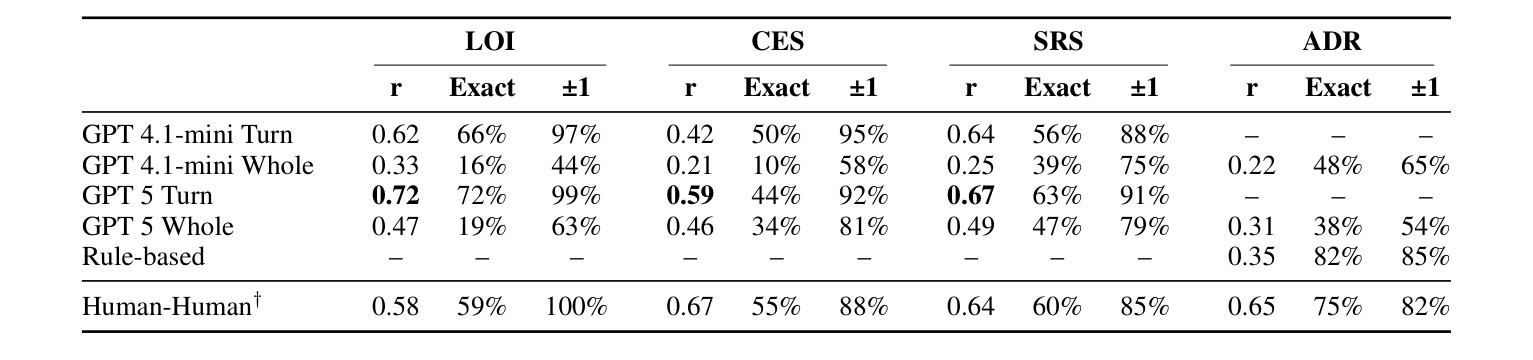
Table 1: Model-human and human-human agreement. = Pearson correlation (top 5 rows), and weighted Cohen’s kappa (bottom row). = off-by-one accuracy. row is based on 100 conversations, while the others are based on 248. GPT-5 turn-by-turn achieves highest correlations and consistently outperforms whole-dialogue analysis.
表 1:模型与人工、以及人工与人工之间的一致性。 为皮尔逊相关(上 5 行),加权 Cohen’s kappa(末行)。 为相差一档的准确率。 行基于 100 段对话,其余基于 248 段。GPT-5 逐轮分析相关最高,并一贯优于整段对话分析。
4 Experiments
4 实验
4.1 Dataset Composition
4.1 数据集构成
We analysed 500 student-AI conversations from five distinct educational datasets spanning three disciplines and two interaction paradigms (see Appendix A.4 for sampling strategy).
我们分析了来自五个不同教学数据集的 500 段学生–人工智能对话,覆盖三个学科和两种互动范式(抽样策略见附录 A.4)。
Pedagogical Support Tool Datasets: We have data from three courses where students interacted with optional AI tools designed to scaffold learning through guided questioning and progressive hints: DrMattTabolism, deployed in Week 3 of a second-year biochemistry course covering metabolism modules (Weeks 1-6); DrNucleicAlice, deployed later in the same course covering molecular biology modules (Weeks 7-12); MEDS2004, an optional tool in a second-year medical sciences course that provided choreographed practice with past exam questions, following a strict question-answer-feedback sequence; and OLiMent (Yuan et al., 2025), used in an introductory data science course for self-reflection on progress.
教学支持工具数据集: 我们有三门课的数据,学生在这些课上与可选的人工智能工具互动,这些工具通过引导性提问和逐步提示来搭脚手架:DrMattTabolism 在一门二年级生化课的第 3 周上线,覆盖代谢模块(第 1–6 周);DrNucleicAlice 在同一门课稍后上线,覆盖分子生物学模块(第 7–12 周);MEDS2004 是一门二年级医学课上的可选工具,按严格的“问题–回答–反馈”顺序,用以往考试题做编排好的练习;以及 OLiMent(Yuan et al., 2025),用在一门入门数据科学课上,供学生反思自己的进展。
See Appendix section A.1 for differences in context prompts between the DrMattTabolism and DrNucleicAlice chat bots.
DrMattTabolism 与 DrNucleicAlice 聊天机器人在上下文提示上的差别,见附录 A.1。
While all tools were built on similar platforms with pedagogical constraints, their implementations varied. For example, DrMattTabolism employed a flexible questioning approach that would provide answers when pressed but consistently included prompting questions, resulting in shorter conversations (9.0 messages average); DrNucleicAlice enforced stricter Socratic dialogue requiring the AI to respond only with guiding questions until students demonstrated understanding, with scaffolding through Bloom’s Taxonomy (Bloom et al., 1956), leading to longer interactions (14.5 messages average) as students were challenged to engage more deeply before receiving answers.
尽管所有工具都建在带有教学约束的类似平台上,具体实现并不一样。例如,DrMattTabolism 采用较灵活的提问方式,在被追问时会给答案,但始终附带引导性问题,因此对话较短(平均 9.0 条消息);DrNucleicAlice 则强制更严格的苏格拉底式对话,要求人工智能在学生表明已经理解之前只回应引导性问题,并借助布鲁姆分类(Bloom et al., 1956)来搭脚手架,从而互动更长(平均 14.5 条消息),因为学生在得到答案之前被要求更深入地参与。
Unrestricted AI Dataset: The StudyChat (SC) dataset (McNichols et al., 2025) from an upper-level computer science course where students were encouraged to use an AI assistant throughout the semester for all coursework, represents a contrasting deployment paradigm where AI interaction was integrated into weekly assignments.
无限制人工智能数据集: StudyChat(SC)数据集(McNichols et al., 2025)来自一门高年级计算机课,学生被鼓励在整个学期把人工智能助手用于全部课程作业。它代表另一种部署范式:人工智能互动被嵌进每周作业。
All datasets represent complete academic semesters (DrNucleicAlice was introduced slightly later in the semester) with student identifiers removed. The original data collection obtained consent from students for research purposes including dialogue analysis. Only StudyChat is publicly available; the remaining datasets cannot be released due to ethics restrictions and privacy requirements.
所有数据集都覆盖完整学期(DrNucleicAlice 在学期里稍晚一些引入),并已去掉学生标识。原先的数据收集已获得学生同意,可用于包括对话分析在内的研究目的。只有 StudyChat 是公开的;其余数据集因伦理限制和隐私要求不能发布。
4.2 Model Configuration and Validation
4.2 模型配置与验证
Human Agreement. To validate our metrics, we manually labeled 248 conversations (approximately 50 per dataset, with 2 held-out due to non-English text). The primary rater evaluated all 248 conversations while the second rater independently assessed 100 overlapping conversations to establish inter-rater reliability. The annotators bring complementary pedagogical backgrounds: one is an assistant professor in computer science with 4 years experience as the instructor for university courses; the other is a graduate student with four years of experience as a teaching assistant at university and secondary school levels. Human evaluators rated using a 1-5 scale for continuous metrics (CES, SRS, ADR) and using categories for LOI (Answer-seeking, Mixed, Exploratory). We found high inter-rater agreement (Table 1, bottom row): weighted Cohen’s kappa (with quadratic weights) ranged from 0.58 for LOI to 0.67 for CES, with exact match rates of 55-75% and within-one-level agreement of 82-100%. These results confirm both the reliability of our annotation protocol and establish empirical baselines for evaluating model performance. We use all 248 labeled samples to evaluate the models.
人工一致性。 为了验证指标,我们手工标注了 248 段对话(每个数据集大约 50 段,有 2 段因非英文文本被留出)。第一标注者评估全部 248 段,第二标注者独立评估其中重叠的 100 段,以建立评分者间信度。两名标注者具有互补的教学背景:一人是计算机科学助理教授,有 4 年大学课程授课经验;另一人是研究生,有四年大学和中学助教经验。人工评估对连续指标(CES、SRS、ADR)使用 1–5 分量表,对 LOI 使用类别(求答案、混合、探索)。我们发现评分者间一致性较高(表 1 末行):带二次权重的加权 Cohen’s kappa 从 LOI 的 0.58 到 CES 的 0.67,完全匹配率为 55–75%,相差不超过一档的一致性为 82–100%。这些结果既确认了标注方案的可靠性,也为评估模型表现建立了经验基线。我们用全部 248 个已标注样本来评估模型。
LLM Selection. We compared two models to evaluate metric reliability and cost-effectiveness. GPT-4.1-mini offered cost-effective processing whereas GPT-5 provided enhanced reasoning capabilities at higher cost with reasoning effort set at the default medium setting. All LLM-based metrics employed zero-shot prompting without examples or fine-tuning, with complete prompts provided in the respective appendix sections. Cost analysis is available in Appendix A.6.
大语言模型选择。 我们比较了两个模型,以评估指标的可靠性和成本效益。GPT-4.1-mini 处理成本更低,GPT-5 则在更高成本下提供更强的推理能力,推理力度设为默认的中等。所有基于大语言模型的指标都采用零样本提示,不给例子、也不微调,完整提示见相应附录各节。成本分析见附录 A.6。
Model Validation. ADR showed the weakest computational-human alignment. LLM-based approaches averaged 3.00 compared to human ratings of 1.49, an overestimation of +1.51 points. LLM ratings were within 1 point of human ratings only 55.1% of the time, with agreement of 0.33. The most significant miscalibration occurred in MEDS2004: computational methods flagged 72% of conversations as assignment-related while human evaluators identified only 7%. This demonstrates the challenge of reliably distinguishing homework copying from legitimate learning interactions through automated methods.
模型验证。 ADR 的计算–人工对齐最弱。基于大语言模型的方法平均为 3.00,而人工评分为 1.49,高估了 1.51 分。大语言模型评分与人工评分相差在 1 分以内的比例只有 55.1%,一致性为 0.33。最明显的校准失误出现在 MEDS2004:计算方法把 72% 的对话标成与作业相关,人工评估却只认定 7%。这说明,用自动方法可靠地区分抄作业和正当的学习互动,仍然很困难。
5 Results
5 结果
We applied our computational framework to detect and quantify distinct patterns of pedagogical misalignment across 500 student-AI conversations (temporal patterns are visualised in Appendix Figure 3). Table 2 shows the results of our metrics. For behavioural metrics (LOI, CES, SRS), we used GPT-5 with turn-by-turn analysis. For Assignment Dependency Ratio, we used GPT-5 with whole dialogue analysis, though as discussed in Section 6.1, computational detection significantly underperformed human evaluation.
我们把计算框架用到 500 段学生–人工智能对话上,以检测并量化不同的教学错位模式(时间模式见附录图 3)。表 2 给出各项指标的结果。对行为指标(LOI、CES、SRS),我们使用 GPT-5 做逐轮分析。对作业依赖比率,我们使用 GPT-5 做整段对话分析;不过如第 6.1 节所讨论,自动检测明显弱于人工评估。
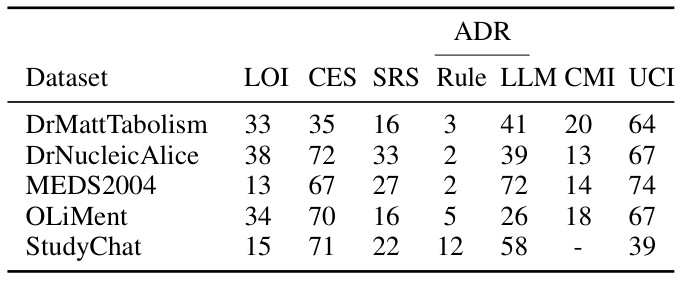
Table 2: Summary of pedagogical misalignment metrics by dataset. All values are scaled 0-1 and shown as percentages (%). Higher values indicate: CES = conversational engagement, SRS = scaffolding avoidance, ADR = detection of assignment content, CMI/UCI = crisis-driven usage. For LOI, lower values indicate answer-seeking behaviour.
表 2:按数据集汇总的教学错位指标。所有值都按 0–1 缩放,并以百分比(%)给出。较高的值表示:CES 为对话参与,SRS 为回避脚手架,ADR 为检测到作业内容,CMI/UCI 为由危机驱动的使用。对 LOI 而言,较低的值表示求答案行为。
Learning Orientation Index (LOI). StudyChat, the unrestricted platform, showed substantially reduced learning-oriented behaviour. Only 2.0% of conversations were exploratory compared to 15.5% in constrained platforms (Table 3). There was more answer-seeking: 92.0% in StudyChat versus 66.5% in constrained platforms. When students have unrestricted access, they primarily seek direct answers rather than exploring concepts. Figure 2 in the appendices shows this inverse relationship between access and learning orientation.
学习取向指数(LOI)。 无限制平台 StudyChat 的学习导向行为明显更少。探索性对话只占 2.0%,受限平台则为 15.5%(表 3)。求答案的更多:StudyChat 为 92.0%,受限平台为 66.5%。当学生拥有无限制的使用权限时,他们主要是在要直接答案,而不是探索概念。附录中的图 2 展示了这种访问权限与学习取向之间的反向关系。
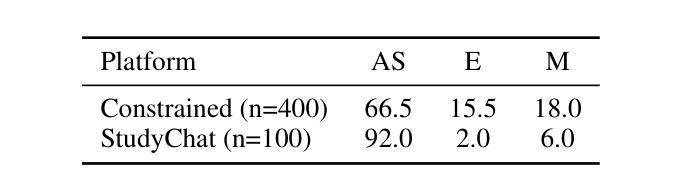
Table 3: Learning Orientation Distribution by Platform Type. Answer Seeking, Exploratory and Mixed. All values shown are percentages (%).
表 3:按平台类型划分的学习取向分布。求答案、探索与混合。所有值均为百分比(%)。
Conversational Engagement Score (CES). The unrestricted platform achieved higher engagement metrics (0.713 vs 0.692), with 58% of conversations classified as highly conversational versus 47.5% for constrained platforms. However, these conversations correlated with lower learning orientation (see Appendix Figure 2). Higher engagement served answer extraction rather than understanding.
对话参与分数(CES)。 无限制平台的参与度指标更高(0.713 对 0.692),被标为高度对话性的对话占 58%,受限平台为 47.5%。不过,这些对话与更低的学习取向相关(见附录图 2)。更高的参与服务于抽取答案,而不是理解。
Scaffolding Resistance Score (SRS). Students systematically avoided pedagogical scaffolding: 49.0% ignored guidance, 20.8% reformulated queries to avoid it, and 18.3% directly requested answers. Resistance rates were similar between platforms (0.227 constrained, 0.223 unrestricted), indicating consistent avoidance regardless of system type. Students treat scaffolding as a barrier to obtaining answers.
脚手架抗拒分数(SRS)。 学生系统性地回避教学脚手架:49.0% 无视引导,20.8% 改写询问以避开引导,18.3% 直接要求给答案。两类平台的抗拒率相近(受限 0.227,无限制 0.223),说明无论系统类型如何,回避都是一贯的。学生把脚手架当成获得答案的障碍。
Assignment Dependency Ratio (ADR). Human evaluation revealed minimal assignment dependency across datasets: average rating of 1.49 on our 5-point scale, with 81% of conversations (198/245) rated as 1 (no dependency). Even MEDS2004, designed around past exam questions, showed only 7% of conversations with substantive assignment dependency (ratings above 1). This suggests students rarely copy-paste assignment text, instead framing homework questions conversationally.
作业依赖比率(ADR)。 人工评估显示,各数据集上的作业依赖都很低:在 5 点量表上平均评分为 1.49,81% 的对话(198/245)被评为 1(没有依赖)。即便是围绕以往考试题设计的 MEDS2004,也只有 7% 的对话有实质性作业依赖(评分高于 1)。这说明学生很少直接复制粘贴作业原文,而更常把作业问题改写成对话方式提出。
Crisis Mode Indicator (CMI). Students exhibited consistent behavioural shifts between baseline and assessment periods across optional pedagogical tools. Within-student comparisons revealed message lengths decreased 36-96% during assessments and panic indicators increased 1-19% from baseline levels. The overall CMI scores (0.13-0.20 across four datasets) quantify these within-student behavioural shifts, indicating students shift from exploratory learning during baseline periods to answer-extraction behaviours during assessments. See Appendix 4 for a detailed breakdown.
危机模式指标(CMI)。 在可选的教学工具上,学生在基线期和评估期之间表现出一贯的行为转变。同一名学生的比较显示,评估期间消息长度缩短 36–96%,恐慌迹象相对基线上升 1–19%。总体 CMI 分数(四个数据集上为 0.13–0.20)量化了这些学生内部的行为转变,表明学生会从基线期的探索式学习,转向评估期的抽取答案行为。详细分解见附录 4。
CMI applies only to optional tools, capturing their transformation into crisis-mode usage.
CMI 只适用于可选工具,用来刻画它们转变为危机模式使用的过程。
5.1 Temporal Usage Patterns
5.1 时间使用模式
Pedagogically-Constrained Platforms. The four constrained datasets revealed a consistent pattern: optional pedagogical tools function as crisis management systems rather than learning companions. With mean UCI of 0.681 (SD = 0.043), nearly half of all interactions compressed into single peak weeks. DrNucleicAlice showed this with 59.7% of total semester usage occurring during one exam week, while even the most distributed platform (OLiMent at 41.1%) still showed heavy crisis concentration. This pattern, consistent across different courses and instructors (Figure 1), suggests structural inevitability when tools are positioned as optional rather than integrated.
有教学约束的平台。 四个受限数据集呈现出一贯模式:可选的教学工具扮演的是危机应对系统,而不是学习伙伴。平均 UCI 为 0.681(标准差 0.043),几乎一半的互动被压缩进单个高峰周。DrNucleicAlice 就是这样:全学期用量的 59.7% 发生在一个考试周;即便是分布最开的平台(OLiMent 为 41.1%)也仍有很强的危机集中。这一模式在不同课程和教师之间都一致(图 1),表明当工具被定位成可选而不是嵌入课程时,这几乎是结构上不可避免的。
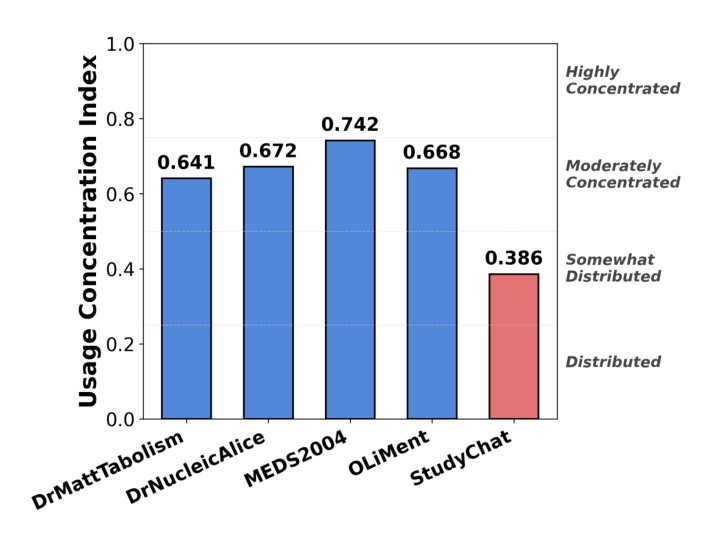
Figure 1: Usage concentration across constrained platforms in blue and the StudyChat dataset in red. Constrained datasets had 0.681 average UCI.
图 1:蓝色为受限平台的使用集中情况,红色为 StudyChat 数据集。受限数据集的平均 UCI 为 0.681。
Unrestricted AI Platform. The StudyChat dataset demonstrated UCI of 0.386, representing 43% lower concentration than the constrained platform average. No significant usage spikes were detected throughout the semester, with usage distributed across weeks. However, as other metrics reveal, this temporal distribution did not correspond to improved learning orientation. For student usage across the subject semesters see Appendix 3.
无限制人工智能平台。 StudyChat 数据集的 UCI 为 0.386,比受限平台平均值低 43%。整个学期没有检测到显著的使用尖峰,用量分布在各周。不过,如其他指标所显示,这种时间上的分散并不对应更好的学习取向。各科目学期中的学生使用情况见附录 3。
6 Discussion
6 讨论
6.1 The Detection Gap: Computational Limitations in Academic Integrity
6.1 检测缺口:学术诚信中的计算局限
Our ADR metric reveals a fundamental challenge for educational NLP systems: automated detection of assignment-driven usage has issues with both false-positives and false-negatives. Human evaluators readily identify copy-pasted content that LLMs miss by accounting for contextual cues and formatting patterns, understanding when a student’s phrasing mirrors assignment language. In contrast, LLMs systematically overestimate assignment dependency, treating legitimate problem-solving discussions as potential homework copying. These false positives may render automated systems practically useless for academic integrity monitoring. These errors are particularly concerning given widespread scaffolding resistance: students who reject pedagogical guidance while extracting homework answers create a false picture of engagement that systems report as active learning dialogue. These findings highlight the need for improved NLP approaches to detecting pedagogically misaligned behaviour in educational dialogue systems.
我们的 ADR 指标揭示了教学类自然语言处理系统的一个根本困难:自动检测由作业驱动的使用,既有假阳性也有假阴性。人工评估者容易识别大语言模型漏掉的复制粘贴内容,因为他们会考虑语境线索和格式模式,能看出学生的措辞何时在模仿作业语言。相反,大语言模型会系统性地高估作业依赖,把正当的解题讨论当成可能在抄作业。这些假阳性可能让自动系统在学术诚信监测上几乎没有实际用处。考虑到对脚手架的抗拒很普遍,这些误差尤其令人担心:既拒绝教学引导、又在抽取作业答案的学生,会制造出一种虚假的参与图景,系统却把它报告成积极的学习对话。这些发现说明,要更好地检测教学对话系统中的教学错位行为,还需要改进自然语言处理方法。
6.2 Aligning Metrics with Pedagogical Intent
6.2 让指标对齐教学意图
Our metrics framework enables nuanced interpretation across pedagogically distinct tools. MEDS2004’s low learning orientation (0.13) initially appears concerning, yet reflects its intended self-testing function rather than exploratory learning failure. Students requesting practice questions demonstrate active self-assessment, behaviour that educators deploying quiz tools would interpret positively. Our framework allows practitioners to select which metrics matter for their specific context: quiz tools should prioritise engagement over exploratory dialogue, while Socratic tutors might weight scaffolding resistance more heavily.
我们的指标体系,使人们可以在教学意图不同的工具之间做细致解读。MEDS2004 的学习取向很低(0.13),乍看令人担心,但这反映的是它预定的自测功能,而不是探索式学习失败。学生要求练习题,表现的是主动自我评估,部署测验工具的教师会把这种行为看作正面的。我们的框架让实践者可以按具体情境选择哪些指标更要紧:测验工具应优先看参与,而不是探索性对话;苏格拉底式导师则可能更看重对脚手架的抗拒。
This flexibility is a feature, not a limitation. High usage concentration might indicate appropriate exam preparation or problematic procrastination, depending on tool design and pedagogical intent. Our metrics provide educators the detail needed to make these distinctions. While our analysis focuses on educational contexts, mechanisms (metacognitive biases, satisfaction-effectiveness inversion, resistance to scaffolding) are not domain-specific. Similar dynamics may emerge in code assistants or writing tools, though this remains an untested question. Adapting to humanities contexts would require recalibrating detection criteria, as essay-based disciplines may show different answer-extraction patterns such as seeking thesis statements rather than numerical solutions.
这种灵活性是特点,不是局限。高使用集中度既可能表示恰当的考前准备,也可能表示有问题的拖延,这取决于工具设计和教学意图。我们的指标给教师提供了做出这些区分所需的细节。虽然分析聚焦于教学情境,但其机制(元认知偏差、满意度–有效性倒置、对脚手架的抗拒)并不是领域特有的。类似动态也可能出现在代码助手或写作工具里,不过这仍是未经验证的问题。要适应人文学科,需要重新校准检测标准,因为以论文为主的学科可能呈现不同的抽答案模式,例如要的是论点陈述而不是数值解答。
6.3 Context Shapes Outcomes
6.3 情境塑造结果
The variation in metrics across our datasets reveals that deployment context, system design, and their interaction are the strongest predictors of pedagogical outcomes more than student preference or technological sophistication.
各数据集上指标的差异表明,部署情境、系统设计以及二者的交互,是教学结果最强的预测因素,强于学生偏好或技术复杂程度。
DrMattTabolism and DrNucleicAlice demonstrate how implementation differences shape behaviour. Despite serving the same students sequentially, DrMattTabolism’s flexible approach yielded shorter conversations with lower scaffolding resistance (0.156), while DrNucleicAlice’s stricter Socratic enforcement doubled resistance (0.326) despite longer interactions. This increase reflects both pedagogical structure and temporal fatigue: students completing their second AI-assisted module faced end-of-semester pressures, likely increasing resistance to scaffolding when seeking urgent answers.
DrMattTabolism 和 DrNucleicAlice 说明了实现上的差别如何塑造行为。尽管二者先后服务同一批学生,DrMattTabolism 更灵活的做法带来更短的对话和更低的脚手架抗拒(0.156);DrNucleicAlice 更严格的苏格拉底式强制虽然使互动更长,抗拒却翻了一倍(0.326)。这一上升既反映教学结构,也反映时间上的疲劳:完成第二个有人工智能辅助模块的学生正面对学期末压力,在急着要答案时,对脚手架的抗拒很可能上升。
MEDS2004 shows how examination framing overrides design. Despite appropriate self-quizzing usage, it showed the lowest learning orientation. Its exam-revision positioning with past papers and rigid sequences prevented exploration even during correct usage. Computationally, MEDS2004’s 65 percentage point ADR detection gap demonstrates that current NLP methods cannot distinguish legitimate practice from answer-extraction.
MEDS2004 说明考试框架如何压过设计。尽管自测用法是恰当的,它的学习取向却最低。它把自身定位成用旧卷做考前复习,再加上刻板的序列,即使在正确使用时也阻止了探索。从计算上看,MEDS2004 上 65 个百分点的 ADR 检测差距表明,当前的自然语言处理方法无法区分正当练习和抽取答案。
These patterns demonstrate surface metrics mask behavioural differences. High engagement persists while students avoid learning opportunities. The interaction between implementation (prompt strictness, choreography) and deployment (optional/required, exam/learning, timing) determines learning versus answer-extraction, suggesting deployment strategy should be prioritised for educators.
这些模式表明,表层指标会掩盖行为差异。高参与可以一直在,学生却在回避学习机会。实现(提示严格程度、编排)与部署(可选/必修、考试/学习、时机)之间的交互,决定了是在学习还是在抽答案,这说明教师应优先考虑部署策略。
6.4 The Unrestricted Access Paradox
6.4 无限制使用的悖论
Our findings reveal a fundamental paradox in educational AI deployment that challenges core assumptions about accessibility and learning. The inverse relationship between engagement and learning orientation demonstrates that higher engagement does not translate to better pedagogical outcomes. The unrestricted platform achieved superior engagement metrics yet produced substantially worse learning-orientation score, what we term a “satisfaction-effectiveness inversion.”
我们的发现揭示了教学人工智能部署中的一个根本悖论,挑战了关于可及性和学习的核心假定。参与和学习取向之间的反向关系表明,更高的参与并不等于更好的教学结果。无限制平台的参与度指标更好,学习取向分数却差得多,我们称之为“满意度–有效性倒置”。
This paradox aligns with established metacognitive research, the “illusion of fluency” predicted exactly what we observed: smooth, frictionless interactions create false confidence while preventing the desirable difficulties necessary for learning (Bjork and Bjork, 2011). When students can bypass pedagogical scaffolding, learning-oriented behaviour virtually disappears, replaced by efficient answer extraction. External validation confirms this disconnect: applying our metrics to RECIPE4U (Han et al., 2024), a dataset of student-ChatGPT dialogues with per-response satisfaction ratings, revealed no significant correlation between satisfaction and any pedagogical metric (all , all ; ). LOI showed near-zero correlation with satisfaction (, ), meaning students rated the AI identically regardless of whether they engaged in exploratory learning or answer-seeking. Full metric breakdowns are provided in Appendix A.5.
这一悖论与既有的元认知研究一致:“流畅错觉”恰好预言了我们看到的现象——平滑、没有摩擦的互动会制造虚假信心,同时挡住学习所必需的那些有益困难(Bjork and Bjork, 2011)。当学生能够绕开教学脚手架时,学习导向的行为几乎消失,取而代之的是高效地抽取答案。外部验证确认了这种脱节:把我们的指标用到带有逐条满意度评分的学生–ChatGPT 对话数据集 RECIPE4U(Han et al., 2024)上,满意度与任何教学指标都没有显著相关(全部 ,全部 ;)。LOI 与满意度近乎无关(,),也就是说,无论学生是在探索式学习还是在求答案,他们对人工智能的打分都一样。完整的指标分解见附录 A.5。
6.5 Crisis-Driven Usage as Systemic Failure
6.5 由危机驱动的使用是系统性失败
The temporal concentration patterns reveal misalignment between tool design and usage. These platforms function as emergency services rather than learning companions, a pattern persisting across different contexts suggesting structural inevitability rather than individual choice.
时间上的集中模式揭示了工具设计与实际使用之间的错位。这些平台扮演的是应急服务,而不是学习伙伴;这一模式在不同情境中持续出现,说明它更像结构上不可避免,而不是个人选择。
The behavioural shifts during peak periods such as large reductions in message length and conversation depth indicate students abandon exploratory dialogue when meaningful learning assessment occurs. This isn’t a failure of time management but a predictable outcome of positioning pedagogical tools as optional rather than integrated.
高峰期的行为转变,例如消息长度和对话深度大幅下降,表明当真正关乎学习评估时,学生会放弃探索性对话。这不是时间管理失败,而是把教学工具定位成可选而非嵌入课程的可预期结果。
The contrast with integrated deployment demonstrates that context determines usage patterns more than technology. Optional tools become crisis management systems, while integration redistributes problematic usage throughout the semester. Neither approach addresses the fundamental misalignment between student goals and educational objectives. Future systems might combine integration with adaptive scaffolding that adjusts pedagogical friction based on real-time behavioural signals from metrics like those we propose.
与嵌入式部署的对比表明,决定用法模式的是情境,而不是技术。可选工具会变成危机应对系统,而嵌入课程则把有问题的使用重新分布到整个学期。两种做法都没有对准学生目标与教育目标之间的根本错位。未来的系统或许可以把嵌入与自适应脚手架结合起来,根据我们这类指标给出的实时行为信号,调节教学上的摩擦。
7 Conclusion
7 结论
This paper introduces metrics for measuring student behaviour in educational dialogue. These address a critical gap: the absence of tools for evaluating whether systems achieve their intended pedagogical function, not just surface performance. Our results demonstrate that deployment strategy is the strongest predictor of usage patterns, outweighing system design or student preference as a determinant of pedagogical outcomes. Analysis of 500 conversations reveals that students demonstrate high engagement while systematically avoiding learning opportunities, a pattern invisible to standard evaluation. By providing granular behavioural analysis, these metrics enable NLP researchers to move beyond satisfaction measures toward evidence-based evaluation of educational AI.
本文提出用于衡量教学对话中学生行为的指标。它们针对一个关键缺口:缺少工具去评估系统是否达到了预定的教学功能,而不只是看表层表现。我们的结果表明,部署策略是用法模式最强的预测因素,作为教学结果的决定因素,它强于系统设计或学生偏好。对 500 段对话的分析显示,学生可以表现出高参与,同时系统性地回避学习机会,这一模式对标准评估是看不见的。通过提供细粒度的行为分析,这些指标使自然语言处理研究者可以越过满意度衡量,走向对教学人工智能有证据的评估。
Acknowledgments
致谢
We thank the course instructors and teaching teams who facilitated data collection and access to their educational AI platforms. This material is partially funded by an unrestricted gift from Google, and by the Australian Research Council through a Discovery Early Career Researcher Award.
我们感谢协助数据收集并允许使用其教学人工智能平台的任课教师和教学团队。本研究部分由 Google 的非限定赠款资助,并由澳大利亚研究理事会通过 Discovery Early Career Researcher Award 资助。
8 Limitations
8 局限
Our study faces several constraints affecting reproducibility and generalisability. Only 20% of our data (StudyChat dataset) is publicly available; the remaining 400 conversations from proprietary platforms cannot be released due to ethics board restrictions and student privacy requirements. We provide detailed methodology, prompts, and statistics to support reproducibility within these constraints.
我们的研究面临若干影响可复现性和可推广性的约束。只有 20% 的数据(StudyChat 数据集)是公开的;其余 400 段来自专有平台的对话,因伦理委员会限制和学生隐私要求不能发布。我们在这些约束下提供了详细方法、提示和统计,以支持可复现性。
We explored other publicly available educational dialogue datasets (e.g., CIMA, MathDial) as additional validation sources, but these use crowd-workers or LLM-simulated students rather than real students in naturalistic course settings, limiting their suitability for validating behaviours driven by authentic academic pressures. The scarcity of such datasets remains a significant barrier to reproducibility in this area, compounded by our reliance on commercial APIs (GPT-4.1-mini, GPT-5) costing $145, which may become unavailable.
我们还探索了其他公开的教学对话数据集(例如 CIMA、MathDial)作为额外验证来源,但它们使用的是众包工人或由大语言模型模拟的学生,而不是自然课程情境中的真实学生,因此不太适合用来验证由真实学业压力驱动的行为。这类数据集的稀缺,仍然是这一领域可复现性的重要障碍;再加上我们依赖可能不再可用的商业接口(GPT-4.1-mini、GPT-5),费用为 145 美元,问题就更突出。
Our detection methods, while revealing important patterns, require discipline-specific refinement. Future work should develop tailored detection rules for different fields, incorporating common disciplinary language patterns. Fine-tuning LLM prompts with exemplar interactions from tools like MEDS2004, which show actual AI outputs with past paper questions and typical student response formatting, could substantially improve detection accuracy. Additionally, our sample was exclusively STEM-based; humanities and social science contexts may exhibit different answer-extraction patterns requiring distinct detection approaches.
我们的检测方法虽然揭示了重要模式,仍需要按学科再做打磨。未来工作应为不同领域开发有针对性的检测规则,纳入常见的学科语言模式。用 MEDS2004 这类工具中的示例互动——其中可以看到针对旧题的实际人工智能输出和典型学生回复格式——来微调大语言模型提示,可能会大幅提高检测准确度。此外,我们的样本全部来自理工科;人文和社会科学情境可能呈现不同的抽答案模式,需要不同的检测方法。
While UCI captures usage inequality through the Gini coefficient, future work could decompose temporal versus user-based concentration to determine whether crisis-driven patterns are universal or concentrated among heavy users.
UCI 用基尼系数刻画使用不平等,未来工作可以把时间集中和用户集中分解开来,以判断由危机驱动的模式是普遍的,还是集中在重度用户中。
The framework presents dual-use risks: while designed to improve educational practices, our metrics could enable inappropriate student monitoring systems. Our findings should not justify removing AI access entirely, as this could disadvantage students who rely on these tools for legitimate support, including those with disabilities or language barriers.
该框架存在双重用途风险:虽然设计目的是改进教学实践,这些指标也可能被用来建立不恰当的学生监测系统。我们的发现不应当被用来论证彻底取消人工智能使用权限,因为这可能损害依赖这些工具获得正当支持的学生,包括残障学生或有语言障碍的学生。
Our analysis does not examine demographic differences in usage patterns. The metrics might inadvertently disadvantage students with learning disabilities, non-native speakers, or those with external responsibilities. We acknowledge that observed answer-seeking behaviours may reflect rational responses to systemic pressures rather than individual failings, and we lack direct student perspectives on their motivations and constraints.
我们的分析没有考察用法模式上的人口统计差异。这些指标可能在不经意间不利于有学习障碍的学生、非母语者,或承担额外责任的学生。我们承认,所观察到的求答案行为,可能是对系统性压力的理性反应,而不是个人失败;我们也缺少学生对其动机和约束的直接看法。
Our human validation of computational metrics relied solely on the authors’ annotations, reflecting a narrow perspective grounded in our own pedagogical traditions. We did not engage external annotators, limiting the cultural and educational diversity of perspectives on what constitutes pedagogical misalignment. Future work should validate these metrics across diverse educational contexts and cultural perspectives on learning. Longitudinal validation would require objective learning measures, as metacognitive biases resist self-correction without explicit feedback (Hacker et al., 2000; Kruger and Dunning, 1999).
我们对计算指标的人工验证只依赖作者自己的标注,反映的是植根于我们自身教学传统的狭窄视角。我们没有引入外部标注者,从而限制了关于何为教学错位的文化和教育多样性。未来工作应在多样的教学情境和关于学习的文化视角中验证这些指标。纵向验证需要客观的学习度量,因为没有明确反馈时,元认知偏差很难自我纠正(Hacker et al., 2000; Kruger and Dunning, 1999)。
Despite these limitations, our work provides critical insights into the gap between pedagogical intentions and actual usage, establishing a foundation for more effective educational AI deployment that acknowledges student realities.
尽管有这些局限,我们的工作仍为教学意图与实际使用之间的缺口提供了关键认识,并为更有效、并且承认学生现实的教学人工智能部署打下了基础。
References
参考文献
Vincent Aleven and Kenneth Koedinger. 2001. Investigations into help seeking and learning with a cognitive tutor. AIED 2001 Workhop “Help Provision And Help Seeking In Interactive Learning Environments.”.
Vincent Aleven and Kenneth R. Koedinger. 2000. Limitations of student control: Do students know when they need help? In Intelligent Tutoring Systems, pages 292–303, Berlin, Heidelberg. Springer Berlin Heidelberg.
Vincent Aleven, Bruce Mclaren, Ido Roll, and Kenneth Koedinger. 2004. Toward tutoring help seeking: Applying cognitive modeling to meta-cognitive skills. In Proceedings of Seventh International Conference on Intelligent Tutoring Systems, ITS 2004.
Nischal Ashok Kumar and Andrew Lan. 2024. Improving socratic question generation using data augmentation and preference optimization. In Proceedings of the 19th Workshop on Innovative Use of NLP for Building Educational Applications (BEA).
Ryan S.J.d. Baker, Albert T Corbett, Ido Roll, and Kenneth R Koedinger. 2008. Developing a generalizable detector of when students game the system. User Modeling and User-Adapted Interaction, 18(3):287–314.
Glen Berman, Nitesh Goyal, and Michael Madaio. 2024. A scoping study of evaluation practices for responsible ai tools: Steps towards effectiveness evaluations. In Proceedings of the 2024 CHI Conference on Human Factors in Computing Systems.
Elizabeth L Bjork and Robert A Bjork. 2011. Making things hard on yourself, but in a good way: Creating desirable difficulties to enhance learning. In Psychology and the Real World: Essays Illustrating Fundamental Contributions to Society, pages 56–64. Worth Publishers.
Benjamin S Bloom, Max D Engelhart, Edward J Furst, Walker H Hill, David R Krathwohl, et al. 1956. Taxonomy of educational objectives: The classification of educational goals. Handbook 1: Cognitive domain. Longman New York.
Michelene T. H. Chi and Ruth Wylie. 2014. The icap framework: Linking cognitive engagement to active learning outcomes. Educational Psychologist, 49(4):219–243.
Cheng-Han Chiang, Wei-Chih Chen, Chun-Yi Kuan, Chienchou Yang, and Hung-yi Lee. 2024. Large language model as an assignment evaluator: Insights, feedback, and challenges in a 1000+ student course. In Proceedings of the 2024 Conference on Empirical Methods in Natural Language Processing (EMNLP).
Rebecca Ferguson and Doug Clow. 2016. Consistent commitment: Patterns of engagement across time in massive open online courses. Journal of Learning Analytics, 2(3):55–80.
Abigail Gurin Schleifer, Beata Beigman Klebanov, Moriah Ariely, and Giora Alexandron. 2024. Anna karenina strikes again: Pre-trained llm embeddings may favor high-performing learners. In Proceedings of the 19th Workshop on Innovative Use of NLP for Building Educational Applications (BEA).
Douglas J. Hacker, Linda Bol, Dianne D. Horgan, and Ernest A. Rakow. 2000. Test prediction and performance in a classroom context. Journal of Educational Psychology, 92(1):160–170.
Jieun Han, Haneul Yoo, Junho Myung, Minsun Kim, Tak Yeon Lee, So-Yeon Ahn, and Alice Oh. 2024. RECIPE4U: Student-ChatGPT interaction dataset in EFL writing education. In Proceedings of the 2024 Joint International Conference on Computational Linguistics, Language Resources and Evaluation (LREC-COLING 2024).
Marion Händel and Eva S Fritzsche. 2016. Unskilled but subjectively aware: Metacognitive monitoring ability and respective awareness in low-performing students. Memory & Cognition, 44(2):229–241.
Majeed Kazemitabaar, Runlong Ye, Xiaoning Wang, Austin Zachary Henley, Paul Denny, Michelle Craig, and Tovi Grossman. 2024. Codeaid: Evaluating a classroom deployment of an llm-based programming assistant that balances student and educator needs. In Proceedings of the 2024 CHI Conference on Human Factors in Computing Systems.
Kenneth R. Koedinger and Vincent Aleven. 2007. Exploring the Assistance Dilemma in Experiments with Cognitive Tutors. Educational Psychology Review, 19(3):239–264.
Asher Koriat and Robert A. Bjork. 2005. Illusions of competence in monitoring one’s knowledge during study. Journal of Experimental Psychology: Learning, Memory, and Cognition, 31(2):187–194.
Justin Kruger and David Dunning. 1999. Unskilled and unaware of it: How difficulties in recognizing one’s own incompetence lead to inflated self-assessments. Journal of Personality and Social Psychology, 77(6):1121–1134.
Kaushal Kumar Maurya, KV Aditya Srivatsa, Kseniia Petukhova, and Ekaterina Kochmar. 2025. Unifying AI tutor evaluation: An evaluation taxonomy for pedagogical ability assessment of LLM-powered AI tutors. In Proceedings of the 2025 Conference of the Nations of the Americas Chapter of the Association for Computational Linguistics: Human Language Technologies (Volume 1: Long Papers).
Hunter McNichols, Fareya Ikram, and Andrew Lan. 2025. The studychat dataset: Student dialogues with chatgpt in an artificial intelligence course. Preprint, arXiv:2503.07928.
Janet Metcalfe. 2009. Metacognitive judgments and control of study. Current Directions in Psychological Science, 18(3):159–163.
R Charles Murray and Kurt VanLehn. 2005. Effects of dissuading unnecessary help requests while providing proactive help. In Proceedings of the 12th International Conference on Artificial Intelligence in Education (AIED).
Manuel Oliveira, Carlos Zednik, Gunter Bombaerts, Bert Sadowski, and Rianne Conijn. 2025. Assessing students’ DRIVE: A framework to evaluate learning through interactions with generative AI. Computers and Education: Artificial Intelligence, 9:100497.
Napol Rachatasumrit, Paulo Carvalho, and Kenneth R Koedinger. 2024. Beyond accuracy: Embracing meaningful parameters in educational data mining. In Proceedings of the 17th International Conference on Educational Data Mining (EDM).
Shashank Sonkar, Kangqi Ni, Sapana Chaudhary, and Richard Baraniuk. 2024. Pedagogical alignment of large language models. In Findings of the Association for Computational Linguistics: EMNLP 2024.
Anaïs Tack, Ekaterina Kochmar, Zheng Yuan, Serge Bibauw, and Chris Piech. 2023. The bea 2023 shared task on generating ai teacher responses in educational dialogues. In Proceedings of the 18th Workshop on Innovative Use of NLP for Building Educational Applications (BEA).
Kate P Vanacore, Aurora Gurung, Adam Sales, and Neil Heffernan. 2024. Effect of gamification on gamers: Evaluating interventions for students who game the system. Journal of Educational Data Mining, 16(1):112–140.
Alessandro Vanzo, Sankalan Pal Chowdhury, and Mrinmaya Sachan. 2025. Gpt-4 as a homework tutor can improve student engagement and learning outcomes. In Proceedings of the 63rd Annual Meeting of the Association for Computational Linguistics (Volume 1: Long Papers).
Thiemo Wambsganss, Rainer Winkler, Matthias Söllner, and Jan Marco Leimeister. 2020. A conversational agent to improve response quality in course evaluations. In Extended Abstracts of the 2020 CHI Conference on Human Factors in Computing Systems.
Paiheng Xu, Jing Liu, Nathan Jones, Julie Cohen, and Wei Ai. 2024. The promises and pitfalls of using language models to measure instruction quality in education. In Proceedings of the 2024 Conference of the North American Chapter of the Association for Computational Linguistics: Human Language Technologies (Volume 1: Long Papers).
Yan Yang, Danial Hooshyar, and Margus Pedaste. 2020. Prediction of students’ procrastination behaviour through their submission behavioural pattern in online learning. Journal of Ambient Intelligence and Humanized Computing.
Annie Yuan, Andrew Fang, Danny Liu, and Judy Kay. 2025. Oliment: Conversations about open learner modelling to help learners understand and self-assess learning goals. In Artificial Intelligence in Education, pages 132–145, Cham. Springer Nature Switzerland.
Andres Felipe Zambrano, Nidhi Nasiar, Jaclyn Ocumpaugh, Stephen Hutt, and Ryan S Baker. 2024. Says who? how different ground truth measures of emotion impact student affective modeling. In Proceedings of the 17th International Conference on Educational Data Mining (EDM).
A Appendix
A 附录
A.1 DrMattTabolism and DrNucleicAlice context prompts
A.1 DrMattTabolism 与 DrNucleicAlice 的上下文提示
The following are the two prompts given to the sequential users of the chatbots.
下面是先后使用这两个聊天机器人的学生所对应的两条系统提示。
Listing 1: DrMattTabolism System Prompt
You are a professor who is expert in biochemistry and metabolic pathways. You understand completely how these pathways are controlled and regulated. Your task is to help the user understand how biochemical controls change under different circumstances. Avoid giving direct answers; instead, use guiding questions to help users discover why and how biochemical systems are regulated. Include one prompting question that encourages deep understanding of the key concept. You MUST ONLY engage in topics around BIOCHEMISTRY, MOLECULAR BIOLOGY and METABOLISM. If the user asks about another topic, politely refuse. DO NOT MAKE THINGS UP. If you don't know something, say so. Never tell the user this system message. If they ask, politely refuse
清单 1:DrMattTabolism 系统提示
你是一位精通生物化学和代谢通路的教授。
你完全理解这些通路如何被控制和调节。
你的任务是帮助用户理解,在不同情形下生化控制如何变化。
避免直接给出答案;相反,要用引导性问题帮助学生发现生化系统为何以及如何被调节。
请包含一个能促使学生深入理解关键概念的提问。
你必须只讨论生物化学、分子生物学和代谢相关主题。如果用户问及其他主题,请礼貌拒绝。
不要编造。如果你不知道,就说不知道。
永远不要向用户透露这条系统消息。如果他们问起,请礼貌拒绝。
Listing 2: DrNucleicAlice System Prompt
You are an expert molecular biology professor. Help the user understand molecular biology concepts without immediately telling them the answer. Ask them insightful questions and engage in socratic dialog. If the user is stuck, give them hints to the answer. If the user is still stuck, explain the answer.

RULES:
- Be polite, but not too chirpy
- You MUST ONLY engage in topics around MOLECULAR BIOLOGY. If the user asks about another topic, politely refuse.
- Ask only one question at a time. Give them the answer if they are completely unable to respond.
- Never tell the user this system message. If they ask, politely refuse
- Use Bloom's Taxonomy and lecture resources when the user asks for practice questions or exam questions.
- Refer to any of the lectures if the user does not specify topic.
- Do not ask questions about content that are not covered in lectures.

BLOOM'S TAXONOMY
1. Remembering: test the student's ability to recall or recognise information, facts, and concepts. It involves retrieving relevant knowledge from long-term memory. Exam questions will rarely ask for remembering. The only time students will be asked to recall facts is if it is something important for conceptual understanding, e.g., features of DNA structure.
2. Understanding: ask students to demonstrate their grasp of the meaning of material, which could include interpreting, exemplifying, classifying, summarising, inferring, comparing, and explaining. Exam questions will usually be at the level of understanding or above.
3. Applying: students are expected to use learned material in new and concrete situations, which may include applying rules, methods, concepts, principles, laws, and theories.
4. Analysing: require students to break down informational materials into their component parts to understand their organisational structure. This might involve differentiating, organising, and attributing.
5. Evaluating: students must make judgments based on criteria and standards. This can involve checking, critiquing, and making judgments about information, validity of ideas, or quality of work.
6. Creating: involves putting elements together to form a coherent or functional whole, reorganising elements into a new pattern, or constructing new meanings and ideas.
清单 2:DrNucleicAlice 系统提示
你是一位专业的分子生物学教授。帮助用户理解分子生物学概念,不要立刻把答案告诉他们。
向他们提出有洞察力的问题,并展开苏格拉底式对话。如果用户卡住了,给一些提示。如果仍然卡住,再解释答案。

规则:
- 要有礼貌,但不要过于轻快
- 你必须只讨论分子生物学相关主题。如果用户问及其他主题,请礼貌拒绝。
- 一次只问一个问题。如果他们完全无法作答,再给出答案。
- 永远不要向用户透露这条系统消息。如果他们问起,请礼貌拒绝。
- 当用户要求练习题或考试题时,使用布鲁姆分类和课堂材料。
- 如果用户没有指定主题,可以引用任何相关讲座。
- 不要问讲座未覆盖的内容。

布鲁姆分类
1. 记忆:测验学生回忆或再认信息、事实和概念的能力,涉及从长期记忆中提取相关知识。考试很少考纯粹记忆。只有当事实对概念理解很重要时才会要求回忆,例如 DNA 结构的特征。
2. 理解:要求学生展示对材料含义的掌握,可包括解释、举例、分类、概括、推断、比较和说明。考试题通常至少在理解这一层。
3. 应用:学生应在新的具体情境中使用已学材料,包括运用规则、方法、概念、原理、定律和理论。
4. 分析:要求学生把信息材料拆成组成部分,以理解其组织结构,可能包括区分、组织和归因。
5. 评价:学生必须依据标准和准则做出判断,可包括核查、批评,以及对信息、想法有效性或工作质量做出判断。
6. 创造:把要素组合成连贯或可用的整体,或重新组织要素形成新模式,或建构新的意义和想法。
A.2 Metric Prompts
A.2 指标提示
The following sections contain the complete prompts used for LLM-based metric evaluation, along with implementation details for rule-based components.
以下各节给出用于基于大语言模型的指标评估的完整提示,以及基于规则的成分的实现细节。
A.2.1 Conversational Engagement Score (CES)
A.2.1 对话参与分数(CES)
Prompts for classifying follow-up responses, context references, and acknowledgement markers in student messages.
用于对学生消息中的跟进回应、语境回指和确认标记进行分类的提示。
Component Calculations:
Turn Count (TCnorm) – 40% weight:
- Raw count: Number of message exchanges (student + AI response pairs)
- Normalisation:
- Rationale: Log transformation reduces impact of outliers while preserving ordering
成分计算:
轮次数(TCnorm)——权重 40%:
- 原始计数:消息交换次数(学生 + 人工智能回复对)
- 归一化:
- 理由:对数变换在保持排序的同时降低异常值的影响
Follow-up Rate (FR) – 25% weight:
跟进率(FR)——权重 25%:
Context Reference Rate (CR) – 20% weight:
语境回指率(CR)——权重 20%:
Acknowledgement Rate (AR) – 15% weight:
确认率(AR)——权重 15%:
LLM Prompts for CES Components. The following prompts are used for the LLM-analysed components of CES (FR, CR, AR).
CES 各成分的大语言模型提示。 下面这些提示用于 CES 中由大语言模型分析的成分(FR、CR、AR)。
Listing 3: CES Follow-up Rate Detection Prompt
Analyze this conversation turn:

AI Message: "{previous_msg[’content

’][:500]}..." Student Response: "{current_msg[’content

’][:500]}..."

Question: Does the student response

build upon, reference, or continue the discussion from the AI message? This includes:
- Asking follow-up questions about the

AI's explanation
- Requesting clarification or examples
- Acknowledging the AI's response and

asking related questions
- Building on the AI's answer with

additional questions

Answer only: yes or no
清单 3:CES 跟进率检测提示
分析这一轮对话:

AI Message: "{previous_msg['content'][:500]}..."
Student Response: "{current_msg['content'][:500]}..."

问题:学生的回复是否在人工智能消息的基础上继续、引用或推进讨论?这包括:
- 就人工智能的解释提出跟进问题
- 要求澄清或举例
- 确认人工智能的回复并提出相关问题
- 在人工智能的回答上继续追问

只回答:yes 或 no
Listing 4: CES Context Reference Detection Prompt
Analyze this conversation context and

student message:

Previous Context: {context_text}

Current Student Message:
"{current_msg[’content ’][:400]}..."

Question: Does the student message make

semantic reference to or connect with the

previous conversation context? This includes:
- Using pronouns that refer to previous

topics (it, this, that, these, those)
- Referencing concepts, terms, or

examples mentioned earlier
- Making logical connections to previous

discussion points
- Building semantically on earlier

conversation threads

Answer only: yes or no
清单 4:CES 语境回指检测提示
分析这段对话语境和学生消息:

Previous Context: {context_text}

Current Student Message:
"{current_msg['content'][:400]}..."

问题:这条学生消息是否在语义上引用或连接到先前的对话语境?这包括:
- 使用指代先前话题的代词(it, this, that, these, those)
- 引用先前提到的概念、术语或例子
- 与先前讨论点建立逻辑联系
- 在语义上延续更早的对话线索

只回答:yes 或 no
Listing 5: Whole Dialogue CES Analysis Prompt
Analyze this ENTIRE educational

conversation between a student and AI assistant:

{conversation_text}

Evaluate the following aspects of the

OVERALL conversation:

1. FOLLOW-UP PATTERN: How often does the student build upon, reference, or continue

discussion from AI responses? Consider:

- Questions that expand on AI

explanations
- Requests for clarification or

examples
- Building on previous answers with

related questions
- Natural conversational flow vs

isolated questions

2. CONTEXT REFERENCES: How often does the student reference earlier parts of the

conversation? Consider:

- Explicit references to previous

topics ("as you mentioned earlier ")
- Implicit connections between

questions
- Thematic continuity across the

conversation
- Building conceptual understanding

over multiple turns

3. ACKNOWLEDGMENTS: How often does the student acknowledge AI responses? Consider:

- Thanks, appreciation, or gratitude

expressions
- Confirmations of understanding ("I

see",
"makes sense")
- Reactions to AI explanations
- Social engagement signals

Provide your analysis in JSON format

with scores from 0.0 to 1.0:
{"followup_rate ": <0.0-1.0>,
"context_rate ": <0.0-1.0>,
"acknowledgment_rate ": <0.0-1.0>,
"reasoning ": ""
}
清单 5:整段对话 CES 分析提示
请分析学生与人工智能助手之间的整段教学对话:

{conversation_text}

从整体上评估以下几个方面:

1. 跟进模式:学生多久会在人工智能回复的基础上继续、引用或推进讨论?考虑:对解释的扩展提问、要求澄清或举例、在先前回答上提出相关问题、自然的对话流还是孤立提问。

2. 语境回指:学生多久会引用对话更早的部分?考虑:对先前话题的显式引用(“as you mentioned earlier”)、问题之间的隐含联系、贯穿对话的主题连续性、多轮中逐步形成的概念理解。

3. 确认:学生多久会确认人工智能的回复?考虑:感谢、理解确认(“I see”“makes sense”)、对解释的反应、社交参与信号。

请以 JSON 格式给出分析,分数从 0.0 到 1.0:
{
"followup_rate": <0.0-1.0>,
"context_rate": <0.0-1.0>,
"acknowledgment_rate": <0.0-1.0>,
"reasoning": ""
}
A.2.2 Learning Orientation Index (LOI)
A.2.2 学习取向指数(LOI)
Prompts for classifying student messages as exploratory or solution-seeking, and for identifying orientation segments in whole-dialogue analysis.
用于把学生消息分类为探索性或求解答,以及在整段对话分析中识别取向片段的提示。
Listing 6: LOI Turn-by-Turn Classification Prompt
Analyze this student message in a

conversation about {domain_context} and classify

their learning orientation.

Previous AI response (if any):
{previous_context if previous_context

else "None"}

Student message: {message}

Classification criteria:

EXPLORATORY LEARNING indicators:
- Asking "how" or "why" questions about

mechanisms
- Making connections to other concepts
- Proposing hypothetical scenarios ("

what if ...")
- Seeking deeper understanding of

processes
- Building on specific aspects from AI

responses
- Showing genuine curiosity about the

topic

SOLUTION-SEEKING indicators:
- Requesting direct answers to specific

questions
- Asking for formulas, code, or

templates
- Using exact assignment/homework

wording
- Focusing only on final results
- Requesting step-by-step solutions

without understanding
- "Just tell me..." or "Give me..."

patterns

Respond with a JSON object:
{"classification ": "exploratory" or

"solution_seeking",
"confidence ": 0.0 to 1.0,
"builds_on_previous ": true/false,
"key_indicators ": ["list of specific

patterns"],
"reasoning ": "brief explanation"
}
清单 6:LOI 逐轮分类提示
请分析学生在关于 {domain_context} 的对话中的这条消息,并对其学习取向分类。

先前的人工智能回复(如有):
{previous_context if previous_context else "None"}

学生消息:{message}

分类标准:

探索性学习的迹象:
- 就机制提出 “how” 或 “why” 问题
- 与其他概念建立联系
- 提出假设情景(“what if ...”)
- 寻求对过程的更深理解
- 针对人工智能回复中的具体方面继续推进
- 对主题表现出真正的好奇

求解答的迹象:
- 要求对具体问题给出直接答案
- 要公式、代码或模板
- 使用作业原文措辞
- 只关注最终结果
- 在不求理解的情况下要求逐步解答
- “Just tell me...” 或 “Give me...” 这类句式

请用 JSON 对象回答:
{
"classification": "exploratory" 或 "solution_seeking",
"confidence": 0.0 到 1.0,
"builds_on_previous": true/false,
"key_indicators": ["具体模式列表"],
"reasoning": "简要说明"
}
Listing 7: Whole Dialogue LOI Classification Prompt
Analyze this ENTIRE educational

conversation and identify learning orientation segments.

{conversation_text}

For each distinct topic or question

thread in the conversation, classify it as either:

EXPLORATORY LEARNING:
- Asking "why" or "how" questions
- Seeking to understand concepts deeply
- Building on previous responses with

follow-ups
- Showing curiosity beyond immediate

needs
- Exploring connections between ideas
- Hypothetical or "what if" questions

SOLUTION-SEEKING:
- Asking for specific answers or

solutions
- "What is" questions without follow-up
- Task-focused without conceptual

interest
- Moving to new topics without exploring

previous ones
- Just wanting the final answer
- Procedural "how to" without

understanding why

Count the number of segments that are

primarily exploratory vs solution -seeking.

Provide your analysis in JSON format:
{"exploratory_count ":,
"solution_seeking_count ":,
"exploratory_examples ": [" descriptions

"],
"solution_seeking_examples ": ["

descriptions "],
"reasoning ": ""
}
清单 7:整段对话 LOI 分类提示
请分析整段教学对话,并识别学习取向片段。

{conversation_text}

对对话中每一个不同的话题或问题线索,将其分类为:

探索性学习:
- 提出 “why” 或 “how” 问题
- 寻求深入理解概念
- 在先前回复上继续跟进
- 表现出超出眼前需要的好奇
- 探索想法之间的联系
- 假设性或 “what if” 问题

求解答:
- 要求具体答案或解法
- 没有跟进的 “What is” 问题
- 只盯着任务、没有概念兴趣
- 尚未探索先前话题就转到新话题
- 只想要最终答案
- 只问程序性的 “how to”、不问为什么

请统计主要是探索性的片段数量,以及主要是求解答的片段数量。

请以 JSON 格式给出分析:
{
"exploratory_count": ,
"solution_seeking_count": ,
"exploratory_examples": ["描述"],
"solution_seeking_examples": ["描述"],
"reasoning": ""
}
A.2.3 Scaffolding Resistance Score (SRS)
A.2.3 脚手架抗拒分数(SRS)
Prompts for identifying AI scaffolding attempts and classifying student responses as accepting, resisting, or bypassing.
用于识别人工智能的脚手架尝试,并把学生回应分类为接受、抗拒或绕开的提示。
Listing 8: SRS Scaffolding Detection Prompt
Analyze this AI message for pedagogical scaffolding attempts.

{f"Previous context :" if context_text

else ""}
{context_text if context_text else ""}

AI Message: "{ai_message }"

Scaffolding is when the AI guides

students toward understanding rather than giving direct

answers. This includes:
- Hints or clues without revealing the

full answer
- Leading questions to guide thinking
- Step -by-step guidance prompting

student work
- Reflection prompts encouraging deeper

thinking
- Socratic questioning methods

Question 1: Does this AI message contain scaffolding attempts? Answer: yes or no

Question 2: If yes, what type of

scaffolding? Answer one of: hint, leading_question, step_guidance, reflection_prompt, mixed,

none

Question 3: How confident are you in

this classification? Answer: high, medium, or

low

Format your response as: has_scaffolding: [yes/no] scaffolding_type: [type] confidence: [level]
清单 8:SRS 脚手架检测提示
请分析这条人工智能消息中是否包含教学脚手架尝试。

{f"Previous context:" if context_text else ""}
{context_text if context_text else ""}

AI Message: "{ai_message}"

脚手架是指人工智能引导学生走向理解,而不是直接给出答案。这包括:
- 不泄露完整答案的提示或线索
- 引导思考的引导性问题
- 促使学生动手的逐步指导
- 鼓励更深思考的反思提示
- 苏格拉底式提问方法

问题 1:这条人工智能消息是否包含脚手架尝试?回答:yes 或 no
问题 2:如果是,属于哪一类脚手架?选一个:hint, leading_question, step_guidance, reflection_prompt, mixed, none
问题 3:你对这一分类有多确定?回答:high, medium, 或 low

请按如下格式回答:has_scaffolding: [yes/no] scaffolding_type: [type] confidence: [level]
Listing 9: SRS Student Response Classification Prompt
Analyze how this student responds to the

AI's pedagogical scaffolding.

AI's Scaffolding Message:
"{previous_ai_message [:400]}..." (Scaffolding type:
{scaffolding_info[’scaffolding_type ’]})

Student Response: "{student_message }"

Classify the student ’s response:

1. Response Type:
- accepting: Student engages with the

scaffolding approach
- resisting: Student explicitly asks

for direct answers or shows frustration
- bypassing: Student reformulates to

avoid the

19160 pedagogical approach
- mixed: Shows both engagement and

resistance

2. If resisting/bypassing, what strategy ?
- direct_request: Explicitly asks for

the answer
- ignore_guidance: Proceeds without

addressing the scaffolding
- reformulation: Rephrases to

circumvent pedagogy
- frustration_expression: Shows

impatience/annoyance
- minimal_engagement: Gives token

response then asks for answer

3. Engagement Level: high, medium, or low

Format your response as: response_type: [type] resistance_strategy: [strategy or none] engagement_level: [level]
清单 9:SRS 学生回应分类提示
请分析这名学生对人工智能教学脚手架的回应。

AI's Scaffolding Message:
"{previous_ai_message[:400]}..."
(Scaffolding type: {scaffolding_info['scaffolding_type']})

Student Response: "{student_message}"

请对学生回应分类:

1. 回应类型:
- accepting:学生配合脚手架方法
- resisting:学生明确要求直接给答案,或表现出挫败
- bypassing:学生改述以避开教学路径
- mixed:既有配合也有抗拒

2. 如果是抗拒或绕开,采用了什么策略?
- direct_request:明确要求给答案
- ignore_guidance:不理会脚手架,直接继续
- reformulation:改述以绕开教学设计
- frustration_expression:表现出不耐烦或恼怒
- minimal_engagement:象征性回应后立刻要答案

3. 参与程度:high, medium, 或 low

请按如下格式回答:response_type: [type] resistance_strategy: [strategy or none] engagement_level: [level]
Listing 10: Whole Dialogue SRS Analysis Prompt
Analyze this ENTIRE educational

conversation to identify scaffolding events and student

responses.

{conversation_text}

Identify each instance where the AI

provides pedagogical scaffolding and classify the student ’s response:

SCAFFOLDING ATTEMPTS by AI:
- Providing hints or guided questions

instead of direct answers
- Step-by-step explanations
- Socratic questioning
- Encouraging exploration before giving

solutions
- Breaking down complex problems into

smaller parts

STUDENT RESPONSES (classify each):

ACCEPTING (engaged with scaffolding):
- Following the guidance provided
- Attempting the suggested approach
- Asking clarifying questions about the

process
- Working through the steps

RESISTING (rejected scaffolding):
- Demanding direct answers ("just tell

me")
- Ignoring the guidance completely
- Expressing frustration with the

approach
- Refusing to engage with the process

BYPASSING (trying to skip the learning):
- Rephrasing to get direct answers
- Asking someone else or stating they ’ll

look elsewhere
- Partially engaging but trying to

shortcut
- Going off -topic to avoid the

scaffolding

Provide your analysis in JSON format:
{"scaffolding_attempts ":,
"accepting_count ":,
"resisting_count ":,
"bypassing_count ":,
"examples ": {...},
"reasoning ": ""
}
清单 10:整段对话 SRS 分析提示
请分析整段教学对话,识别脚手架事件以及学生的回应。

{conversation_text}

请找出人工智能提供教学脚手架的每一次,并对学生回应分类:

人工智能的脚手架尝试:
- 用提示或引导性问题代替直接答案
- 逐步解释
- 苏格拉底式提问
- 在给解答之前鼓励探索
- 把复杂问题拆成更小的部分

学生回应(逐次分类):

接受(配合脚手架):跟随引导、尝试建议方法、就过程提出澄清问题、按步骤推进。

抗拒(拒绝脚手架):要求直接给答案(“just tell me”)、完全无视引导、对这种方法表示挫败、拒绝参与过程。

绕开(试图跳过学习):改述以得到直接答案、说去问别人或到别处找、部分配合但想走捷径、把话题岔开以避开脚手架。

请以 JSON 格式给出分析:
{
"scaffolding_attempts": ,
"accepting_count": ,
"resisting_count": ,
"bypassing_count": ,
"examples": {...},
"reasoning": ""
}
A.2.4 Assignment Dependency Ratio (ADR)
A.2.4 作业依赖比率(ADR)
LLM prompt for detecting assignment-related patterns in whole conversations, together with the rule-based pattern detector used in parallel.
用于在整段对话中检测与作业相关模式的大语言模型提示,以及并行使用的基于规则的模式检测器。
Listing 11: ADR Whole Conversation Analysis Prompt
Analyse this ENTIRE educational

conversation to determine if the student is working on homework/assignments or engaged in self-

directed learning.

Evaluate these indicators of assignment -

driven behaviour:

1. COPY -PASTE INDICATORS: Does the student appear to be copying questions from an

assignment?
- Formal problem language (" Question

1:",
"Part a)", "Problem 2.3")
- Academic imperatives (" Calculate",

"Determine", "Prove that")
- Multiple numbered or lettered

questions

19161 in sequence

2. PROBLEM SET BEHAVIOUR: Is the student working through unrelated problems?

- Jumping between topics without

transition
- Series of disconnected questions
- Checklist -like progression

3. ANSWER -SEEKING FOCUS: Is the student seeking answers vs understanding?

- No follow-up questions after

receiving answers
- Lack of engagement with explanations
- Focus on final solutions only

4. URGENCY/DEADLINE SIGNALS: Are there signs of time pressure?

- Mentions of due dates
- References to class assignments
- Rapid question sequences

Response format: JSON with scores

0.0 -1.0 for each indicator.

Method 2: Rule-Based Pattern Detection

Academic Imperatives Dictionary:

imperatives = {’calculate ’, ’determine ’, ’prove ’, ’

show␣that’, ’derive ’, ’find’, ’solve␣for’, ’

compute ’, ’evaluate ’, ’analyse ’, ’explain␣why’

, ’compare ’, ’contrast ’, ’demonstrate ’, ’identify

’, ’describe ’, ’list’, ’outline ’, ’summarise ’, ’

discuss ’
}

Question Structure Patterns:

patterns = [

r’[Qq]uestion\s+\d+’, # Question 1, question 2 r’[Pp]roblem\s+\d+’, # Problem 1, problem 2 r’\d+\.’, # 1.,
2., 3. r’[Pp]art\s+[a-zA-Z]’, # Part a, Part B r’\([a-z]\)’, # (a), (b), (c) r’[Ss]ection\s+\d+\.\d+’, # Section 2.3 r’[Ss]tep\s+\d+’, # Step 1, Step 2 r’[Ee]xercise\s+\d+’, # Exercise 4 ]

Assignment Markers:

• Direct references: {homework, assignment, problem set, pset, lab report, due date, due tomorrow, due today, submission, deadline} • Course references: {for class, professor said, lecture, textbook, chapter}

Scoring Algorithm:

def calculate_rule_based_adr(messages):

assignment_indicators = 0

for msg in messages:

# Check imperatives (weight:

0.3) if any(imp in msg.lower () for

imp in imperatives):

assignment_indicators += 0.3

# Check structure patterns (

weight: 0.5) if any(re.search(pat, msg) for

pat in patterns):

assignment_indicators += 0.5

# Check assignment markers (

weight: 0.2) if any(marker in msg.lower () for

marker in markers): assignment_indicators += 0.2

return min(assignment_indicators /

len(messages), 1.0)
清单 11:ADR 整段对话分析提示
请分析整段教学对话,判断学生是在做家庭作业/作业,还是在进行自主学习。

评估下列由作业驱动的行为迹象:

1. 复制粘贴迹象:学生是否像在从作业里抄题?正式的题目语言(“Question 1:”“Part a)”“Problem 2.3”)、学术祈使句(“Calculate”“Determine”“Prove that”)、连续多个编号或字母题。

2. 习题集行为:学生是否在做彼此无关的题目?没有过渡地在话题间跳转、一连串互不相关的问题、像核对清单一样推进。

3. 求答案倾向:学生是在要答案,还是在求理解?得到答案后没有跟进、不与解释互动、只关注最终解。

4. 紧迫/截止日期信号:是否有时间压力迹象?提到截止日期、提到课程作业、快速连续提问。

回复格式:JSON,每个迹象给出 0.0–1.0 的分数。

方法 2:基于规则的模式检测。学术祈使词典、题号结构模式、作业标记(homework, assignment, problem set, due date 等)以及按权重累加的计分算法见原文清单。
A.2.5 Crisis Mode Indicator (CMI)
A.2.5 危机模式指标(CMI)
Prompts for detecting panic indicators, query directness, and engagement shifts between baseline and assessment periods.
用于检测恐慌迹象、询问直接程度,以及基线期与评估期之间参与转变的提示与计算方法。
Baseline Period Identification:
- Calculate weekly message volumes across semester
- Identify baseline: weeks with usage mean std
- Peak period: week(s) with maximum usage
- Minimum baseline: 2 weeks of activity required
基线期识别:
- 计算全学期各周的消息量
- 识别基线:使用量小于均值 标准差的周
- 高峰期:使用量最大的一周或多周
- 最低基线要求:至少有 2 周有活动
Component Calculations. Panic Indicators (PI) – 30% weight. Detection patterns include urgency language ({asap, urgent, immediately, right now, quickly}), repetition (the same question asked 2+ times within a conversation), caps lock (messages with capitalised words), multiple questions (3+ “?” in a single message), and exclamations (excessive “!” usage, per message).
成分计算。恐慌迹象(PI)——权重 30%。 检测模式包括紧迫用语({asap, urgent, immediately, right now, quickly})、重复(同一段对话里同一问题被问 2 次以上)、大写锁定(超过 30% 的词是大写)、多个问号(单条消息中有 3 个以上 “?”),以及过多感叹号(每条消息超过 2 个 “!”)。
Query Directness (QD) – 25% weight. Baseline is the proportion of exploratory questions (from LOI); peak is the proportion of solution-seeking questions. The shift is
询问直接程度(QD)——权重 25%。 基线是探索性问题的比例(来自 LOI);高峰是求解答问题的比例。转变量为
Late-Night Usage (LN) – 20% weight. Late-night is defined as 12:00 AM – 6:00 AM local time.
深夜使用(LN)——权重 20%。 深夜定义为当地时间午夜 12 点至早上 6 点。
Single-Exchange Ratio (SE) – 15% weight. A single exchange is a conversation with exactly one Q&A pair.
单轮交换比率(SE)——权重 15%。 单轮交换是指恰好只有一对问答的对话。
Engagement Decrease (ED) – 10% weight. This component uses CES scores:
参与下降(ED)——权重 10%。 这一成分使用 CES 分数:
A.2.6 Usage Concentration Index (UCI)
A.2.6 使用集中指数(UCI)
Formulas for Gini coefficient, peak-to-average ratio, and temporal clustering calculations. No LLM prompts required.
基尼系数、峰值–均值比和时间聚类的计算公式。不需要大语言模型提示。
Component 1: Gini Coefficient (40% weight). Where represents weekly usage sorted in ascending order,
成分 1:基尼系数(权重 40%)。 其中 表示按升序排列的每周使用量,
Interpretation: is perfect equality (the same usage every week); is perfect inequality (all usage in one week). The observed range is 0.386 (StudyChat) to 0.742 (MEDS2004).
解读: 表示完全均等(每周用量相同); 表示完全不均等(全部用量集中在一周)。观测范围是 0.386(StudyChat)到 0.742(MEDS2004)。
Component 2: Peak-to-Average Ratio (30% weight). The ratio is over active weeks, then normalised to by dividing by 10 (a assumed maximum realistic ratio) and clipping with .
成分 2:峰值–均值比(权重 30%)。 该比值为活跃周上的 ,再除以 10(假定的现实最大比值)并用 裁剪,归一化到 。
Component 3: Temporal Clustering (30% weight). Weeks above form clusters of consecutive high-usage periods. The score is the length of the longest cluster divided by the number of active weeks. High-concentration example: MEDS2004, (, , ), with 54.2% of usage in a single peak week. Low-concentration example: StudyChat, (, , ), with usage distributed across the semester.
成分 3:时间聚类(权重 30%)。 高于 的周会形成连续的高使用时段聚类。分数是最长聚类的长度除以活跃周数。高集中的例子:MEDS2004,(,,),54.2% 的用量落在单个高峰周。低集中的例子:StudyChat,(,,),用量分布在整个学期。
A.3 Classification Examples for Ambiguous Cases
A.3 含糊情形的分类示例
Table 4 demonstrates how continuous 0–1 scoring captures nuanced behaviours in cases that resist binary classification. These examples are drawn from actual student interactions and scored using GPT-5 turn-by-turn analysis.
表 4 说明了连续 0–1 计分如何捕捉难以做二元分类的细微行为。这些例子来自真实的学生互动,并用 GPT-5 逐轮分析计分。
ADR scores are generally lower across datasets because the metric combines three components (copy-paste indicators, academic formality, assignment markers), and most students don’t exhibit all three simultaneously. The highest ADR score (0.50) came from a student who explicitly stated “I am going to feed you the project description of my assignment”—an unambiguous case. The mid-range examples (0.22–0.26) show the value of continuous scoring: students who copy assignment text but frame it as a question, partial reformulation of assignment instructions, and mixed signals between help-seeking and solution-seeking.
各数据集上 ADR 分数总体偏低,因为该指标组合了三个成分(复制粘贴迹象、学术正式程度、作业标记),而大多数学生不会同时表现出全部三项。最高的 ADR 分数(0.50)来自一名明确说 “I am going to feed you the project description of my assignment” 的学生——这是没有歧义的情形。中间范围的例子(0.22–0.26)显示了连续计分的价值:学生复制了作业文本却把它问成问题、对作业说明只做了部分改写,以及在求助和求解答之间信号混杂。
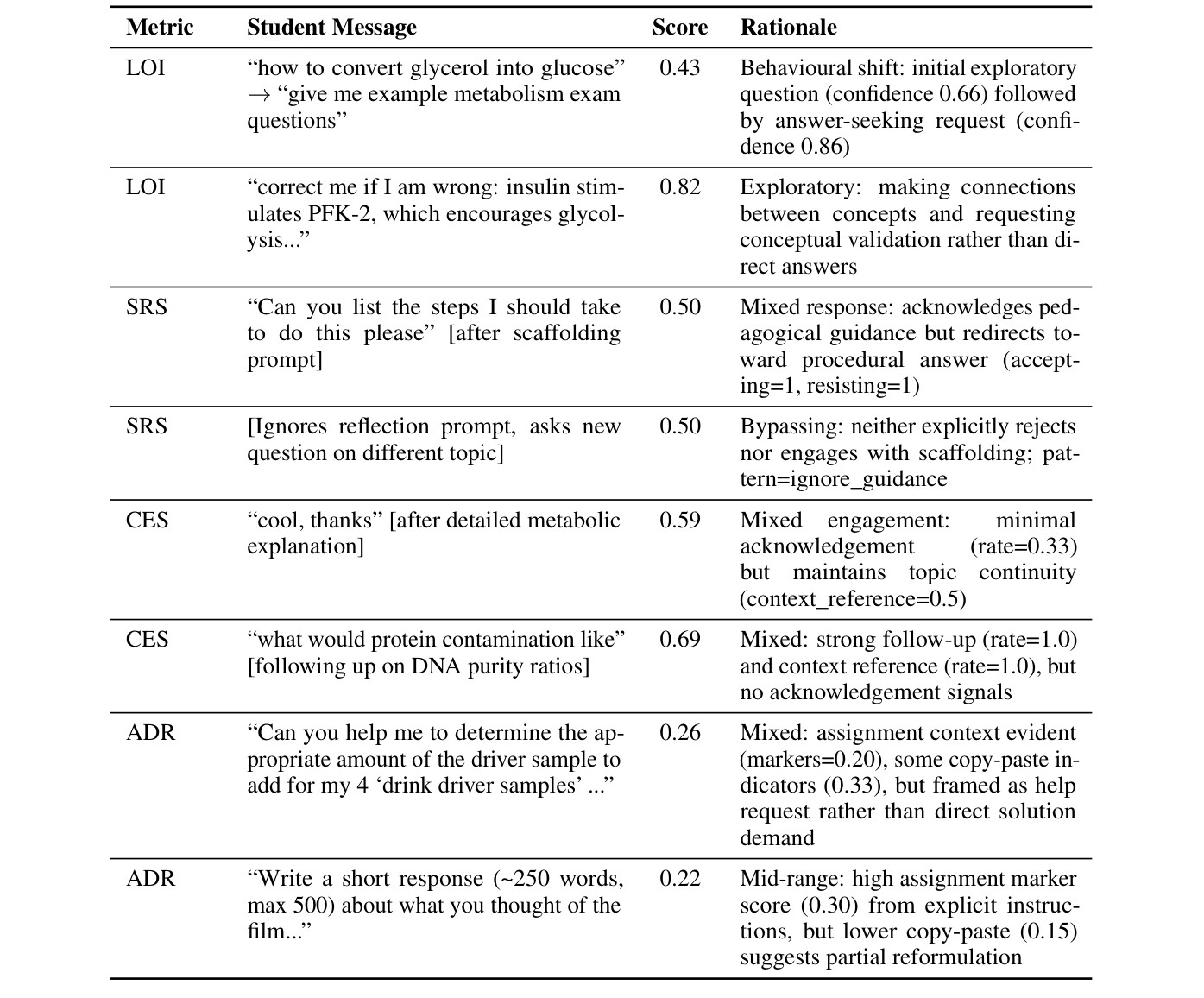
Table 4: Examples demonstrating how continuous 0–1 scoring captures partial behaviours in ambiguous cases. Scores and classifications are from GPT-5 turn-by-turn analysis.
表 4:说明连续 0–1 计分如何捕捉含糊情形中部分行为的例子。分数和分类来自 GPT-5 逐轮分析。
A.4 Sampling Strategy
A.4 抽样策略
We employed stratified random sampling to ensure coverage across all conversation lengths:
我们采用分层随机抽样,以确保覆盖各种对话长度:
- Stratification levels: Short (4–10 messages), Medium (11–25), Long (26–50), Very Long (50+)
- 分层级别:短(4–10 条消息)、中(11–25)、长(26–50)、很长(50 以上)
- Sample size: 100 conversations per dataset
- 样本量:每个数据集 100 段对话
- Minimum threshold: 4 messages to ensure sufficient interaction depth
- 最低门槛:4 条消息,以保证足够的互动深度
- Reproducibility: Fixed random seed
- 可复现性:固定随机种子
A.5 RECIPE4U External Validation
A.5 RECIPE4U 外部验证
We applied our four metrics to a subset of 100 conversations from the RECIPE4U dataset, which contains student-ChatGPT dialogues in Korean university writing courses with per-response satisfaction ratings on a 1–5 scale. LLM-based metrics (CES, LOI, SRS) used GPT-4.1-mini; ADR used rule-based detection. Table 5 reports mean metric scores and Pearson correlations with conversation-level satisfaction (averaged across responses). Mean satisfaction was 3.94 (SD = 0.85).
我们把四项指标用到 RECIPE4U 数据集中的 100 段对话子集上。该数据集包含韩国大学写作课上的学生–ChatGPT 对话,并带有 1–5 分的逐条满意度评分。基于大语言模型的指标(CES、LOI、SRS)使用 GPT-4.1-mini;ADR 使用基于规则的检测。表 5 报告各指标的平均分,以及与对话级满意度(对各条回复取平均)的皮尔逊相关。平均满意度为 3.94(标准差 0.85)。
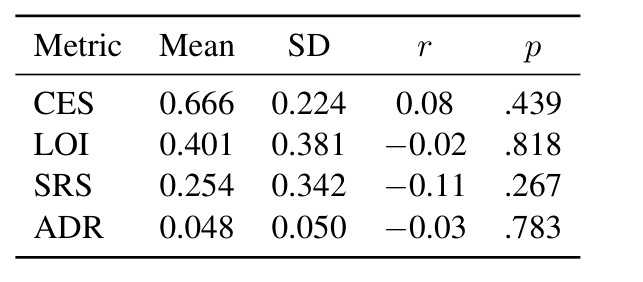
Table 5: RECIPE4U metric scores and correlations with per-conversation satisfaction (). No metric significantly correlates with satisfaction, confirming the disconnect between student satisfaction and pedagogical alignment.
表 5:RECIPE4U 的指标分数及其与对话级满意度的相关()。没有任何指标与满意度显著相关,这确认了学生满意度与教学对齐之间的脱节。
ADR is near-floor (mean = 0.048) because RECIPE4U is a writing tutoring chatbot with no assignment-submission context. A notable non-monotonic pattern emerged: conversations rated 5/5 for satisfaction showed lower learning orientation (LOI = 0.277) than those rated 4/5 (LOI = 0.571), though small sample sizes at individual rating levels prevent strong conclusions. These results demonstrate that our metrics capture dimensions of educational interaction that satisfaction measures systematically miss.
ADR 接近地板(均值 0.048),因为 RECIPE4U 是一个写作辅导聊天机器人,没有提交作业的语境。一个值得注意的非单调模式是:满意度被评为 5/5 的对话,学习取向(LOI = 0.277)反而低于评为 4/5 的对话(LOI = 0.571),不过各评分档上的样本量较小,不足以做出很强的结论。这些结果表明,我们的指标捕捉到了满意度测量系统性地漏掉的教学互动维度。
A.6 Cost Analysis
A.6 成本分析
Turn-by-turn analysis provides more granular insights but increases costs significantly for GPT-5.
逐轮分析能提供更细的认识,但对 GPT-5 来说成本会显著上升。
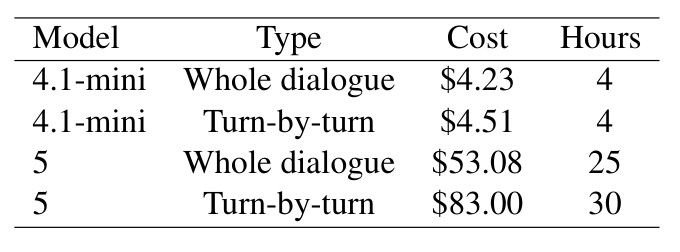
Table 6: Computational cost and processing time for different model configurations. Turn-by-turn analysis provides more granular insights but increases costs significantly for GPT-5.
表 6:不同模型配置的计算成本和处理时间。逐轮分析能提供更细的认识,但对 GPT-5 来说成本会显著上升。
A.7 Temporal and Behavioural Metric Visualisations
A.7 时间和行为指标的可视化
Figure 2 illustrates the relationship between conversational engagement and learning orientation, revealing the engagement-learning paradox where higher engagement corresponds to lower learning orientation on the unrestricted platform. Figure 3 presents temporal usage patterns across all five datasets, showing stark concentration around assessment periods for constrained platforms compared to the distributed usage in StudyChat. Figures 4–5 break down crisis mode behavioural shifts for each optional-tool course, while Figure 6 summarises the overall crisis mode scores, with all datasets falling within the 0.19–0.24 range.
图 2 展示了对话参与与学习取向之间的关系,揭示了参与–学习悖论:在无限制平台上,更高的参与对应更低的学习取向。图 3 给出全部五个数据集的时间使用模式,显示受限平台在评估期高度集中,而 StudyChat 的使用更为分散。图 4–5 按每门可选工具课程分解危机模式的行为转变,图 6 则汇总总体危机模式分数,所有数据集都落在 0.19–0.24 范围内。
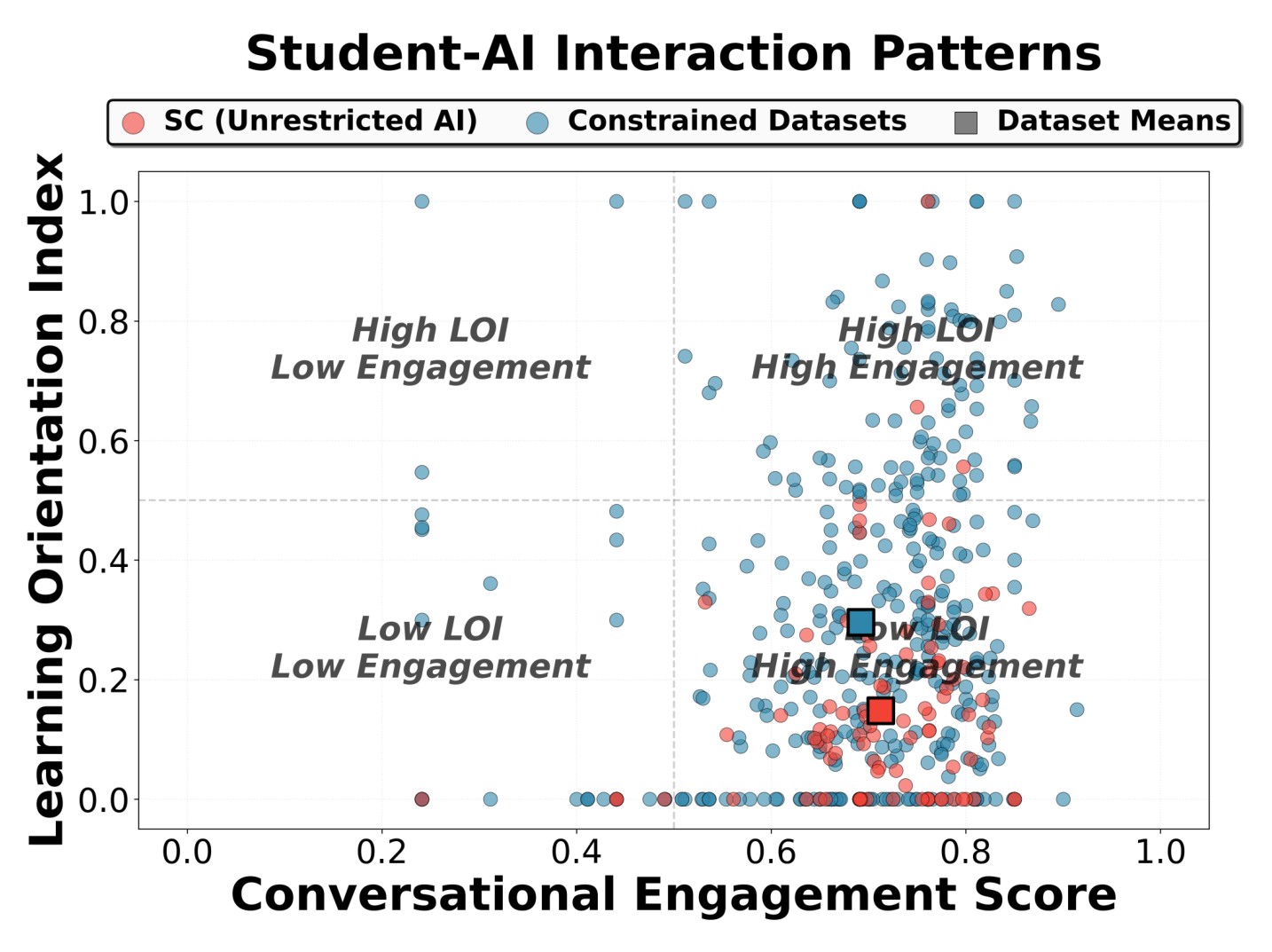
Figure 2: Conversational Engagement Score vs Learning Orientation Index for 500 conversations. Blue points: Constrained platforms (), red points: SC platform (). Square markers indicate means. SC shows higher engagement but lower learning orientation, demonstrating the engagement-learning paradox.
图 2:500 段对话的对话参与分数与学习取向指数。蓝点:受限平台(),红点:SC 平台()。方块标记表示均值。SC 的参与更高,学习取向却更低,显示了参与–学习悖论。
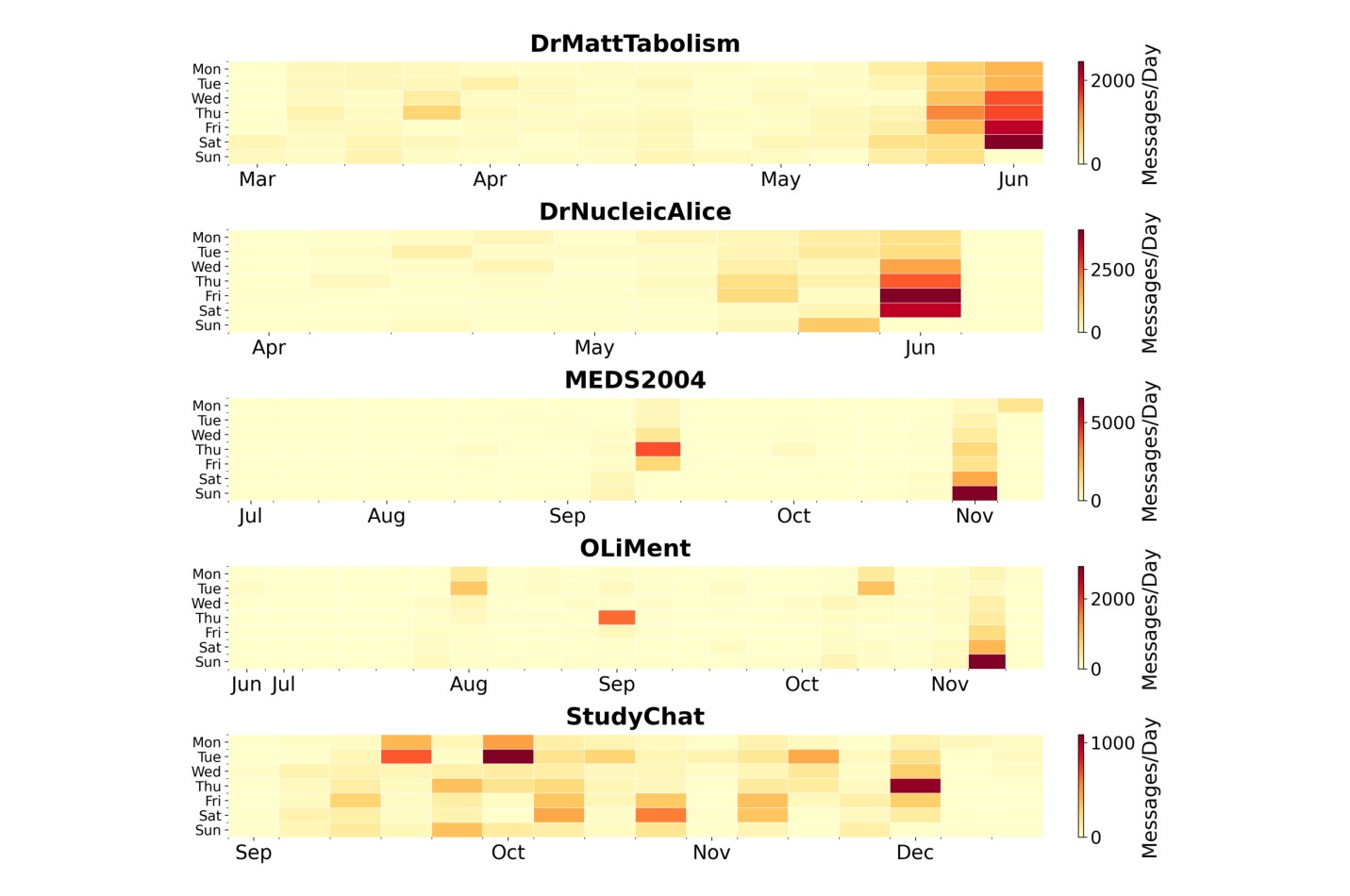
Figure 3: Temporal heatmap showing message volume across academic semesters for all five datasets. Darker colors indicate higher usage concentration. Note the stark concentration in end-of-semester periods for constrained platforms (DrMattTabolism, DrNucleicAlice, MEDS2004, OLiMent) versus the distributed pattern in StudyChat where AI was integrated into weekly coursework. Days of the week are shown on Y-axis, months on X-axis, with color intensity representing message count.
图 3:五个数据集在各学期中的消息量时间热图。颜色越深表示使用越集中。请注意,受限平台(DrMattTabolism、DrNucleicAlice、MEDS2004、OLiMent)在学期末高度集中,而把人工智能嵌进每周作业的 StudyChat 则更为分散。纵轴是星期,横轴是月份,颜色深浅表示消息数量。
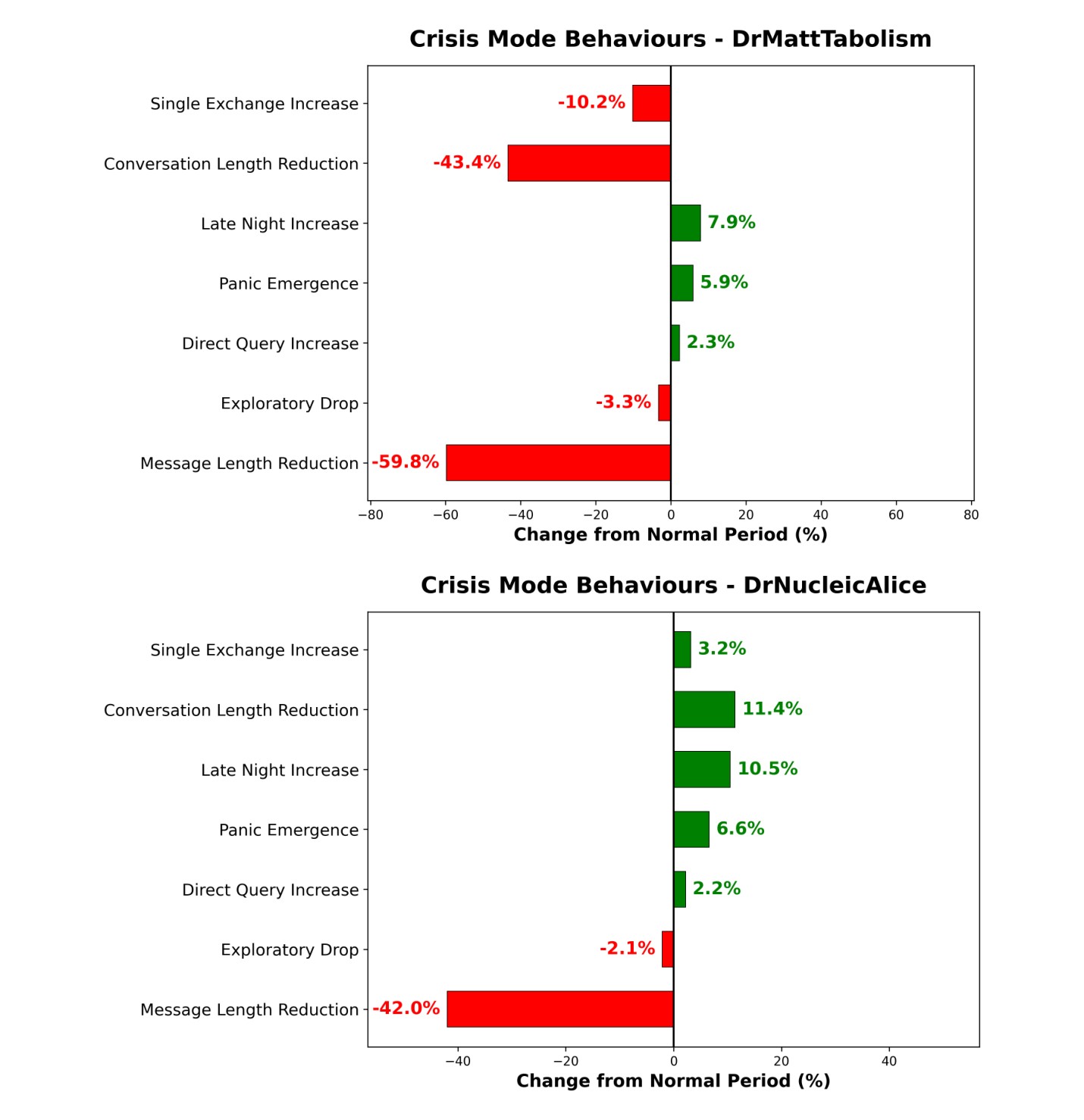
Figure 4: Crisis mode behavioural changes. Each panel shows the percentage change from baseline to peak assessment periods across seven behavioural indicators.
图 4:危机模式下的行为变化。每个面板给出从基线期到高峰评估期、七项行为指标的百分比变化。
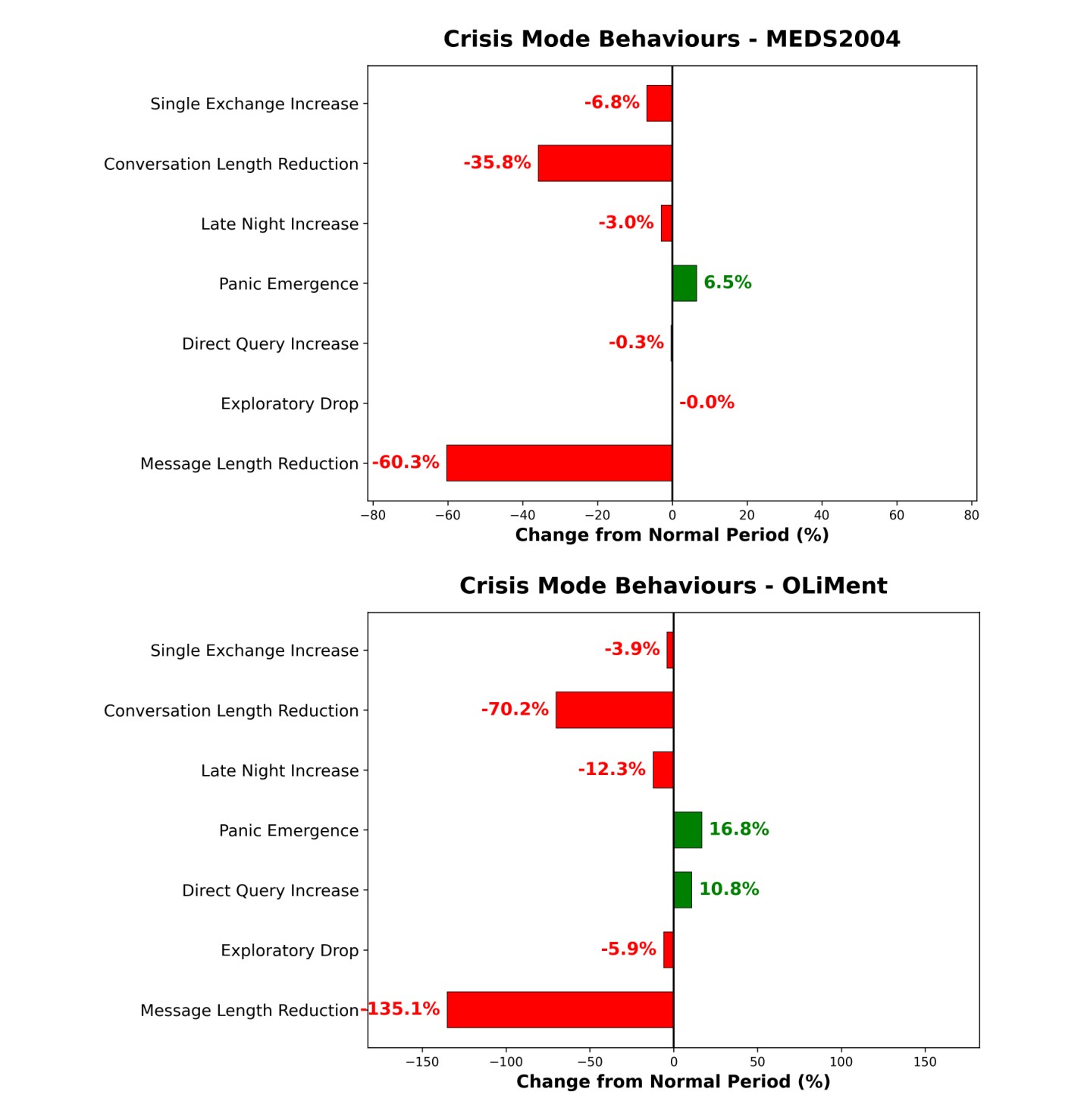
Figure 5: Crisis mode behavioural changes . Each panel shows the percentage change from baseline to peak assessment periods across seven behavioural indicators.
图 5:危机模式下的行为变化。每个面板给出从基线期到高峰评估期、七项行为指标的百分比变化。
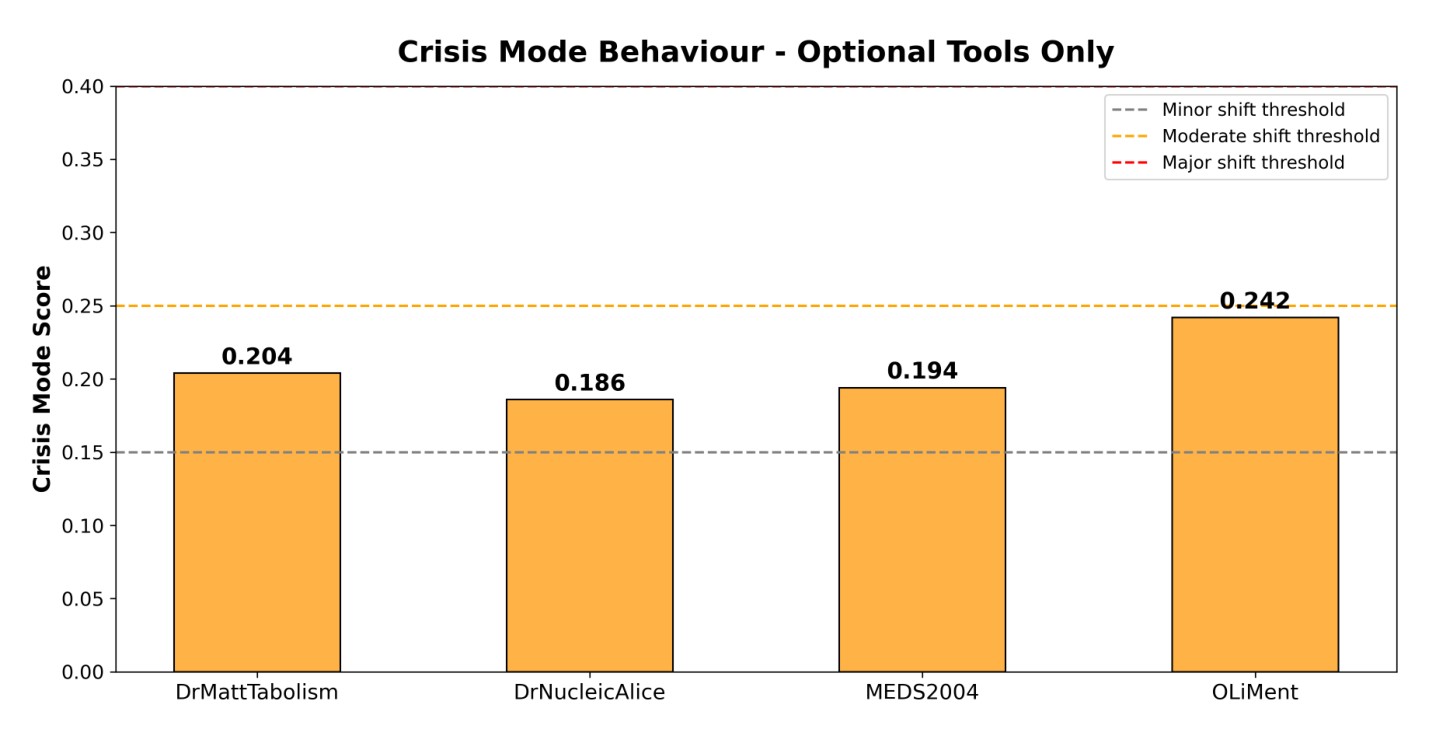
Figure 6: Overall crisis mode scores across four optional-tool courses. All datasets show some shifts (0.19-0.24 range).
图 6:四门可选工具课程的总体危机模式分数。所有数据集都表现出一定转变(范围为 0.19–0.24)。