SAM 3D: 3Dfy Anything in Images
SAM 3D: 3Dfy Anything in Images
SAM 3D:把图像里的任意物体三维化
SAM 3D Team Affiliation: Meta Superintelligence Labs Xingyu Chen Affiliation: Meta Superintelligence Labs Core Contributor (Alphabetical, Equal Contribution) Fu-Jen Chu Affiliation: Meta Superintelligence Labs Core Contributor (Alphabetical, Equal Contribution) Pierre Gleize Affiliation: Meta Superintelligence Labs Core Contributor (Alphabetical, Equal Contribution) Kevin J Liang Affiliation: Meta Superintelligence Labs Core Contributor (Alphabetical, Equal Contribution) Alexander Sax Affiliation: Meta Superintelligence Labs Core Contributor (Alphabetical, Equal Contribution) Hao Tang Affiliation: Meta Superintelligence Labs Core Contributor (Alphabetical, Equal Contribution) Weiyao Wang Affiliation: Meta Superintelligence Labs Core Contributor (Alphabetical, Equal Contribution) Michelle Guo Affiliation: Meta Superintelligence Labs Thibaut Hardin Affiliation: Meta Superintelligence Labs Xiang Li Affiliation: Meta Superintelligence Labs Intern Aohan Lin Affiliation: Meta Superintelligence Labs Jiawei Liu Affiliation: Meta Superintelligence Labs Ziqi Ma Affiliation: Meta Superintelligence Labs Intern Anushka Sagar Affiliation: Meta Superintelligence Labs Bowen Song Affiliation: Meta Superintelligence Labs Intern Xiaodong Wang Affiliation: Meta Superintelligence Labs Jianing Yang Affiliation: Meta Superintelligence Labs Intern Bowen Zhang Affiliation: Meta Superintelligence Labs Intern Piotr Dollár Affiliation: Meta Superintelligence Labs Project Lead Georgia Gkioxari Affiliation: Meta Superintelligence Labs Project Lead Matt Feiszli Affiliation: Meta Superintelligence Labs Jitendra Malik Affiliation: Meta Superintelligence Labs
Abstract
摘要
We present SAM 3D, a generative model for visually grounded 3D object reconstruction, predicting geometry, texture, and layout from a single image. SAM 3D excels in natural images, where occlusion and scene clutter are common and visual recognition cues from context play a larger role. We achieve this with a human- and model-in-the-loop pipeline for annotating object shape, texture, and pose, providing visually grounded 3D reconstruction data at unprecedented scale. We learn from this data in a modern, multi-stage training framework that combines synthetic pretraining with real-world alignment, breaking the 3D “data barrier”. We obtain significant gains over recent work, with at least a win rate in human preference tests on real-world objects and scenes. We will release our code and model weights, an online demo, and a new challenging benchmark for in-the-wild 3D object reconstruction.
我们提出 SAM 3D,这是一种面向视觉锚定三维物体重建的生成模型,能够从单张图像预测几何、纹理和布局。SAM 3D 在自然图像上表现突出:这类图像里遮挡和场景杂乱很常见,来自上下文的视觉识别线索也起着更大作用。我们借助一套人与模型在环(human- and model-in-the-loop)的流程,为物体的形状、纹理和姿态做标注,从而在前所未有的规模上提供视觉锚定的三维重建数据。我们在一套现代的多阶段训练框架中学习这些数据,把合成预训练与真实世界对齐结合起来,打破三维的“数据壁垒”。我们相对近期工作取得了显著提升,在真实世界物体和场景上的人人偏好测试中,胜率至少为 。我们将发布代码与模型权重、在线演示,以及一份新的、有挑战性的野外三维物体重建基准。
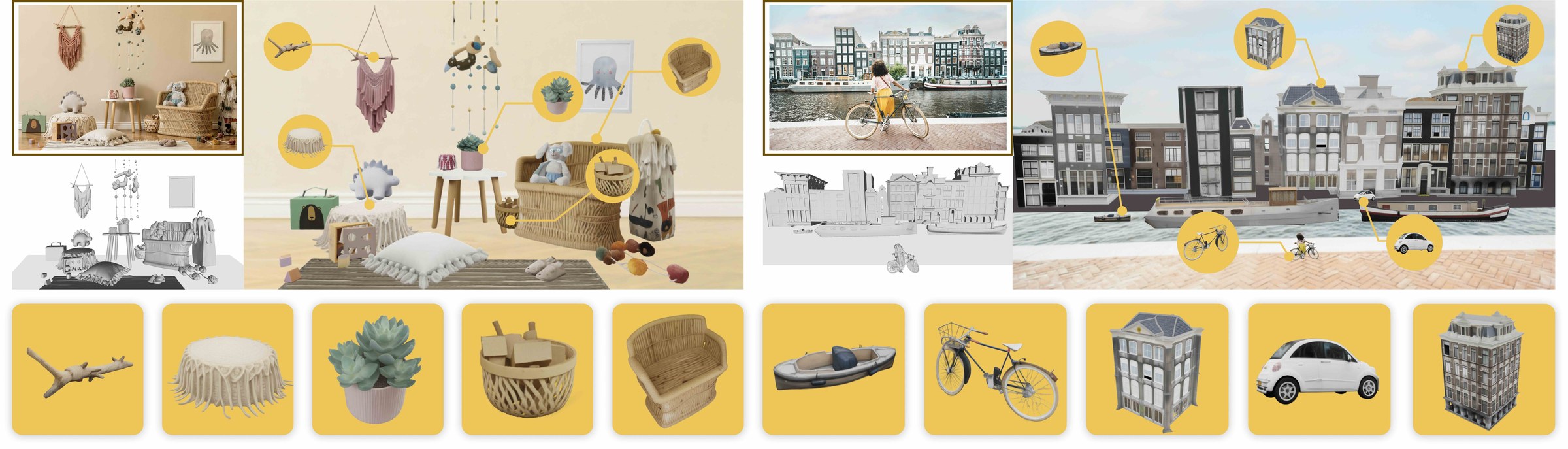
Figure 1: SAM 3D converts a single image into a composable 3D scene made of individual objects. Our method predicts per-object geometry, texture, and layout, enabling full scene reconstruction. Bottom: high-quality 3D assets recovered for each object.
图 1:SAM 3D 把单张图像转换成由各个物体组成、可组合的三维场景。 我们的方法预测每个物体的几何、纹理和布局,从而实现完整的场景重建。底部:为每个物体恢复出的高质量三维资产。
1 Introduction
1 引言
In this paper (see Figure 1) we present SAM 3D, a generative neural network for 3D reconstruction from a single image. The model can reconstruct 3D shape and texture for any object, as well as its layout with respect to the camera, even in complex scenes with significant clutter and occlusion. As the reconstruction is of full 3D shape, not just of the visible 2.5D surface, one can then re-render the object from any desired viewpoint.
在本文中(见图 1),我们提出 SAM 3D,这是一个用于从单张图像做三维重建的生成式神经网络。该模型可以为任意物体重建三维形状和纹理,以及它相对于相机的布局,即便是在杂乱和遮挡都很严重的复杂场景中也是如此。由于重建的是完整的三维形状,而不只是可见的 2.5D 表面,随后可以从任意指定视点重新渲染该物体。
Computer vision has traditionally focused on multi-view geometry as providing the primary signal for 3D shape. However psychologists (and artists before them) have long known that humans can perceive depth and shape from a single image, e.g. Koenderink et al. (1992) demonstrated this elegantly by showing that humans can estimate surface normals at probe points on an object’s image, which can then be integrated to a full surface. In psychology textbooks these single image cues to 3D shape are called “pictorial cues”, and include information such as in shading and texture patterns, but also recognition - the “familiar object” cue. In computer vision, this line of research dates back to Roberts (1963), who showed that once an image pattern was recognized as a known object, its 3D shape and pose could be recovered. The central insight is that recognition enables 3D reconstruction, an idea that has since resurfaced in different technical instantiations (Debevec et al., 2023; Cashman and Fitzgibbon, 2012; Kar et al., 2015; Gkioxari et al., 2019; Xiang et al., 2025; Wu et al., 2024a). Note that this permits generalization to novel objects, because even if a specific object has not been seen before, it is made up of parts seen before.
计算机视觉传统上把多视图几何当作三维形状的主要信号。不过心理学家(以及更早的艺术家)早就知道,人可以从单张图像感知深度和形状。例如,Koenderink et al. (1992) 漂亮地证明:人能够估计物体图像上探测点处的表面法向,再把这些法向积分成完整表面。在心理学教科书里,这些来自单张图像的三维形状线索被称为“图画线索”(pictorial cues),既包括阴影和纹理模式中的信息,也包括识别,也就是“熟悉物体”线索。在计算机视觉中,这条研究线索可以追溯到 Roberts (1963):他表明,一旦某个图像模式被识别为已知物体,就可以恢复它的三维形状和姿态。核心洞见是:识别使三维重建成为可能。此后这一想法以不同的技术形式反复出现(Debevec et al., 2023;Cashman and Fitzgibbon, 2012;Kar et al., 2015;Gkioxari et al., 2019;Xiang et al., 2025;Wu et al., 2024a)。需要指出的是,这允许推广到未见过的新物体,因为即便某个具体物体以前没见过,它也是由见过的部件组成的。
A fundamental challenge for learning such models is the lack of data: specifically, natural images paired with 3D ground truth are difficult to obtain at scale. Recent work (Yang et al., 2024b; Xiang et al., 2025) has shown strong reconstruction from single images. However, these models are trained on isolated objects and struggle with objects in natural scenes, where they may be distant or heavily occluded. To add such images to the training set, we need to find a way to associate specific objects in such images with 3D shape models, acknowledging that generalist human annotators find it hard to do so (unlike, say, attaching a label like “cat” or marking its boundary). Two insights made this possible:
学习这类模型的一个根本挑战是缺少数据:具体而言,与三维真值成对的自然图像很难大规模获得。近期工作(Yang et al., 2024b;Xiang et al., 2025)已经展示了从单张图像出发的较强重建。不过,这些模型是在孤立物体上训练的,面对自然场景中的物体往往会吃力,因为它们可能距离很远,或被严重遮挡。要把这类图像加入训练集,我们需要找到一种办法,把图像中的特定物体与三维形状模型对应起来,同时也要承认:非专业的人类标注员很难完成这件事(这和贴上“猫”这样的标签、或标出它的边界不同)。两点认识使这件事成为可能:
- • We can create synthetic scenes where 3D object models are rendered and pasted into images (inspired by Dosovitskiy et al. (2015)).
- • 我们可以创建合成场景:把三维物体模型渲染后贴进图像(受 Dosovitskiy et al. (2015) 启发)。
- • While humans can’t easily generate 3D shape models for objects, they can select the likely best 3D model from a set of proffered choices and align its pose to the image (or declare that none of the choices is good).
- • 人虽然不容易直接生成物体的三维形状模型,但可以从一组给定候选中选出很可能最好的三维模型,并把它的姿态对齐到图像上(或者声明这些候选里没有合适的)。
We design a training pipeline and data engine by adapting modern, multistage training recipes pioneered by LLMs (Minaee et al., 2025; Mo et al., 2025). As in recent works, we first train on a large collection of rendered synthetic objects. This is supervised pretraining: our model learns a rich vocabulary for object shape and texture, preparing it for real-world reconstruction. Next is mid-training with semi-synthetic data produced by pasting rendered models into natural images. Finally, post-training adapts the model to real images, using both a novel model-in-the-loop (MITL) pipeline and human 3D artists, and aligns it to human preference. We find that synthetic pretraining generalizes, given adequate post-training on natural images.
我们通过改造由大语言模型开创的现代多阶段训练配方(Minaee et al., 2025;Mo et al., 2025),设计了训练流程和数据引擎。与近期工作一样,我们首先在大量渲染的合成物体上训练。这是有监督预训练:模型学到一套丰富的物体形状与纹理词汇,为真实世界重建做好准备。接下来是中期训练,使用把渲染模型贴进自然图像后得到的半合成数据。最后,后训练把模型适配到真实图像上,同时使用一套新的模型在环(model-in-the-loop,MITL)流程和人类三维艺术家,并把它对齐到人的偏好。我们发现,只要在自然图像上有充分的后训练,合成预训练就可以泛化。
Our post-training data, obtained from our MITL data pipeline, is key to obtaining good performance in natural images. Generalist human annotators aren’t capable of producing 3D shape ground truth; hence our annotators select and align 3D models to objects in images from the output of modules – computational and retrieval-based – that produce multiple initial 3D shape proposals. Human annotators select from these proposals, or route them to human artists for a subset of hard instances. The vetted annotations feed back into model training, and the improved model is reintegrated into the data engine to further boost annotation quality. This virtuous cycle steadily improves the quality of 3D annotations, labeling rates, and model performance.
我们从 MITL 数据流程中得到的后训练数据,是在自然图像上取得良好性能的关键。非专业的人类标注员无法直接给出三维形状真值;因此,我们的标注员是从若干模块(计算式和检索式)产生的多个初始三维形状提案中,选择并对齐到图像里的物体。标注员从这些提案中选择,或把其中一部分困难实例转给人类艺术家。经过核验的标注再反馈到模型训练中,改进后的模型再被重新接入数据引擎,以进一步提高标注质量。这一良性循环会稳步提升三维标注的质量、标注速度和模型性能。
Due to the lack of prior benchmarks for real-world 3D reconstruction of object shape and layout, we propose a new evaluation set of image and 3D pairs: SAM 3D Artist Objects (SA-3DAO). The objects in our benchmark range from churches, ski lifts, and large structures to animals, everyday household items, and rare objects, and are paired with the real-world images in which they naturally appear. Professional 3D artists create 3D shapes from the input image, representing an expert human upper bound for visually grounded 3D reconstruction. We hope that contributing such an evaluation benchmark helps accelerate subsequent research iteration of real-world 3D reconstruction models.
由于此前缺少面向真实世界物体形状与布局三维重建的基准,我们提出一份包含 对图像与三维数据的新评测集:SAM 3D Artist Objects(SA-3DAO)。基准中的物体从教堂、缆车和大型结构,到动物、日常用品和罕见物体都有覆盖,并且与它们自然出现在其中的真实世界图像成对。专业三维艺术家根据输入图像创建三维形状,代表了视觉锚定三维重建的专家人类上界。我们希望贡献这样一份评测基准,能够加快后续真实世界三维重建模型的研究迭代。
We summarize our contributions as follows:
我们将贡献概括如下:
- • We introduce SAM 3D, a new foundation model for 3D that predicts object shape, texture, and pose from a single image. By releasing code, model weights, and a demo, we hope to stimulate further advancements in 3D reconstruction and downstream applications of 3D.
- • 我们提出 SAM 3D,一个新的三维基础模型,能够从单张图像预测物体的形状、纹理和姿态。通过发布代码、模型权重和演示,我们希望推动三维重建及其下游应用的进一步发展。
- • We build a MITL pipeline for annotating shape, texture, and pose data, providing visually grounded 3D reconstruction data at unprecedented scale.
- • 我们构建了一套用于标注形状、纹理和姿态数据的 MITL 流程,从而在前所未有的规模上提供视觉锚定的三维重建数据。
- • We exploit this data via LLM-style pretraining and post-training in a novel framework for 3D reconstruction, combining synthetic pretraining with real-world alignment to overcome the orders of magnitude data gap between 3D and domains such as text, images, or video.
- • 我们在一套新的三维重建框架中,以大语言模型式的预训练和后训练来利用这些数据,把合成预训练与真实世界对齐结合起来,以克服三维与文本、图像或视频等领域之间数量级的数据差距。
- • We release a challenging benchmark for real-world 3D object reconstruction, SA-3DAO. Experiments show SAM 3D’s significant gains via metrics and large-scale human preference.
- • 我们发布一份有挑战性的真实世界三维物体重建基准 SA-3DAO。实验通过指标和大规模人人偏好表明,SAM 3D 取得了显著提升。
2 The SAM 3D Model
2 SAM 3D 模型
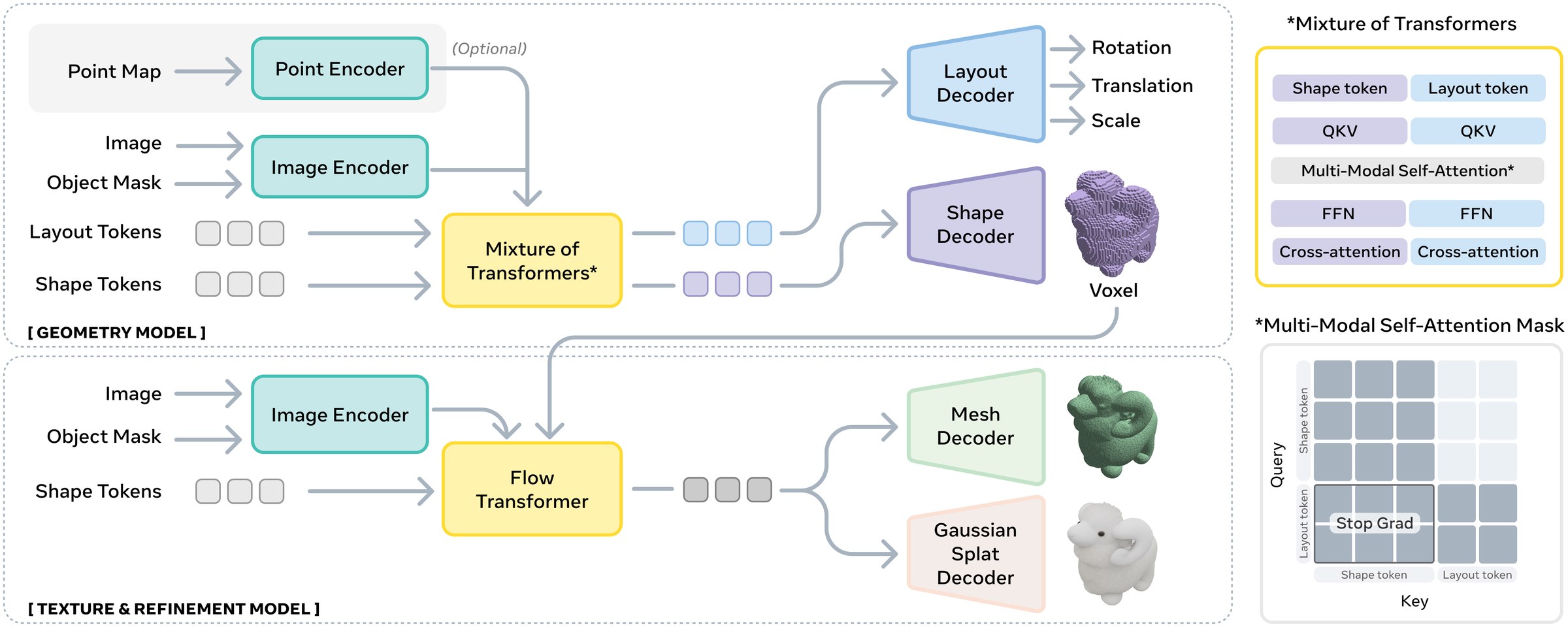
Figure 2: SAM 3D architecture. (top) SAM 3D first predicts coarse shape and layout with the Geometry model; (right) the mixture of transformers architecture apply a two-stream approach with information sharing in the multi-modal self-attention layer. (bottom) The voxels predicted by the Geometry model are passed to the Texture & Refinement model, which adds higher resolution detail and textures.
图 2:SAM 3D 的结构。(上)SAM 3D 首先用几何模型预测粗形状和布局;(右)混合 Transformer 结构采用双流方式,并在多模态自注意力层中共享信息。(下)几何模型预测的体素被送入纹理与细化模型,以加入更高分辨率的细节和纹理。
2.1 Problem Formulation
2.1 问题形式化
The act of taking a photograph maps a 3D object to a set of 2D pixels, specified by a mask in an image . We seek to invert this map. Let the object have shape , texture , and rotation, translation and scale in camera coordinates. Since the 3D to 2D map is lossy, we model the reconstruction problem as a conditional distribution . Our goal is to train a generative model that approximates as closely as possible.
拍照这一动作把一个三维物体映射为一组二维像素,由图像 中的掩码 给出。我们希望反演这个映射。设该物体具有形状 、纹理 ,以及相机坐标系下的旋转、平移和尺度 。由于三维到二维的映射是有损的,我们把重建问题建模为条件分布 。我们的目标是训练一个生成模型 ,使其尽可能接近 。
2.2 Architecture
2.2 结构
We build upon recent SOTA two-stage latent flow matching architectures (Xiang et al., 2025). SAM 3D first jointly predicts object pose and coarse shape, then refines the shapes by integrating pictorial cues (see Figure 2). Unlike Xiang et al. (2025) that reconstructs isolated objects, SAM 3D predicts object layout, creating coherent multi-object scenes.
我们建立在近期最先进的两阶段潜在流匹配结构之上(Xiang et al., 2025)。SAM 3D 首先联合预测物体姿态和粗形状,再通过整合图画线索来细化形状(见图 2)。与重建孤立物体的 Xiang et al. (2025) 不同,SAM 3D 还预测物体布局,从而生成协调的多物体场景。
Input encoding.
We use DINOv2 (Oquab et al., 2023) as an encoder to extract features from two pairs of images, resulting in 4 sets of conditioning tokens:
输入编码。
我们用 DINOv2(Oquab et al., 2023)作为编码器,从两对图像中提取特征,得到 4 组条件词元:
- • Cropped object: We encode the cropped image by mask and its corresponding cropped binary mask, providing a focused, high-resolution view of the object.
- • 裁剪物体:我们编码按掩码 裁出的图像 ,以及相应的裁剪二值掩码,从而提供对该物体聚焦的高分辨率视图。
- • Full image: We encode the full image and its full image binary mask, providing global scene context and recognition cues absent from the cropped view.
- • 整图:我们编码完整图像 及其整图二值掩码,以提供裁剪视图中缺失的全局场景上下文和识别线索。
Optionally, the model supports conditioning on a coarse scene point map, obtained via hardware sensors (e.g., LiDAR on an iPhone), or monocular depth estimation (Yang et al., 2024a; Wang et al., 2025a), enabling SAM 3D to integrate with other pipelines.
此外,模型还支持以粗略的场景点图 为条件, 可由硬件传感器获得(例如 iPhone 上的 LiDAR),或由单目深度估计得到(Yang et al., 2024a;Wang et al., 2025a),从而使 SAM 3D 能够与其他流程集成。
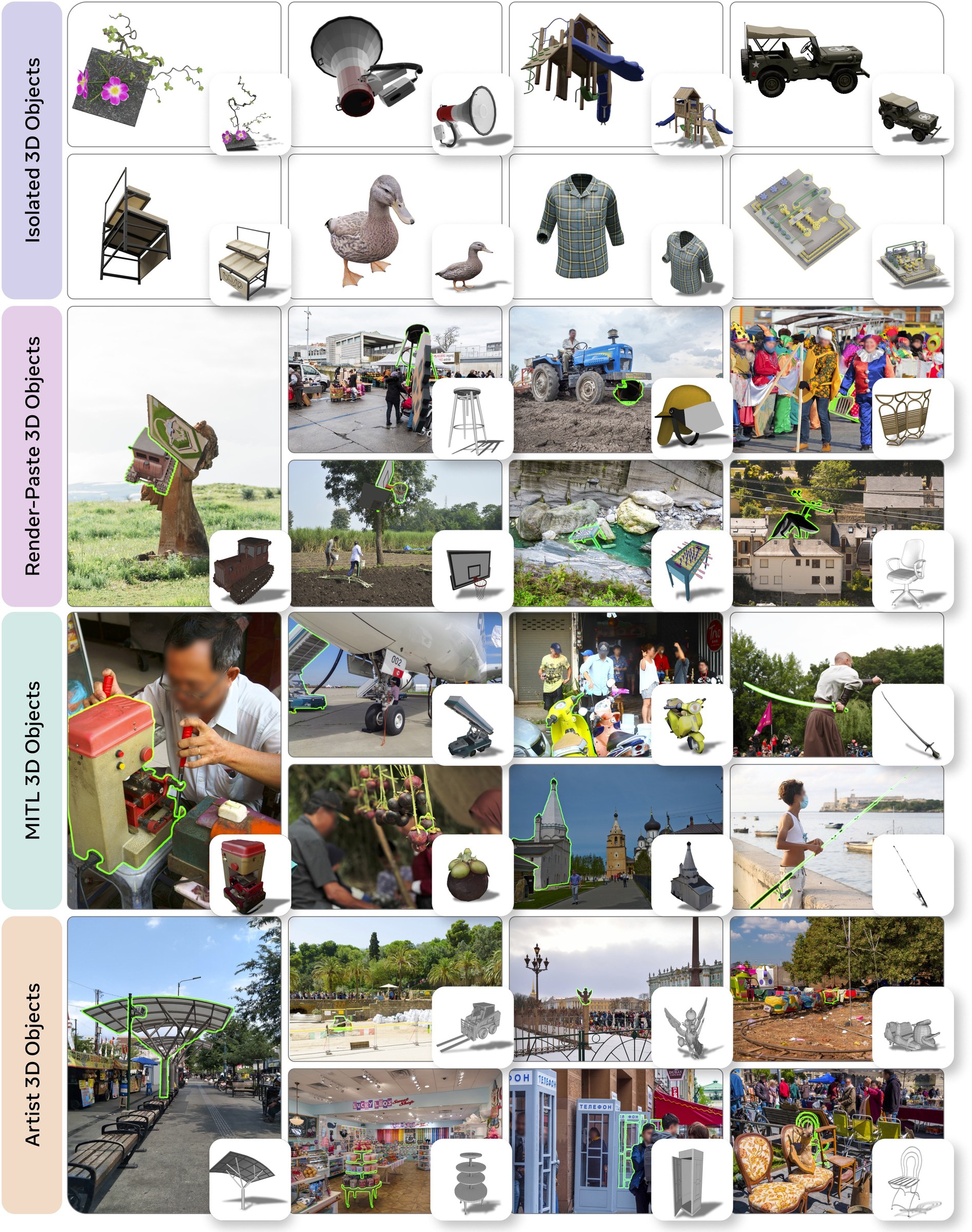
Figure 3: SAM 3D data, with a green outline around the target object, and the ground truth mesh shown in the bottom right. Samples are divided into four rows, based on type. Art-3DO meshes are untextured, while the rest may be textured or not, depending on the underlying asset (Iso-3DO, RP-3DO) or if the mesh was annotated for texture (MITL-3DO).
图 3:SAM 3D 的数据,目标物体用绿色轮廓标出,右下角为真值网格。样本按类型分成四行。Art-3DO 的网格没有纹理,其余则可能有纹理或没有纹理,取决于底层资产(Iso-3DO、RP-3DO),或该网格是否被标注了纹理(MITL-3DO)。
The Geometry Model
models the conditional distribution , where is coarse shape, the 6D rotation (Zhou et al., 2019), the translation, and the scale. Conditioned on the input image and mask encodings, we employ a 1.2B parameter flow transformer with the Mixture-of-Transformers (MoT) architecture (Liang et al., 2025a; Deng et al., 2025), modeling geometry and layout using the attention mask in Figure 2. See Section C.1 for details.
几何模型
建模条件分布 ,其中 是粗形状, 是 6D 旋转(Zhou et al., 2019), 是平移, 是尺度。以输入图像和掩码编码为条件,我们采用一个 12 亿参数、具有混合 Transformer(Mixture-of-Transformers,MoT)结构(Liang et al., 2025a;Deng et al., 2025)的流匹配 Transformer,并用图 2 中的注意力掩码对几何 和布局 建模。细节见第 C.1 节。
The Texture & Refinement Model
learns the conditional distribution . We first extract active voxels from the coarse shape predicted by Geometry model. A 600M parameter sparse latent flow transformer (Xiang et al., 2025; Peebles and Xie, 2023) refines geometric details and synthesizes object texture.
纹理与细化模型
学习条件分布 。我们首先从几何模型预测的粗形状 中提取活跃体素。一个 6 亿参数的稀疏潜在流匹配 Transformer(Xiang et al., 2025;Peebles and Xie, 2023)细化几何细节并合成物体纹理。
3D Decoders.
The latent representations from the Texture & Refinement Model can be decoded to either mesh or 3D Gaussian splats via a pair of VAE decoders , . These separately-trained decoders share the same VAE encoder and hence the same structured latent space (Xiang et al., 2025). We also detail several improvements in Section C.6.
三维解码器。
纹理与细化模型的潜在表征可以通过一对 VAE 解码器 、,解码为网格或三维高斯溅射。这两个分别训练的解码器共享同一个 VAE 编码器,因此也共享同一个结构化潜在空间(Xiang et al., 2025)。我们还在第 C.6 节中详述了若干改进。
3 Training SAM 3D
3 训练 SAM 3D
SAM 3D breaks the 3D data barrier using a recipe that progresses from synthetic pretraining to natural post-training, adapting the playbook from LLMs, robotics, and other large generative models. We build capabilities by stacking different training strategies in pre- and mid-training, and then align the model to real data and human-preferred behaviors through a post-training data flywheel. SAM 3D uses the following approach:
SAM 3D 用一套从合成预训练推进到自然图像后训练的配方来打破三维数据壁垒,改造了来自大语言模型、机器人以及其他大规模生成模型的方法手册。我们在预训练和中期训练中叠放不同的训练策略以积累能力,再通过后训练的数据飞轮,把模型对齐到真实数据和人所偏好的行为。SAM 3D 采用如下做法:
Step 1: Pretraining. This phase builds foundational capabilities, such as shape generation, into a base model.
第 1 步:预训练。 这一阶段把形状生成等基础能力写入一个基座模型。
Step 1.5: Mid-Training. Sometimes called continued pretraining, mid-training imparts general skills such as occlusion robustness, mask-following, and using visual cues.
第 1.5 步:中期训练。 有时也称为继续预训练,中期训练赋予遮挡鲁棒性、掩码跟随以及使用视觉线索等通用技能。
Step 2: Post-Training. Post-training elicits target behavior, such as adapting the model from synthetic to real-world data or following human aesthetic preferences. We collect training samples and preference data from humans and use them in both supervised finetuning (SFT) and direct preference optimization (DPO) (Rafailov et al., 2023).
第 2 步:后训练。 后训练引出目标行为,例如把模型从合成数据适配到真实世界数据,或让它跟随人的审美偏好。我们从人那里收集训练样本 以及偏好数据,并同时用于监督微调(SFT)和直接偏好优化(DPO)(Rafailov et al., 2023)。
This alignment (step 2) can be repeated, first collecting data with the current model and then improving the model with the new data. This creates a virtuous cycle with humans providing the supervision. Figure 12 shows that as we run the data engine longer, model performance steadily improves; dataset generation emerges as a byproduct of this alignment.
这种对齐(第 2 步)可以反复进行:先用当前模型收集数据,再用新数据改进模型。这就形成了一个由人提供监督的良性循环。图 12 表明,数据引擎运行得越久,模型性能就越稳步提高;数据集的生成则是这种对齐的副产品。
The following sections detail the training objectives and data sources used in SAM 3D. We focus on the Geometry model; Texture & Refinement is trained similarly (details in Section C.5). Training hyper-parameters are in Section C.7.
以下几节详述 SAM 3D 所用的训练目标和数据来源。我们把重点放在几何模型上;纹理与细化模型的训练方式类似(细节见第 C.5 节)。训练超参数见第 C.7 节。
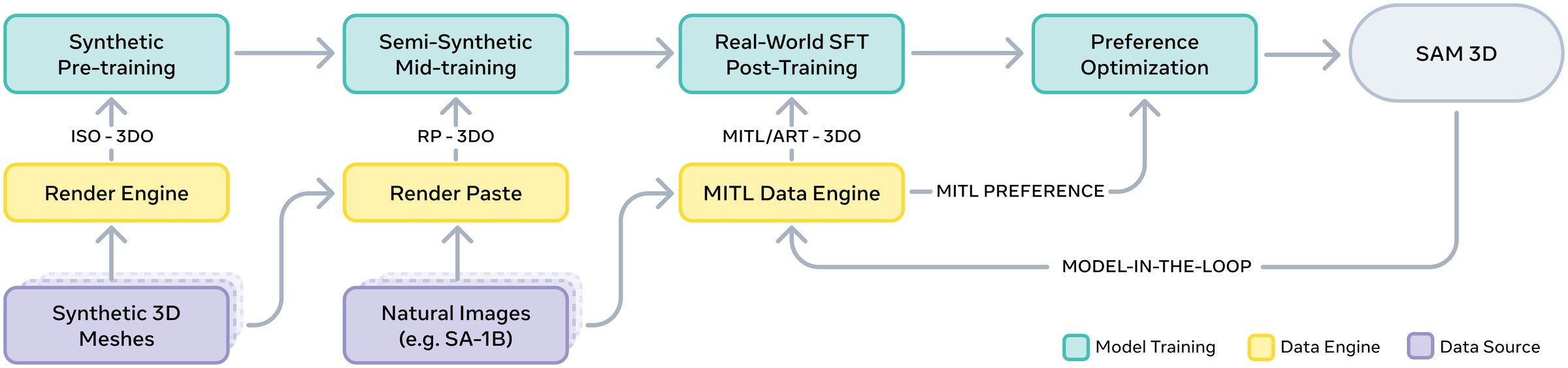
Figure 4: SAM 3D training paradigm. We employ a multi-stage pipeline incrementally exposing the model to increasingly complex data and modalities.
图 4:SAM 3D 的训练范式。 我们采用多阶段流程,逐步让模型接触越来越复杂的数据和模态。
| Training stage | Modalities | Datasets | Condition input |
|---|---|---|---|
| Stage 1 Geometry model | |||
| Pre-training | Iso-3DO | object-centric crop | |
| Mid-training | RP-3DO† | full image | |
| ProcThor, RP-3DO‡ | full image, pointmap∗ | ||
| SFT | MITL, Art-3DO | full image, pointmap∗ | |
| Alignment | MITL preference | full image, pointmap∗ | |
| Stage 2 Texture & Refinement model | |||
| Pre-training | Iso-3DO-500K | object-centric crop | |
| Mid-training | RP-3DO*†,§* | full image | |
| SFT | MITL | full image | |
| Alignment | MITL preference | full image |
Table 1: SAM 3D training stages. †Flying Occlusion (FO) from RP-3DO. ‡Object Swap - Random (OS-R) from RP-3DO. §Object Swap - Annotated (OS-A) from RP-3DO. ∗optional. See Section B.2 for details.
| 训练阶段 | 模态 | 数据集 | 条件输入 |
|---|---|---|---|
| 第 1 阶段 几何模型 | |||
| 预训练 | Iso-3DO | 以物体为中心的裁剪 | |
| 中期训练 | RP-3DO† | 整图 | |
| ProcThor, RP-3DO‡ | 整图,点图∗ | ||
| SFT | MITL, Art-3DO | 整图,点图∗ | |
| 对齐 | MITL 偏好 | 整图,点图∗ | |
| 第 2 阶段 纹理与细化模型 | |||
| 预训练 | Iso-3DO-500K | 以物体为中心的裁剪 | |
| 中期训练 | RP-3DO†,§ | 整图 | |
| SFT | MITL | 整图 | |
| 对齐 | MITL 偏好 | 整图 |
表 1:SAM 3D 的训练阶段。 †来自 RP-3DO 的飞行遮挡(Flying Occlusion,FO)。‡来自 RP-3DO 的物体替换-随机(Object Swap - Random,OS-R)。§来自 RP-3DO 的物体替换-已标注(Object Swap - Annotated,OS-A)。∗可选。细节见第 B.2 节。
3.1 Pre & Mid-Training: Building a Base Model
3.1 预训练与中期训练:构建基座模型
Training begins with synthetic pretraining and mid-training, leveraging available large-scale datasets to learn strong priors for shape and texture, and skills such as mask-following, occlusion handling, and pose estimation. The rich features learned here drastically reduce the number of labeled real-world samples required in post-training (Hernandez et al., 2021), which generally incur acquisition costs. In pre- and mid-training, models are trained with rectified conditional flow matching (Liu et al., 2022) to generate multiple 3D modalities (see Section C.2).
训练从合成预训练和中期训练开始,利用已有的大规模数据集来学习形状和纹理的强先验,以及掩码跟随、遮挡处理和姿态估计等技能。这里学到的丰富特征会大幅减少后训练所需的带标注真实世界样本数量(Hernandez et al., 2021),而这类样本通常获取成本较高。在预训练和中期训练中,模型用矫正条件流匹配(rectified conditional flow matching)(Liu et al., 2022)来生成多种三维模态(见第 C.2 节)。
3.1.1 Pretraining: Single Isolated 3D Assets
Pretraining trains the model to reconstruct accurate 3D shapes and textures from renders of isolated synthetic objects, following the successful recipes from (Xiang et al., 2025; Yang et al., 2024b; Wu et al., 2024b). Specifically, we gather a set of image , shape , and texture triplets, using million object meshes from Objaverse-XL (Deitke et al., 2023) and licensed datasets, and render them from viewpoints, each producing a high-resolution image of a single centered object; more detail in Section B.1. We call this dataset Iso-3DO and train for 2.5 trillion training tokens.
3.1.1 预训练:单个孤立的三维资产
预训练让模型从孤立合成物体的渲染图中重建准确的三维形状和纹理,沿用了(Xiang et al., 2025;Yang et al., 2024b;Wu et al., 2024b)中的成功配方。具体而言,我们收集一组图像 、形状 和纹理 三元组,使用来自 Objaverse-XL(Deitke et al., 2023)和授权数据集的 万个物体网格,并从 个视点渲染,每个视点产生一幅单个居中物体的高分辨率图像;更多细节见第 B.1 节。我们把这份数据称为 Iso-3DO,并训练了 2.5 万亿个训练词元。
3.1.2 Mid-Training: Semi-Synthetic Capabilities
Next, mid-training builds up foundational skills that will enable the model to handle objects in real-world images:
3.1.2 中期训练:半合成能力
接下来,中期训练积累基础技能,使模型能够处理真实世界图像中的物体:
- • Mask-following: We train the model to reconstruct a target object, defined by a binary mask on the input image.
- • 掩码跟随:我们训练模型重建由输入图像上的二值掩码所定义的目标物体。
- • Occlusion robustness: The artificial occluders in our dataset incentivize learning shape completion.
- • 遮挡鲁棒性:数据集中的人工遮挡物会激励模型学习形状补全。
- • Layout estimation: We train the model to produce translation and scale in normalized camera coordinates.
- • 布局估计:我们训练模型在归一化相机坐标中给出平移和尺度。
We construct our data by rendering textured meshes into natural images using alpha compositing. This “render-paste” dataset contains one subset of occluder-occludee pairs, and another subset with real objects replaced by synthetic objects at similar location and scale, creating physically-plausible data with accurate 3D ground truth. We call these million samples with million unique meshes RP-3DO; fig. 3 shows examples. See Section B.2 for more details.
我们通过 alpha 合成,把带纹理的网格渲染进自然图像来构造数据。这份“渲染-粘贴”数据包含一个遮挡物-被遮挡物对的子集,以及另一个用合成物体在相近位置和尺度上替换真实物体的子集,从而得到物理上合理、且带有准确三维真值的数据。我们把这 万个样本、共 万个独特网格称为 RP-3DO;图 3 给出了示例。更多细节见第 B.2 节。
After mid-training (2.7 trillion training tokens), the model has now been trained with all input and output modalities for visually grounded 3D reconstruction. However, all data used has been (semi-)synthetic; to both close the domain gap and fully leverage real-world cues, we need real images.
中期训练(2.7 万亿训练词元)之后,模型已经在视觉锚定三维重建的全部输入和输出模态上受过训练。不过,所用数据都是(半)合成的;要缩小域差距并充分利用真实世界线索,我们还需要真实图像。
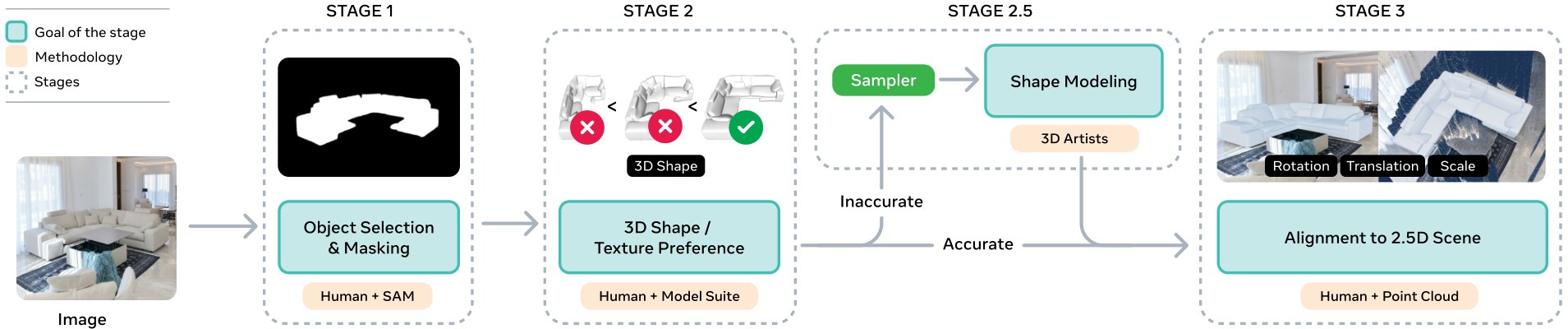
Figure 5: Life of an example going through the data collection pipeline. We streamline annotation by breaking it into subtasks: annotators first choose target objects (Stage 1); rank and select 3D model candidates (Stage 2); then pose these models within a 2.5D scene (Stage 3). Stages 2 and 3 use model-in-the-loop.
图 5:一个样本走过数据收集流程的一生。 我们把标注拆成子任务来简化流程:标注员先选择目标物体(第 1 阶段);再对三维模型候选排序并选择(第 2 阶段);然后把这些模型摆放到 2.5D 场景中(第 3 阶段)。第 2、第 3 阶段使用模型在环。
3.2 Post-Training: Real-World Alignment
3.2 后训练:真实世界对齐
In post-training, we have two goals. The first is to close the domain gap between (semi-)synthetic data and natural images. The second is to align with human preference for shape quality. We adapt the model by using our data engine iteratively; we first (i) collect training data with the current model, and then (ii) update our model using multi-stage post-training on this collected data. We then repeat.
在后训练中,我们有两个目标。第一是缩小(半)合成数据与自然图像之间的域差距。第二是对齐人对形状质量的偏好。我们用数据引擎迭代地适配模型:先 (i)用当前模型收集训练数据,再 (ii)在这些收集到的数据上通过多阶段后训练更新模型。然后重复这一过程。
3.2.1 Post-Training: Collection Step
The core challenge with collecting data for 3D visual grounding is that most people cannot create meshes directly; this requires skilled 3D artists, who even then can take multiple hours. This is different from the segmentation masks collected in SAM (Kirillov et al., 2023). However, given options, most people can choose which mesh resembles an object in the image most accurately. This fact forms the foundation of our data collection for SAM 3D. We convert preferences into training data as follows: sample from our post-trained model, ask annotators to choose the best candidate and then grade its overall quality according to a rubric which we define and update. If the quality meets the (evolving) bar, the candidate becomes a training sample.
3.2.1 后训练:收集步骤
为三维视觉锚定收集数据的核心困难是:大多数人无法直接创建网格;这需要熟练的三维艺术家,即便如此也可能花费数小时。这与 SAM(Kirillov et al., 2023)中收集的分割掩码不同。不过,在给出选项时,大多数人能够选出哪一个网格与图像中的物体最相像。这一事实构成了我们为 SAM 3D 收集数据的基础。我们把偏好转成训练数据的做法如下:从经过后训练的模型中采样,请标注员选出最好的候选,再按我们定义并更新的细则给总体质量打分。如果质量达到(不断演进的)门槛,该候选就成为训练样本。
Unfortunately at the first iteration, our initial model yields few high-quality candidates. This is because before the first collection step, very little real-world data for 3D visual grounding exists. We deal with this cold start problem by leveraging a suite of existing learned and retrieval-based models to produce candidates. In early stages, we draw mostly from the ensemble, but as training progresses our best model dominates, eventually producing about of the annotated data seen by SAM 3D.
可惜在第一次迭代时,初始模型只能给出很少的高质量候选。这是因为在第一次收集步骤之前,几乎不存在用于三维视觉锚定的真实世界数据。我们借助一套已有的学习式和检索式模型来产生候选,以应对这一冷启动问题。在早期阶段,我们主要从这个集成中取样,但随着训练推进,我们最好的模型逐渐占主导,最终产生了 SAM 3D 所见标注数据中约 的部分。
Our annotation pipeline collects 3D object shape , texture , orientation , 3D location , and scale from real-world images. We streamline the process by dividing into subtasks and leveraging existing appropriate models and human annotators within each (see Figure 5): identifying target objects, 3D model ranking and selection, and posing these within a 3D scene (relative to a point map). We outline each stage of the data engine below and present details in Appendix A. In total, we annotate almost million images with million untextured meshes and K textured meshes–unprecedented scale for 3D data paired with natural images.
我们的标注流程从真实世界图像中收集三维物体形状 、纹理 、朝向 、三维位置 和尺度 。我们把过程拆成子任务,并在每个子任务中利用已有的合适模型和人类标注员(见图 5):识别目标物体、三维模型的排序与选择,以及把它们摆放到三维场景中(相对于点图)。下面概述数据引擎的各个阶段,细节见附录 A。我们总共为将近 万张图像标注了约 万个无纹理网格和约 万个带纹理网格——这对与自然图像成对的三维数据而言,规模是前所未有的。
Stage 1: Choosing target objects .
The goal of this stage is to identify a large, diverse set of images and object masks to lift to 3D. To ensure generalization across objects and scenes, we sample images from several diverse real-world datasets, and utilize a 3D-oriented taxonomy to balance the object distribution. To obtain object segmentation masks, we use a combination of pre-existing annotations (Kirillov et al., 2023) and human labelers selecting objects of interest.
第 1 阶段:选择目标物体 。
这一阶段的目标是找出大量、多样的图像 和物体掩码 ,以便提升到三维。为了保证在物体和场景上的泛化,我们从若干多样的真实世界数据集中采样图像,并用一套面向三维的分类体系来平衡物体分布。为了得到物体分割掩码,我们结合使用已有标注(Kirillov et al., 2023)和由人类标注员选择感兴趣的物体。
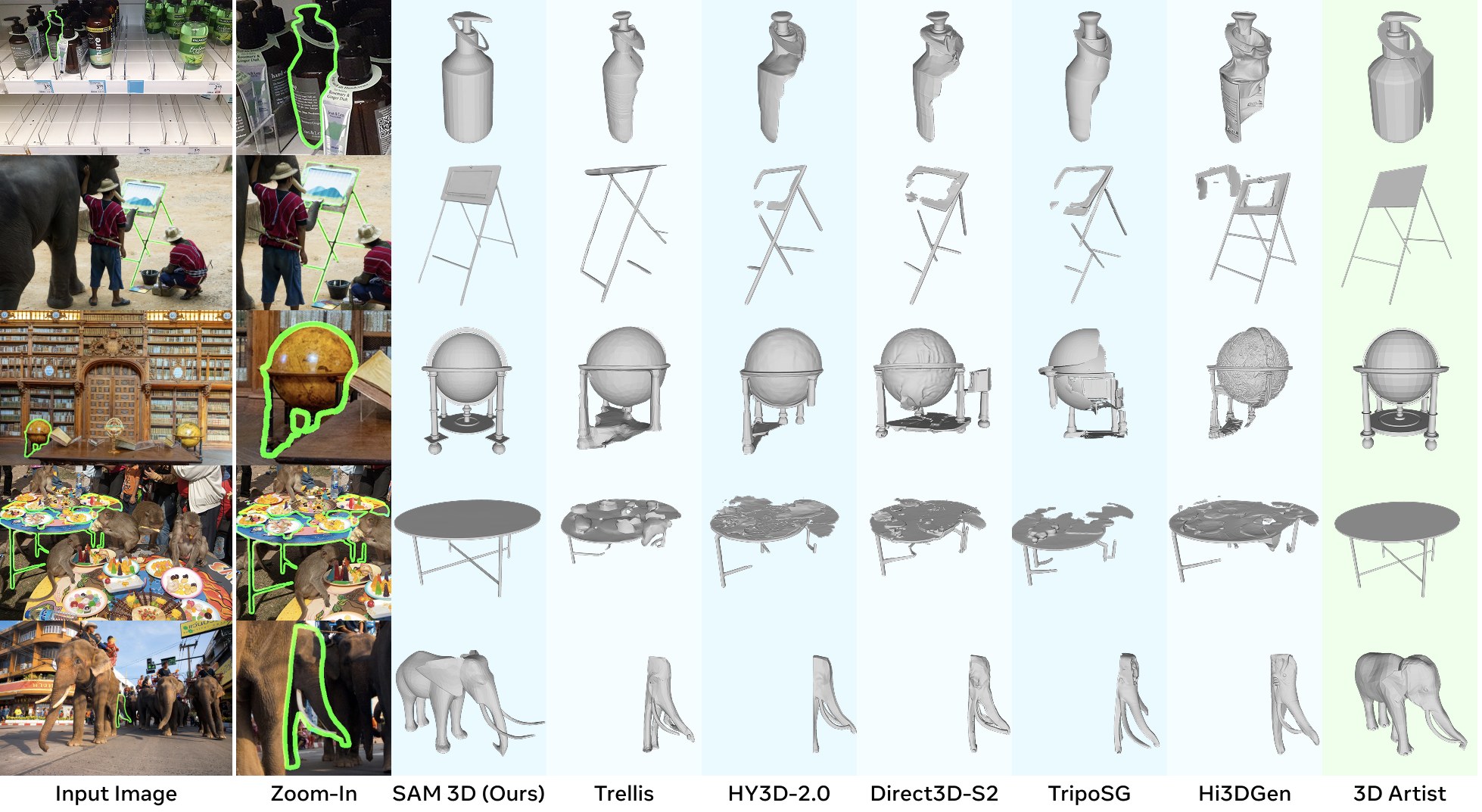
Figure 6: Qualitative comparison to competing image-to-3D asset methods. We compare to the recent Trellis (Xiang et al., 2025), Hunyuan3D-2.1 (Hunyuan3D et al., 2025), Direct3D-S2 (Wu et al., 2025a) and Hi3DGen (Ye et al., 2025) on the artist-generated SA-3DAO for single shape reconstruction; we provide the 3D artist-created ground truth mesh as reference.
图 6:与相互竞争的图像到三维资产方法的定性比较。 我们在艺术家生成的 SA-3DAO 上,与近期的 Trellis(Xiang et al., 2025)、Hunyuan3D-2.1(Hunyuan3D et al., 2025)、Direct3D-S2(Wu et al., 2025a)和 Hi3DGen(Ye et al., 2025)比较单形状重建;并提供三维艺术家创建的真值网格作为参考。
Stage 2: Object model ranking and selection .
The goal of this stage is to collect image-grounded 3D shape and texture . As described above, human annotators choose shape and texture candidates which best match the input image and mask. Annotators rate the example and reject chosen examples that do not meet a predefined quality threshold, i.e. . Bad candidates also become negative examples for preference alignment.
第 2 阶段:物体模型的排序与选择 。
这一阶段的目标是收集与图像锚定的三维形状 和纹理 。如上所述,人类标注员选择与输入图像和掩码最匹配的形状和纹理候选。标注员给该样本打分 ,并拒绝达不到预定质量门槛的已选样本,也就是 。较差的候选也会成为偏好对齐中的负例。
Our data engine maximizes the likelihood of a successful annotation, , by asking annotators to choose between candidates from the ensemble; a form of best-of- search (Ouyang et al., 2022) using humans. The expected quality of this best candidate improves with , and we further increase by first filtering using a model, and then filtering using the human (Anthony et al., 2017); we show results in Section A.7.
我们的数据引擎通过让标注员在来自集成的 个候选中选择,来最大化成功标注()的可能性;这是一种由人执行的 best-of- 搜索(Ouyang et al., 2022)。这个最佳候选的期望质量会随 提高,我们还通过先用模型过滤、再用人类过滤来进一步增大 (Anthony et al., 2017);结果见第 A.7 节。
Stage 2.5: Hard example triage (Artists).
When no model produces a reasonable object shape, our non-specialist annotators cannot correct the meshes, resulting in a lack of data precisely where the model needs it most. We route a small percentage of these hardest cases to professional 3D artists for direct annotation, and we denote this set Art-3DO.
第 2.5 阶段:困难样本分流(艺术家)。
当没有任何模型能给出合理的物体形状时,非专业标注员也无法修正这些网格,于是恰恰在模型最需要数据的地方出现了缺口。我们把一小部分最困难的情形转给专业三维艺术家直接标注,并把这批数据记为 Art-3DO。
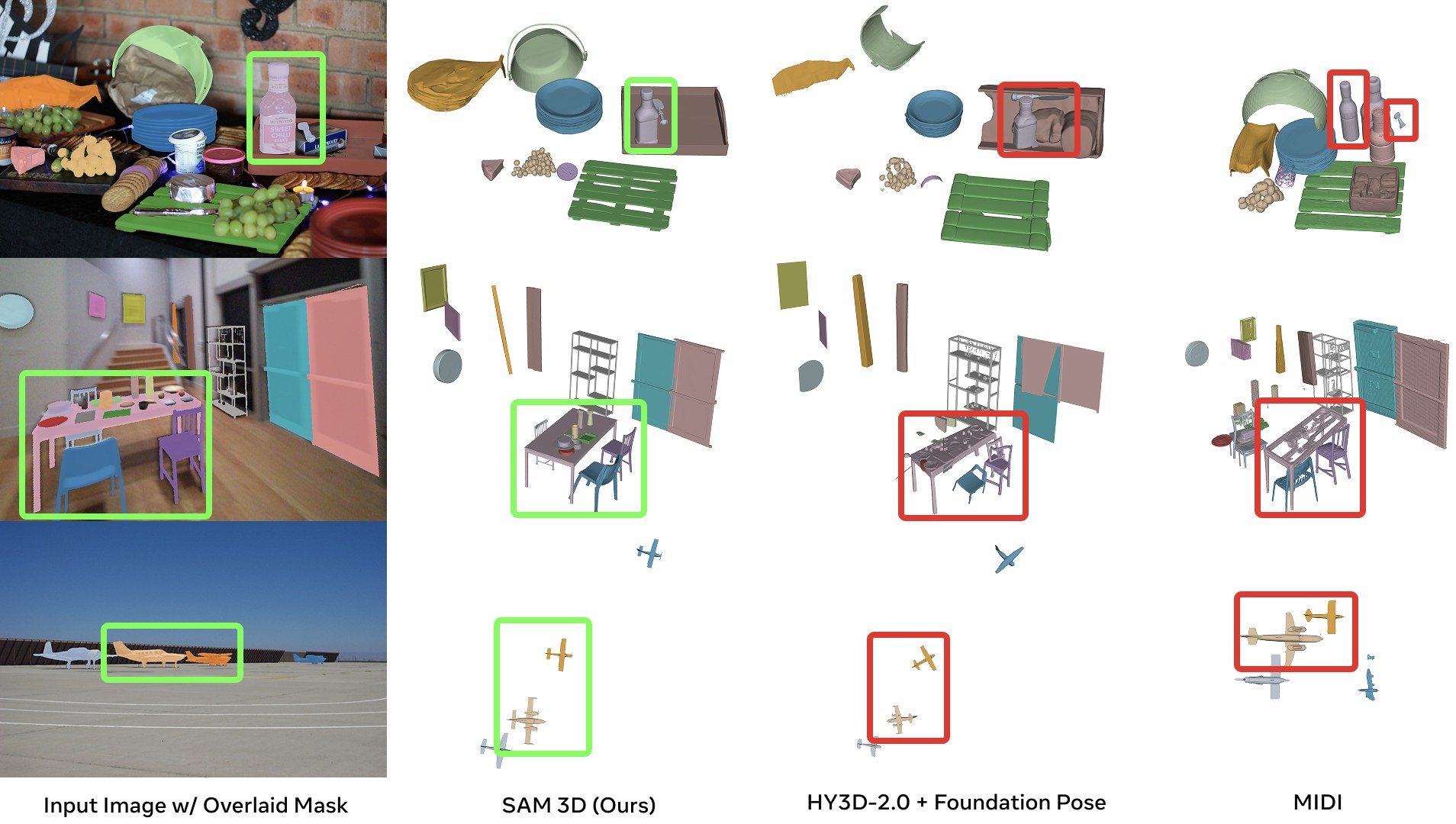
Figure 7: Qualitative comparison to competing scene reconstruction methods. We show SAM 3D’s full 3D scene reconstructions versus alternatives (Wen et al., 2024; Huang et al., 2025).
图 7:与相互竞争的场景重建方法的定性比较。 我们展示 SAM 3D 的完整三维场景重建,并与其他方法对照(Wen et al., 2024;Huang et al., 2025)。
Stage 3: Aligning objects to 2.5D scene .
The previous stages produce a 3D shape for the object, but not its layout in the scene. For each stage 2 shape, annotators label the object pose by manipulating the 3D object’s translation, rotation, and scale relative to a point cloud. We find that point clouds provide enough structure to enable consistent shape placement and orientation.
第 3 阶段:把物体对齐到 2.5D 场景 。
前面的阶段为物体给出了三维形状,但还没有它在场景中的布局。对每个第 2 阶段得到的形状,标注员通过相对于点云调整该三维物体的平移、旋转和尺度来标注姿态。我们发现,点云提供了足够的结构,使形状的放置和朝向能够保持一致。
In general, we can think of the data collection as an API that takes a current best model, , and returns (i) training samples , (ii) a quality rating , and (iii) a set of less preferred candidates () that are all worse than the training sample.
一般而言,可以把数据收集看成一个 API:它接受当前最好的模型 ,并返回(i)训练样本 ,(ii)质量评分 ,以及(iii)一组不那么受偏好的候选(),它们都比该训练样本更差。
3.2.2 Post-Training: Model Improvement Step
The model improvement step in SAM 3D uses these training samples and preference results to update the base model through multiple stages of finetuning and preference alignment. Within each post-training iteration we aggregate data from all previous collection steps; keeping only samples where is above some quality threshold . As training progresses, can increase over time, similar to the cross-entropy method for optimization (de Boer et al., 2005). Our final post-training iteration uses 0.5 trillion training tokens.
3.2.2 后训练:模型改进步骤
SAM 3D 的模型改进步骤利用这些训练样本和偏好结果,通过多阶段微调和偏好对齐来更新基座模型。在每一次后训练迭代中,我们汇总此前所有收集步骤中的数据,只保留 高于某个质量门槛 的样本。随着训练推进, 可以提高,这类似于优化中的交叉熵方法(de Boer et al., 2005)。我们最后一次后训练迭代使用了 0.5 万亿训练词元。
Supervised Fine-Tuning (SFT).
When post-training begins, the base model has only seen synthetic data. Due to the large domain gap between synthetic and real-world data, we begin by finetuning on our aligned meshes from Stage 3.
监督微调(SFT)。
后训练开始时,基座模型只见过合成数据。由于合成数据与真实世界数据之间的域差距很大,我们首先在来自第 3 阶段的已对齐网格上微调。
We begin SFT with the noisier non-expert labels (MITL-3DO), followed by the smaller, high-quality set from 3D artists (Art-3DO). The high quality Art-3DO data enhances model quality by aligning outputs with artists’ aesthetic preferences. We find this helps suppress common failures, e.g. floaters, bottomless meshes, and missing symmetry.
我们先从噪声较大的非专家标注(MITL-3DO)开始做 SFT,再接着使用来自三维艺术家的较小但高质量集合(Art-3DO)。高质量的 Art-3DO 数据通过把输出对齐到艺术家的审美偏好来提升模型质量。我们发现这有助于抑制常见失败,例如漂浮物、没有底部的网格,以及缺失的对称性。
Preference optimization (alignment).
After fine-tuning, the model can robustly generate shape and layout for diverse objects and real-world images. However, humans are sensitive to properties like symmetry, closure, etc. which are difficult to capture with generic objectives like flow matching. Thus, we follow SFT with a stage of direct preference optimization (DPO) (Rafailov et al., 2023), using / pairs from Stage 2 of our data engine. We found this off-policy data was effective at eliminating undesirable model outputs, even after SFT on Art-3DO. DPO training details are in Section C.3.
偏好优化(对齐)。
微调之后,模型已经能够稳健地为多样物体和真实世界图像生成形状和布局。不过,人对对称性、封闭性等性质很敏感,而这些性质很难用流匹配这类通用目标来捕捉。因此,我们在 SFT 之后再做一阶段直接偏好优化(DPO)(Rafailov et al., 2023),使用来自数据引擎第 2 阶段的 / 对。我们发现,即便在 Art-3DO 上做完 SFT 之后,这种离策略数据仍能有效消除不受欢迎的模型输出。DPO 的训练细节见第 C.3 节。
Distillation.
Finally, to enable sub-second shape and layout from the Geometry model, we finish a short distillation stage to reduce the number of function evaluations (NFE) required during inference from . We adapt Frans et al. (2024) to our setting, and describe the details in Section C.4.
蒸馏。
最后,为了让几何模型能够在一秒以内给出形状和布局,我们再做一个简短的蒸馏阶段,把推理所需的函数求值次数(NFE)从 。我们把 Frans et al. (2024) 适配到我们的设定中,细节见第 C.4 节。
4 Experiments
4 实验
| SA-3DAO | ISO3D Eval Set | |||||
|---|---|---|---|---|---|---|
| Model | F1@0.01 () | vIoU () | Chamfer () | EMD () | ULIP () | Uni3D () |
| Trellis | 0.1475 | 0.1392 | 0.0902 | 0.2131 | 0.1473 | 0.3698 |
| HY3D-2.1 | 0.1399 | 0.1266 | 0.1126 | 0.2432 | 0.1293 | 0.3546 |
| HY3D-2.0 | 0.1574 | 0.1504 | 0.0866 | 0.2049 | 0.1484 | 0.3662 |
| Direct3D-S2 | 0.1513 | 0.1465 | 0.0962 | 0.2160 | 0.1405 | 0.3653 |
| TripoSG | 0.1533 | 0.1445 | 0.0844 | 0.2057 | 0.1529 | 0.3687 |
| Hi3DGen | 0.1629 | 0.1531 | 0.0937 | 0.2134 | 0.1419 | 0.3594 |
| SAM 3D | 0.2344 | 0.2311 | 0.0400 | 0.1211 | 0.1488 | 0.3707 |
Table 2: 3D shape quantitative comparison to competing image-to-3D methods, including Trellis (Xiang et al., 2025), HY3D-2.1 (Hunyuan3D et al., 2025), HY3D-2.0 (Team, 2025), Direct3D-S2 (Wu et al., 2025a), TripoSG (Li et al., 2025), Hi3DGen (Ye et al., 2025). SA-3DAO shows metrics that measure accuracy against GT geometry; ISO3D (Ebert, 2025) has no geometric GT and so we show perceptual similarities between 3D and input images (ULIP (Xue et al., 2023) and Uni3D (Zhou et al., 2023)). TripoSG uses a significantly higher mesh resolution, which is rewarded in perceptual metrics.
| SA-3DAO | ISO3D 评测集 | |||||
|---|---|---|---|---|---|---|
| 模型 | F1@0.01 () | vIoU () | Chamfer () | EMD () | ULIP () | Uni3D () |
| Trellis | 0.1475 | 0.1392 | 0.0902 | 0.2131 | 0.1473 | 0.3698 |
| HY3D-2.1 | 0.1399 | 0.1266 | 0.1126 | 0.2432 | 0.1293 | 0.3546 |
| HY3D-2.0 | 0.1574 | 0.1504 | 0.0866 | 0.2049 | 0.1484 | 0.3662 |
| Direct3D-S2 | 0.1513 | 0.1465 | 0.0962 | 0.2160 | 0.1405 | 0.3653 |
| TripoSG | 0.1533 | 0.1445 | 0.0844 | 0.2057 | 0.1529 | 0.3687 |
| Hi3DGen | 0.1629 | 0.1531 | 0.0937 | 0.2134 | 0.1419 | 0.3594 |
| SAM 3D | 0.2344 | 0.2311 | 0.0400 | 0.1211 | 0.1488 | 0.3707 |
表 2:与相互竞争的图像到三维方法的三维形状定量比较,包括 Trellis(Xiang et al., 2025)、HY3D-2.1(Hunyuan3D et al., 2025)、HY3D-2.0(Team, 2025)、Direct3D-S2(Wu et al., 2025a)、TripoSG(Li et al., 2025)、Hi3DGen(Ye et al., 2025)。SA-3DAO 给出的是相对几何真值的精度指标;ISO3D(Ebert, 2025)没有几何真值,因此我们给出三维结果与输入图像之间的感知相似度(ULIP(Xue et al., 2023)和 Uni3D(Zhou et al., 2023))。TripoSG 使用了明显更高的网格分辨率,这在感知指标上会得到奖励。
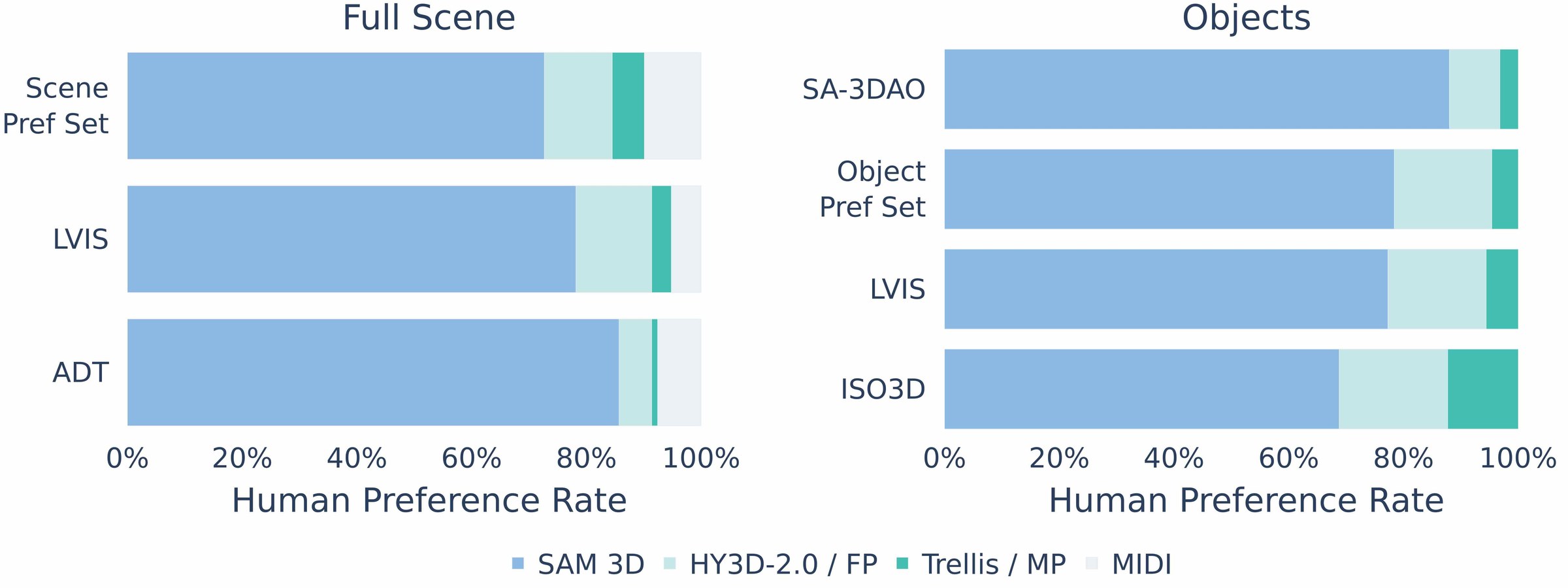
Figure 8: Preference comparison on scene-level and object-level reconstruction. Numbers indicate human preference rates. Objects comparisons are done on textured meshes. SAM 3D is significantly preferred over others on all fronts.
图 8:场景级和物体级重建上的偏好比较。 数字表示人人偏好率。物体比较在带纹理的网格上进行。SAM 3D 在所有方面都明显更受偏好。
Dataset.
To comprehensively evaluate the model capability under real-world scenarios, we carefully build a new benchmark SA-3DAO[^1], consisting of 1K 3D artist-created meshes created from natural images. We also include ISO3D from 3D Arena (Ebert, 2025) for quantitatively evaluating shape and texture, and Aria Digital Twin (ADT) (Pan et al., 2023) for layout. We further conduct human preference evaluation on two curated sets for both scene-level and object-level reconstruction. The Pref Set uses real-world images from MetaCLIP (Xu et al., 2024a) and SA-1B (Kirillov et al., 2023), as well as a set based on LVIS (Gupta et al., 2019). Refer to Appendix D for details on evaluation sets.
数据集。
为了全面评估模型在真实世界场景下的能力,我们精心构建了新基准 SA-3DAO[^1],包含 1000 个由三维艺术家根据自然图像创建的网格。我们还纳入 3D Arena(Ebert, 2025)中的 ISO3D,用于定量评估形状和纹理,以及 Aria Digital Twin(ADT)(Pan et al., 2023),用于评估布局。我们进一步在两份整理好的集合上,分别对场景级和物体级重建做人人偏好评估。Pref Set 使用来自 MetaCLIP(Xu et al., 2024a)和 SA-1B(Kirillov et al., 2023)的真实世界图像,以及一份基于 LVIS(Gupta et al., 2019)的集合。评测集的细节见附录 D。
Settings.
We conduct experiments with a Geometry model trained to condition on pointmaps. For datasets where pointmaps are unavailable, we estimate them with Wang et al. (2025a). We found that shape and texture quality do not depend on whether the model is trained with pointmap conditioning (see Section E.5), but layout (translation/scale) evaluation in Table 3 requires ground-truth depth/pointmap as reference.
设置。
我们用一个被训练为以点图为条件的几何模型做实验。对于没有点图的数据集,我们用 Wang et al. (2025a) 来估计点图。我们发现,形状和纹理质量并不依赖于模型是否在点图条件下训练(见第 E.5 节),但表 3 中的布局(平移/尺度)评测需要真值深度/点图作为参考。
4.1 Comparison with SOTA
4.1 与当时最好方法的比较
| SA-3DAO | Aria Digital Twin | ||||||||
|---|---|---|---|---|---|---|---|---|---|
| Generation | Model | 3D IoU () | ICP-Rot. () | ADD-S () | ADD-S @ 0.1 () | 3D IoU () | ICP-Rot. () | ADD-S () | ADD-S @ 0.1 () |
| Pipeline | Trellis + Megapose | 0.2449 | 39.3866 | 0.5391 | 0.2831 | 0.2531 | 33.6114 | 0.4358 | 0.1971 |
| Pipeline | HY3D-2.0 + Megapose | 0.2518 | 33.8307 | 0.7146 | 0.3647 | 0.3794 | 29.0066 | 0.1457 | 0.4211 |
| Pipeline | HY3D-2.0 + FoundationPose | 0.2937 | 32.9444 | 0.3705 | 0.5396 | 0.3864 | 25.1435 | 0.1026 | 0.5992 |
| Pipeline | HY3D-2.1 + FoundationPose | 0.2395 | 39.8357 | 0.4186 | 0.4177 | 0.2795 | 33.1197 | 0.2135 | 0.4129 |
| Pipeline | SAM 3D + FoundationPose | 0.2837 | 32.9168 | 0.3848 | 0.5079 | 0.3661 | 18.9102 | 0.0930 | 0.6495 |
| Joint | MIDI | - | - | - | - | 0.0336 | 44.2353 | 2.5278 | 0.0175 |
| Joint | SAM 3D | 0.4254 | 20.7667 | 0.2661 | 0.7232 | 0.4970 | 15.2515 | 0.0765 | 0.7673 |
Table 3: 3D layout quantitative comparison to competing layout prediction methods on SA-3DAO and Aria Digital Twin (Pan et al., 2023). SAM 3D significantly outperforms both pipeline approaches used in robotics (Labbé et al., 2022; Wen et al., 2024) and joint generative models (MIDI (Huang et al., 2025)). Most SA-3DAO scenes only contain one object so we do not show MIDI results that require multi-object alignment. The metrics measure bounding box overlap, rotation error, and chamfer-like distances normalized by object diameter.
| SA-3DAO | Aria Digital Twin | ||||||||
|---|---|---|---|---|---|---|---|---|---|
| 生成方式 | 模型 | 3D IoU () | ICP-Rot. () | ADD-S () | ADD-S @ 0.1 () | 3D IoU () | ICP-Rot. () | ADD-S () | ADD-S @ 0.1 () |
| 流水线 | Trellis + Megapose | 0.2449 | 39.3866 | 0.5391 | 0.2831 | 0.2531 | 33.6114 | 0.4358 | 0.1971 |
| 流水线 | HY3D-2.0 + Megapose | 0.2518 | 33.8307 | 0.7146 | 0.3647 | 0.3794 | 29.0066 | 0.1457 | 0.4211 |
| 流水线 | HY3D-2.0 + FoundationPose | 0.2937 | 32.9444 | 0.3705 | 0.5396 | 0.3864 | 25.1435 | 0.1026 | 0.5992 |
| 流水线 | HY3D-2.1 + FoundationPose | 0.2395 | 39.8357 | 0.4186 | 0.4177 | 0.2795 | 33.1197 | 0.2135 | 0.4129 |
| 流水线 | SAM 3D + FoundationPose | 0.2837 | 32.9168 | 0.3848 | 0.5079 | 0.3661 | 18.9102 | 0.0930 | 0.6495 |
| 联合 | MIDI | - | - | - | - | 0.0336 | 44.2353 | 2.5278 | 0.0175 |
| 联合 | SAM 3D | 0.4254 | 20.7667 | 0.2661 | 0.7232 | 0.4970 | 15.2515 | 0.0765 | 0.7673 |
表 3:在 SA-3DAO 和 Aria Digital Twin(Pan et al., 2023)上,与相互竞争的布局预测方法的三维布局定量比较。SAM 3D 明显优于机器人中常用的流水线方法(Labbé et al., 2022;Wen et al., 2024),以及联合生成模型(MIDI(Huang et al., 2025))。大多数 SA-3DAO 场景只包含一个物体,因此我们不展示需要多物体对齐的 MIDI 结果。这些指标衡量的是边界框重叠、旋转误差,以及按物体直径归一化的类 Chamfer 距离。
3D shape and texture.
We evaluate single-object generation by comparing SAM 3D with prior state-of-the-art (SOTA) methods. In human preference studies, SAM 3D achieves a head-to-head win rate on real images (see Figure 8). Table 2 presents quantitative evaluation on shape quality, where SAM 3D matches or exceeds previous SOTA performance on isolated object images (ISO3D), and significantly outperforms all baselines on challenging real-world inputs (SA-3DAO). Qualitative examples in Figure 6 further illustrate the model’s strong generalization under heavy occlusion. In Figure 9, we compare SAM 3D texture vs. other texture models, given SAM 3D shapes (SAM 3D’s improved shape actually benefits other methods in this eval). Annotators significantly prefer SAM 3D texture (details in Section E.2).
三维形状与纹理。
我们通过把 SAM 3D 与先前最好(SOTA)方法比较,来评估单物体生成。在人人偏好研究中,SAM 3D 在真实图像上取得了 的两两胜率(见图 8)。表 2 给出形状质量的定量评估:在孤立物体图像(ISO3D)上,SAM 3D 达到或超过先前最好成绩;在有挑战性的真实世界输入(SA-3DAO)上,则显著优于所有基线。图 6 中的定性例子进一步说明了模型在严重遮挡下的较强泛化。在图 9 中,我们在给定 SAM 3D 形状的条件下,比较 SAM 3D 纹理与其他纹理模型(在这项评测中,SAM 3D 更好的形状实际上也有利于其他方法)。标注员明显更偏好 SAM 3D 的纹理(细节见第 E.2 节)。
3D scene reconstruction.
In preference tests on three evaluation sets, users prefer scene reconstructions from SAM 3D by over prior SOTA (Figure 8). Figure 7 and Figure 24 in the appendix show qualitative comparisons, while Table 3 shows quantitative metrics for object layout. On real-world data like SA-3DAO and ADT, the improvement is fairly stark and persists even when pipeline approaches use SAM 3D meshes. SAM 3D introduces a new real-world capability to generate shape and layout jointly (ADD-S @ 0.1 ), and a sample-then-optimize approach, as in the render-and-compare approaches (Labbé et al., 2022; Wen et al., 2024) can further improve performance (Section E.3). The strong results for layout and scene reconstruction demonstrate that SAM 3D can robustly handle both RGB-only inputs (e.g., SA-3DAO, LVIS, Pref Set) as well as provided pointmaps (e.g., ADT).
三维场景重建。
在三份评测集上的偏好测试中,用户对 SAM 3D 场景重建的偏好约为先前最好方法的 (图 8)。图 7 和附录中的图 24 给出定性比较,表 3 给出物体布局的定量指标。在 SA-3DAO 和 ADT 这类真实世界数据上,提升相当明显,即便流水线方法使用 SAM 3D 的网格,这一优势仍然存在。SAM 3D 引入了一种新的真实世界能力:联合生成形状和布局(ADD-S @ 0.1 从 到 );而先采样再优化的做法,正如 render-and-compare 一类方法(Labbé et al., 2022;Wen et al., 2024)那样,还能进一步提升性能(第 E.3 节)。布局和场景重建上的强结果说明,SAM 3D 既能稳健处理仅有 RGB 的输入(例如 SA-3DAO、LVIS、Pref Set),也能处理给定的点图(例如 ADT)。
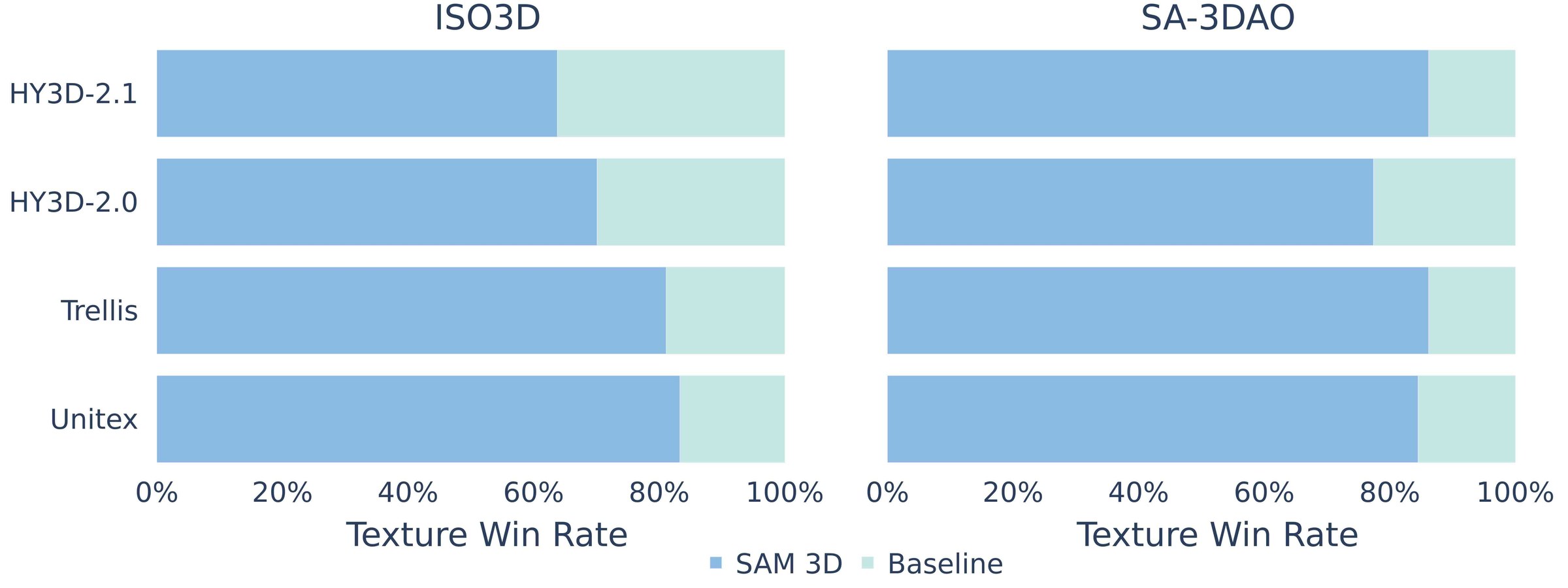
Figure 9: Preference comparison on texture. Since SAM 3D provides higher quality shape, we use the geometry results from SAM 3D and only perform texture generations for all methods. SAM 3D significantly outperforms others.
图 9:纹理上的偏好比较。由于 SAM 3D 提供了更高质量的形状,我们对所有方法都使用 SAM 3D 的几何结果,只比较纹理生成。SAM 3D 明显优于其他方法。
4.2 Analysis Studies
4.2 分析研究
Post-training iterations steadily improve performance.
We observed steady improvements as we ran the data engine for longer, with near-linear Elo scaling shown in the historical comparisons from Stage 2 of our data engine (Figure 12). We found it important to scale all stages simultaneously. The cumulatively linear effect results from more data engine iterations, along with scaling up pretraining, mid-training, and adding new post-training stages. Figure 12 shows that iterating MITL-3DO data alone yields consistent improvements but with decreasing marginal impact.
后训练迭代会稳步提升性能。
我们观察到,数据引擎运行得越久,性能就越稳步提高;数据引擎第 2 阶段的历史比较呈现出近乎线性的 Elo 扩展(图 12)。我们发现,同时扩大所有阶段很重要。这种累积的近线性效果,来自更多的数据引擎迭代,以及扩大预训练、中期训练,并加入新的后训练阶段。图 12 还表明,仅迭代 MITL-3DO 数据也会带来持续改进,但边际影响在下降。
| SA-3DAO | Preference set | ||||
|---|---|---|---|---|---|
| Training Stage | F1 @ 0.01 () | vIoU () | Chamfer () | EMD () | Texture WR () |
| Pre-training (Iso-3DO) | 0.1349 | 0.1202 | 0.1036 | 0.2396 | - |
| + Mid-training (RP-3DO) | 0.1705 | 0.1683 | 0.0760 | 0.1821 | 60.7 |
| + SFT (MITL-3DO) | 0.2027 | 0.2025 | 0.0578 | 0.1510 | 66.9 |
| + DPO (MITL-3DO) | 0.2156 | 0.2156 | 0.0498 | 0.1367 | 66.4 |
| + SFT (Art-3DO) | 0.2331 | 0.2337 | 0.0445 | 0.1257 | - |
| + DPO (Art-3DO) | 0.2344 | 0.2311 | 0.0400 | 0.1211 | - |
Table 4: Cascading improvements from multi-stage training on 3D shape and texture. For texture, we report win rates (WR) between each row and the row above it.
| SA-3DAO | 偏好集 | ||||
|---|---|---|---|---|---|
| 训练阶段 | F1 @ 0.01 () | vIoU () | Chamfer () | EMD () | 纹理胜率 () |
| 预训练(Iso-3DO) | 0.1349 | 0.1202 | 0.1036 | 0.2396 | - |
| + 中期训练(RP-3DO) | 0.1705 | 0.1683 | 0.0760 | 0.1821 | 60.7 |
| + SFT(MITL-3DO) | 0.2027 | 0.2025 | 0.0578 | 0.1510 | 66.9 |
| + DPO(MITL-3DO) | 0.2156 | 0.2156 | 0.0498 | 0.1367 | 66.4 |
| + SFT(Art-3DO) | 0.2331 | 0.2337 | 0.0445 | 0.1257 | - |
| + DPO(Art-3DO) | 0.2344 | 0.2311 | 0.0400 | 0.1211 | - |
表 4:多阶段训练在三维形状和纹理上的级联改进。对于纹理,我们报告每一行相对于上一行的胜率(WR)。
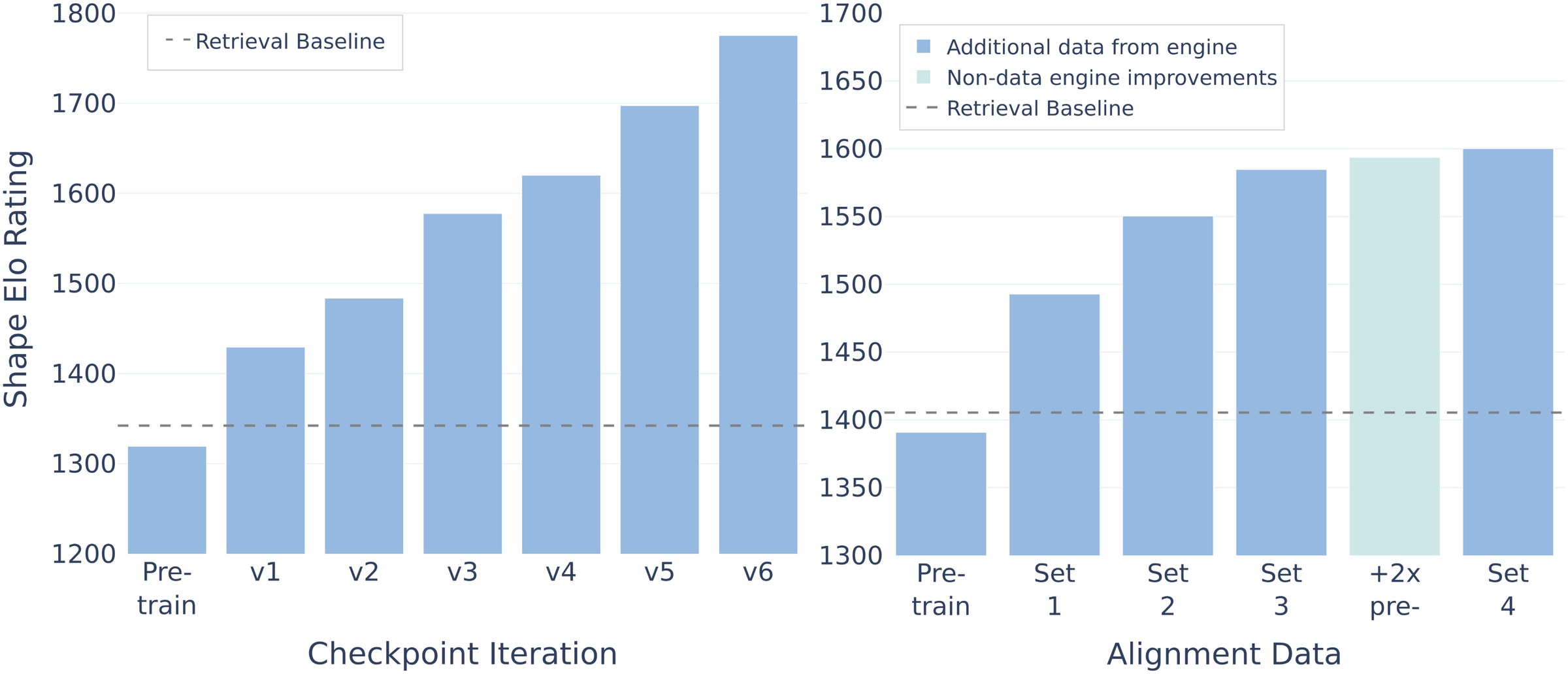
Figure 10: Historical Elo from data engine
Figure 11: Impact of expanding training data
Figure 12: Data engine with additional iterations. The plots show Elo scores of different models; a 400 point Elo difference corresponds to 10:1 odds in a preference test. Models were (a) checkpoints around 3 weeks apart, indicating cumulative improvements as we scale and add different stages and (b) post-trained (SFT) using expanded training data.
图 10:数据引擎的历史 Elo
图 11:扩大训练数据的影响
图 12:带有额外迭代的数据引擎。 图中给出不同模型的 Elo 分数;400 分的 Elo 差距对应于偏好测试中 10:1 的胜算。这些模型分别是 (a) 大约每隔 3 周的检查点,表明随着我们扩大规模并加入不同阶段,改进是累积的;以及 (b) 使用扩大后的训练数据做后训练(SFT)。
Multi-stage training improves performance.
SAM 3D’s real-world performance emerges through multi-stage training. Table 4 reveals near-monotonic 3D shape improvements as each training stage is added, validating the approach that leads to the final model (last row). In the appendix, Figure 19 shows similar results for texture and Table 7 shows the contribution of each individual real-world data stage, by knocking out the MITL-3DO, Art-3DO data, or DPO stages.
多阶段训练会提升性能。
SAM 3D 的真实世界性能是通过多阶段训练涌现出来的。表 4 显示,每增加一个训练阶段,三维形状几乎都单调改进,从而验证了通向最终模型(最后一行)的这条路径。在附录中,图 19 给出了纹理上的类似结果,表 7 则通过去掉 MITL-3DO、Art-3DO 数据或 DPO 阶段,展示各个真实世界数据阶段各自的贡献。
Other ablations.
Please see the appendix for additional ablations on rotation representation (Section E.4), DPO (Section C.3), distillation (Section C.4), pointmaps (Section E.5), and scaling best-of- in the data engine (Section A.7).
其他消融。
关于旋转表示(第 E.4 节)、DPO(第 C.3 节)、蒸馏(第 C.4 节)、点图(第 E.5 节)以及在数据引擎中扩大 best-of-(第 A.7 节)的更多消融,请见附录。
5 Related Work
5 相关工作
3D reconstruction
has been a longstanding challenge in computer vision. Classical methods leverage multiple views and include binocular stereopsis (Wheatstone, 1838), structure-from-motion (Hartley and Zisserman, 2003; Szeliski, 2022; Scharstein and Szeliski, 2002; Torresani et al., 2008; Tomasi and Kanade, 1992), and SLAM (Smith et al., 1990; Castellanos et al., 1999). Other strategies reconstruct by analysis (e.g., silhouettes (Esteban and Schmitt, 2004)) or by synthesis via volume rendering (Kajiya and Von Herzen, 1984), using either implicit representations (Mildenhall et al., 2020) or explicit ones (Sitzmann et al., 2019; Liu et al., 2020). Supervised deep learning methods predict voxels (Xie et al., 2019; Wang et al., 2021), point clouds (Van Hoorick et al., 2022), or meshes (Worchel et al., 2022; Wen et al., 2019), or optimize implicit representations (Liu et al., 2024), e.g., signed distance functions (SDFs), often with high-quality output but requiring multiple views at inference. In contrast, we focus on the more restrictive setting of a single RGB image at test time.
三维重建
一直是计算机视觉中的长期挑战。经典方法利用多个视图,包括双眼立体视觉(Wheatstone, 1838)、运动恢复结构(Hartley and Zisserman, 2003;Szeliski, 2022;Scharstein and Szeliski, 2002;Torresani et al., 2008;Tomasi and Kanade, 1992),以及 SLAM(Smith et al., 1990;Castellanos et al., 1999)。其他策略通过分析来重建(例如轮廓(Esteban and Schmitt, 2004)),或通过体积渲染以合成的方式重建(Kajiya and Von Herzen, 1984),既使用隐式表示(Mildenhall et al., 2020),也使用显式表示(Sitzmann et al., 2019;Liu et al., 2020)。有监督的深度学习方法预测体素(Xie et al., 2019;Wang et al., 2021)、点云(Van Hoorick et al., 2022)或网格(Worchel et al., 2022;Wen et al., 2019),或优化隐式表示(Liu et al., 2024),例如有向距离函数(SDF);它们常常能给出高质量输出,但在推理时需要多个视图。与之不同,我们关注的是测试时只有单张 RGB 图像这一更受限制的设定。
Single-view 3D reconstruction
is considerably more difficult. A large body of work trains reconstruction models with direct 3D supervision, predicting meshes (Xu et al., 2019; Kulkarni et al., 2022), voxels (Girdhar et al., 2016; Wu et al., 2017; Popov et al., 2020), point clouds (Fan et al., 2017; Mescheder et al., 2019), or CAD-aligned geometry (Wang et al., 2018; Gkioxari et al., 2019). More recently, large internet corpora of 3D object assets have enabled a line of generative approaches trained using VAE (Kingma and Welling, 2013) latent representations (Zhang et al., 2023; Xiang et al., 2025; Ren et al., 2024). A related challenge is recovering the full shape of occluded objects from a partial mask (Xu et al., 2024b; Wu et al., 2025b); SAM 3D handles this through data rather than architecture. However, existing generative methods are typically evaluated on simplified synthetic single-object benchmarks such as ShapeNet (Chang et al., 2015), Pix3D (Sun et al., 2018), or Objaverse (Deitke et al., 2023).
单视图三维重建
要困难得多。大量工作用直接的三维监督来训练重建模型,预测网格(Xu et al., 2019;Kulkarni et al., 2022)、体素(Girdhar et al., 2016;Wu et al., 2017;Popov et al., 2020)、点云(Fan et al., 2017;Mescheder et al., 2019),或与 CAD 对齐的几何(Wang et al., 2018;Gkioxari et al., 2019)。最近,互联网上的大规模三维物体资产使得一类生成式方法成为可能,它们用 VAE(Kingma and Welling, 2013)的潜在表示来训练(Zhang et al., 2023;Xiang et al., 2025;Ren et al., 2024)。一个相关挑战是从部分掩码恢复被遮挡物体的完整形状(Xu et al., 2024b;Wu et al., 2025b);SAM 3D 是通过数据而不是结构来处理这一点的。不过,已有生成方法通常是在简化的合成单物体基准上评测的,例如 ShapeNet(Chang et al., 2015)、Pix3D(Sun et al., 2018)或 Objaverse(Deitke et al., 2023)。
Layout estimation
extends single-instance estimation to full scenes. Instead of predicting a single mesh for the entire scene, SAM 3D estimates scene layout by using mask prompts to indicate which objects to reconstruct, and then estimates both shape and pose for each mask instance. Approaches can be decomposed into so-called model-based or model-free methods. Model-based methods decompose the problem into independent parts, first estimating shape (or pulling it from a CAD database) and then posing the objects in the scene (Labbé et al., 2022; Wen et al., 2024; Maninis et al., 2022; Tyszkiewicz et al., 2022; Maninis et al., 2023; Rozumnyi et al., 2023). Alternatively, model-free methods estimate both shape and pose jointly, as in SAM 3D (Brazil et al., 2023; Huang et al., 2025; Yao et al., 2025; Ardelean et al., 2025; Geng et al., 2025; Shi et al., 2025). However, prior approaches are typically restricted to tabletop robotics, streets, or indoor scenes where objects rest on a supporting surface. In contrast, our approach estimates both shape and pose for a broad range of object types across diverse scenes.
布局估计
把单实例估计扩展到完整场景。SAM 3D 并不为整个场景预测一个网格,而是用掩码提示指明要重建哪些物体,再为每个掩码实例估计形状和姿态。这类方法可以分成所谓的基于模型的方法和无模型方法。基于模型的方法把问题拆成相互独立的部分:先估计形状(或从 CAD 库中取出),再把物体摆放到场景中(Labbé et al., 2022;Wen et al., 2024;Maninis et al., 2022;Tyszkiewicz et al., 2022;Maninis et al., 2023;Rozumnyi et al., 2023)。另一类无模型方法则像 SAM 3D 一样联合估计形状和姿态(Brazil et al., 2023;Huang et al., 2025;Yao et al., 2025;Ardelean et al., 2025;Geng et al., 2025;Shi et al., 2025)。不过,先前方法通常局限于桌面机器人、街道,或物体搁在支撑面上的室内场景。与之不同,我们的方法能在多样场景中,为更广泛的物体类型估计形状和姿态。
3D datasets.
Sourcing 3D annotations is challenging: the modality itself is complex, and the specialized tools required are hard to master. Anecdotally, modeling a 3D mesh from a reference image can take an experienced artist hours (Appendix D). Instead, existing 3D datasets (e.g., ShapeNet (Chang et al., 2015), Objaverse-XL (Deitke et al., 2023)) primarily consist of single synthetic objects; without paired real-world images, models can only learn from rendered views. In the real-world domain, existing datasets are small and mostly indoors (Reizenstein et al., 2021; Khanna et al., 2024; Fu et al., 2021; Szot et al., 2021; Pan et al., 2023), or procedurally generated (Dai et al., 2024; Raistrick et al., 2024; Deitke et al., 2022). Models trained on such constrained data struggle to generalize.
三维数据集。
获取三维标注很困难:这一模态本身就复杂,所需的专业工具也很难掌握。根据经验,有经验的艺术家根据参考图像建模一个三维网格也可能花费数小时(附录 D)。因此,已有三维数据集(例如 ShapeNet(Chang et al., 2015)、Objaverse-XL(Deitke et al., 2023))主要由单个合成物体组成;没有成对的真实世界图像,模型就只能从渲染视图中学习。在真实世界领域,已有数据集规模较小,且大多是室内的(Reizenstein et al., 2021;Khanna et al., 2024;Fu et al., 2021;Szot et al., 2021;Pan et al., 2023),或是程序生成的(Dai et al., 2024;Raistrick et al., 2024;Deitke et al., 2022)。在这类受限数据上训练的模型难以泛化。
Post-training.
While post-training began with a single supervised finetuning stage (Girshick et al., 2013; Wei et al., 2021), strong pretraining (Brown et al., 2020) made alignment much more data efficient (Hernandez et al., 2021), enabling iterative preference-based alignment like RLHF (Ouyang et al., 2022) and online DPO (Tang et al., 2024; Rafailov et al., 2023). When post-training must provide a strong steer, self-training methods offer denser supervision–leveraging the model itself to generate increasingly high-quality demonstrations, rather than relying solely on preference signals (Gulcehre et al., 2023; Anthony et al., 2017; Dong et al., 2023; Yuan et al., 2023). SAM 3D employs self-training to bridge the syntheticreal domain gap and break the data barrier for 3D perception; most closely resembling RAFT (Dong et al., 2023), but also incorporating preference tuning.
后训练。
后训练起初只有一个监督微调阶段(Girshick et al., 2013;Wei et al., 2021),而强预训练(Brown et al., 2020)使对齐的数据效率高得多(Hernandez et al., 2021),从而能够进行像 RLHF(Ouyang et al., 2022)和在线 DPO(Tang et al., 2024;Rafailov et al., 2023)这样的迭代式偏好对齐。当后训练必须给出较强引导时,自训练方法能提供更密集的监督:利用模型自身生成质量越来越高的示范,而不是仅仅依赖偏好信号(Gulcehre et al., 2023;Anthony et al., 2017;Dong et al., 2023;Yuan et al., 2023)。SAM 3D 用自训练来弥合合成真实的域差距,并打破三维感知的数据壁垒;它最接近 RAFT(Dong et al., 2023),但也纳入了偏好调优。
Multi-stage pretraining.
Modern pretraining increasingly employs multiple training stages. Early work on curriculum learning (Bengio et al., 2009) provided a basis for staged data mixing in pretraining, with higher-quality data coming later (Grattafiori and others, 2024; OLMo et al., 2025). Li et al. (2023b); Abdin and others (2024) show that mixing synthetic/web curricula can achieve strong performance at smaller scales. Increasingly, additional mid-training stages are used for capability injection, such as context extension (Grattafiori and others, 2024) or coding (Rozière et al., 2024), and recent work finds that mid-training significantly improves post-training effectiveness (Lambert, 2025; Wang et al., 2025b). SAM 3D introduces pretraining and mid-training that can generalize for 3D.
多阶段预训练。
现代预训练越来越多地采用多个训练阶段。关于课程学习的早期工作(Bengio et al., 2009)为预训练中的分阶段数据混合提供了基础,质量更高的数据会放在后面(Grattafiori and others, 2024;OLMo et al., 2025)。Li et al. (2023b);Abdin and others (2024) 表明,混合合成/网络课程可以在较小规模上取得较强性能。越来越多的做法是再加中期训练阶段来注入能力,例如扩展上下文(Grattafiori and others, 2024)或编程(Rozière et al., 2024);近期工作还发现,中期训练会显著提高后训练的效果(Lambert, 2025;Wang et al., 2025b)。SAM 3D 引入了能够为三维泛化的预训练和中期训练。
6 Conclusion
6 结论
We share SAM 3D: a new foundation model for full reconstruction of 3D shape, texture, and layout of objects from natural images. SAM 3D’s robustness on in-the-wild images, made possible by an innovative data engine and modern training recipe, represents a step change for 3D and an advance towards real-world 3D perception. With the release of our model, we expect SAM 3D to unlock new capabilities across diverse applications, such as robotics, AR/VR, gaming, film, and interactive media.
我们分享 SAM 3D:一个新的基础模型,用于从自然图像完整重建物体的三维形状、纹理和布局。凭借创新的数据引擎和现代训练配方,SAM 3D 在野外图像上的鲁棒性,代表着三维领域的一次跃迁,也是迈向真实世界三维感知的一步。随着模型的发布,我们期待 SAM 3D 能在机器人、AR/VR、游戏、影视和交互媒体等多样应用中解锁新的能力。
Acknowledgements
致谢
We thank the following individuals for their contributions to this work:
我们感谢下列人士对本工作的贡献:
For their contributions to SAM Playground Engineering we thank: Robbie Adkins, Rene de la Fuente, Facundo Figueroa, Alex He, Dex Honsa, Alex Lende, Jonny Li, Peter Park, Don Pinkus, Roman Radle, Phillip Thomas, and Meng Wang. We thank our excellent XFN team for leadership and support: Kris Kitani, Vivian Lee, Sasha Mitts, George Orlin, Nikhila Ravi, and Andrew Westbury. Thanks to Helen Klein, Mallika Malhotra, and Azita Shokrpour for support with Legal, Privacy, and Integrity. We thank Michelle Chan, Kei Koyama, William Ngan, Yael Yungster for all the design support throughout the project. Thanks to Arpit Kalla for work on model efficiency. We thank Faye Ma and Kehan Lyu for data engineering support and tooling, and Emmanuel Hernandez, Robert Kuo for pipeline development. We thank Nan Yang for support with egocentric video data efforts. Thanks to our two interns Cem Gokmen, Jasmine Shone for their work on 3D and Lea Wilken for feedback on the manuscript. Thanks to our fantastic data operations team: Paris Baptiste, Karen Bergan, Kai Brown, Ida Cheng, Khadijat Durojaiye, Patrick Edwards, Daniella Factor, Eva Galper, Leonna Jones, Zayida Suber, Tatum Turner, Joseph Walker, and Claudette Ward.
感谢为 SAM Playground 工程作出贡献的:Robbie Adkins、Rene de la Fuente、Facundo Figueroa、Alex He、Dex Honsa、Alex Lende、Jonny Li、Peter Park、Don Pinkus、Roman Radle、Phillip Thomas 和 Meng Wang。感谢出色的跨职能团队在领导和支持上的帮助:Kris Kitani、Vivian Lee、Sasha Mitts、George Orlin、Nikhila Ravi 和 Andrew Westbury。感谢 Helen Klein、Mallika Malhotra 和 Azita Shokrpour 在法律、隐私和诚信方面的支持。感谢 Michelle Chan、Kei Koyama、William Ngan、Yael Yungster 在整个项目中提供的设计支持。感谢 Arpit Kalla 在模型效率上的工作。感谢 Faye Ma 和 Kehan Lyu 在数据工程支持和工具上的帮助,以及 Emmanuel Hernandez、Robert Kuo 在流程开发上的帮助。感谢 Nan Yang 对第一人称视频数据工作的支持。感谢两位实习生 Cem Gokmen、Jasmine Shone 在三维方面的工作,以及 Lea Wilken 对文稿的反馈。感谢出色的数据运营团队:Paris Baptiste、Karen Bergan、Kai Brown、Ida Cheng、Khadijat Durojaiye、Patrick Edwards、Daniella Factor、Eva Galper、Leonna Jones、Zayida Suber、Tatum Turner、Joseph Walker 和 Claudette Ward。
References
参考文献
Abdin et al. (2024) M. Abdin et al. Phi-3 technical report: a highly capable language model locally on your phone . External Links: 2404.14219 , Link Cited by: §5 .
Anthony et al. (2017) T. Anthony, Z. Tian, and D. Barber Thinking fast and slow with deep learning and tree search . In Proceedings of the 31st International Conference on Neural Information Processing Systems , NIPS’17 , Red Hook, NY, USA , pp. 5366–5376 . External Links: ISBN 9781510860964 Cited by: §A.6.1 , §A.8 , §3.2.1 , §5 .
Ardelean et al. (2025) A. Ardelean, M. Özer, and B. Egger Generalizable 3d scene reconstruction via divide and conquer from a single view . In International Conference on 3D Vision (3DV) , Cited by: §5 .
Bengio et al. (2009) Y. Bengio, J. Louradour, R. Collobert, and J. Weston Curriculum learning . In Proceedings of the 26th Annual International Conference on Machine Learning , ICML ’09 , New York, NY, USA , pp. 41–48 . External Links: ISBN 9781605585161 , Link , Document Cited by: §5 .
Bossard et al. (2014) L. Bossard, M. Guillaumin, and L. Van Gool Food-101 – mining discriminative components with random forests . In European Conference on Computer Vision (ECCV) , Cited by: §A.1 .
Brazil et al. (2023) G. Brazil, A. Kumar, J. Straub, N. Ravi, J. Johnson, and G. Gkioxari Omni3d: a large benchmark and model for 3d object detection in the wild . In Proceedings of the IEEE/CVF conference on computer vision and pattern recognition , pp. 13154–13164 . Cited by: §5 .
Brown et al. (2020) T. Brown, B. Mann, N. Ryder, M. Subbiah, J. D. Kaplan, P. Dhariwal, A. Neelakantan, P. Shyam, G. Sastry, A. Askell, et al. Language models are few-shot learners . Advances in neural information processing systems 33 , pp. 1877–1901 . Cited by: §5 .
Carion et al. (2026) N. Carion, L. Gustafson, Y. Hu, S. Debnath, R. Hu, D. Suris, C. Ryali, K. V. Alwala, H. Khedr, A. Huang, et al. Sam 3: segment anything with concepts . In International Conference on Learning Representations , Cited by: §E.9 .
Cashman and Fitzgibbon (2012) T. J. Cashman and A. W. Fitzgibbon What shape are dolphins? building 3d morphable models from 2d images . IEEE transactions on pattern analysis and machine intelligence 35 ( 1 ), pp. 232–244 . Cited by: §1 .
Castellanos et al. (1999) J. A. Castellanos, J. M. Montiel, J. Neira, and J. D. Tardós The SPmap: a probabilistic framework for simultaneous localization and map building . IEEE Transactions on robotics and Automation . Cited by: §5 .
Chang et al. (2015) A. X. Chang, T. Funkhouser, L. Guibas, P. Hanrahan, Q. Huang, Z. Li, S. Savarese, M. Savva, S. Song, H. Su, et al. Shapenet: an information-rich 3d model repository . arXiv preprint arXiv:1512.03012 . Cited by: Appendix D , §5 , §5 .
Dai et al. (2024) T. Dai, J. Wong, Y. Jiang, C. Wang, C. Gokmen, R. Zhang, J. Wu, and L. Fei-Fei Automated creation of digital cousins for robust policy learning . arXiv preprint arXiv:2410.07408 . Cited by: §5 .
Damen et al. (2020) D. Damen, H. Doughty, G. M. Farinella, S. Fidler, A. Furnari, E. Kazakos, D. Moltisanti, J. Munro, T. Perrett, W. Price, et al. The epic-kitchens dataset: collection, challenges and baselines . IEEE Transactions on Pattern Analysis and Machine Intelligence 43 ( 11 ), pp. 4125–4141 . Cited by: §E.7 , Table 12 .
de Boer et al. (2005) P. de Boer, D. P. Kroese, S. Mannor, and R. Y. Rubinstein A tutorial on the cross-entropy method . Annals of operations research 134 ( 1 ), pp. 19–67 ( English ). External Links: Document , ISSN 0254-5330 Cited by: §3.2.2 .
Debevec et al. (2023) P. E. Debevec, C. J. Taylor, and J. Malik Modeling and rendering architecture from photographs: a hybrid geometry-and image-based approach . In Seminal Graphics Papers: Pushing the Boundaries, Volume 2 , Cited by: §1 .
Deitke et al. (2023) M. Deitke, R. Liu, M. Wallingford, H. Ngo, O. Michel, A. Kusupati, A. Fan, C. Laforte, V. Voleti, S. Y. Gadre, et al. Objaverse-xl: a universe of 10m+ 3d objects . Advances in Neural Information Processing Systems 36 , pp. 35799–35813 . Cited by: Appendix D , §3.1.1 , §5 , §5 .
Deitke et al. (2022) M. Deitke, E. VanderBilt, A. Herrasti, L. Weihs, J. Salvador, K. Ehsani, W. Han, E. Kolve, A. Farhadi, A. Kembhavi, and R. Mottaghi ProcTHOR: Large-Scale Embodied AI Using Procedural Generation . In NeurIPS , Note: Outstanding Paper Award Cited by: §5 .
Deng et al. (2025) Y. Deng, Y. Zhu, J. Chen, Y. Wang, Y. Li, H. Li, J. Li, J. Zhang, W. Liu, Y. Zhang, et al. Emerging properties in unified multimodal pretraining . arXiv preprint arXiv:2505.14683 . Cited by: §2.2 .
Diehl and Poynor (2010) K. Diehl and C. Poynor Great expectations?! assortment size, expectations, and satisfaction . Journal of Marketing Research 47 ( 2 ), pp. 312–322 . External Links: Document , Link , https://doi.org/10.1509/jmkr.47.2.312 Cited by: §A.7.1 .
Dong et al. (2023) H. Dong, W. Xiong, D. Goyal, Y. Zhang, W. Chow, R. Pan, S. Diao, J. Zhang, K. SHUM, and T. Zhang RAFT: reward ranked finetuning for generative foundation model alignment . Transactions on Machine Learning Research . External Links: ISSN 2835-8856 , Link Cited by: §A.8 , §5 .
Dosovitskiy et al. (2015) A. Dosovitskiy, P. Fischer, E. Ilg, P. Hausser, C. Hazirbas, V. Golkov, P. Van Der Smagt, D. Cremers, and T. Brox Flownet: learning optical flow with convolutional networks . In Proceedings of the IEEE international conference on computer vision , pp. 2758–2766 . Cited by: §B.2.1 , 1st item .
Ebert (2025) D. Ebert 3D arena: an open platform for generative 3d evaluation . arXiv preprint arXiv:2506.18787 . Cited by: §D.3.1 , §E.2 , Table 8 , §4 , Table 2 .
Esteban and Schmitt (2004) C. H. Esteban and F. Schmitt Silhouette and stereo fusion for 3D object modeling . Computer Vision and Image Understanding . Cited by: §5 .
Fan et al. (2017) H. Fan, H. Su, and L. J. Guibas A point set generation network for 3D object reconstruction from a single image . In CVPR , Cited by: §5 .
Frans et al. (2024) K. Frans, D. Hafner, S. Levine, and P. Abbeel One step diffusion via shortcut models . arXiv preprint arXiv:2410.12557 . Cited by: §C.4 , §C.4 , §3.2.2 .
Fu et al. (2021) H. Fu, B. Cai, L. Gao, L. Zhang, J. Wang, C. Li, Q. Zeng, C. Sun, R. Jia, B. Zhao, et al. 3d-front: 3d furnished rooms with layouts and semantics . In Proceedings of the IEEE/CVF International Conference on Computer Vision , pp. 10933–10942 . Cited by: §5 .
Geng et al. (2025) Z. Geng, N. Wang, S. Xu, C. Ye, B. Li, Z. Chen, S. Peng, and H. Zhao One view, many worlds: single-image to 3d object meets generative domain randomization for one-shot 6d pose estimation . arXiv preprint arXiv:2509.07978 . Cited by: §5 .
Girdhar et al. (2016) R. Girdhar, D. F. Fouhey, M. Rodriguez, and A. Gupta Learning a predictable and generative vector representation for objects . In ECCV , Cited by: §5 .
Girshick et al. (2013) R. B. Girshick, J. Donahue, T. Darrell, and J. Malik Rich feature hierarchies for accurate object detection and semantic segmentation . CoRR abs/1311.2524 . External Links: Link , 1311.2524 Cited by: §5 .
Gkioxari et al. (2019) G. Gkioxari, J. Malik, and J. Johnson Mesh r-cnn . In Proceedings of the IEEE/CVF international conference on computer vision , pp. 9785–9795 . Cited by: §1 , §5 .
Grattafiori et al. (2024) A. Grattafiori et al. The llama 3 herd of models . External Links: 2407.21783 , Link Cited by: §5 .
Grauman et al. (2024) K. Grauman et al. Ego-exo4d: understanding skilled human activity from first- and third-person perspectives . arXiv preprint arXiv:2401.10889 . Cited by: §A.1 .
Grauman et al. (2022) K. Grauman A. Westbury et al. Ego4D: around the world in 3,000 hours of egocentric video . International Journal of Computer Vision (IJCV) . Cited by: §A.1 .
Gulcehre et al. (2023) C. Gulcehre, T. L. Paine, S. Srinivasan, K. Konyushkova, L. Weerts, A. Sharma, A. Siddhant, A. Ahern, M. Wang, C. Gu, W. Macherey, A. Doucet, O. Firat, and N. de Freitas Reinforced self-training (rest) for language modeling . External Links: 2308.08998 , Link Cited by: §5 .
Gupta et al. (2019) A. Gupta, P. Dollar, and R. Girshick Lvis: a dataset for large vocabulary instance segmentation . In Proceedings of the IEEE/CVF conference on computer vision and pattern recognition , pp. 5356–5364 . Cited by: §A.1 , 3rd item , §E.2 , §4 .
Hartley and Zisserman (2003) R. Hartley and A. Zisserman Multiple view geometry in computer vision . Cambridge university press . Cited by: §5 .
Hernandez et al. (2021) D. Hernandez, J. Kaplan, T. Henighan, and S. McCandlish Scaling laws for transfer . arXiv preprint arXiv:2102.01293 . Cited by: §3.1 , §5 .
Huang et al. (2025) Z. Huang, Y. Guo, X. An, Y. Yang, Y. Li, Z. Zou, D. Liang, X. Liu, Y. Cao, and L. Sheng Midi: multi-instance diffusion for single image to 3d scene generation . In Proceedings of the Computer Vision and Pattern Recognition Conference , pp. 23646–23657 . Cited by: Figure 7 , Table 3 , §5 .
Hunyuan3D et al. (2025) T. Hunyuan3D, S. Yang, M. Yang, Y. Feng, X. Huang, S. Zhang, Z. He, D. Luo, H. Liu, Y. Zhao, et al. Hunyuan3D 2.1: from images to high-fidelity 3d assets with production-ready pbr material . arXiv preprint arXiv:2506.15442 . Cited by: §E.2 , Table 8 , Figure 6 , Table 2 .
Kajiya and Von Herzen (1984) J. T. Kajiya and B. P. Von Herzen Ray tracing volume densities . SIGGRAPH . Cited by: §5 .
Kar et al. (2015) A. Kar, S. Tulsiani, J. Carreira, and J. Malik Category-specific object reconstruction from a single image . In Proceedings of the IEEE conference on computer vision and pattern recognition , pp. 1966–1974 . Cited by: §1 .
Khanna et al. (2024) M. Khanna, Y. Mao, H. Jiang, S. Haresh, B. Shacklett, D. Batra, A. Clegg, E. Undersander, A. X. Chang, and M. Savva Habitat synthetic scenes dataset (hssd-200): an analysis of 3d scene scale and realism tradeoffs for objectgoal navigation . In Proceedings of the IEEE/CVF Conference on Computer Vision and Pattern Recognition , pp. 16384–16393 . Cited by: Appendix D , §5 .
Kingma and Welling (2013) D. P. Kingma and M. Welling Auto-encoding variational bayes . arXiv preprint arXiv:1312.6114 . Cited by: §5 .
Kirillov et al. (2023) A. Kirillov, E. Mintun, N. Ravi, H. Mao, C. Rolland, L. Gustafson, T. Xiao, S. Whitehead, A. C. Berg, W. Lo, et al. Segment anything . In Proceedings of the IEEE/CVF international conference on computer vision , pp. 4015–4026 . Cited by: 1st item , §A.1 , §A.1 , 1st item , §E.9 , §3.2.1 , §3.2.1 , §4 .
Koenderink et al. (1992) J. J. Koenderink, A. J. Van Doorn, and A. M. Kappers Surface perception in pictures . Perception & psychophysics 52 ( 5 ), pp. 487–496 . Cited by: §1 .
Kulkarni et al. (2022) N. Kulkarni, J. Johnson, and D. F. Fouhey What’s behind the couch? directed ray distance functions for 3D scene reconstruction . In ECCV , Cited by: §5 .
Labbé et al. (2022) Y. Labbé, L. Manuelli, A. Mousavian, S. Tyree, S. Birchfield, J. Tremblay, J. Carpentier, M. Aubry, D. Fox, and J. Sivic Megapose: 6d pose estimation of novel objects via render & compare . arXiv preprint arXiv:2212.06870 . Cited by: §E.3 , §4.1 , Table 3 , §5 .
Lambert et al. (2024) N. Lambert, V. Pyatkin, J. Morrison, L. Miranda, B. Y. Lin, K. Chandu, N. Dziri, S. Kumar, T. Zick, Y. Choi, N. A. Smith, and H. Hajishirzi RewardBench: evaluating reward models for language modeling . External Links: 2403.13787 , Link Cited by: §E.7 .
Lambert (2025) N. Lambert Reinforcement learning from human feedback . Online . External Links: Link Cited by: §5 .
Li et al. (2025) Y. Li, Z. Zou, Z. Liu, D. Wang, Y. Liang, Z. Yu, X. Liu, Y. Guo, D. Liang, W. Ouyang, et al. TripoSG: high-fidelity 3d shape synthesis using large-scale rectified flow models . arXiv preprint arXiv:2502.06608 . Cited by: Table 2 .
Li et al. (2023a) Y. Li, H. Fan, R. Girdhar, and A. Kirillov Segment anything in videos . arXiv preprint arXiv:2305.06500 . Cited by: §A.1 .
Li et al. (2023b) Y. Li, S. Bubeck, R. Eldan, A. D. Giorno, S. Gunasekar, and Y. T. Lee Textbooks are all you need ii: phi-1.5 technical report . External Links: 2309.05463 , Link Cited by: §5 .
Liang et al. (2025a) W. Liang, L. YU, L. Luo, S. Iyer, N. Dong, C. Zhou, G. Ghosh, M. Lewis, W. Yih, L. Zettlemoyer, and X. V. Lin Mixture-of-transformers: a sparse and scalable architecture for multi-modal foundation models . Transactions on Machine Learning Research . Note: External Links: ISSN 2835-8856 , Link Cited by: §2.2 .
Liang et al. (2025b) Y. Liang, K. Luo, X. Chen, R. Chen, H. Yan, W. Li, J. Liu, and P. Tan UniTEX: universal high fidelity generative texturing for 3d shapes . arXiv preprint arXiv:2505.23253 . Cited by: §E.2 , Table 8 .
Liu et al. (2020) L. Liu, J. Gu, K. Zaw Lin, T. Chua, and C. Theobalt Neural sparse voxel fields . NeurIPS . Cited by: §5 .
Liu et al. (2024) M. Liu, R. Shi, L. Chen, Z. Zhang, C. Xu, X. Wei, H. Chen, C. Zeng, J. Gu, and H. Su One-2-3-45++: fast single image to 3d objects with consistent multi-view generation and 3d diffusion . In Proceedings of the IEEE/CVF conference on computer vision and pattern recognition , pp. 10072–10083 . Cited by: §5 .
Liu et al. (2022) X. Liu, C. Gong, and Q. Liu Flow straight and fast: learning to generate and transfer data with rectified flow . arXiv preprint arXiv:2209.03003 . Cited by: §C.2 , §3.1 .
Lv et al. (2024) Z. Lv, N. Charron, P. Moulon, A. Gamino, C. Peng, C. Sweeney, E. Miller, H. Tang, J. Meissner, J. Dong, et al. Aria everyday activities dataset . arXiv preprint arXiv:2402.13349 . Cited by: §A.1 .
Ma et al. (2024) L. Ma, Y. Ye, F. Hong, V. Guzov, Y. Jiang, R. Postyeni, L. Pesqueira, A. Gamino, V. Baiyya, H. J. Kim, K. Bailey, D. S. Fosas, C. K. Liu, Z. Liu, J. Engel, R. D. Nardi, and R. Newcombe Nymeria: a massive collection of multimodal egocentric daily motion in the wild . In the 18th European Conference on Computer Vision (ECCV) , External Links: Link Cited by: §A.1 .
Maninis et al. (2022) K. Maninis, S. Popov, M. Nießner, and V. Ferrari Vid2cad: cad model alignment using multi-view constraints from videos . IEEE transactions on pattern analysis and machine intelligence . Cited by: §5 .
Maninis et al. (2023) K. Maninis, S. Popov, M. Nießner, and V. Ferrari Cad-estate: large-scale cad model annotation in rgb videos . In International Conference on Computer Vision , Cited by: §5 .
Mayer et al. (2016) N. Mayer, E. Ilg, P. Hausser, P. Fischer, D. Cremers, A. Dosovitskiy, and T. Brox A large dataset to train convolutional networks for disparity, optical flow, and scene flow estimation . In Proceedings of the IEEE conference on computer vision and pattern recognition , pp. 4040–4048 . Cited by: §B.2.1 .
Mescheder et al. (2019) L. Mescheder, M. Oechsle, M. Niemeyer, S. Nowozin, and A. Geiger Occupancy networks: learning 3D reconstruction in function space . In CVPR , Cited by: §5 .
Mildenhall et al. (2020) B. Mildenhall, P. P. Srinivasan, M. Tancik, J. T. Barron, R. Ramamoorthi, and R. Ng NeRF: representing scenes as neural radiance fields for view synthesis . In ECCV , Cited by: §5 .
Minaee et al. (2025) S. Minaee, T. Mikolov, N. Nikzad, M. Chenaghlu, R. Socher, X. Amatriain, and J. Gao Large language models: a survey . External Links: 2402.06196 , Link Cited by: §1 .
Mo et al. (2025) K. Mo, Y. Shi, W. Weng, Z. Zhou, S. Liu, H. Zhang, and A. Zeng Mid-training of large language models: a survey . External Links: 2510.06826 , Link Cited by: §1 .
NVIDIA et al. (2025) NVIDIA, :, J. Bjorck, F. Castañeda, N. Cherniadev, X. Da, R. Ding, L. ”. Fan, Y. Fang, D. Fox, F. Hu, S. Huang, J. Jang, Z. Jiang, J. Kautz, K. Kundalia, L. Lao, Z. Li, Z. Lin, K. Lin, G. Liu, E. Llontop, L. Magne, A. Mandlekar, A. Narayan, S. Nasiriany, S. Reed, Y. L. Tan, G. Wang, Z. Wang, J. Wang, Q. Wang, J. Xiang, Y. Xie, Y. Xu, Z. Xu, S. Ye, Z. Yu, A. Zhang, H. Zhang, Y. Zhao, R. Zheng, and Y. Zhu GR00T n1: an open foundation model for generalist humanoid robots . arXiv preprint arXiv: 2503.14734 . Cited by: §A.6.2 .
OLMo et al. (2025) T. OLMo, P. Walsh, L. Soldaini, D. Groeneveld, K. Lo, S. Arora, A. Bhagia, Y. Gu, S. Huang, M. Jordan, N. Lambert, D. Schwenk, O. Tafjord, T. Anderson, D. Atkinson, F. Brahman, C. Clark, P. Dasigi, N. Dziri, A. Ettinger, M. Guerquin, D. Heineman, H. Ivison, P. W. Koh, J. Liu, S. Malik, W. Merrill, L. J. V. Miranda, J. Morrison, T. Murray, C. Nam, J. Poznanski, V. Pyatkin, A. Rangapur, M. Schmitz, S. Skjonsberg, D. Wadden, C. Wilhelm, M. Wilson, L. Zettlemoyer, A. Farhadi, N. A. Smith, and H. Hajishirzi 2 olmo 2 furious . External Links: 2501.00656 , Link Cited by: §5 .
Oquab et al. (2023) M. Oquab, T. Darcet, T. Moutakanni, H. Vo, M. Szafraniec, V. Khalidov, P. Fernandez, D. Haziza, F. Massa, A. El-Nouby, et al. Dinov2: learning robust visual features without supervision . arXiv preprint arXiv:2304.07193 . Cited by: §2.2 .
Ouyang et al. (2022) L. Ouyang, J. Wu, X. Jiang, D. Almeida, C. L. Wainwright, P. Mishkin, C. Zhang, S. Agarwal, K. Slama, A. Ray, J. Schulman, J. Hilton, F. Kelton, L. Miller, M. Simens, A. Askell, P. Welinder, P. Christiano, J. Leike, and R. Lowe Training language models to follow instructions with human feedback . arXiv preprint arXiv: 2203.02155 . Cited by: §A.8 , §3.2.1 , §5 .
O’Neill et al. (2024) A. O’Neill et al. Open x-embodiment: robotic learning datasets and rt-x models . In 2024 IEEE International Conference on Robotics and Automation (ICRA) , pp. 6892–6903 . Cited by: §A.6.2 .
Pan et al. (2023) X. Pan, N. Charron, Y. Yang, S. Peters, T. Whelan, C. Kong, O. Parkhi, R. Newcombe, and Y. C. Ren Aria digital twin: a new benchmark dataset for egocentric 3d machine perception . In Proceedings of the IEEE/CVF International Conference on Computer Vision , pp. 20133–20143 . Cited by: 4th item , Appendix D , §E.3 , Table 9 , §4 , Table 3 , §5 .
Peebles and Xie (2023) W. Peebles and S. Xie Scalable diffusion models with transformers . In Proceedings of the IEEE/CVF international conference on computer vision , pp. 4195–4205 . Cited by: §2.2 .
Popov et al. (2020) S. Popov, P. Bauszat, and V. Ferrari Corenet: coherent 3d scene reconstruction from a single rgb image . In European Conference on Computer Vision , Cited by: §5 .
Rafailov et al. (2023) R. Rafailov, A. Sharma, E. Mitchell, C. D. Manning, S. Ermon, and C. Finn Direct preference optimization: your language model is secretly a reward model . Advances in neural information processing systems 36 , pp. 53728–53741 . Cited by: §3.2.2 , §3 , §5 .
Raistrick et al. (2024) A. Raistrick, L. Mei, K. Kayan, D. Yan, Y. Zuo, B. Han, H. Wen, M. Parakh, S. Alexandropoulos, L. Lipson, Z. Ma, and J. Deng Infinigen indoors: photorealistic indoor scenes using procedural generation . In Proceedings of the IEEE/CVF Conference on Computer Vision and Pattern Recognition (CVPR) , pp. 21783–21794 . Cited by: §5 .
Ravi et al. (2025) N. Ravi, V. Gabeur, Y. Hu, R. Hu, C. Ryali, T. Ma, H. Khedr, R. Rädle, C. Rolland, L. Gustafson, et al. SAM 2: segment anything in images and videos . In International Conference on Learning Representations , Cited by: §E.9 .
Reizenstein et al. (2021) J. Reizenstein, R. Shapovalov, P. Henzler, L. Sbordone, P. Labatut, and D. Novotny Common objects in 3d: large-scale learning and evaluation of real-life 3d category reconstruction . In Proceedings of the IEEE/CVF international conference on computer vision , pp. 10901–10911 . Cited by: §5 .
Ren et al. (2024) X. Ren, J. Huang, X. Zeng, K. Museth, S. Fidler, and F. Williams Xcube: large-scale 3d generative modeling using sparse voxel hierarchies . In Proceedings of the IEEE/CVF conference on computer vision and pattern recognition , pp. 4209–4219 . Cited by: §5 .
Roberts (1963) L. G. Roberts Machine perception of three-dimensional solids . Ph.D. Thesis , Massachusetts Institute of Technology . Cited by: §1 .
Rozière et al. (2024) B. Rozière, J. Gehring, F. Gloeckle, S. Sootla, I. Gat, X. E. Tan, Y. Adi, J. Liu, R. Sauvestre, T. Remez, J. Rapin, A. Kozhevnikov, I. Evtimov, J. Bitton, M. Bhatt, C. C. Ferrer, A. Grattafiori, W. Xiong, A. Défossez, J. Copet, F. Azhar, H. Touvron, L. Martin, N. Usunier, T. Scialom, and G. Synnaeve Code llama: open foundation models for code . External Links: 2308.12950 , Link Cited by: §5 .
Rozumnyi et al. (2023) D. Rozumnyi, S. Popov, K. Maninis, M. Nießner, and V. Ferrari Estimating generic 3d room structures from 2d annotations . arXiv preprint arXiv:2306.09077 . Cited by: §5 .
Scharstein and Szeliski (2002) D. Scharstein and R. Szeliski A taxonomy and evaluation of dense two-frame stereo correspondence algorithms . IJCV . Cited by: §5 .
Shi et al. (2025) W. Shi, S. Gai, F. Da, and Z. Cai SamPose: generalizable model-free 6d object pose estimation via single-view prompt . IEEE Robotics and Automation Letters . Cited by: §5 .
Sitzmann et al. (2019) V. Sitzmann, J. Thies, F. Heide, M. Nießner, G. Wetzstein, and M. Zollhofer DeepVoxels: learning persistent 3D feature embeddings . In CVPR , Cited by: §5 .
Smith et al. (1990) R. Smith, M. Self, and P. Cheeseman Estimating uncertain spatial relationships in robotics . In Autonomous robot vehicles , Cited by: §5 .
Straub et al. (2024) J. Straub, D. DeTone, T. Shen, N. Yang, C. Sweeney, and R. Newcombe EFM3D: a benchmark for measuring progress towards 3d egocentric foundation models . In arXiv preprint arXiv:2406.10224 , External Links: Link Cited by: §A.1 .
Sun et al. (2018) X. Sun, J. Wu, X. Zhang, Z. Zhang, C. Zhang, T. Xue, J. B. Tenenbaum, and W. T. Freeman Pix3d: dataset and methods for single-image 3d shape modeling . In Proceedings of the IEEE conference on computer vision and pattern recognition , pp. 2974–2983 . Cited by: Appendix D , §5 .
Szeliski (2022) R. Szeliski Computer vision: algorithms and applications . Springer Nature . Cited by: §5 .
Szot et al. (2021) A. Szot, A. Clegg, E. Undersander, E. Wijmans, Y. Zhao, J. Turner, N. Maestre, M. Mukadam, D. S. Chaplot, O. Maksymets, et al. Habitat 2.0: training home assistants to rearrange their habitat . Advances in neural information processing systems 34 , pp. 251–266 . Cited by: §5 .
Tang et al. (2024) Y. Tang, D. Z. Guo, Z. Zheng, D. Calandriello, Y. Cao, E. Tarassov, R. Munos, B. Á. Pires, M. Valko, Y. Cheng, and W. Dabney Understanding the performance gap between online and offline alignment algorithms . arXiv preprint arXiv: 2405.08448 . Cited by: §5 .
Team (2025) T. H. Team Hunyuan3D 2.0: scaling diffusion models for high resolution textured 3d assets generation . External Links: 2501.12202 Cited by: Table 2 .
Tomasi and Kanade (1992) C. Tomasi and T. Kanade Shape and motion from image streams under orthography: a factorization method . IJCV . Cited by: §5 .
Torresani et al. (2008) L. Torresani, A. Hertzmann, and C. Bregler Nonrigid structure-from-motion: estimating shape and motion with hierarchical priors . PAMI . Cited by: §5 .
Tyszkiewicz et al. (2022) M. J. Tyszkiewicz, K. Maninis, S. Popov, and V. Ferrari RayTran: 3d pose estimation and shape reconstruction of multiple objects from videos with ray-traced transformers . In European Conference on Computer Vision , Cited by: §5 .
Van Hoorick et al. (2022) B. Van Hoorick, P. Tendulkar, D. Surís, D. Park, S. Stent, and C. Vondrick Revealing occlusions with 4d neural fields . In CVPR , Cited by: §5 .
Wallace et al. (2024) B. Wallace, M. Dang, R. Rafailov, L. Zhou, A. Lou, S. Purushwalkam, S. Ermon, C. Xiong, S. Joty, and N. Naik Diffusion model alignment using direct preference optimization . In CVPR , Cited by: §C.3 .
Wang et al. (2021) D. Wang, X. Cui, X. Chen, Z. Zou, T. Shi, S. Salcudean, Z. J. Wang, and R. Ward Multi-view 3d reconstruction with transformers . In ICCV , Cited by: §5 .
Wang et al. (2018) N. Wang, Y. Zhang, Z. Li, Y. Fu, W. Liu, and Y. Jiang Pixel2Mesh: generating 3D mesh models from single RGB images . In ECCV , Cited by: §5 .
Wang et al. (2025a) R. Wang, S. Xu, C. Dai, J. Xiang, Y. Deng, X. Tong, and J. Yang Moge: unlocking accurate monocular geometry estimation for open-domain images with optimal training supervision . In Proceedings of the Computer Vision and Pattern Recognition Conference , pp. 5261–5271 . Cited by: §2.2 , §4 .
Wang et al. (2025b) Z. Wang, F. Zhou, X. Li, and P. Liu OctoThinker: mid-training incentivizes reinforcement learning scaling . External Links: 2506.20512 , Link Cited by: §5 .
Wei et al. (2021) J. Wei, M. Bosma, V. Y. Zhao, K. Guu, A. W. Yu, B. Lester, N. Du, A. M. Dai, and Q. V. Le Finetuned language models are zero-shot learners . CoRR abs/2109.01652 . External Links: Link , 2109.01652 Cited by: §5 .
Wen et al. (2024) B. Wen, W. Yang, J. Kautz, and S. Birchfield Foundationpose: unified 6d pose estimation and tracking of novel objects . In Proceedings of the IEEE/CVF Conference on Computer Vision and Pattern Recognition , pp. 17868–17879 . Cited by: §E.3 , Figure 7 , §4.1 , Table 3 , §5 .
Wen et al. (2019) C. Wen, Y. Zhang, Z. Li, and Y. Fu Pixel2Mesh++: multi-view 3D mesh generation via deformation . In ICCV , Cited by: §5 .
Wheatstone (1838) C. Wheatstone Contributions to the physiology of vision.—part the first. on some remarkable, and hitherto unobserved, phenomena of binocular vision . Philosophical transactions of the Royal Society of London . Cited by: §5 .
Worchel et al. (2022) M. Worchel, R. Diaz, W. Hu, O. Schreer, I. Feldmann, and P. Eisert Multi-view mesh reconstruction with neural deferred shading . In CVPR , Cited by: §5 .
Wu et al. (2024a) J. Wu, G. Pavlakos, G. Gkioxari, and J. Malik Reconstructing hand-held objects in 3d . arXiv preprint arXiv:2404.06507 . Cited by: §1 .
Wu et al. (2017) J. Wu, Y. Wang, T. Xue, X. Sun, B. Freeman, and J. Tenenbaum MarrNet: 3D shape reconstruction via 2.5D sketches . NeurIPS . Cited by: §5 .
Wu et al. (2024b) S. Wu, Y. Lin, F. Zhang, Y. Zeng, J. Xu, P. Torr, X. Cao, and Y. Yao Direct3d: scalable image-to-3d generation via 3d latent diffusion transformer . Advances in Neural Information Processing Systems 37 , pp. 121859–121881 . Cited by: §3.1.1 .
Wu et al. (2025a) S. Wu, Y. Lin, F. Zhang, Y. Zeng, Y. Yang, Y. Bao, J. Qian, S. Zhu, P. Torr, X. Cao, and Y. Yao Direct3D-s2: gigascale 3d generation made easy with spatial sparse attention . arXiv preprint arXiv:2505.17412 . Cited by: Figure 6 , Table 2 .
Wu et al. (2025b) T. Wu, C. Zheng, F. Guan, A. Vedaldi, and T. Cham Amodal3r: amodal 3d reconstruction from occluded 2d images . In International Conference on Computer Vision , Cited by: §5 .
Xiang et al. (2025) J. Xiang, Z. Lv, S. Xu, Y. Deng, R. Wang, B. Zhang, D. Chen, X. Tong, and J. Yang Structured 3d latents for scalable and versatile 3d generation . In Proceedings of the Computer Vision and Pattern Recognition Conference , pp. 21469–21480 . Cited by: §B.1 , §C.1 , §C.5 , §C.6 , §E.2 , Table 8 , §1 , §1 , §2.2 , §2.2 , §2.2 , Figure 6 , §3.1.1 , Table 2 , §5 .
Xiang et al. (2018) Y. Xiang, T. Schmidt, V. Narayanan, and D. Fox PoseCNN: a convolutional neural network for 6d object pose estimation in cluttered scenes . In Robotics: Science and Systems (RSS) , Cited by: 3rd item , 3rd item .
Xie et al. (2019) H. Xie, H. Yao, X. Sun, S. Zhou, and S. Zhang Pix2vox: context-aware 3D reconstruction from single and multi-view images . In ICCV , Cited by: §5 .
Xu et al. (2024a) H. Xu, N. Goyal, M. Wortsman, G. Ilharco, O. Sener, A. Kembhavi, A. Farhadi, and R. Girdhar MetaCLIP: how to make clip efficiently . arXiv preprint arXiv:2404.07143 . Cited by: §A.1 , 2nd item , §4 .
Xu et al. (2024b) K. Xu, L. Zhang, and J. Shi Amodal completion via progressive mixed context diffusion . In Conference on Computer Vision and Pattern Recognition , Cited by: §5 .
Xu et al. (2019) Q. Xu, W. Wang, D. Ceylan, R. Mech, and U. Neumann DISN: deep implicit surface network for high-quality single-view 3D reconstruction . NeurIPS . Cited by: §5 .
Xue et al. (2023) L. Xue, M. Gao, C. Xing, R. Martín-Martín, J. Wu, C. Xiong, R. Xu, J. C. Niebles, and S. Savarese Ulip: learning a unified representation of language, images, and point clouds for 3d understanding . In Proceedings of the IEEE/CVF conference on computer vision and pattern recognition , pp. 1179–1189 . Cited by: §D.3.1 , Table 2 .
Yang et al. (2024a) L. Yang, B. Kang, Z. Huang, X. Xu, J. Feng, and H. Zhao Depth anything: unleashing the power of large-scale unlabeled data . In Proceedings of the IEEE/CVF conference on computer vision and pattern recognition , pp. 10371–10381 . Cited by: §2.2 .
Yang et al. (2024b) X. Yang, H. Shi, B. Zhang, F. Yang, J. Wang, H. Zhao, X. Liu, X. Wang, Q. Lin, J. Yu, et al. Hunyuan3d 1.0: a unified framework for text-to-3d and image-to-3d generation . arXiv preprint arXiv:2411.02293 . Cited by: §1 , §3.1.1 .
Yao et al. (2025) K. Yao, L. Zhang, X. Yan, Y. Zeng, Q. Zhang, L. Xu, W. Yang, J. Gu, and J. Yu Cast: component-aligned 3d scene reconstruction from an rgb image . ACM Transactions on Graphics (TOG) . Cited by: §5 .
Ye et al. (2025) C. Ye, Y. Wu, Z. Lu, J. Chang, X. Guo, J. Zhou, H. Zhao, and X. Han Hi3dgen: high-fidelity 3d geometry generation from images via normal bridging . arXiv preprint arXiv:2503.22236 3 , pp. 2 . Cited by: Figure 6 , Table 2 .
Yu et al. (2020) F. Yu, H. Chen, X. Wang, W. Xian, Y. Chen, F. Liu, V. Madhavan, and T. Darrell BDD100K: a diverse driving video database with scalable annotation tooling . In IEEE Conference on Computer Vision and Pattern Recognition (CVPR) , Cited by: §A.1 .
Yuan et al. (2023) Z. Yuan, H. Yuan, C. Li, G. Dong, K. Lu, C. Tan, C. Zhou, and J. Zhou Scaling relationship on learning mathematical reasoning with large language models . External Links: 2308.01825 , Link Cited by: §A.8 , §5 .
Zhang et al. (2023) B. Zhang, J. Tang, M. Niessner, and P. Wonka 3dshape2vecset: a 3d shape representation for neural fields and generative diffusion models . ACM Transactions On Graphics (TOG) 42 ( 4 ), pp. 1–16 . Cited by: §5 .
Zhou et al. (2023) J. Zhou, J. Wang, B. Ma, Y. Liu, T. Huang, and X. Wang Uni3d: exploring unified 3d representation at scale . arXiv preprint arXiv:2310.06773 . Cited by: §D.3.1 , Table 2 .
Zhou et al. (2019) Y. Zhou, C. Barnes, J. Lu, J. Yang, and H. Li On the continuity of rotation representations in neural networks . In Proceedings of the IEEE/CVF conference on computer vision and pattern recognition , pp. 5745–5753 . Cited by: §E.4 , §2.2 .
Outline
附录提纲
The appendix provides additional context to the main paper; it contains additional details about the method and the implementation in SAM 3D, as well as ablations.
附录为正文提供补充背景;其中包含关于方法和 SAM 3D 实现的更多细节,以及消融实验。
The structure of the appendix is as follows:
附录结构如下:
(i) Data Engine details: A more detailed description of the data collection used in the collection step in Section 3.2.1.
(i)数据引擎细节: 对第 3.2.1 节收集步骤中所用数据收集的更详细描述。
(ii) Pretraining and Mid-Training Data: How we collected and filtered the data used for pretraining and mid-training the Geometry and Texture & Refinement models
(ii)预训练与中期训练数据: 我们如何收集和过滤用于预训练及中期训练几何模型、纹理与细化模型的数据
(iii) Training details: Architectural details about MoT and the VAEs. Definitions used for objectives used in each stage. Details on the Geometry and Texture & Refinement models.
(iii)训练细节: 关于 MoT 和 VAE 的结构细节。各阶段所用目标的定义。关于几何模型以及纹理与细化模型的细节。
(iv) Evaluations: Introducing the details of the new SA-3DAO benchmark, and evaluation protocols of preference tests and quantitative metrics
(iv)评测: 介绍新基准 SA-3DAO 的细节,以及偏好测试和定量指标的评测协议
(v) Additional experiments and qualitative examples: Providing additional analysis and insights into the model’s performance.
(v)补充实验和定性例子: 对模型性能提供更多分析和见解。
(vi) Limitations: An analysis of common failure modes, and future work
(vi)局限: 对常见失败模式的分析,以及未来工作
Appendix A Data Annotation Engine Details
附录 A 数据标注引擎细节
A.1 Stage 1: Image and Object Candidate Sourcing
A.1 第 1 阶段:图像与物体候选的来源
Image sources.
To promote generalization across diverse real-world scenes, we expanded our domain coverage by sourcing images from multiple datasets. These include large-scale web-sourced imagery (SA-1B (Kirillov et al., 2023), MetaCLIP (Xu et al., 2024a)), video data capturing everyday environments (SA-VI (Li et al., 2023a)), egocentric video datasets (Ego4D (Grauman et al., 2022), Ego-Exo4D (Grauman and others, 2024), AEA (Lv et al., 2024), AEO (Straub et al., 2024), Nymeria (Ma et al., 2024)), and domain-specific collections such as food (Food Recognition (Bossard et al., 2014)) and driving scenes (BDD100k (Yu et al., 2020)).
图像来源。
为了促进在多样真实世界场景上的泛化,我们从多个数据集中获取图像,以扩大领域覆盖。这些数据包括大规模网络图像(SA-1B(Kirillov et al., 2023)、MetaCLIP(Xu et al., 2024a))、捕捉日常环境的视频数据(SA-VI(Li et al., 2023a))、第一人称视频数据集(Ego4D(Grauman et al., 2022)、Ego-Exo4D(Grauman and others, 2024)、AEA(Lv et al., 2024)、AEO(Straub et al., 2024)、Nymeria(Ma et al., 2024)),以及食物(Food Recognition(Bossard et al., 2014))和驾驶场景(BDD100k(Yu et al., 2020))等特定领域集合。
We first filter out images with low resolution, severe blurriness, low contrast, or noticeable artifacts to ensure high-quality visual inputs that are representative of real-world scenarios. Next, we employ visual-language models for object recognition to generate object-level annotations for each image. Images containing only uninformative backgrounds (e.g., ground, sky, ocean) without salient 3D objects are subsequently removed from the dataset.
我们首先过滤掉分辨率低、模糊严重、对比度低或有明显伪影的图像,以确保高质量、能够代表真实世界情形的视觉输入。随后,我们用视觉-语言模型做物体识别,为每张图像生成物体级标注。只包含无信息背景(例如地面、天空、海洋)而没有显著三维物体的图像,会随后从数据集中去掉。
For each object description, we employ a referral segmentation model to visually ground the object, followed by human annotator verification or refinement of object masks. We discard low-quality masks, masks covering multiple objects, or partial masks that do not capture a distinct object part. This ensures that each retained mask corresponds to a clearly indexable single object instance with sufficient granularity.
对每个物体描述,我们用指称分割模型把该物体在视觉上锚定下来,再由人类标注员核验或修正物体掩码。我们丢弃低质量掩码、覆盖多个物体的掩码,或未能捕捉某个明确物体部件的部分掩码。这保证每个保留下来的掩码都对应于一个可以清楚索引的单个物体实例,并具有足够的粒度。
2D object selection
In addition to the objects manually selected and masked by annotators, we also supplement our object mask inputs with segmentation masks sampled from pre-existing datasets. Besides saving annotation time, this strategy gives us more fine-grained control over the object distribution of the input masks, as object distributions are difficult to enforce on a per-image or per-annotator basis. To ensure a broad coverage of object categories, we adopt two complementary sampling strategies. First, we construct a 3D-oriented taxonomy by carefully merging and modifying the LVIS (Gupta et al., 2019) object categories, emphasizing representations of 3D geometry. For example, different dog breeds are grouped together due to their similar underlying 3D structures, regardless of color, texture, or size. Second, we incorporate human annotator input to identify additional salient objects that may fall outside the taxonomy or are difficult to describe using text alone.
二维物体选择
除了由标注员手工选择并掩码的物体之外,我们还从已有数据集中采样分割掩码,作为物体掩码输入的补充。这一策略不仅节省标注时间,也让我们能更精细地控制输入掩码的物体分布,因为物体分布很难在每张图像或每位标注员的层面上强制执行。为了保证物体类别的广泛覆盖,我们采用两种互补的采样策略。第一,我们通过仔细合并和修改 LVIS(Gupta et al., 2019)的 个物体类别,构建一套面向三维的分类体系,重点强调三维几何的表示。例如,不同的狗品种因其底层三维结构相似而被归为一组,而不考虑颜色、纹理或大小。第二,我们纳入人类标注员的输入,以识别分类体系之外、或仅用文本难以描述的其他显著物体。
We retain object category labels and continuously monitor the distribution of objects passing through our data engine. To balance throughput and efficiency, we employ a curriculum-inspired sampling strategy, progressing from simple to increasingly complex geometries. Specifically, we begin with rigid objects of simple shapes (e.g., balls, cylinders), transition to more structurally complex objects (e.g., tools, buildings) and ultimately include non-rigid and highly deformable objects (e.g., animals, humans, clothing). The sampling distribution is adaptively adjusted to reflect the evolving dataset composition, with particular emphasis on gradually expanding coverage of long-tail object categories. Through this strategy, we’re able to source 850,000 unique object instances from 360,000 images, with annotations covering a wide range of object categories.
我们保留物体类别标签,并持续监测穿过数据引擎的物体分布。为了在吞吐量和效率之间取得平衡,我们采用受课程学习启发的采样策略,从简单几何逐步过渡到越来越复杂的几何。具体而言,我们从形状简单的刚性物体开始(例如球、圆柱),再过渡到结构更复杂的物体(例如工具、建筑),最终纳入非刚性和高度可变形的物体(例如动物、人、服装)。采样分布会根据不断变化的数据集构成自适应调整,并特别强调逐步扩大对长尾物体类别的覆盖。通过这一策略,我们能够从 36 万张图像中得到 85 万个独特物体实例,标注覆盖了广泛的物体类别。
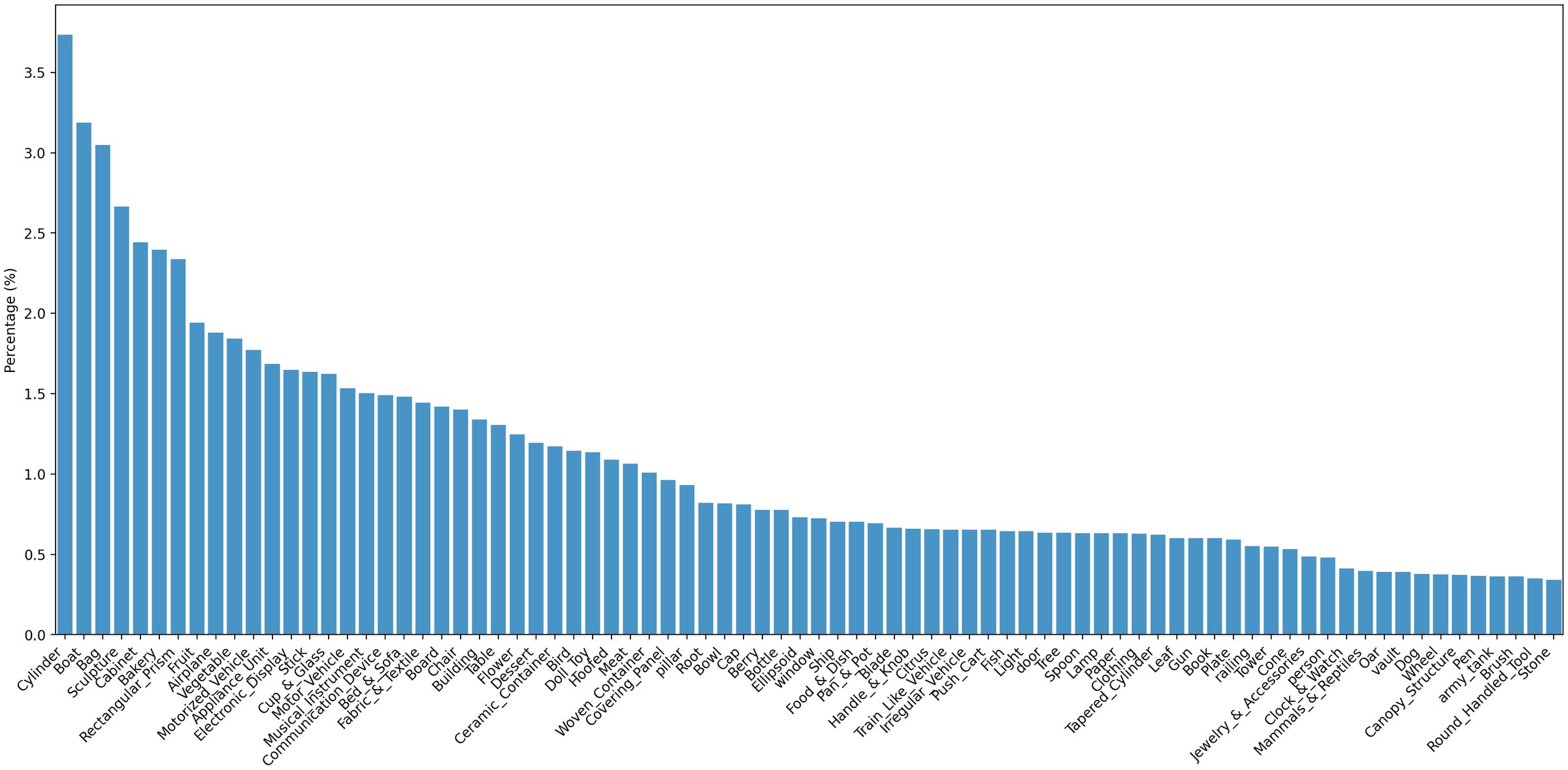
Figure 13: Category distribution of SAM 3D training data. The plot above shows the distribution of the top 80 object categories, which includes a long tail.
图 13:SAM 3D 训练数据的类别分布。上图给出前 80 个物体类别的分布,其中包含长尾。
Texture MITL-3DO.
The MITL-3DO dataset for texture is separate from the dataset for shape and layout, but is collected in a similar fashion. The images are sourced from SA-1B (Kirillov et al., 2023), and we additionally sample a dataset of examples with higher aesthetics – objects with minimal occlusion and high brightness, contrast, colorfulness, sharpness, and aesthetic score – to seed the model with higher-quality texture annotations. We found the high-aesthetics dataset to further improve human preference rate (see “AES” preference win rate in Figure 19).
纹理 MITL-3DO。
用于纹理的 MITL-3DO 数据集与用于形状和布局的数据集是分开的,但收集方式类似。图像来自 SA-1B(Kirillov et al., 2023),我们还额外采样了一份审美更高的样本集合——遮挡很少,并且亮度、对比度、色彩丰富度、锐度和审美分数都较高的物体——以便用更高质量的纹理标注为模型奠基。我们发现,这份高审美数据还能进一步提高人人偏好率(见图 19 中的“AES”偏好胜率)。
A.2 Stage 2: 3D Model-in-the-Loop Suite
A.2 第 2 阶段:三维模型在环套件
3D shape model suite.
3D shape generation is beyond the capabilities of the average human annotator, and it is a time-consuming process even for trained specialists (see Section D.1). Thus, in order to scale shape generation in our annotation pipeline, we instead convert the task to one of verification. We achieve this by employing a diverse set of 3D models to generate shape predictions for each object, asking annotators to pick and grade the best of options. The sources of 3D shapes in our annotations include the following:
三维形状模型套件。
三维形状生成超出了普通人类标注员的能力,即便对受过训练的专家也是耗时的过程(见第 D.1 节)。因此,为了在标注流程中扩大形状生成的规模,我们把任务转成核验。具体做法是:用一组多样的三维模型为每个物体生成形状预测,再请标注员从 个选项中选出最好的并打分。我们标注中的三维形状来源包括:
- • Retrieval: The nearest 3D object is retrieved from a shape object library (pretraining data) using both image- and text-based similarity. For text similarity, we compare visual object descriptions; for image similarity, we compute the distance between CLIP embeddings. While this retrieval approach is nearly guaranteed not to provide an exact 3D reconstruction, it can provide a high quality mesh with matching semantics, particularly when model-generated 3D shapes fail entirely.
- • 检索:用基于图像和基于文本的相似度,从形状物体库(预训练数据)中检索最近的三维物体。文本相似度比较的是视觉物体描述;图像相似度计算的是 CLIP 嵌入之间的距离。这种检索方法几乎可以肯定无法给出精确的三维重建,但可以提供语义匹配的高质量网格,尤其是在模型生成的三维形状完全失败时。
- • Text-to-3D generation: A text-to-3D generative method produces 3D object meshes based on a textual descriptions. This approach can be helpful when image-conditioning is challenging due to clutter or occlusion, but human recognition can still identify the object.
- • 文本到三维生成:一种文本到三维的生成方法根据文本描述产生三维物体网格。当由于杂乱或遮挡而使图像条件变得困难、但人的识别仍能辨认出该物体时,这一做法会有帮助。
- • Image-to-3D generation: Image-to-3D methods, including our own SAM 3D checkpoint, generate 3D objects in the form of point clouds or meshes, conditioned on the image input. When successful, this tends to produce examples that go beyond semantic matches and better respect the object’s physical appearance in the image. However, lack of robustness to occlusion or clutter can negatively impact the results.
- • 图像到三维生成:包括我们自己的 SAM 3D 检查点在内的图像到三维方法,以图像输入为条件,生成点云或网格形式的三维物体。一旦成功,这类例子往往不仅在语义上匹配,还能更好地符合物体在图像中的物理外观。不过,对遮挡或杂乱缺少鲁棒性,可能对结果造成负面影响。
3D texture model suite.
For texture generation, we utilize image-to-3D models, multi-view texture generation models, and our own SAM 3D checkpoints. All texture candidates are generated using shapes produced by the SAM 3D Geometry model, ensuring that texture models have the best chance of success, even in cases of heavy occlusion.
三维纹理模型套件。
对于纹理生成,我们使用图像到三维模型、多视图纹理生成模型,以及我们自己的 SAM 3D 检查点。所有纹理候选都用 SAM 3D 几何模型产生的形状来生成,从而确保即便在严重遮挡的情形下,纹理模型也有最好的成功机会。
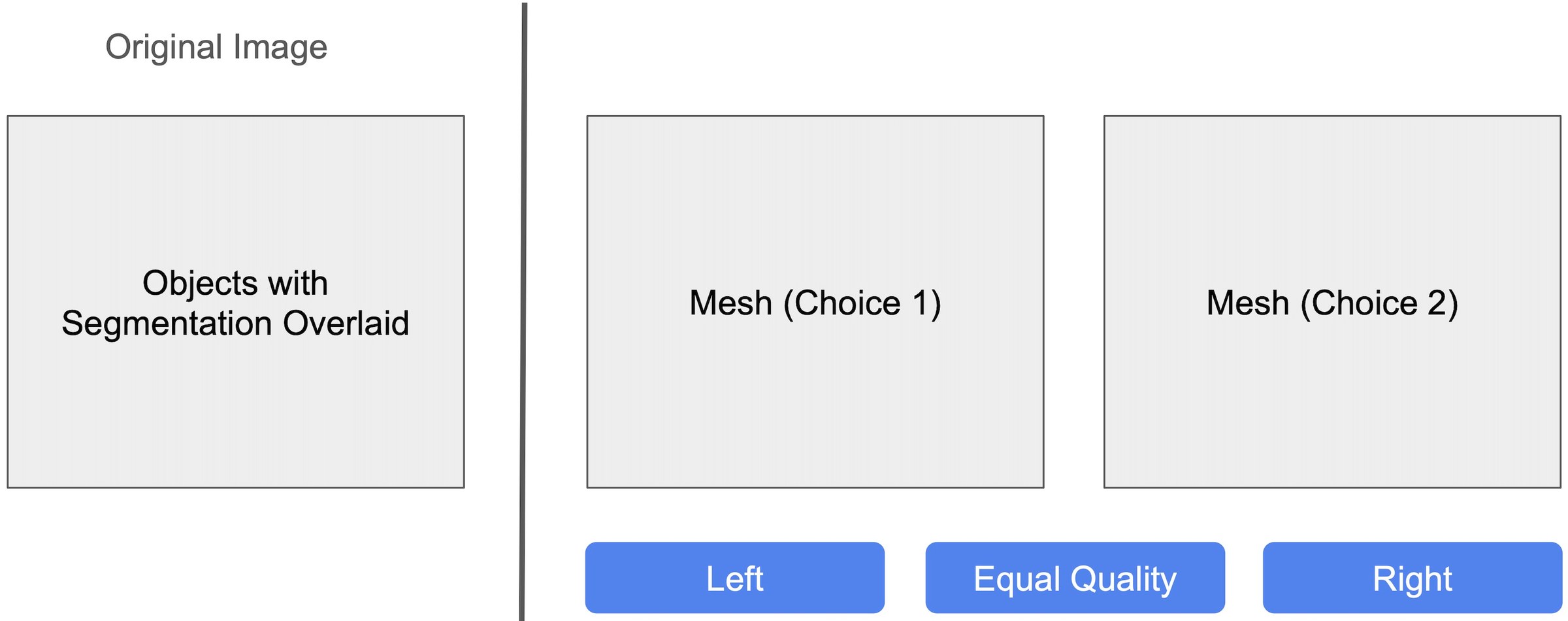
Figure 14: Stage 2 UI sketch. Annotators can only choose between options; they cannot directly edit the meshes or textures.
图 14:第 2 阶段界面示意。 标注员只能在选项之间选择;他们不能直接编辑网格或纹理。
Stage 2 Selection procedure.
The annotators select the best-of- candidates by making a series of pairwise comparisons (see Figure 14). For each object, the annotator is initially presented with two candidates to compare and is asked to pick from the following three choices: “Left” (is better), “Right” (is better), or “Equal Quality”. Because the options are in 3D, we by default automatically rotate the objects on a turntable, but annotators are free to rotate the objects as they wish, or zoom the camera. After making a selection, the non-selected option is replaced by a new candidate; if “Equal Quality”, we randomly choose which candidate to keep. The selection procedure continues until all candidates have been shown. We randomize the order in which candidates are presented to the annotator, to prevent biases due to order from affecting the selection process.
第 2 阶段选择流程。
标注员通过一系列成对比较选出 best-of- 候选(见图 14)。对每个物体,标注员最初会看到两个候选进行比较,并被要求从以下三个选项中选择:“左”(更好)、“右”(更好),或“质量相当”。由于选项是三维的,我们默认会自动让物体在转盘上旋转,但标注员也可以自行旋转物体,或缩放相机。做出选择后,未被选中的选项会被新的候选替换;如果选择“质量相当”,我们就随机决定保留哪一个候选。选择流程持续进行,直到所有候选都展示过。我们随机打乱呈现给标注员的候选顺序,以避免顺序偏差影响选择过程。
After the best candidate is identified in the selection process, annotators are asked to rate the mesh against a predefined quality bar . Examples meeting the bar will become candidates to enter Stage 3 for alignment, while examples under the bar will become negative examples for preference alignment or considered as candidates for manual mesh generation in Stage 2.5.
在选择过程中确定最佳候选之后,标注员需要按预定的质量门槛 给该网格打分。达到门槛的样本会成为进入第 3 阶段做对齐的候选;达不到门槛的样本则会成为偏好对齐中的负例,或被考虑作为第 2.5 阶段手工网格生成的候选。
A.3 Stage 2.5: 3D Artist Mesh Details
A.3 第 2.5 阶段:三维艺术家网格的细节
When the 3D model-in-the-loop suite fails to generate an acceptable mesh for a particular sample, the aforementioned preference-based annotation approach is unable to provide the data needed to improve the model for such objects. To overcome this data distribution blind spot, we work with a team of 3D artists to build meshes for such hard meshes. Given the high cost of specialized 3D artists, we seek to maximize their value by ensuring each object sent to the 3D artists represents a genuine failure case that cannot be resolved by the data engine alone. To maximize the value of this investment, we develop a refined labeling framework that categorizes failures into common types: e.g., complex geometry, occlusion, transparency, and small object size. We balance sampling across these categories. In addition, we employ clustering techniques over images, 3D latents, and object semantics to deduplicate candidates, ensuring that one or a few representative samples per group suffices for effective coverage in data sampling.
当三维模型在环套件无法为某个样本生成可接受的网格时,前述基于偏好的标注方法就无法提供改进这类物体所需的数据。为了克服这一数据分布上的盲区,我们与一组三维艺术家合作,为这些困难网格建模。鉴于专业三维艺术家成本很高,我们力求让送到他们那里的每个物体都真正代表数据引擎自身无法解决的失败情形,从而最大化其价值。为了让这项投入尽可能值当,我们设计了一套更细致的标注框架,把失败归入常见类型:例如复杂几何、遮挡、透明,以及物体尺寸很小。我们在这些类别之间做平衡采样。此外,我们在图像、三维潜在表征和物体语义上使用聚类技术来去除重复候选,以确保每个组只需一两个代表性样本,就足以在数据采样中形成有效覆盖。
Additional details on the data collection process for meshes created by 3D artists can be found in Section D.1, which employed a similar mesh creation process by the artists, but with more intentional curation of inputs.
关于三维艺术家创建网格的数据收集过程的更多细节,可见第 D.1 节;那里的艺术家采用了类似的网格创建流程,但对输入做了更有意识的筛选。
A.4 Stage 3: 3D Mesh Alignment
A.4 第 3 阶段:三维网格对齐
We collect object pose annotations by aligning meshes from prior stages to a scene point cloud derived from the input image. To make this accessible to generalist annotators, we designed and implemented an annotation tool which allows the annotator to manipulate 3D meshes to align to a 2.5D point cloud pre-computed by an off-the-shelf depth estimator. Annotators can use either keyboard or mouse to rotate, translate, and scale the meshes so that the mesh is accurately anchored to the 2.5D point cloud. We also provide additional functions including (a) mesh visibility toggle, (b) target indicator toggle, (c) point cloud size adjustment, (d) control visibility toggle, (e) undo, (f) camera view reset and pre-defined view, and (g) mesh IOU indicator as shown in Figure 15.
我们通过把前几阶段得到的网格对齐到由输入图像得到的场景点云上,来收集物体姿态标注。为了让非专业标注员也能完成这项工作,我们设计并实现了一个标注工具,允许标注员操作三维网格,使其对齐到由现成深度估计器预先计算的 2.5D 点云。标注员可以用键盘或鼠标旋转、平移和缩放网格,使网格准确地锚定到 2.5D 点云上。我们还提供了额外功能,包括(a)网格可见性开关,(b)目标指示器开关,(c)点云大小调节,(d)控制可见性开关,(e)撤销,(f)相机视图重置和预定义视图,以及(g)网格 IoU 指示器,如图 15 所示。
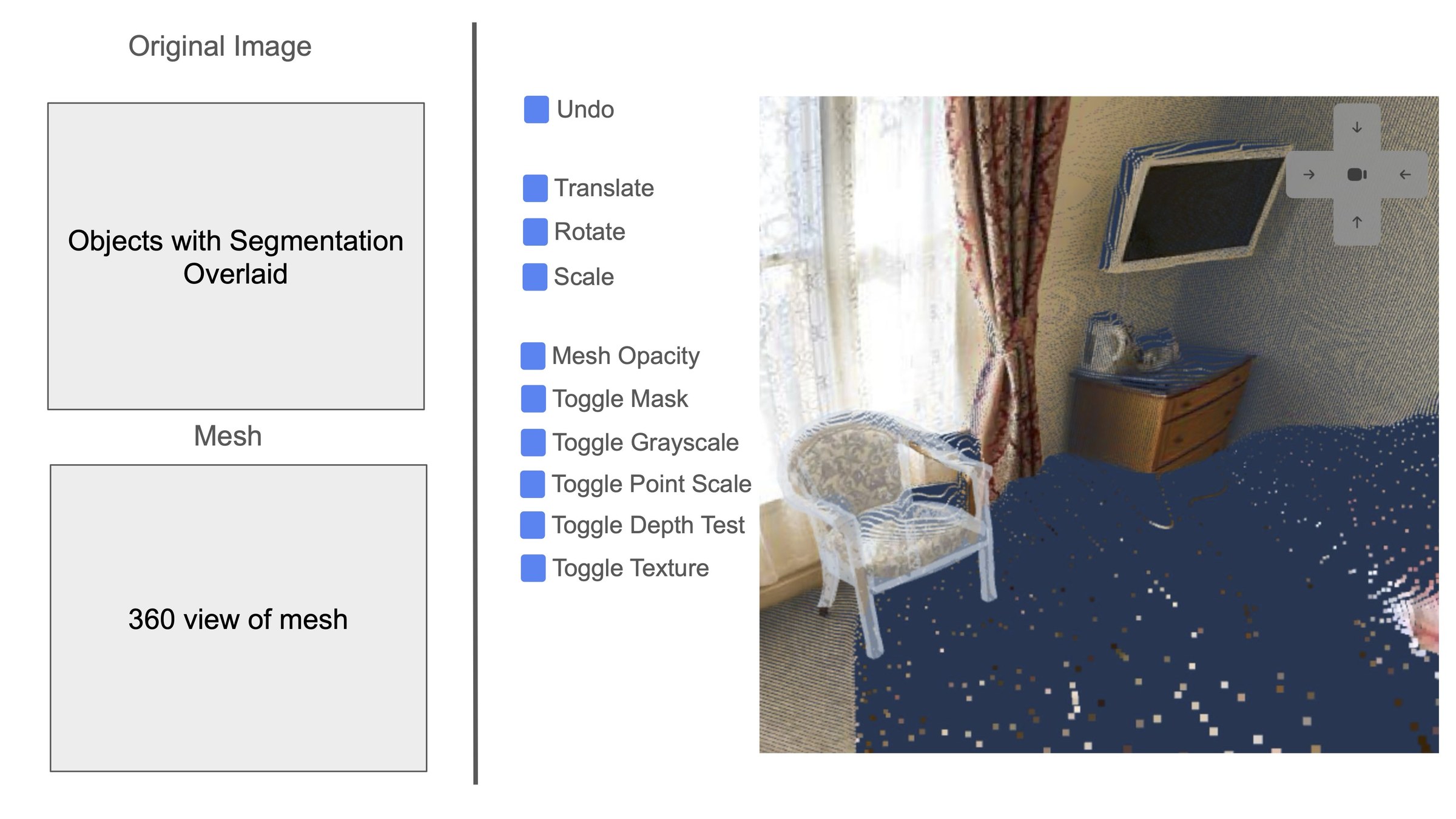
Figure 15: Stage 3 UI sketch. The UI supports annotators in directly placing the object in the 2.5D pointcloud.
图 15:第 3 阶段界面示意。 该界面支持标注员把物体直接放置到 2.5D 点云中。
A.5 Annotation Statistics
A.5 标注统计
- • Stage 1: Annotators on average spend 10 seconds to segment a single interesting object. We utilize SAM (Kirillov et al., 2023) as a tool to assist in segmentation.
- • 第 1 阶段:标注员平均花费 10 秒分割一个感兴趣的单个物体。我们用 SAM(Kirillov et al., 2023)作为辅助分割工具。
- • Stage 2: Annotators on average spend 80 seconds to select the best candidate shape/texture from 6-10 candidate meshes from variable sources.
- • 第 2 阶段:标注员平均花费 80 秒,从来源不一的 6–10 个候选网格中选出最好的形状/纹理候选。
- • Stage 3: Annotators on average spend 150 seconds to anchor and orient the matched 3D shape to the 2.5D point cloud.
- • 第 3 阶段:标注员平均花费 150 秒,把匹配到的三维形状锚定并对准到 2.5D 点云。
- • Over the lifetime of the project (including development), our MITL data engine yields 3.14 million trainable shapes, 1.23 million samples of layout data, 100K trainable textures, and over 7 million pairwise preferences.
- • 在项目生命周期内(包括开发阶段),我们的 MITL 数据引擎产生了 314 万个可训练形状、123 万个布局数据样本、约 10 万个可训练纹理,以及超过 700 万对成对偏好。
A.6 Core Alignment Algorithm
A.6 核心对齐算法
1: Base model , quality threshold curriculum , ensemble size
2: Aligned model
3: // Let denote a demonstration (i.e., a training sample)
4: for to do
5: // Collection Step: Generate demonstrations via expert policy
6: Initialize The dataset collected during iteration
7: for do
8: Amplify current policy via model ensemble and best-of- search
9: Sample Generate candidate demonstrations from expert policy
10: Humans select best candidate via pairwise comparisons
11: Store rejected candidates for preference learning
12: Collect chosen demonstration with rating and rejections
13: end for
14: // Update Step: Train on aggregated high-quality demonstrations and preferences
15: Aggregate and filter by quality
16: Create preference pairs for DPO training
17: Supervised finetuning
18: Align with preferences
19: end for
20: return
Algorithm 1 SAM 3D Basic Alignment (Texture, Shape)
1: 基座模型 ,质量门槛课程 ,集成规模
2: 对齐后的模型
3: // 记 为一个示范(也就是一个训练样本)
4: for to do
5: // 收集步骤: 通过专家策略生成示范
6: Initialize 第 次迭代中收集的数据集
7: for do
8: 通过模型集成和 best-of- 搜索放大当前策略
9: Sample 从专家策略生成 个候选示范
10: 人类通过成对比较选出最佳候选
11: 保存被拒绝的候选,用于偏好学习
12: 收集被选中的示范及其评分和拒绝项
13: end for
14: // 更新步骤: 在汇总后的高质量示范和偏好上训练
15: 汇总并按质量过滤
16: 为 DPO 训练创建偏好对
17: 监督微调
18: 按偏好对齐
19: end for
20: return
算法 1 SAM 3D 基本对齐(纹理、形状)
A.6.1 Basic Algorithm
Algorithm 1 shows the core alignment algorithm, used for all texture annotations and most shape annotations (MITL-3DO). During each collection step, we generate a set of predictions from the current model, and ask annotators to rank and verify these predictions. Generalist annotators can only choose between model outputs and accept/reject; they cannot edit. We maximize the probability of a successful annotation at each iteration by ensembling multiple models and combining multiple models with human preferences into an expert annotator.
A.6.1 基本算法
算法 1 给出了核心对齐算法,用于全部纹理标注和大多数形状标注(MITL-3DO)。在每个收集步骤中,我们从当前模型生成一组预测,并请标注员对这些预测排序和核验。非专业标注员只能在模型输出之间选择并接受/拒绝;他们不能编辑。我们通过集成多个模型,并把多个模型与人的偏好组合成一个专家标注者,来最大化每次迭代中成功标注的概率。
The learning efficiency of the alignment, or the “speed of the data flywheel”, is controlled by two factors:
对齐的学习效率,或者说“数据飞轮的速度”,由两个因素控制:
- • Amplification factor: The size of the performance gap between current model and the expert annotations at each iteration
- • 放大因子:在每次迭代中,当前模型与专家标注之间的性能差距大小
- • Stepwise efficiency: How closely the new model approximates the previous expert from the previous iteration
- • 逐步效率:新模型在多大程度上逼近上一轮迭代中的先前专家
The former induces an upper bound on the new policy’s performance at each iteration, while the latter describes how closely we approach that upper bound – similar to Expert Iteration (Anthony et al., 2017).
前者对每次迭代中新策略的性能给出了上界,后者则描述我们在多大程度上接近这个上界——这类似于专家迭代(Expert Iteration)(Anthony et al., 2017)。
A.6.2 Training Intuition
Our goal in post-training (see Algorithm 1) is to align the model to match human preference on the distribution of all possible real-world objects.
A.6.2 训练直觉
我们在后训练中的目标(见算法 1)是:在所有可能的真实世界物体的分布上,把模型对齐到人的偏好。
The core algorithm in our data engine generates samples by asking humans to select viable samples from a set of candidate generations. Challenging inputs often result in no viable candidate generations and thus never get selected by humans. However, at any current time our model is usually good on some parts of the data distribution, but not on other parts, as shown in the cartoon below:
我们数据引擎中的核心算法,通过请人从一组候选生成中选出可用样本来产生样本。有挑战性的输入常常导致没有任何可用的候选生成,因而永远不会被人选中。不过,在任一当前时刻,我们的模型通常只在数据分布的某些部分上表现较好,在其他部分上则不然,正如下面这幅示意图所示:
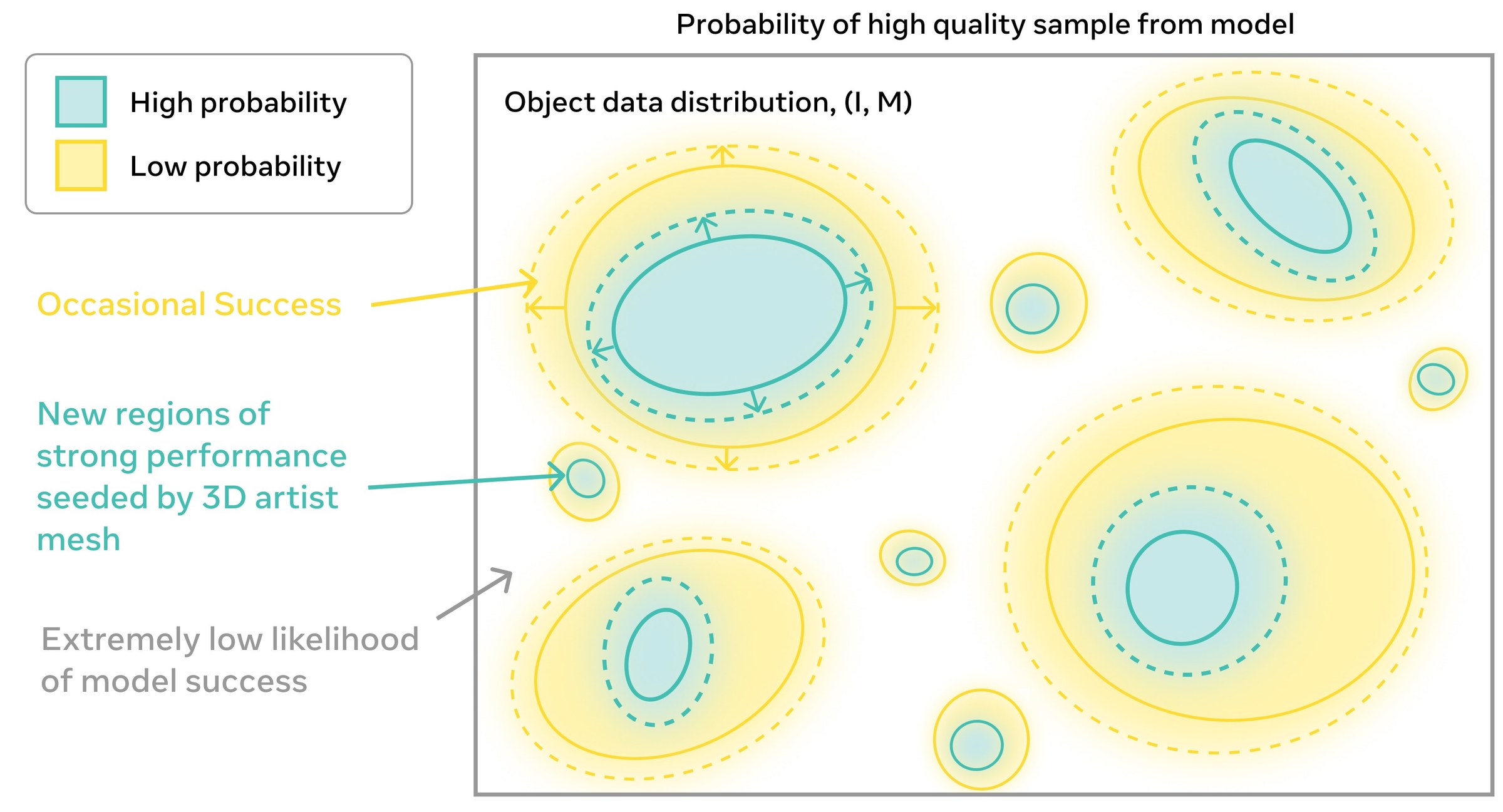
Figure 16: Simplified cartoon depiction of data engine improvement. The diagram depicts model sample quality (color) across the real-world distribution of images and masks. During training, the model begins by doing well (teal) on common categories and simple objects (chairs, bottles, signs, cars). Our goal is to both improve accuracy and robustness on these easy examples (teal), and then push the model to improve performance on less common objects (yellow) in the tail of the probability distribution. While the amplification stage of MITL generally leads to the slow expansion of existing regions of success, using 3D artists to create data for the hardest samples allows us to shortcut the process by “seeding” new regions of the data distribution, which may have taken us longer to reach through MITL verification alone.
图 16:数据引擎改进的简化示意。 图中用颜色表示模型在真实世界图像与掩码分布上的样本质量。训练开始时,模型在常见类别和简单物体(椅子、瓶子、标志、汽车)上表现较好(青绿色)。我们的目标是既提高这些容易样本(青绿色)上的精度和鲁棒性,再推动模型改进概率分布尾部那些不太常见的物体(黄色)上的性能。MITL 的放大阶段通常只会让已有的成功区域缓慢扩展,而让三维艺术家为最困难的样本创建数据,则可以通过在数据分布的新区域“播种”,来缩短这一过程;若只靠 MITL 核验,到达这些区域可能需要更长时间。
The intuition behind the data engine in SAM 3D is that these green islands of reliably good performance correspond to high-density parts of the training data (O’Neill and others, 2024; NVIDIA et al., 2025), and the approach in SAM 3D is that we want to push out from these islands of reliably good generations into the “tail” of the distribution, demarcated by yellow and white background in the cartoon above. The yellow parts of the distribution are challenging for the model, but near enough to the blue islands, that we can occasionally generate satisfactory annotations, but it requires humans to go through many samples.
SAM 3D 数据引擎背后的直觉是:这些能够可靠给出较好结果的绿色岛屿,对应于训练数据中的高密度部分(O’Neill and others, 2024;NVIDIA et al., 2025);SAM 3D 的做法是,我们希望从这些可靠生成的岛屿向外推进,进入上图中用黄色和白色背景标出的分布“尾部”。分布中的黄色部分对模型有挑战,但足够靠近蓝色岛屿,以至于我们偶尔仍能生成令人满意的标注,不过这需要人查看大量样本。
This can create a chicken-and-egg problem where, for the model to become good, it must already be capable of produce a good generation; at least some of the time. For examples that are so challenging that the probability of success is extremely low (white), the model has no hope and we ask human 3D artists (Section A.3) to provide supervision in this part of the data distribution, in order to seed new islands.
这可能造成一个先有鸡还是先有蛋的问题:模型要变好,就必须已经有能力产生好的生成,至少有时如此。对于成功概率极低的那些极具挑战性的例子(白色),模型没有希望,于是我们请人类三维艺术家(第 A.3 节)在数据分布的这一部分提供监督,以便播种新的岛屿。
A.7 Increasing Amplification Factor with Search
A.7 用搜索提高放大因子
A.7.1 Best-of- Search with Reward Models

Figure 17: Reward model data recovery pipeline. The diagram shows how we use reward mdoels to increase in best-of- search to improve the chance of a successful annotation on challenging tail inputs. We use both a VLM and also DPO implicit reward as reward models.
A.7.1 用奖励模型做 Best-of- 搜索
图 17:奖励模型数据回收流程。该图说明我们如何用奖励模型增大 best-of- 搜索中的 ,以提高在有挑战性的尾部输入上成功标注的机会。我们同时使用 VLM 以及 DPO 的隐式奖励作为奖励模型。
Qualitatively, however, we observe that re-visiting some (yellow) inputs with a large number of seeds, our model can sometimes still yield a few good generations (e.g., food can take around seeds to reliably generate a successful mesh in Table 12). This suggests that increasing in the best-of- rejection sampling can potentially allow us to obtain annotations for challenging inputs, which would be difficult to source otherwise. Doing so would allow us to rapidly “push into the tail”, increasing the convergence speed of the alignment algorithm in Algorithm 1. However, the primary impediment to increasing is that, at some point, there are too many choices for a human to compare. This linearly scales the annotation time of preference data collection, and the selections themselves become noisier and more random due to choice overload (Diehl and Poynor, 2010).
不过从定性上看,我们观察到,用大量种子重新访问一些(黄色)输入时,我们的模型有时仍能给出少数较好的生成(例如,食物大约需要 个种子,才能可靠地生成成功的网格,见表 12)。这表明,在 best-of- 拒绝采样中增大 ,有可能让我们为原本难以获取标注的有挑战性输入得到标注。这样做将使我们能够迅速“推进到尾部”,提高算法 1 中对齐算法的收敛速度。不过,增大 的主要障碍是:到了某个程度,人要比较的选项会太多。这会线性增加偏好数据收集的标注时间,而且由于选择过载(Diehl and Poynor, 2010),选择本身也会变得更嘈杂、更随机。
To address this challenge, we explored using learned reward models to perform a first pass in order to surface a smaller number of candidates for humans to then choose between. Figure 17 shows a pipeline to perform reward-ranked best-of- search that increases the yield of successful annotations on challenging inputs. We first run generations with different initial noise, and use the reward model to perform tournament-style ranking, and then pass the winning candidate to human annotators for ranking and verification (as in Stage 2).
为了应对这一挑战,我们探索用学到的奖励模型做第一轮筛选,以便为随后的人类选择浮现出数量更少的候选。图 17 给出一条流程,用于执行按奖励排序的 best-of- 搜索,从而提高有挑战性输入上成功标注的产出。我们首先用不同的初始噪声运行 次生成,再用奖励模型做锦标赛式排序,然后把获胜候选交给人类标注员做排序和核验(如同第 2 阶段)。
We find that this approach indeed helps to recover some of this otherwise difficult data. For example, by scaling the best-of- from to to recover samples that were originally discarded, improving the yield from (since these were originally failures) to . In particular, we observe significant increase in the proportion of successful annotations coming from challenging categories. The food category improves from in the original annotated distribution to . We show the experiments with resulting model performance, as well as ablations using VLMs instead of DPO implicit reward models, in Section E.7.
我们发现,这一做法确实有助于回收部分原本很难得到的数据。例如,把 best-of- 从 扩大到 ,以回收最初被丢弃的样本,把产出从 (因为这些原本都是失败)提高到 。我们尤其观察到,来自有挑战性类别的成功标注比例显著增加。食物类别从原始标注分布中的 提高到 ,提升了 倍。我们在第 E.7 节展示了由此得到的模型性能实验,以及用 VLM 代替 DPO 隐式奖励模型的消融。
A.8 Relationship to Self-Training Approaches
A.8 与自训练方法的关系
The data engine in SAM 3D can alternatively be viewed as an online alignment algorithm similar to RLHF (Ouyang et al., 2022) or related self-training methods. Under this interpretation, the generative model is a policy and the data collection step is a policy evaluation; collecting demonstrations and preferences / through the interaction with the environment (annotators). The model improvement step simply updates the current policy using both finetuning and DPO.
SAM 3D 中的数据引擎也可以被看成一种在线对齐算法,类似于 RLHF(Ouyang et al., 2022)或相关的自训练方法。在这种解释下,生成模型 是一个策略,数据收集步骤是策略评估:通过与环境(标注员)交互来收集示范 和偏好 /。模型改进步骤则只是用微调和 DPO 更新当前策略。
This reframing helps make the relationship to existing work more clear. The most similar learning algorithm to our data engine is Expert Iteration (ExIt) (Anthony et al., 2017). As in ExIt, each iteration starts with a current policy, that we amplify using additional information into an expert policy, and we use this expert policy to generate supervision for imitation learning. Unlike ExIt, which uses purely imitation learning, we use humans-as-verifiers to select which samples to train on, and we make use of additional preference signals as reward signal (Section 3.2.2). However, there are also notable differences in type of supervision that can be used and the amplification steps. Our expert policy amplification step uses a model ensemble instead of only tree search with a value function, and we use preferences in the update step to better align to the task.
这种重新表述有助于把与已有工作的关系说得更清楚。与我们的数据引擎最相似的学习算法是专家迭代(Expert Iteration,ExIt)(Anthony et al., 2017)。与 ExIt 一样,每次迭代都从当前策略开始,我们用额外信息把它放大成专家策略,再用这个专家策略为模仿学习生成监督。与只使用纯模仿学习的 ExIt 不同,我们用人作为核验者来选择训练哪些样本,并在更新步骤中利用额外的偏好信号作为奖励信号(第 3.2.2 节)。不过,在可用监督的类型以及放大步骤上也有明显差异。我们的专家策略放大步骤使用的是模型集成,而不仅仅是带价值函数的树搜索,并且我们在更新步骤中使用偏好,以便更好地对齐到任务。
Algorithm 1 uses reward ranking, similar to RAFT (Dong et al., 2023) and RFT (Yuan et al., 2023), although the alignment algorithm in SAM 3D adds explicit expert policies/ensembles and leverages preference supervision.
算法 1 使用奖励排序,类似于 RAFT(Dong et al., 2023)和 RFT(Yuan et al., 2023),不过 SAM 3D 中的对齐算法还加入了显式的专家策略/集成,并利用了偏好监督。
Appendix B Pretraining and Mid-Training Data Details
附录 B 预训练与中期训练数据的细节
B.1 Iso-3DO Data Filtering
B.1 Iso-3DO 数据过滤
For the Iso-3DO data used for pretraining, the quality of the 3D meshes can vary substantially, and not all samples exhibit high-fidelity geometry. Such examples can ultimately prove harmful to model pretraining, even at scale. One way to filter data is by an aesthetic score filter, as employed by Xiang et al. (2025), which primarily emphasizes visual and textural appeal. We employ a similar filter process for the Texture & Refinement model.
对于预训练所用的 Iso-3DO 数据,三维网格的质量可能相差很大,并非所有样本都具有高保真几何。即便在大规模下,这类样本最终也可能对模型预训练有害。一种过滤数据的方法是审美分数过滤器,正如 Xiang et al. (2025) 所采用的,它主要强调视觉和纹理上的吸引力。我们对纹理与细化模型采用了类似的过滤流程。
However, this filter does not necessarily capture the geometric quality of a training data. Therefore, we develop a rule-based filtering strategy on shape to curate the pretraining data for the Geometry model, removing data with following characteristics:
不过,这一过滤器并不一定能捕捉训练数据的几何质量。因此,我们为几何模型的预训练数据开发了一套基于规则的形状过滤策略,去掉具有以下特征的数据:
- • Overly simplistic geometry, characterized by extremely small volumes (e.g., near-degenerate point-like structures) or minimal normal direction variation (e.g., flat, sheet-like surfaces).
- • 过于简单的几何,其特征是体积极小(例如近乎退化的点状结构),或法向变化极小(例如平坦的片状表面)。
- • Structural outliers, which includes meshes containing spatial outliers: isolated points or fragments that deviate significantly from the primary 3D structure.
- • 结构异常值,包括含有空间异常的网格:明显偏离主要三维结构的孤立点或碎片。
B.2 Render-and-Paste Data Pipeline
B.2 渲染并粘贴的数据流程
We define the Render-Paste approach as follows: Given a natural image and an object instance defined by its mask segment, we replace the object in the image with a synthetic 3D object drawn from the same synthetic sources used in Iso-3DO. The size and position of the 3D object are determined using the 2D object mask together with a pointmap produced by a single-image depth estimator, which also guides the object’s visibility and occlusion to obtain a natural appearance in the final rendering. By nature of starting from a synthetic 3D object first, the resulting data (which we refer to as RP-3DO) has excellent 3D ground truth precision and pixel-alignment compared to subsequent data sources in our training pipeline, which much try to reconstruct 3D from partial 2D information as part of the data annotation process.
我们把 Render-Paste 方法定义如下:给定一张自然图像,以及由其掩码片段定义的一个物体实例,我们用从 Iso-3DO 相同合成来源中取出的合成三维物体,替换图像中的该物体。三维物体的大小和位置由二维物体掩码以及单图深度估计器产生的点图共同决定,点图也指导物体的可见性与遮挡,以使最终渲染具有自然外观。由于一开始用的就是合成三维物体,得到的数据(我们称为 RP-3DO)具有很好的三维真值精度和像素对齐,相比之下,我们训练流程中后续的数据来源必须在标注过程中从部分二维信息去重建三维。
In the following sections, we introduce three variants of Render-Paste that differ along two axes: pose information and semantic relevance.
在以下几节中,我们介绍 Render-Paste 的三种变体,它们沿两个轴有所不同:姿态信息和语义相关性。
- • Section B.2.1: Flying Occlusions (FO) inserts randomly oriented synthetic objects without pose information, resulting in pose-unaware but semantically loose composites.
- • 第 B.2.1 节:飞行遮挡 (FO) 插入随机朝向、没有姿态信息的合成物体,得到对姿态不敏感、语义也较松的合成图。
- • Section B.2.2: Object Swap – Random (OS-R) determines object scale and translation from masks and pointmaps, while using a random rotation and object. Beyond simple replacement, the incorporation of depth ordering provides meaningful visual cues for object size and spatial placement, yielding pose-aware but not fully aligned insertions with moderate semantic relevance, higher than in the Flying Occlusions setting.
- • 第 B.2.2 节:物体替换-随机 (OS-R) 根据掩码和点图确定物体的尺度和平移,同时使用随机旋转和随机物体。除了简单替换之外,引入深度顺序还能为物体大小和空间放置提供有意义的视觉线索,从而得到对姿态有意识、但并未完全对齐、语义相关性中等(高于飞行遮挡设定)的插入。
- • Section B.2.3: Object Swap – Annotated (OS-A) replaces the original object using the annotator-provided ground-truth scale, translation, and rotation, producing fully pose-aligned and semantically matched renderings.
- • 第 B.2.3 节:物体替换-已标注 (OS-A) 使用标注员提供的真值尺度、平移和旋转来替换原始物体,从而产生完全姿态对齐、且语义匹配的渲染。
B.2.1 Flying Occlusions (FO)
The aim of this dataset is to build invariance to occlusion and size variations that commonly occur in real-world scenarios—and to enable the model to leverage full image context instead of only object-centered crops—we construct a dataset of natural images with blended synthetic 3D objects. Inspired by Flying Chairs (Dosovitskiy et al., 2015) and FlyingThings3D (Mayer et al., 2016), we name our first variant Flying Occlusions, reflecting its use of freely inserted synthetic objects.
B.2.1 飞行遮挡(FO)
这一数据集的目标是建立对真实世界中常见的遮挡和尺寸变化的不变性,并使模型能够利用整图上下文,而不只是以物体为中心的裁剪。为此,我们构造了一份把合成三维物体混合进自然图像的数据集。受 Flying Chairs(Dosovitskiy et al., 2015)和 FlyingThings3D(Mayer et al., 2016)启发,我们把第一种变体命名为飞行遮挡,以反映它自由插入合成物体的做法。
Each training example consists of a natural image onto which we composite two rendered 3D objects: an occluder and an occludee. For each pair, we also compute the final visible mask of the occludee after occlusion. To generate each training sample, we randomly pair a selected object with an occluder object. Given the mask of the selected object and the mask of the random occluder , each corresponding to the full mask of the respective object, the visible mask is defined as , where denotes the element-wise (Hadamard) product. To ensure a reasonable degree of occlusion, we enforce . In addition, samples with insufficient visibility are filtered out by requiring , where is the total number of pixels in the image. Here, denotes the sum of all elements in (i.e., the total number of pixels with value if is a binary mask).
每个训练样本由一幅自然图像构成,我们在其上合成两个渲染的三维物体:一个遮挡物和一个被遮挡物。对每一对,我们还会计算被遮挡后被遮挡物最终的可见掩码。为了生成每个训练样本,我们把一个选定物体与一个遮挡物体随机配对。给定选定物体的掩码 和随机遮挡物的掩码 ,它们分别对应于各自物体的完整掩码,可见掩码定义为 ,其中 表示逐元素(Hadamard)乘积。为了保证合理的遮挡程度,我们要求 。此外,可见性不足的样本会被过滤掉,要求 ,其中 是图像中的总像素数。这里, 表示 中所有元素之和(也就是说,如果 是二值掩码,就是取值为 的像素总数)。
Finally, to prevent the model from always predicting the occluded object, in one third of the samples, we treat the selected mesh as the occluder. In these cases, the mask of the selected mesh is complete. In total, we have 55.1M sample with 2.87M unique meshes and 11.17M unique images.
最后,为了防止模型总是去预测被遮挡的物体,在三分之一的样本中,我们把选定网格当作遮挡物。在这些情形下,选定网格的掩码是完整的。我们总共有 5510 万个样本,包含 287 万个独特网格和 1117 万张独特图像。
B.2.2 Object Swap – Random (OS-R)
To enhance robustness to variations in object location and scale, we propose Object Swap – Random (OS-R), a depth-aware render-paste strategy that replaces an object in a natural image with a randomly selected synthetic mesh.
B.2.2 物体替换-随机(OS-R)
为了增强对物体位置和尺度变化的鲁棒性,我们提出物体替换-随机(OS-R),这是一种有深度意识的渲染-粘贴策略,用随机选取的合成网格替换自然图像中的一个物体。
Given a natural image , mask , and random object mesh , we synthesize a new training tuple . We first predict the 2.5D scene pointmap and identify the 3D centroid and bounding box of the target object. The original object is removed via inpainting, and we then insert a random synthetic mesh at the computed centroid with a random 3D rotation . The mesh scale is determined by fitting the mesh to the original object’s 3D bounding box.
给定自然图像 、掩码 和随机物体网格 ,我们合成一个新的训练元组 。我们首先预测 2.5D 场景点图,并确定目标物体的三维质心和边界框。原始物体通过补全被去掉,然后我们在计算出的质心 处以随机三维旋转 插入一个随机合成网格 。网格尺度 通过把网格拟合到原始物体的三维边界框来确定。
We complete the process by re-rendering the new image with a z-buffer check. We render the new mesh into the inpainted image such that only pixels not occluded by existing scene geometry are visible, forming the visible mask . We filter samples with insufficient visibility ( visibility) and update the pointmap by projecting the unoccluded surface points of the new mesh, using .
我们通过带 z-buffer 检查的重新渲染来完成这一过程。我们把新网格渲染进补全后的图像,使得只有未被现有场景几何遮挡的像素可见,从而形成可见掩码 。我们过滤可见性不足(可见性 )的样本,并用 把新网格未遮挡表面点投影回去,以更新点图 。
To ensure the dataset provides sufficient visual cues for estimating translation and scale, we use heuristics to replace only objects that are partially occluded or supported along the bottom, which provides depth ordering and T-junction cues, respectively. We verify these cues by trying to find occlusion boundaries: we sample points on opposite sides of the mask border, and if the outer pixel is significantly closer to the camera than the inner pixel, we consider this part of the boundary occluded. A sample is retained if it meets one of two conditions: (1) physical support, where the background is closer to the camera along the bottom 10% of the object (indicating it rests on a surface), or (2) partial occlusion, where foreground elements occlude at least 10% of the total object perimeter. This process yields 5.95M training samples composed of 2.38M unique meshes and 1.20M unique images.
为了确保数据集为估计平移和尺度提供足够的视觉线索,我们用启发式方法,只替换被部分遮挡或沿底部受到支撑的物体,它们分别提供深度顺序和 T 形交线索。我们通过尝试寻找遮挡边界来核验这些线索:我们在掩码边界两侧采样点,如果外侧像素明显比内侧像素更靠近相机,就把这部分边界视为被遮挡。样本在满足以下两个条件之一时被保留:(1)物理支撑,即沿物体底部 10% 处背景更靠近相机(表明它搁在某个表面上);或(2)部分遮挡,即前景元素遮挡了物体周长至少 10%。这一过程得到 595 万个训练样本,由 238 万个独特网格和 120 万张独特图像组成。
B.2.3 Object Swap – Annotated (OS-A)
In addition to the Object Swap – Random variant, we construct a complementary render-and-paste setting, which we refer to as Object Swap – Annotated (OS-A), which performs an in-place replacement of a real image with a rendered human-annotated object. The motivation for this dataset is to enable Texture & Refinement training that faithfully preserves pixel-aligned correspondence between the rendered mesh and the visual appearance of the target object in the image.
B.2.3 物体替换-已标注(OS-A)
除了 物体替换-随机 这一变体之外,我们还构造了一个互补的渲染并粘贴设定,称为 物体替换-已标注(OS-A),它对真实图像做原地替换,换成渲染后的人类标注物体。这份数据的动机是:使纹理与细化训练能够忠实地保持渲染网格与图像中目标物体视觉外观之间的像素对齐对应。
This approach closely follows the OS-R pipeline, with key distinctions arising from the use of human-annotated data in MITL-3DO. Specifically, each training sample is generated using an image from a curated MITL-3DO subset, where the initial object mask, selected mesh , object placement (translation , rotation , and scale ), and target pose are all sourced from human annotations provided in the MITL-3DO dataset. The selected mesh for each object is chosen by annotators as the best available match to the object’s appearance in the image. During rendering, lighting conditions used for rendering are carefully matched to those in the training data preparation, ensuring consistent brightness and appearance across the dataset. We used a subset of the MITL-3DO shape-preference annotations, yielding million training samples from this render-paste process.
这一做法密切沿用 OS-R 流程,主要区别来自对 MITL-3DO 中人类标注数据的使用。具体而言,每个训练样本都用一份经过整理的 MITL-3DO 子集中的图像生成,其中初始物体掩码、选定网格 、物体放置(平移 、旋转 和尺度 )以及目标姿态,全部来自 MITL-3DO 数据集中提供的人类标注。每个物体的选定网格由标注员选为与该物体在图像中外观最匹配的可用网格。渲染时,用于渲染的光照条件被仔细匹配到训练数据准备中的光照,以确保整个数据集在亮度和外观上保持一致。我们使用了 MITL-3DO 形状偏好标注的一个子集,从这一渲染-粘贴过程中得到 万个训练样本。
B.3 Lighting for Texture Data
B.3 纹理数据的光照
For Iso-3DO and RP-3DO (FO), we randomize the lighting (i.e., direction and intensity) applied on the input images, and use ambient lighting when rendering views used to computing the target latents. Qualitatively, such data processing encourages the model to predict “de-lighted” textures without baking in strong directional shading or specular highlights from the input render. We verify that this is preferred by humans through preference tests (see “Lighting Aug” preference rate in Figure 19).
对于 Iso-3DO 和 RP-3DO(FO),我们随机化施加在输入图像上的光照(也就是方向和强度),并在渲染用于计算目标潜在表征的视图时使用环境光。从定性上看,这样的数据处理会鼓励模型预测“去光照”的纹理,而不是把输入渲染中强烈的方向性阴影或镜面高光烘焙进去。我们通过偏好测试验证了这更受人偏好(见图 19 中的“Lighting Aug”偏好率)。
Appendix C Details on Model Training
附录 C 模型训练的细节
The following sections outline the details of the Geometry and Texture & Refinement models, including architecture, training objective, and training hyperparameters.
以下几节概述几何模型以及纹理与细化模型的细节,包括结构、训练目标和训练超参数。
C.1 Architecture Details on Geometry Model
C.1 几何模型的结构细节
We employ a latent flow matching model. For shape, it denoises the voxels in the latent space of a coarser representation, following Xiang et al. (2025). For layout, we perform denoising directly in the parameter space , as their dimensionality is small. Additionally, we introduce modality-specific input and output projection layers to map both the shape and layout parameters into a shared feature space of dimension , and subsequently project them back to their respective parameter spaces. This results in a total of tokens for the shape and 1 token for , respectively, as input to the Mixture of Transformers (MoT). The MoT architecture comprises two transformers: one dedicated to the shape tokens, and a second whose parameters are shared for the layout parameters , as shown in Figure 2.
我们采用潜在流匹配模型。对于形状,它在较粗的 表征的潜在空间中,对 体素做去噪,沿用 Xiang et al. (2025)。对于布局,我们直接在参数空间 中做去噪,因为它们的维数很小。此外,我们引入模态专用的输入和输出投影层,把形状和布局参数都映射到维度为 的共享特征空间,再把它们投影回各自的参数空间。这样,作为 Mixture of Transformers(MoT)的输入,形状总共有 个 token, 则各有 1 个 token。MoT 结构包含两个 transformer:一个专用于形状 token,另一个的参数在布局参数 之间共享,如图 2 所示。
The MoT design allows independently training of some modalities while maintaining performance on others (e.g., fine-tune shape or layout only), thanks to the structured attention mask illustrated in Figure 2. This proves helpful when training on datasets that contain labels for only one modality (e.g. shape-only), and when freezing shape capabilities and finetuning just for layout. At the same time, MoT still allows for information sharing during the forward pass, through the joint self-attention layers for cross-modal interaction. This shared context is critical for self-consistency: notably, rotation is only meaningful when anchored to the predicted shape.
MoT 的设计允许对某些模态独立训练,同时保持其他模态上的性能(例如只微调形状或只微调布局),这得益于图 2 中所示的结构化注意力掩码。当训练数据只包含一种模态的标签(例如只有形状),以及在冻结形状能力、只微调布局时,这一点很有帮助。与此同时,MoT 在前向过程中仍允许信息共享,通过联合自注意力层进行跨模态交互。这种共享上下文对自一致性至关重要:尤其是,旋转只有锚定到所预测的形状时才有意义。
C.2 Pretraining & SFT Objective: Conditional Rectified Flow Matching
C.2 预训练与 SFT 目标:条件整流流匹配
SAM 3D is trained to jointly generate multiple 3D modalities using rectified conditional flow matching (Liu et al., 2022). Given an input image and mask , the Geometry model optimizes the following multi-modal flow matching objective:
SAM 3D 被训练为用整流条件流匹配(Liu et al., 2022)联合生成多种三维模态。给定输入图像 和掩码 ,几何模型优化如下多模态流匹配目标:
where denotes the set of prediction modalities (shape, rotation, translation, scale), contains the conditioning modalities (image, mask), and is the learned velocity field for modality at the partially noised state, .
其中 表示预测模态的集合(形状、旋转、平移、尺度), 包含条件模态(图像、掩码), 是模态 在部分加噪状态 处学到的速度场。
We want to learn to generate clean states , and during training these are the ground-truth 3D annotations for each modality. Then, the target probability path at time is a linear interpolation between the target state and intial noise state . As a result, the target velocity field is the gradient of this linear interpolation . is simply a per-modality weighting coefficient.
我们希望学会生成干净状态 ,而在训练中这些就是每个模态的三维真值标注。于是,在时间 处的目标概率路径,是目标状态 与初始噪声状态 之间的线性插值 。因此,目标速度场就是这条线性插值的梯度 。 只是一个按模态给出的加权系数。
The Texture & Refinement model optimizes analogous flow-matching objectives using SLAT features. We train both models using AdamW (without weight decay), and training hyperparameters such as sampling and learning rate schedules, EMA weights are in Section C.7.
纹理与细化模型用 SLAT 特征优化类似的流匹配目标。两个模型都用 AdamW(不加权重衰减)训练,采样和学习率日程、EMA 权重等训练超参数见第 C.7 节。
We find it noteworthy that flow matching objective is sufficient for SAM 3D to learn the task of 3D reconstruction, without explicitly enforcing geometric constraints through loss objectives. Interestingly, we observed empirically that while such losses can be helpful in low-data and low-compute regimes, their value declines as data and compute increase, suggesting these geometric priors can be learned implicitly with scale.
我们觉得值得指出的是:流匹配目标就足以让 SAM 3D 学会三维重建这一任务,而不必通过损失目标显式施加几何约束。有意思的是,我们从经验上观察到,这类损失在低数据和低算力设定下可能有帮助,但随着数据和算力增加,它们的价值会下降,这表明这些几何先验可以随规模被隐式学到。
C.3 Preference Alignment Objective: DPO
C.3 偏好对齐目标:DPO
For preference alignment in Section 3.2.2, we follow Diffusion-DPO (Wallace et al., 2024) and adapt to flow matching as follows: given the same input image and mask , we sample a pair of 3D output based on human preference, where is the preferred option and is the less preferred. Our training objective is:
对于第 3.2.2 节中的偏好对齐,我们沿用 Diffusion-DPO(Wallace et al., 2024),并按如下方式适配到流匹配:给定同一输入图像和掩码 ,我们根据人的偏好采样一对三维输出 ,其中 是更受偏好的选项, 是较不受偏好的选项。我们的训练目标是:
$$\displaystyle\mathcal{L}{\mathrm{DPO}} \ \displaystyle=-\mathbb{E}{\begin{array}[]{rl}I&\sim~\mathcal{I},\
(x_{0}^{w},x_{0}^{l})&\sim~\mathcal{X}{I}^{2}\
\tau&\sim~\mathcal{U}(0,T)\
x{\tau}^{w}&\simq(x_{\tau}^{w}\mid x_{0}^{w})\q(x_{\tau}^{l}\mid x_{0}^{l})\end{array}}\big[\operatorname{\log\sigma}\big(-\beta Tw(\tau)\cdot\Delta\big)\big] \ \displaystyle\text{where}\quad\Delta \ \displaystyle=|\mathbf{v}^{w}-\mathbf{v}{\theta}(x{\tau}^{w},c,\tau)|{2}^{2}-|\mathbf{v}^{w}-\mathbf{v}{\mathrm{ref}}(x_{\tau}^{w},c,\tau)|{2}^{2} \ \displaystyle\quad-\big(|\mathbf{v}^{l}-\mathbf{v}{\theta}(x_{\tau}^{l},c,\tau)|{2}^{2}-|\mathbf{v}^{l}-\mathbf{v}{\mathrm{ref}}(x_{\tau}^{l},c,\tau)|_{2}^{2}\big)$$
x_{\tau}^{l}&\sim
where and are the target flow-matching velocities for and , and , are the learned and frozen reference velocity fields, respectively.
其中 和 分别是 和 的目标流匹配速度,、 分别是学到的速度场和冻结的参考速度场。
Implementation details.
We apply DPO on shape prediction in the Geometry model and the predictions of the Texture & Refinement model. We use the preference data collected in Stage 2, where we remove the negatives from non-SAM 3D generations (e.g. retrieval-based methods or multi-view diffusion texture generations), since they are out of the distribution for SAM 3D.
实现细节。
我们把 DPO 用在几何模型的形状预测上,以及纹理与细化模型的预测上。我们使用第 2 阶段收集的偏好数据,并从中去掉非 SAM 3D 生成的负例(例如基于检索的方法,或多视图扩散纹理生成),因为它们对 SAM 3D 来说是分布外的。
C.4 Model Distillation Objective: Shortcut Models
C.4 模型蒸馏目标:捷径模型
For applications needing online 3D perception capabilities (e.g. robotics), model inference time is an essential consideration. In diffusion and flow matching models, the most straightforward way to improve inference speed is by reducing the number of function evaluations (NFE). However, naïvely decreasing the number of steps can significantly degrade performance. Instead, we employ flow matching distillation techniques to reduce the number of inference steps while minimizing impact to quality. Specifically, we adopt the diffusion shortcut formulation from Frans et al. (2024), which offers several advantages over previous consistency distillation approaches: (1) it is simple, avoiding multi-stage training and instability; and (2) the model supports two modes, allowing seamless switching back to the original flow matching inference, so a single model can serve both purposes. Unlike the original formulation, we do not train shortcut models from scratch. Instead, we initialize from fully trained checkpoints and further finetune them with the shortcut objective.
对于需要在线三维感知能力的应用(例如机器人),模型推理时间是一个重要考虑。在扩散和流匹配模型中,提升推理速度最直接的办法是减少函数求值次数(NFE)。不过,简单地减少步数会显著降低性能。相反,我们采用流匹配蒸馏技术,在减少推理步数的同时尽量减小对质量的影响。具体而言,我们采用 Frans et al. (2024) 的扩散捷径公式,它相对先前的一致性蒸馏方法有几项优点:(1)它很简单,避免了多阶段训练和不稳定;(2)模型支持两种模式,可以无缝切回原来的流匹配推理,从而让一个模型同时服务两种用途。与原始公式不同,我们并不从零开始训练捷径模型。相反,我们从充分训练的检查点初始化,再用捷径目标进一步微调它们。
$$\displaystyle\mathcal{L}{S}(\theta) \ \displaystyle=\mathbb{E}{\begin{subarray}{c}x_{0}\sim\mathcal{N}(0,I),\
x_{1}\sim p(x),\
\tau,d\sim p(\tau,d)\end{subarray}}\Big[\qquad\underbrace{\left|\mathbf{v}-\mathbf{v}{\theta}(x{\tau},,c,,\tau,,d{=}0)\right|^{2}}{\text{Flow-Matching}}\qquad+\qquad\underbrace{\left|\mathbf{v}{\mathrm{consistency}}-\mathbf{v}{\theta}(x{\tau},,c,,\tau,,2d)\right|^{2}}_{\text{Self-Consistency}}\qquad\Big]. \tag{8}$$
where:
其中:
- • : a Gaussian noise sample drawn from the standard normal distribution.
- • :从标准正态分布中抽出的高斯噪声样本。
- • : a real data sample from the data distribution.
- • :来自数据分布的真实数据样本。
- • : an interpolated sample between and at time step . (Defined earlier in the paper through the diffusion / flow matching path.)
- • :在时间步 处 与 之间的插值样本。(先前已通过扩散/流匹配路径在文中定义。)
- • : the diffusion time (or noise level) at which the model predicts a local velocity or update step.
- • :模型预测局部速度或更新步时的扩散时间(或噪声水平)。
- • : the step size specifying how large a step the shortcut model should predict. corresponds to flow-matching, corresponds to consistency training.
- • :指定捷径模型应预测多大一步的步长。 对应于流匹配, 对应于一致性训练。
- • : conditioning tokens.
- • :条件 token。
- • : the joint sampling distribution over diffusion times and step sizes used during training.
- • :训练时对扩散时间和步长的联合采样分布。
- • : the shortcut model parameterized by , taking as input the current sample , conditioning , time , and desired step size .
- • :由 参数化的捷径模型,输入为当前样本 、条件 、时间 以及期望步长 。
- • : the empirical instantaneous velocity of the data flow used as the target for the flow-matching objective (corresponds to ).
- • :数据流的经验瞬时速度,用作流匹配目标的目标(对应于 )。
- • : the self-consistency target, constructed by composing two steps of size to form a reference for a single jump of size . Algorithm 2 describes how to construct .
- • :自一致性目标,由两个大小为 的步合成,作为一次大小为 的跳跃的参考。算法 2 描述了如何构造 。
1: Current state , conditioning , step size , CFG weight , teacher model
2: Consistency target
3: // First shortcut step with CFG guidance
4: Apply CFG to get guided velocity
5: Take first step of size
6: // Second shortcut step with CFG guidance
7: Apply CFG at new state
8: Take second step of size
9: // Compute consistency target from two-step trajectory
10: Average velocity over combined step
11: return
Algorithm 2 Consistency Target Construction with CFG Guidance for Shortcut Model Distillation
1: 当前状态 ,条件 ,步长 ,CFG 权重 ,教师模型
2: 一致性目标
3: // 带 CFG 引导的第一步捷径
4: 施加 CFG 以得到引导速度
5: 走出大小为 的第一步
6: // 带 CFG 引导的第二步捷径
7: 在新状态上施加 CFG
8: 走出大小为 的第二步
9: // 由两步轨迹计算一致性目标
10: 在合并后的 步上取平均速度
11: return
算法 2 用于捷径模型蒸馏、带 CFG 引导的一致性目标构造
We also distill CFG into the shortcut mode by using a fixed CFG strength of for Stage 1 and CFG strength of for Stage 2. The final model is fine-tuned for approximately K iterations using the same objective as in Frans et al. (2024): flow matching and shortcut. When shortcut mode is disabled, the model behaves identically to the original flow matching model. We initialize the step size embedder by setting the weights and bias of its final linear layer to zero, since, unlike the other parameters that have already been trained, these are new parameters introduced at the distillation stage. Figure 20 shows quantitative results and Figure 21 shows examples.
我们还通过使用固定的 CFG 强度,把 CFG 蒸馏进捷径模式:第 1 阶段用 ,第 2 阶段用 。最终模型用与 Frans et al. (2024) 相同的目标再微调大约 K 次迭代: 流匹配和 捷径。当捷径模式关闭时,模型的行为与原来的流匹配模型完全相同。我们通过把步长嵌入器最后一层线性层的权重和偏置设为零来初始化它,因为与其他已经训练过的参数不同,这些是在蒸馏阶段新引入的参数。图 20 给出定量结果,图 21 给出例子。
C.5 Texture & Refinement Training Details
C.5 纹理与细化的训练细节
We train the Texture & Refinement model following a multi-stage training paradigm analogous to that of the Geometry model (described in Section 3). Below we provide implementation details for the texture training stages.
我们按照与几何模型(见第 3 节)类似的多阶段训练范式来训练纹理与细化模型。下面给出纹理训练各阶段的实现细节。
VAE Training.
Learning the inverse problem of image to texture map requires a strong alignment in training data between them. However, in previous work (Xiang et al., 2025), renderings of meshes create artifacts like reflections and shadows; objects consistently having extremely dark bottoms is one such common example. To curate a cleaner set of ground truth data, we create our latent SLAT with a “de-lighted rendering” by using ambient lighting to minimize such artifacts. We use this to process all stages of data. We select a uniform lighting strength, based on computing the similarities between SAM 3D predictions and the original image using RP-3DO (FO).
VAE 训练。
学习从图像到纹理图这一逆问题,要求训练数据在二者之间有很强的对齐。不过,在先前工作(Xiang et al., 2025)中,网格渲染会产生反射和阴影一类伪影;物体底部经常极暗,就是一个常见例子。为了整理出更干净的真值数据,我们用环境光做“去光照渲染”,以尽量减少这类伪影,并据此创建潜在 SLAT。我们用这一做法处理所有阶段的数据。我们基于用 RP-3DO(FO)计算 SAM 3D 预测与原始图像之间的相似度,选定一个均匀的光照强度。
Pretraining.
We start with pretraining the model on Iso-3DO-500K, a partition of Iso-3DO data with high aesthetics. Training on such data allows the model to predict plausible, high-quality texture that is characteristic of many 3D asset generation models. To ensure robustness of the texture model on real-world, complex images, we must further train on increasingly challenging data, via additional training stages described below.
预训练。
我们首先在 Iso-3DO-500K 上预训练模型,这是 Iso-3DO 数据中审美较高的一个分区。在这类数据上训练,能让模型预测许多三维资产生成模型所特有的、合理且高质量的纹理。为了保证纹理模型在真实世界、复杂图像上的稳健性,我们必须在日益有挑战的数据上继续训练,也就是通过下面描述的额外训练阶段。
For pretraining data in Iso-3DO, we render conditional images from the 3D mesh. We introduce a random lighting augmentation, where for each view, we apply a random lighting setting in the rendering engine. We hope the model can learn to remove the lighting effects when generating textures.
对于 Iso-3DO 中的预训练数据,我们从三维网格渲染条件图像。我们引入随机光照增强:对每个视图,在渲染引擎中施加一种随机光照设定。我们希望模型在生成纹理时能够去掉光照效应。
Mid-training.
During mid-training, we train on RP-3DO (FO and OS-A). It is starting at this stage where we additionally provide full image conditioning to the model, as we believe contextual cues can help the model predict plausible textures, especially when the object is heavily occluded. We show the effect of training on RP-3DO (FO), as well as the effect of further adding RP-3DO (OS-A) training data to this stage, in Figure 19.
中期训练。
在中期训练中,我们在 RP-3DO(FO 和 OS-A)上训练。正是从这一阶段开始,我们额外向模型提供整图条件,因为我们相信上下文线索能帮助模型预测合理的纹理,尤其是在物体被严重遮挡时。我们在图 19 中展示了在 RP-3DO(FO)上训练的效果,以及进一步向这一阶段加入 RP-3DO(OS-A)训练数据的效果。
We also introduce image data augmentation for RP-3DO (FO): Mask augmentation and Blur augmentation. The Mask augmentation randomly erode or dilate the input mask. This is designed to handle noise in mask at inference time (e.g. segmentation predictions from a model). The Blur augmentation applies a downsample operation on the image followed by an upsample operation. This is especially important to handle cases for motion blur and small objects in an image. These augmentation is carefully studied in Section E.2.
我们还为 RP-3DO(FO)引入图像数据增强:掩码增强和模糊增强。掩码增强会随机腐蚀或膨胀输入掩码。这是为了应对推理时掩码中的噪声(例如来自模型的分割预测)。模糊增强对图像先做下采样再做上采样。这对于处理运动模糊和图像中的小物体尤其重要。这些增强在第 E.2 节中做了仔细研究。
Supervised fine-tuning (SFT).
In the SFT stage, the model is trained on MITL-3DO texture annotations, which includes the “aesthetic” samples described in Section A.1. We show the effect of scaling the MITL-3DO texture annotations by 2x in Figure 19, which improves human preference rate by 14.2%.
有监督微调(SFT)。
在 SFT 阶段,模型在 MITL-3DO 纹理标注上训练,其中包括第 A.1 节所述的“审美”样本。我们在图 19 中展示了把 MITL-3DO 纹理标注扩大 2 倍的效果,人人偏好率提高了 14.2%。
Preference optimization.
Like the Geometry model, we run a final DPO stage to align the model with human preferences collected from the texture data engine. The effect of DPO on texture performance is shown in both Table 4 and Figure 19. We follow the same training objective described in Equation (C.3).
偏好优化。
与几何模型一样,我们再跑一个最终的 DPO 阶段,把模型对齐到从纹理数据引擎收集的人的偏好。DPO 对纹理性能的影响在表 4 和图 19 中都有展示。我们沿用公式(C.3)中描述的同一训练目标。
C.6 Texture & Refinement VAE
C.6 纹理与细化的 VAE
We make improvements over the original SLAT VAE design in Xiang et al. (2025), where features are back-projected to all voxels, including those that are not visible (i.e., occluded) from the current image. This original design choice leads to reduced sharpness in the reconstructed images. To address this issue, we back-project features only to voxels that are visible from each image, utilizing the depth information from that specific view. We call this VAE variant Depth-VAE. During training, we normalize the Kullback–Leibler (KL) regularization term by the active voxel count to prevent large objects from dominating the training loss. We also fine-tune the decoder for downstream needs, such as reducing the number of decoded Gaussians for faster inference.
我们相对 Xiang et al. (2025) 中原来的 SLAT VAE 设计做了改进:原先特征会被反投影到所有体素,包括从当前图像不可见(也就是被遮挡)的体素。这一原始设计选择会降低重建图像的锐度。为了解决这个问题,我们只把特征反投影到从每张图像可见的体素,并利用该特定视图的深度信息。我们把这一 VAE 变体称为 Depth-VAE。在训练中,我们按活跃体素数对 Kullback–Leibler(KL)正则项做归一化,以防止大物体主导训练损失。我们还为下游需求微调解码器,例如减少解码出的高斯数量以加快推理。
C.6.1 Depth-VAE: Depth-Aware Feature Aggregation
To integrate depth information into patch-level features, we propose a depth-guided projection algorithm. Given a feature map and normalized 2D coordinates , we sample features and aggregate them based on visibility, handling occlusions via a depth buffer.
C.6.1 Depth-VAE:有深度意识的特征聚合
为了把深度信息整合进块级特征,我们提出一种深度引导的投影算法。给定特征图 和归一化的二维坐标 ,我们采样特征,并按可见性聚合它们,通过深度缓冲处理遮挡。
Feature Sampling.
For each coordinate , we extract the corresponding feature vector from the DINO-V2 map using differentiable bilinear interpolation (denoted as GridSample).
特征采样。
对每个坐标 ,我们用可微双线性插值(记为 GridSample),从 DINO-V2 特征图 中提取对应的特征向量 。
Occlusion Handling (Depth Filtering).
To identify visible points, we construct a temporary depth buffer. We map the coordinates to a discrete grid and retain the minimum predicted depth at each location to form a surface depth map :
遮挡处理(深度过滤)。
为了识别可见点,我们构造一个临时深度缓冲。我们把坐标 映射到离散网格 ,并在每个位置保留最小的预测深度 ,以形成表面深度图 :
We then resample this map at the original coordinates to obtain the reference surface depth . Note that if ground-truth depth is available, it is used in place of .
然后我们在原始坐标 处重新采样这张图,得到参考表面深度 。注意,如果有真值深度可用,就用它代替 。
Visibility Masking.
We compute a binary mask to discard occluded points. A point is considered visible if its depth is within a tolerance of the reference surface :
可见性掩码。
我们计算一个二值掩码 ,以丢掉被遮挡的点。如果一个点的深度 与参考表面 的差距在容差 之内,就认为该点可见:
We normalize this mask across the batch dimension (or views) to obtain weights .
我们在批次维(或视图维)上归一化这一掩码,得到权重 。
Weighted Aggregation.
The final depth-aware representation is the weighted sum of visible patch features:
加权聚合。
最终的有深度意识表征,是可见块特征的加权和:
C.7 Training Hyperparameters
C.7 训练超参数
| Training stage | Datasets | Condition input | Learning rate | Modality weights | # Meshes | # Images | # Samples | # Tokens |
|---|---|---|---|---|---|---|---|---|
| Pre-training | Iso-3DO | object-centric crop | 2.7M | 64.8M | 64.8M | 2.5T | ||
| Mid-training | RP-3DO (FO) | full image | 2.87M | 11.17M | 55.1M | 2.4T | ||
| RP-3DO (OS-R), ProcThor | full image, pointmap | 2.38M | 1.20M | 5.95M | 0.3T | |||
| SFT | MITL-3DO, Art-3DO | full image, pointmap | 0.6M | 0.5M | 0.6M | 0.9T | ||
| Alignment | MITL preference | full image, pointmap | 88K | 31K | 44K | - |
Table 5: Detailed training hyperparameters for SAM 3D training stages (Geometry Model). This table extends Table 1 from the main paper with additional hyperparameter details.
| 训练阶段 | 数据集 | 条件输入 | 学习率 | 模态权重 | 网格数 | 图像数 | 样本数 | token 数 |
|---|---|---|---|---|---|---|---|---|
| 预训练 | Iso-3DO | 以物体为中心的裁剪 | 2.7M | 64.8M | 64.8M | 2.5T | ||
| 中期训练 | RP-3DO(FO) | 整图 | 2.87M | 11.17M | 55.1M | 2.4T | ||
| RP-3DO(OS-R),ProcThor | 整图,点图 | 2.38M | 1.20M | 5.95M | 0.3T | |||
| SFT | MITL-3DO,Art-3DO | 整图,点图 | 0.6M | 0.5M | 0.6M | 0.9T | ||
| 对齐 | MITL 偏好 | 整图,点图 | 88K | 31K | 44K | - |
表 5:SAM 3D 各训练阶段的详细训练超参数(几何模型)。本表在正文表 1 的基础上补充了更多超参数细节。
| Training stage | Datasets | Condition input | Learning rate | EMA | # Meshes | # Images | # Samples | # Tokens |
|---|---|---|---|---|---|---|---|---|
| Pre-training | Trellis500K | object-centric crop | 0.9999 | 350K | 9M | 10M | 1.1T | |
| Mid-training | RP-3DO (FO,OS-A) | full image | 0.9999 | 800K | 2.4M | 2.4M | 1T | |
| SFT | MITL | full image | 0.999 | 100K | 100K | 100K | 115B | |
| Alignment | MITL preference | full image | 0.99 | 146K | 73K | 73K | - |
Table 6: Detailed training hyperparameters for SAM 3D training stages (Texture & Refinement Model). This table extends Table 1 from the main paper with additional hyperparameter details.
| 训练阶段 | 数据集 | 条件输入 | 学习率 | EMA | 网格数 | 图像数 | 样本数 | token 数 |
|---|---|---|---|---|---|---|---|---|
| 预训练 | Trellis500K | 以物体为中心的裁剪 | 0.9999 | 350K | 9M | 10M | 1.1T | |
| 中期训练 | RP-3DO(FO,OS-A) | 整图 | 0.9999 | 800K | 2.4M | 2.4M | 1T | |
| SFT | MITL | 整图 | 0.999 | 100K | 100K | 100K | 115B | |
| 对齐 | MITL 偏好 | 整图 | 0.99 | 146K | 73K | 73K | - |
表 6:SAM 3D 各训练阶段的详细训练超参数(纹理与细化模型)。 本表在正文表 1 的基础上补充了更多超参数细节。
We summarize training parameters in details in Table 5 for Geometry model and Table 6 for Texture & Refinement model.
我们在表 5 中详细汇总几何模型的训练参数,在表 6 中汇总纹理与细化模型的训练参数。
We use a batch size of 6 per GPU for all training stages of the Geometry model, and epochs iterate over meshes. Pretraining is conducted on 512 A100 GPUs for 200 epochs. Mid-training on FO utilizes 320 A100 GPUs for 50 epochs, followed by further FO mid-training on 128 A100 GPUs for an additional 50 epochs, followed by OS-R midtraining on 256 A100s for 12 epochs. SFT is performed on 128 H200 GPUs for 100 epochs, training on data from our data engine as it becomes available. As this data leads to model improvements (and thus also improving the quality of data produced by the data engine), we raise our quality threshold for keeping samples in our SFT training set; the final run uses an quality cutoff that keeps K samples. DPO is performed on 128 A100 GPUs for 1 epoch.
几何模型所有训练阶段都使用每 GPU 批次大小 6,各个 epoch 按网格迭代。预训练在 512 块 A100 GPU 上进行 200 个 epoch。在 FO 上的中期训练先用 320 块 A100 GPU 做 50 个 epoch,再在 128 块 A100 GPU 上继续做 50 个 epoch 的 FO 中期训练,随后在 256 块 A100 上做 12 个 epoch 的 OS-R 中期训练。SFT 在 128 块 H200 GPU 上进行 100 个 epoch,随着数据引擎产出数据而在其上训练。由于这些数据会带来模型改进(从而也提高数据引擎产出数据的质量),我们提高把样本保留在 SFT 训练集中的质量门槛 ;最后一轮使用的质量截断 会保留 万个样本。DPO 在 128 块 A100 GPU 上进行 1 个 epoch。
For the Texture & Refinement model, we perform pretraining on 256 A100s for 245 epochs with a batch size of 4, followed by mid-training on 256 A100s for 80 epochs with a batch size of 4. For SFT, we use 192 A100s for 89 epochs and batch size of 4. Finally, DPO is conducted on 128 A100s for 2 epochs with a batch size of 3.
对于纹理与细化模型,我们先在 256 块 A100 上以批次大小 4 预训练 245 个 epoch,再在 256 块 A100 上以批次大小 4 做 80 个 epoch 的中期训练。SFT 使用 192 块 A100,做 89 个 epoch,批次大小为 4。最后,DPO 在 128 块 A100 上进行 2 个 epoch,批次大小为 3。
Appendix D Evaluation
附录 D 评测
Current evaluation benchmarks for visually grounded 3D object reconstruction fall short of capturing the complexity of the real world. Many rely on synthetic datasets (Deitke et al., 2023; Chang et al., 2015) where single objects are rendered in isolation, centered against a white background. This introduces a large visual gap with real-world evaluation conditions and the rich variation of real-world imagery. Efforts to move to real data mostly focus on indoor environments (Khanna et al., 2024; Sun et al., 2018; Pan et al., 2023), but these benchmarks heavily skew toward furniture categories such as chairs and tables, limiting the diversity of objects that models must handle in practice. As a result, evaluations on these datasets do not reflect the challenges of natural environments, where objects are occluded, scenes are cluttered, scales vary, lighting conditions complicate appearance, and domains span far beyond indoor or synthetic scenes.
目前针对有视觉依据的三维物体重建的评测基准,还不足以捕捉真实世界的复杂性。许多基准依赖合成数据集(Deitke et al., 2023;Chang et al., 2015),其中单个物体被孤立渲染,居中放在白色背景前。这与真实世界的评测条件、以及真实世界图像的丰富变化之间,引入了很大的视觉差距。转向真实数据的努力大多聚焦于室内环境(Khanna et al., 2024;Sun et al., 2018;Pan et al., 2023),但这些基准严重偏向椅子、桌子一类家具类别,限制了模型在实践中必须处理的物体多样性。因此,在这些数据集上的评测并不能反映自然环境中的挑战:物体会被遮挡,场景会杂乱,尺度会变化,光照条件会让外观更复杂,而且所跨领域远不止室内或合成场景。
D.1 SA-3DAO: A New Benchmark for Real-World 3D Object Reconstruction
D.1 SA-3DAO:一个面向真实世界三维物体重建的新基准
We introduce SAM 3D Artist Objects (SA-3DAO), a new benchmark designed to capture the diversity and complexity of real-world 3D perception. SA-3DAO consists of 1,000 untextured 3D objects, created from and carefully aligned to selected natural images capturing scenes spanning both indoor and outdoor environments, including parks, ski resorts, flea markets, parades and more. The benchmark covers a wide spectrum of object types: objects range from large, structured entities such as ski lifts and escalators, to everyday items like clothing, to rare and culturally specific objects such as tribal face masks. Crucially, the 3D ground truth are of high-fidelity created by professional 3D artists, who are tasked with producing accurate 3D shapes for the objects depicted in the input images. This combination of visual diversity, real-world context, and professionally crafted 3D ground truth makes SA-3DAO a comprehensive testbed for evaluating 3D object reconstruction models.
我们引入 SAM 3D Artist Objects(SA-3DAO),这是一个旨在捕捉真实世界三维感知的多样性和复杂性的新基准。SA-3DAO 包含 1,000 个无纹理三维物体,它们根据所选自然图像创建并仔细对齐,这些图像捕捉的场景既包括室内也包括室外环境,如公园、滑雪场、跳蚤市场、游行等。该基准覆盖了广泛的物体类型:从滑雪缆车和自动扶梯这类大型、有结构的实体,到衣物这类日常物品,再到部落面具这类稀有、具有文化特殊性的物体。至关重要的是,三维真值具有高保真度,由专业三维艺术家制作,他们的任务是为输入图像中所描绘的物体给出准确的三维形状。视觉多样性、真实世界上下文,以及专业制作的三维真值结合在一起,使 SA-3DAO 成为评测三维物体重建模型的一个全面试验台。
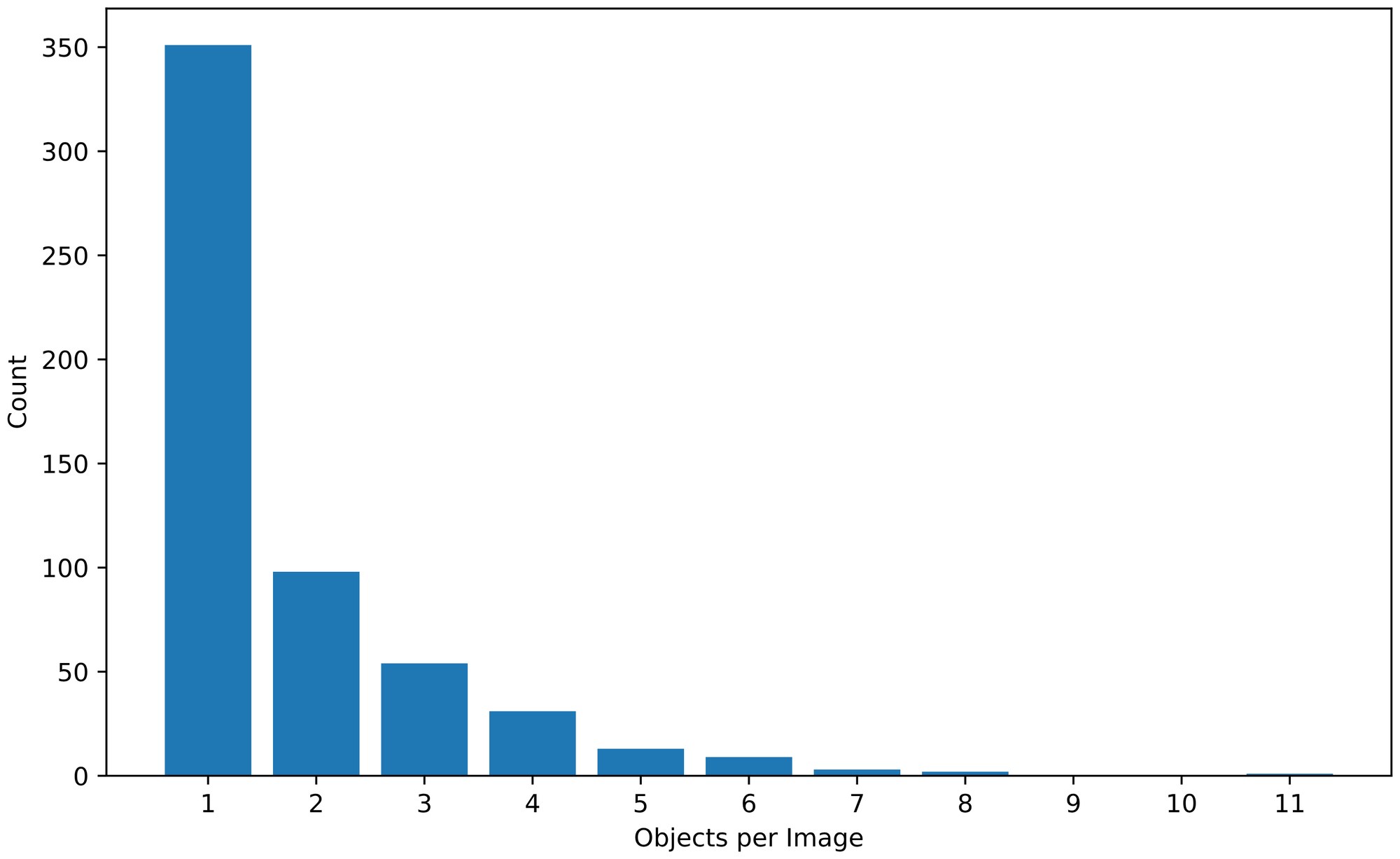
Figure 18: Distribution of number of objects per image in SA-3DAO. The number of objects follows a roughly power-law distribution.
图 18:SA-3DAO 中每张图像的物体数量分布。 物体数量大致遵循幂律分布。
Collection details.
We task professional 3D artists with recovering the shape of a target object from a single image, mirroring our model’s goal of reversing the photographic transform (as described in Section 2.1). In other words, the 3D artists must create a whole 3D mesh that precisely aligns with the object’s visible pixels in the image. Even under ideal settings, this requires contending with only partial information as the back side of the object is typically unseen, but many of the objects in SA-3DAO additionally have natural occlusions, or are small in size within the image; disentangling depth versus scale is often also challenging for a single image. To fill these information gaps, artists rely on recognition and context, using common-sense priors, physical plausibility, and assumptions of symmetry (when appropriate) to complete the meshes. The requirements imposed by this task are atypical to the normal 3D asset creation process that artists are more accustomed to, and efficient annotation requires learning a different mode of operation. After acclimation to the task, completion time per object mesh can vary considerably, ranging from up to 5 minutes for obvious objects with simple geometries to over 5 hours for more challenging cases; the median mesh in our dataset has 4751 vertices. Many of the images provided multiple objects with meshes from the 3D artists; we show the frequency distribution in Figure 18.
收集细节。
我们请专业三维艺术家从单张图像恢复目标物体的形状,这与我们模型的目标相一致:反转摄影变换(如第 2.1 节所述)。换句话说,三维艺术家必须创建一个完整的三维网格,使其与图像中该物体的可见像素精确对齐。即便在理想设定下,这也需要应对只有部分信息的情况,因为物体背面通常看不见;而 SA-3DAO 中的许多物体还有自然遮挡,或在图像中尺寸很小;对单张图像而言,把深度与尺度分开也常常很有挑战。为了填补这些信息缺口,艺术家依赖识别和上下文,使用常识先验、物理合理性,以及(在适当时候)对称性假设来补全网格。这一任务所施加的要求,不同于艺术家更习惯的常规三维资产创建流程,高效标注需要学会另一种工作方式。适应任务之后,每个物体网格的完成时间仍可能相差很大,从几何简单、一目了然的物体最多 5 分钟,到更有挑战的情形超过 5 小时;我们数据集中网格顶点数的中位数是 4751。许多图像提供了多个由三维艺术家给出网格的物体;我们在图 18 中展示频次分布。
D.2 Human Preference Set
D.2 人人偏好集
We further expand our evaluation suite to support more rigorous and domain-targeted assessments. While SA-3DAO provides a general and standardized way to measure progress, we want to also capture the challenges of settings where 3D perception is most critical, such as robotic manipulation and egocentric vision. To address this, we design a human preference set composed of images drawn from these domains of interest. This set enables evaluation through direct human judgment, providing insights that go beyond numerical metrics and capturing aspects of 3D perception that are important in embodied and real-world applications.
我们进一步扩展评测套件,以支持更严格、更针对特定领域的评估。虽然 SA-3DAO 提供了一种通用且标准化的进度衡量方式,我们也希望捕捉三维感知最为关键的那些设定中的挑战,例如机器人操作和第一人称视觉。为此,我们设计了一个人人偏好集,由从这些关注领域抽取的图像组成。这一集合通过直接的人的判断来做评测,提供超越数值指标的洞察,并捕捉在具身和真实世界应用中重要的三维感知方面。
Domains.
We design four human preference test datasets to comprehensively evaluate model capabilities across different scenarios.
领域。
我们设计了四份人人偏好测试数据集,以全面评估模型在不同场景下的能力。
- • SA-1B (Kirillov et al., 2023): We uniformly sample 1,000 image and object mask pairs, covering a diverse range of object categories. This set is intended to assess the model’s generalization ability across varied object distributions, with particular emphasis on long-tail categories.
- • SA-1B(Kirillov et al., 2023):我们均匀采样 1,000 对图像和物体掩码,覆盖多样的物体类别。这一集合旨在评估模型在不同物体分布上的泛化能力,尤其强调长尾类别。
- • MetaCLIP (Xu et al., 2024a): We select 1,000 samples where the object masks are of median or heavily occluded. This set evaluates the model’s performance in reconstructing occluded objects, a common challenge in cluttered scenes.
- • MetaCLIP(Xu et al., 2024a):我们选出 1,000 个物体掩码为中等或严重遮挡的样本。这一集合评估模型在重建被遮挡物体上的表现,这是杂乱场景中的常见挑战。
- • LVIS (Gupta et al., 2019): We densely sample 1,000 images containing between 10 and 30 objects per scene, and is designed to evaluate the model’s transferability to out-of-domain data and to demonstrate its ability to capture physical properties within dense scene layouts.
- • LVIS(Gupta et al., 2019):我们密集采样 1,000 张每场景含 10 到 30 个物体的图像,旨在评估模型向领域外数据的可迁移性,并展示它在密集场景布局中捕捉物理属性的能力。
- • Aria Digital Twin (Pan et al., 2023): We sample a smaller set of 40 video frames, with around 30 objects per scene. This dataset is intended to compare against baselines on scenes with highly accurate pointmaps, similar to those on which the baselines were trained.
- • Aria Digital Twin(Pan et al., 2023):我们采样一个较小的约 40 个视频帧集合,每场景大约 30 个物体。这一数据集旨在在具有高度准确点图的场景上与基线比较,这些点图类似于基线所训练的那些。
Setup.
Human preference evaluations are conducted through a structured sequence of pairwise comparisons. For each image and a masked object, annotators are first presented with two reconstructions (model “A” vs. “B”) and asked to select the one that most accurately matches the object in the image. The chosen reconstruction is then compared against the output of a third model (model “C”), and this process continues iteratively until all candidate models have been compared. Through this series of binary decisions, the most accurate reconstruction is identified as the preference for that particular image. To ensure fairness and avoid bias, the order of comparisons is randomized and the identity of models are anonymized.
设置。
人人偏好评测通过一组结构化的成对比较来进行。对每张图像和一个被掩码的物体,标注员首先看到两次重建(模型“A”对“B”),并被要求选出与图像中物体最准确匹配的那一次。被选中的重建再与第三个模型(模型“C”)的输出比较,这一过程迭代进行,直到所有候选模型都已被比较。通过这一系列二选一的决定,最准确的重建被认定为对该特定图像的偏好。为了保证公平并避免偏差,比较顺序是随机的,模型身份是匿名的。
D.3 Evaluation Metrics
D.3 评测指标
D.3.1 Shape Metrics Definitions
For shape evaluation on SA-3DAO, we first normalize the artist-created ground-truth mesh and the generated mesh independently into the range . We then apply ICP alignment for each mesh pair before computing metrics. We uniformly sample M points from both meshes and report four complementary metrics that capture different aspects of geometric fidelity:
D.3.1 形状指标的定义
对于 SA-3DAO 上的形状评测,我们首先把艺术家创建的真值网格和生成网格各自独立地归一化到 范围。然后在计算指标之前,对每对网格做 ICP 对齐。我们从两个网格上各均匀采样 万个点,并报告四项互补指标,它们捕捉几何保真度的不同方面:
- • F-score @ 0.01: Measures correspondence accuracy between the reconstructed and ground-truth points under a threshold. We compute precision and recall between the two point clouds and report their harmonic mean. F1 evaluates how many points lie close to the ground truth and how completely the reconstruction covers the target shape.
- • F-score @ 0.01: 在 阈值下衡量重建点与真值点之间的对应准确性。我们计算两份点云之间的精确率和召回率,并报告它们的调和平均。F1 评估有多少点靠近真值,以及重建对目标形状的覆盖有多完整。
- • Voxel-IoU: Provides a coarse volumetric agreement score and is sensitive to gross errors in volume, silhouette, and topology. We voxelize both point clouds to resolution and compute intersection-over-union over occupied voxels.
- • 体素 IoU: 给出粗粒度的体积一致分数,对体积、轮廓和拓扑上的严重误差敏感。我们把两份点云体素化到 分辨率,并对被占据体素计算交并比。
- • Chamfer Distance (CD): Measures bidirectional nearest-neighbor distance between reconstructed and ground-truth point sets, highlighting fine-grained geometric deviation and penalizing missing or distorted regions.
- • 倒角距离(CD): 衡量重建点集与真值点集之间的双向最近邻距离,突出细粒度几何偏差,并对缺失或变形区域加以惩罚。
- • Earth Mover’s Distance (EMD): Quantifies the minimal cost required to transport one point distribution to match the other. EMD is more stringent than CD, capturing global structural differences and enforcing bijective correspondence between distributions.
- • 推土机距离(EMD): 量化把一个点分布搬运到与另一个相匹配所需的最小代价。EMD 比 CD 更严格,捕捉全局结构差异,并强制分布之间的双射对应。
Together, these metrics provide a comprehensive view of reconstruction fidelity, from local accuracy to global shape consistency.
这些指标合在一起,从局部精度到全局形状一致性,为重建保真度提供了一个全面视角。
Moreover, to evaluate shape quality on the ISO3D dataset (Ebert, 2025)—which consists of in-the-wild synthetic images without 3D ground truth—we measure perceptual similarity between the generated shape and the input image using ULIP (Xue et al., 2023) and Uni3D (Zhou et al., 2023). For each generated mesh, we uniformly sample surface points to form a point cloud representation, and compute cross-modal similarity between the point cloud features and image features.
此外,为了在 ISO3D 数据集(Ebert, 2025)上评估形状质量——该数据集由 张没有三维真值的野外合成图像组成——我们用 ULIP(Xue et al., 2023)和 Uni3D(Zhou et al., 2023)衡量生成形状与输入图像之间的感知相似度。对每个生成网格,我们均匀采样 个表面点以形成点云表征,并计算点云特征与图像特征之间的跨模态相似度。
D.3.2 Layout Metrics Definitions
To evaluate single-object pose and compare with existing methods, we employ standard 6D pose estimation metrics, and then define ICP rotation error below.
D.3.2 布局指标的定义
为了评估单物体姿态并与已有方法比较,我们采用标准的 6D 姿态估计指标,并在下面定义 ICP 旋转误差。
- • 3D IoU: Measures the overlap of 3D axis-aligned bounding boxes between predicted and ground-truth bounding boxes, using the intersection-over-union. Values range from 0 (no overlap) to 1 (perfect overlap).
- • 3D IoU: 用交并比衡量预测边界框与真值边界框之间三维轴对齐边界框的重叠。取值从 0(无重叠)到 1(完全重叠)。
- • ICP-Rot: ICP Rotation Error is the residual rotation error (in degrees) after ICP alignment. Given predicted rotation and ground-truth rotation , the meshes are first posed, then ICP finds optimal alignment , and ICP-Rot is the angle of this rotation in degrees.
- • ICP-Rot: ICP 旋转误差 是 ICP 对齐后的残余旋转误差(以度为单位)。给定预测旋转 和真值旋转 ,网格首先被摆放到相应姿态,然后 ICP 找到最优对齐 ,ICP-Rot 就是这一旋转的角度(以度计)。
- • ADD-S (Average Distance with Symmetry): ADD-S (Xiang et al., 2018) is the symmetrized average of the minimum point-to-point distances between predicted and ground-truth posed objects, normalized by object diameter: (12) ADD-S (13) where and are the predicted and ground-truth point clouds for the posed shape, and is the diameter of the ground-truth point cloud. The symmetrized formulation averages distances in both directions: from predicted to ground-truth and from ground-truth to predicted. Lower values indicate better pose accuracy. The original ADD-S metric definition (Xiang et al., 2018) was designed for 6DoF pose estimation using a ground truth CAD model. In this case, when the predicted and ground truth shape are the same, the asymmetric and symmetric versions of ADD-S coincide. In SAM 3D we jointly estimate shape and pose, so generalize the metric to the symmetric version.
- • ADD-S(带对称的平均距离): ADD-S(Xiang et al., 2018)是预测与真值摆放后的物体之间最小点到点距离的对称化平均,并按物体直径归一化:
(12)
ADD-S (13)
其中 和 是摆放后形状的预测点云和真值点云, 是真值点云的直径。对称化公式在两个方向上平均距离:从预测到真值,以及从真值到预测。数值越低表示姿态越准确。原先的 ADD-S 指标定义(Xiang et al., 2018)是为使用真值 CAD 模型的 6DoF 姿态估计设计的。在那种情形下,当预测形状与真值形状相同时,ADD-S 的非对称版本和对称版本是一致的。在 SAM 3D 中我们联合估计形状和姿态,因此把该指标推广到对称版本。
- • ADD-S @ 0.1: A binary value per-sample indicating whether the ADD-S distance is less than 10% of the object’s diameter.
- • ADD-S @ 0.1: 每个样本的一个二值量,表示 ADD-S 距离是否小于物体直径的 10%。
Appendix E Additional Ablations
附录 E 更多消融
E.1 Intermediate Training Stage Knockout
E.1 去掉中间训练阶段
While Table 4 in the main paper shows the cumulative effect of adding different stages during training, Table 7 shows the impact of real-world data as intermediate stages. Knocking out any of these stages results in a notable drop in shape performance.
正文中的表 4 展示了训练过程中逐步加入不同阶段的累积效果,而表 7 展示的是作为中间阶段的真实世界数据的影响。去掉这些阶段中的任何一个,都会使形状性能明显下降。
| SA-3DAO | |||||
|---|---|---|---|---|---|
| Model | Training Setup | F1 @ 0.01 () | vIoU () | Chamfer () | EMD () |
| SAM 3D | Full | 0.2344 | 0.2311 | 0.0400 | 0.1211 |
| w/o training on MITL-3DO | 0.2211 | 0.2220 | 0.0486 | 0.1338 | |
| w/o training on Art-3DO | 0.2027 | 0.2025 | 0.0578 | 0.1510 | |
| w/o DPO on MITL-3DO | 0.2156 | 0.2156 | 0.0498 | 0.1367 |
Table 7: Training stage knockout. The impact of training on MITL and 3D artist-generated data.
| SA-3DAO | |||||
|---|---|---|---|---|---|
| 模型 | 训练设定 | F1 @ 0.01 () | vIoU () | Chamfer () | EMD () |
| SAM 3D | 完整 | 0.2344 | 0.2311 | 0.0400 | 0.1211 |
| 不在 MITL-3DO 上训练 | 0.2211 | 0.2220 | 0.0486 | 0.1338 | |
| 不在 Art-3DO 上训练 | 0.2027 | 0.2025 | 0.0578 | 0.1510 | |
| 不在 MITL-3DO 上做 DPO | 0.2156 | 0.2156 | 0.0498 | 0.1367 |
表 7:去掉训练阶段。 在 MITL 和三维艺术家生成数据上训练的影响。
E.2 Texture Evaluations
E.2 纹理评测
Comparison to SOTA.
We compare SAM 3D with existing methods on a holistic level (combined geometry and texture prediction) in Table 8. We compare against existing image-to-3D methods that predict Gaussians or textured meshes, including Trellis (Xiang et al., 2025) and Hunyuan3D-2.1 (Hunyuan3D et al., 2025). We also conduct a texture-only comparison by providing SAM 3D geometry as input to the texture modules of the aforementioned baselines, with the addition of Unitex (Liang et al., 2025b), a model that performs texture prediction given paired image and shape input.
与最好方法的比较。
我们在表 8 中从整体层面(几何与纹理的联合预测)把 SAM 3D 与已有方法比较。我们比较已有的、预测高斯或带纹理网格的图像到三维方法,包括 Trellis(Xiang et al., 2025)和 Hunyuan3D-2.1(Hunyuan3D et al., 2025)。我们还做了仅纹理的比较:把 SAM 3D 的几何作为输入,交给上述基线的纹理模块,并另外加入 Unitex(Liang et al., 2025b),这是一个在成对的图像和形状输入下做纹理预测的模型。
| SAM 3D WR over baselines, SAM 3D shape | ||||
|---|---|---|---|---|
| Model | ISO3D | Preference Set | SA-3DAO | LVIS |
| Trellis | 81.1 | 87.0 | 86.2 | 89.1 |
| Hunyuan3D-2.1 | 63.8 | 87.0 | 86.2 | 89.1 |
| Hunyuan3D-2.0 | 70.1 | 77.5 | 77.4 | 85.7 |
| Unitex | 83.3 | 84.7 | 84.5 | 88.3 |
Table 8: 3D texture. Preference results comparing SAM 3D to competing image-to-3D methods on ISO3D (Ebert, 2025), Preference Set, and SA-3DAO. We compare to the recent Trellis (Xiang et al., 2025), Hunyuan3D-2.1 (Hunyuan3D et al., 2025), and Unitex (Liang et al., 2025b), with the same shape of SAM 3D. The human preference rates represent preference for SAM 3D over each baseline approach.
| 给定 SAM 3D 形状时,SAM 3D 相对基线的胜率 | ||||
|---|---|---|---|---|
| 模型 | ISO3D | 偏好集 | SA-3DAO | LVIS |
| Trellis | 81.1 | 87.0 | 86.2 | 89.1 |
| Hunyuan3D-2.1 | 63.8 | 87.0 | 86.2 | 89.1 |
| Hunyuan3D-2.0 | 70.1 | 77.5 | 77.4 | 85.7 |
| Unitex | 83.3 | 84.7 | 84.5 | 88.3 |
表 8:三维纹理。 在 ISO3D(Ebert, 2025)、偏好集和 SA-3DAO 上,把 SAM 3D 与竞品图像到三维方法比较的偏好结果。我们在使用同一份 SAM 3D 形状的条件下,与近期的 Trellis(Xiang et al., 2025)、Hunyuan3D-2.1(Hunyuan3D et al., 2025)和 Unitex(Liang et al., 2025b)比较。人人偏好率表示相对每种基线方法对 SAM 3D 的偏好。
We report human preference for SAM 3D over each baseline method on multiple datasets: ISO3D (Ebert, 2025), Preference Set, SA-3DAO, and LVIS (Gupta et al., 2019). Results indicate that SAM 3D outperforms existing methods on the holistic image-to-3D task as well as texture estimation – this is due to the fact that the evaluated datasets often contain occlusion and clutter, which is a setting prior works struggle on.
我们在多个数据集上报告相对每种基线方法对 SAM 3D 的人人偏好:ISO3D(Ebert, 2025)、偏好集、SA-3DAO,以及 LVIS(Gupta et al., 2019)。结果表明,SAM 3D 在整体的图像到三维任务以及纹理估计上都优于已有方法——这是因为所评测的数据集常常包含遮挡和杂乱,而这正是先前工作难以应对的设定。
Ablations for Texture Training.
We conduct comprehensive studies on design choices for Texture & Refinement model (Figure 19) using annotator preferences on the Pref Set. We benchmark each component to the alternative model without the change. We remark a few themes here:
纹理训练的消融。
我们用 Pref Set 上标注员的偏好,对纹理与细化模型的设计选择做了全面研究(图 19)。我们把每个组件与去掉该改动的对照模型做基准比较。这里我们指出几个主题:
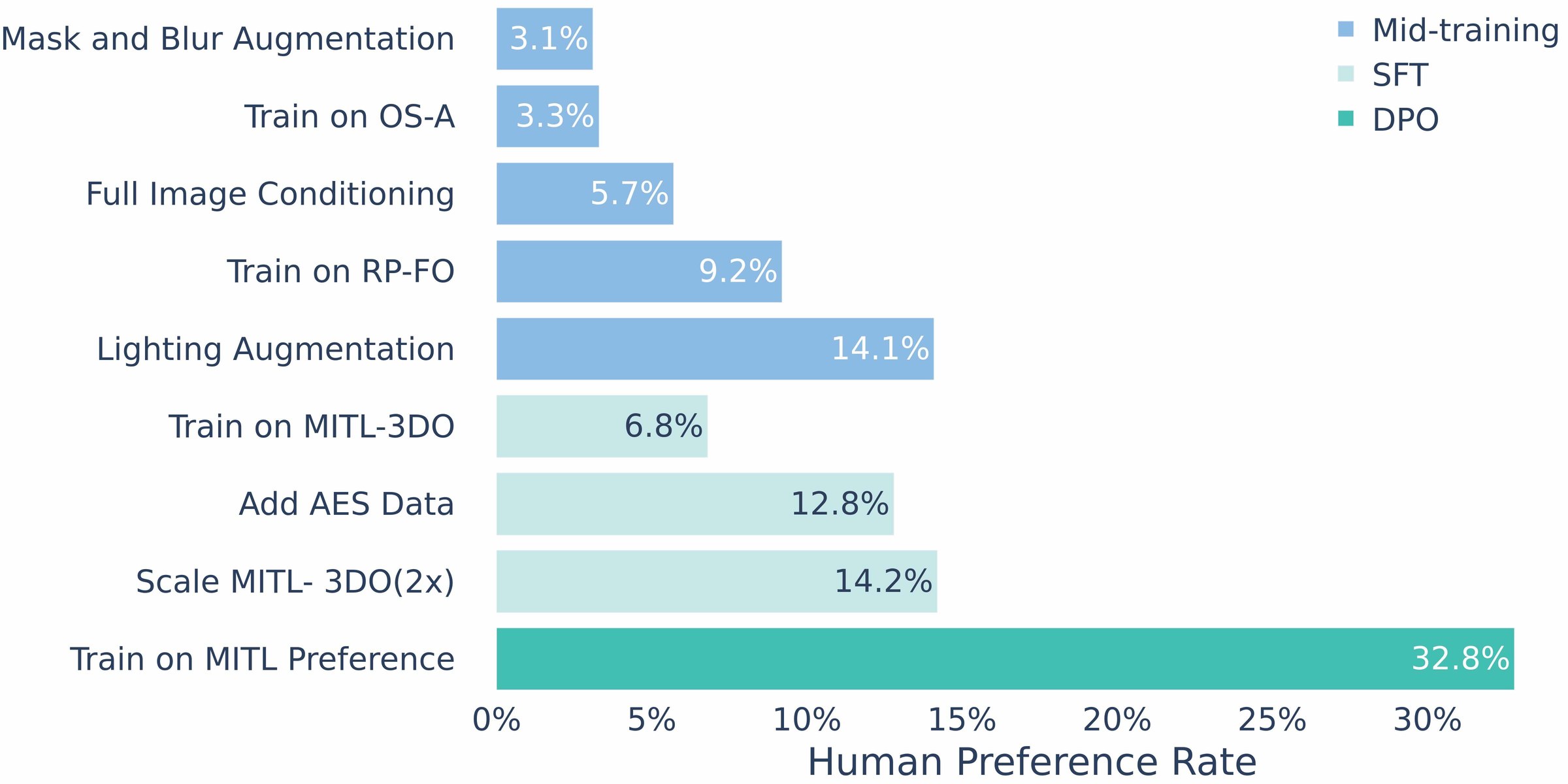
Figure 19: Ablations for the Texture & Refinement model, grouped by training stage. Percentages denote human preference rate for each ablation, over the model without the ablation.
图 19:按训练阶段分组的纹理与细化模型消融。 百分比表示相对去掉该消融后的模型,对各消融的人人偏好率。
- • Augmentation is very important, with lighting augmentation to be the most critical here. This is expected, given the Mask and Blur augmentations primarily focus on specific challenging cases (poor mask quality and low resolution inputs), so their effects get diluted in a holistic evaluation.
- • 增强非常重要,其中光照增强在这里最为关键。这是可以预期的,因为掩码增强和模糊增强主要针对特定的有挑战情形(掩码质量差和低分辨率输入),所以它们的效果在整体评测中会被稀释。
- • RP-3DO data are critical and helps the model adapt to real world.
- • RP-3DO 数据至关重要,能帮助模型适应真实世界。
- • Post-training data are critical, with significant gains coming from it. It demonstrates the effectiveness of our Data Engine, and DPO further amplifies the gains. In addition, sourcing specific type of data (AES) and scaling the data both show significant improvements.
- • 后训练数据至关重要,其中有显著收益来自它。这展示了我们数据引擎的有效性,而 DPO 进一步放大了这些收益。此外,引入特定类型的数据(AES)以及扩大数据规模都显示出显著改进。
E.3 Layout Test-Time Optimization
E.3 布局的测试时优化
Render-and-compare is a longstanding popular approach for pose estimation (Labbé et al., 2022; Wen et al., 2024): iteratively render the object’s shape according to the most recently predicted pose, directly compare with the input pixels, and then adjust the pose prediction accordingly. This heuristic-based search can lead to fairly accurate results, even with weak initial pose samples (“proposals” from a base model). By contrast, SAM 3D operates in a feedforward manner, directly diffusing the object pose (rotation, translation, and scale) conditioned on the image features and, optionally, the scene pointmap. Notably, we do not include any sort of pixel-based loss objective in this process. However, SAM 3D’s pose estimation can very naturally be used as a proposal for render-and-compare optimization. We include experiments showing the impact of this post-optimization process in Table 9, demonstrating that we can achieve further gains in pose metrics on ADT (Pan et al., 2023).
渲染并比较是姿态估计中长期流行的做法(Labbé et al., 2022;Wen et al., 2024):按最近一次预测的姿态迭代渲染物体的形状,直接与输入像素比较,再据此调整姿态预测。这种基于启发式的搜索可以给出相当准确的结果,即便初始姿态样本较弱(来自基座模型的“提案”)。相比之下,SAM 3D 以前馈方式工作,在图像特征以及(可选的)场景点图的条件下,直接扩散物体姿态(旋转、平移和尺度)。值得注意的是,我们在这一过程中不包含任何基于像素的损失目标。不过,SAM 3D 的姿态估计可以很自然地用作渲染并比较优化的提案。我们在表 9 中给出展示这一后优化过程影响的实验,表明我们可以在 ADT(Pan et al., 2023)的姿态指标上取得进一步提升。
| Model | 3D IoU () | ICP-Rot. () | ADD-S () | ADD-S @ 0.1 () | 2D IoU () |
|---|---|---|---|---|---|
| SAM 3D | 0.4837 | 14.4702 | 0.08265 | 0.7545 | 0.5143 |
| SAM 3D (post-optim) | 0.5258 | 14.1460 | 0.07932 | 0.7617 | 0.6487 |
Table 9: Test-time optimization for layout. Quantitative comparison of SAM 3D layout test-time optimization on Aria Digital Twin (Pan et al., 2023).
| 模型 | 3D IoU () | ICP-Rot. () | ADD-S () | ADD-S @ 0.1 () | 2D IoU () |
|---|---|---|---|---|---|
| SAM 3D | 0.4837 | 14.4702 | 0.08265 | 0.7545 | 0.5143 |
| SAM 3D(后优化) | 0.5258 | 14.1460 | 0.07932 | 0.7617 | 0.6487 |
表 9:布局的测试时优化。 在 Aria Digital Twin(Pan et al., 2023)上,对 SAM 3D 布局测试时优化的定量比较。
Specifically, we further optimize the layout proposals from SAM 3D by applying the layout to the generated objects, rendering and comparing for both masks and pixels, and backpropagating the gradients to refine the layout. We finally apply an automatic proposal-checking step, where the optimized layout is accepted only if its mask IoU exceeds that of the initial layout. As shown in Table 9, for the accepted optimized samples out of the ADT instances, both the 3D layout metrics and the 2D mask IoU metric improve substantially, demonstrating the effectiveness of layout test-time optimization.
具体而言,我们进一步优化来自 SAM 3D 的布局提案:把布局施加到生成的物体上,对掩码和像素都做渲染并比较,再把梯度反向传播以细化布局。我们最后施加一个自动的提案检查步骤:只有当优化后布局的掩码 IoU 超过初始布局时,才接受优化后的布局。如表 9 所示,在 个 ADT 实例中被接受的 个优化样本上,三维布局指标和二维掩码 IoU 指标都有大幅改进,展示了布局测试时优化的有效性。
E.4 Rotation Representation
E.4 旋转表征
We compare different rotation representations while keeping all other architecture and training settings identical. Each model is trained on the pretraining dataset and evaluated on a held-out Objaverse test split of 216 samples. As shown in Table 10, switching from a quaternion representation to the 6D continuous rotation parameterization (Zhou et al., 2019) yields a notable reduction in oriented rotation error, confirming that the 6D formulation provides a smoother optimization landscape more suitable for generative modeling. Further applying normalization to the 6D rotation vectors using the statistics over the training datasets leads to an additional improvement when training the flow matching models.
我们在保持所有其他结构和训练设定相同的条件下,比较不同的旋转表征。每个模型都在预训练数据集上训练,并在一份留出的、含 216 个样本的 Objaverse 测试划分上评测。如表 10 所示,从四元数表征改到 6D 连续旋转参数化(Zhou et al., 2019),会明显降低有朝向的旋转误差,这确认了 6D 公式提供了更平滑、更适合生成建模的优化地形。再进一步用训练数据集上的统计量对 6D 旋转向量做归一化,在训练流匹配模型时还会带来额外改进。
| Representation | Chamfer () | ICP-Rot. () |
|---|---|---|
| Quaternion | 0.0061 | 17.9585 |
| 6D Rotation | 0.0074 | 15.5399 |
| Normalized 6D Rotation | 0.0049 | 14.5946 |
Table 10: Rotation representation. Ablation on the representation used during pretraining. We report Chamfer distances and ICP rotation error.
| 表征 | Chamfer () | ICP-Rot. () |
|---|---|---|
| 四元数 | 0.0061 | 17.9585 |
| 6D 旋转 | 0.0074 | 15.5399 |
| 归一化 6D 旋转 | 0.0049 | 14.5946 |
表 10:旋转表征。 对预训练中所用表征的消融。我们报告倒角距离和 ICP 旋转误差。
E.5 Pointmap Minimally Affects Shape
E.5 点图对形状的影响很小
SAM 3D can condition on a 2.5D pointmap derived from sensor measurements (see Section 2.2) or from an off-the-shelf monocular depth estimation derived from the image itself, as is primarily used throughout this work. The latter is notable, as it also means that the current model can continue to benefit from future improvements of depth estimation methods. We observe that the pointmap minimally affects the shape performance: in a head-to-head preference test for shape on LVIS, the version of SAM 3D conditioned on pointmaps and the version without pointmaps are each selected 48% of the time.
SAM 3D 可以以从传感器测量得到的 2.5D 点图为条件(见第 2.2 节),也可以以由图像本身得到的现成单目深度估计为条件,而本文主要使用后者。后者值得注意,因为它也意味着当前模型可以继续受益于未来深度估计方法的改进。我们观察到,点图对形状性能的影响很小:在 LVIS 上针对形状的两两偏好测试中,以点图为条件的 SAM 3D 版本和不以点图为条件的版本各自被选中 48% 的次数。
E.6 Texture & Refinement Depth-VAE Comparison
E.6 纹理与细化 Depth-VAE 的比较
Table 11 shows the result of the improvements made to the VAE used in the Texture & Refinement model; see Section C.6. We found that the depth feature significantly improves the perceptual quality of reconstruction, while scaling the training data further improves the reconstruction performance. We also notice that the enhancement primarily arises from the difficult scenarios for the non-depth VAE (when it has a bad performance).
表 11 给出对纹理与细化模型所用 VAE 所做改进的结果;见第 C.6 节。我们发现,深度特征显著提高了重建的感知质量,而扩大训练数据则进一步改进重建性能。我们还注意到,提升主要来自对非深度 VAE 困难的那些情形(当它表现较差时)。
| Method | PSNR () | SSIM () | LPIPS () |
|---|---|---|---|
| Non-Depth VAE | 30.65 | 0.9470 | 0.04776 |
| Depth-VAE | 30.87 | 0.9500 | 0.04579 |
| Depth-VAE + scaling | 31.60 | 0.9547 | 0.04093 |
Table 11: Depth-VAE ablations. Effectiveness the depth-feature modification to the SLAT VAEs used in the Texture & refinement model. Results are evaluated on the entire GSO dataset.
| 方法 | PSNR () | SSIM () | LPIPS () |
|---|---|---|---|
| 非深度 VAE | 30.65 | 0.9470 | 0.04776 |
| Depth-VAE | 30.87 | 0.9500 | 0.04579 |
| Depth-VAE + 扩大规模 | 31.60 | 0.9547 | 0.04093 |
表 11:Depth-VAE 消融。 对纹理与细化模型所用 SLAT VAE 做深度特征修改的有效性。结果在整个 GSO 数据集上评测。
E.7 Data Engine: Increasing Best-of- Search with Reward Models
E.7 数据引擎:用奖励模型增大 Best-of- 搜索
| Tail Holdout | Epic Kitchens | SA-3DAO | ||||
|---|---|---|---|---|---|---|
| Chamfer | F1 | Chamfer | F1 | Chamfer | F1 | |
| SFT with | 0.0059 | 0.39 | 0.0094 | 0.30 | 0.0083 | 0.26 |
| SFT with recovery | 0.0053 | 0.41 | 0.0090 | 0.32 | 0.0081 | 0.26 |
Table 12: Including reward-model-recovered data during SFT, from the pipeline in Figure 17, improves model performance on challenging inputs, as seen in both Chamfer Distance and F1 score on the tail holdout set, Epic Kitchens (Damen et al., 2020), and SA-3DAO.
| 尾部留出集 | Epic Kitchens | SA-3DAO | ||||
|---|---|---|---|---|---|---|
| Chamfer | F1 | Chamfer | F1 | Chamfer | F1 | |
| 用 做 SFT | 0.0059 | 0.39 | 0.0094 | 0.30 | 0.0083 | 0.26 |
| 用 恢复后做 SFT | 0.0053 | 0.41 | 0.0090 | 0.32 | 0.0081 | 0.26 |
表 12:在 SFT 中纳入由奖励模型恢复的数据,来自图 17 中的流程,会改进模型在有挑战输入上的性能,这在尾部留出集、Epic Kitchens(Damen et al., 2020)和 SA-3DAO 上的倒角距离和 F1 分数中都可以看到。
Finetuning on data recovered using the reward-model-best-of- pipeline improves model performance on various challenging inputs, such as the artist evaluation set, tail holdout set, as well as Epic Kitchens (Damen et al., 2020), as shown in Table 12. This demonstrates that further amplifying the expert policy in Algorithm 1 by increasing in the best-of- search can improve the robustness of the model in challenging categories, and suggests that improved test-time search can increase the alignment convergence speed of the data engine.
在用奖励模型 best-of- 流程恢复的数据上微调,会改进模型在各种有挑战输入上的性能,例如艺术家评测集、尾部留出集,以及 Epic Kitchens(Damen et al., 2020),如表 12 所示。这表明,通过增大 best-of- 搜索中的 来进一步放大算法 1 中的专家策略,可以提高模型在有挑战类别上的稳健性,并暗示改进测试时搜索可以提高数据引擎的对齐收敛速度。
We found that both vision-language models (VLMs), and also the implicit reward models from our DPO stage (Lambert et al., 2024) performed similarly in our case. In our testing, the VLM-as-reward model had binary choice agreement with humans rater preferences, DPO agreed , and two human annotators agreed [^2] of the time. Around 80% of the recovery data came from the DPO-as-reward model.
我们发现,视觉-语言模型(VLM),以及来自我们 DPO 阶段的隐式奖励模型(Lambert et al., 2024),在我们的情形下表现相近。在我们的测试中,把 VLM 作为奖励模型时,与人类评分员偏好的二选一一致率为 ,DPO 约为 ,而两名人类标注员之间的一致率不到 。大约 80% 的恢复数据来自把 DPO 作为奖励模型。
E.8 Model Distillation Results
E.8 模型蒸馏结果
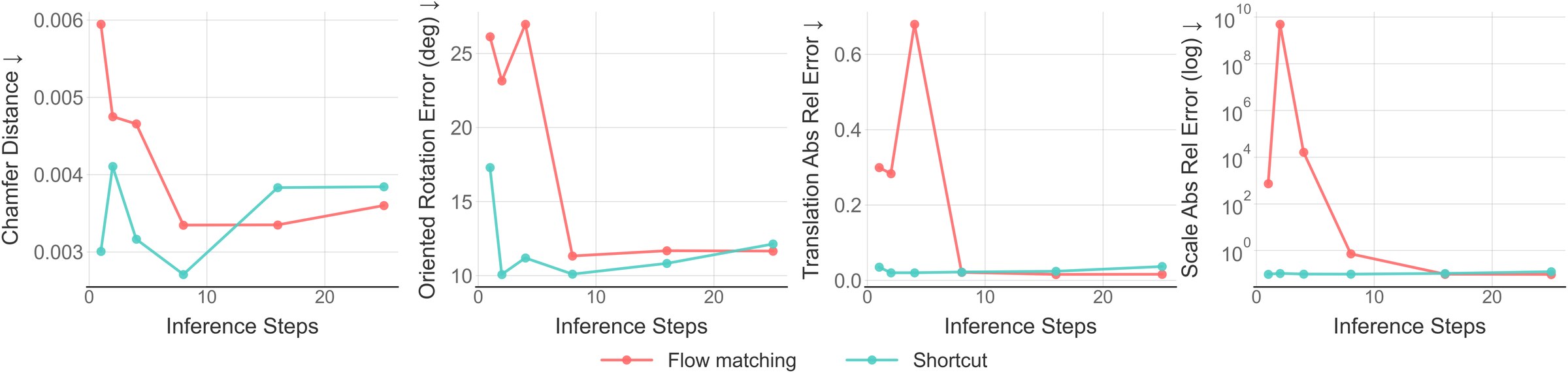
Figure 20: Model distillation. Geometry model shortcut versus flow matching. Flow matching distillation enables the model to perform significantly better during the early iterations, nearly on par with 25 steps performance.
图 20:模型蒸馏。 几何模型的捷径与流匹配对照。流匹配蒸馏使模型在早期迭代中表现显著更好,几乎与 25 步的性能相当。
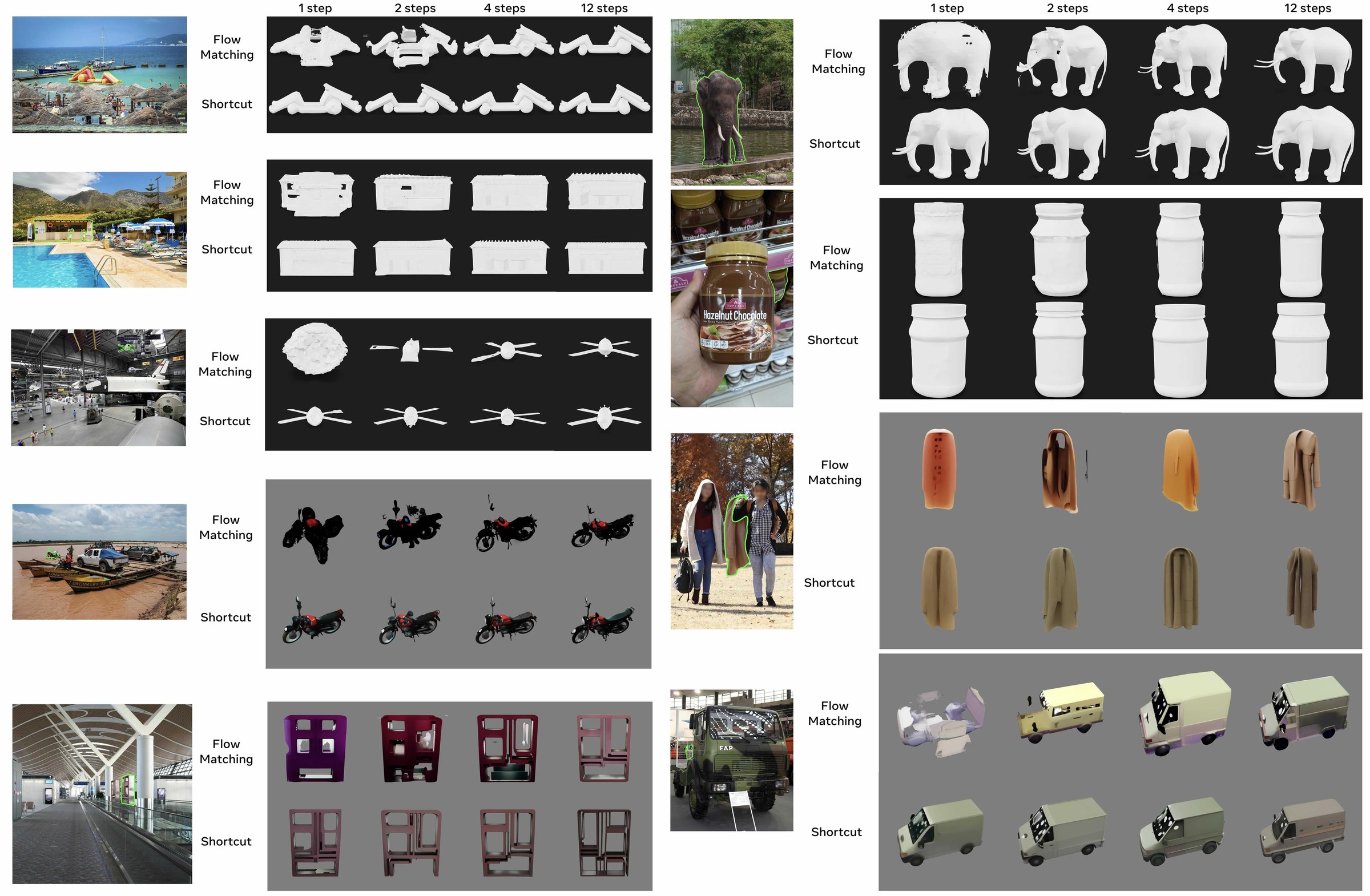
Figure 21: Qualitative examples after distillation. Visualization using difference number of steps in flow matching mode and shortcut mode. The black background displays the mesh rendering without texture, while the grey background shows the rendering of the Gaussian splattings.
图 21:蒸馏后的定性例子。 在流匹配模式和捷径模式下使用不同步数的可视化。黑色背景展示无纹理的网格渲染,灰色背景展示高斯溅射的渲染。
Figure 20 illustrates the performance of SAM 3D with and without distillation, plotted against the number of flow matching steps for the Geometry model. Specifically, using 1-step and 4-step methods yields a 38 and 10 inference speed improvement, respectively, compared to 25 steps with flow matching (w/ CFG). In flow matching mode, CFG is applied during the first half of the steps, resulting in a total NFE that is 1.5 times the number of steps. In contrast, shortcut mode achieves an NFE equal to the number of steps, as CFG is distilled directly into the model. For the Texture & Refinement model, we opted not to apply distillation for the final release, as the final model already performs well with fewer steps out of the box. This is because the overall geometry is primarily determined by the Geometry model’s voxel output, and increasing the number of steps does not significantly alter the geometry. However, as illustrated in Figure 21, where we present a visualization of the model outputs using different numbers of inference steps with shortcut mode enabled for both the Geometry model and the Texture & Refinement model, shortcut model distillation improves texture quality when using fewer steps.
图 20 展示了有无蒸馏时 SAM 3D 的性能,按几何模型的流匹配步数绘制。具体而言,与带 CFG 的 25 步流匹配相比,1 步和 4 步方法分别带来 38 倍和 10 倍的推理速度提升。在流匹配模式中,CFG 施加在前一半步上,因此总 NFE 是步数的 1.5 倍。相比之下,捷径模式的 NFE 等于步数,因为 CFG 被直接蒸馏进模型。对于纹理与细化模型,我们在最终发布中选择不施加蒸馏,因为最终模型在较少步数下就已经表现很好。这是因为整体几何主要由几何模型的体素输出决定,增加步数并不会显著改变几何。不过,如图 21 所示——我们展示了在几何模型以及纹理与细化模型都开启捷径模式时、使用不同推理步数的模型输出可视化——在使用较少步数时,捷径模型蒸馏会改进纹理质量。
E.9 Input Mask Robustness
E.9 输入掩码的稳健性
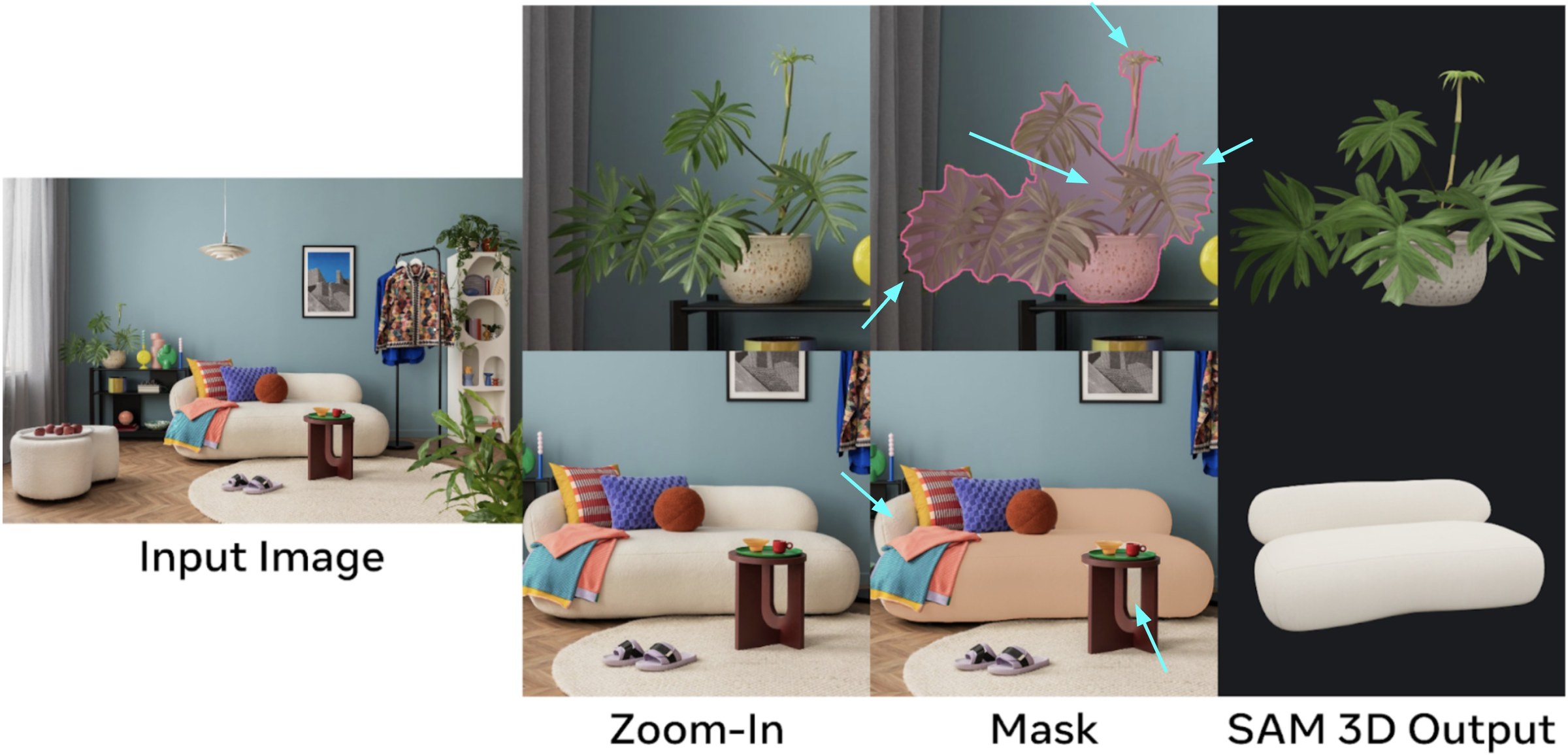
Figure 22: SAM 3D robustness to input mask precision. Top: Over-segmentation; Bottom: Under-segmentation.
图 22:SAM 3D 对输入掩码精度的稳健性。 上:过度分割;下:分割不足。
SAM 3D assumes a segmentation mask as input to designate to the model which object within a scene should be reconstructed, as well as isolate the object’s pixels for visual feature extraction. Accurate segmentation by hand can be time-consuming, but the ready availability of segmentation models like the SAM series (Kirillov et al., 2023; Ravi et al., 2025; Carion et al., 2026) offer a fast, promptable solution. On the other hand, automatic methods are not perfect, and as a preceding step to SAM 3D, there is risk of compounding errors. Yet, we observe empirically that SAM 3D has fair robustness to errors in mask precision (see Figure 22), demonstrating the ability to recognize the intended target object and reconstruct it. We also note that as an input to the model, SAM 3D is agnostic to the source of mask, and thus is able to take advantage of ground truth masks or advancements in segmentation by future models.
SAM 3D 假定以一个分割掩码作为输入,向模型指定场景中应重建哪一个物体,并把该物体的像素隔离开来以提取视觉特征。手工做准确分割可能很耗时,但像 SAM 系列(Kirillov et al., 2023;Ravi et al., 2025;Carion et al., 2026)这样现成的分割模型,提供了一种快速、可提示的解决方案。另一方面,自动方法并不完美,而作为 SAM 3D 的前序步骤,存在误差叠加的风险。不过,我们从经验上观察到,SAM 3D 对掩码精度上的误差具有相当的稳健性(见图 22),表现出识别预定目标物体并重建它的能力。我们还指出,作为模型的输入,SAM 3D 对掩码来源并不敏感,因此能够利用真值掩码,或未来模型在分割上的进展。
Appendix F Limitations
附录 F 局限
There are limits to our model’s resolution based on the architectural hyperparameters we used. The geometry model uses a coarse shape resolution of ; we trained multiple 3D Gaussian splat decoders, with up to splats per occupied voxel. This is sufficient for many types of objects, but for more complex shapes, thin structures, or where human perception is especially attuned, these limits to resolution can lead to noticeable distortions or loss of details. For example, as part of a whole human body, the number of voxels/splats our chosen resolution is able to devote to hands or faces is inherently limited by the overall body’s scale, and due to human visual system’s acuity to such features, this can lead to perceptible artifacts to these body parts. By contrast, when focused on just a single hand or the head, the higher relative resolution available means SAM 3D can reconstruct these significantly better. For these kinds of objects and others, a natural next step for SAM 3D would be to increase the output resolution via architectural changes, a superresolution model, parts-based generation, or switching to an implicit 3D representation.
基于我们所用的结构超参数,模型的分辨率是有限度的。几何模型使用粗形状分辨率 ;我们训练了多个三维高斯溅射解码器,每个被占据体素最多 个溅射。这对许多类型的物体已经足够,但对于更复杂的形状、细薄结构,或人的感知特别敏感的地方,这些分辨率限制会导致明显的变形或细节丢失。例如,作为整个人体的一部分,我们选定的分辨率能够分配给手或脸的体素/溅射数量,本质上受整个人体尺度限制;又由于人的视觉系统对这些特征很敏锐,这会在这些身体部位上产生可察觉的伪影。相比之下,当只聚焦于一只手或头部时,相对分辨率更高,意味着 SAM 3D 可以明显更好地重建它们。对于这类物体以及其他物体,SAM 3D 自然的下一步会是通过结构调整、超分辨率模型、基于部件的生成,或改用隐式三维表征,来提高输出分辨率。
Object layouts are another area where improvements can be made. SAM 3D predicts objects one at a time, and isn’t trained to reason about physical interactions, such as contact, physical stability, interpenetration, or co-alignment (e.g. on the same ground plane). Multi-object prediction combined with appropriate losses would allow joint reasoning about multiple objects in a scene. Similarly, while SAM 3D’s single-object inference is embarrassingly parallel across multiple GPUs, scene-based inference may also present opportunities to more efficiently accelerate the reconstruction of entire scenes. Finally, SAM 3D’s texture predictions are made without knowledge of the predicted object’s pose; as a result, for objects with rotational symmetry, it can occasionally predict textures that effectively rotate the object to the incorrect orientation.
物体布局是另一个可以改进的方面。SAM 3D 一次预测一个物体,并且没有被训练去推理物理交互,例如接触、物理稳定性、相互穿透,或共同对齐(例如在同一地平面上)。多物体预测再配以适当的损失,将允许对场景中的多个物体做联合推理。类似地,虽然 SAM 3D 的单物体推理在多块 GPU 上是完全可并行的(embarrassingly parallel),基于场景的推理也可能提供更有效地加速整场景重建的机会。最后,SAM 3D 的纹理预测是在不知道所预测物体姿态的情况下做出的;因此,对于具有旋转对称性的物体,它偶尔会预测出实际上把物体转到错误朝向的纹理。
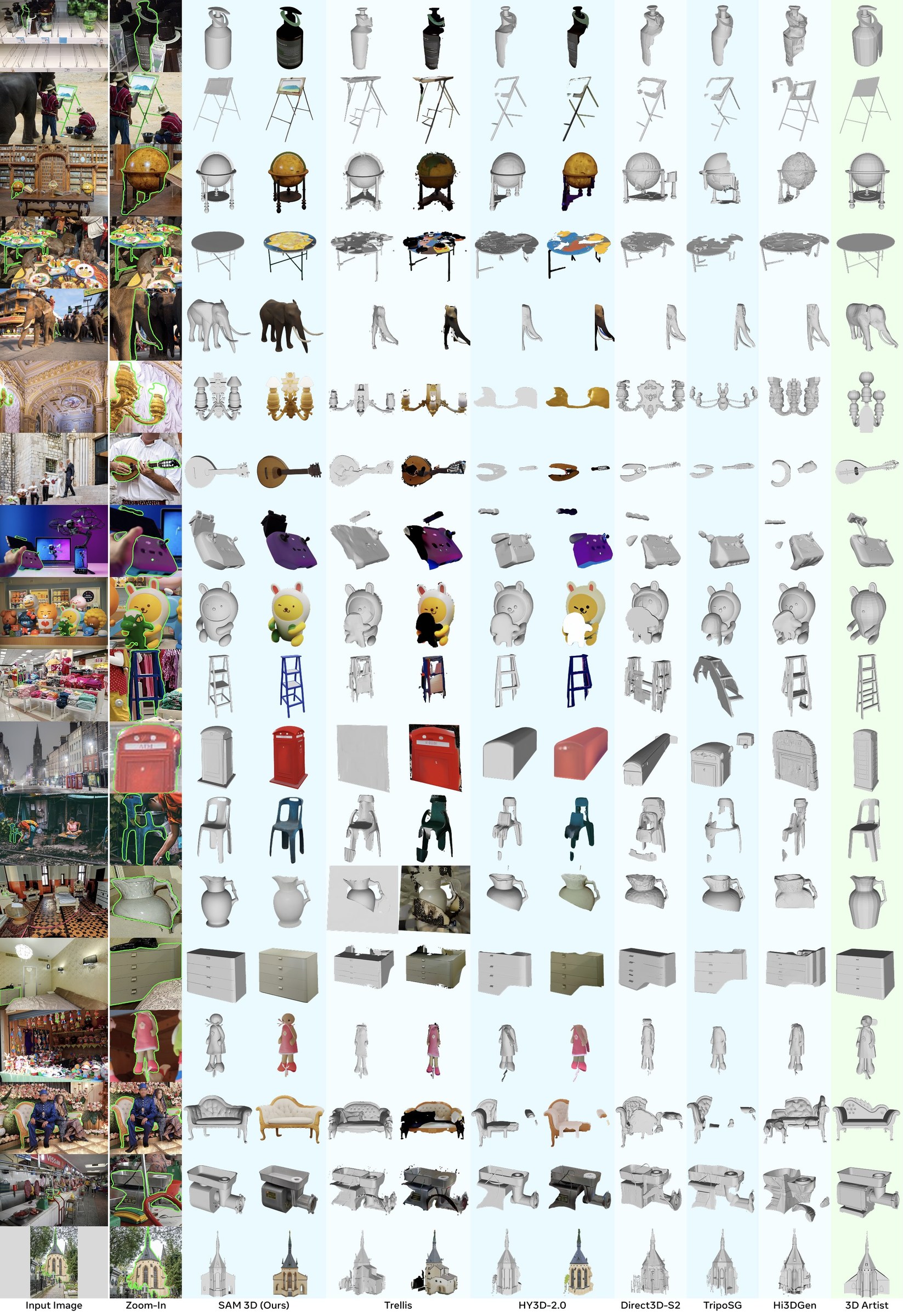
Figure 23: Additional qualitative shape and texture results of our model on the SA-3DAO eval set. For models that include texture, we show the untextured mesh (left) and textured mesh (right) separately.
图 23:我们的模型在 SA-3DAO 评测集上的更多定性形状与纹理结果。 对于包含纹理的模型,我们分别展示无纹理网格(左)和有纹理网格(右)。
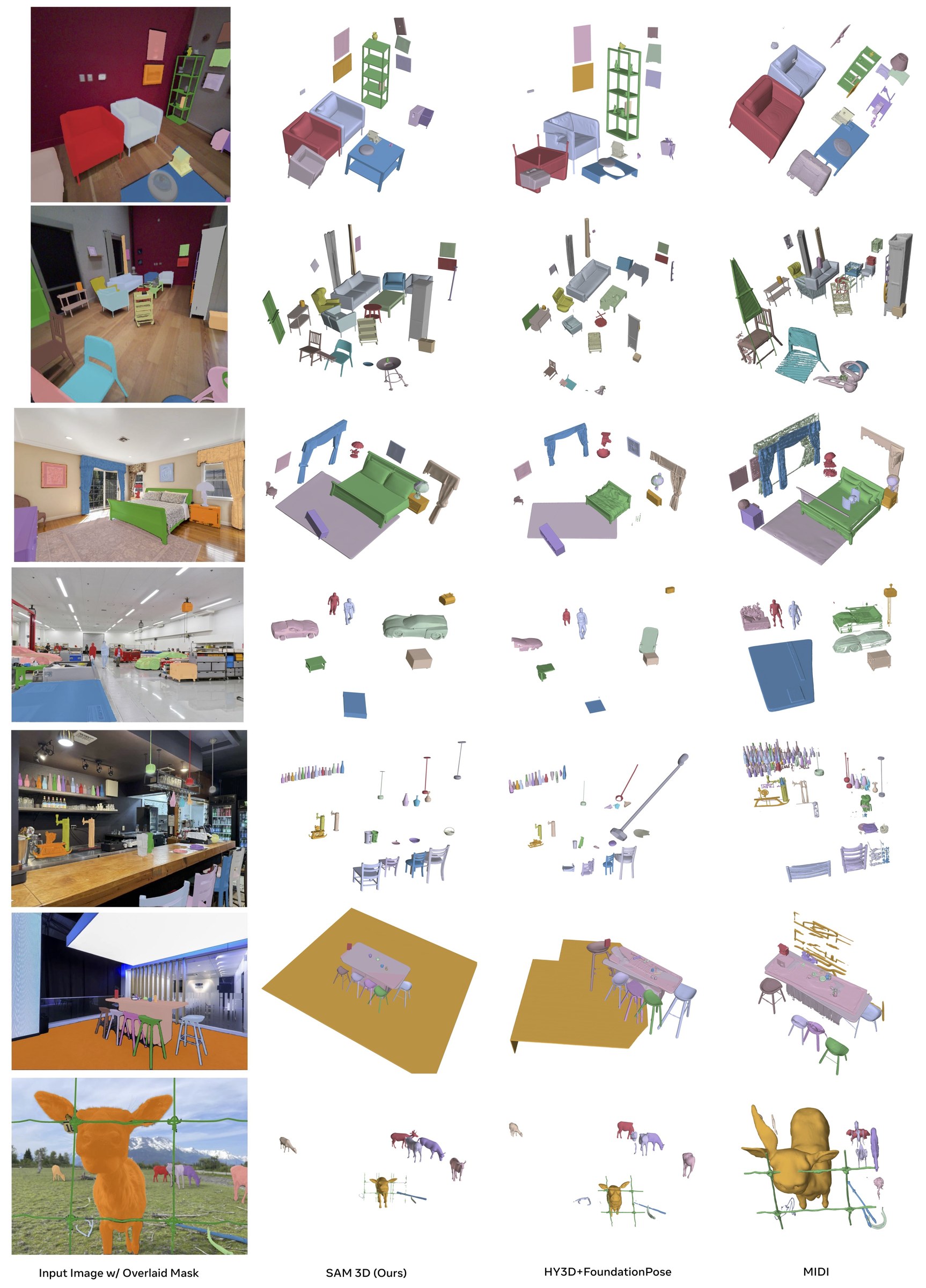
Figure 24: Qualitative examples for scene reconstruction. Showing examples of SAM 3D and alternative scene reconstruction methods.
图 24:场景重建的定性例子。 展示 SAM 3D 与其他场景重建方法的例子。