Roll the dice & look before you leap: Going beyond the creative limits of next-token prediction
Roll the dice & look before you leap: Going beyond the creative limits of next-token prediction
掷骰子,三思而后行:超越下一词预测的创造极限
Vaishnavh Nagarajan Affiliation: Google Research, US Correspondence to: vaishnavh@google.com Chen Henry Wu Affiliation: Carnegie Mellon University, Pittsburgh, US Correspondence to: chenwu2@cs.cmu.edu Charles Ding Affiliation: Carnegie Mellon University, Pittsburgh, US Aditi Raghunathan Affiliation: Carnegie Mellon University, Pittsburgh, US
Abstract
摘要
We design a suite of minimal algorithmic tasks that are a loose abstraction of open-ended real-world tasks. This allows us to cleanly and controllably quantify the creative limits of the present-day language model. Much like real-world tasks that require a creative, far-sighted leap of thought, our tasks require an implicit, open-ended stochastic planning step that either (a) discovers new connections in an abstract knowledge graph (like in wordplay, drawing analogies, or research) or (b) constructs new patterns (like in designing math problems or new proteins). In these tasks, we empirically and conceptually argue how next-token learning is myopic and memorizes excessively; multi-token approaches, namely teacherless training and diffusion models, comparatively excel in producing diverse and original output. Secondly, to elicit randomness without hurting coherence, we find that injecting noise at the input layer (dubbed as seed-conditioning) works surprisingly as well as (and in some conditions, better than) temperature sampling from the output layer. Thus, our work offers a principled, minimal test-bed for analyzing open-ended creative skills, and offers new arguments for going beyond next-token learning and temperature sampling. We make part of the code available under https://github.com/chenwu98/algorithmic-creativity
我们设计一套极简算法任务,作为开放式真实任务的松散抽象,从而干净、可控地量化当代语言模型的创造极限。与需要富有创意、目光长远的思维跃迁的真实任务类似,这些任务要求隐含、开放的随机规划步骤:要么 (a) 在抽象知识图中发现新联系(如文字游戏、类比、科研),要么 (b) 构造新模式(如设计数学题或新蛋白)。我们从经验与概念上论证:下一词学习目光短浅且过度记忆;多词元方法——无教师训练与扩散模型——在产出多样、原创输出上相对更强。其次,为在不伤连贯性的前提下引出随机性,我们发现在输入层注入噪声(称为种子条件化)的效果出人意料地不亚于(在某些条件下甚至优于)输出层温度采样。因此,本文为分析开放式创造技能提供原则性极简试验台,并为超越下一词学习与温度采样提供新论据。部分代码见 https://github.com/chenwu98/algorithmic-creativity
1 Introduction
1 引言
Keywords:
Not all forms of intelligence are solely about being correct or wrong. In open-ended tasks, what also matters is finding creative ways to satisfy a request, making surprising and fresh connections never seen before. For instance, consider responding to highly under-specified prompts like “Generate a challenging high-school word problem involving the Pythagoras Theorem.” or “Suggest some candidate therapeutic antibodies targeting the HER2 antigen.” or “Provide a vivid analogy to differentiate quantum and classical mechanics.” Creativity in such tasks requires generating responses that are not just correct or coherent, but are also diverse across responses and are original compared to the training data. These currently-sidelined desiderata will rise to prominence as we explore LLMs for open-ended scientific discovery (Gruver et al. 2023; Romera-Paredes et al. 2024; Si et al. 2024; Lu et al. 2024a), for generating novel training data (Yu et al. 2024; Yang et al. 2024c; Wang et al. 2023), and as we scale up test-time compute approaches that benefit from diversity in exploration, such as best-of-N (Cobbe et al. 2021; Chow et al. 2024; Dang et al. 2025) and long chain-of-thought reasoning (OpenAI 2024; DeepSeek-AI 2025; Snell et al. 2024; Wu et al. 2024).
关键词:
并非所有智能都只关对错。在开放式任务中,同样重要的是找到满足请求的创意方式,建立从未见过的惊奇新联系。例如回应高度欠定的提示:「生成一道涉及勾股定理的高中难题。」「给出若干靶向 HER2 抗原的候选治疗性抗体。」「用生动类比区分量子与经典力学。」此类任务上的创造力,要求回复不仅正确或连贯,还要跨回复多样,相对训练数据原创。这些目前被边缘化的诉求,会随我们用 LLM 做开放式科学发现(Gruver et al. 2023;Romera-Paredes et al. 2024;Si et al. 2024;Lu et al. 2024a)、生成新颖训练数据(Yu et al. 2024;Yang et al. 2024c;Wang et al. 2023),以及扩大受益于探索多样性的测试时算力方法——如 best-of-N(Cobbe et al. 2021;Chow et al. 2024;Dang et al. 2025)与长思维链推理(OpenAI 2024;DeepSeek-AI 2025;Snell et al. 2024;Wu et al. 2024)——而愈发突出。
Unlike simple open-ended tasks like generating names and basic sentences (Zhang et al. 2024b; Hopkins et al. 2023), many creative tasks (like designing a clever Olympiad problem) are said to involve a random flash of creative insight termed variously as a leap of thought (Wang et al. 2024a; Talmor et al. 2020; Zhong et al. 2024), a “eureka” moment (Bubeck et al. 2023), a mental leap (Holyoak & Thagard 1995; Callaway 2013; Hofstadter 1995) or an incubation step (Varshney et al. 2019). The thesis of this paper is that learning to solve such creative leap-of-thought tasks (defined shortly) is misaligned with the current language modeling paradigm (a) in terms of next-token learning, and (b) in how randomness is elicited. We articulate these two concerns by designing a suite of algorithmic tasks inspired by such creative tasks. We then demonstrate how the creativity of language models suffers in these tasks, and how this can be alleviated (to an extent, within our tasks).
不同于生成名字与简单句子等简单开放任务(Zhang et al. 2024b;Hopkins et al. 2023),许多创造任务(如设计巧妙奥赛题)据说涉及随机灵光一现,被称作思维跃迁(Wang et al. 2024a;Talmor et al. 2020;Zhong et al. 2024)、「尤里卡」时刻(Bubeck et al. 2023)、心智跃迁(Holyoak & Thagard 1995;Callaway 2013;Hofstadter 1995)或孵化步骤(Varshney et al. 2019)。本文论点是:学习这类创造跃迁任务(定义见下)与当前语言建模范式错位——(a) 在下一词学习上,(b) 在如何引出随机性上。我们设计受此类创造任务启发的算法任务套件,展示语言模型在此的创造力如何受损,以及如何(在任务范围内)有所缓解。
Concretely, for the scope of this paper, a creative leap-of-thought task refers to tasks that involve a search-and-plan process; crucially, this process orchestrates multiple random decisions in advance before generating the output. Typically, such a leap of thought is highly implicit in the text — to infer it, one has to deeply engage with the text and detect higher-order patterns. We can think of tasks like designing satisfying math problems, generating worthwhile research ideas, or drawing surprising analogies as examples of such tasks.
具体而言,本文范围内的创造跃迁任务指需要搜索与规划的过程;关键是,该过程在生成输出前须预先协调多个随机决策。通常,这种跃迁在文本中高度隐含——要推断它,必须深入文本、察觉高阶模式。设计令人满意的数学题、提出有价值的研究想法、画出惊奇类比,都可视为此类任务。
Ideally, one would directly study these real-world tasks to quantify the limits of language models. Indeed, a flurry of recent works report that LLM-generated research ideas tend to be rephrased from existing ideas (Gupta & Pruthi 2025; Beel et al. 2025) and that LLM outputs tend to be less creative than humans e.g., Chakrabarty et al. 2024; Lu et al. 2024b (See §J). While assessing real-world tasks is a lofty goal, the evaluations are subjective (Wang et al. 2024b; Runco & Jaeger 2012), and when the model has been exposed to all of the internet, originality is hard to ascertain. Thus, the conclusions will inevitably invite debate (such as Si et al. 2024 vs. Gupta & Pruthi 2025 or Lu et al. 2024a vs. Beel et al. 2025).
理想情况应直接在真实任务上量化语言模型极限。确有一批近作报告:LLM 生成的研究想法往往是对已有想法的改写(Gupta & Pruthi 2025;Beel et al. 2025),LLM 输出也常不如人类有创意,例如 Chakrabarty et al. 2024;Lu et al. 2024b(见 §J)。评估真实任务目标远大,但评价主观(Wang et al. 2024b;Runco & Jaeger 2012);当模型已见过整个互联网,原创性也难确认。结论难免引发争论(如 Si et al. 2024 对 Gupta & Pruthi 2025,或 Lu et al. 2024a 对 Beel et al. 2025)。
In search of more definitive conclusions, we approach from a different angle: we study minimal and controllable tasks that are loose abstractions of real-world tasks and yet allow one to rigorously quantify originality and diversity. This follows along the lines of recent works that have studied the diversity of models in graph path-finding (Khona et al. 2024) and generating challenging CFGs (Allen-Zhu & Li 2023b). Broadly, we refer to such tasks as open-ended algorithmic tasks. Our aim is to design tasks more minimal than these prior tasks, and crucially, tease apart distinct computational skills required for creativity. This will allow us to systematically investigate issues in the current paradigm of model training and propose alternatives.
为求更确定的结论,我们换一角度:研究作为真实任务松散抽象、却能严格量化原创与多样性的极简可控任务。这延续近期在图路径寻找(Khona et al. 2024)与生成困难 CFG(Allen-Zhu & Li 2023b)上研究模型多样性的工作。我们统称此类任务为开放式算法任务。目标是设计比先前更极简、并能拆开创造力所需不同计算技能的任务,从而系统考察当前训练范式的问题并提出替代。
As our first main contribution, we draw inspiration from cognitive science literature (Boden 2003) (see also Franceschelli & Musolesi 2023) to design algorithmic tasks isolating two distinct types of creative leaps of thought. The first class of tasks involves combinational creativity: drawing novel connections in knowledge, like in research, wordplay or drawing analogies (see Fig 1 for task description). The second class of tasks involves exploratory creativity: constructing fresh patterns subject to certain rules, like in designing problems and suspense (see Fig 2). In these tasks, we can precisely evaluate models for the fraction of generations that are coherent, unique and original (not present in training set). We term this metric “algorithmic creativity” to denote that it is solely evaluates the computational aspects of creativity.
作为第一项主要贡献,我们受认知科学文献(Boden 2003)(亦见 Franceschelli & Musolesi 2023)启发,设计算法任务以隔离两类不同的创造跃迁。第一类是组合创造:在知识中建立新联系,如科研、文字游戏或类比(任务描述见图 1)。第二类是探索创造:在规则约束下构造新模式,如出题与悬念设计(见图 2)。在这些任务上,我们可精确评估生成中连贯、唯一且原创(不在训练集中)的比例。我们称该指标为「算法创造力」,表示它只评估创造力的计算侧面。
(a) Sibling Discovery
(a) 兄弟姐妹发现
(a) Circle Construction
(a) 圆构造
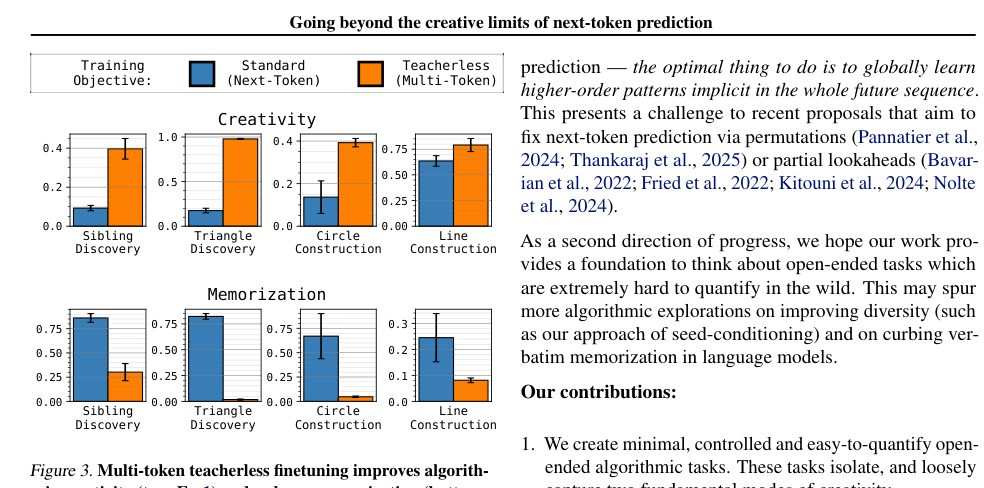
Figure 3: Multi-token teacherless finetuning improves algorithmic creativity (top; Eq 1) and reduces memorization (bottom; fraction of generations seen during training) on our four open-ended algorithmic tasks for a Gemma v1 (2B) model.
图 3:无教师多词元微调提升算法创造力(上;式 1),并降低记忆(下;训练中见过的生成比例),在四项开放式算法任务上对 Gemma v1(2B)模型。
Within this framework, we articulate two creative limits of the current language modeling paradigm. First, we empirically find that next-token learning achieves lower algorithmic creativity (and higher memorization) compared to multi-token approaches, namely, teacherless training (Bachmann & Nagarajan 2024; Monea et al. 2023; Tschannen et al. 2023) and diffusion models (Hoogeboom et al. 2021; Austin et al. 2021; Lou et al. 2023) (see Fig 3 and Fig 4). Our argument is that in all our tasks, inferring the latent leap of thought requires observing global higher-order patterns rather than local next-token patterns in the sequence.
在此框架内,我们阐明当前语言建模范式的两点创造局限。第一,经验上发现下一词学习的算法创造力低于多词元方法——无教师训练(Bachmann & Nagarajan 2024;Monea et al. 2023;Tschannen et al. 2023)与扩散模型(Hoogeboom et al. 2021;Austin et al. 2021;Lou et al. 2023)(见图 3、图 4),记忆也更高。我们的论证是:在全部任务中,推断潜在跃迁需要观察序列中的全局高阶模式,而非局部下一词模式。
Next, we turn to how we elicit randomness from a Transformer. While the de facto approach is to elicit randomness at the output — temperature sampling — we contrast this with injecting randomness into the model. Concretely, we study seed-conditioning, where we train with a random prefix string per example. Surprisingly, we find that seed-conditioning induces non-trivial algorithmic creativity even with deterministic, greedy decoding. In fact, seed-conditioning is competitive with and in some cases, more creative than temperature sampling. Intuitively, maximizing diversity at the output-token-level is computationally burdensome: it requires simultaneously processing a diverse set of leaps of thoughts to compute a marginalized token distribution. It is easier to first sample a single latent leap of thought, and then compute the token conditioned on that one leap. We conjecture that seed-conditioning enables a latent-leap-conditioned token generation.
接着讨论如何从 Transformer 引出随机性。默认做法是在输出端用温度采样;我们对比向模型注入随机性。具体研究种子条件化:为每个训练样例配一个随机前缀串。令人惊讶的是,即便确定性贪心解码,种子条件化也能诱导不可忽略的算法创造力;事实上它与温度采样相当,有时更有创意。直观上,在输出词元级最大化多样性计算负担重:须同时处理多样跃迁以计算边缘化词元分布。更容易的是先采样单个潜在跃迁,再据此计算条件词元。我们猜想种子条件化实现了以潜在跃迁为条件的词元生成。
Overall, we hope our study advances the field in two directions. First, we provide a new angle to advocate for multi-token approaches, orthogonal to the “path-star” example in Bachmann & Nagarajan 2024 (or 6 in short). Whereas, the path-star example portrays a gap in correctness of reasoning, ours shows a gap in diversity of open-ended thinking. We note though that 6 is an impossibility result where next-token learning breaks down spectacularly (unless there is exponential data or compute), while ours is a data-inefficiency result (where next-token learning occurs but is mediocre). Next, the gap we show appears even in 2-token-lookahead tasks as against the many-token-lookahead path-star task. Third, and perhaps most conceptually important is the fact that, while the path-star task is amenable to next-token prediction upon reversing the tokens, we identify tasks where no re-ordering is friendly towards next-token prediction — the optimal thing to do is to globally learn higher-order patterns implicit in the whole future sequence. This presents a challenge to recent proposals that aim to fix next-token prediction via permutations (Pannatier et al. 2024; Thankaraj et al. 2025) or partial lookaheads (Bavarian et al. 2022; Fried et al. 2022; Kitouni et al. 2024; Nolte et al. 2024).
总体希望沿两个方向推进领域。第一,为多词元方法提供新论据,正交于 Bachmann & Nagarajan 2024 的「路径星」例子(下称 6)。路径星刻画正确性推理差距,我们展示开放式思维多样性差距。注意 6 是不可能性结果(除非指数数据或算力,下一词学习彻底崩坏),我们则是数据低效结果(下一词仍在学,但平庸)。其次,我们在仅需 2 词元前瞻的任务上也能看到差距,而路径星需多词元前瞻。第三、或许概念上最重要的是:路径星在反转词元顺序后可对下一词预测友好,我们找到无论何种重排都不友好下一词预测的任务——最优做法是全局学习整段未来序列中隐含的高阶模式。这对靠置换(Pannatier et al. 2024;Thankaraj et al. 2025)或部分前瞻(Bavarian et al. 2022;Fried et al. 2022;Kitouni et al. 2024;Nolte et al. 2024)修补下一词预测的近期方案提出挑战。
As a second direction of progress, we hope our work provides a foundation to think about open-ended tasks which are extremely hard to quantify in the wild. This may spur more algorithmic explorations on improving diversity (such as our approach of seed-conditioning) and on curbing verbatim memorization in language models.
作为第二方向,希望为极难在野外量化的开放式任务提供思考基础,从而推动更多提升多样性的算法探索(如种子条件化)以及抑制语言模型逐字记忆。
Our contributions:
我们的贡献:
- We create minimal, controlled and easy-to-quantify open-ended algorithmic tasks. These tasks isolate, and loosely capture two fundamental modes of creativity.
- 创建极简、可控、易量化的开放式算法任务,隔离并松散刻画两种基本创造模式。
- We find that multi-token prediction through teacherless training or diffusion, results in significantly increased algorithmic creativity and reduced memorization in our tasks compared to next-token prediction.
- 发现通过无教师训练或扩散做多词元预测,相对下一词预测显著提高算法创造力并降低记忆。
- Our argument provides new support for multi-token prediction, going beyond (6). We show a gap in creativity in an open-ended task (rather than correctness in a deterministic one), in much simpler 2-token-lookahead tasks, and in tasks where no token permutation is friendly to next-token-learning.
- 论证为多词元预测提供超越 (6) 的新支持:在开放任务上展示创造力差距(而非确定性任务上的正确性),任务更简单(2 词元前瞻),且无任何词元置换对下一词学习友好。
- We find that input-randomization via seed-conditioning achieves algorithmic creativity competitive with conventional output-randomization via temperature sampling.
- 发现输入随机化的种子条件化,其算法创造力可与传统输出随机化的温度采样匹敌。
2 Open-ended algorithmic tasks & two types of creativity
2 开放式算法任务与两类创造力
We are interested in designing simple algorithmic tasks that are loosely inspired by endeavors such as generating scientific ideas, wordplay, narration, or problem-set design, where one needs to generate strings that are both “interesting” and never seen before. In all these tasks, before generating the output, one requires a (creative) leap of thought, a process that (a) is implicit i.e., is not spelled out in token space (or is even inherently hard to spell out), (b) involves discrete random choices (c) and together, those choices must be coherent in that they are carefully planned to satisfy various non-trivial, discrete constraints. These constraints fundamentally define the task and make it interesting e.g., a word problem should be solvable by arithmetic rules, or a pun must deliver a surprising punchline. The goal in such open-ended tasks is not just coherence though, but also diversity and novelty — generations must be as varied as possible and must not be regurgitated training data. Before we design tasks that require the aforementioned leap of thought, we first clarify what tasks do not require it.
我们关注设计简单算法任务,松散启发自生成科学想法、文字游戏、叙事或题集设计等:需要生成既「有趣」又从未见过的字符串。在这些任务中,生成输出前需要一次*(创造)思维跃迁*,该过程 (a) 隐含,即未在词元空间写明(甚至本质难写明);(b) 涉及离散随机选择;(c) 这些选择须连贯,经仔细规划以满足各种非平凡离散约束。约束从根本上定义任务并使之有趣,例如应用题须可用算术规则求解,双关须交付惊奇包袱。开放式任务的目标不只是连贯,还有多样性与新颖——生成应尽量多样,且不能是训练数据的复读。在设计需要上述跃迁的任务前,先澄清哪些任务不需要它。
Open-ended tasks that do not require a leap of thought. One simple open-ended task that may come to mind is generating uniformly-random known entities, like celebrity names (Zhang et al. 2024b). However, there is no opportunity to create a novel string here. A more interesting example may be generating grammatically coherent PCFG strings following a subject verb object format e.g., the cat chased a rat (Hopkins et al. 2023). While novel strings become possible here, no sophisticated leaps of thought are involved; each token can be generated on the fly, satisfying a local next-token constraint to be coherent.
不需要思维跃迁的开放式任务。 一个简单例子是均匀随机生成已知实体,如名人名字(Zhang et al. 2024b)。但这里没有创造新串的空间。更有趣的是按主谓宾生成语法连贯的 PCFG 串,例如 the cat chased a rat(Hopkins et al. 2023)。虽可出现新串,却无复杂跃迁;每个词元可即时生成,满足局部下一词约束即可连贯。
In light of this, we can rephrase our goal as designing open-ended, creative tasks where coherence requires satisfying more interesting, “global” constraints. To build this systematically, we draw inspiration from literature in cognitive science (Boden 2003). Boden 2003 argues that fundamentally, there are three forms of creativity in that order: combinational, exploratory and transformative. We elaborate on the first two (the last, we do not look at).
据此,目标可改写为:设计连贯性要求满足更有趣「全局」约束的开放、创造任务。为系统构建,我们受认知科学文献(Boden 2003)启发。Boden 2003 认为创造力从根本上有三种,依次为组合、探索与变革。我们展开前两种(第三种本文不涉及)。
2.1 The fundamental types of creativity (Boden 2003)
2.1 创造力的基本类型(Boden 2003)
Combinational creativity. Consider rudimentary wordplay of the form “What musical genre do balloons enjoy? Pop music.” or “What kind of shoes do spies wear? Sneakers.” There is a global structure here: two unrelated entities (genre & balloons) are related eventually through a punchline (pop); the punchline itself is a mutual neighbor on a semantic graph. More broadly, Boden 2003 argues that many tasks, like the above, involve “making unfamiliar combinations of familiar ideas” or the “unexpected juxtaposition of [known] ideas”. Other tasks include drawing analogies, or finding connections between disparate ideas in science. All these tasks involve a leap of thought that in effect searches and plans over a space of known facts and combines them.
组合创造。 考虑初级文字游戏:「气球喜欢什么音乐类型?流行音乐。」或「间谍穿什么鞋?运动鞋。」这里有全局结构:两个不相关实体(类型与气球)最终通过包袱(pop)联系起来;包袱本身是语义图上的共同邻居。更广地,Boden 2003 认为许多任务涉及「熟悉观念的陌生组合」或「[已知]观念的意外并置」。其他任务包括画类比,或在科学中发现迥异想法之间的联系。这些任务的跃迁本质上是在已知事实空间上搜索并规划、再加以组合。
Exploratory creativity. Consider the act of developing a mystery or designing logical puzzles. These endeavors are not as knowledge-heavy. What they crucially require is constructing fresh patterns that satisfy some highly non-trivial global constraint e.g., being resolvable as per some rules (e.g., logic). Such endeavors fall into a second class of exploratory creativity in Boden 2003. This includes much grander forms of exploration e.g., exploring various forms of outputs within a stylistic constraint, or exploring various corollaries within a theoretical paradigm in physics or chemistry. The leap of thought here requires searching over all possible sequences, constrained by a set of rules.
探索创造。 考虑构思悬疑或设计逻辑谜题。这些活动不那么依赖知识存量;关键是构造满足高度非平凡全局约束的新模式,例如可按某些规则(如逻辑)求解。此类努力落入 Boden 2003 的第二类探索创造,也包括更宏大的探索:在风格约束内探索各种输出形式,或在物理、化学某理论范式内探索各种推论。此处的跃迁需要在规则约束下搜索所有可能序列。
In the upcoming sections, we will attempt to capture some core computations of rudimentary instances within the two classes of creative skills above. We emphasize that by no means does our minimal algorithmic setup intend to capture the human values that go into these endeavors; nor do they capture the rich array of creative acts that Boden 2003 discusses within these categories. (See limitations in §6)
后续各节尝试捕捉上述两类创造技能中初级实例的一些核心计算。我们强调:极简算法设定绝无意捕捉这些活动中的人类价值,也未覆盖 Boden 2003 在各类下讨论的丰富创造行为。(局限见 §6)
2.2 The basic setting and notations
2.2 基本设定与记号
In all our tasks, we assume the standard generative model setting: the model must learn an underlying distribution through a training set of independent samples . The distribution is over a space of -length strings. The tasks are open-ended in that there is no one correct answer at test-time. The goal is to produce a random string from , much like responding to the query Design a high-school word problem.
全部任务采用标准生成模型设定:模型须通过含 个独立样本 的训练集 学习底层分布 。分布定义在长度 的串空间 上。任务是开放式的:测试时没有唯一正确答案。目标就是从 产出随机串,就像回应「设计一道高中应用题」。
Coherence: Each task is defined by a boolean coherence function which is true only on the support i.e., . The exact form of coh will be defined in each algorithmic task but broadly, we are interested in scenarios where determining coherence requires a global understanding of the whole string. This is inspired by the fact that a wordplay must have a preplanned punchline connecting what comes before, or a word problem must be solvable. We can think of to be a simple uniform distribution over all coherent strings.
连贯性: 每项任务由布尔连贯函数 定义,仅在支撑上为真,即 。coh 的具体形式在各算法任务中定义;大体上我们关心判定连贯需要全局理解整串的情形。这受文字游戏须预先规划包袱、应用题须可解等启发。可将 想成所有连贯串上的简单均匀分布。
Algorithmic creativity: Upon witnessing a finite set of examples, the model must learn to generate only strings that are (a) coherent, (b) original (not memorized) and (c) diverse (covers the whole support). An exact quantification of this is computationally expensive in our tasks. Instead, we approximate it by sampling a set of many independent generations from the model and computing the fraction of that is original, coherent and unique.
算法创造力: 见过有限样例后,模型须学会只生成 (a) 连贯、(b) 原创(未记忆)且 (c) 多样(覆盖整个支撑)的串。精确量化在我们的任务上计算昂贵。我们改为从模型采样大批独立生成集合 ,再计算 中原创、连贯且唯一的比例作为近似。
Let the boolean denote whether an example is from the training set and let the integer function denote the number of unique examples in a set . (The exact definitions of these quantities vary by tasks, as we will see). Then, we define our (empirical) algorithmic creativity metric:
令布尔量 表示样例 是否来自训练集 ,整数函数 表示集合 中唯一样例数。(这些量的精确定义随任务而变,见后文。)于是定义(经验)算法创造力指标:
Our setup models an in-distribution form of novelty as it offers a rigorous way to study the problem. Admittedly, this is a far simpler form of novelty than what is expected in the real-world. Nevertheless, even this simple setting will help us appreciate the limits of current language models.
我们的设定刻画分布内新颖性,以便严格研究。诚然,这比真实世界期望的新颖简单得多。即便如此,这一简单设定仍有助于认识当前语言模型的极限。
2.3 Tasks inspired by combinational creativity
2.3 受组合创造启发的任务
Combinational creativity requires a recall-and-search through entities from memory, constrained to relate with each other in an interesting way. We abstract this through tasks that discover structures from an in-weights graph i.e., a graph stored in the model weights, not reveal in context.
组合创造需要从记忆中回忆并搜索实体,并约束它们以有趣方式相互关联。我们用从权重内图——存在模型权重中、不在上下文揭示的图——发现结构的任务来抽象这一点。
2.3.1 Sibling discovery
This task involves an implicit, bipartite with parent vertices each neighboring a set of children , and so on. We define to be true on sibling-parent triplets of the form such that . We then consider a uniform distribution over all coherent strings for a fixed graph . The model witnesses i.i.d samples from . During test-time, the model must maximize algorithmic creativity (Eq 1) by generating novel parent-sibling triplets based on its in-weights knowledge of . Note that the model is not provided the graph in-context as this would sidestep a core computational step in combinational creativity: recalling facts from a large memory (see §B.2). The hope is that the model infers and stores the pairwise adjacencies of in its weights (given sufficient data). Full dataset description is in §C and Fig 9.
2.3.1 兄弟姐妹发现
该任务含隐含二分图 ,父顶点 各自邻接一组子女 , 等。我们定义 在形如 且 的兄弟姐妹–父三元组上为真。再考虑固定图 上所有连贯串 的均匀分布 。模型见到来自 的 i.i.d. 样本。测试时须凭权重内对 的知识生成新颖的父–兄弟姐妹三元组,以最大化算法创造力(式 1)。注意图不在上下文给出,否则会绕开组合创造的核心计算步骤:从大记忆中回忆事实(见 §B.2)。期望是模型(在足够数据下)推断并在权重中存储 的成对邻接。完整数据描述见 §C 与图 9。
We view this task as an abstraction of the wordplay example. One can think of the parent as the “punchline” that delivers a connection between otherwise non-adjacent vertices, in the same way sneaker surprisingly connects the otherwise non-adjacent words, spies and shoes.
可视该任务为文字游戏例子的抽象。父 可比作「包袱」,把本不相邻的顶点联系起来,正如 sneaker 惊奇地连接本不相邻的 spies 与 shoes。
A note on the leap of thought. To concretely illustrate what we mean by a leap of thought, we note that the above task can be designed with or without a leap. Observe that the most natural order of generation is to generate the parent vertex (i.e., punchline) first, and pick the siblings after (conditioned on the parent). Thus, if the task demanded the ordering , it would involve no leap of thought: each next token can be learned and generated through simple rules conditioned on the past, without planning.
关于思维跃迁的说明。 为具体说明跃迁含义,注意上述任务可有可无跃迁。最自然的生成顺序是先生成父顶点(即包袱),再(以父为条件)选兄弟姐妹。因此若任务要求顺序 ,则无跃迁:每个下一词都可通过依赖过去的简单规则学习与生成,无需规划。
However, the word play example involves a non-sequential leap of thought in that even though the punchline (the parent) appears last, it must be planned ahead of time. Paralleling this leap-of-thought structure, we define our sibling discovery task to generate the triplets as ), where the siblings appear first. We hypothesize that this (sibling-first) construction is adversarial towards next-token learning, while a reversed (parent-first) dataset is friendlier towards next-token learning. More on this in §2.6.
但文字游戏例子涉及非顺序跃迁:尽管包袱(父)最后出现,却必须事先规划。为平行这种跃迁结构,我们把兄弟姐妹发现定义为生成 ,兄弟姐妹在前。我们假设这种(兄弟姐妹优先)构造对下一词学习不利,而反转(父优先)数据对下一词更友好。更多见 §2.6。
2.3.2 Triangle discovery
Next, we design a task that requires a more complex, higher-order planning: generating triangles from an appropriately-constructed knowledge graph (see graph construction in §C). Thus, in this task iff all three edges between belong in . Furthermore, we define and such that various permutations of the same triangle are counted as one (see details in §C, including the exact formatting of the string). Note that the leap of thought in this task is much harder to learn and execute as it requires co-ordinating three edges in parallel, from memory.
2.3.2 三角形发现
接着设计需要更复杂高阶规划的任务:从适当构造的知识图 生成三角形(图构造见 §C)。于是 当且仅当 之间三条边都属于 。此外定义 与 ,使同一三角形的各种置换计为同一个(细节见 §C,含串的精确格式)。该任务的跃迁更难学习与执行,因为须从记忆中并行协调三条边。
This type of a higher-order planning task can be thought of an abstraction of more complex wordplay (like antanaclasis, where a word must repeat in two different senses in a sentence, while still being coherently related to the rest of the sentence) or creating word games (like crosswords) or discovering contradictions or feedback loops in a body of knowledge, an essential research skill — see §B.3.
这类高阶规划可视为更复杂文字游戏(如同词异义:一词须在句中以两种不同意义出现,同时与句中其余部分连贯相关)、字谜(如填字)或在知识体中发现矛盾与反馈环——重要研究技能——的抽象,见 §B.3。
2.4 Tasks inspired by exploratory creativity
2.4 受探索创造启发的任务
We are also interested in the less-knowledge-intensive creativity involved in tasks like designing word problems that demand novel solutions. We capture this skill minimally through tasks that construct new structures. No knowledge graph is involved in these tasks.
我们也关心设计要求新解法的应用题等不那么知识密集的创造。用构造新结构的任务极简刻画该技能;这些任务不涉及知识图。
2.4.1 Circle construction
In this task, the model must generate adjacency lists that can be rearranged to recover circle graphs of vertices. Let the generated list be . We define iff there exists a resolving permutation such that for distinct . i.e., each edge leads to the next, and eventually circles back to the first vertex. We define uniq and mem such that different examples with the same resolving are counted as the same, even if they have differing vertices. As always, the learner is then exposed to a finite set of uniformly sampled coherent strings. Note that the latent leap of thought here requires constructing a novel permutation before generating the sequence.
2.4.1 圆构造
该任务中,模型须生成可重排以恢复 个顶点的圆图的邻接表。令生成列表为 。定义 当且仅当存在解析置换 ,使 ,且 互异。即每条边通向下一条,最终绕回首顶点。定义 uniq 与 mem,使具有相同解析 的不同样例(即便顶点不同)计为相同。与往常一样,学习器见到有限个均匀采样的连贯串。注意此处潜在跃迁要求在生成序列前先构造新颖置换 。
Loosely, we can think of the resolving permutation as how a conflict in a story or a word problem or a puzzle is solved; the vertices as characters or mathematical objects; the rules of rearranging an adjacency list as rules of logic, math or story-building. The creative goal in this task is to create novel dynamics in the conflict, or equivalently, novel dynamics in how the conflict is resolved. Thus if only the entities differ, but the plot dynamics remain unaltered, we count them as duplicates. See details in §C.
松散地说,可将解析置换 想成故事、应用题或谜题中冲突如何解决;顶点是角色或数学对象;重排邻接表的规则是逻辑、数学或叙事规则。该任务的创造目标是创造冲突中的新颖动态,或等价地,解决冲突方式的新颖动态。因此若仅实体不同而情节动态不变,计为重复。细节见 §C。
2.4.2 Line construction
A simple variant of the above task is one where the edge list is of a line graph. The resolving permutation satisfies for distinct . i.e., each edge leads to the next until a dead-end.
2.4.2 线构造
上述任务的简单变体是边列表对应线图。解析置换 满足 ,且 互异。即每条边通向下一条,直至死胡同。
2.5 Permutation-invariance of our tasks
2.5 任务的置换不变性
We emphasize a key novel aspect in our last three tasks. Many algorithmic tasks in literature like addition (Lee et al. 2024), or the path-star task (6) or Sibling Discovery have a natural ordering in which the tokens can be learned and generated, even if not left to right. However, the Triangle Discovery, Line Construction and Circle Construction tasks are permutation-invariant — no token is more privileged than the other, and all tokens must be “simultaneously learned” to infer the underlying process. We view this as an abstraction of real-world tasks where the creative process is highly implicit, and not immediate from the text. These tasks offer a test-bed even for non-next-token approaches that rely on re-permuting the tokens (Pannatier et al. 2024; Thankaraj et al. 2025) or predicting only a part of the future (Kitouni et al. 2024; Nolte et al. 2024; Bavarian et al. 2022; Fried et al. 2022).
我们强调后三项任务的一个关键新侧面。文献中许多算法任务如加法(Lee et al. 2024)、路径星任务 (6) 或兄弟姐妹发现,即便不是从左到右,也有词元可被学习与生成的自然顺序。然而三角形发现、线构造与圆构造是置换不变的——无词元比其他更特权,必须「同时学习」所有词元才能推断底层过程。我们视之为真实任务的抽象:创造过程高度隐含,无法从文本立即看出。这些任务也为依赖重排词元(Pannatier et al. 2024;Thankaraj et al. 2025)或只预测部分未来(Kitouni et al. 2024;Nolte et al. 2024;Bavarian et al. 2022;Fried et al. 2022)的非下一词方法提供试验台。
2.6 How next-token learning may suffer in our tasks
2.6 下一词学习在我们任务上可能如何吃亏
Much like in sophisticated creative tasks, in our tasks, the most natural way to generate the string is by planning various random latent choices (say ) in advance and by producing a plan-conditioned distribution over coherent strings . However, next-token prediction (NTP) – or next-token learning to be precise – we argue, is myopic and fails to learn such a latent plan. Our argument extends that of 6 to our even simpler tasks.
与复杂创造任务类似,在我们任务中生成串最自然的方式是预先规划各种随机潜在选择(记为 ),再产生连贯串 上的计划条件分布 。但下一词预测(NTP)——精确说是下一词学习——我们论证其目光短浅,学不会这种潜在计划。论证把 6 的思路延伸到更简单的任务。
Consider learning the Sibling Discovery where we must generate sibling-parent triplets . Even if the parent must be emitted last, the most natural generative rule is to plan the parent first and decide the children last. We can think of this as learning a latent plan . Then, learning the plan-conditioned generation factorizes to learning the distribution of children conditioned on a parent as and (due to conditional independence), and the trivial . This requires only as many parent-sibling edges as there are in the graph, i.e., many points, if there are parents, each with children. This is optimal.
考虑学习须生成兄弟姐妹–父三元组 的兄弟姐妹发现。即便父必须最后发出,最自然的生成规则仍是先规划父、最后决定子女。可视之为学习潜在计划 。于是学习计划条件生成 分解为学习以父为条件的子女分布 与 (由条件独立),以及平凡的 。这只需要图中已有的父–兄弟姐妹边数,即若有 个父、各 个子女,则 个点,此为最优。
Things proceed differently with NTP. We argue that a NTP-learner would fail to learn the plan . The key intuition is that that an NTP-learner learns the parent witnessing the siblings as input. This is trivial to fit: the parent is simply the mutual neighbor of the two siblings revealed in the prefix! 6 term such shortcuts as Clever Hans cheats since the model witnesses and exploits part of the ground-truth it must generate (the siblings). Such cheats are simpler than even the true generative rule and are thus quickly picked up during learning. The model then loses any supervision to learn the latent plan, .
NTP 下情况不同。我们论证 NTP 学习器学不会计划 。关键直觉是:NTP 学习器以兄弟姐妹 为输入来学习父 。这极易拟合:父不过是前缀中揭示的两个兄弟姐妹的共同邻居!6 称此类捷径为聪明汉斯作弊,因为模型见到并利用了本应自己生成的部分真值(兄弟姐妹)。这类作弊比真实生成规则更简单,因而在学习中很快被捡起。模型于是失去学习潜在计划 的任何监督。
After the Clever Hans cheat is learned, the NTP-learner learns the second sibling not through the plan-conditioned distribution but through the next-token-conditional, . This is a complex distribution: learning this would require witnessing every sibling-sibling pair totalling many training data — larger by a factor of than the data requirements of the more natural rule.
聪明汉斯作弊学会后,NTP 学习器学第二个兄弟姐妹不再通过计划条件分布 ,而是通过下一词条件 。这是复杂分布:学它需要见到每个兄弟姐妹对,共 训练数据——比更自然规则的数据需求大 倍。
More abstractly, in our tasks, it is most efficient to learn a well-planned random latent and a subsequent latent-conditioned distribution . However, NTP factorizes this into pieces of the form . Consequently, the model learns uninformative latents from the later tokens, lured by Clever Hans cheats. Conversely, the earlier tokens are learned through complex rules bereft of a latent plan. While this may not lead to complete breakdown of learning as in 6, it must lead to data-hungry learning.
更抽象地,在我们任务中,最高效的是学习规划良好的随机潜在 及随后的潜在条件分布 。但 NTP 将其分解为形如 的片段。结果是模型被聪明汉斯作弊引诱,从较后词元学到无信息潜变量;反过来,较早词元通过缺少潜在计划的复杂规则学习。这未必像 6 那样导致学习彻底崩坏,但必然导致数据饥渴的学习。
3 Training and Inference
3 训练与推理
Transformers.
For our next-token-trained (NTP) models, we use the standard teacher-forcing objective used in supervised finetuning. Given prompt and ground truth sequence , the model is trained to predict the ’th token , given as input the prompt and all ground truth tokens up until that point, . We write the objective more explicitly in §A Eq 2. For the multi-token Transformer models, we use teacherless training (Monea et al. 2023; Bachmann & Nagarajan 2024; Tschannen et al. 2023), where the model is trained to predict simultaneously for all , only given the prompt (and some dummy tokens in place of the that was once given as input). Since the exact details of this is irrelevant to our discussion, we describe this in Eq 2. To train our models, we use a hybrid of this objective and the next-token objective.
Transformer。
对下一词训练(NTP)模型,我们使用监督微调中的标准教师强制目标。给定提示 与真值序列 ,模型被训练在输入提示及该点之前全部真值词元 时预测第 个词元 。目标更显式写法见 §A 式 2。对多词元 Transformer,我们用无教师训练(Monea et al. 2023;Bachmann & Nagarajan 2024;Tschannen et al. 2023):仅给定提示 (以及取代曾作为输入的 的若干哑词元),同时对所有 预测 。细节与讨论无关,见式 2。训练时我们混合该目标与下一词目标。
Diffusion models.
Rather than sequentially predicting each token conditioned on previously generated tokens, discrete diffusion models (Hoogeboom et al. 2021; Austin et al. 2021) iteratively add noise to all tokens and then learn to denoise them in reverse. This strategy allows the model to capture global dependencies among tokens during training, making it an example of a multi-token objective. In our experiments, we used the score entropy discrete diffusion model (SEDD, Lou et al. 2023), which starts generation from a sequence of fully masked tokens. Over multiple steps, the model simultaneously predicts and unmasks these tokens, progressively refining the entire sequence.
扩散模型。
离散扩散模型(Hoogeboom et al. 2021;Austin et al. 2021)不是按已生成词元顺序条件预测每个词元,而是迭代地对所有词元加噪,再学习反向去噪。该策略使模型在训练中捕捉词元间全局依赖,是多词元目标的一例。实验中我们使用分数熵离散扩散模型(SEDD,Lou et al. 2023),从全掩码词元序列开始生成;经多步同时预测并揭开这些词元,逐步精炼整段序列。
Inference. In all the above techniques, we extract each sample independently from the model (as against say, extracting them in continuous succession in the same context). For Transformers, during inference, we perform standard autoregression in both the next- and multi-token trained settings. We do this either with greedy decoding or with nucleus sampling (Finlayson et al. 2024).
推理。 上述技术均从模型独立抽取每个样本(而非在同一上下文中连续抽取)。对 Transformer,推理时在下一词与多词元训练设定下都做标准自回归,可用贪心解码或核采样(Finlayson et al. 2024)。
3.1 Seed-conditioning
3.1 种子条件化
Unlike closed-ended tasks where a prompt (i.e., a prefix) maps to a unique correct answer, our open-ended tasks are prompt-free. As an alternative to this, we also tried prepending a prompt of pause tokens (Goyal et al. 2024) to all datapoints — both during training and during inference — to enable extra computation before the model emits its outputs. Next, we tried a more sophisticated alternative we term seed-conditioning. Here, we associate each training point with an arbitrary (meaningless) prefix to the model (e.g., of random characters) called a seed; during test-time, we prompt with novel seeds hoping to extract novel test data. We provide hypotheses motivating this procedure in §5.1.
封闭任务中提示(即前缀)映到唯一正确答案;我们的开放任务无提示。作为替代,我们尝试给所有数据点——训练与推理——前置停顿词元提示(Goyal et al. 2024),以便在模型发出输出前多算几步。接着尝试更精巧的替代,称为种子条件化:为每个训练点配一个任意(无意义)前缀(如随机字符)称为种子;测试时用新颖种子提示,希望抽出新颖测试数据。动机假设见 §5.1。
4 Experimental results
4 实验结果
Key details.
Part of our experiments are performed for a Gemma v1 (2B) pre-trained model (Gemma Team et al. 2024), averaged over 4 runs. For diffusion, we use a 90M (non-embedding) parameters Score Entropy Discrete Diffusion model (SEDD; Lou et al. 2023). For a fair comparison against NTP, we use a 86M (non-embedding) parameters GPT-2 model (Radford et al. 2019). In all our experiments, we finetune the models until it is clear that algorithmic creativity (Eq. 1) has saturated. All values are reported from this checkpoint. Finally, since our best Transformer results were under noise-conditioning (for both next- and mult-token training), our main results are reported under that training setting; we provide various ablations without that as well. Please see §D for more experimental details, and §C for precise dataset details (e.g., how the graph is constructed, how sequences are formatted etc.,).
关键细节。
部分实验在 Gemma v1(2B)预训练模型上完成(Gemma Team et al. 2024),对 4 次运行取平均。扩散用 90M(非嵌入)参数的分数熵离散扩散模型(SEDD;Lou et al. 2023)。为公平对照 NTP,使用 86M(非嵌入)参数 GPT-2 模型(Radford et al. 2019)。全部实验微调到算法创造力(式 1)饱和为止,指标均取该检查点。由于最佳 Transformer 结果均在噪声条件化下(下一词与多词元训练皆然),主结果在该训练设定下报告;我们也提供无噪声条件化的多种消融。更多实验细节见 §D,精确数据细节(如图如何构造、序列如何格式化等)见 §C。
4.1 Observations
4.1 观察
Multi-token prediction improves algorithmic creativity significantly. In all our datasets, the algorithmic creativity of the Gemma v1 (2B) model increases significantly under multi-token prediction ( Fig 3), with nearly a 5x factor for the discovery datasets. Note that for this, we have selected the learning rate favorable towards next-token prediction; tuning for multi-token yields further gains (Fig 15).
多词元预测显著提升算法创造力。 在全部数据集上,Gemma v1(2B)在多词元预测下算法创造力显著上升(图 3),发现类数据集近 5 倍。注意此处学习率是对下一词预测有利的选择;为多词元调参还可再涨(图 15)。
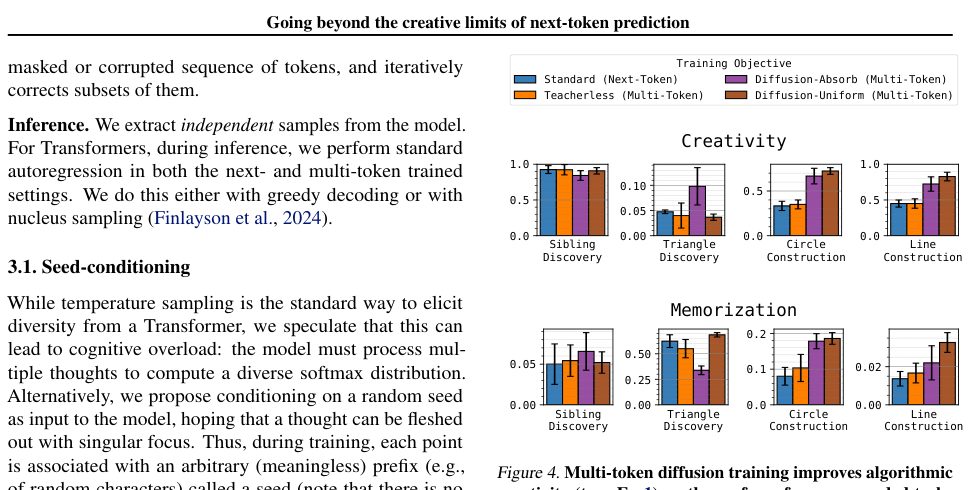
Figure 4: Multi-token diffusion training improves algorithmic creativity (top; Eq 1) on our four open-ended tasks, and reduces memorization on discovery tasks but not construction tasks (bottom).
图 4:多词元扩散训练在四项开放式任务上提升算法创造力(上;式 1),并在发现类任务上降低记忆,但在构造类任务上不然(下)。
In Fig 4, we report performance for the diffusion model against next-token & teacherless training of similar-sized Transformers. We see that diffusion models are consistently better than next-token training, achieving up to 5x higher algorithmic creativity. However, the gains are much smaller or absent with teacherless training. This echoes prior discussions suggesting that the teacherless objective is a hard objective to optimize for smaller Transformers (6); other multi-token approaches (Gloeckle et al. 2024) are even known to hurt small models of the order of 300M.
图 4 报告扩散模型相对同规模 Transformer 的下一词与无教师训练。可见扩散相对下一词训练持续更好,算法创造力最高约 5 倍。但相对无教师训练,增益小得多或没有。这呼应先前讨论:无教师目标对较小 Transformer 难优化 (6);其他多词元方法(Gloeckle et al. 2024)甚至已知会伤害约 300M 量级的小模型。
Multi-token prediction reduces memorization significantly. Algorithmic creativity may suffer either because the model outputs incoherent garbage, or because it repeats the same original output, or because it simply parrots out the training data. In almost all settings, it is the last reason that dominates: across the board (in Fig 3, Fig 4 bottom), next-token prediction is significantly prone to memorizing the data, while multi-token methods are highly resistant. As foreshadowed in §2.6, we hypothesize that this is because NTP memorizes the earlier training tokens without a global plan, having fit the later tokens via local coherence rules (because of Clever Hans cheats à la 6). Note that an exception to this is the smaller models (especially for diffusion) in our construction tasks, where memorization increases under the multi-token objectives; but this increase is mild and crucially, does not hurt algorithmic creativity.
多词元预测显著降低记忆。 算法创造力受损,要么因输出不连贯垃圾,要么因重复同一原创输出,要么因简单复读训练数据。几乎所有设定中,最后一项占主导:全面来看(图 3、图 4 下),下一词预测极易记忆数据,而多词元方法高度抵抗。如 §2.6 所预示,我们假设这是因为 NTP 在靠局部连贯规则拟合较后词元(因聪明汉斯作弊 à la 6)后,无全局计划地记忆较早训练词元。例外是构造任务上的较小模型(尤其扩散),多词元目标下记忆上升;但升幅温和,且关键是不伤算法创造力。
We point the reader to §B.4 for further empirical evidence supporting our argument about NTP from §2.6, including experiments on token-reordering and experiments ruling out other hypotheses.
请读者参阅 §B.4,获取支持 §2.6 中 NTP 论证的进一步经验证据,包括词元重排实验与排除其他假说的实验。
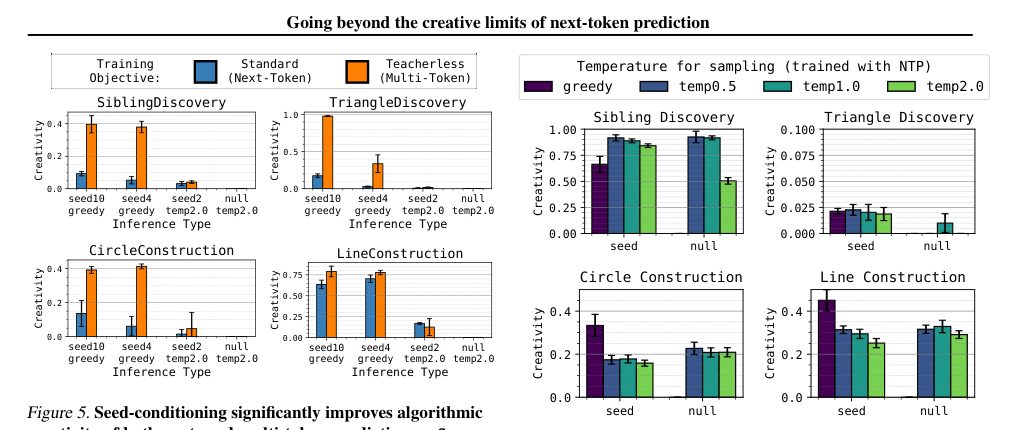
Figure 5: Seed-conditioning significantly improves algorithmic creativity of both next- and multi-token prediction on Gemma v1 (2B) model. The X-axis labels denote the prefix (at training and inference) and the temperature (at inference).
图 5:种子条件化显著提升 Gemma v1(2B)上下一词与多词元预测的算法创造力。横轴标签表示(训练与推理时的)前缀以及(推理时的)温度。
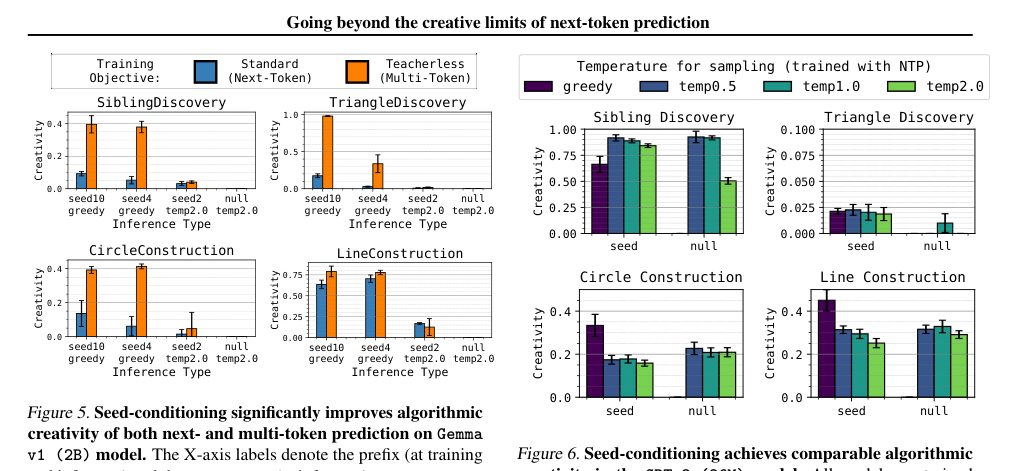
Figure 6: Seed-conditioning improves algorithmic creativity of the GPT-2 (86M) model: All models are trained with NTP. The color denotes temperature, while the X-axis, the prefix. Remarkably, seed-conditioning achieves high creativity even with greedy decoding. However, note that for the discovery datasets, top-K sampling must be enabled to see a positive gap between seed- and null- settings.
图 6:种子条件化提升 GPT-2(86M)模型的算法创造力:全部模型以 NTP 训练。颜色表示温度,横轴表示前缀。值得注意的是,即便贪心解码,种子条件化也能达到高创造力。但注意在发现类数据集上,须启用 top-K 采样才能看到种子与空设定之间的正向差距。
Seed-conditioning improves algorithmic creativity for Transformers. Orthogonal to the effect of multi-token vs. next-token objectives, we point out the effect of seed-conditioning a Transformer. First, and most remarkably, with seed-conditioning, there is no need for temperature: even deterministic generation via greedy decoding generates diverse outputs that have highly non-trivial creativity values (Fig 5, Fig 6). This means that, even though the seeds we provide are arbitrarily paired with the training datapoint, the models have learned to transform the arbitrary noise into meaningful randomness. We also find that increasing the seed lengths consistently boosts algorithmic creativity for both next-token and multi-token approaches (Fig 5, 23). Thus, for Transformers, we propose viewing seed-conditioning as a knob for diversity distinct from temperature sampling.
种子条件化提升 Transformer 的算法创造力。 与多词元相对下一词目标的效应正交,我们指出对 Transformer 做种子条件化的效应。首先也最引人注目:有种子条件化时不必用温度——即便贪心解码的确定性生成,也能产出多样性高、创造力值不可忽略的输出(图 5、图 6)。这意味着,尽管种子与训练点任意配对,模型已学会把任意噪声变成有意义的随机性。我们还发现加长种子持续提升下一词与多词元方法的算法创造力(图 5、23)。因此对 Transformer,我们建议把种子条件化视为有别于温度采样的多样性旋钮。
Next, in comparison to temperature sampling, in our settings, seed-conditioning results in the highest algorithmic creativity in both the small models (Fig 6) and the larger models (Fig 5). In fact, in our larger models, the null and pause token prefix with temperature sampling (Fig 18) exhibit almost no algorithmic creativity (they are mode collapsed, see Fig 19, 20). Besides, for any fixed temperature, prefixing a seed only improves performance over a null prefix (Fig 6, 18).
其次,相对温度采样,在我们设定中种子条件化在小模型(图 6)与较大模型(图 5)上都给出最高算法创造力。事实上,较大模型上带温度采样的空与停顿词元前缀(图 18)几乎没有算法创造力(它们模式崩塌,见图 19、20)。此外,对任何固定温度,前置种子只相对空前缀提升表现(图 6、18)。
In §H.2, we find that the improved creativity from seed-conditioning comes from improved diversity, rather than from reduced memorization (unlike with multi-token training). In some of our settings, this positive gap between seed-conditioning and temperature sampling is attributable to the fact that top- sampling is enabled by default as is standard (specifically, for GPT-2 (86M) on Sibling Discovery and Triangle Discovery where the vocabulary size is larger than ). Intuitively, top- sampling restricts the degree of freedom in output randomness, allowing the seed to introduce new degrees of freedom. However, in all other settings, this explanation does not hold. Regardless all these behaviors of seed-conditioning require further study as they are non-trivial, especially given that the seeds are arbitrarily chosen in relationship to the output. As a starting point, we provide some preliminary hypotheses for when and why seed-conditioning may help Transformers in §5.1. Note that we do not see gains of seed-conditioning when it comes to diffusion training (§ F.3).
在 §H.2,我们发现种子条件化带来的创造力提升来自多样性提高,而非记忆降低(与多词元训练不同)。在某些设定中,种子条件化相对温度采样的正向差距可归因于默认启用 top- 采样(具体是 GPT-2(86M)在兄弟姐妹发现与三角形发现上,词表大于 )。直观上 top- 限制输出随机性的自由度,使种子能引入新自由度。但在所有其他设定中,该解释不成立。无论如何,种子条件化的这些行为都需进一步研究,因其非平凡——尤其种子与输出的关系是任意选定的。作为起点,我们在 §5.1 给出种子条件化何时、为何可能帮助 Transformer 的初步假说。注意扩散训练上看不到种子条件化的增益(§F.3)。
Robustness to hyperparameters. In §E and Fig 22, we do sensitivity analysis on all the datasets. We report how our above findings are robust to the choice of learning rate, batch-size, number of training steps, weight given to the multi-token objective, varying sampling conditions and reasonable changes to the complexity of the dataset and training set size (as per our argument in §2.6, we do expect the next-vs. multi-token gap to diminish for larger dataset size).
对超参的稳健性。 在 §E 与图 22,我们对全部数据集做敏感性分析,报告上述发现对学习率、批大小、训练步数、多词元目标权重、不同采样条件以及数据集复杂度与训练集大小合理变化的稳健性(按 §2.6 的论证,我们预期下一词相对多词元的差距会随数据增多而缩小)。
4.2 An initial exploration of real-world summarization
4.2 真实摘要任务的初步探索
For a more realistic examination of our findings, we conduct preliminary investigation of GPT models finetuned with NTP and the multi-token teacherless objectives on summarization tasks (XSUM, CNN/DailyMail). We measure the diversity of a model for any given prompt by generating different completions and computing a Self-Bleu metric (Zhu et al. 2018). Admittedly though, a summarization task is not as open-ended as we would like: a higher quality model (i.e., higher Rouge; Lin 2004) necessarily means lower diversity. To account for this, we plot how diversity evolves over time as a function of the quality of the model; we then find in Fig 7 that for a given model quality, the larger multi-token models achieve higher diversity (albeit only by a slight amount). This increase does not hold for smaller models and is not always noticeable for CNN/DailyMail (see §I). Interestingly, teacherless training consistently shows an increase in summarization quality, measured by Rouge.
为更现实地审视发现,我们在摘要任务(XSUM、CNN/DailyMail)上对用 NTP 与多词元无教师目标微调的 GPT 模型做初步调查。对任意给定提示,通过生成 5 个不同补全并计算 Self-Bleu(Zhu et al. 2018)衡量多样性。诚然摘要不如我们希望的那么开放:质量更高(即 Rouge 更高;Lin 2004)必然意味着多样性更低。为此我们绘制多样性如何随模型质量随时间演变;图 7 显示在给定质量下,较大的多词元模型多样性更高(尽管幅度不大)。该增幅在小模型上不成立,在 CNN/DailyMail 上也不总明显(见 §I)。有趣的是,无教师训练持续提升按 Rouge 衡量的摘要质量。
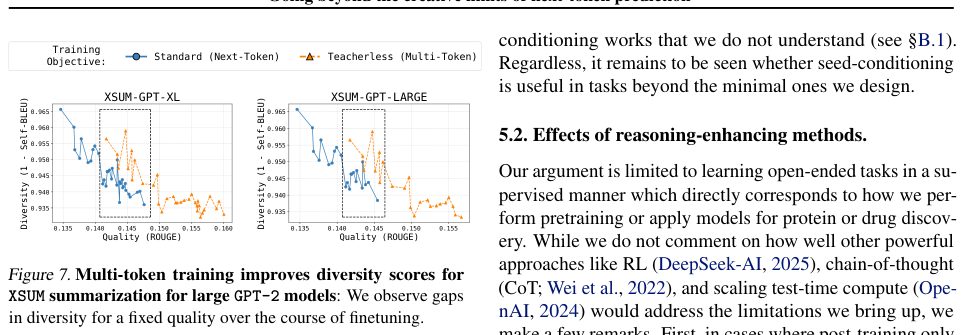
Figure 7: Multi-token training improves diversity scores for XSUM summarization for large GPT-2 models: Here, we plot diversity and quality as measured over multiple checkpoints during finetuning, and observe differences in diversity for a fixed quality.
图 7:多词元训练提升大型 GPT-2 模型在 XSUM 摘要上的多样性分数:我们绘制微调期间多检查点的多样性与质量,并观察固定质量下的多样性差异。
5 Discussion
5 讨论
5.1 Intuition about seed-conditioning
5.1 关于种子条件化的直觉
Seed-conditioning produces non-trivial algorithmic creativity even with greedy decoding. Perhaps, one could view the seed prefixes as a simpler alternative to varying the wordings of a prompt Li et al. 2023; Lau et al. 2024; Naik et al. 2024 or tuning a soft-prompt (Wang et al. 2024c), both of which are known to induce diversity. However, it is unexpected that the seeds provide any meaningful randomness at all, given they are arbitrarily picked with no semantic relationship to the training point. We do not understand this presently.
种子条件化即便在贪心解码下也能产生不可忽略的算法创造力。或许可将种子前缀视为变换提示措辞(Li et al. 2023;Lau et al. 2024;Naik et al. 2024)或调软提示(Wang et al. 2024c)的更简替代——后两者已知能诱导多样性。但鉴于种子任意选取、与训练点无语义关系,它们竟能提供任何有意义随机性,仍出人意料。我们目前尚不理解。
Another pertinent question is to why seed-conditioning works better than temperature sampling in the settings it does. To this, we offer three potential explanations. The simplest explanation is that in our GPT-2 (86M) settings, top-K sampling is enabled by default. This restricts the degree of freedom in the support induced by the output-layer randomness; thus, providing different seeds can help vary this support and produce more varying samples. However, this does not explain the gap we see in the other datasets where the output vocabulary is smaller than (), or in Gemma v1 (2B) where we do not use top-K sampling.
另一个相关问题是:在种子条件化优于温度采样的设定中,为何如此。我们给出三种可能解释。最简单的是:在 GPT-2(86M)设定中默认启用 top-K 采样,限制了输出层随机性诱导的支撑自由度;因而提供不同种子有助于改变该支撑、产生更多样样本。但这解释不了词表小于 ()的其他数据集,以及未用 top-K 的 Gemma v1(2B)上看到的差距。
Thus, we speculatively put forth two more arguments. First, is a representational one. Fixing a random seed upfront may help the model flesh out (i.e., compute the tokens of) one thought per sample, as against maintaining a running set of multiple thoughts and computing a distribution over all their tokens at each step. A similar point is made in a concurrent position paper (Jahrens & Martinetz 2025). The second argument is specific to next-token prediction on open-ended planning tasks: fixing a random seed upfront may help the model co-ordinate multiple interlocking random decisions in advance rather than deciding them on the fly.
因此我们试探性地提出另外两点。第一是表示层面的:事先固定随机种子可能帮助模型为每个样本充实(即计算词元)一个想法,而不是维护多个想法的运行集合并在每步对它们的全部词元计算分布。同期立场论文(Jahrens & Martinetz 2025)也提出类似观点。第二点专属于开放式规划任务上的下一词预测:事先固定随机种子可能帮助模型预先协调多个环环相扣的随机决策,而非即时决定。
Finally, there are also optimization aspects of how seed-conditioning works that we do not understand (see §B.1). Regardless, it remains to be seen whether seed-conditioning is useful in tasks beyond the minimal ones we design.
最后,种子条件化如何工作还有我们不理解的优化侧面(见 §B.1)。无论如何,它在超出我们设计的极简任务之外是否有用,仍待观察。
5.2 Effects of reasoning-enhancing methods.
5.2 增强推理方法的影响
Our argument is limited to learning open-ended tasks in a supervised manner. While we do not comment on how well other approaches like RL (DeepSeek-AI 2025), chain-of-thought (CoT; Wei et al. 2022), and scaling test-time compute (OpenAI 2024) would fare, we remark that these methods are designed to enhance the quality of a single example. It is unclear how to design them to maximize originality against a training set, and diversity over multiple responses. Furthermore, there is a profound question as to whether merely spelling out a model’s thought in token space can be an efficient way to search and maximize diversity. This may require enumerating all possible candidates by trial and error, an impossible feat when the search space is large.
我们的论证限于以监督方式学习开放式任务。虽不评论 RL(DeepSeek-AI 2025)、思维链(CoT;Wei et al. 2022)与扩展测试时算力(OpenAI 2024)等其他方法表现如何,但指出这些方法旨在提升单个样例的质量。如何设计它们以相对训练集最大化原创性、并在多份回复上最大化多样性,尚不清楚。此外有一个深刻问题:仅把模型想法写在词元空间,是否是搜索并最大化多样性的高效方式。当搜索空间大时,这可能要求通过试错枚举所有候选——几乎不可能。
We present more discussions in §B.
更多讨论见 §B。
6 Limitations
6 局限
We enumerate in detail the limitations of our work in terms of our experimental conclusions and in terms of our general approach to an abstraction of creativity.
我们从实验结论与对创造力抽象的一般进路两方面,详细列举工作局限。
6.1 Limitations of our experimental conclusions
6.1 实验结论的局限
- There may be many ways to improve upon next-token prediction for a minimal task. Unfortunately, success here does not necessarily guarantee success on more complex tasks. Conversely, minimal tasks are more valuable as a failure base case: failure here guarantees failure in more complex tasks.
- 对极简任务改进下一词预测的方式可能很多。可惜此处的成功未必保证更复杂任务上的成功。反过来,极简任务作为失败基线更有价值:此处失败保证更复杂任务也会失败。
- Our examples do not preclude the existence of tasks where next-token prediction will outperform multi-token prediction; multi-token prediction is simply a more general-purpose objective suitable to lookahead tasks.
- 我们的例子不排除存在下一词预测优于多词元预测的任务;多词元预测只是更适合前瞻任务的通用目标。
- The teacherless multi-token prediction technique we explore as an alternative is generally harder to optimize than next-token prediction, especially for smaller models.
- 作为替代探索的无教师多词元预测,一般比下一词预测更难优化,尤其对小模型。
- Even if multi-token approaches outperform next-token prediction relatively, in some of our simple tasks, all algorithms are far from delivering a sufficiently diverse model.
- 即便多词元相对优于下一词,在我们某些简单任务上,所有算法距离交付足够多样的模型仍很远。
- Although our tasks are minimal, we note that there is a certain range of hyperparameters (e.g., high degree or edge count) beyond which the models can struggle to learn them. We find that Triangle Discovery in particular is a challenging task, especially for smaller models. We also note that the models are curiously sensitive to the way the edges are formatted (see §F.4).
- 尽管任务极简,我们注意到存在一定超参范围(如高度数或边数)之外模型会学得很吃力。尤其三角形发现对小模型具有挑战。模型对边的格式化方式也出奇敏感(见 §F.4)。
- While seed-conditioning appears to be a competitive alternative to temperature sampling, there are caveats here: (a) In our GPT-2 (86M) experiments for Sibling Discovery and Triangle Discovery, the gap between seed-conditioning and temperature-sampling is contingent on top-K sampling (which is turned on by default in the library as it is standard practice in real-world applications). Although this does not seem to be a requirement in our other settings (and is immaterial for the other datasets which have a smaller vocabulary), it is not clear how crucial this factor would be for demonstrating the same gap in real settings. (b) It is not clear how well this idea may generalize to realistic data. (c) Unfortunately, seed-conditioning requires special training of the model, which is not as appealing as the far simpler temperature sampling.
- 虽种子条件化看似可与温度采样竞争,仍有附带条件:(a) 在 GPT-2(86M)的兄弟姐妹发现与三角形发现实验中,种子相对温度的差距依赖于 top-K 采样(库默认开启,因真实应用中常见)。虽其他设定似乎不要求(且对词表更小的其他数据集无关紧要),但在真实设定中要展示同样差距时该因素有多关键,尚不清楚。(b) 该想法对现实数据泛化如何也不清。(c) 遗憾的是种子条件化需要特殊训练,不如温度采样简单诱人。
6.2 Our approach to creativity
6.2 我们对创造力的进路
Below, we enumerate some important limitations of our approach towards building abstract and minimal models of creative tasks.
以下列举我们构建创造任务抽象极简模型时的若干重要局限。
- The skills we capture in our tasks are only (a subset of) computational skills necessary for creativity; these are far from being sufficient.
- 任务捕捉的技能只是创造力必要计算技能的(子集);远非充分。
- The type of algorithmic tasks we study capture only a tiny subset of creative tasks that fall under the taxonomy in Boden 2003. There is yet another class called transformative creativity that we do not look at, and also other important taxonomies such as the Big-C/little-c creativity (Csikszentmihalyi 1996). Big-C Creativity corresponds breakthroughs and world-changing ideas; what we focus on is adjacent to a class of little-c creativity tasks. Relatedly, many real-world creative tasks appear to be “out-of-distribution” in nature, which we do not capture.
- 所研究的算法任务类型只覆盖 Boden 2003 分类下创造任务的极小子集。还有一类变革创造我们未涉及,以及其他重要分类如大 C / 小 c 创造力(Csikszentmihalyi 1996)。大 C 对应突破与改变世界的想法;我们关注的邻近小 c 创造任务。相关地,许多真实创造任务呈现「分布外」性质,我们未刻画。
- Real-world creative tasks also apply over much larger context length and require drawing connections from a significantly larger memory (literally, the set of all things a human may know about). Our algorithmic tasks are tiny in comparison (although deliberately so).
- 真实创造任务也作用在长得多的上下文上,并需从显著更大的记忆(字面上一人类可能知道的一切)中建立联系。我们的算法任务相比之下极小(虽是有意为之)。
- Our empirical measure of creativity for algorithmic tasks is only a computationally-efficient proxy. Achieving an absolute high algorithmic creativity score does not imply a complete coverage of the space.
- 对算法任务的经验创造力度量只是计算高效的代理。算法创造力分数绝对高,并不意味着完全覆盖空间。
- As stated earlier, we study abstract tasks that are inspired by the computations involved in creative tasks. Our study is not intended to capture the subjective, social, cultural and personal values integral to many creative tasks.
- 如前所述,我们研究受创造任务所涉计算启发的抽象任务。研究无意捕捉许多创造任务中不可或缺的主观、社会、文化与个人价值。
7 Related Work
7 相关工作
Open-ended algorithmic tasks.
Directly related to us are Khona et al. 2024; Allen-Zhu & Li 2023b who study diversity of next-token-trained models on an open-ended algorithmic task. Khona et al. 2024 demonstrate a diversity-accuracy tradeoff under temperature-scaling for path-connectivity on on a knowledge graph. We show how this tradeoff can be improved under alternative training methods. Allen-Zhu & Li 2023b empirically demonstrate that next-token predictors are able to learn a synthetic, challenging CFG, in the “infinite” data regime ( tokens). Our datasets are not CFGs, with the exception of Sibling Discovery. Our negative result does not contradict theirs since what we show is a sub-optimality of NTP in a smaller data regime. Our work also extends the above works by studying limitations in much more minimal tasks that require as little as 2-hop lookahead. There are other works that study Transformers on non-open-ended graph-algorithmic tasks, discussed in §J.
开放式算法任务。
与我们直接相关的是 Khona et al. 2024;Allen-Zhu & Li 2023b,他们在开放式算法任务上研究下一词训练模型的多样性。Khona et al. 2024 展示知识图路径连通性在温度缩放下的多样性–准确率权衡。我们展示该权衡如何在替代训练方法下改善。Allen-Zhu & Li 2023b 经验表明,在「无限」数据体制(约 1 亿词元)下下一词预测器能够学会合成困难 CFG。除兄弟姐妹发现外,我们的数据不是 CFG。我们的否定结果不与其矛盾,因我们展示的是较小数据体制下 NTP 的次优性。工作还把上述研究延伸到更极简、仅需 2 跳前瞻的任务上的局限。另有在非开放图算法任务上研究 Transformer 的工作,见 §J。
Diversity in generative models.
Generative diversity has long been a major goal, at least until the revolution in (deterministic) reasoning of language models. Much work has gone into concerns such as mode collapse (Che et al. 2017) or posterior collapse (Bowman et al. 2016) and memorization (Carlini et al. 2020; Carlini et al. 2023; Nasr et al. 2023). Temperature sampling has been known to have weak correlation with creativity, often inadvertently introducing incoherence (Peeperkorn et al. 2024; Chen & Ding 2023; Chung et al. 2023). Our results on seed-conditioning are also reminiscent of a line of work on reinforcement learning (RL) showing that adding noises to the policy model parameters enables more efficient exploration than directly adding noises to the output space (Plappert et al. 2017; Fortunato et al. 2017). We defer discussion of theoretical studies of diversity and memorization and with empirical studies on natural-language creativity in §J.
生成模型中的多样性。
生成多样性长期是重要目标,至少直到语言模型(确定性)推理革命之前。大量工作关注模式崩塌(Che et al. 2017)或后验崩塌(Bowman et al. 2016)以及记忆(Carlini et al. 2020;Carlini et al. 2023;Nasr et al. 2023)。已知温度采样与创造力相关弱,常无意引入不连贯(Peeperkorn et al. 2024;Chen & Ding 2023;Chung et al. 2023)。种子条件化结果也让人联想到强化学习(RL)中向策略模型参数加噪比直接向输出空间加噪更能高效探索的工作线(Plappert et al. 2017;Fortunato et al. 2017)。多样性与记忆的理论研究及自然语言创造力经验研究的讨论延至 §J。
Going beyond next-token prediction (NTP).
There has been a recent emerging discussion surrounding the role of NTP as foundational piece in developing intelligent models. On the critical side, arguments have been made about the inference-time issues with auto-regression (Dziri et al. 2024; LeCun 2024; Kääriäinen 2006; Ross & Bagnell 2010). Others have reported the planning and arithmetic limitations of next-token trained models (McCoy et al. 2023; Momennejad et al. 2023; Valmeekam et al. 2023a; Valmeekam et al. 2023b; Valmeekam et al. 2023c; Bachmann & Nagarajan 2024) where the goal is accuracy, not diversity. As for diffusion as an alternative to NTP, our findings parallel that of Ye et al. 2024 who show that their variant of diffusion is able to solve the challenging path-star task of 6. We provide references to more lines of multi-token prediction work in §J. There are also other Transformer failures such as the reversal curse (Allen-Zhu & Li 2023a) or shortcut-learning (Dziri et al. 2024; Zhang et al. 2023; Liu et al. 2023; Young & You 2022; Lai et al. 2021; Ranaldi & Zanzotto 2023), however these are out-of-distribution failures; the sub-optimality we show is in-distribution, like in 6.
超越下一词预测(NTP)。
围绕 NTP 作为发展智能模型基础构件的角色,近期讨论兴起。批评方面,有人论证自回归的推理时问题(Dziri et al. 2024;LeCun 2024;Kääriäinen 2006;Ross & Bagnell 2010)。另有报告下一词训练模型在规划与算术上的局限(McCoy et al. 2023;Momennejad et al. 2023;Valmeekam et al. 2023a;Valmeekam et al. 2023b;Valmeekam et al. 2023c;Bachmann & Nagarajan 2024),其目标是准确率而非多样性。作为 NTP 替代的扩散,我们的发现平行于 Ye et al. 2024:其扩散变体能解决 6 的困难路径星任务。更多多词元预测工作线见 §J。另有反转诅咒(Allen-Zhu & Li 2023a)或捷径学习(Dziri et al. 2024;Zhang et al. 2023;Liu et al. 2023;Young & You 2022;Lai et al. 2021;Ranaldi & Zanzotto 2023)等 Transformer 失败,但那些是分布外失败;我们展示的次优是分布内的,与 6 类似。
Injecting noise into a Transformer.
Most related to seed-conditioning is DeSalvo et al. 2024 who induce diversity by varying a soft-prompt learned using a reconstruction loss. Our approach requires no modification to the architecture or the loss; however, we train the whole model, which is more expensive. A concurrent position paper (Jahrens & Martinetz 2025) conceptually suggests injecting noise with the same motivation as us. The benefits of seed-conditioning may also be related to the fact that varying the wording in a prompt is known to induce diverse outputs (Li et al. 2023; Lau et al. 2024; Naik et al. 2024). Various works also inject noise into a Transformer, in a different form (e.g., inducing Gaussian noise), and for a different function such as quality, robustness (Hua et al. 2022; Jain et al. 2024) or efficiency (Wang et al. 2024c).
向 Transformer 注入噪声。
与种子条件化最相关的是 DeSalvo et al. 2024:通过变化用重构损失学到的软提示诱导多样性。我们的方法无需改架构或损失;但训练整个模型,更昂贵。同期立场论文(Jahrens & Martinetz 2025)概念上建议以与我们相同的动机注入噪声。种子条件化的益处也可能与变换提示措辞已知能诱导多样输出有关(Li et al. 2023;Lau et al. 2024;Naik et al. 2024)。另有工作以不同形式(如高斯噪声)向 Transformer 注入噪声,服务于质量、稳健性(Hua et al. 2022;Jain et al. 2024)或效率(Wang et al. 2024c)等不同功能。
8 Conclusions
8 结论
This work provides a minimal test-bed of tasks abstracting distinct modes of creativity. While these tasks are admittedly an extreme caricaturization of real-world tasks, they enable us to quantify otherwise elusive metrics like originality and diversity. They also enable us to control and investigate distinct parts of the current apparatus for language modeling (next-token learning and softmax-based temperature sampling) and advocate for alternatives (multi-token learning and seed-conditioning). The surprising effectiveness of seed-conditioning raises various open questions (§B.1). There are also other profound questions as to whether reasoning-enhancing methods like RL and CoT are optimal for enhancing open-ended diversity and originality (§5.2). Overall, we hope our work inspires discussion in the various directions of multi-token prediction, creativity and planning.
本文提供抽象不同创造模式的极简任务试验台。虽这些任务无疑是对真实任务的极端漫画化,却使我们能量化原本难以捉摸的原创性与多样性指标。它们也使我们能控制并考察当前语言建模装置的不同部分(下一词学习与基于 softmax 的温度采样),并倡导替代方案(多词元学习与种子条件化)。种子条件化出人意料的有效性引出诸多开放问题(§B.1)。另有深刻问题:RL 与 CoT 等增强推理方法对提升开放式多样性与原创性是否最优(§5.2)。总体希望本文激发多词元预测、创造力与规划等方向的讨论。
9 Impact Statement
9 影响声明
This paper presents work whose goal is to advance the field of Machine Learning through the study of simple algorithmic tasks inspired by creativity. There are many potential societal consequences of our work — especially if one applies AI to real-world creative endeavors — none which we feel must be specifically highlighted in our focused algorithmic study.
本文通过研究受创造力启发的简单算法任务推进机器学习。工作可能有多种社会后果——尤其若将 AI 用于真实创造活动——但在我们聚焦的算法研究中,我们认为无需特别强调其中哪一项。
References
参考文献
Alabdulmohsin et al. (2024) Alabdulmohsin, I., Tran, V. Q., and Dehghani, M. Fractal patterns may unravel the intelligence in next-token prediction, 2024.
Allen-Zhu & Li (2023a) Allen-Zhu, Z. and Li, Y. Physics of language models: Part 3.2, knowledge manipulation. CoRR , abs/2309.14402, 2023a. doi: 10.48550/ARXIV.2309.14402 . URL https://doi.org/10.48550/arXiv.2309.14402 .
Allen-Zhu & Li (2023b) Allen-Zhu, Z. and Li, Y. Physics of language models: Part 1, context-free grammar. CoRR , abs/2305.13673, 2023b. doi: 10.48550/ARXIV.2305.13673 . URL https://doi.org/10.48550/arXiv.2305.13673 .
Anderson et al. (2024) Anderson, B. R., Shah, J. H., and Kreminski, M. Homogenization effects of large language models on human creative ideation. In Proceedings of the 16th Conference on Creativity & Cognition, Chicago, IL, USA, June 23-26, 2024 , pp. 413–425. ACM, 2024. URL https://doi.org/10.1145/3635636.3656204 .
Austin et al. (2021) Austin, J., Johnson, D. D., Ho, J., Tarlow, D., and van den Berg, R. Structured denoising diffusion models in discrete state-spaces. NeurIPS , 2021.
Bachmann & Nagarajan (2024) Bachmann, G. and Nagarajan, V. The pitfalls of next-token prediction. In Proceedings of the 41st International Conference on Machine Learning , volume 235 of Proceedings of Machine Learning Research , pp. 2296–2318, 2024.
Bavarian et al. (2022) Bavarian, M., Jun, H., Tezak, N. A., Schulman, J., McLeavey, C., Tworek, J., and Chen, M. Efficient training of language models to fill in the middle. ArXiv , abs/2207.14255, 2022. URL https://api.semanticscholar.org/CorpusID:251135268 .
Beel et al. (2025) Beel, J., Kan, M.-Y., and Baumgart, M. Evaluating sakana’s ai scientist for autonomous research: Wishful thinking or an emerging reality towards ’artificial research intelligence’ (ari)?, 2025.
Berglund et al. (2024) Berglund, L., Tong, M., Kaufmann, M., Balesni, M., Stickland, A. C., Korbak, T., and Evans, O. The reversal curse: Llms trained on "a is b" fail to learn "b is a". In The Twelfth International Conference on Learning Representations, ICLR 2024, Vienna, Austria, May 7-11, 2024 . OpenReview.net, 2024. URL https://openreview.net/forum?id=GPKTIktA0k .
Boden (2003) Boden, M. A. The Creative Mind - Myths and Mechanisms (2. ed.) . Routledge, 2003.
Bowman et al. (2016) Bowman, S. R., Vilnis, L., Vinyals, O., Dai, A. M., Józefowicz, R., and Bengio, S. Generating sentences from a continuous space. In Proceedings of the 20th SIGNLL Conference on Computational Natural Language Learning, CoNLL 2016, , pp. 10–21. ACL, 2016.
Bubeck et al. (2023) Bubeck, S., Chandrasekaran, V., Eldan, R., Gehrke, J., Horvitz, E., Kamar, E., Lee, P., Lee, Y. T., Li, Y., Lundberg, S., et al. Sparks of artificial general intelligence: Early experiments with gpt-4. arXiv preprint arXiv:2303.12712 , 2023.
Callaway (2013) Callaway, E. Cognitive science: Leap of thought. Nature , 502, 2013.
Carlini et al. (2020) Carlini, N., Tramèr, F., Wallace, E., Jagielski, M., Herbert-Voss, A., Lee, K., Roberts, A., Brown, T. B., Song, D. X., Erlingsson, Ú., Oprea, A., and Raffel, C. Extracting training data from large language models. In USENIX Security Symposium , 2020.
Carlini et al. (2023) Carlini, N., Ippolito, D., Jagielski, M., Lee, K., Tramèr, F., and Zhang, C. Quantifying memorization across neural language models. ICLR , 2023.
Chakrabarty et al. (2024) Chakrabarty, T., Laban, P., Agarwal, D., Muresan, S., and Wu, C. Art or artifice? large language models and the false promise of creativity. In Proceedings of the CHI Conference on Human Factors in Computing Systems, CHI 2024, Honolulu, HI, USA, May 11-16, 2024 , pp. 30:1–30:34. ACM, 2024.
Che et al. (2017) Che, T., Li, Y., Jacob, A. P., Bengio, Y., and Li, W. Mode regularized generative adversarial networks. In 5th International Conference on Learning Representations, ICLR 2017, Toulon, France, April 24-26, 2017, Conference Track Proceedings . OpenReview.net, 2017.
Chen & Ding (2023) Chen, H. and Ding, N. Probing the "creativity" of large language models: Can models produce divergent semantic association? In Findings of the Association for Computational Linguistics: EMNLP 2023, Singapore, December 6-10, 2023 , pp. 12881–12888. Association for Computational Linguistics, 2023.
Chow et al. (2024) Chow, Y., Tennenholtz, G., Gur, I., Zhuang, V., Dai, B., Thiagarajan, S., Boutilier, C., Agarwal, R., Kumar, A., and Faust, A. Inference-aware fine-tuning for best-of-n sampling in large language models. ArXiv , abs/2412.15287, 2024. URL https://api.semanticscholar.org/CorpusID:274965054 .
Chung et al. (2023) Chung, J. J. Y., Kamar, E., and Amershi, S. Increasing diversity while maintaining accuracy: Text data generation with large language models and human interventions. In Proceedings of the 61st Annual Meeting of the Association for Computational Linguistics (Volume 1: Long Papers), ACL , pp. 575–593. Association for Computational Linguistics, 2023.
Cobbe et al. (2021) Cobbe, K., Kosaraju, V., Bavarian, M., Chen, M., Jun, H., Kaiser, L., Plappert, M., Tworek, J., Hilton, J., Nakano, R., Hesse, C., and Schulman, J. Training verifiers to solve math word problems. arXiv preprint arXiv:2110.14168 , 2021.
Csikszentmihalyi (1996) Csikszentmihalyi, M. Creativity: Flow and the Psychology of Discovery and Invention . HarperCollins Publishers, New York, NY, first edition, 1996.
Dang et al. (2025) Dang, X., Baek, C., Wen, K., Kolter, Z., and Raghunathan, A. Weight ensembling improves reasoning in language models. 2025. URL https://api.semanticscholar.org/CorpusID:277781120 .
Dawid & LeCun (2023) Dawid, A. and LeCun, Y. Introduction to latent variable energy-based models: A path towards autonomous machine intelligence. arXiv preprint arXiv:2306.02572 , 2023.
DeepSeek-AI (2025) DeepSeek-AI. Deepseek-r1: Incentivizing reasoning capability in llms via reinforcement learning. ArXiv , abs/2501.12948, 2025.
DeepSeek-AI et al. (2024) DeepSeek-AI, Liu, A., Feng, B., Xue, B., Wang, B.-L., Wu, B., Lu, C., Zhao, C., Deng, C., Zhang, C., Ruan, C., Dai, D., Guo, D., Yang, D., Chen, D., Ji, D.-L., Li, E., Lin, F., Dai, F., Luo, F., Hao, G., Chen, G., Li, G., Zhang, H., Bao, H., Xu, H., Wang, H., Zhang, H., Ding, H., Xin, H., Gao, H., Li, H., Qu, H., Cai, J. L., Liang, J., Guo, J., Ni, J., Li, J., Wang, J., Chen, J., Chen, J., Yuan, J., Qiu, J., Li, J., Song, J.-M., Dong, K., Hu, K., Gao, K., Guan, K., Huang, K., Yu, K., Wang, L., Zhang, L., Xu, L., Xia, L., Zhao, L., Wang, L., Zhang, L., Li, M., Wang, M., Zhang, M., Zhang, M., Tang, M., Li, M., Tian, N., Huang, P., Wang, P., Zhang, P., Wang, Q., Zhu, Q., Chen, Q., Du, Q., Chen, R. J., Jin, R. L., Ge, R., Zhang, R., Pan, R., Wang, R., Xu, R., Zhang, R., Chen, R., Li, S. S., Lu, S., Zhou, S., Chen, S., Wu, S.-P., Ye, S., Ma, S., Wang, S., Zhou, S., Yu, S., Zhou, S., Pan, S., Wang, T., Yun, T., Pei, T., Sun, T., Xiao, W. L., Zeng, W., Zhao, W., An, W., Liu, W., Liang, W., Gao, W., Yu, W.-X., Zhang, W., Li, X. Q., Jin, X., Wang, X., Bi, X., Liu, X., Wang, X., Shen, X.-C., Chen, X., Zhang, X., Chen, X., Nie, X., Sun, X., Wang, X., Cheng, X., Liu, X., Xie, X., Liu, X., Yu, X., Song, X., Shan, X., Zhou, X., Yang, X., Li, X., Su, X., Lin, X., Li, Y. K., Wang, Y. Q., Wei, Y. X., Zhu, Y. X., Zhang, Y., Xu, Y., Huang, Y., Li, Y., Zhao, Y., Sun, Y., Li, Y., Wang, Y., Yu, Y., Zheng, Y., Zhang, Y., Shi, Y., Xiong, Y., He, Y., Tang, Y., Piao, Y., Wang, Y., Tan, Y., Ma, Y.-B., Liu, Y., Guo, Y., Wu, Y., Ou, Y., Zhu, Y., Wang, Y., Gong, Y., Zou, Y., He, Y., Zha, Y., Xiong, Y., Ma, Y., Yan, Y., Luo, Y.-W., mei You, Y., Liu, Y., Zhou, Y., Wu, Z. F., Ren, Z., Ren, Z., Sha, Z., Fu, Z., Xu, Z., Huang, Z., Zhang, Z., Xie, Z., guo Zhang, Z., Hao, Z., Gou, Z., Ma, Z., Yan, Z., Shao, Z., Xu, Z., Wu, Z., Zhang, Z., Li, Z., Gu, Z., Zhu, Z., Liu, Z., Li, Z.-A., Xie, Z., Song, Z., Gao, Z., and Pan, Z. Deepseek-v3 technical report. In ArXiv , 2024.
DeSalvo et al. (2024) DeSalvo, G., Kagy, J.-F., Karydas, L., Rostamizadeh, A., and Kumar, S. No more hard prompts: Softsrv prompting for synthetic data generation, 2024. URL https://arxiv.org/abs/2410.16534 .
Du et al. (2023) Du, L., Mei, H., and Eisner, J. Autoregressive modeling with lookahead attention. arXiv preprint arXiv:2305.12272 , 2023.
Dziri et al. (2024) Dziri, N., Lu, X., Sclar, M., Li, X. L., Jiang, L., Lin, B. Y., Welleck, S., West, P., Bhagavatula, C., Le Bras, R., et al. Faith and fate: Limits of transformers on compositionality. Advances in Neural Information Processing Systems , 36, 2024.
Feng et al. (2023) Feng, G., Zhang, B., Gu, Y., Ye, H., He, D., and Wang, L. Towards revealing the mystery behind chain of thought: a theoretical perspective. Advances in Neural Information Processing Systems , 36, 2023.
Finlayson et al. (2024) Finlayson, M., Hewitt, J., Koller, A., Swayamdipta, S., and Sabharwal, A. Closing the curious case of neural text degeneration. In The Twelfth International Conference on Learning Representations, ICLR 2024, Vienna, Austria, May 7-11, 2024 . OpenReview.net, 2024.
Fortunato et al. (2017) Fortunato, M., Azar, M. G., Piot, B., Menick, J., Osband, I., Graves, A., Mnih, V., Munos, R., Hassabis, D., Pietquin, O., Blundell, C., and Legg, S. Noisy networks for exploration. ArXiv , abs/1706.10295, 2017. URL https://api.semanticscholar.org/CorpusID:5176587 .
Franceschelli & Musolesi (2023) Franceschelli, G. and Musolesi, M. On the creativity of large language models. CoRR , abs/2304.00008, 2023.
Fried et al. (2022) Fried, D., Aghajanyan, A., Lin, J., Wang, S. I., Wallace, E., Shi, F., Zhong, R., tau Yih, W., Zettlemoyer, L., and Lewis, M. Incoder: A generative model for code infilling and synthesis. ArXiv , abs/2204.05999, 2022. URL https://api.semanticscholar.org/CorpusID:248157108 .
Gemma Team et al. (2024) Gemma Team, T. M., Hardin, C., Dadashi, R., Bhupatiraju, S., Sifre, L., Rivière, M., Kale, M. S., Love, J., Tafti, P., Hussenot, L., and et al. Gemma. 2024. doi: 10.34740/KAGGLE/M/3301 . URL https://www.kaggle.com/m/3301 .
Gloeckle et al. (2024) Gloeckle, F., Idrissi, B. Y., Rozière, B., Lopez-Paz, D., and Synnaeve, G. Better & faster large language models via multi-token prediction. 2024.
Gong et al. (2023) Gong, S., Li, M., Feng, J., Wu, Z., and Kong, L. Diffuseq: Sequence to sequence text generation with diffusion models. In The Eleventh International Conference on Learning Representations, ICLR 2023, Kigali, Rwanda, May 1-5, 2023 . OpenReview.net, 2023.
Goodfellow et al. (2020) Goodfellow, I. J., Pouget-Abadie, J., Mirza, M., Xu, B., Warde-Farley, D., Ozair, S., Courville, A. C., and Bengio, Y. Generative adversarial networks. Commun. ACM , 63(11):139–144, 2020. doi: 10.1145/3422622 . URL https://doi.org/10.1145/3422622 .
Goyal et al. (2017) Goyal, A., Sordoni, A., Côté, M.-A., Ke, N. R., and Bengio, Y. Z-forcing: Training stochastic recurrent networks. NeurIPS , 2017.
Goyal et al. (2024) Goyal, S., Ji, Z., Rawat, A. S., Menon, A. K., Kumar, S., and Nagarajan, V. Think before you speak: Training language models with pause tokens. The Twelfth International Conference on Learning Representations, ICLR 2024 , 2024.
Gruver et al. (2023) Gruver, N., Stanton, S., Frey, N. C., Rudner, T. G. J., Hotzel, I., Lafrance-Vanasse, J., Rajpal, A., Cho, K., and Wilson, A. G. Protein design with guided discrete diffusion. ArXiv , abs/2305.20009, 2023. URL https://api.semanticscholar.org/CorpusID:258987335 .
Gu et al. (2018) Gu, J., Bradbury, J., Xiong, C., Li, V. O. K., and Socher, R. Non-autoregressive neural machine translation. In 6th International Conference on Learning Representations, ICLR 2018, Conference Track Proceedings . OpenReview.net, 2018.
Gupta & Pruthi (2025) Gupta, T. and Pruthi, D. All that glitters is not novel: Plagiarism in ai generated research, 2025. URL https://arxiv.org/abs/2502.16487 .
Hofstadter (1995) Hofstadter, D. A review of mental leaps: Analogy in creative thought. AI Mag. , 16(3):75–80, 1995. doi: 10.1609/AIMAG.V16I3.1154 . URL https://doi.org/10.1609/aimag.v16i3.1154 .
Holyoak & Thagard (1995) Holyoak, K. J. and Thagard, P. Mental leaps: analogy in creative thought . MIT Press, Cambridge, MA, USA, 1995. ISBN 0262082330.
Hoogeboom et al. (2021) Hoogeboom, E., Nielsen, D., Jaini, P., Forr’e, P., and Welling, M. Argmax flows and multinomial diffusion: Learning categorical distributions. In Neural Information Processing Systems , 2021.
Hopkins et al. (2023) Hopkins, A. K., Renda, A., and Carbin, M. Can LLMs generate random numbers? evaluating LLM sampling in controlled domains. In ICML 2023 Workshop: Sampling and Optimization in Discrete Space , 2023. URL https://openreview.net/forum?id=Vhh1K9LjVI .
Hua et al. (2022) Hua, H., Li, X., Dou, D., Xu, C., and Luo, J. Fine-tuning pre-trained language models with noise stability regularization. CoRR , 2022.
Jahrens & Martinetz (2025) Jahrens, M. and Martinetz, T. Why llms cannot think and how to fix it, 2025. URL https://arxiv.org/abs/2503.09211 .
Jain et al. (2024) Jain, N., Chiang, P., Wen, Y., Kirchenbauer, J., Chu, H., Somepalli, G., Bartoldson, B. R., Kailkhura, B., Schwarzschild, A., Saha, A., Goldblum, M., Geiping, J., and Goldstein, T. Neftune: Noisy embeddings improve instruction finetuning. In The Twelfth International Conference on Learning Representations, ICLR 2024, Vienna, Austria, May 7-11, 2024 . OpenReview.net, 2024.
Jansen et al. (2024) Jansen, P. A., Cot’e, M.-A., Khot, T., Bransom, E., Dalvi, B., Majumder, B. P., Tafjord, O., and Clark, P. Discoveryworld: A virtual environment for developing and evaluating automated scientific discovery agents. NeurIPS , 2024.
Kääriäinen (2006) Kääriäinen, M. Lower bounds for reductions. In Atomic Learning Workshop , 2006.
Kalai & Vempala (2024) Kalai, A. T. and Vempala, S. S. Calibrated language models must hallucinate. In Proceedings of the 56th Annual ACM Symposium on Theory of Computing, STOC 2024, Vancouver, BC, Canada, June 24-28, 2024 , pp. 160–171. ACM, 2024.
Kalavasis et al. (2024) Kalavasis, A., Mehrotra, A., and Velegkas, G. On the limits of language generation: Trade-offs between hallucination and mode collapse. abs/2411.09642, 2024.
Kamb & Ganguli (2024) Kamb, M. and Ganguli, S. An analytic theory of creativity in convolutional diffusion models, 2024. URL https://arxiv.org/abs/2412.20292 .
Khona et al. (2024) Khona, M., Okawa, M., Hula, J., Ramesh, R., Nishi, K., Dick, R. P., Lubana, E. S., and Tanaka, H. Towards an understanding of stepwise inference in transformers: A synthetic graph navigation model. In Forty-first International Conference on Machine Learning, ICML 2024, Vienna, Austria, July 21-27, 2024 . OpenReview.net, 2024.
Kingma & Welling (2014) Kingma, D. P. and Welling, M. Auto-encoding variational bayes. In Bengio, Y. and LeCun, Y. (eds.), 2nd International Conference on Learning Representations, ICLR 2014, Banff, AB, Canada, April 14-16, 2014, Conference Track Proceedings , 2014. URL http://arxiv.org/abs/1312.6114 .
Kitouni et al. (2024) Kitouni, O., Nolte, N., Bouchacourt, D., Williams, A., Rabbat, M., and Ibrahim, M. The factorization curse: Which tokens you predict underlie the reversal curse and more. CoRR , abs/2406.05183, 2024. doi: 10.48550/ARXIV.2406.05183 . URL https://doi.org/10.48550/arXiv.2406.05183 .
Kleinberg & Mullainathan (2024) Kleinberg, J. M. and Mullainathan, S. Language generation in the limit. CoRR , abs/2404.06757, 2024. doi: 10.48550/ARXIV.2404.06757 . URL https://doi.org/10.48550/arXiv.2404.06757 .
Lai et al. (2021) Lai, Y., Zhang, C., Feng, Y., Huang, Q., and Zhao, D. Why machine reading comprehension models learn shortcuts? In Findings of the Association for Computational Linguistics: ACL/IJCNLP 2021, Online Event, August 1-6, 2021 , volume ACL/IJCNLP 2021 of Findings of ACL , pp. 989–1002. Association for Computational Linguistics, 2021.
Lau et al. (2024) Lau, G. K. R., Hu, W., Liu, D., Chen, J., Ng, S.-K., and Low, B. K. H. Dipper: Diversity in prompts for producing large language model ensembles in reasoning tasks, 2024. URL https://arxiv.org/abs/2412.15238 .
LeCun (2024) LeCun, Y. Do large language models need sensory grounding for meaning and understanding? University Lecture, 2024.
Lee et al. (2024) Lee, N., Sreenivasan, K., Lee, J. D., Lee, K., and Papailiopoulos, D. Teaching arithmetic to small transformers. In The Twelfth International Conference on Learning Representations, ICLR 2024 . OpenReview.net, 2024.
Li et al. (2023) Li, Y., Lin, Z., Zhang, S., Fu, Q., Chen, B., Lou, J.-G., and Chen, W. Making language models better reasoners with step-aware verifier. In Proceedings of the 61st Annual Meeting of the Association for Computational Linguistics (Volume 1: Long Papers) , Toronto, Canada, July 2023. Association for Computational Linguistics. URL https://aclanthology.org/2023.acl-long.291/ .
Lin (2004) Lin, C.-Y. ROUGE: A package for automatic evaluation of summaries. In Text Summarization Branches Out , pp. 74–81, Barcelona, Spain, July 2004. Association for Computational Linguistics. URL https://aclanthology.org/W04-1013/ .
Liu et al. (2023) Liu, B., Ash, J. T., Goel, S., Krishnamurthy, A., and Zhang, C. Transformers learn shortcuts to automata. In The Eleventh International Conference on Learning Representations, ICLR 2023 , 2023.
Lou et al. (2023) Lou, A., Meng, C., and Ermon, S. Discrete diffusion modeling by estimating the ratios of the data distribution. In International Conference on Machine Learning , 2023.
Lu et al. (2024a) Lu, C., Lu, C., Lange, R. T., Foerster, J., Clune, J., and Ha, D. The ai scientist: Towards fully automated open-ended scientific discovery, 2024a.
Lu et al. (2024b) Lu, X., Sclar, M., Hallinan, S., Mireshghallah, N., Liu, J., Han, S., Ettinger, A., Jiang, L., Chandu, K. R., Dziri, N., and Choi, Y. AI as humanity’s salieri: Quantifying linguistic creativity of language models via systematic attribution of machine text against web text. abs/2410.04265, 2024b.
Malach (2023) Malach, E. Auto-regressive next-token predictors are universal learners. arXiv preprint arXiv:2309.06979 , 2023.
McCoy et al. (2023) McCoy, R. T., Yao, S., Friedman, D., Hardy, M., and Griffiths, T. L. Embers of autoregression: Understanding large language models through the problem they are trained to solve. arXiv preprint arXiv:2309.13638 , 2023.
McLaughlin et al. (2024) McLaughlin, A., Campbell, J., Uppuluri, A., and Yang, Y. Aidanbench: Stress-testing language model creativity on open-ended questions. In NeurIPS 2024 Workshop on Language Gamification , 2024.
Merrill & Sabharwal (2024) Merrill, W. and Sabharwal, A. The expressive power of transformers with chain of thought. In The Twelfth International Conference on Learning Representations , 2024.
Mirowski et al. (2024) Mirowski, P. W., Love, J., Mathewson, K. W., and Mohamed, S. A robot walks into a bar: Can language models serve as creativity support tools for comedy? an evaluation of llms’ humour alignment with comedians. CoRR , abs/2405.20956, 2024.
Momennejad et al. (2023) Momennejad, I., Hasanbeig, H., Frujeri, F. V., Sharma, H., Ness, R. O., Jojic, N., Palangi, H., and Larson, J. Evaluating cognitive maps and planning in large language models with cogeval. Advances in Neural Information Processing Systems , 36, 2023.
Monea et al. (2023) Monea, G., Joulin, A., and Grave, E. Pass: Parallel speculative sampling. 3rd Workshop on Efficient Natural Language and Speech Processing (NeurIPS 2023) , 2023.
Nagarajan et al. (2018) Nagarajan, V., Raffel, C., and Goodfellow, I. J. Theoretical insights into memorization in gans. In Neural Information Processing Systems Workshop , volume 1, pp. 3, 2018.
Naik et al. (2024) Naik, R., Chandrasekaran, V., Yuksekgonul, M., Palangi, H., and Nushi, B. Diversity of thought improves reasoning abilities of llms, 2024. URL https://arxiv.org/abs/2310.07088 .
Nakkiran et al. (2024) Nakkiran, P., Bradley, A., Zhou, H., and Advani, M. Step-by-step diffusion: An elementary tutorial, 2024.
Nallapati et al. (2016) Nallapati, R., Zhou, B., dos santos, C. N., Gulcehre, C., and Xiang, B. Abstractive text summarization using sequence-to-sequence rnns and beyond, 2016. URL https://arxiv.org/abs/1602.06023 .
Narayan et al. (2018) Narayan, S., Cohen, S. B., and Lapata, M. Don’t give me the details, just the summary! topic-aware convolutional neural networks for extreme summarization, 2018. URL https://arxiv.org/abs/1808.08745 .
Nasr et al. (2023) Nasr, M., Carlini, N., Hayase, J., Jagielski, M., Cooper, A. F., Ippolito, D., Choquette-Choo, C. A., Wallace, E., Tramèr, F., and Lee, K. Scalable extraction of training data from (production) language models. ArXiv , 2023.
Nolte et al. (2024) Nolte, N., Kitouni, O., Williams, A., Rabbat, M., and Ibrahim, M. Transformers can navigate mazes with multi-step prediction. CoRR , abs/2412.05117, 2024. doi: 10.48550/ARXIV.2412.05117 . URL https://doi.org/10.48550/arXiv.2412.05117 .
OpenAI (2024) OpenAI. Openai o1 system card. ArXiv , 2024.
Padmakumar & He (2024) Padmakumar, V. and He, H. Does writing with language models reduce content diversity? In The Twelfth International Conference on Learning Representations, ICLR 2024, Vienna, Austria, May 7-11, 2024 . OpenReview.net, 2024. URL https://openreview.net/forum?id=Feiz5HtCD0 .
Pannatier et al. (2024) Pannatier, A., Courdier, E., and Fleuret, F. σ \sigma -gpts: A new approach to autoregressive models. In Machine Learning and Knowledge Discovery in Databases. Research Track - European Conference, ECML PKDD 2024, Vilnius, Lithuania, September 9-13, 2024, Proceedings, Part VII , volume 14947 of Lecture Notes in Computer Science , pp. 143–159. Springer, 2024.
Peeperkorn et al. (2024) Peeperkorn, M., Kouwenhoven, T., Brown, D., and Jordanous, A. Is temperature the creativity parameter of large language models? abs/2405.00492, 2024.
Plappert et al. (2017) Plappert, M., Houthooft, R., Dhariwal, P., Sidor, S., Chen, R. Y., Chen, X., Asfour, T., Abbeel, P., and Andrychowicz, M. Parameter space noise for exploration. ArXiv , abs/1706.01905, 2017. URL https://api.semanticscholar.org/CorpusID:2971655 .
Radford et al. (2019) Radford, A., Wu, J., Child, R., Luan, D., Amodei, D., and Sutskever, I. Language models are unsupervised multitask learners. 2019.
Ranaldi & Zanzotto (2023) Ranaldi, L. and Zanzotto, F. M. Hans, are you clever? clever hans effect analysis of neural systems, 2023.
Romera-Paredes et al. (2024) Romera-Paredes, B., Barekatain, M., Novikov, A., Balog, M., Kumar, M. P., Dupont, E., Ruiz, F. J. R., Ellenberg, J. S., Wang, P., Fawzi, O., Kohli, P., and Fawzi, A. Mathematical discoveries from program search with large language models. Nat. , 625(7995), 2024.
Ross & Bagnell (2010) Ross, S. and Bagnell, D. Efficient reductions for imitation learning. In Proceedings of the Thirteenth International Conference on Artificial Intelligence and Statistics, AISTATS 2010, Chia Laguna Resort, Sardinia, Italy, May 13-15, 2010 , volume 9 of JMLR Proceedings , 2010.
Runco & Jaeger (2012) Runco, M. A. and Jaeger, G. J. The standard definition of creativity. Creativity Research Journal , 24(1):92–96, 2012.
Sanford et al. (2024) Sanford, C., Fatemi, B., Hall, E., Tsitsulin, A., Kazemi, S. M., Halcrow, J., Perozzi, B., and Mirrokni, V. Understanding transformer reasoning capabilities via graph algorithms. abs/2405.18512, 2024.
Saparov et al. (2024) Saparov, A., Pawar, S., Pimpalgaonkar, S., Joshi, N., Pang, R. Y., Padmakumar, V., Kazemi, S. M., Kim, N., and He, H. Transformers struggle to learn to search, 2024. URL https://arxiv.org/abs/2412.04703 .
(96) Schnitzler, J., Ho, X., Huang, J., Boudin, F., Sugawara, S., and Aizawa, A. Morehopqa: More than multi-hop reasoning. abs/2406.13397. doi: 10.48550/ARXIV.2406.13397 .
Shannon (1948) Shannon, C. E. A mathematical theory of communication. The Bell System Technical Journal , 27(3):379–423, 1948.
Shannon (1951) Shannon, C. E. Prediction and entropy of printed english. The Bell System Technical Journal , 30(1):50–64, 1951.
Shlegeris et al. (2022) Shlegeris, B., Roger, F., Chan, L., and McLean, E. Language models are better than humans at next-token prediction. arXiv preprint arXiv:2212.11281 , 2022.
Si et al. (2024) Si, C., Yang, D., and Hashimoto, T. Can llms generate novel research ideas? A large-scale human study with 100+ NLP researchers. 2024.
Snell et al. (2024) Snell, C., Lee, J., Xu, K., and Kumar, A. Scaling llm test-time compute optimally can be more effective than scaling model parameters. ArXiv , abs/2408.03314, 2024. URL https://api.semanticscholar.org/CorpusID:271719990 .
Talmor et al. (2020) Talmor, A., Tafjord, O., Clark, P., Goldberg, Y., and Berant, J. Leap-of-thought: Teaching pre-trained models to systematically reason over implicit knowledge. In Advances in Neural Information Processing Systems 33: Annual Conference on Neural Information Processing Systems 2020, NeurIPS 2020, December 6-12, 2020, virtual , 2020.
Thankaraj et al. (2025) Thankaraj, A., Jiang, Y., Kolter, J. Z., and Bisk, Y. Looking beyond the next token, 2025. URL https://arxiv.org/abs/2504.11336 .
Tschannen et al. (2023) Tschannen, M., Kumar, M., Steiner, A., Zhai, X., Houlsby, N., and Beyer, L. Image captioners are scalable vision learners too. In Advances in Neural Information Processing Systems 36: Annual Conference on Neural Information Processing Systems 2023, NeurIPS 2023, New Orleans, LA, USA, December 10 - 16, 2023 , 2023.
Valmeekam et al. (2023a) Valmeekam, K., Marquez, M., and Kambhampati, S. Can large language models really improve by self-critiquing their own plans? arXiv preprint arXiv:2310.08118 , 2023a.
Valmeekam et al. (2023b) Valmeekam, K., Marquez, M., Olmo, A., Sreedharan, S., and Kambhampati, S. Planbench: An extensible benchmark for evaluating large language models on planning and reasoning about change, 2023b.
Valmeekam et al. (2023c) Valmeekam, K., Marquez, M., Sreedharan, S., and Kambhampati, S. On the planning abilities of large language models - A critical investigation. In Advances in Neural Information Processing Systems 36: Annual Conference on Neural Information Processing Systems 2023, NeurIPS 2023, New Orleans, LA, USA, December 10 - 16, 2023 , 2023c.
Varshney et al. (2019) Varshney, L. R., Pinel, F., Varshney, K. R., Bhattacharjya, D., Schörgendorfer, A., and Chee, Y. A big data approach to computational creativity: The curious case of chef watson. IBM J. Res. Dev. , 63(1):7:1–7:18, 2019.
(109) Walsh, M., Preus, A., and Gronski, E. Does chatgpt have a poetic style? In Proceedings of the Computational Humanities Research Conference 2024, Aarhus, Denmark, December 4-6, 2024 , volume 3834 of CEUR Workshop Proceedings , pp. 1201–1219. CEUR-WS.org.
Wang et al. (2024a) Wang, H., Zhao, Y., Li, D., Wang, X., Liu, G., Lan, X., and Wang, H. Innovative thinking, infinite humor: Humor research of large language models through structured thought leaps. abs/2410.10370, 2024a.
Wang et al. (2024b) Wang, H., Zou, J., Mozer, M., Goyal, A., Lamb, A., Zhang, L., Su, W. J., Deng, Z., Xie, M. Q., Brown, H., and Kawaguchi, K. Can ai be as creative as humans?, 2024b. URL https://arxiv.org/abs/2401.01623 .
Wang et al. (2021) Wang, J. X., King, M., Porcel, N., Kurth-Nelson, Z., Zhu, T., Deck, C., Choy, P., Cassin, M., Reynolds, M., Song, F., Buttimore, G., Reichert, D. P., Rabinowitz, N. C., Matthey, L., Hassabis, D., Lerchner, A., and Botvinick, M. M. Alchemy: A benchmark and analysis toolkit for meta-reinforcement learning agents. In NeurIPS Datasets and Benchmarks , 2021. URL https://api.semanticscholar.org/CorpusID:239019925 .
Wang et al. (2023) Wang, Y., Kordi, Y., Mishra, S., Liu, A., Smith, N. A., Khashabi, D., and Hajishirzi, H. Self-instruct: Aligning language models with self-generated instructions. In Proceedings of the 61st Annual Meeting of the Association for Computational Linguistics (Volume 1: Long Papers), ACL 2023, Toronto, Canada, July 9-14, 2023 , pp. 13484–13508. Association for Computational Linguistics, 2023.
Wang et al. (2024c) Wang, Y., Luo, X., Wei, F., Liu, Y., Zhu, Q., Zhang, X., Yang, Q., Xu, D., and Che, W. Make some noise: Unlocking language model parallel inference capability through noisy training. In Proceedings of the 2024 Conference on Empirical Methods in Natural Language Processing, EMNLP 2024, Miami, FL, USA, November 12-16, 2024 , pp. 12914–12926. Association for Computational Linguistics, 2024c.
Wei et al. (2022) Wei, J., Wang, X., Schuurmans, D., Bosma, M., Ichter, B., Xia, F., Chi, E. H., Le, Q. V., and Zhou, D. Chain-of-thought prompting elicits reasoning in large language models. In Advances in Neural Information Processing Systems 35: Annual Conference on Neural Information Processing Systems 2022, NeurIPS 2022 , 2022.
Wies et al. (2023) Wies, N., Levine, Y., and Shashua, A. Sub-task decomposition enables learning in sequence to sequence tasks. In The Eleventh International Conference on Learning Representations, ICLR 2023 , 2023.
Wu et al. (2024) Wu, Y., Sun, Z., Li, S., Welleck, S., and Yang, Y. Inference scaling laws: An empirical analysis of compute-optimal inference for problem-solving with language models. 2024. URL https://api.semanticscholar.org/CorpusID:271601023 .
Xu et al. (2022) Xu, M., Jiang, G., Zhang, C., Zhu, S.-C., and Zhu, Y. Interactive visual reasoning under uncertainty. In Neural Information Processing Systems , 2022. URL https://api.semanticscholar.org/CorpusID:249889691 .
Yang et al. (2024a) Yang, S., Gribovskaya, E., Kassner, N., Geva, M., and Riedel, S. Do large language models latently perform multi-hop reasoning? In Proceedings of the 62nd Annual Meeting of the Association for Computational Linguistics (Volume 1: Long Papers), ACL 2024, Bangkok, Thailand, August 11-16, 2024 , pp. 10210–10229. Association for Computational Linguistics, 2024a.
Yang et al. (2024b) Yang, S., Kassner, N., Gribovskaya, E., Riedel, S., and Geva, M. Do large language models perform latent multi-hop reasoning without exploiting shortcuts? abs/2411.16679, 2024b. doi: 10.48550/ARXIV.2411.16679 . URL https://doi.org/10.48550/arXiv.2411.16679 .
Yang et al. (2017) Yang, Z., Hu, Z., Salakhutdinov, R., and Berg-Kirkpatrick, T. Improved variational autoencoders for text modeling using dilated convolutions. ICML , 2017.
Yang et al. (2024c) Yang, Z., Band, N., Li, S., Candès, E. J., and Hashimoto, T. Synthetic continued pretraining. CoRR , abs/2409.07431, 2024c. doi: 10.48550/ARXIV.2409.07431 . URL https://doi.org/10.48550/arXiv.2409.07431 .
Ye et al. (2024) Ye, J., Gao, J., Gong, S., Zheng, L., Jiang, X., Li, Z., and Kong, L. Beyond autoregression: Discrete diffusion for complex reasoning and planning. 2024. doi: 10.48550/ARXIV.2410.14157 .
Young & You (2022) Young, T. and You, Y. On the inconsistencies of conditionals learned by masked language models. arXiv preprint arXiv:2301.00068 , 2022.
Yu et al. (2024) Yu, L., Jiang, W., Shi, H., YU, J., Liu, Z., Zhang, Y., Kwok, J., Li, Z., Weller, A., and Liu, W. Metamath: Bootstrap your own mathematical questions for large language models. In The Twelfth International Conference on Learning Representations , 2024. URL https://openreview.net/forum?id=N8N0hgNDRt .
Zhang et al. (2023) Zhang, H., Li, L. H., Meng, T., Chang, K., and den Broeck, G. V. On the paradox of learning to reason from data. In Proceedings of the Thirty-Second International Joint Conference on Artificial Intelligence, IJCAI 2023, 19th-25th August 2023, Macao, SAR, China , pp. 3365–3373. ijcai.org, 2023.
Zhang et al. (2024a) Zhang, J., Jain, L., Guo, Y., Chen, J., Zhou, K. L., Suresh, S., Wagenmaker, A., Sievert, S., Rogers, T. T., Jamieson, K., Mankoff, R., and Nowak, R. Humor in AI: massive scale crowd-sourced preferences and benchmarks for cartoon captioning. CoRR , abs/2406.10522, 2024a.
Zhang et al. (2024b) Zhang, Y., Schwarzschild, A., Carlini, N., Kolter, Z., and Ippolito, D. Forcing diffuse distributions out of language models. abs/2404.10859, 2024b.
Zhang et al. (2025) Zhang, Y., Diddee, H., Holm, S., Liu, H., Liu, X., Samuel, V., Wang, B., and Ippolito, D. Noveltybench: Evaluating language models for humanlike diversity. 2025. URL https://api.semanticscholar.org/CorpusID:277621515 .
Zhao et al. (2024) Zhao, Y., Zhang, R., Li, W., Huang, D., Guo, J., Peng, S., Hao, Y., Wen, Y., Hu, X., Du, Z., Guo, Q., Li, L., and Chen, Y. Assessing and understanding creativity in large language models. ArXiv , abs/2401.12491, 2024. URL https://api.semanticscholar.org/CorpusID:267094860 .
Zhong et al. (2024) Zhong, S., Huang, Z., Gao, S., Wen, W., Lin, L., Zitnik, M., and Zhou, P. Let’s think outside the box: Exploring leap-of-thought in large language models with creative humor generation. In IEEE/CVF Conference on Computer Vision and Pattern Recognition, CVPR 2024 , 2024.
Zhu et al. (2018) Zhu, Y., Lu, S., Zheng, L., Guo, J., Zhang, W., Wang, J., and Yu, Y. Texygen: A benchmarking platform for text generation models. The 41st International ACM SIGIR Conference on Research & Development in Information Retrieval , 2018.
Appendix A Transformer Training Objectives
附录 A Transformer 训练目标
Let be our language model, parameterized by , for which is the probability it assigns to the th output being , given as input a sequence . Let be a prefix-response pair. In standard next-token finetuning, we maximize the objective:
令 为参数 的语言模型,其中 是在输入序列 时赋予第 个输出 为 的概率。令 为前缀–回复对。标准下一词微调最大化目标:
In teacherless (multi-token) training (Monea et al. 2023; Bachmann & Nagarajan 2024; Tschannen et al. 2023), we make use of an uninformative input string that simply corresponds to a series of dummy tokens .
在无教师(多词元)训练(Monea et al. 2023;Bachmann & Nagarajan 2024;Tschannen et al. 2023)中,我们使用无信息输入串 ,即一串哑词元 $$。
Appendix B Further discussion
附录 B 进一步讨论
B.1 Style of noise-injection
B.1 噪声注入方式
Our technique of injecting noise into the model is somewhat different from how noise is introduced in traditional VAEs (Kingma & Welling 2014) or GANs (Goodfellow et al. 2020), and this difference is worth noticing. In traditional approaches, although the model learns a noise-output mapping, this mapping is enforced only at a distribution level i.e., the distribution of noise vectors must map to a distribution of real vectors. However, in our approach we arbitrarily enforce what noise vector goes to what real datapoint, at a pointwise level. This raises the open questions of why seed-conditioning works in the first place — surprisingly, without breaking optimization or generalization — and whether there is a way to enforce it at distribution-level, and whether that can provide even greater improvements.
我们向模型注入噪声的技术,与传统 VAE(Kingma & Welling 2014)或 GAN(Goodfellow et al. 2020)引入噪声的方式有所不同,值得注意。传统方法中,虽模型学习噪声–输出映射,但该映射仅在分布层面强制,即噪声向量分布须映到真实向量分布。我们的方法则在点对点层面任意强制哪个噪声向量对应哪个真实数据点。这引出开放问题:种子条件化为何以出人意料地不破坏优化或泛化的方式首先有效;是否能在分布层面强制;以及那样能否带来更大提升。
B.2 In-weights vs in-context graphs for combinational creativity
B.2 组合创造的权重内图与上下文内图
Combinational creativity requires searching through known entities. In abstracting this, there is an interesting choice to be made as to whether the relevant search space is retrieved and spelled out in-context or whether it remains in-weights (like in Sibling Discovery and Triangle Discovery). We argue that the in-context version does not capture the creative skills required in many real-world tasks. For instance, discovering a fresh and surprising analogy necessitates noticing similarities from sufficiently distinct parts of one’s vast, rich space of memory. Thus, the core challenge here lies in retrieving from the entirety of one’s memory. If one were to faithfully simulate this an in-context version of this in a model, one would have to provide the entirety of the model’s pretraining data in context.
组合创造需要在已知实体中搜索。抽象时有一有趣选择:相关搜索空间是检索并写在上下文中,还是留在权重内(如兄弟姐妹发现与三角形发现)。我们认为上下文版本捕捉不了许多真实任务所需的创造技能。例如,发现新鲜惊奇的类比,需要从广阔丰富记忆中足够不同的部分察觉相似。因此核心挑战在于从记忆整体检索。若要在模型中忠实地用上下文版本模拟,就必须把模型全部预训练数据放进上下文。
B.3 Examples of Triangle Discovery
B.3 三角形发现的例子
Although we presented this task as a more complex, higher-order counterpart to Sibling Discovery, we retrospectively identify some real-world examples that resemble the higher-order search skill involved in this task.
虽将该任务表述为兄弟姐妹发现更复杂的高阶对应物,我们事后识别出一些类似该任务所涉高阶搜索技能的真实例子。
- Discovering contradictions: Consider identifying non-trivial contradictions within (a large body) of knowledge (like a legal system, or a proof based on many lemmas, or the literature spanning many papers in a certain field). This may require identifying two or more facts that together result in an implication that contradicts another fact.
- 发现矛盾: 考虑在(大块)知识中识别非平凡矛盾(如法律体系、基于诸多引理的证明,或某领域跨多篇论文的文献)。这可能需要识别两个或多个事实,它们合在一起推出与另一事实矛盾的含义。
- Discovering feedback loops: Fields like biology, ecology, climate science and economics may involve discovering non-trivial feedback loops. Unlike feedback loops where two events encourage each other, a non-trivial loop would be one where an Event A encourages Event B, that in turn encourages Event C that in turn encourages Event A.
- 发现反馈环: 生物、生态、气候科学与经济学等领域可能涉及发现非平凡反馈环。不同于两事件相互促进的反馈,非平凡环可以是事件 A 促进事件 B,B 促进事件 C,C 又促进事件 A。
- Antanaclasis: An antanaclasis involves using a word in two different senses in a sentence, while still ensuring that each sense has a coherent relationship with the rest of the sentence. Consider Benjamin Franklin’s quote, Your argument is sound, nothing but sound. Here, the two senses are as in “logically correct”, as in “noise”. This sentence encodes an pairwise relationship between three entities , individually. While the last two entities (the two senses) themselves must be related to each other (through the common word, sound), for a coherent sentence, both senses must also be appropriate descriptors for the first entity, argument. Thus, constructing this sentence requires searching through one’s vocabulary to discover three words that satisfy these three relationships simultaneously.
- 同词异义(antanaclasis): 同词异义指在一句中以两种不同意义使用一词,同时保证每种意义与句中其余部分连贯相关。如本杰明·富兰克林的名句 Your argument is sound, nothing but sound。此处两种意义是 「逻辑正确」与 「声响」。该句编码三个实体 之间的成对关系。后两个实体(两种意义)本身须相关(通过共同词 sound);为使句子连贯,两种意义也都必须是第一个实体 argument 的恰当描述。因此构造该句需要在词汇中搜索,发现同时满足这三种关系的三个词。
- Word games: Some word games require identifying a set of words that simultaneously have pairwise relationships with each other. (a) For example, standard crosswords would require identifying sets of 4 or more words that have various simultaneous pairwise intersections in the letters used. (b) Devising “& Lit.” clues in cryptic crosswords are an altogether different, yet compelling example that require discovering a satisfying triangular relationship. Consider the clue “Some assassin in Japan” whose answer is Ninja. Here the phrase Some assassin in Japan participates in two senses. First, is the direct semantic sense as a definition of what a Ninja is. But there is a second, indirect sense: the word Some indicates that the solution lies as some substring of the phrase, namely ‘‘assassi(n in Ja)pan’’. Thus, constructing the clue requires identifying a triangular relationship between just like in an antanaclasis. This is true generally of any & Lit. clues as these clues must perform “double duty” in pointing to the answer.
- 文字游戏: 某些文字游戏要求识别一组同时具有成对关系的词。(a) 例如标准填字需要识别 4 个或更多在所用字母上有多种同时交叉的词集。(b) 设计 cryptic crossword 中的「& Lit.」线索是另一类引人入胜的例子,需要发现令人满意的三角关系。考虑线索「Some assassin in Japan」,答案是 Ninja。短语 Some assassin in Japan 参与两种意义:一是对 Ninja 是什么的直接语义定义;二是间接意义:Some 表示解是短语的某子串,即「assassi(n in Ja)pan」。因此构造线索需要识别 之间的三角关系,正如同词异义。一般地,任何 & Lit. 线索都须「双重职责」指向答案。
B.4 Further evidence of our argument in §2.6
B.4 对 §2.6 论证的进一步证据
Below we provide two more pieces of evidence affirming the failure mechanism of next-token prediction outlined in §2.6.
以下再提供两则证据,肯定 §2.6 概述的下一词预测失败机制。
Improved algorithmic creativity is not due to some form of capacity control. While §2.6 argues that multi-token prediction should help creativity by providing critical lookahead capabilities, it is also possible that it simply acts as a form of capacity control that prevents memorization. We rule this out in Fig 8: even as memorization computed on unseen seeds is controlled, the multi-token model perfectly reproduces the training data on seen seeds. We term this seed-memorization. An exact equivalence of this phenomenon was noticed in GANs in Nagarajan et al. 2018, where the generator can be trained on specific latent vectors to memorize the mapping on those, and yet produce fresh samples outside of those latent vectors.
算法创造力提升并非某种容量控制。 §2.6 论证多词元预测应通过提供关键前瞻能力帮助创造力,但也可能只是防止记忆的容量控制。图 8 排除这一点:即便在未见种子上计算的记忆受控,多词元模型仍在已见种子上完美复现训练数据。我们称之为种子记忆。Nagarajan et al. 2018 在 GAN 中注意到完全等价现象:生成器可在特定潜向量上训练以记忆那些映射,却仍在那些潜向量之外产出新鲜样本。
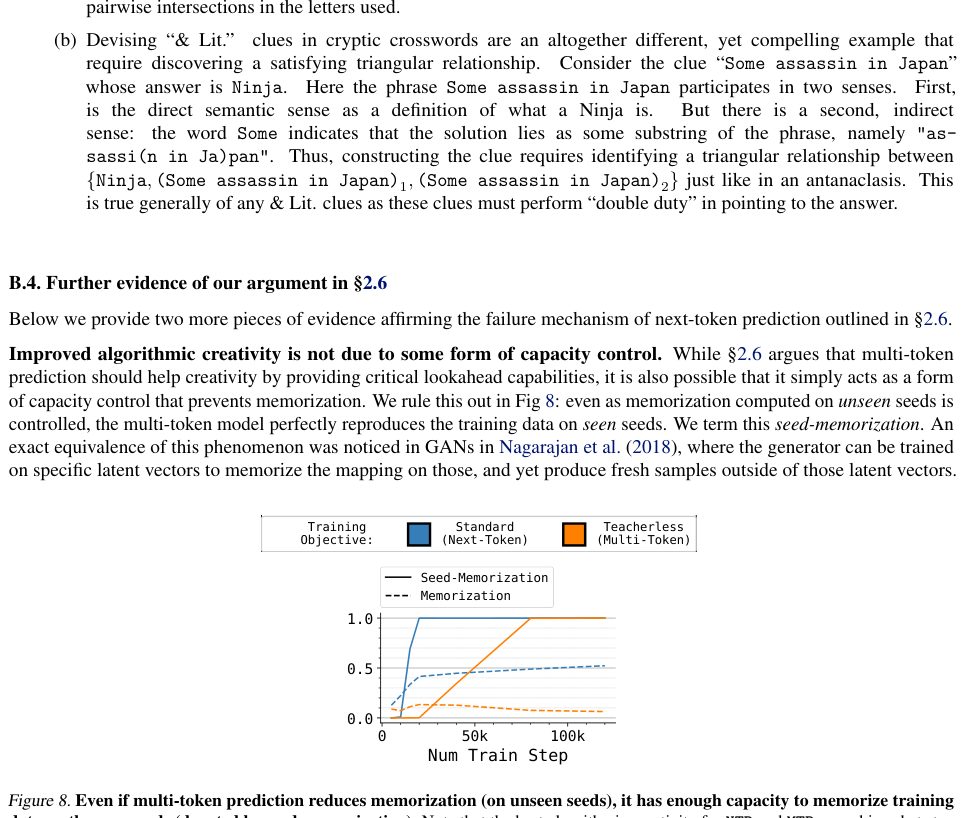
Figure 8: Even if multi-token prediction reduces memorization (on unseen seeds), it has enough capacity to memorize training data on the seen seeds (denoted by seed-memorization). Note that the best algorithmic creativity for NTP and MTP are achieved at step 10k and 40k, respectively, which are the checkpoints we used to report metrics in Fig 4.
图 8:即便多词元预测降低(未见种子上的)记忆,它仍有足够容量在已见种子上记忆训练数据(记为种子记忆)。注意 NTP 与 MTP 的最佳算法创造力分别在第 10k 与 40k 步达到,即我们用来报告图 4 指标的检查点。
Effect of token reordering. The implication of our argument in §2.6 is that next-token learning would benefit from reversing the token ordering of the Sibling Discovery task (i.e., parent appears before siblings). Indeed, we find this to be the case in Fig 12 and Fig 22. Interestingly, we find that the reverse-trained NTP model is still far from the original multi-token teacherless model. More surprisingly, a teacherless model trained on the reversed data, achieves even higher algorithmic creativity of all training methods here. Note that in all other datasets, no reordering of the tokens should make any change to the training.
词元重排的影响。 §2.6 论证的含义是:下一词学习会受益于反转兄弟姐妹发现的词元顺序(即父出现在兄弟姐妹之前)。的确,图 12 与图 22 如此。有趣的是,反转训练的 NTP 模型仍远逊于原始多词元无教师模型。更惊人的是,在反转数据上训练的无教师模型,在此处所有训练方法中算法创造力最高。注意在所有其他数据集上,任何词元重排都不应改变训练。
(a) Sibling Discovery
(a) 兄弟姐妹发现
(a) Circle Construction
(a) 圆构造
Appendix C Description of datasets
附录 C 数据集描述
C.1 Datasets inspired by combinational creativity
C.1 受组合创造启发的数据集
Dataset 1: Sibling Discovery.
This task is based off a bipartite graph made of parent vertices each neighboring a corresponding set of children . We set the number of parent vertices to be small and the number of children for each parent vertex to be large. For example, and . We define to hold on “sibling-parent” triplets of the form such that .
数据集 1:兄弟姐妹发现。
该任务基于二分图 ,由父顶点 组成,各自邻接对应子女集 。我们设父顶点数 较小,每个父的子女数 较大。例如 、。定义 在形如 且 的「兄弟姐妹–父」三元组上成立。
Next, we ensure that the training set is large enough for the model to infer all the edges in the graph. Let and (for all ). This means . At the same time, to keep the task non-trivial, the training set must be small enough to not cover all the coherent sibling-parent triplets. Thus, we ensure .
接着保证训练集足够大,使模型能推断图中全部边。令 、(对所有 )。这意味着 。同时为保持任务非平凡,训练集须足够小以至不覆盖全部连贯兄弟姐妹–父三元组。因而保证 。
For the default version of this dataset, we set and for all .
该数据集的默认版本取 ,对所有 取 。
Dataset 2: Triangle Discovery
This task is based off an undirected graph which contains many triangles. Since a triangle is a symmetric structure, the problem remains the same even upon reordering the vertices. Thus, in this task iff all three edges between belong in . To make this task interesting (neither too trivial nor too non-trivial) for our models to learn, we enforce several constraints on the graph. First, we try to keep the degree deg of each vertex to be sufficiently small. On the one hand, this is so that no vertex requires too much computation to find a triangle it is part of; on the other, we also do not want a very dense graph where most random triplets are a triangle. In addition to this degree requirement, we ensure that each vertex has a minimum number of triangles.
数据集 2:三角形发现
该任务基于含许多三角形的无向图 。因三角形对称,重排顶点问题不变。于是 当且仅当 之间三条边都属于 。为使任务对我们的模型既不过易也不过难,对图施加若干约束。首先尽量让每个顶点的度数 deg 足够小:一方面使找其所在三角形的计算不过重;另一方面也不想要绝大多数随机三元组都是三角形的极密图。除度数要求外,保证每个顶点有最少三角形数。
Thus to create a graph that is neither too trivial nor too non-trivial, we define a two-step graph generation procedure. In the first step, we iterate over the vertices, and add deg many edges from that vertex to other vertices in the set (where deg is small, such as 3 or 10). To avoid creating high-degree vertices inadvertently, we only select neighbors with degree . This alone may not ensure a sufficient number triangles in each vertex; so we iterate over the vertices to explicitly create tri random triangles on each vertex (where tri is small, such as 6 or 10). We do this by selecting pairs of a vertex’s neighbors and drawing an edge between them.
为生成既不过易也不过难的图,我们定义两步图生成过程。第一步遍历顶点,从该顶点向集合中其他顶点加 deg 条边(deg 较小,如 3 或 10)。为避免无意制造高度数顶点,只选择度数 的邻居。这本身未必保证每顶点有足够三角形;于是再遍历顶点,在每顶点上显式创建 tri 个随机三角形(tri 较小,如 6 或 10):选取该顶点邻居对并在其间连边。
Next, we want a training dataset such that (a) the model can infer all the edges from the graph and yet (b) not all triangles appear in the dataset. This necessitates training on a dataset that consists not only of a subset of the triangles, but also of edges from the graph. Our training data consists of two parts: (1) are random triangles from the graph, (2) are random edges from the graph. In the training set, the triangle and edge samples are distinguished by a prefix “triangle:” or “edge:”. During test-time, we ensure that the model is prompted with “triangle:”. A triangle is tokenized as “tri: ” and an edge as “edge: ”. We provide both the directions of edge to potentially avoid any issues with the reversal curse (Berglund et al. 2024; Allen-Zhu & Li 2023a).
接着希望训练集使 (a) 模型能从图推断全部边,但 (b) 并非所有三角形都出现在数据中。这要求训练数据不仅含三角形子集,还含图中的边。训练数据分两部分:(1) 1/3 为图中随机三角形,(2) 2/3 为图中随机边。训练集中三角形与边样本用前缀「triangle:」或「edge:」区分。测试时保证提示为「triangle:」。三角形 标记化为「tri: 」,边 为「edge: 」。我们提供边的两个方向,以潜在避免反转诅咒问题(Berglund et al. 2024;Allen-Zhu & Li 2023a)。
For the default setting of the dataset, we set , , .
数据集默认设定取 ,,。
C.2 Datasets inspired by exploratory creativity
C.2 受探索创造启发的数据集
Dataset 3: Circle Construction.
In this task, the generated strings must be randomized adjacency lists that can be rearranged to recover circle graphs of vertices. The vertices come from a fixed vocabulary of tokens. Specifically, let the generated list be . We define iff there exists a resolving permutation such that for distinct . i.e., each edge leads to the next, and eventually circles back to the first vertex. In our experiments, we set to be larger than .
数据集 3:圆构造。
该任务中,生成串须为可重排以恢复 顶点圆图的随机邻接表。顶点来自 个词元的固定词表。具体地,令生成列表为 。定义 当且仅当存在解析置换 ,使 ,且 互异。即每条边通向下一条,最终绕回首顶点。实验中设 大于 。
Our default experiments are reported for .
默认实验报告 。
Dataset 4: Line Construction
This task is a minor variant of the above where the edge set corresponds to a line graph. The details are same here except for coherence to hold, we need a resolving permutation such that for distinct . i.e., each edge leads to the next, stopping at a dead-end. We use the same set of hyperparamters as Circle Construction.
数据集 4:线构造
该任务是上述的小变体,边集 对应线图。细节相同,只是连贯性要求存在解析置换 使 ,且 互异。即每条边通向下一条,止于死胡同。超参与圆构造相同。
Our default experiments are reported for .
默认实验报告 。
Appendix D Further experimental details
附录 D 进一步实验细节
Details for Gemma v1 (2B) model. In Table 1, we provide the hyperparameter details for each of our datasets. We note some common details here. First, the batch size is , but each sequence is packed with multiple examples; thus the model sequence length (divided by the input length) can be treated as a multiplicative factor that determines the effective batch size. The learning rates are chosen favorable to next-token prediction (not multi-token prediction). The training steps were chosen roughly based on a point after which the model had saturated in algorithmic creativity (and exhibited decreasing creativity). We use a learning rate with linear warm up for steps, followed by cosine annealing upto a factor of the maximum learning rate. To measure creativity, we sample a test dataset of datapoints.
Gemma v1(2B)模型细节。 表 1 给出各数据集超参。此处记若干共同细节。批大小为 ,但每条序列打包多样例;因此模型序列长度(除以输入长度)可视为决定有效批大小的乘性因子。学习率选择对下一词预测有利(而非多词元)。训练步数大致选在模型算法创造力饱和(并开始下降)之后。学习率线性预热 步,再余弦退火至最大学习率的 。衡量创造力时采样大小为 的测试集 。
We represent the main tokens in our tasks with integers (ranging upwards of to as many distinct integers as required). In the seed-conditioning setting, we use seeds of default length , using randomly sampled uppercase characters from the English alphabet. In all datasets, we space-separate the vertices in a string, and comma-separate the edges.
任务中的主要词元用整数表示(从 起按需取足够多不同整数)。种子条件化设定下默认种子长度 ,从英文字母表随机采样大写字符。全部数据集中,顶点用空格分隔,边用逗号分隔。
| Hyperparameter | Sibling Discovery | Triangle Discovery | Circle Construction | Line Construction |
|---|---|---|---|---|
| Max. Learning Rate | ||||
| Model Seq. Len. | ||||
| Training steps | ||||
| Training size | ||||
| Weight given to multi-token obj. |
Table 1: Hyperparameter details for Gemma v1 (2B) model.
| 超参 | 兄弟姐妹发现 | 三角形发现 | 圆构造 | 线构造 |
|---|---|---|---|---|
| Max. Learning Rate | ||||
| Model Seq. Len. | ||||
| Training steps | ||||
| Training size | ||||
| Weight given to multi-token obj. |
表 1:Gemma v1(2B)模型超参细节。
Details for GPT-2 (86M) model. We use GPT-2 (small) with 86M non-embedding parameters when we are comparing Transformers with diffusion models. We train these models with a learning rate of and a batch size of , to convergence in terms of the algorithmic creativity. In temperature sampling, we use nucleus sampling with a parameter of , although we observed this does not affect the results qualitatively. We used top-k sampling with a parameter of . We also explore temperatures above for these models since temperatures low than only did worse. We provide sensitivity analysis of learning rate in §F.
GPT-2(86M)模型细节。 与扩散模型对照 Transformer 时,使用非嵌入参数 86M 的 GPT-2(small)。学习率 、批大小 ,训练至算法创造力收敛。温度采样用参数 的核采样,但我们观察到这不定性改变结果。top-k 采样参数为 。也探索高于 的温度,因低于 只更差。学习率敏感性见 §F。
Details for SEDD (90M) model. We use SEDD’s “absorb” variant, which begins denoising with a fully masked sequence and iteratively refines tokens over 128 denoising steps. This variant achieves the best language modeling performance in the original paper. Same as GPT-2 (86M), we train these models with a learning rate of and a batch size of , to convergence in terms of algorithmic creativity. [^1] We provide sensitive analysis of learning rate in §F. For sampling, we used the default function parameters, which turned out to involve top- sampling with .
SEDD(90M)模型细节。 使用 SEDD 的「absorb」变体:从全掩码序列开始去噪,经 128 步迭代精炼词元。该变体在原论文中语言模型表现最佳。与 GPT-2(86M)相同,学习率 、批大小 ,训练至算法创造力收敛。[^1] 学习率敏感性见 §F。采样使用默认函数参数,结果涉及 的 top- 采样。
Appendix E Sensitivity analyses for Gemma v1 (2B)
附录 E Gemma v1(2B)的敏感性分析
In this section, we report that our observations are robust to the choice of various hyper-parameters. First, we present a series of plots for the Gemma v1 (2B) model; each group of plots reports varying one hyperparameter for all the datasets. Fig 11 for train set size, Fig 12 for task complexity, Fig 13 for the weight given to the multi-token objective (and Fig 14 correspondingly for memorization), Fig 15 for learning rates, Fig 16 for number of training steps and Fig 17 for batch size. In §E.1, we report analyses for varying sampling conditions. It is worth noting that the occasional exceptions to our trends generally come from Line Construction, suggesting that this task is most friendly towards next-token prediction of the four we study.
本节报告观察对各种超参选择的稳健性。首先给出 Gemma v1(2B)的系列图;每组图对全部数据集变化一个超参。图 11 为训练集大小,图 12 为任务复杂度,图 13 为多词元目标权重(图 14 对应记忆),图 15 为学习率,图 16 为训练步数,图 17 为批大小。§E.1 报告不同采样条件的分析。值得注意:趋势的偶发例外一般来自线构造,暗示四项中它最对下一词预测友好。
Note on task-complexity. In Fig 12, we report robustness of our results to variations in the task complexity (e.g., degree, path length etc.,). Note that the variations we have explored are within reasonable factors. If we vastly increase certain factors (e.g., increase the degree of the vertices), we expect learning to become either highly trivial or non-trivial (see §C for some reasoning). Besides, as discussed in the main paper, teacherless training is a hard objective to optimize especially for smaller models; thus, we expect increasing the task complexity beyond a point to hurt the teacherless model for a fixed model size (crucially, for optimization reasons, not generalization reasons).
关于任务复杂度。 图 12 报告结果对任务复杂度变化(如度数、路径长度等)的稳健性。注意所探索变化在合理因子内。若大幅增加某些因子(如提高顶点度数),预期学习会变得极平凡或极非平凡(理由见 §C)。此外如正文所述,无教师训练尤其对小模型难优化;因此预期超过某点后提高任务复杂度会伤害固定规模下的无教师模型(关键是优化原因,而非泛化原因)。
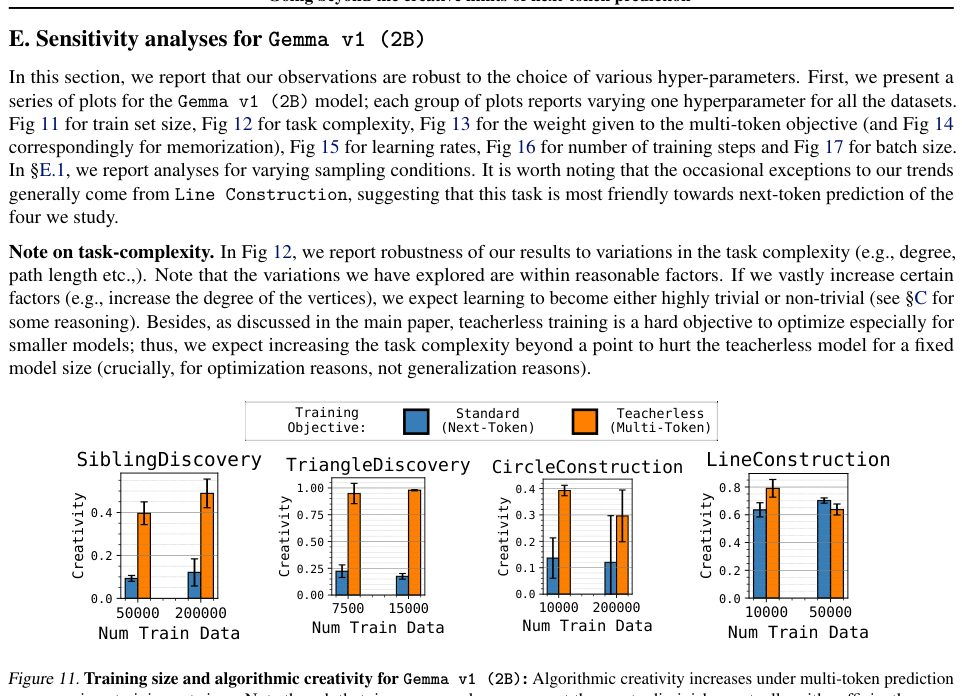
Figure 11: Training size and algorithmic creativity for Gemma v1 (2B): Algorithmic creativity increases under multi-token prediction across various training set sizes. Note though that, in our examples, we except the gap to diminish eventually with sufficiently many training datapoints (this is unlike the failure of next-token prediction in 6).
图 11:Gemma v1(2B)的训练规模与算法创造力:在多种训练集大小下,多词元预测均提升算法创造力。但注意在我们的例子中,预期差距最终会随足够多训练点缩小(这不同于 6 中下一词预测的失败)。
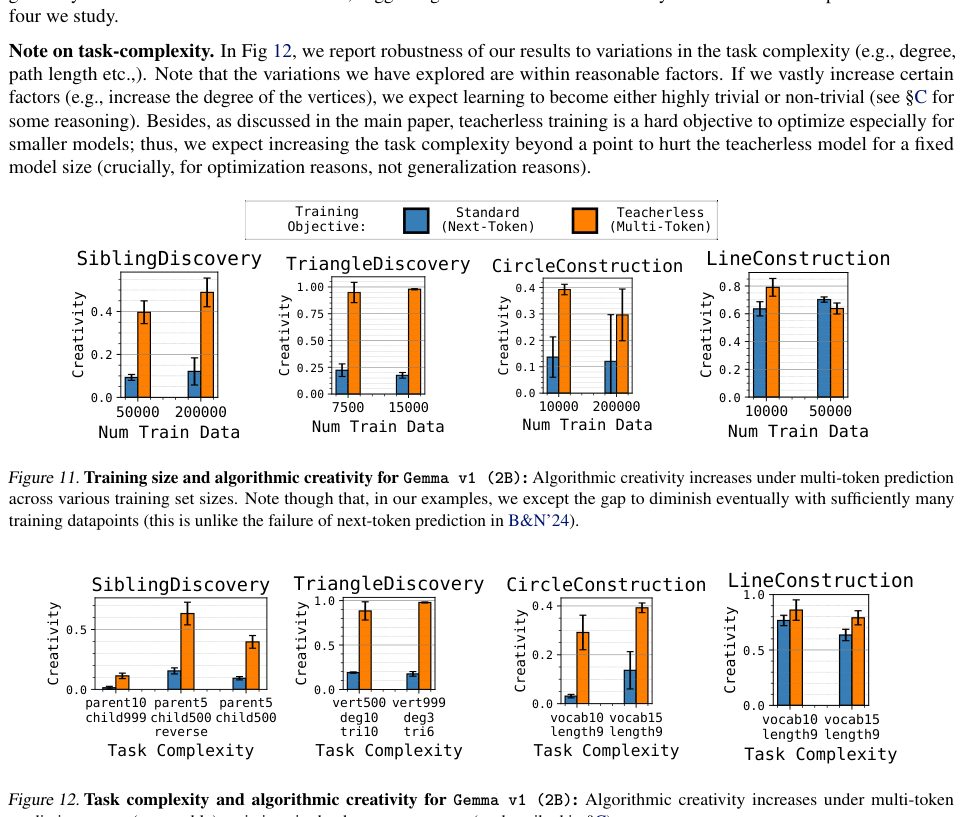
Figure 12: Task complexity and algorithmic creativity for Gemma v1 (2B): Algorithmic creativity increases under multi-token prediction across (reasonable) variations in the dataset parameters (as described in §C).
图 12:Gemma v1(2B)的任务复杂度与算法创造力:在数据参数的(合理)变化下(见 §C),多词元预测均提升算法创造力。
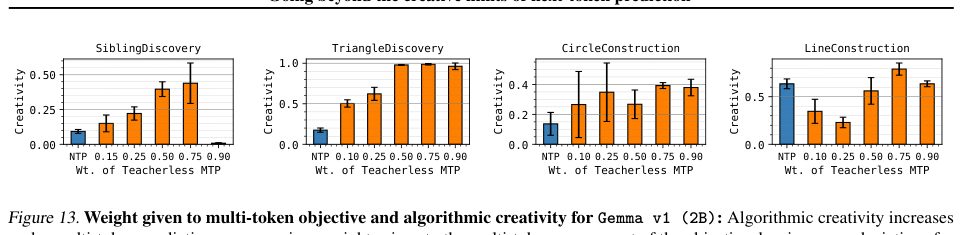
Figure 13: Weight given to multi-token objective and algorithmic creativity for Gemma v1 (2B): Algorithmic creativity increases under multi-token prediction across various weights given to the multi-token component of the objective, barring some deviations for Line Construction.
图 13:Gemma v1(2B)的多词元目标权重与算法创造力:在多词元分量的多种权重下,多词元预测均提升算法创造力,线构造有个别偏离。
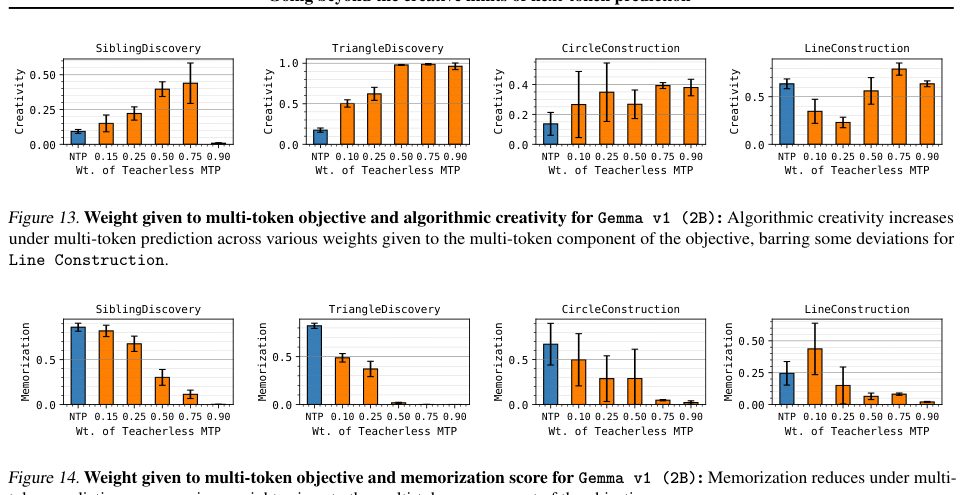
Figure 14: Weight given to multi-token objective and memorization score for Gemma v1 (2B): Memorization reduces under multi-token prediction across various weights given to the multi-token component of the objective.
图 14:Gemma v1(2B)的多词元目标权重与记忆分数:在多词元分量的多种权重下,多词元预测均降低记忆。
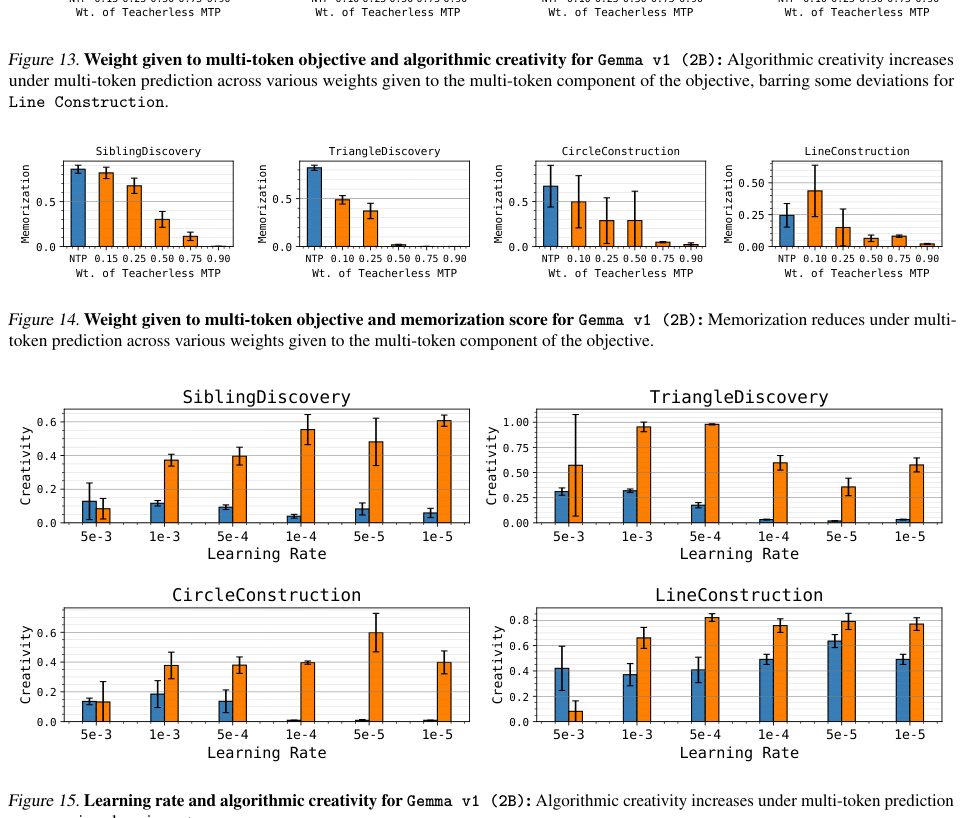
Figure 15: Learning rate and algorithmic creativity for Gemma v1 (2B): Algorithmic creativity increases under multi-token prediction across various learning rates.
图 15:Gemma v1(2B)的学习率与算法创造力:在多种学习率下,多词元预测均提升算法创造力。
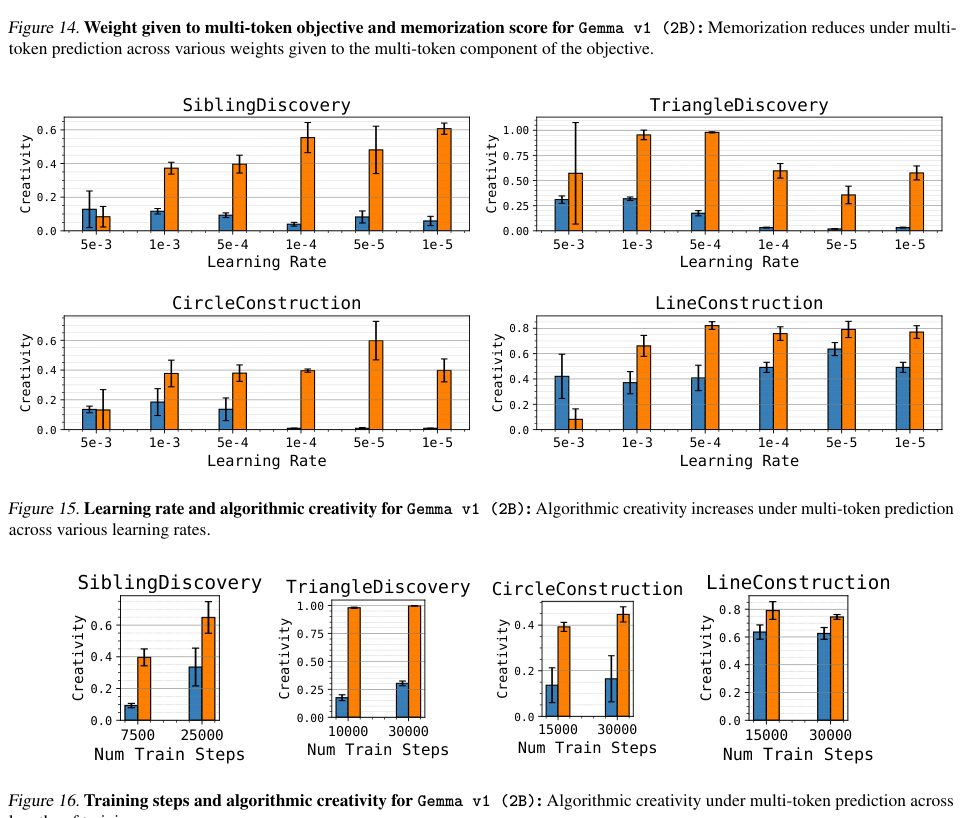
Figure 16: Training steps and algorithmic creativity for Gemma v1 (2B): Algorithmic creativity under multi-token prediction across lengths of training.
图 16:Gemma v1(2B)的训练步数与算法创造力:跨不同训练长度,多词元预测下的算法创造力。
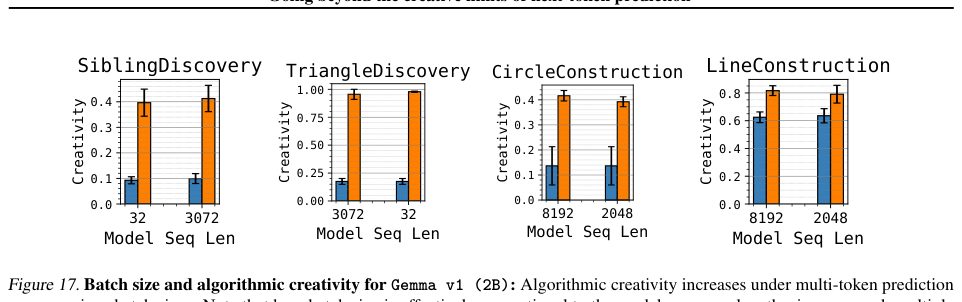
Figure 17: Batch size and algorithmic creativity for Gemma v1 (2B): Algorithmic creativity increases under multi-token prediction across various batch sizes. Note that here batch size is effectively proportional to the model sequence length, since we pack multiple finetuning examples into the sequence.
图 17:Gemma v1(2B)的批大小与算法创造力:在多种批大小下,多词元预测均提升算法创造力。注意此处批大小实际与模型序列长度成正比,因我们把多个微调样例打包进序列。
E.1 Varying sampling methods
E.1 变化采样方法
Fig 18, Fig 19, and Fig 20 report creativity, memorization and coherence (i.e., fraction of generated strings that are coherent) for various sampling methods (greedy decoding and nucleus sampling) with various prefix conditionings (namely, null, pause and seed).
图 18、图 19 与图 20 报告在各种采样方法(贪心解码与核采样)与各种前缀条件化(空、停顿与种子)下的创造力、记忆与连贯性(即生成串中连贯的比例)。
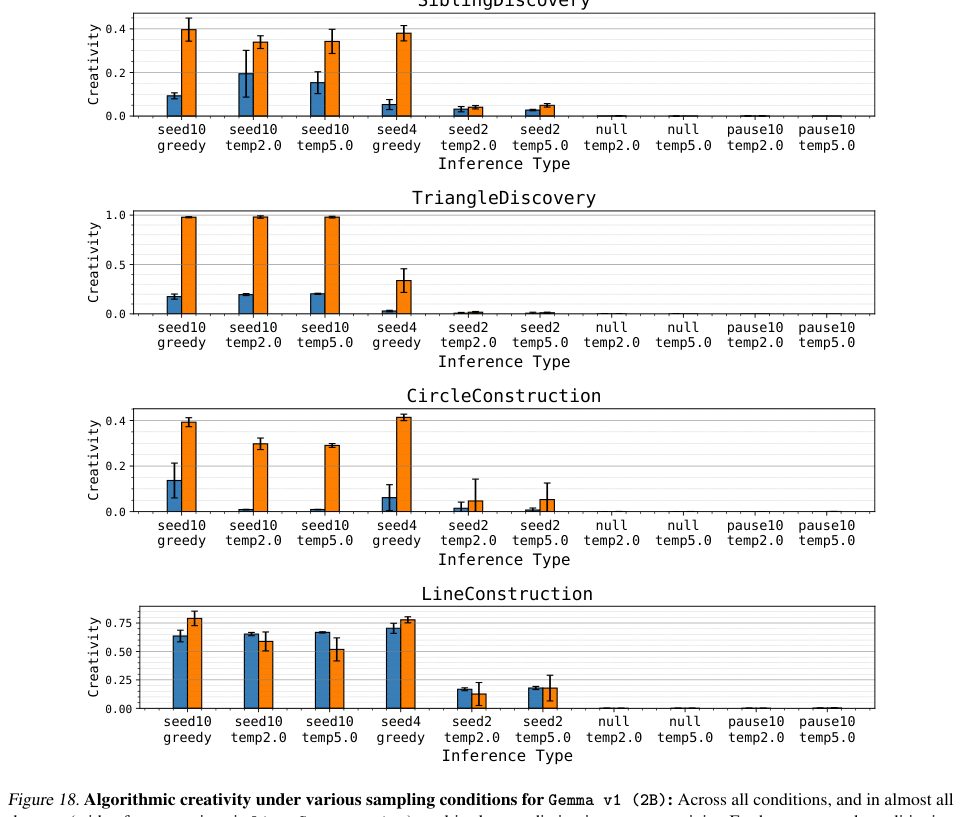
Figure 18: Algorithmic creativity under various sampling conditions for Gemma v1 (2B): Across all conditions, and in almost all datasets (with a few exceptions in Line Construction), multi-token prediction improves creativity. Furthermore, seed-conditioning achieves best algorithmic creativity, with a longer seed helping more.
图 18:Gemma v1(2B)在各种采样条件下的算法创造力:几乎全部条件与数据集上(线构造有少量例外),多词元预测提升创造力。此外种子条件化达到最佳算法创造力,更长种子帮助更大。
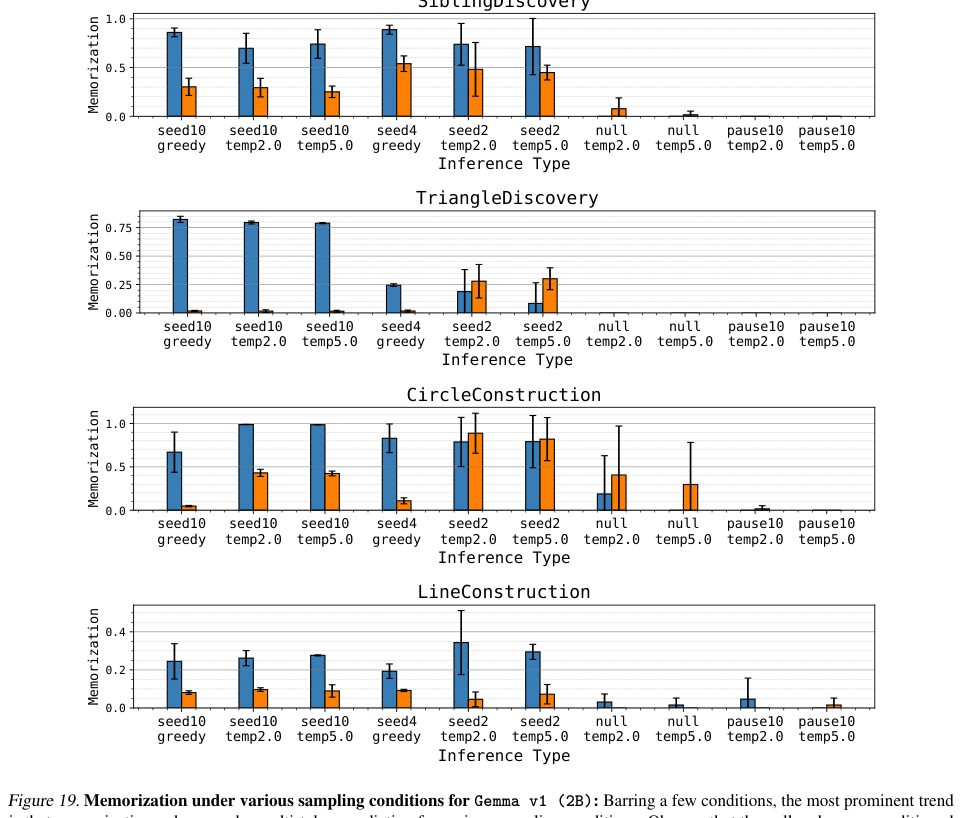
Figure 19: Memorization under various sampling conditions for Gemma v1 (2B): Barring a few conditions, the most prominent trend is that memorization reduces under multi-token prediction for various sampling conditions. Observe that the null and pause-conditioned models do produce some memorized output while their creativity was non-existent.
图 19:Gemma v1(2B)在各种采样条件下的记忆:除少数条件外,最突出趋势是多词元预测在各种采样条件下降低记忆。注意空与停顿条件化模型确实产生一些记忆输出,而其创造力却不存在。
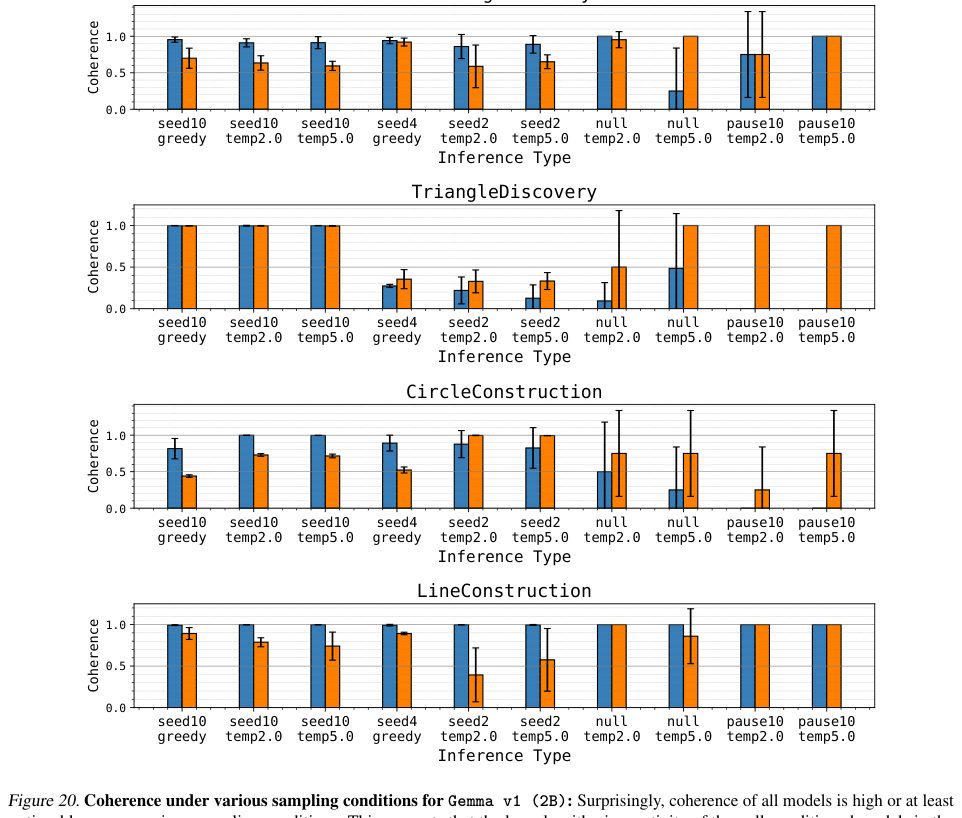
Figure 20: Coherence under various sampling conditions for Gemma v1 (2B): Surprisingly, coherence of all models is high or at least noticeable, across various sampling conditions. This suggests that the low algorithmic creativity of the null-conditioned models in the previous plots arises from model collapsing to single original point.
图 20:Gemma v1(2B)在各种采样条件下的连贯性:令人惊讶的是,所有模型在各种采样条件下连贯性都高或至少可察觉。这表明前图中空条件化模型算法创造力低,源于模型崩塌到单一原创点。
Appendix F Additional experiments in SEDD (90M)vs. GPT-2 (86M)
附录 F SEDD(90M)对 GPT-2(86M)的额外实验
F.1 Ablation studies
F.1 消融研究
In this section, we first provide additional ablation studies for SEDD (90M)vs GPT-2 (86M)with different training and dataset settings (Fig 21 and Fig 22).
本节先给出 SEDD(90M)对 GPT-2(86M)在不同训练与数据设定下的额外消融(图 21 与图 22)。
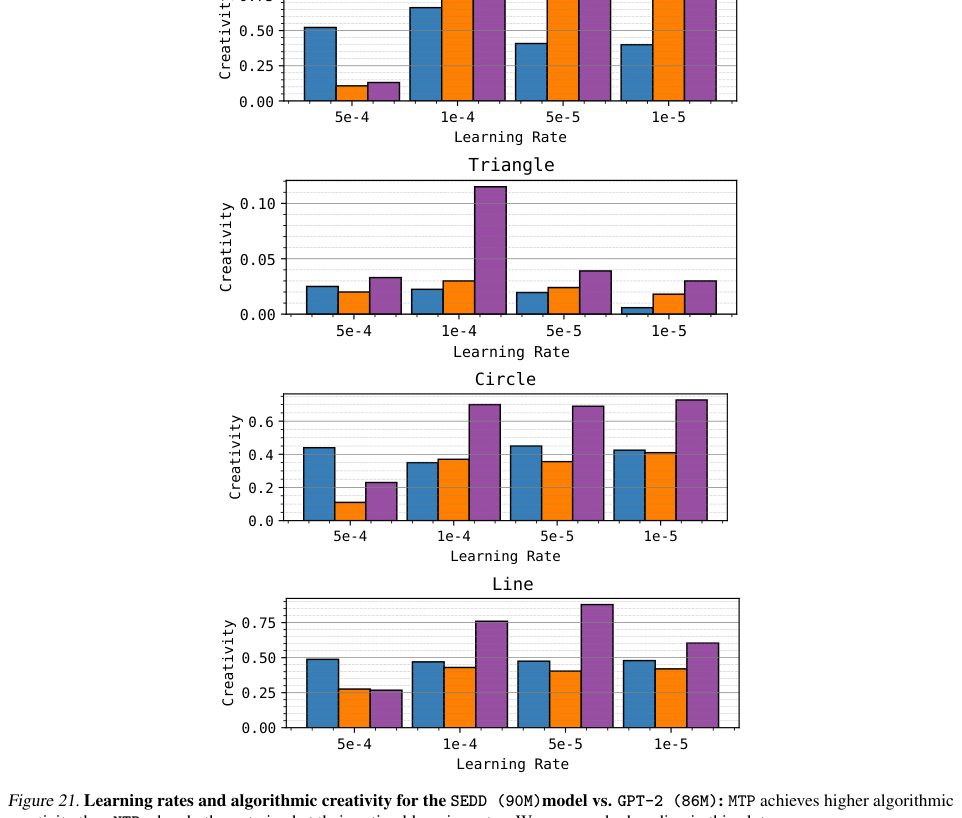
Figure 21: Learning rates and algorithmic creativity for the SEDD (90M)model vs. GPT-2 (86M): MTP achieves higher algorithmic creativity than NTP when both are trained at their optimal learning rates.
图 21:SEDD(90M)对 GPT-2(86M)的学习率与算法创造力:当二者均在各自最优学习率训练时,MTP 的算法创造力高于 NTP。
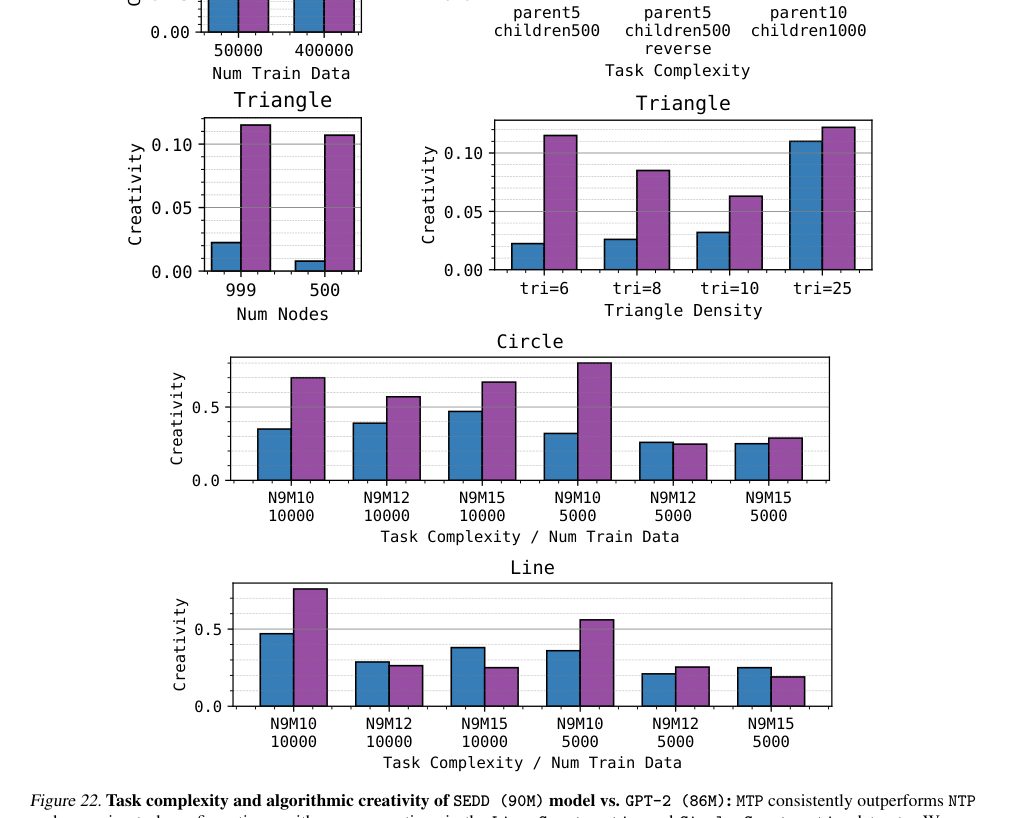
Figure 22: Task complexity and algorithmic creativity of SEDD (90M) model vs. GPT-2 (86M): MTP consistently outperforms NTP under varying task configurations, with some exceptions in the Line Constructionand Circle Constructiondatasets.
图 22:SEDD(90M)对 GPT-2(86M)的任务复杂度与算法创造力:在变化的任务配置下 MTP 持续优于 NTP,线构造与圆构造有个别例外。
F.2 Effect of seed length
F.2 种子长度的影响
We provide an ablation study on the seed length for NTP vs MTP on the Sibling Discovery task (Fig 23 (left)). We see that longer seeds lead to higher algorithmic creativity.
我们在兄弟姐妹发现任务上对 NTP 对 MTP 做种子长度消融(图 23 左)。可见更长种子带来更高算法创造力。
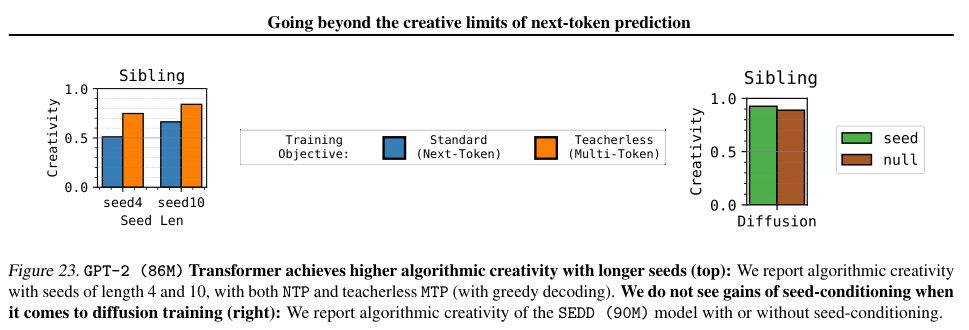
Figure 23: GPT-2 (86M) Transformer achieves higher algorithmic creativity with longer seeds (top): We report algorithmic creativity with seeds of length 4 and 10, with both NTP and teacherless MTP. we do not see gains of seed-conditioning when it comes to diffusion training (right): We report algorithmic creativity of the SEDD (90M) model with or without seed-conditioning.
图 23:GPT-2(86M)Transformer 在更长种子下算法创造力更高(上):报告长度 4 与 10 的种子下 NTP 与无教师 MTP 的算法创造力。扩散训练上看不到种子条件化增益(右):报告 SEDD(90M)有无种子条件化的算法创造力。
F.3 Seed-conditioning for diffusion training
F.3 扩散训练的种子条件化
In Fig 23 (right), we apply seed-conditioning to the SEDD (90M) on the Sibling Discovery task. Unlike what we see on transformers, we do not observe improved creativity when applying seed-conditioning to diffusion training.
图 23(右)在兄弟姐妹发现上对 SEDD(90M)施加种子条件化。与 Transformer 上所见不同,扩散训练施加种子条件化未见创造力提升。
F.4 Format sensitivity for Triangle Discovery
F.4 三角形发现的格式敏感性
Recall that our input format for Triangle Discovery follows the edge list representation of triangles (§C, Fig. 10). For instance, triangle ABC is represented as AB, BC, CA. This format explicitly lists the edges of the triangle, making it easier for the model to attend to edge-level patterns during learning.
回顾三角形发现的输入格式遵循三角形的边列表表示(§C,图 10)。例如三角形 ABC 表示为 AB, BC, CA。该格式显式列出三角形的边,便于模型在学习中关注边级模式。
We also experimented with an alternative node-based representation, where triangle ABC is represented more compactly as ABC, without making the edges explicit. We note in Fig 24 that the models are curiously sensitive to the way the triangles are formatted. Models trained on the node-based format perform equally badly with all training objectives, while the diffusion model outperforms NTP by a large margin with the edge list representation.
我们也试验了替代的基于节点的表示:三角形 ABC 更紧凑地表示为 ABC,不显式给出边。图 24 显示模型对三角形格式化方式出奇敏感。在基于节点的格式上,所有训练目标下模型都同样差;而在边列表表示下,扩散模型大幅优于 NTP。
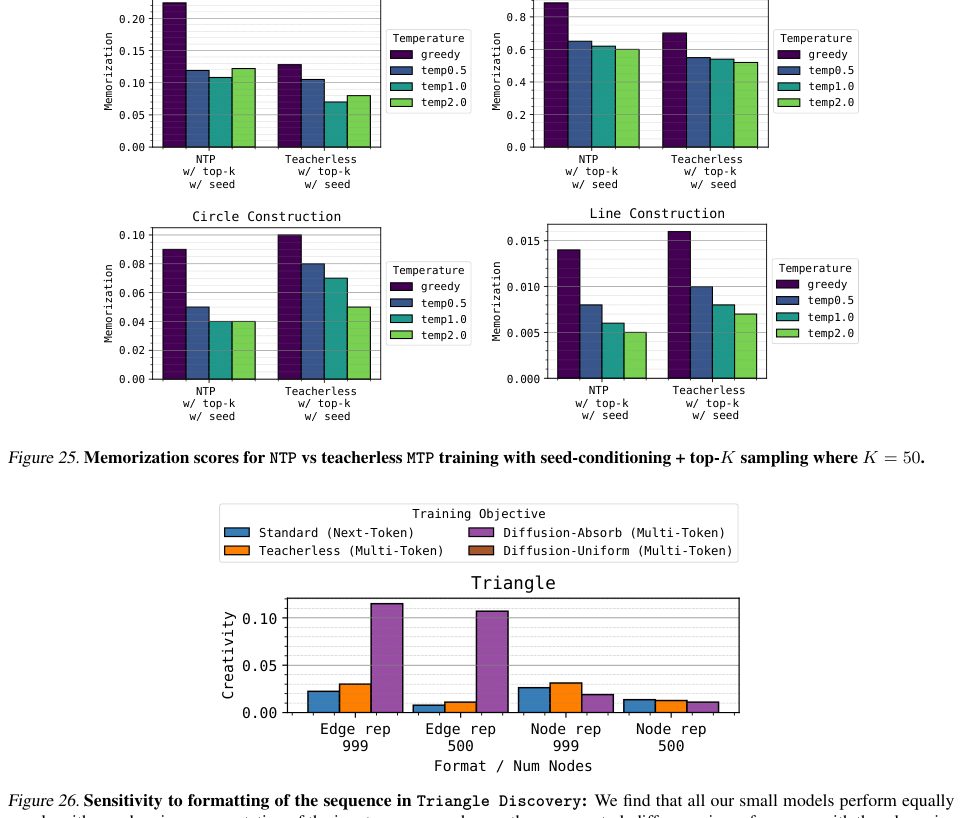
Figure 24: Sensitivity to formatting of the sequence in Triangle Discovery: We find that all our small models perform equally poorly with a node-wise representation of the input sequence, whereas there was a stark difference in performance with the edge-wise representation.
图 24:三角形发现中序列格式的敏感性:发现我们所有小模型在节点式输入表示上同样差,而在边式表示上表现差异鲜明。
Appendix G Additional experiments with medium-sized Transformer and SEDD
附录 G 中等规模 Transformer 与 SEDD 的额外实验
We replicate our SEDD (90M) and GPT-2 (86M) experiments on a larger model size (400M parameters). In Fig 25, we see similar trends to the smaller model sizes (Fig 4).
我们在更大模型规模(约 400M 参数)上复现 SEDD(90M)与 GPT-2(86M)实验。图 25 显示与较小模型规模(图 4)相似的趋势。
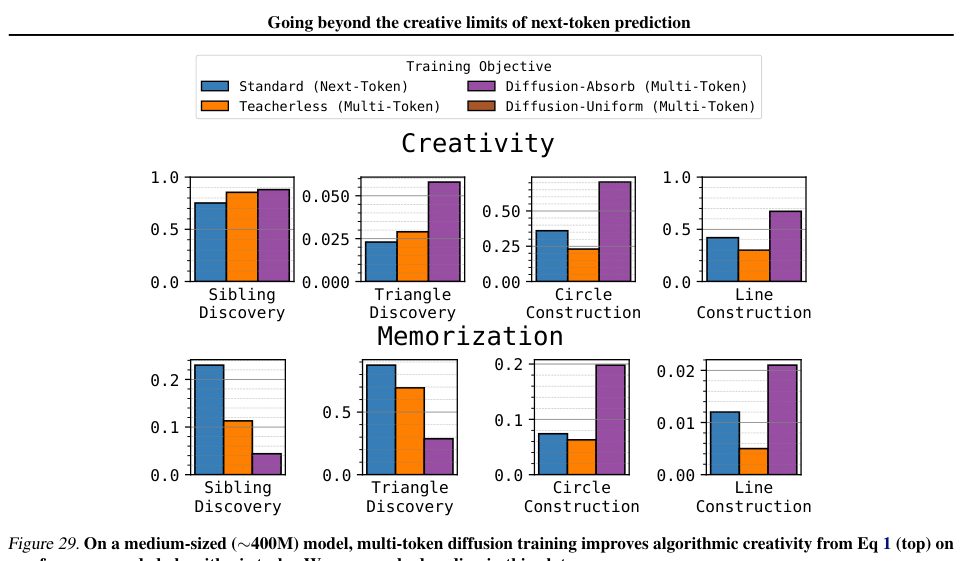
Figure 25: On a medium-sized (400M) model, multi-token diffusion training improves algorithmic creativity from Eq 1 (top) on our four open-ended algorithmic tasks.
图 25:在中等规模(约 400M)模型上,多词元扩散训练在四项开放式算法任务上提升式 1 的算法创造力(上)。
Appendix H Decomposing creativity
附录 H 分解创造力
Through following experiments on the GPT-2 (86M) model in the Sibling Discovery task, we try to understand the dynamics between two important quantities that affect algorithmic creativity: diversity/duplication and originality/memorization
通过 GPT-2(86M)在兄弟姐妹发现上的下列实验,我们试图理解影响算法创造力的两个重要量之间的动态:多样性/重复与原创性/记忆。
H.1 Diversity score
H.1 多样性分数
Equation (1) defines our algorithmic creativity by rewarding samples that are both unique and novel. A higher score can be achieved either by enhancing diversity or by reducing memorization. In the following section, we examine this decomposition using the Sibling Discovery task. Formally, we define the diversity score as:
式 (1) 通过奖励既唯一又新颖的样本定义算法创造力。更高分数可通过增强多样性或降低记忆达到。下节用兄弟姐妹发现任务考察该分解。形式上定义多样性分数为:
We first demonstrate that creativity and diversity are not necessarily correlated, and next, that MTP particularly improves creativity (while achieving lower diversity than NTP). To show this, we report the algorithmic creativity and diversity scores along training in Fig 26. We see that for NTP, the diversity score keeps increasing and stays high, while algorithmic creativity increases in the first 10k steps and starts to decrease. For teacherless training, both scores increase throughout training. While the diversity of MTP is surprisingly lower than NTP throughout training, the creativity of MTP surpasses NTP at 20k steps.
我们先证明创造力与多样性未必相关,再证明 MTP 尤其提升创造力(同时多样性低于 NTP)。为此在图 26 报告训练过程中的算法创造力与多样性分数。可见对 NTP,多样性分数持续上升并保持高位,而算法创造力在前 10k 步上升后开始下降。对无教师训练,两分数在整个训练中都上升。虽 MTP 的多样性在整个训练中出人意料地低于 NTP,但 MTP 的创造力在 20k 步超越 NTP。
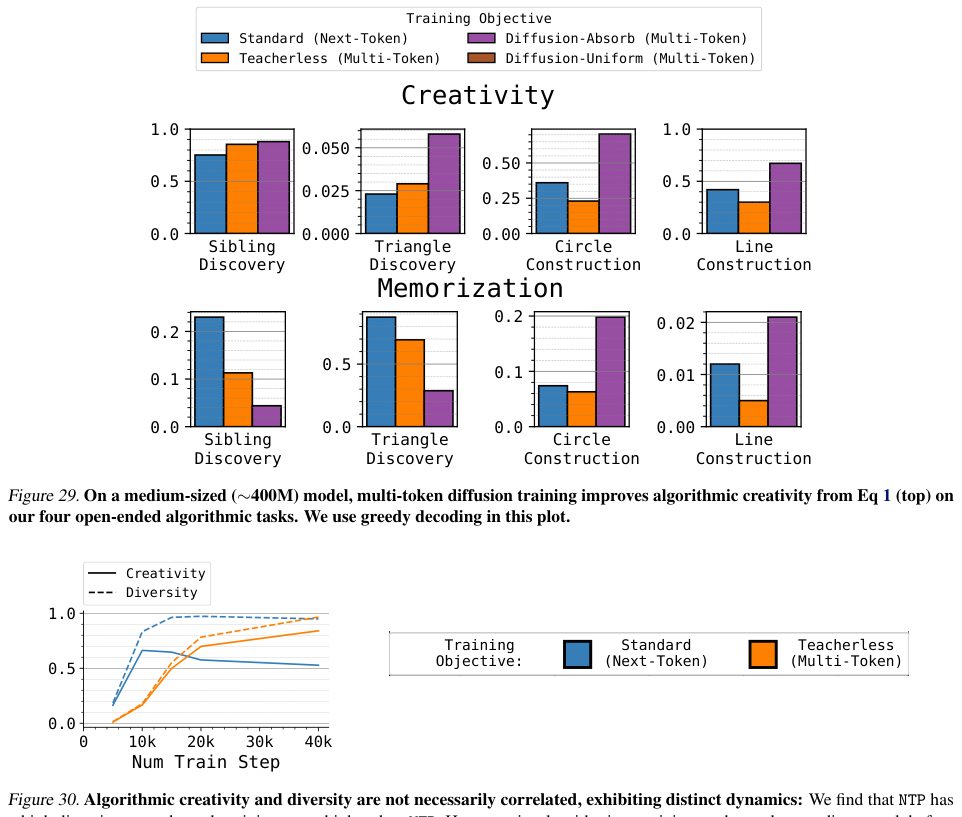
Figure 26: Algorithmic creativity and diversity are not necessarily correlated, exhibiting distinct dynamics: We find that NTP has a high diversity score through training, even higher than MTP. However, its algorithmic creativity reaches only a mediocre peak before descending, when MTP starts surpassing it.
图 26:算法创造力与多样性未必相关,呈现不同动态:发现 NTP 在整个训练中多样性分数高,甚至高于 MTP。但其算法创造力只达到平庸峰值后下降,而 MTP 开始超越它。
H.2 Decomposing algorithmic creativity as diversity and memorization
H.2 将算法创造力分解为多样性与记忆
Better creativity can be achieved either by enhancing diversity or by reducing memorization – we try to disentangle these factors in this section. In Fig 27, we plot the algorithmic creativity, diversity, and memorization scores at the checkpoint of best algorithmic creativity. We see that seed-conditioning contributes to higher diversity but does little to bring down memorization; however, teacherless training contributes to higher diversity and also to reducing memorization. In Fig 26, we see that the best creativity and best diversity are not achieved at the same checkpoint.
更好的创造力可通过增强多样性或降低记忆达到——本节试图拆开这些因素。图 27 在最佳算法创造力检查点绘制算法创造力、多样性与记忆分数。可见种子条件化贡献更高多样性,但对降低记忆帮助不大;而无教师训练既提高多样性也降低记忆。图 26 显示最佳创造力与最佳多样性并非同一检查点。
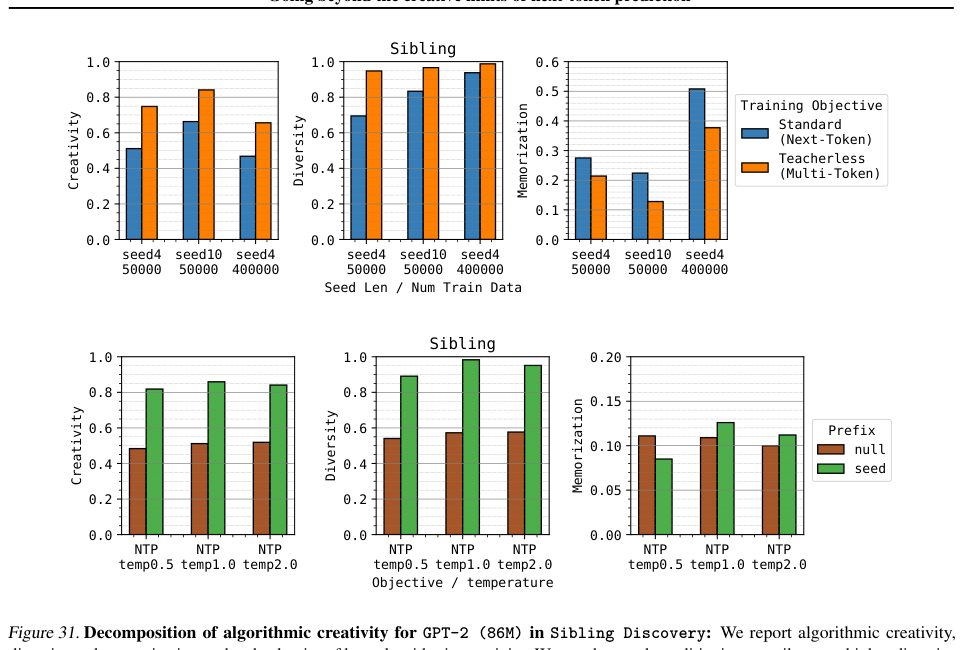
Figure 27: Decomposition of algorithmic creativity for GPT-2 (86M) in Sibling Discovery: We report algorithmic creativity, diversity and memorization at the checkpoint of best algorithmic creativity. We see that seed-conditioning contributes to higher diversity but does not help bring down memorization; teacherless training helps both diversity and in bringing down memorization.
图 27:GPT-2(86M)在兄弟姐妹发现上算法创造力的分解:在最佳算法创造力检查点报告算法创造力、多样性与记忆。可见种子条件化贡献更高多样性但不帮助降低记忆;无教师训练既帮助多样性也帮助降低记忆。
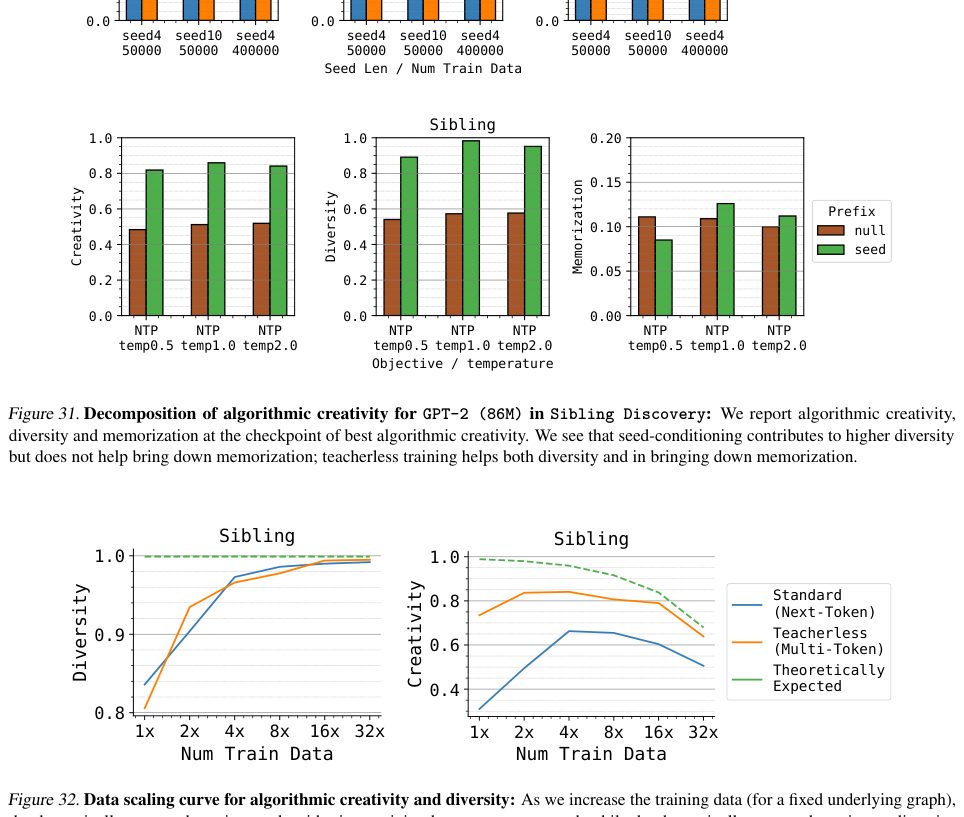
Figure 28: Data scaling curve for algorithmic creativity and diversity: As we increase the training data (for a fixed underlying graph), the theoretically expected maximum algorithmic creativity decreases as expected, while the theoretically expected maximum diversity stays the same. NTP tails to achieve the theoretically expected algorithmic creativity, while MTP almost achieves the theoretically expected performance at scale.
图 28:算法创造力与多样性的数据缩放曲线:在固定底层图上增加训练数据时,理论期望的最大算法创造力如预期下降,而理论期望的最大多样性保持不变。NTP 未能达到理论期望的算法创造力,而 MTP 在规模上几乎达到理论期望表现。
H.3 Data scaling for algorithmic creativity
H.3 算法创造力的数据缩放
How does algorithmic creativity change as we increase the amount of training data? Intuitively, more training data helps the model learn the true distribution, but also makes it harder to generate unseen samples (since the uncovered space becomes rarer). To understand this, we plot how models perform relative to a theoretically expected maximum algorithmic creativity. This is computed by assuming an oracle that samples a generated set (in Eq. (1)) uniformly with replacement from the true underlying distribution, and then computing algorithmic creativity Eq. (1. In Fig 28, we see that as we increase the training data (for a fixed underlying graph), the theoretically expected creativity decreases as expected, while the theoretically expected diversity stays the same (since this quantity does not care about being original with respect to the training set). Interestingly, as training data increases, MTP narrows the gap between NTP and the theoretically expected creativity and almost achieves the theoretically expected performance in the high data regime.
增加训练数据量时算法创造力如何变化?直观上更多数据帮助模型学习真实分布,但也更难生成未见样本(未覆盖空间变得更稀)。为理解这一点,我们绘制模型相对理论期望最大算法创造力的表现。计算方式是假设预言机从真实底层分布有放回均匀采样生成集 (式 (1)),再计算算法创造力式 (1)。图 28 显示:在固定底层图上增加训练数据时,理论期望创造力如预期下降,而理论期望多样性保持不变(因该量不关心相对训练集是否原创)。有趣的是,随训练数据增加,MTP 缩小与 NTP 及理论期望创造力之间的差距,并在高数据体制几乎达到理论期望表现。
Appendix I Experiments on summarization
附录 I 摘要实验
Experimental Details. In Table 2, we provide the hyperparameter details for the GPT models finetuned on both XSUM (Narayan et al. 2018) and CNN/DailyMail (Nallapati et al. 2016) for one epoch. We use a learning rate with linear warm up for of the total steps, followed by linear decay to . To measure Rouge and Self-Bleu, we generate and average across 5 summarizations per document, on a test dataset of datapoints. We finetune our models with either the NTP objective (Eq 2) or the teacherless MTP objective (Eq 2), with equal weight to both.
实验细节。 表 2 给出在 XSUM(Narayan et al. 2018)与 CNN/DailyMail(Nallapati et al. 2016)上微调一个 epoch 的 GPT 模型超参。学习率线性预热总步数的 ,再线性衰减至 。衡量 Rouge 与 Self-Bleu 时,在 点测试集 上每文档生成并平均 5 份摘要。微调使用 NTP 目标(式 2)或无教师 MTP 目标(式 2),二者等权。
| Hyperparameter | XSUM | CNN/DailyMail |
|---|---|---|
| Batch Size | ||
| Max. Learning Rate | ||
| Warmup Steps | ||
| Training Steps | ||
| Training Size |
Table 2: Hyperparameter details for summarization experiments.
| 超参 | XSUM | CNN/DailyMail |
|---|---|---|
| Batch Size | ||
| Max. Learning Rate | ||
| Warmup Steps | ||
| Training Steps | ||
| Training Size |
表 2:摘要实验超参细节。
To measure quality, we compute the average of Rouge-1, Rouge-2, Rouge-L as Rouge. For measuring diversity, we generate five different summaries per test example, and compute Self-Bleu. This computes average pairwise sentence Bleu-2 scores with weights on - and -tuples.
衡量质量时,取 Rouge-1、Rouge-2、Rouge-L 的平均为 Rouge。衡量多样性时,每测试样例生成五份不同摘要,计算 Self-Bleu:对 1- 与 2- 元组用权重 计算平均成对句子 Bleu-2。
I.1 Additional graphs for effect of multi-token training
I.1 多词元训练效应的额外图
Fig 29 shows the diversity and quality graphs on the smaller-sized GPT-2 models on XSUM, and Fig 30 for CNN/DailyMail. While we consistently see improved quality from the multi-token model across the board, we don’t see an increased diversity for fixed Rouge scores anymore.
图 29 给出较小 GPT-2 模型在 XSUM 上的多样性与质量图,图 30 为 CNN/DailyMail。虽全面持续看到多词元模型质量提升,但固定 Rouge 下不再看到多样性增加。
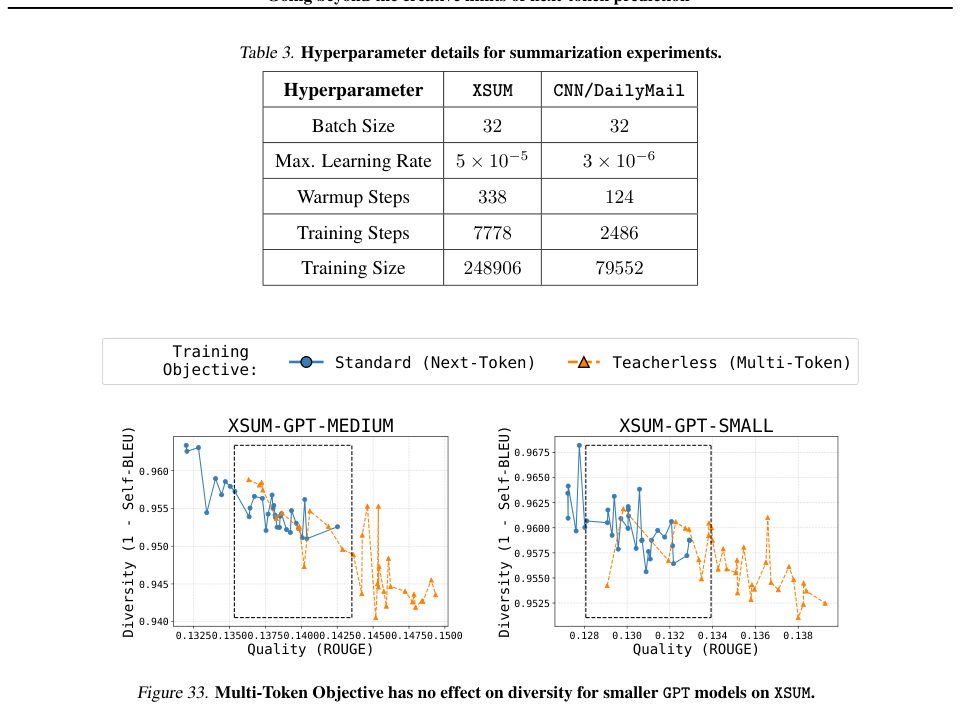
Figure 29: Multi-Token Objective has no effect on diversity for smaller GPT models on XSUM.
图 29:多词元目标对较小 GPT 模型在 XSUM 上的多样性无影响。
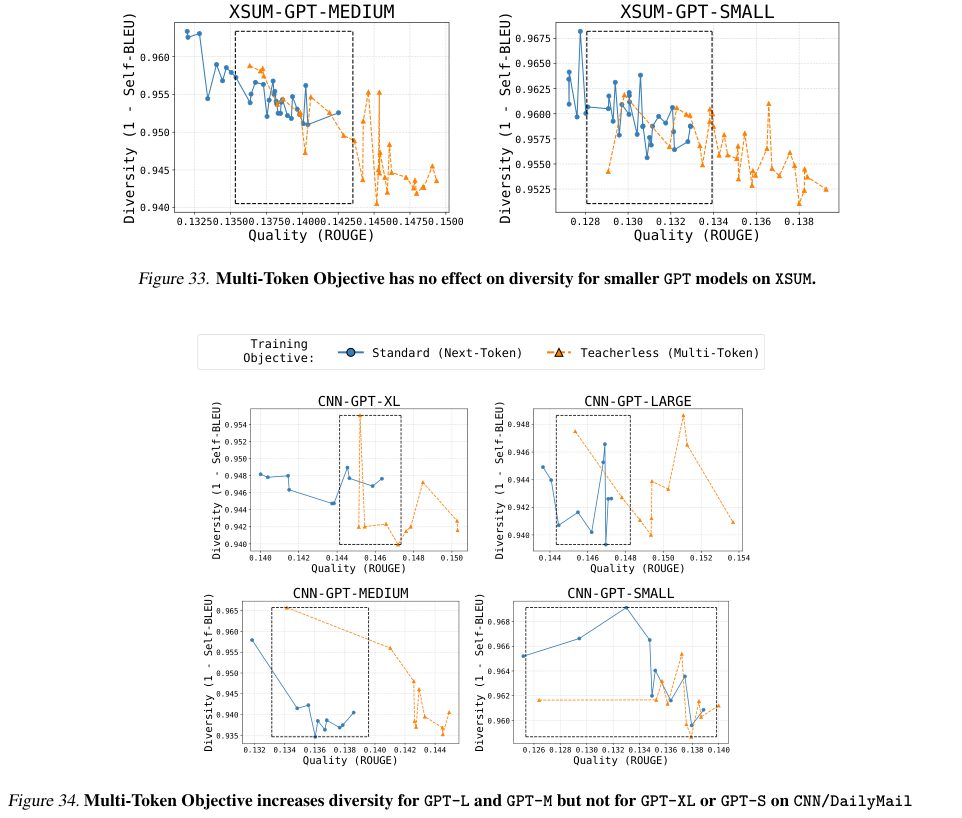
Figure 30: Multi-Token Objective increases diversity for GPT-L and GPT-M but not for GPT-XL or GPT-S on CNN/DailyMail
图 30:多词元目标提升 GPT-L 与 GPT-M 在 CNN/DailyMail 上的多样性,但对 GPT-XL 或 GPT-S 不然
I.2 Effect of seed-conditioning
I.2 种子条件化的影响
We also conducted seed-conditioning experiments as described in §3.1. The seed strings we use are randomly sampled uppercase characters from the English alphabet. We report the quality-diversity plots in Fig 31 (for next-token prediction on XSUM) and Fig 32 (for multi-token prediction on XSUM). As such, we do not find any changes in diversity, perhaps because this is not a sufficiently open-ended task.
我们也按 §3.1 做了种子条件化实验。种子串为从英文字母表随机采样的 个大写字符。质量–多样性图见图 31(XSUM 上的下一词预测)与图 32(XSUM 上的多词元预测)。如此并未发现多样性变化,或许因该任务不够开放。
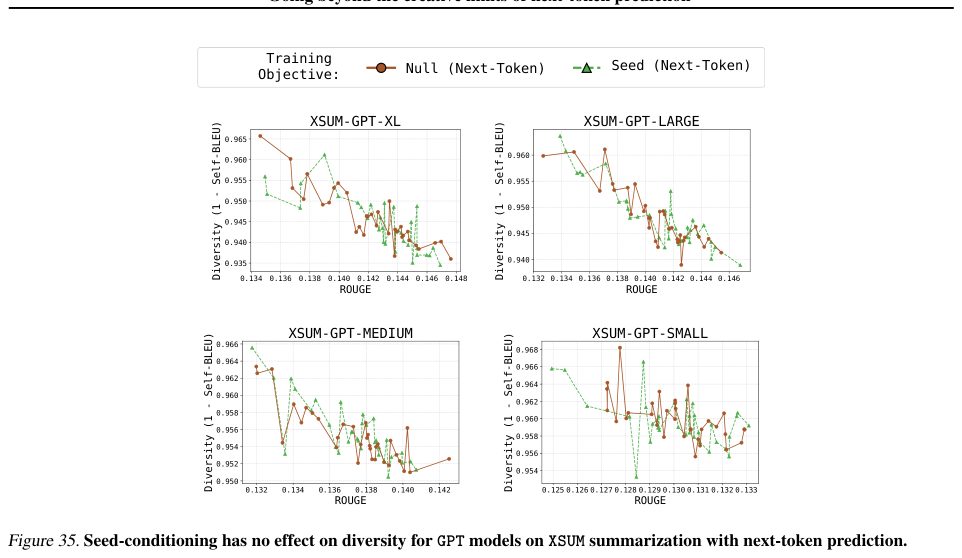
Figure 31: Seed-conditioning has no effect on diversity for GPT models on XSUM summarization with next-token prediction.
图 31:种子条件化对 GPT 模型在 XSUM 摘要上下一词预测的多样性无影响。
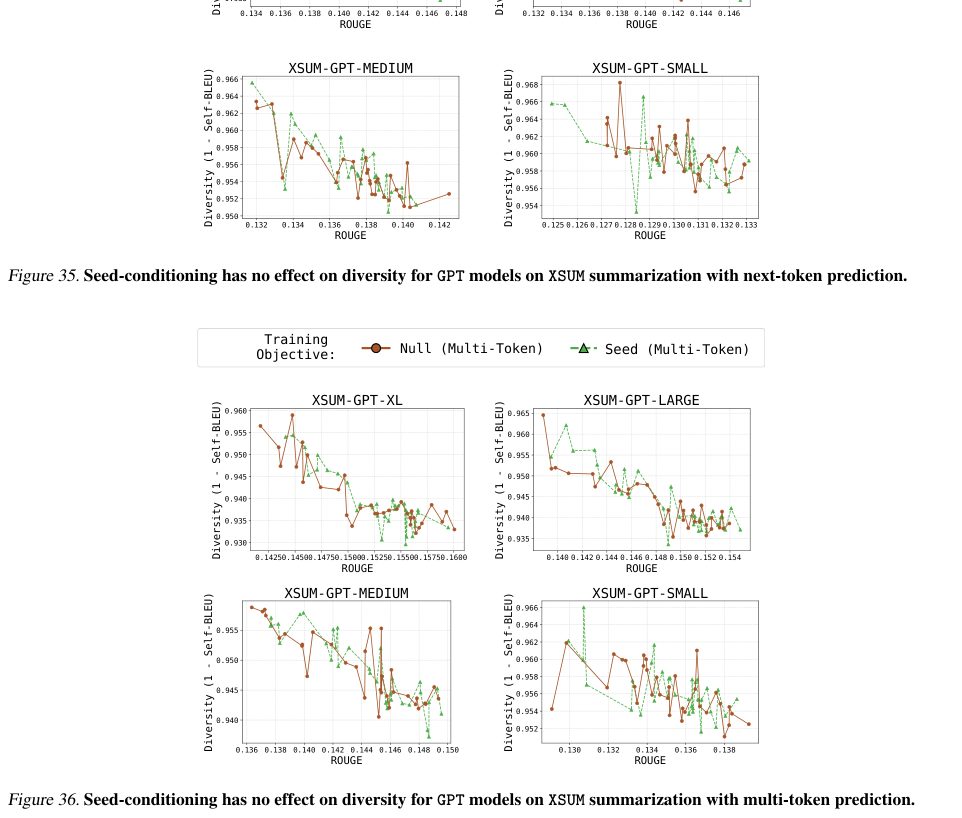
Figure 32: Seed-conditioning has no effect on diversity for GPT models on XSUM summarization with multi-token prediction.
图 32:种子条件化对 GPT 模型在 XSUM 摘要上多词元预测的多样性无影响。
Appendix J More related works
附录 J 更多相关工作
Empirical studies of creativity in LLMs.
There is a long line of recent works that measure novelty and creativity of LLMs and LLM-assisted users. (Chakrabarty et al. 2024; Lu et al. 2024b) quantitatively evaluate and report that models vastly underperform under expert human evaluation against human writers. Zhang et al. 2024a argue that finetuning methods such as RLHF and DPO, are limited when applied to creative humor-generation tasks. Likewise models like GPT4 and Claude currently underperform top human contestants in generating humorous captions. In poetry, Walsh et al. argue that there are certain characterstic styles that ChatGPT restricts itself to. Even assisted-writing can reduce diversity (Padmakumar & He 2024) or produce bland writing (Mirowski et al. 2024). On the positive side, Si et al. 2024 report that LLMs surprisingly generate novel research ideas, although these are less feasible. Anderson et al. 2024 find that users tend to produce more divergent ideas when assisted by ChatGPT (although at a group level, ideas tend to homogenize). Another line of works (Wang et al. 2024a; Talmor et al. 2020; Zhong et al. 2024) has proposed algorithmic improvements involve creative leaps-of-thought for real-world tasks.
LLM 创造力的经验研究。
近期有一长串工作衡量 LLM 与 LLM 辅助用户的新颖性与创造力。(Chakrabarty et al. 2024;Lu et al. 2024b) 定量评估并报告:在专家人类评价下模型相对人类写作者大幅落后。Zhang et al. 2024a 论证 RLHF 与 DPO 等微调方法用于创造幽默生成任务时受限。同样,GPT-4 与 Claude 等模型目前在生成幽默字幕上不如顶尖人类选手。诗歌方面,Walsh et al. 认为 ChatGPT 局限于某些特征风格。即便辅助写作也可能降低多样性(Padmakumar & He 2024)或产出平淡文字(Mirowski et al. 2024)。积极一面,Si et al. 2024 报告 LLM 出人意料地能生成新颖研究想法,尽管可行性较低。Anderson et al. 2024 发现用户在 ChatGPT 辅助下倾向产出更多发散想法(但在群体层面想法趋于同质化)。另一工作线(Wang et al. 2024a;Talmor et al. 2020;Zhong et al. 2024)为真实任务提出涉及创造跃迁的算法改进。
Other studies have proposed benchmarks for evaluating creativity. AidanBench (McLaughlin et al. 2024) and NoveltyBench (Zhang et al. 2025) evaluate LMs on their ability to produce diverse and coherent responses by penalizing repetition across generations. However, they do not measure originality relative to training data, leaving open whether outputs are genuinely novel or simply unseen paraphrases/recombinations. Zhao et al. 2024 evaluate LM creativity using the Torrance Tests of Creative Thinking, a standard in human psychometrics. Another line of work such as Alchemy (Wang et al. 2021), IVRE (Xu et al. 2022), and DiscoveryWorld (Jansen et al. 2024) present simulations with hidden facts and rules, requiring LMs to explore, hypothesize, and test through interaction. While these simulations focus on pretrained models rather than examining how training shapes creative capabilities, they serve as valuable and realistic benchmarks for assessing the role of creativity in scientific discovery.
另有研究提出评估创造力的基准。AidanBench(McLaughlin et al. 2024)与 NoveltyBench(Zhang et al. 2025)通过惩罚跨生成重复,评估 LM 产出多样连贯回复的能力。但它们不衡量相对训练数据的原创性,输出究竟是真正新颖还是未见过的改写/重组仍开放。Zhao et al. 2024 用人类心理测量中的托兰斯创造性思维测验评估 LM 创造力。另一线工作如 Alchemy(Wang et al. 2021)、IVRE(Xu et al. 2022)与 DiscoveryWorld(Jansen et al. 2024)提供含隐藏事实与规则的仿真,要求 LM 通过交互探索、假设与检验。这些仿真聚焦预训练模型而非考察训练如何塑造创造能力,但仍是评估创造力在科学发现中角色的有价值且现实的基准。
Finally, we refer the reader to Franceschelli & Musolesi 2023 for a rigorous treatment of philosophical questions surrounding creativity in LLMs. We also a refer to Wang et al. 2024b for a theoretical treatment of how to formalize subjectivity in creativity.
最后请读者参阅 Franceschelli & Musolesi 2023,以严格处理围绕 LLM 创造力的哲学问题;以及 Wang et al. 2024b,以理论处理如何形式化创造力中的主观性。
The next-token prediction debate.
In support of next-token prediction, there are arguments (Shannon 1948; Shannon 1951; Alabdulmohsin et al. 2024) that claim that language is captured by NTP with models even superceding humans (Shlegeris et al. 2022) at NTP. There are also theoretical results emphasizing the expressivity (Merrill & Sabharwal 2024; Feng et al. 2023) and learnability (Malach 2023; Wies et al. 2023) of autoregressive Transformers as long as there is a sufficiently long chain of thought.
下一词预测之争。
支持下一词预测方面,有论证(Shannon 1948;Shannon 1951;Alabdulmohsin et al. 2024)称语言由 NTP 捕捉,模型甚至在 NTP 上超越人类(Shlegeris et al. 2022)。也有理论结果强调:只要思维链足够长,自回归 Transformer 的表达力(Merrill & Sabharwal 2024;Feng et al. 2023)与可学性(Malach 2023;Wies et al. 2023)。
Multi-token training.
While these methods employ diverse strategies, a common feature is their reliance on multi-token objectives that capture broader dependencies across entire sequences. Representative examples include teacherless training (Bachmann & Nagarajan 2024; Monea et al. 2023; Tschannen et al. 2023) and independent output heads or modules (Gloeckle et al. 2024; DeepSeek-AI et al. 2024) or inserting a lookahead attention (Du et al. 2023). Another line of research is discrete diffusion models (Hoogeboom et al. 2021; Austin et al. 2021; Gong et al. 2023; Lou et al. 2023), which avoid strict left-to-right factorization by iteratively refining an entire sequence at multiple positions. There are other models as well, such as energy-based models (Dawid & LeCun 2023) and non-autoregressive models or (Gu et al. 2018).
多词元训练。
这些方法策略多样,共同特征是依赖捕捉整段序列更广依赖的多词元目标。代表性例子包括无教师训练(Bachmann & Nagarajan 2024;Monea et al. 2023;Tschannen et al. 2023)、独立输出头或模块(Gloeckle et al. 2024;DeepSeek-AI et al. 2024),或插入前瞻注意力(Du et al. 2023)。另一研究线是离散扩散模型(Hoogeboom et al. 2021;Austin et al. 2021;Gong et al. 2023;Lou et al. 2023),通过在多位置迭代精炼整段序列避免严格从左到右分解。另有基于能量的模型(Dawid & LeCun 2023)与非自回归模型(Gu et al. 2018)等。
Transformers and graph algorithmic tasks.
Graph tasks have been used to understand various limitations of Transformers in orthogonal settings. Bachmann & Nagarajan 2024; Saparov et al. 2024 report that Transformers are limited in terms of learning to search tasks on graphs, while Sanford et al. 2024 provide positive expressivity results for a range of algorithmic tasks that process an graph. These works differ from our study of combinational creativity since their graphs are provided in-context and the tasks have a unique answer. Other works (Schnitzler et al.; Yang et al. 2024a; Yang et al. 2024b) study multi-hop question answering on a knowledge graph; however, this does not require planning.
Transformer 与图算法任务。
图任务被用于理解 Transformer 在正交设定下的多种局限。Bachmann & Nagarajan 2024;Saparov et al. 2024 报告 Transformer 在学习图上的搜索任务方面受限,而 Sanford et al. 2024 为处理图的一系列算法任务给出正面表达力结果。这些工作与我们对组合创造的研究不同:其图在上下文给出,且任务有唯一答案。另有工作(Schnitzler et al.;Yang et al. 2024a;Yang et al. 2024b)研究知识图上的多跳问答;但这不需要规划。
Diversity of generative models.
One line of work relevant to us in the history of generative models is RNN-based VAE for text data (Bowman et al. 2016). The motivation, like in our work, was to learn high-level semantic features rather than next-token features with the hope of producing more novel sentences. However, this suffered from posterior collapse, where the model ignores the latent variable altogether inspiring various solutions (Yang et al. 2017; Goyal et al. 2017). Our results on noise-conditioning are also reminiscent of a line of work on exploration in reinforcement learning (RL), where it has been shown that adding noises to the policy model parameters enables more efficient exploration than directly adding noises to the output space (Plappert et al. 2017; Fortunato et al. 2017).
生成模型的多样性。
生成模型史上与我们相关的一条线是面向文本数据的基于 RNN 的 VAE(Bowman et al. 2016)。动机与我们类似:希望学习高层语义特征而非下一词特征,以产出更新颖句子。但这遭受后验崩塌——模型完全忽略潜变量——并激发多种解法(Yang et al. 2017;Goyal et al. 2017)。噪声条件化结果也让人联想到强化学习中的探索工作线:向策略模型参数加噪比直接向输出空间加噪更能高效探索(Plappert et al. 2017;Fortunato et al. 2017)。
Learning-theoretic studies of diversity in LLMs.
Various theoretical works provide rigorous arguments for how preventing hallucination and maximizing the model’s coverage are at odds with each other in abstract settings (Kalai & Vempala 2024; Kalavasis et al. 2024; Kleinberg & Mullainathan 2024). We clarify that this tension does not apply in our concrete settings. In those abstract settings, the strings in the support can be arbitrary and adversarially chosen whereas, our strings are generated by a simple rule (which can be learned).
LLM 多样性的学习理论研究。
多项理论工作在抽象设定中严格论证:防止幻觉与最大化模型覆盖相互对立(Kalai & Vempala 2024;Kalavasis et al. 2024;Kleinberg & Mullainathan 2024)。我们澄清:该张力不适用于我们的具体设定。在那些抽象设定中,支撑中的串可任意且对抗选取;而我们的串由可学习的简单规则生成。
Another theoretical question underlying generative models is that the optimum of their objectives are attained at perfect memorization; yet they tend to produce novel examples e.g., this question has been posed for GANs in Nagarajan et al. 2018 and for diffusion in Nakkiran et al. 2024 (see “remarks on generalization”) or Kamb & Ganguli 2024. Of relevance to us is, Kamb & Ganguli 2024 who provide a theoretical and empirical argument for how image diffusion models are able to generate combinatorially many creative outputs; theirs however do not require the type of planning our tasks do.
生成模型背后的另一理论问题是:其目标的最优在完美记忆处达到,却往往产出新颖样例;例如 Nagarajan et al. 2018 对 GAN、Nakkiran et al. 2024(见「泛化评注」)或 Kamb & Ganguli 2024 对扩散提出该问题。与我们相关的是 Kamb & Ganguli 2024:他们从理论与经验论证图像扩散模型如何能生成组合爆炸多的创造输出;但其任务不要求我们任务所需的那类规划。