RoboDojo: A Unified Sim-and-Real Benchmark for Comprehensive Evaluation of Generalist Robot Manipulation Policies
RoboDojo: A Unified Sim-and-Real Benchmark for Comprehensive Evaluation of Generalist Robot Manipulation Policies
RoboDojo:用于全面评测通用机器人操作策略的统一仿真与真实世界基准
Abstract
摘要
Generalist robot manipulation policies have made substantial progress, yet existing benchmarks remain limited in their ability to systematically and comprehensively evaluate policy capabilities. Many benchmarks rely on simple, short-horizon, or skill-narrow tasks that often share similar manipulation patterns and cover only limited capability dimensions. Moreover, evaluations are commonly conducted either in simulation or in the real world alone: simulation provides efficient and scalable feedback but cannot fully capture physical deployment challenges, whereas real-world evaluation offers direct evidence of deployment performance but is costly, time-consuming, and difficult to reproduce. To address these limitations, we introduce RoboDojo, a unified sim-and-real benchmark for comprehensive evaluation of generalist robot manipulation policies. RoboDojo includes 42 simulation tasks and 18 real-world tasks designed to cover diverse, challenging, and complementary manipulation capabilities. The simulation benchmark evaluates five capability dimensions: generalization, memory, precision, long-horizon execution, and open-vocabulary instruction following, while the real-world benchmark exposes policies to challenging physical-world deployment conditions. To support large-scale evaluation, RoboDojo implements heterogeneous parallel simulation in Isaac Sim, substantially improving evaluation throughput. For real-world evaluation, RoboDojo provides RoboDojo-RealEval, a reproducible real-world evaluation system with remote cloud access. By standardizing the hardware setup, scene reset procedure, evaluation protocol, and deployment interface, RoboDojo-RealEval enables policies to be tested under consistent physical conditions. In parallel, XPolicyLab provides a unified infrastructure for policy development and deployment, allowing policies to be integrated once and evaluated across RoboDojo simulation and real-world settings with minimal policy-side adaptation. We integrate 30 policies into XPolicyLab and evaluate them on RoboDojo, establishing a public leaderboard with systematic analysis of current policy performance. The website is available at http://robodojo-benchmark.com/.
通用机器人操作策略已取得长足进展,但现有基准在系统、全面地评测策略能力方面仍然有限。许多基准依赖简单、短时程或技能单一的任务,这些任务往往操作模式相似,只覆盖有限的能力维度。此外,评测通常只在仿真或只在真实世界中进行:仿真提供高效、可扩展的反馈,但无法完全捕捉实际部署中的物理挑战;真实世界评测能直接证明部署性能,却成本高、耗时长且难以复现。为了解决这些局限,我们提出 RoboDojo,一个用于全面评测通用机器人操作策略的统一仿真与真实世界基准。RoboDojo 包含 42 个仿真任务和 18 个真实世界任务,旨在覆盖多样、有挑战且相互补充的操作能力。仿真基准评测五个能力维度:泛化、记忆、精度、长时程执行和开放词汇指令遵循;真实世界基准则让策略面对有挑战的物理世界部署条件。为支持大规模评测,RoboDojo 在 Isaac Sim 中实现了异构并行仿真,大幅提高了评测吞吐量。在真实世界评测方面,RoboDojo 提供 RoboDojo-RealEval,一个可复现、支持远程云端访问的真实世界评测系统。通过标准化硬件配置、场景复位流程、评测协议和部署接口,RoboDojo-RealEval 使策略能在一致的物理条件下接受测试。与此同时,XPolicyLab 为策略开发和部署提供统一的基础设施,使策略只需接入一次,就能在 RoboDojo 的仿真和真实世界设置中接受评测,策略侧所需的适配极少。我们把 30 个策略接入 XPolicyLab 并在 RoboDojo 上评测,建立了公开排行榜,并对当前策略的性能做了系统分析。网站地址为 http://robodojo-benchmark.com/。
Website: RoboDojo-Benchmark.com Code: Benchmark, XPolicyLab Document Leaderboard
网站:RoboDojo-Benchmark.com 代码:Benchmark、XPolicyLab 文档 排行榜
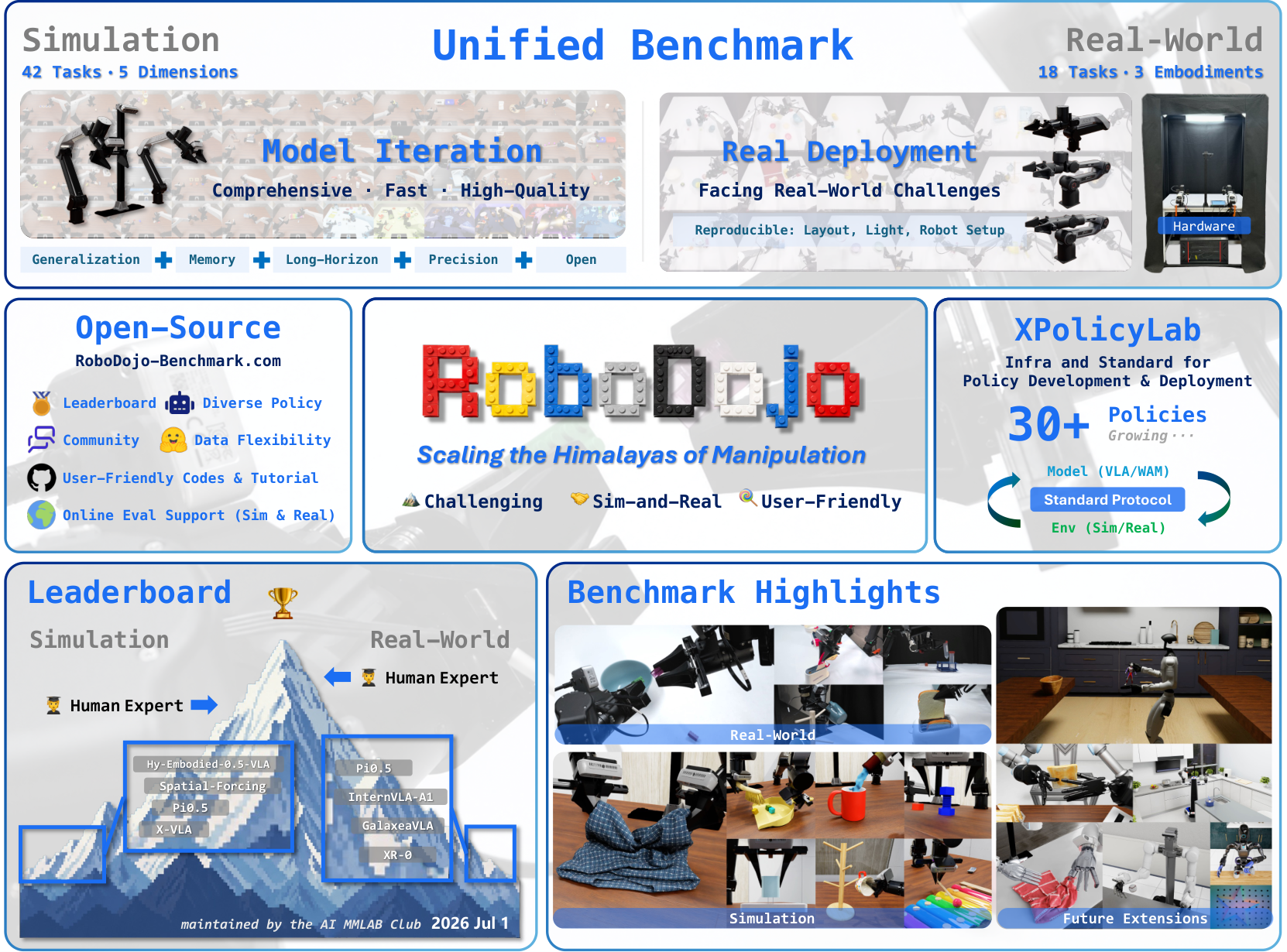
Figure 1: Overview of RoboDojo. RoboDojo unifies efficient simulation evaluation and reproducible real-world testing for generalist robot manipulation, covering 42 simulation tasks, 18 real-world tasks, heterogeneous parallel simulation, RoboDojo-RealEval, XPolicyLab, and a continuously updated leaderboard.
图 1:RoboDojo 概览。RoboDojo 把高效的仿真评测和可复现的真实世界测试统一起来,用于通用机器人操作,涵盖 42 个仿真任务、18 个真实世界任务、异构并行仿真、RoboDojo-RealEval、XPolicyLab,以及一个持续更新的排行榜。
1. Introduction
1. 引言
A central objective of embodied intelligence is to enable robots to perform manipulation tasks in the physical world. Recent advances in generalist robot policies and embodied foundation models have led to increasingly capable systems across diverse manipulation scenarios (Intelligence et al., 2026b; Zhang et al., 2026c; Li et al., 2026a; Li et al., 2025b; Zhang et al., 2026a; Lyu et al., 2026; Yuan et al., 2026a). As these systems continue to advance, reliable evaluation becomes essential for understanding their capabilities, limitations, and remaining failure modes. Existing benchmarks have investigated important aspects of robot manipulation, including language-conditioned long-horizon execution (Mees et al., 2022), generalization (Chen et al., 2025a), memory-dependent manipulation (Chen et al., 2026b), precise manipulation (Chen et al., 2026a; Lan et al., 2025), and real-world deployment (Yakefu et al., 2025; Chen et al., 2026c; Atreya et al., 2025). Despite this progress, current evaluation protocols remain insufficient for systematically assessing generalist manipulation policies. Many benchmarks rely on relatively simple or short-horizon tasks, and task variations are often introduced primarily through changes in objects, layouts, or language expressions. While such variations are useful for measuring distributional robustness, they often preserve similar underlying manipulation patterns, limiting diagnostic coverage over distinct challenges such as generalization, memory, precision, open-semantic grounding, sequential execution, bimanual coordination, and tool use.
具身智能的一个核心目标,是让机器人能在物理世界中执行操作任务。通用机器人策略和具身基础模型的最新进展,带来了在各种操作场景中能力越来越强的系统(Intelligence et al., 2026b; Zhang et al., 2026c; Li et al., 2026a; Li et al., 2025b; Zhang et al., 2026a; Lyu et al., 2026; Yuan et al., 2026a)。随着这些系统不断进步,可靠的评测对于理解它们的能力、局限和仍存在的失败模式变得至关重要。现有基准已经研究了机器人操作的一些重要方面,包括语言条件下的长时程执行(Mees et al., 2022)、泛化(Chen et al., 2025a)、依赖记忆的操作(Chen et al., 2026b)、精确操作(Chen et al., 2026a; Lan et al., 2025)以及真实世界部署(Yakefu et al., 2025; Chen et al., 2026c; Atreya et al., 2025)。尽管有这些进展,现有评测协议仍不足以系统地评估通用操作策略。许多基准依赖相对简单或短时程的任务,任务变化往往主要通过改变物体、布局或语言表述来引入。这类变化对衡量分布稳健性有用,但它们往往保留了相似的底层操作模式,限制了对泛化、记忆、精度、开放语义理解、顺序执行、双臂协调和工具使用等不同挑战的诊断覆盖。
Another key limitation is the separation between simulation and real-world evaluation. Simulation-based benchmarks are efficient and scalable, making them suitable for rapid feedback and model iteration; however, they cannot fully capture contact-rich dynamics, actuation errors, perception noise, and other physical factors that emerge during deployment. Real-world evaluation provides a more direct assessment of policy behavior under physical-world conditions, but is costly, time-consuming, and difficult to reproduce without standardized hardware setups, scene reset procedures, evaluation protocols, and deployment interfaces. These limitations motivate a unified benchmark that combines scalable simulation-based diagnosis with reproducible real-world validation.
另一个关键局限,是仿真评测与真实世界评测相互分离。基于仿真的基准高效且可扩展,适合快速反馈和模型迭代;但它们无法完全捕捉部署中出现的富接触动力学、执行误差、感知噪声及其他物理因素。真实世界评测能更直接地评估策略在物理世界条件下的行为,但成本高、耗时长,而且如果没有标准化的硬件配置、场景复位流程、评测协议和部署接口,就难以复现。这些局限促使我们构建一个统一的基准,把可扩展的仿真诊断与可复现的真实世界验证结合起来。
We introduce RoboDojo, a unified sim-and-real benchmark for efficient, comprehensive, and reproducible evaluation of generalist robot manipulation policies. RoboDojo contains 42 simulation tasks and 18 real-world tasks. The simulation benchmark provides broad capability coverage across Generalization, Memory, Long-Horizon, Precision, and Open, and supports heterogeneous parallel evaluation in Isaac Sim, enabling different tasks and scenes to run concurrently. The real-world benchmark complements simulation by exposing policies to challenging physical deployment conditions, including contact-rich interactions, perception noise, actuation errors, and environmental variations. To support reproducible physical testing, we design RoboDojo-RealEval, a remote real-world evaluation system that standardizes the hardware setup, workspace layout, lighting condition, scene reset procedure, evaluation protocol, and deployment interface. We further provide XPolicyLab, a unified infrastructure for policy development and deployment, enabling policies to be integrated once and evaluated across RoboDojo simulation and real-world settings with minimal policy-side adaptation.
我们提出 RoboDojo,一个统一的仿真与真实世界基准,用于高效、全面、可复现地评测通用机器人操作策略。RoboDojo 包含 42 个仿真任务和 18 个真实世界任务。仿真基准在泛化、记忆、长时程、精度和开放五个维度上提供广泛的能力覆盖,并支持在 Isaac Sim 中进行异构并行评测,让不同的任务和场景可以同时运行。真实世界基准是对仿真的补充,它让策略面对有挑战的物理部署条件,包括富接触交互、感知噪声、执行误差和环境变化。为支持可复现的物理测试,我们设计了 RoboDojo-RealEval,一个远程真实世界评测系统,它对硬件配置、工作空间布局、光照条件、场景复位流程、评测协议和部署接口进行了标准化。我们还提供 XPolicyLab,一个统一的策略开发和部署基础设施,使策略只需接入一次,就能在 RoboDojo 的仿真和真实世界设置中接受评测,策略侧所需的适配极少。
RoboDojo is designed not only to expand benchmark scale, but also to establish a unified evaluation loop for diagnosing and improving generalist robot policies. In simulation, it supports fast policy iteration through diverse task designs and capability-oriented analysis. In the real world, it examines whether policy improvements transfer to challenging physical deployment conditions under standardized and reproducible settings. Together with continuously updated test cases, diagnostic analysis, and a public leaderboard, RoboDojo provides a systematic platform for measuring progress toward robust generalist manipulation. Our contributions are summarized as follows:
RoboDojo 的设计目标不仅是扩大基准规模,还要建立一个用于诊断和改进通用机器人策略的统一评测闭环。在仿真中,它通过多样的任务设计和面向能力的分析支持快速的策略迭代。在真实世界中,它在标准化、可复现的设置下检验策略的改进能否迁移到有挑战的物理部署条件。连同持续更新的测试用例、诊断分析和公开排行榜,RoboDojo 为衡量通向稳健通用操作的进展提供了一个系统的平台。我们的贡献总结如下:
- We develop a unified sim-and-real evaluation system for robot manipulation policies, using a shared policy interface and evaluation pipeline across simulation and real-world testing. The system supports heterogeneous parallel simulation for efficient feedback and RoboDojo-RealEval for standardized, reproducible, and remote physical evaluation.
- 我们为机器人操作策略开发了一个统一的仿真与真实世界评测系统,在仿真和真实世界测试中使用共享的策略接口和评测流程。该系统支持用于高效反馈的异构并行仿真,以及用于标准化、可复现、远程物理评测的 RoboDojo-RealEval。
- We construct the RoboDojo Benchmark, including 42 simulation tasks and 18 real-world tasks. The simulation tasks cover five capability dimensions: Generalization, Memory, Long-Horizon, Precision, and Open, while the real-world tasks span three robot embodiments and evaluate policies under challenging physical deployment conditions.
- 我们构建了 RoboDojo 基准,包含 42 个仿真任务和 18 个真实世界任务。仿真任务涵盖五个能力维度:泛化、记忆、长时程、精度和开放;真实世界任务横跨三种机器人本体,在有挑战的物理部署条件下评测策略。
- We build XPolicyLab, a standardized infrastructure for policy development and deployment. XPolicyLab integrates 30 robot manipulation models into a shared framework, enabling policies to be developed, deployed, and evaluated across RoboDojo benchmarks with minimal policy-side adaptation.
- 我们构建了 XPolicyLab,一个标准化的策略开发和部署基础设施。XPolicyLab 把 30 个机器人操作模型整合进一个共享框架,使策略能在 RoboDojo 各基准上开发、部署和评测,策略侧所需的适配极少。
- We conduct extensive evaluations of existing robot manipulation policies on RoboDojo. Based on these results, we establish a public leaderboard and provide systematic analysis of current policy limitations across simulation and real-world settings, highlighting key directions for future generalist manipulation policies.
- 我们在 RoboDojo 上对现有机器人操作策略进行了大量评测。基于这些结果,我们建立了公开排行榜,并系统分析了当前策略在仿真和真实世界设置中的局限,指出了未来通用操作策略的关键方向。
2. Related Work
2. 相关工作
2.1. Robot Learning in Manipulation
2.1. 机器人操作中的学习
Robot manipulation policies have rapidly evolved from classical imitation learning methods to large-scale generalist robot policies (Kim et al., 2024; Chen et al., 2025c). Representative imitation learning approaches (Zhao et al., 2023; Chi et al., 2024; Chen et al., 2025b; Ze et al., 2024; Liu et al., 2025b) have achieved strong visuomotor manipulation performance by learning from expert demonstrations. More recent vision-language-action models and foundation policies, including (Intelligence et al., 2025), RDT2 (Team, 2025), JoyAI-RA (Zhang et al., 2026d), Wall-OSS-0.5 (Yu et al., 2026b), Wall-WM (Li et al., 2026b), LDA-1B (Lyu et al., 2026), Motus (Bi et al., 2026a), G0.5 (Galaxea Team, 2026), MotuBrain (Team et al., 2026), Qwen-RobotManip (Yuan et al., 2026a), Hy-Embodied-0.5-VLA (Zhang et al., 2026a) and LingBot-VA (Li et al., 2026a), further improve open-vocabulary instruction following, cross-task generalization, and cross-embodiment transfer. In parallel, recent studies have explored specific capability bottlenecks, such as memory-augmented manipulation (Shi et al., 2025; Torne et al., 2026), dynamic manipulation (Cai et al., 2026b), and world-model-based control (Intelligence et al., 2026a; Bi et al., 2026a; Ye et al., 2026c).
机器人操作策略已从经典的模仿学习方法迅速发展到大规模通用机器人策略(Kim et al., 2024; Chen et al., 2025c)。具有代表性的模仿学习方法(Zhao et al., 2023; Chi et al., 2024; Chen et al., 2025b; Ze et al., 2024; Liu et al., 2025b)通过从专家示范中学习,取得了很强的视觉运动操作性能。较新的视觉-语言-动作模型和基础策略,包括 (Intelligence et al., 2025)、RDT2(Team, 2025)、JoyAI-RA(Zhang et al., 2026d)、Wall-OSS-0.5(Yu et al., 2026b)、Wall-WM(Li et al., 2026b)、LDA-1B(Lyu et al., 2026)、Motus(Bi et al., 2026a)、G0.5(Galaxea Team, 2026)、MotuBrain(Team et al., 2026)、Qwen-RobotManip(Yuan et al., 2026a)、Hy-Embodied-0.5-VLA(Zhang et al., 2026a)和 LingBot-VA(Li et al., 2026a),进一步提升了开放词汇指令遵循、跨任务泛化和跨本体迁移能力。与此同时,近期研究还探索了特定的能力瓶颈,例如记忆增强的操作(Shi et al., 2025; Torne et al., 2026)、动态操作(Cai et al., 2026b)以及基于世界模型的控制(Intelligence et al., 2026a; Bi et al., 2026a; Ye et al., 2026c)。
Despite this progress, existing policies still exhibit limited robustness when deployed beyond controlled task distributions. Their failures can arise from diverse factors, including insufficient temporal reasoning, weak spatial precision, limited generalization, and sensitivity to physical-world variations. This motivates evaluation protocols that go beyond aggregate task success and provide structured diagnosis across complementary manipulation capabilities and deployment settings. RoboDojo follows this direction by evaluating generalist policies through both capability-oriented simulation tasks and standardized real-world tests.
尽管有这些进展,现有策略在受控任务分布之外部署时,稳健性仍然有限。它们的失败可能来自多种因素,包括时间推理不足、空间精度弱、泛化有限,以及对物理世界变化敏感。这促使人们设计超越总体任务成功率的评测协议,在相互补充的操作能力和部署设置上提供结构化诊断。RoboDojo 沿着这一方向,通过面向能力的仿真任务和标准化的真实世界测试来评测通用策略。
2.2. Evaluation for Robot Manipulation
2.2. 机器人操作的评测
A wide range of benchmarks have been proposed for evaluating robot manipulation. Simulation benchmarks provide scalable and reproducible testbeds: CALVIN (Mees et al., 2022) focuses on language-conditioned long-horizon manipulation; LIBERO (Liu et al., 2023) studies lifelong learning across spatial, object, goal, and long-horizon suites; RoboTwin (Chen et al., 2025a) evaluates bimanual manipulation and generalization under structured domain randomization; RMBench (Chen et al., 2026b) targets memory-dependent manipulation; GarmentLab (Lu et al., 2024) focuses on garment manipulation; and SimplerEnv (Li et al., 2024a) studies simulation environments that correlate with real-world performance. Real-world benchmarks, including ManipulationNet (Chen et al., 2026c), RoboChallenge (Yakefu et al., 2025), and RoboArena (Atreya et al., 2025), further assess policy behavior under physical deployment conditions.
人们已经提出了大量用于评测机器人操作的基准。仿真基准提供可扩展、可复现的测试平台:CALVIN(Mees et al., 2022)关注语言条件下的长时程操作;LIBERO(Liu et al., 2023)研究在空间、物体、目标和长时程几个套件上的终身学习;RoboTwin(Chen et al., 2025a)在结构化领域随机化下评测双臂操作和泛化;RMBench(Chen et al., 2026b)针对依赖记忆的操作;GarmentLab(Lu et al., 2024)关注衣物操作;SimplerEnv(Li et al., 2024a)研究与真实世界性能相关的仿真环境。真实世界基准,包括 ManipulationNet(Chen et al., 2026c)、RoboChallenge(Yakefu et al., 2025)和 RoboArena(Atreya et al., 2025),进一步在物理部署条件下评估策略行为。
These benchmarks have substantially advanced robot policy evaluation, but they are often specialized to particular task families, capability axes, or evaluation environments. Simulation-only benchmarks enable efficient and controlled stress testing, yet cannot fully capture the physical uncertainties of real-world deployment. Real-world benchmarks provide more direct evidence of deployed performance, but reproducibility remains difficult when hardware setups, scene reset procedures, evaluation protocols, and deployment interfaces vary across users or sites. RoboDojo addresses this gap by providing a unified sim-and-real benchmark with a shared policy interface and evaluation pipeline. It combines capability-oriented simulation diagnosis with reproducible real-world validation, while supporting policy integration through XPolicyLab. A detailed comparison between RoboDojo and existing benchmarks is provided in Appendix B.
这些基准大大推进了机器人策略评测,但它们往往专门针对特定的任务族、能力维度或评测环境。纯仿真基准能进行高效、受控的压力测试,却无法完全捕捉真实世界部署中的物理不确定性。真实世界基准能更直接地证明部署性能,但当硬件配置、场景复位流程、评测协议和部署接口因用户或站点而异时,可复现性仍然难以保证。RoboDojo 通过提供一个具有共享策略接口和评测流程的统一仿真与真实世界基准来弥补这一空白。它把面向能力的仿真诊断与可复现的真实世界验证结合起来,同时通过 XPolicyLab 支持策略接入。RoboDojo 与现有基准的详细比较见附录 B。
3. RoboDojo Benchmark
3. RoboDojo 基准
Building on the system design in Section 4, we construct the RoboDojo Benchmark to evaluate generalist robot manipulation policies across simulation and the real world. RoboDojo consists of 42 simulation tasks and 18 real-world tasks. The simulation benchmark supports efficient model iteration and capability-oriented diagnosis across five dimensions: Generalization, Memory, Precision, Long-Horizon, and Open. These dimensions capture distinct manipulation requirements beyond variations in objects, layouts, or language instructions. The real-world benchmark complements simulation by evaluating policies under challenging physical deployment conditions with standardized and reproducible protocols. Together, RoboDojo provides a broad evaluation suite for systematically diagnosing the limitations of current embodied manipulation policies.
在第 4 节系统设计的基础上,我们构建了 RoboDojo 基准,用于在仿真和真实世界中评测通用机器人操作策略。RoboDojo 由 42 个仿真任务和 18 个真实世界任务组成。仿真基准支持在泛化、记忆、精度、长时程和开放五个维度上进行高效的模型迭代和面向能力的诊断。这些维度刻画了超出物体、布局或语言指令变化之外的不同操作要求。真实世界基准作为仿真的补充,用标准化、可复现的协议在有挑战的物理部署条件下评测策略。两者合在一起,RoboDojo 提供了一套覆盖面广的评测套件,用于系统地诊断当前具身操作策略的局限。
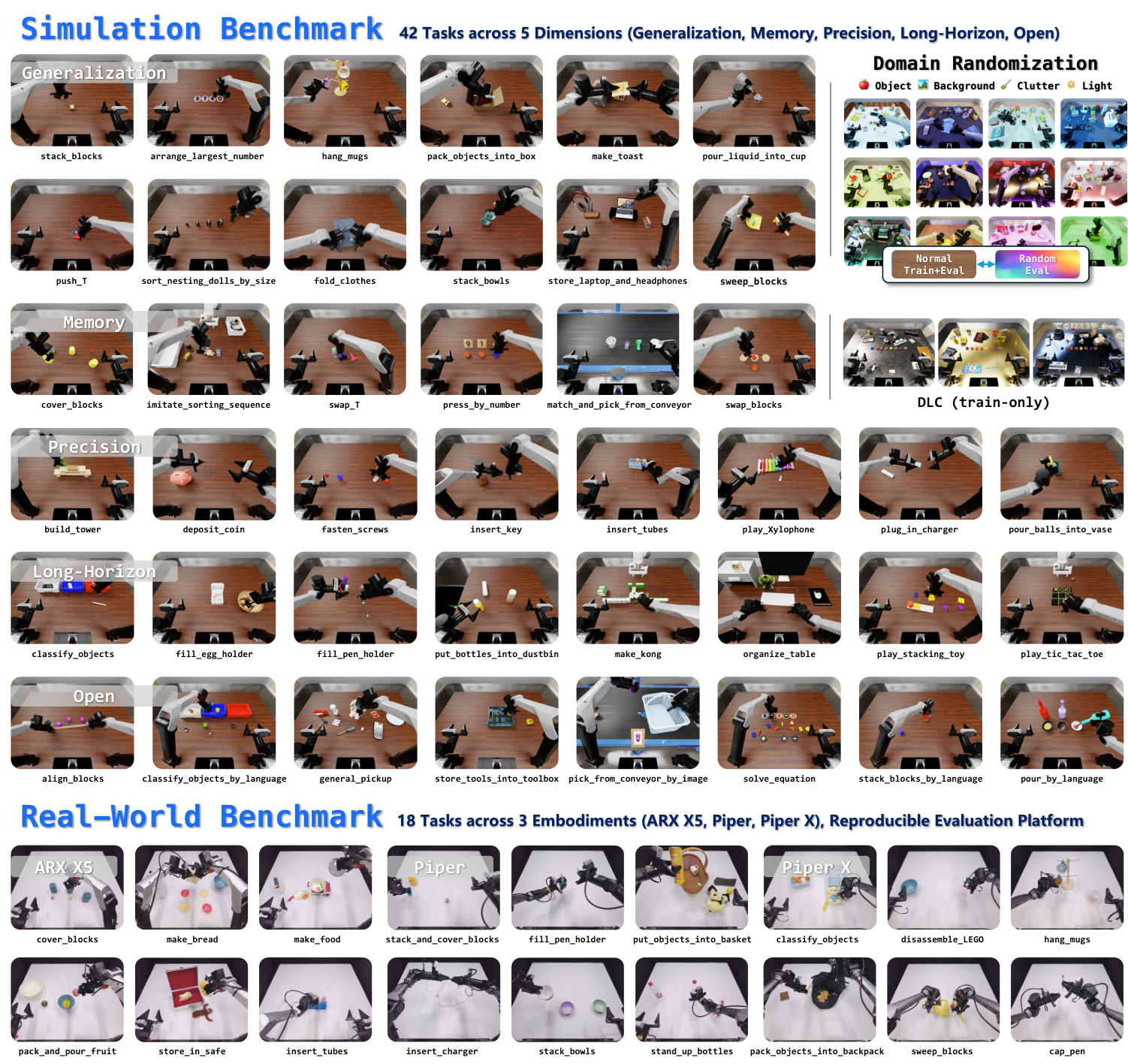
Figure 2: Task Overview of RoboDojo. RoboDojo includes 42 simulation tasks and 18 real-world tasks for evaluating generalist robot manipulation policies. The simulation tasks are organized into five capability dimensions: Generalization, Memory, Long-Horizon, Precision, and Open, enabling efficient capability-oriented diagnosis. The real-world tasks assess policy behavior under challenging and reproducible physical deployment conditions. Together, these tasks cover diverse manipulation skills, spatial configurations, and bimanual coordination patterns across simulation and the real world.
图 2:RoboDojo 任务概览。RoboDojo 包含 42 个仿真任务和 18 个真实世界任务,用于评测通用机器人操作策略。仿真任务按五个能力维度组织:泛化、记忆、长时程、精度和开放,便于高效地进行面向能力的诊断。真实世界任务评估策略在有挑战且可复现的物理部署条件下的行为。这些任务合在一起,覆盖了仿真和真实世界中多样的操作技能、空间配置和双臂协调模式。
3.1. Simulation Benchmark
3.1. 仿真基准
We design 42 simulation tasks on the ARX X5 bimanual platform, with the two arm bases separated by 0.6 m. These tasks are organized into five capability dimensions: Generalization, Memory, Long-Horizon, Precision, and Open. The simulation benchmark is designed to provide rapid policy feedback and capability-oriented diagnosis beyond repeated variations of a narrow skill set. Together with the heterogeneous parallel simulation described in Section 4.1.3, RoboDojo enables efficient model iteration across diverse task structures and manipulation requirements. An overview of all simulation tasks is shown in Fig. 2. Detailed task definitions and visualizations are provided in Appendix I and the project documentation.
我们在 ARX X5 双臂平台上设计了 42 个仿真任务,两个机械臂基座相距 0.6 m。这些任务按五个能力维度组织:泛化、记忆、长时程、精度和开放。仿真基准旨在提供快速的策略反馈和面向能力的诊断,而不只是对一小组技能做重复变化。结合第 4.1.3 节所述的异构并行仿真,RoboDojo 能在多样的任务结构和操作要求上进行高效的模型迭代。全部仿真任务的概览见图 2。详细的任务定义和可视化见附录 I 及项目文档。
Generalization.
Robust deployment requires policies to complete the same task across diverse environments, rather than relying on fixed scenes or familiar visual contexts. The Generalization dimension includes 12 tasks that evaluate robustness to unseen variations in backgrounds, lighting, clutter, and target objects. Compared with RoboTwin 2.0 (Chen et al., 2025a), RoboDojo introduces stronger scene randomization and denser tabletop clutter. While RoboTwin 2.0 includes at most 10 clutter objects, RoboDojo randomizes up to 25 clutter objects, substantially increasing visual distraction and scene complexity. To further reduce overfitting to the default wooden-table scene, we provide 100 supplementary DLC trajectories for data-level augmentation. These trajectories are collected from simple pick-and-place behaviors under randomized backgrounds, lighting, and clutter layouts. Since they are independent of the evaluation tasks, they improve visual exposure without directly leaking task-specific solutions.
泛化。
稳健的部署要求策略能在多样的环境中完成同一任务,而不是依赖固定场景或熟悉的视觉背景。泛化维度包含 12 个任务,评测策略对背景、光照、杂物和目标物体等未见变化的稳健性。与 RoboTwin 2.0(Chen et al., 2025a)相比,RoboDojo 引入了更强的场景随机化和更密集的桌面杂物。RoboTwin 2.0 最多包含 10 个杂物,而 RoboDojo 最多随机放置 25 个杂物,大幅增加了视觉干扰和场景复杂度。为了进一步减少对默认木桌场景的过拟合,我们提供 100 条补充的 DLC 轨迹用于数据层面的增强。这些轨迹是在随机背景、光照和杂物布局下,通过简单的抓取放置行为采集的。由于它们与评测任务无关,因此能增加视觉多样性,又不会直接泄露特定任务的解法。
Memory.
Many manipulation tasks are partially observable, where the correct action depends on information observed earlier rather than only the current frame. Inspired by RMBench (Chen et al., 2026b), the Memory dimension includes 6 tasks that evaluate long-context observation modeling, key-frame memory, and non-Markovian decision making. These tasks cover both short-history settings, where a few key observations are sufficient for task completion, and longer interactive settings that require reasoning over multi-frame temporal sequences. For example, in match_and_pick_from_conveyor, the policy must remember the category of an object that disappears on the conveyor and later pick a matching object from subsequent candidates. In imitate_sorting_sequence, the policy observes another robot arm placing objects into a basket in a specific order, and must remember and reproduce the demonstrated ordering. These settings challenge policies that rely only on the current observation or a short fixed-length history.
记忆。
许多操作任务是部分可观测的,正确的动作取决于先前观察到的信息,而不只是当前帧。受 RMBench(Chen et al., 2026b)启发,记忆维度包含 6 个任务,评测长上下文观测建模、关键帧记忆和非马尔可夫决策。这些任务既包括短历史设置(只需少量关键观测即可完成任务),也包括需要对多帧时间序列进行推理的较长交互设置。例如,在 match_and_pick_from_conveyor 中,策略必须记住传送带上消失的一个物体的类别,随后从后续的候选物体中挑出与之匹配的物体。在 imitate_sorting_sequence 中,策略观察另一只机械臂按特定顺序把物体放进篮子,必须记住并复现所示范的顺序。这些设置对只依赖当前观测或固定长度短历史的策略构成挑战。
Long-Horizon.
Practical manipulation often requires executing a sequence of dependent steps before reaching the final goal. The Long-Horizon dimension includes 8 tasks that evaluate whether policies can infer task structure, maintain progress, and complete all required sub-steps without early termination or accumulated errors. For example, classify_objects requires the robot to sort multiple objects into corresponding target locations. Due to the relatively large workspace, the task may also require handover behaviors between the two arms, resulting in longer execution horizons and increased temporal complexity.
长时程。
实际的操作往往需要先执行一系列相互依赖的步骤,才能达到最终目标。长时程维度包含 8 个任务,评测策略能否推断任务结构、保持进度,并完成所有必需的子步骤,而不会提前终止或累积误差。例如,classify_objects 要求机器人把多个物体分拣到对应的目标位置。由于工作空间相对较大,该任务可能还需要两臂之间的交接动作,从而导致更长的执行时程和更高的时间复杂度。
Precision.
Fine-grained manipulation requires accurate visual grounding, smooth motion prediction, and stable local control, since small spatial errors can directly lead to failure. The Precision dimension includes 8 tasks with strict spatial and motion accuracy requirements, focusing on fine-grained target localization, trajectory smoothness, and contact-rich control stability. For example, in insert_tubes, the policy must continuously insert tubes into narrow holes. Even small localization or trajectory errors can prevent successful insertion, making this dimension particularly sensitive to action accuracy and motion stability.
精度。
精细操作需要准确的视觉定位、平滑的运动预测和稳定的局部控制,因为微小的空间误差就可能直接导致失败。精度维度包含 8 个对空间和运动精度有严格要求的任务,侧重精细的目标定位、轨迹平滑度和富接触控制的稳定性。例如,在 insert_tubes 中,策略必须连续把管子插入狭窄的孔中。即使很小的定位或轨迹误差也可能导致插入失败,因此这一维度对动作精度和运动稳定性尤为敏感。
Open.
Generalist robot policies should understand diverse task specifications and transfer learned skills to new goals. The Open dimension includes 8 tasks that evaluate unseen task specifications whose required skills appear in the training data under different contexts. These tasks test open-semantic grounding, skill recombination, and language-conditioned transfer. For example, general_pickup requires object grasping, a skill frequently observed during training, while the specific grasping goal is not directly included in the training tasks. This dimension examines whether policies can recombine learned manipulation skills and ground new language instructions to solve previously unseen tasks.
开放。
通用机器人策略应当理解多样的任务规格,并把学到的技能迁移到新目标上。开放维度包含 8 个任务,评测未见过的任务规格,这些任务所需的技能在训练数据中以不同的上下文出现过。这些任务检验开放语义理解、技能重组和语言条件下的迁移。例如,general_pickup 需要抓取物体,这是训练中经常出现的技能,但具体的抓取目标并未直接包含在训练任务中。这一维度检验策略能否重组已学到的操作技能,并把新的语言指令落实到具体操作上,从而解决此前未见过的任务。
3.1.2. Training Data Setting
For simulation policy training, we provide 35 task directories with 3,500 trajectories, totaling 1,859,602 frames and 20.66 hours of bimanual manipulation data recorded at 25 Hz. These directories include 34 training tasks from the Generalization, Memory, Long-Horizon, and Precision dimensions, together with one auxiliary DLC data directory. Each training task contains 100 trajectories collected through either automated trajectory synthesis or VR-based teleoperation. The Open dimension is excluded from the training set, as it is designed to evaluate skill recombination and transfer to unseen task specifications rather than imitation of task-specific demonstrations.
3.1.2. 训练数据设置
为了训练仿真策略,我们提供 35 个任务目录,共 3,500 条轨迹,总计 1,859,602 帧、20.66 小时的双臂操作数据,以 25 Hz 录制。这些目录包括来自泛化、记忆、长时程和精度维度的 34 个训练任务,以及一个辅助 DLC 数据目录。每个训练任务包含 100 条轨迹,通过自动轨迹合成或基于 VR 的遥操作采集。开放维度不包含在训练集中,因为它旨在评测技能重组以及向未见任务规格的迁移,而不是对特定任务示范的模仿。
For the Generalization dimension, demonstrations are collected under the standard setting without domain randomization. To reduce overfitting to a single visual configuration, we additionally include 100 auxiliary DLC trajectories for data-level augmentation. These trajectories are generated under complex domain randomization, including diverse backgrounds, lighting conditions, and clutter layouts. The auxiliary DLC data broadens visual exposure while remaining independent of the evaluation tasks, avoiding direct leakage of task-specific solutions. Detailed data modalities, collection procedures, and statistics are provided in Appendix D.1.
对于泛化维度,示范是在无领域随机化的标准设置下采集的。为了减少对单一视觉配置的过拟合,我们另外加入 100 条辅助 DLC 轨迹用于数据层面的增强。这些轨迹是在复杂的领域随机化下生成的,包括多样的背景、光照条件和杂物布局。辅助 DLC 数据扩大了视觉多样性,同时与评测任务无关,避免直接泄露特定任务的解法。详细的数据模态、采集流程和统计信息见附录 D.1。
3.1.3. Evaluation Setting
We evaluate policies on all 42 simulation tasks across five capability dimensions: Generalization, Memory, Long-Horizon, Precision, and Open. Each task is evaluated for 50 episodes, resulting in 2,100 episodes in total. We report both success rate and average score: success rate measures binary task completion, while average score captures partial task progress.
3.1.3. 评测设置
我们在全部 42 个仿真任务上、跨越泛化、记忆、长时程、精度和开放五个能力维度评测策略。每个任务评测 50 个回合,共计 2,100 个回合。我们同时报告成功率和平均得分:成功率衡量二值的任务完成情况,平均得分反映任务的部分进度。
For the 12 Generalization tasks, the 50 episodes are split into 25 standard episodes and 25 random episodes. The standard setting evaluates in-domain performance, whereas the random setting introduces variations in backgrounds, clutter layouts, task-relevant objects, and lighting conditions to assess robustness under visual and scene-level distribution shifts. The overall performance is computed as the mean across the five capability dimensions, rather than across all tasks, preventing dimensions with more tasks from dominating the aggregate metric. Additional details on task horizons and episode settings are provided in Appendix D.2.
对于 12 个泛化任务,50 个回合分为 25 个标准回合和 25 个随机回合。标准设置评测域内性能,随机设置则引入背景、杂物布局、任务相关物体和光照条件的变化,评估在视觉和场景层面分布偏移下的稳健性。总体性能按五个能力维度的平均值计算,而不是按全部任务平均,以免任务较多的维度主导总体指标。关于任务时程和回合设置的更多细节见附录 D.2。
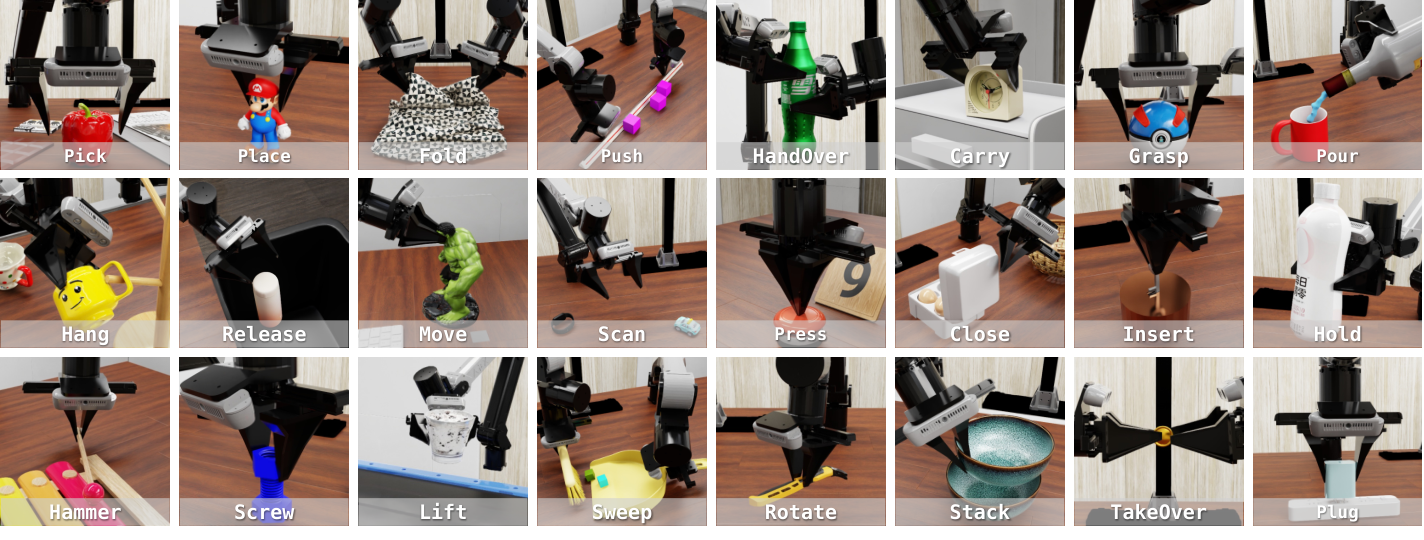
Figure 3: Skill Diversity in RoboDojo. Representative simulation tasks cover 24 manipulation skills, including grasping, placing, pushing, pulling, stacking, insertion, opening, closing, folding, alignment, tool use, and contact-sensitive operations. These tasks span diverse spatial configurations and bimanual coordination patterns, enabling skill-level diagnosis beyond repetitive pick-and-place behaviors.
图 3:RoboDojo 中的技能多样性。代表性的仿真任务涵盖 24 种操作技能,包括抓取、放置、推、拉、堆叠、插入、打开、关闭、折叠、对齐、使用工具以及对接触敏感的操作。这些任务覆盖多样的空间配置和双臂协调模式,使诊断可以细到技能层面,而不局限于重复的抓取放置行为。
3.2. Real-World Benchmark
3.2. 真实世界基准
To evaluate policy performance under physical deployment conditions, we construct the RoboDojo Real-World Benchmark. The benchmark consists of 18 real-world tasks across three commonly used collaborative bimanual robot platforms: ARX X5, Piper, and Piper X. This multi-embodiment design evaluates whether policies can maintain reliable performance across different robot kinematics, workspaces, camera placements, and data distributions, rather than being specialized to a single platform.
为了评测策略在物理部署条件下的性能,我们构建了 RoboDojo 真实世界基准。该基准由 18 个真实世界任务组成,分布在三种常用的协作式双臂机器人平台上:ARX X5、Piper 和 Piper X。这种多本体设计评测策略能否在不同的机器人运动学、工作空间、相机位置和数据分布上保持可靠的性能,而不是只针对单一平台。
Unlike simulation tasks, which support rapid feedback and capability-oriented diagnosis, the real-world benchmark exposes policies to deployment challenges that are difficult to fully capture in simulation, including contact-rich interactions, perception noise, actuation errors, workspace constraints, and temporal variations. As described in Section 4.2, we open-source the hardware setup and evaluation specifications of RoboDojo-RealEval to support reproducible deployment. RoboDojo-RealEval standardizes the hardware configuration, workspace layout, lighting condition, scene reset procedure, evaluation protocol, and deployment interface, enabling policies to be tested under consistent physical conditions. We further provide cloud-based remote evaluation, allowing users to submit policies and evaluate them under shared physical test configurations. Detailed task information is provided in Appendix J and the project documentation.
仿真任务支持快速反馈和面向能力的诊断;与之不同,真实世界基准让策略面对难以在仿真中完全捕捉的部署挑战,包括富接触交互、感知噪声、执行误差、工作空间约束和时间上的变化。如第 4.2 节所述,我们开源了 RoboDojo-RealEval 的硬件配置和评测规范,以支持可复现的部署。RoboDojo-RealEval 对硬件配置、工作空间布局、光照条件、场景复位流程、评测协议和部署接口进行了标准化,使策略能在一致的物理条件下接受测试。我们还提供基于云的远程评测,让用户提交策略,并在共享的物理测试配置下评测。详细的任务信息见附录 J 及项目文档。

Figure 4: Real-World Task Highlights. Representative key frames of challenging real-world manipulation tasks across different robot embodiments.
图 4:真实世界任务亮点。不同机器人本体上有挑战的真实世界操作任务的代表性关键帧。
3.2.1. Task Design
We design 6 tasks for each embodiment, resulting in 18 real-world tasks in total. Since real-world evaluation is constrained by hardware cost, execution time, human reset effort, and safety considerations, the benchmark is designed as a compact yet challenging physical test suite rather than an exhaustive enumeration of all capability dimensions. The selected tasks cover representative requirements, including long-horizon execution, precise manipulation, memory, and generalization.
3.2.1. 任务设计
我们为每种本体设计 6 个任务,共计 18 个真实世界任务。由于真实世界评测受硬件成本、执行时间、人工复位工作量和安全考虑的限制,该基准被设计成一套紧凑而有挑战的物理测试套件,而不是对所有能力维度的穷举。所选任务涵盖有代表性的要求,包括长时程执行、精确操作、记忆和泛化。
Importantly, we do not construct one-to-one aligned task pairs between simulation and the real world. The real-world benchmark is not intended to measure direct sim-to-real transfer on matched tasks. Instead, it serves as a complementary evaluation setting for testing whether policies can handle physical deployment challenges beyond simulation success. The tasks involve contact-rich interactions, fine-grained spatial alignment, multi-object manipulation, partial observability, and embodiment-specific motion constraints, making evaluation sensitive to perception errors, actuation noise, accumulated trajectory drift, and unstable contact dynamics.
重要的是,我们没有在仿真和真实世界之间构建一一对应的任务对。真实世界基准并不打算在匹配的任务上衡量直接的仿真到真实迁移。相反,它是一个补充性的评测设置,用来检验策略能否应对仿真成功之外的物理部署挑战。这些任务涉及富接触交互、精细的空间对齐、多物体操作、部分可观测性以及特定于本体的运动约束,使评测对感知误差、执行噪声、累积的轨迹漂移和不稳定的接触动力学都很敏感。
By evaluating policies across ARX X5, Piper, and Piper X under a shared protocol, RoboDojo assesses whether current generalist manipulation policies can operate reliably across diverse real-world deployment conditions. Detailed task specifications are provided in Appendix J.
通过在共享协议下在 ARX X5、Piper 和 Piper X 上评测策略,RoboDojo 评估当前的通用操作策略能否在多样的真实世界部署条件下可靠运行。详细的任务规格见附录 J。
3.2.2. Training Data Setting
We collect real-world demonstrations using a homogeneous leader-follower teleoperation setup, where the leader arm has the same embodiment as the follower robot. This design aligns the teleoperation command space with the deployed robot embodiment, providing stable demonstrations for policy training. For each task, we collect 100 demonstrations from four operators to increase behavior diversity and reduce operator-specific bias. Across three embodiments and 18 tasks, the dataset contains 1,800 trajectories and 1,611,841 frames, corresponding to 17.91 hours of bimanual manipulation data recorded at 25 Hz.
3.2.2. 训练数据设置
我们用同构的主从遥操作装置采集真实世界示范,即主臂与从动机器人具有相同的本体。这种设计使遥操作的指令空间与部署的机器人本体一致,为策略训练提供稳定的示范。每个任务由四名操作员采集 100 条示范,以增加行为多样性、减少特定操作员带来的偏差。在三种本体和 18 个任务上,数据集共包含 1,800 条轨迹、1,611,841 帧,对应 17.91 小时以 25 Hz 录制的双臂操作数据。
Each demonstration includes robot states, language annotations, and synchronized RGB observations from one head camera and two wrist cameras. After collection, all trajectories are manually inspected for task completion, demonstration quality, and consistency with the RoboDojo-RealEval reset protocol. Detailed data modalities, filtering criteria, and embodiment-wise statistics are provided in Appendix E.1.
每条示范包括机器人状态、语言标注,以及来自一个头部相机和两个腕部相机的同步 RGB 观测。采集完成后,所有轨迹都经过人工检查,确认任务是否完成、示范质量如何,以及是否符合 RoboDojo-RealEval 的复位协议。详细的数据模态、筛选标准和分本体统计见附录 E.1。
3.2.3. Evaluation Setting
For real-world evaluation, we use the RoboDojo-RealEval platform introduced in Section 4.2. RoboDojo-RealEval supports both local deployment and remote cloud-based evaluation, where policies communicate with the real-robot client through the protocol described in Section H. For each task, each policy is evaluated over 10 trials. Before each trial, a pre-collected evaluation layout is replayed to ensure consistent initial conditions across policies and sessions.
3.2.3. 评测设置
真实世界评测使用第 4.2 节介绍的 RoboDojo-RealEval 平台。RoboDojo-RealEval 既支持本地部署,也支持基于云的远程评测,策略通过第 H 节所述的协议与真实机器人客户端通信。每个任务上,每个策略评测 10 次试验。每次试验之前,都会重放一个预先采集的评测布局,以保证不同策略和不同会话之间的初始条件一致。
All trials are recorded and independently scored by three evaluators under a double-blind protocol. The scoring accounts for both final task success and intermediate sub-step completion, enabling fine-grained assessment of partial progress. The final score of each trial is computed as the average of the three evaluator scores. To improve transparency and fairness, we release evaluation videos and scores for leaderboard submissions, and provide an appeal mechanism for potential scoring errors. Additional details on motion planning, execution horizons, safety termination, and scoring protocols are provided in Appendix E.2.
所有试验都被录像,并由三名评测者在双盲协议下独立打分。评分同时考虑最终的任务成功和中间子步骤的完成情况,从而能细致评估部分进度。每次试验的最终得分取三名评测者得分的平均值。为了提高透明度和公平性,我们公开排行榜提交的评测视频和得分,并为可能的评分错误提供申诉机制。关于运动规划、执行时程、安全终止和评分协议的更多细节见附录 E.2。
3.3. Evaluation Integrity and Anti-Gaming Protocols
3.3. 评测完整性与防刷榜协议
Although RoboDojo open-sources the simulation benchmark and the structural design of the real-world evaluation platform, official leaderboard publication requires a standardized verification protocol to ensure fairness, reproducibility, and community supervision. RoboDojo uses released public layouts as the primary leaderboard evaluation settings, allowing users to inspect task layouts, reproduce evaluations, and compare methods under a shared protocol. To reduce overfitting, hand-tuning, and leaderboard gaming on public layouts, submitted models are additionally evaluated on hidden verification layouts during official evaluation. These hidden layouts serve as an auxiliary consistency check rather than the primary leaderboard test set.
尽管 RoboDojo 开源了仿真基准和真实世界评测平台的结构设计,但正式的排行榜发布需要一套标准化的验证协议,以保证公平性、可复现性和社区监督。RoboDojo 使用已公开发布的布局作为排行榜评测的主要设置,让用户可以检查任务布局、复现评测,并在共享协议下比较方法。为了减少在公开布局上的过拟合、手工调参和刷榜行为,提交的模型在正式评测时还会在隐藏的验证布局上接受额外评测。这些隐藏布局作为辅助的一致性检查,而不是排行榜的主要测试集。
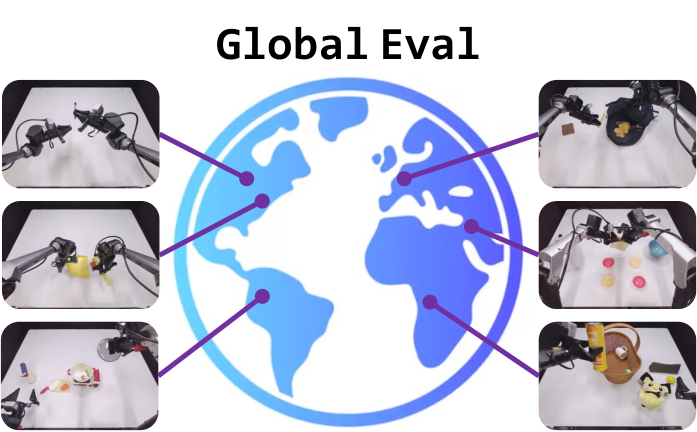
Figure 5: RoboDojo official evaluation is jointly supported by global academic institutional partners, with no commercial participation.
图 5:RoboDojo 的正式评测由全球学术机构合作伙伴共同支持,没有商业机构参与。
RoboDojo supports remote evaluation without requiring participants to release checkpoints or source code during private development. Participants can run a remote policy server and communicate with the official RoboDojo evaluation client through the standardized deployment protocol. To publish results on the official verified leaderboard, each submission must satisfy the following requirements: (1) policies are evaluated through the official RoboDojo online evaluation system; (2) simulation results are reported over three random seeds with mean and standard deviation, and real-world results cover all three robot embodiments, including ARX X5, Piper, and Piper X; (3) submitted models pass hidden-layout verification; (4) the evaluated checkpoint, training and deployment code, configuration files, and reproducibility instructions are released through XPolicyLab at the leaderboard publication stage; and (5) evaluation videos are released for community inspection.
RoboDojo 支持远程评测,参与者在私下开发期间无需公开检查点或源代码。参与者可以运行一个远程策略服务器,通过标准化的部署协议与官方的 RoboDojo 评测客户端通信。要在官方验证排行榜上发布结果,每份提交都必须满足以下要求:(1) 策略通过官方的 RoboDojo 在线评测系统进行评测;(2) 仿真结果需报告三个随机种子的均值和标准差,真实世界结果需覆盖全部三种机器人本体,即 ARX X5、Piper 和 Piper X;(3) 提交的模型通过隐藏布局验证;(4) 在排行榜发布阶段,通过 XPolicyLab 公开被评测的检查点、训练和部署代码、配置文件以及复现说明;(5) 公开评测视频供社区检查。
Participants may still use RoboDojo for private evaluation and iteration without releasing code or checkpoints. However, results without the evaluated checkpoint, implementation, configuration files, and reproducibility instructions are reported separately and are not considered verified leaderboard entries. In this way, RoboDojo balances flexible remote development with a verified publication protocol that emphasizes reproducible policy performance rather than hand-tuned results on specific released layouts. Additional details of the verification and publication protocol are provided in Appendix A.2.
参与者仍然可以在不公开代码或检查点的情况下,用 RoboDojo 进行私下评测和迭代。但缺少被评测检查点、实现、配置文件和复现说明的结果会单独报告,不算作经过验证的排行榜条目。通过这种方式,RoboDojo 在灵活的远程开发与经过验证的发布协议之间取得平衡,强调可复现的策略性能,而不是在特定公开布局上手工调出来的结果。验证和发布协议的更多细节见附录 A.2。
4. Technical Implementation
4. 技术实现
In this section, we present the technical design of the RoboDojo evaluation platform. RoboDojo comprises three main components: a simulation evaluation platform, a real-world evaluation platform, and XPolicyLab, a unified infrastructure for policy development and deployment. The simulation platform supports diverse task construction, digital-twin asset generation, heterogeneous parallel evaluation, and simulation data collection, enabling rapid feedback and efficient policy iteration across manipulation capabilities. The real-world platform, RoboDojo-RealEval, enables reproducible physical evaluation by standardizing the hardware configuration, workspace layout, lighting condition, scene reset procedure, evaluation protocol, and deployment interface. XPolicyLab defines a shared policy interface for observation updates, action prediction, policy reset, and batched policy queries, allowing different robot manipulation policies to be integrated into a common codebase and evaluated under a unified protocol. Together, these components enable policies to be integrated once, iterated efficiently in simulation, and deployed to standardized real-world evaluation with minimal policy-side adaptation.
本节介绍 RoboDojo 评测平台的技术设计。RoboDojo 由三个主要组件构成:仿真评测平台、真实世界评测平台,以及统一的策略开发和部署基础设施 XPolicyLab。仿真平台支持多样的任务构建、数字孪生资产生成、异构并行评测和仿真数据采集,能在各项操作能力上提供快速反馈和高效的策略迭代。真实世界平台 RoboDojo-RealEval 通过标准化硬件配置、工作空间布局、光照条件、场景复位流程、评测协议和部署接口,实现可复现的物理评测。XPolicyLab 为观测更新、动作预测、策略重置和批量策略查询定义了共享的策略接口,使不同的机器人操作策略能整合进同一代码库,并在统一协议下评测。这些组件合在一起,使策略只需接入一次,就能在仿真中高效迭代,并以极少的策略侧适配部署到标准化的真实世界评测中。
4.1. Simulation Platform
4.1. 仿真平台
To support efficient and reproducible evaluation of generalist manipulation policies, RoboDojo builds a configurable simulation platform based on NVIDIA Isaac Sim (NVIDIA, 2025) and Isaac Lab (Mittal et al., 2025). The platform comprises three main components: a configuration-driven simulation stack, a physically grounded digital asset library, and a heterogeneous parallel execution mechanism. Together, these components support diverse task construction, scalable policy evaluation, and efficient demonstration collection. Additional implementation details are provided in Appendix F.1.
为了支持对通用操作策略进行高效、可复现的评测,RoboDojo 基于 NVIDIA Isaac Sim(NVIDIA, 2025)和 Isaac Lab(Mittal et al., 2025)构建了一个可配置的仿真平台。该平台由三个主要组件组成:配置驱动的仿真栈、有物理依据的数字资产库,以及异构并行执行机制。这些组件合在一起,支持多样的任务构建、可扩展的策略评测和高效的示范采集。更多实现细节见附录 F.1。
4.1.1. Simulation Platform Setup
RoboDojo uses the vectorized execution interface of Isaac Lab (Mittal et al., 2025) as the simulation backend, and builds its simulation stack on the infrastructure of MagicSim (Lu et al., 2026), inheriting its modular manager architecture, configuration-driven scene construction pipeline, and object simulation backend. Each task is instantiated from modular YAML specifications that define task assets, scene layouts, initialization distributions, randomization ranges, and success conditions. This design decouples task specification from simulator execution, allowing different tasks to share the same runtime while varying task-specific objects, scene layouts, and reset distributions, details can be found in F.
4.1.1. 仿真平台搭建
RoboDojo 使用 Isaac Lab(Mittal et al., 2025)的向量化执行接口作为仿真后端,并在 MagicSim(Lu et al., 2026)的基础设施之上构建仿真栈,继承了其模块化的管理器架构、配置驱动的场景构建流程和物体仿真后端。每个任务都由模块化的 YAML 规格实例化,这些规格定义了任务资产、场景布局、初始化分布、随机化范围和成功条件。这种设计把任务规格与模拟器执行解耦,让不同任务共享同一运行时,同时改变特定于任务的物体、场景布局和复位分布,详见 F。
At reset time, RoboDojo samples task-relevant objects, object poses, articulation states, clutter layouts, lighting conditions, and background textures with deterministic seed control. This enables diverse yet reproducible scene instances for both training and evaluation. The same scene construction pipeline supports rigid, articulated, and deformable assets through a unified interface. Details of the configuration format, randomization parameters, and scene construction pipeline are provided in Appendix F.2.
在复位时,RoboDojo 在确定性的种子控制下采样任务相关物体、物体位姿、关节状态、杂物布局、光照条件和背景纹理。这使训练和评测都能得到多样而可复现的场景实例。同一场景构建流程通过统一接口支持刚体、铰接和可变形资产。配置格式、随机化参数和场景构建流程的细节见附录 F.2。
4.1.2. Physically Grounded Digital Asset Library
RoboDojo builds a digital asset library containing rigid, articulated, and deformable objects. These assets are used as both task-relevant objects and clutter distractors across simulation tasks, enabling diverse scene instantiations while maintaining reliable physical behavior for contact-rich manipulation, inspired by ManiTwin (Wang et al., 2026b). Rigid objects are collected from online repositories and reconstructed from real-world daily objects using Meshy AI¹. Each asset is annotated with semantic and task-level metadata, including object categories, language descriptions, placement regions, success-checking annotations, and manipulation affordances.
4.1.2. 有物理依据的数字资产库
RoboDojo 构建了一个包含刚体、铰接和可变形物体的数字资产库。受 ManiTwin(Wang et al., 2026b)启发,这些资产在各个仿真任务中既用作任务相关物体,也用作杂物干扰物,使场景实例化多样化,同时在富接触操作中保持可靠的物理行为。刚体物体从在线资源库收集,或用 Meshy AI¹ 根据真实世界的日常物品重建。每个资产都标注了语义和任务层面的元数据,包括物体类别、语言描述、放置区域、成功判定标注和操作可供性。
Articulated and deformable assets are collected from open-source platforms, 3D scanning, and selected assets from ClothesNet (Zhou et al., 2023). Before being used in RoboDojo tasks, these assets are standardized in terms of kinematic structure, collision geometry, material parameters, and simulation-ready representations. Details on asset processing, annotation, and physical validation are provided in Appendix F.3.
铰接和可变形资产收集自开源平台、3D 扫描,以及从 ClothesNet(Zhou et al., 2023)中挑选的资产。在用于 RoboDojo 任务之前,这些资产在运动学结构、碰撞几何、材质参数和可直接仿真的表示方面都经过标准化。资产处理、标注和物理验证的细节见附录 F.3。
(a) Asset library. Sample rigid, articulated, and deformable assets.
(a) 资产库。刚体、铰接和可变形资产示例。
(译注:HTML 版本中此处只有子图 (a) 的说明,未见图 6 的总图注,照录。)
4.1.3. Heterogeneous Parallelism
Efficient benchmark evaluation requires parallel simulation over diverse scenes. Standard vectorized simulation often relies on homogeneous cloned environments, where parallel instances share the same scene template and differ mainly in poses or random seeds. While efficient, this setting is insufficient for evaluating generalist manipulation policies, which should be tested across diverse object geometries, object counts, clutter layouts, articulated structures, and background conditions.
4.1.3. 异构并行
高效的基准评测需要在多样的场景上并行仿真。标准的向量化仿真通常依赖同构的克隆环境,各并行实例共享同一场景模板,主要只在位姿或随机种子上有所不同。这种设置虽然高效,却不足以评测通用操作策略,因为这类策略应该在多样的物体几何形状、物体数量、杂物布局、铰接结构和背景条件下接受测试。
RoboDojo therefore supports heterogeneous parallel simulation. Multiple environments are stepped under a shared vectorized interface, while each environment maintains an independently sampled scene configuration. Different parallel environments can contain different object categories, asset geometries, numbers of distractors, articulation structures, and task layouts. This design improves evaluation speed while preserving the scene-level diversity required for robust policy assessment. Implementation details of heterogeneous parallelism and multi-GPU sharding are provided in Appendix F.4.
因此,RoboDojo 支持异构并行仿真。多个环境在共享的向量化接口下步进,而每个环境保持独立采样的场景配置。不同的并行环境可以包含不同的物体类别、资产几何形状、干扰物数量、铰接结构和任务布局。这种设计在提高评测速度的同时,保留了稳健评估策略所需的场景级多样性。异构并行和多 GPU 分片的实现细节见附录 F.4。
4.1.4. Simulation Data Collection
RoboDojo supports two complementary data collection modes: automated trajectory synthesis and VR-based teleoperation. Both modes use a shared asset annotation layer that specifies manipulation-related affordances and task semantics, including graspable regions, placement regions, functional parts, and task-specific interaction points. These annotations support automated skill grounding and task validation.
4.1.4. 仿真数据采集
RoboDojo 支持两种互补的数据采集模式:自动轨迹合成和基于 VR 的遥操作。两种模式都使用一个共享的资产标注层,规定与操作相关的可供性和任务语义,包括可抓取区域、放置区域、功能部件和特定于任务的交互点。这些标注支持自动的技能落地和任务验证。
For automated synthesis, RoboDojo composes demonstrations from reusable low-level skills, such as grasp, place, handover, insert, open, close, stack, and push_up. Each skill is grounded in asset annotations and executed with the cuRobo v2 motion planner (Sundaralingam et al., 2026). For tasks that are difficult to synthesize automatically, RoboDojo provides a VR-based teleoperation interface for collecting high-quality demonstrations. Details on skill composition, motion planning, and teleoperation control are provided in Appendix F.5.
在自动合成方面,RoboDojo 由可复用的底层技能组合出示范,例如 grasp、place、handover、insert、open、close、stack 和 push_up。每项技能都以资产标注为依据,并用 cuRobo v2 运动规划器(Sundaralingam et al., 2026)执行。对于难以自动合成的任务,RoboDojo 提供基于 VR 的遥操作界面来采集高质量示范。技能组合、运动规划和遥操作控制的细节见附录 F.5。
4.2. Real-World Platform: RoboDojo-RealEval
4.2. 真实世界平台:RoboDojo-RealEval
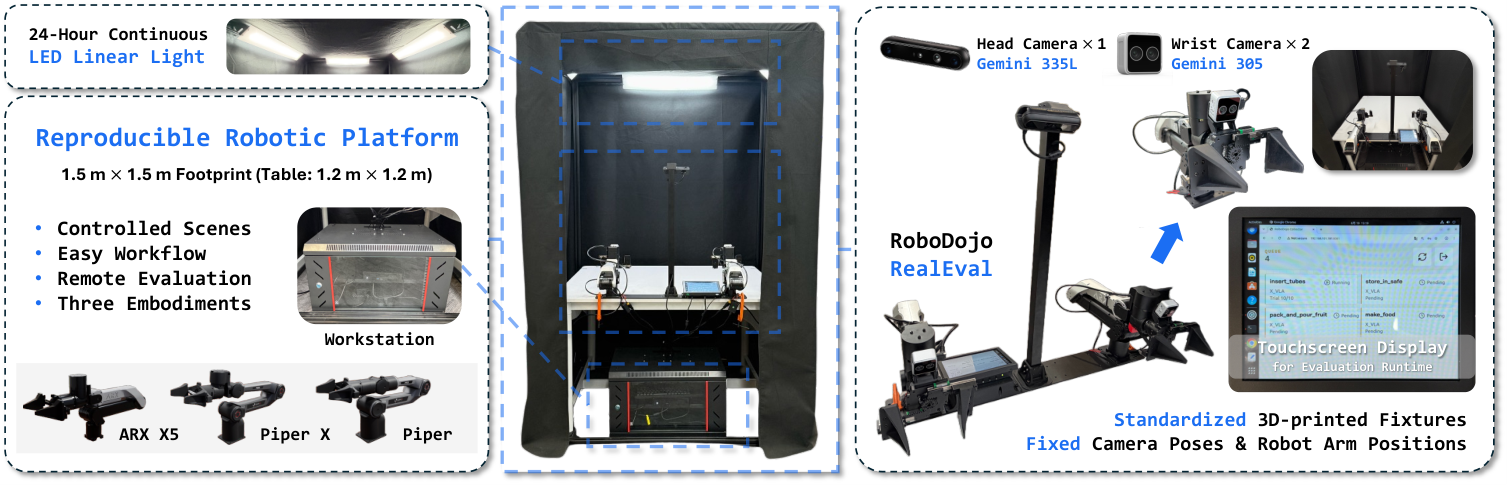
Figure 7: Overview of the RoboDojo-RealEval system. RoboDojo-RealEval provides a standardized physical platform for reproducible real-world robot manipulation evaluation, with controlled workspace geometry, fixed robot and camera mounts, stable lighting, a touchscreen evaluation interface, and support for three collaborative bimanual embodiments.
图 7:RoboDojo-RealEval 系统概览。RoboDojo-RealEval 为可复现的真实世界机器人操作评测提供了一个标准化的物理平台,具有受控的工作空间几何、固定的机器人和相机支架、稳定的光照、一个触摸屏评测界面,并支持三种协作式双臂本体。
Real-world robot evaluation is highly sensitive to incidental factors such as lighting, robot placement, camera pose, manipulation surface condition, and scene reset accuracy, making reproducibility and fairness difficult to ensure across sessions and sites. To address this issue, we develop the RoboDojo-RealEval Platform, shown in Fig. 7, as a standardized hardware and software system for reproducible real-world evaluation. RoboDojo-RealEval fixes the relative poses of robot arms, cameras, lighting units, and the manipulation workspace through modular structural components, and provides a touchscreen-based web interface for scene reset, policy execution, emergency stop, video collection, and cloud-based scoring. During evaluation, predefined task layouts are replayed through a transparent overlay between the target layout image and the live observation stream, enabling evaluators to restore consistent initial conditions before each trial. The platform supports three collaborative bimanual embodiments, including ARX X5, Piper, and Piper X, and enables both local deployment and remote cloud-based evaluation under shared physical protocols. Together, these designs reduce uncontrolled variations and provide a reproducible physical foundation for standardized real-world policy evaluation. Additional hardware details, layout replay procedures, safety controls, and scoring protocols are provided in Appendix G.
真实世界的机器人评测对光照、机器人摆放、相机位姿、操作台面状况和场景复位精度等偶然因素高度敏感,使得在不同会话和站点之间难以保证可复现性和公平性。为了解决这一问题,我们开发了 RoboDojo-RealEval 平台(见图 7),作为用于可复现真实世界评测的标准化软硬件系统。RoboDojo-RealEval 通过模块化的结构件固定机械臂、相机、照明单元和操作工作空间之间的相对位姿,并提供一个基于触摸屏的网页界面,用于场景复位、策略执行、紧急停止、视频采集和云端评分。评测时,预定义的任务布局通过目标布局图像与实时观测画面之间的半透明叠加来重放,使评测者能在每次试验前恢复一致的初始条件。该平台支持三种协作式双臂本体,即 ARX X5、Piper 和 Piper X,并支持在共享物理协议下进行本地部署和基于云的远程评测。这些设计合在一起减少了不受控的变化,为标准化的真实世界策略评测提供了可复现的物理基础。更多硬件细节、布局重放流程、安全控制和评分协议见附录 G。
4.3. XPolicyLab
4.3. XPolicyLab
XPolicyLab is a unified infrastructure and standard for robot policy development, training, evaluation, and deployment. It is designed to reduce the engineering burden of integrating heterogeneous robot policies into a shared benchmark ecosystem. Existing policies often rely on different data formats, preprocessing pipelines, training scripts, action representations, and runtime environments. XPolicyLab standardizes these external workflows through common data conversion tools, training templates, deployment procedures, and evaluation scripts, while preserving each policy’s internal architecture and implementation.
XPolicyLab 是一套用于机器人策略开发、训练、评测和部署的统一基础设施和标准。它旨在减轻把异构的机器人策略整合进共享基准生态的工程负担。现有策略往往依赖不同的数据格式、预处理流程、训练脚本、动作表示和运行环境。XPolicyLab 通过通用的数据转换工具、训练模板、部署流程和评测脚本,把这些外部工作流标准化,同时保留每个策略的内部架构和实现。
Through XPolicyLab, we integrate 30 representative robot policy models into a shared codebase, enabling consistent training, debugging, deployment, and comparison under the RoboDojo protocol. For evaluation, XPolicyLab connects policy servers with RoboDojo simulation and RoboDojo-RealEval through a standardized observation-action interface. The same policy implementation can therefore be trained and iterated in simulation with fast feedback, and then deployed to remote real-world evaluation with minimal policy-side adaptation. The unified policy interface, communication protocol, and implementation details are provided in Appendix H. The supported policies and project codebase are available at https://XPolicyLab.github.io.
通过 XPolicyLab,我们把 30 个有代表性的机器人策略模型整合进共享代码库,使它们能在 RoboDojo 协议下一致地训练、调试、部署和比较。在评测方面,XPolicyLab 通过标准化的观测-动作接口,把策略服务器与 RoboDojo 仿真和 RoboDojo-RealEval 连接起来。因此,同一份策略实现可以先在仿真中借助快速反馈进行训练和迭代,再以极少的策略侧适配部署到远程真实世界评测中。统一的策略接口、通信协议和实现细节见附录 H。支持的策略和项目代码库见 https://XPolicyLab.github.io。
5. RoboDojo Leaderboard
5. RoboDojo 排行榜
We establish RoboDojo leaderboards to provide standardized comparisons of current robot manipulation policies across both simulation and real-world settings. The simulation leaderboard evaluates broad capability coverage and supports efficient diagnosis through large-scale, repeated trials across five capability dimensions. The real-world leaderboard complements simulation by assessing policy behavior under standardized physical deployment conditions across multiple robot embodiments. Together, these leaderboards provide a unified view of policy performance, revealing both capability-level limitations in simulation and deployment-level challenges in the physical world.
我们建立 RoboDojo 排行榜,在仿真和真实世界两种设置下对当前的机器人操作策略进行标准化比较。仿真排行榜评测覆盖面广的能力,并通过在五个能力维度上大规模的重复试验支持高效诊断。真实世界排行榜是仿真的补充,在多种机器人本体上、在标准化的物理部署条件下评估策略行为。这些排行榜合在一起,提供了策略性能的统一视图,既揭示仿真中能力层面的局限,也揭示物理世界中部署层面的挑战。
5.1. Simulation Benchmark Leaderboard
5.1. 仿真基准排行榜
Using XPolicyLab, we integrate, train, and evaluate 30 representative robot manipulation policies on the RoboDojo Simulation Benchmark Leaderboard. As a human-level reference, we additionally invite three expert teleoperators to perform VR-based simulation teleoperation under the same success criteria and execution horizons used for policy evaluation. Each expert has more than 1,000 hours of simulation teleoperation experience and participated in constructing the RoboDojo Simulation Benchmark dataset.
借助 XPolicyLab,我们在 RoboDojo 仿真基准排行榜上整合、训练并评测了 30 个有代表性的机器人操作策略。作为人类水平的参照,我们还邀请三名专家遥操作员,在与策略评测相同的成功标准和执行时程下,进行基于 VR 的仿真遥操作。每位专家都有超过 1,000 小时的仿真遥操作经验,并参与了 RoboDojo 仿真基准数据集的构建。
For most policies, we train three random seeds and evaluate each seed for 50 trials per task. For the Generalization dimension, the 50 trials are split into 25 trials under the standard setting and 25 trials under the randomized setting. Unless otherwise specified, each policy is therefore evaluated over 150 trials per task across three seeds. We report the mean success rate and mean score for each capability dimension, together with their corresponding standard deviations. The overall success rate and score are computed by averaging the corresponding metrics across the five capability dimensions.
对于大多数策略,我们训练三个随机种子,每个种子在每个任务上评测 50 次试验。对于泛化维度,50 次试验分为标准设置下的 25 次和随机设置下的 25 次。因此除非另有说明,每个策略在每个任务上跨三个种子共评测 150 次试验。我们报告每个能力维度的平均成功率和平均得分,以及相应的标准差。总体成功率和得分通过对五个能力维度的相应指标取平均来计算。
The leaderboard is frozen for this paper on 3 Jul. 2026, while the latest results will be continuously updated at http://RoboDojo-Benchmark.com/Leaderboard. Detailed training configurations for all evaluated models are provided in Appendix K. Models not trained with three random seeds are specially marked in the appendix.
本文所用的排行榜冻结于 2026 年 7 月 3 日,最新结果将在 http://RoboDojo-Benchmark.com/Leaderboard 持续更新。所有被评测模型的详细训练配置见附录 K。没有用三个随机种子训练的模型在附录中特别标注。
| Alg Dim | Generalization | Precision | Long-Horizon | Memory | Open | Average |
|---|---|---|---|---|---|---|
| Hy-Embodied-0.5-VLA (Zhang et al., 2026a) | 11.77 / 8.39% | 13.81 / 8.00% | 25.74 / 14.92% | 13.37 / 12.11% | 0.65 / 0.58% | 13.07 / 8.80% |
| Spatial Forcing (Li et al., 2025a) | 14.12 / 9.33% | 17.33 / 10.58% | 23.26 / 14.58% | 5.43 / 4.11% | 1.78 / 1.58% | 12.38 / 8.04% |
| (Intelligence et al., 2025) | 13.37 / 8.17% | 12.40 / 5.50% | 23.54 / 14.67% | 5.78 / 4.56% | 1.98 / 1.67% | 11.41 / 6.91% |
| X-VLA (Zheng et al., 2025) | 10.48 / 6.78% | 18.32 / 12.00% | 16.53 / 9.75% | 4.76 / 3.56% | 0.55 / 0.50% | 10.13 / 6.52% |
| X-WAM (Guo et al., 2026) | 7.39 / 3.33% | 6.72 / 1.83% | 17.47 / 9.08% | 6.32 / 4.67% | 0.57 / 0.25% | 7.69 / 3.83% |
| Xiaomi-Robotics-0 (Cai et al., 2026c) | 7.43 / 5.56% | 8.42 / 4.58% | 13.51 / 6.92% | 5.07 / 3.67% | 0.22 / 0.17% | 6.93 / 4.18% |
| StarVLA- (Ye et al., 2026b) | 3.93 / 2.33% | 9.90 / 4.33% | 14.15 / 6.50% | 3.34 / 2.44% | 0.68 / 0.58% | 6.40 / 3.24% |
| GigaWorld-Policy (Ye et al., 2026a) | 5.34 / 2.89% | 6.15 / 1.83% | 15.51 / 8.92% | 3.46 / 2.22% | 0.54 / 0.50% | 6.20 / 3.27% |
| GalaxeaVLA (G0) (Jiang et al., 2025) | 4.53 / 2.83% | 8.10 / 3.83% | 12.60 / 5.58% | 3.17 / 1.89% | 0.70 / 0.67% | 5.82 / 2.96% |
| LingBot-VLA (Wu et al., 2026) | 6.71 / 4.28% | 5.33 / 1.83% | 10.89 / 5.25% | 3.82 / 2.78% | 0.72 / 0.67% | 5.50 / 2.96% |
| EventVLA (Yang et al., 2026a) | 3.94 / 1.94% | 10.13 / 5.75% | 5.05 / 0.83% | 4.92 / 4.78% | 0.80 / 0.75% | 4.97 / 2.81% |
| AHA-WAM (Cai et al., 2026a) | 5.79 / 3.28% | 5.86 / 2.42% | 8.61 / 2.67% | 2.97 / 2.78% | 0.88 / 0.83% | 4.82 / 2.39% |
| ABot-M0 (Yang et al., 2026c) | 5.73 / 3.50% | 5.50 / 1.75% | 3.96 / 0.50% | 2.44 / 2.22% | 0.72 / 0.67% | 3.67 / 1.73% |
| Fast-WAM (Yuan et al., 2026b) | 2.34 / 1.11% | 1.96 / 0.00% | 9.14 / 5.17% | 3.55 / 3.44% | 0.42 / 0.42% | 3.48 / 2.03% |
| (Black et al., 2024) | 3.94 / 2.56% | 3.56 / 0.75% | 6.19 / 2.00% | 3.47 / 2.11% | 0.25 / 0.25% | 3.48 / 1.53% |
| GR00T-N1.7 (Bjorck et al., 2025) | 2.16 / 1.22% | 2.54 / 0.67% | 8.30 / 3.58% | 1.06 / 0.89% | 0.18 / 0.17% | 2.85 / 1.31% |
| InternVLA-A1 (Cai et al., 2026b) | 2.87 / 1.83% | 3.00 / 0.92% | 4.79 / 1.17% | 1.58 / 1.33% | 0.17 / 0.17% | 2.48 / 1.08% |
| SmolVLA (Single Task) (Shukor et al., 2025) | 1.69 / 1.22% | 2.87 / 0.33% | 1.22 / 0.25% | 3.35 / 2.44% | 0.00 / 0.00% | 1.83 / 0.85% |
| LDA-1B (Lyu et al., 2026) | 0.71 / 0.17% | 3.21 / 0.50% | 1.92 / 0.08% | 2.08 / 1.78% | 0.00 / 0.00% | 1.58 / 0.51% |
| MolmoAct2 (Fang et al., 2026) | 0.39 / 0.06% | 0.45 / 0.00% | 2.32 / 0.00% | 1.02 / 1.00% | 0.91 / 0.83% | 1.02 / 0.38% |
| GO-1 (Bu et al., 2025) | 1.58 / 1.22% | 1.45 / 0.42% | 1.13 / 0.25% | 0.70 / 0.67% | 0.08 / 0.08% | 0.99 / 0.53% |
| ACT (Single-Task) (Zhao et al., 2023) | 0.69 / 0.56% | 0.85 / 0.00% | 1.73 / 0.92% | 1.65 / 0.13% | 0.00 / 0.00% | 0.98 / 0.32% |
| H-RDT (Bi et al., 2026b) | 0.49 / 0.22% | 0.41 / 0.00% | 2.23 / 0.17% | 0.12 / 0.11% | 0.08 / 0.08% | 0.67 / 0.12% |
| RDT-1B (Liu et al., 2025a) | 0.56 / 0.33% | 0.38 / 0.00% | 1.13 / 0.00% | 0.49 / 0.33% | 0.00 / 0.00% | 0.51 / 0.13% |
| DM0 (Yu et al., 2026a) | 0.49 / 0.06% | 0.61 / 0.00% | 0.97 / 0.08% | 0.20 / 0.11% | 0.00 / 0.00% | 0.45 / 0.05% |
| Dexora-1B (Zhang et al., 2026e) | 0.49 / 0.11% | 0.49 / 0.00% | 0.82 / 0.00% | 0.12 / 0.00% | 0.01 / 0.00% | 0.38 / 0.02% |
| A1 (Zhang et al., 2026b) | 0.16 / 0.00% | 0.09 / 0.00% | 1.07 / 0.00% | 0.00 / 0.00% | 0.08 / 0.08% | 0.28 / 0.02% |
| Spirit v1.5 (Team et al., ) | 0.80 / 0.50% | 0.03 / 0.00% | 0.11 / 0.00% | 0.22 / 0.22% | 0.00 / 0.00% | 0.23 / 0.14% |
| TinyVLA (Wen et al., 2025) | 0.03 / 0.00% | 0.05 / 0.00% | 0.67 / 0.00% | 0.11 / 0.11% | 0.25 / 0.25% | 0.22 / 0.07% |
| OpenVLA-OFT (Kim et al., 2025) | 0.04 / 0.00% | 0.20 / 0.00% | 0.70 / 0.00% | 0.00 / 0.00% | 0.08 / 0.08% | 0.21 / 0.02% |
| Human Expert (Teleop) | 90.05 / 87.83% | 68.06 / 64.00% | 83.63 / 74.25% | 75.25 / 74.33% | 85.13 / 79.75% | 80.42 / 76.03% |
Table 1: RoboDojo Simulation Benchmark Leaderboard. Each cell reports score / success rate for a capability dimension. For each metric, rankings among evaluated policies are marked as Best and Second Best. Human teleoperation is reported as a reference and is excluded from policy ranking. (3 Jul. 2026, continuously updated at RoboDojo-Benchmark.com/Leaderboard.)
| 算法 维度 | 泛化 | 精度 | 长时程 | 记忆 | 开放 | 平均 |
|---|---|---|---|---|---|---|
| Hy-Embodied-0.5-VLA (Zhang et al., 2026a) | 11.77 / 8.39% | 13.81 / 8.00% | 25.74 / 14.92% | 13.37 / 12.11% | 0.65 / 0.58% | 13.07 / 8.80% |
| Spatial Forcing (Li et al., 2025a) | 14.12 / 9.33% | 17.33 / 10.58% | 23.26 / 14.58% | 5.43 / 4.11% | 1.78 / 1.58% | 12.38 / 8.04% |
| (Intelligence et al., 2025) | 13.37 / 8.17% | 12.40 / 5.50% | 23.54 / 14.67% | 5.78 / 4.56% | 1.98 / 1.67% | 11.41 / 6.91% |
| X-VLA (Zheng et al., 2025) | 10.48 / 6.78% | 18.32 / 12.00% | 16.53 / 9.75% | 4.76 / 3.56% | 0.55 / 0.50% | 10.13 / 6.52% |
| X-WAM (Guo et al., 2026) | 7.39 / 3.33% | 6.72 / 1.83% | 17.47 / 9.08% | 6.32 / 4.67% | 0.57 / 0.25% | 7.69 / 3.83% |
| Xiaomi-Robotics-0 (Cai et al., 2026c) | 7.43 / 5.56% | 8.42 / 4.58% | 13.51 / 6.92% | 5.07 / 3.67% | 0.22 / 0.17% | 6.93 / 4.18% |
| StarVLA- (Ye et al., 2026b) | 3.93 / 2.33% | 9.90 / 4.33% | 14.15 / 6.50% | 3.34 / 2.44% | 0.68 / 0.58% | 6.40 / 3.24% |
| GigaWorld-Policy (Ye et al., 2026a) | 5.34 / 2.89% | 6.15 / 1.83% | 15.51 / 8.92% | 3.46 / 2.22% | 0.54 / 0.50% | 6.20 / 3.27% |
| GalaxeaVLA (G0) (Jiang et al., 2025) | 4.53 / 2.83% | 8.10 / 3.83% | 12.60 / 5.58% | 3.17 / 1.89% | 0.70 / 0.67% | 5.82 / 2.96% |
| LingBot-VLA (Wu et al., 2026) | 6.71 / 4.28% | 5.33 / 1.83% | 10.89 / 5.25% | 3.82 / 2.78% | 0.72 / 0.67% | 5.50 / 2.96% |
| EventVLA (Yang et al., 2026a) | 3.94 / 1.94% | 10.13 / 5.75% | 5.05 / 0.83% | 4.92 / 4.78% | 0.80 / 0.75% | 4.97 / 2.81% |
| AHA-WAM (Cai et al., 2026a) | 5.79 / 3.28% | 5.86 / 2.42% | 8.61 / 2.67% | 2.97 / 2.78% | 0.88 / 0.83% | 4.82 / 2.39% |
| ABot-M0 (Yang et al., 2026c) | 5.73 / 3.50% | 5.50 / 1.75% | 3.96 / 0.50% | 2.44 / 2.22% | 0.72 / 0.67% | 3.67 / 1.73% |
| Fast-WAM (Yuan et al., 2026b) | 2.34 / 1.11% | 1.96 / 0.00% | 9.14 / 5.17% | 3.55 / 3.44% | 0.42 / 0.42% | 3.48 / 2.03% |
| (Black et al., 2024) | 3.94 / 2.56% | 3.56 / 0.75% | 6.19 / 2.00% | 3.47 / 2.11% | 0.25 / 0.25% | 3.48 / 1.53% |
| GR00T-N1.7 (Bjorck et al., 2025) | 2.16 / 1.22% | 2.54 / 0.67% | 8.30 / 3.58% | 1.06 / 0.89% | 0.18 / 0.17% | 2.85 / 1.31% |
| InternVLA-A1 (Cai et al., 2026b) | 2.87 / 1.83% | 3.00 / 0.92% | 4.79 / 1.17% | 1.58 / 1.33% | 0.17 / 0.17% | 2.48 / 1.08% |
| SmolVLA (单任务) (Shukor et al., 2025) | 1.69 / 1.22% | 2.87 / 0.33% | 1.22 / 0.25% | 3.35 / 2.44% | 0.00 / 0.00% | 1.83 / 0.85% |
| LDA-1B (Lyu et al., 2026) | 0.71 / 0.17% | 3.21 / 0.50% | 1.92 / 0.08% | 2.08 / 1.78% | 0.00 / 0.00% | 1.58 / 0.51% |
| MolmoAct2 (Fang et al., 2026) | 0.39 / 0.06% | 0.45 / 0.00% | 2.32 / 0.00% | 1.02 / 1.00% | 0.91 / 0.83% | 1.02 / 0.38% |
| GO-1 (Bu et al., 2025) | 1.58 / 1.22% | 1.45 / 0.42% | 1.13 / 0.25% | 0.70 / 0.67% | 0.08 / 0.08% | 0.99 / 0.53% |
| ACT (单任务) (Zhao et al., 2023) | 0.69 / 0.56% | 0.85 / 0.00% | 1.73 / 0.92% | 1.65 / 0.13% | 0.00 / 0.00% | 0.98 / 0.32% |
| H-RDT (Bi et al., 2026b) | 0.49 / 0.22% | 0.41 / 0.00% | 2.23 / 0.17% | 0.12 / 0.11% | 0.08 / 0.08% | 0.67 / 0.12% |
| RDT-1B (Liu et al., 2025a) | 0.56 / 0.33% | 0.38 / 0.00% | 1.13 / 0.00% | 0.49 / 0.33% | 0.00 / 0.00% | 0.51 / 0.13% |
| DM0 (Yu et al., 2026a) | 0.49 / 0.06% | 0.61 / 0.00% | 0.97 / 0.08% | 0.20 / 0.11% | 0.00 / 0.00% | 0.45 / 0.05% |
| Dexora-1B (Zhang et al., 2026e) | 0.49 / 0.11% | 0.49 / 0.00% | 0.82 / 0.00% | 0.12 / 0.00% | 0.01 / 0.00% | 0.38 / 0.02% |
| A1 (Zhang et al., 2026b) | 0.16 / 0.00% | 0.09 / 0.00% | 1.07 / 0.00% | 0.00 / 0.00% | 0.08 / 0.08% | 0.28 / 0.02% |
| Spirit v1.5 (Team et al., ) | 0.80 / 0.50% | 0.03 / 0.00% | 0.11 / 0.00% | 0.22 / 0.22% | 0.00 / 0.00% | 0.23 / 0.14% |
| TinyVLA (Wen et al., 2025) | 0.03 / 0.00% | 0.05 / 0.00% | 0.67 / 0.00% | 0.11 / 0.11% | 0.25 / 0.25% | 0.22 / 0.07% |
| OpenVLA-OFT (Kim et al., 2025) | 0.04 / 0.00% | 0.20 / 0.00% | 0.70 / 0.00% | 0.00 / 0.00% | 0.08 / 0.08% | 0.21 / 0.02% |
| 人类专家(遥操作) | 90.05 / 87.83% | 68.06 / 64.00% | 83.63 / 74.25% | 75.25 / 74.33% | 85.13 / 79.75% | 80.42 / 76.03% |
表 1:RoboDojo 仿真基准排行榜。每个单元格报告某一能力维度的得分 / 成功率。对每项指标,被评测策略中的排名以 最佳 和 次佳 标出。人类遥操作仅作为参照,不参与策略排名。(2026 年 7 月 3 日,持续更新于 RoboDojo-Benchmark.com/Leaderboard。)
(译注:原表用两种样式区分“最佳”和“次佳”,转换后两者都显示为粗体。)
5.2. Real-World Benchmark Leaderboard
5.2. 真实世界基准排行榜
We evaluate 10 representative robot manipulation policies on the RoboDojo Real-World Benchmark Leaderboard. As a human-level reference, we additionally invite expert human teleoperators to perform real-world teleoperation using the same homogeneous leader-follower setup and task constraints as policy evaluation. Each teleoperator has more than 1,500 hours of real-world robot teleoperation experience and participated in collecting the RoboDojo Real-World Benchmark dataset.
我们在 RoboDojo 真实世界基准排行榜上评测了 10 个有代表性的机器人操作策略。作为人类水平的参照,我们还邀请专家遥操作员,使用与策略评测相同的同构主从装置和任务约束进行真实世界遥操作。每位遥操作员都有超过 1,500 小时的真实机器人遥操作经验,并参与了 RoboDojo 真实世界基准数据集的采集。
For each evaluated policy, we train one random seed for each robot embodiment and evaluate it on the corresponding real-world tasks. The benchmark contains 18 tasks across three embodiments, with 10 trials per task, resulting in 180 real-world evaluation trials per policy. All evaluations are conducted through the RoboDojo-RealEval platform under the standardized scene reset procedure, evaluation protocol, and deployment interface described in Section 4.2. We report both task success rate and score, and compute aggregate performance across all real-world tasks.
对每个被评测的策略,我们在每种机器人本体上训练一个随机种子,并在相应的真实世界任务上评测。该基准包含三种本体上的 18 个任务,每个任务 10 次试验,因此每个策略共有 180 次真实世界评测试验。所有评测都通过 RoboDojo-RealEval 平台、在第 4.2 节所述的标准化场景复位流程、评测协议和部署接口下进行。我们同时报告任务成功率和得分,并计算全部真实世界任务上的总体表现。
The real-world leaderboard is frozen for this paper on 3 Jul. 2026, while the latest results will be continuously updated at https://RoboDojo-Benchmark.com/Leaderboard. Detailed training configurations, hyperparameters, and policy-specific implementation details for all evaluated models are provided in Appendix K.
本文所用的真实世界排行榜冻结于 2026 年 7 月 3 日,最新结果将在 https://RoboDojo-Benchmark.com/Leaderboard 持续更新。所有被评测模型的详细训练配置、超参数和特定于策略的实现细节见附录 K。
| Policy | Embodiment | Task 1 | Task 2 | Task 3 | Task 4 | Task 5 | Task 6 | Emb. Avg. | Overall Avg. |
|---|---|---|---|---|---|---|---|---|---|
| (Intelligence et al., 2025) | ARX X5 | 24.6 / 20.0 | 1.8 / 0.0 | 25.8 / 10.0 | 47.0 / 20.0 | 40.0 / 20.0 | 26.8 / 10.0 | 27.7 / 13.3 | 22.9 / 12.8 |
| Piper | 10.0 / 10.0 | 28.0 / 0.0 | 10.0 / 10.0 | 0.0 / 0.0 | 72.0 / 60.0 | 72.0 / 50.0 | 32.0 / 21.7 | ||
| Piper X | 0.0 / 0.0 | 14.8 / 10.0 | 0.0 / 0.0 | 29.5 / 10.0 | 7.5 / 0.0 | 3.0 / 0.0 | 9.1 / 3.3 | ||
| InternVLA-A1 (Cai et al., 2026b) | ARX X5 | 0.0 / 0.0 | 0.0 / 0.0 | 0.0 / 0.0 | 0.0 / 0.0 | 48.0 / 20.0 | 12.0 / 0.0 | 10.0 / 3.3 | 12.0 / 7.2 |
| Piper | 0.0 / 0.0 | 7.3 / 0.0 | 0.0 / 0.0 | 0.0 / 0.0 | 73.0 / 70.0 | 59.0 / 40.0 | 23.2 / 18.3 | ||
| Piper X | 0.0 / 0.0 | 0.0 / 0.0 | 4.0 / 0.0 | 2.0 / 0.0 | 0.0 / 0.0 | 10.0 / 0.0 | 2.7 / 0.0 | ||
| GalaxeaVLA (G0) (Jiang et al., 2025) | ARX X5 | 1.0 / 0.0 | 0.0 / 0.0 | 3.0 / 0.0 | 6.0 / 0.0 | 0.0 / 0.0 | 10.3 / 0.0 | 3.4 / 0.0 | 9.0 / 4.4 |
| Piper | 0.0 / 0.0 | 32.7 / 10.0 | 13.3 / 10.0 | 0.0 / 0.0 | 56.0 / 50.0 | 30.0 / 10.0 | 22.0 / 13.3 | ||
| Piper X | 0.0 / 0.0 | 0.0 / 0.0 | 0.0 / 0.0 | 4.0 / 0.0 | 0.0 / 0.0 | 6.0 / 0.0 | 1.7 / 0.0 | ||
| Xiaomi-Robotics-0 (Cai et al., 2026c) | ARX X5 | 24.0 / 20.0 | 0.0 / 0.0 | 3.0 / 0.0 | 4.0 / 0.0 | 40.0 / 20.0 | 19.0 / 10.0 | 15.0 / 8.3 | 7.9 / 3.9 |
| Piper | 0.0 / 0.0 | 0.0 / 0.0 | 0.0 / 0.0 | 0.0 / 0.0 | 23.0 / 20.0 | 22.7 / 0.0 | 7.6 / 3.3 | ||
| Piper X | 0.0 / 0.0 | 0.7 / 0.0 | 4.0 / 0.0 | 0.0 / 0.0 | 0.0 / 0.0 | 2.7 / 0.0 | 1.2 / 0.0 | ||
| X-VLA (Zheng et al., 2025) | ARX X5 | 0.0 / 0.0 | 0.0 / 0.0 | 0.0 / 0.0 | 2.0 / 0.0 | 20.7 / 10.0 | 18.0 / 0.0 | 6.8 / 1.7 | 7.6 / 3.3 |
| Piper | 0.0 / 0.0 | 5.3 / 0.0 | 0.0 / 0.0 | 0.0 / 0.0 | 53.0 / 50.0 | 37.0 / 0.0 | 15.9 / 8.3 | ||
| Piper X | 0.0 / 0.0 | 0.0 / 0.0 | 0.0 / 0.0 | 0.0 / 0.0 | 0.0 / 0.0 | 0.7 / 0.0 | 0.1 / 0.0 | ||
| GR00T-N1.7 (Bjorck et al., 2025) | ARX X5 | 10.0 / 10.0 | 0.0 / 0.0 | 9.0 / 0.0 | 14.7 / 0.0 | 16.0 / 0.0 | 6.0 / 0.0 | 9.3 / 1.7 | 5.9 / 1.7 |
| Piper | 0.0 / 0.0 | 0.0 / 0.0 | 0.0 / 0.0 | 0.0 / 0.0 | 10.0 / 10.0 | 31.0 / 10.0 | 6.8 / 3.3 | ||
| Piper X | 0.0 / 0.0 | 0.0 / 0.0 | 0.0 / 0.0 | 0.0 / 0.0 | 0.0 / 0.0 | 8.7 / 0.0 | 1.4 / 0.0 | ||
| (Black et al., 2024) | ARX X5 | 9.0 / 0.0 | 0.0 / 0.0 | 3.0 / 0.0 | 18.0 / 0.0 | 0.0 / 0.0 | 18.7 / 0.0 | 8.1 / 0.0 | 5.8 / 1.7 |
| Piper | 0.0 / 0.0 | 6.0 / 0.0 | 0.0 / 0.0 | 0.0 / 0.0 | 42.0 / 30.0 | 6.0 / 0.0 | 9.0 / 5.0 | ||
| Piper X | 0.0 / 0.0 | 0.0 / 0.0 | 0.0 / 0.0 | 2.0 / 0.0 | 0.0 / 0.0 | 0.0 / 0.0 | 0.3 / 0.0 | ||
| StarVLA- (Ye et al., 2026b) | ARX X5 | 0.0 / 0.0 | 0.0 / 0.0 | 0.0 / 0.0 | 0.0 / 0.0 | 0.0 / 0.0 | 0.0 / 0.0 | 0.0 / 0.0 | 4.1 / 1.7 |
| Piper | 0.0 / 0.0 | 14.0 / 0.0 | 0.0 / 0.0 | 0.0 / 0.0 | 39.0 / 30.0 | 18.7 / 0.0 | 12.0 / 5.0 | ||
| Piper X | 0.0 / 0.0 | 2.7 / 0.0 | 0.0 / 0.0 | 0.0 / 0.0 | 0.0 / 0.0 | 0.0 / 0.0 | 0.5 / 0.0 | ||
| Spirit v1.5 (Team et al., ) | ARX X5 | 0.0 / 0.0 | 0.0 / 0.0 | 0.0 / 0.0 | 0.0 / 0.0 | 0.0 / 0.0 | 0.0 / 0.0 | 0.0 / 0.0 | 1.6 / 0.6 |
| Piper | 0.0 / 0.0 | 0.0 / 0.0 | 0.0 / 0.0 | 0.0 / 0.0 | 10.0 / 10.0 | 14.0 / 0.0 | 4.0 / 1.7 | ||
| Piper X | 0.0 / 0.0 | 0.0 / 0.0 | 0.0 / 0.0 | 0.0 / 0.0 | 0.0 / 0.0 | 4.0 / 0.0 | 0.7 / 0.0 | ||
| DM0 (Yu et al., 2026a) | ARX X5 | 0.0 / 0.0 | 0.0 / 0.0 | 0.0 / 0.0 | 0.0 / 0.0 | 0.0 / 0.0 | 0.0 / 0.0 | 0.0 / 0.0 | 0.0 / 0.0 |
| Piper | 0.0 / 0.0 | 0.0 / 0.0 | 0.0 / 0.0 | 0.0 / 0.0 | 0.0 / 0.0 | 0.0 / 0.0 | 0.0 / 0.0 | ||
| Piper X | 0.0 / 0.0 | 0.0 / 0.0 | 0.0 / 0.0 | 0.0 / 0.0 | 0.0 / 0.0 | 0.0 / 0.0 | 0.0 / 0.0 | ||
| Human Expert (Teleop) | ARX X5 | 100.0 / 100.00 | 100.0 / 100.00 | 100.0 / 100.00 | 100.0 / 100.00 | 100.0 / 100.00 | 100.0 / 100.00 | 100.0 / 100.00 | 100.0 / 100.00 |
| Piper | 100.0 / 100.00 | 100.0 / 100.00 | 100.0 / 100.00 | 100.0 / 100.00 | 100.0 / 100.00 | 100.0 / 100.00 | 100.0 / 100.00 | ||
| Piper X | 100.0 / 100.00 | 100.0 / 100.00 | 100.0 / 100.00 | 100.0 / 100.00 | 100.0 / 100.00 | 100.0 / 100.00 | 100.0 / 100.00 |
Table 2: RoboDojo Real-World Benchmark Leaderboard. Each cell reports score / success rate. For each embodiment-specific task, embodiment average, and overall average, rankings among evaluated policies are marked as Best and Second Best; ties are marked consistently. Human teleoperation is reported as a reference and is excluded from policy ranking. (3 Jul. 2026, continuously updated at RoboDojo-Benchmark.com/Leaderboard.)
| 策略 | 本体 | 任务 1 | 任务 2 | 任务 3 | 任务 4 | 任务 5 | 任务 6 | 本体平均 | 总体平均 |
|---|---|---|---|---|---|---|---|---|---|
| (Intelligence et al., 2025) | ARX X5 | 24.6 / 20.0 | 1.8 / 0.0 | 25.8 / 10.0 | 47.0 / 20.0 | 40.0 / 20.0 | 26.8 / 10.0 | 27.7 / 13.3 | 22.9 / 12.8 |
| Piper | 10.0 / 10.0 | 28.0 / 0.0 | 10.0 / 10.0 | 0.0 / 0.0 | 72.0 / 60.0 | 72.0 / 50.0 | 32.0 / 21.7 | ||
| Piper X | 0.0 / 0.0 | 14.8 / 10.0 | 0.0 / 0.0 | 29.5 / 10.0 | 7.5 / 0.0 | 3.0 / 0.0 | 9.1 / 3.3 | ||
| InternVLA-A1 (Cai et al., 2026b) | ARX X5 | 0.0 / 0.0 | 0.0 / 0.0 | 0.0 / 0.0 | 0.0 / 0.0 | 48.0 / 20.0 | 12.0 / 0.0 | 10.0 / 3.3 | 12.0 / 7.2 |
| Piper | 0.0 / 0.0 | 7.3 / 0.0 | 0.0 / 0.0 | 0.0 / 0.0 | 73.0 / 70.0 | 59.0 / 40.0 | 23.2 / 18.3 | ||
| Piper X | 0.0 / 0.0 | 0.0 / 0.0 | 4.0 / 0.0 | 2.0 / 0.0 | 0.0 / 0.0 | 10.0 / 0.0 | 2.7 / 0.0 | ||
| GalaxeaVLA (G0) (Jiang et al., 2025) | ARX X5 | 1.0 / 0.0 | 0.0 / 0.0 | 3.0 / 0.0 | 6.0 / 0.0 | 0.0 / 0.0 | 10.3 / 0.0 | 3.4 / 0.0 | 9.0 / 4.4 |
| Piper | 0.0 / 0.0 | 32.7 / 10.0 | 13.3 / 10.0 | 0.0 / 0.0 | 56.0 / 50.0 | 30.0 / 10.0 | 22.0 / 13.3 | ||
| Piper X | 0.0 / 0.0 | 0.0 / 0.0 | 0.0 / 0.0 | 4.0 / 0.0 | 0.0 / 0.0 | 6.0 / 0.0 | 1.7 / 0.0 | ||
| Xiaomi-Robotics-0 (Cai et al., 2026c) | ARX X5 | 24.0 / 20.0 | 0.0 / 0.0 | 3.0 / 0.0 | 4.0 / 0.0 | 40.0 / 20.0 | 19.0 / 10.0 | 15.0 / 8.3 | 7.9 / 3.9 |
| Piper | 0.0 / 0.0 | 0.0 / 0.0 | 0.0 / 0.0 | 0.0 / 0.0 | 23.0 / 20.0 | 22.7 / 0.0 | 7.6 / 3.3 | ||
| Piper X | 0.0 / 0.0 | 0.7 / 0.0 | 4.0 / 0.0 | 0.0 / 0.0 | 0.0 / 0.0 | 2.7 / 0.0 | 1.2 / 0.0 | ||
| X-VLA (Zheng et al., 2025) | ARX X5 | 0.0 / 0.0 | 0.0 / 0.0 | 0.0 / 0.0 | 2.0 / 0.0 | 20.7 / 10.0 | 18.0 / 0.0 | 6.8 / 1.7 | 7.6 / 3.3 |
| Piper | 0.0 / 0.0 | 5.3 / 0.0 | 0.0 / 0.0 | 0.0 / 0.0 | 53.0 / 50.0 | 37.0 / 0.0 | 15.9 / 8.3 | ||
| Piper X | 0.0 / 0.0 | 0.0 / 0.0 | 0.0 / 0.0 | 0.0 / 0.0 | 0.0 / 0.0 | 0.7 / 0.0 | 0.1 / 0.0 | ||
| GR00T-N1.7 (Bjorck et al., 2025) | ARX X5 | 10.0 / 10.0 | 0.0 / 0.0 | 9.0 / 0.0 | 14.7 / 0.0 | 16.0 / 0.0 | 6.0 / 0.0 | 9.3 / 1.7 | 5.9 / 1.7 |
| Piper | 0.0 / 0.0 | 0.0 / 0.0 | 0.0 / 0.0 | 0.0 / 0.0 | 10.0 / 10.0 | 31.0 / 10.0 | 6.8 / 3.3 | ||
| Piper X | 0.0 / 0.0 | 0.0 / 0.0 | 0.0 / 0.0 | 0.0 / 0.0 | 0.0 / 0.0 | 8.7 / 0.0 | 1.4 / 0.0 | ||
| (Black et al., 2024) | ARX X5 | 9.0 / 0.0 | 0.0 / 0.0 | 3.0 / 0.0 | 18.0 / 0.0 | 0.0 / 0.0 | 18.7 / 0.0 | 8.1 / 0.0 | 5.8 / 1.7 |
| Piper | 0.0 / 0.0 | 6.0 / 0.0 | 0.0 / 0.0 | 0.0 / 0.0 | 42.0 / 30.0 | 6.0 / 0.0 | 9.0 / 5.0 | ||
| Piper X | 0.0 / 0.0 | 0.0 / 0.0 | 0.0 / 0.0 | 2.0 / 0.0 | 0.0 / 0.0 | 0.0 / 0.0 | 0.3 / 0.0 | ||
| StarVLA- (Ye et al., 2026b) | ARX X5 | 0.0 / 0.0 | 0.0 / 0.0 | 0.0 / 0.0 | 0.0 / 0.0 | 0.0 / 0.0 | 0.0 / 0.0 | 0.0 / 0.0 | 4.1 / 1.7 |
| Piper | 0.0 / 0.0 | 14.0 / 0.0 | 0.0 / 0.0 | 0.0 / 0.0 | 39.0 / 30.0 | 18.7 / 0.0 | 12.0 / 5.0 | ||
| Piper X | 0.0 / 0.0 | 2.7 / 0.0 | 0.0 / 0.0 | 0.0 / 0.0 | 0.0 / 0.0 | 0.0 / 0.0 | 0.5 / 0.0 | ||
| Spirit v1.5 (Team et al., ) | ARX X5 | 0.0 / 0.0 | 0.0 / 0.0 | 0.0 / 0.0 | 0.0 / 0.0 | 0.0 / 0.0 | 0.0 / 0.0 | 0.0 / 0.0 | 1.6 / 0.6 |
| Piper | 0.0 / 0.0 | 0.0 / 0.0 | 0.0 / 0.0 | 0.0 / 0.0 | 10.0 / 10.0 | 14.0 / 0.0 | 4.0 / 1.7 | ||
| Piper X | 0.0 / 0.0 | 0.0 / 0.0 | 0.0 / 0.0 | 0.0 / 0.0 | 0.0 / 0.0 | 4.0 / 0.0 | 0.7 / 0.0 | ||
| DM0 (Yu et al., 2026a) | ARX X5 | 0.0 / 0.0 | 0.0 / 0.0 | 0.0 / 0.0 | 0.0 / 0.0 | 0.0 / 0.0 | 0.0 / 0.0 | 0.0 / 0.0 | 0.0 / 0.0 |
| Piper | 0.0 / 0.0 | 0.0 / 0.0 | 0.0 / 0.0 | 0.0 / 0.0 | 0.0 / 0.0 | 0.0 / 0.0 | 0.0 / 0.0 | ||
| Piper X | 0.0 / 0.0 | 0.0 / 0.0 | 0.0 / 0.0 | 0.0 / 0.0 | 0.0 / 0.0 | 0.0 / 0.0 | 0.0 / 0.0 | ||
| 人类专家(遥操作) | ARX X5 | 100.0 / 100.00 | 100.0 / 100.00 | 100.0 / 100.00 | 100.0 / 100.00 | 100.0 / 100.00 | 100.0 / 100.00 | 100.0 / 100.00 | 100.0 / 100.00 |
| Piper | 100.0 / 100.00 | 100.0 / 100.00 | 100.0 / 100.00 | 100.0 / 100.00 | 100.0 / 100.00 | 100.0 / 100.00 | 100.0 / 100.00 | ||
| Piper X | 100.0 / 100.00 | 100.0 / 100.00 | 100.0 / 100.00 | 100.0 / 100.00 | 100.0 / 100.00 | 100.0 / 100.00 | 100.0 / 100.00 |
表 2:RoboDojo 真实世界基准排行榜。每个单元格报告得分 / 成功率。对每个本体上的每个任务、本体平均和总体平均,被评测策略中的排名以 最佳 和 次佳 标出;并列时标注方式一致。人类遥操作仅作为参照,不参与策略排名。(2026 年 7 月 3 日,持续更新于 RoboDojo-Benchmark.com/Leaderboard。)
(译注:原表中每个策略占三行,策略名单元格跨行合并;此处在 Piper、Piper X 两行留空策略列。原表用两种样式区分“最佳”和“次佳”,转换后两者都显示为粗体。)
6. Experiments
6. 实验
Beyond the leaderboard results in Section 5, our experiments further analyze what RoboDojo reveals about current robot manipulation policies and evaluate the benchmark system itself. We focus on three questions: (1) what limitations RoboDojo reveals, by analyzing policy failures across capability dimensions and task types, and identifying key directions for future generalist manipulation policies; (2) how efficiently RoboDojo supports benchmark execution, by examining evaluation efficiency in both heterogeneous parallel simulation and standardized real-world testing; and (3) how reproducible RoboDojo evaluation is, by studying simulation-side stability across repeated seeds and real-world consistency under standardized RoboDojo-RealEval conditions.
除第 5 节的排行榜结果之外,我们的实验进一步分析 RoboDojo 揭示了当前机器人操作策略的哪些问题,并评测基准系统本身。我们关注三个问题:(1) RoboDojo 揭示了哪些局限——分析策略在各能力维度和任务类型上的失败,找出未来通用操作策略的关键方向;(2) RoboDojo 支持基准执行的效率如何——考察异构并行仿真和标准化真实世界测试中的评测效率;(3) RoboDojo 评测的可复现性如何——研究仿真端在重复种子下的稳定性,以及在标准化 RoboDojo-RealEval 条件下真实世界结果的一致性。
6.1. Analysis of RoboDojo Simulation Performance
6.1. RoboDojo 仿真性能分析
Based on the simulation leaderboard in Section 5.1, we summarize key findings revealed by RoboDojo. Our analysis focuses on the current capabilities and limitations of generalist robot manipulation policies, including their performance gap from expert teleoperation and the remaining challenges toward robust general-purpose manipulation.
基于第 5.1 节的仿真排行榜,我们总结 RoboDojo 揭示的关键发现。分析聚焦于通用机器人操作策略当前的能力和局限,包括它们与专家遥操作之间的性能差距,以及实现稳健的通用操作仍面临的挑战。
Finding 1: RoboDojo reveals a substantial gap toward balanced generalist robot manipulation. Table 1 summarizes the performance of current generalist robot manipulation policies on the RoboDojo simulation benchmark. Among the evaluated policies, Hy-Embodied-0.5-VLA, Spatial Forcing, , X-VLA, Xiaomi-Robotics-0, X-WAM, GigaWorld-Policy, and StarVLA- form the current leading group in terms of average performance. However, their results remain clustered in a low-score regime. Even the best-performing policy achieves only an average success rate and a average score, far below human experts, who reach a success rate and an score under the same evaluation protocol. This gap indicates that, although the tasks are feasible for human operators, current policies remain far from reliable task completion across diverse manipulation scenarios.
发现 1:RoboDojo 揭示出,距离能力均衡的通用机器人操作还有很大差距。表 1 汇总了当前通用机器人操作策略在 RoboDojo 仿真基准上的表现。在被评测的策略中,Hy-Embodied-0.5-VLA、Spatial Forcing、、X-VLA、Xiaomi-Robotics-0、X-WAM、GigaWorld-Policy 和 StarVLA- 在平均性能上构成当前的领先梯队。然而,它们的结果仍集中在低分区间。即使表现最好的策略,平均成功率也只有 、平均得分 ,远低于人类专家——在相同评测协议下,人类专家的成功率达到 、得分 。这一差距表明,尽管这些任务对人类操作员是可行的,当前策略离在多样操作场景中可靠完成任务还很远。
Beyond this overall gap, RoboDojo further reveals that current policies lack balanced capability development across dimensions. Different methods exhibit relative strengths in different areas: Spatial Forcing performs strongly on Generalization, X-VLA leads on Precision, is competitive on Open tasks, while Hy-Embodied-0.5-VLA achieves the best Long-Horizon, Memory, and overall performance. Nevertheless, these strengths remain dimension-specific and do not consistently translate across the full benchmark. Current policies perform relatively better on Generalization and Long-Horizon tasks, suggesting partial progress in visual grounding, goal localization, and multi-step execution. However, this advantage is only relative: even on these stronger dimensions, the best success rates remain below . Precision, Memory, and Open tasks continue to expose more severe bottlenecks in fine-grained control, persistent scene understanding, and open-ended task execution. These results show that RoboDojo provides diagnostic signals beyond a single aggregate success rate, revealing fragmented progress across individual capabilities and a substantial gap toward balanced generalist robot manipulation.
除这一总体差距之外,RoboDojo 还揭示出当前策略在各维度上的能力发展并不均衡。不同方法在不同方面各有相对优势:Spatial Forcing 在泛化上表现强,X-VLA 在精度上领先, 在开放任务上有竞争力,而 Hy-Embodied-0.5-VLA 在长时程、记忆和总体表现上最好。然而,这些优势仍局限于特定维度,并不能稳定地推广到整个基准。当前策略在泛化和长时程任务上表现相对较好,说明在视觉定位、目标定位和多步执行方面取得了部分进展。但这种优势只是相对的:即使在这些较强的维度上,最好的成功率也低于 。精度、记忆和开放任务继续暴露出更严重的瓶颈,分别体现在精细控制、持续的场景理解和开放式任务执行上。这些结果表明,RoboDojo 提供的诊断信号超出了单一的总体成功率,揭示了各项能力上零散的进展,以及距离能力均衡的通用机器人操作仍有很大差距。

Figure 8: Domain randomization in RoboDojo. We visualize the effects of domain randomization in simulation, including variations in background, lighting, clutter layout, object appearance, and scene configuration. These randomized environments increase visual diversity and reduce overfitting to a fixed simulation setting.
图 8:RoboDojo 中的领域随机化。我们可视化了仿真中领域随机化的效果,包括背景、光照、杂物布局、物体外观和场景配置的变化。这些随机化环境增加了视觉多样性,减少了对固定仿真设置的过拟合。
Finding 2: Scene-level randomization causes broad performance collapse, while visual-spatial grounding only partially improves robustness.
发现 2:场景级随机化导致性能大面积崩溃,而视觉-空间定位只能部分提高稳健性。
The Generalization dimension in RoboDojo evaluates policy robustness under visual and scene-level distribution shifts, including changes in object instances, layouts, clutter, lighting, and visual backgrounds. As shown in Table 1, Spatial Forcing achieves the strongest overall performance on this dimension, with a success rate and a score. The Standard–Random comparison in Table 3 further shows that the difficulty does not come from a few isolated hard cases; instead, scene randomization causes a broad performance collapse across nearly all policies.
RoboDojo 的泛化维度评测策略在视觉和场景层面分布偏移下的稳健性,包括物体实例、布局、杂物、光照和视觉背景的变化。如表 1 所示,Spatial Forcing 在这一维度上总体表现最强,成功率 、得分 。表 3 中标准与随机设置的对比进一步表明,难度并非来自少数孤立的难例;相反,场景随机化使几乎所有策略的性能都大面积崩溃。
A key observation is that strong performance in the Standard setting does not necessarily transfer to randomized scenes. Among the higher-performing methods, Hy-Embodied-0.5-VLA obtains the highest Standard score of , but drops to under Random, corresponding to a relative drop. In contrast, Spatial Forcing improves over its base model in both absolute Random score ( vs. ) and relative score retention, reducing the drop from to . This suggests that explicit 3D spatial grounding and spatial representation alignment can improve robustness to scene-level variations, especially when object poses, spatial layouts, and visual backgrounds change.
一个关键观察是,在标准设置下表现强并不一定能迁移到随机场景。在表现较好的方法中,Hy-Embodied-0.5-VLA 取得了最高的标准设置得分 ,但在随机设置下降到 ,相对下降 。相比之下,Spatial Forcing 在随机设置的绝对得分( 对 )和相对得分保持率上都优于其基座模型 ,把下降幅度从 降到 。这说明显式的 3D 空间定位和空间表征对齐可以提高对场景级变化的稳健性,尤其是在物体位姿、空间布局和视觉背景发生变化时。
However, this improvement remains limited in absolute terms. Even the strongest Random score is only , and most competitive policies lose the majority of their Standard-setting performance after randomization. This indicates that current generalist manipulation policies remain highly sensitive to visual and spatial distribution shifts. Importantly, the failure is not merely a high-level recognition problem: even when policies can identify task-relevant objects or goals, distribution shifts may still degrade metric localization, action grounding, trajectory generation, and recovery from off-nominal states. Therefore, visual-spatial grounding is helpful for scene-level generalization, but reliable manipulation under randomized scenes also requires stable low-level control, robust closed-loop correction, and recovery-oriented policy behavior.
然而,这种改进在绝对值上仍然有限。即使最强的随机设置得分也只有 ,大多数有竞争力的策略在随机化后失去了大部分标准设置下的性能。这表明当前的通用操作策略对视觉和空间分布偏移仍高度敏感。重要的是,失败并不只是高层识别问题:即使策略能识别任务相关的物体或目标,分布偏移仍可能削弱度量定位、动作落地、轨迹生成以及从偏离常态的状态中恢复的能力。因此,视觉-空间定位有助于场景级泛化,但要在随机场景中可靠地操作,还需要稳定的底层控制、稳健的闭环纠正,以及以恢复为导向的策略行为。
| Policy-wise Score (Standard / Random, Relative Drop) | |||||||
|---|---|---|---|---|---|---|---|
| Hy-Embodied-0.5-VLA | Spatial Forcing | X_VLA | Xiaomi-Robotics-0 | X_WAM | LingBot-VLA | AHA-WAM | |
| GigaWorldPolicy | ABot-M0 | GalaxeaVLA | starVLA | EventVLA | InternVLA-A1 | FastWAM | |
| GR00T-N1.7 | SmolVLA | GO1 | Spirit_v15 | ACT | LDA-1B | Dexbotic-DM0 | H-RDT |
| RDT-1B | Dexora-1B | MolmoACT2 | A1 | TinyVLA | OpenVLA-OFT |
Table 3: Policy performance under standard and randomized visual settings. Each cell reports Standard Score / Random Score, with the relative score drop shown in parentheses. The drop is computed as .
| 各策略得分(标准 / 随机,相对下降) | |||||||
|---|---|---|---|---|---|---|---|
| Hy-Embodied-0.5-VLA | Spatial Forcing | X_VLA | Xiaomi-Robotics-0 | X_WAM | LingBot-VLA | AHA-WAM | |
| GigaWorldPolicy | ABot-M0 | GalaxeaVLA | starVLA | EventVLA | InternVLA-A1 | FastWAM | |
| GR00T-N1.7 | SmolVLA | GO1 | Spirit_v15 | ACT | LDA-1B | Dexbotic-DM0 | H-RDT |
| RDT-1B | Dexora-1B | MolmoACT2 | A1 | TinyVLA | OpenVLA-OFT |
表 3:标准和随机视觉设置下的策略表现。每个单元格报告标准得分 / 随机得分,括号中为相对得分下降。下降幅度按 计算。
(译注:OpenVLA-OFT 的随机得分高于标准得分,原表记为 −100.0%,按 计算确为 −100%,照录。)
Finding 3: Current policies make partial progress on structured long-horizon tasks, but reliable skill composition remains difficult. Long-Horizon is one of the relatively stronger dimensions in RoboDojo for leading policies. Hy-Embodied-0.5-VLA achieves the best performance, with a success rate and a score, followed closely by with a success rate and a score, and Spatial Forcing with a success rate and a score. Compared with Precision, Memory, and Open tasks, these results suggest that current policies can make more progress on structured multi-step workflows with clear intermediate goals and visually grounded substeps. Nevertheless, even the best policy succeeds in fewer than of Long-Horizon episodes, indicating that long-horizon manipulation remains far from reliable.
发现 3:当前策略在结构化的长时程任务上取得了部分进展,但可靠的技能组合仍然困难。对领先的策略而言,长时程是 RoboDojo 中相对较强的维度之一。Hy-Embodied-0.5-VLA 表现最好,成功率 、得分 ;紧随其后的是 ,成功率 、得分 ;以及 Spatial Forcing,成功率 、得分 。与精度、记忆和开放任务相比,这些结果说明当前策略在中间目标明确、子步骤有视觉依据的结构化多步流程上能取得更多进展。然而,即使最好的策略,在长时程回合中的成功率也不到 ,说明长时程操作离可靠还很远。
The gap between scores and success rates suggests that many policies can complete partial stages but fail to consistently reach the final goal. This reflects a central challenge in long-horizon manipulation: individual skills do not automatically compose into robust multi-step behavior. Policies must maintain task progress, select appropriate subtasks, switch stages at the right time, and recover from intermediate errors. Small execution errors can accumulate over extended sequences, causing later stages to fail even when early steps are partially successful.
得分与成功率之间的差距说明,许多策略能完成部分阶段,却不能稳定地达到最终目标。这反映了长时程操作中的一个核心挑战:单项技能并不会自动组合成稳健的多步行为。策略必须保持任务进度、选择合适的子任务、在正确的时机切换阶段,并从中间错误中恢复。微小的执行误差会在长序列中累积,即使前面的步骤部分成功,后面的阶段也可能失败。
The leading results further indicate that stronger action priors, embodied pretraining, and spatial grounding can help long-horizon execution. Hy-Embodied-0.5-VLA may benefit from large-scale embodied pretraining and temporally structured action prediction, while Spatial Forcing and suggest the value of spatial grounding and strong base policy training. However, these advantages remain limited. Overall, current policies show partial progress on structured long-horizon execution, but still lack reliable skill composition, stage-level decision making, and error recovery.
领先的结果还表明,更强的动作先验、具身预训练和空间定位有助于长时程执行。Hy-Embodied-0.5-VLA 可能得益于大规模具身预训练和具有时间结构的动作预测,而 Spatial Forcing 和 则显示了空间定位和强基座策略训练的价值。然而,这些优势仍然有限。总体而言,当前策略在结构化长时程执行上有部分进展,但仍缺乏可靠的技能组合、阶段层面的决策和错误恢复能力。
Finding 4: Precision remains a major bottleneck due to limited contact-aware control and weak off-trajectory correction. The Precision dimension exposes a distinct failure mode from Generalization and Long-Horizon tasks. Policies must not only recognize task-relevant objects and target poses, but also generate spatially accurate, temporally smooth, and contact-sensitive actions under tight tolerances. As shown in Table 1, X-VLA achieves the best Precision performance, with a success rate and an score, followed by Spatial Forcing with a success rate and a score, and Hy-Embodied-0.5-VLA with an success rate and a score. However, even the strongest models remain far from reliable precision manipulation.
发现 4:由于缺乏接触感知的控制、偏离轨迹后的纠正能力弱,精度仍是主要瓶颈。精度维度暴露出一种与泛化和长时程任务不同的失败模式。策略不仅要识别任务相关物体和目标位姿,还要在严格的容差下生成空间上准确、时间上平滑且对接触敏感的动作。如表 1 所示,X-VLA 的精度表现最好,成功率 、得分 ;其次是 Spatial Forcing,成功率 、得分 ;以及 Hy-Embodied-0.5-VLA,成功率 、得分 。然而,即使最强的模型,离可靠的精确操作也还很远。
The Precision ranking differs from the overall leaderboard: Hy-Embodied-0.5-VLA obtains the best average performance, but is surpassed by X-VLA and Spatial Forcing on precision tasks. This suggests that stronger global task execution does not automatically yield accurate local control. Precision tasks require metric spatial reasoning, fine-grained motion generation, and stable contact transitions. Although stronger spatial grounding or action alignment may provide relative advantages, current policies still lack sufficiently robust 3D localization, smooth action prediction, and closed-loop contact control.
精度维度的排名与总体排行榜不同:Hy-Embodied-0.5-VLA 的平均表现最好,但在精度任务上被 X-VLA 和 Spatial Forcing 超过。这说明更强的全局任务执行能力并不会自动带来准确的局部控制。精度任务需要度量层面的空间推理、精细的运动生成和稳定的接触过渡。尽管更强的空间定位或动作对齐可能带来相对优势,当前策略仍缺乏足够稳健的 3D 定位、平滑的动作预测和闭环接触控制。
Our rollouts further suggest that many precision failures arise from weak state-conditioned correction rather than task misunderstanding. For example, in insert_key, after failing to hand over or align the key, many policies still continue executing the subsequent insertion motion, indicating that they often follow an open-loop action sequence without verifying whether the current state satisfies the precondition for the next stage. We also observe action jitter in several policies across both end-effector and joint-space control interfaces, suggesting that such instability is not specific to a particular action representation, but is more likely related to insufficient temporal smoothness in action prediction. These results indicate that reliable precision manipulation requires smoother low-level action priors, contact-aware feedback, and correction-oriented training signals for recovering from off-trajectory states.
我们的回合记录还表明,许多精度失败源于基于状态的纠正能力弱,而不是对任务的误解。例如在 insert_key 中,许多策略在交接或对准钥匙失败后,仍继续执行后续的插入动作,说明它们往往按开环动作序列执行,而不检查当前状态是否满足下一阶段的前提条件。我们还观察到,若干策略在末端执行器和关节空间两种控制接口下都出现动作抖动,说明这种不稳定并非特定于某种动作表示,更可能与动作预测的时间平滑性不足有关。这些结果表明,可靠的精确操作需要更平滑的底层动作先验、接触感知的反馈,以及用于从偏离轨迹的状态中恢复的、以纠正为导向的训练信号。
Finding 5: Memory mechanisms help, but memory-conditioned execution remains the bottleneck. The Memory dimension shows that history- or memory-conditioned designs can improve performance, but are still far from reliable. Hy-Embodied-0.5-VLA achieves the best result, with a success rate and a score, while EventVLA also benefits from its KEM-based memory design, reaching a success rate and a score. However, the gap between these models suggests that explicit memory structure alone is insufficient. EventVLA stores sparse long-horizon evidence more explicitly, but our rollouts indicate that many failures arise from downstream manipulation errors or incorrect subtask execution rather than the complete absence of memory cues. In contrast, Hy-Embodied-0.5-VLA may benefit from stronger embodied pretraining and action priors, which help convert historical context into executable behavior. These results suggest that the key challenge is not only remembering past observations, but also using memory to guide state-conditioned decisions and robust action execution.
发现 5:记忆机制有帮助,但以记忆为条件的执行仍是瓶颈。记忆维度表明,以历史或记忆为条件的设计可以提高性能,但离可靠仍很远。Hy-Embodied-0.5-VLA 取得最好结果,成功率 、得分 ;EventVLA 也得益于其基于 KEM 的记忆设计,成功率达到 、得分 。然而,这两个模型之间的差距说明,仅有显式的记忆结构是不够的。EventVLA 更显式地存储稀疏的长时程证据,但我们的回合记录显示,许多失败源于下游的操作错误或子任务执行错误,而不是完全缺失记忆线索。相比之下,Hy-Embodied-0.5-VLA 可能得益于更强的具身预训练和动作先验,这有助于把历史上下文转化为可执行的行为。这些结果说明,关键挑战不只是记住过去的观测,还在于用记忆来指导基于状态的决策和稳健的动作执行。
World-model-style prediction provides another form of implicit temporal memory. X-WAM achieves a success rate and a score on Memory tasks, slightly below EventVLA in success rate but higher in score. This suggests that predictive pretraining can help encode temporal continuity, object permanence, and task progress, leading to stronger partial completion. However, predictive models do not necessarily preserve or retrieve sparse historical evidence after it disappears from the current observation. Their limited final success rates indicate that temporal prediction alone is insufficient for tasks requiring reliable sparse-evidence recall and memory-conditioned control. Overall, RoboDojo suggests that future policies should combine predictive temporal modeling, explicit memory supervision, and action learning that directly conditions execution on remembered evidence.
世界模型式的预测提供了另一种隐式的时间记忆。X-WAM 在记忆任务上的成功率为 、得分 ,成功率略低于 EventVLA,但得分更高。这说明预测式预训练有助于编码时间连续性、物体恒存性和任务进度,带来更好的部分完成度。然而,预测模型并不一定能在稀疏的历史证据从当前观测中消失后保存或检索它。它们有限的最终成功率表明,仅靠时间预测,不足以完成需要可靠回忆稀疏证据并以记忆为条件进行控制的任务。总体而言,RoboDojo 表明,未来的策略应当把预测式的时间建模、显式的记忆监督,以及直接以所记住的证据为执行条件的动作学习结合起来。
Finding 6: Open-semantic manipulation remains largely unsolved. The Open dimension is the most challenging split in RoboDojo. Current policies achieve near-zero performance on this dimension, and even the best-performing model, , reaches only a success rate and a score. This result exposes a critical limitation of current generalist manipulation policies: they remain poorly equipped for tasks where language instructions require semantic interpretation beyond closed-set demonstrations. In real-world settings, users may specify novel goals, refer to objects by function or intent, or expect robots to recombine learned skills in unfamiliar ways. Unlike closed-set imitation tasks, Open tasks cannot be solved by simply matching familiar instructions to memorized action patterns.
发现 6:开放语义操作基本上仍未解决。开放维度是 RoboDojo 中最具挑战性的部分。当前策略在这一维度上的表现接近于零,即使表现最好的模型 ,成功率也只有 、得分 。这一结果暴露了当前通用操作策略的一个关键局限:当语言指令需要超出封闭集示范的语义理解时,它们几乎无能为力。在真实世界中,用户可能提出新的目标,按功能或意图指称物体,或期望机器人以不熟悉的方式重组已学到的技能。与封闭集的模仿任务不同,开放任务无法通过简单地把熟悉的指令与记住的动作模式相匹配来解决。
These results suggest that current policies still lack robust semantic-to-action grounding. Although strong vision-language backbones can improve high-level perception and language understanding, they often fail to align open-ended instructions, visual affordances, and executable manipulation actions. In particular, policies must infer task intent, identify relevant objects or functional relations, select appropriate skills, and execute them under physical constraints. The near-zero Open performance indicates that this full semantic-to-action pipeline remains highly fragile. Future generalist manipulation policies therefore require stronger multimodal alignment, open-vocabulary affordance grounding, compositional skill learning, and execution-aware training signals that connect semantic goals to reliable robot behaviors.
这些结果说明,当前策略仍缺乏稳健的“语义到动作”的落地能力。尽管强大的视觉-语言骨干网络能提升高层感知和语言理解,它们往往无法把开放式指令、视觉可供性和可执行的操作动作对齐。具体来说,策略必须推断任务意图、识别相关物体或功能关系、选择合适的技能,并在物理约束下执行。开放维度接近于零的表现说明,这一完整的语义到动作流程仍然非常脆弱。因此,未来的通用操作策略需要更强的多模态对齐、开放词汇的可供性定位、组合式技能学习,以及把语义目标与可靠机器人行为联系起来、感知执行情况的训练信号。
6.2. Analysis of RoboDojo Real-World Performance
6.2. RoboDojo 真实世界性能分析
Before presenting the findings, we analyze the real-world results from three aspects: the gap to human teleoperation, the mismatch between simulation and real-world rankings, and deployment-specific failures such as action jitter and unsafe behaviors. These analyses show that RoboDojo-RealEval complements simulation by exposing physical-world bottlenecks that are difficult to capture in simulation alone.
在给出发现之前,我们从三个方面分析真实世界结果:与人类遥操作的差距、仿真排名与真实世界排名的不一致,以及动作抖动和不安全行为等部署特有的失败。这些分析表明,RoboDojo-RealEval 能暴露仅靠仿真难以捕捉的物理世界瓶颈,是对仿真的补充。
Finding 1: Real-world deployment remains unreliable, with partial progress rarely translating into task completion. Table 2 shows that RoboDojo-RealEval remains highly challenging for current generalist manipulation policies. The best-performing policy, , achieves only a overall success rate and a score across 18 real-world tasks, while human teleoperation reaches a success rate and a score on all tasks and embodiments. This gap shows that the tasks are feasible under the standardized protocol, yet current policies remain far from reliable physical deployment.
发现 1:真实世界部署仍不可靠,部分进展很少能转化为任务完成。表 2 显示,RoboDojo-RealEval 对当前通用操作策略来说仍极具挑战。表现最好的策略 在 18 个真实世界任务上的总体成功率只有 、得分 ,而人类遥操作在所有任务和本体上都达到 的成功率和 的得分。这一差距表明,这些任务在标准化协议下是可完成的,但当前策略离可靠的物理部署还很远。
The higher scores relative to success rates further indicate that current policies can often make partial progress but fail to complete the full task. For example, , InternVLA-A1, and GalaxeaVLA obtain scores of , , and , respectively, but their success rates remain only , , and . This suggests that real-world failures are driven not only by task misunderstanding, but also by execution bottlenecks such as precise alignment, contact handling, sub-step transition, and recovery from intermediate errors. Reliable real-world manipulation therefore requires closed-loop execution that can convert partial progress into final task success under physical uncertainty.
得分高于成功率,进一步说明当前策略常常能取得部分进展,却无法完成整个任务。例如,、InternVLA-A1 和 GalaxeaVLA 的得分分别为 、 和 ,但成功率只有 、 和 。这说明真实世界中的失败不仅源于对任务的误解,还源于精确对准、接触处理、子步骤过渡以及从中间错误中恢复等执行瓶颈。因此,可靠的真实世界操作需要闭环执行,在物理不确定性下把部分进展转化为最终的任务成功。
Finding 2: Simulation performance and real-world deployability are only partially aligned. Since RoboDojo-RealEval currently evaluates a subset of the simulation leaderboard, we focus on policies evaluated in both settings. Among these overlapping policies, the two leaderboards show partial but not complete alignment. remains the strongest policy in RoboDojo-RealEval and is also among the leading methods in simulation, suggesting that simulation performance captures important aspects of general manipulation capability. However, the relative ordering changes for several policies: InternVLA-A1 and GalaxeaVLA achieve stronger real-world positions than their simulation rankings would suggest, while some policies with competitive simulation performance do not preserve the same advantage after physical deployment.
发现 2:仿真性能与真实世界可部署性只是部分一致。由于 RoboDojo-RealEval 目前只评测仿真排行榜中的一部分策略,我们聚焦于在两种设置下都评测过的策略。在这些重叠的策略中,两个排行榜部分一致,但并不完全一致。 在 RoboDojo-RealEval 中仍是最强的策略,在仿真中也属于领先方法,说明仿真性能捕捉到了通用操作能力的重要方面。然而,若干策略的相对顺序发生了变化:InternVLA-A1 和 GalaxeaVLA 在真实世界中的位置比它们的仿真排名所预示的要靠前,而一些在仿真中颇有竞争力的策略在物理部署后没能保持同样的优势。
This mismatch should be interpreted carefully. RoboDojo is not designed as a paired sim-to-real transfer benchmark with one-to-one matched simulation and real-world task distributions. Instead, the two settings stress complementary aspects of generalist manipulation policies. Simulation provides scalable capability diagnosis across generalization, precision, long-horizon execution, memory, and open-semantic grounding, while RoboDojo-RealEval measures whether policies remain executable and reliable under physical deployment constraints.
对这种不一致需要谨慎解读。RoboDojo 并不是一个成对的仿真到真实迁移基准,其仿真和真实世界的任务分布并非一一匹配。相反,两种设置侧重于通用操作策略相互补充的方面。仿真在泛化、精度、长时程执行、记忆和开放语义理解上提供可扩展的能力诊断,而 RoboDojo-RealEval 衡量策略在物理部署约束下是否仍可执行、是否可靠。
Real-world evaluation introduces factors that are difficult to fully capture in simulation, including perception noise, camera and robot calibration errors, actuation latency, controller-specific dynamics, contact instability, and accumulated execution drift. These factors can cause policies with strong simulation performance to fail if their actions are jittery, poorly calibrated, insufficiently contact-aware, or unable to recover from small deviations. The partial alignment therefore supports the sim-and-real design of RoboDojo: simulation enables efficient large-scale capability analysis, while real-world evaluation exposes deployment-specific bottlenecks that cannot be inferred from simulation alone.
真实世界评测引入了难以在仿真中完全捕捉的因素,包括感知噪声、相机和机器人的标定误差、执行延迟、特定于控制器的动力学、接触不稳定以及累积的执行漂移。如果策略的动作抖动、标定不佳、对接触不够敏感,或无法从小偏差中恢复,这些因素就可能让在仿真中表现强的策略失败。因此,这种部分一致性支持了 RoboDojo 的仿真加真实世界设计:仿真能进行高效的大规模能力分析,而真实世界评测能暴露仅凭仿真无法推断的部署特有瓶颈。
Finding 3: Real-world evaluation exposes execution instability and safety-critical behaviors beyond aggregate success metrics. Real-world evaluation reveals deployment-specific failure modes that are not fully captured by aggregate success rates or simulation scores. Across several policies, we observe action jitter, oscillatory motions, repeated ineffective actions, contact instability, and occasional safety-critical behaviors. These failures indicate that physical deployment depends not only on high-level task understanding, but also on the temporal stability and safety of low-level action execution.
发现 3:真实世界评测暴露出总体成功指标之外的执行不稳定和安全攸关行为。真实世界评测揭示了总体成功率或仿真得分无法完全反映的部署特有失败模式。在若干策略中,我们观察到动作抖动、振荡运动、反复的无效动作、接触不稳定,以及偶尔出现的安全攸关行为。这些失败表明,物理部署不仅取决于高层的任务理解,还取决于底层动作执行的时间稳定性和安全性。
For example, DM0 frequently produces unstable control signals during deployment, leading to erratic motions that require close monitoring or safety intervention. This distinction is important: in simulation, unstable actions may only reduce task scores, whereas on physical robots they can introduce hardware risk, unsafe contacts, or unintended interactions with the environment. Therefore, final task success alone is insufficient to characterize real-world deployment quality.
例如,DM0 在部署中频繁产生不稳定的控制信号,导致动作不规则,需要密切监视或安全干预。这一区别很重要:在仿真中,不稳定的动作可能只会降低任务得分;而在实体机器人上,它们可能带来硬件风险、不安全的接触,或与环境发生意外的交互。因此,仅凭最终的任务成功,不足以刻画真实世界的部署质量。
These observations suggest that future generalist manipulation policies should optimize deployment-oriented properties beyond task completion, including action smoothness, contact-aware feedback, bounded control behavior, and recovery from off-trajectory states. RoboDojo-RealEval therefore provides complementary diagnostic value by revealing whether a policy is not only capable in principle, but also stable and safe enough for physical execution.
这些观察表明,未来的通用操作策略应当优化任务完成之外的、面向部署的性质,包括动作平滑性、接触感知的反馈、有界的控制行为,以及从偏离轨迹的状态中恢复的能力。因此,RoboDojo-RealEval 提供了补充性的诊断价值:它揭示一个策略不仅在原则上有能力,而且是否足够稳定、安全,可以进行物理执行。
6.3. Evaluation Efficiency
6.3. 评测效率
In this section, we evaluate the efficiency of RoboDojo in both simulation and real-world settings. For simulation, we measure the throughput improvement brought by heterogeneous parallel simulation under zero-action rollouts and large-policy inference. For real-world evaluation, we measure the wall-clock time required to complete physical trials, including scene reset, policy inference, and robot execution. These results quantify the practical cost of running RoboDojo at benchmark scale.
本节评测 RoboDojo 在仿真和真实世界两种设置下的效率。在仿真方面,我们测量异构并行仿真在零动作回合和大型策略推理两种情况下带来的吞吐量提升。在真实世界评测方面,我们测量完成物理试验所需的实际耗时,包括场景复位、策略推理和机器人执行。这些结果量化了以基准规模运行 RoboDojo 的实际成本。
6.3.1. Simulation Evaluation Efficiency
To evaluate the efficiency gain from heterogeneous parallel simulation, we conduct controlled experiments under five representative settings: RoboDojo with heterogeneous or non-heterogeneous parallel simulation under zero-action rollouts, RoboDojo with heterogeneous or non-heterogeneous parallel simulation coupled with policy inference, and RoboTwin 2.0 with zero-action rollouts. All simulation and rendering workloads are executed on 8RTX 4090 GPUs. In our setup, each RTX 4090 runs one RoboDojo simulation process with 10 parallel environments, while RoboTwin 2.0 runs two simulation processes per GPU. Notably, RoboTwin 2.0 renders three camera views at a resolution of , whereas RoboDojo renders at , resulting in a higher per-frame rendering workload. For non-zero-action RoboDojo settings, inference is performed on an A800 server within the same local network. The zero-action setting measures raw simulation throughput without policy inference overhead, whereas the setting evaluates end-to-end efficiency under a realistic remote policy-deployment scenario.
6.3.1. 仿真评测效率
为了评测异构并行仿真带来的效率提升,我们在五种有代表性的设置下进行受控实验:零动作回合下使用异构或非异构并行仿真的 RoboDojo;结合 策略推理、使用异构或非异构并行仿真的 RoboDojo;以及零动作回合下的 RoboTwin 2.0。所有仿真和渲染负载都在 8RTX 4090 GPU 上执行。在我们的设置中,每块 RTX 4090 运行一个包含 10 个并行环境的 RoboDojo 仿真进程,而 RoboTwin 2.0 每块 GPU 运行两个仿真进程。值得注意的是,RoboTwin 2.0 以 的分辨率渲染三个相机视角,而 RoboDojo 以 渲染,每帧的渲染负载更高。在非零动作的 RoboDojo 设置中, 推理在同一局域网内的一台 A800 服务器上进行。零动作设置衡量不含策略推理开销的原始仿真吞吐量,而 设置评估在真实的远程策略部署场景下的端到端效率。
As shown in Table 4, heterogeneous parallel simulation substantially improves evaluation throughput. Under zero-action rollouts, RoboDojo achieves 77.4 interactions/s, compared with 40.0 interactions/s under non-heterogeneous parallel simulation, yielding a speedup. When inference is included, heterogeneous parallel simulation achieves 64.0 interactions/s, outperforming the non-heterogeneous setting by . These results show that the proposed infrastructure improves both raw simulation throughput and practical end-to-end evaluation efficiency. Compared with RoboTwin 2.0 zero-action rollouts, RoboDojo achieves higher normalized throughput while supporting more diverse tasks and scenes. This efficiency enables large-scale policy evaluation and rapid feedback across comprehensive capability dimensions.
如表 4 所示,异构并行仿真大幅提高了评测吞吐量。在零动作回合下,RoboDojo 达到每秒 77.4 次交互,而非异构并行仿真为每秒 40.0 次,提速 。加入 推理后,异构并行仿真达到每秒 64.0 次交互,比非异构设置快 。这些结果表明,所提出的基础设施既提高了原始仿真吞吐量,也提高了实际的端到端评测效率。与 RoboTwin 2.0 的零动作回合相比,RoboDojo 在支持更多样任务和场景的同时,取得了更高的归一化吞吐量。这种效率使得在全面的能力维度上进行大规模策略评测和快速反馈成为可能。
| Benchmark | Evaluation Setting | Frames | Time | Avg. Speed |
|---|---|---|---|---|
| RoboDojo | Heterogeneous parallel simulation, zero action | 1,640,000 | 5h 53m | 77.4 interactions/s |
| RoboDojo | Non-heterogeneous parallel simulation, zero action | 1,640,000 | 11h 22m | 40.0 interactions/s |
| RoboDojo | Heterogeneous parallel simulation + inference | 1,640,000 | 7h 07m | 64.0 interactions/s |
| RoboDojo | Non-heterogeneous parallel simulation + inference | 1,640,000 | 11h 38m | 39.2 interactions/s |
| RoboTwin 2.0 | Zero-action rollout | 3,100,000 | 19h 19m | 44.6 interactions/s |
Table 4: Simulation evaluation efficiency. All simulation and rendering workloads are executed on 8RTX 4090 GPUs. RoboDojo runs one simulation process with 10 parallel environments per RTX 4090, while RoboTwin 2.0 runs two simulation processes per GPU. For non-zero-action RoboDojo settings, policy inference is performed on an A800 server within the same local network.
| 基准 | 评测设置 | 帧数 | 耗时 | 平均速度 |
|---|---|---|---|---|
| RoboDojo | 异构并行仿真,零动作 | 1,640,000 | 5 小时 53 分 | 77.4 次交互/秒 |
| RoboDojo | 非异构并行仿真,零动作 | 1,640,000 | 11 小时 22 分 | 40.0 次交互/秒 |
| RoboDojo | 异构并行仿真 + 推理 | 1,640,000 | 7 小时 07 分 | 64.0 次交互/秒 |
| RoboDojo | 非异构并行仿真 + 推理 | 1,640,000 | 11 小时 38 分 | 39.2 次交互/秒 |
| RoboTwin 2.0 | 零动作回合 | 3,100,000 | 19 小时 19 分 | 44.6 次交互/秒 |
表 4:仿真评测效率。所有仿真和渲染负载都在 8RTX 4090 GPU 上执行。RoboDojo 每块 RTX 4090 运行一个包含 10 个并行环境的仿真进程,而 RoboTwin 2.0 每块 GPU 运行两个仿真进程。在非零动作的 RoboDojo 设置中, 策略推理在同一局域网内的一台 A800 服务器上进行。
6.3.2. Real-World Evaluation Efficiency
We further evaluate the efficiency of RoboDojo-RealEval using as the test policy. The policy server is deployed on an RTX 4090 server within the same local-area network as the real-world robot platform. For each task, we measure the wall-clock time required to complete 10 full evaluation trials, including scene reset, policy inference, and robot execution. All trials are executed to completion without manual interruption or early stopping, making the reported time a conservative estimate of the real-world evaluation cost.
6.3.2. 真实世界评测效率
我们进一步以 作为测试策略,评测 RoboDojo-RealEval 的效率。策略服务器部署在与真实机器人平台处于同一局域网内的一台 RTX 4090 服务器上。对每个任务,我们测量完成 10 次完整评测试验所需的实际耗时,包括场景复位、策略推理和机器人执行。所有试验都完整执行,没有人工中断或提前停止,因此报告的时间是对真实世界评测成本的保守估计。
As shown in Table 5, RoboDojo-RealEval completes the 18-task real-world evaluation in 202.0 minutes, corresponding to approximately 3.4 hours for 180 physical trials. On average, each task requires 11.2 minutes for 10 trials. These results indicate that the standardized scene reset procedure, local RTX 4090 policy deployment, and unified evaluation interface substantially reduce the operational overhead of real-world benchmarking, enabling RoboDojo-RealEval to provide relatively rapid feedback while preserving full physical evaluation.
如表 5 所示,RoboDojo-RealEval 用 202.0 分钟完成了 18 个任务的真实世界评测,即 180 次物理试验约需 3.4 小时。平均每个任务的 10 次试验需要 11.2 分钟。这些结果表明,标准化的场景复位流程、本地 RTX 4090 策略部署和统一的评测接口大大降低了真实世界基准测试的运营开销,使 RoboDojo-RealEval 能在保持完整物理评测的同时提供相对快速的反馈。
| Task | Time (min) | Task | Time (min) | Task | Time (min) |
|---|---|---|---|---|---|
| connect_charger | 13.5 | stand_up_bottles | 7.2 | cap_pen | 6.1 |
| stack_bowls | 7.3 | put_objects_into_basket | 20.5 | pack_and_pour_fruit | 11.1 |
| stack_and_cover_blocks | 9.9 | hang_mugs | 9.2 | store_in_safe | 9.8 |
| fill_pen_holder | 10.7 | pack_objects_into_backpack | 12.1 | make_food | 24.0 |
| sweep_blocks | 6.0 | classify_objects | 15.5 | insert_tubes | 9.0 |
| disassemble_LEGO | 5.7 | cover_blocks | 10.8 | make_bread | 13.6 |
| Total | 202.0 |
Table 5: Real-world evaluation time for each task. Each entry reports the wall-clock time required to complete 10 full evaluation trials, including scene reset, RTX 4090 policy inference within the same local-area network, and robot execution.
| 任务 | 耗时(分钟) | 任务 | 耗时(分钟) | 任务 | 耗时(分钟) |
|---|---|---|---|---|---|
| connect_charger | 13.5 | stand_up_bottles | 7.2 | cap_pen | 6.1 |
| stack_bowls | 7.3 | put_objects_into_basket | 20.5 | pack_and_pour_fruit | 11.1 |
| stack_and_cover_blocks | 9.9 | hang_mugs | 9.2 | store_in_safe | 9.8 |
| fill_pen_holder | 10.7 | pack_objects_into_backpack | 12.1 | make_food | 24.0 |
| sweep_blocks | 6.0 | classify_objects | 15.5 | insert_tubes | 9.0 |
| disassemble_LEGO | 5.7 | cover_blocks | 10.8 | make_bread | 13.6 |
| 合计 | 202.0 |
表 5:每个任务的真实世界评测时间。每项为完成 10 次完整评测试验所需的实际耗时,包括场景复位、同一局域网内的 RTX 4090 策略推理和机器人执行。
6.4. Evaluation Stability
6.4. 评测稳定性
We evaluate the stability of RoboDojo by measuring performance variation across both simulation and real-world evaluation settings. In simulation, we test whether the same policy obtains consistent results across different simulation workers and GPU deployments. In the real world, we examine cross-system consistency across RoboDojo-RealEval platforms, where hardware setup, lighting conditions, camera placement, and scene layout replay are standardized. This study assesses whether RoboDojo can provide stable and reliable scores for leaderboard comparison and remote real-world evaluation.
我们通过测量仿真和真实世界两种评测设置下的性能波动来评测 RoboDojo 的稳定性。在仿真中,我们检验同一策略在不同的仿真工作进程和 GPU 部署上能否得到一致的结果。在真实世界中,我们考察不同 RoboDojo-RealEval 平台之间的跨系统一致性,这些平台的硬件配置、光照条件、相机摆放和场景布局重放都经过标准化。这项研究评估 RoboDojo 能否为排行榜比较和远程真实世界评测提供稳定可靠的分数。
6.4.1. Simulation Evaluation Stability
Although RoboDojo uses standardized task configurations and evaluation protocols, Isaac Sim rendering and low-level simulation execution may still introduce minor nondeterminism across GPU devices. To evaluate the cross-GPU consistency of the simulation benchmark, we conduct stability experiments on three RTX 4090 GPUs. Specifically, we use layout 0 of each task and evaluate three representative policies, including , Xiaomi-Robotics-0, and GalaxeaVLA, with three random seeds on each GPU.
6.4.1. 仿真评测稳定性
尽管 RoboDojo 使用标准化的任务配置和评测协议,Isaac Sim 的渲染和底层仿真执行仍可能在不同 GPU 设备之间引入轻微的非确定性。为了评测仿真基准的跨 GPU 一致性,我们在三块 RTX 4090 GPU 上进行稳定性实验。具体来说,我们使用每个任务的布局 0,在每块 GPU 上用三个随机种子评测三个有代表性的策略:、Xiaomi-Robotics-0 和 GalaxeaVLA。
| Policy | Overall SR | Overall Score | Max Task SR | Max Task Score |
|---|---|---|---|---|
| 1.0 | 0.5 | 23.1 | 12.9 | |
| GalaxeaVLA | 1.2 | 1.0 | 15.3 | 16.6 |
| InternVLA-A1 | 1.3 | 1.2 | 17.3 | 10.4 |
Table 6: Real-world evaluation stability. We report the standard deviation across three repeated runs. Full per-task results are in Appendix Table 9.
| 策略 | 总体成功率 | 总体得分 | 单任务最大成功率 | 单任务最大得分 |
|---|---|---|---|---|
| 1.0 | 0.5 | 23.1 | 12.9 | |
| GalaxeaVLA | 1.2 | 1.0 | 15.3 | 16.6 |
| InternVLA-A1 | 1.3 | 1.2 | 17.3 | 10.4 |
表 6:真实世界评测稳定性。我们报告三次重复运行之间的标准差。完整的逐任务结果见附录表 9。
(译注:原表为两级表头,“Overall”和“Max Task”下各分 SR(成功率)与 Score(得分)两列,此处合并为一级表头。)
Table 7 reports the cross-GPU standard deviation of success rate and score. Overall, RoboDojo produces consistent simulation evaluation results across different GPUs. Across all policies and capability dimensions, the largest success-rate standard deviation is only percentage points, and the largest score standard deviation is . For the overall average, the standard deviation is at most percentage points in success rate and in score. These results indicate that, under standardized evaluation layouts, RoboDojo yields stable simulation scores across GPU devices, making it suitable for fair leaderboard comparison despite minor nondeterminism from simulator rendering and low-level execution.
表 7 报告了成功率和得分的跨 GPU 标准差。总体而言,RoboDojo 在不同 GPU 上给出一致的仿真评测结果。在所有策略和能力维度上,成功率标准差最大只有 个百分点,得分标准差最大为 。对于总体平均,成功率标准差至多为 个百分点,得分标准差至多为 。这些结果表明,在标准化的评测布局下,RoboDojo 在不同 GPU 设备上给出稳定的仿真分数,尽管模拟器渲染和底层执行存在轻微的非确定性,它仍适合用于公平的排行榜比较。
| Policy | Generalization | Precision | Long-Horizon | Memory | Open | Average |
|---|---|---|---|---|---|---|
| / | / | / | / | / | / | |
| Xiaomi-Robotics-0 | / | / | / | / | / | / |
| GalaxeaVLA | / | / | / | / | / | / |
Table 7: Simulation evaluation stability across GPUs. We evaluate , Xiaomi-Robotics-0, and GalaxeaVLA on three RTX 4090 GPUs using layout 0 of each task, with three random seeds on each GPU. Each cell reports the cross-GPU standard deviation in the format of success rate / score. Success-rate standard deviations are reported in percentage points.
| 策略 | 泛化 | 精度 | 长时程 | 记忆 | 开放 | 平均 |
|---|---|---|---|---|---|---|
| / | / | / | / | / | / | |
| Xiaomi-Robotics-0 | / | / | / | / | / | / |
| GalaxeaVLA | / | / | / | / | / | / |
表 7:跨 GPU 的仿真评测稳定性。我们使用每个任务的布局 0,在三块 RTX 4090 GPU 上评测 、Xiaomi-Robotics-0 和 GalaxeaVLA,每块 GPU 用三个随机种子。每个单元格以“成功率 / 得分”的格式报告跨 GPU 标准差。成功率标准差以百分点为单位。
6.4.2. Real-World Evaluation Stability
To examine the repeatability of RoboDojo-RealEval, we repeat real-world evaluation for three representative leaderboard policies: , InternVLA-A1, and GalaxeaVLA. Each policy is evaluated for three independent rounds under the same RoboDojo-RealEval protocol, covering all 18 real-world tasks across three robot embodiments.
6.4.2. 真实世界评测稳定性
为了考察 RoboDojo-RealEval 的可重复性,我们对排行榜上三个有代表性的策略重复进行真实世界评测:、InternVLA-A1 和 GalaxeaVLA。每个策略在相同的 RoboDojo-RealEval 协议下独立评测三轮,覆盖三种机器人本体上的全部 18 个真实世界任务。
Table 6 summarizes the aggregate repeated-evaluation stability, and the full per-task breakdown is provided in Appendix Table 9. Overall, RoboDojo-RealEval produces stable aggregate evaluation results. Across the three policies, the standard deviation of the overall success rate is at most percentage points, and the standard deviation of the overall score is at most points. This indicates that the overall leaderboard results are not overly sensitive to a single evaluation round.
表 6 汇总了重复评测的总体稳定性,完整的逐任务细分见附录表 9。总体而言,RoboDojo-RealEval 给出稳定的总体评测结果。在这三个策略上,总体成功率的标准差至多为 个百分点,总体得分的标准差至多为 分。这表明总体排行榜结果对单轮评测并不过分敏感。
At the task level, several tasks exhibit larger variance, especially when the number of physical trials is limited and the task involves contact-rich or multi-stage execution. Such variance is expected in real-world robot evaluation, where small differences in object placement, contact state, perception noise, and accumulated execution error can affect the final outcome. Nevertheless, these variations are largely averaged out at the aggregate level, supporting the repeatability of RoboDojo-RealEval under its standardized hardware setup, scene reset procedure, evaluation protocol, and scoring process.
在任务层面,有几个任务的方差较大,尤其是在物理试验次数有限、任务涉及富接触或多阶段执行时。这种方差在真实世界机器人评测中是可以预期的,因为物体摆放、接触状态、感知噪声和累积执行误差上的微小差异都可能影响最终结果。尽管如此,这些波动在总体层面基本被平均掉了,支持了 RoboDojo-RealEval 在其标准化硬件配置、场景复位流程、评测协议和评分过程下的可重复性。
7. Future Extensions
7. 未来扩展

Figure 9: Future extensions of RoboDojo. RoboDojo will be continuously expanded to broader manipulation scenarios and embodiments, including dexterous hand manipulation, humanoid whole-body manipulation, tactile manipulation, and mobile manipulation.
图 9:RoboDojo 的未来扩展。RoboDojo 将持续扩展到更广泛的操作场景和本体,包括灵巧手操作、人形机器人全身操作、触觉操作和移动操作。
RoboDojo is designed as an extensible benchmarking platform rather than a fixed task collection. In future releases, we will continuously expand RoboDojo toward broader scenarios, embodiments, and evaluation settings. As shown in Figure 9, we plan to introduce larger-scale benchmarks for dexterous hand manipulation, humanoid whole-body manipulation, tactile manipulation, and mobile manipulation. For each direction, RoboDojo will support multiple robot embodiments to improve accessibility and enable fair comparison across different hardware platforms. By progressively extending the task suite, embodiment coverage, and sensing modalities, RoboDojo aims to evolve into a general-purpose evaluation platform for embodied manipulation.
RoboDojo 被设计为一个可扩展的基准平台,而不是一组固定的任务。在未来的版本中,我们将持续把 RoboDojo 扩展到更广泛的场景、本体和评测设置。如图 9 所示,我们计划为灵巧手操作、人形机器人全身操作、触觉操作和移动操作引入更大规模的基准。对每个方向,RoboDojo 都将支持多种机器人本体,以提高可及性,并在不同硬件平台之间进行公平比较。通过逐步扩展任务套件、本体覆盖和感知模态,RoboDojo 的目标是发展成为一个面向具身操作的通用评测平台。
8. Conclusion
8. 结论
We presented RoboDojo, a unified sim-and-real benchmark for evaluating generalist robot manipulation policies. RoboDojo includes 42 simulation tasks and 18 real-world tasks, covering diverse, long-horizon, precision-demanding, memory-dependent, and open-ended manipulation scenarios. The simulation benchmark supports efficient large-scale evaluation through heterogeneous parallel execution, enabling rapid feedback and fine-grained capability diagnosis. The real-world benchmark, built on RoboDojo-RealEval, provides standardized hardware configurations, scene reset procedures, evaluation protocols, and remote cloud-based access for reproducible physical assessment. Together with XPolicyLab, a unified standard and infrastructure for policy development and deployment, RoboDojo enables policies to be integrated, evaluated, and compared under a shared protocol.
我们提出了 RoboDojo,一个用于评测通用机器人操作策略的统一仿真与真实世界基准。RoboDojo 包含 42 个仿真任务和 18 个真实世界任务,涵盖多样的、长时程的、要求精度的、依赖记忆的以及开放式的操作场景。仿真基准通过异构并行执行支持高效的大规模评测,能提供快速反馈和细粒度的能力诊断。基于 RoboDojo-RealEval 的真实世界基准提供标准化的硬件配置、场景复位流程、评测协议和远程云端访问,用于可复现的物理评估。连同统一的策略开发和部署标准与基础设施 XPolicyLab,RoboDojo 使策略能在共享协议下接入、评测和比较。
Our experiments show that current robot policies remain far from reliable general-purpose manipulation. In simulation, RoboDojo reveals insufficient capability coverage across key dimensions, including generalization, long-horizon execution, precise manipulation, memory, and open-ended task understanding, indicating that current models are not yet comprehensive across diverse manipulation requirements. In the real world, the evaluated policies still perform poorly on complex manipulation tasks, showing that current models are not yet robust enough to handle challenging physical deployment conditions. RoboDojo will continue to update its leaderboard with new policies, tasks, evaluation results, and community submissions, providing a challenging testbed, reproducible evaluation platform, and open benchmark for tracking progress toward more capable omni-manipulation policies.
我们的实验表明,当前的机器人策略离可靠的通用操作还很远。在仿真中,RoboDojo 揭示出在泛化、长时程执行、精确操作、记忆和开放式任务理解等关键维度上能力覆盖不足,说明当前模型尚不能全面应对多样的操作要求。在真实世界中,被评测的策略在复杂操作任务上仍然表现不佳,说明当前模型还不够稳健,难以应对有挑战的物理部署条件。RoboDojo 将持续用新的策略、任务、评测结果和社区提交来更新排行榜,为追踪通向能力更强的全能操作策略的进展,提供一个有挑战的测试平台、可复现的评测平台和开放的基准。
References
参考文献
Atreya et al. [2025] Pranav Atreya, Karl Pertsch, Tony Lee, Moo Jin Kim, Arhan Jain, Artur Kuramshin, Clemens Eppner, Cyrus Neary, Edward Hu, Fabio Ramos, et al. Roboarena: Distributed real-world evaluation of generalist robot policies. arXiv preprint arXiv:2506.18123 , 2025.
Bi et al. [2026a] Hongzhe Bi, Hengkai Tan, Shenghao Xie, Zeyuan Wang, Shuhe Huang, Haitian Liu, Ruowen Zhao, Yao Feng, Chendong Xiang, Yinze Rong, et al. Motus: A unified latent action world model. In Proceedings of the IEEE/CVF Conference on Computer Vision and Pattern Recognition , pages 35101–35113, 2026a.
Bi et al. [2026b] Hongzhe Bi, Lingxuan Wu, Tianwei Lin, Hengkai Tan, Zhizhong Su, Hang Su, and Jun Zhu. H-rdt: Human manipulation enhanced bimanual robotic manipulation. In Proceedings of the AAAI Conference on Artificial Intelligence , volume 40, pages 18135–18143, 2026b.
Bjorck et al. [2025] Johan Bjorck, Fernando Castañeda, Nikita Cherniadev, Xingye Da, Runyu Ding, Linxi Fan, Yu Fang, Dieter Fox, Fengyuan Hu, Spencer Huang, et al. Gr00t n1: An open foundation model for generalist humanoid robots. arXiv preprint arXiv:2503.14734 , 2025.
Black et al. [2024] Kevin Black, Noah Brown, Danny Driess, Adnan Esmail, Michael Equi, Chelsea Finn, Niccolo Fusai, Lachy Groom, Karol Hausman, Brian Ichter, et al. p i 0 pi_{0} : A vision-language-action flow model for general robot control. arXiv preprint arXiv:2410.24164 , 2024.
Bu et al. [2025] Qingwen Bu, Jisong Cai, Li Chen, Xiuqi Cui, Yan Ding, Siyuan Feng, Shenyuan Gao, Xindong He, Xuan Hu, Xu Huang, et al. Agibot world colosseo: A large-scale manipulation platform for scalable and intelligent embodied systems. arXiv preprint arXiv:2503.06669 , 2025.
Cai et al. [2026a] Jisong Cai, Long Ling, Shiwei Chu, Zhongshan Liu, Jiayue Kang, Zhixuan Liang, Wenjie Xu, Yinan Mao, Weinan Zhang, Xiaokang Yang, et al. Aha-wam: Asynchronous horizon-adaptive world-action modeling with observation-guided context routing. arXiv preprint arXiv:2606.09811 , 2026a.
Cai et al. [2026b] Junhao Cai, Zetao Cai, Jiafei Cao, Yilun Chen, Zeyu He, Lei Jiang, Hang Li, Hengjie Li, Yang Li, Yufei Liu, et al. Internvla-a1: Unifying understanding, generation and action for robotic manipulation. arXiv preprint arXiv:2601.02456 , 2026b.
Cai et al. [2026c] Rui Cai, Jun Guo, Xinze He, Piaopiao Jin, Jie Li, Bingxuan Lin, Futeng Liu, Wei Liu, Fei Ma, Kun Ma, et al. Xiaomi-robotics-0: An open-sourced vision-language-action model with real-time execution. arXiv preprint arXiv:2602.12684 , 2026c.
Caron et al. [2026] Stéphane Caron, Yann De Mont-Marin, Rohan Budhiraja, Seung Hyeon Bang, Ivan Domrachev, Simeon Nedelchev, Peter Du, Adrien Escande, Joris Vaillant, Bruce Wingo, Santosh Patapati, Daniel San José Pro, and Nicolas Guillermo Marticorena Vidal. Pink: Python inverse kinematics based on Pinocchio, 2026. URL https://github.com/stephane-caron/pink .
Chen et al. [2026a] Baijun Chen, Weijie Wan, Tianxing Chen, Xianda Guo, Congsheng Xu, Yuanyang Qi, Haojie Zhang, Longyan Wu, Tianling Xu, Zixuan Li, et al. Univtac: A unified simulation platform for visuo-tactile manipulation data generation, learning, and benchmarking. arXiv preprint arXiv:2602.10093 , 2026a.
Chen et al. [2025a] Tianxing Chen, Zanxin Chen, Baijun Chen, Zijian Cai, Yibin Liu, Zixuan Li, Qiwei Liang, Xianliang Lin, Yiheng Ge, Zhenyu Gu, et al. Robotwin 2.0: A scalable data generator and benchmark with strong domain randomization for robust bimanual robotic manipulation. arXiv preprint arXiv:2506.18088 , 2025a.
Chen et al. [2025b] Tianxing Chen, Yao Mu, Zhixuan Liang, Zanxin Chen, Shijia Peng, Qiangyu Chen, Mingkun Xu, Ruizhen Hu, Hongyuan Zhang, Xuelong Li, et al. G3flow: Generative 3d semantic flow for pose-aware and generalizable object manipulation. In Proceedings of the Computer Vision and Pattern Recognition Conference , pages 1735–1744, 2025b.
Chen et al. [2025c] Tianxing Chen, Kaixuan Wang, Zhaohui Yang, Yuhao Zhang, Zanxin Chen, Baijun Chen, Wanxi Dong, Ziyuan Liu, Dong Chen, Tianshuo Yang, et al. Benchmarking generalizable bimanual manipulation: Robotwin dual-arm collaboration challenge at cvpr 2025 meis workshop. arXiv preprint arXiv:2506.23351 , 2025c.
Chen et al. [2026b] Tianxing Chen, Yuran Wang, Mingleyang Li, Yan Qin, Hao Shi, Zixuan Li, Yifan Hu, Yingsheng Zhang, Kaixuan Wang, Yue Chen, et al. Rmbench: Memory-dependent robotic manipulation benchmark with insights into policy design. arXiv preprint arXiv:2603.01229 , 2026b.
Chen et al. [2026c] Yiting Chen, Kenneth Kimble, Edward H Adelson, Tamim Asfour, Podshara Chanrungmaneekul, Sachin Chitta, Yash Chitambar, Ziyang Chen, Ken Goldberg, Danica Kragic, et al. Manipulationnet: An infrastructure for benchmarking real-world robot manipulation with physical skill challenges and embodied multimodal reasoning. arXiv preprint arXiv:2603.04363 , 2026c.
Chi et al. [2024] Cheng Chi, Zhenjia Xu, Siyuan Feng, Eric Cousineau, Yilun Du, Benjamin Burchfiel, Russ Tedrake, and Shuran Song. Diffusion Policy: Visuomotor Policy Learning via Action Diffusion, March 2024.
Fang et al. [2026] Haoquan Fang, Jiafei Duan, Donovan Clay, Sam Wang, Shuo Liu, Weikai Huang, Xiang Fan, Wei-Chuan Tsai, Shirui Chen, Yi Ru Wang, et al. Molmoact2: Action reasoning models for real-world deployment. arXiv preprint arXiv:2605.02881 , 2026.
Galaxea Team [2026] Galaxea Team. Galaxea g0.5 technical report. 2026. URL https://opengalaxea.github.io/G05/ .
Gao et al. [2026] Ning Gao, Jinliang Zheng, Xing Gao, Haoxiang Ma, Hanqing Wang, Yukai Wang, Jiantong Chen, Zanxin Chen, Shujie Zhang, Mingda Jia, et al. Ebench: Elemental diagnosis of generalist mobile manipulation policies. arXiv preprint arXiv:2606.18239 , 2026.
Guo et al. [2026] Jun Guo, Qiwei Li, Peiyan Li, Zilong Chen, Nan Sun, Yifei Su, Heyun Wang, Yuan Zhang, Xinghang Li, and Huaping Liu. Unified 4d world action modeling from video priors with asynchronous denoising, 2026. URL https://arxiv.org/abs/2604.26694 .
Intelligence et al. [2025] Physical Intelligence, Kevin Black, Noah Brown, James Darpinian, Karan Dhabalia, Danny Driess, Adnan Esmail, Michael Equi, Chelsea Finn, Niccolo Fusai, et al. p i 0.5 \ pi_{0.5} : A vision-language-action model with open-world generalization. arXiv preprint arXiv:2504.16054 , 2025.
Intelligence et al. [2026a] Physical Intelligence, Bo Ai, Ali Amin, Raichelle Aniceto, Ashwin Balakrishna, Greg Balke, Kevin Black, George Bokinsky, Shihao Cao, Thomas Charbonnier, Vedant Choudhary, Foster Collins, Ken Conley, Grace Connors, James Darpinian, Karan Dhabalia, Maitrayee Dhaka, Jared DiCarlo, Danny Driess, Michael Equi, Adnan Esmail, Yunhao Fang, Chelsea Finn, Catherine Glossop, Thomas Godden, Ivan Goryachev, Lachlan Groom, Haroun Habeeb, Hunter Hancock, Karol Hausman, Gashon Hussein, Victor Hwang, Brian Ichter, Connor Jacobsen, Szymon Jakubczak, Rowan Jen, Tim Jones, Gregg Kammerer, Ben Katz, Liyiming Ke, Mairbek Khadikov, Chandra Kuchi, Marinda Lamb, Devin LeBlanc, Brendon LeCount, Sergey Levine, Xinyu Li, Adrian Li-Bell, Vladislav Lialin, Zhonglin Liang, Wallace Lim, Yao Lu, Enyu Luo, Vishnu Mano, Nandan Marwaha, Aikys Mongush, Liam Murphy, Suraj Nair, Tyler Patterson, Karl Pertsch, Allen Z. Ren, Gavin Schelske, Charvi Sharma, Baifeng Shi, Lucy Xiaoyang Shi, Laura Smith, Jost Tobias Springenberg, Kyle Stachowicz, Will Stoeckle, Jiaming Tang, Jimmy Tanner, Shalom Tekeste, Marcel Torne, Kyle Vedder, Quan Vuong, Anna Walling, Haohuan Wang, Jason Wang, XuDong Wang, Chris Whalen, Samuel Whitmore, Blake Williams, Charles Xu, Sukwon Yoo, Lili Yu, Wuming Zhang, Zhuoyang Zhang, and Ury Zhilinsky. π 0.7 {\pi}_{0.7} : a steerable generalist robotic foundation model with emergent capabilities, 2026a. URL https://arxiv.org/abs/2604.15483 .
Intelligence et al. [2026b] Physical Intelligence, Bo Ai, Ali Amin, Raichelle Aniceto, Ashwin Balakrishna, Greg Balke, Kevin Black, George Bokinsky, Shihao Cao, Thomas Charbonnier, et al. Pi 0.7: a steerable generalist robotic foundation model with emergent capabilities. arXiv preprint arXiv:2604.15483 , 2026b.
James et al. [2019] Stephen James, Zicong Ma, David Rovick Arrojo, and Andrew J. Davison. Rlbench: The robot learning benchmark & learning environment, 2019. URL https://arxiv.org/abs/1909.12271 .
Jiang et al. [2025] Tao Jiang, Tianyuan Yuan, Yicheng Liu, Chenhao Lu, Jianning Cui, Xiao Liu, Shuiqi Cheng, Jiyang Gao, Huazhe Xu, and Hang Zhao. Galaxea open-world dataset and g0 dual-system vla model. arXiv preprint arXiv:2509.00576 , 2025.
Kim et al. [2024] Moo Jin Kim, Karl Pertsch, Siddharth Karamcheti, Ted Xiao, Ashwin Balakrishna, Suraj Nair, Rafael Rafailov, Ethan Foster, Grace Lam, Pannag Sanketi, et al. Openvla: An open-source vision-language-action model. arXiv preprint arXiv:2406.09246 , 2024.
Kim et al. [2025] Moo Jin Kim, Chelsea Finn, and Percy Liang. Fine-tuning vision-language-action models: Optimizing speed and success. arXiv preprint arXiv:2502.19645 , 2025.
Lan et al. [2025] Zhiqian Lan, Yuxuan Jiang, Ruiqi Wang, Xuanbing Xie, Rongkui Zhang, Yicheng Zhu, Peihang Li, Tianshuo Yang, Tianxing Chen, Haoyu Gao, et al. Autobio: A simulation and benchmark for robotic automation in digital biology laboratory. arXiv preprint arXiv:2505.14030 , 2025.
Li et al. [2023] Chengshu Li, Ruohan Zhang, Josiah Wong, Cem Gokmen, Sanjana Srivastava, Roberto Martín-Martín, Chen Wang, Gabrael Levine, Michael Lingelbach, Jiankai Sun, et al. Behavior-1k: A benchmark for embodied ai with 1,000 everyday activities and realistic simulation. In Conference on Robot Learning , pages 80–93. PMLR, 2023.
Li et al. [2025a] Fuhao Li, Wenxuan Song, Han Zhao, Jingbo Wang, Pengxiang Ding, Donglin Wang, Long Zeng, and Haoang Li. Spatial forcing: Implicit spatial representation alignment for vision-language-action model. arXiv preprint arXiv:2510.12276 , 2025a.
Li et al. [2025b] Haozhan Li, Yuxin Zuo, Jiale Yu, Yuhao Zhang, Zhaohui Yang, Kaiyan Zhang, Xuekai Zhu, Yuchen Zhang, Tianxing Chen, Ganqu Cui, et al. Simplevla-rl: Scaling vla training via reinforcement learning. arXiv preprint arXiv:2509.09674 , 2025b.
Li et al. [2026a] Lin Li, Qihang Zhang, Yiming Luo, Shuai Yang, Ruilin Wang, Fei Han, Mingrui Yu, Zelin Gao, Nan Xue, Xing Zhu, Yujun Shen, and Yinghao Xu. Causal world modeling for robot control, 2026a. URL https://arxiv.org/abs/2601.21998 .
Li et al. [2026b] Shalfun Li, Victor Yao, Charles Yang, Truth Qu, Regis Cheng, Ryan Yu, Howard Lu, Newton Von, Vincent Chen, Yohann Tang, et al. Wall-wm: Carving world action modeling at the event joints. arXiv preprint arXiv:2606.01955 , 2026b.
Li et al. [2024a] Xuanlin Li, Kyle Hsu, Jiayuan Gu, Karl Pertsch, Oier Mees, Homer Rich Walke, Chuyuan Fu, Ishikaa Lunawat, Isabel Sieh, Sean Kirmani, Sergey Levine, Jiajun Wu, Chelsea Finn, Hao Su, Quan Vuong, and Ted Xiao. Evaluating real-world robot manipulation policies in simulation, 2024a. URL https://arxiv.org/abs/2405.05941 .
Li et al. [2024b] Xuanlin Li, Kyle Hsu, Jiayuan Gu, Karl Pertsch, Oier Mees, Homer Rich Walke, Chuyuan Fu, Ishikaa Lunawat, Isabel Sieh, Sean Kirmani, et al. Evaluating real-world robot manipulation policies in simulation. arXiv preprint arXiv:2405.05941 , 2024b.
Liu et al. [2023] Bo Liu, Yifeng Zhu, Chongkai Gao, Yihao Feng, Qiang Liu, Yuke Zhu, and Peter Stone. Libero: Benchmarking knowledge transfer for lifelong robot learning. Advances in Neural Information Processing Systems , 36:44776–44791, 2023.
Liu et al. [2025a] Songming Liu, Lingxuan Wu, Bangguo Li, Hengkai Tan, Huayu Chen, Zhengyi Wang, Ke Xu, Hang Su, and Jun Zhu. Rdt-1b: a diffusion foundation model for bimanual manipulation. In International Conference on Learning Representations , volume 2025, pages 29982–30009, 2025a.
Liu et al. [2025b] Yushan Liu, Shilong Mu, Xintao Chao, Zizhen Li, Yao Mu, Tianxing Chen, Shoujie Li, Chuqiao Lyu, Xiao-ping Zhang, and Wenbo Ding. Avr: Active vision-driven robotic precision manipulation with viewpoint and focal length optimization. arXiv e-prints , pages arXiv–2503, 2025b.
Lu et al. [2024] Haoran Lu, Ruihai Wu, Yitong Li, Sijie Li, Ziyu Zhu, Chuanruo Ning, Yan Shen, Longzan Luo, Yuanpei Chen, and Hao Dong. Garmentlab: A unified simulation and benchmark for garment manipulation. In Advances in Neural Information Processing Systems , 2024.
Lu et al. [2026] Haoran Lu, Songling Liu, Yue Chen, Guo Ye, Mutian Shen, Shuyang Yu, Yu Xiao, Jihai Zhao, Shang Wu, Jianshu Zhang, Xiangtian Gui, Chuye Hong, Yuran Wang, Maojiang Su, Jiayi Wang, Ruihai Wu, Zhaoran Wang, and Han Liu. Magicsim: A unified infrastructure for executable embodied interaction, 2026. URL https://arxiv.org/abs/2606.17511 .
Lyu et al. [2026] Jiangran Lyu, Kai Liu, Xuheng Zhang, Haoran Liao, Yusen Feng, Wenxuan Zhu, Tingrui Shen, Jiayi Chen, Jiazhao Zhang, Yifei Dong, et al. Lda-1b: Scaling latent dynamics action model via universal embodied data ingestion. arXiv preprint arXiv:2602.12215 , 2026.
Mees et al. [2022] Oier Mees, Lukas Hermann, Erick Rosete-Beas, and Wolfram Burgard. Calvin: A benchmark for language-conditioned policy learning for long-horizon robot manipulation tasks. IEEE Robotics and Automation Letters , 7(3):7327–7334, 2022.
Mittal et al. [2025] Mayank Mittal, Pascal Roth, James Tigue, Antoine Richard, Octi Zhang, Peter Du, Antonio Serrano-Muñoz, Xinjie Yao, René Zurbrügg, Nikita Rudin, Lukasz Wawrzyniak, Milad Rakhsha, Alain Denzler, Eric Heiden, Ales Borovicka, Ossama Ahmed, Iretiayo Akinola, Abrar Anwar, Mark T. Carlson, Ji Yuan Feng, Animesh Garg, Renato Gasoto, Lionel Gulich, Yijie Guo, M. Gussert, Alex Hansen, Mihir Kulkarni, Chenran Li, Wei Liu, Viktor Makoviychuk, Grzegorz Malczyk, Hammad Mazhar, Masoud Moghani, Adithyavairavan Murali, Michael Noseworthy, Alexander Poddubny, Nathan Ratliff, Welf Rehberg, Clemens Schwarke, Ritvik Singh, James Latham Smith, Bingjie Tang, Ruchik Thaker, Matthew Trepte, Karl Van Wyk, Fangzhou Yu, Alex Millane, Vikram Ramasamy, Remo Steiner, Sangeeta Subramanian, Clemens Volk, CY Chen, Neel Jawale, Ashwin Varghese Kuruttukulam, Michael A. Lin, Ajay Mandlekar, Karsten Patzwaldt, John Welsh, Huihua Zhao, Fatima Anes, Jean-Francois Lafleche, Nicolas Moënne-Loccoz, Soowan Park, Rob Stepinski, Dirk Van Gelder, Chris Amevor, Jan Carius, Jumyung Chang, Anka He Chen, Pablo de Heras Ciechomski, Gilles Daviet, Mohammad Mohajerani, Julia von Muralt, Viktor Reutskyy, Michael Sauter, Simon Schirm, Eric L. Shi, Pierre Terdiman, Kenny Vilella, Tobias Widmer, Gordon Yeoman, Tiffany Chen, Sergey Grizan, Cathy Li, Lotus Li, Connor Smith, Rafael Wiltz, Kostas Alexis, Yan Chang, David Chu, Linxi "Jim" Fan, Farbod Farshidian, Ankur Handa, Spencer Huang, Marco Hutter, Yashraj Narang, Soha Pouya, Shiwei Sheng, Yuke Zhu, Miles Macklin, Adam Moravanszky, Philipp Reist, Yunrong Guo, David Hoeller, and Gavriel State. Isaac lab: A gpu-accelerated simulation framework for multi-modal robot learning. arXiv preprint arXiv:2511.04831 , 2025. URL https://arxiv.org/abs/2511.04831 .
Mu et al. [2025] Yao Mu, Tianxing Chen, Zanxin Chen, Shijia Peng, Zhiqian Lan, Zeyu Gao, Zhixuan Liang, Qiaojun Yu, Yude Zou, Mingkun Xu, et al. Robotwin: Dual-arm robot benchmark with generative digital twins. In Proceedings of the Computer Vision and Pattern Recognition Conference , pages 27649–27660, 2025.
Nasiriany et al. [2026] Soroush Nasiriany, Sepehr Nasiriany, Abhiram Maddukuri, and Yuke Zhu. Robocasa365: A large-scale simulation framework for training and benchmarking generalist robots. arXiv preprint arXiv:2603.04356 , 2026.
NVIDIA [2025] NVIDIA. Isaac Sim, 2025. URL https://github.com/isaac-sim/IsaacSim .
Shi et al. [2025] Hao Shi, Bin Xie, Yingfei Liu, Lin Sun, Fengrong Liu, Tiancai Wang, Erjin Zhou, Haoqiang Fan, Xiangyu Zhang, and Gao Huang. Memoryvla: Perceptual-cognitive memory in vision-language-action models for robotic manipulation. arXiv preprint arXiv:2508.19236 , 2025.
Shukor et al. [2025] Mustafa Shukor, Dana Aubakirova, Francesco Capuano, Pepijn Kooijmans, Steven Palma, Adil Zouitine, Michel Aractingi, Caroline Pascal, Martino Russi, Andres Marafioti, et al. Smolvla: A vision-language-action model for affordable and efficient robotics. arXiv preprint arXiv:2506.01844 , 2025.
Sundaralingam et al. [2026] Balakumar Sundaralingam, Adithyavairavan Murali, and Stan Birchfield. curobov2: Dynamics-aware motion generation with depth-fused distance fields for high-dof robots, 2026. URL https://arxiv.org/abs/2603.05493 .
Team et al. [2026] MotuBrain Team, Chendong Xiang, Fan Bao, Haitian Liu, Hengkai Tan, Hongzhe Bi, James Li, Jiabao Liu, Jingrui Pang, Kiro Jing, et al. Motubrain: An advanced world action model for robot control. arXiv preprint arXiv:2604.27792 , 2026.
Team [2025] RDT Team. Rdt2: Enabling zero-shot cross-embodiment generalization by scaling up umi data, September 2025. URL https://github.com/thu-ml/RDT2 .
[53] Spirit AI Team et al. Spirit-v1. 5: Clean data is the enemy of great robot foundation models. spirit ai blog, 2026.
Torne et al. [2026] Marcel Torne, Karl Pertsch, Homer Walke, Kyle Vedder, Suraj Nair, Brian Ichter, Allen Z. Ren, Haohuan Wang, Jiaming Tang, Kyle Stachowicz, Karan Dhabalia, Michael Equi, Quan Vuong, Jost Tobias Springenberg, Sergey Levine, Chelsea Finn, and Danny Driess. Mem: Multi-scale embodied memory for vision language action models, 2026. URL https://arxiv.org/abs/2603.03596 .
Wang et al. [2026a] Hanwen Wang, Weizhi Zhao, Xiangyu Wang, Siyuan Huang, He Lin, Boyuan Zheng, Rongtao Xu, Gang Wang, Yao Mu, He Wang, et al. Dexjoco: A benchmark and toolkit for task-oriented dexterous manipulation on mujoco. arXiv preprint arXiv:2605.16257 , 2026a.
Wang et al. [2026b] Kaixuan Wang, Tianxing Chen, Jiawei Liu, Honghao Su, Shaolong Zhu, Minxuan Wang, Zixuan Li, Yue Chen, Huan-ang Gao, Yusen Qin, et al. Manitwin: Scaling data-generation-ready digital object dataset to 100k. arXiv preprint arXiv:2603.16866 , 2026b.
Wen et al. [2025] Junjie Wen, Yichen Zhu, Jinming Li, Minjie Zhu, Zhibin Tang, Kun Wu, Zhiyuan Xu, Ning Liu, Ran Cheng, Chaomin Shen, et al. Tinyvla: Towards fast, data-efficient vision-language-action models for robotic manipulation. IEEE Robotics and Automation Letters , 2025.
Wu et al. [2026] Wei Wu, Fan Lu, Yunnan Wang, Shuai Yang, Shi Liu, Fangjing Wang, Qian Zhu, He Sun, Yong Wang, Shuailei Ma, et al. A pragmatic vla foundation model. arXiv preprint arXiv:2601.18692 , 2026.
Yakefu et al. [2025] Adina Yakefu, Bin Xie, Chongyang Xu, Enwen Zhang, Erjin Zhou, Fan Jia, Haitao Yang, Haoqiang Fan, Haowei Zhang, Hongyang Peng, et al. Robochallenge: Large-scale real-robot evaluation of embodied policies. arXiv preprint arXiv:2510.17950 , 2025.
Yang et al. [2026a] Ganlin Yang, Zhangzheng Tu, Yuqiang Yang, Sitong Mao, Junyi Dong, Tianxing Chen, Jiaqi Peng, Jing Xiong, Jiafei Cao, Jifeng Dai, et al. Eventvla: Event-driven visual evidence memory for long-horizon vision-language-action policies. arXiv preprint arXiv:2606.20092 , 2026a.
Yang et al. [2026b] Xuning Yang, Rishit Dagli, Alex Zook, Hugo Hadfield, Ankit Goyal, Stan Birchfield, Fabio Ramos, and Jonathan Tremblay. Robolab: A high-fidelity simulation benchmark for analysis of task generalist policies. arXiv preprint arXiv:2604.09860 , 2026b.
Yang et al. [2026c] Yandan Yang, Shuang Zeng, Tong Lin, Xinyuan Chang, Dekang Qi, Junjin Xiao, Haoyun Liu, Ronghan Chen, Yuzhi Chen, Dongjie Huo, et al. Abot-m0: Vla foundation model for robotic manipulation with action manifold learning. arXiv preprint arXiv:2602.11236 , 2026c.
Ye et al. [2026a] Angen Ye, Boyuan Wang, Chaojun Ni, Guan Huang, Guosheng Zhao, Hao Li, Hengtao Li, Jie Li, Jindi Lv, Jingyu Liu, et al. Gigaworld-policy: An efficient action-centered world–action model. arXiv preprint arXiv:2603.17240 , 2026a.
Ye et al. [2026b] Jinhui Ye, Ning Gao, Senqiao Yang, Jinliang Zheng, Zixuan Wang, Yuxin Chen, Pengguang Chen, Yilun Chen, Shu Liu, and Jiaya Jia. Starvla- α \alpha : Reducing complexity in vision-language-action systems. arXiv preprint arXiv:2604.11757 , 2026b.
Ye et al. [2026c] Seonghyeon Ye, Yunhao Ge, Kaiyuan Zheng, Shenyuan Gao, Sihyun Yu, George Kurian, Suneel Indupuru, You Liang Tan, Chuning Zhu, Jiannan Xiang, Ayaan Malik, Kyungmin Lee, William Liang, Nadun Ranawaka, Jiasheng Gu, Yinzhen Xu, Guanzhi Wang, Fengyuan Hu, Avnish Narayan, Johan Bjorck, Jing Wang, Gwanghyun Kim, Dantong Niu, Ruijie Zheng, Yuqi Xie, Jimmy Wu, Qi Wang, Ryan Julian, Danfei Xu, Yilun Du, Yevgen Chebotar, Scott Reed, Jan Kautz, Yuke Zhu, Linxi "Jim" Fan, and Joel Jang. World action models are zero-shot policies, 2026c. URL https://arxiv.org/abs/2602.15922 .
Yu et al. [2026a] En Yu, Haoran Lv, Jianjian Sun, Kangheng Lin, Ruitao Zhang, Yukang Shi, Yuyang Chen, Ze Chen, Ziheng Zhang, Fan Jia, et al. Dm0: An embodied-native vision-language-action model towards physical ai. arXiv preprint arXiv:2602.14974 , 2026a.
Yu et al. [2026b] Ryan Yu, Pushi Zhang, Starrick Liu, Brae Liu, Miracle Kang, Shalfun Li, Lights Shi, Ellie Ma, Ping Yang, Chris Pan, et al. Wall-oss-0.5 technical report. arXiv preprint arXiv:2605.30877 , 2026b.
Yu et al. [2020] Tianhe Yu, Deirdre Quillen, Zhanpeng He, Ryan Julian, Karol Hausman, Chelsea Finn, and Sergey Levine. Meta-world: A benchmark and evaluation for multi-task and meta reinforcement learning. In Conference on robot learning , pages 1094–1100. PMLR, 2020.
Yuan et al. [2026a] Haoqi Yuan, Zhixuan Liang, Anzhe Chen, Ye Wang, Haoyang Li, Pei Lin, Yiyang Huang, Zixing Lei, Tong Zhang, Jiazhao Zhang, et al. Qwen-robotmanip technical report: Alignment unlocks scale for robotic manipulation foundation models. arXiv preprint arXiv:2606.17846 , 2026a.
Yuan et al. [2026b] Tianyuan Yuan, Zibin Dong, Yicheng Liu, and Hang Zhao. Fast-wam: Do world action models need test-time future imagination? arXiv preprint arXiv:2603.16666 , 2026b.
Ze et al. [2024] Yanjie Ze, Gu Zhang, Kangning Zhang, Chenyuan Hu, Muhan Wang, and Huazhe Xu. 3d diffusion policy: Generalizable visuomotor policy learning via simple 3d representations, 2024. URL https://arxiv.org/abs/2403.03954 .
Zhang et al. [2026a] He Zhang, Lingzhu Xiang, Haitao Lin, Zeyu Huang, Minghui Wang, Dingyan Zhong, Yubo Dong, Yihao Wu, Yongming Rao, Dongsheng Zhang, et al. Hy-embodied-0.5-vla: From vision-language-action models to a real-world robot learning stack. arXiv preprint arXiv:2606.14409 , 2026a.
Zhang et al. [2026b] Kaidong Zhang, Jian Zhang, Rongtao Xu, Yu Sun, Shuoshuo Xue, Youpeng Wen, Xiaoyu Guo, Minghao Guo, Weijia Liufu, Liu Zihou, et al. A1: A fully transparent open-source, adaptive and efficient truncated vision-language-action model. arXiv preprint arXiv:2604.05672 , 2026b.
Zhang et al. [2025] Shiduo Zhang, Zhe Xu, Peiju Liu, Xiaopeng Yu, Yuan Li, Qinghui Gao, Zhaoye Fei, Zhangyue Yin, Zuxuan Wu, Yu-Gang Jiang, et al. Vlabench: A large-scale benchmark for language-conditioned robotics manipulation with long-horizon reasoning tasks. In Proceedings of the IEEE/CVF International Conference on Computer Vision , pages 11142–11152, 2025.
Zhang et al. [2026c] Tianle Zhang, Zhihao Yuan, Dafeng Chi, Peidong Liu, Dongwei Li, Kejun Hu, Likui Zhang, Junnan Nie, Ziming Wei, Zengjue Chen, Yili Tang, Jiayi Li, Zhiyuan Xiang, Mingyang Li, Tianci Luo, Hanwen Wan, Ao Li, Linbo Zhai, Zhihao Zhan, Xiaodong Bai, Jiakun Cai, Peng Cao, Kangliang Chen, Siang Chen, Yixiang Dai, Shuai Di, Yicheng Gong, Chenguang Gui, Yucheng Guo, Peng Hao, Qingrong He, Haoyang Huang, Kunrui Huang, Zhixuan Huang, Shibo Jin, Yixiang Jin, Anson Li, Dongjiang Li, Jiawei Li, Ruodai Li, Yihang Li, Yuzhen Li, Jiaming Liang, Fangsheng Liu, Jing Long, Mingxi Luo, Xing Pan, Hui Shen, Xiaomeng Tian, Daming Wang, Song Wang, Junwu Xiong, Hang Xu, Wanting Xu, Zhengcheng Yu, He Zhang, Jiyao Zhang, Lin Zhao, Chen Zhou, Nan Duan, Yuzheng Zhuang, and Liang Lin. Joyai-ra 0.1: A foundation model for robotic autonomy, 2026c. URL https://arxiv.org/abs/2604.20100 .
Zhang et al. [2026d] Tianle Zhang, Zhihao Yuan, Dafeng Chi, Peidong Liu, Dongwei Li, Kejun Hu, Likui Zhang, Junnan Nie, Ziming Wei, Zengjue Chen, et al. Joyai-ra 0.1: A foundation model for robotic autonomy. arXiv preprint arXiv:2604.20100 , 2026d.
Zhang et al. [2026e] Zongzheng Zhang, Jingrui Pang, Zhuo Yang, Kun Li, Minwen Liao, Saining Zhang, Guoxuan Chi, Jinbang Guo, Huan-ang Gao, Modi Shi, et al. Dexora: Open-source vla for high-dof bimanual dexterity. arXiv preprint arXiv:2605.18722 , 2026e.
Zhao et al. [2023] Tony Z Zhao, Vikash Kumar, Sergey Levine, and Chelsea Finn. Learning fine-grained bimanual manipulation with low-cost hardware. arXiv preprint arXiv:2304.13705 , 2023.
Zheng et al. [2025] Jinliang Zheng, Jianxiong Li, Zhihao Wang, Dongxiu Liu, Xirui Kang, Yuchun Feng, Yinan Zheng, Jiayin Zou, Yilun Chen, Jia Zeng, et al. X-vla: Soft-prompted transformer as scalable cross-embodiment vision-language-action model. arXiv preprint arXiv:2510.10274 , 2025.
Zhou et al. [2023] Bingyang Zhou, Haoyu Zhou, Tianhai Liang, Qiaojun Yu, Siheng Zhao, Yuwei Zeng, Jun Lv, Siyuan Luo, Qiancai Wang, Xinyuan Yu, et al. Clothesnet: An information-rich 3d garment model repository with simulated clothes environment. In Proceedings of the IEEE/CVF International Conference on Computer Vision , pages 20428–20438, 2023.
Zhu et al. [2020] Yuke Zhu, Josiah Wong, Ajay Mandlekar, Roberto Martín-Martín, Abhishek Joshi, Kevin Lin, Abhiram Maddukuri, Soroush Nasiriany, and Yifeng Zhu. robosuite: A modular simulation framework and benchmark for robot learning. arXiv preprint arXiv:2009.12293 , 2020.
Appendix
附录
Appendix A Acknowledgments
附录 A 致谢
A.1. Contributors
A.1. 贡献者
RoboDojo-RealEval Infrastructure Contributors.
We sincerely thank Tian Nian, Zijian Cai, Kehe Ye, Yukun Liao, Shaolong Zhu, Qiangyu Chen, Jiahao Zhang and Zichun Chen for their valuable support in developing the RoboDojo-RealEval real-world evaluation infrastructure.
RoboDojo-RealEval 基础设施贡献者。
我们衷心感谢 Tian Nian、Zijian Cai、Kehe Ye、Yukun Liao、Shaolong Zhu、Qiangyu Chen、Jiahao Zhang 和 Zichun Chen 在开发 RoboDojo-RealEval 真实世界评测基础设施方面提供的宝贵支持。
Policy Contributors.
We sincerely thank the following contributors for providing policy models and supporting their integration and evaluation in RoboDojo: Jun Guo, Zongzheng Zhang, Hongzhe Bi, Jisong Cai, Xiaofeng Wang, Zheng Zhu, Yuhang Tang, Weijie Ke, Mingleyang Li, Ganlin Yang, Shuai Yang, Hengtao Li, Wenxuan Song, Zhangzheng Tu, Kaidong Zhang, Yu Sun, Shuhe Huang, Junliang Guo, Tong Zhang, Yixing Chen, Pengxiang Ding, Rongxu Cui, and Hengkai Tan.
策略贡献者。
我们衷心感谢以下贡献者提供策略模型,并支持这些模型在 RoboDojo 中的接入和评测:Jun Guo、Zongzheng Zhang、Hongzhe Bi、Jisong Cai、Xiaofeng Wang、Zheng Zhu、Yuhang Tang、Weijie Ke、Mingleyang Li、Ganlin Yang、Shuai Yang、Hengtao Li、Wenxuan Song、Zhangzheng Tu、Kaidong Zhang、Yu Sun、Shuhe Huang、Junliang Guo、Tong Zhang、Yixing Chen、Pengxiang Ding、Rongxu Cui 和 Hengkai Tan。
A.2. Evaluation Integrity and Leaderboard Publication Details
A.2. 评测完整性与排行榜发布细节
Official remote evaluation.
Policies must be evaluated through the RoboDojo online evaluation system, either by submitting a deployable policy package or by connecting a remote policy server. Both simulation and real-world evaluations are conducted through the official RoboDojo pipeline using the released task layouts, standardized scene reset procedure, evaluation protocol, and deployment interface. Reported scores are computed by the official evaluation system rather than self-reported by participants.
官方远程评测。
策略必须通过 RoboDojo 在线评测系统进行评测,方式可以是提交可部署的策略包,也可以是连接远程策略服务器。仿真和真实世界评测都通过官方的 RoboDojo 流程进行,使用已发布的任务布局、标准化的场景复位流程、评测协议和部署接口。报告的分数由官方评测系统计算,而不是由参与者自行报告。
Repeated simulation evaluation and multi-embodiment real-world evaluation.
For simulation, each submitted policy is evaluated under three random seeds to reduce the influence of stochastic initialization and evaluation noise. Participants may submit either three training-seed checkpoints or one checkpoint evaluated under three evaluation seeds. RoboDojo reports the mean and standard deviation across the three simulation runs. For real-world evaluation, each policy is evaluated on all three robot embodiments, including ARX X5, Piper, and Piper X. We report both per-embodiment and aggregate performance to reflect whether a policy generalizes across different collaborative bimanual platforms.
重复的仿真评测与多本体的真实世界评测。
在仿真方面,每个提交的策略都在三个随机种子下评测,以减少随机初始化和评测噪声的影响。参与者可以提交三个训练种子的检查点,也可以提交一个检查点并在三个评测种子下评测。RoboDojo 报告三次仿真运行的均值和标准差。在真实世界评测方面,每个策略都在全部三种机器人本体上评测,即 ARX X5、Piper 和 Piper X。我们同时报告分本体的表现和总体表现,以反映策略能否在不同的协作式双臂平台之间泛化。
Hidden verification.
During official evaluation, each submitted model is also evaluated on a hidden verification set with randomized layouts. This set is used to detect overfitting, hand-tuning, or gaming of the released public layouts. If the success rate on the hidden verification set differs significantly from that on the public evaluation set, the submission is considered invalid and is excluded from the official verified leaderboard.
隐藏验证。
在正式评测期间,每个提交的模型还会在一个布局随机化的隐藏验证集上评测。该集合用于检测对已公开布局的过拟合、手工调参或刷榜行为。如果隐藏验证集上的成功率与公开评测集上的成功率差异显著,该提交即被视为无效,不进入官方验证排行榜。
Open-source artifact for verified publication.
Participants who choose to publish results on the official verified leaderboard must release the full evaluation artifact through XPolicyLab. This includes the training and deployment code, the evaluated checkpoint, configuration files, and instructions for model loading, inference, deployment, and evaluation under the unified RoboDojo interface. This requirement applies only at the leaderboard publication stage, not during private evaluation. Releasing the exact artifact used for evaluation enables community inspection and independent reproduction.
用于验证发布的开源材料。
选择在官方验证排行榜上发布结果的参与者,必须通过 XPolicyLab 公开完整的评测材料。这包括训练和部署代码、被评测的检查点、配置文件,以及在统一的 RoboDojo 接口下加载模型、推理、部署和评测的说明。这一要求只适用于排行榜发布阶段,不适用于私下评测期间。公开评测时所用的确切材料,使社区可以检查并独立复现。
Appendix B Comparison with Existing Benchmarks
附录 B 与现有基准的比较
We compare RoboDojo with existing robot manipulation benchmarks in Table 8. The comparison highlights RoboDojo’s distinctive design in terms of benchmark scale, sim-and-real evaluation, capability coverage, task diversity, real-world reproducibility, and remote evaluation support. Compared with prior benchmarks that are often specialized to either simulation or real-world evaluation, RoboDojo provides a unified benchmark suite that connects rapid simulation-based diagnosis with standardized real-world validation.
我们在表 8 中把 RoboDojo 与现有的机器人操作基准进行比较。这一比较突出了 RoboDojo 在基准规模、仿真加真实世界评测、能力覆盖、任务多样性、真实世界可复现性和远程评测支持方面的独特设计。以往的基准往往专门用于仿真或真实世界中的一种,与之相比,RoboDojo 提供了一套统一的基准套件,把基于仿真的快速诊断与标准化的真实世界验证联系起来。
| Benchmark | Platform | Skill | HP | Bimanual | Tasks | Data Source | Num. Policies | Sim-and-Real |
|---|---|---|---|---|---|---|---|---|
| RoboTwin 1.0 [Mu et al., 2025] | SAPIEN | 7 | 15 | Teleop+DataGen | 4 | |||
| RoboTwin 2.0 [Chen et al., 2025a] | SAPIEN | 13 | 50 | DataGen | 11 | |||
| RMBench [Chen et al., 2026b] | SAPIEN | 3 | 9 | Teleop+DataGen | 5 | |||
| AutoBio [Lan et al., 2025] | MuJoCo | 3 | 16 | DataGen | 2 | |||
| DexJoCo [Wang et al., 2026a] | MuJoCo | 12 | 11 | Teleop | 4 | |||
| LIBERO [Liu et al., 2023] | MuJoCo | 6 | 130 | Teleop | 3 | |||
| CALVIN [Mees et al., 2022] | PyBullet | 10 | 34 | Teleop | 1 | |||
| RLBench [James et al., 2019] | CoppeliaSim | 18 | 100 | DataGen | N/R | |||
| RoboCasa365 [Nasiriany et al., 2026] | MuJoCo | 8 | 365 | Teleop+DataGen | 4 | |||
| SimplerEnv [Li et al., 2024b] | SAPIEN | 4 | 8 | Teleop | 4 | |||
| VLABench [Zhang et al., 2025] | MuJoCo | 10 | 100 | DataGen | 3 | |||
| BEHAVIOR-1K [Li et al., 2023] | Isaac Sim | 19 | 1000 | Teleop | 6 | |||
| RoboSuite [Zhu et al., 2020] | MuJoCo | 9 | 9 | Teleop | 1 | |||
| Meta-World [Yu et al., 2020] | MuJoCo | 13 | 50 | DataGen | 7 | |||
| EBench [Gao et al., 2026] | Isaac Sim | 11 | 26 | Teleop+DataGen | 4 | |||
| RoboLab [Yang et al., 2026b] | Isaac Lab | 4 | 120 | Teleop | 5 | |||
| ManipulationNet [Chen et al., 2026c] | Real Robot | 5 | 5 | N/R | N/R | |||
| RoboArena [Atreya et al., 2025] | Real Robot | 11 | N/R | N/R | 7 | |||
| RoboChallenge [Yakefu et al., 2025] | Real Robot | 13 | 30 | Teleop | 5 | |||
| RoboDojo (ours) | Isaac Sim | 24 | 60 | Teleop+DataGen | 35+ |
Table 8: Comparison between RoboDojo and other benchmarks. “Skill” is the number of operation primitives covered; “Num. Policies” is the number of baseline policies the benchmark integrates/evaluates. N/R indicates not reported. HP indicates heterogeneous parallelization.
| 基准 | 平台 | 技能 | HP | 双臂 | 任务数 | 数据来源 | 策略数 | 仿真+真实 |
|---|---|---|---|---|---|---|---|---|
| RoboTwin 1.0 [Mu et al., 2025] | SAPIEN | 7 | 15 | Teleop+DataGen | 4 | |||
| RoboTwin 2.0 [Chen et al., 2025a] | SAPIEN | 13 | 50 | DataGen | 11 | |||
| RMBench [Chen et al., 2026b] | SAPIEN | 3 | 9 | Teleop+DataGen | 5 | |||
| AutoBio [Lan et al., 2025] | MuJoCo | 3 | 16 | DataGen | 2 | |||
| DexJoCo [Wang et al., 2026a] | MuJoCo | 12 | 11 | Teleop | 4 | |||
| LIBERO [Liu et al., 2023] | MuJoCo | 6 | 130 | Teleop | 3 | |||
| CALVIN [Mees et al., 2022] | PyBullet | 10 | 34 | Teleop | 1 | |||
| RLBench [James et al., 2019] | CoppeliaSim | 18 | 100 | DataGen | N/R | |||
| RoboCasa365 [Nasiriany et al., 2026] | MuJoCo | 8 | 365 | Teleop+DataGen | 4 | |||
| SimplerEnv [Li et al., 2024b] | SAPIEN | 4 | 8 | Teleop | 4 | |||
| VLABench [Zhang et al., 2025] | MuJoCo | 10 | 100 | DataGen | 3 | |||
| BEHAVIOR-1K [Li et al., 2023] | Isaac Sim | 19 | 1000 | Teleop | 6 | |||
| RoboSuite [Zhu et al., 2020] | MuJoCo | 9 | 9 | Teleop | 1 | |||
| Meta-World [Yu et al., 2020] | MuJoCo | 13 | 50 | DataGen | 7 | |||
| EBench [Gao et al., 2026] | Isaac Sim | 11 | 26 | Teleop+DataGen | 4 | |||
| RoboLab [Yang et al., 2026b] | Isaac Lab | 4 | 120 | Teleop | 5 | |||
| ManipulationNet [Chen et al., 2026c] | 真实机器人 | 5 | 5 | N/R | N/R | |||
| RoboArena [Atreya et al., 2025] | 真实机器人 | 11 | N/R | N/R | 7 | |||
| RoboChallenge [Yakefu et al., 2025] | 真实机器人 | 13 | 30 | Teleop | 5 | |||
| RoboDojo (本文) | Isaac Sim | 24 | 60 | Teleop+DataGen | 35+ |
表 8:RoboDojo 与其他基准的比较。“技能”是覆盖的操作原语数量;“策略数”是该基准整合/评测的基线策略数量。N/R 表示未报告。HP 表示异构并行。
(译注:表中 Teleop 指遥操作,DataGen 指自动数据生成;RoboDojo 一行的任务数 60 即 42 个仿真任务加 18 个真实世界任务,策略数记为 35+,与正文的 30 个不同,照录。)
Appendix C Real-World Evaluation Stability
附录 C 真实世界评测稳定性
We evaluate , GalaxeaVLA, and InternVLA-A1 over three independent RoboDojo-RealEval runs. Each cell reports the standard deviation of success rate and score across R1–R3, with success-rate deviations in percentage points. The “Overall” row gives the standard deviation of the average performance across runs.
我们在三次独立的 RoboDojo-RealEval 运行中评测 、GalaxeaVLA 和 InternVLA-A1。每个单元格报告 R1–R3 之间成功率和得分的标准差,成功率偏差以百分点为单位。“Overall”一行给出各次运行平均表现的标准差。
| Task | Std. SR (pp) | Std. Score | GalaxeaVLA Std. SR (pp) | GalaxeaVLA Std. Score | InternVLA-A1 Std. SR (pp) | InternVLA-A1 Std. Score |
|---|---|---|---|---|---|---|
| connect_charger | 0.0 | 0.0 | 0.0 | 0.0 | 0.0 | 0.0 |
| stack_bowls | 5.8 | 4.0 | 15.3 | 16.6 | 5.8 | 3.5 |
| stack_and_cover_blocks | 5.8 | 5.8 | 0.0 | 0.0 | 0.0 | 0.0 |
| fill_pen_holder | 10.0 | 1.2 | 5.8 | 11.7 | 0.0 | 3.5 |
| stand_up_bottles | 5.8 | 6.6 | 0.0 | 7.8 | 15.3 | 9.8 |
| put_objects_into_basket | 5.8 | 5.8 | 5.8 | 5.8 | 5.8 | 5.8 |
| hang_mugs | 0.0 | 1.2 | 0.0 | 2.3 | 0.0 | 2.3 |
| pack_objects_into_backpack | 5.8 | 3.5 | 0.0 | 1.7 | 0.0 | 6.5 |
| sweep_blocks | 5.8 | 5.8 | 5.8 | 5.8 | 0.0 | 0.0 |
| disassemble_LEGO | 5.8 | 4.6 | 0.0 | 1.2 | 0.0 | 0.0 |
| classify_objects | 0.0 | 2.3 | 0.0 | 0.0 | 0.0 | 0.0 |
| cap_pen | 0.0 | 2.0 | 0.0 | 2.3 | 0.0 | 2.0 |
| pack_and_pour_fruit | 5.8 | 3.1 | 0.0 | 3.5 | 0.0 | 10.0 |
| store_in_safe | 23.1 | 12.9 | 11.5 | 13.9 | 17.3 | 10.4 |
| make_food | 5.8 | 5.1 | 0.0 | 1.7 | 0.0 | 0.0 |
| insert_tubes | 5.8 | 6.4 | 0.0 | 8.4 | 0.0 | 4.6 |
| cover_blocks | 5.8 | 4.6 | 0.0 | 0.3 | 0.0 | 0.0 |
| make_bread | 0.0 | 0.0 | 0.0 | 0.0 | 0.0 | 0.0 |
| Overall | 1.0 | 0.5 | 1.2 | 1.0 | 1.3 | 1.2 |
Table 9: Full per-task real-world evaluation stability across repeated runs.
| 任务 | 成功率标准差(百分点) | 得分标准差 | GalaxeaVLA 成功率标准差(百分点) | GalaxeaVLA 得分标准差 | InternVLA-A1 成功率标准差(百分点) | InternVLA-A1 得分标准差 |
|---|---|---|---|---|---|---|
| connect_charger | 0.0 | 0.0 | 0.0 | 0.0 | 0.0 | 0.0 |
| stack_bowls | 5.8 | 4.0 | 15.3 | 16.6 | 5.8 | 3.5 |
| stack_and_cover_blocks | 5.8 | 5.8 | 0.0 | 0.0 | 0.0 | 0.0 |
| fill_pen_holder | 10.0 | 1.2 | 5.8 | 11.7 | 0.0 | 3.5 |
| stand_up_bottles | 5.8 | 6.6 | 0.0 | 7.8 | 15.3 | 9.8 |
| put_objects_into_basket | 5.8 | 5.8 | 5.8 | 5.8 | 5.8 | 5.8 |
| hang_mugs | 0.0 | 1.2 | 0.0 | 2.3 | 0.0 | 2.3 |
| pack_objects_into_backpack | 5.8 | 3.5 | 0.0 | 1.7 | 0.0 | 6.5 |
| sweep_blocks | 5.8 | 5.8 | 5.8 | 5.8 | 0.0 | 0.0 |
| disassemble_LEGO | 5.8 | 4.6 | 0.0 | 1.2 | 0.0 | 0.0 |
| classify_objects | 0.0 | 2.3 | 0.0 | 0.0 | 0.0 | 0.0 |
| cap_pen | 0.0 | 2.0 | 0.0 | 2.3 | 0.0 | 2.0 |
| pack_and_pour_fruit | 5.8 | 3.1 | 0.0 | 3.5 | 0.0 | 10.0 |
| store_in_safe | 23.1 | 12.9 | 11.5 | 13.9 | 17.3 | 10.4 |
| make_food | 5.8 | 5.1 | 0.0 | 1.7 | 0.0 | 0.0 |
| insert_tubes | 5.8 | 6.4 | 0.0 | 8.4 | 0.0 | 4.6 |
| cover_blocks | 5.8 | 4.6 | 0.0 | 0.3 | 0.0 | 0.0 |
| make_bread | 0.0 | 0.0 | 0.0 | 0.0 | 0.0 | 0.0 |
| 总体 | 1.0 | 0.5 | 1.2 | 1.0 | 1.3 | 1.2 |
表 9:重复运行下完整的逐任务真实世界评测稳定性。
(译注:原表为两级表头,此处合并为一级表头。)
Appendix D Simulation Training and Evaluation Details
附录 D 仿真训练与评测细节
D.1. Simulation Training Data Details
D.1. 仿真训练数据细节
Table 10 summarizes the simulation training data used in RoboDojo. The training set contains 35 task directories and 3,500 trajectories, totaling 1,859,602 frames, corresponding to 20.66 hours of bimanual manipulation data recorded at 25 Hz. Each trajectory provides synchronized RGB-D observations from a head-mounted camera and two wrist cameras at a resolution of . Depth images are normalized and stored as integer values in millimeters. A third-view RGB video is also recorded for preview and visualization. The dataset further includes robot states and next-frame actions, covering end-effector poses, gripper states, and joint positions.
表 10 汇总了 RoboDojo 所用的仿真训练数据。训练集包含 35 个任务目录和 3,500 条轨迹,总计 1,859,602 帧,对应 20.66 小时以 25 Hz 录制的双臂操作数据。每条轨迹提供来自一个头戴相机和两个腕部相机的同步 RGB-D 观测,分辨率为 。深度图像经过归一化,以毫米为单位存为整数。另外还录制了一段第三视角的 RGB 视频,用于预览和可视化。数据集还包括机器人状态和下一帧动作,涵盖末端执行器位姿、夹爪状态和关节位置。
Demonstrations are collected through either automated trajectory synthesis or VR-based teleoperation, depending on task structure and execution difficulty. For tasks in the Generalization, Memory, Long-Horizon, and Precision dimensions, we collect 100 trajectories per task. The Open dimension is reserved for evaluation only and does not include task-specific training demonstrations, since it is designed to assess skill recombination and transfer to unseen task specifications rather than imitation of task-specific demonstrations.
根据任务结构和执行难度,示范通过自动轨迹合成或基于 VR 的遥操作采集。对于泛化、记忆、长时程和精度维度的任务,每个任务采集 100 条轨迹。开放维度只用于评测,不包含特定于任务的训练示范,因为它旨在评估技能重组和向未见任务规格的迁移,而不是对特定任务示范的模仿。
For Generalization tasks, training trajectories are collected under the normal setting without domain randomization. To reduce overfitting to a single visual configuration during supervised fine-tuning, we additionally include one auxiliary DLC task with 100 domain-randomized trajectories. These trajectories include diverse backgrounds, lighting conditions, and clutter layouts, broadening visual exposure without leaking task-specific solutions from the evaluation tasks.
对于泛化任务,训练轨迹是在无领域随机化的常规设置下采集的。为了在监督微调期间减少对单一视觉配置的过拟合,我们另外加入一个辅助 DLC 任务,包含 100 条领域随机化的轨迹。这些轨迹包括多样的背景、光照条件和杂物布局,扩大了视觉多样性,又不会泄露评测任务的特定解法。
| Category | Frames | Duration | Trajectories | Avg. Frames / Traj. | Avg. Duration / Traj. |
|---|---|---|---|---|---|
| Generalization | 592,432 | 6.58 h | 1,200 | 494 | 19.75 s |
| Memory | 328,975 | 3.66 h | 600 | 548 | 21.93 s |
| Precision | 368,459 | 4.09 h | 800 | 461 | 18.42 s |
| Long-Horizon | 504,133 | 5.60 h | 800 | 630 | 25.21 s |
| Open | 0 | 0.00 h | 0 | – | – |
| DLC | 65,603 | 0.73 h | 100 | 656 | 26.24 s |
| Total | 1,859,602 | 20.66 h | 3,500 | 531 | 21.25 s |
Table 10: Simulation training data statistics. The simulation training set contains 1,859,602 frames from 3,500 trajectories, corresponding to 20.66 hours of bimanual manipulation data at 25 Hz. The Open dimension is excluded from the training set and used only to evaluate skill recombination and transfer to unseen task specifications. DLC denotes an auxiliary domain-randomized task used to broaden visual exposure during training.
| 类别 | 帧数 | 时长 | 轨迹数 | 平均每条轨迹帧数 | 平均每条轨迹时长 |
|---|---|---|---|---|---|
| 泛化 | 592,432 | 6.58 h | 1,200 | 494 | 19.75 s |
| 记忆 | 328,975 | 3.66 h | 600 | 548 | 21.93 s |
| 精度 | 368,459 | 4.09 h | 800 | 461 | 18.42 s |
| 长时程 | 504,133 | 5.60 h | 800 | 630 | 25.21 s |
| 开放 | 0 | 0.00 h | 0 | – | – |
| DLC | 65,603 | 0.73 h | 100 | 656 | 26.24 s |
| 合计 | 1,859,602 | 20.66 h | 3,500 | 531 | 21.25 s |
表 10:仿真训练数据统计。仿真训练集包含来自 3,500 条轨迹的 1,859,602 帧,对应 20.66 小时、25 Hz 的双臂操作数据。开放维度不在训练集中,只用于评测技能重组和向未见任务规格的迁移。DLC 指一个辅助的领域随机化任务,用于在训练中扩大视觉多样性。
D.2. Simulation Evaluation Details
D.2. 仿真评测细节
For each simulation task, the maximum interaction horizon is determined from the demonstration data. Specifically, we compute the 90th percentile of task-specific trajectory lengths and set the evaluation horizon to this value. For short tasks generated by automated trajectory synthesis, we use a larger multiplier of to avoid premature termination caused by small trajectory-length variations. This setting provides sufficient execution time while keeping the evaluation horizon consistent with the demonstrated task complexity.
对每个仿真任务,最大交互时程由示范数据确定。具体来说,我们计算该任务轨迹长度的第 90 百分位数,并把评测时程设为该值的 。对于由自动轨迹合成生成的短任务,我们使用更大的倍数 ,以免轨迹长度的微小差异导致过早终止。这一设置提供了足够的执行时间,同时使评测时程与示范所体现的任务复杂度保持一致。
Appendix E Real-World Training and Evaluation Details
附录 E 真实世界训练与评测细节
E.1. Real-World Training Data Details
E.1. 真实世界训练数据细节
Table 11 summarizes the real-world demonstration data used in RoboDojo. We collect demonstrations using a homogeneous leader-follower teleoperation setup, where the leader arm has the same embodiment as the follower robot. For each task, we collect 100 demonstrations recorded by four different operators to improve behavior diversity and reduce operator-specific bias. Across three robot embodiments, including ARX X5, Piper, and Piper X, the dataset contains 1,800 trajectories and 1,611,841 frames, corresponding to 17.91 hours of bimanual manipulation data recorded at 25 Hz. Although each embodiment contributes the same number of trajectories, the total duration differs due to embodiment-specific execution speeds, workspace configurations, and task structures.
表 11 汇总了 RoboDojo 所用的真实世界示范数据。我们用同构的主从遥操作装置采集示范,即主臂与从动机器人具有相同的本体。每个任务由四名不同的操作员录制 100 条示范,以提高行为多样性、减少特定操作员带来的偏差。在 ARX X5、Piper 和 Piper X 三种机器人本体上,数据集共包含 1,800 条轨迹和 1,611,841 帧,对应 17.91 小时以 25 Hz 录制的双臂操作数据。尽管每种本体贡献的轨迹数相同,但由于各本体的执行速度、工作空间配置和任务结构不同,总时长也有所不同。
| Embodiment | Frames | Duration | Trajectories | Avg. Frames / Traj. | Avg. Duration / Traj. |
|---|---|---|---|---|---|
| ARX X5 | 665,071 | 7.39 h | 600 | 1,108 | 44.34 s |
| Piper | 539,737 | 6.00 h | 600 | 900 | 35.98 s |
| Piper X | 407,033 | 4.52 h | 600 | 678 | 27.14 s |
| Total | 1,611,841 | 17.91 h | 1,800 | 895 | 35.82 s |
Table 11: Real-world demonstration statistics. The real-world dataset contains 1,611,841 frames from 1,800 trajectories across three robot embodiments, corresponding to 17.91 hours of bimanual manipulation data at 25 Hz. Each embodiment contains 600 trajectories from 6 tasks, while the duration differs due to embodiment-specific execution speeds and task structures.
| 本体 | 帧数 | 时长 | 轨迹数 | 平均每条轨迹帧数 | 平均每条轨迹时长 |
|---|---|---|---|---|---|
| ARX X5 | 665,071 | 7.39 h | 600 | 1,108 | 44.34 s |
| Piper | 539,737 | 6.00 h | 600 | 900 | 35.98 s |
| Piper X | 407,033 | 4.52 h | 600 | 678 | 27.14 s |
| 合计 | 1,611,841 | 17.91 h | 1,800 | 895 | 35.82 s |
表 11:真实世界示范统计。真实世界数据集包含三种机器人本体上 1,800 条轨迹的 1,611,841 帧,对应 17.91 小时、25 Hz 的双臂操作数据。每种本体包含 6 个任务的 600 条轨迹,时长则因各本体的执行速度和任务结构而不同。
Each demonstration includes robot joint states, end-effector poses, language annotations, and synchronized RGB observations from three camera views, including one head camera and two wrist cameras. All videos are recorded at a resolution of . After collection, all trajectories are manually inspected by multiple reviewers. The filtering criteria include whether the RoboDojo-RealEval platform is properly reset before the trial, whether the operator hesitates excessively during execution, and whether the task is successfully completed. The reset check covers protocol-specific conditions such as flattening the table cover and adjusting lighting to the standard intensity. This filtering process ensures that the demonstrations are task-complete, high-quality, and consistent with the real-world evaluation protocol.
每条示范包括机器人关节状态、末端执行器位姿、语言标注,以及来自三个相机视角(一个头部相机和两个腕部相机)的同步 RGB 观测。所有视频都以 的分辨率录制。采集完成后,所有轨迹都由多名审核员人工检查。筛选标准包括:试验前 RoboDojo-RealEval 平台是否正确复位、操作员在执行过程中是否过度犹豫,以及任务是否成功完成。复位检查涵盖协议规定的条件,例如把桌布铺平、把光照调到标准强度。这一筛选过程保证了示范完成了任务、质量高,并且与真实世界评测协议一致。
E.2. Real-World Evaluation Details
E.2. 真实世界评测细节
For each real-world task, each policy is evaluated for 10 trials. Evaluation layouts are collected in advance and replayed before each trial to ensure consistent initial conditions across policies and sessions. When a policy outputs end-effector control commands, we use Pink [Caron et al., 2026] as the robot motion planner to convert end-effector targets into executable robot motions.
在每个真实世界任务上,每个策略评测 10 次试验。评测布局预先采集,并在每次试验前重放,以保证不同策略和会话之间的初始条件一致。当策略输出末端执行器控制指令时,我们使用 Pink [Caron et al., 2026] 作为机器人运动规划器,把末端执行器目标转换为可执行的机器人运动。
The maximum execution horizon for each task is determined from the demonstration videos by multiplying the 90th percentile trajectory length by 1.5. Once the step limit is reached, the trial is automatically terminated and the robot returns to its reset pose. The evaluation manager may also manually stop a trial if the robot exhibits unsafe behavior that could damage the platform, such as hitting the table, colliding with the external frame, or self-collision. All evaluation videos are recorded for scoring.
每个任务的最大执行时程根据示范视频确定:取轨迹长度的第 90 百分位数乘以 1.5。一旦达到步数上限,试验即自动终止,机器人回到复位姿态。如果机器人出现可能损坏平台的不安全行为,例如撞击桌面、与外部框架碰撞或自碰撞,评测管理员也可以手动停止试验。所有评测视频都会被录下用于评分。
Each video is scored independently by three evaluators under a double-blind protocol. The scoring considers both final task outcome and intermediate sub-step completion. The final trial score is obtained by averaging the three evaluator scores. To improve transparency and fairness, we release all evaluation videos and corresponding evaluator scores for leaderboard submissions, and allow users to appeal potential scoring errors.
每段视频由三名评测者在双盲协议下独立评分。评分同时考虑最终的任务结果和中间子步骤的完成情况。试验的最终得分取三名评测者得分的平均值。为了提高透明度和公平性,我们公开排行榜提交的所有评测视频和相应的评测者得分,并允许用户就可能的评分错误提出申诉。
Public evaluation videos and closed-source track.
For transparency, RoboDojo releases evaluation videos for models included in the official verified leaderboard. These videos provide qualitative evidence of policy behavior and allow the community to inspect success cases, failure modes, and potential abnormal evaluation behavior. Results without the evaluated checkpoint, implementation, configuration files, and reproducibility instructions are reported only in a separate closed-source track, which is marked as non-official and unverified because the results cannot be independently reproduced or inspected by the community.
公开的评测视频与闭源赛道。
为了透明起见,RoboDojo 公开官方验证排行榜所收录模型的评测视频。这些视频提供了策略行为的定性证据,让社区可以检查成功案例、失败模式以及可能存在的异常评测行为。缺少被评测检查点、实现、配置文件和复现说明的结果,只在单独的闭源赛道中报告;由于这些结果无法被社区独立复现或检查,该赛道被标为非官方、未经验证。
Appendix F Simulation Platform Details
附录 F 仿真平台细节
This section provides additional implementation details of the RoboDojo simulation platform, including the configuration-driven task setup, digital asset processing, heterogeneous parallel simulation, and demonstration collection pipeline.
本节补充 RoboDojo 仿真平台的实现细节,包括配置驱动的任务搭建、数字资产处理、异构并行仿真和示范采集流程。
F.1. Simulation Platform Foundation
F.1. 仿真平台基础
The RoboDojo simulation platform is built upon the MagicSim infrastructure [Lu et al., 2026], whose codebase provides the foundation of our simulation stack. RoboDojo adopts MagicSim as its core simulation infrastructure, inheriting its modular manager-based runtime design and physically based object abstraction system. Specifically, RoboDojo reuses MagicSim’s environment backbone for launching simulation, configuring physics and rendering, managing deterministic seeds, and exposing standardized hooks for task-specific scene setup, stepping, action application, and reset. Through MagicSim’s manager architecture, key simulation functions such as scene construction, object management, layout generation, camera configuration, data capture, and robot control are modularized into reusable components. RoboDojo further connects this infrastructure with Isaac Lab’s vectorized reinforcement learning interface, while preserving MagicSim’s manager-driven execution pattern for observation, reward, and termination computation.
RoboDojo 仿真平台构建在 MagicSim 基础设施 [Lu et al., 2026] 之上,其代码库是我们仿真栈的基础。RoboDojo 采用 MagicSim 作为核心仿真基础设施,继承了它基于管理器的模块化运行时设计和基于物理的物体抽象系统。具体来说,RoboDojo 复用了 MagicSim 的环境骨架,用于启动仿真、配置物理和渲染、管理确定性种子,并为特定于任务的场景搭建、步进、动作施加和复位提供标准化的钩子。借助 MagicSim 的管理器架构,场景构建、物体管理、布局生成、相机配置、数据捕获和机器人控制等关键仿真功能被模块化为可复用的组件。RoboDojo 进一步把这一基础设施与 Isaac Lab 的向量化强化学习接口连接起来,同时保留 MagicSim 由管理器驱动的观测、奖励和终止计算模式。
RoboDojo also builds on MagicSim’s physically grounded object system, which provides unified abstractions for rigid bodies, articulated mechanisms, static geometry, garments, fluids, and scene fixtures. These MagicSim components encapsulate USD asset loading, PhysX-backed simulation setup, material configuration, state querying, and deterministic utility support, allowing RoboDojo to focus on robotic task construction rather than low-level simulator engineering. We thanks again to MagicSim who provides the foundational simulation architecture, object model, and simulation backend upon which RoboDojo’s embodied robotic environments are developed.
RoboDojo 还建立在 MagicSim 有物理依据的物体系统之上,该系统为刚体、铰接机构、静态几何、衣物、流体和场景固定物提供统一的抽象。这些 MagicSim 组件封装了 USD 资产加载、基于 PhysX 的仿真搭建、材质配置、状态查询和确定性工具支持,使 RoboDojo 能专注于机器人任务构建,而不是底层的模拟器工程。我们再次感谢 MagicSim 提供了基础的仿真架构、物体模型和仿真后端,RoboDojo 的具身机器人环境正是在此之上开发的。
F.2. Configuration-Driven Simulation Setup
F.2. 配置驱动的仿真搭建
RoboDojo follows a configuration-first design, where each task is specified by modular YAML files rather than hard-coded simulator scripts. Each configuration defines task-relevant assets, distractor assets, object initialization distributions, robot initialization, camera settings, lighting conditions, background textures, articulation states, success conditions, and evaluation seeds. This design separates task specification from simulator execution, allowing different tasks to share the same runtime while changing task-specific objects, scene layouts, and randomization ranges.
RoboDojo 遵循配置优先的设计,每个任务由模块化的 YAML 文件指定,而不是硬编码的模拟器脚本。每份配置定义任务相关资产、干扰物资产、物体初始化分布、机器人初始化、相机设置、光照条件、背景纹理、关节状态、成功条件和评测种子。这种设计把任务规格与模拟器执行分开,让不同任务共享同一运行时,同时改变特定于任务的物体、场景布局和随机化范围。
At reset time, the simulator samples scene instances according to the task configuration under deterministic seed control. This allows RoboDojo to generate diverse scene layouts while remaining reproducible across evaluation runs. For example, the same task can be evaluated under different object poses, clutter configurations, lighting conditions, and background textures by changing the evaluation seed, while keeping the sampling process deterministic.
在复位时,模拟器在确定性的种子控制下,根据任务配置采样场景实例。这使 RoboDojo 能生成多样的场景布局,同时在各次评测运行之间保持可复现。例如,通过改变评测种子,同一任务可以在不同的物体位姿、杂物配置、光照条件和背景纹理下评测,而采样过程仍是确定性的。
The platform supports rigid, articulated, and deformable assets through a unified scene construction pipeline. Rigid objects are loaded with collision geometry and physical parameters. Articulated objects are instantiated with joint configurations, joint limits, and initial articulation states. Deformable objects are instantiated with estimated material parameters and simulation-ready mesh representations. This unified pipeline enables different asset types to be used under the same task and policy interface.
该平台通过统一的场景构建流程支持刚体、铰接和可变形资产。刚体物体加载时带有碰撞几何和物理参数。铰接物体以关节配置、关节限位和初始关节状态实例化。可变形物体以估计的材质参数和可直接仿真的网格表示实例化。这一统一流程使不同类型的资产可以在同一任务和策略接口下使用。
F.3. Digital Asset Processing and Validation
F.3. 数字资产的处理与验证
RoboDojo builds a digital asset library containing rigid, articulated, and deformable objects for task construction and clutter generation. For rigid objects, we collect assets from online repositories and reconstruct additional real-world daily objects using Meshy AI from reference images or text prompts. Reconstructed meshes are converted into simulation-ready USD assets and manually inspected in Isaac Sim before being added to the benchmark library.
RoboDojo 构建了一个包含刚体、铰接和可变形物体的数字资产库,用于任务构建和杂物生成。对于刚体物体,我们从在线资源库收集资产,并用 Meshy AI 根据参考图像或文本提示重建更多真实世界的日常物品。重建的网格被转换为可直接仿真的 USD 资产,并在加入基准资产库之前在 Isaac Sim 中人工检查。
Each asset is annotated with semantic and task-level metadata, including language descriptions, object categories, placement annotations, success-checking annotations, and manipulation affordances for automated data generation. These annotations support both task construction and demonstration generation. For example, graspable regions, placement regions, functional parts, and task-specific interaction points are used to ground low-level skills during automated trajectory synthesis and to define task-specific success checks.
每个资产都标注了语义和任务层面的元数据,包括语言描述、物体类别、放置标注、成功判定标注,以及用于自动数据生成的操作可供性。这些标注同时支持任务构建和示范生成。例如,可抓取区域、放置区域、功能部件和特定于任务的交互点,既用于在自动轨迹合成中落实底层技能,也用于定义特定于任务的成功判定。
For articulated objects, we inspect the kinematic structure, joint configuration, collision geometry, joint limits, and physical stability. For deformable objects, we assign estimated material parameters and realistic textures, and supplement the asset set with selected assets from ClothesNet [Zhou et al., 2023]. All assets are validated through simulation rollouts to reduce unstable contacts, incorrect collision geometry, and physically implausible behavior. This validation process improves the physical reliability of contact-rich manipulation tasks and reduces failures caused by asset artifacts rather than policy limitations.
对于铰接物体,我们检查其运动学结构、关节配置、碰撞几何、关节限位和物理稳定性。对于可变形物体,我们赋予估计的材质参数和逼真的纹理,并从 ClothesNet [Zhou et al., 2023] 中挑选资产补充资产集。所有资产都通过仿真回合进行验证,以减少不稳定的接触、错误的碰撞几何和物理上不合理的行为。这一验证过程提高了富接触操作任务的物理可靠性,减少了由资产瑕疵而非策略局限导致的失败。
F.4. Heterogeneous Parallelism Implementation
F.4. 异构并行的实现
RoboDojo implements heterogeneous parallelism by disabling strict physics replication across cloned environments and allowing each environment to instantiate its own scene modules from seed-controlled configurations. Unlike homogeneous vectorized environments, where parallel instances usually share the same scene template, RoboDojo allows different environments in the same simulator process to contain different object categories, asset geometries, object counts, clutter layouts, articulation structures, and task configurations.
RoboDojo 实现异构并行的方式是:关闭各克隆环境之间严格的物理复制,允许每个环境根据种子控制的配置实例化自己的场景模块。在同构的向量化环境中,各并行实例通常共享同一场景模板;与之不同,RoboDojo 允许同一模拟器进程中的不同环境包含不同的物体类别、资产几何形状、物体数量、杂物布局、铰接结构和任务配置。
Each environment maintains an independent task state, random seed, robot initialization, observation stream, and success condition, while sharing the same batched stepping and action dispatch interface. This design preserves the efficiency of vectorized execution while allowing parallel evaluation over diverse scene configurations. For example, one environment may evaluate a rigid-object pick-and-place task with clutter distractors, while another may evaluate manipulation of an articulated object with a different joint structure.
每个环境维护独立的任务状态、随机种子、机器人初始化、观测流和成功条件,同时共享同一个批量步进和动作分发接口。这种设计在保留向量化执行效率的同时,允许在多样的场景配置上并行评测。例如,一个环境可能在评测带有杂物干扰的刚体抓取放置任务,而另一个环境可能在评测对具有不同关节结构的铰接物体的操作。
For larger-scale evaluation and data collection, RoboDojo partitions episode seeds across multiple GPUs and launches independent simulator processes. Each process runs a subset of tasks and seeds, and the results are aggregated after evaluation. Combining intra-process heterogeneous environments with inter-process GPU sharding enables scalable evaluation without forcing all parallel environments to share the same scene template. This is especially important for evaluating generalist manipulation policies, since the benchmark should expose policies to diverse object geometries, layouts, and physical configurations rather than repeated rollouts of a single cloned scene.
对于更大规模的评测和数据采集,RoboDojo 把回合种子划分到多块 GPU 上,并启动相互独立的模拟器进程。每个进程运行一部分任务和种子,评测结束后汇总结果。把进程内的异构环境与进程间的 GPU 分片结合起来,就能实现可扩展的评测,而不必强迫所有并行环境共享同一场景模板。这对评测通用操作策略尤为重要,因为基准应当让策略面对多样的物体几何形状、布局和物理配置,而不是对单一克隆场景重复跑回合。
F.5. Simulation Demonstration Collection
F.5. 仿真示范采集
RoboDojo supports two complementary demonstration collection modes: automated trajectory synthesis and VR-based teleoperation. Both modes use the same asset annotation layer, which specifies manipulation-related affordances and task semantics such as graspable regions, placement regions, functional parts, and task-specific interaction points. These annotations support automated skill grounding and task validation.
RoboDojo 支持两种互补的示范采集模式:自动轨迹合成和基于 VR 的遥操作。两种模式使用同一个资产标注层,规定与操作相关的可供性和任务语义,例如可抓取区域、放置区域、功能部件和特定于任务的交互点。这些标注支持自动的技能落地和任务验证。
For automated trajectory synthesis, each task is decomposed into an ordered sequence of manually specified low-level skills. The skill library includes primitives such as push_up, place, handover, grasp, insert, open, close, and stack. Each skill is grounded in the corresponding object annotations and executed using the cuRobo v2 motion planner [Sundaralingam et al., 2026], which generates physically feasible robot motions. This design enables complex demonstrations to be generated through reusable skill composition.
在自动轨迹合成中,每个任务被分解为一个人工指定的、有序的底层技能序列。技能库包括 push_up、place、handover、grasp、insert、open、close 和 stack 等原语。每项技能都以相应的物体标注为依据,并用 cuRobo v2 运动规划器 [Sundaralingam et al., 2026] 执行,后者生成物理上可行的机器人运动。这种设计使复杂的示范可以通过可复用的技能组合来生成。
For tasks that are difficult to synthesize automatically, RoboDojo provides a VR-based teleoperation interface using devices such as Meta Quest and Pico. The system captures the delta 6D pose of the VR controller and maps it to target end-effector motion in simulation, which is solved online by cuRobo v2. For a single 6-DoF ARX X5 arm, spatial motion solving latency can reach approximately 3 ms per planning step. The gripper is controlled through controller buttons, while foot pedals are used to trigger task start and termination, fix robot arms, and provide other efficiency-oriented controls. This interface enables efficient collection of high-quality demonstrations for complex simulation tasks where automated synthesis is unreliable.
对于难以自动合成的任务,RoboDojo 提供一个基于 VR 的遥操作界面,可使用 Meta Quest 和 Pico 等设备。系统捕捉 VR 手柄的 6D 位姿增量,并把它映射为仿真中末端执行器的目标运动,由 cuRobo v2 在线求解。对于单条六自由度的 ARX X5 机械臂,每个规划步的空间运动求解延迟可低至约 3 ms。夹爪通过手柄按键控制,脚踏板则用于触发任务开始和结束、固定机械臂以及其他提高效率的控制。这一界面使得在自动合成不可靠的复杂仿真任务上,也能高效采集高质量示范。
Appendix G RoboDojo-RealEval Platform Details
附录 G RoboDojo-RealEval 平台细节
Hardware setup.
RoboDojo-RealEval uses a fixed-height white evaluation table with a 1.2 m 1.2 m workspace. A replaceable white table cover maintains a consistent visual background and reduces replacement cost caused by surface damage during repeated evaluations. The workspace is enclosed by an external frame of 1.5 m 1.5 m 2.1 m. Black curtains are mounted on the left, right, front, and top sides to reduce external illumination, while three linear LED light sources with fixed mounts provide stable lighting over the manipulation workspace. Custom structural components fix the relative geometry between the table, frame, robot arms, and cameras. A bottom connector fixes the relative distance, position, and orientation of the two robot arms, while a steel tube and custom 3D-printed mount fix the head-camera pose. The platform also includes a touchscreen interface and an integrated workstation box for the control computer and cooling system.
硬件配置。
RoboDojo-RealEval 使用一张固定高度的白色评测桌,工作空间为 1.2 m 1.2 m。一块可更换的白色桌布保持一致的视觉背景,并降低反复评测中台面损坏带来的更换成本。工作空间由一个 1.5 m 1.5 m 2.1 m 的外部框架围起。框架的左、右、前、顶四面挂有黑色帘布以减少外部光照,三个固定安装的线性 LED 光源为操作工作空间提供稳定的照明。定制的结构件固定了桌子、框架、机械臂和相机之间的相对几何关系。底部连接件固定两条机械臂的相对距离、位置和朝向,一根钢管和定制的 3D 打印支架固定头部相机的位姿。平台还包括一个触摸屏界面,以及一个容纳控制计算机和散热系统的一体化工作站箱。
Layout replay and evaluation workflow.
For each real-world task, we pre-collect reference evaluation layouts. During evaluation, the target layout image is overlaid with transparency on the live observation stream through the web interface. Evaluators compare the current scene with the reference layout and adjust object positions until the live observation aligns with the target image. This provides an intuitive mechanism for replaying initial layouts and reducing reset variation across policies and sessions. In our test with five data collectors, restoring a scene with five objects takes 14 seconds on average.
布局重放与评测流程。
对每个真实世界任务,我们预先采集参考评测布局。评测时,目标布局图像通过网页界面以半透明方式叠加在实时观测画面上。评测者把当前场景与参考布局相比较,调整物体位置,直到实时观测与目标图像对齐。这为重放初始布局、减少不同策略和会话之间的复位差异提供了一种直观的机制。在我们对五名数据采集员的测试中,恢复一个包含五个物体的场景平均需要 14 秒。
Safety control and scoring.
After scene reset, the evaluator starts policy execution through the touchscreen interface. Since submitted policies may behave unexpectedly due to code errors or poor training, RoboDojo-RealEval provides an emergency stop function. Once triggered, policy control is immediately disabled and the robot slowly returns to a safe reset state. All observation videos are automatically collected and uploaded to the cloud for scoring. Each trajectory is scored by three independent raters who are blind to the identity of the evaluated policy. Samples with large scoring discrepancies are filtered, and the remaining scores are averaged to obtain the final result.
安全控制与评分。
场景复位后,评测者通过触摸屏界面启动策略执行。由于提交的策略可能因代码错误或训练不佳而行为异常,RoboDojo-RealEval 提供了紧急停止功能。一旦触发,策略控制立即被禁用,机器人缓慢回到安全的复位状态。所有观测视频都会被自动采集并上传到云端用于评分。每条轨迹由三名独立的评分员打分,他们不知道被评测策略的身份。评分差异较大的样本会被过滤,其余分数取平均得到最终结果。
G.1. Hardware Components of RoboDojo-RealEval
G.1. RoboDojo-RealEval 的硬件组件

Fig. 10 shows the hardware components of the RoboDojo-RealEval platform. The platform integrates wrist cameras, a head camera, replaceable collaborative bimanual robot embodiments, a robot and camera support structure, an external frame with controlled lighting and curtains, an integrated workstation box, and a touchscreen-based operation interface. These components jointly standardize sensing, robot placement, illumination, and workspace layout, providing a reproducible hardware foundation for real-world policy evaluation.
图 10 展示了 RoboDojo-RealEval 平台的硬件组件。平台集成了腕部相机、头部相机、可更换的协作式双臂机器人本体、机器人和相机支撑结构、带受控照明和帘布的外部框架、一体化工作站箱,以及基于触摸屏的操作界面。这些组件共同标准化了感知、机器人摆放、照明和工作空间布局,为真实世界的策略评测提供了可复现的硬件基础。
Figure 10: Hardware components of RoboDojo-RealEval. The platform consists of (a) two Gemini 305 wrist cameras, (b) one Gemini 335L head camera, (c) replaceable collaborative bimanual robot embodiments including ARX X5, Piper, and Piper X, (d) robot and camera support structure with a touchscreen interface, (e) external frame with LED lighting and curtains, (f) integrated workstation box, and (g) the assembled evaluation platform. These components standardize sensing, robot placement, illumination, and workspace layout for reproducible real-world evaluation.
图 10:RoboDojo-RealEval 的硬件组件。该平台包括 (a) 两台 Gemini 305 腕部相机,(b) 一台 Gemini 335L 头部相机,(c) 可更换的协作式双臂机器人本体,包括 ARX X5、Piper 和 Piper X,(d) 带触摸屏界面的机器人和相机支撑结构,(e) 带 LED 照明和帘布的外部框架,(f) 一体化工作站箱,以及 (g) 组装好的评测平台。这些组件标准化了感知、机器人摆放、照明和工作空间布局,以实现可复现的真实世界评测。
Appendix H XPolicyLab Design Details
附录 H XPolicyLab 设计细节
XPolicyLab standardizes the external workflow of robot policy development while allowing each policy to preserve its own internal architecture and implementation. Its design covers three levels: data format, policy interface, and deployment protocol. This separation enables heterogeneous policies, including diffusion policies, VLA models, world-model-based policies, and classical imitation learning baselines, to be trained, debugged, deployed, and evaluated under the same RoboDojo protocol.
XPolicyLab 把机器人策略开发的外部工作流标准化,同时允许每个策略保留自己的内部架构和实现。其设计涵盖三个层次:数据格式、策略接口和部署协议。这种分离使异构的策略——包括扩散策略、VLA 模型、基于世界模型的策略以及经典的模仿学习基线——都能在同一 RoboDojo 协议下训练、调试、部署和评测。
Data format and policy development.
XPolicyLab converts raw RoboDojo trajectories into policy-specific training formats, such as HDF5 files, LeRobot-style datasets, precomputed language embeddings, and model-specific normalization statistics. At the benchmark level, each trajectory follows a unified observation and action format. Each observation may contain language instructions, multi-view visual inputs, robot states, and metadata. Visual inputs include head, wrist, and third-view cameras, while robot states may include joint positions, end-effector poses, TCP poses, gripper states, and mobile base states. All pose values follow the same convention, represented as position and quaternion in the form . This unified format separates policy-specific data requirements from the benchmark protocol, allowing different policies to be connected through lightweight adapters and compared under consistent task, robot, action, and seed settings.
数据格式与策略开发。
XPolicyLab 把原始的 RoboDojo 轨迹转换为各策略特定的训练格式,例如 HDF5 文件、LeRobot 风格的数据集、预先计算的语言嵌入以及特定于模型的归一化统计量。在基准层面,每条轨迹都遵循统一的观测和动作格式。每个观测可能包含语言指令、多视角视觉输入、机器人状态和元数据。视觉输入包括头部、腕部和第三视角相机,机器人状态可能包括关节位置、末端执行器位姿、TCP 位姿、夹爪状态和移动底盘状态。所有位姿值都遵循同一约定,表示为位置加四元数,形式为 。这种统一格式把特定于策略的数据需求与基准协议分开,使不同策略能通过轻量的适配器接入,并在一致的任务、机器人、动作和种子设置下进行比较。
Policy interface and debugging.
XPolicyLab defines a common policy interface through a standardized Model abstraction. Each policy implements a small set of required methods, including update_obs, get_action, and reset. For parallel simulation evaluation, XPolicyLab additionally supports batched interfaces such as update_obs_batch and get_action_batch. The environment client only calls these standardized functions and does not need to access the internal policy architecture. XPolicyLab also provides an offline debug mode that generates correctly shaped observations and validates returned actions, allowing developers to test model loading, observation parsing, action dimensions, parameter passing, and server-client communication before full simulation or real-world evaluation.
策略接口与调试。
XPolicyLab 通过一个标准化的 Model 抽象定义了通用的策略接口。每个策略实现少量必需的方法,包括 update_obs、get_action 和 reset。为了支持并行仿真评测,XPolicyLab 还支持 update_obs_batch 和 get_action_batch 等批量接口。环境客户端只调用这些标准化函数,无需访问策略的内部架构。XPolicyLab 还提供离线调试模式,生成形状正确的观测并校验返回的动作,让开发者在完整的仿真或真实世界评测之前,就能测试模型加载、观测解析、动作维度、参数传递以及服务器-客户端通信。
Package organization and deployment protocol.
XPolicyLab standardizes the organization of each policy package. A policy package is expected to provide installation, data processing, training, model serving, and evaluation scripts under a consistent structure, such as install.sh, process_data.sh, train.sh, eval.sh, model.py, deploy.py, and deploy.yml. The same set of experiment parameters, including dataset name, task name, checkpoint name, robot configuration, action type, and random seed, is used across data processing, training, and evaluation. This convention improves reproducibility and makes it easier to inspect, rerun, and compare experiments across policies.
包组织与部署协议。
XPolicyLab 对每个策略包的组织方式做了标准化。一个策略包应当按一致的结构提供安装、数据处理、训练、模型服务和评测脚本,例如 install.sh、process_data.sh、train.sh、eval.sh、model.py、deploy.py 和 deploy.yml。同一组实验参数,包括数据集名称、任务名称、检查点名称、机器人配置、动作类型和随机种子,在数据处理、训练和评测中通用。这一约定提高了可复现性,也让检查、重跑和比较不同策略的实验变得更容易。
Communication protocol.
XPolicyLab implements policy-environment communication through a lightweight client-server protocol based on WebSocket and MessagePack. The policy runs as a model server, while the simulator or real robot runs as an environment client. WebSocket provides persistent bidirectional communication for low-latency action queries, and MessagePack serializes observations and actions into a compact binary format that supports images, robot states, nested dictionaries, and action commands. This protocol enables efficient remote communication across offline debugging, heterogeneous parallel simulation, and cloud-based real-world evaluation, while keeping the policy runtime independent of the underlying evaluation environment.
通信协议。
XPolicyLab 通过一个基于 WebSocket 和 MessagePack 的轻量级客户端-服务器协议实现策略与环境之间的通信。策略作为模型服务器运行,模拟器或真实机器人作为环境客户端运行。WebSocket 提供持久的双向通信,用于低延迟的动作查询;MessagePack 把观测和动作序列化为紧凑的二进制格式,支持图像、机器人状态、嵌套字典和动作指令。该协议使离线调试、异构并行仿真和基于云的真实世界评测都能进行高效的远程通信,同时让策略运行时独立于底层的评测环境。
Evaluation loop.
The standard evaluation loop is shown in Table 12. At the beginning of each episode, the environment resets the policy state. The environment then repeatedly obtains an observation, sends it to the policy server, requests an action chunk, and executes the returned actions until the episode terminates. The same logic is extended to batched simulation evaluation by maintaining a list of active environment indices and querying the policy with batched observations. This minimal interface supports single-environment evaluation, vectorized simulation, action chunking, and remote real-world deployment.
评测循环。
标准评测循环见表 12。在每个回合开始时,环境重置策略状态。然后环境反复获取观测、把观测发送给策略服务器、请求一个动作块,并执行返回的动作,直到回合结束。同样的逻辑通过维护一个活跃环境索引列表、用批量观测查询策略,扩展到批量仿真评测。这一最小接口支持单环境评测、向量化仿真、动作分块以及远程真实世界部署。
| Stage | Single-Environment Deployment | Batched Parallel Deployment |
|---|---|---|
| Policy initialization | policy.reset() resets the policy state before each episode. This mode is used for real-world evaluation and standard single-task simulation. | policy.reset() resets the policy state before evaluating multiple simulation environments in parallel. |
| Observation update | XPolicyLab receives the latest observation from the RoboDojo environment and updates the policy by policy.update_obs(). | XPolicyLab collects active environment indices , receives batched observations , and updates the policy by policy.update_obs_batch(). |
| Action prediction | The policy predicts an action chunk through policy.get_action(). The same interface is used for simulation and real-world deployment. | The policy predicts batched action chunks through policy.get_action_batch(), allowing multiple environments to share one policy service. |
| Environment execution | RoboDojo executes each action in the chunk through env.step() until the episode terminates or the action chunk is exhausted. | RoboDojo executes the -th action for all active environments through env.step_batch(, ). Finished environments are removed from the active set. |
| Evaluation role | Used for remote real-world evaluation in RoboDojo-RealEval, where policies are tested under standardized and reproducible physical conditions. | Used for RoboDojo simulation evaluation, where different tasks, scenes, and processes run concurrently to improve evaluation speed and support rapid policy iteration. |
Table 12: XPolicyLab unified policy interface and evaluation protocol. XPolicyLab provides a shared policy-side interface for RoboDojo simulation and real-world evaluation. The same policy implementation can be deployed in single-environment real-world evaluation and batched simulation evaluation, where the batched interface enables heterogeneous parallel execution for faster feedback.
| 阶段 | 单环境部署 | 批量并行部署 |
|---|---|---|
| 策略初始化 | policy.reset() 在每个回合之前重置策略状态。此模式用于真实世界评测和标准的单任务仿真。 | policy.reset() 在并行评测多个仿真环境之前重置策略状态。 |
| 观测更新 | XPolicyLab 从 RoboDojo 环境接收最新观测 ,并通过 policy.update_obs() 更新策略。 | XPolicyLab 收集活跃环境索引 ,接收批量观测 ,并通过 policy.update_obs_batch() 更新策略。 |
| 动作预测 | 策略通过 policy.get_action() 预测一个动作块 。仿真和真实世界部署使用同一接口。 | 策略通过 policy.get_action_batch() 预测批量动作块 ,使多个环境可以共享一个策略服务。 |
| 环境执行 | RoboDojo 通过 env.step() 逐个执行动作块中的动作,直到回合结束或动作块用完。 | RoboDojo 通过 env.step_batch(, ) 为所有活跃环境执行第 个动作。已结束的环境从活跃集合中移除。 |
| 评测用途 | 用于 RoboDojo-RealEval 中的远程真实世界评测,策略在标准化、可复现的物理条件下接受测试。 | 用于 RoboDojo 仿真评测,不同的任务、场景和进程并发运行,以提高评测速度、支持快速的策略迭代。 |
表 12:XPolicyLab 统一的策略接口与评测协议。XPolicyLab 为 RoboDojo 的仿真和真实世界评测提供了共享的策略侧接口。同一份策略实现既可以部署在单环境的真实世界评测中,也可以部署在批量仿真评测中,其中批量接口支持异构并行执行,以获得更快的反馈。
Appendix I Simulation Benchmark Tasks Details
附录 I 仿真基准任务细节
We provide a complete specification for each simulation task, including the task name, the language instructions used for data collection and evaluation, the task description, the source of expert demonstrations, and the task split indicating whether it is used for training or testing. This task-level documentation is intended to make the benchmark transparent and reproducible, and to help users clearly understand the evaluation protocol of each task. More details are available at https://robodojo-benchmark.com/doc.
我们为每个仿真任务提供完整的规格说明,包括任务名称、数据采集和评测所用的语言指令、任务描述、专家示范的来源,以及表明该任务用于训练还是测试的任务划分。这份任务级文档旨在使基准透明、可复现,并帮助用户清楚理解每个任务的评测协议。更多细节见 https://robodojo-benchmark.com/doc。
(译注:开放维度中 stack_blocks_by_language、general_pickup、classify_objects_by_language 三个任务的指令在原文中留有空位(例如 “in the order of , , and ”),应为模板占位符在 HTML 版本中丢失,照录。)
I.1. Generalization
I.1. 泛化
stack_bowls
- Instruction: Stack the three bowls together.
- Description: There are three bowls. The robot needs to stack all the bowls together.
- Data Source: Teleop
- Usage: Train & Eval
stack_bowls
- 指令:把三个碗叠在一起。
- 描述:有三个碗。机器人需要把所有碗叠在一起。
- 数据来源:遥操作
- 用途:训练与评测
push_T
- Instruction: Push the T-shaped block to align it precisely with the gray T-shaped pad.
- Description: There is a thin gray T-shaped pad and a T-shaped block. The robot needs to push the T-shaped block until it is precisely aligned with and fitted onto the gray pad.
- Data Source: Teleop
- Usage: Train & Eval
push_T
- 指令:推动 T 形块,使其与灰色 T 形垫精确对齐。
- 描述:有一块薄的灰色 T 形垫和一个 T 形块。机器人需要推动 T 形块,直到它与灰色垫精确对齐并贴合在垫上。
- 数据来源:遥操作
- 用途:训练与评测
pack_objects_into_box
- Instruction: Place all the objects into the box with their front sides facing left.
- Description: There are several objects on the table and a box. The robot needs to pick up all the objects, place them into the box, and ensure that each object is oriented with its front side facing left.
- Data Source: Teleop
- Usage: Train & Eval
pack_objects_into_box
- 指令:把所有物体放进盒子,正面朝左。
- 描述:桌上有若干物体和一个盒子。机器人需要拿起所有物体放进盒子,并确保每个物体的正面朝左。
- 数据来源:遥操作
- 用途:训练与评测
fold_clothes
- Instruction: Fold the clothes neatly.
- Description: There is a piece of clothing. The robot needs to fold it neatly.
- Data Source: AutoGen
- Usage: Train & Eval
fold_clothes
- 指令:把衣服叠整齐。
- 描述:有一件衣服。机器人需要把它叠整齐。
- 数据来源:自动生成
- 用途:训练与评测
hang_mugs
- Instruction: Hang all the mugs on the mug rack.
- Description: There are three mugs and one mug rack. The robot needs to pick up each mug and hang all of them on the rack.
- Data Source: Teleop
- Usage: Train & Eval
hang_mugs
- 指令:把所有马克杯挂到杯架上。
- 描述:有三个马克杯和一个杯架。机器人需要拿起每个马克杯,把它们全部挂到杯架上。
- 数据来源:遥操作
- 用途:训练与评测
sweep_blocks
- Instruction: Pick up the broom, hand it over to the right hand, then use the dustpan to sweep the blocks.
- Description: There is a broom and a dustpan on the left side, and the blocks are on the right side. The robot needs to first pick up the broom, hand it over to the right hand, then grasp the dustpan with the left hand, and finally sweep the blocks successfully.
- Data Source: Teleop
- Usage: Train & Eval
sweep_blocks
- 指令:拿起扫帚,交到右手,再用簸箕扫起积木。
- 描述:左侧有一把扫帚和一个簸箕,积木在右侧。机器人需要先拿起扫帚交到右手,再用左手抓住簸箕,最后成功扫起积木。
- 数据来源:遥操作
- 用途:训练与评测
pour_liquid_into_cup
- Instruction: Pour the liquid from the bottle into the cup.
- Description: There is a bottle containing liquid and a cup. The robot needs to pick up the bottle and pour the liquid into the cup.
- Data Source: Teleop
- Usage: Train & Eval
pour_liquid_into_cup
- 指令:把瓶中的液体倒进杯子。
- 描述:有一个装有液体的瓶子和一个杯子。机器人需要拿起瓶子,把液体倒进杯子。
- 数据来源:遥操作
- 用途:训练与评测
make_toast
- Instruction: Pick up two slices of bread, place them into the toaster, and press the lever down.
- Description: There is a basket containing multiple slices of bread and a toaster. The robot needs to pick up two slices one by one, place them into the toaster, and then press the lever down to start toasting.
- Data Source: Teleop
- Usage: Train & Eval
make_toast
- 指令:拿起两片面包放进烤面包机,然后按下拉杆。
- 描述:有一个装着多片面包的篮子和一台烤面包机。机器人需要逐片拿起两片面包放进烤面包机,然后按下拉杆开始烤。
- 数据来源:遥操作
- 用途:训练与评测
arrange_largest_number
- Instruction: Arrange the numbers from left to right to form the largest possible number, and place them on the pad.
- Description: There are several number tiles on the table and a pad for placement. The robot needs to determine the order that forms the largest possible number, then place the four numbers on the pad from left to right in that order.
- Data Source: AutoGen
- Usage: Train & Eval
arrange_largest_number
- 指令:把数字从左到右排列成可能的最大数,并放在垫子上。
- 描述:桌上有若干数字块和一块用于摆放的垫子。机器人需要确定组成最大数的顺序,然后按这个顺序把四个数字从左到右放到垫子上。
- 数据来源:自动生成
- 用途:训练与评测
sort_nesting_dolls_by_size
- Instruction: Arrange the five nesting dolls in a row from left to right in descending size order.
- Description: There are five nesting dolls of different sizes on the table. The robot needs to sort them by size and arrange them in a straight row from left to right, from largest to smallest.
- Data Source: AutoGen
- Usage: Train & Eval
sort_nesting_dolls_by_size
- 指令:把五个套娃按尺寸从大到小、从左到右排成一行。
- 描述:桌上有五个大小不同的套娃。机器人需要按大小排序,从左到右、从大到小排成一条直线。
- 数据来源:自动生成
- 用途:训练与评测
store_laptop_and_headphones
- Instruction: Hang the headphones on the headphone stand, close the laptop, then place it into the vertical laptop stand.
- Description: There is an open laptop on a laptop stand, a vertical laptop stand, a pair of headphones, and a headphone stand. The laptop opening angle is random but greater than 30 degrees. The robot needs to first hang the headphones on the headphone stand, then close the laptop, pick it up from the stand, and insert it into the vertical laptop stand.
- Data Source: Teleop
- Usage: Train & Eval
store_laptop_and_headphones
- 指令:把耳机挂到耳机架上,合上笔记本电脑,再把它放进立式笔记本支架。
- 描述:有一台放在笔记本支架上的打开的笔记本电脑、一个立式笔记本支架、一副耳机和一个耳机架。笔记本电脑的打开角度是随机的,但大于 30 度。机器人需要先把耳机挂到耳机架上,然后合上笔记本电脑,把它从支架上拿起,插进立式笔记本支架。
- 数据来源:遥操作
- 用途:训练与评测
stack_blocks
- Instruction: Stack the three blocks with different textures.
- Description: There are three blocks with different textures on the table. The robot needs to pick them up and stack them into a stable pile.
- Data Source: AutoGen
- Usage: Train & Eval
stack_blocks
- 指令:把三块纹理不同的积木叠起来。
- 描述:桌上有三块纹理不同的积木。机器人需要拿起它们,叠成稳定的一摞。
- 数据来源:自动生成
- 用途:训练与评测
I.2. Open
I.2. 开放
align_blocks
- Instruction: Use the set square to push the three blocks into a straight, aligned row, then reset the robot arm.
- Description: There is a set square and three blocks. The robot needs to use the set square to push the blocks until they are aligned in parallel in a straight row.
- Data Source: null (eval-only)
- Usage: Eval
align_blocks
- 指令:用三角板把三块积木推成整齐的一条直线,然后让机械臂复位。
- 描述:有一把三角板和三块积木。机器人需要用三角板推动积木,直到它们平行对齐成一条直线。
- 数据来源:无(仅评测)
- 用途:评测
solve_equation
- Instruction: Complete the equation by selecting the correct missing number or operator and placing it on the pad, then reset the robot arm.
- Description: There is an arithmetic equation on the table and a pad for the answer. The equation is missing either a number or an operator. The robot needs to choose the correct missing item from the randomly arranged numbers and operators on the table and place it on the pad to complete the equation.
- Data Source: null (eval-only)
- Usage: Eval
solve_equation
- 指令:选出缺失的正确数字或运算符放到垫子上,补全等式,然后让机械臂复位。
- 描述:桌上有一个算术等式和一块放答案的垫子。等式缺少一个数字或一个运算符。机器人需要从桌上随机摆放的数字和运算符中选出正确的缺失项,放到垫子上补全等式。
- 数据来源:无(仅评测)
- 用途:评测
stack_blocks_by_language
- Instruction: Stack the three blocks on top of each other in the order of , , and , then reset the robot arm.
- Description: There are several colored blocks. The robot needs to understand the language instruction and stack the blocks in the specified color order.
- Data Source: null (eval-only)
- Usage: Eval
stack_blocks_by_language
- 指令:按 、 和 的顺序把三块积木叠起来,然后让机械臂复位。
- 描述:有若干彩色积木。机器人需要理解语言指令,按指定的颜色顺序把积木叠起来。
- 数据来源:无(仅评测)
- 用途:评测
general_pickup
- Instruction: Pick up the by 10 cm.
- Description: There are multiple objects. The robot needs to understand the language instruction, identify the target object, and pick it up.
- Data Source: null (eval-only)
- Usage: Eval
general_pickup
- 指令:把 拿起 10 cm。
- 描述:有多个物体。机器人需要理解语言指令,识别目标物体并把它拿起来。
- 数据来源:无(仅评测)
- 用途:评测
classify_objects_by_language
- Instruction: Put objects into the left basket, objects into the middle basket, and objects into the right basket, then reset the robot arm.
- Description: There are three baskets and three categories of unseen objects. The robot needs to understand the language instruction, identify the category of each object, and place the objects into the specified baskets from left to right.
- Data Source: null (eval-only)
- Usage: Eval
classify_objects_by_language
- 指令:把 物体放进左边的篮子, 物体放进中间的篮子, 物体放进右边的篮子,然后让机械臂复位。
- 描述:有三个篮子和三类未见过的物体。机器人需要理解语言指令,识别每个物体的类别,并把物体从左到右放进指定的篮子。
- 数据来源:无(仅评测)
- 用途:评测
pick_from_conveyor_by_image
- Instruction: Lift the basket more than 8 cm, identify the target object on the conveyor according to the image on the board, pick it up, and place it into the basket.
- Description: There is a board displaying an image of the target object, a basket, and a conveyor carrying multiple objects. The robot needs to first lift the basket more than 8 cm, identify the target object on the conveyor based on the image shown on the board, pick up the target object, and place it into the basket.
- Data Source: null (eval-only)
- Usage: Eval
pick_from_conveyor_by_image
- 指令:把篮子举起 8 cm 以上,根据看板上的图片识别传送带上的目标物体,把它拿起来放进篮子。
- 描述:有一块显示目标物体图片的看板、一个篮子和一条载有多个物体的传送带。机器人需要先把篮子举起 8 cm 以上,根据看板上的图片识别传送带上的目标物体,拿起目标物体并放进篮子。
- 数据来源:无(仅评测)
- 用途:评测
store_tools_in_toolbox
- Instruction: Place each tool into its matching position in the toolbox, then reset the robot arm.
- Description: There are several tools and a toolbox with designated slots. The robot needs to pick up each tool and place it into the corresponding position in the toolbox.
- Data Source: null (eval-only)
- Usage: Eval
store_tools_in_toolbox
- 指令:把每件工具放到工具箱中与之对应的位置,然后让机械臂复位。
- 描述:有若干工具和一个带有指定槽位的工具箱。机器人需要拿起每件工具,放到工具箱中对应的位置。
- 数据来源:无(仅评测)
- 用途:评测
pour_by_language
- Instruction: Pour the liquid from the first bottle into the first bowl, from the second bottle into the second bowl, and from the third bottle into the third bowl. Then reset the robot arm.
- Description: There are several bottles, cups, and containers on the table. The robot needs to follow the language instruction and pour the liquid from each specified bottle into the corresponding container in the correct order.
- Data Source: null (eval-only)
- Usage: Eval
pour_by_language
- 指令:把第一个瓶子里的液体倒进第一个碗,第二个瓶子的倒进第二个碗,第三个瓶子的倒进第三个碗。然后让机械臂复位。
- 描述:桌上有若干瓶子、杯子和容器。机器人需要按照语言指令,按正确的顺序把每个指定瓶子里的液体倒进对应的容器。
- 数据来源:无(仅评测)
- 用途:评测
I.3. Memory
I.3. 记忆
cover_blocks
- Instruction: Cover the blocks from left to right, remember their colors, then uncover them in the order: red, green, and blue.
- Description: There are three covers and three blocks arranged in a random order. The blocks are red, green, and blue. The robot needs to cover the blocks from left to right, remember the color under each cover, and then uncover the blocks in the order of red, green, and blue.
- Data Source: AutoGen
- Usage: Train & Eval
cover_blocks
- 指令:从左到右盖住积木,记住它们的颜色,然后按红、绿、蓝的顺序揭开。
- 描述:有三个盖子和三块随机排列的积木,积木分别为红、绿、蓝色。机器人需要从左到右盖住积木,记住每个盖子下的颜色,然后按红、绿、蓝的顺序揭开。
- 数据来源:自动生成
- 用途:训练与评测
match_and_pick_from_conveyor
- Instruction: Remember the first object on the conveyor, then pick the matching object when it appears again.
- Description: An object first appears on the conveyor and is carried away. The robot needs to remember this object, observe the following objects on the conveyor, and pick the one that matches the first object.
- Data Source: Teleop
- Usage: Train & Eval
match_and_pick_from_conveyor
- 指令:记住传送带上的第一个物体,当与之匹配的物体再次出现时把它拿起来。
- 描述:一个物体先出现在传送带上并被带走。机器人需要记住这个物体,观察传送带上随后出现的物体,并拿起与第一个物体匹配的那一个。
- 数据来源:遥操作
- 用途:训练与评测
swap_T
- Instruction: Pick up the two T-shaped blocks, swap their positions, and place them back with the correct orientations.
- Description: There are two T-shaped blocks on the table. The robot needs to grasp them with both hands, swap their positions, and place them back so that each block matches the original pose of the other one, including both position and orientation. This is a memory-based task.
- Data Source: AutoGen
- Usage: Train & Eval
swap_T
- 指令:拿起两块 T 形块,交换位置,再以正确的朝向放回。
- 描述:桌上有两块 T 形块。机器人需要用双手抓起它们,交换位置并放回,使每块都与另一块原来的位姿(包括位置和朝向)一致。这是一个基于记忆的任务。
- 数据来源:自动生成
- 用途:训练与评测
press_by_number
- Instruction: Press the two red buttons the required number of times according to the number cards, then press the blue button to confirm.
- Description: There are two number cards, two red buttons, and one blue confirmation button. The robot needs to read the numbers, press each red button the corresponding number of times, and then press the blue button to confirm. Pressing the blue button ends the task immediately.
- Data Source: AutoGen
- Usage: Train & Eval
press_by_number
- 指令:根据数字卡片把两个红色按钮各按相应次数,然后按蓝色按钮确认。
- 描述:有两张数字卡片、两个红色按钮和一个蓝色确认按钮。机器人需要读出数字,把每个红色按钮按相应的次数,然后按蓝色按钮确认。按下蓝色按钮会立即结束任务。
- 数据来源:自动生成
- 用途:训练与评测
imitate_sorting_sequence
- Instruction: Observe the object placement order, remember it, then place the corresponding objects into the basket in the same order.
- Description: There are five categories of objects, with five objects on each side. The opposite robot places its objects into the basket on the right side in a certain order. The robot needs to observe and remember this sequence, then place its corresponding objects into the basket in the same order. This is a memory-based imitation task.
- Data Source: AutoGen
- Usage: Train & Eval
imitate_sorting_sequence
- 指令:观察并记住物体的放置顺序,然后按相同顺序把对应物体放进篮子。
- 描述:有五类物体,两侧各有五个物体。对面的机器人按一定顺序把它的物体放进右侧的篮子。机器人需要观察并记住这个顺序,然后按相同顺序把自己这边对应的物体放进篮子。这是一个基于记忆的模仿任务。
- 数据来源:自动生成
- 用途:训练与评测
swap_blocks
- Instruction: Swap the two blocks using the empty mat, pressing the button after each move.
- Description: There are three mats, two blocks placed on two of the mats, and one button. The robot needs to swap the positions of the two blocks by using the empty mat as a temporary place. After each move, the robot must press the button.
- Data Source: AutoGen
- Usage: Train & Eval
swap_blocks
- 指令:借助空垫子交换两块积木,每次移动后按一下按钮。
- 描述:有三块垫子,其中两块上各放着一块积木,还有一个按钮。机器人需要以空垫子为临时位置,交换两块积木的位置。每次移动后,机器人都必须按一下按钮。
- 数据来源:自动生成
- 用途:训练与评测
I.4. Precision
I.4. 精度
fasten_screws
- Instruction: Insert and tighten each screw into the nut of the same color.
- Description: There are three screws and three nuts on the table. The screws and nuts come from five possible colors: red, blue, gray, yellow, and purple. In each episode, three different colors are selected, and the robot needs to match each screw with the nut of the same color, insert it, and tighten it. The screw positions vary within a small range, while the nut positions vary within a larger range. If a handover is needed, the robot can first place the screw in the middle and then let the other arm pick it up and fasten it.
- Data Source: AutoGen
- Usage: Train & Eval
fasten_screws
- 指令:把每颗螺丝插入同色的螺母并拧紧。
- 描述:桌上有三颗螺丝和三个螺母。螺丝和螺母有五种可能的颜色:红、蓝、灰、黄、紫。每个回合选出三种不同的颜色,机器人需要把每颗螺丝与同色的螺母配对,插入并拧紧。螺丝的位置在较小范围内变化,螺母的位置在较大范围内变化。如果需要交接,机器人可以先把螺丝放在中间,再让另一只手臂拿起并拧紧。
- 数据来源:自动生成
- 用途:训练与评测
insert_tubes
- Instruction: Insert the three tubes into the rack one by one.
- Description: There is a tube rack and three tubes. The robot needs to pick up each tube in sequence and insert all tubes into the rack.
- Data Source: AutoGen
- Usage: Train & Eval
insert_tubes
- 指令:把三根管子逐一插进管架。
- 描述:有一个管架和三根管子。机器人需要依次拿起每根管子,把所有管子都插进管架。
- 数据来源:自动生成
- 用途:训练与评测
plug_in_charger
- Instruction: Plug the charger into the power strip.
- Description: There is a charger plug and a power strip. The robot needs to pick up the charger plug and insert it into the power strip.
- Data Source: AutoGen
- Usage: Train & Eval
plug_in_charger
- 指令:把充电器插到插线板上。
- 描述:有一个充电器插头和一个插线板。机器人需要拿起充电器插头,把它插到插线板上。
- 数据来源:自动生成
- 用途:训练与评测
pour_balls_into_vase
- Instruction: Pour all the balls from the cup into the vase.
- Description: There is a cup containing many small balls and a vase. The robot needs to pick up the cup and pour all the balls into the vase.
- Data Source: Teleop
- Usage: Train & Eval
pour_balls_into_vase
- 指令:把杯子里的小球全部倒进花瓶。
- 描述:有一个装着许多小球的杯子和一个花瓶。机器人需要拿起杯子,把所有小球倒进花瓶。
- 数据来源:遥操作
- 用途:训练与评测
play_Xylophone
- Instruction: Pick up the mallet and strike all xylophone keys from left to right.
- Description: There is a xylophone and a mallet. The robot needs to pick up the mallet with one hand and strike all the xylophone keys from left to right.
- Data Source: AutoGen
- Usage: Train & Eval
play_Xylophone
- 指令:拿起琴槌,从左到右敲响木琴的所有琴键。
- 描述:有一架木琴和一根琴槌。机器人需要用一只手拿起琴槌,从左到右敲响所有琴键。
- 数据来源:自动生成
- 用途:训练与评测
deposit_coin
- Instruction: Pick up the coin from the holder and insert it precisely into the coin bank.
- Description: There is a coin placed on a holder and a coin bank. The robot needs to pick up the coin and accurately insert it into the slot of the coin bank.
- Data Source: AutoGen
- Usage: Train & Eval
deposit_coin
- 指令:从支架上拿起硬币,精确地投进存钱罐。
- 描述:支架上放着一枚硬币,旁边有一个存钱罐。机器人需要拿起硬币,准确地投进存钱罐的投币口。
- 数据来源:自动生成
- 用途:训练与评测
insert_key
- Instruction: Pick up the thick card, hand it over to the other hand to adjust its pose, then insert it into the card slot.
- Description: There is a thick card and a card slot on the table. The robot needs to pick up the card, hand it over to the other hand for pose adjustment, and then insert it accurately into the card slot.
- Data Source: AutoGen
- Usage: Train & Eval
insert_key
- 指令:拿起厚卡片,交给另一只手调整位姿,然后插进卡槽。
- 描述:桌上有一张厚卡片和一个卡槽。机器人需要拿起卡片,交给另一只手调整位姿,然后准确地插进卡槽。
- 数据来源:自动生成
- 用途:训练与评测
build_tower
- Instruction: Build a tower using the wooden blocks and wooden boards.
- Description: There are wooden blocks and wooden boards on the table. The robot needs to use them to build a stable tower structure.
- Data Source: AutoGen
- Usage: Train & Eval
build_tower
- 指令:用木块和木板搭一座塔。
- 描述:桌上有木块和木板。机器人需要用它们搭出一个稳定的塔形结构。
- 数据来源:自动生成
- 用途:训练与评测
I.5. Long-Horizon
I.5. 长时程
put_bottles_into_dustbin
- Instruction: Pick up the bottles and throw them into the dustbin, using handover when needed.
- Description: There are four bottles on the table, and they may be either standing or lying down. A dustbin is placed beside the table. The robot needs to pick up the bottles and throw them into the dustbin. Because of the shifted table layout, bottles on the right side require a handover between the two hands before being discarded.
- Data Source: Teleop
- Usage: Train & Eval
put_bottles_into_dustbin
- 指令:拿起瓶子扔进垃圾桶,必要时进行交接。
- 描述:桌上有四个瓶子,可能立着也可能倒着。桌旁放着一个垃圾桶。机器人需要拿起瓶子扔进垃圾桶。由于桌子布局偏移,右侧的瓶子需要先在两只手之间交接,然后才能扔掉。
- 数据来源:遥操作
- 用途:训练与评测
play_tic_tac_toe
- Instruction: Play tic-tac-toe as the first player and fill the board with the opponent.
- Description: There is a 3-by-3 tic-tac-toe board. The robot plays as the first player, while the opponent follows a random strategy. The robot and the opponent take turns placing their marks until the board is filled.
- Data Source: AutoGen
- Usage: Train & Eval
play_tic_tac_toe
- 指令:作为先手下井字棋,与对手一起把棋盘下满。
- 描述:有一个 3×3 的井字棋盘。机器人作为先手,对手采用随机策略。机器人和对手轮流落子,直到棋盘下满。
- 数据来源:自动生成
- 用途:训练与评测
classify_objects
- Instruction: Sort the objects by category into the three baskets.
- Description: There are three categories of objects and three baskets. The robot needs to group the objects by category and place each category into a separate basket. Any basket can be used for any category, as long as objects of the same category are placed together.
- Data Source: Teleop
- Usage: Train & Eval
classify_objects
- 指令:按类别把物体分到三个篮子里。
- 描述:有三类物体和三个篮子。机器人需要按类别给物体分组,把每一类放进一个单独的篮子。任一篮子可用于任一类别,只要同类物体放在一起即可。
- 数据来源:遥操作
- 用途:训练与评测
fill_pen_holder
- Instruction: Hold the pen holder with one hand, place all pens into it with the other hand, then put it back down.
- Description: There is a pen holder and several pens. The robot needs to grasp the pen holder with one hand, use the other hand to place the pens into the holder one by one, and finally put the filled pen holder back on the table.
- Data Source: Teleop
- Usage: Train & Eval
fill_pen_holder
- 指令:一只手拿着笔筒,另一只手把所有笔放进去,然后把笔筒放回桌上。
- 描述:有一个笔筒和若干支笔。机器人需要用一只手抓住笔筒,用另一只手把笔逐一放进笔筒,最后把装满的笔筒放回桌上。
- 数据来源:遥操作
- 用途:训练与评测
fill_egg_holder
- Instruction: Place the four eggs from the basket into the egg holder, then close the lid.
- Description: There is a woven basket containing four eggs and an egg holder. The robot needs to pick up the eggs one by one, place all four into the egg holder, and then close the lid.
- Data Source: Teleop
- Usage: Train & Eval
fill_egg_holder
- 指令:把篮子里的四个鸡蛋放进蛋托,然后合上盖子。
- 描述:有一个装着四个鸡蛋的编织篮和一个蛋托。机器人需要逐个拿起鸡蛋,把四个都放进蛋托,然后合上盖子。
- 数据来源:遥操作
- 用途:训练与评测
organize_table
- Instruction: Place the mouse on the mouse pad, push the keyboard into the frame, put the figurine on the stand, place the alarm clock on the drawer, then open the drawer and put all remaining miscellaneous items inside.
- Description: There are a computer, a keyboard, a mouse, an alarm clock, a cartoon figurine, three miscellaneous items, and a drawer. The robot needs to organize the table by placing the mouse on the mouse pad, pushing the keyboard into the frame, putting the figurine on the stand, placing the alarm clock on top of the drawer, opening the drawer, and putting all remaining miscellaneous items into it.
- Data Source: Teleop
- Usage: Train & Eval
organize_table
- 指令:把鼠标放到鼠标垫上,把键盘推进框里,把手办放到展示架上,把闹钟放到抽屉上,然后打开抽屉,把其余杂物都放进去。
- 描述:有一台电脑、一个键盘、一个鼠标、一个闹钟、一个卡通手办、三件杂物和一个抽屉。机器人需要整理桌面:把鼠标放到鼠标垫上,把键盘推进框里,把手办放到展示架上,把闹钟放到抽屉顶上,打开抽屉,并把其余杂物都放进去。
- 数据来源:遥操作
- 用途:训练与评测
play_stacking_toy
- Instruction: Place all stacking toy pieces onto the correct pegs.
- Description: There is a stacking toy with four pegs and four types of pieces. The numbers of pieces in the four types are 4, 3, 2, and 1, and each peg matches one type. The robot needs to place all pieces onto their corresponding pegs correctly.
- Data Source: AutoGen
- Usage: Train & Eval
play_stacking_toy
- 指令:把叠叠乐玩具的所有部件放到正确的柱子上。
- 描述:有一个带四根柱子的叠叠乐玩具和四种部件。四种部件的数量分别为 4、3、2、1 个,每根柱子对应一种部件。机器人需要把所有部件正确地放到对应的柱子上。
- 数据来源:自动生成
- 用途:训练与评测
make_kong
- Instruction: Wait for the opponent to discard a tile, then declare a kong with the matching tiles.
- Description: There is a Mahjong setup. The opponent first pushes out a tile. The robot needs to observe the discarded tile, identify the matching tiles on its side, and perform a valid kong action. The setup guarantees that a kong is possible.
- Data Source: AutoGen
- Usage: Train & Eval
make_kong
- 指令:等对手打出一张牌,然后用相同的牌开杠。
- 描述:有一副麻将。对手先打出一张牌。机器人需要观察打出的牌,找出自己这边相同的牌,完成一次合规的杠。场景设置保证可以开杠。
- 数据来源:自动生成
- 用途:训练与评测
I.6. DLC
I.6. DLC
dlc
- Instruction: Arrange the letters to spell "RoboDojo" in a row.
- Description: There are multiple separated letters on a cluttered tabletop with a complex background. The robot needs to identify the letters that form "RoboDojo" and arrange them in the correct order in a straight row.
- Data Source: null (train-only)
- Usage: Train
dlc
- 指令:把字母排成一行,拼出“RoboDojo”。
- 描述:在背景复杂、杂物很多的桌面上有多个分散的字母。机器人需要找出组成“RoboDojo”的字母,并按正确顺序排成一条直线。
- 数据来源:无(仅训练)
- 用途:训练
Appendix J Real-World Benchmark Tasks Details
附录 J 真实世界基准任务细节
We provide a complete specification for each real-world task, including the task name, the language instructions used for data collection and evaluation, the task description, the source of expert demonstrations, and the task split indicating whether it is used for training or testing. This task-level documentation makes the real-world benchmark transparent and reproducible, and helps users understand the standardized evaluation protocol for each physical task. More details are available at RoboDojo-Benchmark.com/doc.
我们为每个真实世界任务提供完整的规格说明,包括任务名称、数据采集和评测所用的语言指令、任务描述、专家示范的来源,以及表明该任务用于训练还是测试的任务划分。这份任务级文档使真实世界基准透明、可复现,并帮助用户理解每个物理任务的标准化评测协议。更多细节见 RoboDojo-Benchmark.com/doc。
(译注:J.3 中的 insert_charger 在正文表 5 和附录表 9 中写作 connect_charger,照录。)
J.1. ARX X5
J.1. ARX X5
insert_tubes
- Instruction: Pick up the test tubes on the table and insert them into the test tube rack.
- Description: There are multiple test tubes and a test tube rack on the table. The robot needs to pick up the test tubes one by one and insert them into the slots of the test tube rack.
- Data Source: Teleop
- Usage: Train & Eval
insert_tubes
- 指令:拿起桌上的试管,插进试管架。
- 描述:桌上有多支试管和一个试管架。机器人需要逐一拿起试管,插进试管架的槽位。
- 数据来源:遥操作
- 用途:训练与评测
make_bread
- Instruction: Pick up the two slices of bread from the bowl and place them into the toaster, then place the two small bowls on the plate.
- Description: There are two slices of bread in a bowl, a toaster, two small bowls, and a plate on the table. The robot needs to pick up the bread slices and place them into the toaster, then pick up the two small bowls and place them onto the plate.
- Data Source: Teleop
- Usage: Train & Eval
make_bread
- 指令:从碗里拿起两片面包放进烤面包机,然后把两个小碗放到盘子上。
- 描述:桌上有一个装着两片面包的碗、一台烤面包机、两个小碗和一个盘子。机器人需要拿起面包片放进烤面包机,然后拿起两个小碗放到盘子上。
- 数据来源:遥操作
- 用途:训练与评测
make_food
- Instruction: Take the cutting board out and place it on the table. Then place the steak and the knife on the cutting board, put the vegetables and shrimp into the pot, place the pot on the stove, and finally cover it with the lid.
- Description: There is a cutting board, a steak, a knife, vegetables, shrimp, a pot, a stove, and a lid in the scene. The robot needs to place the cutting board on the table, arrange the steak and knife on it, put the vegetables and shrimp into the pot, move the pot onto the stove, and finally cover the pot with the lid.
- Data Source: Teleop
- Usage: Train & Eval
make_food
- 指令:把砧板拿出来放到桌上。然后把牛排和刀放到砧板上,把蔬菜和虾放进锅里,把锅放到炉子上,最后盖上锅盖。
- 描述:场景中有一块砧板、一块牛排、一把刀、蔬菜、虾、一口锅、一个炉子和一个锅盖。机器人需要把砧板放到桌上,把牛排和刀摆在砧板上,把蔬菜和虾放进锅里,把锅移到炉子上,最后盖上锅盖。
- 数据来源:遥操作
- 用途:训练与评测
pack_and_pour_fruit
- Instruction: Place all the fruits into the blue bowl, then pour the fruits from the blue bowl into the large white bowl.
- Description: There are several fruits, a blue bowl, and a large white bowl on the table. The robot needs to pick up all the fruits and place them into the blue bowl, then transfer them by pouring the fruits from the blue bowl into the large white bowl.
- Data Source: Teleop
- Usage: Train & Eval
pack_and_pour_fruit
- 指令:把所有水果放进蓝碗,再把水果从蓝碗倒进大白碗。
- 描述:桌上有若干水果、一个蓝碗和一个大白碗。机器人需要拿起所有水果放进蓝碗,再把水果从蓝碗倒进大白碗。
- 数据来源:遥操作
- 用途:训练与评测
cover_blocks
- Instruction: Cover the three blocks from left to right, then uncover them again in the order of red, green, and blue.
- Description: There are three lids and three colored blocks on the table: red, green, and blue. The robot needs to first cover the blocks from left to right with the lids, memorize the correspondence between the lids and the block colors, and then uncover them again in the order of red, green, and blue.
- Data Source: Teleop
- Usage: Train & Eval
cover_blocks
- 指令:从左到右盖住三块积木,然后按红、绿、蓝的顺序再揭开。
- 描述:桌上有三个盖子和三块彩色积木:红、绿、蓝。机器人需要先用盖子从左到右盖住积木,记住盖子与积木颜色的对应关系,然后按红、绿、蓝的顺序再揭开。
- 数据来源:遥操作
- 用途:训练与评测
store_in_safe
- Instruction: Place all the objects into the safe, then close the safe.
- Description: There are multiple objects on the table and a safe nearby. The robot needs to pick up all the objects one by one, place them into the safe, and then close the safe.
- Data Source: Teleop
- Usage: Train & Eval
store_in_safe
- 指令:把所有物体放进保险箱,然后关上保险箱。
- 描述:桌上有多个物体,旁边有一个保险箱。机器人需要逐一拿起所有物体放进保险箱,然后关上保险箱。
- 数据来源:遥操作
- 用途:训练与评测
J.2. Piper X
J.2. Piper X
disassemble_LEGO
- Instruction: Take apart the assembled LEGO structure and place all the pieces into the bowl.
- Description: There is an assembled LEGO structure on the table and a bowl nearby. The robot needs to disassemble the LEGO structure and place all the separated pieces into the bowl.
- Data Source: Teleop
- Usage: Train & Eval
disassemble_LEGO
- 指令:拆开拼好的乐高结构,把所有零件放进碗里。
- 描述:桌上有一个拼好的乐高结构,旁边有一个碗。机器人需要拆开乐高结构,把拆下的所有零件放进碗里。
- 数据来源:遥操作
- 用途:训练与评测
cap_pen
- Instruction: Pick up the pen and the pen cap, then put the cap on the pen.
- Description: There is a pen and a pen cap on the table. The robot needs to pick up both the pen and the cap, align them properly, and put the cap onto the pen.
- Data Source: Teleop
- Usage: Train & Eval
cap_pen
- 指令:拿起笔和笔帽,把笔帽盖到笔上。
- 描述:桌上有一支笔和一个笔帽。机器人需要拿起笔和笔帽,把两者对准,把笔帽盖到笔上。
- 数据来源:遥操作
- 用途:训练与评测
hang_mugs
- Instruction: Hang the mugs on the mug rack.
- Description: There are several mugs and a mug rack on the table. The robot needs to pick up each mug and hang it on the mug rack.
- Data Source: Teleop
- Usage: Train & Eval
hang_mugs
- 指令:把马克杯挂到杯架上。
- 描述:桌上有若干马克杯和一个杯架。机器人需要拿起每个马克杯挂到杯架上。
- 数据来源:遥操作
- 用途:训练与评测
classify_objects
- Instruction: Classify the two types of objects on the table and place them into the two baskets.
- Description: There are two categories of objects and two baskets on the table. The robot needs to identify the category of each object, classify them accordingly, and place each type into the correct basket.
- Data Source: Teleop
- Usage: Train & Eval
classify_objects
- 指令:把桌上的两类物体分类,放进两个篮子。
- 描述:桌上有两类物体和两个篮子。机器人需要识别每个物体的类别,据此分类,并把每一类放进正确的篮子。
- 数据来源:遥操作
- 用途:训练与评测
sweep_blocks
- Instruction: Pick up the broom, hand it over to the right hand, then use the dustpan to sweep the blocks.
- Description: There is a broom and a dustpan on the left side, and the blocks are on the right side. The robot needs to first pick up the broom, hand it over to the right hand, then grasp the dustpan with the left hand, and finally sweep the blocks successfully.
- Data Source: Teleop
- Usage: Train & Eval
sweep_blocks
- 指令:拿起扫帚,交到右手,再用簸箕扫起积木。
- 描述:左侧有一把扫帚和一个簸箕,积木在右侧。机器人需要先拿起扫帚交到右手,再用左手抓住簸箕,最后成功扫起积木。
- 数据来源:遥操作
- 用途:训练与评测
pack_objects_into_backpack
- Instruction: Place all the objects on the table into the backpack.
- Description: There are multiple objects on the table and a backpack nearby. The robot needs to pick up all the objects one by one and place them into the backpack.
- Data Source: Teleop
- Usage: Train & Eval
pack_objects_into_backpack
- 指令:把桌上的所有物体放进背包。
- 描述:桌上有多个物体,旁边有一个背包。机器人需要逐一拿起所有物体放进背包。
- 数据来源:遥操作
- 用途:训练与评测
J.3. Piper
J.3. Piper
fill_pen_holder
- Instruction: Pick up the pen holder and place all the pens into it.
- Description: There is a pen holder and several pens on the table. The robot needs to pick up the pen holder and place all the pens into it one by one.
- Data Source: Teleop
- Usage: Train & Eval
fill_pen_holder
- 指令:拿起笔筒,把所有笔放进去。
- 描述:桌上有一个笔筒和若干支笔。机器人需要拿起笔筒,把所有笔逐一放进去。
- 数据来源:遥操作
- 用途:训练与评测
put_objects_into_basket
- Instruction: Place all the objects on the table into the basket.
- Description: There are multiple objects on the table and a basket nearby. The robot needs to pick up all the objects one by one and place them into the basket.
- Data Source: Teleop
- Usage: Train & Eval
put_objects_into_basket
- 指令:把桌上的所有物体放进篮子。
- 描述:桌上有多个物体,旁边有一个篮子。机器人需要逐一拿起所有物体放进篮子。
- 数据来源:遥操作
- 用途:训练与评测
stack_and_cover_blocks
- Instruction: Stack the blocks on the table, then cover them with the cup.
- Description: There are several blocks and a cup on the table. The robot needs to stack the blocks into a pile and then place the cup over them to cover the stacked blocks.
- Data Source: Teleop
- Usage: Train & Eval
stack_and_cover_blocks
- 指令:把桌上的积木叠起来,然后用杯子罩住。
- 描述:桌上有若干积木和一个杯子。机器人需要把积木叠成一摞,然后把杯子扣在上面罩住叠好的积木。
- 数据来源:遥操作
- 用途:训练与评测
stack_bowls
- Instruction: Stack the bowls on the table.
- Description: There are several bowls on the table. The robot needs to pick them up one by one and stack them neatly.
- Data Source: Teleop
- Usage: Train & Eval
stack_bowls
- 指令:把桌上的碗叠起来。
- 描述:桌上有若干个碗。机器人需要逐个拿起它们并整齐地叠起来。
- 数据来源:遥操作
- 用途:训练与评测
stand_up_bottles
- Instruction: Stand the bottle upright.
- Description: There is a bottle lying on the table. The robot needs to pick it up and place it upright on the table.
- Data Source: Teleop
- Usage: Train & Eval
stand_up_bottles
- 指令:把瓶子竖起来。
- 描述:桌上有一个倒着的瓶子。机器人需要拿起它,竖直放到桌上。
- 数据来源:遥操作
- 用途:训练与评测
insert_charger
- Instruction: Insert the charger plug into the power strip, then connect the charging cable to the plug.
- Description: There is a charger plug, a charging cable, and a power strip on the table. The robot needs to insert the charger plug into the power strip and then connect the charging cable to the plug.
- Data Source: Teleop
- Usage: Train & Eval
insert_charger
- 指令:把充电器插头插到插线板上,然后把充电线连到插头上。
- 描述:桌上有一个充电器插头、一根充电线和一个插线板。机器人需要把充电器插头插到插线板上,然后把充电线连到插头上。
- 数据来源:遥操作
- 用途:训练与评测
Appendix K Policy Training Details
附录 K 策略训练细节
In this section, we provide the training settings for all evaluated policies in RoboDojo. For each policy, we report the initialization checkpoint, training data, batch size, number of training steps, and other model-specific configurations when applicable. These details are included to improve reproducibility and to clarify how each policy is trained for simulation and real-world evaluation.
本节给出 RoboDojo 中所有被评测策略的训练设置。对每个策略,我们报告初始化检查点、训练数据、批大小、训练步数,以及适用时的其他特定于模型的配置。给出这些细节是为了提高可复现性,并说明每个策略是如何为仿真和真实世界评测进行训练的。
Hy-Embodied-0.5-VLA. We fine-tune Hy-Embodied-0.5-VLA from the foundation checkpoint hosted at https://huggingface.co/tencent/Hy-Embodied-0.5-VLA-UMI. For simulation experiments, we follow its official open-source evaluation setting on RoboTwin 2.0, training the model with a batch size of 128 for 200K steps and using 6 historical images sampled every 20 steps for memory encoding.
Hy-Embodied-0.5-VLA。我们从托管在 https://huggingface.co/tencent/Hy-Embodied-0.5-VLA-UMI 的基础检查点微调 Hy-Embodied-0.5-VLA。在仿真实验中,我们沿用其在 RoboTwin 2.0 上的官方开源评测设置,以批大小 128 训练 200K 步,并使用每 20 步采样一次的 6 张历史图像进行记忆编码。
Spatial Forcing. We fine-tune Spatial Forcing from the gs://openpi-assets/checkpoints/pi05_base foundation checkpoint. For simulation experiments, the model is trained with a batch size of 256 for 60K steps.
Spatial Forcing。我们从 gs://openpi-assets/checkpoints/pi05_base 基础检查点微调 Spatial Forcing。在仿真实验中,模型以批大小 256 训练 60K 步。
. We fine-tune from the gs://openpi-assets/checkpoints/pi05_base foundation checkpoint. For simulation experiments, the model is trained with a batch size of 256 for 60K steps. For real-world experiments, we use the same batch size and train the model for 30K steps.
。我们从 gs://openpi-assets/checkpoints/pi05_base 基础检查点微调 。在仿真实验中,模型以批大小 256 训练 60K 步。在真实世界实验中,使用相同的批大小训练 30K 步。
X-VLA. We fine-tune X-VLA from the 2toInf/X-VLA-Pt foundation checkpoint. For simulation experiments, the model is trained with a batch size of 256 for 100K steps. For real-world experiments, we use the same batch size and train the model for 50K steps.
X-VLA。我们从 2toInf/X-VLA-Pt 基础检查点微调 X-VLA。在仿真实验中,模型以批大小 256 训练 100K 步。在真实世界实验中,使用相同的批大小训练 50K 步。
Xiaomi-Robotics-0. We fine-tune Xiaomi-Robotics-0 from the Xiaomi-Robotics-0-Pretrain foundation checkpoint. For simulation experiments, the model is trained with a batch size of 256 for 100K steps. For real-world experiments, we use the same batch size and train the model for 50K steps.
Xiaomi-Robotics-0。我们从 Xiaomi-Robotics-0-Pretrain 基础检查点微调 Xiaomi-Robotics-0。在仿真实验中,模型以批大小 256 训练 100K 步。在真实世界实验中,使用相同的批大小训练 50K 步。
X-WAM. We fine-tune X-WAM from the Wan2.2-TI2V-5B foundation checkpoint. For simulation experiments, the model is trained with a batch size of 32 for 40K steps.
X-WAM。我们从 Wan2.2-TI2V-5B 基础检查点微调 X-WAM。在仿真实验中,模型以批大小 32 训练 40K 步。
GigaWorld-Policy. We fine-tune GigaWorld-Policy from the Wan2.2-TI2V-5B foundation checkpoint. For simulation experiments, the model is trained with a batch size of 32. The video optimization stage is trained for 50K steps (1 epoch), followed by the action optimization stage for 250K steps (2 epochs), resulting in 300K total optimization steps (3 epochs).
GigaWorld-Policy。我们从 Wan2.2-TI2V-5B 基础检查点微调 GigaWorld-Policy。在仿真实验中,模型以批大小 32 训练。视频优化阶段训练 50K 步(1 个 epoch),随后的动作优化阶段训练 250K 步(2 个 epoch),共计 300K 优化步(3 个 epoch)。
StarVLA-. We fine-tune StarVLA- from the Qwen3-VL-4B-Instruct foundation checkpoint. For simulation experiments, the model is trained with a batch size of 128 for 100K steps. For real-world experiments, we use the same batch size and train the model for 30K steps.
StarVLA-。我们从 Qwen3-VL-4B-Instruct 基础检查点微调 StarVLA-。在仿真实验中,模型以批大小 128 训练 100K 步。在真实世界实验中,使用相同的批大小训练 30K 步。
GalaxeaVLA. We fine-tune GalaxeaVLA from the G0Plus_3B-base foundation checkpoint. For simulation experiments, the model is trained with a batch size of 32 for 4 epochs. For real-world experiments, we use the same batch size and train the model for 4 epochs.
GalaxeaVLA。我们从 G0Plus_3B-base 基础检查点微调 GalaxeaVLA。在仿真实验中,模型以批大小 32 训练 4 个 epoch。在真实世界实验中,使用相同的批大小训练 4 个 epoch。
LingBot-VLA. We fine-tune LingBot-VLA from the lingbot-vla-4b foundation checkpoint. For simulation experiments, the model is trained with a batch size of 256 for 15K steps.
LingBot-VLA。我们从 lingbot-vla-4b 基础检查点微调 LingBot-VLA。在仿真实验中,模型以批大小 256 训练 15K 步。
EventVLA. We fine-tune EventVLA from the Qwen3-VL-4B-Instruct foundation checkpoint. For simulation experiments, the model is trained with a batch size of 128 for 150K steps.
EventVLA。我们从 Qwen3-VL-4B-Instruct 基础检查点微调 EventVLA。在仿真实验中,模型以批大小 128 训练 150K 步。
Fast-WAM. We fine-tune Fast-WAM from the Wan2.2-TI2V-5B foundation checkpoint. For simulation experiments, the model is trained with a batch size of 256 for 20K steps.
Fast-WAM。我们从 Wan2.2-TI2V-5B 基础检查点微调 Fast-WAM。在仿真实验中,模型以批大小 256 训练 20K 步。
AHA-WAM. We fine-tune AHA-WAM from the Wan2.2-TI2V-5B foundation checkpoint. For simulation experiments, the model is trained with a batch size of 768 for 25K steps.
AHA-WAM。我们从 Wan2.2-TI2V-5B 基础检查点微调 AHA-WAM。在仿真实验中,模型以批大小 768 训练 25K 步。
. We fine-tune from the gs://openpi-assets/checkpoints/pi0_base foundation checkpoint. For simulation experiments, the model is trained with a batch size of 256 for 60K steps. For real-world experiments, we use the same batch size and train the model for 30K steps.
。我们从 gs://openpi-assets/checkpoints/pi0_base 基础检查点微调 。在仿真实验中,模型以批大小 256 训练 60K 步。在真实世界实验中,使用相同的批大小训练 30K 步。
GR00T-N1.7. We fine-tune GR00T-N1.7 from the nvidias/GR00T-N1.7-3B foundation checkpoint. For simulation experiments, the model is trained with a batch size of 640 for 100K steps. For real-world experiments, we use the same batch size and train the model for 50K steps.
GR00T-N1.7。我们从 nvidias/GR00T-N1.7-3B 基础检查点微调 GR00T-N1.7。在仿真实验中,模型以批大小 640 训练 100K 步。在真实世界实验中,使用相同的批大小训练 50K 步。
InternVLA-A1. We fine-tune InternVLA-A1 from the InternVLA-A1-3B foundation checkpoint. For simulation experiments, the model is trained with a batch size of 64 for 60K steps. For real-world experiments, we use the same batch size and train the model for 30K steps.
InternVLA-A1。我们从 InternVLA-A1-3B 基础检查点微调 InternVLA-A1。在仿真实验中,模型以批大小 64 训练 60K 步。在真实世界实验中,使用相同的批大小训练 30K 步。
SmolVLA (Single Task). We fine-tune SmolVLA (Single Task) from the smolvla_base foundation checkpoint. For simulation experiments, the model is trained with a batch size of 512 for 100K steps.
SmolVLA(单任务)。我们从 smolvla_base 基础检查点微调 SmolVLA(单任务)。在仿真实验中,模型以批大小 512 训练 100K 步。
GO-1. We fine-tune GO-1 from the GO-1 foundation checkpoint. For simulation experiments, the model is trained with a batch size of 96 for 4 epochs, corresponding to 77,484 optimization steps.
GO-1。我们从 GO-1 基础检查点微调 GO-1。在仿真实验中,模型以批大小 96 训练 4 个 epoch,对应 77,484 个优化步。
LDA-1B. We fine-tune LDA-1B from the LDA-pretrain foundation checkpoint. For simulation experiments, the model is trained with a batch size of 128 for 300K steps.
LDA-1B。我们从 LDA-pretrain 基础检查点微调 LDA-1B。在仿真实验中,模型以批大小 128 训练 300K 步。
MolmoAct2. We fine-tune MolmoAct2 from the MolmoAct2 foundation checkpoint. For simulation experiments, the model is trained with a batch size of 128 for 100K steps.
MolmoAct2。我们从 MolmoAct2 基础检查点微调 MolmoAct2。在仿真实验中,模型以批大小 128 训练 100K 步。
ACT (Single Task). We train ACT (Single Task) from scratch. For simulation experiments, the model is trained with a batch size of 128 for 6K steps.
ACT(单任务)。我们从头训练 ACT(单任务)。在仿真实验中,模型以批大小 128 训练 6K 步。
H-RDT. We fine-tune H-RDT from the pretrain-0618/checkpoint-500000 foundation checkpoint. For simulation experiments, the model is trained with a batch size of 256 for 90K steps.
H-RDT。我们从 pretrain-0618/checkpoint-500000 基础检查点微调 H-RDT。在仿真实验中,模型以批大小 256 训练 90K 步。
Spirit v1.5. We fine-tune Spirit v1.5 from the Spirit-v1.5 foundation checkpoint. For simulation experiments, the model is trained with a batch size of 256 for 50K steps. For real-world experiments, we use the same batch size and train the model for 30K steps.
Spirit v1.5。我们从 Spirit-v1.5 基础检查点微调 Spirit v1.5。在仿真实验中,模型以批大小 256 训练 50K 步。在真实世界实验中,使用相同的批大小训练 30K 步。
RDT-1B. We fine-tune RDT-1B from the rdt-1b foundation checkpoint. For simulation experiments, the model is trained with a batch size of 256 for 200K steps.
RDT-1B。我们从 rdt-1b 基础检查点微调 RDT-1B。在仿真实验中,模型以批大小 256 训练 200K 步。
DM0. We fine-tune DM0 from the DM0-base foundation checkpoint. For simulation experiments, the model is trained with a batch size of 32 for 100K steps. For real-world experiments, we use the same batch size and train the model for 50K steps.
DM0。我们从 DM0-base 基础检查点微调 DM0。在仿真实验中,模型以批大小 32 训练 100K 步。在真实世界实验中,使用相同的批大小训练 50K 步。