ReconVLA: Reconstructive Vision-Language-Action Model as Effective Robot Perceiver
ReconVLA: Reconstructive Vision-Language-Action Model as Effective Robot Perceiver
ReconVLA:作为有效机器人感知器的重建式视觉-语言-动作模型
Wenxuan Song Ziyang Zhou Han Zhao Jiayi Chen Pengxiang Ding Haodong Yan Yuxin Huang Feilong Tang Donglin Wang Haoang Li
Abstract
摘要
Recent advances in Vision-Language-Action (VLA) models have enabled robotic agents to integrate multimodal understanding with action execution. However, our empirical analysis reveals that current VLAs struggle to allocate visual attention to target regions. Instead, visual attention is always dispersed. To guide the visual attention grounding on the correct target, we propose ReconVLA, a reconstructive VLA model with an implicit grounding paradigm. Conditioned on the model’s visual outputs, a diffusion transformer aims to reconstruct the gaze region of the image, which corresponds to the target manipulated objects. This process prompts the VLA model to learn fine-grained representations and accurately allocate visual attention, thus effectively leveraging task-specific visual information and conducting precise manipulation. Moreover, we curate a large-scale pretraining dataset comprising over 100k trajectories and 2 million data samples from open-source robotic datasets, further boosting the model’s generalization in visual reconstruction. Extensive experiments in simulation and the real world demonstrate the superiority of our implicit grounding method, showcasing its capabilities of precise manipulation and generalization. Our project page is https://zionchow.github.io/ReconVLA/.
视觉-语言-动作(Vision-Language-Action,VLA)模型的近期进展,使机器人智能体能够把多模态理解与动作执行结合起来。然而,我们的实证分析表明,现有 VLA 难以把视觉注意力分配到目标区域,视觉注意力总是分散的。为了把视觉注意力锚定到正确目标上,我们提出 ReconVLA,这是一种采用隐式锚定(implicit grounding)范式的重建式 VLA 模型。以模型的视觉输出为条件,一个扩散 Transformer 旨在重建图像中的注视区域(gaze region),也就是要操作的目标物体所在的区域。这一过程促使 VLA 模型学习细粒度表征并准确地分配视觉注意力,从而有效利用任务相关的视觉信息,并完成精确操作。此外,我们从开源机器人数据集中整理了一份大规模预训练数据,包含超过 10 万条轨迹和 200 万个样本,进一步提升模型在视觉重建上的泛化能力。在仿真和真实世界中的大量实验表明,我们的隐式锚定方法更为有效,并展现出精确操作与泛化能力。项目主页为 https://zionchow.github.io/ReconVLA/。
The Hong Kong University of Science and Technology (Guangzhou)
Westlake University Zhejiang University Monash University
1 Introduction
1 引言
Recent progress in Vision-Language Models (VLMs) (Awadalla et al. 2023; Liu et al. 2024b) has demonstrated their potential to bridge perceptual and linguistic modalities effectively. Building upon these advances, Vision-Language-Action (VLA) models (Brohan et al. 2023; Zitkovich et al. 2023; Octo Model Team et al. 2024; Niu et al. 2024; Song et al. 2024; Kim et al. 2024) have extended this capability to action execution by integrating multimodal understanding. Benefit of billions of parameters and pretraining on large-scale robot datasets (O’Neill et al. 2024; Fang et al. 2024), these models have shown promise in enabling generalizable skills.
视觉-语言模型(Vision-Language Model,VLM)(Awadalla et al. 2023;Liu et al. 2024b)的近期进展表明,它们有潜力有效沟通感知模态与语言模态。在此基础上,视觉-语言-动作(VLA)模型(Brohan et al. 2023;Zitkovich et al. 2023;Octo Model Team et al. 2024;Niu et al. 2024;Song et al. 2024;Kim et al. 2024)通过整合多模态理解,把这一能力延伸到了动作执行。得益于数十亿参数以及在大规模机器人数据集上的预训练(O’Neill et al. 2024;Fang et al. 2024),这些模型在实现可泛化技能方面显示出前景。
Accurate visual grounding is fundamental to enable precise grasping of VLAs, especially in cluttered environments and long-horizon tasks. To analyze the visual grounding behavior during predicting actions, we visualize the attention map on visual inputs. The results show that traditional VLA models often exhibit dispersed visual attention (Figure 4 Row 1), failing to focus precisely on the target object, which may further lead to manipulating incorrect objects. The finding raises a critical question: how can VLA models refine visual attention allocation and further improve visual grounding capabilities?
准确的视觉锚定对于 VLA 完成精确抓取至关重要,在杂乱环境和长程任务中尤其如此。为了分析模型在预测动作时的视觉锚定行为,我们可视化了视觉输入上的注意力图。结果显示,传统 VLA 模型的视觉注意力往往是分散的(图 4 第 1 行),无法精确聚焦在目标物体上,进而可能导致操作错误的对象。这一发现引出一个关键问题:VLA 模型怎样改进视觉注意力的分配,并进一步提升视觉锚定能力?
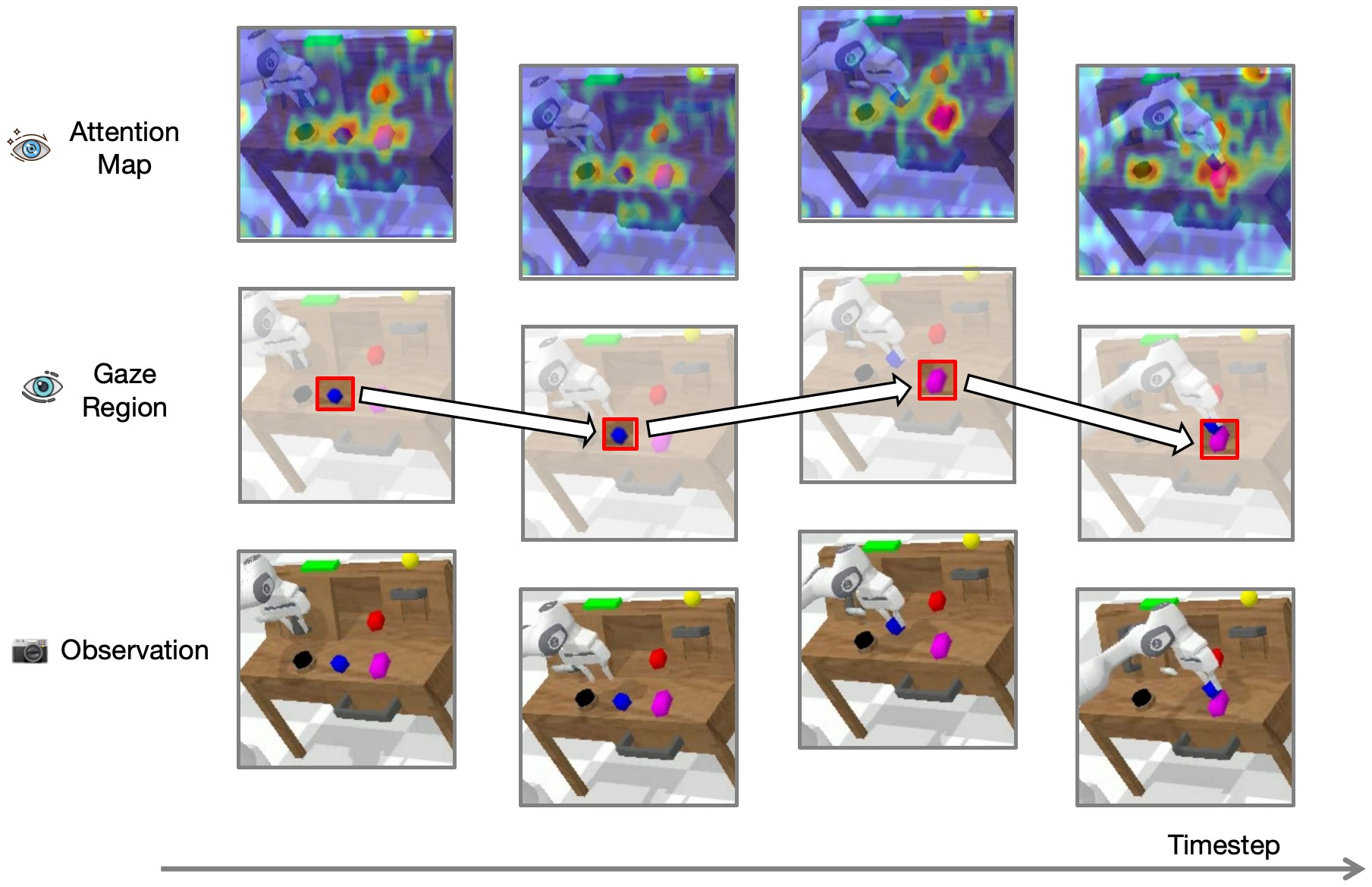
Figure 1: Visualization of the observation, gaze region, and attention map. For a long-horizon task “stack blocks” that requires the arm to lift the blue block and put it on the pink one. Although there are several distractors, our model adaptively adjusts the gaze region, guiding the allocation of visual attention to the right target. With the precise visual grounding, it sequentially manipulates different target objects and successfully completes the task.
图 1:对观察、注视区域和注意力图的可视化。 在长程任务“码积木(stack blocks)”中,机械臂需要提起蓝色积木并放到粉色积木上。尽管场景里有若干干扰物,我们的模型仍能自适应地调整注视区域,引导视觉注意力分配到正确目标。凭借精确的视觉锚定,它依次操作不同的目标物体,并成功完成任务。
Previous visual grounding methods for VLAs usually explicitly input grounded images (Huang et al. 2025; Li et al. 2025) or output bounding boxes (Zawalski et al. 2024; Deng et al. 2025) in a chain-of-thought (CoT) manner. These methods enhance the perception of target regions and improve spatial awareness, while they do not fundamentally refine the attention allocation. Inspired by reconstructive visual instruction tuning (Wang et al. 2024), we introduce an auxiliary visual reconstruction module implemented as a lightweight diffusion transformer (Peebles and Xie 2022). This module is conditioned on the visual outputs of the VLA model and aims to reconstruct the target manipulated region from noise. This process prompts the VLA model to learn fine-grained representations with region-specific information, thereby focusing visual attention on the correct area. As shown in Figure 1, this mechanism is analogous to the gaze behavior of the human eye, where the eye perceives a small, focused area with sharp clarity while the surrounding regions remain blurred (Stewart 2020). Thus, the target manipulated region is named gaze region.
先前面向 VLA 的视觉锚定方法,通常是显式地输入已被锚定的图像(Huang et al. 2025;Li et al. 2025),或以思维链(chain-of-thought,CoT)的方式输出边界框(Zawalski et al. 2024;Deng et al. 2025)。这些方法能够加强对目标区域的感知并改善空间意识,但并没有从根本上改进注意力的分配。受到重建式视觉指令微调(Wang et al. 2024)的启发,我们引入一个辅助视觉重建模块,用轻量扩散 Transformer(Peebles and Xie 2022)实现。该模块以 VLA 模型的视觉输出为条件,目标是从噪声中重建要操作的目标区域。这一过程促使 VLA 模型学习带有区域特定信息的细粒度表征,从而把视觉注意力集中到正确区域。如图 1 所示,这一机制类似于人眼的注视行为:眼睛只把一小块聚焦区域看得很清楚,周围区域则保持模糊(Stewart 2020)。因此,要操作的目标区域被称为注视区域。
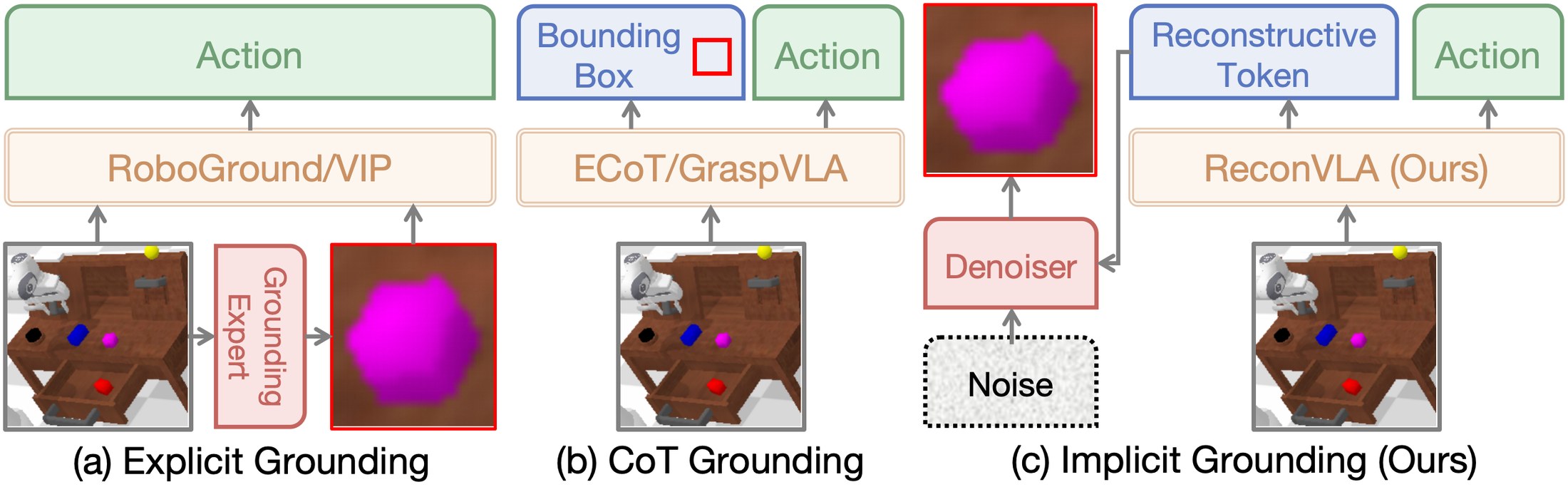
Figure 2: Conceptual comparison between different paradigms. (a) Explicit Grounding: Employing an external grounding expert and inputting entire images and cropped images (Huang et al. 2025; Li et al. 2025). (b) CoT Grounding: Outputting coordinates of bounding boxes before action in a chain-of-thought (CoT) manner (Zawalski et al. 2024; Deng et al. 2025). (c) Implicit Grounding: Our ReconVLA directly leverages crucial regions as implicit visual supervision for visual outputs, called reconstructive tokens, through a reconstruction process.
图 2:不同范式的概念比较。 (a)显式锚定:使用外部锚定专家,并同时输入整图和裁剪图(Huang et al. 2025;Li et al. 2025)。(b)思维链锚定:以思维链(CoT)的方式,在动作之前先输出边界框坐标(Zawalski et al. 2024;Deng et al. 2025)。(c)隐式锚定:我们的 ReconVLA 通过重建过程,直接把关键区域当作视觉输出的隐式视觉监督,称为重建词元(reconstructive tokens)。
However, similar to their VLM backbone (Liu et al. 2024b), conventional VLA models are finetuned on vision-language understanding tasks and generate actions in an autoregressive manner, lacking visual generation capabilities. To address this limitation, we curated a pretraining dataset containing over 100k trajectories and 2 million data samples. We select severak open-source robotic datasets (Walke et al. 2024; Liu et al. 2024a; Mees et al. 2021) and design an automatic data processing by Grounding DINO (Liu et al. 2024c) to produce pairwise entire images and images of target manipulated regions. Pretraining on this large-scale dataset significantly enhances the model’s generalization ability in visual generation.
然而,与它们的 VLM 骨干(Liu et al. 2024b)类似,常规 VLA 模型是在视觉-语言理解任务上微调的,并以自回归方式生成动作,缺乏视觉生成能力。为弥补这一不足,我们整理了一份包含超过 10 万条轨迹、200 万个样本的预训练数据集。我们选取若干开源机器人数据集(Walke et al. 2024;Liu et al. 2024a;Mees et al. 2021),并用 Grounding DINO(Liu et al. 2024c)设计自动数据处理流程,生成整图与目标操作区域图像的成对样本。在这份大规模数据上预训练,显著提升了模型在视觉生成上的泛化能力。
By leveraging the aforementioned techniques, we develop the Reconstructive Vision-Language-Action Model (ReconVLA). It takes current images, language instructions, and robot proprioception as inputs. During training, the gaze regions of input images are processed into latent tokens via a frozen visual tokenizer, which preserves detailed visual information and enables high-fidelity reconstruction. To better learn the latent information, we train a diffusion transformer learning to recover the latent tokens guided by reconstructive tokens. The diffusion denosing effectively models the conditional distribution of visual observation.
借助上述技术,我们提出了重建式视觉-语言-动作模型(Reconstructive Vision-Language-Action Model,ReconVLA)。它以当前图像、语言指令和机器人本体感觉作为输入。训练时,输入图像的注视区域经过冻结的视觉分词器处理成潜在词元,以保留细致的视觉信息并支持高保真重建。为了更好地学习这些潜在信息,我们训练一个扩散 Transformer,在重建词元的引导下恢复这些潜在词元。扩散去噪能够有效地建模视觉观察的条件分布。
Experiments in long-horizon tasks demonstrate that our implicit grounding method is more effective than other visual grounding paradigms. Besides, visualizations of visual attention prove that our ReconVLA demonstrates directive visual attention and leads to precise manipulation. Then, ablation studies prove the generalization through large-scale pretraining. Comprehensive comparison with other popular methods shows that our ReconVLA yields superior performance. Finally, we conduct real-world experiments and evaluate the generalization to unseen objects. This demonstrates that our ReconVLA has the potential to facilitate the real-world deployment of VLAs.
在长程任务上的实验表明,我们的隐式锚定方法比其他视觉锚定范式更有效。此外,视觉注意力的可视化证明,ReconVLA 表现出有指向性的视觉注意,并带来精确操作。随后的消融研究证实了大规模预训练所带来的泛化。与其他常见方法的全面比较显示,ReconVLA 取得了更好的性能。最后,我们进行了真实世界实验,并评估了对未见物体的泛化。这表明 ReconVLA 有潜力推动 VLA 在真实世界中的部署。
In summary, our key contributions are as follows:
概括起来,我们的主要贡献如下:
- • We propose ReconVLA, a reconstructive VLA model with an implicit grounding paradigm. The reconstruction of gaze regions prompts the model toward precise visual attention allocation and fine-grained representation learning, thereby enhancing visual grounding capabilities and executing precise manipulation.
- • 我们提出 ReconVLA,一种采用隐式锚定范式的重建式 VLA 模型。对注视区域的重建促使模型更精确地分配视觉注意力,并学习细粒度表征,从而增强视觉锚定能力并完成精确操作。
- • We constructed a large-scale robot pretraining dataset, containing more than 100k trajectories, 2 million data samples. Pretraining on this dataset enhances the model’s generalization of visual reconstruction capabilities.
- • 我们构建了一份大规模机器人预训练数据集,包含超过 10 万条轨迹、200 万个样本。在该数据上预训练,增强了模型视觉重建能力的泛化。
- • Extensive experiments in simulation and the real world show the superiority of our implicit grounding methods and the capabilities of precise manipulation and generalization for unseen targets.
- • 在仿真和真实世界中的大量实验表明,我们的隐式锚定方法更为有效,并具备精确操作以及对未见目标的泛化能力。
2 Related Work
2 相关工作
Action-centric Vision-language-action Models.
Building upon foundational advancements on pretrained VLMs (Beyer et al. 2024; Lu et al. 2024; Liu et al. 2024b), VLAs (Brohan et al. 2023; Zitkovich et al. 2023; Ding et al. 2024; Octo Model Team et al. 2024; Tong et al. 2025; Zhao et al. 2025a; Zhao et al. 2025b; Cui et al. 2025; Song et al. 2025c; Song et al. 2025a) learn to generate executable actions supervised by actions. Within them, RoboFlamingo (Li et al. 2024) models sequential history information with an explicit policy head. OpenVLA (Kim et al. 2024) is the first open-source VLA model with large-scale robotic pretraining (O’Neill et al. 2024). VLAS (Zhao et al. 2025b) expands the modality with audio. UniVLA (Bu et al. 2025) learns task-centric latent actions from web-scale videos and adapts to different downstream tasks. These models only supervise action outputs, while our ReconVLA supervise visual outputs as auxiliary tasks, thus enhancing visual perception.
以动作为中心的视觉-语言-动作模型。
在预训练 VLM(Beyer et al. 2024;Lu et al. 2024;Liu et al. 2024b)的基础进展之上,VLA(Brohan et al. 2023;Zitkovich et al. 2023;Ding et al. 2024;Octo Model Team et al. 2024;Tong et al. 2025;Zhao et al. 2025a;Zhao et al. 2025b;Cui et al. 2025;Song et al. 2025c;Song et al. 2025a)在动作监督下学习生成可执行动作。其中,RoboFlamingo(Li et al. 2024)用显式策略头对序列历史信息建模。OpenVLA(Kim et al. 2024)是首个带有大规模机器人预训练(O’Neill et al. 2024)的开源 VLA 模型。VLAS(Zhao et al. 2025b)把模态扩展到了音频。UniVLA(Bu et al. 2025)从网络规模的视频中学习以任务为中心的潜在动作,并适配到不同的下游任务。这些模型只监督动作输出,而我们的 ReconVLA 把视觉输出作为辅助任务来监督,从而增强视觉感知。
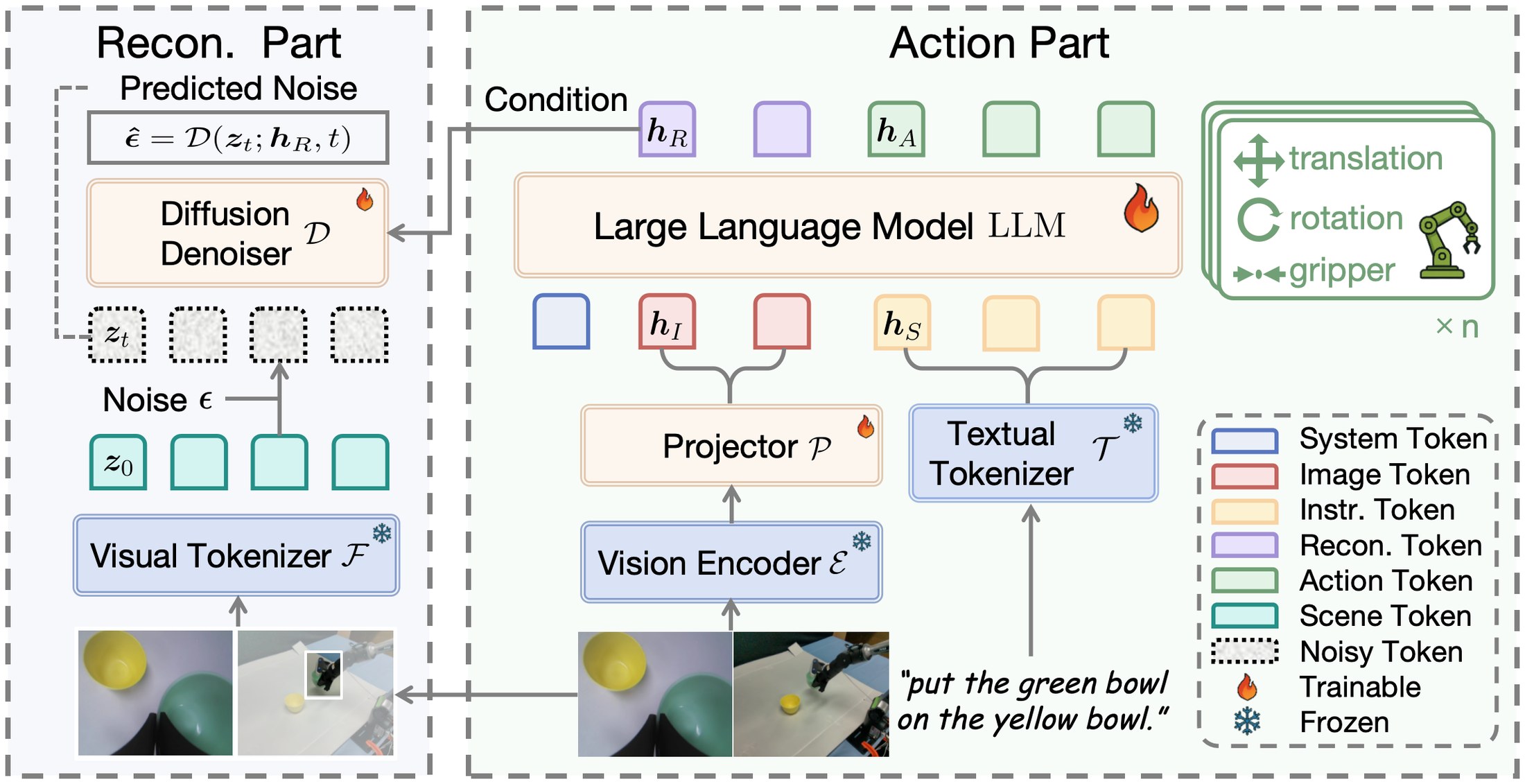
Figure 3: Architecture of our ReconVLA. Our model consists of a reconstructive part and an action part. The input includes multi-view images and a text instruction. For the action part, the model outputs discrete action tokens. For the reconstruction part, our ReconVLA is guided to output reconstructive tokens, which are conditions of the denoising process to reconstruct the scene tokens from noisy . The scene tokens are tokenized images of gaze regions. This supervision enables our ReconVLA to enhance visual grounding and fine-grained comprehension capabilities, which contribute to precise manipulation.
图 3:ReconVLA 的结构。我们的模型由重建部分和动作部分组成。输入包括多视角图像和一条文本指令。在动作部分,模型输出离散动作词元。在重建部分,ReconVLA 被引导输出重建词元,它们作为去噪过程的条件,用于从带噪的 重建场景词元 。场景词元是注视区域图像经分词后的结果。这一监督使 ReconVLA 能够增强视觉锚定和细粒度理解能力,从而有助于精确操作。
Generative Methods for Manipulation.
Previous works have explored image or video generation models for robotic control. Unipi (Du et al. 2023) first generates future images and extracts action from generated images. SuSIE (Black et al. 2024) generates subgoals with an image-editing diffusion model and executes them using a language-agnostic policy. CLOVER (Bu et al. 2024) produces visual plans to guide a closed-loop policy using error measurements. GR-1 (Wu et al. 2024) first combines generative methods with VLAs. It proposes a GPT-style model for visual robot manipulation by leveraging large-scale video pre-training to predict future images and robot actions. 3D-VLA (Zhen et al. 2024) further integrates depth information as guidance for vision-language-action reasoning and planning. GEVRM (Zhang et al. 2025) generates future images for a goal-conditioned policy in a closed-loop manner. These methods (Tian et al. 2024; Guo et al. 2024; Wang et al. 2025; Cen et al. 2025) predict future frames to learn from dynamics, thereby enhancing the model’s planning capability. In contrast, our approach reconstructs target regions of the current image to achieve precise perception and manipulation.
面向操作的生成式方法。
已有工作探索用图像或视频生成模型来做机器人控制。Unipi(Du et al. 2023)先生成未来图像,再从生成的图像中提取动作。SuSIE(Black et al. 2024)用图像编辑扩散模型生成子目标,再用一个与语言无关的策略去执行。CLOVER(Bu et al. 2024)生成视觉计划,并用误差度量引导闭环策略。GR-1(Wu et al. 2024)首次把生成方法与 VLA 结合起来。它提出一种 GPT 风格的模型,通过大规模视频预训练来预测未来图像和机器人动作,用于视觉机器人操作。3D-VLA(Zhen et al. 2024)进一步引入深度信息,作为视觉-语言-动作推理与规划的引导。GEVRM(Zhang et al. 2025)以闭环方式为目标条件策略生成未来图像。这些方法(Tian et al. 2024;Guo et al. 2024;Wang et al. 2025;Cen et al. 2025)通过预测未来帧来从动力学中学习,从而增强模型的规划能力。与之不同,我们的方法重建的是当前图像中的目标区域,以实现精确感知和精确操作。
Visual Grounding Methods for Manipulation.
Explicit grounding methods often take the grounded image as extra inputs to serve as auxiliary observation (Figure 2 (a)). RoboGround (Huang et al. 2025) employs LISA (Lai et al. 2024) as a high-level segmenter to extract the target object and background based on instructions and feeds them as part of the observation into the VLA model. Similarly, VIP (Li et al. 2025) uses YOLOv11 (Khanam and Hussain 2024) to segment the target object, which is then enlarged and provided to a transformer-based policy. However, these models rely on external expert models and do not fundamentally enhance the visual grounding capabilities of the policy itself. ECoT (Zawalski et al. 2024) and GraspVLA (Deng et al. 2025) (Figure 2 (b)) adopt a chain-of-thought approach, sequentially outputting bounding boxes and actions, which simultaneously trains the grounding capability and provides richer information for action output through causal attention. In contrast to these prior methods, our ReconVLA directly reconstructs the target manipulation region from the visual outputs (Figure 2 (c)), thereby implicitly performing grounding while encouraging the model to learn fine-grained representations of the target region. This process emulates the human eye’s spontaneous ability to focus on salient regions within the field of view.
面向操作的视觉锚定方法。
显式锚定方法常常把已被锚定的图像作为额外输入,充当辅助观察(图 2(a))。RoboGround(Huang et al. 2025)用 LISA(Lai et al. 2024)作为高层分割器,根据指令提取目标物体和背景,再把它们作为观察的一部分送入 VLA 模型。类似地,VIP(Li et al. 2025)用 YOLOv11(Khanam and Hussain 2024)分割目标物体,再将其放大后提供给基于 Transformer 的策略。然而,这些模型依赖外部专家模型,并没有从根本上提升策略自身的视觉锚定能力。ECoT(Zawalski et al. 2024)和 GraspVLA(Deng et al. 2025)(图 2(b))采用思维链方式,依次输出边界框和动作,从而同时训练锚定能力,并通过因果注意力为动作输出提供更丰富的信息。与这些先前方法不同,我们的 ReconVLA 直接从视觉输出重建目标操作区域(图 2(c)),从而在隐式完成锚定的同时,鼓励模型学习目标区域的细粒度表征。这一过程模仿了人眼在视野中自发聚焦显著区域的能力。
3 Method
3 方法
3.1 Preliminaries
3.1 预备知识
To establish the foundation of our method, we first formalize the typical formulation and architecture of VLA models in the context of robotic manipulation (Brohan et al. 2023; Zitkovich et al. 2023; Kim et al. 2024; Zhao et al. 2025b; Song et al. 2025b). Given a pair of images and text instructions , the VLA model predicts the actions .
为了给方法打下基础,我们先在机器人操作的语境中,形式化 VLA 模型的典型问题设定与结构(Brohan et al. 2023;Zitkovich et al. 2023;Kim et al. 2024;Zhao et al. 2025b;Song et al. 2025b)。给定一对图像和文本指令 ,VLA 模型 预测动作 。
Architecture.
A regular VLA mainly consists of a large language model LLM, a vision encoder , the tokenizer , and an action detokenizer . The tuple are processed into image tokens and text tokens by and seperately. These tokens are then fed into the LLM to generate action tokens . Finally, the action detokenizer maps into executable action for robotic control. The whole process can be formulated as:
结构。
一个常规的 VLA 主要由一个大语言模型 LLM、视觉编码器 、分词器 以及动作反分词器 组成。元组 分别由 和 处理成图像词元 和文本词元 。这些词元随后被送入 LLM,以生成动作词元 。最后,动作反分词器 把 映射为可用于机器人控制的可执行动作 。整个过程可以写成:
Specifically, the action tokens are generated in an autoregressive manner:
具体而言,动作词元以自回归方式生成:
where denotes the -th action token and denotes the total number of action tokens.
其中 表示第 个动作词元, 表示动作词元的总数。
3.2 Reconstructive Vision-Language-Action Model
3.2 重建式视觉-语言-动作模型
With observation of the dispersed attention, we aim to guide VLAs’ visual attention to focus on the correct target. Our philosophy is to construct an auxiliary visual supervision, realized by setting a reconstructive visual signal. The supervising signal serves as conditions to guide a diffusion denoising process to reconstruct the target manipulated region. Formally, we present the Reconstructive Vision-Language-Action Model (ReconVLA), grounded in this framework.
在观察到注意力分散之后,我们希望引导 VLA 的视觉注意力聚焦到正确目标上。我们的思路是构造一项辅助视觉监督,具体做法是设置一个重建式视觉信号。该监督信号作为条件,引导扩散去噪过程去重建要操作的目标区域。在此框架下,我们提出重建式视觉-语言-动作模型(ReconVLA)。
Reconstruction Target.
When manipulating objects, humans receive a global view of the scene. However, visual perception primarily focuses on a small part of it, namely the region intended to be manipulated. This behavior is known as gaze. Similarly, the reconstruction target of our ReconVLA is the target manipulated region, which we refer to as the gaze region. The gaze region not only helps the model focus on the correct target among multiple affordable regions, but also enhances the detailed perception of these regions. Besides, the mechanism implicitly facilitates sub-task planning in long-horizon tasks by focusing on and switching to different sub-goals.
重建目标。
人在操作物体时会接收场景的全局视野。但视觉感知主要集中在其中一小部分,也就是打算去操作的那个区域。这种行为被称为注视。类似地,我们 ReconVLA 的重建目标就是要操作的目标区域,我们称之为注视区域。注视区域不仅帮助模型在多个可操作区域中聚焦正确目标,也增强了对这些区域的细节感知。此外,通过聚焦并切换到不同的子目标,这一机制还隐式地有助于长程任务中的子任务规划。
Loss Function.
The overall training objectives of ReconVLA include (i) the autoregressive action prediction supervised by demonstration data, and (ii) another reconstructive term supervised by the visual features of gaze regions, i.e., , where the is cross-entropy loss and the is a measurement between reconstructive tokens and reconstruction targets .
损失函数。
ReconVLA 的总体训练目标包括 (i) 由示范数据监督的自回归动作预测,以及 (ii) 由注视区域视觉特征监督的重建项,也就是 ,其中 是交叉熵损失, 是重建词元 与重建目标 之间的度量。
Latent Visual Reconstruction.
To construct a region-specific visual supervision signal from an RGB input with spatial information redundancy (He et al. 2022), we design a denosing process to reconstruct tokens with low-level features of gaze regions. This process encourages the model to fully capture intrinsic features instead of cloning explicit RGB values (Chen et al. 2023; Song and Ermon 2020; Karras et al. 2022; Yang et al. 2024b).
潜在视觉重建。
为了从带有空间信息冗余的 RGB 输入中构造区域特定的视觉监督信号(He et al. 2022),我们设计了一个去噪过程,用来重建带有注视区域低层特征的词元。这一过程鼓励模型充分捕捉内在特征,而不是去克隆显式的 RGB 数值(Chen et al. 2023;Song and Ermon 2020;Karras et al. 2022;Yang et al. 2024b)。
Figure 3 illustrates that our ReconVLA utilizes the visual tokenizer to extract target scene tokens . Specifically, we employ a continuous variational autoencoder (VAE) (Kingma and Welling 2022) in (Rombach et al. 2022) as the visual tokenizer because of its visual fidelity and ability to capture fine-grained image features. The denoiser trys to predict the noise and recover from noisy tokens conditioned on the reconstructive tokens . The reconstructive objective function is formalized following a diffusion process (Ho, Jain, and Abbeel 2020):
图 3 表明,我们的 ReconVLA 用视觉分词器 提取目标场景词元 。具体而言,我们采用 (Rombach et al. 2022) 中的连续变分自编码器(VAE)(Kingma and Welling 2022)作为视觉分词器 ,因为它具有较好的视觉保真度,并能捕捉细粒度的图像特征。去噪器 试图在重建词元 的条件下预测噪声,并从带噪词元 中恢复 。重建目标函数按照扩散过程(Ho, Jain, and Abbeel 2020)形式化为:
where denotes the diffusion timesteps. The denoiser consists of a stack of Transformer encoder blocks (Vaswani 2017) with self-attention modules to capture the correlations between noisy tokens and reconstructive tokens.
其中 表示扩散时间步。去噪器 由一叠 Transformer 编码器块(Vaswani 2017)组成,其中的自注意力模块用于捕捉带噪词元与重建词元之间的关联。
To ensure that the VLA model processes visual tokens corresponding to the instructed target, it is necessary to guarantee that image tokens attend to instruction tokens. Thus, we prepend a set of instruction tokens before the image tokens, enabling the image tokens to fuse information from these prefix texts through causal attention. Experimental results show that this interleaved format achieves our objective without degrading the model’s inherent language modeling capability.
为了确保 VLA 模型处理的是与指令目标相对应的视觉词元,必须保证图像词元能够注意到指令词元。因此,我们在图像词元之前放置一组指令词元,使图像词元能够通过因果注意力融合这些前缀文本中的信息。实验结果表明,这种交错格式能够达到我们的目标,同时不会削弱模型固有的语言建模能力。
Implementation Details.
In this paper, we construct our ReconVLA based on a pretrained vision-language model LLaVA-7b (Liu et al. 2024b), which uses Qwen2-7b (Yang et al. 2024a) as the LLM backbone and siglip-so400m-patch14-384 (Zhai et al. 2023) as the vision encoder.
实现细节。
本文将 ReconVLA 建立在预训练视觉-语言模型 LLaVA-7b(Liu et al. 2024b)之上,它以 Qwen2-7b(Yang et al. 2024a)作为 LLM 骨干,并以 siglip-so400m-patch14-384(Zhai et al. 2023)作为视觉编码器。
3.3 Visual Pretraining
3.3 视觉预训练
The reconstruction capability of the VLA model is inherently limited, as its VLM backbone is primarily trained on vision-language understanding tasks. To enhance its ability to ground and reconstruct specific regions, we design a pretraining process for reconstruction tasks on a large-scale robot dataset.
VLA 模型的重建能力天生有限,因为它的 VLM 骨干主要是在视觉-语言理解任务上训练的。为了增强它锚定并重建特定区域的能力,我们在大规模机器人数据上设计了面向重建任务的预训练过程。
Dataset.
To build a foundational reconstruction capability, we constructed the pre-training dataset based on large-scale open-source robotic datasets BridgeData V2 (Walke et al. 2023), along with high-quality simulation datasets LIBERO (Liu et al. 2024a) and CALVIN (Mees et al. 2021). Given an image-text pair, we fine-tune Grounding DINO (Liu et al. 2024c), which is the state-of-the-art open-vocabulary object detector, to segment out the gaze region that the robot is instructed to interact with. The cropped images and original images are organized in a pairwise manner. In this way, we obtain an annotated visual pretraining dataset containing over 100k trajectories and 2 million samples.
数据集。
为了建立基础的重建能力,我们基于大规模开源机器人数据集 BridgeData V2(Walke et al. 2023),以及高质量仿真数据集 LIBERO(Liu et al. 2024a)和 CALVIN(Mees et al. 2021),构建了预训练数据。给定一对图像-文本,我们微调开放词汇目标检测器 Grounding DINO(Liu et al. 2024c),由它分割出机器人按指令需要交互的注视区域。裁剪后的图像与原始图像按成对方式组织。这样,我们得到一份带标注的视觉预训练数据集,包含超过 10 万条轨迹和 200 万个样本。
Training.
During the pretraining process, we perform gradient backpropagation both on the reconstruction loss and action loss to keep the consistency of the optimization target. This process equips our VLM with generalized visual reconstruction capabilities and facilitates the model’s deployment to diverse environments and tasks. After pretraining, we finetune our model on specific tasks to precisely align vision-language comprehension and visual reconstruction capabilities with manipulation capabilities on the corresponding action space.
训练。
在预训练过程中,我们同时对重建损失和动作损失做梯度反向传播,以保持优化目标的一致性。这一过程使 VLM 具备可泛化的视觉重建能力,并有助于把模型部署到多样的环境和任务中。预训练之后,我们在具体任务上微调模型,以便把视觉-语言理解与视觉重建能力,精确对齐到相应动作空间上的操作能力。
4 Experiments
4 实验
In this section, we structure the experiments to answer the following questions:
在这一节中,我们围绕下列问题组织实验:
- • Does our implicit grounding approach outperform other visual grounding paradigms? (see Section 4.2)
- • 我们的隐式锚定方法是否优于其他视觉锚定范式?(见第 4.2 节)
- • Does the gazing mechanism contribute to visual grounding and further improve the precise manipulation? (see Section 4.3)
- • 注视机制是否有助于视觉锚定,并进一步提升精确操作?(见第 4.3 节)
- • Does our proposed pretraining stage improve the generalization of visual generation, and how do other proposed key designs in ReconVLA influence the overall performance? (see Section 4.4)
- • 我们提出的预训练阶段是否改善了视觉生成的泛化,ReconVLA 中其他关键设计又如何影响总体性能?(见第 4.4 节)
- • Can ReconVLA effectively manage long-horizon tasks compared with other competitive methods? (see Section 4.5)
- • 与其他有竞争力的方法相比,ReconVLA 能否有效应对长程任务?(见第 4.5 节)
- • Can ReconVLA realize generalized manipulation on unseen targets in real-world tasks? (see Section 4.6)
- • ReconVLA 能否在真实世界任务中,对未见目标实现可泛化的操作?(见第 4.6 节)
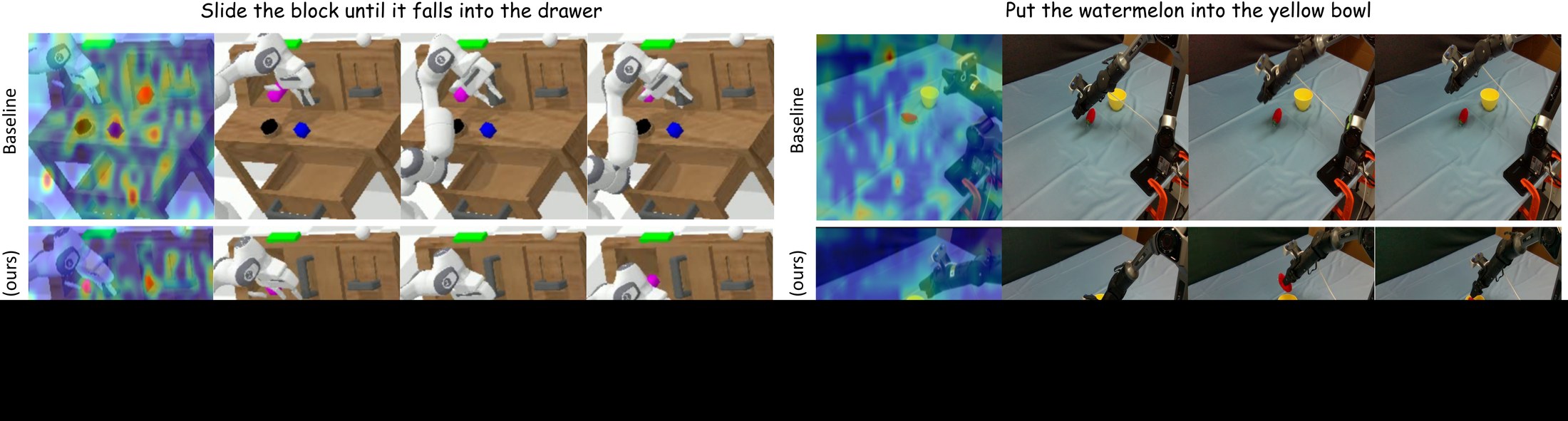
Figure 4: Qualitative comparison of attention maps on CALVIN (Mees et al. 2021) and the real world. Row 1: The baseline exhibits dispersed attention patterns or predominantly attends to an incorrect region, leading to inaccurate actions. Row 2: With auxiliary visual supervision signals, ReconVLA forces the model to focus on specific image contents with higher attention values and precisely move to the target region, thus successfully completing the task.
图 4:在 CALVIN(Mees et al. 2021)和真实世界中注意力图的定性比较。 第 1 行:基线表现出分散的注意力模式,或主要注意到错误区域,从而导致不准确的动作。第 2 行:在辅助视觉监督信号下,ReconVLA 迫使模型以更高的注意力值聚焦于特定图像内容,并精确移动到目标区域,从而成功完成任务。
| Paradigm | Success Rate (%) | Avg. Len | ||||
|---|---|---|---|---|---|---|
| 1/5 | 2/5 | 3/5 | 4/5 | 5/5 | ||
| Baseline | 88.8 | 76.1 | 63.7 | 57.0 | 49.0 | 3.36 |
| EG | 94.4 | 82.5 | 70.9 | 62.2 | 50.2 | 3.61 |
| CG | 47.0 | 14.3 | 1.6 | 0.0 | 0.0 | 0.63 |
| IG (ours) | 95.6 | 87.6 | 76.9 | 69.3 | 64.1 | 3.95 |
Table 1: Comparison among different paradigms, including Explicit Grounding (EG), CoT Grounding (CG), and our Implicit Grounding (IG). The comparison is conducted on the CALVIN ABCD.
| 范式 | 成功率(%) | 平均长度 | ||||
|---|---|---|---|---|---|---|
| 1/5 | 2/5 | 3/5 | 4/5 | 5/5 | ||
| 基线 | 88.8 | 76.1 | 63.7 | 57.0 | 49.0 | 3.36 |
| EG | 94.4 | 82.5 | 70.9 | 62.2 | 50.2 | 3.61 |
| CG | 47.0 | 14.3 | 1.6 | 0.0 | 0.0 | 0.63 |
| IG(本文) | 95.6 | 87.6 | 76.9 | 69.3 | 64.1 | 3.95 |
表 1:不同范式的比较,包括显式锚定(EG)、思维链锚定(CG)以及我们的隐式锚定(IG)。比较在 CALVIN ABCD 上进行。
| Recon. | Gaze Region | Pretrain | Splits | Task completed in a row (%) | Average Length | ||||
|---|---|---|---|---|---|---|---|---|---|
| 1 | 2 | 3 | 4 | 5 | |||||
| ✓ | ✓ | ✓ | ABCD | 95.6 | 87.6 | 76.9 | 69.3 | 64.1 | 3.95 |
| ✓ | ✓ | ABCD | 96.8 | 86.9 | 76.9 | 64.9 | 58.2 | 3.85 | |
| ✓ | ABCD | 89.8 | 80.3 | 67.7 | 56.6 | 46.5 | 3.42 | ||
| ABCD | 88.8 | 76.1 | 63.7 | 57.0 | 49.0 | 3.36 |
Table 2: Ablation results of the proposed techniques using the reconstructive part, gaze region, and pretraining.
| 重建 | 注视区域 | 预训练 | 划分 | 连续完成任务比例(%) | 平均长度 | ||||
|---|---|---|---|---|---|---|---|---|---|
| 1 | 2 | 3 | 4 | 5 | |||||
| ✓ | ✓ | ✓ | ABCD | 95.6 | 87.6 | 76.9 | 69.3 | 64.1 | 3.95 |
| ✓ | ✓ | ABCD | 96.8 | 86.9 | 76.9 | 64.9 | 58.2 | 3.85 | |
| ✓ | ABCD | 89.8 | 80.3 | 67.7 | 56.6 | 46.5 | 3.42 | ||
| ABCD | 88.8 | 76.1 | 63.7 | 57.0 | 49.0 | 3.36 |
表 2:对重建模块、注视区域和预训练这几项技术的消融结果。
| Category | Method | Splits | Success Rate (%) | Avg. Len | ||||
|---|---|---|---|---|---|---|---|---|
| 1/5 | 2/5 | 3/5 | 4/5 | 5/5 | ||||
| Generative Methods | UniPi (Du et al. 2023) (NIPS’23) | ABCD | 56.0 | 16.0 | 8.0 | 8.0 | 4.0 | 0.92 |
| SuSIE (Black et al. 2024) (ICLR’24) | ABCD | 87.0 | 69.0 | 49.0 | 38.0 | 26.0 | 2.69 | |
| GEVRM (Zhang et al. 2025) (ICLR’25) | ABCD | 92.0 | 70.0 | 54.0 | 41.0 | 26.0 | 2.83 | |
| GR-1 (Wu et al. 2024) (ICLR’24) | ABCD | 85.4 | 71.2 | 59.6 | 49.7 | 40.1 | 3.06 | |
| Vidman (Wen et al. 2024) (NIPS’24) | ABCD | 91.5 | 76.4 | 68.2 | 59.2 | 46.7 | 3.42 | |
| CLOVER (Bu et al. 2024) (NIPS’24) | ABCD | 96.0 | 83.5 | 70.8 | 57.5 | 45.4 | 3.53 | |
| Large VLA Models | VLAS (Zhao et al. 2025b) (ICLR’25) | ABCD | 87.2 | 64.2 | 40.9 | 28.1 | 19.6 | 2.40 |
| RoboFlamingo (Li et al. 2024) (ICLR’24) | ABCD | 82.4 | 61.9 | 46.6 | 33.1 | 23.5 | 2.47 | |
| OpenVLA (Kim et al. 2024) (CoRL’24) | ABCD | 91.3 | 77.8 | 62.0 | 52.1 | 43.5 | 3.27 | |
| UniVLA (Bu et al. 2025) (RSS’25) | ABCD | 95.5 | 85.8 | 75.4 | 66.9 | 56.5 | 3.80 | |
| Reconstructive Methods | ReconVLA (ours) | ABCD | 95.6 | 87.6 | 76.9 | 69.3 | 64.1 | 3.95 |
Table 3: Comparison with various manipulation models on CALVIN ABCD in success rates and average length.
| 类别 | 方法 | 划分 | 成功率(%) | 平均长度 | ||||
|---|---|---|---|---|---|---|---|---|
| 1/5 | 2/5 | 3/5 | 4/5 | 5/5 | ||||
| 生成式方法 | UniPi (Du et al. 2023) (NIPS’23) | ABCD | 56.0 | 16.0 | 8.0 | 8.0 | 4.0 | 0.92 |
| SuSIE (Black et al. 2024) (ICLR’24) | ABCD | 87.0 | 69.0 | 49.0 | 38.0 | 26.0 | 2.69 | |
| GEVRM (Zhang et al. 2025) (ICLR’25) | ABCD | 92.0 | 70.0 | 54.0 | 41.0 | 26.0 | 2.83 | |
| GR-1 (Wu et al. 2024) (ICLR’24) | ABCD | 85.4 | 71.2 | 59.6 | 49.7 | 40.1 | 3.06 | |
| Vidman (Wen et al. 2024) (NIPS’24) | ABCD | 91.5 | 76.4 | 68.2 | 59.2 | 46.7 | 3.42 | |
| CLOVER (Bu et al. 2024) (NIPS’24) | ABCD | 96.0 | 83.5 | 70.8 | 57.5 | 45.4 | 3.53 | |
| 大型 VLA 模型 | VLAS (Zhao et al. 2025b) (ICLR’25) | ABCD | 87.2 | 64.2 | 40.9 | 28.1 | 19.6 | 2.40 |
| RoboFlamingo (Li et al. 2024) (ICLR’24) | ABCD | 82.4 | 61.9 | 46.6 | 33.1 | 23.5 | 2.47 | |
| OpenVLA (Kim et al. 2024) (CoRL’24) | ABCD | 91.3 | 77.8 | 62.0 | 52.1 | 43.5 | 3.27 | |
| UniVLA (Bu et al. 2025) (RSS’25) | ABCD | 95.5 | 85.8 | 75.4 | 66.9 | 56.5 | 3.80 | |
| 重建式方法 | ReconVLA(本文) | ABCD | 95.6 | 87.6 | 76.9 | 69.3 | 64.1 | 3.95 |
表 3:在 CALVIN ABCD 上与多种操作模型的比较(成功率和平均长度)。
| Category | Method | Splits | Success Rate (%) | Avg. Len | ||||
|---|---|---|---|---|---|---|---|---|
| 1/5 | 2/5 | 3/5 | 4/5 | 5/5 | ||||
| Generative Methods | 3D-VLA (Zhen et al. 2024) (ICML’24) | ABCDD | 44.7 | 16.3 | 8.1 | 1.6 | 0 | 0.70 |
| GR-1 (Wu et al. 2024) (ICLR’24) | ABCDD | 94.9 | 89.6 | 84.4 | 78.9 | 73.1 | 4.21 | |
| Large VLA Models | VLAS (Zhao et al. 2025b) (ICLR’25) | ABCDD | 94.2 | 84.0 | 73.2 | 64.3 | 54.6 | 3.70 |
| RoboFlamingo (Li et al. 2024) (ICLR’24) | ABCDD | 96.4 | 89.6 | 82.4 | 74.0 | 66.0 | 4.08 | |
| Reconstructive Methods | ReconVLA (ours) | ABCDD | 98.0 | 90.0 | 84.5 | 78.5 | 70.5 | 4.23 |
Table 4: Comparison with various manipulation models on CALVIN ABCDD in success rates and average length.
| 类别 | 方法 | 划分 | 成功率(%) | 平均长度 | ||||
|---|---|---|---|---|---|---|---|---|
| 1/5 | 2/5 | 3/5 | 4/5 | 5/5 | ||||
| 生成式方法 | 3D-VLA (Zhen et al. 2024) (ICML’24) | ABCDD | 44.7 | 16.3 | 8.1 | 1.6 | 0 | 0.70 |
| GR-1 (Wu et al. 2024) (ICLR’24) | ABCDD | 94.9 | 89.6 | 84.4 | 78.9 | 73.1 | 4.21 | |
| 大型 VLA 模型 | VLAS (Zhao et al. 2025b) (ICLR’25) | ABCDD | 94.2 | 84.0 | 73.2 | 64.3 | 54.6 | 3.70 |
| RoboFlamingo (Li et al. 2024) (ICLR’24) | ABCDD | 96.4 | 89.6 | 82.4 | 74.0 | 66.0 | 4.08 | |
| 重建式方法 | ReconVLA(本文) | ABCDD | 98.0 | 90.0 | 84.5 | 78.5 | 70.5 | 4.23 |
表 4:在 CALVIN ABCDD 上与多种操作模型的比较(成功率和平均长度)。
4.1 Simulation Environment
4.1 仿真环境
The CALVIN benchmark (Mees et al. 2021) is built on top of the PyBullet (Coumans and Bai 2016–2019) simulator and involves a Franka Panda Robot arm that manipulates the scene. CALVIN consists of 34 tasks and 4 different environments (A, B, C and D). The CALVIN long-horizon challenge is a sequential task comprising five subtasks. We report the success rates for each subtask and the average completed length across all five tasks. The method is evaluated over 500 rollouts to ensure a fair comparison. The metrics of CALVIN are the success rates of each sub-task and the average length of all sequential 5 sub-tasks.
CALVIN 基准(Mees et al. 2021)建立在 PyBullet(Coumans and Bai 2016–2019)仿真器之上,其中一台 Franka Panda 机械臂对场景进行操作。CALVIN 包含 34 项任务和 4 个不同环境(A、B、C 和 D)。CALVIN 长程挑战是一项由五个子任务组成的序列任务。我们报告每个子任务的成功率,以及在全部五项任务上的平均完成长度。为了保证比较公平,方法在 500 次 rollout 上评估。CALVIN 的指标是各子任务的成功率,以及全部连续 5 个子任务的平均长度。
4.2 Paradigm Comparison
4.2 范式比较
We implement different visual grounding paradigms in Figure 2 on the same baseline to conduct a fair comparison.
我们在同一套基线上实现图 2 中的不同视觉锚定范式,以进行公平比较。
Explicit Grounding (EG).
We choose a finetuned YOLOv11 (Khanam and Hussain 2024) as the detector to recognize the target object at each timestep. Then we crop out the recognized object region from the image and resize it. Then the resized and original images are jointly fed to the VLA model to guide object manipulation.
显式锚定(EG)。
我们选择一个经过微调的 YOLOv11(Khanam and Hussain 2024)作为检测器,在每个时间步识别目标物体。随后从图像中裁出被识别到的物体区域并调整大小。再把调整后的图像与原始图像一起送入 VLA 模型,以引导物体操作。
Chain-of-Thought Grounding (CG).
For data preparation, we preprocess the images with the detector to get the coordinates of the bounding box. Then, we reformulate the training dataset and modify the outputs in a CoT format: Bbox [x1 x2 y1 y2] + action sequence. The input remains the original images. In this way, the VLA model learns to ground the target object and output actions with the grounding information.
思维链锚定(CG)。
在数据准备方面,我们先用检测器预处理图像,得到边界框坐标。然后重新组织训练数据,并把输出改成思维链格式:Bbox [x1 x2 y1 y2] + 动作序列。输入仍是原始图像。这样,VLA 模型学习锚定目标物体,并在带有锚定信息的情况下输出动作。
Results.
As shown in Table 1, EG gets relatively higher success rates than baseline. This indicates that explicit grounding as input helps better comprehension of spatial relationships. However, the simple concatenation of entire and cropped images introduces visual information redundancy, which limits model performance. CG performance is even worse. This suggests that bounding boxes in coordinate form are insufficient to effectively guide the model in precisely manipulating target locations. Additionally, directly outputting precise coordinates and action values together presents training challenges for VLA models.
结果。
如表 1 所示,EG 的成功率相对高于基线。这表明把显式锚定作为输入,有助于更好地理解空间关系。然而,简单地拼接整图和裁剪图会引入视觉信息冗余,从而限制模型性能。CG 的表现甚至更差。这说明坐标形式的边界框不足以有效引导模型精确操作目标位置。此外,把精确坐标和动作值直接一起输出,也会给 VLA 模型的训练带来困难。
Our implicit grounding method gets the highest success rates, which demonstrates the superiority of our method over other paradigms. From the perspective of training mechanism, the advantage stems from our implicit grounding learning framework, which enables the model to precisely attend to visual information at target objects, thereby achieving precise manipulation. From the perspective of architecture, our model directly supervises visual outputs, eliminating the need for additional inputs or outputs. This design yields a simple yet effective training and inference pipeline.
我们的隐式锚定方法取得了最高的成功率,表明该方法优于其他范式。从训练机制看,优势来自隐式锚定学习框架,它使模型能够精确关注目标物体处的视觉信息,从而实现精确操作。从结构看,我们的模型直接监督视觉输出,不需要额外的输入或输出。这一设计得到了一套简单而有效的训练与推理流程。
4.3 In-depth Analysis
4.3 深入分析
To better explore the influence of the gazing mechanism, we conduct qualitative experiments of visual attention and its effect on fine-grained manipulation tasks.
为了更好地考察注视机制的影响,我们对视觉注意力及其在精细操作任务上的作用做了定性实验。
Attention Visualization
Figure 4 demonstrates that the implementation of enables the alignment of attention closely with the gaze region, which corresponds to the target object. For the instruction “put the watermelon into the yellow bowl”, the attention of baseline is highly dispersed, with the third-view image attention mostly focused on irrelevant positions and resulting in the task failure. In contrast, ReconVLA successfully concentrates attention on the correct target, i.e., the watermelon. This demonstrates that our method brings precise visual grounding, which facilitates task success.
注意力可视化
图 4 表明,引入 能够使注意力与注视区域紧密对齐,而注视区域对应于目标物体。对于指令“把西瓜放进黄碗”,基线的注意力高度分散,第三人称视角图像上的注意力大多落在无关位置,并导致任务失败。相比之下,ReconVLA 成功地把注意力集中在正确目标上,也就是西瓜。这说明我们的方法带来了精确的视觉锚定,从而有助于任务成功。
Precise Manipulation.
Among all tasks, the “stack block” task is the most challenging, which requires the robot to lift one block and precisely stack it on the other block. While our baseline achieves only 59.3% on this task, our gazing mechanism attains a success rate as high as 79.5%, representing a 20.2% increase. This significant improvement highlights the enhanced action accuracy of our gazing mechanism through precise visual grounding.
精确操作。
在所有任务中,“码积木”最为困难:机器人需要提起一块积木,并精确地叠到另一块积木上。我们的基线在该任务上只有 59.3%,而注视机制把成功率提高到 79.5%,提升了 20.2%。这一显著改进凸显了注视机制通过精确视觉锚定所带来的动作准确性提升。
4.4 Ablation Study
4.4 消融实验
We perform ablation studies of the proposed techniques using the reconstructive part, gaze region, and pretraining on large-scale robotic datasets in Table 2. We observe that pretraining leads to a significant improvement in success rates. This is because, in unseen test environments, grounding the target object and performing reconstruction is inherently challenging and poses a generalization challenge to the model’s generative capability. Pretraining on large-scale datasets substantially enhances the model’s generalization ability during visual reconstruction. Furthermore, reconstructing the gaze region to be manipulated, rather than the entire image, proves to be more effective. This guides the model’s visual attention to focus on the target object, thereby avoiding manipulation of incorrect targets. Notably, models trained to reconstruct the entire image still outperform the baseline, which can be attributed to the enhanced holistic visual attention. However, in unseen scenarios, reconstructing the entire image with pixel redundancy is extremely challenging, which further limits the performance improvements.
我们在表 2 中,对重建模块、注视区域以及在大规模机器人数据上的预训练做了消融。我们观察到,预训练会显著提高成功率。这是因为在未见过的测试环境中,锚定目标物体并完成重建本身就很困难,对模型的生成能力构成了泛化挑战。在大规模数据上预训练,能实质性地增强模型在视觉重建时的泛化能力。此外,重建待操作的注视区域,而不是整幅图像,被证明更为有效。这会引导模型的视觉注意力聚焦到目标物体,从而避免操作错误目标。值得注意的是,被训练去重建整幅图像的模型仍然优于基线,这可以归因于整体视觉注意力得到了增强。但在未见场景中,重建带有像素冗余的整幅图像极为困难,这会进一步限制性能提升。
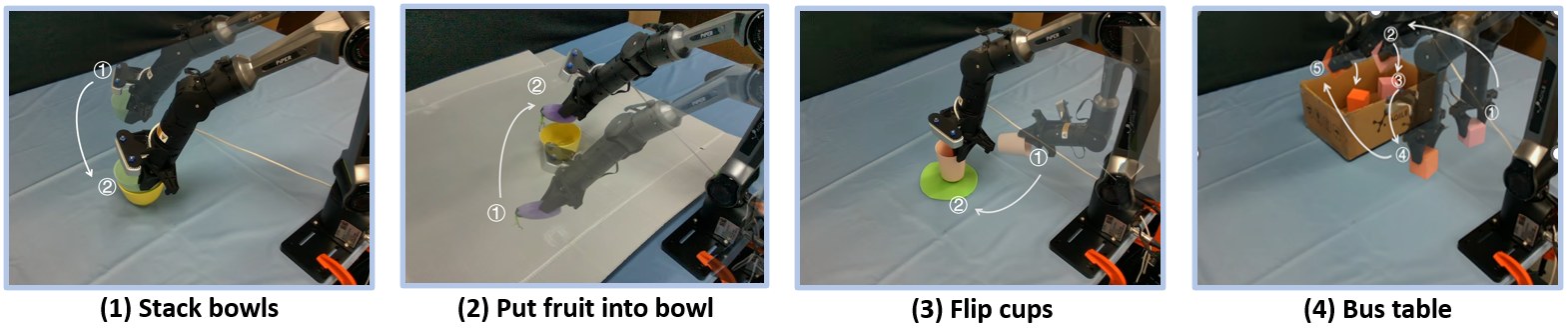
Figure 5: Real-world Setup of four representative tasks. We use a 6-DoF AgileX PiPer robotic arm with a 1-DoF parallel gripper and a RealSense D515 depth camera as Eye-on-Base and an ORBBEC Dabai depth camera as Eye-on-Hand. We selected four representative and practically meaningful tasks: (1) Stack bowls, (2) Put fruit into bowl, (3) Flip cups, (4) Bus table.
图 5:四项代表性任务的真实世界设置。 我们使用一台 6 自由度 AgileX PiPer 机械臂,配备 1 自由度平行夹爪,并以 RealSense D515 深度相机作为机座眼(Eye-on-Base),以 ORBBEC Dabai 深度相机作为手眼(Eye-on-Hand)。我们选取了四项有代表性、也有实际意义的任务:(1)码碗(Stack bowls),(2)把水果放进碗里(Put fruit into bowl),(3)翻转杯子(Flip cups),(4)收拾桌面(Bus table)。
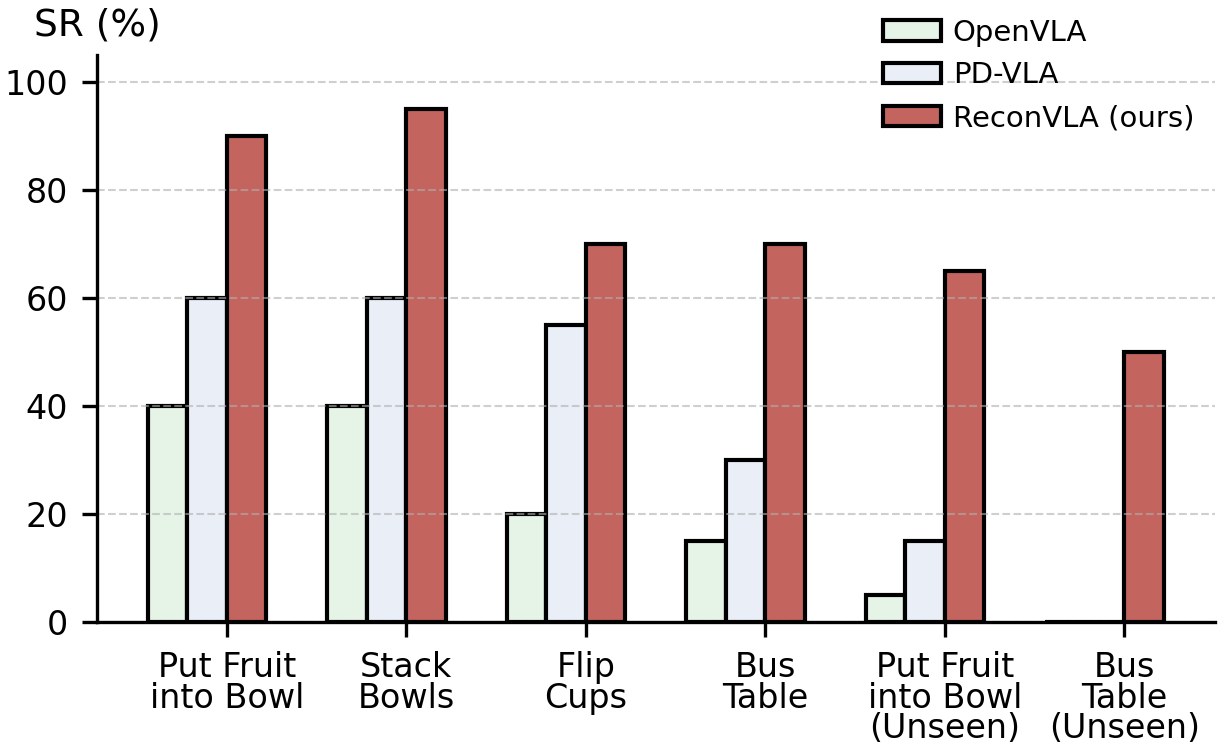
Figure 6: Real-world multi-task results. We report success rates (SR) across 4 different tasks as well as 2 unseen tasks.
图 6:真实世界多任务结果。我们报告 4 项不同任务以及 2 项未见任务上的成功率(SR)。
4.5 Comparison with State-of-the-arts
4.5 与当时最好方法的比较
Compared Methods.
We compare our model with generative methods that predict future images (UniPi, SuSIE, CLOVER, 3D-VLA, GR-1, Vidman, GEVRM), and large VLA models (RoboFlamingo, VLAS, OpenVLA, UniVLA), as introduced in Section 2.
比较方法。
我们将模型与预测未来图像的生成式方法(UniPi、SuSIE、CLOVER、3D-VLA、GR-1、Vidman、GEVRM)以及大型 VLA 模型(RoboFlamingo、VLAS、OpenVLA、UniVLA)进行比较,这些方法已在第 2 节介绍。
Results.
In the basic ABCDD tasks, our ReconVLA achieves competitive performance, successfully completing an average of 4.23 out of 5 consecutive tasks, with a success rate of 98.0% on the first task. This indicates that our gazing mechanism provides a flexible planning ability to realize a better operation schedule in long-horizon tasks. The ABCD tasks challenge the generalization for unseen backgrounds. Our method surpasses all generative methods, including the popular GR-1 with over 20% success rates on the last sub-task. This indicates that besides the generative model that predicts the future images, enhancing the perception of the current observation is equally valuable for robot manipulation. With comparable parameter amounts, our method outperforms OpenVLA by 20.6% and UniVLA by 7.6% on the last sub-task, which indicates the effectiveness of our implicit grounding learning strategy.
结果。
在基本的 ABCDD 任务上,我们的 ReconVLA 取得了有竞争力的表现:连续 5 项任务平均完成 4.23 项,第一项任务的成功率为 98.0%。这表明注视机制能够提供灵活的规划能力,从而在长程任务中安排更好的操作顺序。ABCD 任务考察的是对未见背景的泛化。我们的方法超过了所有生成式方法,包括常见的 GR-1,在最后一项子任务上的成功率高出 20% 以上。这说明,除了预测未来图像的生成模型之外,增强对当前观察的感知对机器人操作同样有价值。在参数量相当的情况下,我们的方法在最后一项子任务上分别高出 OpenVLA 20.6 个百分点、高出 UniVLA 7.6 个百分点,表明隐式锚定学习策略是有效的。
4.6 Multi-task Experiments in the Real World
4.6 真实世界中的多任务实验
Setup.
We conducted real-world experiments using a 6-DoF AgileX PiPer robotic arm with a 1-DoF parallel gripper. Besides, we use a RealSense D515 depth camera as Eye-on-Base and an ORBBEC Dabai depth camera as Eye-on-Hand for visual inputs.
设置。
我们使用一台 6 自由度 AgileX PiPer 机械臂和 1 自由度平行夹爪进行真实世界实验。此外,我们用 RealSense D515 深度相机作为机座眼,用 ORBBEC Dabai 深度相机作为手眼,以提供视觉输入。
Tasks.
We select four representative tasks: Put fruit into bowl, Stack bowls, Flip cups, and Bus table. To enhance the model’s generalization ability, each task includes variations in target objects and background colors. We collect 150 trajectories per task on average. For evaluation, each model is tested on each task with 20 trials, and the success rate is used as the performance metric. For unseen tasks, we replace the target object with unseen ones.
任务。
我们选取四项有代表性的任务:把水果放进碗里、码碗、翻转杯子以及收拾桌面。为了增强模型的泛化能力,每项任务都包含目标物体和背景颜色的变化。我们为每项任务平均采集 150 条轨迹。评测时,每个模型在每项任务上测试 20 次,并以成功率作为性能指标。对于未见任务,我们把目标物体替换为未见过的物体。
Results.
ReconVLA consistently outperforms both popular OpenVLA and strong PD-VLA across the four real-world tasks, achieving the highest success rate in each case. In particular, ReconVLA achieves a success rate close to or exceeding 90% on both the Put Fruit into Bowl and Stack Bowls tasks. OpenVLA shows limited effectiveness in executing fine-grained manipulation tasks (e.g., flip cup and bus table), while our ReconVLA achieves significant performance improvements through precise visual grounding.
结果。
在全部四项真实世界任务上,ReconVLA 都持续优于常见的 OpenVLA 和较强的 PD-VLA,并在每一项上都取得最高成功率。尤其是,ReconVLA 在把水果放进碗里和码碗两项任务上的成功率接近或超过 90%。OpenVLA 在执行精细操作任务(例如翻转杯子和收拾桌面)时效果有限,而我们的 ReconVLA 通过精确的视觉锚定取得了显著的性能提升。
In unseen tasks, where the target objects are absent from the training data, both OpenVLA and PD-VLA methods exhibit nearly 0% success rates. Benefiting from large-scale mix-data pretraining, our ReconVLA can still successfully ground the target objects and complete the intended actions, demonstrating the advantage of our approach’s visual generalization capability.
在未见任务中,目标物体并未出现在训练数据里,OpenVLA 和 PD-VLA 的成功率都接近 0%。得益于大规模混合数据预训练,我们的 ReconVLA 仍然能够成功锚定目标物体并完成预定动作,显示出该方法在视觉泛化上的优势。
5 Conclusion
5 结论
In this paper, we analyze and reveal the dispersed visual attention in traditional VLAs, which limits the precise manipulation. Then, we propose a reconstructive vision-language-action model (ReconVLA), a novel framework trained in an implicit grounding paradigm. Our ReconVLA successfully realizes accurate visual attention allocation and further enhances manipulation skills. We further construct a large-scale pretraining dataset for ReconVLA to generalize on diverse scenes and unseen objects. Extensive experiments in simulation and the real world show the superiority of our implicit grounding methods.
在本文中,我们分析并揭示了传统 VLA 中分散的视觉注意力,它限制了精确操作。随后,我们提出重建式视觉-语言-动作模型(ReconVLA),这是一种在隐式锚定范式下训练的新框架。ReconVLA 成功地实现了准确的视觉注意力分配,并进一步增强了操作技能。我们还为 ReconVLA 构建了一份大规模预训练数据集,使其能够在多样场景和未见物体上泛化。在仿真和真实世界中的大量实验表明,我们的隐式锚定方法更为有效。
References
参考文献
Awadalla et al. (2023) Awadalla, A.; Gao, I.; Gardner, J.; Hessel, J.; Hanafy, Y.; Zhu, W.; Marathe, K.; Bitton, Y.; Gadre, S.; Sagawa, S.; Jitsev, J.; Kornblith, S.; Koh, P. W.; Ilharco, G.; Wortsman, M.; and Schmidt, L. 2023. OpenFlamingo: An Open-Source Framework for Training Large Autoregressive Vision-Language Models. arXiv preprint arXiv:2308.01390 .
Beyer et al. (2024) Beyer, L.; Steiner, A.; Pinto, A. S.; Kolesnikov, A.; Wang, X.; Salz, D.; Neumann, M.; Alabdulmohsin, I.; Tschannen, M.; Bugliarello, E.; et al. 2024. Paligemma: A versatile 3b vlm for transfer. arXiv preprint arXiv:2407.07726 .
Black et al. (2024) Black, K.; Nakamoto, M.; Atreya, P.; Walke, H. R.; Finn, C.; Kumar, A.; and Levine, S. 2024. Zero-Shot Robotic Manipulation with Pre-Trained Image-Editing Diffusion Models. In The Twelfth International Conference on Learning Representations .
Brohan et al. (2023) Brohan, A.; Brown, N.; Carbajal, J.; Chebotar, Y.; Dabis, J.; Finn, C.; ; et al. 2023. RT-1: Robotics Transformer for Real-World Control at Scale. Proceedings of Robotics: Science and Systems .
Bu et al. (2025) Bu, Q.; Yang, Y.; Cai, J.; Gao, S.; Ren, G.; Yao, M.; Luo, P.; and Li, H. 2025. UniVLA: Learning to Act Anywhere with Task-centric Latent Actions. arXiv preprint arXiv:2505.06111 .
Bu et al. (2024) Bu, Q.; Zeng, J.; Chen, L.; Yang, Y.; Zhou, G.; Yan, J.; Luo, P.; Cui, H.; Ma, Y.; and Li, H. 2024. Closed-loop visuomotor control with generative expectation for robotic manipulation. Advances in Neural Information Processing Systems , 37: 139002–139029.
Cen et al. (2025) Cen, J.; Yu, C.; Yuan, H.; Jiang, Y.; Huang, S.; Guo, J.; Li, X.; Song, Y.; Luo, H.; Wang, F.; et al. 2025. WorldVLA: Towards Autoregressive Action World Model. arXiv preprint arXiv:2506.21539 .
Chen et al. (2023) Chen, M.; Huang, K.; Zhao, T.; and Wang, M. 2023. Score Approximation, Estimation and Distribution Recovery of Diffusion Models on Low-Dimensional Data. arXiv:2302.07194.
Coumans and Bai (2016–2019) Coumans, E.; and Bai, Y. 2016–2019. PyBullet, a Python module for physics simulation for games, robotics and machine learning. http://pybullet.org .
Cui et al. (2025) Cui, C.; Ding, P.; Song, W.; Bai, S.; Tong, X.; Ge, Z.; Suo, R.; Zhou, W.; Liu, Y.; Jia, B.; et al. 2025. OpenHelix: A Short Survey, Empirical Analysis, and Open-Source Dual-System VLA Model for Robotic Manipulation. arXiv preprint arXiv:2505.03912 .
Deng et al. (2025) Deng, S.; Yan, M.; Wei, S.; Ma, H.; Yang, Y.; Chen, J.; Zhang, Z.; Yang, T.; Zhang, X.; Cui, H.; et al. 2025. Graspvla: a grasping foundation model pre-trained on billion-scale synthetic action data. arXiv preprint arXiv:2505.03233 .
Ding et al. (2024) Ding, P.; Zhao, H.; Zhang, W.; Song, W.; Zhang, M.; Huang, S.; Yang, N.; and Wang, D. 2024. Quar-vla: Vision-language-action model for quadruped robots. In European Conference on Computer Vision , 352–367. Springer.
Du et al. (2023) Du, Y.; Yang, S.; Dai, B.; Dai, H.; Nachum, O.; Tenenbaum, J.; Schuurmans, D.; and Abbeel, P. 2023. Learning universal policies via text-guided video generation. Advances in neural information processing systems , 36: 9156–9172.
Fang et al. (2024) Fang, H.-S.; Fang, H.; Tang, Z.; Liu, J.; Wang, C.; Wang, J.; Zhu, H.; and Lu, C. 2024. Rh20t: A comprehensive robotic dataset for learning diverse skills in one-shot. In 2024 IEEE International Conference on Robotics and Automation (ICRA) , 653–660. IEEE.
Guo et al. (2024) Guo, Y.; Hu, Y.; Zhang, J.; Wang, Y.-J.; Chen, X.; Lu, C.; and Chen, J. 2024. Prediction with Action: Visual Policy Learning via Joint Denoising Process. arXiv:2411.18179.
He et al. (2022) He, K.; Chen, X.; Xie, S.; Li, Y.; Dollár, P.; and Girshick, R. 2022. Masked autoencoders are scalable vision learners. In Proceedings of the IEEE/CVF conference on computer vision and pattern recognition , 16000–16009.
Ho, Jain, and Abbeel (2020) Ho, J.; Jain, A.; and Abbeel, P. 2020. Denoising Diffusion Probabilistic Models. arXiv:2006.11239.
Huang et al. (2025) Huang, H.; Chen, X.; Chen, Y.; Li, H.; Han, X.; Wang, Z.; Wang, T.; Pang, J.; and Zhao, Z. 2025. RoboGround: Robotic Manipulation with Grounded Vision-Language Priors. In Proceedings of the Computer Vision and Pattern Recognition Conference (CVPR) , 22540–22550.
Karras et al. (2022) Karras, T.; Aittala, M.; Aila, T.; and Laine, S. 2022. Elucidating the Design Space of Diffusion-Based Generative Models. arXiv:2206.00364.
Khanam and Hussain (2024) Khanam, R.; and Hussain, M. 2024. Yolov11: An overview of the key architectural enhancements. arXiv preprint arXiv:2410.17725 .
Kim et al. (2024) Kim, M. J.; Pertsch, K.; Karamcheti, S.; Xiao, T.; Balakrishna, A.; Nair, S.; Rafailov, R.; Foster, E. P.; Sanketi, P. R.; Vuong, Q.; et al. 2024. OpenVLA: An Open-Source Vision-Language-Action Model. In 8th Annual Conference on Robot Learning .
Kingma and Welling (2022) Kingma, D. P.; and Welling, M. 2022. Auto-Encoding Variational Bayes. arXiv:1312.6114.
Lai et al. (2024) Lai, X.; Tian, Z.; Chen, Y.; et al. 2024. LISA: Reasoning Segmentation via Large Language Model. arXiv:2308.00692.
Li et al. (2024) Li, X.; Liu, M.; Zhang, H.; Yu, C.; Xu, J.; Wu, H.; Cheang, C.; Jing, Y.; Zhang, W.; Liu, H.; et al. 2024. Vision-Language Foundation Models as Effective Robot Imitators. In The Twelfth International Conference on Learning Representations .
Li et al. (2025) Li, Z.; Ren, L.; Yang, J.; Zhao, Y.; Wu, X.; Xu, Z.; Bai, X.; and Zhao, H. 2025. VIP: Vision Instructed Pre-training for Robotic Manipulation. In Forty-second International Conference on Machine Learning .
Liu et al. (2024a) Liu, B.; Zhu, Y.; Gao, C.; Feng, Y.; Liu, Q.; Zhu, Y.; and Stone, P. 2024a. Libero: Benchmarking knowledge transfer for lifelong robot learning. Advances in Neural Information Processing Systems , 36.
Liu et al. (2024b) Liu, H.; Li, C.; Wu, Q.; and Lee, Y. J. 2024b. Visual instruction tuning. Advances in neural information processing systems , 36.
Liu et al. (2024c) Liu, S.; Zeng, Z.; Ren, T.; Li, F.; Zhang, H.; Yang, J.; Jiang, Q.; Li, C.; Yang, J.; Su, H.; et al. 2024c. Grounding dino: Marrying dino with grounded pre-training for open-set object detection. In European conference on computer vision , 38–55. Springer.
Lu et al. (2024) Lu, H.; Liu, W.; Zhang, B.; Wang, B.; Dong, K.; Liu, B.; Sun, J.; Ren, T.; Li, Z.; Yang, H.; et al. 2024. Deepseek-vl: towards real-world vision-language understanding. arXiv preprint arXiv:2403.05525 .
Mees et al. (2021) Mees, O.; Hermann, L.; Rosete-Beas, E.; and Burgard, W. 2021. CALVIN: A Benchmark for Language-Conditioned Policy Learning for Long-Horizon Robot Manipulation Tasks. IEEE Robotics and Automation Letters .
Niu et al. (2024) Niu, D.; Sharma, Y.; Biamby, G.; Quenum, J.; Bai, Y.; Shi, B.; Darrell, T.; and Herzig, R. 2024. LLARVA: Vision-Action Instruction Tuning Enhances Robot Learning. arXiv preprint arXiv:2406.11815 .
Octo Model Team et al. (2024) Octo Model Team; Ghosh, D.; Walke, H.; Pertsch, K.; Black, K.; Mees, O.; Dasari, S.; Hejna, J.; Xu, C.; Luo, J.; Kreiman, T.; Tan, Y.; Chen, L. Y.; Sanketi, P.; Vuong, Q.; Xiao, T.; Sadigh, D.; Finn, C.; and Levine, S. 2024. Octo: An Open-Source Generalist Robot Policy. In Proceedings of Robotics: Science and Systems . Delft, Netherlands.
O’Neill et al. (2024) O’Neill, A.; Rehman, A.; Maddukuri, A.; Gupta, A.; Padalkar, A.; Lee, A.; Pooley, A.; Gupta, A.; Mandlekar, A.; Jain, A.; et al. 2024. Open x-embodiment: Robotic learning datasets and rt-x models: Open x-embodiment collaboration 0. In 2024 IEEE International Conference on Robotics and Automation (ICRA) , 6892–6903. IEEE.
Peebles and Xie (2022) Peebles, W.; and Xie, S. 2022. Scalable Diffusion Models with Transformers. arXiv preprint arXiv:2212.09748 .
Rombach et al. (2022) Rombach, R.; Blattmann, A.; Lorenz, D.; Esser, P.; and Ommer, B. 2022. High-Resolution Image Synthesis with Latent Diffusion Models. arXiv:2112.10752.
Song et al. (2025a) Song, W.; Chen, J.; Ding, P.; Huang, Y.; Zhao, H.; Wang, D.; and Li, H. 2025a. CEED-VLA: Consistency Vision-Language-Action Model with Early-Exit Decoding. arXiv preprint arXiv:2506.13725 .
Song et al. (2025b) Song, W.; Chen, J.; Ding, P.; Zhao, H.; Zhao, W.; Zhong, Z.; Ge, Z.; Ma, J.; and Li, H. 2025b. Accelerating Vision-Language-Action Model Integrated with Action Chunking via Parallel Decoding. arXiv preprint arXiv:2503.02310 .
Song et al. (2025c) Song, W.; Chen, J.; Li, W.; He, X.; Zhao, H.; Cui, C.; Su, P. D. S.; Tang, F.; Cheng, X.; Wang, D.; et al. 2025c. Rationalvla: A rational vision-language-action model with dual system. arXiv preprint arXiv:2506.10826 .
Song et al. (2024) Song, W.; Zhao, H.; Ding, P.; Cui, C.; Lyu, S.; Fan, Y.; and Wang, D. 2024. Germ: A generalist robotic model with mixture-of-experts for quadruped robot. In 2024 IEEE/RSJ International Conference on Intelligent Robots and Systems (IROS) , 11879–11886. IEEE.
Song and Ermon (2020) Song, Y.; and Ermon, S. 2020. Generative Modeling by Estimating Gradients of the Data Distribution. arXiv:1907.05600.
Stewart (2020) Stewart, E. E. M. e. a. 2020. A review of interactions between peripheral and foveal vision. Journal of Vision , 20(12): 2–2.
Tian et al. (2024) Tian, Y.; Yang, S.; Zeng, J.; Wang, P.; Lin, D.; Dong, H.; and Pang, J. 2024. Predictive inverse dynamics models are scalable learners for robotic manipulation. arXiv preprint arXiv:2412.15109 .
Tong et al. (2025) Tong, X.; Ding, P.; Fan, Y.; Wang, D.; Zhang, W.; Cui, C.; Sun, M.; Zhao, H.; Zhang, H.; Dang, Y.; Huang, S.; and Lyu, S. 2025. QUART-Online: Latency-Free Large Multimodal Language Model for Quadruped Robot Learning. arXiv:2412.15576.
Vaswani (2017) Vaswani, A. 2017. Attention is all you need. Advances in Neural Information Processing Systems .
Walke et al. (2024) Walke, H.; Black, K.; Lee, A.; Kim, M. J.; Du, M.; Zheng, C.; Zhao, T.; Hansen-Estruch, P.; Vuong, Q.; He, A.; Myers, V.; Fang, K.; Finn, C.; and Levine, S. 2024. BridgeData V2: A Dataset for Robot Learning at Scale. arXiv:2308.12952.
Walke et al. (2023) Walke, H. R.; Black, K.; Zhao, T. Z.; Vuong, Q.; Zheng, C.; Hansen-Estruch, P.; He, A. W.; Myers, V.; Kim, M. J.; Du, M.; et al. 2023. Bridgedata v2: A dataset for robot learning at scale. In Conference on Robot Learning , 1723–1736. PMLR.
Wang et al. (2024) Wang, H.; Zheng, A.; Zhao, Y.; Wang, T.; Ge, Z.; Zhang, X.; and Zhang, Z. 2024. Reconstructive Visual Instruction Tuning. arXiv:2410.09575.
Wang et al. (2025) Wang, Y.; Li, X.; Wang, W.; Zhang, J.; Li, Y.; Chen, Y.; Wang, X.; and Zhang, Z. 2025. Unified Vision-Language-Action Model. arXiv preprint arXiv:2506.19850 .
Wen et al. (2024) Wen, Y.; Lin, J.; Zhu, Y.; Han, J.; Xu, H.; Zhao, S.; and Liang, X. 2024. Vidman: Exploiting implicit dynamics from video diffusion model for effective robot manipulation. Advances in Neural Information Processing Systems , 37: 41051–41075.
Wu et al. (2024) Wu, H.; Jing, Y.; Cheang, C.; Chen, G.; Xu, J.; Li, X.; Liu, M.; Li, H.; and Kong, T. 2024. Unleashing Large-Scale Video Generative Pre-training for Visual Robot Manipulation. ICLR .
Yang et al. (2024a) Yang, A.; Yang, B.; Hui, B.; Zheng, B.; Yu, B.; Zhou, C.; Li, C.; Li, C.; Liu, D.; Huang, F.; Dong, G.; Wei, H.; Lin, H.; Tang, J.; Wang, J.; Yang, J.; Tu, J.; Zhang, J.; Ma, J.; Yang, J.; Xu, J.; Zhou, J.; Bai, J.; He, J.; Lin, J.; Dang, K.; Lu, K.; Chen, K.; Yang, K.; Li, M.; Xue, M.; Ni, N.; Zhang, P.; Wang, P.; Peng, R.; Men, R.; Gao, R.; Lin, R.; Wang, S.; Bai, S.; Tan, S.; Zhu, T.; Li, T.; Liu, T.; Ge, W.; Deng, X.; Zhou, X.; Ren, X.; Zhang, X.; Wei, X.; Ren, X.; Liu, X.; Fan, Y.; Yao, Y.; Zhang, Y.; Wan, Y.; Chu, Y.; Liu, Y.; Cui, Z.; Zhang, Z.; Guo, Z.; and Fan, Z. 2024a. Qwen2 Technical Report. arXiv:2407.10671.
Yang et al. (2024b) Yang, R.; Wang, Z.; Jiang, B.; and Li, S. 2024b. The Convergence of Variance Exploding Diffusion Models under the Manifold Hypothesis.
Zawalski et al. (2024) Zawalski, M.; Chen, W.; Pertsch, K.; Mees, O.; Finn, C.; and Levine, S. 2024. Robotic control via embodied chain-of-thought reasoning. arXiv preprint arXiv:2407.08693 .
Zhai et al. (2023) Zhai, X.; Mustafa, B.; Kolesnikov, A.; and Beyer, L. 2023. Sigmoid Loss for Language Image Pre-Training. arXiv:2303.15343.
Zhang et al. (2025) Zhang, H.; Ding, P.; Lyu, S.; Peng, Y.; and Wang, D. 2025. GEVRM: Goal-Expressive Video Generation Model For Robust Visual Manipulation. In The Thirteenth International Conference on Learning Representations .
Zhao et al. (2025a) Zhao, H.; Song, W.; Wang, D.; Tong, X.; Ding, P.; Cheng, X.; and Ge, Z. 2025a. MoRE: Unlocking Scalability in Reinforcement Learning for Quadruped Vision-Language-Action Models. arXiv preprint arXiv:2503.08007 .
Zhao et al. (2025b) Zhao, W.; Ding, P.; Zhang, M.; Gong, Z.; Bai, S.; Zhao, H.; and Wang, D. 2025b. VLAS: Vision-Language-Action Model With Speech Instructions For Customized Robot Manipulation. International Conference on Learning Representations (ICLR) .
Zhen et al. (2024) Zhen, H.; Qiu, X.; Chen, P.; Yang, J.; Yan, X.; Du, Y.; Hong, Y.; and Gan, C. 2024. 3D-VLA: A 3D Vision-Language-Action Generative World Model. In ICML .
Zitkovich et al. (2023) Zitkovich, B.; Yu, T.; Xu, S.; Xu, P.; Xiao, T.; Xia, F.; Wu, J.; Wohlhart, P.; Welker, S.; Wahid, A.; et al. 2023. Rt-2: Vision-language-action models transfer web knowledge to robotic control. In Conference on Robot Learning , 2165–2183. PMLR.