QMIX: Monotonic Value Function Factorisation for Deep Multi-Agent Reinforcement Learning
QMIX: Monotonic Value Function Factorisation for Deep Multi-Agent Reinforcement Learning
Equal contribution
University of Oxford, Oxford, United Kingdom Russian-Armenian University, Yerevan, Armenia. Correspondence to: Tabish Rashid tabish.rashid@cs.ox.ac.uk, Mikayel Samvelyan mikayel@samvelyan.com.
Proceedings of the 35th International Conference on Machine Learning, Stockholm, Sweden, PMLR 80, 2018. Copyright 2018 by the author(s).
Abstract
摘要
In many real-world settings, a team of agents must coordinate their behaviour while acting in a decentralised way. At the same time, it is often possible to train the agents in a centralised fashion in a simulated or laboratory setting, where global state information is available and communication constraints are lifted. Learning joint action-values conditioned on extra state information is an attractive way to exploit centralised learning, but the best strategy for then extracting decentralised policies is unclear. Our solution is QMIX, a novel value-based method that can train decentralised policies in a centralised end-to-end fashion. QMIX employs a network that estimates joint action-values as a complex non-linear combination of per-agent values that condition only on local observations. We structurally enforce that the joint-action value is monotonic in the per-agent values, which allows tractable maximisation of the joint action-value in off-policy learning, and guarantees consistency between the centralised and decentralised policies. We evaluate QMIX on a challenging set of StarCraft II micromanagement tasks, and show that QMIX significantly outperforms existing value-based multi-agent reinforcement learning methods.
在许多现实场景中,一组智能体必须在分散行动的同时协调彼此的行为。与此同时,常常可以在模拟器或实验室里以中心化的方式训练这些智能体,这时全局状态信息可用,通信约束也被放开。学习以额外状态信息为条件的联合动作价值,是利用中心化学习的一种有吸引力的做法,但随后如何从中提取分散策略,最好的办法并不清楚。我们的方案是 QMIX:一种新的基于价值的方法,可以按中心化、端到端的方式训练分散策略。QMIX 使用一个网络,把联合动作价值估计为各个智能体价值的复杂非线性组合,而这些个体价值只以局部观测为条件。我们在结构上强制联合动作价值对各个智能体价值是单调的,从而使离策略学习中对联合动作价值的最大化变得可处理,并保证中心化策略与分散策略之间的一致性。我们在一组具有挑战性的《星际争霸 II》微操任务上评估 QMIX,并表明它明显优于已有的基于价值的多智能体强化学习方法。
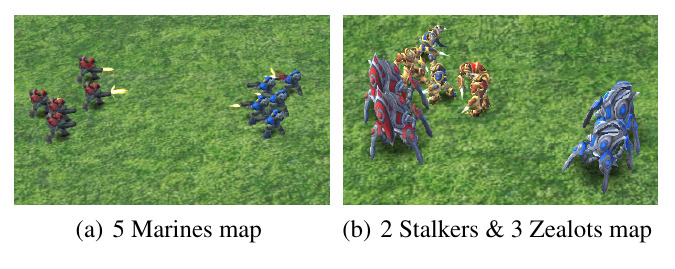
Figure 1. Decentralised unit micromanagement in StarCraft II, where each learning agent controls an individual unit. The goal is to coordinate behaviour across agents to defeat all enemy units.
图 1. 《星际争霸 II》中的分散式单位微操:每个学习智能体控制一个单位。目标是在智能体之间协调行为,以击败全部敌方单位。
1. Introduction
1. 引言
Reinforcement learning (RL) holds considerable promise to help address a variety of cooperative multi-agent problems, such as coordination of robot swarms (Hüttenrauch et al., 2017) and autonomous cars (Cao et al., 2012).
强化学习(reinforcement learning,RL)在解决多种合作式多智能体问题方面前景可观,例如机器人集群的协调(Hüttenrauch et al., 2017)以及自动驾驶汽车(Cao et al., 2012)。
In many such settings, partial observability and/or communication constraints necessitate the learning of decentralised policies, which condition only on the local action-observation history of each agent. Decentralised policies also naturally attenuate the problem that joint action spaces grow exponentially with the number of agents, often rendering the application of traditional single-agent RL methods impractical.
在许多此类设定中,部分可观测性和(或)通信约束使得必须学习分散策略,这类策略只以每个智能体的局部动作–观测历史为条件。分散策略也自然缓解了联合动作空间随智能体数目指数增长的问题,而这一增长常常使传统的单智能体强化学习方法难以应用。
Fortunately, decentralised policies can often be learned in a centralised fashion in a simulated or laboratory setting. This often grants access to additional state information, otherwise hidden from agents, and removes inter-agent communication constraints. The paradigm of centralised training with decentralised execution (Oliehoek et al., 2008; Kraemer & Banerjee, 2016) has recently attracted attention in the RL community (Jorge et al., 2016; Foerster et al., 2018). However, many challenges surrounding how to best exploit centralised training remain open.
幸运的是,分散策略常常可以在模拟器或实验室设定中以中心化的方式来学习。这通常还能获得对智能体而言原本隐藏的额外状态信息,并解除智能体之间的通信约束。中心化训练、分散执行(centralised training with decentralised execution)(Oliehoek et al., 2008; Kraemer & Banerjee, 2016)这一范式近来在强化学习社区引起关注(Jorge et al., 2016; Foerster et al., 2018)。不过,如何最好地利用中心化训练,仍有许多挑战尚未解决。
One of these challenges is how to represent and use the action-value function that most RL methods learn. On the one hand, properly capturing the effects of the agents’ actions requires a centralised action-value function that conditions on the global state and the joint action. On the other hand, such a function is difficult to learn when there are many agents and, even if it can be learned, offers no obvious way to extract decentralised policies that allow each agent to select only an individual action based on an individual observation.
其中一个挑战是,大多数强化学习方法所学习的动作价值函数该如何表示、如何使用。一方面,要正确刻画各智能体动作的效果,需要一个以全局状态和联合动作为条件的中心化动作价值函数 。另一方面,当智能体很多时,这样的函数很难学习;即便能够学会,也没有明显的办法从中提取分散策略,使每个智能体只根据各自的观测选择各自的动作。
The simplest option is to forgo a centralised action-value function and let each agent learn an individual action-value function independently, as in independent Q-learning (IQL) (Tan, 1993). However, this approach cannot explicitly represent interactions between the agents and may not converge, as each agent’s learning is confounded by the learning and exploration of others.
最简单的做法是放弃中心化的动作价值函数,让每个智能体 独立学习各自的动作价值函数 ,就像独立 Q 学习(independent Q-learning,IQL)(Tan, 1993)那样。不过,这种方法无法显式表示智能体之间的相互作用,也可能不收敛,因为每个智能体的学习会受到其他智能体的学习和探索的干扰。
At the other extreme, we can learn a fully centralised state-action value function and then use it to guide the optimisation of decentralised policies in an actor-critic framework, an approach taken by counterfactual multi-agent (COMA) policy gradients (Foerster et al., 2018), as well as work by Gupta et al. (2017). However, this requires on-policy learning, which can be sample-inefficient, and training the fully centralised critic becomes impractical when there are more than a handful of agents.
在另一极端,我们可以学习一个完全中心化的状态–动作价值函数 ,再在 Actor-Critic 框架中用它来指导分散策略的优化。反事实多智能体(counterfactual multi-agent,COMA)策略梯度(Foerster et al., 2018)以及 Gupta et al. (2017) 的工作采取的就是这一做法。不过,这需要同策略学习,样本效率可能较差;而且当智能体数目超过少数几个时,训练完全中心化的评论家会变得不现实。
In between these two extremes, we can learn a centralised but factored , an approach taken by value decomposition networks (VDN) (Sunehag et al., 2017). By representing as a sum of individual value functions that condition only on individual observations and actions, a decentralised policy arises simply from each agent selecting actions greedily with respect to its . However, VDN severely limits the complexity of centralised action-value functions that can be represented and ignores any extra state information available during training.
在这两个极端之间,我们可以学习一个中心化但又经过分解的 ,价值分解网络(value decomposition network,VDN)(Sunehag et al., 2017)采取的就是这一做法。把 表示成只以各自观测和动作为条件的个体价值函数 之和,分散策略就可以简单地由每个智能体对其 做贪心动作选择而得到。不过,VDN 严重限制了能够表示的中心化动作价值函数的复杂度,并且忽略了训练时可用的任何额外状态信息。
In this paper, we propose a new approach called QMIX which, like VDN, lies between the extremes of IQL and COMA, but can represent a much richer class of action-value functions. Key to our method is the insight that the full factorisation of VDN is not necessary to extract decentralised policies. Instead, we only need to ensure that a global performed on yields the same result as a set of individual operations performed on each . To this end, it suffices to enforce a monotonicity constraint on the relationship between and each :
本文提出一种名为 QMIX 的新方法:它与 VDN 一样处于 IQL 和 COMA 这两个极端之间,但能够表示更丰富的一类动作价值函数。我们方法的关键认识是:要提取分散策略,并不需要 VDN 那种完全的因子分解。相反,我们只需要保证对 做全局 的结果,与对每个 分别做 的结果相同。为此,只需对 与每个 之间的关系施加单调性约束:
QMIX consists of agent networks representing each , and a mixing network that combines them into , not as a simple sum as in VDN, but in a complex non-linear way that ensures consistency between the centralised and decentralised policies. At the same time, it enforces the constraint of (1) by restricting the mixing network to have positive weights. As a result, QMIX can represent complex centralised action-value functions with a factored representation that scales well in the number of agents and allows decentralised policies to be easily extracted via linear-time individual operations.
QMIX 由表示各个 的智能体网络,以及一个把它们组合成 的混合网络构成;组合方式不是 VDN 中那样简单的求和,而是一种复杂的非线性方式,以保证中心化策略与分散策略一致。与此同时,它通过把混合网络的权重限制为正,来强制满足 (1) 中的约束。因此,QMIX 能够用一种随智能体数目良好扩展的分解表示,来表示复杂的中心化动作价值函数,并可以通过线性时间的个体 操作方便地提取分散策略。
We evaluate QMIX on a range of unit micromanagement tasks built in StarCraft II. (Vinyals et al., 2017). Our experiments show that QMIX outperforms IQL and VDN, both in terms of absolute performance and learning speed. In particular, our method shows considerable performance gains on a task with heterogeneous agents. Moreover, our ablations show both the necessity of conditioning on the state information and the non-linear mixing of agent -values in order to achieve consistent performance across tasks.
我们在《星际争霸 II》中构建的一系列单位微操任务上评估 QMIX。(Vinyals et al., 2017)。实验表明,QMIX 在绝对性能和学习速度上都优于 IQL 和 VDN。尤其是,我们的方法在一个具有异质智能体的任务上有可观的性能提升。此外,消融实验表明,要对不同任务都取得稳定表现,既需要以状态信息为条件,也需要对智能体的 值做非线性混合。
StarCraft and StarCraft II are trademarks of Blizzard EntertainmentTM.
2. Related Work
2. 相关工作
Recent work in multi-agent RL has started moving from tabular methods (Yang & Gu, 2004; Busoniu et al., 2008) to deep learning methods that can tackle high-dimensional state and action spaces (Tampuu et al., 2017; Foerster et al., 2018; Peng et al., 2017). In this paper, we focus on cooperative settings.
多智能体强化学习的近期工作已开始从表格方法(Yang & Gu, 2004; Busoniu et al., 2008)转向能够处理高维状态和动作空间的深度学习方法(Tampuu et al., 2017; Foerster et al., 2018; Peng et al., 2017)。本文关注合作设定。
On the one hand, a natural approach to finding policies for a multi-agent system is to directly learn decentralised value functions or policies. Independent Q-learning (Tan, 1993) trains independent action-value functions for each agent using Q-learning (Watkins, 1989). (Tampuu et al., 2017) extend this approach to deep neural networks using DQN (Mnih et al., 2015). While trivially achieving decentralisation, these approaches are prone to instability arising from the non-stationarity of the environment induced by simultaneously learning and exploring agents. Omidshafiei et al. (2017) and Foerster et al. (2017) address learning stabilisation to some extent, but still learn decentralised value functions and do not allow for the inclusion of extra state information during training.
一方面,为多智能体系统寻找策略的一种自然做法,是直接学习分散的价值函数或策略。独立 Q 学习(Tan, 1993)用 Q 学习(Watkins, 1989)为每个智能体训练独立的动作价值函数。(Tampuu et al., 2017)用 DQN(Mnih et al., 2015)把这一做法扩展到深度神经网络。这些方法虽然轻易实现了分散化,但容易因多个智能体同时学习和探索而使环境变得非平稳,从而出现不稳定。Omidshafiei et al. (2017) 和 Foerster et al. (2017) 在一定程度上处理了学习稳定性,但仍然学习的是分散价值函数,并且不允许在训练时纳入额外的状态信息。
On the other hand, centralised learning of joint actions can naturally handle coordination problems and avoids non-stationarity, but is hard to scale, as the joint action space grows exponentially in the number of agents. Classical approaches to scalable centralised learning include coordination graphs (Guestrin et al., 2002), which exploit conditional independencies between agents by decomposing a global reward function into a sum of agent-local terms. Sparse cooperative Q-learning (Kok & Vlassis, 2006) is a tabular Q-learning algorithm that learns to coordinate the actions of a group of cooperative agents only in the states in which such coordination is necessary, encoding those dependencies in a coordination graph. These methods require the dependencies between agents to be pre-supplied, whereas we do not require such prior knowledge. Instead, we assume that each agent always contributes to the global reward, and learns the magnitude of its contribution in each state.
另一方面,对联合动作做中心化学习可以自然地处理协调问题,并避免非平稳,但很难扩展,因为联合动作空间随智能体数目指数增长。可扩展中心化学习的经典方法包括协调图(coordination graph)(Guestrin et al., 2002),它通过把全局奖励函数分解为若干智能体局部项之和,来利用智能体之间的条件独立性。稀疏合作 Q 学习(Kok & Vlassis, 2006)是一种表格 Q 学习算法,只在有必要协调的那些状态中学习一组合作智能体的动作协调,并把这些依赖编码进协调图。这些方法要求预先给出智能体之间的依赖,而我们不需要这类先验知识。相反,我们假定每个智能体始终对全局奖励有贡献,并学习它在每个状态下贡献的大小。
More recent approaches for centralised learning require even more communication during execution: CommNet (Sukhbaatar et al., 2016) uses a centralised network architecture to exchange information between agents. BicNet (Peng et al., 2017) uses bidirectional RNNs to exchange information between agents in an actor-critic setting. This approach additionally requires estimating individual agent rewards.
更新一些的中心化学习方法在执行时甚至需要更多通信:CommNet(Sukhbaatar et al., 2016)用中心化的网络结构在智能体之间交换信息。BicNet(Peng et al., 2017)在 Actor-Critic 设定中用双向 RNN 在智能体之间交换信息。这种方法还需要估计每个智能体各自的奖励。
Some work has developed hybrid approaches that exploit the setting of centralised learning with fully decentralised execution. COMA (Foerster et al., 2018) uses a centralised critic to train decentralised actors, estimating a counterfactual advantage function for each agent in order to address multi-agent credit assignment. Similarly, Gupta et al. (2017) present a centralised actor-critic algorithm with per-agent critics, which scales better with the number of agents but mitigates the advantages of centralisation. Lowe et al. (2017) learn a centralised critic for each agent and apply this to competitive games with continuous action spaces. These approaches use on-policy policy gradient learning, which can have poor sample efficiency and is prone to getting stuck in sub-optimal local minima.
也有工作发展出利用中心化学习、完全分散执行这一设定的混合方法。COMA(Foerster et al., 2018)用中心化评论家训练分散的执行者,为每个智能体估计一个反事实优势函数,以处理多智能体信用分配。类似地,Gupta et al. (2017) 提出一种带有每个智能体各自评论家的中心化 Actor-Critic 算法,它随智能体数目扩展得更好,但削弱了中心化的优势。Lowe et al. (2017) 为每个智能体学习一个中心化评论家,并把这一做法用到具有连续动作空间的竞争游戏中。这些方法使用同策略的策略梯度学习,样本效率可能较差,也容易陷入次优的局部极小。
Sunehag et al. (2017) propose value decomposition networks (VDN), which allow for centralised value-function learning with decentralised execution. Their algorithm decomposes a central state-action value function into a sum of individual agent terms. This corresponds to the use of a degenerate fully disconnected coordination graph. VDN does not make use of additional state information during training and can represent only a limited class of centralised action-value functions.
Sunehag et al. (2017) 提出价值分解网络(VDN),它允许中心化地学习价值函数,同时分散执行。他们的算法把一个中心的状态–动作价值函数分解为各个智能体项之和。这相当于使用一个退化的、完全无连接的协调图。VDN 在训练时不利用额外的状态信息,只能表示有限的一类中心化动作价值函数。
A number of papers have established unit micromanagement in StarCraft as a benchmark for deep multi-agent RL. Usunier et al. (2017) present an algorithm using a centralised greedy MDP and first-order optimisation. Peng et al. (2017) also evaluate their methods on StarCraft. However, neither requires decentralised execution. Similar to our setup is the work of Foerster et al. (2017), who evaluate replay stabilisation methods for IQL on combat scenarios with up to five agents. Foerster et al. (2018) also uses this setting. In this paper, we construct unit micromanagement tasks in the StarCraft II Learning Environment (SC2LE) (Vinyals et al., 2017) as opposed to StarCraft, because it is actively supported by the game developers and SC2LE offers a more stable testing environment.
已有若干论文把《星际争霸》中的单位微操确立为深度多智能体强化学习的基准。Usunier et al. (2017) 提出一种使用中心化贪心 MDP 和一阶优化的算法。Peng et al. (2017) 也在《星际争霸》上评估他们的方法。不过,这两者都不要求分散执行。与我们设定相近的是 Foerster et al. (2017) 的工作,他们在最多五个智能体的战斗场景上评估用于 IQL 的回放稳定方法。Foerster et al. (2018) 也使用这一设定。本文在《星际争霸 II》学习环境(StarCraft II Learning Environment,SC2LE)(Vinyals et al., 2017)中构建单位微操任务,而不是在《星际争霸》中,因为它得到游戏开发者的持续支持,并且 SC2LE 提供更稳定的测试环境。
QMIX relies on a neural network to transform the centralised state into the weights of another neural network, in a manner reminiscent of hypernetworks (Ha et al., 2017). This second neural network is constrained to be monotonic with respect to its inputs by keeping its weights positive. Dugas et al. (2009) investigate such functional restrictions for neural networks.
QMIX 依赖一个神经网络,把中心化状态变换成另一个神经网络的权重,这种方式让人联想到超网络(hypernetwork)(Ha et al., 2017)。这第二个神经网络通过保持权重为正,被约束为对其输入单调。Dugas et al. (2009) 研究过神经网络上的这类函数限制。
3. Background
3. 背景
A fully cooperative multi-agent task can be described as a Dec-POMDP (Oliehoek & Amato, 2016) consisting of a tuple . describes the true state of the environment. At each time step, each agent chooses an action , forming a joint action . This causes a transition on the environment according to the state transition function . All agents share the same reward function and is a discount factor.
一个完全合作的多智能体任务可以描述为一个 Dec-POMDP(Oliehoek & Amato, 2016),由元组 构成。 描述环境的真实状态。在每个时间步,每个智能体 选择一个动作 ,形成联合动作 。这会依据状态转移函数 引起环境转移。所有智能体共享同一个奖励函数 , 是折扣因子。
We consider a partially observable scenario in which each agent draws individual observations according to observation function . Each agent has an action-observation history , on which it conditions a stochastic policy . The joint policy has a joint action-value function: , where is the discounted return.
我们考虑部分可观测的情形:每个智能体依据观测函数 得到各自的观测 。每个智能体有一个动作–观测历史 ,并据此条件化一个随机策略 。联合策略 具有联合动作价值函数:,其中 是折扣回报。
Although training is centralised, execution is decentralised, i.e., the learning algorithm has access to all local action-observation histories and global state , but each agent’s learnt policy can condition only on its own action-observation history .
尽管训练是中心化的,执行却是分散的,也就是说,学习算法可以获得全部局部动作–观测历史 以及全局状态 ,但每个智能体学到的策略只能以自己的动作–观测历史 为条件。
3.1. Deep Q-Learning
3.1. 深度 Q 学习
Deep Q-learning represents the action-value function with a deep neural network parameterised by . Deep Q-networks (DQNs) (Mnih et al., 2015) use a replay memory to store the transition tuple , where the state is observed after taking the action in state and receiving reward . is learnt by sampling batches of transitions from the replay memory and minimising the squared TD error:
深度 Q 学习用由 参数化的深度神经网络来表示动作价值函数。深度 Q 网络(DQN)(Mnih et al., 2015)用回放记忆存储转移元组 ,其中状态 是在状态 采取动作 并获得奖励 之后观测到的。通过从回放记忆中采样大小为 的转移批次,并最小化平方时序差分(TD)误差,来学习 :
where . are the parameters of a target network that are periodically copied from and kept constant for a number of iterations.
其中 。 是目标网络的参数,它们会周期性地从 复制过来,并在若干次迭代中保持不变。
3.2. Deep Recurrent Q-Learning
3.2. 深度循环 Q 学习
In partially observable settings, agents can benefit from conditioning on their entire action-observation history. Hausknecht & Stone (2015) propose Deep Recurrent Q-networks (DRQN) that make use of recurrent neural networks. Typically, gated architectures such as LSTM (Hochreiter & Schmidhuber, 1997) or GRU (Chung et al., 2014) are used to facilitate learning over longer timescales.
在部分可观测设定中,智能体可以受益于以完整的动作–观测历史为条件。Hausknecht & Stone (2015) 提出使用循环神经网络的深度循环 Q 网络(Deep Recurrent Q-network,DRQN)。通常会使用 LSTM(Hochreiter & Schmidhuber, 1997)或 GRU(Chung et al., 2014)这类门控结构,以便在更长的时间尺度上学习。
3.3. Independent Q-Learning
3.3. 独立 Q 学习
Perhaps the most commonly applied method in multi-agent learning is independent Q-learning (IQL) (Tan, 1993), which decomposes a multi-agent problem into a collection of simultaneous single-agent problems that share the same environment. This approach does not address the non-stationarity introduced due to the changing policies of the learning agents, and thus, unlike Q-learning, has no convergence guarantees even in the limit of infinite exploration. In practice, nevertheless, IQL commonly serves as a surprisingly strong benchmark even in mixed and competitive games (Tampuu et al., 2017; Leibo et al., 2017).
多智能体学习中最常使用的方法,或许就是独立 Q 学习(IQL)(Tan, 1993):它把一个多智能体问题分解成一组共享同一环境的、同时进行的单智能体问题。这种方法并不处理因学习智能体策略变化而引入的非平稳,因此与 Q 学习不同,即便在探索趋于无穷的极限下也没有收敛保证。尽管如此,在实践中,即便在混合和竞争博弈里,IQL 也常常是一个出人意料地强的基准(Tampuu et al., 2017; Leibo et al., 2017)。
3.4. Value Decomposition Networks
3.4. 价值分解网络
By contrast, value decomposition networks (VDNs) (Sunehag et al., 2017) aim to learn a joint action-value function , where is a joint action-observation history and is a joint action. It represents as a sum of individual value functions , one for each agent , that condition only on individual action-observation histories:
相比之下,价值分解网络(VDN)(Sunehag et al., 2017)旨在学习联合动作价值函数 ,其中 是联合动作–观测历史, 是联合动作。它把 表示成个体价值函数 之和,每个智能体 一个,并且这些函数只以各自的动作–观测历史为条件:
Strictly speaking, each is a utility function (Guestrin et al., 2002) and not a value function since by itself it does not estimate an expected return. However, for terminological simplicity we refer to both and as value functions.
严格来说,每个 是一个效用函数(Guestrin et al., 2002),而不是价值函数,因为它本身并不估计期望回报。不过,为术语简单起见,我们把 和 都称为价值函数。
The loss function for VDN is equivalent to (2), where is replaced by . An advantage of this representation is that a decentralised policy arises simply from each agent performing greedy action selection with respect to its .
VDN 的损失函数与 (2) 等价,只需把 换成 。这种表示的一个优点是:分散策略可以简单地由每个智能体对其 做贪心动作选择而产生。
4. QMIX
In this section, we propose a new approach called QMIX which, like VDN, lies between the extremes of IQL and centralised Q-learning, but can represent a much richer class of action-value functions.
在本节中,我们提出一种名为 QMIX 的新方法:它与 VDN 一样处于 IQL 和中心化 Q 学习这两个极端之间,但能够表示更丰富的一类动作价值函数。
Key to our method is the insight that the full factorisation of VDN is not necessary in order to be able to extract decentralised policies that are fully consistent with their centralised counterpart. Instead, for consistency we only need to ensure that a global performed on yields the same result as a set of individual operations performed on each :
我们方法的关键认识是:要提取与其中心化对应物完全一致的分散策略,并不需要 VDN 那种完全的因子分解。相反,为了一致性,我们只需要保证对 做全局 的结果,与对每个 分别做 的结果相同:
This allows each agent to participate in a decentralised execution solely by choosing greedy actions with respect to its . As a side effect, if (4) is satisfied, then taking the of , required by off-policy learning updates, is trivially tractable.
这使得每个智能体 只需对其 选择贪心动作,就可以参与分散执行。作为附带结果,若 (4) 成立,则离策略学习更新中需要对 取 的步骤也变得显然可处理。
VDN’s representation is sufficient to satisfy (4). However, QMIX is based on the observation that this representation can be generalised to the larger family of monotonic functions that are also sufficient but not necessary to satisfy (4). Monotonicity can be enforced through a constraint on the relationship between and each :
VDN 的表示足以满足 (4)。不过,QMIX 基于这样的观察:这一表示可以推广到更大的一类单调函数,它们对于满足 (4) 也是充分但非必要的。单调性可以通过对 与每个 之间关系的约束来强制:
To enforce (5), QMIX represents using an architecture consisting of agent networks, a mixing network, and a set of hypernetworks (Ha et al., 2017). Figure 2 illustrates the overall setup.
为强制满足 (5),QMIX 用由智能体网络、混合网络以及一组超网络(Ha et al., 2017)构成的架构来表示 。图 2 给出了整体设置。
For each agent , there is one agent network that represents its individual value function . We represent agent networks as DRQNs that receive the current individual observation and the last action as input at each time step, as shown in Figure 2c.
对每个智能体 ,都有一个智能体网络来表示它的个体价值函数 。我们把智能体网络表示成 DRQN,在每个时间步接收当前的个体观测 以及上一步动作 作为输入,如图 2c 所示。
The mixing network is a feed-forward neural network that takes the agent network outputs as input and mixes them monotonically, producing the values of , as shown in Figure 2a. To enforce the monotonicity constraint of (5), the weights (but not the biases) of the mixing network are restricted to be non-negative. This allows the mixing network to approximate any monotonic function arbitrarily closely (Dugas et al., 2009).
混合网络是一个前馈神经网络,它以智能体网络的输出为输入,并把它们单调地混合,产生 的值,如图 2a 所示。为强制满足 (5) 的单调性约束,混合网络的权重(但不包括偏置)被限制为非负。这使得混合网络可以任意逼近任何单调函数(Dugas et al., 2009)。
The weights of the mixing network are produced by separate hypernetworks. Each hypernetwork takes the state as input and generates the weights of one layer of the mixing network. Each hypernetwork consists of a single linear layer, followed by an absolute activation function, to ensure that the mixing network weights are non-negative. The output of the hypernetwork is then a vector, which is reshaped into a matrix of appropriate size. The biases are produced in the same manner but are not restricted to being non-negative. The final bias is produced by a 2 layer hypernetwork with a ReLU non-linearity. Figure 2a illustrates the mixing network and the hypernetworks.
混合网络的权重由各自独立的超网络产生。每个超网络以状态 为输入,生成混合网络某一层的权重。每个超网络由一个线性层后接绝对值激活函数构成,以保证混合网络的权重非负。超网络的输出是一个向量,再被重塑成适当大小的矩阵。偏置用同样的方式产生,但不受非负限制。最后一项偏置由一个带 ReLU 非线性的两层超网络产生。图 2a 展示了混合网络和超网络。
The state is used by the hypernetworks rather than being passed directly into the mixing network because is allowed to depend on the extra state information in non-monotonic ways. Thus, it would be overly constraining to pass some function of through the monotonic network alongside the per-agent values. Instead, the use of hypernetworks makes it possible to condition the weights of the monotonic network on in an arbitrary way, thus integrating the full state into the joint action-value estimates as flexibly as possible.
状态由超网络使用,而不是被直接送进混合网络,因为允许 以非单调的方式依赖额外的状态信息。因此,若把 的某个函数与各智能体价值一道送进单调网络,约束就会过强。相反,使用超网络可以任意地让单调网络的权重以 为条件,从而尽可能灵活地把完整状态 纳入联合动作价值的估计之中。
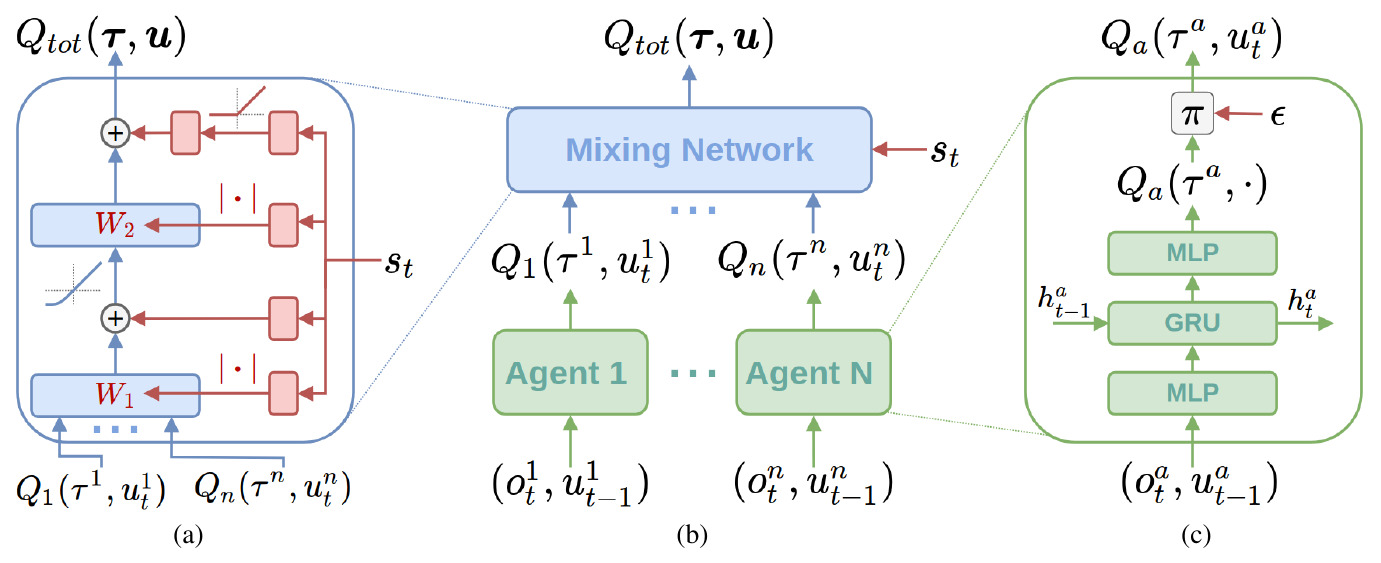
Figure 2. (a) Mixing network structure. In red are the hypernetworks that produce the weights and biases for mixing network layers shown in blue. (b) The overall QMIX architecture. (c) Agent network structure. Best viewed in colour.
图 2. (a) 混合网络结构。红色是超网络,它们为蓝色所示的混合网络层产生权重和偏置。(b) QMIX 的整体架构。(c) 智能体网络结构。彩色阅读效果更好。
QMIX is trained end-to-end to minimise the following loss:
QMIX 端到端训练,以最小化如下损失:
where is the batch size of transitions sampled from the replay buffer, and are the parameters of a target network as in DQN. (6) is analogous to the standard DQN loss of (2). Since (4) holds, we can perform the maximisation of in time linear in the number of agents (as opposed to scaling exponentially in the worst case).
其中 是从回放缓冲中采样的转移批次大小,, 与 DQN 中一样是目标网络的参数。(6) 类似于 (2) 中的标准 DQN 损失。由于 (4) 成立,我们可以在随智能体数目线性的时间内完成对 的最大化(而不是在最坏情况下按指数扩展)。
4.1. Representational Complexity
4.1. 表示复杂度
The value function class representable with QMIX includes any value function that can be factored into a non-linear monotonic combination of the agents’ individual value functions in the fully observable setting. This expands upon the linear monotonic value functions that are representable by VDN. However, the constraint in (5) prevents QMIX from representing value functions that do not factorise in such a manner.
QMIX 能够表示的价值函数类,包括在完全可观测设定下可分解为各智能体个体价值函数之非线性单调组合的任何价值函数。这扩展了 VDN 能够表示的线性单调价值函数。不过,(5) 中的约束使 QMIX 无法表示不能按这种方式分解的价值函数。
Intuitively, any value function for which an agent’s best action depends on the actions of the other agents at the same time step will not factorise appropriately, and hence cannot be represented perfectly by QMIX. However, QMIX can approximate such value functions more accurately than VDN. Furthermore, it can take advantage of the extra state information available during training, which we show empirically. A more detailed discussion on the representation complexity is available in the supplementary materials.
直观上,若某个价值函数中一个智能体的最佳动作依赖于同一时间步其他智能体的动作,它就不会按这种方式恰当分解,因而不能被 QMIX 完美表示。不过,QMIX 仍能比 VDN 更准确地逼近这类价值函数。此外,它还能利用训练时可用的额外状态信息,我们会用实验表明这一点。关于表示复杂度的更详细讨论见补充材料。
5. Two-Step Game
5. 两步博弈
To illustrate the effects of representational complexity of VDN and QMIX, we devise a simple two-step cooperative matrix game for two agents.
为说明 VDN 和 QMIX 在表示复杂度上的影响,我们设计了一个简单的两步合作矩阵博弈,供两个智能体进行。
At the first step, Agent 1 chooses which of the two matrix games to play in the next timestep. For the first time step, the actions of Agent 2 have no effect. In the second step, both agents choose an action and receive a global reward according to the payoff matrices depicted in Table 1.
在第一步,智能体 1 选择下一时间步要玩两个矩阵博弈中的哪一个。在第一个时间步,智能体 2 的动作没有效果。在第二步,两个智能体都选择一个动作,并根据表 1 中的收益矩阵获得全局奖励。
State 2A
| Agent 2 | |||
|---|---|---|---|
| Agent 1 | 7 | 7 | |
| 7 | 7 |
State 2B
| Agent 2 | |||
|---|---|---|---|
| Agent 1 | 0 | 1 | |
| 1 | 8 |
Table 1. Payoff matrices of the two-step game after the Agent 1 chose the first action. Action A takes the agents to State 2A and action B takes them to State 2B.
状态 2A
| Agent 2 | |||
|---|---|---|---|
| Agent 1 | 7 | 7 | |
| 7 | 7 |
状态 2B
| Agent 2 | |||
|---|---|---|---|
| Agent 1 | 0 | 1 | |
| 1 | 8 |
表 1. 智能体 1 选择第一步动作之后,两步博弈的收益矩阵。动作 A 把智能体带到状态 2A,动作 B 把它们带到状态 2B。
We train VDN and QMIX on this task for 5000 episodes and examine the final learned value functions in the limit of full exploration (). Full exploration ensures that each method is guaranteed to eventually explore all available game states, such that the representational capacity of the state-action value function approximation remains the only limitation. The full details of the architecture and hyperparameters used are provided in the supplementary material.
我们在这一任务上把 VDN 和 QMIX 训练 5000 个回合,并在充分探索的极限下()考察最终学到的价值函数。充分探索保证每种方法最终都会探索到所有可用的博弈状态,从而使状态–动作价值函数近似的表示能力成为唯一的限制。所用架构和超参数的完整细节见补充材料。
(a) VDN
| State 1 | State 2A | State 2B | ||||
|---|---|---|---|---|---|---|
| 6.94 | 6.94 | 6.99 | 7.02 | -1.87 | 2.31 | |
| 6.35 | 6.36 | 6.99 | 7.02 | 2.33 | 6.51 |
(b) QMIX
| State 1 | State 2A | State 2B | ||||
|---|---|---|---|---|---|---|
| 6.93 | 6.93 | 7.00 | 7.00 | 0.00 | 1.00 | |
| 7.92 | 7.92 | 7.00 | 7.00 | 1.00 | 8.00 |
Table 2. on the two-step game for (a) VDN and (b) QMIX.
(a) VDN
| State 1 | State 2A | State 2B | ||||
|---|---|---|---|---|---|---|
| 6.94 | 6.94 | 6.99 | 7.02 | -1.87 | 2.31 | |
| 6.35 | 6.36 | 6.99 | 7.02 | 2.33 | 6.51 |
(b) QMIX
| State 1 | State 2A | State 2B | ||||
|---|---|---|---|---|---|---|
| 6.93 | 6.93 | 7.00 | 7.00 | 0.00 | 1.00 | |
| 7.92 | 7.92 | 7.00 | 7.00 | 1.00 | 8.00 |
表 2. 两步博弈上的 :(a) 为 VDN,(b) 为 QMIX。
Table 2, which shows the learned values for , demonstrates that QMIX’s higher representational capacity allows it to accurately represent the joint-action value function whereas VDN cannot. This directly translates into VDN learning the suboptimal strategy of selecting Action A at the first step and receiving a reward of 7, whereas QMIX recovers the optimal strategy from its learnt joint-action values and receives a reward of 8.
表 2 给出了学到的 值,表明 QMIX 更高的表示能力使它能够准确表示联合动作价值函数,而 VDN 做不到。这直接导致 VDN 学到在第一步选择动作 A、从而获得奖励 7 的次优策略,而 QMIX 从学到的联合动作价值中恢复了最优策略,获得奖励 8。
6. Experimental Setup
6. 实验设置
In this section, we describe the decentralised StarCraft II micromanagement problems to which we apply QMIX and the ablations we consider.
在本节中,我们描述将 QMIX 应用于其中的分散式《星际争霸 II》微操问题,以及我们所考虑的消融。
6.1. Decentralised StarCraft II Micromanagement
6.1. 分散式《星际争霸 II》微操
Real-time strategy (RTS) games have recently emerged as challenging benchmarks for the RL community. StarCraft, in particular, offers a great opportunity to tackle competitive and cooperative multi-agent problems. Units in StarCraft have a rich set of complex micro-actions that allow the learning of complex interactions between collaborating agents.
即时战略(RTS)游戏近来已成为强化学习社区具有挑战性的基准。尤其是《星际争霸》,为处理竞争性和合作性的多智能体问题提供了很好的机会。《星际争霸》中的单位拥有丰富而复杂的微操动作,从而可以学习协作智能体之间复杂的相互作用。
Previous work (Usunier et al., 2017; Foerster et al., 2018; Peng et al., 2017) applied RL to the original version of StarCraft: BW, which made use of the standard API or related wrappers (Synnaeve et al., 2016). We perform our experiments on the StarCraft II Learning Environment (SC2LE) (Vinyals et al., 2017), which is based on the second version of the game. Because it is supported by the developers of the game, SC2LE mitigates many of the practical difficulties in using StarCraft as an RL platform, such as the dependence on complicated APIs and external emulation software.
以往工作(Usunier et al., 2017; Foerster et al., 2018; Peng et al., 2017)把强化学习用在原版《星际争霸:母巢之战》(StarCraft: BW)上,借助的是标准 API 或相关封装(Synnaeve et al., 2016)。我们的实验在基于第二代游戏的《星际争霸 II》学习环境(SC2LE)(Vinyals et al., 2017)上进行。由于得到游戏开发者的支持,SC2LE 缓解了把《星际争霸》当作强化学习平台时的许多实际困难,例如对复杂 API 和外部模拟软件的依赖。
In this work, we focus on the decentralised micromanagement problem in StarCraft II, in which each of the learning agents controls an individual army unit. We consider combat scenarios where two groups of identical units are placed symmetrically on the map. The units of the first, allied, group are controlled by the decentralised agents. The enemy units are controlled by a built-in StarCraft II AI, which makes use of handcrafted heuristics. The initial placement of units within the groups varies across episodes. The difficulty of the computer AI controlling the enemy units is set to medium. At the beginning of each episode, the enemy units are ordered to attack the allies. We compare our results on a set of maps where each unit group consists of 3 Marines (3m), 5 Marines (5m), 8 Marines (8m), 2 Stalkers and 3 Zealots (2s_3z), 3 Stalkers and 5 Zealots (3s_5z), or 1 Colossus, 3 Stalkers and 5 Zealots (1c_3s_5z).
在这项工作中,我们关注《星际争霸 II》中的分散式微操问题:每个学习智能体控制一个己方作战单位。我们考虑的战斗场景是,两组相同的单位被对称地放置在地图上。第一组、也就是盟军单位,由分散的智能体控制。敌方单位由内置的《星际争霸 II》AI 控制,该 AI 使用手工设计的启发式。组内单位的初始位置在不同回合之间会变化。控制敌方单位的电脑 AI 难度设为中等。每个回合开始时,敌方单位受命进攻盟军。我们在一组地图上比较结果,每组单位分别为:3 个机枪兵(3m)、5 个机枪兵(5m)、8 个机枪兵(8m)、2 个追猎者和 3 个狂热者(2s_3z)、3 个追猎者和 5 个狂热者(3s_5z),或 1 个巨像、3 个追猎者和 5 个狂热者(1c_3s_5z)。
Similar to the work of Foerster et al. (2018), the action space of agents consists of the following set of discrete actions: move[direction], attack[enemy_id], stop, and noop. Agents can only move in four directions: north, south, east, or west. A unit is allowed to perform the attack[enemy_id] action only if the enemy is within its shooting range. This facilitates the decentralisation of the problem and prohibits the usage of the attack-move macro-actions that are integrated into the game. Furthermore, we disable the following unit behaviour when idle: responding to enemy fire and attacking enemies if they are in range. By doing so, we force the agents to explore in order to find the optimal combat strategy themselves, rather than relying on built-in StarCraft II utilities.
与 Foerster et al. (2018) 的工作类似,智能体的动作空间由如下离散动作组成:move[direction]、attack[enemy_id]、stop 以及 noop。智能体只能向四个方向移动:北、南、东或西。只有当敌人位于射击范围内时,单位才被允许执行 attack[enemy_id] 动作。这有助于问题的分散化,并禁止使用游戏中集成的“攻击–移动”宏动作。此外,我们禁用了单位在空闲时的如下行为:对敌方开火还击,以及在敌人进入射程时主动攻击。这样做是为了迫使智能体通过探索自己找到最优战斗策略,而不是依赖《星际争霸 II》的内置功能。
Partial observability is achieved by the introduction of unit sight range, which restricts the agents from receiving information about allied or enemy units that are out of range. Moreover, agents can only observe others if they are alive and cannot distinguish between units that are dead or out of range.
部分可观测性通过引入单位视野范围来实现,它限制智能体无法获得超出范围的盟军或敌方单位的信息。此外,智能体只能观测到仍然存活的其他单位,并且无法区分一个单位是已经死亡还是在视野之外。
At each time step, the agents receive a joint reward equal to the total damage dealt on the enemy units. In addition, agents receive a bonus of 10 points after killing each opponent, and 200 points after killing all opponents. These rewards are all normalised to ensure the maximum cumulative reward achievable in an episode is 20.
在每个时间步,智能体获得的联合奖励等于对敌方单位造成的总伤害。此外,每击杀一个对手,智能体获得 10 点奖励;击杀全部对手后,再获得 200 点。这些奖励都经过归一化,以确保一个回合内可获得的累计奖励上限为 20。
The full details of the environmental setup, architecture and training are available in the supplementary material.
环境设置、架构和训练的完整细节见补充材料。
6.2. Ablations
6.2. 消融
We perform ablation experiments in order to investigate the influence of the inclusion of extra state information and the necessity of non-linear transformations in the mixing network.
我们进行消融实验,以考察纳入额外状态信息的影响,以及混合网络中非线性变换是否必要。
First, we analyse the significance of extra state information on the mixing network by comparing against QMIX without hypernetworks. Thus, the weights and biases of the mixing network are learned in the standard way, without conditioning on the state. We refer to this method as QMIX-NS. We take the absolute value of the weights in order to enforce the monotonicity constraint.
首先,我们通过与不使用超网络的 QMIX 相比较,分析额外状态信息对混合网络的重要性。于是,混合网络的权重和偏置按标准方式学习,不以状态为条件。我们称这种方法为 QMIX-NS。为强制满足单调性约束,我们对权重取绝对值。
Second, we investigate the necessity of non-linear mixing by removing the hidden layer of the mixing network. This method can be thought of as an extension of VDN that uses the state to perform a weighted sum over values. We call this method QMIX-Lin.
其次,我们通过去掉混合网络的隐藏层,考察非线性混合是否必要。这种方法可以看成 VDN 的一种扩展:它使用状态 对各个 值做加权求和。我们称这种方法为 QMIX-Lin。
Third, we investigate the significance of utilising the state in comparison to the non-linear mixing. To do this we extend VDN by adding a state-dependent term to the sum of the agent’s -Values. This state-dependent term is produced by a network with a single hidden layer of 32 units and a ReLU non-linearity, taking in the state as input (the same as the hypernetwork producing the final bias in QMIX). We refer to this method as VDN-S.
第三,我们考察利用状态 相对于非线性混合的重要性。为此,我们扩展 VDN,在各智能体 值之和上再加一个依赖状态的项。这一项由一个带 32 个单元的单隐藏层和 ReLU 非线性的网络产生,输入为状态 (与 QMIX 中产生最后一项偏置的超网络相同)。我们称这种方法为 VDN-S。
We also show the performance of a non-learning heuristic-based algorithm with full observability, where each agent attacks the closest enemy and continues attacking the same target until the unit dies. Afterwards, the agent starts attacking the nearest enemy and so forth.
我们还给出一种具有完全可观测性、不进行学习的基于启发式的算法的表现:每个智能体攻击最近的敌人,并持续攻击同一目标直到该单位死亡。之后,该智能体再开始攻击最近的敌人,依此类推。
7. Results
7. 结果
In order to evaluate each method’s performance, we adopt the following evaluation procedure: for each run of a method, we pause training every 100 episodes and run 20 independent episodes with each agent performing greedy decentralised action selection. The percentage of these episodes in which the method defeats all enemy units within the time limit is referred to as the test win rate.
为评估每种方法的表现,我们采用如下评估程序:对方法的每一次运行,每 100 个训练回合暂停一次,并独立运行 20 个回合,其中每个智能体做贪心的分散动作选择。在这些回合中,该方法在时限内击败全部敌方单位的比例,称为测试胜率。
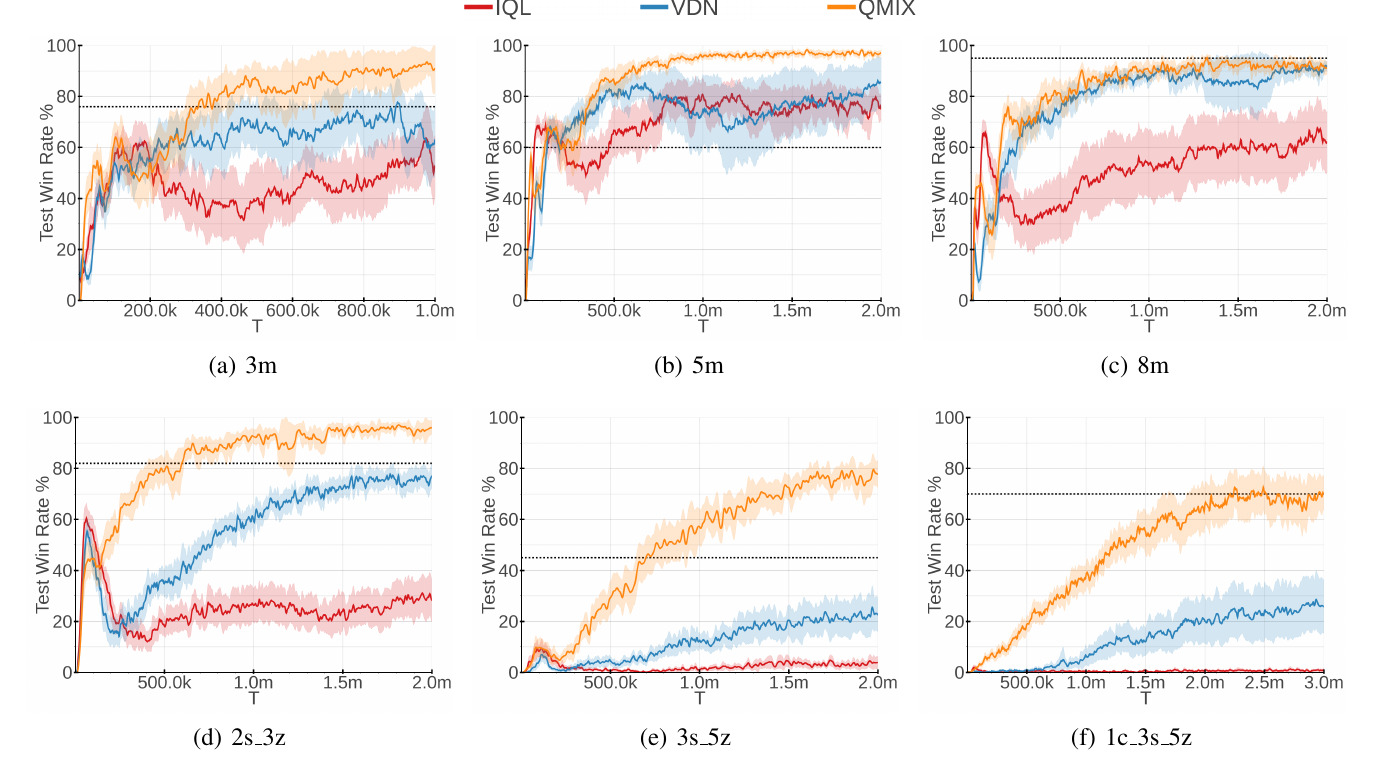
Figure 3. Win rates for IQL, VDN, and QMIX on six different combat maps. The performance of the heuristic-based algorithm is shown as a dashed line.
图 3. IQL、VDN 和 QMIX 在六张不同战斗地图上的胜率。基于启发式的算法的表现用虚线表示。
Figures 3 and 4 plot the mean test win rate across 20 runs for each method on selected maps, together with 95% confidence intervals. The graphs for all methods on all maps are available in the supplementary material.
图 3 和图 4 绘出每种方法在选定地图上 20 次运行的平均测试胜率,以及 95% 置信区间。所有方法在全部地图上的曲线见补充材料。
7.1. Main Results
7.1. 主要结果
In all scenarios, IQL fails to learn a policy that consistently defeats the enemy. In addition, the training is highly unstable due to the non-stationarity of the environment which arises due to the other agents changing their behaviour during training.
在所有场景中,IQL 都未能学会一种能稳定击败敌人的策略。此外,由于其他智能体在训练中改变行为而使环境变得非平稳,训练也高度不稳定。
The benefits of learning the joint action-value function can be demonstrated by VDN’s superior performance over IQL in all scenarios. VDN is able to more consistently learn basic coordinated behaviour, in the form of focus firing which allows it to win the majority of its encounters on the 5m and 8m maps. On the 8m map, this simple strategy is sufficient for good performance, as evidenced by the extremely high win rate of the heuristic-based algorithm, and explains the performance parity with QMIX. However, on the 3m task, which requires more fine-grained control, it is unable to learn to consistently defeat the enemy.
学习联合动作价值函数的好处,可以由 VDN 在所有场景上都优于 IQL 来说明。VDN 能够更稳定地学会基本的协调行为,其形式是集火,这使它在 5m 和 8m 地图上赢得了大多数遭遇战。在 8m 地图上,这种简单策略已足以获得良好表现,基于启发式的算法极高的胜率也说明了这一点,并解释了它与 QMIX 表现相当的原因。不过,在需要更精细控制的 3m 任务上,它无法学会稳定地击败敌人。
QMIX is noticeably the strongest performer on all of the maps, in particular on the maps with hetergenous agent types. The largest performance gap can be seen in the 3s_5z and 1c_3s_5z maps, where VDN is unable to reach the performance of the simple heuristic. The superior representational capacity of QMIX combined with the state information presents a clear benefit over a more restricted linear decomposition.
QMIX 在全部地图上都明显是表现最强的,尤其是在具有异质(hetergenous)智能体类型的地图上。最大的性能差距出现在 3s_5z 和 1c_3s_5z 地图上,在那里 VDN 达不到这一简单启发式的水平。QMIX 更强的表示能力再结合状态信息,相对于更受限制的线性分解,呈现出明显的优势。
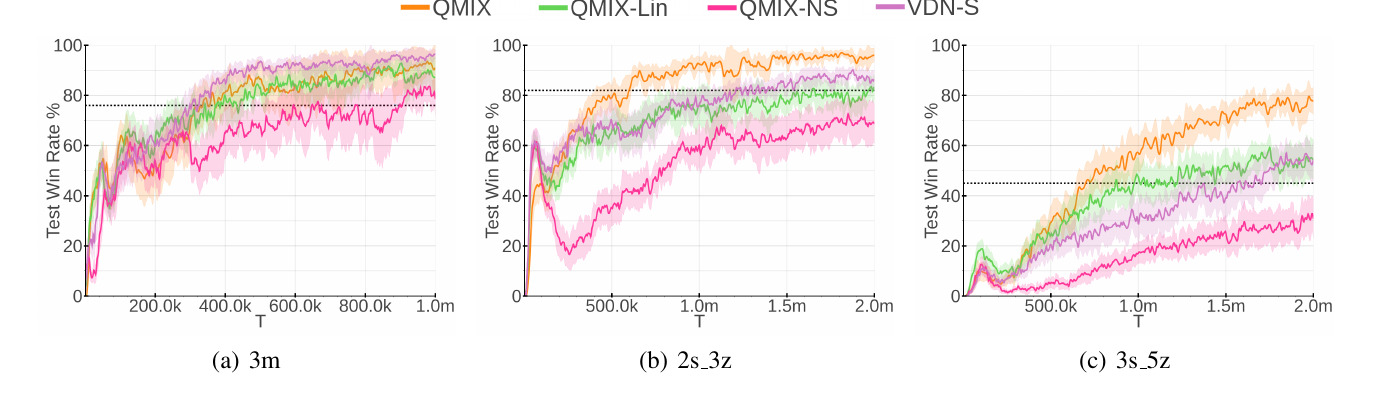
Figure 4. Win rates for QMIX and ablations on 3m, 2s_3z and 3s_5z maps.
图 4. QMIX 及其消融在 3m、2s_3z 和 3s_5z 地图上的胜率。
7.2. Ablation Results
7.2. 消融结果
Our additional ablation experiments reveal that QMIX outperforms, or is competitive with, all of its ablations discussed in Section 6.2. Figure 4a shows that non-linear value function factorisation is not always required on a map with homogeneous agent types. However, the additional complexity introduced through the extra hidden layer does not slow down learning. In contrast, Figures 4b and 4c show that on a map with heterogeneous agent types a combination of both central state information and non-linear value function factorisation is required to achieve good performance. QMIX-NS performs on par or slightly better than VDN in both scenarios, which suggests that a non-linear decomposition is not always beneficial when not conditioning on the central state in complex scenarios. Additionally, the performance of VDN-S compared to QMIX-Lin shows the necessity of allowing a non-linear mixing in order to fully leverage central state information.
额外的消融实验表明,QMIX 优于、或至少不弱于第 6.2 节讨论的全部消融。图 4a 显示,在智能体类型同质的地图上,非线性的价值函数分解并非总是必需。不过,额外隐藏层带来的附加复杂度并没有拖慢学习。相比之下,图 4b 和 4c 显示,在智能体类型异质的地图上,要取得良好表现,需要同时具备中心状态信息和非线性价值函数分解。QMIX-NS 在两种场景中都与 VDN 相当或略好,这表明在复杂场景中若不以中心状态为条件,非线性分解并非总是有益。此外,VDN-S 相对于 QMIX-Lin 的表现说明:为了充分利用中心状态信息,允许非线性混合是必要的。
7.3. Learned Policies
7.3. 学到的策略
We examine the learned behaviours of the policies in order to better understand the differences between the strategies learnt by the different methods. On the 8m scenario, both QMIX and VDN learn the particularly sophisticated strategy of first positioning the units into a semicircle in order to fire at the incoming enemy units from the sides (as opposed to just head on). On the 2s_3z scenario, VDN first runs left and then attacks the enemy once they are in range with no regards to positioning or unit match-ups. QMIX, on the other hand learns to position the Stalkers so that the enemy Zealots cannot attack them. This is especially important since Zealots counter Stalkers. QMIX achieves this by having the allied Zealots first block off and then attack the enemy Zealots (whilst the Stalkers fire from a safe distance), before moving on to the enemy Stalkers. The same behaviour is observed in the 3s_5z scenario for QMIX. VDN-S does not learn to protect the Stalkers from the Zealots, and first positions the units around their starting location and then attacks the enemy as they move in.
我们考察策略学到的行为,以便更好地理解不同方法所学策略之间的差别。在 8m 场景中,QMIX 和 VDN 都学会了一种相当精细的策略:先把单位排成半圆,以便从侧面(而不是迎头)向逼近的敌方单位开火。在 2s_3z 场景中,VDN 先向左跑,然后在敌人进入射程后发起攻击,并不考虑站位或兵种克制。QMIX 则学会把追猎者放在敌方狂热者无法攻击到的位置。这一点尤其重要,因为狂热者克制追猎者。QMIX 的做法是:先让己方狂热者挡住并攻击敌方狂热者(同时追猎者从安全距离输出),然后再转向敌方追猎者。在 3s_5z 场景中,QMIX 也表现出同样的行为。VDN-S 没有学会保护追猎者免受狂热者攻击,而是先把单位布置在出发位置附近,再在敌人逼近时发起攻击。
The initial hump in the performance of both VDN and IQL is due to both methods initially learning the simple strategy of just attacking the first visible enemy (which is quite successful as shown by the heuristic). However, due to exploratory learning behaviour, they also attempt to move around (instead of just firing), which results in the rapid decline in performance. IQL is unable to then recover the initial strategy, whereas VDN learns how to combine small movements and firing together.
VDN 和 IQL 表现曲线上最初的隆起,是因为这两种方法一开始都学会了只攻击第一个可见敌人这种简单策略(正如启发式所示,这一策略相当成功)。不过,由于探索性的学习行为,它们也会尝试四处移动(而不是只开火),从而导致表现迅速下降。随后 IQL 无法恢复最初的策略,而 VDN 学会了把小幅移动和开火结合起来。
8. Conclusion
8. 结论
This paper presented QMIX, a deep multi-agent RL method that allows end-to-end learning of decentralised policies in a centralised setting and makes efficient use of extra state information. QMIX allows the learning of a rich joint action-value function, which admits tractable decompositions into per-agent action-value functions. This is achieved by imposing a monotonicity constraint on the mixing network.
本文提出了 QMIX,一种深度多智能体强化学习方法:它可以在中心化设定中端到端地学习分散策略,并高效利用额外的状态信息。QMIX 能够学习丰富的联合动作价值函数,并且这一函数可以可处理地分解为各个智能体的动作价值函数。这是通过对混合网络施加单调性约束实现的。
Our results in decentralised unit micromanagement tasks in StarCraft II show that QMIX improves the final performance over other value-based multi-agent methods that employ less sophisticated joint state-value function factorisation, as well as independent Q-learning.
我们在《星际争霸 II》分散式单位微操任务上的结果表明,相对于采用更简单的联合状态价值函数分解的其他基于价值的多智能体方法,以及独立 Q 学习,QMIX 提高了最终性能。
In the near future, we aim to conduct additional experiments to compare the methods across tasks with a larger number and greater diversity of units. In the longer term, we aim to complement QMIX with more coordinated exploration schemes for settings with many learning agents.
在近期,我们计划进行更多实验,在单位数量更多、种类更丰富的任务上比较这些方法。从更长期看,我们希望为 QMIX 配上更协调的探索方案,以用于有许多学习智能体的设定。
Acknowledgements
致谢
This project has received funding from the European Research Council (ERC) under the European Union’s Horizon 2020 research and innovation programme (grant agreement number 637713). It was also supported by the Oxford-Google DeepMind Graduate Scholarship, the UK EPSRC CDT in Autonomous Intelligent Machines and Systems, Chevening Scholarship, Luys Scholarship and an EPSRC grant (EP/M508111/1, EP/N509711/1). This work is linked to and partly funded by the project Free the Drones (FreeD) under the Innovation Fund Denmark and Microsoft. The experiments were made possible by a generous equipment grant from NVIDIA.
本项目获得欧洲研究理事会(ERC)在欧盟地平线 2020 研究与创新计划下的资助(资助协议编号 637713)。它还得到牛津–Google DeepMind 研究生奖学金、英国 EPSRC 自主智能机器与系统中心(CDT)、志奋领奖学金、Luys 奖学金以及一项 EPSRC 资助(EP/M508111/1, EP/N509711/1)的支持。本工作与丹麦创新基金和微软资助的 Free the Drones(FreeD)项目相关,并部分由其资助。实验得以进行,还得益于 NVIDIA 慷慨的设备赠予。
We would like to thank Frans Oliehoek and Wendelin Boehmer for helpful comments and discussion. We also thank Oriol Vinyals, Kevin Calderone, and the rest of the SC2LE team at DeepMind and Blizzard for their work on the interface.
感谢 Frans Oliehoek 和 Wendelin Boehmer 提出的有益意见和讨论。也感谢 Oriol Vinyals、Kevin Calderone,以及 DeepMind 与暴雪 SC2LE 团队的其他成员在接口上的工作。
References
参考文献
Busoniu, Lucian, Babuska, Robert, and De Schutter, Bart. A Comprehensive Survey of Multiagent Reinforcement Learning. IEEE Transactions on Systems, Man, and Cybernetics, Part C (Applications and Reviews), 38(2):156–172, 2008.
Cao, Yongcan, Yu, Wenwu, Ren, Wei, and Chen, Guanrong. An Overview of Recent Progress in the Study of Distributed Multi-agent Coordination. IEEE Transactions on Industrial Informatics, 9(1):427–438, 2012.
Chung, Junyoung, Gulcehre, Caglar, Cho, Kyunghyun, and Bengio, Yoshua. Empirical evaluation of gated recurrent neural networks on sequence modeling. In NIPS 2014 Workshop on Deep Learning, 2014.
Dugas, Charles, Bengio, Yoshua, Blisle, Franois, Nadeau, Claude, and Garcia, Ren. Incorporating functional knowledge in neural networks. Journal of Machine Learning Research, 10:1239–1262, 2009.
Foerster, Jakob, Nardelli, Nantas, Farquhar, Gregory, Afouras, Triantafyllos, Torr, Philip H. S., Kohli, Pushmeet, and Whiteson, Shimon. Stabilising Experience Replay for Deep Multi-Agent Reinforcement Learning. In Proceedings of The 34th International Conference on Machine Learning, pp. 1146–1155, 2017.
Foerster, Jakob, Farquhar, Gregory, Afouras, Triantafyllos, Nardelli, Nantas, and Whiteson, Shimon. Counterfactual multi-agent policy gradients. AAAI 2018: Proceedings of the Thirty-Second AAAI Conference on Artificial Intelligence, 2018.
Guestrin, Carlos, Koller, Daphne, and Parr, Ronald. Multiagent Planning with Factored MDPs. In Advances in Neural Information Processing Systems 14, pp. 1523–1530. MIT Press, 2002.
Gupta, Jayesh K., Egorov, Maxim, and Kochenderfer, Mykel. Cooperative Multi-agent Control Using Deep Reinforcement Learning. In Autonomous Agents and Multiagent Systems, pp. 66–83. Springer, 2017.
Ha, David, Dai, Andrew, and Le, Quoc V. HyperNetworks. In Proceedings of the International Conference on Learning Representations (ICLR), 2017.
Hausknecht, Matthew and Stone, Peter. Deep Recurrent Q-Learning for Partially Observable MDPs. In AAAI Fall Symposium on Sequential Decision Making for Intelligent Agents, 2015.
Hochreiter, Sepp and Schmidhuber, Jürgen. Long short-term memory. Neural computation, 9(8):1735–1780, 1997.
Hüttenrauch, Maximilian, Šošić, Adrian, and Neumann, Gerhard. Guided Deep Reinforcement Learning for Swarm Systems. In AAMAS 2017 Autonomous Robots and Multirobot Systems (ARMS) Workshop, 2017.
Jorge, Emilio, Kågebäck, Mikael, and Gustavsson, Emil. Learning to play guess who? and inventing a grounded language as a consequence. In NIPS Workshop on Deep Reinforcement Learning, 2016.
Kok, Jelle R. and Vlassis, Nikos. Collaborative Multiagent Reinforcement Learning by Payoff Propagation. Journal of Machine Learning Research, 7:1789–1828, 2006.
Kraemer, Landon and Banerjee, Bikramjit. Multi-agent reinforcement learning as a rehearsal for decentralized planning. Neurocomputing, 190:82–94, 2016.
Leibo, Joel Z, Zambaldi, Vinicius, Lanctot, Marc, Marecki, Janusz, and Graepel, Thore. Multi-agent reinforcement learning in sequential social dilemmas. In Proceedings of the 16th Conference on Autonomous Agents and Multiagent Systems, pp. 464–473, 2017.
Lowe, Ryan, Wu, Yi, Tamar, Aviv, Harb, Jean, Abbeel, OpenAI Pieter, and Mordatch, Igor. Multi-agent actor-critic for mixed cooperative-competitive environments. In Advances in Neural Information Processing Systems, pp. 6382–6393, 2017.
Mnih, Volodymyr, Kavukcuoglu, Koray, Silver, David, Rusu, Andrei A, Veness, Joel, Bellemare, Marc G, Graves, Alex, Riedmiller, Martin, Fidjeland, Andreas K, Ostrovski, Georg, and others. Human-level control through deep reinforcement learning. Nature, 518(7540):529–533, 2015.
Oliehoek, Frans A. and Amato, Christopher. A Concise Introduction to Decentralized POMDPs. SpringerBriefs in Intelligent Systems. Springer, 2016.
Oliehoek, Frans A., Spaan, Matthijs T. J., and Vlassis, Nikos. Optimal and Approximate Q-value Functions for Decentralized POMDPs. Journal of Artificial Intelligence Research, 32(1):289–353, 2008.
Omidshafiei, Shayegan, Pazis, Jason, Amato, Christopher, How, Jonathan P., and Vian, John. Deep Decentralized Multi-task Multi-Agent RL under Partial Observability. In Proceedings of the 34th International Conference on Machine Learning, pp. 2681–2690, 2017.
Peng, Peng, Wen, Ying, Yang, Yaodong, Yuan, Quan, Tang, Zhenkun, Long, Haitao, and Wang, Jun. Multiagent Bidirectionally-Coordinated Nets: Emergence of Human-level Coordination in Learning to Play StarCraft Combat Games. arXiv preprint arXiv:1703.10069, 2017.
Pinkus, Allan. Approximation theory of the mlp model in neural networks. Acta numerica, 8:143–195, 1999.
Sukhbaatar, Sainbayar, Fergus, Rob, and others. Learning multiagent communication with backpropagation. In Advances in Neural Information Processing Systems, pp. 2244–2252, 2016.
Sunehag, Peter, Lever, Guy, Gruslys, Audrunas, Czarnecki, Wojciech Marian, Zambaldi, Vinicius, Jaderberg, Max, Lanctot, Marc, Sonnerat, Nicolas, Leibo, Joel Z., Tuyls, Karl, and Graepel, Thore. Value-Decomposition Networks For Cooperative Multi-Agent Learning Based On Team Reward. In Proceedings of the 17th International Conference on Autonomous Agents and Multiagent Systems, 2017.
Synnaeve, Gabriel, Nardelli, Nantas, Auvolat, Alex, Chintala, Soumith, Lacroix, Timothe, Lin, Zeming, Richoux, Florian, and Usunier, Nicolas. TorchCraft: a Library for Machine Learning Research on Real-Time Strategy Games. arXiv preprint arXiv:1611.00625, 2016.
Tampuu, Ardi, Matiisen, Tambet, Kodelja, Dorian, Kuzovkin, Ilya, Korjus, Kristjan, Aru, Juhan, Aru, Jaan, and Vicente, Raul. Multiagent cooperation and competition with deep reinforcement learning. PloS one, 2017.
Tan, Ming. Multi-agent reinforcement learning: Independent vs. cooperative agents. In Proceedings of the Tenth International Conference on Machine Learning, pp. 330–337, 1993.
Usunier, Nicolas, Synnaeve, Gabriel, Lin, Zeming, and Chintala, Soumith. Episodic Exploration for Deep Deterministic Policies: An Application to StarCraft Micromanagement Tasks. In Proceedings of the International Conference on Learning Representations (ICLR), 2017.
Vinyals, Oriol, Ewalds, Timo, Bartunov, Sergey, Georgiev, Petko, Vezhnevets, Alexander Sasha, Yeo, Michelle, Makhzani, Alireza, Küttler, Heinrich, Agapiou, John, Schrittwieser, Julian, Quan, John, Gaffney, Stephen, Petersen, Stig, Simonyan, Karen, Schaul, Tom, van Hasselt, Hado, Silver, David, Lillicrap, Timothy, Calderone, Kevin, Keet, Paul, Brunasso, Anthony, Lawrence, David, Ekermo, Anders, Repp, Jacob, and Tsing, Rodney. StarCraft II: A New Challenge for Reinforcement Learning. arXiv preprint arXiv:1708.04782, 2017.
Watkins, Christopher. Learning from delayed rewards. PhD thesis, University of Cambridge England, 1989.
Yang, Erfu and Gu, Dongbing. Multiagent reinforcement learning for multi-robot systems: A survey. Technical report, 2004.