Player-1: Learning to Play Games from Synthetic Experience
Player-1: Learning to Play from Synthetic Experience
Player-1:从合成经验中学会玩游戏
Abstract
摘要
Computer-use agents have demonstrated strong capabilities in interpreting screens and executing keyboard and mouse actions. However, games, with their visually rich worlds and diverse mechanics, remain challenging and offer a demanding next step toward general digital control. Current game-agent learning pipelines often rely on large-scale demonstrations with limited coverage of dynamic game states, while scalable environments for interactive training remain difficult to obtain. We introduce Player-1, a post-training framework for learning game control beyond demonstrations through synthetic experience. We extend the computer-use action space with relative pointer motion, sustained inputs, and composite actions. For supervised initialization, we fine-tune computer-use models on 6,044 curated gameplay trajectories that pair recorded actions with task instructions and visual reasoning. We construct Player-1-Gym, sixteen synthetic 2D and 3D environments designed around control demands shared across games. Programmatically verifiable rewards and randomized observations and control dynamics support multi-environment reinforcement learning with PPO. The resulting Player-1-9B and Player-1-35B-A3B improve MineDojo-300 success over their SFT policies by 27.8 and 17.7 percentage points, respectively. Player-1-9B reaches 38.33% success compared with 12.63% for the strongest evaluated baseline, with further gains over SFT on ViZDoom-10 and GameWorld. Further analyses show that broader synthetic environment coverage improves transfer, while the use of composite actions that combine multiple keyboard and mouse inputs increases during RL. We demonstrate that learning from synthetic experience substantially improves game control beyond supervised initialization, with gains that generalize beyond the RL training suite.
ComputerUse 智能体(computer-use agent)在理解屏幕、执行键盘和鼠标操作方面已经表现出很强的能力。但游戏有丰富的视觉世界和多样的玩法机制,仍然很有挑战性,是迈向通用数字控制的一个高要求的下一步。现有的游戏智能体学习流程往往依赖大规模示范数据,对动态游戏状态的覆盖有限,而可扩展的交互式训练环境又很难获得。我们提出 Player-1,一个通过合成经验在示范之外学习游戏控制的后训练框架。我们在ComputerUse 的动作空间中加入了相对指针移动、持续输入和组合动作。在监督初始化阶段,我们用 6,044 条精选游戏轨迹微调ComputerUse 模型,这些轨迹把录制的动作与任务指令和视觉推理配对。我们构建了 Player-1-Gym,包含 16 个围绕各类游戏共有的控制需求设计的合成 2D 和 3D 环境。可程序化验证的奖励,加上随机化的观测和控制动态,支持用 PPO 做多环境强化学习。得到的 Player-1-9B 和 Player-1-35B-A3B 在 MineDojo-300 上的成功率比各自的 SFT 策略分别提高 27.8 和 17.7 个百分点。Player-1-9B 的成功率达到 38.33%,而评测中最强的基线为 12.63%;在 ViZDoom-10 和 GameWorld 上也比 SFT 有进一步提升。进一步分析表明,合成环境覆盖面越广,迁移效果越好;同时,在强化学习过程中,组合多个键盘和鼠标输入的组合动作用得越来越多。我们证明,从合成经验中学习能在监督初始化之外大幅提升游戏控制能力,而且收益能推广到强化学习训练套件之外。
Project: player-1-project.github.io/ Code: github.com/TencentARC/Player-1
项目主页:player-1-project.github.io/ 代码:github.com/TencentARC/Player-1
1 Introduction
1 引言
Foundation models have developed broad capabilities in visual understanding, reasoning, and instruction following (OpenAI, 2024; Anthropic, 2025; Gemini Team, 2025). Computer-use agents bring these capabilities to digital interfaces, interpreting screens and executing keyboard and mouse actions (Wang et al., 2025a; Bai et al., 2025; Lu et al., 2026). Games offer a demanding next step toward general digital control: their visually complex environments and diverse mechanics require precise, sustained, and concurrent control under dynamic and rapidly changing visual feedback (Luo et al., 2026a).
基础模型已经在视觉理解、推理和指令遵循上发展出广泛的能力(OpenAI, 2024; Anthropic, 2025; Gemini Team, 2025)。ComputerUse 智能体把这些能力带到数字界面上,理解屏幕并执行键盘和鼠标操作(Wang et al., 2025a; Bai et al., 2025; Lu et al., 2026)。游戏是迈向通用数字控制的一个高要求的下一步:视觉上复杂的环境和多样的机制,要求智能体在动态、快速变化的视觉反馈下做到精确、持续、并发的控制(Luo et al., 2026a)。
Recent game agents learn from large-scale gameplay demonstrations and interactive experience (Wang et al., 2025b; Magne et al., 2026; SIMA Team, 2025; Shi et al., 2026). Yet demonstrations cover only a limited portion of the states an agent may encounter in open-ended tasks, while scalable environments for interactive training remain difficult to obtain. Despite differences in appearance and rules, we find that many games share recurring control demands such as precise aiming, sustained movement, and coordinated inputs. This motivates our central question: Can synthetic experience advance game-control capabilities beyond supervised initialization, with gains that generalize to games outside the RL training suite?
近来的游戏智能体从大规模游戏示范和交互经验中学习(Wang et al., 2025b; Magne et al., 2026; SIMA Team, 2025; Shi et al., 2026)。但示范只覆盖了智能体在开放式任务中可能遇到的一小部分状态,而可扩展的交互式训练环境仍然难以获得。我们发现,尽管外观和规则各不相同,许多游戏都有反复出现的共同控制需求,例如精确瞄准、持续移动和协调输入。这引出了我们的核心问题:合成经验能否在监督初始化之外提升游戏控制能力,并且这种提升能否推广到强化学习训练套件之外的游戏?
Three challenges shape this approach. First, gameplay demonstrations recorded with heterogeneous input conventions and temporal resolutions must be converted into a shared action space, and paired with task instructions and visual reasoning that reflect the player’s intent. Second, learning beyond demonstrations requires feedback on states reached by the policy’s own actions, but implementing programmatic rewards across diverse commercial games is difficult to scale. Third, experience from environments with different control demands, dynamics, and reward scales must be incorporated into a shared policy that generalizes beyond the training suite. These challenges motivate our supervised initialization from curated demonstrations, followed by learning in controllable synthetic environments with verifiable rewards.
这一思路面临三个挑战。第一,游戏示范的录制采用了各不相同的输入约定和时间分辨率,必须转换到一个共享的动作空间中,并配上反映玩家意图的任务指令和视觉推理。第二,要在示范之外学习,就需要对策略自身动作所到达的状态给出反馈,但在各种商业游戏中实现程序化奖励很难规模化。第三,来自不同控制需求、动态和奖励尺度的环境的经验,必须融入一个能推广到训练套件之外的共享策略。这些挑战促使我们先用精选示范做监督初始化,再在带可验证奖励的可控合成环境中学习。
We present Player-1, a post-training framework for learning game control beyond demonstrations through synthetic experience, as illustrated in Figure 1. We extend the computer-use action space with relative pointer motion, sustained inputs, and composite actions. Curated gameplay demonstrations pair recorded actions with task instructions and visual reasoning to initialize game control. Player-1-Gym then provides sixteen synthetic 2D and 3D environments designed around recurring control demands across aiming, combat, driving, navigation, and UI interaction. Programmatic game-state rewards and randomization of observations and control dynamics support multi-environment reinforcement learning with verifiable rewards (RLVR), yielding Player-1-9B and Player-1-35B-A3B. Table 1 summarizes the differences and focuses of representative game-agent learning pipelines.
我们提出 Player-1,一个通过合成经验在示范之外学习游戏控制的后训练框架,如图 1 所示。我们在ComputerUse 的动作空间中加入了相对指针移动、持续输入和组合动作。精选的游戏示范把录制的动作与任务指令和视觉推理配对,用于初始化游戏控制。随后,Player-1-Gym 提供 16 个合成 2D 和 3D 环境,围绕瞄准、战斗、驾驶、导航和 UI 交互等反复出现的控制需求设计。程序化的游戏状态奖励,加上对观测和控制动态的随机化,支持基于可验证奖励的多环境强化学习(reinforcement learning with verifiable rewards, RLVR),最终得到 Player-1-9B 和 Player-1-35B-A3B。表 1 总结了代表性游戏智能体学习流程的差异和侧重点。
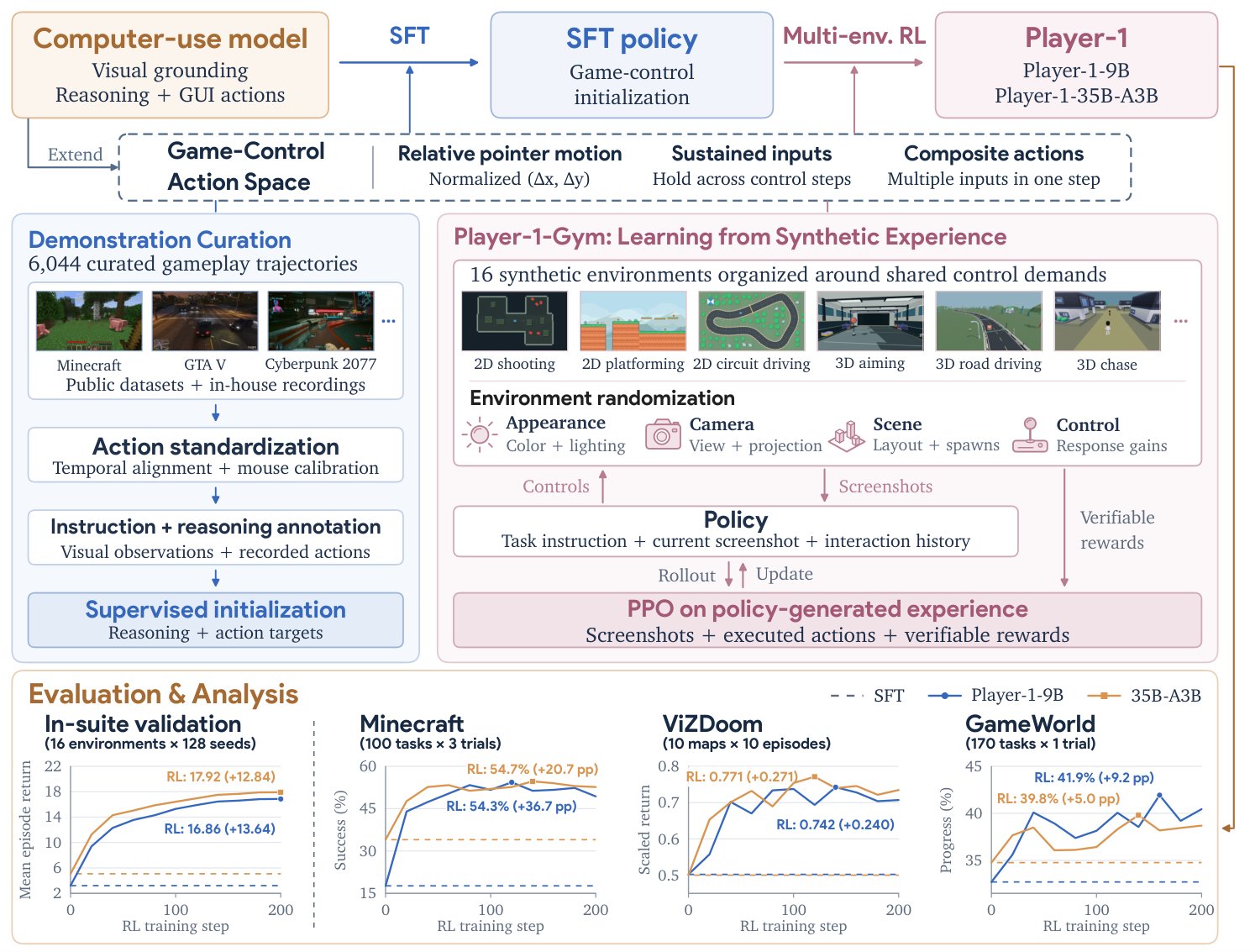
Figure 1: Overview of Player-1: learning game control beyond demonstrations. A shared game-control action space connects supervised initialization from gameplay demonstrations with multi-environment RL in Player-1-Gym. Learning from synthetic experience with verifiable rewards advances control capabilities beyond SFT, with gains that generalize beyond the RL training suite.
图 1:Player-1 概览:在示范之外学习游戏控制。一个共享的游戏控制动作空间,把基于游戏示范的监督初始化与 Player-1-Gym 中的多环境强化学习连接起来。从带可验证奖励的合成经验中学习,使控制能力超越 SFT,并且收益能推广到强化学习训练套件之外。
Our results demonstrate that learning from synthetic experience improves game-control capabilities, with gains extending beyond the RL training suite. On MineDojo-300, Player-1-9B improves from 10.54% success after SFT to 38.33%, exceeding the strongest evaluated external baseline at 12.63% under our evaluation protocol. The same policy also improves on ViZDoom-10 and GameWorld, both outside the RL training suite. We summarize our main contributions as follows:
结果表明,从合成经验中学习能提升游戏控制能力,而且收益延伸到强化学习训练套件之外。在 MineDojo-300 上,Player-1-9B 的成功率从 SFT 之后的 10.54% 提高到 38.33%,在我们的评测协议下超过了评测中最强的外部基线(12.63%)。同一策略在 ViZDoom-10 和 GameWorld 上也有提升,这两个基准都在强化学习训练套件之外。我们的主要贡献总结如下:
- We present Player-1, a post-training framework that builds on supervised initialization to learn transferable game-control capabilities from synthetic experience. A shared action space supports relative pointer motion, sustained inputs, and composite actions, while 6,044 curated gameplay trajectories provide supervised initialization for subsequent interactive learning.
- We introduce Player-1-Gym, sixteen synthetic 2D and 3D environments designed around recurring control demands across games. Programmatically verifiable rewards, together with randomized observations and control dynamics, provide diverse experience for multi-environment reinforcement learning beyond demonstrations.
- We demonstrate that learning from synthetic experience advances game-control capabilities beyond supervised demonstrations: Player-1-9B and Player-1-35B-A3B gain 27.8 and 17.7 pp in MineDojo-300 success, respectively, with further gains on ViZDoom and GameWorld outside the RL training suite. Further analyses show improved transfer with broader environment coverage and increased composite-action use during RL.
- 我们提出 Player-1,一个在监督初始化基础上从合成经验中学习可迁移游戏控制能力的后训练框架。共享的动作空间支持相对指针移动、持续输入和组合动作,6,044 条精选游戏轨迹为后续的交互式学习提供监督初始化。
- 我们推出 Player-1-Gym,包含16 个合成 2D 和 3D 环境,围绕各类游戏反复出现的控制需求设计。可程序化验证的奖励,加上随机化的观测和控制动态,为示范之外的多环境强化学习提供了多样的经验。
- 我们证明从合成经验中学习能使游戏控制能力超越监督示范:Player-1-9B 和 Player-1-35B-A3B 在 MineDojo-300 上的成功率分别提高 27.8 和 17.7 个百分点,在强化学习训练套件之外的 ViZDoom 和 GameWorld 上也有进一步提升。进一步分析表明,环境覆盖面越广,迁移越好;强化学习过程中组合动作的使用也在增加。
| Method | Learning focus | Supervision | RL environments | Evaluation | Availability |
|---|---|---|---|---|---|
| Game-TARS | Large-scale pretraining | Reasoning + action | — | Held-out games | ✗ |
| SIMA 2 | Embodied assistance | Reasoning + action | Games + world model | Held-out games | ✗ |
| NitroGen | System-1 generalist | Action | — | Games + adaptation | ✓ |
| Odysseus | Long-horizon RL | Reasoning + action | 5 Mario levels | Mario games | ✓ |
| Player-1 | Beyond demonstrations | Reasoning + action | 16 synthetic envs | RL held-out games | ✓ |
Table 1: Comparison of representative game-agent learning pipelines, including supervision, RL environments, evaluation scope, and pipeline and model availability.
| 方法 | 学习侧重 | 监督信号 | 强化学习环境 | 评测 | 开放情况 |
|---|---|---|---|---|---|
| Game-TARS | 大规模预训练 | 推理 + 动作 | — | 留出游戏 | ✗ |
| SIMA 2 | 具身辅助 | 推理 + 动作 | 游戏 + 世界模型 | 留出游戏 | ✗ |
| NitroGen | 系统 1 通才 | 动作 | — | 游戏 + 适配 | ✓ |
| Odysseus | 长时程强化学习 | 推理 + 动作 | 5 个马里奥关卡 | 马里奥游戏 | ✓ |
| Player-1 | 超越示范 | 推理 + 动作 | 16 个合成环境 | 强化学习留出游戏 | ✓ |
表 1:代表性游戏智能体学习流程的比较,包括监督信号、强化学习环境、评测范围,以及流程和模型的开放情况。
2 Related Work
2 相关工作
Generalist and Computer-Use Agents.
Foundation models provide broad language, reasoning, and multimodal capabilities that underpin general-purpose agents (OpenAI, 2024; Anthropic, 2025; Gemini Team, 2025; Yang et al., 2025). Vision-language models (VLMs) connect visual perception with language, supporting scene understanding and spatial grounding (Bai et al., 2025). Computer-use agents (CUAs) specialize these capabilities for screenshot-conditioned interaction, using keyboard and mouse actions to complete multi-step tasks (Hu et al., 2024; Qin et al., 2025; Wang et al., 2025a; Lu et al., 2026).
通用智能体与ComputerUse 智能体。
基础模型提供了广泛的语言、推理和多模态能力,是通用智能体的基础(OpenAI, 2024; Anthropic, 2025; Gemini Team, 2025; Yang et al., 2025)。视觉语言模型(VLM)把视觉感知与语言连接起来,支持场景理解和空间定位(Bai et al., 2025)。ComputerUse 智能体(CUA)把这些能力专门用于以截图为条件的交互,用键盘和鼠标操作完成多步任务(Hu et al., 2024; Qin et al., 2025; Wang et al., 2025a; Lu et al., 2026)。
Game Agents, Development, and Environments.
Game-agent research spans planning-based systems (Tan et al., 2025b), learned visual policies and vision–language–action (VLA) models (SIMA Team, 2024; Tan et al., 2025a; Li et al., 2025; Wang et al., 2025b; Magne et al., 2026; Yue et al., 2026), and joint video–action models (Guo et al., 2026). Reinforcement learning further supports self-improvement and long-horizon control (SIMA Team, 2025; Shi et al., 2026). Most recently, Jev demonstrates low-latency game control through a text-only interface, relying on structured game-state representations rather than screenshot observations (Almeida, 2026). Complementary benchmarks evaluate gameplay (Ouyang et al., 2026) and agentic game development (Chi et al., 2026; Luo et al., 2026b). Code world models synthesized from rules and trajectories support planning (Lehrach et al., 2026), while game engine development provides trajectory data for world-model training (Zhou et al., 2026), connecting game creation to learning (Luo et al., 2026a).
游戏智能体、游戏开发与环境。
游戏智能体研究涵盖基于规划的系统(Tan et al., 2025b)、学习得到的视觉策略和视觉-语言-动作(VLA)模型(SIMA Team, 2024; Tan et al., 2025a; Li et al., 2025; Wang et al., 2025b; Magne et al., 2026; Yue et al., 2026),以及视频—动作联合模型(Guo et al., 2026)。强化学习进一步支持自我改进和长时程控制(SIMA Team, 2025; Shi et al., 2026)。最近,Jev 通过纯文本接口展示了低延迟的游戏控制,它依赖结构化的游戏状态表示,而不是截图观测(Almeida, 2026)。另有基准评测游戏玩法(Ouyang et al., 2026)和智能体式游戏开发(Chi et al., 2026; Luo et al., 2026b)。由规则和轨迹合成的代码世界模型可以支持规划(Lehrach et al., 2026),游戏引擎开发则为世界模型训练提供轨迹数据(Zhou et al., 2026),把游戏创作与学习联系起来(Luo et al., 2026a)。
Agent Post-Training with Verifiable Rewards.
Post-training with verifiable rewards enables agents to learn from the outcomes of their own actions. Environment-synthesis approaches expand training coverage by constructing interactive tasks with verifiable rewards (Dong et al., 2026; Wang et al., 2026a). Adaptive approaches learn which environments to generate or jointly improve the policy, environment, and reward model (Liu et al., 2026; Wang et al., 2026b). In games, SIMA 2 combines supervised initialization with online RLVR and further demonstrates self-improvement transfer across Genie 3 environments (SIMA Team, 2025). Player-1 combines supervised initialization with learning from synthetic experience in environments organized around shared control demands, demonstrating game-control gains that generalize beyond the RL training suite.
基于可验证奖励的智能体后训练。
基于可验证奖励的后训练,使智能体能从自身动作的结果中学习。环境合成方法通过构建带可验证奖励的交互任务来扩大训练覆盖面(Dong et al., 2026; Wang et al., 2026a)。自适应方法学习该生成哪些环境,或联合改进策略、环境和奖励模型(Liu et al., 2026; Wang et al., 2026b)。在游戏领域,SIMA 2 把监督初始化与在线 RLVR 结合,并进一步展示了在 Genie 3 环境之间迁移的自我改进(SIMA Team, 2025)。Player-1 把监督初始化与在围绕共同控制需求组织的环境中从合成经验学习结合起来,展示了能推广到强化学习训练套件之外的游戏控制提升。
3 Method
3 方法
Player-1 connects supervised initialization with learning from synthetic experience through a shared game-control action space. We first extend computer-use actions to support dynamic game control, and initialize the policy using curated gameplay demonstrations. We then optimize the policy across Player-1-Gym’s synthetic environments using PPO with verifiable rewards.
Player-1 通过一个共享的游戏控制动作空间,把监督初始化与从合成经验中学习连接起来。我们先扩展ComputerUse 动作以支持动态游戏控制,并用精选游戏示范初始化策略。然后用带可验证奖励的 PPO,在 Player-1-Gym 的各个合成环境上优化策略。
3.1 Extending the Computer-Use Action Space
3.1 扩展ComputerUse 动作空间
We extend the computer-use action space for dynamic game control while retaining screenshot-conditioned decision making. At turn , the policy receives task instruction , screenshot , and interaction history (see Section 3.2):
我们为动态游戏控制扩展ComputerUse 动作空间,同时保留以截图为条件的决策方式。在第 轮,策略接收任务指令 、截图 和交互历史 (见第 3.2 节):
Here is reasoning and the proposed action. The game-control action space extends the base model’s computer-use actions with relative pointer motion, sustained inputs, and composite actions.
其中 是推理, 是提出的动作。游戏控制动作空间在基础模型的ComputerUse 动作之上,加入了相对指针移动、持续输入和组合动作。
Relative pointer motion.
For the mouse actions, CUAs typically use normalized absolute coordinates to select visible targets by specifying their on-screen positions. In game-play scenarios, to control the camera without a visible pointer, we extend this action space with relative displacements:
相对指针移动。
对于鼠标动作,CUA 通常用归一化的绝对坐标,通过指定屏幕位置来选择可见目标。在游戏场景中,为了在没有可见指针的情况下控制镜头,我们在动作空间中加入相对位移:
Absolute coordinates satisfy , while relative displacements are normalized by screen width and height. Positive denotes rightward motion, and positive denotes downward motion. The resulting view rotation depends on the game’s camera gain.
绝对坐标满足 ,相对位移 按屏幕宽度和高度归一化。正的 表示向右移动,正的 表示向下移动。由此产生的视角旋转取决于游戏的镜头增益。
Sustained inputs.
We extend taps and clicks with holds lasting one full control step of duration . For a key or mouse button , the press or long-hold action space is
持续输入。
我们在单击和轻按之外,加入持续一个完整控制步(时长 )的按住操作。对于某个按键或鼠标按钮 ,按下或长按的动作空间为
Repeating holds across consecutive control steps sustains movement and interaction.
在连续的控制步中重复按住,就能维持移动和交互。
Composite actions.
We define a composite action as two or more compatible keyboard or mouse inputs executed concurrently within one control step. The step action space is
组合动作。
我们把组合动作定义为在一个控制步内并发执行的两个或更多相容的键盘或鼠标输入。单步动作空间为
Each ; denotes concurrent execution and . These combinations support coordinated movement and combat that is crucial for game control. For example, holding ‘W’ while tapping ‘Space’ enables running jumps, and pointer motion with a right-button hold and left-button click enables concurrent aiming and firing.
每个 ; 表示并发执行,且 。这些组合支持协调的移动和战斗,这对游戏控制至关重要。例如,按住“W”的同时轻按“空格”可以助跑跳跃;移动指针的同时按住右键并点击左键,可以同时瞄准和射击。
3.2 Supervised Initialization for Game Control
3.2 游戏控制的监督初始化
The extended action space in Section 3.1 defines the available controls, but the policy must learn when and how to use them. In this section, we describe how we use SFT on a compact collection of curated gameplay demonstrations to initialize computer-use models for subsequent learning from synthetic experience.
第 3.1 节扩展的动作空间定义了可用的控制方式,但策略还必须学会何时、如何使用它们。本节说明我们如何在一小批精选游戏示范上做 SFT,初始化ComputerUse 模型,以便随后从合成经验中学习。
Demonstration trajectory curation.
We curate 6,044 gameplay trajectories comprising 295,097 interaction turns from public datasets (Choi et al., 2026; Markov AI, 2026; Yue et al., 2026; Baker et al., 2022) and in-house recordings, mapping recorded controls to the shared game-control action space defined in Section 3.1. Controls are aligned to shared action intervals, and source-specific mouse calibration expresses relative inputs in normalized, pixel-equivalent coordinates. After filtering incomplete or redundant recordings, we use a VLM (Google DeepMind, 2026) to annotate the recorded actions with task instructions and per-turn visual reasoning. For reasoning annotation, the VLM conditions on the task instruction, current and past observations, and the action target. Figure 2 illustrates input coverage and an annotated demonstration. Appendix B details the sources, alignment, calibration, and annotation procedures.
示范轨迹整理。
我们从公开数据集(Choi et al., 2026; Markov AI, 2026; Yue et al., 2026; Baker et al., 2022)和内部录制中整理出 6,044 条游戏轨迹,共 295,097 个交互轮次,并把录制的控制映射到第 3.1 节定义的共享游戏控制动作空间。控制按共享的动作时间间隔对齐,并通过针对各数据源的鼠标校准,把相对输入表示为归一化的像素等效坐标。过滤掉不完整或冗余的录制后,我们用一个 VLM(Google DeepMind, 2026)为录制的动作标注任务指令和逐轮的视觉推理。标注推理时,VLM 以任务指令、当前和过去的观测以及动作目标为条件。图 2 展示了输入覆盖情况和一条标注后的示范。附录 B 详细说明了数据来源、对齐、校准和标注流程。
Supervised fine-tuning.
We construct each SFT example as , where the task instruction , current screenshot , and retained history form the policy input, while visual reasoning and action provide supervision. Following Wang et al. (2025b), our SFT, RL, and evaluation share a history setting: two recent visual–action turns and two earlier action-only turns, with reasoning omitted. We fine-tune the policy to predict conditioned on the task instruction, current screenshot, and retained history. We use action-balanced sampling detailed in Appendix D.1 to increase exposure to less frequent controls and composite actions.
监督微调。
我们把每个 SFT 样本构造为 ,其中任务指令 、当前截图 和保留的历史 构成策略输入,视觉推理 和动作 提供监督。参照 Wang et al.(2025b),我们的 SFT、强化学习和评测共用 的历史设置:两个最近的“视觉—动作”轮次,加上两个更早的“仅动作”轮次,推理部分省略。我们微调策略,使其在给定任务指令、当前截图和保留历史的条件下预测 。我们使用附录 D.1 详述的动作均衡采样,增加不常见控制和组合动作的曝光。
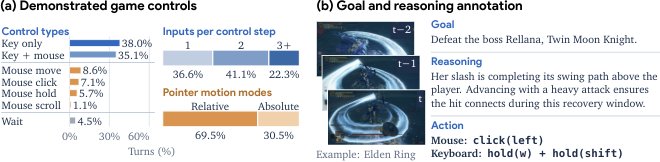
Figure 2: Curated gameplay demonstrations for supervised initialization. (a) Recorded controls summarized by control type, number of inputs per control step, and pointer-motion mode in our demonstration trajectories. Two or more concurrent inputs form a composite action. (b) A demonstration sample pairing recorded actions with an annotated task instruction and visual reasoning.
图 2:用于监督初始化的精选游戏示范。(a) 示范轨迹中录制的控制,按控制类型、每个控制步的输入数和指针移动模式汇总。两个或更多并发输入构成一个组合动作。(b) 一条示范样本,把录制的动作与标注的任务指令和视觉推理配对。
3.3 Player-1-Gym: Learning from Synthetic Experience
3.3 Player-1-Gym:从合成经验中学习
We construct Player-1-Gym, a suite of synthetic environments organized around control demands shared across games. Programmatically verifiable rewards, together with randomized observations and control dynamics, support our multi-environment PPO training of the SFT-initialized policy.
我们构建了 Player-1-Gym,一套围绕各类游戏共有控制需求组织的合成环境。可程序化验证的奖励,加上随机化的观测和控制动态,支持我们对 SFT 初始化的策略进行多环境 PPO 训练。
Verifiable environment construction.
We identify recurring control demands across games and organize training tasks into five families: aiming, combat, driving, navigation, and UI interaction. For example, aiming tasks require pointer-based or camera-relative target tracking, while combat tasks combine movement with attack timing. Building upon our own shared 2D and 3D engines, reusable assets, and scene templates, we implement sixteen environments that require these forms of control through different game mechanics, viewpoints, and spatial layouts, as shown in Figure 3(a–b). A unified runtime provides screenshot observations and executes the shared game-control action space. This shared foundation facilitates extending the suite with new environments while maintaining consistent observation and action interfaces.
可验证环境的构建。
我们找出各类游戏中反复出现的控制需求,把训练任务分为五类:瞄准、战斗、驾驶、导航和 UI 交互。例如,瞄准任务要求基于指针或相对镜头追踪目标,战斗任务则把移动与攻击时机结合起来。在我们自建的共享 2D 和 3D 引擎、可复用资产和场景模板的基础上,我们实现了 16 个环境,通过不同的游戏机制、视角和空间布局来考察这些控制形式,如图 3(a–b) 所示。统一的运行时提供截图观测,并执行共享的游戏控制动作空间。这一共同基础便于在保持观测和动作接口一致的前提下,向套件中添加新环境。
To provide verifiable training feedback, each environment defines game- and task-specific scoring rules over changing game states. Score increments supply step-level rewards, providing dense and verifiable feedback without a learned judge, while privileged state is not exposed to the policy.
为了提供可验证的训练反馈,每个环境都针对变化的游戏状态定义了与游戏和任务相关的计分规则。分数的增量提供步级奖励,不需要学习出来的评判模型,就能给出稠密且可验证的反馈;同时,特权状态不对策略开放。
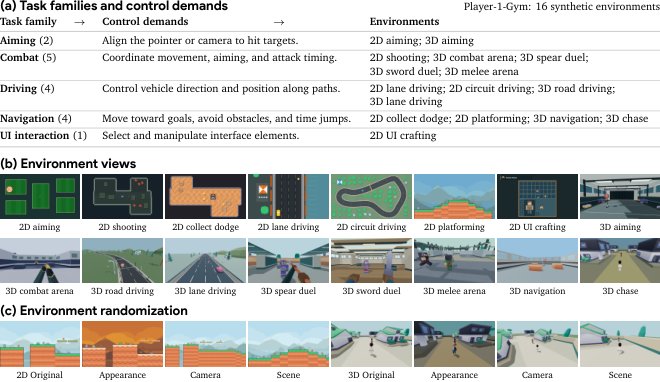
Figure 3: Player-1-Gym: synthetic experience with verifiable rewards. (a) Shared control demands across five task families. (b) Visualization of sixteen 2D and 3D environments. (c) Examples of appearance, camera, and scene randomization applied to the same environment.
图 3:Player-1-Gym:带可验证奖励的合成经验。(a) 五类任务共有的控制需求。(b) 16 个 2D 和 3D 环境的可视化。(c) 对同一环境施加外观、镜头和场景随机化的示例。
Environment randomization.
To further broaden training experience within each environment, we randomize four complementary dimensions in Player-1-Gym: (1) Appearance: colors, lighting, and assets; (2) Camera: projection, placement, and initial orientation; (3) Scene: layouts, spawns, and task-specific configurations; and (4) Control: input-response gains for camera rotation, movement, driving, and steering where applicable. All four dimensions are jointly randomized during training where supported. Examples are provided in Figure 3(c). Appendix C further specifies the distributions and per-environment settings.
环境随机化。
为了进一步扩大每个环境内部的训练经验,我们在 Player-1-Gym 中对四个互补的维度做随机化:(1) 外观:颜色、光照和资产;(2) 镜头:投影、位置和初始朝向;(3) 场景:布局、出生点和与任务相关的配置;(4) 控制:镜头旋转、移动、驾驶和转向(如适用)的输入响应增益。在支持的环境中,训练时四个维度同时随机化。示例见图 3(c)。附录 C 进一步给出了各项分布和逐环境的设置。
Multi-environment reinforcement learning.
We jointly optimize the SFT-initialized policy with PPO across randomized environments with different control demands, dynamics, and reward scales. To limit the effect of reward-scale differences on policy-update magnitudes, we apply per-environment advantage normalization to generalized advantage estimates (GAE):
多环境强化学习。
我们在控制需求、动态和奖励尺度各不相同的随机化环境上,用 PPO 联合优化 SFT 初始化的策略。为了限制奖励尺度差异对策略更新幅度的影响,我们对广义优势估计(GAE)施加逐环境优势归一化:
Here indexes turns and response tokens. For each environment , contains its response-token indices in the rollout batch, with . We normalize each for using the corresponding advantage mean and sample variance . Return-to-go targets accumulate rewards from subsequent turns, allowing later outcomes to inform earlier control decisions. Appendix D.2 further details reward construction, cross-turn credit, loss aggregation, and optimization.
其中 索引轮次, 索引响应词元。对每个环境 , 包含它在采样批次中的响应词元索引,。对 ,我们用对应的优势均值 和样本方差 归一化每个 。剩余回报(return-to-go)目标累积后续轮次的奖励,让后来的结果能为更早的控制决策提供信息。附录 D.2 进一步详述了奖励构造、跨轮次信用分配、损失聚合和优化。
4 Experiments
4 实验
4.1 Experimental Setup
4.1 实验设置
Training setup.
We initialize Player-1-9B and Player-1-35B-A3B from their respective Qwen3.5-9B and Qwen3.5-35B-A3B backbones. Both undergo two epochs of SFT on the full demonstration dataset with action-balanced sampling. We then apply proximal policy optimization (PPO) in the sixteen-environment Player-1-Gym suite. Both model sizes train on the full sixteen-environment suite with a budget of 200 RL steps. Each training step collects 256 episodes allocated equally across environments, with at most 50 interaction turns per episode. More training details and hyperparameters are provided in Appendix D.
训练设置。
我们分别从 Qwen3.5-9B 和 Qwen3.5-35B-A3B 骨干初始化 Player-1-9B 和 Player-1-35B-A3B。两者都在完整示范数据集上用动作均衡采样做两轮 SFT。然后在 16 个环境的 Player-1-Gym 套件中应用近端策略优化(PPO)。两种规模的模型都在完整的 16 环境套件上训练,预算为 200 个强化学习步。每个训练步收集 256 个回合,平均分配到各环境,每个回合最多 50 个交互轮次。更多训练细节和超参数见附录 D。
Evaluation.
Besides in-domain evaluation of sixteen Player-1-Gym environments, we construct two evaluation suites: MineDojo-300, comprising 300 tasks from the MineDojo (Fan et al., 2022) task collection in Minecraft, and ViZDoom-10, comprising ten maps from the twelve available maps in ViZDoom (Kempka et al., 2016). We also evaluate browser-game interaction on GameWorld (Ouyang et al., 2026), covering 170 tasks across 34 games. Our standardized evaluation protocols use 8 trials per MineDojo task, 50 per ViZDoom map, and 3 per GameWorld task. Appendix E details benchmark composition, metrics, and budgets.
评测。
除了在 16 个 Player-1-Gym 环境上的域内评测,我们还构建了两套评测:MineDojo-300,包含 Minecraft 中 MineDojo(Fan et al., 2022)任务集的 300 个任务;ViZDoom-10,包含 ViZDoom(Kempka et al., 2016)现有 12 张地图中的 10 张。我们还在 GameWorld(Ouyang et al., 2026)上评测浏览器游戏交互,涵盖 34 款游戏的 170 个任务。我们的标准化评测协议为每个 MineDojo 任务跑 8 次,每张 ViZDoom 地图 50 次,每个 GameWorld 任务 3 次。附录 E 详述了基准构成、指标和预算。
We compare against game-specific models, including JARVIS-VLA (Li et al., 2025), NitroGen (Magne et al., 2026), Open-P2P (Yue et al., 2026), and GameWAM (Guo et al., 2026), as well as computer-use models, including UI-TARS-1.5-7B (ByteDance Seed, 2025) and our Qwen3.5 base models. We keep their native preprocessing and inference procedures across the benchmarks. We also compare the base models, our SFT-initialized models, and the final Player-1 models to separate the gains from SFT and those from synthetic experience.
我们与游戏专用模型比较,包括 JARVIS-VLA(Li et al., 2025)、NitroGen(Magne et al., 2026)、Open-P2P(Yue et al., 2026)和 GameWAM(Guo et al., 2026),也与ComputerUse 模型比较,包括 UI-TARS-1.5-7B(ByteDance Seed, 2025)和我们所用的 Qwen3.5 基础模型。在所有基准上,我们保留它们原生的预处理和推理流程。我们还比较了基础模型、SFT 初始化后的模型和最终的 Player-1 模型,以区分 SFT 带来的收益和合成经验带来的收益。
4.2 Main Results
4.2 主要结果
Task-directed control in Minecraft.
On MineDojo-300, SFT raises success from 9.21% to 10.54% for 9B and from 7.79% to 23.38% for 35B-A3B. Interactive learning raises 9B success to 38.33%, a large gain of 27.79 percentage points over SFT. The number of tasks completed in at least four of eight trials increases from 20 to 136, showing gains in both task coverage and repeatability.
Minecraft 中的任务导向控制。
在 MineDojo-300 上,SFT 把 9B 的成功率从 9.21% 提高到 10.54%,把 35B-A3B 从 7.79% 提高到 23.38%。交互式学习把 9B 的成功率提高到 38.33%,比 SFT 高出 27.79 个百分点。8 次中至少成功 4 次的任务数从 20 个增加到 136 个,说明任务覆盖面和可重复性都有提升。
| Success rate (%) | Coverage by successes () | ||||||
|---|---|---|---|---|---|---|---|
| Method | Combat | Harvest | Overall | [95% CI] | 1 of 8 | 2 of 8 | 4 of 8 |
| JARVIS-VLA | 7.56 | 5.00 | 6.71 | [5.38, 8.08] | 95/300 | 41/300 | 5/300 |
| UI-TARS-1.5-7B | 0.56 | 0.00 | 0.38 | [0.13, 0.67] | 8/300 | 1/300 | 0/300 |
| NitroGen | 0.00 | 0.00 | 0.00 | [-] | 0/300 | 0/300 | 0/300 |
| Open-P2P-1.2B | 0.44 | 0.00 | 0.29 | [0.08, 0.50] | 7/300 | 0/300 | 0/300 |
| GameWAM | 14.00 | 9.88 | 12.63 | [10.79, 14.54] | 155/300 | 79/300 | 16/300 |
| Qwen3.5-9B | 11.75 | 4.13 | 9.21 | [7.50, 11.00] | 106/300 | 59/300 | 13/300 |
| Qwen3.5-35B-A3B | 8.69 | 6.00 | 7.79 | [6.25, 9.46] | 99/300 | 50/300 | 8/300 |
| Player-1-9B-SFT | 12.50 | 6.63 | 10.54 | [8.67, 12.50] | 120/300 | 63/300 | 20/300 |
| Player-1-35B-A3B-SFT | 30.31 | 9.50 | 23.38 | [20.63, 26.21] | 172/300 | 133/300 | 76/300 |
| Player-1-9B | 52.31 | 10.38 | 38.33 | [35.13, 41.58] | 209/300 | 173/300 | 136/300 |
| Player-1-35B-A3B | 55.56 | 12.00 | 41.04 | [37.83, 44.29] | 224/300 | 182/300 | 142/300 |
Table 2: Task success and coverage on MineDojo-300. Results use 8 trials per task. Coverage counts tasks meeting the success thresholds; brackets show 95% task-bootstrap confidence intervals.
| 成功率(%) | 按成功次数统计的覆盖() | ||||||
|---|---|---|---|---|---|---|---|
| 方法 | 战斗 | 采集 | 总体 | [95% CI] | 1/8 | 2/8 | 4/8 |
| JARVIS-VLA | 7.56 | 5.00 | 6.71 | [5.38, 8.08] | 95/300 | 41/300 | 5/300 |
| UI-TARS-1.5-7B | 0.56 | 0.00 | 0.38 | [0.13, 0.67] | 8/300 | 1/300 | 0/300 |
| NitroGen | 0.00 | 0.00 | 0.00 | [-] | 0/300 | 0/300 | 0/300 |
| Open-P2P-1.2B | 0.44 | 0.00 | 0.29 | [0.08, 0.50] | 7/300 | 0/300 | 0/300 |
| GameWAM | 14.00 | 9.88 | 12.63 | [10.79, 14.54] | 155/300 | 79/300 | 16/300 |
| Qwen3.5-9B | 11.75 | 4.13 | 9.21 | [7.50, 11.00] | 106/300 | 59/300 | 13/300 |
| Qwen3.5-35B-A3B | 8.69 | 6.00 | 7.79 | [6.25, 9.46] | 99/300 | 50/300 | 8/300 |
| Player-1-9B-SFT | 12.50 | 6.63 | 10.54 | [8.67, 12.50] | 120/300 | 63/300 | 20/300 |
| Player-1-35B-A3B-SFT | 30.31 | 9.50 | 23.38 | [20.63, 26.21] | 172/300 | 133/300 | 76/300 |
| Player-1-9B | 52.31 | 10.38 | 38.33 | [35.13, 41.58] | 209/300 | 173/300 | 136/300 |
| Player-1-35B-A3B | 55.56 | 12.00 | 41.04 | [37.83, 44.29] | 224/300 | 182/300 | 142/300 |
表 2:MineDojo-300 上的任务成功率与覆盖。每个任务跑 8 次。覆盖统计达到各成功次数阈值的任务数;方括号内为基于任务自助法的 95% 置信区间。
| Method | Precision shooting | Goal navigation | Mobile combat | Survival | Overall |
|---|---|---|---|---|---|
| JARVIS-VLA | |||||
| UI-TARS-1.5-7B | |||||
| NitroGen | |||||
| Open-P2P-1.2B | |||||
| GameWAM | 1.1860 | ||||
| Qwen3.5-9B | |||||
| Qwen3.5-35B-A3B | |||||
| Player-1-9B-SFT | |||||
| Player-1-35B-A3B-SFT | |||||
| Player-1-9B | 1.0772 | 0.5974 | |||
| Player-1-35B-A3B | 0.8979 | 0.7236 |
| Method | Success (%) | Progress (%) |
|---|---|---|
| JARVIS-VLA | 6.47 | 17.61 |
| UI-TARS-1.5-7B | 5.49 | 19.71 |
| NitroGen | 8.82 | 23.41 |
| Open-P2P-1.2B | 2.35 | 10.37 |
| GameWAM | 5.88 | 16.91 |
| Qwen3.5-9B | 10.39 | 29.22 |
| Qwen3.5-35B-A3B | 13.14 | 33.49 |
| Player-1-9B-SFT | 13.14 | 31.43 |
| Player-1-35B-A3B-SFT | 15.49 | 34.60 |
| Player-1-9B | 15.88 | 34.45 |
| Player-1-35B-A3B | 17.25 | 38.79 |
Table 3: First-person control on ViZDoom-10, with 50 trials per map. We report the mean scaled return. Map-specific reward settings and scaling factors are provided in Appendix E.4.
| 方法 | 精确射击 | 目标导航 | 移动战斗 | 生存 | 总体 |
|---|---|---|---|---|---|
| JARVIS-VLA | |||||
| UI-TARS-1.5-7B | |||||
| NitroGen | |||||
| Open-P2P-1.2B | |||||
| GameWAM | 1.1860 | ||||
| Qwen3.5-9B | |||||
| Qwen3.5-35B-A3B | |||||
| Player-1-9B-SFT | |||||
| Player-1-35B-A3B-SFT | |||||
| Player-1-9B | 1.0772 | 0.5974 | |||
| Player-1-35B-A3B | 0.8979 | 0.7236 |
| 方法 | 成功率(%) | 进度(%) |
|---|---|---|
| JARVIS-VLA | 6.47 | 17.61 |
| UI-TARS-1.5-7B | 5.49 | 19.71 |
| NitroGen | 8.82 | 23.41 |
| Open-P2P-1.2B | 2.35 | 10.37 |
| GameWAM | 5.88 | 16.91 |
| Qwen3.5-9B | 10.39 | 29.22 |
| Qwen3.5-35B-A3B | 13.14 | 33.49 |
| Player-1-9B-SFT | 13.14 | 31.43 |
| Player-1-35B-A3B-SFT | 15.49 | 34.60 |
| Player-1-9B | 15.88 | 34.45 |
| Player-1-35B-A3B | 17.25 | 38.79 |
表 3:ViZDoom-10 上的第一人称控制,每张地图跑 50 次。我们报告平均缩放回报。各地图的奖励设置和缩放系数见附录 E.4。
Generalization beyond the RL training suite.
The same policy improves performance on external games. On ViZDoom-10, Player-1-9B increases scaled return from 0.4361 after SFT to 0.6922. Player-1-35B-A3B achieves an overall scaled return of 0.7236, surpassing GameWAM, the strongest external baseline at 0.3938, by 83.7%. On GameWorld’s episodes, progress rises from 31.43% to 34.45%. Together, these results show that control experience acquired in Player-1-Gym transfers to first-person shooting and distinct browser games, beyond the synthesized environments for RL. These gains support using synthetic experience to develop transferable control capabilities without reinforcement learning in each target game.
推广到强化学习训练套件之外。
同一策略在外部游戏上也提升了表现。在 ViZDoom-10 上,Player-1-9B 的缩放回报从 SFT 之后的 0.4361 提高到 0.6922。Player-1-35B-A3B 的总体缩放回报达到 0.7236,比最强的外部基线 GameWAM(0.3938)高出 83.7%。在 GameWorld 的 个回合上,进度从 31.43% 提高到 34.45%。这些结果共同表明,在 Player-1-Gym 中获得的控制经验能迁移到第一人称射击和各种不同的浏览器游戏上,超出了用于强化学习的合成环境范围。这些收益支持这样一种做法:用合成经验培养可迁移的控制能力,而无需在每个目标游戏中做强化学习。
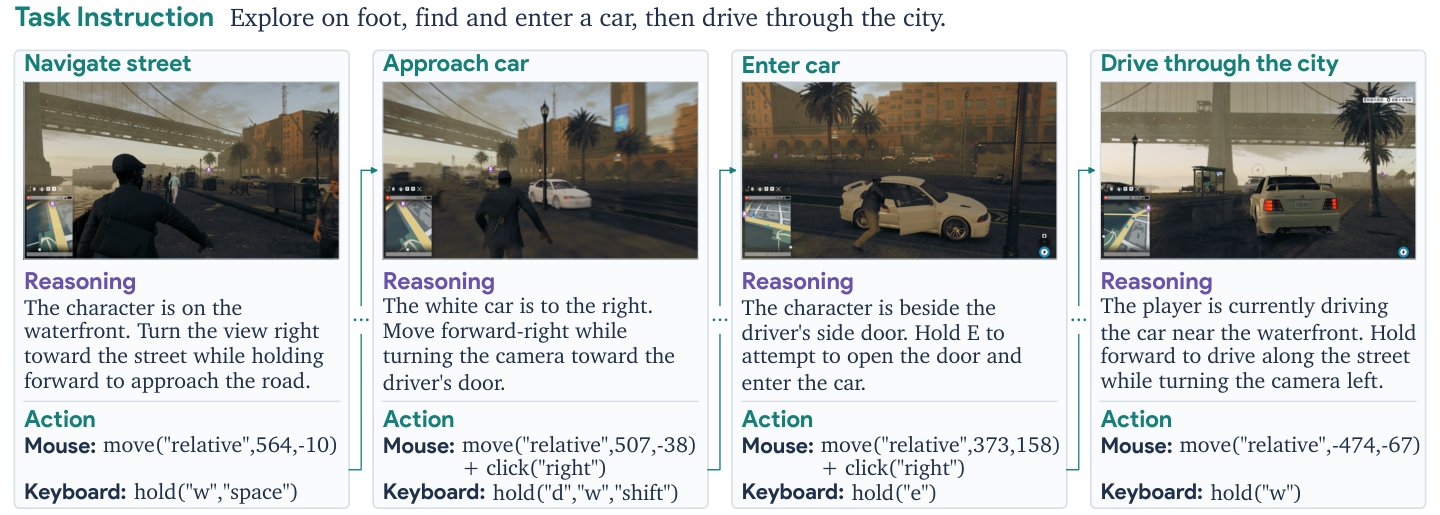
Figure 4: Player-1-9B in the held-out commercial game Watch Dogs 2: on-foot navigation, car approach, vehicle entry, and city driving. The sequence illustrates coordinated movement and camera control during navigation, and specified inputs for vehicle entry and driving. Reasoning and action text has been lightly shortened and reformatted for readability.
图 4:Player-1-9B 在留出的商业游戏《看门狗 2》(Watch Dogs 2)中:步行导航、接近汽车、上车和城市驾驶。这组画面展示了导航中协调的移动与镜头控制,以及上车和驾驶时的特定输入。为便于阅读,推理和动作文本做了少量删减和重新排版。
Case Example: Control in an Unseen Commercial Game.
We integrate Player-1 into commercial games using an observation–action loop with visual inputs and keyboard–mouse controls. Figure 4 shows an example sequence in Watch Dogs 2, a game unseen during both SFT and RL. Experience acquired during training enables the agent to reason and act across on-foot navigation, target approach, vehicle interaction, and driving scenarios.
案例:在未见过的商业游戏中控制。
我们通过一个以视觉为输入、以键盘鼠标为控制的“观测—动作”循环,把 Player-1 接入商业游戏。图 4 展示了《看门狗 2》中的一段示例,这款游戏在 SFT 和强化学习中都没有出现过。训练中获得的经验使智能体能在步行导航、接近目标、与车辆交互和驾驶等场景中推理并行动。
5 Analysis
5 分析
5.1 Learning Dynamics
5.1 学习动态
In this section, we illustrate the learning dynamics of the SFT-initialized policies over RL steps. Figure 5(a,b) separates penalized episode returns from unpenalized game scores, with each metric averaged across sixteen environments.
本节展示 SFT 初始化的策略在各强化学习步上的学习动态。图 5(a,b) 把带惩罚的回合回报与不带惩罚的游戏分数分开展示,每项指标都在 16 个环境上取平均。
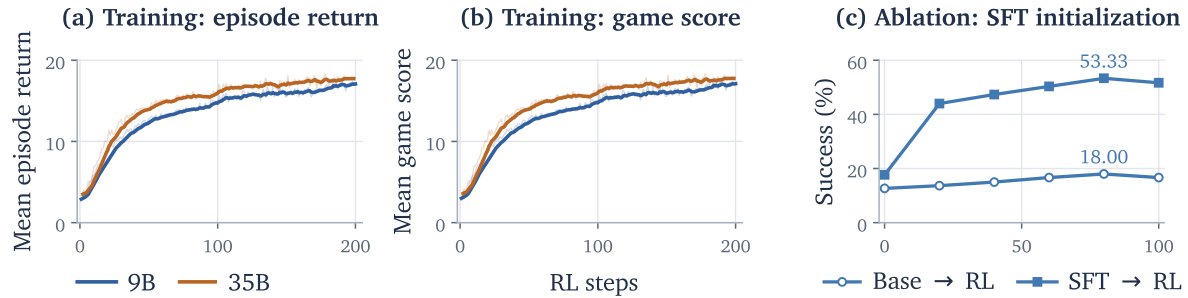
Figure 5: Training dynamics and the effect of supervised initialization. (a,b) Mean episode returns and game scores across 16 environments for 9B and 35B-A3B over 200 RL steps; faint traces show raw values and bold curves show EMA. (c) BaseRL and SFTRL for 9B over 0–100 RL steps.
图 5:训练动态与监督初始化的作用。(a,b) 9B 和 35B-A3B 在 200 个强化学习步中,16 个环境上的平均回合回报和游戏分数;浅色曲线为原始值,粗曲线为指数移动平均(EMA)。(c) 9B 在 0–100 个强化学习步中的“基础模型→强化学习”与“SFT→强化学习”对比。
Learning beyond SFT.
As shown in Figure 5(a,b), both mean episode return and mean game score rise across the RL training steps. Gains are largest early in training and become more gradual later. The 35B-A3B curve finishes slightly above the 9B curve on both measures. These trends indicate that learning from synthetic experience improves game control beyond SFT.
超越 SFT 的学习。
如图 5(a,b) 所示,平均回合回报和平均游戏分数都随强化学习训练步数上升。提升在训练早期最大,之后逐渐放缓。在两项指标上,35B-A3B 的曲线最终都略高于 9B。这些趋势说明,从合成经验中学习使游戏控制超越了 SFT。
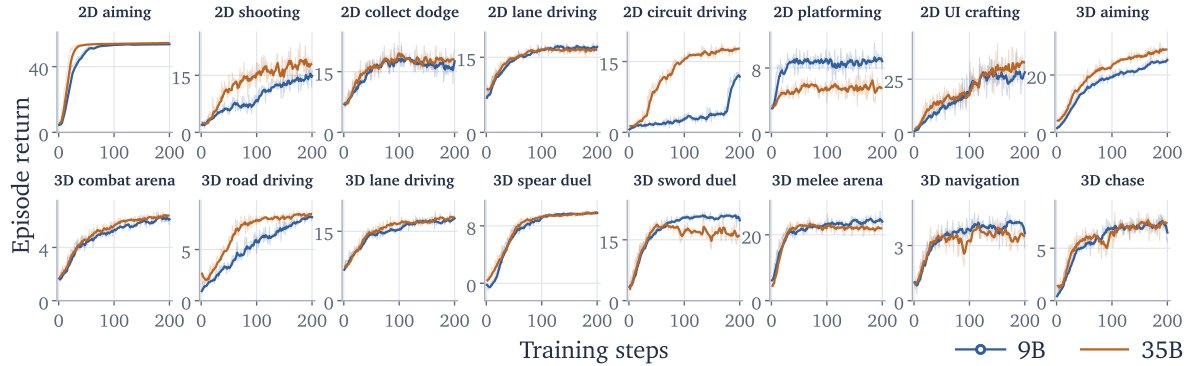
Figure 6: Per-environment episode returns for 9B and 35B-A3B over 200 RL steps. The curves show differences in learning progress, return scales, and relative model performance across diverse synthetic environments.
图 6:9B 和 35B-A3B 在 200 个强化学习步中各环境的回合回报。曲线显示了在各种合成环境中,学习进度、回报尺度和模型相对表现的差异。
Effect of supervised initialization.
Figure 5(c) contrasts the displayed BaseRL and SFTRL trajectories for 9B over 100 RL steps. SFTRL rises from 17.67% to 51.67% Minecraft success, while BaseRL rises from 12.67% to 16.67%, leaving a 35.00-percentage-point gap at step 100.
监督初始化的作用。
图 5(c) 对比了 9B 在 100 个强化学习步中“基础模型→强化学习”和“SFT→强化学习”两条轨迹。“SFT→强化学习”的 Minecraft 成功率从 17.67% 升到 51.67%,而“基础模型→强化学习”从 12.67% 升到 16.67%,第 100 步时相差 35.00 个百分点。
Learning across environments.
Figure 6 breaks down episode returns across all sixteen training environments. Both models show broad net gains, but their learning trajectories vary across environments. For example, performance on simpler tasks such as 2D aiming improves rapidly and then levels off, whereas gains in 2D circuit driving emerge much later.
跨环境的学习。
图 6 拆分了全部 16 个训练环境的回合回报。两个模型都普遍取得净收益,但学习轨迹因环境而异。例如,2D 瞄准这类较简单的任务提升很快,然后趋于平稳;2D 赛道驾驶的提升则出现得晚得多。
5.2 Environment Scaling
5.2 环境扩展
Expanding the training suite.
The scaling comparison allocates a fixed budget of 25,600 episodes over 100 RL steps across 2, 4, 8, or 16 environments, starting from the same Player-1-9B-SFT checkpoint. Each configuration uses 256 episodes per step, allocated equally across the environments. Appendix D.4 specifies the subsets and protocol.
扩大训练套件。
扩展比较在 100 个强化学习步中把固定的 25,600 个回合预算分配到 2、4、8 或 16 个环境上,都从同一个 Player-1-9B-SFT 检查点出发。每种配置每步使用 256 个回合,平均分配到各环境。附录 D.4 给出了具体的环境子集和协议。
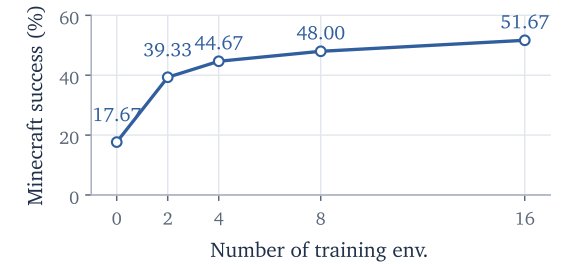
Figure 7: Environment scaling at a fixed budget of 25,600 episodes over 100 RL steps. Zero denotes the SFT reference.
图 7:在 100 个强化学习步、固定 25,600 个回合预算下的环境扩展。零表示 SFT 参照。
5.3 Evolution of Action Composition
5.3 动作组成的演变
Figure 8 shows increased use of composite actions during RL. Across Player-1-9B’s in-suite validation trajectories, the share of turns with composite actions rises from 64.7% at the start of RL to 85.4% and 93.2% after 50 and 100 RL steps, respectively. This progressive increase occurs without an explicit reward for action composition, suggesting that task-driven RL reinforces coordinated inputs common to game control, such as aiming while firing or moving while adjusting the camera.
图 8 显示,组合动作的使用在强化学习过程中不断增加。在 Player-1-9B 的套件内验证轨迹中,含组合动作的轮次占比从强化学习开始时的 64.7%,在 50 步和 100 步后分别升到 85.4% 和 93.2%。这种逐步增加并没有针对动作组合的显式奖励,说明任务驱动的强化学习强化了游戏控制中常见的协调输入,例如边瞄准边射击,或边移动边调整镜头。
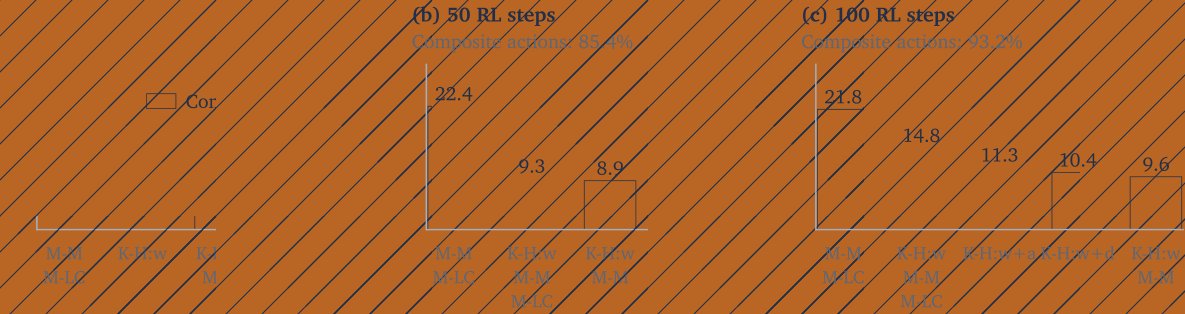
Figure 8: Evolution of action composition during Player-1-Gym validation. Composite-action use rises from 64.7% to 93.2% over 100 RL steps. Bars show each checkpoint’s most frequent actions as shares of all turns. K-H: key hold; M-M: mouse movement; M-LC: mouse left click.
图 8:Player-1-Gym 验证中动作组成的演变。在 100 个强化学习步中,组合动作的使用比例从 64.7% 升到 93.2%。柱状图显示每个检查点最常见的动作占全部轮次的比例。K-H:按住按键;M-M:鼠标移动;M-LC:鼠标左键单击。
6 Conclusion
6 结论
We presented Player-1, a post-training framework for learning game control beyond demonstrations through synthetic experience. Curated gameplay demonstrations initialize computer-use models in a shared game-control action space. Player-1-Gym then provides sixteen synthetic environments organized around shared control demands, with verifiable rewards and randomized observations and control dynamics for multi-environment RL. Evaluations on MineDojo-300, ViZDoom-10, and GameWorld demonstrate that learning from synthetic experience advances game-control capabilities beyond SFT, with gains that generalize beyond the RL training suite. Further analyses show improved transfer with larger training suites. Together, these findings establish synthetic experience as an effective resource for learning transferable game control without online training in each target game.
我们提出了 Player-1,一个通过合成经验在示范之外学习游戏控制的后训练框架。精选的游戏示范在共享的游戏控制动作空间中初始化ComputerUse 模型。随后,Player-1-Gym 提供 16 个围绕共同控制需求组织的合成环境,带有可验证奖励以及随机化的观测和控制动态,用于多环境强化学习。在 MineDojo-300、ViZDoom-10 和 GameWorld 上的评测表明,从合成经验中学习能使游戏控制能力超越 SFT,收益能推广到强化学习训练套件之外。进一步分析表明,训练套件越大,迁移越好。这些发现共同确立了合成经验作为一种有效资源的地位:无需在每个目标游戏中在线训练,就能学到可迁移的游戏控制。
References
参考文献
Almeida (2026) Diogo Almeida. Introducing System One Models & Jev. TypeSafe AI Blog, September 2026. URL https://typesafe.ai/blog/introducing-system-one-models-and-jev .
Anthropic (2025) Anthropic. Introducing Claude 4. Technical announcement, 2025. URL https://www.anthropic.com/news/claude-4 .
Bai et al. (2025) Shuai Bai, Yuxuan Cai, Ruizhe Chen, Keqin Chen, Xionghui Chen, Zesen Cheng, Lianghao Deng, Wei Ding, Chang Gao, Chunjiang Ge, et al. Qwen3-VL technical report. arXiv preprint arXiv:2511.21631 , 2025. URL https://arxiv.org/abs/2511.21631 .
Baker et al. (2022) Bowen Baker, Ilge Akkaya, Peter Zhokhov, Joost Huizinga, Jie Tang, Adrien Ecoffet, Brandon Houghton, Raul Sampedro, and Jeff Clune. Video pretraining (VPT): Learning to act by watching unlabeled online videos. arXiv preprint arXiv:2206.11795 , 2022.
ByteDance Seed (2025) ByteDance Seed. UI-TARS-1.5-7B, 2025. URL https://huggingface.co/ByteDance-Seed/UI-TARS-1.5-7B . Model release.
Chi et al. (2026) Wayne Chi, Yixiong Fang, Arnav Yayavaram, Siddharth Yayavaram, Seth Karten, Qiuhong Anna Wei, Runkun Chen, Alexander Wang, Valerie Chen, Ameet Talwalkar, and Chris Donahue. GameDevBench: Evaluating agentic capabilities through game development. arXiv preprint arXiv:2602.11103 , 2026. URL https://arxiv.org/abs/2602.11103 .
Choi et al. (2026) Suhwan Choi, Jaeyoon Jung, Haebin Seong, Minchan Kim, Minyeong Kim, Yongjun Cho, Yoonshik Kim, Yubeen Park, Youngjae Yu, and Yunsung Lee. D2E: Scaling vision-action pretraining on desktop data for transfer to embodied AI. In International Conference on Learning Representations , 2026. URL https://arxiv.org/abs/2510.05684 .
Dong et al. (2026) Guanting Dong, Junting Lu, Junjie Huang, Wanjun Zhong, Longxiang Liu, Shijue Huang, et al. Agent-World: Scaling real-world environment synthesis for evolving general agent intelligence. arXiv preprint arXiv:2604.18292 , 2026.
Fan et al. (2022) Linxi Fan, Guanzhi Wang, Yunfan Jiang, Ajay Mandlekar, Yuncong Yang, Haoyi Zhu, Andrew Tang, De-An Huang, Yuke Zhu, and Anima Anandkumar. MineDojo: Building open-ended embodied agents with internet-scale knowledge. In Advances in Neural Information Processing Systems , volume 35, pp. 18343–18362, 2022.
Gemini Team (2025) Gemini Team. Gemini 2.5: Pushing the frontier with advanced reasoning, multimodality, long context, and next generation agentic capabilities. Technical report, Google DeepMind, 2025. URL https://storage.googleapis.com/deepmind-media/gemini/gemini_v2_5_report.pdf .
Google DeepMind (2026) Google DeepMind. Gemini 3.8 Flash. Model card, 2026. URL https://deepmind.google/models/model-cards/gemini-3-8-flash/ .
Guo et al. (2026) Yuncheng Guo, Zhanqiu Zhang, Yiwen Guo, and Weijia Li. GameWAM: A world action model for video games. arXiv preprint arXiv:2608.26200 , 2026. URL https://arxiv.org/abs/2608.26200 .
Hu et al. (2024) Siyuan Hu, Mingyu Ouyang, Difei Gao, and Mike Zheng Shou. The dawn of GUI agent: A preliminary case study with Claude 3.5 Computer Use. arXiv preprint arXiv:2411.10323 , 2024. URL https://arxiv.org/abs/2411.10323 .
Kempka et al. (2016) Michał Kempka, Marek Wydmuch, Grzegorz Runc, Jakub Toczek, and Wojciech Jaśkowski. ViZDoom: A doom-based AI research platform for visual reinforcement learning. In IEEE Conference on Computational Intelligence and Games , pp. 341–348, 2016. doi: 10.1109/CIG.2016.7860433 . URL https://arxiv.org/abs/1605.02097 .
Lehrach et al. (2026) Wolfgang Lehrach, Daniel Hennes, Miguel Lazaro-Gredilla, Xinghua Lou, Carter Wendelken, Zun Li, Antoine Dedieu, Marc Lanctot, Atil Iscen, John Schultz, Marcus Chiam, Ian Gemp, Piotr Zielinski, Satinder Singh, and Kevin Murphy. Code world models for general game playing. In The Fourteenth International Conference on Learning Representations , 2026. URL https://openreview.net/forum?id=1UoB7IWiku .
Li et al. (2025) Muyao Li, Zihao Wang, Kaichen He, Xiaojian Ma, and Yitao Liang. JARVIS-VLA: Post-training large-scale vision language models to play visual games with keyboards and mouse. In Findings of the Association for Computational Linguistics: ACL 2025 , pp. 17878–17899, 2025. doi: 10.18653/v1/2025.findings-acl.920 .
Liu et al. (2026) Bo Liu, Simon Yu, Yiding Jiang, Ao Qu, Andrew Zhao, Zichen Liu, Junsu Kim, Zijian Zhou, Seungone Kim, Tongzheng Ren, Mickel Liu, Hanfei Yu, Zhaorun Chen, Weiyan Shi, Paul Pu Liang, Luke Zettlemoyer, Yejin Choi, and Natasha Jaques. SPADE: Self-play in adaptive synthetic executable environments. arXiv preprint arXiv:2608.19197 , 2026.
Lu et al. (2026) Dunjie Lu, Shuai Bai, Tianyi Bai, Sicheng Fan, Chang Gao, Jian Guan, Feng Hu, Mianqiu Huang, Xingyang Huang, Yizhen Jiang, et al. Qwen-CUA: Native computer use for (almost) everything. arXiv preprint arXiv:2608.02352 , 2026. URL https://arxiv.org/abs/2608.02352 .
Luo et al. (2026a) Meng Luo, Yanlin Li, Hao Li, Hongzhan Lin, Pengfei Zhou, Tianjie Ju, Ran Zhang, Yeying Jin, Mong-Li Lee, and Wynne Hsu. AI for games in the foundation model era. arXiv preprint arXiv:2609.16679 , 2026a. URL https://arxiv.org/abs/2609.16679 .
Luo et al. (2026b) Tongxu Luo, Rongsheng Wang, Jiaxi Bi, Chenming Xu, Zhengyang Tang, Jianlong Chen, Juhao Liang, Ke Ji, Shuqi Guo, Yuhao Du, Fan Bu, Wenyu Du, Xiaotong Zhang, Kyle Li, Shaobo Wang, Linfeng Zhang, Yuxuan Liu, Xin Lai, Chenxin Li, Yiduo Guo, Zhexin Zhang, Xinyuan Wang, Tianyi Bai, Ziniu Li, and Benyou Wang. GameCraft-Bench: Can agents build playable games end-to-end in a real game engine? arXiv preprint arXiv:2606.17861 , 2026b. URL https://arxiv.org/abs/2606.17861 .
Magne et al. (2026) Loïc Magne, Anas Awadalla, Guanzhi Wang, Yinzhen Xu, Joshua Belofsky, Fengyuan Hu, Joohwan Kim, Ludwig Schmidt, Georgia Gkioxari, Jan Kautz, Yisong Yue, Yejin Choi, Yuke Zhu, and Linxi Fan. NitroGen: An open foundation model for generalist gaming agents. In Proceedings of the IEEE/CVF Conference on Computer Vision and Pattern Recognition , pp. 21511–21521, 2026.
Markov AI (2026) Markov AI. Gaming 500 hours. Hugging Face dataset, 2026. URL https://huggingface.co/datasets/markov-ai/gaming-500-hours .
OpenAI (2024) OpenAI. GPT-4o system card. arXiv preprint arXiv:2410.21276 , 2024. URL https://arxiv.org/abs/2410.21276 .
Ouyang et al. (2026) Mingyu Ouyang, Siyuan Hu, Kevin Qinghong Lin, Hwee Tou Ng, and Mike Zheng Shou. GameWorld: Towards standardized and verifiable evaluation of multimodal game agents. arXiv preprint arXiv:2604.07429 , 2026.
Qin et al. (2025) Yujia Qin, Yining Ye, Junjie Fang, Haoming Wang, Shihao Liang, Shizuo Tian, Junda Zhang, et al. UI-TARS: Pioneering automated GUI interaction with native agents. arXiv preprint arXiv:2501.12326 , 2025.
Shi et al. (2026) Chengshuai Shi, Wenzhe Li, Xinran Liang, Yizhou Lu, Wenjia Yang, Ruirong Feng, Seth Karten, Ziran Yang, Zihan Ding, Gabriel Sarch, Danqi Chen, Karthik Narasimhan, and Chi Jin. Odysseus: Scaling VLMs to 100+ turn decision-making in games via reinforcement learning. arXiv preprint arXiv:2605.00347 , 2026.
SIMA Team (2024) SIMA Team. Scaling instructable agents across many simulated worlds. arXiv preprint arXiv:2404.10179 , 2024. URL https://arxiv.org/abs/2404.10179 .
SIMA Team (2025) SIMA Team. SIMA 2: A generalist embodied agent for virtual worlds. arXiv preprint arXiv:2512.04797 , 2025. URL https://arxiv.org/abs/2512.04797 .
Tan et al. (2025a) Weihao Tan, Xiangyang Li, Yunhao Fang, Heyuan Yao, Shi Yan, Hao Luo, Tenglong Ao, Huihui Li, Hongbin Ren, Bairen Yi, Yujia Qin, Bo An, Libin Liu, and Guang Shi. Lumine: An open recipe for building generalist agents in 3D open worlds. arXiv preprint arXiv:2511.08892 , 2025a. URL https://arxiv.org/abs/2511.08892 .
Tan et al. (2025b) Weihao Tan, Wentao Zhang, Xinrun Xu, Haochong Xia, Ziluo Ding, Boyu Li, Bohan Zhou, Junpeng Yue, Jiechuan Jiang, Yewen Li, Ruyi An, Molei Qin, Chuqiao Zong, Longtao Zheng, Yujie Wu, Xiaoqiang Chai, Yifei Bi, Tianbao Xie, Pengjie Gu, Xiyun Li, Ceyao Zhang, Long Tian, Chaojie Wang, Xinrun Wang, Börje F. Karlsson, Bo An, Shuicheng Yan, and Zongqing Lu. Cradle: Empowering foundation agents towards general computer control. In Proceedings of the 42nd International Conference on Machine Learning , volume 267 of Proceedings of Machine Learning Research , pp. 58658–58725, 2025b. URL https://proceedings.mlr.press/v267/tan25h.html .
Wang et al. (2026a) Bowen Wang, Dunjie Lu, Junli Wang, Tianyi Bai, Shixuan Liu, Zhipeng Zhang, Haiquan Wang, Hao Hu, Tianbao Xie, Shuai Bai, Dayiheng Liu, Que Shen, Junyang Lin, and Tao Yu. CUA-Gym: Scaling verifiable training environments and tasks for computer-use agents. arXiv preprint arXiv:2605.25624 , 2026a.
Wang et al. (2025a) Haoming Wang, Haoyang Zou, Huatong Song, Jiazhan Feng, Junjie Fang, Junting Lu, Longxiang Liu, Qinyu Luo, Shihao Liang, Shijue Huang, Wanjun Zhong, Yining Ye, Yujia Qin, et al. UI-TARS-2 technical report: Advancing GUI agent with multi-turn reinforcement learning. arXiv preprint arXiv:2509.02544 , 2025a.
Wang et al. (2026b) Yinjie Wang, Tianbao Xie, Ke Shen, Mengdi Wang, and Ling Yang. RLAnything: Forge environment, policy, and reward model in completely dynamic RL system. arXiv preprint arXiv:2602.02488 , 2026b.
Wang et al. (2025b) Zihao Wang, Xujing Li, Yining Ye, Junjie Fang, Haoming Wang, Longxiang Liu, et al. Game-TARS: Pretrained foundation models for scalable generalist multimodal game agents. arXiv preprint arXiv:2510.23691 , 2025b. URL https://arxiv.org/abs/2510.23691 .
Yang et al. (2025) An Yang, Anfeng Li, Baosong Yang, Beichen Zhang, Binyuan Hui, Bo Zheng, Bowen Yu, Chang Gao, Chengen Huang, Chenxu Lv, et al. Qwen3 technical report. arXiv preprint arXiv:2505.09388 , 2025. URL https://arxiv.org/abs/2505.09388 .
Yue et al. (2026) Yuguang Yue, Irakli Salia, Samuel Hunt, Chris Green, Wenzhe Shi, and Jonathan J. Hunt. Scaling behavior cloning improves causal reasoning: An open model for real-time video game playing. arXiv preprint arXiv:2601.04575 , 2026. URL https://arxiv.org/abs/2601.04575 .
Zhou et al. (2026) Pengfei Zhou, Hexin Wang, Zhengfeiyang Zhang, Yixing Ma, Zhenglin Wan, Kaipeng Zhang, Wangbo Zhao, and Yang You. Agentic game development as a verifiable trajectory data engine for scaling world models. arXiv preprint arXiv:2608.25518 , 2026. URL https://arxiv.org/abs/2608.25518 .
Appendix A Game-Control Interface
附录 A 游戏控制接口
A.1 Coordinates and Composite Actions
A.1 坐标与组合动作
Table 5 specifies the execution semantics of the actions introduced in Section 3.1. For an observation of width and height , normalized absolute positions and relative displacements map to pixels as
表 5 规定了第 3.1 节引入的各动作的执行语义。对于宽 、高 的观测,归一化的绝对位置和相对位移按下式映射到像素:
The origin is the upper-left corner, and positive displacement points right and down. One movement uses either absolute or relative coordinates. A key cannot be both held and tapped in the same step, nor can one mouse button be both held and clicked.
原点在左上角,正位移指向右方和下方。一次移动只能使用绝对坐标或相对坐标之一。同一步中,一个按键不能既按住又轻按,一个鼠标按钮也不能既按住又单击。
| Component | Semantics |
|---|---|
| Key hold / tap | Hold a set of keys throughout the step, or briefly press and release them. |
| Mouse movement | Move to an absolute screen position or apply a relative displacement. |
| Mouse hold / click | Hold one button throughout the step, or click one button. Different buttons may execute concurrently. |
| Mouse scroll | Apply one upward or downward scroll step. |
| Wait | No operation. Advance one step without keyboard or mouse input. |
Table 5: Game-control semantics. Inputs in a composite action execute concurrently within one step; bindings are restricted to those supported by the environment.
| 组件 | 语义 |
|---|---|
| 按住 / 轻按按键 | 在整个步内按住一组按键,或短暂按下后松开。 |
| 鼠标移动 | 移动到屏幕上的绝对位置,或施加一个相对位移。 |
| 按住 / 单击鼠标 | 在整个步内按住一个按钮,或单击一个按钮。不同按钮可以并发执行。 |
| 鼠标滚动 | 向上或向下滚动一格。 |
| 等待 | 无操作。在没有键盘或鼠标输入的情况下前进一步。 |
表 5:游戏控制语义。组合动作中的各输入在一步内并发执行;按键绑定仅限环境支持的范围。
A.2 Execution and Visual Feedback
A.2 执行与视觉反馈
Relative motion requests input displacement, not a universal camera angle. For per-pixel camera gain , requested yaw and pitch increments and have magnitudes
相对移动请求的是输入位移,而不是一个通用的镜头角度。设每像素的镜头增益为 ,请求的偏航和俯仰增量 和 的大小为
before native camera limits; mouse displacement is not multiplied by action duration. The seven mouse-controlled 3D Player-1-Gym environments use a nominal gain radians per observation pixel by default. With Control randomization, the effective gain is , where is defined in Appendix C.2. Observation geometry and camera constraints remain fixed within a checkpoint comparison. Benchmark-specific settings are given in Appendix E.
这是在应用游戏原生镜头限制之前的值;鼠标位移不乘以动作时长。Player-1-Gym 中七个用鼠标控制的 3D 环境,默认使用每观测像素 弧度的标称增益。启用控制随机化时,有效增益为 ,其中 的定义见附录 C.2。在一次检查点比较内,观测几何和镜头约束保持不变。各基准的具体设置见附录 E。
A.3 Observation and Interaction History
A.3 观测与交互历史
SFT, RL, and evaluation all use two recent visual–action turns and two earlier action-only turns. In the earlier action-only turns, screenshots are replaced by ; reasoning in all retained historical turns is replaced by . The current screenshot and executed historical actions are retained.
SFT、强化学习和评测都使用两个最近的“视觉—动作”轮次和两个更早的“仅动作”轮次。在更早的“仅动作”轮次中,截图被替换为 ;所有保留的历史轮次中的推理都被替换为 。当前截图和已执行的历史动作予以保留。
Appendix B Gameplay Demonstrations: Construction and Annotation
附录 B 游戏示范:构建与标注
B.1 Sources and Statistics
B.1 来源与统计
Both model sizes are trained with the collection in Figure 9: 6,044 trajectories and 295,097 turns from 2,544 source-qualified recording sessions and 172 games. We approximate the sampled control hours, which equal the turn count 200 ms, or 16.4 hours in total for the full annotated dataset.
两种规模的模型都用图 9 中的数据集训练:6,044 条轨迹、295,097 个轮次,来自 2,544 个符合来源要求的录制会话和 172 款游戏。我们估算了采样的控制时长,即轮次数 200 毫秒,完整标注数据集共计 16.4 小时。
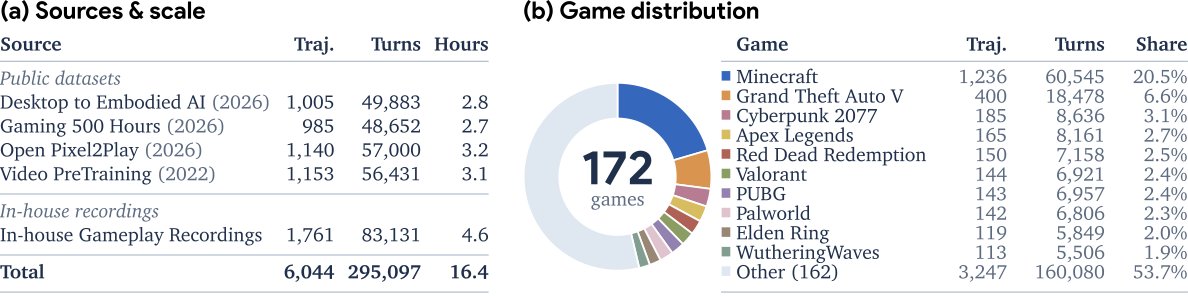
Figure 9: Sources and game distribution of the 6,044 gameplay demonstrations used for SFT. (a) Sources and scale, with sampled control hours. (b) Game distribution.
图 9:用于 SFT 的 6,044 条游戏示范的来源与游戏分布。(a) 来源与规模,附采样控制时长。(b) 游戏分布。
Quality selection.
We automated validity, activity, and repetition checks that complement source-level and manual review of recording completeness, observation–action alignment, and sequence diversity. The collection contains 5,360 gameplay trajectories with a total of 268,000 turns and 684 in-game UI trajectories with a total of 27,097 turns.
质量筛选。
我们做了自动化的有效性、活跃度和重复性检查,作为对录制完整性、观测—动作对齐和序列多样性的来源级审查与人工审查的补充。数据集包含 5,360 条游戏轨迹(共 268,000 个轮次)和 684 条游戏内 UI 轨迹(共 27,097 个轮次)。
Action statistics.
Figure 2(a) counts the distribution of each action across all samples in the dataset. Keyboard–mouse composites take precedence. Mouse-only turns are assigned by movement, click, hold, then scroll. Inputs per step count each key tap/hold and mouse operation separately, with wait as one no-op. Pointer-mode shares use all turns containing mouse_move, including keyboard–mouse composites.
动作统计。
图 2(a) 统计了数据集中所有样本里各动作的分布。键盘—鼠标组合优先归类。仅含鼠标的轮次依次按移动、单击、按住、滚动归类。每步输入数分别计入每次按键轻按/按住和每个鼠标操作,等待算作一次空操作。指针模式占比使用所有包含 mouse_move 的轮次,包括键盘—鼠标组合。
B.2 Action Standardization
B.2 动作标准化
Temporal alignment.
For continuous gameplay, source timestamps define contiguous intervals of 150–250 ms, projected onto a 200-ms target grid using cumulative boundaries. Relative input is summed within each source interval. Keyboard presses shorter than 100 ms become taps, and longer presses become holds on overlapping target steps. Mouse presses lasting at most 300 ms become clicks. Each target summarizes compatible recorded inputs for concurrent execution within one control step.
时间对齐。
对于连续游戏过程,源时间戳定义了 150–250 毫秒的连续区间,再用累计边界投影到 200 毫秒的目标网格上。相对输入在每个源区间内求和。短于 100 毫秒的键盘按压记为轻按,更长的按压在重叠的目标步上记为按住。持续不超过 300 毫秒的鼠标按压记为单击。每个目标步汇总可在一个控制步内并发执行的相容录制输入。
UI trajectories also follow recorded operation boundaries. Clicks retain their recorded targets, key sequences expand into individual presses, drags use start and endpoint controls with an explicit release, and scroll gestures become directional steps. Execution uses the shared 200-ms action space. Sampled control hours use target execution duration, while UI trajectories retain their recorded, operation-dependent timing.
UI 轨迹同样遵循录制的操作边界。单击保留其录制目标,按键序列展开为单个按压,拖拽使用起点和终点控制并显式释放,滚动手势转为有方向的步骤。执行使用共享的 200 毫秒动作空间。采样控制时长使用目标执行时长,而 UI 轨迹保留其录制的、随操作而定的时间。
Spatial alignment.
Native relative-mouse input scales vary across data sources and recording setups. We therefore calibrate these inputs to pixel-equivalent displacements using freely moving GUI pointers from the same recording session. The mapping also applies to pointer-locked recordings. Camera response is defined in Appendix A.2. For native-input sums , coefficients , and logical recording size , the normalized target is
空间对齐。
原生相对鼠标输入的尺度因数据源和录制设置而异。因此,我们利用同一录制会话中自由移动的 GUI 指针,把这些输入校准为像素等效位移。这一映射同样适用于锁定指针的录制。镜头响应的定义见附录 A.2。对于原生输入之和 、系数 和逻辑录制尺寸 ,归一化目标为
Mouse-move Calibration.
In-house and D2E calibration uses GUI windows with stable focus and geometry, aligned timestamps, and no pointer clipping or recentering. For paired native input and pointer displacement , window and pooled session estimates are
鼠标移动校准。
内部数据和 D2E 的校准使用焦点和几何稳定、时间戳对齐、指针没有被裁剪或重新居中的 GUI 窗口。对于配对的原生输入 和指针位移 ,窗口级估计和合并的会话级估计分别为
D2E uses window-equal estimates for a source-level coefficient; in-house coefficients are recording-specific. Pixel2Play uses per-axis Huber regression over at least two stable, non-overlapping two-second GUI blocks. Out-of-range projections are rejected rather than clipped to ensure the action quality. Table 6 lists the source mappings.
D2E 使用各窗口等权的估计作为来源级系数;内部数据的系数则针对每段录制。Pixel2Play 在至少两个稳定、互不重叠的两秒 GUI 片段上,按坐标轴分别做 Huber 回归。超出范围的投影直接拒绝而不是裁剪,以保证动作质量。表 6 列出了各来源的映射。
| Source | Mapping |
|---|---|
| In-house | Recording-specific calibration coefficients. |
| D2E | Source-level for relative input; absolute endpoints for UI operations. |
| Pixel2Play | Hierarchical selection: session GUI fit metadata profile display scale. |
| VPT | in logical coordinates for relative input; absolute endpoints for UI operations. |
| Gaming 500h | Recorded absolute positions projected using capture geometry. |
Table 6: Source-specific mouse-action mapping. Relative inputs use calibration coefficients bound to recording geometry; UI operations use absolute endpoints.
| 来源 | 映射 |
|---|---|
| 内部数据 | 针对每段录制的校准系数。 |
| D2E | 相对输入使用来源级系数 ;UI 操作使用绝对端点。 |
| Pixel2Play | 分层选择:会话 GUI 拟合 元数据配置 显示缩放。 |
| VPT | 相对输入在逻辑 坐标下使用 ;UI 操作使用绝对端点。 |
| Gaming 500h | 录制的绝对位置按采集几何投影。 |
表 6:各来源的鼠标动作映射。相对输入使用与录制几何绑定的校准系数;UI 操作使用绝对端点。
B.3 Goal and Reasoning Annotation
B.3 目标与推理标注
We use Gemini 3.8 Flash to build reusable profiles of rules, roles, inputs, and examples for each game in the trajectory, and check them for recorded-control coverage and action validity. It assigns goals from each profile, full-trajectory storyboard, and action timeline. The same game from different data sources should share the same assembled profile. For per-turn reasoning annotation, it re-uses the goal, fixed action target, and current and past frames.
我们用 Gemini 3.8 Flash 为轨迹中的每款游戏建立可复用的档案,包括规则、角色、输入和示例,并检查档案对录制控制的覆盖和动作有效性。它根据每份档案、整条轨迹的故事板和动作时间线分配目标。来自不同数据源的同一款游戏应共用同一份汇总档案。在逐轮推理标注中,它复用目标、固定的动作目标以及当前和过去的画面。
Appendix C Player-1-Gym: Tasks, Rewards, and Randomization
附录 C Player-1-Gym:任务、奖励与随机化
C.1 Tasks and Verifiable Rewards
C.1 任务与可验证奖励
By primary task, the sixteen environments comprise aiming (2), combat (5), driving (4), navigation (4), and UI interaction (1). Tables 7 and 8 specify their tasks, score components, and API state fields. Interaction tests, score checks, and human review verify controls, observable transitions, and reward events against human-defined rules.
按主要任务划分,16 个环境包括瞄准(2 个)、战斗(5 个)、驾驶(4 个)、导航(4 个)和 UI 交互(1 个)。表 7 和表 8 给出了它们的任务、计分组成和 API 状态字段。交互测试、分数检查和人工审查,按照人为定义的规则验证了控制、可观测的状态转移和奖励事件。
We designed the shared Three.js browser runtime to provide controllable resets, keyboard–mouse execution, screenshots, and rewards, with fixed-step simulation independent of inference latency. Each environment defines a cumulative score and supplies the increment as reward. Reward computation and evaluation use privileged state, while the policy receives only screenshots and task/control text. Episodes only end on native completion or failure, or at the turn cap when the task is not completed under the limits.
我们设计了共享的 Three.js 浏览器运行时,提供可控的重置、键盘鼠标执行、截图和奖励,并采用与推理延迟无关的固定步长模拟。每个环境定义一个累计分数 ,并把增量 作为奖励。奖励计算和评测使用特权状态,而策略只接收截图和任务/控制文本。回合只在游戏原生的完成或失败时结束,或者在任务未能在限制内完成时于轮次上限处结束。
| Environment | Task and control | Score components | State fields (API) |
|---|---|---|---|
| 2D aiming | Track and click moving targets | Hits accumulated precision | targets_collected, precision_total |
| 2D shooting | Move, aim, and shoot | Enemies defeated | kills |
| 2D collect dodge | Collect while avoiding hazards | Coins collected | coins_collected |
| 2D lane driving | Time lane changes | Coins collected | coins_collected |
| 2D circuit driving | Steer through a route | Checkpoints reached | checkpoints_passed |
| 2D platforming | Run, jump, and dash | Coins, cleared gaps/spikes, and flags | coins_collected, gaps_cleared, spikes_cleared, flags_reached |
| 2D UI crafting | Consult, craft, and equip | Recipe consultations + material reward crafts + selections equips | recipe_book_rewards, correct_material_reward, target_crafts, correct_equipment_selections, equipment_equipped |
Table 7: 2D environments, controls, and verifiable score components. State fields are read from gameGymAPI.getState().metrics; primary_score gives the resulting cumulative score.
| 环境 | 任务与控制 | 计分组成 | 状态字段(API) |
|---|---|---|---|
| 2D 瞄准 | 追踪并点击移动目标 | 命中数 累计精度 | targets_collected, precision_total |
| 2D 射击 | 移动、瞄准并射击 | 击败的敌人数 | kills |
| 2D 收集躲避 | 边收集边躲避危险 | 收集的金币数 | coins_collected |
| 2D 车道驾驶 | 把握变道时机 | 收集的金币数 | coins_collected |
| 2D 赛道驾驶 | 沿路线转向行驶 | 到达的检查点数 | checkpoints_passed |
| 2D 平台跳跃 | 奔跑、跳跃和冲刺 | 金币、越过的缺口/尖刺和旗帜 | coins_collected, gaps_cleared, spikes_cleared, flags_reached |
| 2D UI 合成 | 查阅、合成和装备 | 查阅配方 + 材料奖励 合成数 + 选择数 装备数 | recipe_book_rewards, correct_material_reward, target_crafts, correct_equipment_selections, equipment_equipped |
表 7:2D 环境、控制方式和可验证的计分组成。状态字段从 gameGymAPI.getState().metrics 读取;primary_score 给出由此得到的累计分数。
| Environment | Task and control | Score components | State fields (API) |
|---|---|---|---|
| 3D aiming | Track and hit targets | Target hits | hits |
| 3D combat arena | Coordinate movement, aim, and fire | Enemies defeated | kills |
| 3D road driving | Follow bends and checkpoints | Checkpoints reached | checkpoints_passed |
| 3D lane driving | Collect and avoid with lane changes | Coins collected | coins_collected |
| 3D spear duel | Track, charge, release, and dodge | Spear hits damage received | spear_hits, damage_taken |
| 3D sword duel | Approach, aim, and strike | Attack hits + defeats damage received | attack_hits, kills, damage_taken |
| 3D melee arena | Coordinate facing, range, and movement | Attack hits + defeats damage received | attack_hits, kills, damage_taken |
| 3D navigation | Reach successive flags | Goals reached | goals_reached |
| 3D chase | Pursue around obstacles | Targets reached | targets_reached |
Table 8: 3D environments, controls, and verifiable score components. State fields are read from gameGymAPI.getState().metrics; primary_score gives the resulting cumulative score.
| 环境 | 任务与控制 | 计分组成 | 状态字段(API) |
|---|---|---|---|
| 3D 瞄准 | 追踪并击中目标 | 目标命中数 | hits |
| 3D 战斗竞技场 | 协调移动、瞄准和开火 | 击败的敌人数 | kills |
| 3D 公路驾驶 | 沿弯道和检查点行驶 | 到达的检查点数 | checkpoints_passed |
| 3D 车道驾驶 | 通过变道收集和躲避 | 收集的金币数 | coins_collected |
| 3D 长矛对决 | 追踪、蓄力、出手和闪避 | 长矛命中数 受到的伤害 | spear_hits, damage_taken |
| 3D 剑术对决 | 接近、瞄准和攻击 | 攻击命中数 + 击败数 受到的伤害 | attack_hits, kills, damage_taken |
| 3D 近战竞技场 | 协调朝向、距离和移动 | 攻击命中数 + 击败数 受到的伤害 | attack_hits, kills, damage_taken |
| 3D 导航 | 依次到达各个旗帜 | 到达的目标数 | goals_reached |
| 3D 追逐 | 绕过障碍物追赶 | 追上的目标数 | targets_reached |
表 8:3D 环境、控制方式和可验证的计分组成。状态字段从 gameGymAPI.getState().metrics 读取;primary_score 给出由此得到的累计分数。
C.2 Randomization and Sampling
C.2 随机化与采样
Figure 10 shows individual and joint Appearance, Camera, and Scene variation. The parameters, distributions, and applicable environments for Appearance, Camera, Scene, and Control are specified in Table 9. Specifically, appearance preserves collision geometry and functional roles; Scene varies layouts, spawns, and subsequent entity generation, potentially changing task difficulty. Appearance and Camera are sampled at reset and fixed within each episode, with triangular modes at native values. Background lightness and saturation, ambient intensity, and key-light intensity share one sampled quantile, and linked asset components receive compatible color changes. Orthographic zoom is relative to the native view, including 2D platforming. Initial first-person point-of-view yaw/pitch is distinct from camera-rig pitch.
图 10 展示了外观、镜头和场景的单独变化与联合变化。外观、镜头、场景和控制各项的参数、分布和适用环境见表 9。具体来说,外观随机化保持碰撞几何和功能角色不变;场景随机化改变布局、出生点和随后的实体生成,可能改变任务难度。外观和镜头在重置时采样,在每个回合内固定,三角分布的众数取原生值。背景明度和饱和度、环境光强度和主光强度共用一个采样分位数,相互关联的资产组件得到相容的颜色变化。正交缩放相对于原生视图,2D 平台跳跃也包括在内。初始第一人称视角的偏航/俯仰,与镜头支架的俯仰是两回事。
Control-response sampling.
Control varies input response independently of camera projection and scene configuration. For each supported response parameter , we independently sample
控制响应采样。
控制随机化改变输入响应,与镜头投影和场景配置相互独立。对每个支持的响应参数 ,我们独立采样
The control seed is independent of domain randomization. Separate parameter substreams set values at reset, unchanged through respawns. The narrower chasing, platforming, and jump ranges preserve pursuit-speed and traversal constraints. Collision rules, gravity, attack timing, control bindings, and reward definitions remain fixed. Table 10 specifies the training mixture.
控制随机化的种子与域随机化相互独立。各参数有单独的子随机流,在重置时设定取值,重生后保持不变。追逐、平台跳跃和跳跃的范围较窄,以保持追赶速度和通行约束。碰撞规则、重力、攻击时机、控制绑定和奖励定义保持固定。表 10 给出了训练混合配置。
| (a) Appearance | |||
|---|---|---|---|
| Visual attribute | Native | Perturbed distribution / choice | Applies to |
| Entity hue shift | Uniform over | All games | |
| Entity saturation | 1 | All games | |
| Entity lightness | 1 | All games | |
| Background hue shift | All games | ||
| Background saturation | 1 | All games | |
| Background lightness | 1 | All games | |
| Color temperature | Neutral | Warm / neutral / cool: | All games |
| Ambient intensity | 1 | 3D games | |
| Key-light intensity | 1 | 3D games | |
| Key-light azimuth | : | 3D games | |
| Shadow strength | 1 | 3D games | |
| Visual assets | Native | Compatible non-native variants | All games |
| (b) Camera | |||
|---|---|---|---|
| Camera parameter | Native | Perturbed distribution | Applies to |
| Orthographic zoom | 1 | 2D games | |
| FOV offset | 3D games | ||
| Rig height | 1 | 3D games | |
| Follow distance | 1 | 3D road/lane driving, melee arena, chase | |
| Rig pitch offset | 0 | rad | 3D except driving |
| Initial yaw: aiming | 0 | rad | 3D aiming, 3D combat arena |
| Initial yaw: combat | 0 | rad | 3D duel/melee games |
| Initial yaw: navigation | 0 | rad | 3D navigation, 3D chase |
| Initial pitch | 0 | rad | All three groups |
| (c) Scene | |
|---|---|
| Environment | Task-specific variation |
| 2D aiming | Target positions, motion, and spatial layouts |
| 2D shooting | Connected walls, enemy regions, and spawns |
| 2D collect dodge | Connected layouts, coins, and moving obstacles |
| 2D lane driving | Initial lane and object sequences |
| 2D circuit driving | Circuit geometry, direction, scale, and mirroring |
| 2D platforming | Platforms, gaps, hazards, and route widths |
| 2D UI crafting | Recipes, quantities, distractors, and inventory layouts |
| 3D aiming | Target directions, distances, and spawns |
| 3D combat arena | Connected rooms, cover, and spawns |
| 3D road driving | Road curvature, phase, and mirroring |
| 3D lane driving | Initial lane and object sequences |
| 3D spear duel | Arena geometry and opponent spawns |
| 3D sword duel | Platforms, cover, and spawns |
| 3D melee arena | Connected courtyards, gates, and spawns |
| 3D navigation | Obstacles, starts, and goal positions |
| 3D chase | Building geometry, starts, and target routes |
| (d) Control | |||
|---|---|---|---|
| Response multiplier | Native | Perturbed distribution | Applies to |
| Look gain | 1 | 3D except driving | |
| Movement | 1 | 2D shooting, collect dodge, and lane driving; 3D combat arena, lane driving, spear duel, sword duel, melee arena, and navigation | |
| Chasing movement | 1 | 3D chase | |
| Platform movement | 1 | 2D platforming | |
| Driving | 1 | 4 driving games | |
| Steering | 1 | 3D road driving | |
| Jump impulse | 1 | 2D platforming; 3D combat arena |
Table 9: Appearance, camera, scene, and control-response randomization configurations. Multipliers are relative to each game’s native setting. denotes uniform sampling and is parameterized by lower bound, mode, and upper bound. Rig parameters affect only camera components used by the game. Scene variation is task-specific and may already be present in native settings.
| (a) 外观 | |||
|---|---|---|---|
| 视觉属性 | 原生值 | 扰动分布 / 选项 | 适用范围 |
| 实体色相偏移 | 均匀取自 | 所有游戏 | |
| 实体饱和度 | 1 | 所有游戏 | |
| 实体明度 | 1 | 所有游戏 | |
| 背景色相偏移 | 所有游戏 | ||
| 背景饱和度 | 1 | 所有游戏 | |
| 背景明度 | 1 | 所有游戏 | |
| 色温 | 中性 | 暖 / 中性 / 冷: | 所有游戏 |
| 环境光强度 | 1 | 3D 游戏 | |
| 主光强度 | 1 | 3D 游戏 | |
| 主光方位角 | : | 3D 游戏 | |
| 阴影强度 | 1 | 3D 游戏 | |
| 视觉资产 | 原生 | 相容的非原生变体 | 所有游戏 |
| (b) 镜头 | |||
|---|---|---|---|
| 镜头参数 | 原生值 | 扰动分布 | 适用范围 |
| 正交缩放 | 1 | 2D 游戏 | |
| 视场角偏移 | 3D 游戏 | ||
| 支架高度 | 1 | 3D 游戏 | |
| 跟随距离 | 1 | 3D 公路/车道驾驶、近战竞技场、追逐 | |
| 支架俯仰偏移 | 0 | 弧度 | 3D(驾驶类除外) |
| 初始偏航:瞄准 | 0 | 弧度 | 3D 瞄准、3D 战斗竞技场 |
| 初始偏航:战斗 | 0 | 弧度 | 3D 对决/近战游戏 |
| 初始偏航:导航 | 0 | 弧度 | 3D 导航、3D 追逐 |
| 初始俯仰 | 0 | 弧度 | 以上三组 |
| (c) 场景 | |
|---|---|
| 环境 | 与任务相关的变化 |
| 2D 瞄准 | 目标位置、运动和空间布局 |
| 2D 射击 | 相连的墙体、敌人区域和出生点 |
| 2D 收集躲避 | 相连的布局、金币和移动障碍物 |
| 2D 车道驾驶 | 初始车道和物体序列 |
| 2D 赛道驾驶 | 赛道几何、方向、尺度和镜像 |
| 2D 平台跳跃 | 平台、缺口、危险物和路线宽度 |
| 2D UI 合成 | 配方、数量、干扰项和物品栏布局 |
| 3D 瞄准 | 目标方向、距离和出生点 |
| 3D 战斗竞技场 | 相连的房间、掩体和出生点 |
| 3D 公路驾驶 | 道路曲率、相位和镜像 |
| 3D 车道驾驶 | 初始车道和物体序列 |
| 3D 长矛对决 | 场地几何和对手出生点 |
| 3D 剑术对决 | 平台、掩体和出生点 |
| 3D 近战竞技场 | 相连的庭院、大门和出生点 |
| 3D 导航 | 障碍物、起点和目标位置 |
| 3D 追逐 | 建筑几何、起点和目标路线 |
| (d) 控制 | |||
|---|---|---|---|
| 响应倍率 | 原生值 | 扰动分布 | 适用范围 |
| 视角增益 | 1 | 3D(驾驶类除外) | |
| 移动 | 1 | 2D 射击、收集躲避和车道驾驶;3D 战斗竞技场、车道驾驶、长矛对决、剑术对决、近战竞技场和导航 | |
| 追逐移动 | 1 | 3D 追逐 | |
| 平台移动 | 1 | 2D 平台跳跃 | |
| 驾驶 | 1 | 4 款驾驶游戏 | |
| 转向 | 1 | 3D 公路驾驶 | |
| 跳跃冲量 | 1 | 2D 平台跳跃;3D 战斗竞技场 |
表 9:外观、镜头、场景和控制响应的随机化配置。倍率相对于各游戏的原生设置。 表示均匀采样, 的参数依次为下界、众数和上界。支架参数只影响游戏用到的镜头组件。场景变化与任务相关,原生设置中可能已经存在。
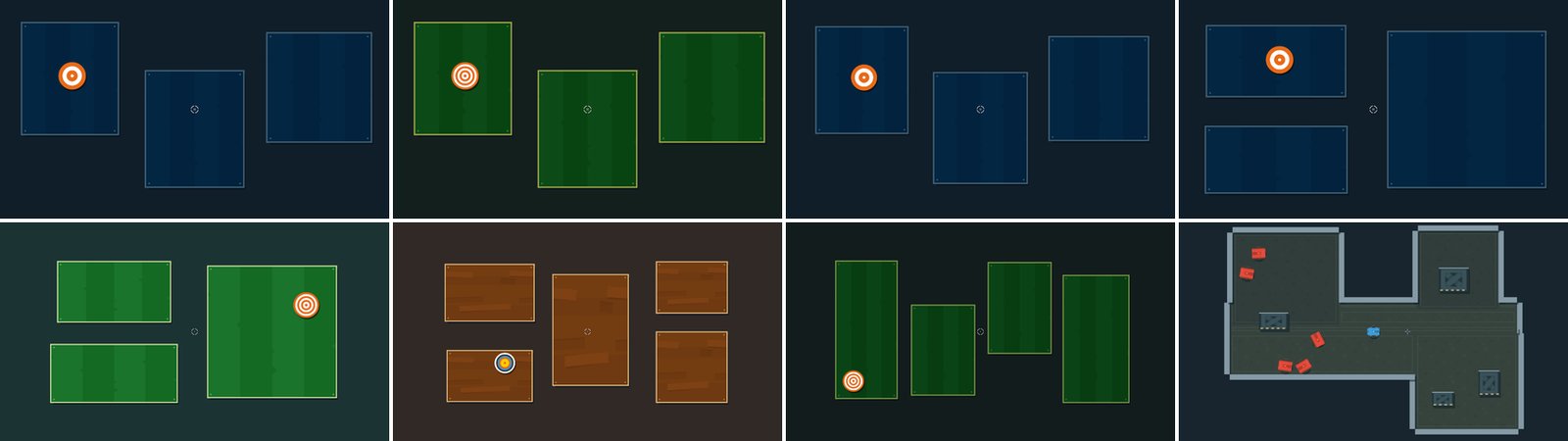
Figure 10: Visual examples of Player-1-Gym randomization: 16 environments seven views. Original uses default profiles; Appearance, Camera, and Scene change one domain; Joint 1–3 combine these three dimensions. Control-response variation is omitted because its effects require action sequences rather than static screenshots.
图 10:Player-1-Gym 随机化的可视化示例:16 个环境 七种视图。“原始”使用默认配置;“外观”“镜头”“场景”各改变一个维度;“联合 1–3”组合这三个维度。控制响应的变化需要动作序列而非静态截图才能看出效果,因此没有展示。
Appendix D Post-Training Details
附录 D 后训练细节
D.1 Supervised Fine-Tuning
D.1 监督微调
For supervised fine-tuning, both model sizes use token-level cross-entropy on the current turn’s reasoning and action, with the history in Appendix A.3.
在监督微调中,两种规模的模型都对当前轮次的推理和动作使用词元级交叉熵,历史设置见附录 A.3。
Action-balanced sampling.
In human gameplay recordings, some actions occupy only a small fraction of playing time but are critical for game progress. For example, left mouse button inputs account for less than 1% of valid inputs in the original recordings, which are dominated by keyboard inputs and mouse movement. In addition to selecting and filtering demonstrations for action coverage during data curation, we use action-balanced sampling to strengthen supervision for these infrequent but important actions. We classify each turn by its current recorded action into overlapping pools: keyboard, mouse movement, click, hold, any mouse button, keyboard–mouse, movement–click, keyboard–click, and keyboard–movement–click. Keyboard includes held and tapped keys; keyboard–mouse includes any mouse input, including scrolling. Other contains the remaining turns, including wait and scroll-only actions. Each draw selects a pool proportionally to its weight (1 for each control pool; 0.1 for Other), then samples a turn uniformly with replacement.
动作均衡采样。
在人类游戏录制中,有些动作只占游戏时间的一小部分,却对游戏进展至关重要。例如,在原始录制中,鼠标左键输入只占有效输入的不到 1%,大部分是键盘输入和鼠标移动。除了在数据整理阶段为动作覆盖挑选和过滤示范之外,我们还使用动作均衡采样,加强对这些不常见但重要的动作的监督。我们按每个轮次当前录制的动作,把它归入若干相互重叠的池:键盘、鼠标移动、单击、按住、任意鼠标按钮、键盘—鼠标、移动—单击、键盘—单击,以及键盘—移动—单击。键盘包括按住和轻按的按键;键盘—鼠标包括任何鼠标输入,滚动也算在内。“其他”池包含其余轮次,包括等待和仅滚动的动作。每次抽取时,按权重比例选择一个池(每个控制池权重为 1,“其他”为 0.1),再从中有放回地均匀抽取一个轮次。
D.2 Multi-Environment Reinforcement Learning
D.2 多环境强化学习
During RL, we use synchronous PPO with a dense critic initialized from Qwen3.5-9B for both actor sizes. Before actor updates begin, the critic undergoes five warmup iterations under the same environment configuration. Rollouts retain the observations, prompts, responses, masks, and behavior log probabilities used at generation, preserving the same conditioning during optimization.
在强化学习阶段,我们使用同步 PPO,两种规模的行动者都配一个由 Qwen3.5-9B 初始化的稠密评论家。在开始更新行动者之前,评论家在相同的环境配置下先做五次预热迭代。采样结果保留生成时所用的观测、提示、响应、掩码和行为对数概率,使优化时的条件与生成时一致。
Reward and cross-turn credit.
For turn in environment , we define the penalized step reward and undiscounted return-to-go as
奖励与跨轮次信用分配。
对于环境 中的第 轮,我们定义带惩罚的步奖励和不折扣的剩余回报为
where is the game-score increment (Appendix C.1) and the terminal turn. Training curves average episode returns . The penalties are
其中 是游戏分数增量(附录 C.1), 是终止轮次。训练曲线对回合回报 取平均。惩罚项为
where counts generated reasoning/prose tokens. An invalid action executes the runtime’s wait fallback. We apply no additional terminal-failure penalty or task-wise reward rescaling. With , return targets are computed over complete trajectories, preserving cross-turn credit.
其中 统计生成的推理/文字词元数。无效动作会执行运行时的“等待”兜底操作。我们不额外施加终止失败惩罚,也不按任务重新缩放奖励。取 时,回报目标在完整轨迹上计算,保留了跨轮次的信用分配。
Advantage normalization and loss reduction.
We normalize advantages globally in GAE, then within environments using Equation (1), with and ; critic return targets are unchanged. For minibatch , let be turn ’s nonempty response-token set selected by the loss mask. The clipped PPO loss averages within turns, then across turns:
优势归一化与损失归约。
我们先在 GAE 中做全局优势归一化,再用式 (1) 在环境内部归一化,其中 ,;评论家的回报目标不变。对于小批次 ,令 为损失掩码选出的第 轮的非空响应词元集合。截断的 PPO 损失先在轮次内平均,再在轮次之间平均:
The critic uses the same reduction. Normalization is token-weighted within environments, whereas losses weight turns equally. Each environment therefore contributes in proportion to its included turns.
评论家使用相同的归约方式。归一化在环境内部按词元加权,而损失对各轮次等权。因此每个环境的贡献与其包含的轮次数成正比。
D.3 Training Implementation
D.3 训练实现
Table 10 summarizes the shared recipe for both model sizes. For each model size, the SFT stage uses 32 NVIDIA H200 GPUs and takes approximately 24 hours, while a 200-step RL run uses 64 H200 GPUs and takes approximately 36 hours. Both durations include validation. Browser rollouts use a cluster-wide pool of 32 workers, each managing up to 16 isolated Playwright browser contexts, for a total capacity of 512 concurrent environments. Browser processes and contexts are reused across episodes to amortize startup costs.
表 10 汇总了两种规模模型共用的配方。每种规模的模型,SFT 阶段使用 32 块 NVIDIA H200 GPU,耗时约 24 小时;一次 200 步的强化学习运行使用 64 块 H200 GPU,耗时约 36 小时。两项时长都包括验证。浏览器采样使用一个集群级的 32 个工作进程池,每个进程最多管理 16 个相互隔离的 Playwright 浏览器上下文,总共可同时运行 512 个环境。浏览器进程和上下文在各回合之间复用,以分摊启动开销。
| Setting | Player-1-9B | Player-1-35B-A3B |
|---|---|---|
| Actor / critic | Dense 9B / dense 9B | MoE 35B-A3B / dense 9B |
| SFT | ||
| Training trajectories | 6,044 | |
| History (visual–action + action-only) | ||
| Sampling | Pool weights: nine action pools 1 each; Other 0.1 | |
| Epoch budget / global batch | 2 / 512 turns | |
| Learning rate / warmup fraction | / 0.03 | |
| Interactive learning | ||
| Algorithm / discount / GAE parameter | PPO / / | |
| RL training steps | 200 | |
| Critic-only warmup | 5 iterations | |
| History (visual–action + action-only) | ||
| Observation resolution | 480P | |
| Rollout batch / PPO minibatch | 256 episodes / 64 turn responses | |
| Episode cap | 50 turns | |
| Output cap per turn | 256 tokens | |
| Actor learning rate | ||
| Critic learning rate | ||
| Optimizer / learning-rate schedule | AdamW / constant | |
| AdamW / weight decay | / 0.01 | |
| PPO epochs per rollout batch | 1 | |
| Gradient-norm clip / PPO clip | 1.0 / 0.2 | |
| Reward rescaling | None | |
| Advantage normalization / loss | Per environment / token mean, then turn mean | |
| Environment allocation | Equal across 16 environments | |
| Randomization mixture | 100% Appearance + Camera + Scene + Control |
Table 10: Post-training configuration. Both model sizes share the settings below except for actor architecture. Each RL step includes rollout collection and PPO updates; critic-only warmup is excluded.
| 设置 | Player-1-9B | Player-1-35B-A3B |
|---|---|---|
| 行动者 / 评论家 | 稠密 9B / 稠密 9B | MoE 35B-A3B / 稠密 9B |
| SFT | ||
| 训练轨迹数 | 6,044 | |
| 历史(视觉—动作 + 仅动作) | ||
| 采样 | 池权重:九个动作池各为 1;“其他”为 0.1 | |
| 轮数预算 / 全局批大小 | 2 / 512 个轮次 | |
| 学习率 / 预热比例 | / 0.03 | |
| 交互式学习 | ||
| 算法 / 折扣 / GAE 参数 | PPO / / | |
| 强化学习训练步数 | 200 | |
| 仅评论家预热 | 5 次迭代 | |
| 历史(视觉—动作 + 仅动作) | ||
| 观测分辨率 | 480P | |
| 采样批次 / PPO 小批次 | 256 个回合 / 64 个轮次响应 | |
| 回合上限 | 50 个轮次 | |
| 每轮输出上限 | 256 个词元 | |
| 行动者学习率 | ||
| 评论家学习率 | ||
| 优化器 / 学习率调度 | AdamW / 常数 | |
| AdamW / 权重衰减 | / 0.01 | |
| 每个采样批次的 PPO 轮数 | 1 | |
| 梯度范数截断 / PPO 截断 | 1.0 / 0.2 | |
| 奖励重缩放 | 无 | |
| 优势归一化 / 损失 | 逐环境 / 先按词元平均,再按轮次平均 | |
| 环境分配 | 16 个环境均分 | |
| 随机化混合 | 100% 外观 + 镜头 + 场景 + 控制 |
表 10:后训练配置。两种规模的模型除行动者架构外共用下列设置。每个强化学习步包括采样收集和 PPO 更新;仅评论家预热不计在内。
D.4 Environment-Scaling Protocol
D.4 环境扩展协议
For Section 5.2, 9B policies start independently from the same SFT checkpoint, sharing the PPO, history, reward, and randomization settings in Table 10. Table 11 gives the suites and matched episode budgets, while interaction lengths and compute may vary within different episodes. Comparisons share Minecraft development tasks and trial seeds, with SFT as the zero-environment reference.
在第 5.2 节中,各 9B 策略都从同一个 SFT 检查点独立出发,共用表 10 中的 PPO、历史、奖励和随机化设置。表 11 给出了各套件和匹配的回合预算,不同回合内的交互长度和计算量可能不同。各比较共用 Minecraft 开发任务和试验种子,以 SFT 作为零环境参照。
| Envs. | Environment subset | Episodes / env. / step |
|---|---|---|
| 2 | 2D shooting; 3D navigation | 128 |
| 4 | 2-env. subset + 2D circuit driving; 3D aiming | 64 |
| 8 | 4-env. subset + 2D UI crafting; 2D platforming; 3D sword duel; 3D road driving | 32 |
| 16 | Full Player-1-Gym suite | 16 |
Table 11: Environment subsets for 9B scaling. All runs use 100 RL steps and 25,600 episodes (256 per step), allocated equally across environments.
| 环境数 | 环境子集 | 回合数 / 环境 / 步 |
|---|---|---|
| 2 | 2D 射击;3D 导航 | 128 |
| 4 | 2 环境子集 + 2D 赛道驾驶;3D 瞄准 | 64 |
| 8 | 4 环境子集 + 2D UI 合成;2D 平台跳跃;3D 剑术对决;3D 公路驾驶 | 32 |
| 16 | 完整的 Player-1-Gym 套件 | 16 |
表 11:9B 扩展实验的环境子集。所有运行都使用 100 个强化学习步和 25,600 个回合(每步 256 个),平均分配到各环境。
Appendix E Evaluation and Results
附录 E 评测与结果
Table 12 lists the full panels and budgets. Methods share each panel’s tasks, trial seeds, and decision budgets while retaining model-specific preprocessing and inference schedules. Periodic evaluation during RL steps uses 100 Minecraft tasks with three trials each, ten ViZDoom maps with ten episodes each, and 170 GameWorld tasks with one trial each. Qwen3.5, Player-1-SFT, and final Player-1-9B are deployed with the history in Appendix A.3.
表 12 列出了完整的评测组和预算。各方法共用每个评测组的任务、试验种子和决策预算,同时保留各模型特有的预处理和推理调度。强化学习过程中的周期性评测使用 100 个 Minecraft 任务(各 3 次试验)、10 张 ViZDoom 地图(各 10 个回合)和 170 个 GameWorld 任务(各 1 次试验)。Qwen3.5、Player-1-SFT 和最终的 Player-1-9B 部署时使用附录 A.3 中的历史设置。
| Panel | Tasks / maps | Trials | Budget | Metrics |
|---|---|---|---|---|
| Player-1-Gym | 16 games | 128 / game | 50 decisions | Mean episode return |
| MineDojo-300 | 300 tasks | 8 / task | 1,000 decisions | Success; task coverage counts |
| ViZDoom-10 | 10 maps | 50 / map | 150–2,100 decisions | Scaled return |
| GameWorld | 170 tasks; 34 games | 3 / task | 400 decisions | Success; progress |
Table 12: Evaluation panels, budgets, and reporting units. Decision limits are per episode (per role in GameWorld). The three external benchmarks use environments outside Player-1-Gym.
| 评测组 | 任务 / 地图 | 试验次数 | 预算 | 指标 |
|---|---|---|---|---|
| Player-1-Gym | 16 款游戏 | 每款 128 次 | 50 次决策 | 平均回合回报 |
| MineDojo-300 | 300 个任务 | 每任务 8 次 | 1,000 次决策 | 成功率;任务覆盖计数 |
| ViZDoom-10 | 10 张地图 | 每图 50 次 | 150–2,100 次决策 | 缩放回报 |
| GameWorld | 170 个任务;34 款游戏 | 每任务 3 次 | 400 次决策 | 成功率;进度 |
表 12:评测组、预算和报告单位。决策上限按回合计(GameWorld 中按角色计)。三个外部基准使用的环境都在 Player-1-Gym 之外。
Evaluation cost.
Our full MineDojo-300, ViZDoom-10, and GameWorld protocols allocate up to 3.14 million agent decision turns per model. Our in-suite validation records average roughly 3,000 input tokens and 100 output tokens per turn, including visual context and generated reasoning. Using these observed lengths as a workload proxy, a full-budget evaluation would cost approximately USD 110,000 at GPT-6 Astra’s standard API rates of USD 10 and USD 50 per million input and output tokens, respectively, before caching discounts.[^1] Actual costs depend on model-specific tokenization, reasoning, and episode lengths. Considering the estimated cost, our focus is mainly on representative released game-control and computer-use policies rather than proprietary API models.
评测成本。
我们完整的 MineDojo-300、ViZDoom-10 和 GameWorld 评测协议,每个模型最多分配 314 万个智能体决策轮次。我们的套件内验证记录显示,每轮平均约有 3,000 个输入词元和 100 个输出词元,包括视觉上下文和生成的推理。以这些观测到的长度作为工作量的代理,按 GPT-6 Astra 每百万输入词元 10 美元、每百万输出词元 50 美元的标准 API 价格,在缓存折扣之前,一次全预算评测约需 11 万美元。[^1] 实际成本取决于各模型的分词方式、推理长度和回合长度。考虑到这一估算成本,我们主要关注已发布的代表性游戏控制和ComputerUse 策略,而不是闭源 API 模型。
[^1] https://developers.openai.com/api/docs/models/gpt-6-astra, accessed Sep 24, 2026.
[^1] https://developers.openai.com/api/docs/models/gpt-6-astra,访问于 2026 年 9 月 24 日。
E.1 Baseline Inference and Action Adapters
E.1 基线推理与动作适配器
We deploy JARVIS-VLA with its action-token decoder and two history entries to predict one action per decision. UI-TARS-1.5-7B uses three previous screenshots, deterministic decoding, and a 400-token output limit. Its adapter maps pixel-coordinate actions to one benchmark interval, with drag and double-click unsupported. NitroGen aggregates an 18-action chunk into six benchmark decisions (three native actions per decision), refreshing the image after each chunk. GameWAM predicts 16 actions and executes eight before replanning, using its Minecraft checkpoint outside Doom and its ViZDoom checkpoint for Doom. Open-P2P uses visual-only conditioning and session-specific recurrent state. All temporal inference state is isolated between episodes.
我们部署 JARVIS-VLA 时使用其动作词元解码器和两条历史记录,每次决策预测一个动作。UI-TARS-1.5-7B 使用三张先前的截图、确定性解码和 400 个词元的输出上限。它的适配器把像素坐标动作映射到一个基准时间间隔,不支持拖拽和双击。NitroGen 把一个 18 个动作的块聚合为六次基准决策(每次决策三个原生动作),每个块之后刷新图像。GameWAM 预测 16 个动作,执行其中 8 个后重新规划;在 Doom 之外使用其 Minecraft 检查点,在 Doom 中使用其 ViZDoom 检查点。Open-P2P 只用视觉条件,并使用会话特定的循环状态。所有时序推理状态在回合之间相互隔离。
Model inputs retain the released preprocessing for the best practice of each baseline: Minecraft is rendered at . We resize the screenshots to for JARVIS-VLA and UI-TARS, for NitroGen, for GameWAM, and for Open-P2P. JARVIS-VLA and GameWAM retain their native degree-based Minecraft camera actions, while Open-P2P uses an adapter gain of degrees per raw mouse pixel. Browser-game adapters project native actions onto per-game and per-role bindings. Benchmark action intervals remain fixed, so a native action chunk can span different simulated durations across benchmarks.
为了让每个基线发挥最佳效果,模型输入沿用其发布时的预处理:Minecraft 以 渲染。我们把截图缩放到 JARVIS-VLA 和 UI-TARS 用的 、NitroGen 用的 、GameWAM 用的 ,以及 Open-P2P 用的 。JARVIS-VLA 和 GameWAM 保留其原生的、以角度为单位的 Minecraft 镜头动作,Open-P2P 使用每原始鼠标像素 度的适配器增益。浏览器游戏适配器把原生动作投影到各游戏、各角色的按键绑定上。基准的动作时间间隔保持固定,因此一个原生动作块在不同基准上可能跨越不同的模拟时长。
E.2 Player-1-Gym In-Suite Validation
E.2 Player-1-Gym 套件内验证
In-suite validation uses the seeded panel in Table 12 with the training randomization settings. For an episode of turns in environment , the return is
套件内验证使用表 12 中带固定种子的评测组,以及训练时的随机化设置。对于环境 中长度为 轮的一个回合,回报为
Here is the native game-score increment (Appendix C.1), and the invalid-action and length penalties are defined in Appendix D.2. We report mean episode return, averaging trials within each environment and then equally across the sixteen environments.
其中 是游戏原生的分数增量(附录 C.1),无效动作惩罚和长度惩罚的定义见附录 D.2。我们报告平均回合回报:先在每个环境内对各次试验取平均,再在 16 个环境之间等权平均。
E.3 MineDojo-300
MineDojo-300 contains 200 Combat and 100 Harvest tasks from MineDojo, ported to MineStudio on Minecraft 1.16.5. World and task seeds are deterministically derived from each task and trial. Success is verified after initialization from inventory acquisition for Harvest tasks or target kills for Combat tasks. We average success over trials within each task, then equally over tasks. One decision advances a 50-ms simulator tick. Player-1’s camera adapter uses a nominal gain of radians per observation pixel, subject to native constraints.
MineDojo-300 包含来自 MineDojo 的 200 个战斗任务和 100 个采集任务,移植到基于 Minecraft 1.16.5 的 MineStudio 上。世界种子和任务种子由每个任务和每次试验确定性地导出。初始化之后,采集任务按物品栏获得情况、战斗任务按目标击杀情况验证是否成功。我们先在每个任务内对各次试验的成功率取平均,再在各任务之间等权平均。一次决策推进一个 50 毫秒的模拟器时钟刻。Player-1 的镜头适配器使用每观测像素 弧度的标称增益,受游戏原生约束限制。
We also report Task coverage in for , where counts successes among eight trials for task . Entries , with , count tasks meeting each threshold. Overall success intervals use 100,000 percentile task-cluster bootstrap replicates, stratified by Combat and Harvest while retaining all eight trials per task and the panel’s category weights. The 95% intervals quantify within-panel task-sampling uncertainty. For all-zero outcomes, we report [-].
我们还报告任务覆盖 ,其中 , 是任务 在八次试验中的成功次数。表中的 ()统计达到各阈值的任务数。总体成功率的区间使用 100,000 次百分位任务聚类自助法重抽样,按战斗和采集分层,同时保留每个任务的全部八次试验和评测组的类别权重。95% 区间量化的是评测组内任务抽样的不确定性。对于全为零的结果,我们记为 [-]。
Hunt a Bat in Night Plains with an Iron Sword, Shield, and Diamond Armor
Task instruction: “hunt a bat in night plains with a iron sword, shield, and a full suite of diamond armors”
Fight a Husk in Night Desert with an Iron Sword, Shield, and Diamond Armor
Task instruction: “combat a husk in night desert with a iron sword, shield, and a full suite of diamond armors”
Obtain One Log in Plains
Task instruction: “obtain log in plains”
Figure 11: Example tasks and scenes from MineDojo-300.
在夜晚平原用铁剑、盾牌和钻石盔甲猎杀一只蝙蝠
任务指令:“hunt a bat in night plains with a iron sword, shield, and a full suite of diamond armors”(在夜晚平原用铁剑、盾牌和一整套钻石盔甲猎杀一只蝙蝠。)
在夜晚沙漠用铁剑、盾牌和钻石盔甲与尸壳战斗
任务指令:“combat a husk in night desert with a iron sword, shield, and a full suite of diamond armors”(在夜晚沙漠用铁剑、盾牌和一整套钻石盔甲与一只尸壳战斗。)
在平原获得一块原木
任务指令:“obtain log in plains”(在平原获得原木。)
图 11:MineDojo-300 中的任务和场景示例。
E.4 ViZDoom-10
| Category | Map | Raw reward rule | Scale |
|---|---|---|---|
| Precision shooting | Basic | for eliminating the target; per shot; per tic. | 100 |
| Defend the Center | per kill; on death. | 10 | |
| Defend the Line | per kill; on death. | 10 | |
| Goal navigation | Deadly Corridor | Forward position along the corridor; for collecting armor; on death. | 1000 |
| My Way Home | for reaching the goal; per tic. | 1 | |
| Mobile combat | Battle 1 | per kill. | 10 |
| Battle 2 | per kill. | 10 | |
| Deathmatch | Enemy-dependent kill bonuses, with 1, 3, 3, 4, 3, and 10 for the six enemy types. | 10 | |
| Survival | Health Gathering | per tic alive; on death. | 2100 |
| Health Gathering Supreme | per tic alive; on death. | 2100 |
Table 13: ViZDoom-10 map categories, raw reward rules, and fixed scales. Rewards accumulate over an episode; a tic is one simulator tick. Scaled Return divides the raw episode return by .
| 类别 | 地图 | 原始奖励规则 | 缩放系数 |
|---|---|---|---|
| 精确射击 | Basic | 消灭目标 ;每次射击 ;每个时钟刻 。 | 100 |
| Defend the Center | 每次击杀 ;死亡 。 | 10 | |
| Defend the Line | 每次击杀 ;死亡 。 | 10 | |
| 目标导航 | Deadly Corridor | 沿走廊前进的位置;拾取护甲 ;死亡 。 | 1000 |
| My Way Home | 到达目标 ;每个时钟刻 。 | 1 | |
| 移动战斗 | Battle 1 | 每次击杀 。 | 10 |
| Battle 2 | 每次击杀 。 | 10 | |
| Deathmatch | 按敌人类型给击杀奖励,六类敌人分别为 1、3、3、4、3 和 10。 | 10 | |
| 生存 | Health Gathering | 存活每个时钟刻 ;死亡 。 | 2100 |
| Health Gathering Supreme | 存活每个时钟刻 ;死亡 。 | 2100 |
表 13:ViZDoom-10 的地图类别、原始奖励规则和固定缩放系数。奖励在回合内累积;一个时钟刻(tic)是模拟器的一次更新。缩放回报等于原始回合回报除以 。
Table 13 lists the ten selected maps, control categories, native rewards, and fixed return scales. ViZDoom 1.3.0 provides RGB observations. Each decision advances two simulator tics. Basic permits 150 decisions, Deathmatch 2,100, and the other maps 1,050, subject to earlier native termination. Player-1’s camera adapter uses radians per observation pixel with native pitch constraints.
表 13 列出了选用的十张地图、控制类别、原生奖励和固定的回报缩放系数。ViZDoom 1.3.0 提供 的 RGB 观测。每次决策推进两个模拟器时钟刻。Basic 允许 150 次决策,Deathmatch 允许 2,100 次,其余地图 1,050 次,若原生环境提前终止则以其为准。Player-1 的镜头适配器使用每观测像素 弧度的增益,并遵守原生的俯仰约束。
From raw return and map-specific scale , we compute map, category (), and overall scaled returns:
由原始回报 和各地图的缩放系数 ,我们计算地图、类别()和总体的缩放回报:
Evaluation uses fixed seeds per map, with identical scales across models. The survival scale of 2,100 corresponds to the native time-reward budget, with death penalties retained. Observation geometry, timing, and camera constraints are matched within each backbone.
评测在每张地图上使用 个固定种子,各模型的缩放系数相同。生存类的缩放系数 2,100 对应原生的时间奖励预算,死亡惩罚予以保留。在每个骨干模型内部,观测几何、时间和镜头约束保持一致。
Deadly Corridor
Task instruction: “Fight through the corridor and reach the green armor at the far end while staying alive.”
Battle 2
Task instruction: “Fight the monsters and maximize the total episode reward. Move through the arena, keep enemies in view, and fire accurately while staying alive.”
Health Gathering Supreme
Task instruction: “Search the damaging maze for medical cases, avoid poison bottles, and survive as long as possible.”
Figure 12: Example tasks and scenes from ViZDoom-10.
Deadly Corridor
任务指令:“Fight through the corridor and reach the green armor at the far end while staying alive.”(杀出走廊,在活着的前提下到达尽头的绿色护甲。)
Battle 2
任务指令:“Fight the monsters and maximize the total episode reward. Move through the arena, keep enemies in view, and fire accurately while staying alive.”(与怪物战斗,最大化回合总奖励。在竞技场中移动,让敌人保持在视野内,在活着的前提下准确开火。)
Health Gathering Supreme
任务指令:“Search the damaging maze for medical cases, avoid poison bottles, and survive as long as possible.”(在会扣血的迷宫中寻找医疗箱,避开毒药瓶,尽可能久地存活。)
图 12:ViZDoom-10 中的任务和场景示例。
E.5 GameWorld
GameWorld includes 170 tasks across 34 diverse browser games. We evaluate our model for three trials with seeds 0, 1, and 2 (Table 12). The policy receives screenshots, rules, and instructions, while evaluator state is hidden. Action duration, observation geometry, and admissible controls follow each game’s configuration, and multi-role games keep separate histories. Success is the fraction of trials reporting completion, while progress is the achieved fraction from its initial value to its target, clipped to . The evaluator averages objectives and retains the best task progress reached. Reported success and progress average trials within each task, then equally across tasks.
GameWorld 包含 34 款不同浏览器游戏中的 170 个任务。我们用种子 0、1 和 2 对模型做三次试验评测(表 12)。策略接收截图、规则和指令,评测器状态对其隐藏。动作时长、观测几何和可用控制遵循各游戏的配置,多角色游戏为每个角色保留单独的历史。成功率是报告完成的试验所占比例,进度是从初始值到目标值之间已完成的比例,截断到 。评测器对各目标取平均,并保留任务达到的最佳进度。报告的成功率和进度先在每个任务内对试验取平均,再在任务之间等权平均。
OVO
Task instruction: “Load into level 3. Clear level 3 and reach level 4 or higher.”
Temple Run 2
Task instruction: “Reach at least 4000 points in one run with no stumbles, deaths, or revivals.”
Another Gentleman’s Adventure
Task instruction: “Gather at least 4 coins in the current level.”
Figure 13: Example tasks and scenes from GameWorld.
OVO
任务指令:“Load into level 3. Clear level 3 and reach level 4 or higher.”(进入第 3 关,通过第 3 关并到达第 4 关或更高。)
Temple Run 2
任务指令:“Reach at least 4000 points in one run with no stumbles, deaths, or revivals.”(在一次奔跑中拿到至少 4000 分,不能绊倒、死亡或复活。)
Another Gentleman’s Adventure
任务指令:“Gather at least 4 coins in the current level.”(在当前关卡收集至少 4 枚金币。)
图 13:GameWorld 中的任务和场景示例。