Open X-Embodiment: Robotic Learning Datasets and RT-X Models
Open X-Embodiment: Robotic Learning Datasets and RT-X Models
O pen X - E mbodiment Collaboration robotics-transformer-x.github.io Abby O’Neill Abdul Rehman Abhinav Gupta Abhiram Maddukuri Abhishek Gupta Abhishek Padalkar Abraham Lee Acorn Pooley Agrim Gupta Ajay Mandlekar Ajinkya Jain Albert Tung Alex Bewley Alex Herzog Alex Irpan Alexander Khazatsky Anant Rai Anchit Gupta Andrew Wang Andrey Kolobov Anikait Singh Animesh Garg Aniruddha Kembhavi Annie Xie Anthony Brohan Antonin Raffin Archit Sharma Arefeh Yavary Arhan Jain Ashwin Balakrishna Ayzaan Wahid Ben Burgess-Limerick Beomjoon Kim Bernhard Schölkopf Blake Wulfe Brian Ichter Cewu Lu Charles Xu Charlotte Le Chelsea Finn Chen Wang Chenfeng Xu Cheng Chi Chenguang Huang Christine Chan Christopher Agia Chuer Pan Chuyuan Fu Coline Devin Danfei Xu Daniel Morton Danny Driess Daphne Chen Deepak Pathak Dhruv Shah Dieter Büchler Dinesh Jayaraman Dmitry Kalashnikov Dorsa Sadigh Edward Johns Ethan Foster Fangchen Liu Federico Ceola Fei Xia Feiyu Zhao Felipe Vieira Frujeri Freek Stulp Gaoyue Zhou Gaurav S. Sukhatme Gautam Salhotra Ge Yan Gilbert Feng Giulio Schiavi Glen Berseth Gregory Kahn Guangwen Yang Guanzhi Wang Hao Su Hao-Shu Fang Haochen Shi Henghui Bao Heni Ben Amor Henrik I Christensen Hiroki Furuta Homanga Bharadhwaj Homer Walke Hongjie Fang Huy Ha Igor Mordatch Ilija Radosavovic Isabel Leal Jacky Liang Jad Abou-Chakra Jaehyung Kim Jaimyn Drake Jan Peters Jan Schneider Jasmine Hsu Jay Vakil Jeannette Bohg Jeffrey Bingham Jeffrey Wu Jensen Gao Jiaheng Hu Jiajun Wu Jialin Wu Jiankai Sun Jianlan Luo Jiayuan Gu Jie Tan Jihoon Oh Jimmy Wu Jingpei Lu Jingyun Yang Jitendra Malik João Silvério Joey Hejna Jonathan Booher Jonathan Tompson Jonathan Yang Jordi Salvador Joseph J. Lim Junhyek Han Kaiyuan Wang Kanishka Rao Karl Pertsch Karol Hausman Keegan Go Keerthana Gopalakrishnan Ken Goldberg Kendra Byrne Kenneth Oslund Kento Kawaharazuka Kevin Black Kevin Lin Kevin Zhang Kiana Ehsani Kiran Lekkala Kirsty Ellis Krishan Rana Krishnan Srinivasan Kuan Fang Kunal Pratap Singh Kuo-Hao Zeng Kyle Hatch Kyle Hsu Laurent Itti Lawrence Yunliang Chen Lerrel Pinto Li Fei-Fei Liam Tan Linxi ”Jim” Fan Lionel Ott Lisa Lee Luca Weihs Magnum Chen Marion Lepert Marius Memmel Masayoshi Tomizuka Masha Itkina Mateo Guaman Castro Max Spero Maximilian Du Michael Ahn Michael C. Yip Mingtong Zhang Mingyu Ding Minho Heo Mohan Kumar Srirama Mohit Sharma Moo Jin Kim Muhammad Zubair Irshad Naoaki Kanazawa Nicklas Hansen Nicolas Heess Nikhil J Joshi Niko Suenderhauf Ning Liu Norman Di Palo Nur Muhammad Mahi Shafiullah Oier Mees Oliver Kroemer Osbert Bastani Pannag R Sanketi Patrick ”Tree” Miller Patrick Yin Paul Wohlhart Peng Xu Peter David Fagan Peter Mitrano Pierre Sermanet Pieter Abbeel Priya Sundaresan Qiuyu Chen Quan Vuong Rafael Rafailov Ran Tian Ria Doshi Roberto Mart’in-Mart’in Rohan Baijal Rosario Scalise Rose Hendrix Roy Lin Runjia Qian Ruohan Zhang Russell Mendonca Rutav Shah Ryan Hoque Ryan Julian Samuel Bustamante Sean Kirmani Sergey Levine Shan Lin Sherry Moore Shikhar Bahl Shivin Dass Shubham Sonawani Shubham Tulsiani Shuran Song Sichun Xu Siddhant Haldar Siddharth Karamcheti Simeon Adebola Simon Guist Soroush Nasiriany Stefan Schaal Stefan Welker Stephen Tian Subramanian Ramamoorthy Sudeep Dasari Suneel Belkhale Sungjae Park Suraj Nair Suvir Mirchandani Takayuki Osa Tanmay Gupta Tatsuya Harada Tatsuya Matsushima Ted Xiao Thomas Kollar Tianhe Yu Tianli Ding Todor Davchev Tony Z. Zhao Travis Armstrong Trevor Darrell Trinity Chung Vidhi Jain Vikash Kumar Vincent Vanhoucke Vitor Guizilini Wei Zhan Wenxuan Zhou Wolfram Burgard Xi Chen Xiangyu Chen Xiaolong Wang Xinghao Zhu Xinyang Geng Xiyuan Liu Xu Liangwei Xuanlin Li Yansong Pang Yao Lu Yecheng Jason Ma Yejin Kim Yevgen Chebotar Yifan Zhou Yifeng Zhu Yilin Wu Ying Xu Yixuan Wang Yonatan Bisk Yongqiang Dou Yoonyoung Cho Youngwoon Lee Yuchen Cui Yue Cao Yueh-Hua Wu Yujin Tang Yuke Zhu Yunchu Zhang Yunfan Jiang Yunshuang Li Yunzhu Li Yusuke Iwasawa Yutaka Matsuo Zehan Ma Zhuo Xu Zichen Jeff Cui Zichen Zhang Zipeng Fu Zipeng Lin
Abstract
摘要
Large, high-capacity models trained on diverse datasets have shown remarkable successes on efficiently tackling downstream applications. In domains from NLP to Computer Vision, this has led to a consolidation of pretrained models, with general pretrained backbones serving as a starting point for many applications. Can such a consolidation happen in robotics? Conventionally, robotic learning methods train a separate model for every application, every robot, and even every environment. Can we instead train “generalist” X-robot policy that can be adapted efficiently to new robots, tasks, and environments? In this paper, we provide datasets in standardized data formats and models to make it possible to explore this possibility in the context of robotic manipulation, alongside experimental results that provide an example of effective X-robot policies. We assemble a dataset from different robots collected through a collaboration between institutions, demonstrating skills ( tasks). We show that a high-capacity model trained on this data, which we call RT-X, exhibits positive transfer and improves the capabilities of multiple robots by leveraging experience from other platforms. The project website is robotics-transformer-x.github.io.
在多样化数据上训练的大容量模型,已在高效解决下游应用上取得显著成功。从 NLP 到计算机视觉,这推动了预训练模型的收敛:通用预训练骨干成为许多应用的起点。机器人领域能否出现同样的收敛?传统上,机器人学习方法为每个应用、每台机器人、甚至每个环境单独训练一个模型。我们能否改为训练可高效适配新机器人、新任务与新环境的「通才」跨本体(X-robot)策略?本文提供标准化数据格式的数据集与模型,使人们能在机器人操作语境下探索这一可能,并给出有效跨本体策略的实验示例。我们通过 21 家机构协作,汇集来自 种不同机器人的数据,覆盖 种技能( 项任务)。结果表明,在此数据上训练的高容量模型——我们称为 RT-X——展现正向迁移,并能借助其他平台经验提升多台机器人的能力。项目网站:robotics-transformer-x.github.io。
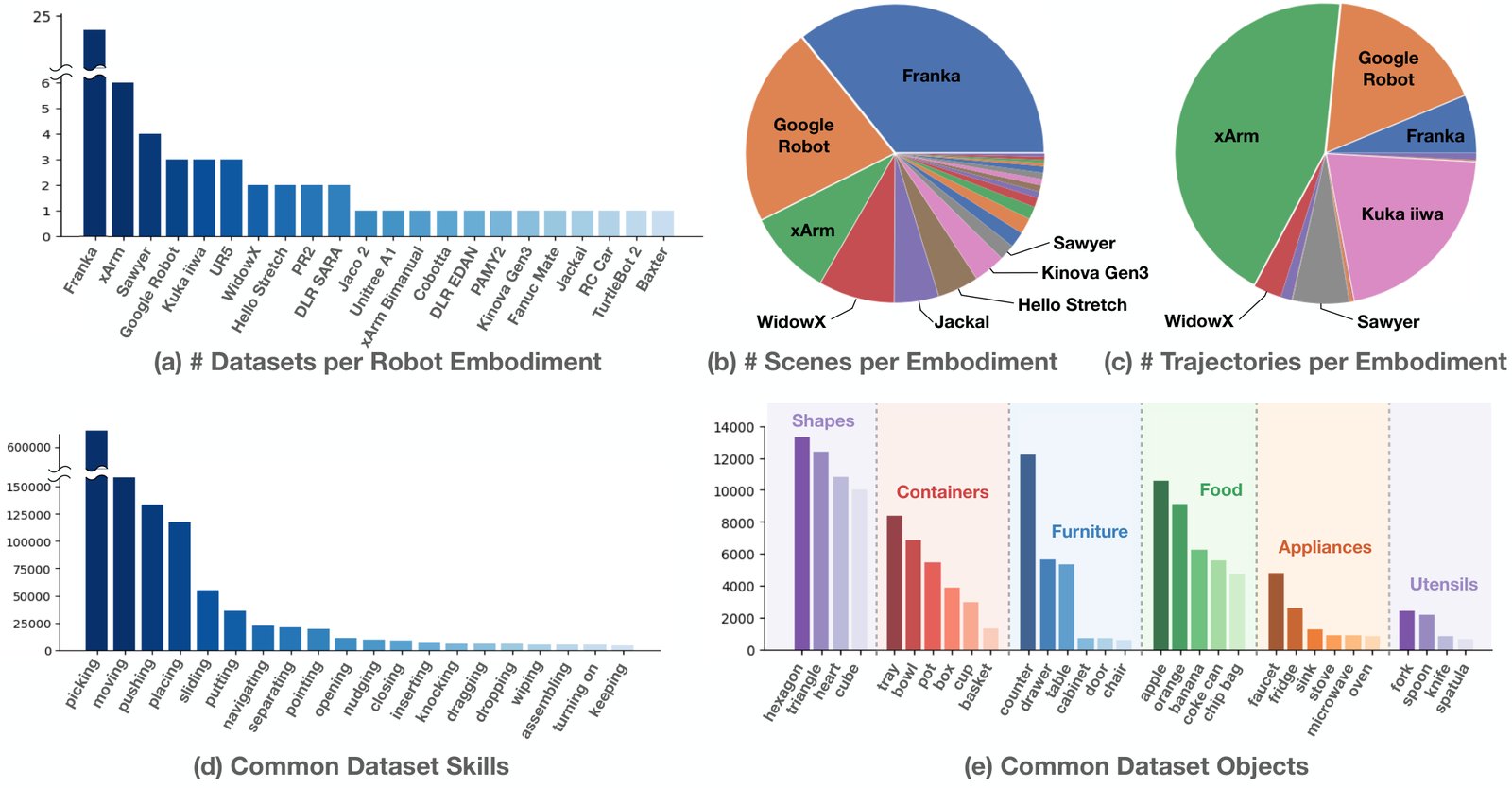
Fig. 1: We propose an open, large-scale dataset for robot learning curated from institutions across the globe. The dataset represents diverse behaviors, robot embodiments and environments, and enables learning generalized robotic policies.
图 1:我们提出面向机器人学习的开放大规模数据集,由全球 家机构整理。数据覆盖多样行为、机器人本体与环境,支撑学习可泛化的机器人策略。
I Introduction
I 引言
A central lesson from advances in machine learning and artificial intelligence is that large-scale learning from diverse datasets can enable capable AI systems by providing for general-purpose pretrained models. In fact, large-scale general-purpose models typically trained on large and diverse datasets can often outperform their narrowly targeted counterparts trained on smaller but more task-specific data. For instance, open-vocab classifiers (e.g., CLIP [1]) trained on large datasets scraped from the web tend to outperform fixed-vocabulary models trained on more limited datasets, and large language models [2, 3] trained on massive text corpora tend to outperform systems that are only trained on narrow task-specific datasets. Increasingly, the most effective way to tackle a given narrow task (e.g., in vision or NLP) is to adapt a general-purpose model. However, these lessons are difficult to apply in robotics: any single robotic domain might be too narrow, and while computer vision and NLP can leverage large datasets sourced from the web, comparably large and broad datasets for robotic interaction are hard to come by. Even the largest data collection efforts still end up with datasets that are a fraction of the size and diversity of benchmark datasets in vision (5-18M) [4, 5] and NLP (1.5B-4.5B) [6, 7]. More importantly, such datasets are often still narrow along some axes of variation, either focusing on a single environment, a single set of objects, or a narrow range of tasks. How can we overcome these challenges in robotics and move the field of robotic learning toward large data regime that has been so successful in other domains?
机器学习与人工智能进展的一条核心经验是:在多样化数据上大规模学习,能通过提供通才预训练模型来造就有能力的 AI 系统。事实上,通常在大规模多样数据上训练的通用大模型,往往优于在更小但更任务专用的数据上训练的窄域对应物。例如,在网络大规模数据上训练的开放词表分类器(如 CLIP [1])常优于在更受限数据上训练的固定词表模型;在海量文本上训练的大语言模型 [2, 3] 也常优于只在窄任务数据上训练的系统。越来越多地,解决给定窄任务(视觉或 NLP)的最有效方式是适配一个通才模型。然而这些经验很难直接搬到机器人:任一单一机器人域都可能过窄;计算机视觉与 NLP 能利用网络大规模数据,而规模与广度可比的机器人交互数据却难求。即便最大的数据采集努力,所得数据集相对视觉(5–18M)[4, 5] 与 NLP(1.5B–4.5B)[6, 7] 基准仍只是零头,更重要的是往往在某些变化轴上仍然很窄——只盯一个环境、一组物体或一小段任务范围。我们如何克服这些挑战,把机器人学习推向其他领域已证明成功的大数据体制?
Inspired by the generalization made possible by pretraining large vision or language models on diverse data, we take the perspective that the goal of training generalizable robot policies requires X-embodiment training, i.e., with data from multiple robotic platforms. While each individual robotic learning dataset might be too narrow, the union of all such datasets provides a better coverage of variations in environments and robots. Learning generalizable robot policies requires developing methods that can utilize X-embodiment data, tapping into datasets from many labs, robots, and settings. Even if such datasets in their current size and coverage are insufficient to attain the impressive generalization results that have been demonstrated by large language models, in the future, the union of such data can potentially provide this kind of coverage. Because of this, we believe that enabling research into X-embodiment robotic learning is critical at the present juncture.
受在多样数据上预训练大规模视觉或语言模型所带来泛化的启发,我们采取的视角是:训练可泛化机器人策略的目标需要跨本体(X-embodiment)训练,也就是使用来自多种机器人平台的数据。单个机器人学习数据集或许过窄,但所有此类数据的并集能更好覆盖环境与机器人的变化。学习可泛化策略,需要发展能利用跨本体数据、打通众多实验室、机器人与设定的方法。即便以当前规模与覆盖,这类数据还不足以复现大语言模型那类惊人泛化,未来其并集仍有望提供此类覆盖。因此,我们相信:在当下节点推动跨本体机器人学习研究至关重要。
Following this rationale, we have two goals: (1) Evaluate whether policies trained on data from many different robots and environments enjoy the benefits of positive transfer, attaining better performance than policies trained only on data from each evaluation setup. (2) Organize large robotic datasets to enable future research on X-embodiment models.
据此,我们有两个目标:(1) 评估在多机器人、多环境数据上训练的策略是否享受正向迁移,表现优于只在各评估设定数据上训练的策略;(2) 整理大规模机器人数据集,支撑未来的跨本体模型研究。
We focus our work on robotic manipulation. Addressing goal (1), our empirical contribution is to demonstrate that several recent robotic learning methods, with minimal modification, can utilize X-embodiment data and enable positive transfer. Specifically, we train the RT-1 [8] and RT-2 [9] models on different robotic manipulators. We show that the resulting models, which we call RT-X, can improve over policies trained only on data from the evaluation domain, exhibiting better generalization and new capabilities. Addressing (2), we provide the Open X-Embodiment (OXE) Repository, which includes a dataset with different robotic embodiments from different institutions that can enable the robotics community to pursue further research on X-embodiment models, along with open-source tools to facilitate such research. Our aim is not to innovate in terms of the particular architectures and algorithms, but rather to provide the model that we trained together with data and tools to energize research around X-embodiment robotic learning.
工作聚焦机器人操作。针对目标 (1),经验贡献是表明:若干近期机器人学习方法稍加修改即可利用跨本体数据并实现正向迁移。具体地,我们在 种不同操作臂上训练 RT-1 [8] 与 RT-2 [9];所得模型称为 RT-X,相对只在评估域数据上训练的策略,能提升表现,并展现更好的泛化与新能力。针对 (2),我们提供 Open X-Embodiment(OXE)仓库,包含来自 家机构、 种机器人本体的数据集,以及便于研究的开源工具。我们的目标不在架构与算法上标新立异,而是提供所训练的模型以及数据与工具,激发围绕跨本体机器人学习的研究。
Fig. 1: The Open X-Embodiment Dataset. (a): the dataset consists of 60 individual datasets across embodiments. (b): the Franka robot has the largest diversity in visually distinct scenes due to the large number of Franka datasets, (c): xArm and Google Robot contribute the most number of trajectories due to a few large datasets, (d, e): the dataset contains a great diversity of skills and common objects.
图 1:Open X-Embodiment 数据集。(a):数据包含跨 种本体的 60 个独立数据集。(b):因 Franka 相关数据集最多,其视觉上可区分场景的多样性最大;(c):因若干大规模数据集,xArm 与 Google Robot 贡献了最多轨迹;(d, e):数据在技能与常见物体上具有很大多样性。
II Related Work
II 相关工作
Transfer across embodiments. A number of prior works have studied methods for transfer across robot embodiments in simulation [10, 11, 12, 13, 14, 15, 16, 17, 18, 19, 20, 21, 22] and on real robots [23, 24, 25, 26, 27, 28, 29]. These methods often introduce mechanisms specifically designed to address the embodiment gap between different robots, such as shared action representations [14, 30], incorporating representation learning objectives [17, 26], adapting the learned policy on embodiment information [30, 31, 11, 18, 15], and decoupling robot and environment representations [24]. Prior work has provided initial demonstrations of X-embodiment training [27] and transfer [25, 32, 29] with transformer models. We investigate complementary architectures and provide complementary analyses, and, in particular, study the interaction between X-embodiment transfer and web-scale pretraining. Similarly, methods for transfer across human and robot embodiments also often employ techniques for reducing the embodiment gap, i.e. by translating between domains or learning transferable representations [33, 34, 35, 36, 37, 38, 39, 40, 41, 42, 43]. Alternatively, some works focus on sub-aspects of the problem such as learning transferable reward functions [44, 17, 45, 46, 47, 48], goals [49, 50], dynamics models [51], or visual representations [52, 53, 54, 55, 56, 57, 58, 59] from human video data. Unlike most of these prior works, we directly train a policy on X-embodiment data, without any mechanisms to reduce the embodiment gap, and observe positive transfer by leveraging that data.
跨本体迁移。 多项先前工作研究了仿真 [10–22] 与真实机器人 [23–29] 上的跨本体迁移方法。它们常引入专门缩小不同机器人之间本体差距的机制,如共享动作表示 [14, 30]、加入表示学习目标 [17, 26]、按本体信息适配所学策略 [30, 31, 11, 18, 15]、解耦机器人与环境表示 [24]。已有工作初步展示了用 Transformer 做跨本体训练 [27] 与迁移 [25, 32, 29]。我们考察互补架构并给出互补分析,尤其研究跨本体迁移与网络规模预训练的相互作用。类似地,人—机本体迁移方法也常采用缩小本体差距的技术,例如域间翻译或学习可迁移表示 [33–43]。另一些工作聚焦子问题,如从人类视频学习可迁移奖励 [44, 17, 45–48]、目标 [49, 50]、动力学模型 [51] 或视觉表示 [52–59]。与多数先前工作不同,我们直接在跨本体数据上训练策略,不引入缩小本体差距的机制,并观察到借助这些数据的正向迁移。
Large-scale robot learning datasets. The robot learning community has created open-source robot learning datasets, spanning grasping [60, 61, 62, 63, 64, 65, 66, 67, 68, 69, 70, 71], pushing interactions [72, 73, 74, 23], sets of objects and models [75, 76, 77, 78, 79, 80, 81, 82, 83, 84, 85], and teleoperated demonstrations [86, 87, 88, 89, 90, 8, 91, 92, 93, 94, 95]. With the exception of RoboNet [23], these datasets contain data of robots of the same type, whereas we focus on data spanning multiple embodiments. The goal of our data repository is complementary to these efforts: we process and aggregate a large number of prior datasets into a single, standardized repository, called Open X-Embodiment, which shows how robot learning datasets can be shared in a meaningul and useful way.
大规模机器人学习数据集。 机器人学习社区已创建开源数据集,覆盖抓取 [60–71]、推挤交互 [72–74, 23]、物体与模型集合 [75–85] 以及遥操作演示 [86–95]。除 RoboNet [23] 外,这些数据多只含同一类型机器人;我们则聚焦跨多种本体的数据。本数据仓库的目标与这些努力互补:我们把大量先前数据加工并汇总为单一、标准化的仓库 Open X-Embodiment,展示机器人学习数据如何以有意义且可用的方式共享。
Language-conditioned robot learning. Prior work has aimed to endow robots and other agents with the ability to understand and follow language instructions [96, 97, 98, 99, 100, 101], often by learning language-conditioned policies [45, 102, 103, 104, 105, 40, 106, 8]. We train language-conditioned policies via imitation learning like many of these prior works but do so using large-scale multi-embodiment demonstration data. Following previous works that leverage pre-trained language embeddings [107, 45, 108, 103, 40, 109, 110, 8, 111, 112] and pre-trained vision-language models [113, 114, 115, 9] in robotic imitation learning, we study both forms of pre-training in our experiments, specifically following the recipes of RT-1 [8] and RT-2 [9].
语言条件机器人学习。 先前工作致力于让机器人及其他智能体理解并遵循语言指令 [96–101],常通过学习语言条件策略 [45, 102–106, 8]。我们像许多先前工作一样用模仿学习训练语言条件策略,但使用大规模多本体演示数据。沿用在机器人模仿学习中利用预训练语言嵌入 [107, 45, 108, 103, 40, 109–112] 与预训练视觉—语言模型 [113–115, 9] 的路线,实验中两种预训练都做了研究,具体遵循 RT-1 [8] 与 RT-2 [9] 的配方。
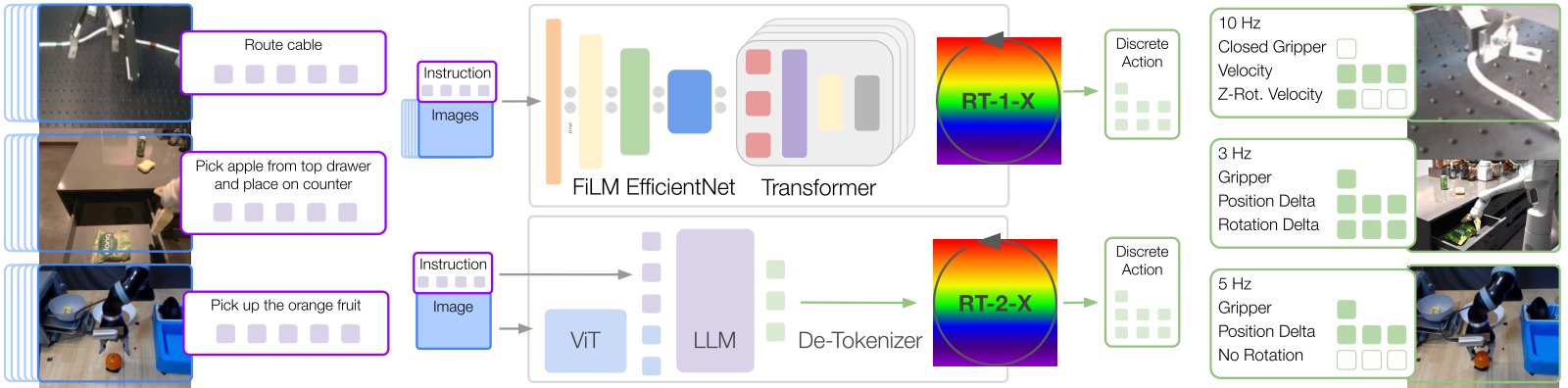
Fig. 2: RT-1-X and RT-2-X both take images and a text instruction as input and output discretized end-effector actions. RT-1-X is an architecture designed for robotics, with a FiLM [116] conditioned EfficientNet [117] and a Transformer [118]. RT-2-X builds on a VLM backbone by representing actions as another language, and training action text tokens together with vision-language data.
图 2:RT-1-X 与 RT-2-X 均以图像与文本指令为输入,输出离散化的末端执行器动作。RT-1-X 是面向机器人的架构,含 FiLM [116] 条件化的 EfficientNet [117] 与 Transformer [118]。RT-2-X 建立在 VLM 骨干上,把动作也表示成一种语言,并与视觉—语言数据一起训练动作文本 token。
III The Open X-Embodiment Repository
III Open X-Embodiment 仓库
We introduce the Open X-Embodiment Repository (robotics-transformer-x.github.io) – an open-source repository which includes large-scale data along with pre-trained model checkpoints for X-embodied robot learning research. More specifically, we provide and maintain the following open-source resources to the broader community:
我们推出 Open X-Embodiment 仓库(robotics-transformer-x.github.io)——一个开源仓库,包含面向跨本体机器人学习研究的大规模数据与预训练模型检查点。更具体地,我们向更广泛社区提供并维护以下开源资源:
- • Open X-Embodiment Dataset: robot learning dataset with 1M+ robot trajectories from robot embodiments.
- • Pre-Trained Checkpoints: a selection of RT-X model checkpoints ready for inference and finetuning.
- • Open X-Embodiment 数据集:含来自 种机器人本体的 100 万+ 条机器人轨迹 的学习数据。
- • 预训练检查点:若干可直接推理与微调的 RT-X 模型检查点。
We intend for these resources to form a foundation for X-embodiment research in robot learning, but they are just the start. Open X-Embodiment is a community-driven effort, currently involving institutions from around the world, and we hope to further broaden participation and grow the initial Open X-Embodiment Dataset over time. In this section, we summarize the dataset and X-embodiment learning framework, before discussing the specific models we use to evaluate our dataset and our experimental results.
我们希望这些资源成为机器人学习中跨本体研究的基础,但这只是起点。Open X-Embodiment 是社区驱动的努力,目前涉及全球 家机构;我们希望进一步扩大参与,并随时间扩展初始数据集。本节先概述数据集与跨本体学习框架,再讨论用于评估数据集的具体模型与实验结果。
III-A The Open X-Embodiment Dataset
III-A Open X-Embodiment 数据集
The Open X-Embodiment Dataset contains 1M+ real robot trajectories spanning robot embodiments, from single robot arms to bi-manual robots and quadrupeds. The dataset was constructed by pooling 60 existing robot datasets from robotic research labs around the world and converting them into a consistent data format for easy download and usage. We use the RLDS data format [119], which saves data in serialized tfrecord files and accommodates the various action spaces and input modalities of different robot setups, such as differing numbers of RGB cameras, depth cameras and point clouds. It also supports efficient, parallelized data loading in all major deep learning frameworks. For more details about the data storage format and a breakdown of all 60 datasets, see robotics-transformer-x.github.io.
Open X-Embodiment 数据集包含跨越 种机器人本体、逾 100 万条真实机器人轨迹,从单臂到双臂机器人与四足。数据通过汇集全球 个机器人研究实验室的 60 个既有机器人数据集,并转换为一致格式以便下载使用而建成。我们采用 RLDS 数据格式 [119]:数据存为序列化 tfrecord,能容纳不同机器人设定的动作空间与输入模态,如不同数量的 RGB 相机、深度相机与点云;并支持各大深度学习框架中高效、可并行的数据加载。数据存储格式与全部 60 个数据集的拆解见 robotics-transformer-x.github.io。
III-B Dataset Analysis
III-B 数据集分析
Fig. 1 analyzes the Open X-Embodiment Dataset. Fig. 1(a) shows the breakdown of datasets by robot embodiments, with the Franka robot being the most common. This is reflected in the number of distinct scenes (based on dataset metadata) per embodiment (Fig. 1(b)), where Franka dominates. Fig. 1(c) shows the breakdown of trajectories per embodiment. To further analyze the diversity, we use the language annotations present in our data. We use the PaLM language model [3] to extract objects and behaviors from the instructions. Fig. 1(d,e) show the diversity of skills and objects. While most skills belong to the pick-place family, the long tail of the dataset contains skills like “wiping” or “assembling”. Additionally, the data covers a range of household objects, from appliances to food items and utensils.
图 1 分析 Open X-Embodiment 数据集。图 1(a) 按机器人本体拆分数据集,Franka 最为常见;这反映在各本体的不同场景数上(基于数据集元数据,图 1(b)),Franka 占主导。图 1(c) 给出各本体轨迹数。为进一步分析多样性,我们利用数据中的语言标注,用 PaLM [3] 从指令中抽取物体与行为。图 1(d,e) 展示技能与物体的多样性:多数技能属 pick-place 家族,但长尾含「擦拭」「装配」等;数据还覆盖从电器到食材与餐具等家居物体。
IV RT-X Design
IV RT-X 设计
To evaluate how much X-embodiment training can improve the performance of learned policies on individual robots, we require models that have sufficient capacity to productively make use of such large and heterogeneous datasets. To that end, our experiments will build on two recently proposed Transformer-based robotic policies: RT-1 [8] and RT-2 [9]. We briefly summarize the design of these models in this section, and discuss how we adapted them to the X-embodiment setting in our experiments.
为评估跨本体训练能在多大程度上提升各台机器人上学得策略的表现,我们需要有足够容量、能有效利用如此大规模且异质数据的模型。因此实验建立在两种近期提出的基于 Transformer 的机器人策略之上:RT-1 [8] 与 RT-2 [9]。本节简要回顾其设计,并讨论我们如何把它们适配到跨本体设定。
IV-A Data format consolidation
IV-A 数据格式整合
One challenge of creating X-embodiment models is that observation and action spaces vary significantly across robots. We use a coarsely aligned action and observation space across datasets. The model receives a history of recent images and language instructions as observations and predicts a 7-dimensional action vector controlling the end-effector (, , , roll, pitch, yaw, and gripper opening or the rates of these quantities). We select one canonical camera view from each dataset as the input image, resize it to a common resolution and convert the original action set into a 7 DoF end-effector action. We normalize each dataset’s actions prior to discretization. This way, an output of the model can be interpreted (de-normalized) differently depending on the embodiment used. It should be noted that despite this coarse alignment, the camera observations still vary substantially across datasets, e.g. due to differing camera poses relative to the robot or differing camera properties, see Figure 2. Similarly, for the action space, we do not align the coordinate frames across datasets in which the end-effector is controlled, and allow action values to represent either absolute or relative positions or velocities, as per the original control scheme chosen for each robot. Thus, the same action vector may induce very different motions for different robots.
构建跨本体模型的挑战之一是:不同机器人的观察与动作空间差异很大。我们在各数据集间使用粗略对齐的动作与观察空间。模型接收近期图像历史与语言指令作为观察,并预测控制末端执行器的 7 维动作向量(、、、roll、pitch、yaw,以及夹爪开度或这些量的速率)。从每个数据集选一个规范相机视角作为输入图像,缩放到统一分辨率,并把原始动作集转为 7 自由度末端执行器动作;离散化前对每个数据集的动作做归一化。这样,模型输出可按所用本体不同地解释(反归一化)。需要指出:即便做了粗对齐,各数据集相机观察仍差异显著,例如相对机器人的相机位姿或相机特性不同,见图 2。动作空间上,我们也不对齐各数据集中控制末端执行器的坐标系,并允许动作值按各机器人原控制方案表示绝对或相对位置或速度。因此,同一动作向量在不同机器人上可能引发非常不同的运动。
IV-B Policy architectures
IV-B 策略架构
We consider two model architectures in our experiments: (1) RT-1 [8], an efficient Transformer-based architecture designed for robotic control, and (2) RT-2 [9] a large vision-language model co-fine-tuned to output robot actions as natural language tokens. Both models take in a visual input and natural language instruction describing the task, and output a tokenized action. For each model, the action is tokenized into 256 bins uniformly distributed along each of eight dimensions; one dimension for terminating the episode and seven dimensions for end-effector movement. Although both architectures are described in detail in their original papers [8, 9], we provide a short summary of each below:
实验考虑两种模型架构:(1)RT-1 [8],面向机器人控制的高效 Transformer 架构;(2)RT-2 [9],与输出为自然语言 token 的机器人动作共同微调的大规模视觉—语言—动作模型。两者都以视觉输入与描述任务的自然语言指令为输入,并输出经 tokenization 的动作。对每个模型,动作在八个维度上各均匀分成 256 个桶进行 tokenization:一维用于终止回合,七维用于末端执行器运动。尽管原论文 [8, 9] 有详细描述,下文仍给出简短摘要:
RT-1 [8] is a 35M parameter network built on a Transformer architecture [118] and designed for robotic control, as shown in Fig. 2. It takes in a history of images along with the natural language. Each image is processed through an ImageNet-pretrained EfficientNet [117] and the natural language instruction is transformed into a USE [120] embedding. The visual and language representations are then interwoven via FiLM [116] layers, producing 81 vision-language tokens. These tokens are fed into a decoder-only Transformer, which outputs the tokenized actions.
RT-1 [8] 是建立在 Transformer 架构 [118] 上、面向机器人控制的 3500 万参数网络,见图 2。它接收 帧图像历史与自然语言。每张图经 ImageNet 预训练的 EfficientNet [117] 处理,语言指令变为 USE [120] 嵌入;视觉与语言表示再经 FiLM [116] 层交织,得到 81 个视觉—语言 token,送入仅解码器的 Transformer,输出经 tokenization 的动作。
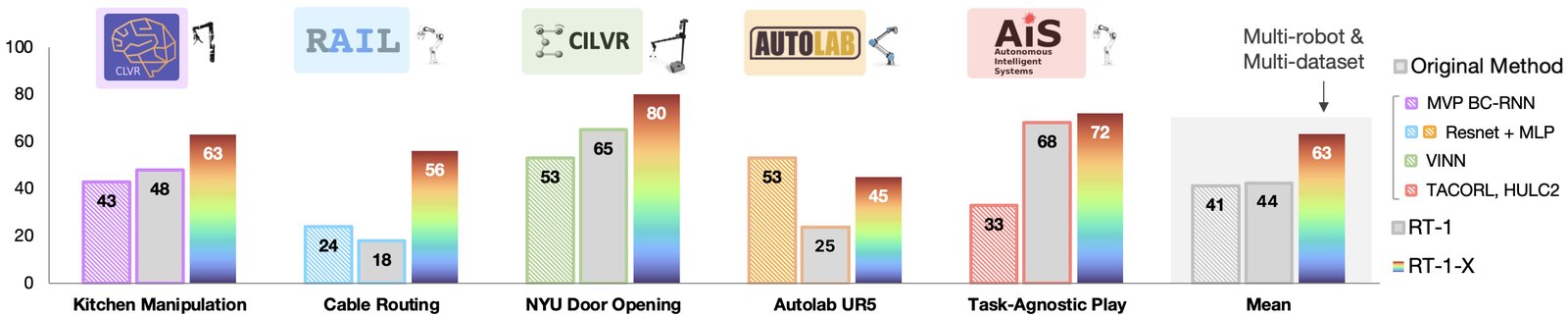
Fig. 3: RT-1-X mean success rate is higher than that of either the Original Method or RT-1. RT-1 and RT-1-X have the same network architecture. Therefore the performance increase can be attributed to co-training on the robotics data mixture. The lab logos indicate the physical location of real robot evaluation, and the robot pictures indicate the embodiment used for the evaluation.
图 3:RT-1-X 的平均成功率比 Original Method 或 RT-1 高出 。RT-1 与 RT-1-X 网络架构相同,因此性能提升可归因于在机器人数据混合上的共训练。实验室标志表示真实机器人评估的物理地点,机器人图片表示评估所用本体。
RT-2 [9] is a family of large vision-language-action models (VLAs) trained on Internet-scale vision and language data along with robotic control data. RT-2 casts the tokenized actions to text tokens, e.g., a possible action may be “1 128 91 241 5 101 127”. As such, any pretrained vision-language model (VLM [121, 122, 123]) can be finetuned for robotic control, thus leveraging the backbone of VLMs and transferring some of their generalization properties. In this work, we focus on the RT-2-PaLI-X variant [121] built on a backbone of a visual model, ViT [124], and a language model, UL2 [125], and pretrained primarily on the WebLI [121] dataset.
RT-2 [9] 是一族在互联网规模视觉与语言数据以及机器人控制数据上训练的大规模视觉—语言—动作模型(VLA)。RT-2 把经 tokenization 的动作写成文本 token,例如可能的动作是「1 128 91 241 5 101 127」。因此任何预训练视觉—语言模型(VLM [121–123])都可微调用于机器人控制,从而借用 VLM 骨干并迁移其部分泛化性质。本文聚焦 RT-2-PaLI-X 变体 [121]:骨干为视觉模型 ViT [124] 与语言模型 UL2 [125],主要在 WebLI [121] 上预训练。
IV-C Training and inference details
IV-C 训练与推理细节
Both models use a standard categorical cross-entropy objective over their output space (discrete buckets for RT-1 and all possible language tokens for RT-2).
两个模型都在输出空间上使用标准类别交叉熵目标(RT-1 为离散桶,RT-2 为全部可能的语言 token)。
We define the robotics data mixture used across all of the experiments as the data from manipulators, and taken from RT-1 [8], QT-Opt [66], Bridge [95], Task Agnostic Robot Play [126, 127], Jaco Play [128], Cable Routing [129], RoboTurk [86], NYU VINN [130], Austin VIOLA [131], Berkeley Autolab UR5 [132], TOTO [133] and Language Table [91] datasets. RT-1-X is trained on only robotics mixture data defined above, whereas RT-2-X is trained via co-fine-tuning (similarly to the original RT-2 [9]), with an approximately one to one split of the original VLM data and the robotics data mixture. Note that the robotics data mixture used in our experiments includes embodiments which is fewer than the entire Open X-Embodiment dataset () – the practical reason for this difference is that we have continued to extend the dataset over time, and at the time of the experiments, the dataset above represented all of the data. In the future, we plan to continue training policies on the extended versions of the dataset as well as continue to grow the dataset together with the robot learning community.
我们把全部实验所用的机器人数据混合定义为来自 种操作臂的数据,取自 RT-1 [8]、QT-Opt [66]、Bridge [95]、Task Agnostic Robot Play [126, 127]、Jaco Play [128]、Cable Routing [129]、RoboTurk [86]、NYU VINN [130]、Austin VIOLA [131]、Berkeley Autolab UR5 [132]、TOTO [133] 与 Language Table [91]。RT-1-X 只在上述机器人混合上训练;RT-2-X 则经共微调(类似原版 RT-2 [9]),原始 VLM 数据与机器人混合大约一比一。注意实验所用机器人混合含 种本体,少于整个 Open X-Embodiment 数据集()——现实原因是我们持续在扩展数据集,实验时上述数据已代表当时全部可用数据。未来我们计划在扩展版本上继续训练策略,并与机器人学习社区一起继续壮大数据集。
At inference time, each model is run at the rate required for the robot (3-10 Hz), with RT-1 run locally and RT-2 hosted on a cloud service and queried over the network.
推理时,各模型以机器人所需速率运行(3–10 Hz):RT-1 本地运行,RT-2 托管在云服务上经网络查询。
| Evaluation Setting | Bridge | Bridge | RT-1 paper 6 skills |
|---|---|---|---|
| Evaluation Location | IRIS (Stanford) | RAIL Lab (UCB) | Google Robotic Lab |
| Robot Embodiment | WidowX | WidowX | Google Robot |
| Original Method | LCBC [95] | LCBC [95] | - |
| Original Method | - | ||
| RT-1 | 30% | 92% | |
| RT-1-X | |||
| RT-2-X (55B) | 50% | 30% | 91% |
TABLE I: Parameter count scaling experiment to assess the impact of capacity on absorbing large-scale diverse embodiment data. For these large-scale datasets (Bridge and RT-1 paper data), RT-1-X underfits and performs worse than the Original Method and RT-1. RT-2-X model with significantly many more parameters can obtain strong performance in these two evaluation scenarios.
| 评估设定 | Bridge | Bridge | RT-1 论文 6 技能 |
|---|---|---|---|
| 评估地点 | IRIS (Stanford) | RAIL Lab (UCB) | Google Robotic Lab |
| 机器人本体 | WidowX | WidowX | Google Robot |
| Original Method | LCBC [95] | LCBC [95] | - |
| Original Method | - | ||
| RT-1 | 30% | 92% | |
| RT-1-X | |||
| RT-2-X (55B) | 50% | 30% | 91% |
表 I:参数量扩展实验,评估容量对吸收大规模多样本体数据的影响。在这些大规模数据集(Bridge 与 RT-1 论文数据)上,RT-1-X 欠拟合,表现弱于 Original Method 与 RT-1;参数显著更多的 RT-2-X 能在这两种评估场景中取得强表现。
V Experimental Results
V 实验结果
Our experiments answer three questions about the effect of X-embodiment training: (1) Can policies trained on our X-embodiment dataset effectively enable positive transfer, such that co-training on data collected on multiple robots improves performance on the training task? (2) Does co-training models on data from multiple platforms and tasks improve generalization to new, unseen tasks? (3) What is the influence of different design dimensions, such as model size, model architecture or dataset composition, on performance and generalization capabilities of the resulting policy? To answer these questions we conduct the total number of 3600 evaluation trials across 6 different robots.
实验回答关于跨本体训练效应的三个问题:(1)在我们的跨本体数据上训练的策略能否有效实现正向迁移,使多机器人数据上的共训练提升训练任务表现?(2)在多平台、多任务数据上共训练,能否改进对新未见任务的泛化?(3)模型规模、架构或数据组成等不同设计维度,对所得策略的表现与泛化能力有何影响?为回答这些问题,我们在 6 种不同机器人上共进行 3600 次评估试验。
V-A In-distribution performance across different embodiments
V-A 不同本体上的分布内表现
To assess the ability of RT-X models to learn from X-embodiment data, we evaluate performance on in-distribution tasks. We split our evaluation into two types: evaluation on domains that have small-scale datasets (Fig. 3), where we would expect transfer from larger datasets to significantly improve performance, and evaluation on domains that have large-scale datasets (Table I), where we expect further improvement to be more challenging. Note that we use the same robotics data training mixture (defined in Sec. IV-C) for all the evaluations presented in this section. For small-scale dataset experiments, we use Kitchen Manipulation [128], Cable Routing [129], NYU Door Opening [130], AUTOLab UR5 [132], and Robot Play [134]. We use the same evaluation and robot embodiment as in the respective publications. For large-scale dataset experiments, we consider Bridge [95] and RT-1 [8] for in-distribution evaluation and use their respective robots: WidowX and Google Robot.
为评估 RT-X 模型从跨本体数据学习的能力,我们在分布内任务上评测,并分成两类:小规模数据集域(图 3)——预期从更大数据集迁移会显著提升;大规模数据集域(表 I)——进一步提升更具挑战。注意本节所有评估使用同一机器人数据训练混合(第 IV-C 节定义)。小规模数据实验使用 Kitchen Manipulation [128]、Cable Routing [129]、NYU Door Opening [130]、AUTOLab UR5 [132] 与 Robot Play [134],评估与机器人本体与各自原论文一致。大规模数据实验考虑 Bridge [95] 与 RT-1 [8] 做分布内评估,分别使用 WidowX 与 Google Robot。
For each small dataset domain, we compare the performance of the RT-1-X model, and for each large dataset we consider both the RT-1-X and RT-2-X models. For all experiments, the models are co-trained on the full X-embodiment dataset. Throughout this evaluation we compare with two baseline models: (1) The model developed by the creators of the dataset trained only on that respective dataset. This constitutes a reasonable baseline insofar as it can be expected that the model has been optimized to work well with the associated data; we refer to this baseline model as the Original Method model. (2) An RT-1 model trained on the dataset in isolation; this baseline allows us to assess whether the RT-X model architectures have enough capacity to represent policies for multiple different robot platforms simultaneously, and whether co-training on multi-embodiment data leads to higher performance.
对每个小数据域,我们比较 RT-1-X;对每个大数据域,同时考虑 RT-1-X 与 RT-2-X。全部实验中模型都在完整跨本体数据上共训练。整段评估与两个基线对比:(1)由数据集创建者开发、只在该数据集上训练的模型——可预期其已针对相关数据优化,称为 Original Method;(2)只在该数据集上单独训练的 RT-1——用于评估 RT-X 架构是否有足够容量同时表示多机器人平台策略,以及多本体共训练是否带来更高表现。
Small-scale dataset domains (Fig. 3). RT-1-X outperforms Original Method trained on each of the robot-specific datasets on 4 of the 5 datasets, with a large average improvement, demonstrating domains with limited data benefit substantially from co-training on X-embodiment data.
小规模数据集域(图 3)。RT-1-X 在 5 个数据集中的 4 个上优于只在各机器人专用数据上训练的 Original Method,平均提升很大,表明数据有限的域从跨本体共训练中显著受益。
| Row | Model | Size | History Length | Dataset | Co-Trained w/ Web | Initial Checkpoint | Emergent Skills Evaluation | RT-2 Generalization Evaluation |
|---|---|---|---|---|---|---|---|---|
| (1) | RT-2 | 55B | none | Google Robot action | Yes | Web-pretrained | 62% | |
| (2) | RT-2-X | 55B | none | Robotics data | Yes | Web-pretrained | 75.8% | 61% |
| (3) | RT-2-X | 55B | none | Robotics data except Bridge | Yes | Web-pretrained | ||
| (4) | RT-2-X | 5B | 2 | Robotics data | Yes | Web-pretrained | ||
| (5) | RT-2-X | 5B | none | Robotics data | Yes | Web-pretrained | ||
| (6) | RT-2-X | 5B | 2 | Robotics data | No | From scratch | ||
| (7) | RT-2-X | 5B | 2 | Robotics data | No | Web-pretrained |
TABLE II: Ablations to show the impact of design decisions on generalization (to unseen objects, backgrounds, and environments) and emergent skills (skills from other datasets on the Google Robot), showing the importance of Web-pretraining, model size, and history.
| 行 | 模型 | 规模 | 历史长度 | 数据集 | 与网络共训练 | 初始检查点 | 涌现技能评估 | RT-2 泛化评估 |
|---|---|---|---|---|---|---|---|---|
| (1) | RT-2 | 55B | 无 | Google Robot 动作 | 是 | 网络预训练 | 62% | |
| (2) | RT-2-X | 55B | 无 | 机器人数据 | 是 | 网络预训练 | 75.8% | 61% |
| (3) | RT-2-X | 55B | 无 | 机器人数据(除 Bridge) | 是 | 网络预训练 | ||
| (4) | RT-2-X | 5B | 2 | 机器人数据 | 是 | 网络预训练 | ||
| (5) | RT-2-X | 5B | 无 | 机器人数据 | 是 | 网络预训练 | ||
| (6) | RT-2-X | 5B | 2 | 机器人数据 | 否 | 从零 | ||
| (7) | RT-2-X | 5B | 2 | 机器人数据 | 否 | 网络预训练 |
表 II:消融设计决策对泛化(未见物体、背景与环境)与涌现技能(其他数据集技能在 Google Robot 上)的影响,表明网络预训练、模型规模与历史的重要性。
Large-scale dataset domains (Table I). In the large-dataset setting, the RT-1-X model does not outperform the RT-1 baseline trained on only the embodiment-specific dataset, which indicates underfitting for that model class. However, the larger RT-2-X model outperforms both the Original Method and RT-1 suggesting that X-robot training can improve performance in the data-rich domains, but only when utilizing a sufficiently high-capacity architecture.
大规模数据集域(表 I)。在大数据设定下,RT-1-X 并未超过只在本体专用数据上训练的 RT-1 基线,表明该模型类存在欠拟合。然而更大的 RT-2-X 同时超过 Original Method 与 RT-1,说明跨机器人训练也能提升数据充裕域的表现,但前提是使用足够高容量的架构。
V-B Improved generalization to out-of-distribution settings
V-B 改进对分布外设定的泛化
We now examine how X-embodiment training can enable better generalization to out-of-distribution settings and more complex and novel instructions. These experiments focus on the high-data domains, and use the RT-2-X model.
接着考察跨本体训练如何改进对分布外设定以及更复杂、更新颖指令的泛化。这些实验聚焦高数据域,并使用 RT-2-X。
Unseen objects, backgrounds and environments. We first conduct the same evaluation of generalization properties as proposed in [9], testing for the ability to manipulate unseen objects in unseen environments and against unseen backgrounds. We find that RT-2 and RT-2-X perform roughly on par (Table II, rows (1) and (2), last column). This is not unexpected, since RT-2 already generalizes well (see [9]) along these dimensions due to its VLM backbone.
未见物体、背景与环境。 我们首先按 [9] 提出的方式评估泛化:在未见环境、未见背景下操作未见物体的能力。发现 RT-2 与 RT-2-X 大致持平(表 II,行 (1)(2) 最后一列)。这并不意外:凭借 VLM 骨干,RT-2 在这些维度上已泛化良好(见 [9])。
Emergent skills evaluation. To investigate the transfer of knowledge across robots, we conduct experiments with the Google Robot, assessing the performance on tasks like the ones shown in Fig. 4. These tasks involve objects and skills that are not present in the RT-2 dataset but occur in the Bridge dataset [95] for a different robot (the WidowX robot). Results are shown in Table II, Emergent Skills Evaluation column. Comparing rows (1) and (2), we find that RT-2-X outperforms RT-2 by , suggesting that incorporating data from other robots into the training improves the range of tasks that can be performed even by a robot that already has large amounts of data available. Our results suggest that co-training with data from other platforms imbues the RT-2-X controller with additional skills for the platform that are not present in that platform’s original dataset.
涌现技能评估。 为研究跨机器人知识迁移,我们在 Google Robot 上评估图 4 一类任务:涉及物体与技能不在 RT-2 数据中,却出现在另一机器人(WidowX)的 Bridge 数据 [95] 里。结果见表 II「涌现技能评估」列。比较行 (1)(2),RT-2-X 相对 RT-2 高出约 ,说明把其他机器人数据纳入训练,能拓宽即便已有大量数据的平台可执行任务范围。结果表明:与其他平台数据共训练,会给 RT-2-X 控制器注入该平台原始数据中不存在的额外技能。
Our next ablation involves removing the Bridge dataset from RT-2-X training: Row (3) shows the results for RT-2-X that includes all data used for RT-2-X except the Bridge dataset. This variation significantly reduces performance on the hold-out tasks, suggesting that transfer from the WidowX data may indeed be responsible for the additional skills that can be performed by RT-2-X with the Google Robot.
下一步消融是从 RT-2-X 训练中去掉 Bridge:行 (3) 是包含 RT-2-X 全部数据、唯独不含 Bridge 的变体。该变体在保留任务上表现显著下降,暗示来自 WidowX 数据的迁移可能确实是 Google Robot 上 RT-2-X 额外技能的来源。
V-C Design decisions
V-C 设计决策
Lastly, we perform ablations to measure the influence of different design decisions on the generalization capabilities of our most performant RT-2-X model, which are presented in Table II. We note that including a short history of images significantly improves generalization performance (row (4) vs row (5)). Similarly to the conclusions in the RT-2 paper [9], Web-based pre-training of the model is critical to achieving a high performance for the large models (row (4) vs row (6)). We also note that the model has significantly higher success rate in the Emergent Skills compared to the model (row (2) vs row (4)), demonstrating that higher model capacity enables higher degree of transfer across robotic datasets. Contrary to previous RT-2 findings, co-fine-tuning and fine-tuning have similar performance in both the Emergent Skills and Generalization Evaluation (row (4) vs row (7)), which we attribute to the fact that the robotics data used in RT-2-X is much more diverse than the previously used robotics datasets.
最后,我们对表现最好的 RT-2-X 做消融,衡量不同设计决策对泛化能力的影响,见表 II。加入短图像历史显著提升泛化(行 (4) 对行 (5))。与 RT-2 论文 [9] 结论类似,基于网络的预训练对大模型取得高性能至关重要(行 (4) 对行 (6))。我们也注意到 55B 模型在涌现技能上的成功率显著高于 5B(行 (2) 对行 (4)),表明更高容量带来跨机器人数据集更强的迁移。与先前 RT-2 发现不同,共微调与微调在涌现技能与泛化评估上表现相近(行 (4) 对行 (7)),我们归因于 RT-2-X 所用机器人数据远比先前机器人数据集更多样。
VI Discussion, Future Work, and Open Problems
VI 讨论、未来工作与开放问题
We presented a consolidated dataset that combines data from robotic embodiments collected through a collaboration between institutions, demonstrating skills ( tasks). We also presented an experimental demonstration that Transformer-based policies trained on this data can exhibit significant positive transfer between the different robots in the dataset. Our results showed that the RT-1-X policy has a higher success rate than the original, state-of-the-art methods contributed by different collaborating institutions, while the bigger vision-language-model-based version (RT-2-X) demonstrated generalization improvements over a model trained only on data from the evaluation embodiment. In addition, we provided multiple resources for the robotics community to explore the X-embodiment robot learning research, including: the unified X-robot and X-institution dataset, sample code showing how to use the data, and the RT-1-X model to serve as a foundation for future exploration.
我们给出合并自 家机构协作采集的 种机器人本体的统一数据集,覆盖 种技能( 项任务);并实验证明在此数据上训练的基于 Transformer 的策略,能在数据集内不同机器人之间展现显著正向迁移。结果表明:RT-1-X 策略的成功率比各合作机构贡献的原最优方法高出 ;而更大的视觉—语言—模型版本(RT-2-X)相对只在评估本体数据上训练的模型,泛化提升约 。此外,我们为机器人社区探索跨本体学习提供了多项资源:统一的跨机器人、跨机构数据集,示例用法代码,以及可作为未来探索基础的 RT-1-X 模型。
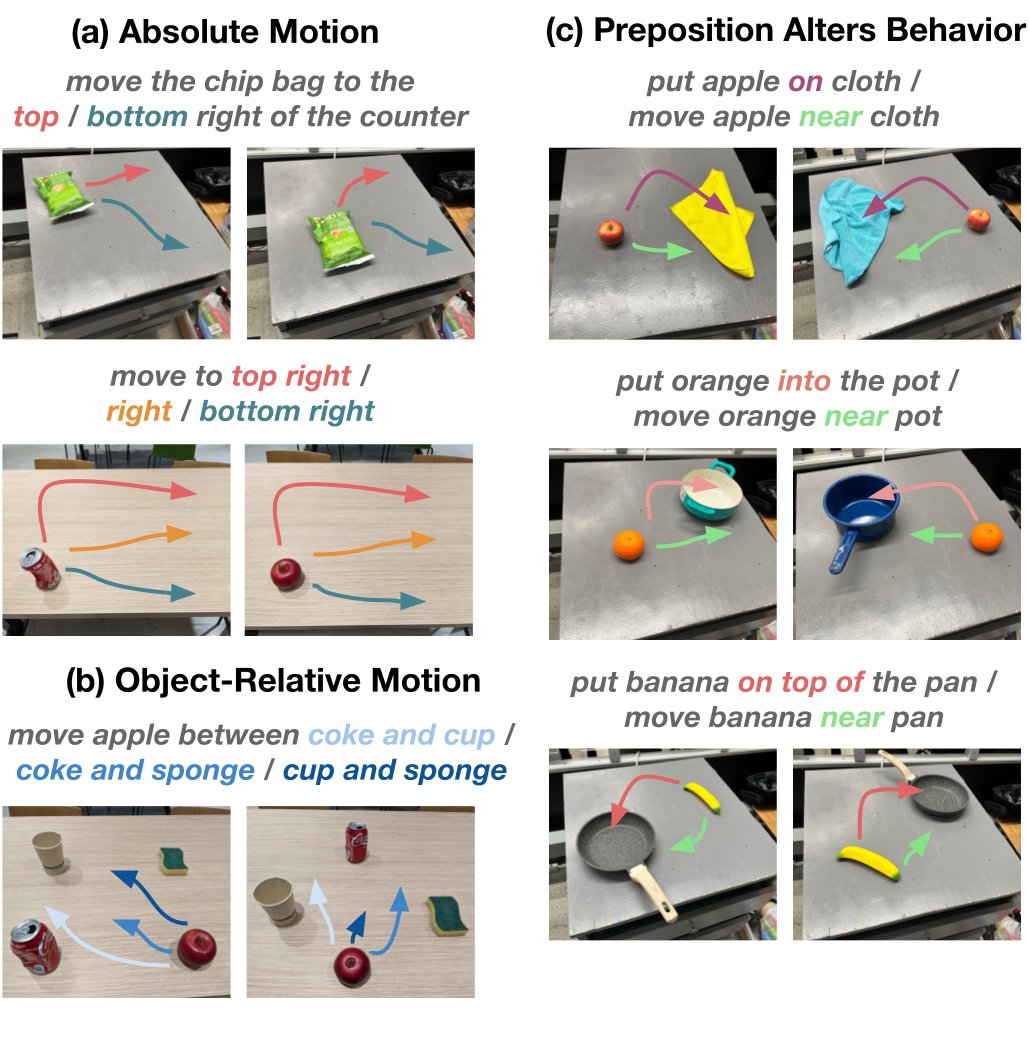
Fig. 4: To assess transfer between embodiments, we evaluate the RT-2-X model on out-of-distribution skills. These skills are in the Bridge dataset, but not in the Google Robot dataset (the embodiment they are evaluated on).
图 4:为评估本体之间的迁移,我们在分布外技能上评估 RT-2-X。这些技能出现在 Bridge 数据中,但不在 Google Robot 数据中(即它们被评估的本体)。
While RT-X demonstrates a step towards a X-embodied robot generalist, many more steps are needed to make this future a reality. Our experiments do not consider robots with very different sensing and actuation modalities. They do not study generalization to new robots, and provide a decision criterion for when positive transfer does or does not happen. Studying these questions is an important future work direction. This work serves not only as an example that X-robot learning is feasible and practical, but also provide the tools to advance research in this direction in the future.
尽管 RT-X 朝跨本体机器人通才迈出一步,要实现这一未来仍需许多步骤。实验未考虑传感与驱动模态差异很大的机器人;也未研究向新机器人的泛化,也未给出正向迁移何时发生、何时不发生的判定准则。研究这些问题是重要的未来方向。本文不仅作为跨机器人学习可行且实用的示例,也为未来推进该方向的研究提供了工具。
References
参考文献
[1] A. Radford, J. W. Kim, C. Hallacy, A. Ramesh, G. Goh, S. Agarwal, G. Sastry, A. Askell, P. Mishkin, J. Clark et al. , “Learning transferable visual models from natural language supervision,” in International conference on machine learning . PMLR, 2021, pp. 8748–8763.
[2] OpenAI, “GPT-4 technical report,” 2023.
[3] R. Anil, A. M. Dai, O. Firat, M. Johnson, D. Lepikhin, A. Passos, S. Shakeri, E. Taropa, P. Bailey, Z. Chen et al. , “PaLM 2 technical report,” arXiv preprint arXiv:2305.10403 , 2023.
[4] T. Weyand, A. Araujo, B. Cao, and J. Sim, “Google landmarks dataset v2 - a large-scale benchmark for instance-level recognition and retrieval,” in Proceedings of the IEEE/CVF Conference on Computer Vision and Pattern Recognition (CVPR) , June 2020.
[5] B. Wu, W. Chen, Y. Fan, Y. Zhang, J. Hou, J. Liu, and T. Zhang, “Tencent ML-images: A large-scale multi-label image database for visual representation learning,” IEEE Access , vol. 7, 2019.
[6] J. Lehmann, R. Isele, M. Jakob, A. Jentzsch, D. Kontokostas, P. N. Mendes, S. Hellmann, M. Morsey, P. van Kleef, S. Auer, and C. Bizer, “DBpedia - a large-scale, multilingual knowledge base extracted from wikipedia.” Semantic Web , vol. 6, no. 2, pp. 167–195, 2015. [Online]. Available: http://dblp.uni-trier.de/db/journals/semweb/semweb6.html#LehmannIJJKMHMK15
[7] H. Mühleisen and C. Bizer, “Web data commons-extracting structured data from two large web corpora.” LDOW , vol. 937, pp. 133–145, 2012.
[8] A. Brohan, N. Brown, J. Carbajal, Y. Chebotar, J. Dabis, C. Finn, K. Gopalakrishnan, K. Hausman, A. Herzog, J. Hsu et al. , “RT-1: Robotics transformer for real-world control at scale,” Robotics: Science and Systems (RSS) , 2023.
[9] A. Brohan, N. Brown, J. Carbajal, Y. Chebotar, X. Chen, K. Choromanski, T. Ding, D. Driess, A. Dubey, C. Finn et al. , “RT-2: Vision-language-action models transfer web knowledge to robotic control,” arXiv preprint arXiv:2307.15818 , 2023.
[10] C. Devin, A. Gupta, T. Darrell, P. Abbeel, and S. Levine, “Learning modular neural network policies for multi-task and multi-robot transfer,” in 2017 IEEE international conference on robotics and automation (ICRA) . IEEE, 2017, pp. 2169–2176.
[11] T. Chen, A. Murali, and A. Gupta, “Hardware conditioned policies for multi-robot transfer learning,” in Advances in Neural Information Processing Systems , 2018, pp. 9355–9366.
[12] A. Sanchez-Gonzalez, N. Heess, J. T. Springenberg, J. Merel, M. Riedmiller, R. Hadsell, and P. Battaglia, “Graph networks as learnable physics engines for inference and control,” in Proceedings of the 35th International Conference on Machine Learning , ser. Proceedings of Machine Learning Research, J. Dy and A. Krause, Eds., vol. 80. PMLR, 10–15 Jul 2018, pp. 4470–4479. [Online]. Available: https://proceedings.mlr.press/v80/sanchez-gonzalez18a.html
[13] D. Pathak, C. Lu, T. Darrell, P. Isola, and A. A. Efros, “Learning to control self-assembling morphologies: a study of generalization via modularity,” Advances in Neural Information Processing Systems , vol. 32, 2019.
[14] R. Martín-Martín, M. Lee, R. Gardner, S. Savarese, J. Bohg, and A. Garg, “Variable impedance control in end-effector space. an action space for reinforcement learning in contact rich tasks,” in Proceedings of the International Conference of Intelligent Robots and Systems (IROS) , 2019.
[15] W. Huang, I. Mordatch, and D. Pathak, “One policy to control them all: Shared modular policies for agent-agnostic control,” in ICML , 2020.
[16] V. Kurin, M. Igl, T. Rocktäschel, W. Boehmer, and S. Whiteson, “My body is a cage: the role of morphology in graph-based incompatible control,” arXiv preprint arXiv:2010.01856 , 2020.
[17] K. Zakka, A. Zeng, P. Florence, J. Tompson, J. Bohg, and D. Dwibedi, “XIRL: Cross-embodiment inverse reinforcement learning,” Conference on Robot Learning (CoRL) , 2021.
[18] A. Ghadirzadeh, X. Chen, P. Poklukar, C. Finn, M. Björkman, and D. Kragic, “Bayesian meta-learning for few-shot policy adaptation across robotic platforms,” in 2021 IEEE/RSJ International Conference on Intelligent Robots and Systems (IROS) . IEEE, 2021, pp. 1274–1280.
[19] A. Gupta, L. Fan, S. Ganguli, and L. Fei-Fei, “Metamorph: Learning universal controllers with transformers,” in International Conference on Learning Representations , 2021.
[20] I. Schubert, J. Zhang, J. Bruce, S. Bechtle, E. Parisotto, M. Riedmiller, J. T. Springenberg, A. Byravan, L. Hasenclever, and N. Heess, “A generalist dynamics model for control,” 2023.
[21] D. Shah, A. Sridhar, A. Bhorkar, N. Hirose, and S. Levine, “GNM: A general navigation model to drive any robot,” in 2023 IEEE International Conference on Robotics and Automation (ICRA) . IEEE, 2023, pp. 7226–7233.
[22] Y. Zhou, S. Sonawani, M. Phielipp, S. Stepputtis, and H. Amor, “Modularity through attention: Efficient training and transfer of language-conditioned policies for robot manipulation,” in Proceedings of The 6th Conference on Robot Learning , ser. Proceedings of Machine Learning Research, K. Liu, D. Kulic, and J. Ichnowski, Eds., vol. 205. PMLR, 14–18 Dec 2023, pp. 1684–1695. [Online]. Available: https://proceedings.mlr.press/v205/zhou23b.html
[23] S. Dasari, F. Ebert, S. Tian, S. Nair, B. Bucher, K. Schmeckpeper, S. Singh, S. Levine, and C. Finn, “RoboNet: Large-scale multi-robot learning,” in Conference on Robot Learning (CoRL) , vol. 100. PMLR, 2019, pp. 885–897.
[24] E. S. Hu, K. Huang, O. Rybkin, and D. Jayaraman, “Know thyself: Transferable visual control policies through robot-awareness,” in International Conference on Learning Representations , 2022.
[25] K. Bousmalis, G. Vezzani, D. Rao, C. Devin, A. X. Lee, M. Bauza, T. Davchev, Y. Zhou, A. Gupta, A. Raju et al. , “RoboCat: A self-improving foundation agent for robotic manipulation,” arXiv preprint arXiv:2306.11706 , 2023.
[26] J. Yang, D. Sadigh, and C. Finn, “Polybot: Training one policy across robots while embracing variability,” arXiv preprint arXiv:2307.03719 , 2023.
[27] S. Reed, K. Zolna, E. Parisotto, S. G. Colmenarejo, A. Novikov, G. Barth-maron, M. Giménez, Y. Sulsky, J. Kay, J. T. Springenberg, T. Eccles, J. Bruce, A. Razavi, A. Edwards, N. Heess, Y. Chen, R. Hadsell, O. Vinyals, M. Bordbar, and N. de Freitas, “A generalist agent,” Transactions on Machine Learning Research , 2022.
[28] G. Salhotra, I.-C. A. Liu, and G. Sukhatme, “Bridging action space mismatch in learning from demonstrations,” arXiv preprint arXiv:2304.03833 , 2023.
[29] I. Radosavovic, B. Shi, L. Fu, K. Goldberg, T. Darrell, and J. Malik, “Robot learning with sensorimotor pre-training,” in Conference on Robot Learning , 2023.
[30] L. Shao, F. Ferreira, M. Jorda, V. Nambiar, J. Luo, E. Solowjow, J. A. Ojea, O. Khatib, and J. Bohg, “UniGrasp: Learning a unified model to grasp with multifingered robotic hands,” IEEE Robotics and Automation Letters , vol. 5, no. 2, pp. 2286–2293, 2020.
[31] Z. Xu, B. Qi, S. Agrawal, and S. Song, “Adagrasp: Learning an adaptive gripper-aware grasping policy,” in 2021 IEEE International Conference on Robotics and Automation (ICRA) . IEEE, 2021, pp. 4620–4626.
[32] D. Shah, A. Sridhar, N. Dashora, K. Stachowicz, K. Black, N. Hirose, and S. Levine, “ViNT: A Foundation Model for Visual Navigation,” in 7th Annual Conference on Robot Learning (CoRL) , 2023.
[33] Y. Liu, A. Gupta, P. Abbeel, and S. Levine, “Imitation from observation: Learning to imitate behaviors from raw video via context translation,” in 2018 IEEE International Conference on Robotics and Automation (ICRA) . IEEE, 2018, pp. 1118–1125.
[34] T. Yu, C. Finn, S. Dasari, A. Xie, T. Zhang, P. Abbeel, and S. Levine, “One-shot imitation from observing humans via domain-adaptive meta-learning,” Robotics: Science and Systems XIV , 2018.
[35] P. Sharma, D. Pathak, and A. Gupta, “Third-person visual imitation learning via decoupled hierarchical controller,” Advances in Neural Information Processing Systems , vol. 32, 2019.
[36] L. Smith, N. Dhawan, M. Zhang, P. Abbeel, and S. Levine, “Avid: Learning multi-stage tasks via pixel-level translation of human videos,” arXiv preprint arXiv:1912.04443 , 2019.
[37] A. Bonardi, S. James, and A. J. Davison, “Learning one-shot imitation from humans without humans,” IEEE Robotics and Automation Letters , vol. 5, no. 2, pp. 3533–3539, 2020.
[38] K. Schmeckpeper, O. Rybkin, K. Daniilidis, S. Levine, and C. Finn, “Reinforcement learning with videos: Combining offline observations with interaction,” in Conference on Robot Learning . PMLR, 2021, pp. 339–354.
[39] H. Xiong, Q. Li, Y.-C. Chen, H. Bharadhwaj, S. Sinha, and A. Garg, “Learning by watching: Physical imitation of manipulation skills from human videos,” in 2021 IEEE/RSJ International Conference on Intelligent Robots and Systems (IROS) . IEEE, 2021, pp. 7827–7834.
[40] E. Jang, A. Irpan, M. Khansari, D. Kappler, F. Ebert, C. Lynch, S. Levine, and C. Finn, “BC-Z: Zero-shot task generalization with robotic imitation learning,” in Conference on Robot Learning (CoRL) , 2021, pp. 991–1002.
[41] S. Bahl, A. Gupta, and D. Pathak, “Human-to-robot imitation in the wild,” Robotics: Science and Systems (RSS) , 2022.
[42] M. Ding, Y. Xu, Z. Chen, D. D. Cox, P. Luo, J. B. Tenenbaum, and C. Gan, “Embodied concept learner: Self-supervised learning of concepts and mapping through instruction following,” in Conference on Robot Learning . PMLR, 2023, pp. 1743–1754.
[43] S. Bahl, R. Mendonca, L. Chen, U. Jain, and D. Pathak, “Affordances from human videos as a versatile representation for robotics,” in Proceedings of the IEEE/CVF Conference on Computer Vision and Pattern Recognition (CVPR) , June 2023, pp. 13 778–13 790.
[44] P. Sermanet, K. Xu, and S. Levine, “Unsupervised perceptual rewards for imitation learning,” arXiv preprint arXiv:1612.06699 , 2016.
[45] L. Shao, T. Migimatsu, Q. Zhang, K. Yang, and J. Bohg, “Concept2Robot: Learning manipulation concepts from instructions and human demonstrations,” in Proceedings of Robotics: Science and Systems (RSS) , 2020.
[46] A. S. Chen, S. Nair, and C. Finn, “Learning generalizable robotic reward functions from “in-the-wild” human videos,” arXiv preprint arXiv:2103.16817 , 2021.
[47] S. Kumar, J. Zamora, N. Hansen, R. Jangir, and X. Wang, “Graph inverse reinforcement learning from diverse videos,” in Conference on Robot Learning . PMLR, 2023, pp. 55–66.
[48] M. Alakuijala, G. Dulac-Arnold, J. Mairal, J. Ponce, and C. Schmid, “Learning reward functions for robotic manipulation by observing humans,” in 2023 IEEE International Conference on Robotics and Automation (ICRA) . IEEE, 2023, pp. 5006–5012.
[49] Y. Zhou, Y. Aytar, and K. Bousmalis, “Manipulator-independent representations for visual imitation,” 2021.
[50] C. Wang, L. Fan, J. Sun, R. Zhang, L. Fei-Fei, D. Xu, Y. Zhu, and A. Anandkumar, “Mimicplay: Long-horizon imitation learning by watching human play,” in Conference on Robot Learning , 2023.
[51] K. Schmeckpeper, A. Xie, O. Rybkin, S. Tian, K. Daniilidis, S. Levine, and C. Finn, “Learning predictive models from observation and interaction,” in European Conference on Computer Vision . Springer, 2020, pp. 708–725.
[52] S. Nair, A. Rajeswaran, V. Kumar, C. Finn, and A. Gupta, “R3m: A universal visual representation for robot manipulation,” in CoRL , 2022.
[53] T. Xiao, I. Radosavovic, T. Darrell, and J. Malik, “Masked visual pre-training for motor control,” arXiv preprint arXiv:2203.06173 , 2022.
[54] I. Radosavovic, T. Xiao, S. James, P. Abbeel, J. Malik, and T. Darrell, “Real-world robot learning with masked visual pre-training,” in Conference on Robot Learning , 2022.
[55] Y. J. Ma, S. Sodhani, D. Jayaraman, O. Bastani, V. Kumar, and A. Zhang, “Vip: Towards universal visual reward and representation via value-implicit pre-training,” arXiv preprint arXiv:2210.00030 , 2022.
[56] A. Majumdar, K. Yadav, S. Arnaud, Y. J. Ma, C. Chen, S. Silwal, A. Jain, V.-P. Berges, P. Abbeel, J. Malik et al. , “Where are we in the search for an artificial visual cortex for embodied intelligence?” arXiv preprint arXiv:2303.18240 , 2023.
[57] S. Karamcheti, S. Nair, A. S. Chen, T. Kollar, C. Finn, D. Sadigh, and P. Liang, “Language-driven representation learning for robotics,” Robotics: Science and Systems (RSS) , 2023.
[58] Y. Mu, S. Yao, M. Ding, P. Luo, and C. Gan, “EC2: Emergent communication for embodied control,” in Proceedings of the IEEE/CVF Conference on Computer Vision and Pattern Recognition , 2023, pp. 6704–6714.
[59] S. Bahl, R. Mendonca, L. Chen, U. Jain, and D. Pathak, “Affordances from human videos as a versatile representation for robotics,” in Proceedings of the IEEE/CVF Conference on Computer Vision and Pattern Recognition , 2023, pp. 13 778–13 790.
[60] Y. Jiang, S. Moseson, and A. Saxena, “Efficient grasping from RGBD images: Learning using a new rectangle representation,” in 2011 IEEE International conference on robotics and automation . IEEE, 2011, pp. 3304–3311.
[61] L. Pinto and A. K. Gupta, “Supersizing self-supervision: Learning to grasp from 50k tries and 700 robot hours,” 2016 IEEE International Conference on Robotics and Automation (ICRA) , pp. 3406–3413, 2015.
[62] D. Kappler, J. Bohg, and S. Schaal, “Leveraging big data for grasp planning,” in ICRA , 2015, pp. 4304–4311.
[63] J. Mahler, J. Liang, S. Niyaz, M. Laskey, R. Doan, X. Liu, J. A. Ojea, and K. Goldberg, “Dex-Net 2.0: Deep learning to plan robust grasps with synthetic point clouds and analytic grasp metrics,” in Robotics: Science and Systems (RSS) , 2017.
[64] A. Depierre, E. Dellandréa, and L. Chen, “Jacquard: A large scale dataset for robotic grasp detection,” in 2018 IEEE/RSJ International Conference on Intelligent Robots and Systems (IROS) . IEEE, 2018, pp. 3511–3516.
[65] S. Levine, P. Pastor, A. Krizhevsky, J. Ibarz, and D. Quillen, “Learning hand-eye coordination for robotic grasping with deep learning and large-scale data collection,” The International journal of robotics research , vol. 37, no. 4-5, pp. 421–436, 2018.
[66] D. Kalashnikov, A. Irpan, P. Pastor, J. Ibarz, A. Herzog, E. Jang, D. Quillen, E. Holly, M. Kalakrishnan, V. Vanhoucke et al. , “QT-Opt: Scalable deep reinforcement learning for vision-based robotic manipulation,” arXiv preprint arXiv:1806.10293 , 2018.
[67] S. Brahmbhatt, C. Ham, C. Kemp, and J. Hays, “Contactdb: Analyzing and predicting grasp contact via thermal imaging,” 04 2019.
[68] H.-S. Fang, C. Wang, M. Gou, and C. Lu, “Graspnet-1billion: a large-scale benchmark for general object grasping,” in Proceedings of the IEEE/CVF conference on computer vision and pattern recognition , 2020, pp. 11 444–11 453.
[69] C. Eppner, A. Mousavian, and D. Fox, “ACRONYM: A large-scale grasp dataset based on simulation,” in 2021 IEEE Int. Conf. on Robotics and Automation, ICRA , 2020.
[70] K. Bousmalis, A. Irpan, P. Wohlhart, Y. Bai, M. Kelcey, M. Kalakrishnan, L. Downs, J. Ibarz, P. Pastor, K. Konolige, S. Levine, and V. Vanhoucke, “Using simulation and domain adaptation to improve efficiency of deep robotic grasping,” in ICRA , 2018, pp. 4243–4250.
[71] X. Zhu, R. Tian, C. Xu, M. Huo, W. Zhan, M. Tomizuka, and M. Ding, “Fanuc manipulation: A dataset for learning-based manipulation with fanuc mate 200iD robot,” https://sites.google.com/berkeley.edu/fanuc-manipulation , 2023.
[72] K.-T. Yu, M. Bauza, N. Fazeli, and A. Rodriguez, “More than a million ways to be pushed. a high-fidelity experimental dataset of planar pushing,” in 2016 IEEE/RSJ international conference on intelligent robots and systems (IROS) . IEEE, 2016, pp. 30–37.
[73] C. Finn and S. Levine, “Deep visual foresight for planning robot motion,” in 2017 IEEE International Conference on Robotics and Automation (ICRA) . IEEE, 2017, pp. 2786–2793.
[74] F. Ebert, C. Finn, S. Dasari, A. Xie, A. Lee, and S. Levine, “Visual foresight: Model-based deep reinforcement learning for vision-based robotic control,” arXiv preprint arXiv:1812.00568 , 2018.
[75] P. Shilane, P. Min, M. Kazhdan, and T. Funkhouser, “The princeton shape benchmark,” in Shape Modeling Applications , 2004, pp. 167–388.
[76] W. Wohlkinger, A. Aldoma Buchaca, R. Rusu, and M. Vincze, “3DNet: Large-Scale Object Class Recognition from CAD Models,” in IEEE International Conference on Robotics and Automation (ICRA) , 2012.
[77] A. Kasper, Z. Xue, and R. Dillmann, “The kit object models database: An object model database for object recognition, localization and manipulation in service robotics,” The International Journal of Robotics Research , vol. 31, no. 8, pp. 927–934, 2012.
[78] A. Singh, J. Sha, K. S. Narayan, T. Achim, and P. Abbeel, “BigBIRD: A large-scale 3D database of object instances,” in IEEE International Conference on Robotics and Automation (ICRA) , 2014, pp. 509–516.
[79] B. Calli, A. Walsman, A. Singh, S. Srinivasa, P. Abbeel, and A. M. Dollar, “Benchmarking in manipulation research: Using the Yale-CMU-Berkeley object and model set,” IEEE Robotics & Automation Magazine , vol. 22, no. 3, pp. 36–52, 2015.
[80] Zhirong Wu, S. Song, A. Khosla, Fisher Yu, Linguang Zhang, Xiaoou Tang, and J. Xiao, “3D ShapeNets: A deep representation for volumetric shapes,” in IEEE Conference on Computer Vision and Pattern Recognition (CVPR) , 2015, pp. 1912–1920.
[81] Y. Xiang, W. Kim, W. Chen, J. Ji, C. Choy, H. Su, R. Mottaghi, L. Guibas, and S. Savarese, “ObjectNet3D: A large scale database for 3d object recognition,” in European Conference on Computer Vision (ECCV) . Springer, 2016, pp. 160–176.
[82] D. Morrison, P. Corke, and J. Leitner, “Egad! an evolved grasping analysis dataset for diversity and reproducibility in robotic manipulation,” IEEE Robotics and Automation Letters , vol. 5, no. 3, pp. 4368–4375, 2020.
[83] R. Gao, Y.-Y. Chang, S. Mall, L. Fei-Fei, and J. Wu, “ObjectFolder: A dataset of objects with implicit visual, auditory, and tactile representations,” in Conference on Robot Learning , 2021, pp. 466–476.
[84] L. Downs, A. Francis, N. Koenig, B. Kinman, R. Hickman, K. Reymann, T. B. McHugh, and V. Vanhoucke, “Google scanned objects: A high-quality dataset of 3D scanned household items,” in 2022 International Conference on Robotics and Automation (ICRA) . IEEE, 2022, pp. 2553–2560.
[85] D. Kalashnikov, J. Varley, Y. Chebotar, B. Swanson, R. Jonschkowski, C. Finn, S. Levine, and K. Hausman, “MT-Opt: Continuous multi-task robotic reinforcement learning at scale,” arXiv preprint arXiv:2104.08212 , 2021.
[86] A. Mandlekar, Y. Zhu, A. Garg, J. Booher, M. Spero, A. Tung, J. Gao, J. Emmons, A. Gupta, E. Orbay, S. Savarese, and L. Fei-Fei, “RoboTurk: A crowdsourcing platform for robotic skill learning through imitation,” CoRR , vol. abs/1811.02790, 2018. [Online]. Available: http://arxiv.org/abs/1811.02790
[87] P. Sharma, L. Mohan, L. Pinto, and A. Gupta, “Multiple interactions made easy (MIME): Large scale demonstrations data for imitation,” in Conference on robot learning . PMLR, 2018, pp. 906–915.
[88] A. Mandlekar, J. Booher, M. Spero, A. Tung, A. Gupta, Y. Zhu, A. Garg, S. Savarese, and L. Fei-Fei, “Scaling robot supervision to hundreds of hours with RoboTurk: Robotic manipulation dataset through human reasoning and dexterity,” in 2019 IEEE/RSJ International Conference on Intelligent Robots and Systems (IROS) . IEEE, 2019, pp. 1048–1055.
[89] F. Ebert, Y. Yang, K. Schmeckpeper, B. Bucher, G. Georgakis, K. Daniilidis, C. Finn, and S. Levine, “Bridge data: Boosting generalization of robotic skills with cross-domain datasets,” in Robotics: Science and Systems (RSS) XVIII , 2022.
[90] A. Mandlekar, D. Xu, J. Wong, S. Nasiriany, C. Wang, R. Kulkarni, L. Fei-Fei, S. Savarese, Y. Zhu, and R. Martín-Martín, “What matters in learning from offline human demonstrations for robot manipulation,” in arXiv preprint arXiv:2108.03298 , 2021.
[91] C. Lynch, A. Wahid, J. Tompson, T. Ding, J. Betker, R. Baruch, T. Armstrong, and P. Florence, “Interactive language: Talking to robots in real time,” IEEE Robotics and Automation Letters , 2023.
[92] H.-S. Fang, H. Fang, Z. Tang, J. Liu, J. Wang, H. Zhu, and C. Lu, “RH20T: A robotic dataset for learning diverse skills in one-shot,” in RSS 2023 Workshop on Learning for Task and Motion Planning , 2023.
[93] H. Bharadhwaj, J. Vakil, M. Sharma, A. Gupta, S. Tulsiani, and V. Kumar, “RoboAgent: Towards sample efficient robot manipulation with semantic augmentations and action chunking,” arxiv , 2023.
[94] M. Heo, Y. Lee, D. Lee, and J. J. Lim, “Furniturebench: Reproducible real-world benchmark for long-horizon complex manipulation,” in Robotics: Science and Systems , 2023.
[95] H. Walke, K. Black, A. Lee, M. J. Kim, M. Du, C. Zheng, T. Zhao, P. Hansen-Estruch, Q. Vuong, A. He, V. Myers, K. Fang, C. Finn, and S. Levine, “Bridgedata v2: A dataset for robot learning at scale,” 2023.
[96] T. Winograd, “Understanding natural language,” Cognitive Psychology , vol. 3, no. 1, pp. 1–191, 1972. [Online]. Available: https://www.sciencedirect.com/science/article/pii/0010028572900023
[97] M. MacMahon, B. Stankiewicz, and B. Kuipers, “Walk the talk: Connecting language, knowledge, and action in route instructions,” in Proceedings of the Twenty-First AAAI Conference on Artificial Intelligence , 2006.
[98] T. Kollar, S. Tellex, D. Roy, and N. Roy, “Toward understanding natural language directions,” in 2010 5th ACM/IEEE International Conference on Human-Robot Interaction (HRI) , 2010, pp. 259–266.
[99] D. L. Chen and R. J. Mooney, “Learning to interpret natural language navigation instructions from observations,” in Proceedings of the Twenty-Fifth AAAI Conference on Artificial Intelligence , 2011, p. 859–865.
[100] F. Duvallet, J. Oh, A. Stentz, M. Walter, T. Howard, S. Hemachandra, S. Teller, and N. Roy, “Inferring maps and behaviors from natural language instructions,” in International Symposium on Experimental Robotics (ISER) , 2014.
[101] J. Luketina, N. Nardelli, G. Farquhar, J. N. Foerster, J. Andreas, E. Grefenstette, S. Whiteson, and T. Rocktäschel, “A survey of reinforcement learning informed by natural language,” in IJCAI , 2019.
[102] S. Stepputtis, J. Campbell, M. Phielipp, S. Lee, C. Baral, and H. Ben Amor, “Language-conditioned imitation learning for robot manipulation tasks,” Advances in Neural Information Processing Systems , vol. 33, pp. 13 139–13 150, 2020.
[103] S. Nair, E. Mitchell, K. Chen, S. Savarese, C. Finn et al. , “Learning language-conditioned robot behavior from offline data and crowd-sourced annotation,” in Conference on Robot Learning . PMLR, 2022, pp. 1303–1315.
[104] O. Mees, L. Hermann, E. Rosete-Beas, and W. Burgard, “CALVIN: A benchmark for language-conditioned policy learning for long-horizon robot manipulation tasks,” IEEE Robotics and Automation Letters , 2022.
[105] O. Mees, L. Hermann, and W. Burgard, “What matters in language conditioned robotic imitation learning over unstructured data,” IEEE Robotics and Automation Letters , vol. 7, no. 4, pp. 11 205–11 212, 2022.
[106] M. Shridhar, L. Manuelli, and D. Fox, “Perceiver-actor: A multi-task transformer for robotic manipulation,” Conference on Robot Learning (CoRL) , 2022.
[107] F. Hill, S. Mokra, N. Wong, and T. Harley, “Human instruction-following with deep reinforcement learning via transfer-learning from text,” arXiv preprint arXiv:2005.09382 , 2020.
[108] C. Lynch and P. Sermanet, “Grounding language in play,” Robotics: Science and Systems (RSS) , 2021.
[109] M. Ahn, A. Brohan, N. Brown, Y. Chebotar, O. Cortes, B. David, C. Finn, K. Gopalakrishnan, K. Hausman, A. Herzog et al. , “Do as I can, not as I say: Grounding language in robotic affordances,” Conference on Robot Learning (CoRL) , 2022.
[110] Y. Jiang, A. Gupta, Z. Zhang, G. Wang, Y. Dou, Y. Chen, L. Fei-Fei, A. Anandkumar, Y. Zhu, and L. Fan, “VIMA: General robot manipulation with multimodal prompts,” International Conference on Machine Learning (ICML) , 2023.
[111] S. Vemprala, R. Bonatti, A. Bucker, and A. Kapoor, “ChatGPT for robotics: Design principles and model abilities,” Microsoft Auton. Syst. Robot. Res , vol. 2, p. 20, 2023.
[112] W. Huang, C. Wang, R. Zhang, Y. Li, J. Wu, and L. Fei-Fei, “VoxPoser: Composable 3d value maps for robotic manipulation with language models,” arXiv preprint arXiv:2307.05973 , 2023.
[113] M. Shridhar, L. Manuelli, and D. Fox, “Cliport: What and where pathways for robotic manipulation,” in Conference on Robot Learning . PMLR, 2022, pp. 894–906.
[114] A. Stone, T. Xiao, Y. Lu, K. Gopalakrishnan, K.-H. Lee, Q. Vuong, P. Wohlhart, B. Zitkovich, F. Xia, C. Finn et al. , “Open-world object manipulation using pre-trained vision-language models,” arXiv preprint arXiv:2303.00905 , 2023.
[115] Y. Mu, Q. Zhang, M. Hu, W. Wang, M. Ding, J. Jin, B. Wang, J. Dai, Y. Qiao, and P. Luo, “EmbodiedGPT: Vision-language pre-training via embodied chain of thought,” arXiv preprint arXiv:2305.15021 , 2023.
[116] E. Perez, F. Strub, H. de Vries, V. Dumoulin, and A. Courville, “Film: Visual reasoning with a general conditioning layer,” 2017.
[117] M. Tan and Q. Le, “EfficientNet: Rethinking model scaling for convolutional neural networks,” in International conference on machine learning . PMLR, 2019, pp. 6105–6114.
[118] A. Vaswani, N. Shazeer, N. Parmar, J. Uszkoreit, L. Jones, A. N. Gomez, Ł. Kaiser, and I. Polosukhin, “Attention is all you need,” Advances in neural information processing systems , vol. 30, 2017.
[119] S. Ramos, S. Girgin, L. Hussenot, D. Vincent, H. Yakubovich, D. Toyama, A. Gergely, P. Stanczyk, R. Marinier, J. Harmsen, O. Pietquin, and N. Momchev, “RLDS: an ecosystem to generate, share and use datasets in reinforcement learning,” 2021.
[120] D. Cer, Y. Yang, S. yi Kong, N. Hua, N. Limtiaco, R. S. John, N. Constant, M. Guajardo-Cespedes, S. Yuan, C. Tar, Y.-H. Sung, B. Strope, and R. Kurzweil, “Universal sentence encoder,” 2018.
[121] X. Chen, J. Djolonga, P. Padlewski, B. Mustafa, S. Changpinyo, J. Wu, C. R. Ruiz, S. Goodman, X. Wang, Y. Tay, S. Shakeri, M. Dehghani, D. Salz, M. Lucic, M. Tschannen, A. Nagrani, H. Hu, M. Joshi, B. Pang, C. Montgomery, P. Pietrzyk, M. Ritter, A. Piergiovanni, M. Minderer, F. Pavetic, A. Waters, G. Li, I. Alabdulmohsin, L. Beyer, J. Amelot, K. Lee, A. P. Steiner, Y. Li, D. Keysers, A. Arnab, Y. Xu, K. Rong, A. Kolesnikov, M. Seyedhosseini, A. Angelova, X. Zhai, N. Houlsby, and R. Soricut, “Pali-x: On scaling up a multilingual vision and language model,” 2023.
[122] J.-B. Alayrac, J. Donahue, P. Luc, A. Miech, I. Barr, Y. Hasson, K. Lenc, A. Mensch, K. Millican, M. Reynolds, R. Ring, E. Rutherford, S. Cabi, T. Han, Z. Gong, S. Samangooei, M. Monteiro, J. Menick, S. Borgeaud, A. Brock, A. Nematzadeh, S. Sharifzadeh, M. Binkowski, R. Barreira, O. Vinyals, A. Zisserman, and K. Simonyan, “Flamingo: a visual language model for few-shot learning,” 2022.
[123] D. Driess, F. Xia, M. S. M. Sajjadi, C. Lynch, A. Chowdhery, B. Ichter, A. Wahid, J. Tompson, Q. Vuong, T. Yu, W. Huang, Y. Chebotar, P. Sermanet, D. Duckworth, S. Levine, V. Vanhoucke, K. Hausman, M. Toussaint, K. Greff, A. Zeng, I. Mordatch, and P. Florence, “PaLM-E: An embodied multimodal language model,” 2023.
[124] A. Dosovitskiy, L. Beyer, A. Kolesnikov, D. Weissenborn, X. Zhai, T. Unterthiner, M. Dehghani, M. Minderer, G. Heigold, S. Gelly, J. Uszkoreit, and N. Houlsby, “An image is worth 16x16 words: Transformers for image recognition at scale,” 2021.
[125] Y. Tay, M. Dehghani, V. Q. Tran, X. Garcia, J. Wei, X. Wang, H. W. Chung, S. Shakeri, D. Bahri, T. Schuster, H. S. Zheng, D. Zhou, N. Houlsby, and D. Metzler, “UL2: Unifying language learning paradigms,” 2023.
[126] E. Rosete-Beas, O. Mees, G. Kalweit, J. Boedecker, and W. Burgard, “Latent plans for task agnostic offline reinforcement learning,” in Proceedings of the 6th Conference on Robot Learning (CoRL) , 2022.
[127] O. Mees, J. Borja-Diaz, and W. Burgard, “Grounding language with visual affordances over unstructured data,” in Proceedings of the IEEE International Conference on Robotics and Automation (ICRA) , London, UK, 2023.
[128] S. Dass, J. Yapeter, J. Zhang, J. Zhang, K. Pertsch, S. Nikolaidis, and J. J. Lim, “CLVR jaco play dataset,” 2023. [Online]. Available: https://github.com/clvrai/clvr_jaco_play_dataset
[129] J. Luo, C. Xu, X. Geng, G. Feng, K. Fang, L. Tan, S. Schaal, and S. Levine, “Multi-stage cable routing through hierarchical imitation learning,” arXiv preprint arXiv:2307.08927 , 2023.
[130] J. Pari, N. M. Shafiullah, S. P. Arunachalam, and L. Pinto, “The surprising effectiveness of representation learning for visual imitation,” 2021.
[131] Y. Zhu, A. Joshi, P. Stone, and Y. Zhu, “Viola: Imitation learning for vision-based manipulation with object proposal priors,” 2023.
[132] L. Y. Chen, S. Adebola, and K. Goldberg, “Berkeley UR5 demonstration dataset,” https://sites.google.com/view/berkeley-ur5/home .
[133] G. Zhou, V. Dean, M. K. Srirama, A. Rajeswaran, J. Pari, K. Hatch, A. Jain, T. Yu, P. Abbeel, L. Pinto, C. Finn, and A. Gupta, “Train offline, test online: A real robot learning benchmark,” 2023.
[134] “Task-agnostic real world robot play,” https://www.kaggle.com/datasets/oiermees/taco-robot .