Meta-World: A Benchmark and Evaluation for Multi-Task and Meta Reinforcement Learning
Meta-World: A Benchmark and Evaluation for Multi-Task and Meta Reinforcement Learning
Stanford University1, UC Berkeley2, Columbia University3,
University of Southern California4, Robotics at Google5
∗denotes equal contribution
3rd Conference on Robot Learning (CoRL 2019), Osaka, Japan.
Abstract:
摘要:
Meta-reinforcement learning algorithms can enable robots to acquire new skills much more quickly, by leveraging prior experience to learn how to learn. However, much of the current research on meta-reinforcement learning focuses on task distributions that are very narrow. For example, a commonly used meta-reinforcement learning benchmark uses different running velocities for a simulated robot as different tasks. When policies are meta-trained on such narrow task distributions, they cannot possibly generalize to more quickly acquire entirely new tasks. Therefore, if the aim of these methods is enable faster acquisition of entirely new behaviors, we must evaluate them on task distributions that are sufficiently broad to enable generalization to new behaviors. In this paper, we propose an open-source simulated benchmark for meta-reinforcement learning and multi-task learning consisting of 50 distinct robotic manipulation tasks. Our aim is to make it possible to develop algorithms that generalize to accelerate the acquisition of entirely new, held-out tasks. We evaluate 6 state-of-the-art meta-reinforcement learning and multi-task learning algorithms on these tasks. Surprisingly, while each task and its variations (e.g., with different object positions) can be learned with reasonable success, these algorithms struggle to learn with multiple tasks at the same time, even with as few as ten distinct training tasks. Our analysis and open-source environments pave the way for future research in multi-task learning and meta-learning that can enable meaningful generalization, thereby unlocking the full potential of these methods.
元强化学习(meta-reinforcement learning)算法可以让机器人借助先前经验来学会如何学习,从而更快地掌握新技能。然而,当前大量元强化学习研究关注的任务分布都非常窄。例如,一个常用的元强化学习基准把仿真机器人的不同奔跑速度当作不同任务。当策略在这样窄的任务分布上做元训练时,不可能泛化到更快地掌握全新任务。因此,若这些方法的目标是更快地获得全新行为,就必须在足够宽、能够支持向新行为泛化的任务分布上评测它们。本文提出一套开源的仿真基准,面向元强化学习和多任务学习,包含 50 个彼此不同的机器人操作任务。我们的目的,是让人们有条件去发展能够泛化、从而加快掌握全新、留出任务的算法。我们在这些任务上评测了 6 种当时最优的元强化学习和多任务学习算法。出乎意料的是,尽管每个任务及其变体(例如物体位置不同)都可以相当成功地被学会,这些算法在同时学习多个任务时却很吃力,即便训练任务只有十个也是如此。我们的分析和开源环境,为未来能够实现有意义泛化的多任务学习和元学习研究铺路,从而释放这些方法的全部潜力。
1Videos of the benchmark tasks are on the anonymous project page: meta-world.github.io. Our open-sourced codes are available at: https://github.com/rlworkgroup/metaworld
1基准任务的视频见匿名项目页:meta-world.github.io。我们开源的代码见:https://github.com/rlworkgroup/metaworld
Keywords: meta-learning, multi-task reinforcement learning, benchmarks
关键词:元学习,多任务强化学习,基准
1 Introduction
1 引言
While reinforcement learning (RL) has achieved some success in domains such as assembly [1], ping pong [2], in-hand manipulation [3], and hockey [4], state-of-the-art methods require substantially more experience than humans to acquire only one narrowly-defined skill. If we want robots to be broadly useful in realistic environments, we instead need algorithms that can learn a wide variety of skills reliably and efficiently. Fortunately, in most specific domains, such as robotic manipulation or locomotion, many individual tasks share common structure that can be reused to acquire related tasks more efficiently. For example, most robotic manipulation tasks involve grasping or moving objects in the workspace. However, while current methods can learn to individual skills like screwing on a bottle cap [1] and hanging a mug [5], we need algorithms that can efficiently learn shared structure across many related tasks, and use that structure to learn new skills quickly, such as screwing a jar lid or hanging a bag. Recent advances in machine learning have provided unparalleled generalization capabilities in domains such as images [6] and speech [7], suggesting that this should be possible; however, we have yet to see such generalization to diverse tasks in reinforcement learning settings.
尽管强化学习(RL)已在装配 [1]、乒乓球 [2]、手内操作 [3] 和冰球 [4] 等领域取得一些成功,当时最优的方法仍需要比人类多得多的经验,才能掌握一项定义很窄的技能。若希望机器人在真实环境中有广泛用途,我们需要的是能够可靠、高效地学会多种技能的算法。幸运的是,在机器人操作或运动控制等大多数具体领域里,许多单个任务共享可以复用的共同结构,从而更高效地掌握相关任务。例如,大多数机器人操作任务都涉及在工作空间中抓取或移动物体。然而,尽管当前方法可以学会旋上瓶盖 [1]、挂上杯子 [5] 这类单项技能,我们还需要能够高效地在许多相关任务上学到共享结构,并利用这种结构快速学会新技能的算法,例如旋上罐盖或挂上袋子。机器学习的近期进展已在图像 [6] 和语音 [7] 等领域带来无可比拟的泛化能力,表明这应当是可能的;但在强化学习设置中,我们尚未见到对多样化任务的这种泛化。
Recent works in meta-learning and multi-task reinforcement learning have shown promise for addressing this gap. Multi-task RL methods aim to learn a single policy that can solve multiple tasks more efficiently than learning the tasks individually, while meta-learning methods train on many tasks, and optimize for fast adaptation to a new task. While these methods have made progress, the development of both classes of approaches has been limited by the lack of established benchmarks and evaluation protocols that reflect realistic use cases. On one hand, multi-task RL methods have largely been evaluated on disjoint and overly diverse tasks such as the Atari suite [8], where there is little efficiency to be gained by learning across games [9]. On the other hand, meta-RL methods have been evaluated on very narrow task distributions. For example, one popular evaluation of meta-learning involves choosing different running directions for simulated legged robots [10], which then enables fast adaptation to new directions. While these are technically distinct tasks, they are a far cry from the promise of a meta-learned model that can adapt to any new task within some domain.
元学习和多任务强化学习的近期工作,为弥补这一差距展现了希望。多任务 RL 方法旨在学习一个单一策略,比分别学习各个任务更高效地解决多个任务;元学习方法则在许多任务上训练,并针对向新任务的快速适应做优化。这些方法虽有进展,但两类做法的发展都受限于缺少能反映现实用法的既定基准和评测协议。一方面,多任务 RL 方法大多在 Atari 套件 [8] 这类彼此割裂、过于多样的任务上评测,跨游戏学习几乎带不来效率收益 [9]。另一方面,元强化学习方法又是在非常窄的任务分布上评测。例如,一种流行的元学习评测是为仿真腿式机器人选择不同的奔跑方向 [10],从而能够快速适应新的方向。这些在技术上确是不同任务,但距离“在某个领域内适应任意新任务”的元学习模型承诺,还差得很远。
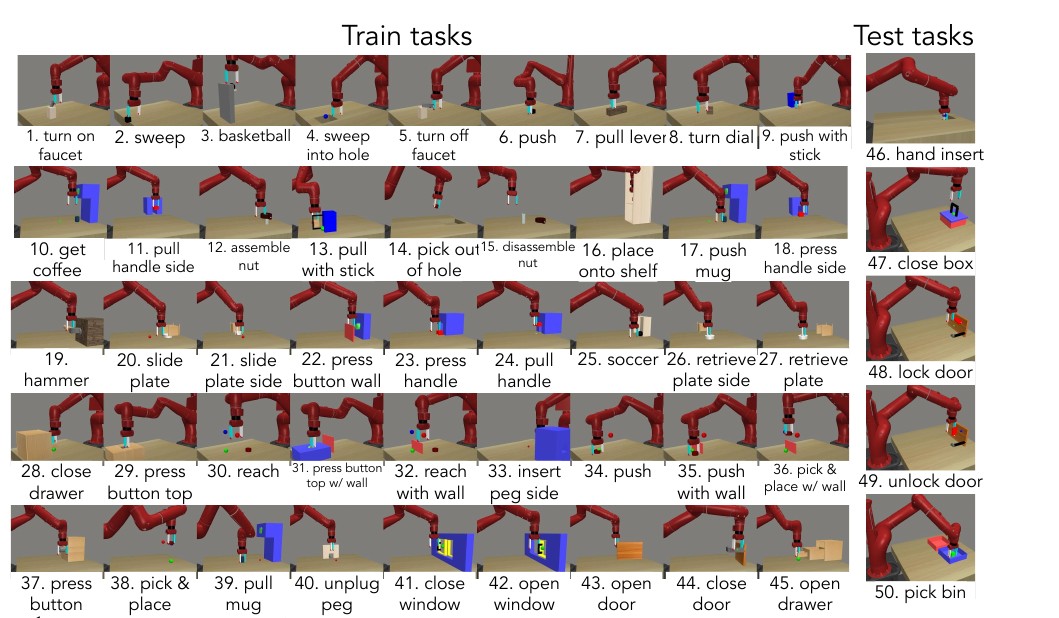
Figure 1: Meta-World contains 50 manipulation tasks, designed to be diverse yet carry shared structure that can be leveraged for efficient multi-task RL and transfer to new tasks via meta-RL. In the most difficult evaluation, the method must use experience from 45 training tasks (left) to quickly learn distinctly new test tasks (right).
图 1:Meta-World 包含 50 个操作任务,设计上既多样,又带有可被高效多任务 RL 以及经元强化学习向新任务迁移所利用的共享结构。在最困难的评测中,方法必须利用 45 个训练任务(左)上的经验,快速学会明显不同的新测试任务(右)。
In order to study the capabilities of current multi-task and meta-reinforcement learning methods and make it feasible to design new algorithms that actually generalize and adapt quickly on meaningfully distinct tasks, we need evaluation protocols and task suites that are broad enough to enable this sort of generalization, while containing sufficient shared structure for generalization to be possible.
为了考察当前多任务与元强化学习方法的能力,并使设计真正能在有意义地彼此不同的任务上泛化并快速适应的新算法成为可能,我们需要足够宽、能够支持这种泛化的评测协议和任务套件,同时又要有足够的共享结构,使泛化成为可能。
The key contributions of this work are a suite of 50 diverse simulated manipulation tasks and an extensive empirical evaluation of how previous methods perform on sets of such distinct tasks. We contend that multi-task and meta reinforcement learning methods that aim to efficiently learn many tasks and quickly generalize to new tasks should be evaluated on distributions of tasks that are diverse and exhibit shared structure. To this end, we present a benchmark of simulated manipulation tasks with everyday objects, all of which are contained in a shared, table-top environment with a simulated Sawyer arm. By providing a large set of distinct tasks that share common environment and control structure, we believe that this benchmark will allow researchers to test the generalization capabilities of the current multi-task and meta RL methods, and help to identify new research avenues to improve the current approaches. Our empirical evaluation of existing methods on this benchmark reveals that, despite some impressive progress in multi-task and meta-reinforcement learning over the past few years, current methods are generally not able to learn diverse task sets, much less generalize successfully to entirely new tasks. We provide an evaluation protocol with evaluation modes of varying difficulty, and observe that current methods only show success in the easiest modes. This opens the door for future developments in multi-task and meta reinforcement learning: instead of focusing on further increasing performance on current narrow task suites, we believe that it is essential for future work in these areas to focus on increasing the capabilities of algorithms to handle highly diverse task sets. By doing so, we can enable meaningful generalization across many tasks and achieve the full potential of meta-learning as a means of incorporating past experience to make it possible for robots to acquire new skills as quickly as people can.
本文的主要贡献是一套包含 50 个多样化仿真操作任务的套件,以及对以往方法在这类彼此不同的任务集合上表现的广泛实证评测。我们认为,若多任务和元强化学习方法的目标是高效学会许多任务并快速泛化到新任务,就应当在既多样、又具有共享结构的任务分布上评测。为此,我们给出一套用日常物体做的仿真操作任务基准,全部放在同一个桌面环境中,机械臂为仿真的 Sawyer。通过提供大量共享环境和控制结构、又彼此不同的任务,我们相信这一基准将使研究者能够检验当前多任务和元强化学习方法的泛化能力,并帮助找出改进现有方法的新研究途径。我们在该基准上对已有方法的实证评测表明:尽管过去几年多任务和元强化学习已有一些令人印象深刻的进展,当前方法通常仍无法学会多样化的任务集合,更不用说成功泛化到全新任务。我们提供一套难度各异的评测协议,并观察到当前方法只在最容易的模式上表现出成功。这为多任务和元强化学习的未来发展打开了门:与其继续把精力放在进一步提高当前窄任务套件上的成绩,我们认为这些方向的未来工作必须着力提高算法处理高度多样化任务集合的能力。这样,我们才能在许多任务之间实现有意义的泛化,并发挥元学习作为纳入既往经验之手段的全部潜力,使机器人有可能像人一样快地掌握新技能。
2 Related Work
2 相关工作
Previous works that have proposed benchmarks for reinforcement learning have largely focused on single task learning settings [11, 12, 13]. One popular benchmark used to study multi-task learning is the Arcade Learning Environment, a suite of dozens of Atari 2600 games [14]. While having a tremendous impact on the multi-task reinforcement learning research community [9, 15, 8, 16, 17], the Atari games included in the benchmark have significant differences in visual appearance, controls, and objectives, making it challenging to acquire any efficiency gains through shared learning. In fact, many prior multi-task learning methods have observed substantial negative transfer between the Atari games [9, 15]. In contrast, we would like to study a case where positive transfer between the different tasks should be possible. We therefore propose a set of related yet diverse tasks that share the same robot, action space, and workspace.
以往提出的强化学习基准,大多聚焦于单任务学习设置 [11, 12, 13]。用来研究多任务学习的一个流行基准是 Arcade Learning Environment,一套包含数十个 Atari 2600 游戏的套件 [14]。它对多任务强化学习研究社区影响巨大 [9, 15, 8, 16, 17],但该基准中的 Atari 游戏在视觉外观、控制和目标上差别很大,很难通过共享学习获得效率收益。事实上,许多先前的多任务学习方法都观察到 Atari 游戏之间存在大量负迁移 [9, 15]。与此相对,我们希望研究的是不同任务之间应当可能出现正迁移的情形。因此我们提出一组相关而又多样的任务,它们共用同一机器人、同一动作空间和同一工作空间。
Meta-reinforcement learning methods have been evaluated on a number of different problems, including maze navigation [18, 19, 20], continuous control domains with parametric variation across tasks [10, 21, 22, 23], bandit problems [19, 18, 20, 24], levels of an arcade game [25], and locomotion tasks with varying dynamics [26, 27]. Complementary to these evaluations, we aim to develop a testbed of tasks and an evaluation protocol that are reflective of the challenges in applying meta-learning to robotic manipulation problems, including both parameteric and non-parametric variation in tasks.
元强化学习方法已在许多不同问题上评测过,包括迷宫导航 [18, 19, 20]、任务间存在参数变化的连续控制领域 [10, 21, 22, 23]、赌博机问题 [19, 18, 20, 24]、街机游戏的关卡 [25],以及动力学变化的运动控制任务 [26, 27]。与这些评测互补,我们旨在发展一套能够反映把元学习用于机器人操作问题时的挑战的任务试验台和评测协议,其中既包含任务的参数变化,也包含非参数变化。
There is a long history of robotics benchmarks [28], datasets [29, 30, 31, 32, 33, 34, 35], competitions [36] and standardized object sets [37, 38] that have played an important role in robotics research. Similarly, there exists a number of robotics simulation benchmarks including visual navigation [39, 40, 41, 42, 43], autonomous driving [44, 45, 46], grasping [47, 48, 49], single-task manipulation [50], among others. In this work, our aim is to continue this trend and provide a large suite of tasks that will allow researchers to study multi-task learning, meta-learning, and transfer in general. Further, unlike these prior simulation benchmarks, we particularly focus on providing a suite of many diverse manipulation tasks and a protocol for multi-task and meta RL evaluation.
机器人学中早有基准 [28]、数据集 [29, 30, 31, 32, 33, 34, 35]、竞赛 [36] 和标准化物体集合 [37, 38] 的传统,它们在机器人研究中发挥了重要作用。同样,也已有若干机器人仿真基准,包括视觉导航 [39, 40, 41, 42, 43]、自动驾驶 [44, 45, 46]、抓取 [47, 48, 49]、单任务操作 [50] 等。在这项工作中,我们的目标是延续这一趋势,提供一套大规模任务,使研究者能够研究多任务学习、元学习以及一般意义上的迁移。此外,与这些先前的仿真基准不同,我们特别着重提供许多多样化的操作任务,以及一套多任务和元强化学习的评测协议。
3 The Multi-Task and Meta-RL Problem Statements
3 多任务与元强化学习问题表述
Our proposed benchmark is aimed at making it possible to study generalization in meta-RL and multi-task RL. In this section, we define the meta-RL and multi-task RL problem statements, and describe some of the challenges associated with task distributions in these settings.
我们提出的基准旨在使研究元强化学习和多任务强化学习中的泛化成为可能。本节给出元强化学习和多任务强化学习的问题表述,并说明这些设置中与任务分布相关的若干挑战。
We use the formalism of Markov decision processes (MDPs), where each task (\mathcal{T}) corresponds to a different finite horizon MDP, represented by a tuple ((S, A, P, R, H, \gamma)), where (s \in S) correspond to states, (a \in A) correspond to the available actions, (P(s_{t+1}|s_t, a_t)) represents the stochastic transition dynamics, (R(s, a)) is a reward function, (H) is the horizon and (\gamma) is the discount factor. In standard reinforcement learning, the goal is to learn a policy (\pi(a|s)) that maximizes the expected return, which is the sum of (discounted) rewards over all time. In multi-task and meta-RL settings, we assume a distribution of tasks (p(\mathcal{T})). Different tasks may vary in any aspect of the Markov decision process, though efficiency gains in adaptation to new tasks are only possible if the tasks share some common structure. For example, as we describe in the next section, the tasks in our proposed benchmark have the same action space and horizon, and structurally similar rewards and state spaces.
我们采用马尔可夫决策过程(MDP)的形式化:每个任务 (\mathcal{T}) 对应一个不同的有限时域 MDP,表示为元组 ((S, A, P, R, H, \gamma)),其中 (s \in S) 对应状态,(a \in A) 对应可用动作,(P(s_{t+1}|s_t, a_t)) 表示随机转移动力学,(R(s, a)) 是奖励函数,(H) 是时域,(\gamma) 是折扣因子。在标准强化学习中,目标是学习策略 (\pi(a|s)),最大化期望回报,即所有时刻(折扣后)奖励之和。在多任务和元强化学习设置中,我们假定有任务分布 (p(\mathcal{T}))。不同任务可以在马尔可夫决策过程的任何方面有所变化,但只有在任务共享某些共同结构时,向新任务适应才可能带来效率收益。例如,如下节所述,我们提出的基准中的任务具有相同的动作空间和时域,以及结构相似的奖励和状态空间。
2In practice, the policy must be able to read in the state for each of the tasks, which typically requires them to at least have the same dimensionality. In our benchmarks, some tasks have different numbers of objects, but the state dimensionality is always the same, meaning that some state coordinates are unused for some tasks.
2实践中,策略必须能够读入每个任务的状态,这通常至少要求它们具有相同的维数。在我们的基准中,有些任务的物体数量不同,但状态维数始终相同,这意味着某些状态坐标在部分任务中不会被用到。
Multi-task RL problem statement. The goal of multi-task RL is to learn a single, task-conditioned policy (\pi(a|s, z)), where (z) indicates an encoding of the task ID. This policy should maximize the average expected return across all tasks from the task distribution (p(\mathcal{T})), given by (\mathbb{E}{\mathcal{T} \sim p(\mathcal{T})}[\mathbb{E}{\pi}[\sum_{t=0}^{H} \gamma^t R_t(s_t, a_t)]]). The information about the task can be provided to the policy in various ways, e.g. using a one-hot task identification encoding (z) that is passed in addition to the current state. There is no separate test set of tasks, and multi-task RL algorithms are typically evaluated on their average performance over the training tasks.
多任务强化学习问题表述。多任务强化学习的目标是学习一个单一的、以任务为条件的策略 (\pi(a|s, z)),其中 (z) 表示任务 ID 的编码。该策略应最大化来自任务分布 (p(\mathcal{T})) 的全部任务上的平均期望回报,即 (\mathbb{E}{\mathcal{T} \sim p(\mathcal{T})}[\mathbb{E}{\pi}[\sum_{t=0}^{H} \gamma^t R_t(s_t, a_t)]])。关于任务的信息可以用多种方式提供给策略,例如使用在当前状态之外再输入的独热任务标识编码 (z)。没有单独的测试任务集,多任务强化学习算法通常按它们在训练任务上的平均性能来评测。
Meta-RL problem statement. Meta-reinforcement learning aims to leverage the set of training task to learn a policy (\pi(a|s)) that can quickly adapt to new test tasks that were not seen during training, where both training and test tasks are assumed to be drawn from the same task distribution (p(\mathcal{T})). Typically, the training tasks are referred to as the meta-training set, to distinguish from the adaptation (training) phase performed on the (meta-) test tasks. During meta-training, the learning algorithm has access to (M) tasks ({\mathcal{T}i}{i=1}^{M}) that are drawn from the task distribution (p(\mathcal{T})). At meta-test time, a new task (\mathcal{T}_j \sim p(\mathcal{T})) is sampled that was not seen during meta-training, and the meta-trained policy must quickly adapt to this task to achieve the highest return with a small number of samples. A key premise in meta-RL is that a sufficiently powerful meta-RL method can meta-learn a model that effectively implements a highly efficient reinforcement learning procedure, which can then solve entirely new tasks very quickly – much more quickly than a conventional reinforcement learning algorithm learning from scratch. However, in order for this to happen, the meta-training distribution (p(\mathcal{T})) must be sufficiently broad to encompass these new tasks. Unfortunately, most prior work in meta-RL evaluates on very narrow task distributions, with only one or two dimensions of parametric variation, such as the running direction for a simulated robot [10, 21, 22, 23].
元强化学习问题表述。元强化学习旨在利用训练任务集合,学习一个策略 (\pi(a|s)),使之能够快速适应训练时未见过的新测试任务;训练任务和测试任务都被假定抽自同一任务分布 (p(\mathcal{T}))。训练任务通常称为元训练集,以区别于在(元)测试任务上进行的适应(训练)阶段。在元训练期间,学习算法可以使用从任务分布 (p(\mathcal{T})) 中抽出的 (M) 个任务 ({\mathcal{T}i}{i=1}^{M})。在元测试时,会采样一个元训练时未见过的新任务 (\mathcal{T}_j \sim p(\mathcal{T})),经过元训练的策略必须快速适应这一任务,用少量样本取得尽可能高的回报。元强化学习的一个关键前提是:足够强的元强化学习方法可以元学习出一个模型,该模型实际上实现了一种高效的强化学习程序,从而能够非常快地解决全新任务——比从零开始学习的常规强化学习算法快得多。然而,要做到这一点,元训练分布 (p(\mathcal{T})) 必须足够宽,以涵盖这些新任务。遗憾的是,以往大多数元强化学习工作都在非常窄的任务分布上评测,只有一两个维度的参数变化,例如仿真机器人的奔跑方向 [10, 21, 22, 23]。
4 Meta-World
If we want meta-RL methods to generalize effectively to entirely new tasks, we must meta-train on broad task distributions that are representative of the range of tasks that a particular agent might need to solve in the future. To this end, we propose a new multi-task and meta-RL benchmark, which we call Meta-World. In this section, we motivate the design decisions behind the Meta-World tasks, discuss the range of tasks, describe the representation of the actions, observations, and rewards, and present a set of evaluation protocols of varying difficulty for both meta-RL and multi-task RL.
若希望元强化学习方法有效地泛化到全新任务,就必须在足够宽、能够代表某个智能体未来可能需要解决的任务范围的任务分布上做元训练。为此,我们提出一个新的多任务与元强化学习基准,称为 Meta-World。本节说明 Meta-World 任务背后的设计选择,讨论任务范围,描述动作、观察和奖励的表示,并给出一套难度各异、同时面向元强化学习和多任务强化学习的评测协议。
4.1 The Space of Manipulation Tasks: Parametric and Non-Parametric Variability
4.1 操作任务空间:参数变化与非参数变化
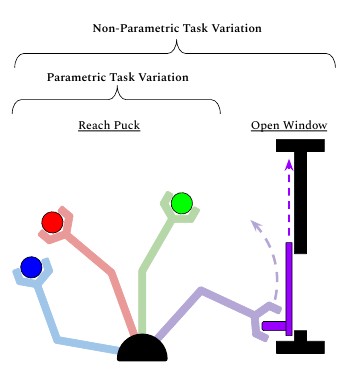
Figure 2: Parametric/nonparametric variation: all “reach puck” tasks (left) can be parameterized by the puck position, while the difference between “reach puck” and “open window” (right) is non-parametric.
图 2:参数 / 非参数变化:所有 “reach puck” 任务(左)都可以由冰球位置参数化,而 “reach puck” 与 “open window”(右)之间的差别则是非参数的。
Meta-learning makes two critical assumptions: first, that the meta-training and meta-test tasks are drawn from the same distribution, (p(\mathcal{T})), and second, that the task distribution (p(\mathcal{T})) exhibits shared structure that can be utilized for efficient adaptation to new tasks. If (p(\mathcal{T})) is defined as a family of variations within a particular control task, as in prior work [10, 22], then it is unreasonable to hope for generalization to entirely new control tasks. For example, an agent has little hope of being able to quickly learn to open a door, without having ever experienced doors before, if it has only been trained on a set of meta-training tasks that are homogeneous and narrow. Thus, to enable meta-RL methods to adapt to entirely new tasks, we propose a much larger suite of tasks consisting of 50 qualitatively-distinct manipulation tasks, where continuous parameter variation cannot be used to describe the differences between tasks.
元学习有两个关键假定:第一,元训练任务和元测试任务抽自同一分布 (p(\mathcal{T}));第二,任务分布 (p(\mathcal{T})) 具有可被用来高效适应新任务的共享结构。若像先前工作 [10, 22] 那样,把 (p(\mathcal{T})) 定义成某一控制任务内部的一组变化,那么指望泛化到全新的控制任务是不合理的。例如,一个智能体如果只在一组同质而狭窄的元训练任务上受过训练,又从未见过门,就很难指望它能很快学会开门。因此,为使元强化学习方法能够适应全新任务,我们提出一套大得多的任务,包含 50 个性质上彼此不同的操作任务,任务之间的差别无法用连续的参数变化来描述。
With such non-parametric variation, however, there is the danger that tasks will not exhibit enough shared structure, or will lack the task overlap needed for the method to avoid memorizing each of the tasks. Motivated by this challenge, we design each task to include parametric variation in object and goal positions, as illustrated in Figure 2. Introducing this parametric variability not only creates a substantially larger (infinite) variety of tasks, but also makes it substantially more practical to expect that a meta-trained model will generalize to acquire entirely new tasks more quickly, since varying the positions provides for wider coverage of the space of possible manipulation tasks. Without parametric variation, the model could for example memorize that any object at a particular location is a door, while any object at another location is a drawer. If the locations are not fixed, this kind of memorization is much less likely, and the model is forced to generalize more broadly. With enough tasks and variation within tasks, pairs of qualitatively-distinct tasks are more likely to overlap, serving as a catalyst for generalization. For example, closing a drawer and pushing a block can appear as nearly the same task for some initial and goal positions of each object.
不过,有了这种非参数变化,也存在任务共享结构不足、或缺少足以避免方法把每个任务都记住的任务重叠的危险。出于这一考虑,我们把每个任务都设计成在物体和目标位置上包含参数变化,如图 2 所示。引入这种参数可变性,不但造就了大得多(无限)的任务多样性,也使人们更有理由期待经过元训练的模型能够更快地泛化并掌握全新任务,因为改变位置可以更宽地覆盖可能的操作任务空间。若没有参数变化,模型例如可能记住某一位置上的任何物体都是门,另一位置上的任何物体都是抽屉。若位置不固定,这种记忆就难得多,模型也被迫更广泛地泛化。当任务足够多、任务内部变化足够大时,性质上不同的成对任务更可能发生重叠,从而成为泛化的催化剂。例如,在某些初始和目标位置下,关抽屉和推方块看起来几乎可以是同一任务。
Note that this kind of parametric variation, which we introduce for each task, essentially represents the entirety of the task distribution for previous meta-RL evaluations [10, 22], which test on single tasks (e.g., running towards a goal) with parametric variability (e.g., variation in the goal position). Our full task distribution is therefore substantially broader, since it includes this parametric variability for each of the 50 tasks.
需要说明,我们为每个任务引入的这种参数变化,本质上就相当于以往元强化学习评测 [10, 22] 的全部任务分布——那些评测是在带参数可变性(例如目标位置变化)的单个任务(例如向目标奔跑)上测试的。因此,我们的完整任务分布要宽得多,因为它为全部 50 个任务都包含了这种参数可变性。
To provide shared structure, the 50 environments require the same robotic arm to interact with different objects, with different shapes, joints, and connectivity. The tasks themselves require the robot to execute a combination of reaching, pushing, and grasping, depending on the task. By recombining these basic behavioral building blocks with a variety of objects with different shapes and articulation properties, we can create a wide range of manipulation tasks. For example, the open door task involves pushing or grasping an object with a revolute joint, while the open drawer task requires pushing or grasping an object with a sliding joint. More complex tasks require a combination of these building blocks, which must be executed in the right order. We visualize all of the tasks in Meta-World in Figure 1, and include a description of all tasks in Appendix A.
为了提供共享结构,这 50 个环境要求同一只机械臂与形状、关节和连接方式不同的物体交互。任务本身则要求机器人根据任务执行伸手、推和抓的组合。把这些基本行为构件与形状和铰接性质各异的多种物体重新组合,就可以构造出范围很广的操作任务。例如,开门任务涉及推或抓一个带转动关节的物体,而开抽屉任务则要求推或抓一个带滑动关节的物体。更复杂的任务需要按正确顺序执行这些构件的组合。我们在图 1 中展示了 Meta-World 的全部任务,并在附录 A 中给出所有任务的说明。
All of the tasks are implemented in the MuJoCo physics engine [51], which enables fast simulation of physical contact. To make the interface simple and accessible, we base our suite on the Multiworld interface [52] and the OpenAI Gym environment interfaces [11], making additions and adaptations of the suite relatively easy for researchers already familiar with Gym.
全部任务都在 MuJoCo 物理引擎 [51] 中实现,从而能够快速仿真物理接触。为使接口简单易用,我们的套件基于 Multiworld 接口 [52] 和 OpenAI Gym 环境接口 [11],使已经熟悉 Gym 的研究者比较容易对套件做增补和改动。
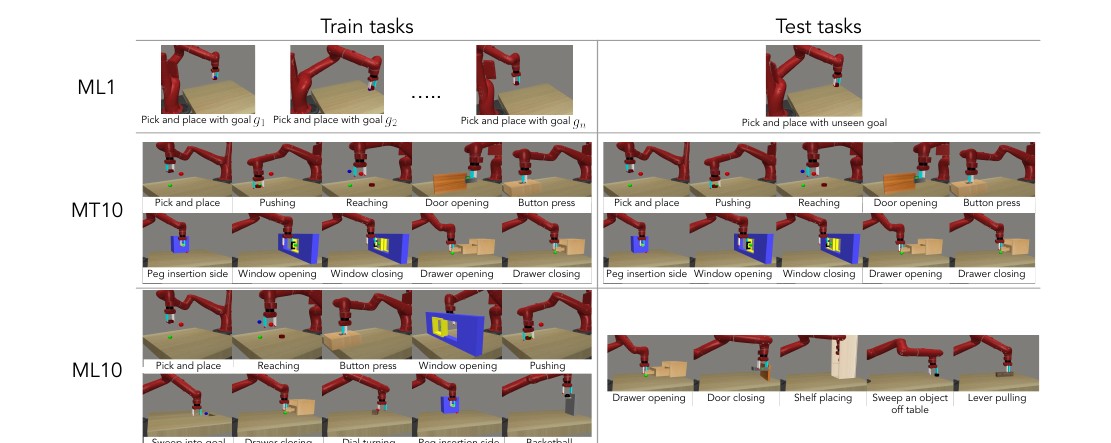
Figure 3: Visualization of three of our multi-task and meta-learning evaluation protocols, ranging from within task adaptation in ML1, to multi-task training across 10 distinct task families in MT10, to adapting to new tasks in ML10. Our most challenging evaluation mode ML45 is shown in Figure 1.
图 3:我们三种多任务与元学习评测协议的示意,范围从 ML1 中同一任务内的适应,到 MT10 中跨 10 个不同任务家族的多任务训练,再到 ML10 中适应新任务。最具挑战性的评测模式 ML45 见图 1。
4.2 Actions, Observations, and Rewards
4.2 动作、观察与奖励
In order to represent policies for multiple tasks with one model, the observation and action spaces must contain significant shared structure across tasks. All of our tasks are performed by a simulated Sawyer robot, with the action space corresponding to 3D end-effector positions. For all tasks, the robot must either manipulate one object with a variable goal position, or manipulate two objects with a fixed goal position. The observation space is represented as a 3-tuple of either the 3D Cartesian positions of the end-effector, the object, and the goal, or the 3D Cartesian positions of the end-effector, the first object, and the second object, and is always 9 dimensional.
要用一个模型表示多个任务的策略,观察空间和动作空间必须在各任务之间具有显著的共享结构。我们的全部任务都由仿真的 Sawyer 机器人完成,动作空间对应三维末端执行器位置。对所有任务,机器人要么操作一个目标位置可变的物体,要么操作两个目标位置固定的物体。观察空间表示为一个三元组:或者是末端执行器、物体和目标的三维笛卡尔坐标,或者是末端执行器、第一个物体和第二个物体的三维笛卡尔坐标,维数始终为 9。
Designing reward functions for Meta-World requires two major considerations. First, to guarantee that our tasks are within the reach of current single-task reinforcement learning algorithms, which is a prerequisite for evaluating multi-task and meta-RL algorithms, we design well-shaped reward functions for each task that make each of the tasks at least individually solvable. More importantly, the reward functions must exhibit shared structure across tasks. Critically, even if the reward function admits the same optimal policy for multiple tasks, varying reward scales or structures can make the tasks appear completely distinct for the learning algorithm, masking their shared structure and leading to preferences for tasks with high-magnitude rewards [8]. Accordingly, we adopt a structured, multi-component reward function for all tasks, which leads to effective policy learning for each of the task components. For instance, in a task that involves a combination of reaching, grasping, and placing an object, let (o \in \mathbb{R}^3) be the object position, where (o = (o_x, o_y, o_z)), (h \in \mathbb{R}^3) be the position of the robot’s gripper, (z_{\mathrm{target}} \in \mathbb{R}) be the target height of lifting the object, and (g \in \mathbb{R}^3) be goal position. With the above definition, the multi-component reward function (R) is the additive combination of a reaching reward (R_{\mathrm{reach}}), a grasping reward (R_{\mathrm{grasp}}) and a placing reward (R_{\mathrm{place}}), or subsets thereof for simpler tasks that only involve reaching and/or pushing. With this design, the reward functions across all tasks have similar magnitude and conform to similar structure, as desired. The full form of the reward function and a list of all task rewards is provided in Appendix B.
为 Meta-World 设计奖励函数有两个主要考虑。第一,为了保证我们的任务落在当前单任务强化学习算法力所能及的范围内——这是评测多任务和元强化学习算法的前提——我们为每个任务设计了形状良好的奖励函数,使每个任务至少可以单独被解决。更重要的是,奖励函数必须在各任务之间具有共享结构。关键在于,即便奖励函数对多个任务允许相同的最优策略,变化的奖励尺度或结构也会让学习算法把这些任务看成完全不同,掩盖它们的共享结构,并导致偏好奖励幅度大的任务 [8]。因此,我们对全部任务采用一种结构化的多分量奖励函数,从而能够对任务的各个分量都有效地学习策略。例如,在一个涉及伸手、抓取和放置物体之组合的任务中,设 (o \in \mathbb{R}^3) 为物体位置,其中 (o = (o_x, o_y, o_z)),(h \in \mathbb{R}^3) 为机器人夹爪位置,(z_{\mathrm{target}} \in \mathbb{R}) 为举起物体的目标高度,(g \in \mathbb{R}^3) 为目标位置。按上述定义,多分量奖励函数 (R) 是伸手奖励 (R_{\mathrm{reach}})、抓取奖励 (R_{\mathrm{grasp}}) 和放置奖励 (R_{\mathrm{place}}) 的加性组合;对只涉及伸手和/或推的更简单任务,则使用其中的子集。这样设计之后,各任务的奖励函数具有相近的幅度并符合相似的结构,正合所需。奖励函数的完整形式以及全部任务奖励的列表见附录 B。
4.3 Evaluation Protocol
4.3 评测协议
With the goal of providing a challenging benchmark to facilitate progress in multi-task RL and meta-RL, we design an evaluation protocol with varying levels of difficulty, ranging from the level of current goal-centric meta-RL benchmarks to a setting where methods must learn distinctly new, challenging manipulation tasks based on diverse experience across 45 tasks. We hence divide our evaluation into five categories, which we describe next. We then detail our evaluation criteria.
为了提供一套有挑战性的基准以推动多任务强化学习和元强化学习的进展,我们设计了难度不等的评测协议,从当前以目标为中心的元强化学习基准的水平,直到方法必须基于 45 个任务上的多样经验、学会明显不同且有挑战性的新操作任务的设置。因此,我们把评测分成五类,下面依次说明,然后再详述评测标准。
Meta-Learning 1 (ML1): Few-shot adaptation to goal variation within one task. The simplest evaluation aims to verify that previous meta-RL algorithms can adapt to new object or goal configurations on only one type of task. ML1 uses single Meta-World Tasks, with the meta-training “tasks” corresponding to 50 random initial object and goal positions, and meta-testing on 10 held-out positions. This resembles the evaluations in prior works [10, 22]. We evaluate algorithms on three individual tasks from Meta-World: reaching, pushing, and pick and place, where the variation is over reaching position or goal object position. The goal positions are not provided in the observation, forcing meta-RL algorithms to adapt to the goal through trial-and-error.
元学习 1(ML1):在同一任务内对目标变化做少样本适应。最简单的评测旨在验证以往的元强化学习算法能否在仅一类任务上适应新的物体或目标配置。ML1 使用单个 Meta-World 任务,元训练“任务”对应 50 个随机的初始物体和目标位置,元测试则在 10 个留出位置上进行。这与先前工作 [10, 22] 中的评测相近。我们在 Meta-World 的三个单项任务上评测算法:伸手、推,以及抓取放置,变化在于伸手位置或目标物体位置。观察中不提供目标位置,从而迫使元强化学习算法通过试错来适应目标。
Multi-Task 10, Multi-Task 50 (MT10, MT50): Learning one multi-task policy that generalizes to 10 and 50 training tasks. A first step towards adapting quickly to distinctly new tasks is the ability to train a single policy that can solve multiple distinct training tasks. The multi-task evaluation in Meta-World tests the ability to learn multiple tasks at once, without accounting for generalization to new tasks. The MT10 evaluation uses 10 tasks: reach, push, pick and place, open door, open drawer, close drawer, press button top-down, insert peg side, open window, and open box. The larger MT50 evaluation uses all 50 Meta-World tasks. The policy is provided with a one-hot vector indicating the current task. The positions of objects and goal positions are fixed in all tasks in this evaluation, so as to focus on acquiring the distinct skills, rather than generalization and robustness.
多任务 10、多任务 50(MT10、MT50):学习一个能够泛化到 10 个和 50 个训练任务的多任务策略。迈向快速适应明显不同的新任务的第一步,是能够训练一个可以解决多个不同训练任务的单一策略。Meta-World 中的多任务评测检验的是同时学习多个任务的能力,并不考虑向新任务的泛化。MT10 评测使用 10 个任务:reach、push、pick and place、open door、open drawer、close drawer、press button top-down、insert peg side、open window 和 open box。规模更大的 MT50 评测使用全部 50 个 Meta-World 任务。策略会得到一个指示当前任务的独热向量。该评测中所有任务的物体位置和目标位置都是固定的,以便把重点放在掌握这些不同技能上,而不是泛化和鲁棒性。
Meta-Learning 10, Meta-Learning 45 (ML10, ML45): Few-shot adaptation to new test tasks with 10 and 50 meta-training tasks. With the objective to test generalization to new tasks, we hold out 5 tasks and meta-train policies on 10 and 45 tasks. We randomize object and goals positions and intentionally select training tasks with structural similarity to the test tasks. Task IDs are not provided as input, requiring a meta-RL algorithm to identify the tasks from experience.
元学习 10、元学习 45(ML10、ML45):在 10 个和 50 个元训练任务上对新测试任务做少样本适应。为了检验向新任务的泛化,我们留出 5 个任务,并分别在 10 个和 45 个任务上对策略做元训练。我们随机化物体和目标位置,并有意选择与测试任务具有结构相似性的训练任务。输入中不提供任务 ID,要求元强化学习算法从经验中识别任务。
Success metrics. Since values of reward are not directly indicative how successful a policy is, we define an interpretable success metric for each task, which will be used as the evaluation criterion for all of the above evaluation settings. Since all of our tasks involve manipulating one or more objects into a goal configuration, this success metric is based on the distance between the task-relevant object and its final goal pose, i.e. (|o - g|_2 < \epsilon), where (\epsilon) is a small distance threshold such as 5 cm. For the complete list of success metrics and thresholds for each task, see Appendix B.
成功度量。由于奖励值并不能直接表明一个策略有多成功,我们为每个任务定义了一种可解释的成功度量,并把它作为上述全部评测设置的评测标准。因为我们的全部任务都涉及把一个或多个物体操作到目标配置,这一成功度量基于任务相关物体与其最终目标位姿之间的距离,即 (|o - g|_2 < \epsilon),其中 (\epsilon) 是诸如 5 厘米这样的小距离阈值。各任务成功度量与阈值的完整列表见附录 B。
5 Experimental Results and Analysis
5 实验结果与分析
The first, most basic goal of our experiments is to verify that each of the 50 presented tasks are indeed solveable by existing single-task reinforcement learning algorithms. We provide this verification in Appendix C. Beyond verifying the individual tasks, the goals of our experiments are to study the following questions: (1) can existing state-of-the-art meta-learning algorithms quickly learn qualitatively new tasks when meta-trained on a sufficiently broad, yet structured task distribution, and (2) how do different multi-task and meta-learning algorithms compare in this setting? To answer these questions, we evaluate various multi-task and meta-learning algorithms on the Meta-World benchmark. We include the training curves of all evaluations in Figure 8 in the Appendix D. Videos of the tasks and evaluations, along with all source code, are on the project webpage.
我们实验的首要、也最基本的目标,是验证所给出的 50 个任务确实都可以被现有的单任务强化学习算法解决。这一验证见附录 C。在验证各个任务之外,实验还要研究下列问题:(1)当在足够宽而又有结构的任务分布上做元训练时,现有的最优元学习算法能否快速学会性质上全新的任务;(2)在这一设置下,不同的多任务和元学习算法如何比较?为回答这些问题,我们在 Meta-World 基准上评测了多种多任务和元学习算法。全部评测的训练曲线见附录 D 中的图 8。任务与评测的视频以及全部源代码,见项目网页。
3Videos are on the project webpage, at meta-world.github.io
3视频见项目网页 meta-world.github.io
In the multi-task evaluation, we evaluate the following RL algorithms: multi-task proximal policy optimization (PPO) [53]: a policy gradient algorithm adapted to the multi-task setting by providing the one-hot task ID as input, multi-task trust region policy optimization (TRPO) [54]: an on-policy policy gradient algorithm adapted to the multi-task setting using the one-hot task ID as input, multi-task soft actor-critic (SAC) [55]: an off-policy actor-critic algorithm adapted to the multi-task setting using the one-hot task ID as input, multi-task multi-headed soft actor-critic (SAC) [55]: an off-policy actor-critic algorithm similar to multi-task SAC but using a multi-headed policy with one head per task, and an on-policy version of task embeddings (TE) [56]: a multi-task reinforcement learning algorithm that parameterizes the learned policies via shared skill embedding space. For the meta-RL evaluation, we study three algorithms: RL(^2) [18, 19]: an on-policy meta-RL algorithm that corresponds to training a LSTM network with hidden states maintained across episodes within a task and trained with PPO, model-agnostic meta-learning (MAML) [10, 21]: an on-policy gradient-based meta-RL algorithm that embeds policy gradient steps into the meta-optimization, and is trained with PPO, and probabilistic embeddings for actor-critic RL (PEARL) [22]: an off-policy actor-critic meta-RL algorithm, which learns to encode experience into a probabilistic embedding of the task that is fed to the actor and the critic.
在多任务评测中,我们评测下列强化学习算法:多任务近端策略优化(PPO)[53]:一种策略梯度算法,通过把独热任务 ID 作为输入来改用于多任务设置;多任务信任域策略优化(TRPO)[54]:一种同策略的策略梯度算法,同样用独热任务 ID 作为输入改用于多任务设置;多任务 soft actor-critic(SAC)[55]:一种异策略的 actor-critic 算法,用独热任务 ID 作为输入改用于多任务设置;多任务多头 soft actor-critic(SAC)[55]:与多任务 SAC 类似的异策略 actor-critic 算法,但使用每个任务一个头的多头策略;以及任务嵌入(TE)[56] 的一种同策略版本:一种多任务强化学习算法,通过共享的技能嵌入空间来参数化所学策略。在元强化学习评测中,我们研究三种算法:RL(^2) [18, 19]:一种同策略元强化学习算法,对应训练一个 LSTM 网络,其隐状态在同一任务的各条回合之间保持,并用 PPO 训练;与模型无关的元学习(MAML)[10, 21]:一种基于梯度的同策略元强化学习算法,把策略梯度步骤嵌入元优化中,并用 PPO 训练;以及面向 actor-critic 强化学习的概率嵌入(PEARL)[22]:一种异策略的 actor-critic 元强化学习算法,学习把经验编码成任务的概率嵌入,再送给 actor 和 critic。
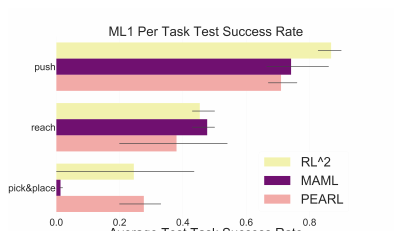
Figure 4: Comparison on our simplest meta-RL evaluation, ML1.
图 4:在最简单的元强化学习评测 ML1 上的比较。
We show results of the simplest meta-learning evaluation mode, ML1, in Figure 4. We find that there is room for improvement even in this very simple setting. Next, we look at results of multi-task learning across distinct tasks, starting with MT10 in the top left of Figure 5. We find that multi-task multi-headed SAC is able to learn the MT10 task suite well, achieving around 85% success rate averaged across tasks, while multi-task SAC that has a single head can only solve around 40% of the tasks, indicating that adopting a multi-headed architecture can greatly improve multi-task learning performance. On-policy methods such as task embeddings, multi-task PPO, and multi-task TRPO perform significantly worse, achieving less than 30% success across tasks. However, as we scale to 50 distinct tasks with MT50 (Figure 5, bottom left), we find that multi-task multi-headed SAC achieves only 40% average performance across the 50 tasks, while the other four methods have less than 30% success rates, indicating significant room for improvement.
我们在图 4 中给出最简单的元学习评测模式 ML1 的结果。我们发现,即便在这一非常简单的设置中也仍有改进余地。接下来,我们看跨不同任务的多任务学习结果,从图 5 左上的 MT10 开始。我们发现,多任务多头 SAC 能够很好地学会 MT10 任务套件,跨任务平均成功率约为 85%;而只有单头的多任务 SAC 大约只能解决 40% 的任务,表明采用多头结构可以大大提高多任务学习的表现。任务嵌入、多任务 PPO 和多任务 TRPO 等同策略方法明显更差,跨任务成功率低于 30%。然而,当我们用 MT50 扩展到 50 个不同任务时(图 5 左下),多任务多头 SAC 在 50 个任务上的平均表现只有 40%,其余四种方法的成功率都低于 30%,说明仍有很大改进余地。
Finally, we study the ML10 and ML45 meta-learning benchmarks, which require learning the meta-training tasks and generalizing to new meta-test tasks with small amounts of experience. We find that the prior meta-RL methods, MAML and RL(^2) reach about 40% and 10% success on ML10 test tasks, while PEARL is unable to generalize to new tasks on ML10. On ML45, PEARL manages to accomplish around 30% success rate on the test set, which suggests that having more meta-training tasks is conducive for PEARL to learn the underlying shared structure and adapt to unseen tasks. MAML and RL(^2) solve around 20% of the meta-test tasks, potentially due to the additional optimization challenges in this regime. Note that, on both ML10 and ML45, the meta-training performance of all methods also has considerable room for improvement, suggesting that optimization challenges are generally more severe in the meta-learning setting. The fact that some methods nonetheless exhibit meaningful generalization suggests that the ML10 and ML45 benchmarks are solvable, but challenging for current methods, leaving considerable room for improvement in future work.
最后,我们研究 ML10 和 ML45 元学习基准,它们要求学会元训练任务,并用少量经验泛化到新的元测试任务。我们发现,先前的元强化学习方法 MAML 和 RL(^2) 在 ML10 测试任务上分别达到约 40% 和 10% 的成功,而 PEARL 无法在 ML10 上泛化到新任务。在 ML45 上,PEARL 在测试集上能够达到约 30% 的成功率,这表明元训练任务更多有助于 PEARL 学习底层共享结构并适应未见过的任务。MAML 和 RL(^2) 解决了大约 20% 的元测试任务,这可能是因为这一机制中额外的优化困难。需要说明,在 ML10 和 ML45 上,所有方法的元训练性能也仍有很大改进余地,说明优化方面的挑战在元学习设置中通常更为严峻。尽管如此,仍有一些方法表现出有意义的泛化,这表明 ML10 和 ML45 基准是可解的,但对当前方法仍有挑战,为未来工作留下了相当大的改进空间。
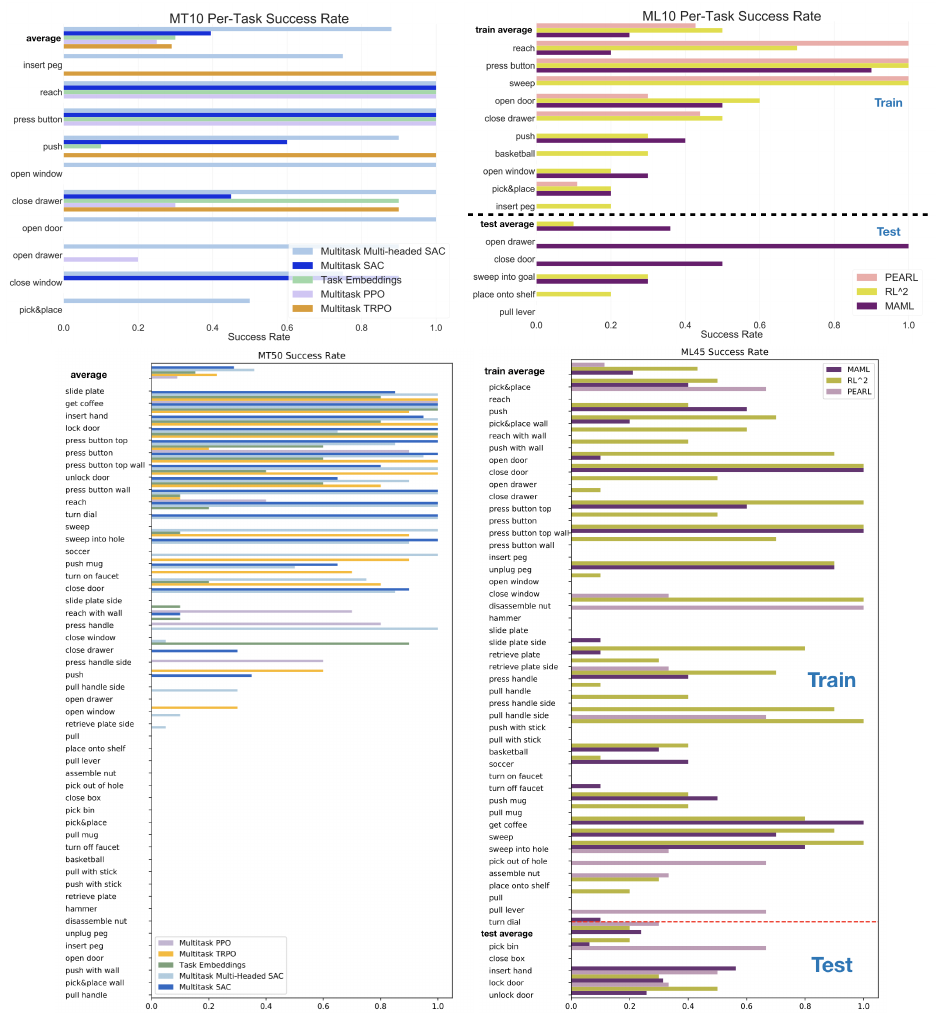
Figure 5: Quantitative results on MT10, MT50, ML10, and ML45. Note that, even on the challenging ML10 and ML45 benchmarks, current methods already exhibit some degree of generalization, but meta-training performance leaves considerable room for improvement, suggesting that future work could attain better performance on these benchmarks.
图 5:MT10、MT50、ML10 和 ML45 上的定量结果。即使在具有挑战性的 ML10 和 ML45 基准上,当前方法也已经表现出一定程度的泛化,但元训练性能仍有很大改进余地,说明未来工作有可能在这些基准上取得更好的表现。
6 Conclusion and Directions for Future Work
6 结论与未来工作方向
We proposed an open-source benchmark for meta-reinforcement learning and multi-task learning, which consists of a large number of simulated robotic manipulation tasks. Unlike previous evaluation benchmarks in meta-RL, our benchmark specifically emphasizes generalization to distinctly new tasks, not just in terms of parametric variation in goals, but completely new objects and interaction scenarios. While meta-RL can in principle make it feasible for agents to acquire new skills more quickly by leveraging past experience, previous evaluation benchmarks utilize very narrow task distributions, making it difficult to understand the degree to which meta-RL actually enables this kind of generalization. The aim of our benchmark is to make it possible to develop new meta-RL algorithms that actually exhibit this sort of generalization. Our experiments show that current meta-RL methods in fact cannot yet generalize effectively to entirely new tasks and do not even learn the meta-training tasks effectively when meta-trained across multiple distinct tasks. This suggests a number of directions for future work, which we describe below.
我们提出了一套面向元强化学习和多任务学习的开源基准,包含大量仿真机器人操作任务。与以往的元强化学习评测基准不同,我们的基准特别强调向明显不同的新任务泛化,不只是目标上的参数变化,还包括全新的物体和交互情景。尽管元强化学习原则上可以让智能体借助既往经验更快地掌握新技能,以往的评测基准使用的任务分布非常窄,因而很难判断元强化学习在多大程度上真正实现了这种泛化。我们提出这一基准的目的,是使发展真正表现出这种泛化的新元强化学习算法成为可能。实验表明,当前的元强化学习方法实际上还不能有效地泛化到全新任务,甚至在跨多个不同任务做元训练时,也不能有效地学会元训练任务。这提示了若干未来工作方向,我们在下面说明。
Future directions for algorithm design. The main conclusion from our experimental evaluation with our proposed benchmark is that current meta-RL algorithms generally struggle in settings where the meta-training tasks are highly diverse. This issue mirrors the challenges observed in multi-task RL, which is also challenging with our task suite, and has been observed to require considerable additional algorithmic development to attain good results in prior work [9, 15, 16]. A number of recent works have studied algorithmic improvements in the area of multi-task reinforcement learning, as well as potential explanations for the difficulty of RL in the multi-task setting [8, 57]. Incorporating some of these methods into meta-RL, as well as developing new techniques to enable meta-RL algorithms to train on broader task distributions, would be a promising direction for future work to enable meta-RL methods to generalize effectively across diverse tasks, and our proposed benchmark suite can provide future algorithms development with a useful gauge of progress towards the eventual goal of broad task generalization.
算法设计的未来方向。用我们提出的基准做实验评测,主要结论是:当前的元强化学习算法在元训练任务高度多样的设置中通常都很吃力。这一问题与多任务强化学习中观察到的挑战相呼应——在我们的任务套件上,多任务强化学习同样困难,先前工作也观察到要取得好结果还需要相当多额外的算法发展 [9, 15, 16]。近期已有若干工作研究多任务强化学习方面的算法改进,以及强化学习在多任务设置中之所以困难的可能解释 [8, 57]。把其中一些方法纳入元强化学习,并发展新技术使元强化学习算法能够在更宽的任务分布上训练,将是一个有前景的未来方向,以使元强化学习方法能够在多样任务之间有效泛化;而我们提出的基准套件,可以为未来的算法发展提供一个有用的进度标尺,通向最终的广泛任务泛化目标。
Future extensions of the benchmark. While the presented benchmark is significantly broader and more challenging than existing evaluations of meta-reinforcement learning algorithms, there are a number of extensions to the benchmark that would continue to improve and expand upon its applicability to realistic robotics tasks. First, in many situations, the poses of objects are not directly accessible to a robot in the real world. Hence, one interesting and important direction for future work is to consider image observations and sparse rewards. Sparse rewards can be derived already using the success metrics, while support for image rendering is already supported by the code. However, for meta-learning algorithms, special care needs to be taken to ensure that the task cannot be inferred directly from the image, else meta-learning algorithms will memorize the training tasks rather than learning to adapt. Another natural extension would be to consider including a breadth of compositional long-horizon tasks, where there exist combinatorial numbers of tasks. Such tasks would be a straightforward extension, and provide the possibility to include many more tasks with shared structure. Another challenge when deploying robot learning and meta-learning algorithms is the manual effort of resetting the environment. To simulate this case, one simple extension of the benchmark is to significantly reduce the frequency of resets available to the robot while learning. Lastly, in many real-world situations, the tasks are not available all at once. To reflect this challenge in the benchmark, we can add an evaluation protocol that matches that of online meta-learning problem statements [58]. We leave these directions for future work, either to be done by ourselves or in the form of open-source contributions. To summarize, we believe that the proposed form of the task suite represents a significant step towards evaluating multi-task and meta-learning algorithms on diverse robotic manipulation problems that will pave the way for future research in these areas.
基准的未来扩展。尽管所给出的基准已经比现有的元强化学习算法评测更宽、也更有挑战,仍有若干扩展可以继续改进并扩大它在真实机器人任务上的适用性。首先,在许多情形下,真实世界中的机器人并不能直接获得物体的位姿。因此,未来工作的一个有意思且重要的方向是考虑图像观察和稀疏奖励。稀疏奖励已经可以用成功度量导出,代码也已经支持图像渲染。不过,对元学习算法需要特别小心,确保不能直接从图像推断出任务,否则元学习算法会把训练任务记住,而不是学会适应。另一个自然的扩展是纳入一批组合式的长时域任务,其中任务数量可以是组合爆炸的。这类任务会是一种直接的扩展,并有可能纳入更多具有共享结构的任务。在部署机器人学习和元学习算法时,另一个挑战是重置环境的人工成本。为了模拟这种情况,对基准的一个简单扩展是显著降低学习过程中机器人可以使用的重置频率。最后,在许多真实情形中,任务并不是同时全部可用的。为在基准中反映这一挑战,我们可以增加一套与在线元学习问题表述 [58] 相一致的评测协议。这些方向留给未来工作,既可以由我们自己完成,也可以以开源贡献的形式完成。总而言之,我们认为所提出的这一任务套件形式,是朝着在多样化机器人操作问题上评测多任务和元学习算法迈出的重要一步,将为这些方向的未来研究铺路。
Acknowledgments
致谢
We thank Suraj Nair for feedback on a draft of the paper. This research was supported in part by the National Science Foundation under IIS-1651843, IIS-1700697, and IIS-1700696, the Office of Naval Research, ARL DCIST CRA W911NF-17-2-0181, DARPA, Google, Amazon, and NVIDIA.
我们感谢 Suraj Nair 对论文草稿的意见。本研究部分得到国家科学基金会 IIS-1651843、IIS-1700697 和 IIS-1700696,海军研究办公室,ARL DCIST CRA W911NF-17-2-0181,DARPA,Google,Amazon 以及 NVIDIA 的支持。
A Task Descriptions
A 任务说明
In Table 1, we include a description of each of the 50 Meta-World tasks.
表 1 给出了 50 个 Meta-World 任务中每一个的说明。
| Task | Description |
|---|---|
| turn on faucet | Rotate the faucet counter-clockwise. Randomize faucet positions |
| sweep | Sweep a puck off the table. Randomize puck positions |
| assemble nut | Pick up a nut and place it onto a peg. Randomize nut and peg positions |
| turn off faucet | Rotate the faucet clockwise. Randomize faucet positions |
| push | Push the puck to a goal. Randomize puck and goal positions |
| pull lever | Pull a lever down 90 degrees. Randomize lever positions |
| turn dial | Rotate a dial 180 degrees. Randomize dial positions |
| push with stick | Grasp a stick and push a box using the stick. Randomize stick positions. |
| get coffee | Push a button on the coffee machine. Randomize the position of the coffee machine |
| pull handle side | Pull a handle up sideways. Randomize the handle positions |
| basketball | Dunk the basketball into the basket. Randomize basketball and basket positions |
| pull with stick | Grasp a stick and pull a box with the stick. Randomize stick positions |
| sweep into hole | Sweep a puck into a hole. Randomize puck positions |
| disassemble nut | pick a nut out of the a peg. Randomize the nut positions |
| place onto shelf | pick and place a puck onto a shelf. Randomize puck and shelf positions |
| push mug | Push a mug under a coffee machine. Randomize the mug and the machine positions |
| press handle side | Press a handle down sideways. Randomize the handle positions |
| hammer | Hammer a screw on the wall. Randomize the hammer and the screw positions |
| slide plate | Slide a plate into a cabinet. Randomize the plate and cabinet positions |
| slide plate side | Slide a plate into a cabinet sideways. Randomize the plate and cabinet positions |
| press button wall | Bypass a wall and press a button. Randomize the button positions |
| press handle | Press a handle down. Randomize the handle positions |
| pull handle | Pull a handle up. Randomize the handle positions |
| soccer | Kick a soccer into the goal. Randomize the soccer and goal positions |
| retrieve plate side | Get a plate from the cabinet sideways. Randomize plate and cabinet positions |
| retrieve plate | Get a plate from the cabinet. Randomize plate and cabinet positions |
| close drawer | Push and close a drawer. Randomize the drawer positions |
| press button top | Press a button from the top. Randomize button positions |
| reach | reach a goal position. Randomize the goal positions |
| press button top wall | Bypass a wall and press a button from the top. Randomize button positions |
| reach with wall | Bypass a wall and reach a goal. Randomize goal positions |
| insert peg side | Insert a peg sideways. Randomize peg and goal positions |
| pull | Pull a puck to a goal. Randomize puck and goal positions |
| push with wall | Bypass a wall and push a puck to a goal. Randomize puck and goal positions |
| pick out of hole | Pick up a puck from a hole. Randomize puck and goal positions |
| pick&place w/ wall | Pick a puck, bypass a wall and place the puck. Randomize puck and goal positions |
| press button | Press a button. Randomize button positions |
| pick&place | Pick and place a puck to a goal. Randomize puck and goal positions |
| pull mug | Pull a mug from a coffee machine. Randomize the mug and the machine positions |
| unplug peg | Unplug a peg sideways. Randomize peg positions |
| close window | Push and close a window. Randomize window positions |
| open window | Push and open a window. Randomize window positions |
| open door | Open a door with a revolving joint. Randomize door positions |
| close door | Close a door with a revolvinig joint. Randomize door positions |
| open drawer | Open a drawer. Randomize drawer positions |
| insert hand | Insert the gripper into a hole. |
| close box | Grasp the cover and close the box with it. Randomize the cover and box positions |
| lock door | Lock the door by rotating the lock clockwise. Randomize door positions |
| unlock door | Unlock the door by rotating the lock counter-clockwise. Randomize door positions |
| pick bin | Grasp the puck from one bin and place it into another bin. Randomize puck positions |
Table 1: A list of all of the Meta-World tasks and a description of each task.
| 任务 | 说明 |
|---|---|
| turn on faucet | 逆时针旋转水龙头。随机化水龙头位置 |
| sweep | 把冰球扫下桌子。随机化冰球位置 |
| assemble nut | 拿起螺母并放到销钉上。随机化螺母和销钉位置 |
| turn off faucet | 顺时针旋转水龙头。随机化水龙头位置 |
| push | 把冰球推到目标处。随机化冰球和目标位置 |
| pull lever | 把杠杆向下拉 90 度。随机化杠杆位置 |
| turn dial | 把旋钮旋转 180 度。随机化旋钮位置 |
| push with stick | 抓住一根棍子,用棍子去推箱子。随机化棍子位置。 |
| get coffee | 按下咖啡机上的按钮。随机化咖啡机位置 |
| pull handle side | 侧向向上拉手柄。随机化手柄位置 |
| basketball | 把篮球扣进篮筐。随机化篮球和篮筐位置 |
| pull with stick | 抓住一根棍子,用棍子去拉箱子。随机化棍子位置 |
| sweep into hole | 把冰球扫进洞里。随机化冰球位置 |
| disassemble nut | 把螺母从销钉上取下。随机化螺母位置 |
| place onto shelf | 抓取冰球并放到架子上。随机化冰球和架子位置 |
| push mug | 把杯子推到咖啡机下面。随机化杯子和机器位置 |
| press handle side | 侧向向下按手柄。随机化手柄位置 |
| hammer | 把墙上的螺丝钉锤进去。随机化锤子和螺丝钉位置 |
| slide plate | 把盘子滑进柜子。随机化盘子和柜子位置 |
| slide plate side | 侧向把盘子滑进柜子。随机化盘子和柜子位置 |
| press button wall | 绕过一面墙并按下按钮。随机化按钮位置 |
| press handle | 向下按手柄。随机化手柄位置 |
| pull handle | 向上拉手柄。随机化手柄位置 |
| soccer | 把足球踢进球门。随机化足球和球门位置 |
| retrieve plate side | 侧向从柜子里取出盘子。随机化盘子和柜子位置 |
| retrieve plate | 从柜子里取出盘子。随机化盘子和柜子位置 |
| close drawer | 推上并关上抽屉。随机化抽屉位置 |
| press button top | 从上方按下按钮。随机化按钮位置 |
| reach | 伸手到达目标位置。随机化目标位置 |
| press button top wall | 绕过一面墙并从上方按下按钮。随机化按钮位置 |
| reach with wall | 绕过一面墙并伸手到达目标。随机化目标位置 |
| insert peg side | 侧向插入销钉。随机化销钉和目标位置 |
| pull | 把冰球拉到目标处。随机化冰球和目标位置 |
| push with wall | 绕过一面墙并把冰球推到目标处。随机化冰球和目标位置 |
| pick out of hole | 从洞里拿起冰球。随机化冰球和目标位置 |
| pick&place w/ wall | 拿起冰球,绕过一面墙,再放下冰球。随机化冰球和目标位置 |
| press button | 按下按钮。随机化按钮位置 |
| pick&place | 把冰球抓取并放置到目标处。随机化冰球和目标位置 |
| pull mug | 从咖啡机上拉开杯子。随机化杯子和机器位置 |
| unplug peg | 侧向拔出销钉。随机化销钉位置 |
| close window | 推上并关上窗户。随机化窗户位置 |
| open window | 推开一扇窗户。随机化窗户位置 |
| open door | 打开一扇带转动关节的门。随机化门的位置 |
| close door | 关上一个带转动关节的门。随机化门的位置 |
| open drawer | 打开抽屉。随机化抽屉位置 |
| insert hand | 把夹爪伸进洞里。 |
| close box | 抓住盖子并用它盖上盒子。随机化盖子和盒子位置 |
| lock door | 顺时针旋转锁芯锁上门。随机化门的位置 |
| unlock door | 逆时针旋转锁芯打开门锁。随机化门的位置 |
| pick bin | 从一个箱子里抓住冰球并放到另一个箱子里。随机化冰球位置 |
表 1:全部 Meta-World 任务及其说明的列表。
B Task Rewards and Success Metrics
B 任务奖励与成功度量
The form of the reward function is shared across tasks. In particular, the multi-component reward function (R) is a combination of a reaching reward (R_{\mathrm{reach}}), a grasping reward (R_{\mathrm{grasp}}) and a placing reward (R_{\mathrm{place}}) as follows:
奖励函数的形式在各任务之间是共享的。具体来说,多分量奖励函数 (R) 是伸手奖励 (R_{\mathrm{reach}})、抓取奖励 (R_{\mathrm{grasp}}) 和放置奖励 (R_{\mathrm{place}}) 的组合,如下所示:
where (\epsilon, c_1, c_2, c_3) are constant for all tasks. For tasks that involve reaching and pushing, the reward (R) can be formed as a combination of a reaching reward (R_{\mathrm{reach}}) and a pushing reward (R_{\mathrm{push}}):
其中 (\epsilon, c_1, c_2, c_3) 对全部任务都是常数。对于涉及伸手和推的任务,奖励 (R) 可以写成伸手奖励 (R_{\mathrm{reach}}) 与推的奖励 (R_{\mathrm{push}}) 的组合:
With this design, the reward functions across all tasks have similar magnitude and conform to similar structure, as desired. In Table 2, we include a complete list of reward functions of each of the 50 Meta-World tasks. In Table 3, we include a complete list of success metrics of each of the 50 Meta-World tasks.
这样设计之后,各任务的奖励函数具有相近的幅度并符合相似的结构,正合所需。表 2 给出了 50 个 Meta-World 任务中每一个的完整奖励函数列表。表 3 给出了 50 个 Meta-World 任务中每一个的完整成功度量列表。
| Task | Reward |
|---|---|
| turn on faucet | (-|h-o|2 + \mathbb{I}{|h-o|_2<0.05}\cdot 1000\cdot\exp{|h-g|_2^2/0.01}) |
| sweep | (-|h-o|2 + \mathbb{I}{|h-o|_2<0.05}\cdot 1000\cdot\exp{|h-g|_2^2/0.01}) |
| pick out of hole | (-|h-o|2 + \mathbb{I}{|h-o|2<0.05}\cdot 100\cdot\min{o_z, z{\mathrm{target}}} + \mathbb{I}_{ |
| turn off faucet | (-|h-o|2 + \mathbb{I}{|h-o|_2<0.05}\cdot 1000\cdot\exp{|h-g|_2^2/0.01}) |
| push with stick | (-|h-o|2 + \mathbb{I}{|h-o|2<0.05}\cdot 100\cdot\min{o_z, z{\mathrm{target}}} + \mathbb{I}_{ |
| get coffee | (-|h-o|2 + \mathbb{I}{|h-o|_2<0.05}\cdot 1000\cdot\exp{|h-g|_2^2/0.01}) |
| pull handle side | (-|h-o|2 + \mathbb{I}{|h-o|_2<0.05}\cdot 1000\cdot\exp{|h-g|_2^2/0.01}) |
| basketball | (-|h-o|2 + \mathbb{I}{|h-o|2<0.05}\cdot 100\cdot\min{o_z, z{\mathrm{target}}} + \mathbb{I}_{ |
| pull with stick | (-|h-o|2 + \mathbb{I}{|h-o|2<0.05}\cdot 100\cdot\min{o_z, z{\mathrm{target}}} + \mathbb{I}_{ |
| sweep into hole | (-|h-o|2 + \mathbb{I}{|h-o|_2<0.05}\cdot 1000\cdot\exp{|h-g|_2^2/0.01}) |
| disassemble nut | (-|h-o|2 + \mathbb{I}{|h-o|2<0.05}\cdot 100\cdot\min{o_z, z{\mathrm{target}}} + \mathbb{I}_{ |
| assemble nut | (-|h-o|2 + \mathbb{I}{|h-o|2<0.05}\cdot 100\cdot\min{o_z, z{\mathrm{target}}} + \mathbb{I}_{ |
| place onto shelf | (-|h-o|2 + \mathbb{I}{|h-o|2<0.05}\cdot 100\cdot\min{o_z, z{\mathrm{target}}} + \mathbb{I}_{ |
| push mug | (-|h-o|2 + \mathbb{I}{|h-o|_2<0.05}\cdot 1000\cdot\exp{|h-g|_2^2/0.01}) |
| press handle side | (-|h-o|2 + \mathbb{I}{|h-o|_2<0.05}\cdot 1000\cdot\exp{|h-g|_2^2/0.01}) |
| hammer | (-|h-o|2 + \mathbb{I}{|h-o|2<0.05}\cdot 100\cdot\min{o_z, z{\mathrm{target}}} + \mathbb{I}_{ |
| slide plate | (-|h-o|2 + \mathbb{I}{|h-o|_2<0.05}\cdot 1000\cdot\exp{|h-g|_2^2/0.01}) |
| slide plate side | (-|h-o|2 + \mathbb{I}{|h-o|_2<0.05}\cdot 1000\cdot\exp{|h-g|_2^2/0.01}) |
| press button wall | (-|h-o|2 + \mathbb{I}{|h-o|_2<0.05}\cdot 1000\cdot\exp{|h-g|_2^2/0.01}) |
| press handle | (-|h-o|2 + \mathbb{I}{|h-o|_2<0.05}\cdot 1000\cdot\exp{|h-g|_2^2/0.01}) |
| pull handle | (-|h-o|2 + \mathbb{I}{|h-o|_2<0.05}\cdot 1000\cdot\exp{|h-g|_2^2/0.01}) |
| soccer | (-|h-o|2 + \mathbb{I}{|h-o|_2<0.05}\cdot 1000\cdot\exp{|h-g|_2^2/0.01}) |
| retrieve plate side | (-|h-o|2 + \mathbb{I}{|h-o|_2<0.05}\cdot 1000\cdot\exp{|h-g|_2^2/0.01}) |
| retrieve plate | (-|h-o|2 + \mathbb{I}{|h-o|_2<0.05}\cdot 1000\cdot\exp{|h-g|_2^2/0.01}) |
| close drawer | (-|h-o|2 + \mathbb{I}{|h-o|_2<0.05}\cdot 1000\cdot\exp{|h-g|_2^2/0.01}) |
| reach | (1000\cdot\exp{|h-g|_2^2/0.01}) |
| press button top wall | (-|h-o|2 + \mathbb{I}{|h-o|_2<0.05}\cdot 1000\cdot\exp{|h-g|_2^2/0.01}) |
| reach with wall | (1000\cdot\exp{|h-g|_2^2/0.01}) |
| insert peg side | (-|h-o|2 + \mathbb{I}{|h-o|2<0.05}\cdot 100\cdot\min{o_z, z{\mathrm{target}}} + \mathbb{I}_{ |
| push | (-|h-o|2 + \mathbb{I}{|h-o|_2<0.05}\cdot 1000\cdot\exp{|h-g|_2^2/0.01}) |
| push with wall | (-|h-o|2 + \mathbb{I}{|h-o|_2<0.05}\cdot 1000\cdot\exp{|h-g|_2^2/0.01}) |
| pick&place w/ wall | (-|h-o|2 + \mathbb{I}{|h-o|2<0.05}\cdot 100\cdot\min{o_z, z{\mathrm{target}}} + \mathbb{I}_{ |
| press button | (-|h-o|2 + \mathbb{I}{|h-o|_2<0.05}\cdot 1000\cdot\exp{|h-g|_2^2/0.01}) |
| press button top | (-|h-o|2 + \mathbb{I}{|h-o|_2<0.05}\cdot 1000\cdot\exp{|h-g|_2^2/0.01}) |
| pick&place | (-|h-o|2 + \mathbb{I}{|h-o|2<0.05}\cdot 100\cdot\min{o_z, z{\mathrm{target}}} + \mathbb{I}_{ |
| pull | (-|h-o|2 + \mathbb{I}{|h-o|_2<0.05}\cdot 1000\cdot\exp{|h-g|_2^2/0.01}) |
| pull mug | (-|h-o|2 + \mathbb{I}{|h-o|_2<0.05}\cdot 1000\cdot\exp{|h-g|_2^2/0.01}) |
| unplug peg | (-|h-o|2 + \mathbb{I}{|h-o|2<0.05}\cdot 100\cdot\min{o_z, z{\mathrm{target}}} + \mathbb{I}_{ |
| turn dial | (-|h-o|2 + \mathbb{I}{|h-o|_2<0.05}\cdot 1000\cdot\exp{|h-g|_2^2/0.01}) |
| pull lever | (-|h-o|2 + \mathbb{I}{|h-o|_2<0.05}\cdot 1000\cdot\exp{|h-g|_2^2/0.01}) |
| close window | (-|h-o|2 + \mathbb{I}{|h-o|_2<0.05}\cdot 1000\cdot\exp{|h-g|_2^2/0.01}) |
| open window | (-|h-o|2 + \mathbb{I}{|h-o|_2<0.05}\cdot 1000\cdot\exp{|h-g|_2^2/0.01}) |
| open door | (-|h-o|2 + \mathbb{I}{|h-o|_2<0.05}\cdot 1000\cdot\exp{|h-g|_2^2/0.01}) |
| close door | (-|h-o|2 + \mathbb{I}{|h-o|_2<0.05}\cdot 1000\cdot\exp{|h-g|_2^2/0.01}) |
| open drawer | (-|h-o|2 + \mathbb{I}{|h-o|_2<0.05}\cdot 1000\cdot\exp{|h-g|_2^2/0.01}) |
| insert hand | (1000\cdot\exp{|h-g|_2^2/0.01}) |
| close box | (-|h-o|2 + \mathbb{I}{|h-o|2<0.05}\cdot 100\cdot\min{o_z, z{\mathrm{target}}} + \mathbb{I}_{ |
| lock door | (-|h-o|2 + \mathbb{I}{|h-o|_2<0.05}\cdot 1000\cdot\exp{|h-g|_2^2/0.01}) |
| unlock door | (-|h-o|2 + \mathbb{I}{|h-o|_2<0.05}\cdot 1000\cdot\exp{|h-g|_2^2/0.01}) |
| pick bin | (-|h-o|2 + \mathbb{I}{|h-o|2<0.05}\cdot 100\cdot\min{o_z, z{\mathrm{target}}} + \mathbb{I}_{ |
Table 2: A list of reward functions used for each of the Meta-World tasks.
| 任务 | 奖励 |
|---|---|
| turn on faucet | (-|h-o|2 + \mathbb{I}{|h-o|_2<0.05}\cdot 1000\cdot\exp{|h-g|_2^2/0.01}) |
| sweep | (-|h-o|2 + \mathbb{I}{|h-o|_2<0.05}\cdot 1000\cdot\exp{|h-g|_2^2/0.01}) |
| pick out of hole | (-|h-o|2 + \mathbb{I}{|h-o|2<0.05}\cdot 100\cdot\min{o_z, z{\mathrm{target}}} + \mathbb{I}_{ |
| turn off faucet | (-|h-o|2 + \mathbb{I}{|h-o|_2<0.05}\cdot 1000\cdot\exp{|h-g|_2^2/0.01}) |
| push with stick | (-|h-o|2 + \mathbb{I}{|h-o|2<0.05}\cdot 100\cdot\min{o_z, z{\mathrm{target}}} + \mathbb{I}_{ |
| get coffee | (-|h-o|2 + \mathbb{I}{|h-o|_2<0.05}\cdot 1000\cdot\exp{|h-g|_2^2/0.01}) |
| pull handle side | (-|h-o|2 + \mathbb{I}{|h-o|_2<0.05}\cdot 1000\cdot\exp{|h-g|_2^2/0.01}) |
| basketball | (-|h-o|2 + \mathbb{I}{|h-o|2<0.05}\cdot 100\cdot\min{o_z, z{\mathrm{target}}} + \mathbb{I}_{ |
| pull with stick | (-|h-o|2 + \mathbb{I}{|h-o|2<0.05}\cdot 100\cdot\min{o_z, z{\mathrm{target}}} + \mathbb{I}_{ |
| sweep into hole | (-|h-o|2 + \mathbb{I}{|h-o|_2<0.05}\cdot 1000\cdot\exp{|h-g|_2^2/0.01}) |
| disassemble nut | (-|h-o|2 + \mathbb{I}{|h-o|2<0.05}\cdot 100\cdot\min{o_z, z{\mathrm{target}}} + \mathbb{I}_{ |
| assemble nut | (-|h-o|2 + \mathbb{I}{|h-o|2<0.05}\cdot 100\cdot\min{o_z, z{\mathrm{target}}} + \mathbb{I}_{ |
| place onto shelf | (-|h-o|2 + \mathbb{I}{|h-o|2<0.05}\cdot 100\cdot\min{o_z, z{\mathrm{target}}} + \mathbb{I}_{ |
| push mug | (-|h-o|2 + \mathbb{I}{|h-o|_2<0.05}\cdot 1000\cdot\exp{|h-g|_2^2/0.01}) |
| press handle side | (-|h-o|2 + \mathbb{I}{|h-o|_2<0.05}\cdot 1000\cdot\exp{|h-g|_2^2/0.01}) |
| hammer | (-|h-o|2 + \mathbb{I}{|h-o|2<0.05}\cdot 100\cdot\min{o_z, z{\mathrm{target}}} + \mathbb{I}_{ |
| slide plate | (-|h-o|2 + \mathbb{I}{|h-o|_2<0.05}\cdot 1000\cdot\exp{|h-g|_2^2/0.01}) |
| slide plate side | (-|h-o|2 + \mathbb{I}{|h-o|_2<0.05}\cdot 1000\cdot\exp{|h-g|_2^2/0.01}) |
| press button wall | (-|h-o|2 + \mathbb{I}{|h-o|_2<0.05}\cdot 1000\cdot\exp{|h-g|_2^2/0.01}) |
| press handle | (-|h-o|2 + \mathbb{I}{|h-o|_2<0.05}\cdot 1000\cdot\exp{|h-g|_2^2/0.01}) |
| pull handle | (-|h-o|2 + \mathbb{I}{|h-o|_2<0.05}\cdot 1000\cdot\exp{|h-g|_2^2/0.01}) |
| soccer | (-|h-o|2 + \mathbb{I}{|h-o|_2<0.05}\cdot 1000\cdot\exp{|h-g|_2^2/0.01}) |
| retrieve plate side | (-|h-o|2 + \mathbb{I}{|h-o|_2<0.05}\cdot 1000\cdot\exp{|h-g|_2^2/0.01}) |
| retrieve plate | (-|h-o|2 + \mathbb{I}{|h-o|_2<0.05}\cdot 1000\cdot\exp{|h-g|_2^2/0.01}) |
| close drawer | (-|h-o|2 + \mathbb{I}{|h-o|_2<0.05}\cdot 1000\cdot\exp{|h-g|_2^2/0.01}) |
| reach | (1000\cdot\exp{|h-g|_2^2/0.01}) |
| press button top wall | (-|h-o|2 + \mathbb{I}{|h-o|_2<0.05}\cdot 1000\cdot\exp{|h-g|_2^2/0.01}) |
| reach with wall | (1000\cdot\exp{|h-g|_2^2/0.01}) |
| insert peg side | (-|h-o|2 + \mathbb{I}{|h-o|2<0.05}\cdot 100\cdot\min{o_z, z{\mathrm{target}}} + \mathbb{I}_{ |
| push | (-|h-o|2 + \mathbb{I}{|h-o|_2<0.05}\cdot 1000\cdot\exp{|h-g|_2^2/0.01}) |
| push with wall | (-|h-o|2 + \mathbb{I}{|h-o|_2<0.05}\cdot 1000\cdot\exp{|h-g|_2^2/0.01}) |
| pick&place w/ wall | (-|h-o|2 + \mathbb{I}{|h-o|2<0.05}\cdot 100\cdot\min{o_z, z{\mathrm{target}}} + \mathbb{I}_{ |
| press button | (-|h-o|2 + \mathbb{I}{|h-o|_2<0.05}\cdot 1000\cdot\exp{|h-g|_2^2/0.01}) |
| press button top | (-|h-o|2 + \mathbb{I}{|h-o|_2<0.05}\cdot 1000\cdot\exp{|h-g|_2^2/0.01}) |
| pick&place | (-|h-o|2 + \mathbb{I}{|h-o|2<0.05}\cdot 100\cdot\min{o_z, z{\mathrm{target}}} + \mathbb{I}_{ |
| pull | (-|h-o|2 + \mathbb{I}{|h-o|_2<0.05}\cdot 1000\cdot\exp{|h-g|_2^2/0.01}) |
| pull mug | (-|h-o|2 + \mathbb{I}{|h-o|_2<0.05}\cdot 1000\cdot\exp{|h-g|_2^2/0.01}) |
| unplug peg | (-|h-o|2 + \mathbb{I}{|h-o|2<0.05}\cdot 100\cdot\min{o_z, z{\mathrm{target}}} + \mathbb{I}_{ |
| turn dial | (-|h-o|2 + \mathbb{I}{|h-o|_2<0.05}\cdot 1000\cdot\exp{|h-g|_2^2/0.01}) |
| pull lever | (-|h-o|2 + \mathbb{I}{|h-o|_2<0.05}\cdot 1000\cdot\exp{|h-g|_2^2/0.01}) |
| close window | (-|h-o|2 + \mathbb{I}{|h-o|_2<0.05}\cdot 1000\cdot\exp{|h-g|_2^2/0.01}) |
| open window | (-|h-o|2 + \mathbb{I}{|h-o|_2<0.05}\cdot 1000\cdot\exp{|h-g|_2^2/0.01}) |
| open door | (-|h-o|2 + \mathbb{I}{|h-o|_2<0.05}\cdot 1000\cdot\exp{|h-g|_2^2/0.01}) |
| close door | (-|h-o|2 + \mathbb{I}{|h-o|_2<0.05}\cdot 1000\cdot\exp{|h-g|_2^2/0.01}) |
| open drawer | (-|h-o|2 + \mathbb{I}{|h-o|_2<0.05}\cdot 1000\cdot\exp{|h-g|_2^2/0.01}) |
| insert hand | (1000\cdot\exp{|h-g|_2^2/0.01}) |
| close box | (-|h-o|2 + \mathbb{I}{|h-o|2<0.05}\cdot 100\cdot\min{o_z, z{\mathrm{target}}} + \mathbb{I}_{ |
| lock door | (-|h-o|2 + \mathbb{I}{|h-o|_2<0.05}\cdot 1000\cdot\exp{|h-g|_2^2/0.01}) |
| unlock door | (-|h-o|2 + \mathbb{I}{|h-o|_2<0.05}\cdot 1000\cdot\exp{|h-g|_2^2/0.01}) |
| pick bin | (-|h-o|2 + \mathbb{I}{|h-o|2<0.05}\cdot 100\cdot\min{o_z, z{\mathrm{target}}} + \mathbb{I}_{ |
表 2:各 Meta-World 任务所用奖励函数的列表。
| Task | Success Metric |
|---|---|
| turn on faucet | (\mathbb{I}_{|o-g|_2<0.05}) |
| sweep | (\mathbb{I}_{|o-g|_2<0.05}) |
| pick out of hole | (\mathbb{I}_{|o-g|_2<0.08}) |
| turn off faucet | (\mathbb{I}_{|o-g|_2<0.05}) |
| push | (\mathbb{I}_{|o-g|_2<0.07}) |
| push with stick | (\mathbb{I}_{|o-g|_2<0.08}) |
| get coffee | (\mathbb{I}_{|o-g|_2<0.02}) |
| pull handle side | (\mathbb{I}_{|o-g|_2<0.04}) |
| basketball | (\mathbb{I}_{|o-g|_2<0.08}) |
| pull with stick | (\mathbb{I}_{|o-g|_2<0.08}) |
| sweep into hole | (\mathbb{I}_{|o-g|_2<0.05}) |
| disassemble nut | (\mathbb{I}_{|o-g|_2<0.08}) |
| assemble nut | (\mathbb{I}_{|o-g|_2<0.08}) |
| place onto shelf | (\mathbb{I}_{|o-g|_2<0.08}) |
| push mug | (\mathbb{I}_{|o-g|_2<0.07}) |
| press handle side | (\mathbb{I}_{|o-g|_2<0.04}) |
| hammer | (\mathbb{I}_{|o-g|_2<0.05}) |
| slide plate | (\mathbb{I}_{|o-g|_2<0.07}) |
| slide plate side | (\mathbb{I}_{|o-g|_2<0.07}) |
| press button wall | (\mathbb{I}_{|o-g|_2<0.02}) |
| press handle | (\mathbb{I}_{|o-g|_2<0.02}) |
| pull handle | (\mathbb{I}_{|o-g|_2<0.04}) |
| soccer | (\mathbb{I}_{|o-g|_2<0.07}) |
| retrieve plate side | (\mathbb{I}_{|o-g|_2<0.07}) |
| retrieve plate | (\mathbb{I}_{|o-g|_2<0.07}) |
| close drawer | (\mathbb{I}_{|o-g|_2<0.08}) |
| reach | (\mathbb{I}_{|o-g|_2<0.05}) |
| press button top wall | (\mathbb{I}_{|o-g|_2<0.02}) |
| reach with wall | (\mathbb{I}_{|o-g|_2<0.05}) |
| insert peg side | (\mathbb{I}_{|o-g|_2<0.07}) |
| push with wall | (\mathbb{I}_{|o-g|_2<0.07}) |
| pick&place w/ wall | (\mathbb{I}_{|o-g|_2<0.07}) |
| press button | (\mathbb{I}_{|o-g|_2<0.02}) |
| press button top | (\mathbb{I}_{|o-g|_2<0.02}) |
| pick&place | (\mathbb{I}_{|o-g|_2<0.07}) |
| pull | (\mathbb{I}_{|o-g|_2<0.07}) |
| pull mug | (\mathbb{I}_{|o-g|_2<0.07}) |
| unplug peg | (\mathbb{I}_{|o-g|_2<0.07}) |
| turn dial | (\mathbb{I}_{|o-g|_2<0.03}) |
| pull lever | (\mathbb{I}_{|o-g|_2<0.05}) |
| close window | (\mathbb{I}_{|o-g|_2<0.05}) |
| open window | (\mathbb{I}_{|o-g|_2<0.05}) |
| open door | (\mathbb{I}_{|o-g|_2<0.08}) |
| close door | (\mathbb{I}_{|o-g|_2<0.08}) |
| open drawer | (\mathbb{I}_{|o-g|_2<0.08}) |
| insert hand | (\mathbb{I}_{|o-g|_2<0.05}) |
| close box | (\mathbb{I}_{|o-g|_2<0.08}) |
| lock door | (\mathbb{I}_{|o-g|_2<0.05}) |
| unlock door | (\mathbb{I}_{|o-g|_2<0.05}) |
| pick bin | (\mathbb{I}_{|o-g|_2<0.08}) |
Table 3: A list of success metrics used for each of the Meta-World tasks. All units are in meters.
| 任务 | 成功度量 |
|---|---|
| turn on faucet | (\mathbb{I}_{|o-g|_2<0.05}) |
| sweep | (\mathbb{I}_{|o-g|_2<0.05}) |
| pick out of hole | (\mathbb{I}_{|o-g|_2<0.08}) |
| turn off faucet | (\mathbb{I}_{|o-g|_2<0.05}) |
| push | (\mathbb{I}_{|o-g|_2<0.07}) |
| push with stick | (\mathbb{I}_{|o-g|_2<0.08}) |
| get coffee | (\mathbb{I}_{|o-g|_2<0.02}) |
| pull handle side | (\mathbb{I}_{|o-g|_2<0.04}) |
| basketball | (\mathbb{I}_{|o-g|_2<0.08}) |
| pull with stick | (\mathbb{I}_{|o-g|_2<0.08}) |
| sweep into hole | (\mathbb{I}_{|o-g|_2<0.05}) |
| disassemble nut | (\mathbb{I}_{|o-g|_2<0.08}) |
| assemble nut | (\mathbb{I}_{|o-g|_2<0.08}) |
| place onto shelf | (\mathbb{I}_{|o-g|_2<0.08}) |
| push mug | (\mathbb{I}_{|o-g|_2<0.07}) |
| press handle side | (\mathbb{I}_{|o-g|_2<0.04}) |
| hammer | (\mathbb{I}_{|o-g|_2<0.05}) |
| slide plate | (\mathbb{I}_{|o-g|_2<0.07}) |
| slide plate side | (\mathbb{I}_{|o-g|_2<0.07}) |
| press button wall | (\mathbb{I}_{|o-g|_2<0.02}) |
| press handle | (\mathbb{I}_{|o-g|_2<0.02}) |
| pull handle | (\mathbb{I}_{|o-g|_2<0.04}) |
| soccer | (\mathbb{I}_{|o-g|_2<0.07}) |
| retrieve plate side | (\mathbb{I}_{|o-g|_2<0.07}) |
| retrieve plate | (\mathbb{I}_{|o-g|_2<0.07}) |
| close drawer | (\mathbb{I}_{|o-g|_2<0.08}) |
| reach | (\mathbb{I}_{|o-g|_2<0.05}) |
| press button top wall | (\mathbb{I}_{|o-g|_2<0.02}) |
| reach with wall | (\mathbb{I}_{|o-g|_2<0.05}) |
| insert peg side | (\mathbb{I}_{|o-g|_2<0.07}) |
| push with wall | (\mathbb{I}_{|o-g|_2<0.07}) |
| pick&place w/ wall | (\mathbb{I}_{|o-g|_2<0.07}) |
| press button | (\mathbb{I}_{|o-g|_2<0.02}) |
| press button top | (\mathbb{I}_{|o-g|_2<0.02}) |
| pick&place | (\mathbb{I}_{|o-g|_2<0.07}) |
| pull | (\mathbb{I}_{|o-g|_2<0.07}) |
| pull mug | (\mathbb{I}_{|o-g|_2<0.07}) |
| unplug peg | (\mathbb{I}_{|o-g|_2<0.07}) |
| turn dial | (\mathbb{I}_{|o-g|_2<0.03}) |
| pull lever | (\mathbb{I}_{|o-g|_2<0.05}) |
| close window | (\mathbb{I}_{|o-g|_2<0.05}) |
| open window | (\mathbb{I}_{|o-g|_2<0.05}) |
| open door | (\mathbb{I}_{|o-g|_2<0.08}) |
| close door | (\mathbb{I}_{|o-g|_2<0.08}) |
| open drawer | (\mathbb{I}_{|o-g|_2<0.08}) |
| insert hand | (\mathbb{I}_{|o-g|_2<0.05}) |
| close box | (\mathbb{I}_{|o-g|_2<0.08}) |
| lock door | (\mathbb{I}_{|o-g|_2<0.05}) |
| unlock door | (\mathbb{I}_{|o-g|_2<0.05}) |
| pick bin | (\mathbb{I}_{|o-g|_2<0.08}) |
表 3:各 Meta-World 任务所用成功度量的列表。全部单位为米。
C Benchmark Verification with Single-Task Learning
C 用单任务学习做基准验证
In this section, we aim to verify that each of the benchmark tasks are individually solvable provided enough data. To do so, we consider two state-of-the-art single task reinforcement learning methods, proximal policy optimization (PPO) [53] and soft actor-critic (SAC) [55]. This evaluation is purely for validation of the tasks, and not an official evaluation protocol of the benchmark. Details of the hyperparameters are provided in Appendix E. The results of this experiment are illustrated in Figure 6. We indeed find that SAC can learn to perform all of the 50 tasks to some degree, while PPO can solve a large majority of the tasks.
在本节中,我们旨在验证:只要数据足够,基准中的每个任务都可以被单独解决。为此,我们考虑两种当时最优的单任务强化学习方法:近端策略优化(PPO)[53] 和 soft actor-critic(SAC)[55]。这一评测只用于验证任务本身,并不是该基准的正式评测协议。超参数细节见附录 E。实验结果如图 6 所示。我们确实发现,SAC 能够在一定程度上学会完成全部 50 个任务,而 PPO 也能解决其中的绝大多数任务。
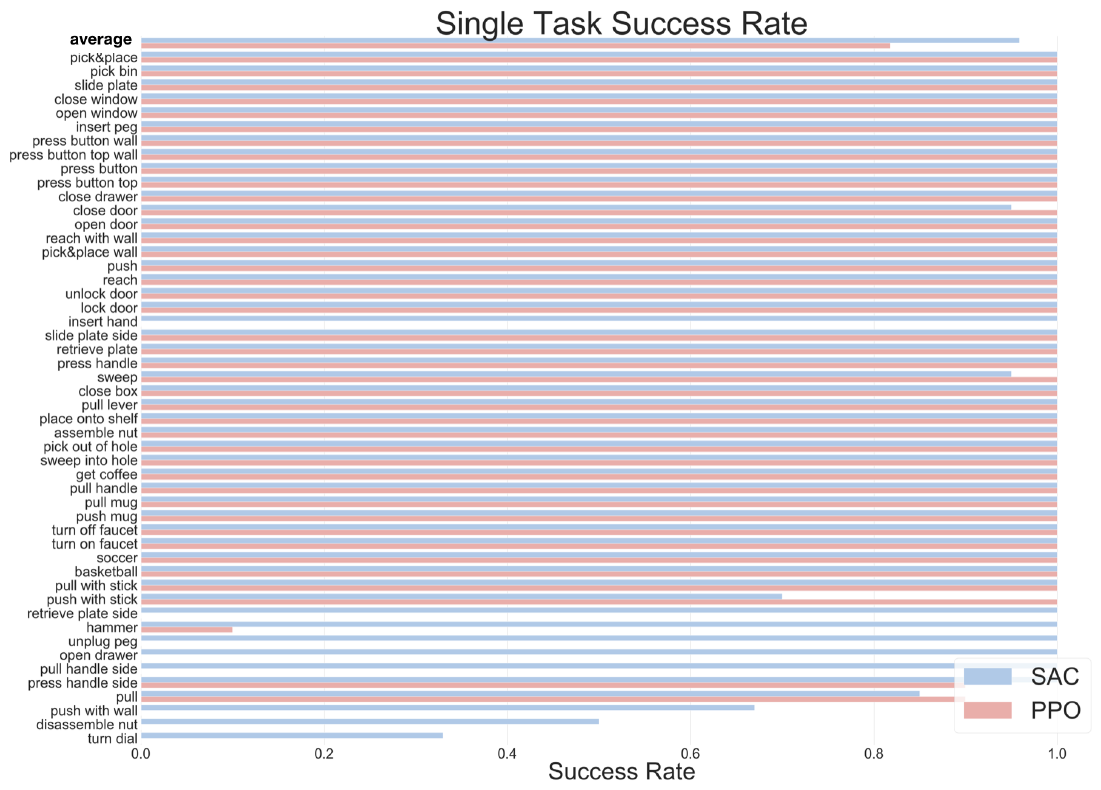
Figure 6: Performance of independent policies trained on individual tasks using soft actor-critic (SAC) and proximal policy optimization (PPO). We verify that SAC can solve all of the tasks and PPO can also solve most of the tasks.
图 6:用 soft actor-critic(SAC)和近端策略优化(PPO)在各个任务上单独训练独立策略的表现。我们验证了 SAC 能够解决全部任务,PPO 也能解决其中大多数任务。
D Learning curves
D 学习曲线
In evaluating meta-learning algorithms, we care not just about performance but also about efficiency, i.e. the amount of data required by the meta-training process. While the adaptation process for all algorithms is extremely efficient, requiring only 10 trajectories, the meta-learning process can be very inefficient, particularly for on-policy algorithms such as MAML, RL(^2). In Figure 7, we show full learning curves of the three meta-learning methods on ML1. In Figure 8, we show full learning curves of MT10, ML10, MT50 and ML45. The MT10 and MT50 learning curves show the efficiency of multi-task learning, a critical evaluation metric, since sample efficiency gains are a primary motivation for using multi-task learning. Unsurprisingly, we find that off-policy algorithms such as soft actor-critic and PEARL are able to learn with substantially less data than on-policy algorithms.
在评测元学习算法时,我们关心的不只是表现,还有效率,也就是元训练过程所需的数据量。尽管所有算法的适应过程都极为高效,只需 10 条轨迹,元学习过程却可能非常低效,对 MAML、RL(^2) 等同策略算法尤其如此。图 7 给出三种元学习方法在 ML1 上的完整学习曲线。图 8 给出 MT10、ML10、MT50 和 ML45 的完整学习曲线。MT10 和 MT50 的学习曲线显示了多任务学习的效率,这是一项关键评测指标,因为样本效率上的收益是使用多任务学习的主要动机。并不出人意料,我们发现 soft actor-critic 和 PEARL 这类异策略算法能够用比同策略算法少得多的数据来学习。
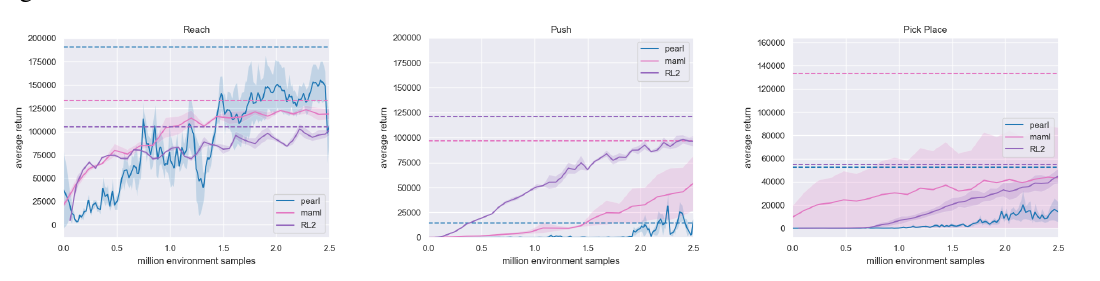
Figure 7: Comparison of PEARL, MAML, and RL2 learning curves on the simplest evaluation, ML1, where the methods need to adapt quickly to new object and goal positions within the one meta-training task.
图 7:在最简单的评测 ML1 上比较 PEARL、MAML 与 RL2 的学习曲线;在这一评测中,方法需要在同一个元训练任务内快速适应新的物体和目标位置。
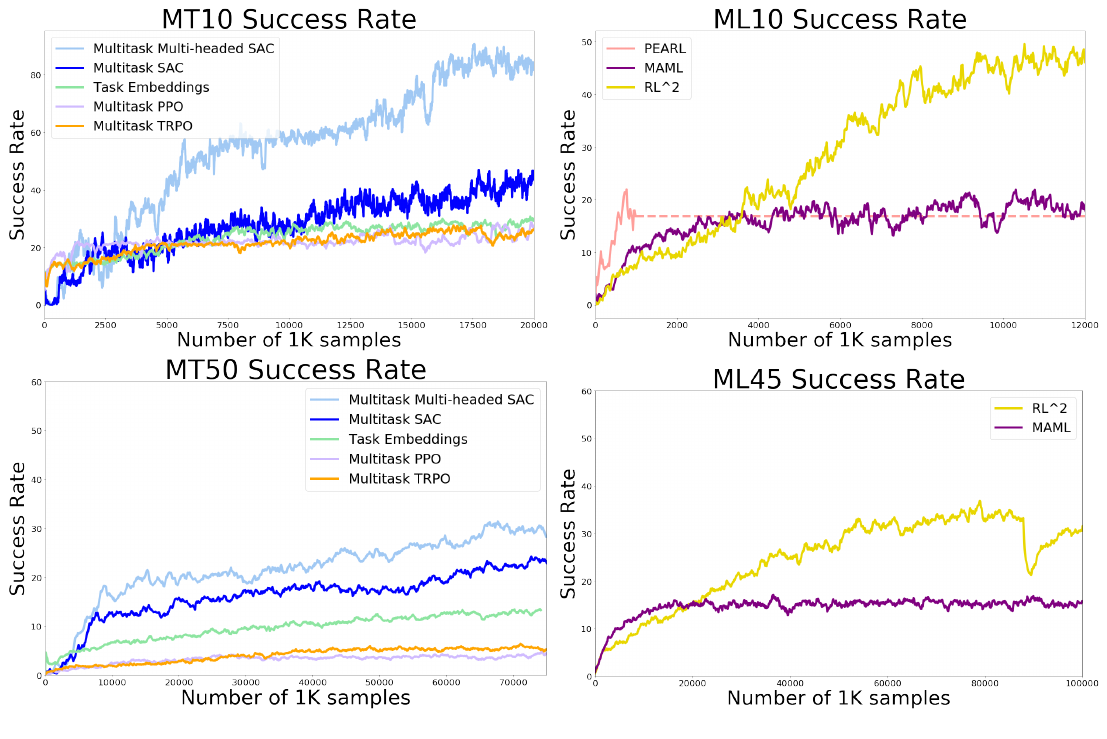
Figure 8: Learning curves of all methods on MT10, ML10, MT50, and ML45 benchmarks. Y-axis represents success rate averaged over tasks in percentage (%). Off-policy algorithms such as multi-task SAC and PEARL learn much more efficiently than off-policy methods.
图 8:全部方法在 MT10、ML10、MT50 和 ML45 基准上的学习曲线。纵轴表示跨任务平均的成功率,单位为百分比(%)。多任务 SAC 和 PEARL 这类异策略算法的学习效率远高于异策略方法。
E Hyperparameter Details
E 超参数细节
In this section, we provide hyperparameter values for each of the methods in our experimental evaluation.
本节给出实验评测中每种方法的超参数取值。
E.1 Single Task SAC
E.1 单任务 SAC
| Hyperparameter | Hyperparameter values |
|---|---|
| batch size | 128 |
| non-linearity | ReLU |
| policy initialization | standard Gaussian |
| exploration parameters | run a uniform exploration policy 1000 steps |
| # of samples / # of train steps per iteration | 1 env step / 1 training step |
| policy learning rate | 3e-4 |
| Q function learning rate | 3e-4 |
| optimizer | Adam |
| discount | .99 |
| horizon | 150 |
| reward scale | 1.0 |
| temperature | learned |
| 超参数 | 超参数取值 |
|---|---|
| 批量大小 | 128 |
| 非线性 | ReLU |
| 策略初始化 | 标准高斯 |
| 探索参数 | 用均匀探索策略运行 1000 步 |
| 每次迭代的样本数 / 训练步数 | 1 个环境步 / 1 个训练步 |
| 策略学习率 | 3e-4 |
| Q 函数学习率 | 3e-4 |
| 优化器 | Adam |
| 折扣 | .99 |
| 时域 | 150 |
| 奖励尺度 | 1.0 |
| 温度 | 学习得到 |
E.2 Single Task PPO
E.2 单任务 PPO
| Hyperparameter | Hyperparameter values |
|---|---|
| non-linearity | ReLU |
| batch size | 4096 |
| policy initial standard deviation | 2. |
| entropy regularization coefficient | 1e-3 |
| baseline | linear feature baseline |
| 超参数 | 超参数取值 |
|---|---|
| 非线性 | ReLU |
| 批量大小 | 4096 |
| 策略初始标准差 | 2. |
| 熵正则化系数 | 1e-3 |
| 基线 | 线性特征基线 |
E.3 Multi-Task SAC
E.3 多任务 SAC
| Hyperparameter | Hyperparameter values |
|---|---|
| network architecture | feedforward network |
| network size | three fully connected layers with 400 units |
| batch size | 128 × number of tasks |
| non-linearity | ReLU |
| policy initialization | standard Gaussian |
| exploration parameters | run a uniform exploration policy 1000 steps |
| # of samples / # of train steps per iteration | number of tasks env steps / 1 training step |
| policy learning rate | 3e-4 |
| Q function learning rate | 3e-4 |
| optimizer | Adam |
| discount | .99 |
| horizon | 150 |
| reward scale | 1.0 |
| temperature | learned and disentangled with tasks |
| 超参数 | 超参数取值 |
|---|---|
| 网络结构 | 前馈网络 |
| 网络规模 | 三个全连接层,每层 400 个单元 |
| 批量大小 | 128 × 任务数 |
| 非线性 | ReLU |
| 策略初始化 | 标准高斯 |
| 探索参数 | 用均匀探索策略运行 1000 步 |
| 每次迭代的样本数 / 训练步数 | 任务数个环境步 / 1 个训练步 |
| 策略学习率 | 3e-4 |
| Q 函数学习率 | 3e-4 |
| 优化器 | Adam |
| 折扣 | .99 |
| 时域 | 150 |
| 奖励尺度 | 1.0 |
| 温度 | 学习得到,并与任务解耦 |
E.4 Multi-Task Multi-Headed SAC
E.4 多任务多头 SAC
| Hyperparameter | Hyperparameter values |
|---|---|
| network architecture | multi-head (one head per task) |
| network size | three fully connected layers with 400 units |
| batch size | 128 × number of tasks |
| non-linearity | ReLU |
| policy initialization | standard Gaussian |
| exploration parameters | run a uniform exploration policy 1000 steps |
| # of samples / # of train steps per iteration | number of tasks env steps / 1 training step |
| policy learning rate | 3e-4 |
| Q function learning rate | 3e-4 |
| optimizer | Adam |
| discount | .99 |
| horizon | 150 |
| reward scale | 1.0 |
| temperature | learned and disentangled with tasks |
| 超参数 | 超参数取值 |
|---|---|
| 网络结构 | 多头(每个任务一个头) |
| 网络规模 | 三个全连接层,每层 400 个单元 |
| 批量大小 | 128 × 任务数 |
| 非线性 | ReLU |
| 策略初始化 | 标准高斯 |
| 探索参数 | 用均匀探索策略运行 1000 步 |
| 每次迭代的样本数 / 训练步数 | 任务数个环境步 / 1 个训练步 |
| 策略学习率 | 3e-4 |
| Q 函数学习率 | 3e-4 |
| 优化器 | Adam |
| 折扣 | .99 |
| 时域 | 150 |
| 奖励尺度 | 1.0 |
| 温度 | 学习得到,并与任务解耦 |
E.5 Multi-Task PPO
E.5 多任务 PPO
| Hyperparameter | Hyperparameter values |
|---|---|
| batch size | # of tasks * 10 * 150 |
| policy initial standard deviation | 2. |
| entropy regularization coefficient | 0.002 |
| baseline | linear feature baseline fit with observations and returns |
| 超参数 | 超参数取值 |
|---|---|
| 批量大小 | 任务数 * 10 * 150 |
| 策略初始标准差 | 2. |
| 熵正则化系数 | 0.002 |
| 基线 | 用观察和回报拟合的线性特征基线 |
E.6 Multi-Task TRPO
E.6 多任务 TRPO
| Hyperparameter | Hyperparameter values |
|---|---|
| batch size | # of tasks * 10 * 150 |
| policy initial standard deviation | 2. |
| step size | 0.01 |
| baseline | linear feature baseline fit with observations and returns |
| 超参数 | 超参数取值 |
|---|---|
| 批量大小 | 任务数 * 10 * 150 |
| 策略初始标准差 | 2. |
| 步长 | 0.01 |
| 基线 | 用观察和回报拟合的线性特征基线 |
E.7 Task Embeddings
E.7 任务嵌入
| Hyperparameter | Hyperparameter values |
|---|---|
| nonlinearity | tanh |
| batch size | # of tasks * 10 * 150 |
| latent dimension | 6 |
| inference window length | 20 |
| embedding maximum standard deviation | 2. |
| baseline | Gaussian MLP, fit with observations, latent variables and returns |
| 超参数 | 超参数取值 |
|---|---|
| 非线性 | tanh |
| 批量大小 | 任务数 * 10 * 150 |
| 潜变量维数 | 6 |
| 推断窗口长度 | 20 |
| 嵌入的最大标准差 | 2. |
| 基线 | 高斯 MLP,用观察、潜变量和回报拟合 |
E.8 PEARL
| Hyperparameter | Hyperparameter values |
|---|---|
| policy learning rate | 3e-4 |
| Q function learning rate | 3e-4 |
| discount | .99 |
| horizon | 150 |
| # of samples / # of train steps per iteration | 12,000 env steps / 10,000 training steps |
| 超参数 | 超参数取值 |
|---|---|
| 策略学习率 | 3e-4 |
| Q 函数学习率 | 3e-4 |
| 折扣 | .99 |
| 时域 | 150 |
| 每次迭代的样本数 / 训练步数 | 12,000 个环境步 / 10,000 个训练步 |
E.9 RL2
| Hyperparameter | Hyperparameter values |
|---|---|
| nonlinearity | tanh |
| policy initialization | Gaussian with σ = 2.0 |
| baseline | linear-fit with polynomial features (n = 2) of observation and time step |
| meta batch size | 40 |
| # roll-outs per meta task | 10 |
| horizon | 150 |
| optimizer | Adam |
| learning rate | 1e-3 |
| discount | .99 |
| batch size | # of tasks * 10 * 150 |
| 超参数 | 超参数取值 |
|---|---|
| 非线性 | tanh |
| 策略初始化 | 高斯,σ = 2.0 |
| 基线 | 用观察和时间步的多项式特征(n = 2)做线性拟合 |
| 元批量大小 | 40 |
| 每个元任务的 rollout 数 | 10 |
| 时域 | 150 |
| 优化器 | Adam |
| 学习率 | 1e-3 |
| 折扣 | .99 |
| 批量大小 | 任务数 * 10 * 150 |
E.10 MAML
| Hyperparameter | Hyperparameter values |
|---|---|
| nonlinearity | tanh |
| meta batch size | 20 |
| # roll-outs per meta task | 10 |
| inner gradient step learning rate | 0.05 |
| discount | .99 |
| 超参数 | 超参数取值 |
|---|---|
| 非线性 | tanh |
| 元批量大小 | 20 |
| 每个元任务的 rollout 数 | 10 |
| 内层梯度步学习率 | 0.05 |
| 折扣 | .99 |
References
参考文献
[1] S. Levine, C. Finn, T. Darrell, and P. Abbeel. End-to-end training of deep visuomotor policies. Journal of Machine Learning Research (JMLR), 2016.
[2] K. Mülling, J. Kober, O. Kroemer, and J. Peters. Learning to select and generalize striking movements in robot table tennis. The International Journal of Robotics Research, 32(3):263–279, 2013.
[3] M. Andrychowicz, B. Baker, M. Chociej, R. Jozefowicz, B. McGrew, J. Pachocki, A. Petron, M. Plappert, G. Powell, A. Ray, et al. Learning dexterous in-hand manipulation. arXiv:1808.00177, 2018.
[4] Y. Chebotar, K. Hausman, M. Zhang, G. Sukhatme, S. Schaal, and S. Levine. Combining model-based and model-free updates for trajectory-centric reinforcement learning. In International Conference on Machine Learning (ICML), 2017.
[5] L. Manuelli, W. Gao, P. R. Florence, and R. Tedrake. kpam: Keypoint affordances for category-level robotic manipulation. CoRR, abs/1903.06684, 2019.
[6] A. Krizhevsky, I. Sutskever, and G. E. Hinton. Imagenet classification with deep convolutional neural networks. In Advances in neural information processing systems, 2012.
[7] J. Devlin, M. Chang, K. Lee, and K. Toutanova. BERT: pre-training of deep bidirectional transformers for language understanding. CoRR, abs/1810.04805, 2018.
[8] M. Hessel, H. Soyer, L. Espeholt, W. Czarnecki, S. Schmitt, and H. van Hasselt. Multi-task deep reinforcement learning with popart. CoRR, abs/1809.04474, 2018.
[9] E. Parisotto, J. L. Ba, and R. Salakhutdinov. Actor-mimic: Deep multitask and transfer reinforcement learning. arXiv:1511.06342, 2015.
[10] C. Finn, P. Abbeel, and S. Levine. Model-agnostic meta-learning for fast adaptation of deep networks. In International Conference on Machine Learning, 2017.
[11] G. Brockman, V. Cheung, L. Pettersson, J. Schneider, J. Schulman, J. Tang, and W. Zaremba. Openai gym. arXiv:1606.01540, 2016.
[12] K. Cobbe, O. Klimov, C. Hesse, T. Kim, and J. Schulman. Quantifying generalization in reinforcement learning. arXiv:1812.02341, 2018.
[13] Y. Tassa, Y. Doron, A. Muldal, T. Erez, Y. Li, D. d. L. Casas, D. Budden, A. Abdolmaleki, J. Merel, A. Lefrancq, et al. Deepmind control suite. arXiv:1801.00690, 2018.
[14] M. C. Machado, M. G. Bellemare, E. Talvitie, J. Veness, M. J. Hausknecht, and M. Bowling. Revisiting the arcade learning environment: Evaluation protocols and open problems for general agents. CoRR, abs/1709.06009, 2017.
[15] A. A. Rusu, S. G. Colmenarejo, C. Gulcehre, G. Desjardins, J. Kirkpatrick, R. Pascanu, V. Mnih, K. Kavukcuoglu, and R. Hadsell. Policy distillation. arXiv:1511.06295, 2015.
[16] L. Espeholt, H. Soyer, R. Munos, K. Simonyan, V. Mnih, T. Ward, Y. Doron, V. Firoiu, T. Harley, I. Dunning, et al. Impala: Scalable distributed deep-rl with importance weighted actor-learner architectures. arXiv:1802.01561, 2018.
[17] S. Sharma and B. Ravindran. Online multi-task learning using active sampling. 2017.
[18] Y. Duan, J. Schulman, X. Chen, P. L. Bartlett, I. Sutskever, and P. Abbeel. RL: Fast reinforcement learning via slow reinforcement learning. CoRR, abs/1611.02779, 2016.
[19] J. X. Wang, Z. Kurth-Nelson, D. Tirumala, H. Soyer, J. Z. Leibo, R. Munos, C. Blundell, D. Kumaran, and M. Botvinick. Learning to reinforcement learn, 2016. arXiv:1611.05763.
[20] N. Mishra, M. Rohaninejad, X. Chen, and P. Abbeel. A simple neural attentive meta-learner. arXiv:1707.03141, 2017.
[21] J. Rothfuss, D. Lee, I. Clavera, T. Asfour, and P. Abbeel. Promp: Proximal meta-policy search. arXiv:1810.06784, 2018.
[22] K. Rakelly, A. Zhou, D. Quillen, C. Finn, and S. Levine. Efficient off-policy meta-reinforcement learning via probabilistic context variables. arXiv:1903.08254, 2019.
[23] C. Fernando, J. Sygnowski, S. Osindero, J. Wang, T. Schaul, D. Teplyashin, P. Sprechmann, A. Pritzel, and A. Rusu. Meta-learning by the baldwin effect. In Proceedings of the Genetic and Evolutionary Computation Conference Companion, pages 1313–1320. ACM, 2018.
[24] S. Ritter, J. X. Wang, Z. Kurth-Nelson, S. M. Jayakumar, C. Blundell, R. Pascanu, and M. Botvinick. Been there, done that: Meta-learning with episodic recall. arXiv preprint arXiv:1805.09692, 2018.
[25] A. Nichol, V. Pfau, C. Hesse, O. Klimov, and J. Schulman. Gotta learn fast: A new benchmark for generalization in rl. arXiv:1804.03720, 2018.
[26] A. Nagabandi, I. Clavera, S. Liu, R. S. Fearing, P. Abbeel, S. Levine, and C. Finn. Learning to adapt in dynamic, real-world environments through meta-reinforcement learning. arXiv:1803.11347, 2018.
[27] S. Sæmundsson, K. Hofmann, and M. P. Deisenroth. Meta reinforcement learning with latent variable gaussian processes. arXiv:1803.07551, 2018.
[28] B. Calli, A. Walsman, A. Singh, S. Srinivasa, P. Abbeel, and A. M. Dollar. Benchmarking in manipulation research: The ycb object and model set and benchmarking protocols. arXiv:1502.03143, 2015.
[29] I. Lenz, H. Lee, and A. Saxena. Deep learning for detecting robotic grasps. The International Journal of Robotics Research, 34(4-5):705–724, 2015.
[30] C. Finn, I. Goodfellow, and S. Levine. Unsupervised learning for physical interaction through video prediction. In Advances in neural information processing systems, pages 64–72, 2016.
[31] K.-T. Yu, M. Bauza, N. Fazeli, and A. Rodriguez. More than a million ways to be pushed. a high-fidelity experimental dataset of planar pushing. In 2016 IEEE/RSJ international conference on intelligent robots and systems (IROS), pages 30–37. IEEE, 2016.
[32] Y. Chebotar, K. Hausman, Z. Su, A. Molchanov, O. Kroemer, G. Sukhatme, and S. Schaal. Bigs: Biotac grasp stability dataset. In ICRA 2016 Workshop on Grasping and Manipulation Datasets, 2016.
[33] A. Gupta, A. Murali, D. P. Gandhi, and L. Pinto. Robot learning in homes: Improving generalization and reducing dataset bias. In Advances in Neural Information Processing Systems, pages 9112–9122, 2018.
[34] A. Mandlekar, Y. Zhu, A. Garg, J. Booher, M. Spero, A. Tung, J. Gao, J. Emmons, A. Gupta, E. Orbay, et al. Roboturk: A crowdsourcing platform for robotic skill learning through imitation. arXiv:1811.02790, 2018.
[35] P. Sharma, L. Mohan, L. Pinto, and A. Gupta. Multiple interactions made easy (mime): Large scale demonstrations data for imitation. arXiv preprint arXiv:1810.07121, 2018.
[36] N. Correll, K. E. Bekris, D. Berenson, O. Brock, A. Causo, K. Hauser, K. Okada, A. Rodriguez, J. M. Romano, and P. R. Wurman. Analysis and observations from the first amazon picking challenge. IEEE Transactions on Automation Science and Engineering, 15(1):172–188, 2016.
[37] B. Calli, A. Singh, A. Walsman, S. Srinivasa, P. Abbeel, and A. M. Dollar. The ycb object and model set: Towards common benchmarks for manipulation research. In International Conference on Advanced Robotics (ICAR), 2015.
[38] Y. S. Choi, T. Deyle, T. Chen, J. D. Glass, and C. C. Kemp. A list of household objects for robotic retrieval prioritized by people with als. In International Conference on Rehabilitation Robotics, 2009.
[39] M. Savva, A. Kadian, O. Maksymets, Y. Zhao, E. Wijmans, B. Jain, J. Straub, J. Liu, V. Koltun, J. Malik, et al. Habitat: A platform for embodied ai research. arXiv:1904.01201, 2019.
[40] E. Kolve, R. Mottaghi, D. Gordon, Y. Zhu, A. Gupta, and A. Farhadi. Ai2-thor: An interactive 3d environment for visual ai. arXiv:1712.05474, 2017.
[41] S. Brodeur, E. Perez, A. Anand, F. Golemo, L. Celotti, F. Strub, J. Rouat, H. Larochelle, and A. Courville. Home: A household multimodal environment. arXiv:1711.11017, 2017.
[42] M. Savva, A. X. Chang, A. Dosovitskiy, T. Funkhouser, and V. Koltun. Minos: Multimodal indoor simulator for navigation in complex environments. arXiv:1712.03931, 2017.
[43] F. Xia, A. R. Zamir, Z. He, A. Sax, J. Malik, and S. Savarese. Gibson env: Real-world perception for embodied agents. In Computer Vision and Pattern Recognition, 2018.
[44] A. Dosovitskiy, G. Ros, F. Codevilla, A. Lopez, and V. Koltun. Carla: An open urban driving simulator. arXiv:1711.03938, 2017.
[45] B. Wymann, E. Espié, C. Guionneau, C. Dimitrakakis, R. Coulom, and A. Sumner. Torcs, the open racing car simulator. Software available at http://torcs. sourceforge. net, 4(6), 2000.
[46] S. R. Richter, Z. Hayder, and V. Koltun. Playing for benchmarks. In Proceedings of the IEEE International Conference on Computer Vision, pages 2213–2222, 2017.
[47] D. Kappler, J. Bohg, and S. Schaal. Leveraging big data for grasp planning. In 2015 IEEE International Conference on Robotics and Automation (ICRA), pages 4304–4311. IEEE, 2015.
[48] A. Kasper, Z. Xue, and R. Dillmann. The kit object models database: An object model database for object recognition, localization and manipulation in service robotics. The International Journal of Robotics Research, 31(8):927–934, 2012.
[49] C. Goldfeder, M. Ciocarlie, H. Dang, and P. K. Allen. The columbia grasp database. 2008.
[50] L. Fan, Y. Zhu, J. Zhu, Z. Liu, O. Zeng, A. Gupta, J. Creus-Costa, S. Savarese, and L. Fei-Fei. Surreal: Open-source reinforcement learning framework and robot manipulation benchmark. In Conference on Robot Learning, 2018.
[51] E. Todorov, T. Erez, and Y. Tassa. Mujoco: A physics engine for model-based control. In International Conference on Intelligent Robots and Systems, 2012.
[52] A. V. Nair, V. Pong, M. Dalal, S. Bahl, S. Lin, and S. Levine. Visual reinforcement learning with imagined goals. In Advances in Neural Information Processing Systems, 2018.
[53] J. Schulman, F. Wolski, P. Dhariwal, A. Radford, and O. Klimov. Proximal policy optimization algorithms. arXiv preprint arXiv:1707.06347, 2017.
[54] J. Schulman, S. Levine, P. Abbeel, M. Jordan, and P. Moritz. Trust region policy optimization. In International conference on machine learning, pages 1889–1897, 2015.
[55] T. Haarnoja, A. Zhou, P. Abbeel, and S. Levine. Soft actor-critic: Off-policy maximum entropy deep reinforcement learning with a stochastic actor. arXiv preprint arXiv:1801.01290, 2018.
[56] Z. W. N. H. M. R. Karol Hausman, Jost Tobias Springenberg. Learning an embedding space for transferable robot skills. International Conference on Learning Representations, 2018.
[57] T. Schaul, D. Borsa, J. Modayil, and R. Pascanu. Ray interference: a source of plateaus in deep reinforcement learning. arXiv preprint arXiv:1904.11455, 2019.
[58] C. Finn, A. Rajeswaran, S. Kakade, and S. Levine. Online meta-learning. International Conference on Machine Learning (ICML), 2019.