LingGym: How Far Are LLMs from Thinking Like Field Linguists?
LingGym: How Far Are LLMs from Thinking Like Field Linguists?
University of British Columbia
University of Waterloo
Vector Institute
cyang33@mail.ubc.ca, franklin.ma@ubc.ca
fhs@uwaterloo.ca, jian.zhu@ubc.ca
Abstract
摘要
This paper introduces LingGym, a new benchmark that evaluates LLMs’ capacity for meta-linguistic reasoning using Interlinear Glossed Text (IGT) and grammatical descriptions extracted from 18 typologically diverse reference grammars. Unlike previous work that focuses on specific downstream tasks, we assess whether LLMs can generalize linguistic inference across low-resource languages and structures not seen during training. We present a controlled evaluation task: Word-Gloss Inference, in which the model must infer a missing word and gloss from context using varying levels of linguistic information (e.g., glosses, grammatical explanations, translations). Our results show that incorporating structured linguistic cues leads to consistent improvements in reasoning performance across all models. This work highlights both the promise and current limitations of using LLMs for typologically informed linguistic analysis and low-resource language documentation.
本文介绍 LingGym,一套新的基准,用从 18 部类型多样的参考语法中抽出的行间注释文本(IGT)和语法描写,来评估大语言模型的元语言推理能力。与聚焦特定下游任务的既有工作不同,我们考察的是:模型能否把语言推理推广到训练时未见过的低资源语言和结构上。我们给出一项受控评测任务:词–注释推理(Word-Gloss Inference),要求模型借助不同层次的语言信息(例如注释、语法解释、译文),从上下文中推断被遮住的词及其注释。结果表明,加入结构化的语言线索后,所有模型的推理表现都有稳定提升。这项工作同时标出了用大语言模型做有类型学依据的语言分析和低资源语言记录时的前景与当前局限。
1 Introduction
1 引言
In recent years, researchers have been actively exploring how large language models (OpenAI et al., 2024; Yang et al., 2024a; Grattafiori et al., 2024) can assist and accelerate scientific discoveries in various disciplines (Romera-Paredes et al., 2024; Merchant et al., 2023; Fawzi et al., 2022; Hayes et al., 2025; Zhang et al., 2024c, e.g.,). However, exploration on how LLMs can assist social sciences is relatively limited Grossmann et al. (2023); Bail (2024); Ziems et al. (2024). In particular, LLMs with the capacity of reasoning about meta-linguistic knowledge have the potential to become powerful tools for language documentation, linguistic hypothesis testing, and typological research. For example, by generalizing linguistic structures such as morphology, syntax, and word order across languages, they can suggest morpheme segmentations and glosses, identify patterns or counterexamples to test hypotheses, and compare structural features across different languages.
近年来,研究者一直在积极探索大语言模型(OpenAI et al., 2024; Yang et al., 2024a; Grattafiori et al., 2024)如何协助并加快各学科的科学发现(例如 Romera-Paredes et al., 2024; Merchant et al., 2023; Fawzi et al., 2022; Hayes et al., 2025; Zhang et al., 2024c)。不过,关于大语言模型如何协助社会科学的探索仍相对有限 Grossmann et al. (2023); Bail (2024); Ziems et al. (2024)。尤其是,具备元语言知识推理能力的大语言模型,有潜力成为语言记录、语言学假说检验和类型学研究的有力工具。例如,通过把形态、句法和词序等语言结构推广到不同语言,它们可以建议语素切分和注释,找出用以检验假说的模式或反例,并比较不同语言的结构特征。
On the other hand, while recent advances have shown impressive performance in high-resource languages like English, our understanding of their effectiveness on typologically diverse and underrepresented languages remains limited Alhanai et al. (2025), mainly due to the overwhelming dominance of English and other high-resource languages in their training data Blasi et al. (2022); Khade et al. (2025); Li et al. (2024); Wu and Dredze (2020).
另一方面,尽管近期进展已在英语等高资源语言上展现出令人印象深刻的表现,我们对它们在类型多样、又较少被代表的语言上究竟效果如何,了解仍然有限 Alhanai et al. (2025),主要是因为英语和其他高资源语言在训练数据中占据压倒性地位 Blasi et al. (2022); Khade et al. (2025); Li et al. (2024); Wu and Dredze (2020)。
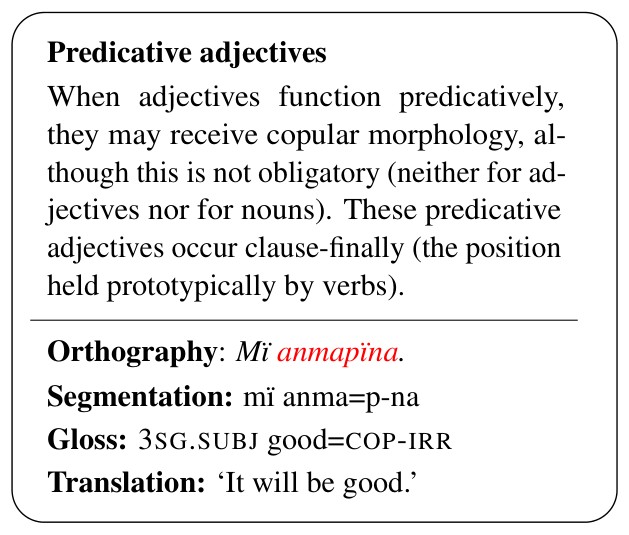
Figure 1: An excerpt explaining predicative adjectives in Ulwa, with an associated example as IGT from A Grammar of Ulwa (Papua New Guinea; Barlow, 2023, p. 166). The example IGT is represented with the Leipzig Glossing rules Comrie et al. (2017). The text in red highlights the emphasized word discussed in the grammar explanation. The gloss consists of a third-person singular subject marker (3sg.subj) for “it,” and an irrealis copula (cop-irr) marker for “will be.”
图 1:一段讲解 Ulwa 谓语形容词的摘录,并附来自 A Grammar of Ulwa(巴布亚新几内亚;Barlow, 2023,第 166 页)的对应 IGT 例句。该 IGT 按 Leipzig 注释规则 Comrie et al. (2017) 书写。红色文字标出语法解释中加以强调的词。注释包含表示“它”的第三人称单数主语标记(3sg.subj),以及表示“将是”的非现实系词(cop-irr)标记。
To explore how well LLMs can understand low-resource languages when provided with structured linguistic input, we turn to reference grammars Mosel (2006); Chelliah (2013), which aim to comprehensively describe the structure of individual languages. Reference grammars offer two valuable types of information:
为考察大语言模型在获得结构化语言输入时,对低资源语言的理解能到什么程度,我们转向参考语法 Mosel (2006); Chelliah (2013),这类著作旨在全面描写个别语言的结构。参考语法提供两类有价值的信息:
- Interlinear glossed text (IGT), a standard text format used by field linguists to present linguistic data, which is useful for tasks like morphological analysis, syntactic structure identification. IGT typically consists of four lines: a phonological or orthographic transcription, a segmentation of words into morphemes, corresponding grammatical glosses, and a free English translation. Conventions include hyphens to mark morpheme boundaries, equals signs for clitic boundaries, and periods to separate multiple glossing elements for a single morpheme Comrie et al. (2017), as illustrated in Figure 1.
- 行间注释文本(IGT),这是田野语言学家用来呈现语言材料的标准文本格式,可用于形态分析、句法结构识别等任务。IGT 通常包含四行:音系或正字转写、把词切分成语素、对应的语法注释,以及自由的英语译文。惯例上用连字符标记语素边界,用等号标记附着词边界,并用句点把同一语素上的多个注释成分分开 Comrie et al. (2017),如图 1 所示。
- Grammatical terms and explanations embedded throughout the text, where important linguistic terms (e.g., tense markers, case particles, verb classes) are defined and contextualized within the grammar.
- 嵌在正文各处的语法术语与解释,其中重要的语言学术语(例如时标记、格助词、动词类别)会在语法书内部得到定义,并被放回具体语境中。
Together, these resources reflect the approach taken by human linguists, who analyze unfamiliar languages by studying structured descriptions rather than relying on raw corpora. Thanks to decades of documentation efforts, such materials are available for many endangered and low-resource languages, presenting a valuable opportunity to test LLMs’ ability to reason over structured linguistic knowledge curated by experts. Unlike the unstructured web-scale corpora typically used to train LLMs, descriptive grammars hold a unique advantage by offering systematic and interpretable accounts of a language’s morphology and syntax. In addition to serving human language learners and linguists, these structured frameworks that encode rich meta-linguistic knowledge also offer a valuable resource for evaluating LLMs. By drawing on this explicit information, we can design targeted evaluation tasks that probe model performance across diverse linguistic phenomena and typological patterns.
这些资源合在一起,正反映了人类语言学家的做法:他们靠研究结构化描写来分析不熟悉的语言,而不是只依赖生语料。得益于数十年的记录工作,许多濒危和低资源语言都有这类材料,这为检验大语言模型能否对专家整理的结构化语言知识做推理,提供了宝贵机会。与通常用来训练大语言模型的、非结构化的网络规模语料不同,描写语法的独特优势在于,它能对一门语言的形态和句法给出系统、可解释的说明。这些编码了丰富元语言知识的结构化框架,除了服务人类语言学习者和语言学家,也为评估大语言模型提供了有价值的资源。借助这些显式信息,我们可以设计有针对性的评测任务,考察模型在多样语言现象和类型模式上的表现。
In this work, we design a task-oriented approach: for each target sentence, the LLM receives the utterance or the utterance paired with its glosses, augmented by targeted grammatical cues (e.g., rules about verb conjugation or case marking). We evaluate the model’s comprehension through a controlled task (Figure 2): word-gloss inference, where the model anwsers a multiple-choice question to infer a missing word or its corresponding gloss based on the linguistic context.
在这项工作中,我们设计了一种面向任务的做法:对每个目标句子,大语言模型会收到话语本身,或话语及其注释,并辅以有针对性的语法线索(例如关于动词变位或格标记的规则)。我们通过一项受控任务(图 2)来评估模型的理解:词–注释推理,即让模型回答一道选择题,根据语言上下文推断被遮住的词或其对应注释。
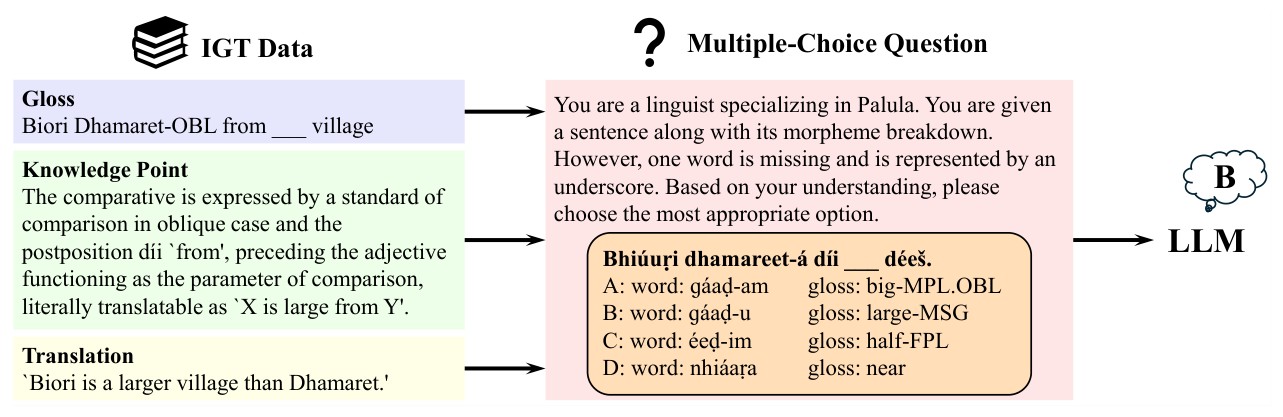
Figure 2: An illustration of how IGT data is transformed into a multiple-choice question for evaluating an LLM. One word is masked with an underscore in the provided sentence. An LLM takes the constructed prompt and the most contextually appropriate answer based on the linguistic information.
图 2:示意如何把 IGT 数据转换成用于评估大语言模型的选择题。所给句子中有一个词被下划线遮住。大语言模型根据构造好的提示,并依据语言信息选出在语境上最合适的答案。
Our contributions are as follows: first, we present a cleaned and structured dataset of IGT examples drawn from 18 endangered and low-resource languages—these examples are extracted from publicly available reference grammars and subsequently verified by hand (§3.2, §4). Second, we develop an evaluation framework grounded in descriptive linguistic resources to assess how well LLMs can interpret and infer in low-resource languages using IGT data and grammatical rules (§4.2). Third, we benchmark multiple state-of-the-art LLMs on our proposed tasks and provide a typologically informed analysis of their performance, highlighting both capabilities and limitations when processing structured linguistic knowledge (§5.1, §5.2). We release the benchmark on GitHub.[^1]
我们的贡献如下:第一,我们整理并结构化了一份 IGT 例句数据集,来自 18 种濒危和低资源语言——这些例句抽自公开可得的参考语法,并随后经人工核对(§3.2,§4)。第二,我们建立一套扎根于描写语言学资源的评估框架,用来考察大语言模型在低资源语言上,借助 IGT 数据和语法规则进行解释和推断的能力(§4.2)。第三,我们在所提出的任务上对多个先进大语言模型做基准测试,并给出有类型学依据的表现分析,标出它们在处理结构化语言知识时的能力与局限(§5.1,§5.2)。我们在 GitHub 上发布该基准。[^1]
2 Related Work
2 相关工作
2.1 NLP for Low-Resource languages
2.1 面向低资源语言的 NLP
The value of language models as tools to assist language documentation and revitalization has been well recognized Bird (2020) in both linguistics and natural language processing (NLP) communities. These models enable a variety of applications, including automatic transcriptions of speech Dunbar et al. (2017); Li et al. (2020); Samir et al. (2025); Zhu et al. (2025), low-resource speech synthesis Kazantsevaa et al. (2024); Wang et al. (2025), automatic interlinear glossing Moeller et al. (2020); He et al. (2024); Yang et al. (2024b), grapheme-to-phoneme conversion Li et al. (2022); Zhu et al. (2022), and more Gessler and Von Der Wense (2024). Most existing work formulates a specific subtask in language documentation as an established NLP task with standard evaluation metrics.
语言模型作为协助语言记录与复兴的工具,其价值已在语言学和自然语言处理(NLP)两个社区得到充分认识 Bird (2020)。这些模型支撑多种应用,包括语音自动转写 Dunbar et al. (2017); Li et al. (2020); Samir et al. (2025); Zhu et al. (2025)、低资源语音合成 Kazantsevaa et al. (2024); Wang et al. (2025)、自动行间注释 Moeller et al. (2020); He et al. (2024); Yang et al. (2024b)、字素到音素转换 Li et al. (2022); Zhu et al. (2022),以及其他工作 Gessler and Von Der Wense (2024)。既有研究大多把语言记录中的某一子任务写成已有的 NLP 任务,并沿用标准评估指标。
While these directions have led to many low-resource NLP technologies, there are still many limitations Bird (2020). First, many models are trained on specific languages where training data is available, and are usually not generalizable to unseen languages. Second, many technologies are developed in highly artificial settings with well-defined tasks and clean data. As a result, they are unable to solve many linguistic tasks in real language documentation that are more complex, noisy, and subjective.[^2] To bridge the gap, in this work, we present a benchmark in real language documentation scenarios and use it to assess the reasoning capabilities of general-purpose LLMs.
这些方向虽然带来了许多低资源 NLP 技术,但局限仍然很多 Bird (2020)。第一,许多模型只在有训练数据的特定语言上训练,通常无法推广到未见过的语言。第二,许多技术是在任务定义清楚、数据干净的高度人工设定中开发的。因此,它们无法解决真实语言记录中许多更复杂、更嘈杂、也更主观的语言学任务。[^2] 为弥合这一差距,我们在本文中给出一套面向真实语言记录场景的基准,并用它来评估通用大语言模型的推理能力。
2.2 Assessing Linguistic Knowledge in LMs
2.2 评估语言模型中的语言知识
Assessing the linguistic knowledge of LMs has long been a central topic in computational linguistics. Early studies focused on assessing the implicit linguistic knowledge of language models emerging from training, such as general syntactic knowledge Gulordava et al. (2018); Goldberg (2019); Hu et al. (2020); Wilcox et al. (2018), dependency structure (Hewitt and Manning, 2019; Manning et al., 2020), natural language inference (McCoy et al., 2019), and psycholinguistics judgments (Warstadt et al., 2020; Ettinger, 2020). This line of work centers mostly on English and only measure the implicit linguistic knowledge through proxies like probes, logits, and perplexity.
评估语言模型的语言知识,长期以来都是计算语言学的中心议题。早期研究关注的是模型在训练中涌现出的隐含语言知识,例如一般句法知识 Gulordava et al. (2018); Goldberg (2019); Hu et al. (2020); Wilcox et al. (2018)、依存结构(Hewitt and Manning, 2019; Manning et al., 2020)、自然语言推理(McCoy et al., 2019),以及心理语言学判断(Warstadt et al., 2020; Ettinger, 2020)。这条路线大多以英语为中心,并且只通过探针、logits 和困惑度等代理量来测量隐含的语言知识。
As LLMs’ capacities continue to increase, research has shown that LLMs can follow explicit meta-linguistic concepts or learn languages from explicit meta-linguistic descriptions Tanzer et al. (2024); Bean et al. (2024); Zhang et al. (2024b); Spencer and Kongborrirak (2025); Zhang et al. (2024a); Ramos et al. (2024); Beguš et al. (2023), and can infer the underlying grammatical rules through concrete examples during in-context learning Ginn et al. (2024). Yet, there is still large room for improvement in terms of linguistic reasoning, even for the state-of-the-art LLMs Bean et al. (2024)—most importantly, existing approaches only deal with a handful of low-resource languages and mostly on machine translation tasks. It remains unclear if LLMs can perform abstract meta-linguistic reasoning across low-resource languages that are not seen during training. In this paper, we evaluate the extent to which LLMs can perform linguistic reasoning across a wide range of structural phenomena and generalize to unseen low-resource languages. The ability to make correct inferences would demonstrate the models’ potential to support the analysis of previously understudied languages.
随着大语言模型能力继续提高,研究已经表明,它们能够遵循显式的元语言概念,或从显式的元语言描写中学习语言 Tanzer et al. (2024); Bean et al. (2024); Zhang et al. (2024b); Spencer and Kongborrirak (2025); Zhang et al. (2024a); Ramos et al. (2024); Beguš et al. (2023),也能在上下文学习中通过具体例子推断底层语法规则 Ginn et al. (2024)。不过,即便是最先进的大语言模型,在语言推理上仍有很大改进空间 Bean et al. (2024)——最重要的是,既有方法只处理少数低资源语言,而且多半停在机器翻译任务上。大语言模型能否对训练中未见过的低资源语言做抽象的元语言推理,目前仍不清楚。本文评估的是:模型能在多大程度上跨越多种结构现象做语言推理,并把这种能力推广到未见过的低资源语言。如果能够做出正确推断,将表明模型有潜力支持对以往研究不足的语言进行分析。
3 Data
3 数据
We construct our benchmark from a collection of low-resource languages documented in publicly available reference grammars published by Language Science Press (LSP),[^3] an open-access publisher of high-quality linguistic research. We select books from their Studies in Diversity Linguistics and Comprehensive Grammar Library series.
我们的基准建立在一批低资源语言之上,这些语言记录在 Language Science Press(LSP)[^3] 公开出版的参考语法中。LSP 是一家开放获取的高质量语言学研究出版社。我们从其 Studies in Diversity Linguistics 和 Comprehensive Grammar Library 两套丛书中选书。
3.1 Reference Grammars
3.1 参考语法
Reference grammars are comprehensive, systematic descriptions of individual languages, often based on fieldwork and long-term collaboration with native speakers Mosel (2006); Chelliah (2013). Their goal is to capture linguistic intricacies through various examples and discussions of language use in diverse contexts. Typically, they address all major linguistic domains, including phonology, morphology, syntax, semantics, and pragmatics, providing valuable resources for theoretical research, typological comparison, language learning, documentation, and revitalization.
参考语法是对个别语言全面、系统的描写,往往基于田野调查以及与母语者的长期合作 Mosel (2006); Chelliah (2013)。其目标是通过各种例句和对多样语境中语言使用的讨论,捕捉语言的细致之处。它们通常覆盖音系、形态、句法、语义和语用等主要领域,为理论研究、类型比较、语言学习、记录和复兴提供了有价值的资源。
For instance, Carol J. Pebley and Thomas E. Payne authored A Grammar of Kagayanen: a Western Austronesian language spoken by around 30,000 people in the Philippines Pebley and Payne (2024). The work adopts a typologically informed descriptive framework inspired by Dixon’s Basic Linguistic Theory Dixon (2009).
例如,Carol J. Pebley 与 Thomas E. Payne 撰写了 A Grammar of Kagayanen:这是一种西澳斯特罗尼西亚语言,在菲律宾约有 3 万人使用 Pebley and Payne (2024)。该书采用受 Dixon 的基本语言理论启发、并有类型学依据的描写框架 Dixon (2009)。
All grammar books used in this study are publicly available under the Creative Commons Attribution 4.0 International License (CC BY 4.0).[^4]
本研究所用的全部语法书均在知识共享署名 4.0 国际许可协议(CC BY 4.0)下公开提供。[^4]
3.2 Data Preprocessing
3.2 数据预处理
Parsing the LaTeX source files. We retrieve the LaTeX source code of 18 reference grammars from their publicly available GitHub sites. To ensure the utility of each grammar for our benchmark, we filter each chapter’s raw LaTeX source file against our criteria. Specifically, we retain languages that (i) include labelled sections (via \label tags) that correspond to grammatical rules or descriptive content, and (ii) contain IGT examples that are explicitly linked to these rule explanations. For each selected IGT instance, we require that a target keyword (typically a word, morpheme or form under discussion) be highlighted within the example, thereby allowing us to align example sentences with specific grammatical features.
解析 LaTeX 源文件。 我们从各书公开的 GitHub 站点获取 18 部参考语法的 LaTeX 源代码。为确保每部语法对基准有用,我们按自定标准过滤各章的原始 LaTeX 源文件。具体而言,我们保留同时满足以下条件的语言:(i)含有对应语法规则或描写内容的带标签章节(通过 \label 标签),(ii)含有明确关联到这些规则解释的 IGT 例句。对每条入选的 IGT 实例,我们要求目标关键词(通常是正在讨论的词、语素或形式)在例句中被突出显示,从而可以把例句与特定语法特征对齐。
We begin by converting the raw LaTeX files from each grammar into plain text, removing all formatting commands while retaining boldfaced keywords that indicate grammatical focus. Chapters that lack IGT examples, such as acknowledgments and appendices, are excluded in certain languages.
我们先把各部语法的原始 LaTeX 文件转成纯文本,去掉全部格式命令,但保留标示语法焦点的黑体关键词。在部分语言中,没有 IGT 例句的章节,例如致谢和附录,会被排除。
Categorizing individual chapters. Chapters are manually categorized into either phonology, morphology, syntax, semantics, pragmatics, or other linguistic subfields based on their introductory content (see Appendix F.2). We exclude chapters related to phonetics (if applicable) due to the lack of IGT content and inconsistent formatting of the symbols from the International Phonetic Alphabet.
给各章分类。 我们根据各章导言内容,手工把章节归入音系、形态、句法、语义、语用或其他语言学子领域(见附录 F.2)。如果某章与语音学相关,我们会将其排除(若适用),因为其中往往没有 IGT 内容,而且国际音标符号的格式也不一致。
Extracting IGT instances. After cleaning the LaTeX syntax, we extract structured IGT examples from each chapter, along with their preceding knowledge points (KPs), which we define as explanatory paragraphs containing an IGT label tag and the grammatical rationale for the associated example (see Figure 1). In addition, we record the hierarchical metadata for each example, which includes the chapter title, section heading, and subsection heading. Each IGT instance is filtered based on structural markers such as label tags, transcription lines (when applicable), morpheme segmentation lines, glossing lines, and free translations. Figure 3 shows an example of Pichi Yakpo (2019) from the cleaning process. After this automated extraction, we perform manual cleaning to ensure that all examples have a complete and aligned IGT structure. We then verify that the number of words (separated by spaces) matches the number of glosses. In each word, we also ensure one-to-one alignment between morphemes (separated by hyphens) and glosses.
抽取 IGT 实例。 清理 LaTeX 语法后,我们从各章抽取结构化的 IGT 例句,并带上其前面的知识点(KP)。我们把知识点定义为:含有 IGT 标签、并为所附例句提供语法理据的解释性段落(见图 1)。此外,我们还记录每条例句的层次元数据,包括章标题、节标题和小节标题。每条 IGT 实例会按结构标记过滤,例如标签、转写行(若有)、语素切分行、注释行和自由译文。图 3 给出 Pichi Yakpo (2019) 在清理过程中的一个例子。自动抽取之后,我们再做人工清理,确保所有例句都有完整、对齐的 IGT 结构。随后核对其词数(按空格分隔)与注释数是否一致。在每个词内部,我们也确保语素(按连字符分隔)与注释一一对齐。
In this study, we use the morpheme-segmented line as standardized input across languages. This choice reflects finer-grained grammatical units and ensures better alignment with glosses.
本研究把语素切分行作为跨语言的标准输入。这一选择反映了更细的语法单位,也能与注释更好地对齐。
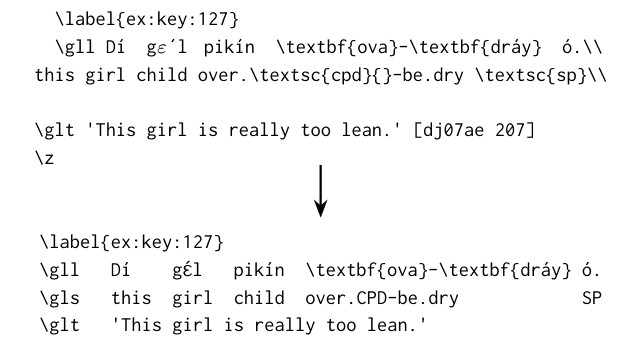
Figure 3: The top portion shows the raw LaTeX source of an IGT example in Pichi Yakpo (2019), where individual morphemes and glosses are annotated using various commands. The bottom portion shows the cleaned version after processing: it converts the gloss line into three aligned components—the morpheme line, gloss line, and translation line.
图 3:上半部分是 Pichi Yakpo (2019) 中一条 IGT 例句的原始 LaTeX 源码,其中各个语素和注释用不同命令标注。下半部分是处理后的清理版本:它把注释行转成三个对齐的组成部分——语素行、注释行和译文行。
4 The LingGym Benchmark
4 LingGym 基准
The high-level characteristics of our LingGym dataset are summarized in Table 1. In total, we process 18 reference grammars from LSP, spanning 8 language families, and yield 19,612 IGT examples aligned with relevant KPs after data filtering and cleaning. Most languages in LingGym are from the African and Pacific regions, areas that have traditionally been underrepresented in the NLP community. A summary of the dataset’s distribution across linguistic subfields is shown in Table 2: the benchmark covers all aspects of the linguistic subfields commonly used to describe the structures of languages, with a strong focus on syntax in the questions reflecting the typical emphasis in language documentation practices.
表 1 汇总了 LingGym 数据集的总体特征。我们共处理了 LSP 的 18 部参考语法,覆盖 8 个语系;经过过滤和清理后,得到 19,612 条与相关知识点对齐的 IGT 例句。LingGym 中的多数语言来自非洲和太平洋地区,这些地区在 NLP 社区中长期代表性不足。表 2 给出了数据在各语言学子领域中的分布:该基准覆盖了描写语言结构时常用的各个子领域,而题目中句法占比很高,这也反映了语言记录实践中的一贯侧重。
Table 1: Number of KP-IGT pairs for the LingGym dataset. In total, 18 reference grammars from 8 language families are processed.
| Language | Family | Examples |
|---|---|---|
| Pichi | Atlantic-Congo | 2,846 |
| Gyeli | Atlantic-Congo | 691 |
| Moloko | Atlantic-Congo | 439 |
| Fwe | Atlantic-Congo | 147 |
| Papuan Malay | Austronesian | 3,766 |
| Rapa Nui | Austronesian | 1,709 |
| Kagayanen | Austronesian | 550 |
| Vamale | Austronesian | 67 |
| Komnzo | Trans-New Guinea | 709 |
| Mauwake | Trans-New Guinea | 1,787 |
| Kalamang | Trans-New Guinea | 656 |
| Ulwa | Trans-New Guinea | 1,851 |
| Palula | Indo-European | 1,674 |
| Tuatschin | Indo-European | 1,113 |
| Japhug | Sino-Tibetan | 358 |
| Yauyos Quechua | Quechuan | 1,143 |
| Mehweb | Northeast Caucasian | 85 |
| Ik | Nilo-Saharan | 21 |
| Total | 19,612 |
表 1:LingGym 数据集中知识点–IGT 对的数量。总共处理了来自 8 个语系的 18 部参考语法。
| 语言 | 语系 | 例句数 |
|---|---|---|
| Pichi | 大西洋-刚果 | 2,846 |
| Gyeli | 大西洋-刚果 | 691 |
| Moloko | 大西洋-刚果 | 439 |
| Fwe | 大西洋-刚果 | 147 |
| Papuan Malay | 南岛 | 3,766 |
| Rapa Nui | 南岛 | 1,709 |
| Kagayanen | 南岛 | 550 |
| Vamale | 南岛 | 67 |
| Komnzo | 跨新几内亚 | 709 |
| Mauwake | 跨新几内亚 | 1,787 |
| Kalamang | 跨新几内亚 | 656 |
| Ulwa | 跨新几内亚 | 1,851 |
| Palula | 印欧 | 1,674 |
| Tuatschin | 印欧 | 1,113 |
| Japhug | 汉藏 | 358 |
| Yauyos Quechua | 克丘亚 | 1,143 |
| Mehweb | 东北高加索 | 85 |
| Ik | 尼罗-撒哈拉 | 21 |
| 合计 | 19,612 |
Table 2: Distribution of examples by linguistic subfield.
| Linguistic Subfield | # Examples | % of Total |
|---|---|---|
| Morphology | 1,410 | 7.19% |
| Phonology | 71 | 0.36% |
| Pragmatics | 139 | 0.71% |
| Semantics | 967 | 4.93% |
| Syntax | 16,747 | 85.39% |
| Other | 278 | 1.42% |
| Total | 19,612 | 100% |
表 2:各语言学子领域的例句分布。
| 语言学子领域 | 例句数 | 占总比例 |
|---|---|---|
| 形态 | 1,410 | 7.19% |
| 音系 | 71 | 0.36% |
| 语用 | 139 | 0.71% |
| 语义 | 967 | 4.93% |
| 句法 | 16,747 | 85.39% |
| 其他 | 278 | 1.42% |
| 合计 | 19,612 | 100% |
4.1 Word-Gloss Inference
4.1 词–注释推理
We introduce a multiple-choice, cloze-style word/word-gloss inference task, which can be used to evaluate whether LLMs can infer grammatical information from structured linguistic data. Each question presents an IGT example in which a single word or a single word plus its gloss has been masked. The model must identify the correct word or word-gloss pair from four options, based on the sentence context, grammatical structure, and accompanying explanation. More details of the task can be found in §4.3.
我们提出一项多项选择、完形填空式的词/词–注释推理任务,用来评估大语言模型能否从结构化的语言数据中推断语法信息。每道题给出一条 IGT 例句,其中有一个词、或一个词及其注释被遮住。模型需要根据句子语境、语法结构以及随附的解释,从四个选项中找出正确的词或词–注释对。任务的更多细节见 §4.3。
4.2 Question Generation
4.2 题目生成
We generate these questions using examples drawn from our cleaned data. For each instance, if a word or any of its morphemes is marked with a \textbf tag, we identify that word as the target. To create the set of four answer choices (one correct answer and three distractors), we employ three strategies to generate plausible distractors:
我们用清理后的数据中的例句来生成这些题目。对每个实例,如果某个词或其任一语素带有 \textbf 标记,就把该词定为目标。为构造四个选项(一个正确答案和三个干扰项),我们采用三种策略来生成合理的干扰项:
- Form-based distractor (LCS-based): We find a distractor gloss that shares the longest common substring (LCS) with the correct gloss but differs in grammatical function. For example, given the correct word-gloss pair walk–PST (walk-ed), we generate a distractor like walk–PROG (walk-ing). This shares the root walk (via the LCS) but fulfills a different grammatical function.
- 基于形式的干扰项(基于最长公共子串):我们找一个与正确注释共享最长公共子串(LCS)、但语法功能不同的干扰注释。例如,给定正确的词–注释对 walk–PST(walk-ed),我们生成 walk–PROG(walk-ing)这样的干扰项。它通过 LCS 共享词根 walk,但承担不同的语法功能。
- Semantics-based distractor: We compute the semantic similarity between glosses by embedding them using Sentence-BERT Reimers and Gurevych (2019). The gloss that has the highest semantic similarity with, but is not identical to, the correct gloss is selected and mapped back to the corresponding word in the dataset. This approach introduces subtle meaning contrasts to test deeper grammatical understanding.
- 基于语义的干扰项:我们用 Sentence-BERT Reimers and Gurevych (2019) 对注释做嵌入,计算注释之间的语义相似度。选出与正确注释语义最相近、但又不完全相同的注释,再映射回数据集中对应的词。这种方法引入细微的意义对立,用来检验更深的语法理解。
- Chapter-local distractor: To promote lexical and structural diversity, we randomly sample a word-gloss pair from the same grammar chapter, ensuring that the distractor does not overlap in form or gloss with any of the other options. This approach adds noise that reflects the topic domain but avoids trivial elimination.
- 章内干扰项:为提高词汇和结构上的多样性,我们从同一部语法的同一章中随机抽取一个词–注释对,并确保该干扰项在形式或注释上不与其他选项重叠。这种方法加入反映该章主题域的噪声,同时又避免选项被轻易排除。
All distractor candidates are also ensured not to overlap with each other. To prevent positional bias in candidate answers, we randomly assign the correct answer to one of the four choice positions in each question. This randomization is applied uniformly across all examples, ensuring that each position (A–D) contains the correct answer approximately 25% of the time.
各干扰项候选彼此之间也不得重叠。为避免候选项位置带来偏差,我们在每道题中把正确答案随机分配到四个选项位置之一。这一随机化对全部例句统一进行,确保每个位置(A–D)大约有 25% 的题目是正确答案。
To construct each question, we mask all correct choice words in the gloss and knowledge point lines. The masking in the surface line is always performed at the word level, ensuring consistent granularity across examples. This masking approach preserves the context while clearly signalling the missing element to the model. However, masking in the free translation line presents a challenge, as translations often paraphrase or use semantically related expressions rather than a direct lexical equivalent of the source word/morpheme. As a result, the corresponding segment in the translation cannot always be reliably identified or removed without altering the naturalness or interpretability of the sentence—this introduces a limitation in our masking approach: while the surface and gloss lines are systematically masked, the translation may still contain indirect cues about the target word.
构造每道题时,我们会在注释行和知识点行中遮住所有正确选项对应的词。表层行的遮盖一律在词一级进行,以保持各例句的粒度一致。这种遮盖方式既保留语境,又能向模型明确标出缺失成分。不过,自由译文行的遮盖则更困难,因为译文常常是转述,或使用与源词/语素语义相关的表达,而不是直接的词汇对应。因此,译文中的对应片段并不总能被可靠识别或删去,又不至于损害句子的自然性和可理解性——这也构成我们遮盖方法的一个局限:表层行和注释行会得到系统遮盖,但译文仍可能含有关于目标词的间接线索。
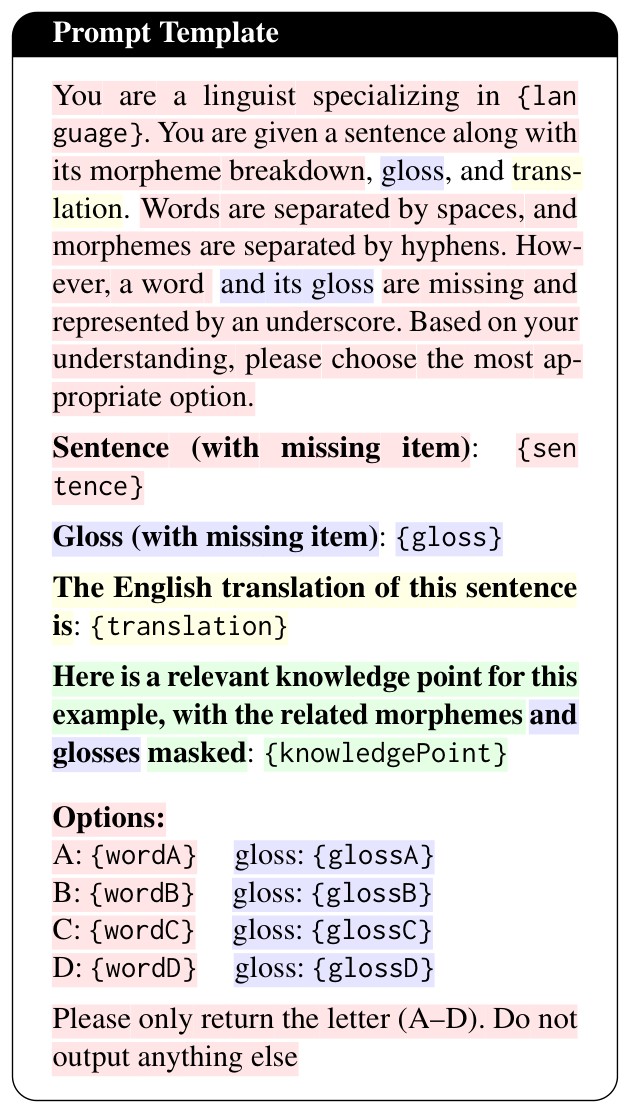
Figure 4: The prompt template used across different difficulty levels.
图 4:各难度等级共用的提示模板。
4.3 Difficulty Levels
4.3 难度等级
To evaluate the impact of different types of linguistic information, we design our prompts to include the following types of knowledge:
为评估不同类型语言信息的作用,我们在提示中纳入以下几类知识:
- Original sentence (S): the morpheme-segmented sentence in target language.
- 原句(S):目标语言中已做语素切分的句子。
- Gloss information (G): The glosses for the given words.
- 注释信息(G):所给词对应的注释。
- Knowledge points (KP): The relevant knowledge points in the grammar book.
- 知识点(KP):语法书中的相关知识点。
- English translations (T): The English translation.
- 英语译文(T):英语翻译。
We conduct our main experiments with four difficulty levels based on data availability: S, S+G, S+G+KP, and S+G+KP+T. All prompts follow the template displayed in Figure 4, and an example is shown in Figure 2.
我们的主实验按数据可得性设置四个难度等级:S、S+G、S+G+KP 和 S+G+KP+T。全部提示都遵循图 4 给出的模板,图 2 给出了一个例子。
Table 3: Accuracies for all languages across input settings and models.
| Qwen2.5 | Gemma 3 | DeepSeek-R1 | LLaMA3 | GPT-4 | ||||||
|---|---|---|---|---|---|---|---|---|---|---|
| Difficulty | 7B | 32B | 4B | 12B | 27B | 7B | 32B | 8B | 70B | o4-mini |
| S | 33.04 | 38.66 | 32.74 | 43.63 | 41.48 | 33.39 | 39.62 | 29.62 | 34.46 | 41.74 |
| S+G | 41.64 | 46.75 | 38.88 | 47.03 | 48.17 | 35.24 | 48.16 | 30.83 | 42.37 | 46.02 |
| S+G+KP | 56.08 | 60.97 | 49.76 | 59.47 | 61.83 | 46.18 | 65.50 | 39.44 | 59.64 | 57.28 |
| S+G+KP+T | 71.09 | 78.29 | 63.92 | 73.97 | 77.02 | 54.39 | 81.17 | 50.32 | 78.25 | 73.88 |
表 3:全部语言在各输入设定和各模型上的准确率。
| Qwen2.5 | Gemma 3 | DeepSeek-R1 | LLaMA3 | GPT-4 | ||||||
|---|---|---|---|---|---|---|---|---|---|---|
| 难度 | 7B | 32B | 4B | 12B | 27B | 7B | 32B | 8B | 70B | o4-mini |
| S | 33.04 | 38.66 | 32.74 | 43.63 | 41.48 | 33.39 | 39.62 | 29.62 | 34.46 | 41.74 |
| S+G | 41.64 | 46.75 | 38.88 | 47.03 | 48.17 | 35.24 | 48.16 | 30.83 | 42.37 | 46.02 |
| S+G+KP | 56.08 | 60.97 | 49.76 | 59.47 | 61.83 | 46.18 | 65.50 | 39.44 | 59.64 | 57.28 |
| S+G+KP+T | 71.09 | 78.29 | 63.92 | 73.97 | 77.02 | 54.39 | 81.17 | 50.32 | 78.25 | 73.88 |
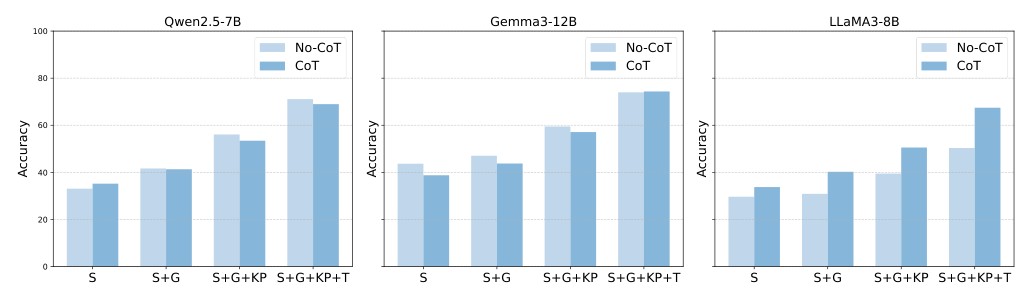
Figure 5: Accuracies of CoT vs. No-CoT prompting across different models and input settings.
图 5:不同模型和输入设定下,思维链提示与非思维链提示的准确率对比。
5 Experiments and Results
5 实验与结果
5.1 Experimental Setup
5.1 实验设置
We evaluate a diverse set of publicly available LLMs, covering a range of sizes and model families. Our evaluation includes models from four major families: Qwen2.5 Yang et al. (2024a), Gemma 3 Team et al. (2025), DeepSeek-R1 Guo et al. (2025), and LLaMA3 Dubey et al. (2024). For Qwen2.5, we include the 7B and 32B models; for Gemma3, we evaluate the 4B, 12B, and 27B variants; for DeepSeek-R1, we test the 7B and 32B; and for LLaMA3, we assess the 8B and AWQ-quantized 70B models. We use the AWQ quantization Lin et al. (2024) for larger 70B models due to limited computing resources. All models are instruction-tuned and are accessed via open-source platforms (i.e., HuggingFace Hub). Inference was performed through vLLM Kwon et al. (2023) and transformers Wolf et al. (2020). All experiments were run on A6000 Ada GPUs, with more details provided in Appendix A. For evaluation, since the word-gloss inference task is formulated as multiple-choice questions with balanced choice distributions, we report standard accuracy as the primary evaluation metric.
我们评估了一组规模和模型家族各异、且公开可得的大语言模型。评测覆盖四个主要家族:Qwen2.5 Yang et al. (2024a)、Gemma 3 Team et al. (2025)、DeepSeek-R1 Guo et al. (2025),以及 LLaMA3 Dubey et al. (2024)。对 Qwen2.5,我们纳入 7B 和 32B 模型;对 Gemma3,评估 4B、12B 和 27B 变体;对 DeepSeek-R1,测试 7B 和 32B;对 LLaMA3,评估 8B 以及经 AWQ 量化的 70B 模型。较大的 70B 模型因计算资源有限而采用 AWQ 量化 Lin et al. (2024)。所有模型都是指令微调版本,并通过开源平台(即 HuggingFace Hub)获取。推理通过 vLLM Kwon et al. (2023) 和 transformers Wolf et al. (2020) 进行。全部实验在 A6000 Ada GPU 上运行,更多细节见附录 A。在评估方面,由于词–注释推理被写成选项分布均衡的选择题,我们以标准准确率作为主要评价指标。
Table 4: Accuracies across all information permutations for selected models. Full results are shown in Appendix C.
| Difficulty | Qwen2.5-7B | Gemma3-12B | DeepSeek-R1-7B | LLaMA3-8B |
|---|---|---|---|---|
| S | 33.04 | 43.63 | 33.39 | 29.62 |
| S+G | 41.64 | 47.03 | 35.24 | 30.83 |
| S+T | 48.65 | 68.52 | 53.91 | 48.65 |
| S+KP | 52.78 | 55.76 | 45.22 | 46.22 |
| S+G+KP | 56.08 | 59.47 | 46.18 | 39.44 |
| S+G+T | 66.59 | 69.43 | 54.39 | 54.39 |
| S+KP+T | 59.12 | 72.95 | 58.79 | 59.12 |
| S+G+KP+T | 71.09 | 73.97 | 54.39 | 50.32 |
表 4:选定模型在全部信息组合上的准确率。完整结果见附录 C。
| 难度 | Qwen2.5-7B | Gemma3-12B | DeepSeek-R1-7B | LLaMA3-8B |
|---|---|---|---|---|
| S | 33.04 | 43.63 | 33.39 | 29.62 |
| S+G | 41.64 | 47.03 | 35.24 | 30.83 |
| S+T | 48.65 | 68.52 | 53.91 | 48.65 |
| S+KP | 52.78 | 55.76 | 45.22 | 46.22 |
| S+G+KP | 56.08 | 59.47 | 46.18 | 39.44 |
| S+G+T | 66.59 | 69.43 | 54.39 | 54.39 |
| S+KP+T | 59.12 | 72.95 | 58.79 | 59.12 |
| S+G+KP+T | 71.09 | 73.97 | 54.39 | 50.32 |
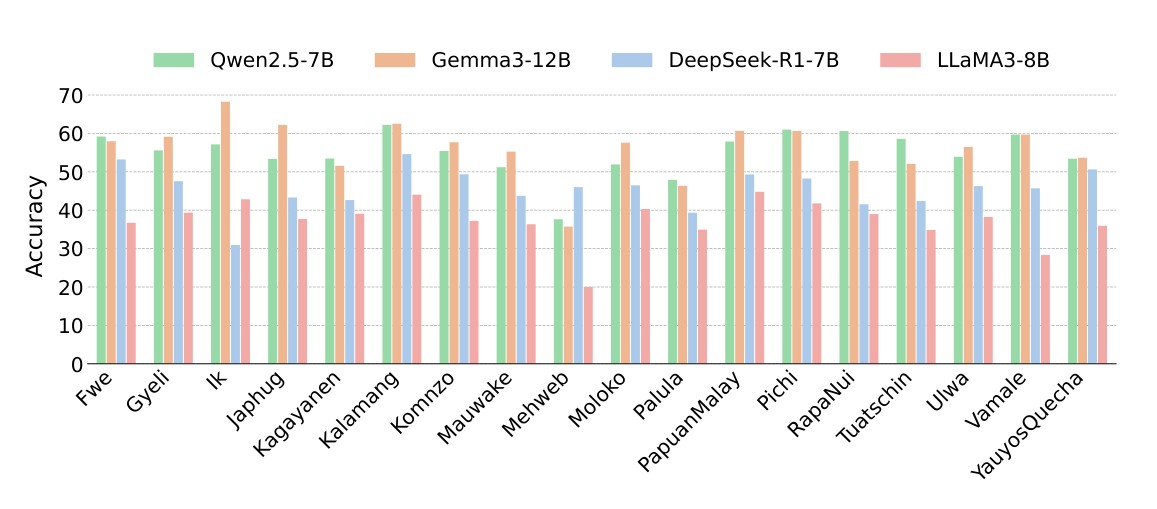
Figure 6: Weighted average accuracy scores across languages under the S+G+KP setting for select models.
图 6:在 S+G+KP 设定下,若干模型按语言加权平均的准确率。
5.2 Results
5.2 结果
Our main results (Table 3) present accuracies for all evaluated LLMs across four difficulty levels. More detailed results are provided in Appendix B, with a concrete prompt example (S+G+KP+T) and model prediction results shown in Figure 8.
我们的主要结果(表 3)给出了所有受评大语言模型在四个难度等级上的准确率。更细的结果见附录 B;图 8 给出了一个具体的提示例子(S+G+KP+T)以及模型的预测结果。
The meta-linguistic reasoning benchmark is challenging to LLMs despite data contamination issues. Data contamination is a common issue in many LLM benchmarks Sainz et al. (2023); Deng et al. (2024), as LLMs are trained on almost all found data on the Internet. All reference grammar books we processed are subject to this risk, as they are openly accessible as LaTeX source code hosted on GitHub. To clarify the potential impact of data contamination, we test the LLM’s performance only with the raw sentences in evaluation languages, without providing any additional information—if LLMs perform above the chance level (25%), it is likely that they have seen some of the language during pretraining.
尽管存在数据污染问题,这一元语言推理基准对大语言模型仍然具有挑战。 数据污染是许多大语言模型基准中的常见问题 Sainz et al. (2023); Deng et al. (2024),因为大语言模型几乎是在互联网上所能找到的全部数据上训练的。我们处理的全部参考语法都面临这一风险,因为它们以开放的 LaTeX 源码形式托管在 GitHub 上。为澄清数据污染的潜在影响,我们只向模型提供评测语言中的原始句子、不给任何额外信息——如果模型表现高于随机水平(25%),它们就很可能在预训练中见过其中一些语言。
Indeed, we find evidence of potential data contamination (first row in Table 3): all LLMs have above-chance performance even when provided only the original sentences. Larger models tend to memorize even more, evidenced by higher performance. However, the overall performance is still far from perfect, suggesting that the memorization effect is limited; that is, our dataset serves as a meaningfully challenging benchmark in a highly specialized domain.
的确,我们发现了潜在数据污染的证据(表 3 第一行):即便只提供原句,所有大语言模型的表现也都高于随机。较大的模型往往记到更多,表现为更高的成绩。不过,总体表现仍远未完美,说明记忆效应是有限的;也就是说,在这一高度专门的领域里,我们的数据集仍然是一项有实质难度的基准。
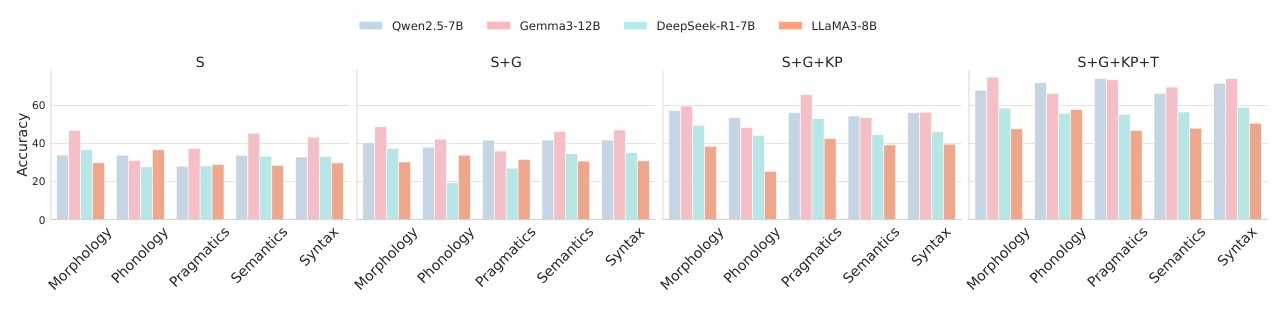
Figure 7: Weighted average accuracies of selected language models across five linguistic subfields: morphology, phonology, pragmatics, semantics, and syntax, under four levels of input difficulty.
图 7:若干语言模型在形态、音系、语用、语义和句法五个语言学子领域上的加权平均准确率,覆盖四个输入难度等级。
KPs improves performance across all conditions. In line with earlier work Tanzer et al. (2024); Zhang et al. (2024b), we find that adding KPs brings consistent improvements across LLM families and parameters (Table 3), suggesting that LLMs possess some abilities to comprehend the linguistic concepts in KPs and associate them with concrete language examples. As expected, larger models outperform smaller models by a large margin. The best performing model, DeepSeek-R1 32B, reaches around 81% accuracy, suggesting that LLMs show remarkable capabilities in meta-lingusitic reasoning that is independent of languages.
在所有条件下,知识点都能提升表现。 与先前工作一致 Tanzer et al. (2024); Zhang et al. (2024b),我们发现加入知识点后,各模型家族和各参数规模都有稳定提升(表 3),说明大语言模型具备一定能力来理解知识点中的语言学概念,并把它们与具体的语言例子联系起来。正如所料,较大模型明显优于较小模型。表现最好的模型 DeepSeek-R1 32B 准确率约达 81%,表明大语言模型在元语言推理上展现出显著能力,而且这种能力并不依赖于特定语言。
To further validate this effect, we conduct controlled experiments on selected models by testing LLMs across all difficulty condition permutations. Our ablation results from Table 4 indicate that gloss information, English translations, and knowledge points each contribute to the meta-linguistic reasoning, independent of each other. Yet none of the LLMs achieve perfect accuracy on these tasks, suggesting a large room for improvement.
为进一步验证这一效应,我们在选定模型上做了对照实验,测试全部难度条件的排列组合。表 4 的消融结果表明,注释信息、英语译文和知识点各自都对元语言推理有贡献,而且彼此独立。不过,没有一个大语言模型在这些任务上达到完美准确率,说明仍有很大改进空间。
CoT does not bring clear improvement to the performance. Chain-of-Thought (CoT) prompting Wei et al. (2022) has been shown to effectively improve performance on reasoning tasks, although the improvement is mainly limited to math and symbolic reasoning tasks Sprague et al. (2025). As shown in Figure 5, we do not find conclusive evidence that meta-linguistic reasoning benefits much from CoT across all LLMs from different families.
思维链并没有带来明确的表现提升。 思维链(CoT)提示 Wei et al. (2022) 已被证明能有效提升推理任务的表现,尽管这种提升主要限于数学和符号推理任务 Sprague et al. (2025)。如图 5 所示,我们没有找到确切证据表明:跨不同家族的大语言模型,其元语言推理能从思维链中得到多少益处。
Reasoning models like DeepSeek-R1 and o4-mini are also not competitive with non-reasoning models. The only exception is DeepSeek-R1 32B Guo et al. (2025), a reasoning model trained to perform long CoT. Although DeepSeek-R1 32B dominates in almost all conditions, DeepSeek-R1 7B does not exhibit such an advantage.
像 DeepSeek-R1 和 o4-mini 这样的推理模型,也并未比非推理模型更有竞争力。唯一的例外是 DeepSeek-R1 32B Guo et al. (2025),这是一个被训练去执行长思维链的推理模型。尽管 DeepSeek-R1 32B 在几乎所有条件下都占优,DeepSeek-R1 7B 却没有表现出这样的优势。
LLM performance is relatively similar across individual languages, language families, and linguistic subfields. The full table by language and models can be found in Appendix E. Figure 6 indicates that the performance is relatively stable across benchmarks, despite some minor variations. This further validates the efficacy of our benchmark, indicating that our benchmark is representative and balanced within and across each language.
大语言模型在各语言、各语系和各语言学子领域上的表现相对接近。 按语言和模型列出的完整表格见附录 E。图 6 表明,尽管存在一些小的波动,各基准上的表现相对稳定。这进一步验证了本基准的有效性,说明它在各语言内部和语言之间都具有代表性和均衡性。
As LingGym is sourced from the whole reference grammar books, it covers structural descriptions in all linguistic subfields that are considered necessary to describe a language. As shown in Figure 7, performance does not vary substantially across linguistic subfields, aside from minor variations. This suggests that LLMs are able to reason—at least to some extent—across linguistic subfields represented in these reference grammars.
由于 LingGym 取材于整部参考语法,它覆盖了描写一门语言时被认为必要的各个语言学子领域中的结构描写。如图 7 所示,除了一些小的波动外,各语言学子领域上的表现没有实质性差异。这表明,大语言模型至少在一定程度上能够对这些参考语法所代表的各个语言学子领域进行推理。
5.3 Error Analysis
5.3 错误分析
We further investigate errors made under our strongest configuration, DeepSeek-R1 32B, with sentence, gloss, knowledge points, plus translation lines (S+G+KP+T) based on the model’s predictions. Most failures can be categorized into three main types:
我们进一步考察了最强配置下的错误,即 DeepSeek-R1 32B 在同时给出句子、注释、知识点和译文(S+G+KP+T)时,根据模型预测所犯的错误。大多数失败可以归为三类:
Abbreviation-heavy items with opaque gloss tags. When correctness depends on understanding dense sequences of gloss abbreviations (such as PP4-CON=DEM.I7[^5] and OBJ.LINK-PL[^6]), the model appears to treat the tags as uninterpreted symbols and guess among look-alike forms. For example, in a Moloko sentence where the prompt gloss already encodes number and possession (“children=Pl[^7] POSS=1S.POSS=Pl[^8]”, with the translation “These particular children here belong to me.”), the model prefers DEM=Pl[^9] over the correct bare DEM. Similarly, in Komnzo for the phrase (“Do it here / with the tools here.”), the model chooses the bare zane (glossed as DEM:PROX[^10]), whereas the correct answer is zane=me (glossed as DEM:PROX=INS[^11]). The instrumental clitic =me is the decisive element that the model fails to recognize. This indicates that comprehensive explanations of these abbreviations need to be incorporated into the prompts as well. We will treat this enhancement as future work.
注释缩写密集、标签晦涩的条目。 当对错取决于能否理解一连串密集的注释缩写时(例如 PP4-CON=DEM.I7[^5] 和 OBJ.LINK-PL[^6]),模型似乎把这些标签当成未加解释的符号,并在外形相近的形式之间猜测。例如,在一句 Moloko 句子中,提示里的注释已经编码了数和领属(“children=Pl[^7] POSS=1S.POSS=Pl[^8]”,译文为 “These particular children here belong to me.”),模型却更倾向于 DEM=Pl[^9],而不是正确的光杆 DEM。类似地,在 Komnzo 的短语(“Do it here / with the tools here.”)中,模型选择了光杆的 zane(注释为 DEM:PROX[^10]),而正确答案是 zane=me(注释为 DEM:PROX=INS[^11])。起决定作用的工具性格附着成分 =me,模型未能识别。这表明,这些缩写的完整解释也需要被写进提示。我们将把这一改进留作未来工作。
Semantically similar distractors. The model often selects an option that is plausible in English but morphosyntactically ill-formed in the target language. In Kalamang, for the sentence “I particularly like doing that thing.”, the model chooses great over the gold gladly. Both convey positive affect in English, but only gladly fits the required collocational/morphological slot. A similar error occurs in Moloko: given the gloss “1S+IFV-see[^12] goat=1S.POSS=Pl[^13] three 2S[^14] ” with its translation “I see my three goats that you gave to me”, the model predicts am\textschwa-v\textschwal=\textopenokw (glossed as DEP-give=2S.IO[^15]), whereas the correct form is am\textschwa-v\textschwal=aw (glossed as DEP-give=1S.IO[^16]). This suggests that the model struggles to differentiate between synonyms or semantically related terms when precise morphological constraints are involved. The underlying issue appears to be that the model relies on semantic similarity rather than understanding the specific grammatical requirements of the target language structure.
语义相近的干扰项。 模型常常选出在英语里说得通、但在目标语言中形态句法并不成立的选项。在 Kalamang 中,对于句子 “I particularly like doing that thing.”,模型选择了 great,而标准答案是 gladly。两者在英语里都传达正面情感,但只有 gladly 符合所需的搭配/形态空位。Moloko 中也有类似错误:给定注释 “1S+IFV-see[^12] goat=1S.POSS=Pl[^13] three 2S[^14] ” 及其译文 “I see my three goats that you gave to me”,模型预测的是 am\textschwa-v\textschwal=\textopenokw(注释为 DEP-give=2S.IO[^15]),而正确形式是 am\textschwa-v\textschwal=aw(注释为 DEP-give=1S.IO[^16])。这说明,当涉及精确的形态约束时,模型难以区分同义词或语义相关的术语。根本问题似乎是:模型依赖的是语义相似度,而不是理解目标语言结构的具体语法要求。
Fine-grained form differences (tones, vowels). The model also struggles when answer choices differ only by minimal morpho-orthographic features such as tone marks or single vowels. In Ulwa, when selecting a word meaning “also”, the model chooses maweka despite the correct form being moweka. Both forms have the same meaning, but the single vowel difference completely changes the correctness of the answer. This indicates that the model has insufficient knowledge of phonological and orthographic variants, resulting in treating morphologically distinct forms as interchangeable alternatives.
细微的形式差异(声调、元音)。 当选项只在声调标记或单个元音这类最小的形态–正字特征上有别时,模型同样会遇到困难。在 Ulwa 中,选择表示 “also” 的词时,模型选了 maweka,而正确形式是 moweka。两种形式意义相同,但单个元音的差别就完全改变了答案的对错。这表明模型对音系和正字变体的知识不足,以致把形态上本应区分的形式当成可以互换的选项。
6 Conclusion
6 结论
We present LingGym, a comprehensive benchmark to assess the meta-lingusitic reasoning ability of LLMs in 18 languages across all linguistic aspects. Our analyses show that LLMs exhibit some capabilities to perform meta-linguistic reasoning, highlighting the potential of using LLMs to assist linguistic analysis.
我们提出 LingGym,一套全面的基准,用于评估大语言模型在 18 种语言、覆盖各个语言学面向时的元语言推理能力。我们的分析表明,大语言模型已展现出一定的元语言推理能力,这凸显了用它们辅助语言分析的潜力。
Our benchmark emphasizes mapping abstract linguistic rules to concrete sentences. Yet in actual fieldwork, it is also important to induce linguistic rules from linguistic samples, which might be assisted with LLMs Spencer and Kongborrirak (2025). In the future, we will extend our work to cover more diverse and in-depth use cases for linguistic analysis, especially for low-resource and endangered languages.
我们的基准强调把抽象的语言规则映射到具体句子。但在实际田野工作中,从语言样本中归纳语言规则同样重要,而这一过程或许也可以得到大语言模型的帮助 Spencer and Kongborrirak (2025)。未来,我们将扩展这项工作,覆盖更多样、也更深入的语言分析用例,尤其是面向低资源和濒危语言的用例。
Limitations
局限
Linguistic analysis is inherently theory-laden and value-laden Bird (2020). Our benchmark is still limited in scope. The grammatical analyses from most reference grammars follow the structuralist framework, which is only one of the many theoretical frameworks in linguistics.
语言分析本身就带有理论负荷和价值负荷 Bird (2020)。我们的基准在范围上仍然有限。多数参考语法中的语法分析遵循结构主义框架,而这只是语言学诸多理论框架中的一种。
Linguistic analysis is a complex task. The immediately preceding KP often does not paint the full picture of a given grammatical construction (i.e., extracted KPs often make references to parent subsections or sections), though they still constitute a good starting point.
语言分析是一项复杂任务。紧邻的前一条知识点,往往并不能完整刻画某一语法结构(也就是说,抽出的知识点常常会引用上级小节或章节),尽管它们仍是很好的起点。
Our study only analyzes 18 languages. While these languages are understudied within the NLP community, they only represent a tiny fraction of human languages. Grambank, a linguistic typological database, records reference grammar books or papers for around 2400 languages Skirgård et al. (2023), and we will continue to expand our analyses to more languages.
我们的研究只分析了 18 种语言。尽管这些语言在 NLP 社区中研究不足,它们也只占人类语言的很小一部分。类型学数据库 Grambank 记录了大约 2400 种语言的参考语法书籍或论文 Skirgård et al. (2023),我们将继续把分析扩展到更多语言。
Our dataset is imbalanced across linguistic subfields, reflecting the natural skew of reference grammars, which devote disproportionate attention to syntax. In principle, subdividing the syntax bucket into finer categories (e.g., word/constituent order, agreement, clause structure) would yield more diagnostic analyses. In practice, however, the specific syntactic topics covered vary substantially across languages and sources, which makes a uniform subcategorization scheme difficult to apply consistently and limits cross-language comparability. We therefore report results at a coarse level—extending to stable and finer-grained syntactic categories is a valuable direction for our future work.
我们的数据在各语言学子领域上并不均衡,这反映了参考语法的自然偏向:它们对句法着墨过多。原则上,把句法这一大类再细分成更细的范畴(例如词序/成分序、一致关系、小句结构)会得到更具诊断性的分析。但在实践中,各语言和各来源所覆盖的具体句法题目差异很大,很难用一套统一的再分类方案一以贯之,也会限制跨语言可比性。因此我们在较粗的层级上报告结果——扩展到稳定、更细的句法范畴,是未来工作的一个有价值方向。
While we have attempted to evaluate LLMs across model families and parameter counts, due to limited budget, we were not able to evaluate on the larger state-of-the-art models like DeepSeek-R1-671B, o4, and Gemini 2.5 Pro. These models might demonstrate stronger abilities than the models reported.
尽管我们已尝试在不同模型家族和参数规模上评估大语言模型,受预算所限,我们未能评估更大的前沿模型,例如 DeepSeek-R1-671B、o4 和 Gemini 2.5 Pro。这些模型有可能展现出比本文所报告模型更强的能力。
Ethics Statement
伦理声明
We only selected the reference grammar books that are publicly available with permissive Creative Commons licenses, allowing us to reprocess and redistribute the dataset.
我们只选择了可公开获取、并带有宽松知识共享许可的参考语法,以便我们能够再处理和再分发该数据集。
Our study falls into the scope of fundamental research in natural language processing and linguistics, with the goal of assisting language documentation with LLMs. There is no direct harm associated with this type of research. We expect this work to contribute to the analysis and documentation of endangered languages.
本研究属于自然语言处理和语言学的基础研究,目标是用大语言模型辅助语言记录。这类研究没有直接危害。我们期望这项工作有助于濒危语言的分析与记录。
Acknowledgements
致谢
We thank three anonymous reviewers and the area chairs for their thoughtful comments on the original manuscript. We would also like to extend our gratitude to the field workers and the community members documenting these languages. This research was enabled in part through the computational resources provided by Advanced Research Computing at the University of British Columbia and the Digital Research Alliance of Canada. The research activities were also supported by the NSERC Discovery Grant and the CFI-JELF Grant awarded to JZ, and a Canada CIFAR AI Chair Award to FS.
我们感谢三位匿名审稿人和领域主席对原稿提出的审慎意见。我们也向记录这些语言的田野工作者和社区成员致以谢意。本研究的部分计算资源由不列颠哥伦比亚大学高级研究计算中心(Advanced Research Computing)以及加拿大数字研究联盟提供。研究工作还得到授予 JZ 的 NSERC Discovery Grant 和 CFI-JELF Grant,以及授予 FS 的 Canada CIFAR AI Chair Award 的支持。
[^2] 2 Language documentation is often subjective because linguists have different habits, preferences, and theoretical approaches to analysis, and there is no universally standardized method for representing or annotating linguistic data.
[^2] 2 语言记录常常具有主观性,因为语言学家在分析习惯、偏好和理论取向上并不相同,而且表示或标注语言材料也没有一套普遍标准化的方法。
[^3] 3 https://langsci-press.org/
[^4] 4 https://creativecommons.org/licenses/by/4.0/ This license permits use, distribution, and adaptation of the materials, provided appropriate credit is given to the original authors and source.
[^4] 4 https://creativecommons.org/licenses/by/4.0/ 该许可允许使用、分发和改编这些材料,但须向原作者和来源给予适当署名。
[^5] 5 This gloss is extracted from Fwe. PP4 = pronominal prefix with agreement set 4; CON = connective; DEM.I7 = demonstrative (series I, form 7; grammar-specific).
[^5] 5 这一注释抽自 Fwe。PP4 = 第 4 组一致关系的代词前缀;CON = 连接成分;DEM.I7 = 指示词(第 I 系列,形式 7;依该语法的特定用法)。
[^6] 6 This gloss is from Gyeli. OBJ.LINK = object linking H tone; PL = plural marker.
[^6] 6 这一注释来自 Gyeli。OBJ.LINK = 宾语连接高调;PL = 复数标记。
[^7] 7 Pl = plural noun clitic.
[^7] 7 Pl = 复数名词附着成分。
[^8] 8 POSS = possessive pronoun; “.” stacks features inside one tag; 1S = first person singular.
[^8] 8 POSS = 物主代词;“.” 用于在同一标签内叠加特征;1S = 第一人称单数。
[^9] 9 DEM = demonstrative.
[^9] 9 DEM = 指示词。
[^10] 10 PROX = proximal demonstrative.
[^10] 10 PROX = 近指指示词。
[^11] 11 INS = instrumental case.
[^11] 11 INS = 工具格。
[^12] 12 1S = first person singular; IFV = imperfective aspect.
[^12] 12 1S = 第一人称单数;IFV = 未完成体。
[^13] 13 POSS = possessive; Pl = plural noun clitic.
[^13] 13 POSS = 领属;Pl = 复数名词附着成分。
[^14] 14 2S = Second person singular.
[^14] 14 2S = 第二人称单数。
[^15] 15 DEP = dependent form of the verb; 2S.IO = 2nd-person singular indirect object pronominal.
[^15] 15 DEP = 动词的从属形式;2S.IO = 第二人称单数间接宾语代词。
[^16] 16 1S.IO = first person singular indirect object pronominal.
[^16] 16 1S.IO = 第一人称单数间接宾语代词。
References
参考文献
Alhanai et al. (2025) Tuka Alhanai, Adam Kasumovic, Mohammad M Ghassemi, Aven Zitzelberger, Jessica M Lundin, and Guillaume Chabot-Couture. 2025. Bridging the gap: Enhancing llm performance for low-resource african languages with new benchmarks, fine-tuning, and cultural adjustments. In Proceedings of the AAAI Conference on Artificial Intelligence , volume 39, pages 27802–27812.
Bail (2024) Christopher A Bail. 2024. Can generative ai improve social science? Proceedings of the National Academy of Sciences , 121(21):e2314021121.
Barlow (2023) Russell Barlow. 2023. A grammar of Ulwa (Papua New Guinea) . Number 6 in Comprehensive Grammar Library. Language Science Press, Berlin.
Bean et al. (2024) Andrew Michael Bean, Simeon Hellsten, Harry Mayne, Jabez Magomere, Ethan A Chi, Ryan Andrew Chi, Scott A. Hale, and Hannah Rose Kirk. 2024. LINGOLY: A benchmark of olympiad-level linguistic reasoning puzzles in low resource and extinct languages . In The Thirty-eight Conference on Neural Information Processing Systems Datasets and Benchmarks Track .
Beguš et al. (2023) Gašper Beguš, Maksymilian Dąbkowski, and Ryan Rhodes. 2023. Large linguistic models: Analyzing theoretical linguistic abilities of llms. arXiv preprint arXiv:2305.00948 .
Berghäll (2015) Liisa Berghäll. 2015. A grammar of Mauwake . Number 4 in Studies in Diversity Linguistics. Language Science Press, Berlin.
Bird (2020) Steven Bird. 2020. Decolonising speech and language technology. In 28th International Conference on Computational Linguistics, COLING 2020 , pages 3504–3519. Association for Computational Linguistics (ACL).
Blasi et al. (2022) Damian Blasi, Antonios Anastasopoulos, and Graham Neubig. 2022. Systematic inequalities in language technology performance across the world‘s languages . In Proceedings of the 60th Annual Meeting of the Association for Computational Linguistics (Volume 1: Long Papers) , pages 5486–5505, Dublin, Ireland. Association for Computational Linguistics.
Chelliah (2013) Shobhana Chelliah. 2013. Fieldwork for language description. Research methods in linguistics , pages 51–73.
Comrie et al. (2017) Bernard Comrie, Martin Haspelmath, and Balthasar Bickel. 2017. The leipzig glossing rules .
Daniel et al. (2019) Michael Daniel, Nina Dobrushina, and Dmitry Ganenkov, editors. 2019. The Mehweb language . Number 1 in Languages of the Caucasus. Language Science Press, Berlin.
Deng et al. (2024) Chunyuan Deng, Yilun Zhao, Xiangru Tang, Mark Gerstein, and Arman Cohan. 2024. Investigating data contamination in modern benchmarks for large language models . In Proceedings of the 2024 Conference of the North American Chapter of the Association for Computational Linguistics: Human Language Technologies (Volume 1: Long Papers) , pages 8706–8719, Mexico City, Mexico. Association for Computational Linguistics.
Dixon (2009) R M W Dixon. 2009. Basics . In Basic Linguistic Theory . Oxford University Press.
Dubey et al. (2024) Abhimanyu Dubey, Abhinav Jauhri, Abhinav Pandey, Abhishek Kadian, Ahmad Al-Dahle, Aiesha Letman, Akhil Mathur, Alan Schelten, Amy Yang, Angela Fan, et al. 2024. The llama 3 herd of models. arXiv preprint arXiv:2407.21783 .
Dunbar et al. (2017) Ewan Dunbar, Xuan Nga Cao, Juan Benjumea, Julien Karadayi, Mathieu Bernard, Laurent Besacier, Xavier Anguera, and Emmanuel Dupoux. 2017. The zero resource speech challenge 2017. In 2017 IEEE Automatic Speech Recognition and Understanding Workshop (ASRU) , pages 323–330. IEEE.
Döhler (2018) Christian Döhler. 2018. A grammar of Komnzo . Number 22 in Studies in Diversity Linguistics. Language Science Press, Berlin.
Ettinger (2020) Allyson Ettinger. 2020. What BERT is not: Lessons from a new suite of psycholinguistic diagnostics for language models . Transactions of the Association for Computational Linguistics , 8:34–48.
Fawzi et al. (2022) Alhussein Fawzi, Matej Balog, Aja Huang, Thomas Hubert, Bernardino Romera-Paredes, Mohammadamin Barekatain, Alexander Novikov, Francisco J R Ruiz, Julian Schrittwieser, Grzegorz Swirszcz, et al. 2022. Discovering faster matrix multiplication algorithms with reinforcement learning. Nature , 610(7930):47–53.
Friesen (2017) Dianne Friesen. 2017. A grammar of Moloko . Number 3 in African Language Grammars and Dictionaries. Language Science Press, Berlin.
Gessler and Von Der Wense (2024) Luke Gessler and Katharina Von Der Wense. 2024. Nlp for language documentation: Two reasons for the gap between theory and practice. In Proceedings of the 4th Workshop on Natural Language Processing for Indigenous Languages of the Americas (AmericasNLP 2024) , pages 1–6.
Ginn et al. (2024) Michael Ginn, Mans Hulden, and Alexis Palmer. 2024. Can we teach language models to gloss endangered languages? In Findings of the Association for Computational Linguistics: EMNLP 2024 , pages 5861–5876, Miami, Florida, USA. Association for Computational Linguistics.
Goldberg (2019) Yoav Goldberg. 2019. Assessing bert’s syntactic abilities. arXiv preprint arXiv:1901.05287 .
Grattafiori et al. (2024) Aaron Grattafiori, Abhimanyu Dubey, Abhinav Jauhri, Abhinav Pandey, Abhishek Kadian, Ahmad Al-Dahle, Aiesha Letman, Akhil Mathur, Alan Schelten, Alex Vaughan, Amy Yang, Angela Fan, Anirudh Goyal, Anthony Hartshorn, Aobo Yang, Archi Mitra, Archie Sravankumar, Artem Korenev, Arthur Hinsvark, Arun Rao, et al. 2024. The llama 3 herd of models . Preprint , arXiv:2407.21783.
Grimm (2021) Nadine Grimm. 2021. A grammar of Gyeli . Number 2 in Comprehensive Grammar Library. Language Science Press, Berlin.
Grossmann et al. (2023) Igor Grossmann, Matthew Feinberg, Dawn C Parker, Nicholas A Christakis, Philip E Tetlock, and William A Cunningham. 2023. Ai and the transformation of social science research. Science , 380(6650):1108–1109.
Gulordava et al. (2018) Kristina Gulordava, Piotr Bojanowski, Edouard Grave, Tal Linzen, and Marco Baroni. 2018. Colorless green recurrent networks dream hierarchically . In Proceedings of the 2018 Conference of the North American Chapter of the Association for Computational Linguistics: Human Language Technologies, Volume 1 (Long Papers) , pages 1195–1205, New Orleans, Louisiana. Association for Computational Linguistics.
Gunnink (2022) Hilde Gunnink. 2022. A grammar of Fwe . Number 6 in African Language Grammars and Dictionaries. Language Science Press, Berlin.
Guo et al. (2025) Daya Guo, Dejian Yang, Haowei Zhang, Junxiao Song, Ruoyu Zhang, Runxin Xu, Qihao Zhu, Shirong Ma, Peiyi Wang, Xiao Bi, et al. 2025. Deepseek-r1: Incentivizing reasoning capability in llms via reinforcement learning. arXiv preprint arXiv:2501.12948 .
Hayes et al. (2025) Thomas Hayes, Roshan Rao, Halil Akin, Nicholas J Sofroniew, Deniz Oktay, Zeming Lin, Robert Verkuil, Vincent Q Tran, Jonathan Deaton, Marius Wiggert, et al. 2025. Simulating 500 million years of evolution with a language model. Science , page eads0018.
He et al. (2024) Taiqi He, Kwanghee Choi, Lindia Tjuatja, Nathaniel Robinson, Jiatong Shi, Shinji Watanabe, Graham Neubig, David Mortensen, and Lori Levin. 2024. Wav2Gloss: Generating interlinear glossed text from speech . In Proceedings of the 62nd Annual Meeting of the Association for Computational Linguistics (Volume 1: Long Papers) , pages 568–582, Bangkok, Thailand. Association for Computational Linguistics.
Hewitt and Manning (2019) John Hewitt and Christopher D. Manning. 2019. A structural probe for finding syntax in word representations . In Proceedings of the 2019 Conference of the North American Chapter of the Association for Computational Linguistics: Human Language Technologies, Volume 1 (Long and Short Papers) , pages 4129–4138, Minneapolis, Minnesota. Association for Computational Linguistics.
Hu et al. (2020) Jennifer Hu, Jon Gauthier, Peng Qian, Ethan Wilcox, and Roger Levy. 2020. A systematic assessment of syntactic generalization in neural language models . In Proceedings of the 58th Annual Meeting of the Association for Computational Linguistics , pages 1725–1744, Online. Association for Computational Linguistics.
Jacques (2021) Guillaume Jacques. 2021. A grammar of Japhug . Number 1 in Comprehensive Grammar Library. Language Science Press, Berlin.
Kazantsevaa et al. (2024) Ross Krekoskid Kazantsevaa, Roland Kuhna, Samuel Larkina, Patrick Littella, Delaney Lothiana, Korin Richmondc Akwiratékha’Martina, Marc Tessiera, Cassia Valentini-Botinhaoc, Dan Wellsc, and Junichi Yamagishib. 2024. Speech generation for indigenous language education. Computer Speech & Language .
Khade et al. (2025) Omkar Khade, Shruti Jagdale, Abhishek Phaltankar, Gauri Takalikar, and Raviraj Joshi. 2025. Challenges in adapting multilingual LLMs to low-resource languages using LoRA PEFT tuning . In Proceedings of the First Workshop on Challenges in Processing South Asian Languages (CHiPSAL 2025) , pages 217–222, Abu Dhabi, UAE. International Committee on Computational Linguistics.
Kieviet (2017) Paulus Kieviet. 2017. A Grammar of Rapa Nui . Number 12 in Studies in Diversity Linguistics. Language Science Press, Berlin.
Kluge (2017) Angela Kluge. 2017. A grammar of Papuan Malay . Number 11 in Studies in Diversity Linguistics. Language Science Press, Berlin.
Kwon et al. (2023) Woosuk Kwon, Zhuohan Li, Siyuan Zhuang, Ying Sheng, Lianmin Zheng, Cody Hao Yu, Joseph Gonzalez, Hao Zhang, and Ion Stoica. 2023. Efficient memory management for large language model serving with pagedattention. In Proceedings of the 29th Symposium on Operating Systems Principles , pages 611–626.
Li et al. (2020) Xinjian Li, Siddharth Dalmia, Juncheng Li, Matthew Lee, Patrick Littell, Jiali Yao, Antonios Anastasopoulos, David R Mortensen, Graham Neubig, Alan W Black, et al. 2020. Universal phone recognition with a multilingual allophone system. In ICASSP 2020-2020 IEEE International Conference on Acoustics, Speech and Signal Processing (ICASSP) , pages 8249–8253. IEEE.
Li et al. (2022) Xinjian Li, Florian Metze, David R Mortensen, Shinji Watanabe, and Alan W Black. 2022. Zero-shot learning for grapheme to phoneme conversion with language ensemble. In Findings of the Association for Computational Linguistics: ACL 2022 , pages 2106–2115.
Li et al. (2024) Zihao Li, Yucheng Shi, Zirui Liu, Fan Yang, Ali Payani, Ninghao Liu, and Mengnan Du. 2024. Language ranker: A metric for quantifying llm performance across high and low-resource languages . Preprint , arXiv:2404.11553.
Liljegren (2016) Henrik Liljegren. 2016. A grammar of Palula . Number 8 in Studies in Diversity Linguistics. Language Science Press, Berlin.
Lin et al. (2024) Ji Lin, Jiaming Tang, Haotian Tang, Shang Yang, Wei-Ming Chen, Wei-Chen Wang, Guangxuan Xiao, Xingyu Dang, Chuang Gan, and Song Han. 2024. Awq: Activation-aware weight quantization for on-device llm compression and acceleration. Proceedings of Machine Learning and Systems , 6:87–100.
Manning et al. (2020) Christopher D Manning, Kevin Clark, John Hewitt, Urvashi Khandelwal, and Omer Levy. 2020. Emergent linguistic structure in artificial neural networks trained by self-supervision. Proceedings of the National Academy of Sciences , 117(48):30046–30054.
Maurer-Cecchini (2021) Philippe Maurer-Cecchini. 2021. A grammar of Tuatschin . Number 3 in Comprehensive Grammar Library. Language Science Press, Berlin.
McCoy et al. (2019) R. Thomas McCoy, Ellie Pavlick, and Tal Linzen. 2019. Right for the wrong reasons: Diagnosing syntactic heuristics in natural language inference . In Proceedings of the 57th Annual Meeting of the Association for Computational Linguistics , pages 3428–3448, Florence, Italy. Association for Computational Linguistics.
Merchant et al. (2023) Amil Merchant, Simon Batzner, Samuel S Schoenholz, Muratahan Aykol, Gowoon Cheon, and Ekin Dogus Cubuk. 2023. Scaling deep learning for materials discovery. Nature , 624(7990):80–85.
Moeller et al. (2020) Sarah Moeller, Ling Liu, Changbing Yang, Katharina Von Der Wense, and Mans Hulden. 2020. Igt2p: From interlinear glossed texts to paradigms. In Proceedings of the 2020 Conference on Empirical Methods in Natural Language Processing (EMNLP) , pages 5251–5262.
Mosel (2006) Ulrike Mosel. 2006. Grammaticography: The art and craft of writing grammars. TRENDS IN LINGUISTICS STUDIES AND MONOGRAPHS , 167:41.
OpenAI et al. (2024) OpenAI, Josh Achiam, Steven Adler, Sandhini Agarwal, Lama Ahmad, Ilge Akkaya, Florencia Leoni Aleman, Diogo Almeida, Janko Altenschmidt, Sam Altman, Shyamal Anadkat, Red Avila, Igor Babuschkin, Suchir Balaji, Valerie Balcom, Paul Baltescu, Haiming Bao, Mohammad Bavarian, Jeff Belgum, Irwan Bello, Jake Berdine, Gabriel Bernadett-Shapiro, Christopher Berner, Lenny Bogdonoff, Oleg Boiko, Madelaine Boyd, Anna-Luisa Brakman, Greg Brockman, Tim Brooks, Miles Brundage, Kevin Button, Trevor Cai, Rosie Campbell, Andrew Cann, et al. 2024. Gpt-4 technical report . Preprint , arXiv:2303.08774.
Pebley and Payne (2024) Carol J. Pebley and Thomas E. Payne. 2024. A grammar of Kagayanen . Number 8 in Comprehensive Grammar Library. Language Science Press, Berlin.
Ramos et al. (2024) Rita Ramos, Everlyn Asiko Chimoto, Maartje ter Hoeve, and Natalie Schluter. 2024. Grammamt: Improving machine translation with grammar-informed in-context learning. arXiv preprint arXiv:2410.18702 .
Reimers and Gurevych (2019) Nils Reimers and Iryna Gurevych. 2019. Sentence-BERT: Sentence embeddings using Siamese BERT-networks . In Proceedings of the 2019 Conference on Empirical Methods in Natural Language Processing and the 9th International Joint Conference on Natural Language Processing (EMNLP-IJCNLP) , pages 3982–3992, Hong Kong, China. Association for Computational Linguistics.
Rohleder (2024) Jean Rohleder. 2024. A grammar of Vamale . Number 9 in Comprehensive Grammar Library. Language Science Press, Berlin.
Romera-Paredes et al. (2024) Bernardino Romera-Paredes, Mohammadamin Barekatain, Alexander Novikov, Matej Balog, M Pawan Kumar, Emilien Dupont, Francisco JR Ruiz, Jordan S Ellenberg, Pengming Wang, Omar Fawzi, et al. 2024. Mathematical discoveries from program search with large language models. Nature , 625(7995):468–475.
Sainz et al. (2023) Oscar Sainz, Jon Campos, Iker García-Ferrero, Julen Etxaniz, Oier Lopez de Lacalle, and Eneko Agirre. 2023. NLP evaluation in trouble: On the need to measure LLM data contamination for each benchmark . In Findings of the Association for Computational Linguistics: EMNLP 2023 , pages 10776–10787, Singapore. Association for Computational Linguistics.
Samir et al. (2025) Farhan Samir, Emily P. Ahn, Shreya Prakash, Márton Soskuthy, Vered Shwartz, and Jian Zhu. 2025. A comparative approach for auditing multilingual phonetic transcript archives . Transactions of the Association for Computational Linguistics , 13:595–612.
Schrock (2017) Terrill Schrock. 2017. The Ik language . Number 1 in African Language Grammars and Dictionaries. Language Science Press, Berlin.
Shimelman (2017) Aviva Shimelman. 2017. A grammar of Yauyos Quechua . Number 9 in Studies in Diversity Linguistics. Language Science Press, Berlin.
Skirgård et al. (2023) Hedvig Skirgård, Hannah J Haynie, Damián E Blasi, Harald Hammarström, Jeremy Collins, Jay J Latarche, Jakob Lesage, Tobias Weber, Alena Witzlack-Makarevich, Sam Passmore, et al. 2023. Grambank reveals the importance of genealogical constraints on linguistic diversity and highlights the impact of language loss. Science Advances , 9(16):eadg6175.
Spencer and Kongborrirak (2025) Piyapath T. Spencer and Nanthipat Kongborrirak. 2025. Can LLMs help create grammar?: Automating grammar creation for endangered languages with in-context learning . In Proceedings of the 31st International Conference on Computational Linguistics , pages 10214–10227, Abu Dhabi, UAE. Association for Computational Linguistics.
Sprague et al. (2025) Zayne Rea Sprague, Fangcong Yin, Juan Diego Rodriguez, Dongwei Jiang, Manya Wadhwa, Prasann Singhal, Xinyu Zhao, Xi Ye, Kyle Mahowald, and Greg Durrett. 2025. To cot or not to cot? chain-of-thought helps mainly on math and symbolic reasoning . In The Thirteenth International Conference on Learning Representations .
Tanzer et al. (2024) Garrett Tanzer, Mirac Suzgun, Eline Visser, Dan Jurafsky, and Luke Melas-Kyriazi. 2024. A benchmark for learning to translate a new language from one grammar book . In The Twelfth International Conference on Learning Representations .
Team et al. (2025) Gemma Team, Aishwarya Kamath, Johan Ferret, Shreya Pathak, Nino Vieillard, Ramona Merhej, Sarah Perrin, Tatiana Matejovicova, Alexandre Ramé, Morgane Rivière, et al. 2025. Gemma 3 technical report. arXiv preprint arXiv:2503.19786 .
Visser (2022) Eline Visser. 2022. A grammar of Kalamang . Number 4 in Comprehensive Grammar Library. Language Science Press, Berlin.
Wang et al. (2025) Shenran Wang, Changbing Yang, Michael l Parkhill, Chad Quinn, Christopher Hammerly, and Jian Zhu. 2025. Developing multilingual speech synthesis system for Ojibwe, mi‘kmaq, and maliseet . In Proceedings of the 2025 Conference of the Nations of the Americas Chapter of the Association for Computational Linguistics: Human Language Technologies (Volume 2: Short Papers) , pages 817–826, Albuquerque, New Mexico. Association for Computational Linguistics.
Warstadt et al. (2020) Alex Warstadt, Alicia Parrish, Haokun Liu, Anhad Mohananey, Wei Peng, Sheng-Fu Wang, and Samuel R. Bowman. 2020. BLiMP: The benchmark of linguistic minimal pairs for English . Transactions of the Association for Computational Linguistics , 8:377–392.
Wei et al. (2022) Jason Wei, Xuezhi Wang, Dale Schuurmans, Maarten Bosma, Fei Xia, Ed Chi, Quoc V Le, Denny Zhou, et al. 2022. Chain-of-thought prompting elicits reasoning in large language models. Advances in neural information processing systems , 35:24824–24837.
Wilcox et al. (2018) Ethan Wilcox, Roger Levy, Takashi Morita, and Richard Futrell. 2018. What do RNN language models learn about filler–gap dependencies? In Proceedings of the 2018 EMNLP Workshop BlackboxNLP: Analyzing and Interpreting Neural Networks for NLP , pages 211–221, Brussels, Belgium. Association for Computational Linguistics.
Wolf et al. (2020) Thomas Wolf, Lysandre Debut, Victor Sanh, Julien Chaumond, Clement Delangue, Anthony Moi, Pierric Cistac, Tim Rault, Remi Louf, Morgan Funtowicz, Joe Davison, Sam Shleifer, Patrick von Platen, Clara Ma, Yacine Jernite, Julien Plu, Canwen Xu, Teven Le Scao, Sylvain Gugger, Mariama Drame, Quentin Lhoest, and Alexander Rush. 2020. Transformers: State-of-the-art natural language processing . In Proceedings of the 2020 Conference on Empirical Methods in Natural Language Processing: System Demonstrations , pages 38–45, Online. Association for Computational Linguistics.
Wu and Dredze (2020) Shijie Wu and Mark Dredze. 2020. Are all languages created equal in multilingual BERT? In Proceedings of the 5th Workshop on Representation Learning for NLP , pages 120–130, Online. Association for Computational Linguistics.
Yakpo (2019) Kofi Yakpo. 2019. A grammar of Pichi . Number 23 in Studies in Diversity Linguistics. Language Science Press, Berlin.
Yang et al. (2024a) An Yang, Baosong Yang, Beichen Zhang, Binyuan Hui, Bo Zheng, Bowen Yu, Chengyuan Li, Dayiheng Liu, Fei Huang, Haoran Wei, Huan Lin, Jian Yang, Jianhong Tu, Jianwei Zhang, Jianxin Yang, Jiaxi Yang, Jingren Zhou, Junyang Lin, Kai Dang, Keming Lu, Keqin Bao, Kexin Yang, Le Yu, Mei Li, Mingfeng Xue, Pei Zhang, Qin Zhu, Rui Men, Runji Lin, Tianhao Li, Tingyu Xia, Xingzhang Ren, Xuancheng Ren, Yang Fan, Yang Su, Yichang Zhang, Yu Wan, Yuqiong Liu, Zeyu Cui, Zhenru Zhang, and Zihan Qiu. 2024a. Qwen2.5 technical report. arXiv preprint arXiv:2412.15115 .
Yang et al. (2024b) Changbing Yang, Garrett Nicolai, and Miikka Silfverberg. 2024b. Multiple sources are better than one: Incorporating external knowledge in low-resource glossing . In Proceedings of the 2024 Conference on Empirical Methods in Natural Language Processing , pages 4537–4552, Miami, Florida, USA. Association for Computational Linguistics.
Zhang et al. (2024a) Chen Zhang, Xiao Liu, Jiuheng Lin, and Yansong Feng. 2024a. Teaching large language models an unseen language on the fly . In Findings of the Association for Computational Linguistics: ACL 2024 , pages 8783–8800, Bangkok, Thailand. Association for Computational Linguistics.
Zhang et al. (2024b) Kexun Zhang, Yee Choi, Zhenqiao Song, Taiqi He, William Yang Wang, and Lei Li. 2024b. Hire a linguist!: Learning endangered languages in LLMs with in-context linguistic descriptions . In Findings of the Association for Computational Linguistics: ACL 2024 , pages 15654–15669, Bangkok, Thailand. Association for Computational Linguistics.
Zhang et al. (2024c) Qiang Zhang, Keyang Ding, Tianwen Lyv, Xinda Wang, Qingyu Yin, Yiwen Zhang, Jing Yu, Yuhao Wang, Xiaotong Li, Zhuoyi Xiang, et al. 2024c. Scientific large language models: A survey on biological & chemical domains. arXiv preprint arXiv:2401.14656 .
Zhu et al. (2025) Jian Zhu, Farhan Samir, Eleanor Chodroff, and David R. Mortensen. 2025. ZIPA: A family of efficient models for multilingual phone recognition . In Proceedings of the 63rd Annual Meeting of the Association for Computational Linguistics (Volume 1: Long Papers) , pages 19568–19585, Vienna, Austria. Association for Computational Linguistics.
Zhu et al. (2022) Jian Zhu, Cong Zhang, and David Jurgens. 2022. ByT5 model for massively multilingual grapheme-to-phoneme conversion . In Proc. Interspeech 2022 , pages 446–450.
Ziems et al. (2024) Caleb Ziems, William Held, Omar Shaikh, Jiaao Chen, Zhehao Zhang, and Diyi Yang. 2024. Can large language models transform computational social science? Computational Linguistics , 50(1):237–291.
Appendix A Sampling Parameters of LLMs
附录 A 大语言模型的采样参数
Table 5: Sampling parameters used for LLM generation.
| Parameter | Value / Description |
|---|---|
| Temperature | 0.7 |
| Top- | 0.9 |
| Max Tokens | 2048 |
| Repetition Penalty | 1.1 |
| Decoding Strategy | Sampling-based decoding |
表 5:大语言模型生成所用的采样参数。
| 参数 | 取值 / 说明 |
|---|---|
| Temperature | 0.7 |
| Top- | 0.9 |
| Max Tokens | 2048 |
| Repetition Penalty | 1.1 |
| Decoding Strategy | 基于采样的解码 |
Appendix B Full Results
附录 B 完整结果
Table 6: Accuracy scores across languages and difficulties for all models.
| Qwen2.5 | Gemma 3 | DeepSeek-R1 | LLaMA3 | GPT-4 | |||||||
|---|---|---|---|---|---|---|---|---|---|---|---|
| Language | Difficulty | 7B | 32B | 4B | 12B | 27B | 7B | 32B | 8B | 70B | o4-mini |
| Atlantic-Congo Language Family | |||||||||||
| Pichi | S | 31.48 | 37.91 | 33.45 | 44.27 | 42.83 | 30.97 | 41.43 | 30.29 | 36.33 | 42.45 |
| S+G | 46.03 | 48.31 | 43.57 | 49.51 | 51.05 | 37.15 | 53.03 | 35.10 | 48.91 | 47.79 | |
| S+G+KP | 61.00 | 65.32 | 57.34 | 62.02 | 65.43 | 48.25 | 68.75 | 41.78 | 66.90 | 60.40 | |
| S+G+KP+T | 73.86 | 79.86 | 69.15 | 75.86 | 79.23 | 60.26 | 81.24 | 53.51 | 82.31 | 75.47 | |
| Gyeli | S | 26.48 | 29.52 | 30.10 | 34.44 | 30.68 | 32.88 | 27.49 | 30.68 | 28.51 | 32.13 |
| S+G | 35.75 | 39.13 | 35.31 | 39.94 | 39.94 | 34.99 | 38.14 | 20.09 | 34.15 | 40.09 | |
| S+G+KP | 55.57 | 60.78 | 46.89 | 60.35 | 63.53 | 47.54 | 63.50 | 39.36 | 58.61 | 57.60 | |
| S+G+KP+T | 64.25 | 72.21 | 56.44 | 67.29 | 73.95 | 57.16 | 76.06 | 47.03 | 71.92 | 70.62 | |
| Moloko | S | 25.97 | 29.84 | 28.93 | 41.46 | 33.26 | 29.76 | 28.34 | 22.78 | 27.56 | 34.40 |
| S+G | 38.29 | 36.90 | 33.71 | 46.47 | 47.38 | 30.68 | 36.83 | 28.70 | 35.31 | 43.51 | |
| S+G+KP | 51.94 | 61.05 | 47.84 | 59.68 | 63.55 | 46.42 | 64.45 | 40.32 | 64.01 | 59.45 | |
| S+G+KP+T | 67.88 | 77.90 | 65.15 | 71.75 | 78.36 | 57.14 | 80.59 | 45.79 | 81.55 | 72.89 | |
| Fwe | S | 35.37 | 40.82 | 37.41 | 42.86 | 36.73 | 29.55 | 33.33 | 29.93 | 38.78 | 36.73 |
| S+G | 44.22 | 47.62 | 43.54 | 40.14 | 40.82 | 32.35 | 50.00 | 29.25 | 34.01 | 41.50 | |
| S+G+KP | 59.18 | 63.27 | 49.66 | 57.14 | 63.27 | 53.44 | 69.44 | 36.73 | 61.09 | 63.27 | |
| S+G+KP+T | 65.31 | 77.55 | 63.27 | 69.39 | 73.47 | 55.47 | 78.32 | 48.98 | 71.43 | 68.71 | |
| Austronesian Language Family | |||||||||||
| Papuan Malay | S | 39.80 | 49.76 | 42.30 | 50.82 | 49.52 | 38.37 | 49.20 | 33.30 | 42.14 | 54.30 |
| S+G | 43.12 | 51.73 | 43.63 | 52.89 | 50.77 | 38.46 | 52.08 | 32.58 | 45.42 | 54.12 | |
| S+G+KP | 57.89 | 63.52 | 52.52 | 63.78 | 65.37 | 48.28 | 68.30 | 44.80 | 62.42 | 62.83 | |
| S+G+KP+T | 77.51 | 82.97 | 68.91 | 80.64 | 81.41 | 64.38 | 84.73 | 60.12 | 81.86 | 81.12 | |
| Rapa Nui | S | 38.68 | 37.62 | 28.91 | 43.89 | 40.26 | 28.38 | 43.10 | 31.01 | 40.78 | 39.56 |
| S+G | 51.84 | 53.00 | 41.95 | 46.58 | 48.51 | 35.19 | 53.57 | 34.87 | 53.31 | 52.08 | |
| S+G+KP | 60.62 | 63.39 | 46.99 | 57.28 | 55.59 | 41.53 | 65.62 | 38.99 | 64.97 | 53.01 | |
| S+G+KP+T | 73.96 | 82.16 | 62.79 | 70.39 | 72.62 | 52.59 | 81.98 | 47.51 | 80.68 | 70.39 | |
| Kagayanen | S | 30.36 | 38.18 | 33.09 | 39.82 | 39.82 | 30.26 | 38.64 | 25.64 | 34.73 | 40.91 |
| S+G | 43.64 | 46.73 | 39.82 | 41.82 | 45.82 | 32.45 | 48.70 | 32.18 | 47.09 | 45.45 | |
| S+G+KP | 53.45 | 55.64 | 50.73 | 53.64 | 57.45 | 42.70 | 65.06 | 39.09 | 56.00 | 54.18 | |
| S+G+KP+T | 66.73 | 72.41 | 61.64 | 69.82 | 72.36 | 55.70 | 80.22 | 52.73 | 79.05 | 71.27 | |
| Vamale | S | 31.34 | 29.85 | 35.82 | 43.28 | 32.84 | 39.06 | 38.81 | 31.34 | 35.82 | 38.81 |
| S+G | 34.33 | 47.76 | 44.78 | 50.57 | 38.81 | 38.46 | 48.44 | 23.88 | 29.85 | 43.28 | |
| S+G+KP | 59.70 | 55.22 | 56.72 | 50.75 | 56.72 | 45.31 | 67.16 | 28.36 | 46.27 | 55.22 | |
| S+G+KP+T | 68.66 | 80.60 | 74.63 | 71.64 | 77.61 | 63.64 | 82.09 | 50.75 | 74.63 | 73.13 | |
| Trans-New Guinea Language Family | |||||||||||
| Komnzo | S | 34.41 | 34.27 | 31.88 | 41.47 | 42.88 | 32.68 | 31.23 | 26.09 | 27.22 | 33.99 |
| S+G | 43.16 | 42.74 | 39.63 | 43.86 | 50.49 | 35.61 | 42.69 | 26.66 | 35.54 | 40.62 | |
| S+G+KP | 55.43 | 60.08 | 51.20 | 59.94 | 65.59 | 49.62 | 67.58 | 37.24 | 59.76 | 58.39 | |
| S+G+KP+T | 68.41 | 77.29 | 65.87 | 73.34 | 75.46 | 55.39 | 83.69 | 46.83 | 75.32 | 73.20 | |
| Mauwake | S | 32.40 | 41.63 | 33.41 | 48.68 | 46.22 | 35.48 | 39.83 | 26.52 | 30.78 | 42.59 |
| S+G | 38.61 | 45.57 | 38.05 | 50.87 | 51.32 | 34.36 | 46.20 | 28.32 | 37.16 | 44.15 | |
| S+G+KP | 51.20 | 57.54 | 46.22 | 59.54 | 61.00 | 43.74 | 61.54 | 36.34 | 51.65 | 56.41 | |
| S+G+KP+T | 64.63 | 73.52 | 59.60 | 71.24 | 77.11 | 56.23 | 77.25 | 43.59 | 73.05 | 71.80 | |
| Kalamang | S | 28.81 | 38.26 | 31.40 | 39.33 | 38.11 | 34.69 | 37.85 | 27.44 | 32.47 | 39.48 |
| S+G | 35.37 | 45.73 | 36.74 | 41.92 | 47.41 | 37.58 | 46.62 | 28.35 | 37.04 | 45.73 | |
| S+G+KP | 62.20 | 65.19 | 52.74 | 64.94 | 67.99 | 54.71 | 68.77 | 44.05 | 63.11 | 61.59 | |
| S+G+KP+T | 75.30 | 82.16 | 64.18 | 77.90 | 83.08 | 65.42 | 86.52 | 54.42 | 80.55 | 78.20 | |
| Ulwa | S | 30.25 | 34.47 | 26.09 | 41.22 | 39.17 | 34.17 | 34.88 | 27.61 | 30.09 | 36.03 |
| S+G | 34.25 | 42.86 | 30.09 | 45.87 | 48.68 | 33.50 | 39.23 | 27.55 | 36.20 | 40.46 | |
| S+G+KP | 53.92 | 61.78 | 44.41 | 60.08 | 64.34 | 46.28 | 66.39 | 38.25 | 57.16 | 55.11 | |
| S+G+KP+T | 65.42 | 73.62 | 56.94 | 72.18 | 75.36 | 58.20 | 77.64 | 45.43 | 73.80 | 68.99 | |
| Indo-European Language Family | |||||||||||
| Palula | S | 28.73 | 31.06 | 27.42 | 35.36 | 35.19 | 32.66 | 32.71 | 30.23 | 31.54 | 35.96 |
| S+G | 38.47 | 40.28 | 37.22 | 40.20 | 43.25 | 32.87 | 43.73 | 29.45 | 39.14 | 36.68 | |
| S+G+KP | 47.91 | 50.06 | 45.40 | 47.97 | 50.42 | 39.41 | 54.72 | 34.95 | 52.15 | 47.79 | |
| S+G+KP+T | 67.03 | 72.87 | 59.98 | 68.04 | 69.71 | 54.16 | 75.89 | 44.92 | 73.78 | 67.74 | |
| Tuatschin | S | 29.29 | 35.13 | 29.02 | 41.96 | 33.69 | 31.60 | 40.53 | 28.75 | 30.37 | 34.95 |
| S+G | 44.65 | 49.51 | 35.94 | 44.65 | 46.09 | 33.77 | 58.27 | 29.83 | 45.64 | 47.62 | |
| S+G+KP | 58.58 | 62.61 | 48.07 | 60.74 | 61.90 | 42.36 | 71.30 | 34.86 | 63.43 | 57.86 | |
| S+G+KP+T | 72.87 | 78.43 | 62.53 | 73.41 | 75.83 | 57.94 | 83.77 | 47.26 | 79.34 | 73.94 | |
| Other Language Families | |||||||||||
| Japhug | S | 27.65 | 31.01 | 31.28 | 43.30 | 45.81 | 32.34 | 36.49 | 27.37 | 32.68 | 36.87 |
| S+G | 38.83 | 51.40 | 40.50 | 47.21 | 53.91 | 30.33 | 48.86 | 24.86 | 49.16 | 48.60 | |
| S+G+KP | 53.35 | 67.04 | 51.68 | 63.13 | 68.44 | 42.99 | 64.37 | 37.71 | 61.90 | 61.17 | |
| S+G+KP+T | 66.20 | 81.28 | 67.88 | 75.14 | 80.73 | 54.27 | 83.10 | 44.41 | 79.05 | 73.18 | |
| Yauyos Quechua | S | 32.98 | 38.06 | 31.06 | 41.29 | 39.11 | 31.64 | 35.19 | 30.36 | 28.35 | 43.74 |
| S+G | 37.27 | 42.91 | 31.41 | 44.01 | 40.86 | 33.43 | 43.25 | 28.52 | 33.07 | 39.81 | |
| S+G+KP | 53.42 | 57.62 | 47.51 | 57.13 | 57.66 | 50.66 | 62.79 | 35.96 | 48.56 | 53.11 | |
| S+G+KP+T | 71.92 | 80.40 | 64.36 | 76.03 | 78.65 | 61.34 | 84.82 | 48.56 | 77.17 | 75.24 | |
| Mehweb | S | 30.59 | 25.88 | 20.00 | 25.88 | 30.59 | 25.00 | 34.12 | 22.35 | 30.59 | 24.71 |
| S+G | 31.76 | 32.94 | 25.88 | 35.29 | 44.71 | 21.43 | 40.24 | 27.06 | 24.71 | 24.71 | |
| S+G+KP | 37.65 | 32.94 | 35.29 | 34.12 | 51.76 | 45.68 | 40.00 | 20.00 | 30.59 | 31.76 | |
| S+G+KP+T | 60.00 | 63.53 | 44.71 | 52.94 | 70.59 | 55.00 | 65.48 | 40.00 | 69.41 | 51.76 | |
| Ik | S | 28.57 | 28.57 | 33.33 | 38.10 | 23.81 | 40.00 | 33.33 | 28.57 | 19.05 | 38.10 |
| S+G | 42.86 | 47.62 | 57.14 | 38.10 | 42.86 | 25.00 | 47.62 | 38.10 | 42.86 | 47.62 | |
| S+G+KP | 57.14 | 57.14 | 57.14 | 57.14 | 66.67 | 30.00 | 80.95 | 42.86 | 66.67 | 61.90 | |
| S+G+KP+T | 90.48 | 95.24 | 85.71 | 71.43 | 90.48 | 76.47 | 95.24 | 61.90 | 100.00 | 90.48 |
表 6:全部模型在各语言、各难度上的准确率。
| Qwen2.5 | Gemma 3 | DeepSeek-R1 | LLaMA3 | GPT-4 | |||||||
|---|---|---|---|---|---|---|---|---|---|---|---|
| 语言 | 难度 | 7B | 32B | 4B | 12B | 27B | 7B | 32B | 8B | 70B | o4-mini |
| 大西洋-刚果语系 | |||||||||||
| Pichi | S | 31.48 | 37.91 | 33.45 | 44.27 | 42.83 | 30.97 | 41.43 | 30.29 | 36.33 | 42.45 |
| S+G | 46.03 | 48.31 | 43.57 | 49.51 | 51.05 | 37.15 | 53.03 | 35.10 | 48.91 | 47.79 | |
| S+G+KP | 61.00 | 65.32 | 57.34 | 62.02 | 65.43 | 48.25 | 68.75 | 41.78 | 66.90 | 60.40 | |
| S+G+KP+T | 73.86 | 79.86 | 69.15 | 75.86 | 79.23 | 60.26 | 81.24 | 53.51 | 82.31 | 75.47 | |
| Gyeli | S | 26.48 | 29.52 | 30.10 | 34.44 | 30.68 | 32.88 | 27.49 | 30.68 | 28.51 | 32.13 |
| S+G | 35.75 | 39.13 | 35.31 | 39.94 | 39.94 | 34.99 | 38.14 | 20.09 | 34.15 | 40.09 | |
| S+G+KP | 55.57 | 60.78 | 46.89 | 60.35 | 63.53 | 47.54 | 63.50 | 39.36 | 58.61 | 57.60 | |
| S+G+KP+T | 64.25 | 72.21 | 56.44 | 67.29 | 73.95 | 57.16 | 76.06 | 47.03 | 71.92 | 70.62 | |
| Moloko | S | 25.97 | 29.84 | 28.93 | 41.46 | 33.26 | 29.76 | 28.34 | 22.78 | 27.56 | 34.40 |
| S+G | 38.29 | 36.90 | 33.71 | 46.47 | 47.38 | 30.68 | 36.83 | 28.70 | 35.31 | 43.51 | |
| S+G+KP | 51.94 | 61.05 | 47.84 | 59.68 | 63.55 | 46.42 | 64.45 | 40.32 | 64.01 | 59.45 | |
| S+G+KP+T | 67.88 | 77.90 | 65.15 | 71.75 | 78.36 | 57.14 | 80.59 | 45.79 | 81.55 | 72.89 | |
| Fwe | S | 35.37 | 40.82 | 37.41 | 42.86 | 36.73 | 29.55 | 33.33 | 29.93 | 38.78 | 36.73 |
| S+G | 44.22 | 47.62 | 43.54 | 40.14 | 40.82 | 32.35 | 50.00 | 29.25 | 34.01 | 41.50 | |
| S+G+KP | 59.18 | 63.27 | 49.66 | 57.14 | 63.27 | 53.44 | 69.44 | 36.73 | 61.09 | 63.27 | |
| S+G+KP+T | 65.31 | 77.55 | 63.27 | 69.39 | 73.47 | 55.47 | 78.32 | 48.98 | 71.43 | 68.71 | |
| 南岛语系 | |||||||||||
| Papuan Malay | S | 39.80 | 49.76 | 42.30 | 50.82 | 49.52 | 38.37 | 49.20 | 33.30 | 42.14 | 54.30 |
| S+G | 43.12 | 51.73 | 43.63 | 52.89 | 50.77 | 38.46 | 52.08 | 32.58 | 45.42 | 54.12 | |
| S+G+KP | 57.89 | 63.52 | 52.52 | 63.78 | 65.37 | 48.28 | 68.30 | 44.80 | 62.42 | 62.83 | |
| S+G+KP+T | 77.51 | 82.97 | 68.91 | 80.64 | 81.41 | 64.38 | 84.73 | 60.12 | 81.86 | 81.12 | |
| Rapa Nui | S | 38.68 | 37.62 | 28.91 | 43.89 | 40.26 | 28.38 | 43.10 | 31.01 | 40.78 | 39.56 |
| S+G | 51.84 | 53.00 | 41.95 | 46.58 | 48.51 | 35.19 | 53.57 | 34.87 | 53.31 | 52.08 | |
| S+G+KP | 60.62 | 63.39 | 46.99 | 57.28 | 55.59 | 41.53 | 65.62 | 38.99 | 64.97 | 53.01 | |
| S+G+KP+T | 73.96 | 82.16 | 62.79 | 70.39 | 72.62 | 52.59 | 81.98 | 47.51 | 80.68 | 70.39 | |
| Kagayanen | S | 30.36 | 38.18 | 33.09 | 39.82 | 39.82 | 30.26 | 38.64 | 25.64 | 34.73 | 40.91 |
| S+G | 43.64 | 46.73 | 39.82 | 41.82 | 45.82 | 32.45 | 48.70 | 32.18 | 47.09 | 45.45 | |
| S+G+KP | 53.45 | 55.64 | 50.73 | 53.64 | 57.45 | 42.70 | 65.06 | 39.09 | 56.00 | 54.18 | |
| S+G+KP+T | 66.73 | 72.41 | 61.64 | 69.82 | 72.36 | 55.70 | 80.22 | 52.73 | 79.05 | 71.27 | |
| Vamale | S | 31.34 | 29.85 | 35.82 | 43.28 | 32.84 | 39.06 | 38.81 | 31.34 | 35.82 | 38.81 |
| S+G | 34.33 | 47.76 | 44.78 | 50.57 | 38.81 | 38.46 | 48.44 | 23.88 | 29.85 | 43.28 | |
| S+G+KP | 59.70 | 55.22 | 56.72 | 50.75 | 56.72 | 45.31 | 67.16 | 28.36 | 46.27 | 55.22 | |
| S+G+KP+T | 68.66 | 80.60 | 74.63 | 71.64 | 77.61 | 63.64 | 82.09 | 50.75 | 74.63 | 73.13 | |
| 跨新几内亚语系 | |||||||||||
| Komnzo | S | 34.41 | 34.27 | 31.88 | 41.47 | 42.88 | 32.68 | 31.23 | 26.09 | 27.22 | 33.99 |
| S+G | 43.16 | 42.74 | 39.63 | 43.86 | 50.49 | 35.61 | 42.69 | 26.66 | 35.54 | 40.62 | |
| S+G+KP | 55.43 | 60.08 | 51.20 | 59.94 | 65.59 | 49.62 | 67.58 | 37.24 | 59.76 | 58.39 | |
| S+G+KP+T | 68.41 | 77.29 | 65.87 | 73.34 | 75.46 | 55.39 | 83.69 | 46.83 | 75.32 | 73.20 | |
| Mauwake | S | 32.40 | 41.63 | 33.41 | 48.68 | 46.22 | 35.48 | 39.83 | 26.52 | 30.78 | 42.59 |
| S+G | 38.61 | 45.57 | 38.05 | 50.87 | 51.32 | 34.36 | 46.20 | 28.32 | 37.16 | 44.15 | |
| S+G+KP | 51.20 | 57.54 | 46.22 | 59.54 | 61.00 | 43.74 | 61.54 | 36.34 | 51.65 | 56.41 | |
| S+G+KP+T | 64.63 | 73.52 | 59.60 | 71.24 | 77.11 | 56.23 | 77.25 | 43.59 | 73.05 | 71.80 | |
| Kalamang | S | 28.81 | 38.26 | 31.40 | 39.33 | 38.11 | 34.69 | 37.85 | 27.44 | 32.47 | 39.48 |
| S+G | 35.37 | 45.73 | 36.74 | 41.92 | 47.41 | 37.58 | 46.62 | 28.35 | 37.04 | 45.73 | |
| S+G+KP | 62.20 | 65.19 | 52.74 | 64.94 | 67.99 | 54.71 | 68.77 | 44.05 | 63.11 | 61.59 | |
| S+G+KP+T | 75.30 | 82.16 | 64.18 | 77.90 | 83.08 | 65.42 | 86.52 | 54.42 | 80.55 | 78.20 | |
| Ulwa | S | 30.25 | 34.47 | 26.09 | 41.22 | 39.17 | 34.17 | 34.88 | 27.61 | 30.09 | 36.03 |
| S+G | 34.25 | 42.86 | 30.09 | 45.87 | 48.68 | 33.50 | 39.23 | 27.55 | 36.20 | 40.46 | |
| S+G+KP | 53.92 | 61.78 | 44.41 | 60.08 | 64.34 | 46.28 | 66.39 | 38.25 | 57.16 | 55.11 | |
| S+G+KP+T | 65.42 | 73.62 | 56.94 | 72.18 | 75.36 | 58.20 | 77.64 | 45.43 | 73.80 | 68.99 | |
| 印欧语系 | |||||||||||
| Palula | S | 28.73 | 31.06 | 27.42 | 35.36 | 35.19 | 32.66 | 32.71 | 30.23 | 31.54 | 35.96 |
| S+G | 38.47 | 40.28 | 37.22 | 40.20 | 43.25 | 32.87 | 43.73 | 29.45 | 39.14 | 36.68 | |
| S+G+KP | 47.91 | 50.06 | 45.40 | 47.97 | 50.42 | 39.41 | 54.72 | 34.95 | 52.15 | 47.79 | |
| S+G+KP+T | 67.03 | 72.87 | 59.98 | 68.04 | 69.71 | 54.16 | 75.89 | 44.92 | 73.78 | 67.74 | |
| Tuatschin | S | 29.29 | 35.13 | 29.02 | 41.96 | 33.69 | 31.60 | 40.53 | 28.75 | 30.37 | 34.95 |
| S+G | 44.65 | 49.51 | 35.94 | 44.65 | 46.09 | 33.77 | 58.27 | 29.83 | 45.64 | 47.62 | |
| S+G+KP | 58.58 | 62.61 | 48.07 | 60.74 | 61.90 | 42.36 | 71.30 | 34.86 | 63.43 | 57.86 | |
| S+G+KP+T | 72.87 | 78.43 | 62.53 | 73.41 | 75.83 | 57.94 | 83.77 | 47.26 | 79.34 | 73.94 | |
| 其他语系 | |||||||||||
| Japhug | S | 27.65 | 31.01 | 31.28 | 43.30 | 45.81 | 32.34 | 36.49 | 27.37 | 32.68 | 36.87 |
| S+G | 38.83 | 51.40 | 40.50 | 47.21 | 53.91 | 30.33 | 48.86 | 24.86 | 49.16 | 48.60 | |
| S+G+KP | 53.35 | 67.04 | 51.68 | 63.13 | 68.44 | 42.99 | 64.37 | 37.71 | 61.90 | 61.17 | |
| S+G+KP+T | 66.20 | 81.28 | 67.88 | 75.14 | 80.73 | 54.27 | 83.10 | 44.41 | 79.05 | 73.18 | |
| Yauyos Quechua | S | 32.98 | 38.06 | 31.06 | 41.29 | 39.11 | 31.64 | 35.19 | 30.36 | 28.35 | 43.74 |
| S+G | 37.27 | 42.91 | 31.41 | 44.01 | 40.86 | 33.43 | 43.25 | 28.52 | 33.07 | 39.81 | |
| S+G+KP | 53.42 | 57.62 | 47.51 | 57.13 | 57.66 | 50.66 | 62.79 | 35.96 | 48.56 | 53.11 | |
| S+G+KP+T | 71.92 | 80.40 | 64.36 | 76.03 | 78.65 | 61.34 | 84.82 | 48.56 | 77.17 | 75.24 | |
| Mehweb | S | 30.59 | 25.88 | 20.00 | 25.88 | 30.59 | 25.00 | 34.12 | 22.35 | 30.59 | 24.71 |
| S+G | 31.76 | 32.94 | 25.88 | 35.29 | 44.71 | 21.43 | 40.24 | 27.06 | 24.71 | 24.71 | |
| S+G+KP | 37.65 | 32.94 | 35.29 | 34.12 | 51.76 | 45.68 | 40.00 | 20.00 | 30.59 | 31.76 | |
| S+G+KP+T | 60.00 | 63.53 | 44.71 | 52.94 | 70.59 | 55.00 | 65.48 | 40.00 | 69.41 | 51.76 | |
| Ik | S | 28.57 | 28.57 | 33.33 | 38.10 | 23.81 | 40.00 | 33.33 | 28.57 | 19.05 | 38.10 |
| S+G | 42.86 | 47.62 | 57.14 | 38.10 | 42.86 | 25.00 | 47.62 | 38.10 | 42.86 | 47.62 | |
| S+G+KP | 57.14 | 57.14 | 57.14 | 57.14 | 66.67 | 30.00 | 80.95 | 42.86 | 66.67 | 61.90 | |
| S+G+KP+T | 90.48 | 95.24 | 85.71 | 71.43 | 90.48 | 76.47 | 95.24 | 61.90 | 100.00 | 90.48 |
Appendix C CoT and Non-CoT Prompting
附录 C 思维链与非思维链提示
Table 7: Accuracy scores with and without CoT across languages and difficulties for select models.
| Language | Difficulty | Qwen2.5-7B | Gemma3-12B | LLaMA3-8B |
|---|---|---|---|---|
| Atlantic-Congo Language Family | ||||
| Pichi | S | 31.48 | 44.27 | 30.97 |
| S+G | 46.03 | 49.51 | 37.15 | |
| S+G+KP | 61.00 | 62.02 | 48.25 | |
| S+G+KP+T | 73.86 | 75.86 | 60.26 | |
| CoT-S | 36.47 | 40.02 | 34.80 | |
| CoT-S+G | 43.68 | 45.71 | 45.52 | |
| CoT-S+G+KP | 58.14 | 60.70 | 55.37 | |
| CoT-S+G+KP+T | 71.10 | 77.20 | 70.28 | |
| Gyeli | S | 26.48 | 34.44 | 32.88 |
| S+G | 35.75 | 39.94 | 34.99 | |
| S+G+KP | 55.57 | 60.35 | 47.54 | |
| S+G+KP+T | 64.25 | 67.29 | 57.16 | |
| CoT-S | 24.60 | 30.54 | 27.06 | |
| CoT-S+G | 31.40 | 39.22 | 35.12 | |
| CoT-S+G+KP | 54.27 | 56.67 | 53.48 | |
| CoT-S+G+KP+T | 62.23 | 69.18 | 66.81 | |
| Moloko | S | 25.97 | 41.46 | 29.76 |
| S+G | 38.29 | 46.47 | 30.68 | |
| S+G+KP | 51.94 | 59.68 | 46.42 | |
| S+G+KP+T | 67.88 | 71.75 | 57.14 | |
| CoT-S | 25.06 | 35.76 | 30.30 | |
| CoT-S+G | 36.45 | 40.09 | 38.27 | |
| CoT-S+G+KP | 50.57 | 53.76 | 49.20 | |
| CoT-S+G+KP+T | 69.25 | 74.49 | 67.88 | |
| Fwe | S | 35.37 | 42.86 | 29.55 |
| S+G | 44.22 | 40.14 | 32.35 | |
| S+G+KP | 59.18 | 57.14 | 53.44 | |
| S+G+KP+T | 65.31 | 69.39 | 55.47 | |
| CoT-S | 33.33 | 38.78 | 25.85 | |
| CoT-S+G | 39.46 | 36.05 | 40.41 | |
| CoT-S+G+KP | 53.74 | 53.06 | 48.63 | |
| CoT-S+G+KP+T | 62.59 | 72.11 | 60.54 | |
| Austronesian Language Family | ||||
| Papuan Malay | S | 39.80 | 50.82 | 38.37 |
| S+G | 43.12 | 52.89 | 38.46 | |
| S+G+KP | 57.89 | 63.78 | 48.28 | |
| S+G+KP+T | 77.51 | 80.64 | 64.38 | |
| CoT-S | 44.90 | 48.33 | 38.97 | |
| CoT-S+G | 45.62 | 49.55 | 42.36 | |
| CoT-S+G+KP | 56.51 | 62.79 | 51.77 | |
| CoT-S+G+KP+T | 76.21 | 79.94 | 72.49 | |
| Rapa Nui | S | 38.68 | 43.89 | 28.38 |
| S+G | 51.84 | 46.58 | 35.19 | |
| S+G+KP | 60.62 | 57.28 | 41.53 | |
| S+G+KP+T | 73.96 | 70.39 | 52.59 | |
| CoT-S | 34.82 | 34.11 | 35.25 | |
| CoT-S+G | 44.12 | 42.36 | 44.05 | |
| CoT-S+G+KP | 53.63 | 51.84 | 50.18 | |
| CoT-S+G+KP+T | 65.75 | 69.20 | 64.51 | |
| Kagayanen | S | 30.36 | 39.82 | 30.26 |
| S+G | 43.64 | 41.82 | 32.45 | |
| S+G+KP | 53.45 | 53.64 | 42.70 | |
| S+G+KP+T | 66.73 | 69.82 | 55.70 | |
| CoT-S | 32.91 | 38.00 | 33.64 | |
| CoT-S+G | 39.45 | 42.91 | 40.55 | |
| CoT-S+G+KP | 51.45 | 52.91 | 43.69 | |
| CoT-S+G+KP+T | 66.18 | 69.64 | 64.84 | |
| Vamale | S | 31.34 | 43.28 | 39.06 |
| S+G | 34.33 | 50.57 | 38.46 | |
| S+G+KP | 59.70 | 50.75 | 45.31 | |
| S+G+KP+T | 68.66 | 71.64 | 63.64 | |
| CoT-S | 19.40 | 31.34 | 35.82 | |
| CoT-S+G | 29.85 | 37.31 | 38.81 | |
| CoT-S+G+KP | 46.27 | 47.76 | 43.28 | |
| CoT-S+G+KP+T | 61.19 | 68.66 | 70.15 | |
| Trans-New Guinea Language Family | ||||
| Komnzo | S | 34.41 | 41.47 | 32.68 |
| S+G | 43.16 | 43.86 | 35.61 | |
| S+G+KP | 55.43 | 59.94 | 49.62 | |
| S+G+KP+T | 68.41 | 73.34 | 55.39 | |
| CoT-S | 35.68 | 35.26 | 27.22 | |
| CoT-S+G | 36.67 | 40.54 | 37.29 | |
| CoT-S+G+KP | 53.17 | 57.97 | 48.30 | |
| CoT-S+G+KP+T | 65.87 | 71.79 | 65.54 | |
| Mauwake | S | 32.40 | 48.68 | 35.48 |
| S+G | 38.61 | 50.87 | 34.36 | |
| S+G+KP | 51.20 | 59.54 | 43.74 | |
| S+G+KP+T | 64.63 | 71.24 | 56.23 | |
| CoT-S | 33.30 | 40.12 | 33.35 | |
| CoT-S+G | 40.87 | 44.21 | 37.33 | |
| CoT-S+G+KP | 50.14 | 57.58 | 47.56 | |
| CoT-S+G+KP+T | 65.30 | 71.18 | 62.81 | |
| Kalamang | S | 28.81 | 39.33 | 34.69 |
| S+G | 35.37 | 41.92 | 37.58 | |
| S+G+KP | 62.20 | 64.94 | 54.71 | |
| S+G+KP+T | 75.30 | 77.90 | 65.42 | |
| CoT-S | 34.76 | 33.84 | 32.01 | |
| CoT-S+G | 39.63 | 37.96 | 37.00 | |
| CoT-S+G+KP | 58.23 | 62.04 | 56.10 | |
| CoT-S+G+KP+T | 74.09 | 78.96 | 73.02 | |
| Ulwa | S | 30.25 | 41.22 | 34.17 |
| S+G | 34.25 | 45.87 | 33.50 | |
| S+G+KP | 53.92 | 60.08 | 46.28 | |
| S+G+KP+T | 65.42 | 72.18 | 58.20 | |
| CoT-S | 32.41 | 35.66 | 31.37 | |
| CoT-S+G | 37.33 | 40.36 | 36.26 | |
| CoT-S+G+KP | 52.24 | 57.05 | 50.00 | |
| CoT-S+G+KP+T | 65.59 | 71.91 | 64.25 | |
| Indo-European Language Family | ||||
| Palula | S | 28.73 | 35.36 | 32.66 |
| S+G | 38.47 | 40.20 | 32.87 | |
| S+G+KP | 47.91 | 47.97 | 39.41 | |
| S+G+KP+T | 67.03 | 68.04 | 54.16 | |
| CoT-S | 28.67 | 33.09 | 30.92 | |
| CoT-S+G | 38.05 | 39.96 | 37.84 | |
| CoT-S+G+KP | 45.10 | 45.94 | 46.24 | |
| CoT-S+G+KP+T | 64.28 | 70.19 | 64.44 | |
| Tuatschin | S | 29.29 | 41.96 | 31.60 |
| S+G | 44.65 | 44.65 | 33.77 | |
| S+G+KP | 58.58 | 60.74 | 42.36 | |
| S+G+KP+T | 72.87 | 73.41 | 57.94 | |
| CoT-S | 31.09 | 38.85 | 32.43 | |
| CoT-S+G | 45.01 | 46.45 | 42.59 | |
| CoT-S+G+KP | 53.73 | 56.33 | 51.40 | |
| CoT-S+G+KP+T | 67.30 | 73.05 | 68.10 | |
| Other Language Families | ||||
| Japhug | S | 27.65 | 43.30 | 32.34 |
| S+G | 38.83 | 47.21 | 30.33 | |
| S+G+KP | 53.35 | 63.13 | 42.99 | |
| S+G+KP+T | 66.20 | 75.14 | 54.27 | |
| CoT-S | 33.80 | 37.43 | 31.01 | |
| CoT-S+G | 41.06 | 48.60 | 39.39 | |
| CoT-S+G+KP | 55.03 | 65.36 | 51.13 | |
| CoT-S+G+KP+T | 70.11 | 77.37 | 64.71 | |
| Yauyos Quechua | S | 32.98 | 41.29 | 31.64 |
| S+G | 37.27 | 44.01 | 33.43 | |
| S+G+KP | 53.42 | 57.13 | 50.66 | |
| S+G+KP+T | 71.92 | 76.03 | 61.34 | |
| CoT-S | 34.12 | 35.61 | 33.83 | |
| CoT-S+G | 39.37 | 39.63 | 34.33 | |
| CoT-S+G+KP | 49.82 | 53.98 | 46.92 | |
| CoT-S+G+KP+T | 69.73 | 77.87 | 66.55 | |
| Mehweb | S | 30.59 | 25.88 | 25.00 |
| S+G | 31.76 | 35.29 | 21.43 | |
| S+G+KP | 37.65 | 34.12 | 45.68 | |
| S+G+KP+T | 60.00 | 52.94 | 55.00 | |
| CoT-S | 36.90 | 25.88 | 29.41 | |
| CoT-S+G | 30.12 | 34.12 | 32.94 | |
| CoT-S+G+KP | 39.76 | 36.47 | 38.82 | |
| CoT-S+G+KP+T | 62.35 | 55.29 | 45.88 | |
| Ik | S | 28.57 | 38.10 | 40.00 |
| S+G | 42.86 | 38.10 | 25.00 | |
| S+G+KP | 57.14 | 57.14 | 30.00 | |
| S+G+KP+T | 90.48 | 71.43 | 76.47 | |
| CoT-S | 23.81 | 19.05 | 33.33 | |
| CoT-S+G | 42.86 | 42.86 | 47.62 | |
| CoT-S+G+KP | 55.00 | 52.38 | 57.14 | |
| CoT-S+G+KP+T | 90.48 | 76.19 | 90.48 |
表 7:若干模型在各语言、各难度上使用思维链与不使用思维链时的准确率。
| 语言 | 难度 | Qwen2.5-7B | Gemma3-12B | LLaMA3-8B |
|---|---|---|---|---|
| 大西洋-刚果语系 | ||||
| Pichi | S | 31.48 | 44.27 | 30.97 |
| S+G | 46.03 | 49.51 | 37.15 | |
| S+G+KP | 61.00 | 62.02 | 48.25 | |
| S+G+KP+T | 73.86 | 75.86 | 60.26 | |
| CoT-S | 36.47 | 40.02 | 34.80 | |
| CoT-S+G | 43.68 | 45.71 | 45.52 | |
| CoT-S+G+KP | 58.14 | 60.70 | 55.37 | |
| CoT-S+G+KP+T | 71.10 | 77.20 | 70.28 | |
| Gyeli | S | 26.48 | 34.44 | 32.88 |
| S+G | 35.75 | 39.94 | 34.99 | |
| S+G+KP | 55.57 | 60.35 | 47.54 | |
| S+G+KP+T | 64.25 | 67.29 | 57.16 | |
| CoT-S | 24.60 | 30.54 | 27.06 | |
| CoT-S+G | 31.40 | 39.22 | 35.12 | |
| CoT-S+G+KP | 54.27 | 56.67 | 53.48 | |
| CoT-S+G+KP+T | 62.23 | 69.18 | 66.81 | |
| Moloko | S | 25.97 | 41.46 | 29.76 |
| S+G | 38.29 | 46.47 | 30.68 | |
| S+G+KP | 51.94 | 59.68 | 46.42 | |
| S+G+KP+T | 67.88 | 71.75 | 57.14 | |
| CoT-S | 25.06 | 35.76 | 30.30 | |
| CoT-S+G | 36.45 | 40.09 | 38.27 | |
| CoT-S+G+KP | 50.57 | 53.76 | 49.20 | |
| CoT-S+G+KP+T | 69.25 | 74.49 | 67.88 | |
| Fwe | S | 35.37 | 42.86 | 29.55 |
| S+G | 44.22 | 40.14 | 32.35 | |
| S+G+KP | 59.18 | 57.14 | 53.44 | |
| S+G+KP+T | 65.31 | 69.39 | 55.47 | |
| CoT-S | 33.33 | 38.78 | 25.85 | |
| CoT-S+G | 39.46 | 36.05 | 40.41 | |
| CoT-S+G+KP | 53.74 | 53.06 | 48.63 | |
| CoT-S+G+KP+T | 62.59 | 72.11 | 60.54 | |
| 南岛语系 | ||||
| Papuan Malay | S | 39.80 | 50.82 | 38.37 |
| S+G | 43.12 | 52.89 | 38.46 | |
| S+G+KP | 57.89 | 63.78 | 48.28 | |
| S+G+KP+T | 77.51 | 80.64 | 64.38 | |
| CoT-S | 44.90 | 48.33 | 38.97 | |
| CoT-S+G | 45.62 | 49.55 | 42.36 | |
| CoT-S+G+KP | 56.51 | 62.79 | 51.77 | |
| CoT-S+G+KP+T | 76.21 | 79.94 | 72.49 | |
| Rapa Nui | S | 38.68 | 43.89 | 28.38 |
| S+G | 51.84 | 46.58 | 35.19 | |
| S+G+KP | 60.62 | 57.28 | 41.53 | |
| S+G+KP+T | 73.96 | 70.39 | 52.59 | |
| CoT-S | 34.82 | 34.11 | 35.25 | |
| CoT-S+G | 44.12 | 42.36 | 44.05 | |
| CoT-S+G+KP | 53.63 | 51.84 | 50.18 | |
| CoT-S+G+KP+T | 65.75 | 69.20 | 64.51 | |
| Kagayanen | S | 30.36 | 39.82 | 30.26 |
| S+G | 43.64 | 41.82 | 32.45 | |
| S+G+KP | 53.45 | 53.64 | 42.70 | |
| S+G+KP+T | 66.73 | 69.82 | 55.70 | |
| CoT-S | 32.91 | 38.00 | 33.64 | |
| CoT-S+G | 39.45 | 42.91 | 40.55 | |
| CoT-S+G+KP | 51.45 | 52.91 | 43.69 | |
| CoT-S+G+KP+T | 66.18 | 69.64 | 64.84 | |
| Vamale | S | 31.34 | 43.28 | 39.06 |
| S+G | 34.33 | 50.57 | 38.46 | |
| S+G+KP | 59.70 | 50.75 | 45.31 | |
| S+G+KP+T | 68.66 | 71.64 | 63.64 | |
| CoT-S | 19.40 | 31.34 | 35.82 | |
| CoT-S+G | 29.85 | 37.31 | 38.81 | |
| CoT-S+G+KP | 46.27 | 47.76 | 43.28 | |
| CoT-S+G+KP+T | 61.19 | 68.66 | 70.15 | |
| 跨新几内亚语系 | ||||
| Komnzo | S | 34.41 | 41.47 | 32.68 |
| S+G | 43.16 | 43.86 | 35.61 | |
| S+G+KP | 55.43 | 59.94 | 49.62 | |
| S+G+KP+T | 68.41 | 73.34 | 55.39 | |
| CoT-S | 35.68 | 35.26 | 27.22 | |
| CoT-S+G | 36.67 | 40.54 | 37.29 | |
| CoT-S+G+KP | 53.17 | 57.97 | 48.30 | |
| CoT-S+G+KP+T | 65.87 | 71.79 | 65.54 | |
| Mauwake | S | 32.40 | 48.68 | 35.48 |
| S+G | 38.61 | 50.87 | 34.36 | |
| S+G+KP | 51.20 | 59.54 | 43.74 | |
| S+G+KP+T | 64.63 | 71.24 | 56.23 | |
| CoT-S | 33.30 | 40.12 | 33.35 | |
| CoT-S+G | 40.87 | 44.21 | 37.33 | |
| CoT-S+G+KP | 50.14 | 57.58 | 47.56 | |
| CoT-S+G+KP+T | 65.30 | 71.18 | 62.81 | |
| Kalamang | S | 28.81 | 39.33 | 34.69 |
| S+G | 35.37 | 41.92 | 37.58 | |
| S+G+KP | 62.20 | 64.94 | 54.71 | |
| S+G+KP+T | 75.30 | 77.90 | 65.42 | |
| CoT-S | 34.76 | 33.84 | 32.01 | |
| CoT-S+G | 39.63 | 37.96 | 37.00 | |
| CoT-S+G+KP | 58.23 | 62.04 | 56.10 | |
| CoT-S+G+KP+T | 74.09 | 78.96 | 73.02 | |
| Ulwa | S | 30.25 | 41.22 | 34.17 |
| S+G | 34.25 | 45.87 | 33.50 | |
| S+G+KP | 53.92 | 60.08 | 46.28 | |
| S+G+KP+T | 65.42 | 72.18 | 58.20 | |
| CoT-S | 32.41 | 35.66 | 31.37 | |
| CoT-S+G | 37.33 | 40.36 | 36.26 | |
| CoT-S+G+KP | 52.24 | 57.05 | 50.00 | |
| CoT-S+G+KP+T | 65.59 | 71.91 | 64.25 | |
| 印欧语系 | ||||
| Palula | S | 28.73 | 35.36 | 32.66 |
| S+G | 38.47 | 40.20 | 32.87 | |
| S+G+KP | 47.91 | 47.97 | 39.41 | |
| S+G+KP+T | 67.03 | 68.04 | 54.16 | |
| CoT-S | 28.67 | 33.09 | 30.92 | |
| CoT-S+G | 38.05 | 39.96 | 37.84 | |
| CoT-S+G+KP | 45.10 | 45.94 | 46.24 | |
| CoT-S+G+KP+T | 64.28 | 70.19 | 64.44 | |
| Tuatschin | S | 29.29 | 41.96 | 31.60 |
| S+G | 44.65 | 44.65 | 33.77 | |
| S+G+KP | 58.58 | 60.74 | 42.36 | |
| S+G+KP+T | 72.87 | 73.41 | 57.94 | |
| CoT-S | 31.09 | 38.85 | 32.43 | |
| CoT-S+G | 45.01 | 46.45 | 42.59 | |
| CoT-S+G+KP | 53.73 | 56.33 | 51.40 | |
| CoT-S+G+KP+T | 67.30 | 73.05 | 68.10 | |
| 其他语系 | ||||
| Japhug | S | 27.65 | 43.30 | 32.34 |
| S+G | 38.83 | 47.21 | 30.33 | |
| S+G+KP | 53.35 | 63.13 | 42.99 | |
| S+G+KP+T | 66.20 | 75.14 | 54.27 | |
| CoT-S | 33.80 | 37.43 | 31.01 | |
| CoT-S+G | 41.06 | 48.60 | 39.39 | |
| CoT-S+G+KP | 55.03 | 65.36 | 51.13 | |
| CoT-S+G+KP+T | 70.11 | 77.37 | 64.71 | |
| Yauyos Quechua | S | 32.98 | 41.29 | 31.64 |
| S+G | 37.27 | 44.01 | 33.43 | |
| S+G+KP | 53.42 | 57.13 | 50.66 | |
| S+G+KP+T | 71.92 | 76.03 | 61.34 | |
| CoT-S | 34.12 | 35.61 | 33.83 | |
| CoT-S+G | 39.37 | 39.63 | 34.33 | |
| CoT-S+G+KP | 49.82 | 53.98 | 46.92 | |
| CoT-S+G+KP+T | 69.73 | 77.87 | 66.55 | |
| Mehweb | S | 30.59 | 25.88 | 25.00 |
| S+G | 31.76 | 35.29 | 21.43 | |
| S+G+KP | 37.65 | 34.12 | 45.68 | |
| S+G+KP+T | 60.00 | 52.94 | 55.00 | |
| CoT-S | 36.90 | 25.88 | 29.41 | |
| CoT-S+G | 30.12 | 34.12 | 32.94 | |
| CoT-S+G+KP | 39.76 | 36.47 | 38.82 | |
| CoT-S+G+KP+T | 62.35 | 55.29 | 45.88 | |
| Ik | S | 28.57 | 38.10 | 40.00 |
| S+G | 42.86 | 38.10 | 25.00 | |
| S+G+KP | 57.14 | 57.14 | 30.00 | |
| S+G+KP+T | 90.48 | 71.43 | 76.47 | |
| CoT-S | 23.81 | 19.05 | 33.33 | |
| CoT-S+G | 42.86 | 42.86 | 47.62 | |
| CoT-S+G+KP | 55.00 | 52.38 | 57.14 | |
| CoT-S+G+KP+T | 90.48 | 76.19 | 90.48 |
Appendix D Ablation Study
附录 D 消融实验
Table 8: Accuracy scores across languages across all information permutations for selected models.
| Language | Difficulty | Qwen2.5-7B | Gemma3-12B | DeepSeek-R1-7B | LLaMA3-8B |
|---|---|---|---|---|---|
| Atlantic-Congo Language Family | |||||
| Pichi | S | 31.48 | 44.27 | 30.97 | 30.29 |
| S+G | 46.03 | 49.51 | 37.15 | 35.10 | |
| S+KP | 59.17 | 60.64 | 45.98 | 52.26 | |
| S+T | 54.80 | 72.63 | 54.81 | 54.80 | |
| S+G+KP | 61.00 | 62.02 | 48.25 | 41.78 | |
| S+G+T | 71.54 | 72.49 | 57.30 | 50.67 | |
| S+KP+T | 64.40 | 76.53 | 61.52 | 64.40 | |
| S+G+KP+T | 73.86 | 75.86 | 60.26 | 53.51 | |
| Gyeli | S | 26.48 | 34.44 | 32.88 | 30.68 |
| S+G | 35.75 | 39.94 | 34.99 | 20.09 | |
| S+KP | 52.03 | 59.29 | 47.77 | 48.99 | |
| S+T | 44.04 | 60.38 | 49.62 | 44.04 | |
| S+G+KP | 55.57 | 60.35 | 47.54 | 39.36 | |
| S+G+T | 58.61 | 61.22 | 48.94 | 38.64 | |
| S+KP+T | 54.00 | 69.68 | 54.83 | 54.00 | |
| S+G+KP+T | 64.25 | 67.29 | 57.16 | 47.03 | |
| Moloko | S | 25.97 | 41.46 | 29.76 | 22.78 |
| S+G | 38.29 | 46.47 | 30.68 | 28.70 | |
| S+KP | 50.00 | 57.54 | 41.18 | 42.73 | |
| S+T | 48.06 | 68.38 | 51.54 | 48.06 | |
| S+G+KP | 51.94 | 59.68 | 46.42 | 40.32 | |
| S+G+T | 62.64 | 71.53 | 53.10 | 42.60 | |
| S+KP+T | 61.78 | 76.12 | 57.11 | 61.78 | |
| S+G+KP+T | 67.88 | 71.75 | 57.14 | 45.79 | |
| Fwe | S | 35.37 | 42.86 | 29.55 | 29.93 |
| S+G | 44.22 | 40.14 | 32.35 | 29.25 | |
| S+KP | 50.34 | 57.86 | 46.62 | 46.94 | |
| S+T | 41.50 | 59.59 | 43.07 | 41.50 | |
| S+G+KP | 59.18 | 57.14 | 53.44 | 36.73 | |
| S+G+T | 55.78 | 57.82 | 40.56 | 42.86 | |
| S+KP+T | 56.16 | 65.25 | 51.47 | 56.16 | |
| S+G+KP+T | 65.31 | 69.39 | 55.47 | 48.98 | |
| Austronesian Language Family | |||||
| Papuan Malay | S | 39.80 | 50.82 | 38.37 | 33.30 |
| S+G | 43.12 | 52.89 | 38.46 | 32.58 | |
| S+KP | 58.55 | 60.64 | 48.03 | 49.43 | |
| S+T | 53.72 | 74.51 | 60.01 | 53.72 | |
| S+G+KP | 57.89 | 63.78 | 48.28 | 44.80 | |
| S+G+T | 72.94 | 76.90 | 60.64 | 54.38 | |
| S+KP+T | 65.09 | 79.68 | 64.19 | 65.09 | |
| S+G+KP+T | 77.51 | 80.64 | 64.38 | 60.12 | |
| Rapa Nui | S | 38.68 | 43.89 | 28.38 | 31.01 |
| S+G | 51.84 | 46.58 | 35.19 | 34.87 | |
| S+KP | 49.21 | 52.46 | 39.64 | 43.75 | |
| S+T | 46.20 | 65.96 | 47.28 | 46.20 | |
| S+G+KP | 60.62 | 57.28 | 41.53 | 38.99 | |
| S+G+T | 73.03 | 64.95 | 49.21 | 44.70 | |
| S+KP+T | 55.98 | 68.60 | 51.65 | 55.98 | |
| S+G+KP+T | 73.96 | 70.39 | 52.59 | 47.51 | |
| Kagayanen | S | 30.36 | 39.82 | 30.26 | 25.64 |
| S+G | 43.64 | 41.82 | 32.45 | 32.18 | |
| S+KP | 46.00 | 51.59 | 41.70 | 44.34 | |
| S+T | 47.64 | 66.61 | 50.93 | 47.64 | |
| S+G+KP | 53.45 | 53.64 | 42.70 | 39.09 | |
| S+G+T | 66.00 | 66.00 | 52.06 | 47.82 | |
| S+KP+T | 58.06 | 68.65 | 57.56 | 58.06 | |
| S+G+KP+T | 66.73 | 69.82 | 55.70 | 52.73 | |
| Vamale | S | 31.34 | 43.28 | 39.06 | 31.34 |
| S+G | 34.33 | 50.57 | 38.46 | 23.88 | |
| S+KP | 49.25 | 59.09 | 43.94 | 46.27 | |
| S+T | 39.39 | 60.61 | 61.90 | 39.39 | |
| S+G+KP | 59.70 | 50.75 | 45.31 | 28.36 | |
| S+G+T | 55.22 | 65.67 | 61.29 | 31.34 | |
| S+KP+T | 61.19 | 57.63 | 60.61 | 54.34 | |
| S+G+KP+T | 68.66 | 71.64 | 63.64 | 50.75 | |
| Trans-New Guinea Language Family | |||||
| Komnzo | S | 34.41 | 41.47 | 32.68 | 26.09 |
| S+G | 43.16 | 43.86 | 35.61 | 26.66 | |
| S+KP | 52.55 | 57.58 | 45.98 | 45.03 | |
| S+T | 45.66 | 61.71 | 51.69 | 45.66 | |
| S+G+KP | 55.43 | 59.94 | 49.62 | 37.24 | |
| S+G+T | 62.06 | 67.14 | 51.41 | 37.52 | |
| S+KP+T | 53.69 | 73.09 | 57.47 | 53.69 | |
| S+G+KP+T | 68.41 | 73.34 | 55.39 | 46.83 | |
| Mauwake | S | 32.40 | 48.68 | 35.48 | 26.52 |
| S+G | 38.61 | 50.87 | 34.36 | 28.32 | |
| S+KP | 49.41 | 55.14 | 42.64 | 44.23 | |
| S+T | 42.45 | 66.25 | 53.30 | 42.45 | |
| S+G+KP | 51.20 | 59.54 | 43.74 | 36.34 | |
| S+G+T | 60.88 | 68.72 | 54.34 | 40.91 | |
| S+KP+T | 53.17 | 70.53 | 55.05 | 53.17 | |
| S+G+KP+T | 64.63 | 71.24 | 56.23 | 43.59 | |
| Kalamang | S | 28.81 | 39.33 | 34.69 | 27.44 |
| S+G | 35.37 | 41.92 | 37.58 | 28.35 | |
| S+KP | 59.60 | 62.96 | 54.21 | 55.12 | |
| S+T | 48.62 | 68.75 | 55.37 | 48.62 | |
| S+G+KP | 62.20 | 64.94 | 54.71 | 44.05 | |
| S+G+T | 64.02 | 67.07 | 58.82 | 42.23 | |
| S+KP+T | 63.89 | 79.44 | 64.84 | 63.89 | |
| S+G+KP+T | 75.30 | 77.90 | 65.42 | 54.42 | |
| Ulwa | S | 30.25 | 41.22 | 34.17 | 27.61 |
| S+G | 34.25 | 45.87 | 33.50 | 27.55 | |
| S+KP | 51.11 | 56.35 | 48.55 | 46.04 | |
| S+T | 45.26 | 64.61 | 51.70 | 45.26 | |
| S+G+KP | 53.92 | 60.08 | 46.28 | 38.25 | |
| S+G+T | 58.18 | 66.18 | 48.50 | 37.06 | |
| S+KP+T | 54.34 | 71.19 | 57.92 | 54.34 | |
| S+G+KP+T | 65.42 | 72.18 | 58.20 | 45.43 | |
| Indo-European Language Family | |||||
| Palula | S | 28.73 | 35.36 | 32.66 | 30.23 |
| S+G | 38.47 | 40.20 | 32.87 | 29.45 | |
| S+KP | 43.84 | 46.43 | 40.09 | 37.67 | |
| S+T | 49.01 | 66.01 | 52.27 | 49.01 | |
| S+G+KP | 47.91 | 47.97 | 39.41 | 34.95 | |
| S+G+T | 62.25 | 65.47 | 51.98 | 40.38 | |
| S+KP+T | 55.66 | 67.16 | 55.85 | 55.66 | |
| S+G+KP+T | 67.03 | 68.04 | 54.16 | 44.92 | |
| Tuatschin | S | 29.29 | 41.96 | 31.60 | 28.75 |
| S+G | 44.65 | 44.65 | 33.77 | 29.83 | |
| S+KP | 49.41 | 52.09 | 41.84 | 43.54 | |
| S+T | 45.35 | 65.52 | 53.14 | 45.35 | |
| S+G+KP | 58.58 | 60.74 | 42.36 | 34.86 | |
| S+G+T | 66.67 | 67.12 | 52.66 | 39.98 | |
| S+KP+T | 57.78 | 69.88 | 56.89 | 57.78 | |
| S+G+KP+T | 72.87 | 73.41 | 57.94 | 47.26 | |
| Other Language Families | |||||
| Japhug | S | 27.65 | 43.30 | 32.34 | 27.37 |
| S+G | 38.83 | 47.21 | 30.33 | 24.86 | |
| S+KP | 50.56 | 57.53 | 43.90 | 41.01 | |
| S+T | 46.22 | 63.71 | 50.00 | 46.22 | |
| S+G+KP | 53.35 | 63.13 | 42.99 | 37.71 | |
| S+G+T | 65.92 | 68.44 | 50.59 | 38.27 | |
| S+KP+T | 58.43 | 72.73 | 51.80 | 58.43 | |
| S+G+KP+T | 66.20 | 75.14 | 54.27 | 44.41 | |
| Yauyos Quechua | S | 32.98 | 41.29 | 31.64 | 30.36 |
| S+G | 37.27 | 44.01 | 33.43 | 28.52 | |
| S+KP | 51.49 | 53.76 | 50.23 | 41.01 | |
| S+T | 46.45 | 72.00 | 56.27 | 46.45 | |
| S+G+KP | 53.42 | 57.13 | 50.66 | 35.96 | |
| S+G+T | 66.23 | 69.82 | 55.28 | 43.39 | |
| S+KP+T | 58.91 | 78.65 | 63.61 | 58.91 | |
| S+G+KP+T | 71.92 | 76.03 | 61.34 | 48.56 | |
| Mehweb | S | 30.59 | 25.88 | 25.00 | 22.35 |
| S+G | 31.76 | 35.29 | 21.43 | 27.06 | |
| S+KP | 27.71 | 34.72 | 27.85 | 36.90 | |
| S+T | 34.12 | 59.04 | 46.25 | 34.12 | |
| S+G+KP | 37.65 | 34.12 | 45.68 | 20.00 | |
| S+G+T | 56.47 | 55.29 | 50.62 | 43.53 | |
| S+KP+T | 43.53 | 56.06 | 46.84 | 43.53 | |
| S+G+KP+T | 60.00 | 52.94 | 55.00 | 40.00 | |
| Ik | S | 28.57 | 38.10 | 40.00 | 28.57 |
| S+G | 42.86 | 38.10 | 25.00 | 38.10 | |
| S+KP | 61.90 | 70.59 | 47.62 | 61.90 | |
| S+T | 66.67 | 80.95 | 61.90 | 66.67 | |
| S+G+KP | 57.14 | 57.14 | 30.00 | 42.86 | |
| S+G+T | 80.95 | 80.95 | 65.00 | 47.62 | |
| S+KP+T | 94.74 | 82.35 | 80.00 | 94.74 | |
| S+G+KP+T | 90.48 | 71.43 | 76.47 | 61.90 |
表 8:选定模型在各语言、全部信息组合上的准确率。
| 语言 | 难度 | Qwen2.5-7B | Gemma3-12B | DeepSeek-R1-7B | LLaMA3-8B |
|---|---|---|---|---|---|
| 大西洋-刚果语系 | |||||
| Pichi | S | 31.48 | 44.27 | 30.97 | 30.29 |
| S+G | 46.03 | 49.51 | 37.15 | 35.10 | |
| S+KP | 59.17 | 60.64 | 45.98 | 52.26 | |
| S+T | 54.80 | 72.63 | 54.81 | 54.80 | |
| S+G+KP | 61.00 | 62.02 | 48.25 | 41.78 | |
| S+G+T | 71.54 | 72.49 | 57.30 | 50.67 | |
| S+KP+T | 64.40 | 76.53 | 61.52 | 64.40 | |
| S+G+KP+T | 73.86 | 75.86 | 60.26 | 53.51 | |
| Gyeli | S | 26.48 | 34.44 | 32.88 | 30.68 |
| S+G | 35.75 | 39.94 | 34.99 | 20.09 | |
| S+KP | 52.03 | 59.29 | 47.77 | 48.99 | |
| S+T | 44.04 | 60.38 | 49.62 | 44.04 | |
| S+G+KP | 55.57 | 60.35 | 47.54 | 39.36 | |
| S+G+T | 58.61 | 61.22 | 48.94 | 38.64 | |
| S+KP+T | 54.00 | 69.68 | 54.83 | 54.00 | |
| S+G+KP+T | 64.25 | 67.29 | 57.16 | 47.03 | |
| Moloko | S | 25.97 | 41.46 | 29.76 | 22.78 |
| S+G | 38.29 | 46.47 | 30.68 | 28.70 | |
| S+KP | 50.00 | 57.54 | 41.18 | 42.73 | |
| S+T | 48.06 | 68.38 | 51.54 | 48.06 | |
| S+G+KP | 51.94 | 59.68 | 46.42 | 40.32 | |
| S+G+T | 62.64 | 71.53 | 53.10 | 42.60 | |
| S+KP+T | 61.78 | 76.12 | 57.11 | 61.78 | |
| S+G+KP+T | 67.88 | 71.75 | 57.14 | 45.79 | |
| Fwe | S | 35.37 | 42.86 | 29.55 | 29.93 |
| S+G | 44.22 | 40.14 | 32.35 | 29.25 | |
| S+KP | 50.34 | 57.86 | 46.62 | 46.94 | |
| S+T | 41.50 | 59.59 | 43.07 | 41.50 | |
| S+G+KP | 59.18 | 57.14 | 53.44 | 36.73 | |
| S+G+T | 55.78 | 57.82 | 40.56 | 42.86 | |
| S+KP+T | 56.16 | 65.25 | 51.47 | 56.16 | |
| S+G+KP+T | 65.31 | 69.39 | 55.47 | 48.98 | |
| 南岛语系 | |||||
| Papuan Malay | S | 39.80 | 50.82 | 38.37 | 33.30 |
| S+G | 43.12 | 52.89 | 38.46 | 32.58 | |
| S+KP | 58.55 | 60.64 | 48.03 | 49.43 | |
| S+T | 53.72 | 74.51 | 60.01 | 53.72 | |
| S+G+KP | 57.89 | 63.78 | 48.28 | 44.80 | |
| S+G+T | 72.94 | 76.90 | 60.64 | 54.38 | |
| S+KP+T | 65.09 | 79.68 | 64.19 | 65.09 | |
| S+G+KP+T | 77.51 | 80.64 | 64.38 | 60.12 | |
| Rapa Nui | S | 38.68 | 43.89 | 28.38 | 31.01 |
| S+G | 51.84 | 46.58 | 35.19 | 34.87 | |
| S+KP | 49.21 | 52.46 | 39.64 | 43.75 | |
| S+T | 46.20 | 65.96 | 47.28 | 46.20 | |
| S+G+KP | 60.62 | 57.28 | 41.53 | 38.99 | |
| S+G+T | 73.03 | 64.95 | 49.21 | 44.70 | |
| S+KP+T | 55.98 | 68.60 | 51.65 | 55.98 | |
| S+G+KP+T | 73.96 | 70.39 | 52.59 | 47.51 | |
| Kagayanen | S | 30.36 | 39.82 | 30.26 | 25.64 |
| S+G | 43.64 | 41.82 | 32.45 | 32.18 | |
| S+KP | 46.00 | 51.59 | 41.70 | 44.34 | |
| S+T | 47.64 | 66.61 | 50.93 | 47.64 | |
| S+G+KP | 53.45 | 53.64 | 42.70 | 39.09 | |
| S+G+T | 66.00 | 66.00 | 52.06 | 47.82 | |
| S+KP+T | 58.06 | 68.65 | 57.56 | 58.06 | |
| S+G+KP+T | 66.73 | 69.82 | 55.70 | 52.73 | |
| Vamale | S | 31.34 | 43.28 | 39.06 | 31.34 |
| S+G | 34.33 | 50.57 | 38.46 | 23.88 | |
| S+KP | 49.25 | 59.09 | 43.94 | 46.27 | |
| S+T | 39.39 | 60.61 | 61.90 | 39.39 | |
| S+G+KP | 59.70 | 50.75 | 45.31 | 28.36 | |
| S+G+T | 55.22 | 65.67 | 61.29 | 31.34 | |
| S+KP+T | 61.19 | 57.63 | 60.61 | 54.34 | |
| S+G+KP+T | 68.66 | 71.64 | 63.64 | 50.75 | |
| 跨新几内亚语系 | |||||
| Komnzo | S | 34.41 | 41.47 | 32.68 | 26.09 |
| S+G | 43.16 | 43.86 | 35.61 | 26.66 | |
| S+KP | 52.55 | 57.58 | 45.98 | 45.03 | |
| S+T | 45.66 | 61.71 | 51.69 | 45.66 | |
| S+G+KP | 55.43 | 59.94 | 49.62 | 37.24 | |
| S+G+T | 62.06 | 67.14 | 51.41 | 37.52 | |
| S+KP+T | 53.69 | 73.09 | 57.47 | 53.69 | |
| S+G+KP+T | 68.41 | 73.34 | 55.39 | 46.83 | |
| Mauwake | S | 32.40 | 48.68 | 35.48 | 26.52 |
| S+G | 38.61 | 50.87 | 34.36 | 28.32 | |
| S+KP | 49.41 | 55.14 | 42.64 | 44.23 | |
| S+T | 42.45 | 66.25 | 53.30 | 42.45 | |
| S+G+KP | 51.20 | 59.54 | 43.74 | 36.34 | |
| S+G+T | 60.88 | 68.72 | 54.34 | 40.91 | |
| S+KP+T | 53.17 | 70.53 | 55.05 | 53.17 | |
| S+G+KP+T | 64.63 | 71.24 | 56.23 | 43.59 | |
| Kalamang | S | 28.81 | 39.33 | 34.69 | 27.44 |
| S+G | 35.37 | 41.92 | 37.58 | 28.35 | |
| S+KP | 59.60 | 62.96 | 54.21 | 55.12 | |
| S+T | 48.62 | 68.75 | 55.37 | 48.62 | |
| S+G+KP | 62.20 | 64.94 | 54.71 | 44.05 | |
| S+G+T | 64.02 | 67.07 | 58.82 | 42.23 | |
| S+KP+T | 63.89 | 79.44 | 64.84 | 63.89 | |
| S+G+KP+T | 75.30 | 77.90 | 65.42 | 54.42 | |
| Ulwa | S | 30.25 | 41.22 | 34.17 | 27.61 |
| S+G | 34.25 | 45.87 | 33.50 | 27.55 | |
| S+KP | 51.11 | 56.35 | 48.55 | 46.04 | |
| S+T | 45.26 | 64.61 | 51.70 | 45.26 | |
| S+G+KP | 53.92 | 60.08 | 46.28 | 38.25 | |
| S+G+T | 58.18 | 66.18 | 48.50 | 37.06 | |
| S+KP+T | 54.34 | 71.19 | 57.92 | 54.34 | |
| S+G+KP+T | 65.42 | 72.18 | 58.20 | 45.43 | |
| 印欧语系 | |||||
| Palula | S | 28.73 | 35.36 | 32.66 | 30.23 |
| S+G | 38.47 | 40.20 | 32.87 | 29.45 | |
| S+KP | 43.84 | 46.43 | 40.09 | 37.67 | |
| S+T | 49.01 | 66.01 | 52.27 | 49.01 | |
| S+G+KP | 47.91 | 47.97 | 39.41 | 34.95 | |
| S+G+T | 62.25 | 65.47 | 51.98 | 40.38 | |
| S+KP+T | 55.66 | 67.16 | 55.85 | 55.66 | |
| S+G+KP+T | 67.03 | 68.04 | 54.16 | 44.92 | |
| Tuatschin | S | 29.29 | 41.96 | 31.60 | 28.75 |
| S+G | 44.65 | 44.65 | 33.77 | 29.83 | |
| S+KP | 49.41 | 52.09 | 41.84 | 43.54 | |
| S+T | 45.35 | 65.52 | 53.14 | 45.35 | |
| S+G+KP | 58.58 | 60.74 | 42.36 | 34.86 | |
| S+G+T | 66.67 | 67.12 | 52.66 | 39.98 | |
| S+KP+T | 57.78 | 69.88 | 56.89 | 57.78 | |
| S+G+KP+T | 72.87 | 73.41 | 57.94 | 47.26 | |
| 其他语系 | |||||
| Japhug | S | 27.65 | 43.30 | 32.34 | 27.37 |
| S+G | 38.83 | 47.21 | 30.33 | 24.86 | |
| S+KP | 50.56 | 57.53 | 43.90 | 41.01 | |
| S+T | 46.22 | 63.71 | 50.00 | 46.22 | |
| S+G+KP | 53.35 | 63.13 | 42.99 | 37.71 | |
| S+G+T | 65.92 | 68.44 | 50.59 | 38.27 | |
| S+KP+T | 58.43 | 72.73 | 51.80 | 58.43 | |
| S+G+KP+T | 66.20 | 75.14 | 54.27 | 44.41 | |
| Yauyos Quechua | S | 32.98 | 41.29 | 31.64 | 30.36 |
| S+G | 37.27 | 44.01 | 33.43 | 28.52 | |
| S+KP | 51.49 | 53.76 | 50.23 | 41.01 | |
| S+T | 46.45 | 72.00 | 56.27 | 46.45 | |
| S+G+KP | 53.42 | 57.13 | 50.66 | 35.96 | |
| S+G+T | 66.23 | 69.82 | 55.28 | 43.39 | |
| S+KP+T | 58.91 | 78.65 | 63.61 | 58.91 | |
| S+G+KP+T | 71.92 | 76.03 | 61.34 | 48.56 | |
| Mehweb | S | 30.59 | 25.88 | 25.00 | 22.35 |
| S+G | 31.76 | 35.29 | 21.43 | 27.06 | |
| S+KP | 27.71 | 34.72 | 27.85 | 36.90 | |
| S+T | 34.12 | 59.04 | 46.25 | 34.12 | |
| S+G+KP | 37.65 | 34.12 | 45.68 | 20.00 | |
| S+G+T | 56.47 | 55.29 | 50.62 | 43.53 | |
| S+KP+T | 43.53 | 56.06 | 46.84 | 43.53 | |
| S+G+KP+T | 60.00 | 52.94 | 55.00 | 40.00 | |
| Ik | S | 28.57 | 38.10 | 40.00 | 28.57 |
| S+G | 42.86 | 38.10 | 25.00 | 38.10 | |
| S+KP | 61.90 | 70.59 | 47.62 | 61.90 | |
| S+T | 66.67 | 80.95 | 61.90 | 66.67 | |
| S+G+KP | 57.14 | 57.14 | 30.00 | 42.86 | |
| S+G+T | 80.95 | 80.95 | 65.00 | 47.62 | |
| S+KP+T | 94.74 | 82.35 | 80.00 | 94.74 | |
| S+G+KP+T | 90.48 | 71.43 | 76.47 | 61.90 |
Appendix E Linguistic Subfields
附录 E 语言学子领域
Table 9: Accuracy scores across linguistic subfields and select difficulties.
| Qwen2.5 | Gemma 3 | DeepSeek-R1 | LLaMA3 | GPT-4 | |||||||
|---|---|---|---|---|---|---|---|---|---|---|---|
| Subfield | Difficulty | 7B | 32B | 4B | 12B | 27B | 7B | 32B | 8B | 70B | o4-mini |
| Morphology | S | 33.90 | 41.20 | 34.47 | 46.81 | 44.04 | 36.65 | 40.86 | 29.79 | 31.77 | 41.49 |
| Morphology | S+G | 40.28 | 44.36 | 39.22 | 48.65 | 46.95 | 37.47 | 47.06 | 30.21 | 37.87 | 42.69 |
| Morphology | S+G+KP | 57.23 | 62.24 | 56.45 | 59.59 | 63.90 | 49.55 | 66.66 | 38.46 | 56.23 | 59.01 |
| Morphology | S+G+KP+T | 67.87 | 76.72 | 64.04 | 74.82 | 77.23 | 58.55 | 80.40 | 47.66 | 76.03 | 73.05 |
| Phonology | S | 33.80 | 35.21 | 42.25 | 30.99 | 28.17 | 27.61 | 44.49 | 36.62 | 39.44 | 36.62 |
| Phonology | S+G | 38.03 | 46.48 | 40.84 | 42.25 | 36.62 | 19.32 | 53.01 | 33.80 | 46.48 | 39.44 |
| Phonology | S+G+KP | 53.52 | 57.75 | 64.79 | 48.29 | 56.34 | 44.27 | 75.81 | 25.35 | 45.07 | 45.07 |
| Phonology | S+G+KP+T | 71.83 | 83.10 | 59.16 | 66.20 | 74.65 | 55.84 | 85.53 | 57.75 | 77.47 | 73.24 |
| Pragmatics | S | 28.06 | 38.13 | 30.21 | 37.41 | 39.57 | 28.12 | 38.13 | 28.78 | 32.37 | 33.10 |
| Pragmatics | S+G | 41.73 | 44.60 | 35.97 | 35.97 | 44.61 | 26.99 | 39.47 | 31.65 | 43.89 | 41.01 |
| Pragmatics | S+G+KP | 56.11 | 62.59 | 65.47 | 65.79 | 64.03 | 53.07 | 70.50 | 42.44 | 64.03 | 58.99 |
| Pragmatics | S+G+KP+T | 74.10 | 74.68 | 65.47 | 73.38 | 75.54 | 55.17 | 78.97 | 46.76 | 73.82 | 75.54 |
| Semantics | S | 33.71 | 38.78 | 34.44 | 45.40 | 39.81 | 33.24 | 38.22 | 28.44 | 32.99 | 40.95 |
| Semantics | S+G | 41.78 | 47.47 | 39.50 | 46.33 | 49.23 | 34.61 | 46.74 | 30.71 | 41.26 | 45.71 |
| Semantics | S+G+KP | 54.39 | 58.14 | 56.46 | 53.49 | 62.77 | 44.52 | 63.91 | 39.19 | 55.62 | 57.81 |
| Semantics | S+G+KP+T | 66.29 | 73.52 | 58.64 | 69.60 | 74.77 | 56.48 | 78.05 | 47.98 | 74.10 | 71.04 |
| Syntax | S | 32.87 | 38.46 | 32.43 | 43.30 | 41.33 | 33.18 | 39.44 | 29.75 | 34.67 | 41.88 |
| Syntax | S+G | 41.76 | 47.01 | 38.80 | 47.05 | 48.25 | 35.18 | 48.36 | 30.84 | 42.85 | 46.32 |
| Syntax | S+G+KP | 56.13 | 61.09 | 60.28 | 56.39 | 61.62 | 46.08 | 65.36 | 39.60 | 60.21 | 57.19 |
| Syntax | S+G+KP+T | 71.63 | 78.70 | 64.23 | 74.15 | 77.12 | 58.99 | 81.40 | 50.62 | 78.65 | 74.11 |
表 9:若干难度下各语言学子领域的准确率。
| Qwen2.5 | Gemma 3 | DeepSeek-R1 | LLaMA3 | GPT-4 | |||||||
|---|---|---|---|---|---|---|---|---|---|---|---|
| 子领域 | 难度 | 7B | 32B | 4B | 12B | 27B | 7B | 32B | 8B | 70B | o4-mini |
| Morphology | S | 33.90 | 41.20 | 34.47 | 46.81 | 44.04 | 36.65 | 40.86 | 29.79 | 31.77 | 41.49 |
| 形态 | S+G | 40.28 | 44.36 | 39.22 | 48.65 | 46.95 | 37.47 | 47.06 | 30.21 | 37.87 | 42.69 |
| 形态 | S+G+KP | 57.23 | 62.24 | 56.45 | 59.59 | 63.90 | 49.55 | 66.66 | 38.46 | 56.23 | 59.01 |
| 形态 | S+G+KP+T | 67.87 | 76.72 | 64.04 | 74.82 | 77.23 | 58.55 | 80.40 | 47.66 | 76.03 | 73.05 |
| 音系 | S | 33.80 | 35.21 | 42.25 | 30.99 | 28.17 | 27.61 | 44.49 | 36.62 | 39.44 | 36.62 |
| 音系 | S+G | 38.03 | 46.48 | 40.84 | 42.25 | 36.62 | 19.32 | 53.01 | 33.80 | 46.48 | 39.44 |
| 音系 | S+G+KP | 53.52 | 57.75 | 64.79 | 48.29 | 56.34 | 44.27 | 75.81 | 25.35 | 45.07 | 45.07 |
| 音系 | S+G+KP+T | 71.83 | 83.10 | 59.16 | 66.20 | 74.65 | 55.84 | 85.53 | 57.75 | 77.47 | 73.24 |
| 语用 | S | 28.06 | 38.13 | 30.21 | 37.41 | 39.57 | 28.12 | 38.13 | 28.78 | 32.37 | 33.10 |
| 语用 | S+G | 41.73 | 44.60 | 35.97 | 35.97 | 44.61 | 26.99 | 39.47 | 31.65 | 43.89 | 41.01 |
| 语用 | S+G+KP | 56.11 | 62.59 | 65.47 | 65.79 | 64.03 | 53.07 | 70.50 | 42.44 | 64.03 | 58.99 |
| 语用 | S+G+KP+T | 74.10 | 74.68 | 65.47 | 73.38 | 75.54 | 55.17 | 78.97 | 46.76 | 73.82 | 75.54 |
| 语义 | S | 33.71 | 38.78 | 34.44 | 45.40 | 39.81 | 33.24 | 38.22 | 28.44 | 32.99 | 40.95 |
| 语义 | S+G | 41.78 | 47.47 | 39.50 | 46.33 | 49.23 | 34.61 | 46.74 | 30.71 | 41.26 | 45.71 |
| 语义 | S+G+KP | 54.39 | 58.14 | 56.46 | 53.49 | 62.77 | 44.52 | 63.91 | 39.19 | 55.62 | 57.81 |
| 语义 | S+G+KP+T | 66.29 | 73.52 | 58.64 | 69.60 | 74.77 | 56.48 | 78.05 | 47.98 | 74.10 | 71.04 |
| 句法 | S | 32.87 | 38.46 | 32.43 | 43.30 | 41.33 | 33.18 | 39.44 | 29.75 | 34.67 | 41.88 |
| 句法 | S+G | 41.76 | 47.01 | 38.80 | 47.05 | 48.25 | 35.18 | 48.36 | 30.84 | 42.85 | 46.32 |
| 句法 | S+G+KP | 56.13 | 61.09 | 60.28 | 56.39 | 61.62 | 46.08 | 65.36 | 39.60 | 60.21 | 57.19 |
| 句法 | S+G+KP+T | 71.63 | 78.70 | 64.23 | 74.15 | 77.12 | 58.99 | 81.40 | 50.62 | 78.65 | 74.11 |
Appendix F Overview of Languages Processed
附录 F 所处理语言概览
F.1 Language Families
F.1 语系
Table 10: Reference grammars and their language families: We process reference grammars from the Studies in Diversity Linguistics and Comprehensive Grammar Library series published by Language Science Press. Each language’s corresponding language family and each chapter’s linguistic subfield are determined by reading the relevant sections (shown in F.2).
| Reference Grammar Title | Language Family | Citation |
|---|---|---|
| A grammar of Pichi | Atlantic-Congo | Yakpo,2019 |
| A grammar of Gyeli | Atlantic-Congo | Grimm,2021 |
| A grammar of Moloko | Atlantic-Congo | Friesen,2017 |
| A grammar of Fwe | Atlantic-Congo | Gunnink,2022 |
| A grammar of Papuan Malay | Austronesian | Kluge,2017 |
| A grammar of Rapa Nui | Austronesian | Kieviet,2017 |
| A grammar of Kagayanen | Austronesian | Pebley and Payne,2024 |
| A grammar of Vamale | Austronesian | Rohleder,2024 |
| A grammar of Komnzo | Trans-New Guinea | Döhler,2018 |
| A grammar of Mauwake | Trans-New Guinea | Berghäll,2015 |
| A grammar of Kalamang | Trans-New Guinea | Visser,2022 |
| A grammar of Ulwa (Papua New Guinea) | Trans-New Guinea | Barlow,2023 |
| A grammar of Palula | Indo-European | Liljegren,2016 |
| A grammar of Tuatschin | Indo-European | Maurer-Cecchini,2021 |
| A grammar of Japhug | Sino-Tibetan | Jacques,2021 |
| A grammar of Yauyos Quechua | Quechuan | Shimelman,2017 |
| The Mehweb language | Northeast Caucasian | Daniel et al.,2019 |
| The Ik language | Nilo-Saharan | Schrock,2017 |
表 10:参考语法及其语系:我们处理由 Language Science Press 出版的 Studies in Diversity Linguistics 和 Comprehensive Grammar Library 两套丛书中的参考语法。每种语言对应的语系、以及各章的语言学子领域,均通过阅读相关章节确定(见 F.2)。
| 参考语法书名 | 语系 | 文献出处 |
|---|---|---|
| A grammar of Pichi | 大西洋-刚果 | Yakpo,2019 |
| A grammar of Gyeli | 大西洋-刚果 | Grimm,2021 |
| A grammar of Moloko | 大西洋-刚果 | Friesen,2017 |
| A grammar of Fwe | 大西洋-刚果 | Gunnink,2022 |
| A grammar of Papuan Malay | 南岛 | Kluge,2017 |
| A grammar of Rapa Nui | 南岛 | Kieviet,2017 |
| A grammar of Kagayanen | 南岛 | Pebley and Payne,2024 |
| A grammar of Vamale | 南岛 | Rohleder,2024 |
| A grammar of Komnzo | 跨新几内亚 | Döhler,2018 |
| A grammar of Mauwake | 跨新几内亚 | Berghäll,2015 |
| A grammar of Kalamang | 跨新几内亚 | Visser,2022 |
| A grammar of Ulwa (Papua New Guinea) | 跨新几内亚 | Barlow,2023 |
| A grammar of Palula | 印欧 | Liljegren,2016 |
| A grammar of Tuatschin | 印欧 | Maurer-Cecchini,2021 |
| A grammar of Japhug | 汉藏 | Jacques,2021 |
| A grammar of Yauyos Quechua | 克丘亚 | Shimelman,2017 |
| The Mehweb language | 东北高加索 | Daniel et al.,2019 |
| The Ik language | 尼罗-撒哈拉 | Schrock,2017 |
F.2 Chapter Categorization
F.2 章节归类
Table 11: Overview of extracted chapters by language and linguistic subfield, in the order they appear in their respective reference grammar.
| Language | Chapter | Subfield |
|---|---|---|
| Pichi | Introduction | Other |
| Pichi | Segmental phonology | Phonology |
| Pichi | Suprasegmental phonology | Phonology |
| Pichi | Morphology | Syntax |
| Pichi | The nominal system | Syntax |
| Pichi | The verbal system | Syntax |
| Pichi | The clause | Syntax |
| Pichi | Spatial and temporal relations | Syntax |
| Pichi | Grammatical relations | Syntax |
| Pichi | Clause linkage | Syntax |
| Pichi | Multiverb constructions | Syntax |
| Pichi | Pragmatic elements and routines | Pragmatics |
| Pichi | Pichi and Spanish in contact | Other |
| Gyeli | Introduction | Other |
| Gyeli | Phonology | Phonology |
| Gyeli | Parts of speech | Syntax |
| Gyeli | Morphology | Morphology |
| Gyeli | The noun phrase | Syntax |
| Gyeli | The verbal complex | Syntax |
| Gyeli | Simple clauses | Syntax |
| Gyeli | Complex clauses | Syntax |
| Moloko | Clause | Syntax |
| Moloko | The na marker and na constructions | Syntax |
| Moloko | Clause combining | Syntax |
| Moloko | Grammatical classes | Syntax |
| Moloko | Noun morphology | Morphology |
| Moloko | Noun phrase | Syntax |
| Moloko | The verb complex | Syntax |
| Moloko | Verb phrase | Syntax |
| Moloko | Verb types and transitivity | Syntax |
| Fwe | Mood | Semantics |
| Fwe | Negation | Semantics |
| Fwe | Syntax and information structure | Syntax |
| Fwe | Nominal morphology | Morphology |
| Fwe | Minor word categories | Syntax |
| Fwe | Verbal derivation | Syntax |
| Fwe | Tense | Semantics |
| Papuan Malay | Introduction | Other |
| Papuan Malay | Phonology | Phonology |
| Papuan Malay | Word-formation | Morphology |
| Papuan Malay | Reduplication | Morphology |
| Papuan Malay | Word classes | Syntax |
| Papuan Malay | Personal pronouns | Syntax |
| Papuan Malay | Demonstratives and locatives | Syntax |
| Papuan Malay | Noun phrases | Syntax |
| Papuan Malay | Adnominal possessive relations | Syntax |
| Papuan Malay | Prepositions and the prepositional phrase | Syntax |
| Papuan Malay | Verbal clauses | Syntax |
| Papuan Malay | Nonverbal clauses | Syntax |
| Papuan Malay | Negative, interrogative, and directive clauses | Syntax |
| Papuan Malay | Conjunctions and constituent combining | Syntax |
| Rapa Nui | Introduction | Other |
| Rapa Nui | Nouns and verbs | Syntax |
| Rapa Nui | Closed word classes | Syntax |
| Rapa Nui | Noun phrase | Syntax |
| Rapa Nui | Possession | Syntax |
| Rapa Nui | Verb phrase | Syntax |
| Rapa Nui | Verbal clause | Syntax |
| Rapa Nui | Nonverbal clauses | Syntax |
| Rapa Nui | Mood | Semantics |
| Rapa Nui | Combining clauses | Syntax |
| Kagayanen | Voice | Syntax |
| Kagayanen | Pragmatically marked structures | Pragmatics |
| Kagayanen | Clause combining | Syntax |
| Kagayanen | Referring expressions | Semantics |
| Kagayanen | Modification | Semantics |
| Kagayanen | Non-verbal clauses | Syntax |
| Kagayanen | Verb structure and inflection | Syntax |
| Kagayanen | Stem-forming morphological processes | Morphology |
| Kagayanen | Morphosyntactically defined verb classes | Syntax |
| Kagayanen | Semantically motivated verb classes | Semantics |
| Vamale | Noun phrases | Syntax |
| Vamale | Nouns | Syntax |
| Vamale | Verb phrases | Syntax |
| Vamale | Verbs | Syntax |
| Vamale | Voice | Syntax |
| Vamale | Word classes | Syntax |
| Komnzo | Word classes | Syntax |
| Komnzo | Nominal morphology | Morphology |
| Komnzo | Verb morphology | Morphology |
| Komnzo | Tense, aspect and mood | Semantics |
| Komnzo | Syntax of the noun phrase | Syntax |
| Komnzo | Clausal syntax | Syntax |
| Komnzo | Complex syntax | Syntax |
| Komnzo | Aspects of the lexicon | Semantics |
| Mauwake | Introduction | Other |
| Mauwake | Morphology | Morphology |
| Mauwake | Phrase level syntax | Syntax |
| Mauwake | Clause | Syntax |
| Mauwake | Functional domains | Semantics |
| Mauwake | Sentence types | Syntax |
| Mauwake | Clause combinations | Syntax |
| Mauwake | Theme, topic, and focus | Semantics |
| Kalamang | Morphological units and processes | Morphology |
| Kalamang | Word classes | Syntax |
| Kalamang | Nouns, noun phrases and postpositional phrases | Syntax |
| Kalamang | Pronouns and person reference and address | Syntax |
| Kalamang | Quantifiers | Semantics |
| Kalamang | Possessive and associative constructions | Semantics |
| Kalamang | Demonstratives | Semantics |
| Kalamang | Verbs | Syntax |
| Kalamang | The clause | Syntax |
| Kalamang | Complex predicates | Syntax |
| Kalamang | Clausal modification | Syntax |
| Kalamang | Multiclausal constructions | Syntax |
| Kalamang | Information structure | Syntax |
| Kalamang | Other topics | Other |
| Ulwa | Adjectives | Syntax |
| Ulwa | Clause-level syntax | Syntax |
| Ulwa | Complex sentences | Syntax |
| Ulwa | Determiners | Syntax |
| Ulwa | The structural consequences of language loss | Syntax |
| Ulwa | The Maruat-Dimiri-Yaul dialect of Ulwa | Other |
| Ulwa | Nouns | Syntax |
| Ulwa | Other word classes | Syntax |
| Ulwa | A grammatical overview of Ulwa | Syntax |
| Ulwa | Phrase-level syntax | Syntax |
| Ulwa | Predicates | Syntax |
| Ulwa | Pronouns | Syntax |
| Ulwa | Topics in semantics | Semantics |
| Ulwa | Additional topics in syntax | Syntax |
| Ulwa | Verbs | Syntax |
| Palula | Typological overview | Other |
| Palula | Nouns | Syntax |
| Palula | Pronouns | Syntax |
| Palula | Adjectives and quantifiers | Syntax |
| Palula | Adverbs and postpositions | Syntax |
| Palula | Verbs | Syntax |
| Palula | Verbal categories | Syntax |
| Palula | Noun phrases and non-verbal agreement | Syntax |
| Palula | Grammatical relations | Syntax |
| Palula | Simple clauses and argument structure | Syntax |
| Palula | Complex constructions | Syntax |
| Palula | Sentence modification | Syntax |
| Tuatschin | Phonology | Phonology |
| Tuatschin | Noun phrase | Syntax |
| Tuatschin | Verb phrase | Syntax |
| Tuatschin | Simple sentences | Syntax |
| Tuatschin | Complex sentences | Syntax |
| Tuatschin | Morphological processes | Morphology |
| Japhug | A grammatical sketch | Syntax |
| Japhug | Phonology | Phonology |
| Japhug | Nominal morphology | Morphology |
| Japhug | Pronouns | Syntax |
| Japhug | Postpositions and relator nouns | Syntax |
| Japhug | The noun phrase | Syntax |
| Japhug | Expressive words and sentence final particles | Syntax |
| Japhug | Non-concatenative verbal morphology | Morphology |
| Japhug | Tense, aspect, modality and evidentiality | Semantics |
| Japhug | Simple clauses | Syntax |
| Japhug | Relative clauses | Syntax |
| Japhug | Complement clauses | Syntax |
| Japhug | Other types of multiclausal constructions | Syntax |
| Japhug | Degree and comparison | Semantics |
| Yauyos Quechua | Substantives | Syntax |
| Yauyos Quechua | Verbs | Syntax |
| Yauyos Quechua | Particles | Syntax |
| Yauyos Quechua | Enclitics | Syntax |
| Yauyos Quechua | Syntax | Syntax |
| Yauyos Quechua | Further analysis of evidential modifiers | Syntax |
| Mehweb | Phonology | Phonology |
| Mehweb | Mood of Mehweb | Semantics |
| Mehweb | Causatives | Syntax |
| Mehweb | Assertive copula in Mehweb | Other |
| Ik | Adverbs | Syntax |
| Ik | Case | Syntax |
| Ik | Demonstratives | Semantics |
| Ik | Morphology | Morphology |
| Ik | Verbs | Syntax |
表 11:按语言和语言学子领域列出的抽出章节概览,顺序与各部参考语法中的出现顺序一致。
| 语言 | 章节 | 子领域 |
|---|---|---|
| Pichi | Introduction | 其他 |
| Pichi | Segmental phonology | 音系 |
| Pichi | Suprasegmental phonology | 音系 |
| Pichi | Morphology | 句法 |
| Pichi | The nominal system | 句法 |
| Pichi | The verbal system | 句法 |
| Pichi | The clause | 句法 |
| Pichi | Spatial and temporal relations | 句法 |
| Pichi | Grammatical relations | 句法 |
| Pichi | Clause linkage | 句法 |
| Pichi | Multiverb constructions | 句法 |
| Pichi | Pragmatic elements and routines | 语用 |
| Pichi | Pichi and Spanish in contact | 其他 |
| Gyeli | Introduction | 其他 |
| Gyeli | Phonology | 音系 |
| Gyeli | Parts of speech | 句法 |
| Gyeli | Morphology | 形态 |
| Gyeli | The noun phrase | 句法 |
| Gyeli | The verbal complex | 句法 |
| Gyeli | Simple clauses | 句法 |
| Gyeli | Complex clauses | 句法 |
| Moloko | Clause | 句法 |
| Moloko | The na marker and na constructions | 句法 |
| Moloko | Clause combining | 句法 |
| Moloko | Grammatical classes | 句法 |
| Moloko | Noun morphology | 形态 |
| Moloko | Noun phrase | 句法 |
| Moloko | The verb complex | 句法 |
| Moloko | Verb phrase | 句法 |
| Moloko | Verb types and transitivity | 句法 |
| Fwe | Mood | 语义 |
| Fwe | Negation | 语义 |
| Fwe | Syntax and information structure | 句法 |
| Fwe | Nominal morphology | 形态 |
| Fwe | Minor word categories | 句法 |
| Fwe | Verbal derivation | 句法 |
| Fwe | Tense | 语义 |
| Papuan Malay | Introduction | 其他 |
| Papuan Malay | Phonology | 音系 |
| Papuan Malay | Word-formation | 形态 |
| Papuan Malay | Reduplication | 形态 |
| Papuan Malay | Word classes | 句法 |
| Papuan Malay | Personal pronouns | 句法 |
| Papuan Malay | Demonstratives and locatives | 句法 |
| Papuan Malay | Noun phrases | 句法 |
| Papuan Malay | Adnominal possessive relations | 句法 |
| Papuan Malay | Prepositions and the prepositional phrase | 句法 |
| Papuan Malay | Verbal clauses | 句法 |
| Papuan Malay | Nonverbal clauses | 句法 |
| Papuan Malay | Negative, interrogative, and directive clauses | 句法 |
| Papuan Malay | Conjunctions and constituent combining | 句法 |
| Rapa Nui | Introduction | 其他 |
| Rapa Nui | Nouns and verbs | 句法 |
| Rapa Nui | Closed word classes | 句法 |
| Rapa Nui | Noun phrase | 句法 |
| Rapa Nui | Possession | 句法 |
| Rapa Nui | Verb phrase | 句法 |
| Rapa Nui | Verbal clause | 句法 |
| Rapa Nui | Nonverbal clauses | 句法 |
| Rapa Nui | Mood | 语义 |
| Rapa Nui | Combining clauses | 句法 |
| Kagayanen | Voice | 句法 |
| Kagayanen | Pragmatically marked structures | 语用 |
| Kagayanen | Clause combining | 句法 |
| Kagayanen | Referring expressions | 语义 |
| Kagayanen | Modification | 语义 |
| Kagayanen | Non-verbal clauses | 句法 |
| Kagayanen | Verb structure and inflection | 句法 |
| Kagayanen | Stem-forming morphological processes | 形态 |
| Kagayanen | Morphosyntactically defined verb classes | 句法 |
| Kagayanen | Semantically motivated verb classes | 语义 |
| Vamale | Noun phrases | 句法 |
| Vamale | Nouns | 句法 |
| Vamale | Verb phrases | 句法 |
| Vamale | Verbs | 句法 |
| Vamale | Voice | 句法 |
| Vamale | Word classes | 句法 |
| Komnzo | Word classes | 句法 |
| Komnzo | Nominal morphology | 形态 |
| Komnzo | Verb morphology | 形态 |
| Komnzo | Tense, aspect and mood | 语义 |
| Komnzo | Syntax of the noun phrase | 句法 |
| Komnzo | Clausal syntax | 句法 |
| Komnzo | Complex syntax | 句法 |
| Komnzo | Aspects of the lexicon | 语义 |
| Mauwake | Introduction | 其他 |
| Mauwake | Morphology | 形态 |
| Mauwake | Phrase level syntax | 句法 |
| Mauwake | Clause | 句法 |
| Mauwake | Functional domains | 语义 |
| Mauwake | Sentence types | 句法 |
| Mauwake | Clause combinations | 句法 |
| Mauwake | Theme, topic, and focus | 语义 |
| Kalamang | Morphological units and processes | 形态 |
| Kalamang | Word classes | 句法 |
| Kalamang | Nouns, noun phrases and postpositional phrases | 句法 |
| Kalamang | Pronouns and person reference and address | 句法 |
| Kalamang | Quantifiers | 语义 |
| Kalamang | Possessive and associative constructions | 语义 |
| Kalamang | Demonstratives | 语义 |
| Kalamang | Verbs | 句法 |
| Kalamang | The clause | 句法 |
| Kalamang | Complex predicates | 句法 |
| Kalamang | Clausal modification | 句法 |
| Kalamang | Multiclausal constructions | 句法 |
| Kalamang | Information structure | 句法 |
| Kalamang | Other topics | 其他 |
| Ulwa | Adjectives | 句法 |
| Ulwa | Clause-level syntax | 句法 |
| Ulwa | Complex sentences | 句法 |
| Ulwa | Determiners | 句法 |
| Ulwa | The structural consequences of language loss | 句法 |
| Ulwa | The Maruat-Dimiri-Yaul dialect of Ulwa | 其他 |
| Ulwa | Nouns | 句法 |
| Ulwa | Other word classes | 句法 |
| Ulwa | A grammatical overview of Ulwa | 句法 |
| Ulwa | Phrase-level syntax | 句法 |
| Ulwa | Predicates | 句法 |
| Ulwa | Pronouns | 句法 |
| Ulwa | Topics in semantics | 语义 |
| Ulwa | Additional topics in syntax | 句法 |
| Ulwa | Verbs | 句法 |
| Palula | Typological overview | 其他 |
| Palula | Nouns | 句法 |
| Palula | Pronouns | 句法 |
| Palula | Adjectives and quantifiers | 句法 |
| Palula | Adverbs and postpositions | 句法 |
| Palula | Verbs | 句法 |
| Palula | Verbal categories | 句法 |
| Palula | Noun phrases and non-verbal agreement | 句法 |
| Palula | Grammatical relations | 句法 |
| Palula | Simple clauses and argument structure | 句法 |
| Palula | Complex constructions | 句法 |
| Palula | Sentence modification | 句法 |
| Tuatschin | Phonology | 音系 |
| Tuatschin | Noun phrase | 句法 |
| Tuatschin | Verb phrase | 句法 |
| Tuatschin | Simple sentences | 句法 |
| Tuatschin | Complex sentences | 句法 |
| Tuatschin | Morphological processes | 形态 |
| Japhug | A grammatical sketch | 句法 |
| Japhug | Phonology | 音系 |
| Japhug | Nominal morphology | 形态 |
| Japhug | Pronouns | 句法 |
| Japhug | Postpositions and relator nouns | 句法 |
| Japhug | The noun phrase | 句法 |
| Japhug | Expressive words and sentence final particles | 句法 |
| Japhug | Non-concatenative verbal morphology | 形态 |
| Japhug | Tense, aspect, modality and evidentiality | 语义 |
| Japhug | Simple clauses | 句法 |
| Japhug | Relative clauses | 句法 |
| Japhug | Complement clauses | 句法 |
| Japhug | Other types of multiclausal constructions | 句法 |
| Japhug | Degree and comparison | 语义 |
| Yauyos Quechua | Substantives | 句法 |
| Yauyos Quechua | Verbs | 句法 |
| Yauyos Quechua | Particles | 句法 |
| Yauyos Quechua | Enclitics | 句法 |
| Yauyos Quechua | Syntax | 句法 |
| Yauyos Quechua | Further analysis of evidential modifiers | 句法 |
| Mehweb | Phonology | 音系 |
| Mehweb | Mood of Mehweb | 语义 |
| Mehweb | Causatives | 句法 |
| Mehweb | Assertive copula in Mehweb | 其他 |
| Ik | Adverbs | 句法 |
| Ik | Case | 句法 |
| Ik | Demonstratives | 语义 |
| Ik | Morphology | 形态 |
| Ik | Verbs | 句法 |
Appendix G A Concrete Prompt Example
附录 G 一个具体的提示例子
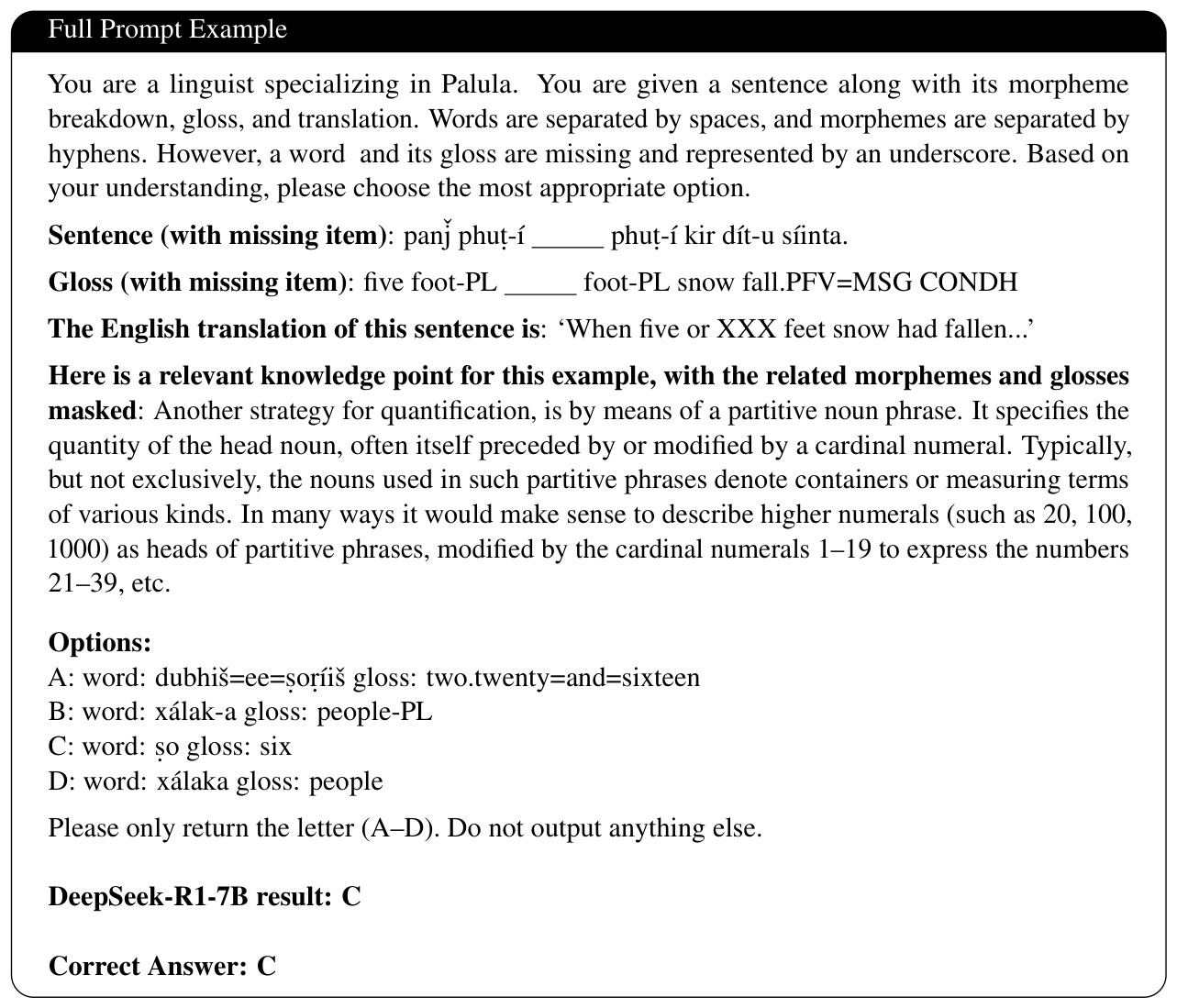
Figure 8: A full prompt example of Palula and its prediction under the S+G+KP+T setting.
图 8:Palula 在 S+G+KP+T 设定下的完整提示例子及其预测结果。