The Imperfective Paradox in Large Language Models
The Imperfective Paradox in Large Language Models
大语言模型中的未完成体悖论
Bolei Ma † † thanks: Work done while visiting The University of Tokyo. Affiliation: LMU Munich & MCML Email: bolei.ma@lmu.de Yusuke Miyao Affiliation: The University of Tokyo Email: yusuke@is.s.u-tokyo.ac.jp
Abstract
摘要
Do Large Language Models (LLMs) genuinely grasp the compositional semantics of events, or do they rely on surface-level probabilistic heuristics? We investigate the Imperfective Paradox, a logical phenomenon where the past progressive aspect entails event realization for activities (e.g., running ran) but not for accomplishments (e.g., building built). We introduce ImperfectiveNLI, a diagnostic dataset designed to probe this distinction across diverse semantic classes. Evaluating state-of-the-art open-weight models, we uncover a pervasive Teleological Bias: models systematically hallucinate completion for goal-oriented events, even overriding explicit textual cancellation. Prompting interventions partially reduce this bias but trigger a calibration crisis, causing models to incorrectly reject valid entailments for atelic verbs. Representational analyses further show that while internal embeddings often distinguish progressive from simple past forms, inference decisions are dominated by strong priors about goal attainment. Taken together, our findings indicate that these current open-weight LLMs operate as predictive narrative engines rather than faithful logical reasoners, and that resolving aspectual inference requires moving beyond prompting toward structurally grounded alignment.[^1]
大语言模型(LLM)是真正把握了事件的组合语义,还是依赖表层的概率启发式?我们考察未完成体悖论(Imperfective Paradox):过去进行体对活动蕴涵事件已经实现(例如 running ran),对达成事件则不蕴涵(例如 building built)。我们提出诊断数据集 ImperfectiveNLI,用于在多样的语义类别上探测这一区分。评估先进的开源权重模型后,我们发现一种普遍的目的论偏置(Teleological Bias):模型会系统性地为有目标的事件幻想出完成,甚至压过文本中明确的取消信息。提示干预可以部分降低这一偏置,却会引发校准危机,使模型错误地拒绝无界动词上本应成立的蕴涵。表征分析进一步表明,内部嵌入往往能够区分进行体与一般过去形式,但推理决策仍被关于目标达成的强先验所主导。综合来看,当前这些开源权重模型更像是预测叙事走向的引擎,而不是忠实的逻辑推理者;要解决体貌推理,需要从提示走向有结构依据的对齐。[^1]
1 Introduction
1 引言
Large Language Models (LLMs) have demonstrated remarkable proficiency in natural language inference (NLI) and complex reasoning tasks (Brown et al., 2020; Touvron et al., 2023). Despite these advancements, questions remain regarding the robustness of their reasoning: do models genuinely grasp the compositional semantics of events, or do they rely on surface-level probabilistic heuristics (Bender et al., 2021; Dziri et al., 2023)? This distinction is critical when processing temporal events. A faithful reasoning agent must distinguish between an action intended (or in progress) and an action realized.
大语言模型(LLM)已在自然语言推理(NLI)和复杂推理任务上表现出很强的能力(Brown et al., 2020; Touvron et al., 2023)。尽管如此,其推理是否稳健仍有疑问:模型是真正把握了事件的组合语义,还是依赖表层的概率启发式(Bender et al., 2021; Dziri et al., 2023)?处理时间性事件时,这一区分尤为关键。一个忠实的推理智能体必须分清“意图中或进行中的动作”与“已经实现的动作”。
Consider the following sentence: “The carpenter was building a gazebo”, as shown in Table 1. Logically, this description of an ongoing process does not entail that the gazebo was ever finished. The construction could have been abandoned or interrupted. This lack of entailment for telic (goal-oriented) events is known in formal semantics as the Imperfective Paradox (Dowty, 1977; Dowty, 1979). In contrast, for atelic verbs like “run”, the process itself constitutes the event Vendler (1957); Bennett and Partee (1978); Smith (1997): “The boy was running” entails “The boy ran”.
请看这句话:“The carpenter was building a gazebo”(木匠当时正在建一座凉亭),如表 1 所示。从逻辑上讲,对一个进行中过程的描述,并不蕴涵凉亭曾经完工。施工完全可能被放弃或打断。对有界(目标导向)事件的这种不蕴涵,在形式语义中称为未完成体悖论(Dowty, 1977; Dowty, 1979)。相反,对像 “run” 这样的无界动词,过程本身就构成事件(Vendler, 1957; Bennett and Partee, 1978; Smith, 1997):“The boy was running” 蕴涵 “The boy ran”。
This phenomenon is grounded in the theory of (Lexical) Aspect, which categorizes events by their telicity (boundedness) (Vendler, 1957; Comrie, 1976; Leiss, 1992). Unlike atelic activities where the process implies the event (e.g., running), telic accomplishments possess a distinct culmination point that separates the process from the result (Moens and Steedman, 1988). Therefore, the progressive aspect acts as a logical filter: it entails realization for activities but suspends it for accomplishments. A robust reasoner must respect this structural boundary, distinguishing between the occurrence of a process and the attainment of a goal.
这一现象的根基是**(词汇)体**理论,它按有界性(telicity)对事件分类(Vendler, 1957; Comrie, 1976; Leiss, 1992)。无界活动中,过程即蕴涵事件(例如跑步);有界的达成事件则有一个把过程与结果分开的明确完成点(Moens and Steedman, 1988)。因此,进行体像一层逻辑滤镜:对活动它蕴涵实现,对达成事件则把实现悬置起来。稳健的推理者必须尊重这条结构边界,区分过程的发生与目标的达成。
| Class | Examples (Premise Hypothesis) | Entail? |
|---|---|---|
| Telic | P: The carpenter was building a gazebo. | ✗ No |
| H: The carpenter built a gazebo. | ||
| Atelic | P: The boy was running in the park. | ✓ Yes |
| H: The boy ran in the park. |
Table 1: Examples for the Imperfective Paradox. Telic verbs do not entail completion in the progressive form.
| 类别 | 例子(前提 假设) | 是否蕴涵? |
|---|---|---|
| 有界 | P: The carpenter was building a gazebo. | ✗ 否 |
| H: The carpenter built a gazebo. | ||
| 无界 | P: The boy was running in the park. | ✓ 是 |
| H: The boy ran in the park. |
表 1:未完成体悖论的例子。有界动词在进行体形式下并不蕴涵完成。
While humans intuitively navigate these aspectual distinctions, we hypothesize that LLMs exhibit a Teleological Bias: a tendency to assume that goal-directed actions inevitably lead to their successful completion. This bias likely stems from the “reporting bias” in pre-training corpora (Gordon and Van Durme, 2013), where narratives typically mention goals only when they are relevant to the outcome, often implying success (Grice, 1975). Consequently, models may hallucinate event completion based on statistical likelihood rather than logical entailment, effectively conflating the intent with the result Farquhar et al. (2024).
人类可以凭直觉处理这些体貌区分,我们则假设 LLM 会表现出目的论偏置:倾向于假定目标导向的动作必然导向成功完成。这一偏置很可能来自预训练语料中的“报道偏差”(Gordon and Van Durme, 2013):叙事通常只在目标与结局相关时才提起目标,并往往暗示成功(Grice, 1975)。于是,模型可能依据统计可能性而不是逻辑蕴涵,幻想出事件已经完成,把意图与结果混为一谈(Farquhar et al., 2024)。
Prior work in NLP has largely focused on aspect classification or modeling, training models to label verbs as stative, dynamic, telic, or atelic (Friedrich et al., 2023, see). However, high classification accuracy does not guarantee robust inference. It remains unexplored whether generative models can apply these aspectual properties to resist fallacious entailments in zero-shot reasoning scenarios.
以往 NLP 工作大多聚焦于体的分类或建模,训练模型把动词标为状态、动态、有界或无界(见 Friedrich et al., 2023)。然而,高分类准确率并不保证稳健的推理。生成式模型能否在零样本推理中运用这些体貌属性,以抵御错误蕴涵,仍有待探索。
To bridge this gap, we introduce ImperfectiveNLI, a diagnostic dataset to probe the Imperfective Paradox. We construct minimal pairs across four logical conditions, contrasting interrupted and ambiguous contexts for both telic and atelic verbs. We evaluate state-of-the-art open-weight models and uncover following critical insights:
为填补这一空白,我们提出 ImperfectiveNLI,一套用于探测未完成体悖论的诊断数据集。我们在四种逻辑条件下构造最小对,对照有界与无界动词在被打断和语义不明两种语境中的表现。我们评估先进的开源权重模型,并得到以下关键发现:
- Teleological Bias Dominates Model Inference: Models exhibit a pervasive tendency to hallucinate completion for goal-oriented events. Crucially, this bias is robust enough to override explicit textual negation (e.g., predicting completion even when an action is interrupted), revealing a fundamental failure in contextual fidelity.
1)目的论偏置主导模型推理: 模型普遍倾向于为有目标的事件幻想出完成。关键的是,这一偏置强到足以压过文本中明确的否定(例如,即使动作被打断,仍预测完成),暴露出在语境忠实性上的根本失败。
- Prompting Interventions Trigger a Calibration Crisis: Strategies like Chain-of-Thought or forced counterfactual non-endpoints can reduce hallucinated completions, but often over-correct, causing models to incorrectly reject valid entailments for atelic activities. Models struggle to adapt reasoning dynamically based on event type.
2)提示干预会引发校准危机: 思维链或强制给出反事实的未完成结局等策略,可以减少幻想出的完成,但常常矫枉过正,使模型错误地拒绝无界活动上本应成立的蕴涵。模型难以按事件类型动态调整推理。
- Representation and Reasoning Are Dissociated: We find that the bias is not representational; embeddings successfully distinguish process (progressive form) from result (simple past form). Instead, inference is dominated by prior expectations about goal completion. The failure is likely driven by predictive priors during decoding, rather than an inherent inability of Transformer architectures to encode the aspectual distinction.
3)表征与推理是分离的: 我们发现偏置并不在表征层面;嵌入能够成功区分过程(进行体)与结果(一般过去)。相反,推理被关于目标完成的先验预期所主导。失败更可能来自解码时的预测先验,而不是 Transformer 架构本身无法编码体貌区分。
Ultimately, our findings underscore that current LLMs struggle to resolve the Imperfective Paradox, operating as probabilistic predictors of narrative outcomes rather than faithful logical reasoners. Bridging this gap requires not just better prompting, but a deeper alignment between model behavior and the formal logic of event semantics.
归根结底,我们的发现表明,当前 LLM 难以化解未完成体悖论,更像是叙事结局的概率预测器,而不是忠实的逻辑推理者。要弥合这一差距,不能只靠更好的提示,还需要让模型行为与事件语义的形式逻辑更深入地对齐。
2 Background
2 背景
2.1 Vendler’s Aspectual Classes: Telicity
2.1 Vendler 的体貌类别:有界性
Vendler (1957) categorized verbs into four aspectual classes (activity, accomplishment, achievement, state) based on their temporal properties. In this study, we focus on the distinction between Activities and Accomplishments, defined by the property of telicity, whether an event involves an inherent endpoint. Telicity often correlates with perfective interpretations, which present an eventuality from a holistic perspective Filip (2008).
Vendler (1957) 根据时间属性把动词分成四个体貌类别(活动、达成、成就、状态)。本研究聚焦活动与达成的区分,其定义性质是有界性,即事件是否包含固有终点。有界性常常与完成体解读相关,后者从整体视角呈现一个事态(Filip, 2008)。
- • Activities (Atelic): Events with no inherent endpoint (e.g., “run”, “swim”, “push a cart”). They are homogeneous; any part of the process counts as an instance of the same event.
- • 活动(无界):没有固有终点的事件(例如 “run”“swim”“push a cart”)。它们是齐质的;过程的任何一部分都算作同一事件的实例。
- • Accomplishments (Telic): Events that proceed toward a specific terminus or goal (e.g., “build a house”, “write a letter”). Such events are only completed and receive canonical perfective interpretations, when the endpoint is reached.
- • 达成(有界):朝向特定终点或目标推进的事件(例如 “build a house”“write a letter”)。只有到达终点,这类事件才算完成,并获得典型的完成体解读。
2.2 The Imperfective Paradox
2.2 未完成体悖论
Semantically, in English, the progressive form has imperfective reading, while the simple past form has perfective reading (Comrie, 1976; Smith, 1997). The Imperfective Paradox arises when we analyze the logical entailment between the progressive form (Imperfective) and the simple past form (Perfective) of these verb classes. Let be an event predicate and denote its progressive form.
在英语语义中,进行体形式具有未完成体解读,一般过去形式具有完成体解读(Comrie, 1976; Smith, 1997)。未完成体悖论出现在我们分析这些动词类别的进行体(未完成体)与一般过去(完成体)之间的逻辑蕴涵时。令 为事件谓词, 表示其进行体形式。
For Atelic predicates (Activities), the entailment holds:
对无界谓词(活动),蕴涵成立:
If was running, then it is true that ran. This is often referred to as the Sub-interval Property: if an activity holds true for an interval, it holds true for any sub-interval Bennett and Partee (1978).
如果 当时在跑,那么 “ 跑过” 为真。这常被称为子区间性质:若一个活动在某区间上成立,则它在该区间的任意子区间上也成立(Bennett and Partee, 1978)。
For Telic predicates (Accomplishments), the entailment fails:
对有界谓词(达成),蕴涵不成立:
If was building a house, it is NOT necessarily true that built a house.
如果 当时在盖一座房子,并不必然为真的是 盖成了这座房子。
The paradox highlights that the progressive form of an accomplishment describes a process leading to a result, but does not assert the result itself Parsons (1990). Dowty (1977) formalized this using possible worlds semantics, suggesting that is true if completes in all “inertia worlds” (worlds where the course of events proceeds without interruption). However, the real world is not necessarily an inertia world and interruptions occur.
这一悖论表明,达成事件的进行体描述的是导向结果的过程,但并不断言结果本身(Parsons, 1990)。Dowty (1977) 用可能世界语义形式化了这一点,认为 为真,当且仅当 在所有“惯性世界”(事件进程不受打断的世界)中完成。然而,现实世界不必是惯性世界,打断也会发生。
2.3 Related Work: Interpreting and Modeling “Aspect” in NLP
2.3 相关工作:在 NLP 中解释与建模“体”
Computational modeling of aspect has evolved from feature-engineering approaches to representation learning Friedrich et al. (2023). Siegel and McKeown (2000) pioneered the use of supervised machine learning for aspectual classification. Subsequent work extensively explored semi-supervised approaches, combining linguistic and distributional features to predict stativity, duration, and situation entity types, while also establishing essential annotated datasets Friedrich and Palmer (2014); Friedrich and Pinkal (2015); Friedrich et al. (2016); Friedrich and Gateva (2017). Similar methodologies were applied to German verbs Hermes et al. (2015) and multilingual morphosyntactic annotation Ramm et al. (2017).
体的计算建模已从特征工程走向表征学习(Friedrich et al., 2023)。Siegel and McKeown (2000) 率先用有监督机器学习做体貌分类。后续工作广泛探索半监督方法,结合语言学与分布特征来预测状态性、持续时间和情境实体类型,并建立了重要的标注数据集(Friedrich and Palmer, 2014; Friedrich and Pinkal, 2015; Friedrich et al., 2016; Friedrich and Gateva, 2017)。类似方法也被用于德语动词(Hermes et al., 2015)以及多语言形态句法标注(Ramm et al., 2017)。
Moving toward compositional semantics, Kober et al. (2020) introduced an NLI-based dataset to model aspect in context. Later work showed that transformer models capture some aspectual cues but rely heavily on surface features such as tense and word order (Metheniti et al., 2022). More recently, Ma (2024) found that large-scale LLMs still struggle with lexical aspect identification. Closely related are two studies on the Imperfective Paradox Pruś et al. (2024); Pruś et al. (2025), which focus primarily on modeling human judgments of progressive versus simple past forms, treating LLM behavior as a secondary comparison. As such, neither study provides a systematic diagnostic evaluation of LLM aspectual inference. Our work directly addresses this gap, offering the first controlled investigation of whether LLMs respect the Imperfective Paradox or instead hallucinate event completion by conflating goal-directed processes with their result states.
走向组合语义方面,Kober et al. (2020) 引入一套基于 NLI 的数据集,在语境中建模体。后来的工作表明,transformer 模型能捕获部分体貌线索,但严重依赖时态和词序等表层特征(Metheniti et al., 2022)。更近一些,Ma (2024) 发现大规模 LLM 在词汇体识别上仍然吃力。与本文密切相关的是关于未完成体悖论的两项研究(Pruś et al., 2024; Pruś et al., 2025),它们主要建模人类对进行体与一般过去形式的判断,只把 LLM 行为作为次要比较。因此,这两项研究都没有对 LLM 的体貌推理给出系统的诊断评估。我们的工作直接填补这一空白,首次在受控条件下考察 LLM 是否尊重未完成体悖论,还是会把目标导向的过程与其结果状态混为一谈,从而幻想出事件已经完成。
3 Dataset - ImperfectiveNLI
3 数据集:ImperfectiveNLI
To evaluate LLMs’ ability to reason about the imperfective paradox and teleological aspectual semantics, we introduce ImperfectiveNLI, a diagnostic NLI dataset in English.
为评估 LLM 对未完成体悖论以及目的论体貌语义的推理能力,我们提出英语诊断 NLI 数据集 ImperfectiveNLI。
Dataset Construction with Different Verbs.
The construction of ImperfectiveNLI employs a template-based generation approach to ensure syntactic uniformity while isolating semantic reasoning. We curated a balanced lexicon of verbs based on Vendler’s aspectual classification:
用不同动词构造数据集。
ImperfectiveNLI 的构造采用基于模板的生成方法,以保证句法一致,同时把语义推理隔离出来。我们按 Vendler 的体貌分类整理了一套均衡的动词词表:
- • 100 Telic Verbs (Accomplishments): Predicates involving a natural endpoint or result state, where the process is distinct from the culmination (e.g., build, write, fix, paint, bake).
- • 100 个有界动词(达成): 带有自然终点或结果状态的谓词,过程与完成点彼此分离(例如 build, write, fix, paint, bake)。
- • 100 Atelic Verbs (Activities): Predicates describing homogeneous processes without a necessary endpoint, where the process itself constitutes the event (e.g., run, swim, wander, play, vibrate).
- • 100 个无界动词(活动): 描述齐质过程、没有必然终点的谓词,过程本身即构成事件(例如 run, swim, wander, play, vibrate)。
For each verb, we generated context-hypothesis pairs using Gemini-assisted rewriting Team et al. (2025), followed by strict human verification. The dataset is structured as a controlled minimal-pair experiment across four logical conditions, resulting in a total of examples.
对每个动词,我们用 Gemini 辅助改写生成语境–假设对(Team et al., 2025),再经过严格的人工核验。数据集按四种逻辑条件组织成受控的最小对实验,共计 条样本。
To investigate whether teleological bias varies across different types of goal-directedness, we further annotated the 100 telic verbs into four fine-grained semantic classes (inspired by the theory of Levin, 1993): Change of State (44), Creation (39), Consumption (9), and Motion to Goal (8).
为考察目的论偏置是否随目标导向类型而变化,我们进一步把这 100 个有界动词标注为四个细粒度语义类别(受 Levin, 1993 的理论启发):状态变化(44)、创造(39)、消耗(9)以及趋向目标的位移(8)。
We restricted this sub-classification to the telic group because, unlike homogeneous activities, telic predicates inherently encode a distinct resultant state (Beavers and Koontz-Garboden, 2012). This classification categorizes the nature of that result: Change of State verbs denote a transformation in the physical or abstract condition of an existing entity (e.g., melt, repair); Creation verbs involve bringing an object into existence (e.g., build, knit); Consumption verbs entail the destruction or complete ingestion of an object (e.g., eat, burn) (Beavers, 2010); and Motion to Goal verbs describe movement towards a specific spatial endpoint (e.g., climb, cross) (Talmy, 2000). This stratification enables us to probe whether LLMs are more prone to hallucinating completion for artifact-creating events, where the “teleological” purpose is most salient, compared to simple state changes.
我们把这一细分类限制在有界组,因为与齐质活动不同,有界谓词本身就编码了一个独特的结果状态(Beavers and Koontz-Garboden, 2012)。这一分类刻画的是该结果的性质:状态变化动词表示既有实体在物理或抽象状况上的转变(例如 melt、repair);创造动词涉及使一个对象进入存在(例如 build、knit);消耗动词意味着对象被毁坏或完全摄入(例如 eat、burn)(Beavers, 2010);趋向目标的位移动词则描述朝向特定空间终点的运动(例如 climb、cross)(Talmy, 2000)。这一分层使我们能够探测:与单纯的状态变化相比,LLM 是否更易于对创造制品的事件幻想出完成——在这类事件里,“目的论”意图最为显眼。
| Group | Condition | Premise Example | Hypothesis | Gold Label |
|---|---|---|---|---|
| A | Interrupted Accomp. (Telic + Cancel) | The carpenter was building a gazebo, but a storm destroyed the frame before the roof was on. | The carpenter built a gazebo. | Contradiction (✗ False) |
| B | Interrupted Activity (Atelic + Stop) | The athletes were running on the track, but it started to hail. | The athletes ran on the track. | Entailment (✓ True) |
| C | Ambiguous Accomp. (Telic + Process) | The carpenter was building a gazebo. | The carpenter built a gazebo. | Neutral (? Unknown) |
| D | Ambiguous Activity (Atelic + Process) | The athletes were running on the track. | The athletes ran on the track. | Entailment (✓ True) |
Table 2: Examples from the ImperfectiveNLI dataset. Group C is the critical probe, where the imperfective paradox implies a Neutral relation, but teleological bias may lead models to predict Entailment.
| 组别 | 条件 | 前提例子 | 假设 | 标准标签 |
|---|---|---|---|---|
| A | 被打断的达成(有界 + 取消) | The carpenter was building a gazebo, but a storm destroyed the frame before the roof was on. | The carpenter built a gazebo. | 矛盾(✗ 假) |
| B | 被打断的活动(无界 + 停止) | The athletes were running on the track, but it started to hail. | The athletes ran on the track. | 蕴涵(✓ 真) |
| C | 语义不明的达成(有界 + 过程) | The carpenter was building a gazebo. | The carpenter built a gazebo. | 中立(? 未知) |
| D | 语义不明的活动(无界 + 过程) | The athletes were running on the track. | The athletes ran on the track. | 蕴涵(✓ 真) |
表 2:ImperfectiveNLI 数据集中的例子。C 组是关键探针:按未完成体悖论应为中立关系,但目的论偏置可能使模型预测蕴涵。
Imperfective Logical Conditions.
The core contribution of ImperfectiveNLI is its minimal-pair design, which can be viewed as a matrix crossing Verb Telicity (Telic vs. Atelic) with Contextual Information (Interrupted vs. Ambiguous), described in the following groups A-D. Table 2 illustrates these conditions with examples.
未完成体的逻辑条件。
ImperfectiveNLI 的核心贡献是其最小对设计,可以看成一个 矩阵,横轴是动词有界性(有界对无界),纵轴是语境信息(被打断对语义不明),即下面的 A–D 组。表 2 用例子说明这些条件。
While standard NLI tasks utilize the labels Entailment, Contradiction, and Neutral (Bowman et al., 2015, e.g.,), we map these to the natural language truth values “True”, “False”, and “Unknown” respectively for our experiments.
标准 NLI 任务使用 Entailment、Contradiction 和 Neutral 标签(例如 Bowman et al., 2015),我们在实验中把它们分别映射为自然语言真值 “True”、“False” 和 “Unknown”。
Quality Assurance.
To ensure the validity and naturalness of the generated data, we recruited three native English speakers as evaluators via Prolific[^2]. They assessed the sentences across three linguistic dimensions, Grammar, Fluency, and Adequacy (details in Appendix C), and were compensated at a rate of £9/hour. Beyond quantitative ratings, evaluators provided corrections for any unnatural or unclear instances. Discrepancies and conflicting revisions were resolved through manual verification, ensuring quality in the final dataset.
质量保证。
为确保生成数据的有效性与自然度,我们通过 Prolific[^2] 招募了三位英语母语评估者。他们从语法、流畅和合适性三个语言维度评估句子(细节见附录 C),报酬为每小时 9 英镑。除定量打分外,评估者还对不自然或不清楚的例子提供修改。分歧与冲突的修订经人工核验解决,以保证最终数据集的质量。
4 Experimental Settings
4 实验设置
4.1 Models
4.1 模型
We experimented with 7 instruction-tuned open-weight models with their parameter around 7-9B: Llama-3.1-8B-Instruct Grattafiori et al. (2024), Mistral-7B-Instruct-v0.3 Jiang et al. (2023), Qwen2.5-7B-Instruct Qwen et al. (2025), deepseek-llm-7b-chat DeepSeek-AI (2024), gemma-2-9b-it Team et al. (2024), glm-4-9b-chat-hf GLM et al. (2024), Yi-1.5-9B-Chat AI et al. (2025).
我们实验了 7 个经过指令微调、参数约在 7–9B 的开源权重模型:Llama-3.1-8B-Instruct(Grattafiori et al., 2024)、Mistral-7B-Instruct-v0.3(Jiang et al., 2023)、Qwen2.5-7B-Instruct(Qwen et al., 2025)、deepseek-llm-7b-chat(DeepSeek-AI, 2024)、gemma-2-9b-it(Team et al., 2024)、glm-4-9b-chat-hf(GLM et al., 2024)、Yi-1.5-9B-Chat(AI et al., 2025)。
4.2 Prompts
4.2 提示
To disentangle the model’s intrinsic biases from its instruction-following capabilities, we evaluate four distinct prompting strategies. The detailed prompts given to the models are presented in Appendix B.
为把模型的内在偏置与其遵循指令的能力拆开,我们评估四种不同的提示策略。给模型的详细提示见附录 B。
(1) Strict Logic Prompt (Zero-Shot).
Our primary setting employs a simple zero-shot instruction, framing the model as a “strict logician”. This prompt explicitly prohibits common sense assumptions (e.g., the pragmatic inference that “building usually implies a house”) and forces the model to rely solely on the provided text.
(1)严格逻辑提示(零样本)。
我们的主要设定采用简单的零样本指令,把模型设定为“严格的逻辑学家”。该提示明确禁止常识性假定(例如“盖房子通常就意味着有一座房子”这种语用推理),并迫使模型只依据所给文本做判断。
(2) Definition-Aware Prompt (DAP).
To test whether the failure stems from a lack of linguistic knowledge or a failure of application, we explicitly inject the linguistic definition of the imperfective aspect for both Activity and Accomplishment into the system prompt. If the bias persists even when the rule is provided, it suggests that the teleological prior is robust enough to override in-context instructions.
(2)定义感知提示(DAP)。
为检验失败来自缺少语言学知识,还是来自运用失败,我们在系统提示中明确注入活动与达成两类未完成体的语言学定义。如果即便给出规则,偏置仍然存在,就说明目的论先验强到足以压过上下文中的指令。
(3) Chain-of-Thought Prompt (CoT).
We adapt the standard “Let’s think step by step” paradigm (Wei et al., 2022b). This setting investigates whether the Teleological Bias is a result of fast, superficial processing. We hypothesize that by forcing the model to articulate the temporal status of the event before predicting the label, it may self-correct the hallucination for Ambiguous Accomplishment.
(3)思维链提示(CoT)。
我们采用标准的 “Let’s think step by step” 范式(Wei et al., 2022b)。这一设定考察目的论偏置是否来自快速、表层的加工。我们假设,若迫使模型在预测标签之前先说清事件的时间状态,它或许能自行纠正对“语义不明的达成”的幻觉。
(4) Counterfactual Prompt (Counterfactual).
Drawing on Dowty (1977)’s theory that the progressive aspect presupposes an “inertia world” (where events proceed normally), this prompt attempts to explicitly break this assumption. We explicitly instruct the model to first generate three plausible real-world scenarios in which the event is interrupted and its endpoint is not reached, before making a judgment.
(4)反事实提示(Counterfactual)。
根据 Dowty (1977) 的理论,进行体预设一个“惯性世界”(事件按常理进行),这一提示试图明确打破该假定。我们明确要求模型先生成三个合理的现实情景,使事件被打断、终点没有到达,然后再做判断。
4.3 Metrics
4.3 指标
We report following metrics:
我们报告以下指标:
(1) Group-wise Accuracy (ACC):
We calculate classification accuracy separately for each logical condition (Groups A–D).
(1)分组准确率(ACC):
我们分别计算每种逻辑条件(A–D 组)的分类准确率。
(2) Teleological Bias Rate (TBR):
This metric specifically quantifies the “Hallucination of Completion” in Group C (Ambiguous Accomplishment). Since the Gold Label for Group C is Unknown, any prediction of True indicates that the model has hallucinated a result. We define TBR as:
(2)目的论偏置率(TBR):
该指标专门量化 C 组(语义不明的达成)中的“完成幻觉”。由于 C 组的标准标签是 Unknown,任何预测为 True 都表明模型幻想出了结果。我们将 TBR 定义为:
where is the set of examples in Group C (or Group A), and is the model’s prediction. A higher TBR indicates a stronger reliance on teleological priors.
其中 是 C 组(或 A 组)样本集合, 是模型预测。TBR 越高,表明对目的论先验的依赖越强。
(3) Aspectual Awareness Gap ():
This metric measures the model’s capability to distinguish the logical implications of atelic processes (which imply realization) from telic processes (which do not). As we are mostly interested in Group C, it is calculated as the difference between the accuracy on the Ambiguous Activity baseline (Group D) and the error rate on the Ambiguous Accomplishment probe (Group C):
(3)体貌觉察差距():
该指标衡量模型区分无界过程(蕴涵实现)与有界过程(不蕴涵实现)之逻辑含义的能力。由于我们最关心 C 组,它定义为语义不明活动基线(D 组)的准确率,与语义不明达成探针(C 组)上错误率之差:
where represents the correct entailment rate for Activity verbs. A high gap indicates ideal aspectual reasoning: the model correctly infers entailment for activities while correctly suspending judgment (low bias) for accomplishments. A low gap suggests that the model treats all progressive verbs homogeneously, likely applying a shallow heuristic (e.g., “mentioning an action implies its completion”) regardless of lexical aspect.
其中 表示活动动词上正确的蕴涵率。差距大表明体貌推理较为理想:模型对活动正确推出蕴涵,同时对达成正确暂缓判断(偏置低)。差距小则表明模型把所有进行体动词一视同仁,很可能不分词汇体,一律套用浅层启发式(例如“提到一个动作就意味着它已完成”)。
Note that is most interpretable when is high; a low driven by a low rather than a high reflects a distinct failure mode, namely, an inability to recognize valid entailments for atelic verbs, rather than teleological overgeneralization.
需要注意, 在 较高时最好解释;若低 主要来自低 而不是高 ,那反映的是另一种失败模式,即无法识别无界动词上本应成立的蕴涵,而不是目的论上的过度泛化。
| Prompt | Model | Acc A () | Acc B () | Acc C () | Acc D () | TBRA () | TBRC () | () |
|---|---|---|---|---|---|---|---|---|
| Zero-shot | Llama-3.1-8B-Instruct | 0.47 | 0.85 | 0.02 | 0.98 | 0.51 | 0.98 | 0.00 |
| Mistral-7B-Instruct-v0.3 | 0.37 | 0.92 | 0.02 | 1.00 | 0.46 | 0.97 | 0.03 | |
| Qwen2.5-7B-Instruct | 0.20 | 0.98 | 0.47 | 0.97 | 0.55 | 0.53 | 0.44 | |
| Yi-1.5-9B-Chat | 0.35 | 0.94 | 0.02 | 1.00 | 0.57 | 0.98 | 0.02 | |
| deepseek-llm-7b-chat | 0.04 | 0.88 | 0.00 | 1.00 | 0.47 | 1.00 | 0.00 | |
| gemma-2-9b-it | 0.03 | 0.96 | 0.06 | 1.00 | 0.50 | 0.94 | 0.06 | |
| glm-4-9b-chat-hf | 0.14 | 0.98 | 0.03 | 1.00 | 0.75 | 0.97 | 0.03 | |
| DAP | Llama-3.1-8B-Instruct | 0.60 | 0.95 | 0.36 | 0.99 | 0.35 | 0.45 | 0.54 |
| Mistral-7B-Instruct-v0.3 | 0.55 | 0.96 | 0.06 | 1.00 | 0.41 | 0.94 | 0.06 | |
| Qwen2.5-7B-Instruct | 0.35 | 0.97 | 0.89 | 0.72 | 0.30 | 0.09 | 0.63 | |
| Yi-1.5-9B-Chat | 0.57 | 0.97 | 0.20 | 1.00 | 0.36 | 0.80 | 0.20 | |
| deepseek-llm-7b-chat | 0.12 | 0.92 | 0.00 | 1.00 | 0.40 | 1.00 | 0.00 | |
| gemma-2-9b-it | 0.08 | 0.90 | 0.60 | 0.88 | 0.31 | 0.40 | 0.48 | |
| glm-4-9b-chat-hf | 0.08 | 1.00 | 0.33 | 0.98 | 0.70 | 0.67 | 0.31 | |
| CoT | Llama-3.1-8B-Instruct | 0.15 | 0.39 | 0.67 | 0.65 | 0.10 | 0.33 | 0.32 |
| Mistral-7B-Instruct-v0.3 | 0.23 | 0.65 | 0.41 | 0.66 | 0.07 | 0.56 | 0.10 | |
| Qwen2.5-7B-Instruct | 0.30 | 0.80 | 0.97 | 0.37 | 0.13 | 0.03 | 0.34 | |
| Yi-1.5-9B-Chat | 0.56 | 0.81 | 0.85 | 0.44 | 0.14 | 0.13 | 0.31 | |
| deepseek-llm-7b-chat | 0.05 | 0.88 | 0.40 | 0.94 | 0.56 | 0.60 | 0.34 | |
| gemma-2-9b-it | 0.15 | 0.88 | 0.98 | 0.15 | 0.26 | 0.02 | 0.13 | |
| glm-4-9b-chat-hf | 0.24 | 0.95 | 0.38 | 0.97 | 0.54 | 0.62 | 0.35 | |
| Counterfactual | Llama-3.1-8B-Instruct | 0.35 | 0.00 | 0.97 | 0.00 | 0.00 | 0.00 | 0.00 |
| Mistral-7B-Instruct-v0.3 | 0.28 | 0.39 | 0.87 | 0.19 | 0.05 | 0.11 | 0.08 | |
| Qwen2.5-7B-Instruct | 0.07 | 0.57 | 1.00 | 0.02 | 0.14 | 0.00 | 0.02 | |
| Yi-1.5-9B-Chat | 0.07 | 0.41 | 1.00 | 0.10 | 0.09 | 0.00 | 0.10 | |
| deepseek-llm-7b-chat | 0.25 | 0.97 | 0.00 | 0.98 | 0.67 | 1.00 | -0.02 | |
| gemma-2-9b-it | 0.03 | 0.00 | 1.00 | 0.00 | 0.00 | 0.00 | 0.00 | |
| glm-4-9b-chat-hf | 0.23 | 0.66 | 0.73 | 0.24 | 0.21 | 0.20 | 0.04 |
Table 3: Model performance under Zero-shot, DAP, CoT, and Counterfactual prompting strategies with Acc for A-D Groups, Teleological Bias Rate for Groups A and C (TBRA, TBRC), and Aspectual Awareness Gap ().
| 提示 | 模型 | 准确率 A () | 准确率 B () | 准确率 C () | 准确率 D () | TBRA () | TBRC () | () |
|---|---|---|---|---|---|---|---|---|
| 零样本 | Llama-3.1-8B-Instruct | 0.47 | 0.85 | 0.02 | 0.98 | 0.51 | 0.98 | 0.00 |
| Mistral-7B-Instruct-v0.3 | 0.37 | 0.92 | 0.02 | 1.00 | 0.46 | 0.97 | 0.03 | |
| Qwen2.5-7B-Instruct | 0.20 | 0.98 | 0.47 | 0.97 | 0.55 | 0.53 | 0.44 | |
| Yi-1.5-9B-Chat | 0.35 | 0.94 | 0.02 | 1.00 | 0.57 | 0.98 | 0.02 | |
| deepseek-llm-7b-chat | 0.04 | 0.88 | 0.00 | 1.00 | 0.47 | 1.00 | 0.00 | |
| gemma-2-9b-it | 0.03 | 0.96 | 0.06 | 1.00 | 0.50 | 0.94 | 0.06 | |
| glm-4-9b-chat-hf | 0.14 | 0.98 | 0.03 | 1.00 | 0.75 | 0.97 | 0.03 | |
| DAP | Llama-3.1-8B-Instruct | 0.60 | 0.95 | 0.36 | 0.99 | 0.35 | 0.45 | 0.54 |
| Mistral-7B-Instruct-v0.3 | 0.55 | 0.96 | 0.06 | 1.00 | 0.41 | 0.94 | 0.06 | |
| Qwen2.5-7B-Instruct | 0.35 | 0.97 | 0.89 | 0.72 | 0.30 | 0.09 | 0.63 | |
| Yi-1.5-9B-Chat | 0.57 | 0.97 | 0.20 | 1.00 | 0.36 | 0.80 | 0.20 | |
| deepseek-llm-7b-chat | 0.12 | 0.92 | 0.00 | 1.00 | 0.40 | 1.00 | 0.00 | |
| gemma-2-9b-it | 0.08 | 0.90 | 0.60 | 0.88 | 0.31 | 0.40 | 0.48 | |
| glm-4-9b-chat-hf | 0.08 | 1.00 | 0.33 | 0.98 | 0.70 | 0.67 | 0.31 | |
| CoT | Llama-3.1-8B-Instruct | 0.15 | 0.39 | 0.67 | 0.65 | 0.10 | 0.33 | 0.32 |
| Mistral-7B-Instruct-v0.3 | 0.23 | 0.65 | 0.41 | 0.66 | 0.07 | 0.56 | 0.10 | |
| Qwen2.5-7B-Instruct | 0.30 | 0.80 | 0.97 | 0.37 | 0.13 | 0.03 | 0.34 | |
| Yi-1.5-9B-Chat | 0.56 | 0.81 | 0.85 | 0.44 | 0.14 | 0.13 | 0.31 | |
| deepseek-llm-7b-chat | 0.05 | 0.88 | 0.40 | 0.94 | 0.56 | 0.60 | 0.34 | |
| gemma-2-9b-it | 0.15 | 0.88 | 0.98 | 0.15 | 0.26 | 0.02 | 0.13 | |
| glm-4-9b-chat-hf | 0.24 | 0.95 | 0.38 | 0.97 | 0.54 | 0.62 | 0.35 | |
| 反事实 | Llama-3.1-8B-Instruct | 0.35 | 0.00 | 0.97 | 0.00 | 0.00 | 0.00 | 0.00 |
| Mistral-7B-Instruct-v0.3 | 0.28 | 0.39 | 0.87 | 0.19 | 0.05 | 0.11 | 0.08 | |
| Qwen2.5-7B-Instruct | 0.07 | 0.57 | 1.00 | 0.02 | 0.14 | 0.00 | 0.02 | |
| Yi-1.5-9B-Chat | 0.07 | 0.41 | 1.00 | 0.10 | 0.09 | 0.00 | 0.10 | |
| deepseek-llm-7b-chat | 0.25 | 0.97 | 0.00 | 0.98 | 0.67 | 1.00 | -0.02 | |
| gemma-2-9b-it | 0.03 | 0.00 | 1.00 | 0.00 | 0.00 | 0.00 | 0.00 | |
| glm-4-9b-chat-hf | 0.23 | 0.66 | 0.73 | 0.24 | 0.21 | 0.20 | 0.04 |
表 3:模型在零样本、DAP、思维链与反事实提示策略下的表现,含 A–D 组准确率、A 组与 C 组的目的论偏置率(TBRA、TBRC),以及体貌觉察差距()。
5 Results and Analysis
5 结果与分析
In this section, we present the evaluation results on ImperfectiveNLI. We aim to answer four key questions: whether LLMs exhibit teleological bias, how prompting strategies mitigate this bias, how the model scale affects the bias, and how these biases manifest across different semantic categories.
本节给出 ImperfectiveNLI 上的评估结果。我们试图回答四个关键问题:LLM 是否表现出目的论偏置,提示策略如何缓解这一偏置,模型规模如何影响偏置,以及这些偏置在不同语义类别上如何体现。
5.1 The Dominance of Teleological Bias for “If A Subject was V-ing, then the Subject V-ed” in Zero-shot
5.1 零样本下目的论偏置对 “If A Subject was V-ing, then the Subject V-ed” 的主导
The first few rows of Table 3 present the performance of seven open-weight models in the zero-shot setting. The results reveal a fundamental inability of current LLMs to decouple the description of a process from the assertion of its result.
表 3 前几行给出七个开源权重模型在零样本设定下的表现。结果表明,当前 LLM 从根本上难以把对过程的描述与对结果的断言拆开。
1? – – The Illusion of Competence.
At first glance, models appear competent in aspectual reasoning, achieving near-perfect accuracy on Group D for ambiguous Activity (atelic verbs) (e.g., Llama-3.1: , Mistral: ). However, this high performance is deceptive. When contrasted with the catastrophic failure on Group C for ambiguous Accomplishment (telic verbs) (e.g., Llama-3.1: ), a different picture emerges. The near-zero for most models indicates that they do not genuinely understand the Sub-interval Property of the atelic verbs (Bennett and Partee, 1978). Instead, they likely employ a shallow heuristic: “If Subject was V-ing, then Subject V-ed”, regardless of verbs in the Zero-shot setting. This aligns with findings by the NLI work McCoy et al. (2019), suggesting that the models might often rely on lexical overlap strategies rather than deep semantic compositionality.
1?——能力的错觉。
乍看之下,模型在体貌推理上显得很能干,在语义不明的活动(无界动词)D 组上接近满分(例如 Llama-3.1:,Mistral:)。然而这一高分具有欺骗性。与语义不明的达成(有界动词)C 组上的灾难性失败(例如 Llama-3.1:)对照,图景就不同了。多数模型近乎为零的 表明,它们并未真正理解无界动词的子区间性质(Bennett and Partee, 1978)。相反,在零样本设定下,它们很可能采用一条浅层启发式:“只要主语当时在 V-ing,就断定主语 V-ed”,而不分动词。这与 NLI 工作 McCoy et al. (2019) 的发现一致,表明模型常常依赖词汇重叠策略,而不是深层的语义组合。
Contextual Neglect via Semantic Priming.
Perhaps the most alarming finding is the resistance to explicit negation in Group A (Interrupted Accomplishment). Despite the textually grounded interruption (e.g., “…a storm destroyed the frame before the roof was on”), most models exhibit a stark performance degradation. This stands in sharp contrast to Group B (Interrupted Activity), where models maintain high accuracy. This performance gap is semantically revealing: for activities, an interruption does not negate the event’s occurrence (the sub-interval property ensures that “stopped running” entails “ran”), whereas for accomplishments, interruption strictly precludes the result.
经由语义启动的语境忽视。
或许最令人警觉的发现,是模型在 A 组(被打断的达成)上对明确否定的抗拒。尽管文本中写明了打断(例如 “…a storm destroyed the frame before the roof was on”),多数模型的表现仍显著变差。这与 B 组(被打断的活动)上模型保持高准确率形成鲜明对照。这一表现差距在语义上很能说明问题:对活动而言,打断并不否定事件已经发生(子区间性质保证 “stopped running” 蕴涵 “ran”);而对达成而言,打断严格排除了结果。
The failure in Group A suggests that the models’ reasoning is driven by Semantic Priming rather than compositional logic (Ettinger, 2020; Kassner and Schütze, 2020). We hypothesize that the co-occurrence of an agent (e.g., carpenter) and a telic verb (e.g., building) activates the “completed result” representation in the model’s high-dimensional space with such magnitude that it overrides the attention mechanism’s focus on the subsequent cancellation clause. This phenomenon exemplifies a failure of contextual fidelity, where static parametric knowledge priors overpower the dynamic input context (Mallen et al., 2023).
A 组上的失败表明,模型的推理是由语义启动驱动的,而不是组合逻辑(Ettinger, 2020; Kassner and Schütze, 2020)。我们假设,施事(例如 carpenter)与有界动词(例如 building)的共现,会在模型的高维空间中以很大强度激活“已完成结果”的表征,从而压过注意力机制对后续取消子句的聚焦。这一现象正是语境忠实性失败的例证:静态的参数知识先验压过了动态的输入语境(Mallen et al., 2023)。
The Outlier: Qwen2.5 shows exceptional performance.
Qwen2.5 stands as a notable exception, maintaining a balanced performance with a TBR of and a healthy of . Unlike its peers, Qwen demonstrates an emerging ability to suspend judgment in ambiguous contexts.
例外:Qwen2.5 表现突出。
Qwen2.5 是一个值得注意的例外,它保持了较为均衡的表现,TBR 为 , 为尚可的 。与同类模型不同,Qwen 表现出在模糊语境中暂缓判断的新兴能力。
5.2 Trade-off: Bias Mitigation vs. Semantic Calibration in Advanced Prompts
5.2 权衡:高级提示中的偏置缓解与语义校准
Evaluating three advanced prompting strategies reveals a consistent trade-off between mitigating teleological bias and maintaining semantic calibration across aspectual classes.
评估三种高级提示策略后,我们发现在缓解目的论偏置与在各体貌类别上保持语义校准之间,存在一贯的权衡。
DAP: The Knowledge-Application Gap.
The DAP which introduces expert linguistic definition for the aspectual classes yields mixed results, exposing a critical gap between possessing linguistic knowledge and applying it. While supplying the linguistic rule improves Llama-3.1’s accuracy on Group C (), it remains ineffective for Mistral (). This persistence of bias implies that the teleological prior is not a misunderstanding of the task definition but a robust feature of the model’s probability distribution. As noted by Dziri et al. (2023), compositional reasoning in Transformers often degrades when it conflicts with high-frequency statistical patterns (i.e., the reporting bias) seen during pre-training.
DAP:知识与运用的差距。
引入体貌类别的专业语言学定义的 DAP,结果好坏参半,暴露出“拥有语言学知识”与“加以运用”之间的关键差距。提供语言学规则改善了 Llama-3.1 在 C 组上的准确率(),对 Mistral 却几乎无效()。偏置的持续存在意味着,目的论先验并不是对任务定义的误解,而是模型概率分布中的稳健特征。正如 Dziri et al. (2023) 所指出的,当组合推理与预训练中见到的高频统计模式(即报道偏差)冲突时,Transformer 中的组合推理往往会退化。
CoT: Reasoning-Induced Uncertainty.
CoT prompting successfully reduces the TBR for most models, proving that allocating compute to intermediate reasoning helps suppress System-1 heuristics (Wei et al., 2022b). However, this comes at a cost. We observe a significant degradation in Group D (Activities), where accuracy drops substantially (e.g., Llama-3.1 ). Qualitative analysis reveals a phenomenon of “over-reasoning” or unfaithful reasoning (Turpin et al., 2023). When forced to analyze ‘‘step-by-step’’, models often hallucinate hypothetical interruptions for simple activities.[^3] CoT appears to over-generalize the progressive-as-incomplete heuristic: when forced to reason step-by-step, models often impose hypothetical interruptions even on atelic verbs, inadvertently suppressing valid entailments.
CoT:由推理引入的不确定。
思维链提示成功降低了多数模型的 TBR,说明把计算分配给中间推理有助于抑制系统 1 启发式(Wei et al., 2022b)。但这是有代价的。我们在 D 组(活动)上观察到显著退化,准确率大幅下降(例如 Llama-3.1 从 )。定性分析揭示了一种“过度推理”或不忠实推理的现象(Turpin et al., 2023)。当被强制“逐步”分析时,模型常常给简单活动幻想出假想的打断。[^3] 思维链似乎把“进行体即未完成”的启发式过度泛化了:一旦被要求逐步推理,模型甚至会给无界动词强加假想的打断,从而在不经意间压制了本应成立的蕴涵。
Counterfactuals: The Calibration Crisis.
The Counterfactual prompt represents the most aggressive intervention for arbitrary interruption. While highly effective at curing teleological bias (Group C Acc ), it induces an obvious calibration bias. Accuracy on Group D collapses to near zero for Llama-3.1. We show the example of Llama-3.1 in Figure 1. The models swing from being “naively optimistic” (Zero-shot) to “paranoidly skeptical” (Counterfactual). The Counterfactual clearly over-instructed the models to follow the imperfective patterns of the telic verbs in Group C, resulting in misunderstanding for the atelic verbs in Group D. The models failed to dynamically adjust their reasoning strategy based on the (a)telicity of verbs, resulting in a wholesale rejection of progressive entailments. This highlights a lack of (aspectual) calibration (Kadavath et al., 2022; Kapoor et al., 2024): while the counterfactual prompt successfully suppresses teleological bias for telic verbs, models fail to modulate this skepticism based on verb class, applying it indiscriminately to atelic verbs as well. Detailed analyses and visualization for other models are provided in Appendix E.
反事实:校准危机。
反事实提示是针对任意打断的最强干预。它在治愈目的论偏置上非常有效(C 组准确率 ),却也诱发了明显的校准偏差。Llama-3.1 在 D 组上的准确率几乎掉到零。我们在图 1 中给出 Llama-3.1 的例子。模型从“天真乐观”(零样本)摆向“偏执多疑”(反事实)。反事实显然过度指令模型去追随 C 组有界动词的未完成体模式,结果误解了 D 组的无界动词。模型未能根据动词的(无)有界性动态调整推理策略,从而对进行体蕴涵一概拒绝。这凸显出(体貌)校准的缺失(Kadavath et al., 2022; Kapoor et al., 2024):反事实提示虽成功压制了有界动词上的目的论偏置,模型却不能按动词类别调节这种多疑,而是不加区分地同样用到无界动词上。对其余模型的详细分析与可视化见附录 E。
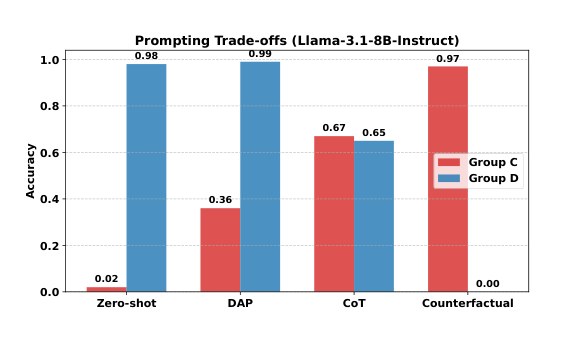
Figure 1: The trade-off in prompting (Llama-3.1). As prompts become more aggressive in targeting bias (Zero-shot Counterfactual), accuracy on Group C improves significantly (Pearson ), while accuracy on Group D declines, though less consistently (). This trade-off illustrates the calibration bias.
图 1:提示中的权衡(Llama-3.1)。随着提示在针对偏置上越来越强(零样本 反事实),C 组准确率显著上升(皮尔逊 ),而 D 组准确率下降,尽管一致性稍弱()。这一权衡说明了校准偏差。
Summary on Different Prompts.
In summary, current LLMs struggle to balance the Imperfective Paradox. They oscillate between two extremes: naive teleology (Zero-shot) where everything is completed, and paranoid skepticism (Counterfactual) where nothing is ever certain (see the trends in Figure 1). This inability to decouple telicity from entailment highlights a critical gap in the true aspectual reasoning capabilities of LLMs.
对各提示的小结。
总的来说,当前 LLM 难以在未完成体悖论上取得平衡。它们在两个极端之间摇摆:天真的目的论(零样本)认定一切都已完成,以及偏执的怀疑(反事实)认为一切都不确定(见图 1 中的趋势)。这种无法把有界性与蕴涵拆开的能力,凸显出 LLM 在真正的体貌推理上的关键缺口。
5.3 Impact of Model Scale
5.3 模型规模的影响
To understand whether aspectual reasoning is a capability that improves linearly with scale or emerges as a distinct skill past a certain threshold, we evaluate the Qwen2.5 family, which showed better performance in §5.1, across five distinct parameter sizes: 1.5B, 7B, 14B, 32B, and 72B. The results, detailed in Table 5 (Appendix) and visualized in Figure 2, reveal that aspectual reasoning follows a distinct trajectory of emergence.
为理解体貌推理是随规模线性改善的能力,还是越过某阈值后才作为一项独立技能涌现,我们评估在 §5.1 中表现较好的 Qwen2.5 系列,覆盖五个不同参数规模:1.5B、7B、14B、32B 和 72B。详细结果见表 5(附录),并在图 2 中可视化,表明体貌推理沿着一条独特的涌现轨迹展开。
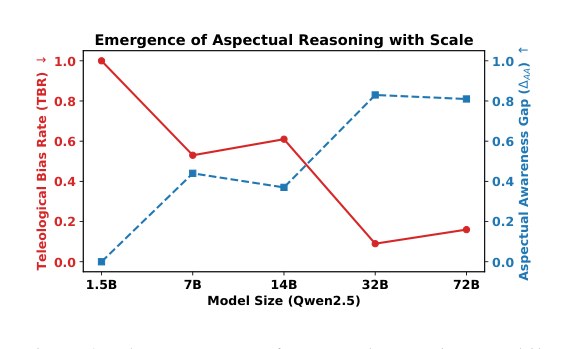
Figure 2: The emergence of aspectual reasoning capabilities across model scales. It shows a significant decrease in TBR and a corresponding increase in .
图 2:体貌推理能力随模型规模的涌现。可以看到 TBR 显著下降,同时 相应上升。
We observe a clear monotonic relationship between model scale and both evaluation metrics. Model size is strongly negatively correlated with Teleological Bias Rate (TBR; ) and strongly positively correlated with the Aspectual Awareness Gap (; ), indicating that increased model capacity systematically reduces teleological overgeneralization while enhancing aspect-sensitive reasoning.
我们观察到模型规模与两项评估指标之间清晰的单调关系。模型大小与目的论偏置率呈强负相关(TBR;),与体貌觉察差距呈强正相关(;),表明容量增大系统性地减少了目的论上的过度泛化,同时增强了对体敏感的推理。
The 1.5B model exhibits a complete inability to handle the Imperfective Paradox. With a TBR of and a of , it treats every progressive verb as an entailed completion. As model scale increases, a dramatic “phase shift” (Wei et al., 2022a) is observed, especially at the 32B level: Accuracy on Group C surges to , and the peaks at . This suggests that robust aspectual distinction, the ability to selectively inhibit the entailment for telic verbs while maintaining it for atelic ones, is an emergent ability. Although the 72B model maintains strong performance, decreases slightly to 0.81, suggesting a potential saturation or optimization bottleneck rather than further qualitative gains. Overall, these results indicate that aspectual understanding improves with scale and exhibits non-linear emergence characteristics rather than linear scaling.
1.5B 模型完全无法处理未完成体悖论。TBR 为 , 为 ,它把每一个进行体动词都当作已完成的蕴涵。随着规模增大,可以观察到剧烈的“相变”(Wei et al., 2022a),在 32B 层级尤其明显:C 组准确率升至 , 达到峰值 。这表明稳健的体貌区分——有选择地抑制有界动词上的蕴涵,同时对无界动词加以保持——是一种涌现能力。72B 模型仍保持较强表现,但 略降至 0.81,暗示可能出现饱和或优化瓶颈,而不是进一步的质性提升。总体而言,这些结果表明体貌理解会随规模改善,并表现出非线性涌现特征,而不是线性缩放。
5.4 Fine-grained Analysis on Verb Semantics
5.4 对动词语义的细粒度分析
Do all telic verb classes trigger the same degree of teleological bias? To answer this, we disaggregate the performance on Group A and Group C based on the four semantic sub-classes defined in §3: Creation, Consumption, Change of State, and Motion to Goal. Figure 3 visualizes the average accuracy across all evaluated models in the zero-shot setting. Detailed results for each model as well as for other prompt settings can be found in Appendix E.
是否所有有界动词类别都会触发同等程度的目的论偏置?为回答这一点,我们按 §3 中定义的四个语义子类——创造、消耗、状态变化和趋向目标的位移——分解 A 组与 C 组上的表现。图 3 可视化了所有评估模型在零样本设定下的平均准确率。各模型以及其他提示设定的详细结果见附录 E。
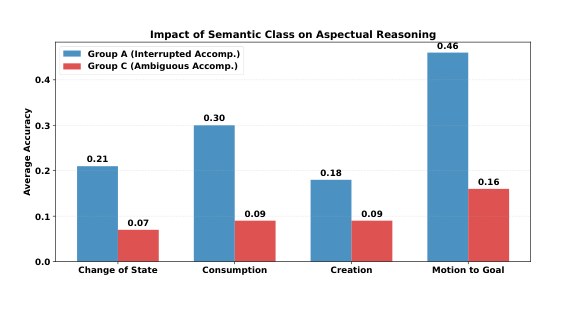
Figure 3: Average accuracy across models by semantic verb classes in Zero-shot. Motion verbs are consistently easier for models to reason about, while Creation verbs induce strong teleological bias (low accuracy in Group C) and resistance to contextual cancellation (lowest accuracy in Group A).
图 3:零样本下按语义动词类别、跨模型的平均准确率。位移动词始终更容易被模型推理对,而创造动词会诱发强烈的目的论偏置(C 组准确率低),并且抗拒语境中的取消信息(A 组准确率最低)。
The Resilience of Motion vs. The Creation Penalty.
We observe a significant semantic divergence. Verbs of Motion to Goal (e.g., “cross”) consistently yield the highest performance. In Group A, the average accuracy for Motion to Goal verbs is , significantly outperforming Creation () and Change of State (). The performance gap is substantial: in Group A and in Group C.[^4]
位移的韧性与创造的惩罚。
我们观察到显著的语义分歧。趋向目标的位移动词(例如 “cross”)始终给出最高表现。在 A 组中,趋向目标的位移动词的平均准确率为 ,明显超过创造()和状态变化()。表现差距相当大:A 组中 ,C 组中约为 。[^4]
We hypothesize that this stems from the nature of the resultative state. For Creation verbs (e.g., “build”), the result involves the existential realization of an object. This explicit “coming into being” appears to act as a stronger attractor in the language model’s predictive distribution than a mere change in spatial coordinates involved in Motion. Consequently, models exhibit higher resistance to negation when an artifact’s existence is at stake.
我们假设这源于结果状态的性质。对创造动词(例如 “build”),结果涉及一个对象在存在上的实现。这种明确的“进入存在”,在语言模型的预测分布中,似乎比位移所涉及的单纯空间坐标变化更强的吸引子。因此,当一件制品的存在处于紧要关头时,模型对否定表现出更高的抗拒。
Representational Analysis: Encoding vs. Inference.
Does teleological bias reflect a failure to distinguish process from result in the model’s internal representations, or does it arise later, at the point of inference? In order to probe this, we measured the cosine similarity between contextual embeddings of progressive (e.g., “was building”) and perfective (e.g., “built”) verb phrases using bert-base-uncased (Devlin et al., 2019), mean-pooled over the word pieces of each verb phrase, treating similarity as a proxy for how well an encoder separates the two aspectual forms.
表征分析:编码对推理。
目的论偏置反映的是模型内部表征未能区分过程与结果,还是出现在更靠后的推理环节?为探测这一点,我们用 bert-base-uncased(Devlin et al., 2019)测量进行体(例如 “was building”)与完成体(例如 “built”)动词短语的语境嵌入之间的余弦相似度,在每个动词短语的子词上做均值池化,并把相似度当作编码器分离两种体貌形式的代理。
(a) Cosine similarity (Process vs. Result).
(b) Similarity vs. TBRC (Zero-shot).
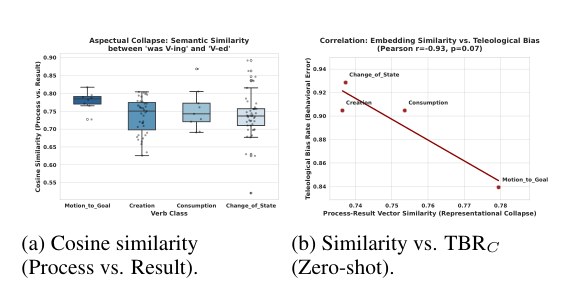
Figure 4: Representational vs. Behavioral Divergence.
(a) 余弦相似度(过程对结果)。
(b) 相似度与 TBRC(零样本)。
图 4:表征与行为的分歧。
Figure 4 reveals an inverse relationship (Pearson ) between how similarly the progressive and perfective forms of a verb are encoded, and how strongly models hallucinate completion for that verb class. Crucially, this relationship runs in the opposite direction from what a simple confusion account would predict. Motion to Goal verbs show relatively higher similarity (median 0.78), meaning “was crossing” and “crossed” are encoded similarly; yet models reason about them most accurately (with TBRC being the lowest). Creation verbs show only slightly lower similarity (median 0.75), meaning the encoder does distinguish “was building” from “built”; yet these verbs trigger higher hallucination rates (with TBRC being higher).
图 4 揭示了一种反向关系(皮尔逊 ):一个动词的进行体与完成体被编码得越相似,模型对该动词类别幻想出完成的程度就越强。关键的是,这一关系与简单的混淆解释所预测的方向相反。趋向目标的位移动词表现出相对更高的相似度(中位数 0.78),意味着 “was crossing” 与 “crossed” 被编码得较接近;然而模型对它们的推理最准确(TBRC 最低)。创造动词的相似度只略低(中位数 0.75),意味着编码器确实区分了 “was building” 与 “built”;然而这些动词触发了更高的幻觉率(TBRC 更高)。
This dissociation suggests that the bias does not stem from the model failing to encode the aspectual distinction. If it did, we would expect high similarity to correlate with high error, but we observe the opposite trend. Instead, even when the representation separates process from result, the inference step is overridden by a strong prior that Creation events reach their goal. The difference between “was building” and “built” is encoded, but models still predict completion, because their training has instilled a robust expectation that construction projects succeed. We therefore hypothesize that Teleological Bias is not a failure of perception (encoding), but a failure of reasoning (decoding): the model’s decoding process is captured by world-knowledge priors rather than guided by the logical content of the input.
这一分离表明,偏置并非源于模型未能编码体貌区分。若是那样,我们会预期高相似度与高错误相关,但我们观察到的是相反趋势。相反,即便表征已经把过程与结果分开,推理步骤仍会被“创造事件终将达成目标”的强先验所覆盖。“was building” 与 “built” 的差异已被编码,模型却仍预测完成,因为训练给它们灌输了“建设项目总会成功”的稳健预期。我们因此假设,目的论偏置不是感知(编码)的失败,而是推理(解码)的失败:模型的解码过程被世界知识先验俘获,而不是由输入的逻辑内容所引导。
6 Conclusion
6 结论
In this work, we evaluated and discovered the Teleological Bias in LLMs using our diagnostic dataset, ImperfectiveNLI. Our findings indicate that current models fundamentally struggle to resolve the Imperfective Paradox, frequently conflating the process of a telic event with its culmination. Our investigation into prompting strategies reveals a critical calibration crisis, finding that while some strategies reduce overconfident or hallucinated predictions, they can also make models overly cautious, causing them to reject correct entailments. Meanwhile, this aspectual understanding can improve with model scale unevenly. Furthermore, our analysis suggests that this bias is not merely a representational deficit but a decision-time failure: while internal embeddings often distinguish between process and result, strong probabilistic priors regarding goal attainment override these signals during inference. We conclude that solving aspectual reasoning requires moving beyond inference-time prompting toward aligning models to structurally respect the internal logical boundaries of event semantics. We hope that ImperfectiveNLI provides a foundation for future work on targeted alignment training, cross-lingual aspectual reasoning, and the broader challenge of teaching LLMs to respect formal semantic boundaries.
本文用诊断数据集 ImperfectiveNLI 评估并发现了 LLM 中的目的论偏置。结果表明,当前模型从根本上难以化解未完成体悖论,常常把有界事件的过程与其完成混为一谈。对提示策略的考察揭示了严峻的校准危机:有些策略可以减少过度自信或幻想出的预测,却也可能使模型过分谨慎,从而拒绝正确的蕴涵。与此同时,这种体貌理解可以随模型规模改善,但不均匀。此外,我们的分析表明,这一偏置并不只是表征上的不足,而是决策时刻的失败:内部嵌入往往能够区分过程与结果,但关于目标达成的强概率先验会在推理时覆盖这些信号。我们的结论是,要解决体貌推理,需要超越推理时的提示,转向让模型在结构上尊重事件语义的内在逻辑边界。希望 ImperfectiveNLI 能为后续的定向对齐训练、跨语言体貌推理,以及更广义地教会 LLM 尊重形式语义边界,提供一个基础。
7 Limitations
7 局限
While our work offers important insights into the imperfective paradox with the teleological bias of LLMs, we acknowledge several limitations that define the scope of our findings and point towards future research directions.
尽管本工作对未完成体悖论以及 LLM 的目的论偏置提供了重要认识,我们也承认若干局限,它们界定了发现的范围,并指向未来的研究方向。
Ecological Validity and Syntactic Diversity.
To strictly isolate the variable of aspectual telicity, we employed a template-based approach to construct ImperfectiveNLI. While this ensures high internal validity and precise minimal-pair comparisons, it sacrifices lexical and syntactic diversity. Real-world language usage often includes complex discourse markers, temporal adjuncts (e.g., “for an hour” vs. “in an hour”), and pragmatic cues that constrain interpretation to express aspectuality Zhang (1995). Consequently, our controlled setup likely overestimates model competence relative to naturalistic settings; handling the imperfective paradox in messier, more complex narratives may prove considerably more challenging.
生态效度与句法多样性。
为严格隔离体貌有界性这一变量,我们采用基于模板的方法构造 ImperfectiveNLI。这保证了较高的内部效度和精确的最小对比较,却牺牲了词汇与句法的多样性。真实语言使用常常包含复杂的话语标记、时间附加语(例如 “for an hour” 对 “in an hour”),以及约束解读、表达体貌的语用线索(Zhang, 1995)。因此,相对于更自然的场景,我们的受控设定很可能高估了模型能力;在更杂乱、更复杂的叙事中处理未完成体悖论,可能会困难得多。
Linguistic Specificity.
Our study focuses exclusively on English, a language that marks the progressive aspect periphrastically (via auxiliary “be” + “-ing”). However, aspect is a typologically diverse category. For instance, Slavic languages mark aspect morphologically (aspect prefixes), while Mandarin Chinese uses aspectual particles. Since LLM tokenizers and representations vary across languages, it remains an open question whether the teleological bias is a universal cognitive artifact of Transformers or an artifact of English-centric pre-training data. Meanwhile, in human cognitive studies, research demonstrates that the conceptualization of event semantics differs fundamentally between aspect languages (those with grammaticalized aspect markers, e.g., English, Chinese, Russian) and non-aspect languages (e.g., German) von Stutterheim et al. (2012); Flecken et al. (2014). Consequently, extending this investigation to a cross-lingual and typological framework represents a vital direction for future research.
语言上的特定性。
本研究只关注英语,英语用迂回形式标记进行体(助动词 “be” + “-ing”)。然而体在类型学上是多样的。例如,斯拉夫语从形态上标记体(体前缀),普通话则使用体貌助词。由于 LLM 的分词器与表征随语言而异,目的论偏置究竟是 Transformer 普遍的认知产物,还是以英语为中心的预训练数据的产物,仍是开放问题。与此同时,在人类认知研究中,已有工作表明,有体语言(具有语法化体标记的语言,例如英语、汉语、俄语)与无体语言(例如德语)对事件语义的概念化有根本差异(von Stutterheim et al., 2012; Flecken et al., 2014)。因此,把这一考察扩展到跨语言与类型学框架,是未来研究的重要方向。
Theoretical Linguistics vs. Human Judgments.
Since our paper focuses on the theoretical concepts of imperfective paradox, we note potential divergence between theoretical labels and empirical human judgments. As the first study systematically investigating the Imperfective Paradox in LLMs, our primary objective was to characterize the teleological bias, the models’ tendency to hallucinate completion, based on established theoretical semantics. While we focus here on establishing this bias in models, we wish to note that exploring the fine-grained nuances of human perception in these contexts is a vital next step.
理论语言学与人类判断。
由于本文聚焦未完成体悖论的理论概念,我们注意到理论标签与经验性的人类判断之间可能存在分歧。作为系统考察 LLM 中未完成体悖论的第一项研究,我们的首要目标是依据既有的理论语义,刻画目的论偏置,即模型幻想出完成的倾向。我们在此着重于确立模型中的这一偏置,同时也希望指出,探索这些语境中人类感知的细微差别,是接下来的重要一步。
Inference-Only Interventions.
Our mitigation strategies were limited to inference-time prompting (CoT, Counterfactuals). While we identified the performance trade-offs as a side effect of these prompts, we did not explore parameter-efficient fine-tuning (PEFT) or activation steering techniques to permanently alter the model’s internal aspectual representations. Future work should investigate whether the “dissociation” between representation and reasoning can be bridged through targeted alignment training rather than transient prompting.
仅限于推理阶段的干预。
我们的缓解策略仅限于推理时提示(思维链、反事实)。虽然我们把性能权衡识别为这些提示的副作用,但并未探索参数高效微调(PEFT)或激活引导等技术,以永久改变模型内部的体貌表征。未来工作应考察,表征与推理之间的“分离”能否通过定向对齐训练,而不是短暂的提示来弥合。
Scope of World Knowledge.
Finally, our semantic analysis focused on four broad classes of telic verbs. We did not model the granularity of “script knowledge” (Schank and Abelson, 1977; Lyu et al., 2021). For example, the probability of interruption varies by event type (e.g., “building a house” takes months and is prone to interruption, whereas “drawing a circle” takes seconds). Current models may rely on these latent temporal priors, which our uniform evaluation setup does not explicitly disentangle from grammatical aspect.
世界知识的范围。
最后,我们的语义分析聚焦于有界动词的四个宽泛类别。我们没有对“脚本知识”的粒度建模(Schank and Abelson, 1977; Lyu et al., 2021)。例如,被打断的概率随事件类型而变(“building a house” 需要数月,容易被打断,而 “drawing a circle” 只需数秒)。当前模型可能依赖这些潜在的时间先验,而我们统一的评估设定并未把它与语法体明确拆开。
8 Ethical Considerations
8 伦理考量
Human Subjects for Data Evaluation.
For the human evaluation of sentence quality, we recruited external participants via the Prolific platform. Prior to the task, annotators were fully informed about the study’s scope and provided informed consent. We ensured that no personally identifiable information (PII) was collected. Evaluators were compensated at an hourly rate of £9, exceeding the platform’s recommended minimum and comparable to the local living wage.
用于数据评估的人类受试者。
为评估句子质量,我们通过 Prolific 平台招募外部参与者。任务开始前,标注者充分了解研究范围并给出知情同意。我们确保不收集任何可识别个人身份的信息(PII)。评估者的时薪为 9 英镑,高于平台建议的最低标准,并与当地生活工资相当。
Artifact Usage.
Regarding the curated artifacts, we release the ImperfectiveNLI dataset under the Creative Commons Attribution-NonCommercial 4.0 International License (CC BY-NC 4.0). This license explicitly permits the distribution and use of the dataset for research purposes. We confirm that our use of these existing artifacts is consistent with their intended academic use, and our derivative dataset is released with the strict specification that it be used solely within research contexts, ensuring compatibility with the original access conditions. The dataset contains no harmful or offensive content.
产物的使用。
关于整理后的产物,我们以知识共享署名–非商业性使用 4.0 国际许可协议(CC BY-NC 4.0)发布 ImperfectiveNLI 数据集。该许可明确允许为研究目的分发和使用数据集。我们确认,对这些既有产物的使用符合其原定的学术用途,派生数据集在发布时也严格限定仅用于研究情境,从而与原先的访问条件相容。数据集不含有害或冒犯性内容。
Use of AI Assistants.
As described in Section 3, we used Gemini to assist in the initial generation and curation of the dataset. To ensure data quality and mitigate potential machine artifacts, all generated instances underwent rigorous manual verification and refinement by three native English speakers (see validation details in Section 3 and Appendix C).
AI 助手的使用。
如第 3 节所述,我们使用 Gemini 辅助数据集的初始生成与整理。为确保数据质量并减少可能的机器痕迹,所有生成实例都经过三位英语母语者的严格人工核验与修改(验证细节见第 3 节与附录 C)。
Regarding the manuscript and experimental code, we acknowledge the use of ChatGPT solely for grammatical correction, stylistic polishing, and assistance with preliminary coding routines. The authors verified all AI-assisted outputs and bear full responsibility for the accuracy and originality of the content presented in this work.
关于手稿与实验代码,我们承认仅将 ChatGPT 用于语法修正、文风润色,以及协助初步编码例程。作者核验了所有 AI 辅助输出,并对本文内容的准确性与原创性负全部责任。
Acknowledgments
致谢
This publication was supported by LMUexcellent, funded by the Federal Ministry of Research, Technology and Space (BMFTR) and the Free State of Bavaria under the Excellence Strategy of the German Federal Government and the Länder.
本出版物得到 LMUexcellent 的支持,由联邦研究、技术与空间部(BMFTR)以及巴伐利亚自由州依据德国联邦政府与各州的卓越战略提供资金。
We also thank Max Müller-Eberstein for valuable discussions and insightful exchanges related to this project.
我们也感谢 Max Müller-Eberstein 与本项目相关的宝贵讨论和富有启发的交流。
References
参考文献
AI et al. (2025) 01. AI, :, A. Young, B. Chen, C. Li, C. Huang, G. Zhang, G. Zhang, G. Wang, H. Li, J. Zhu, J. Chen, J. Chang, K. Yu, P. Liu, Q. Liu, S. Yue, S. Yang, S. Yang, W. Xie, W. Huang, X. Hu, X. Ren, X. Niu, P. Nie, Y. Li, Y. Xu, Y. Liu, Y. Wang, Y. Cai, Z. Gu, Z. Liu, and Z. Dai Yi: open foundation models by 01.ai . External Links: 2403.04652 , Link Cited by: §4.1 .
Beavers and Koontz-Garboden (2012) J. Beavers and A. Koontz-Garboden Manner and result in the roots of verbal meaning . Linguistic Inquiry 43 ( 3 ), pp. 331–369 . External Links: ISSN 0024-3892 , Document , Link , https://direct.mit.edu/ling/article-pdf/43/3/331/725079/ling_a_00093.pdf Cited by: §3 .
Beavers (2010) J. Beavers The structure of lexical meaning: why semantics really matters . Language 86 ( 4 ), pp. 821–864 . External Links: ISSN 1535-0665 , Link Cited by: §3 .
Bender et al. (2021) E. M. Bender, T. Gebru, A. McMillan-Major, and S. Shmitchell On the dangers of stochastic parrots: can language models be too big? . In Proceedings of the 2021 ACM Conference on Fairness, Accountability, and Transparency , FAccT ’21 , New York, NY, USA , pp. 610–623 . External Links: ISBN 9781450383097 , Link , Document Cited by: §1 .
Bennett and Partee (1978) M. Bennett and B. H. Partee Toward the logic of tense and aspect in english . IU Linguistics Club , Indiana University Linguistics Club . External Links: Link Cited by: §1 , §2.2 , §5.1 .
Bowman et al. (2015) S. R. Bowman, G. Angeli, C. Potts, and C. D. Manning A large annotated corpus for learning natural language inference . In Proceedings of the 2015 Conference on Empirical Methods in Natural Language Processing , L. Màrquez, C. Callison-Burch, and J. Su (Eds.) , Lisbon, Portugal , pp. 632–642 . External Links: Link , Document Cited by: §3 .
Brown et al. (2020) T. Brown, B. Mann, N. Ryder, M. Subbiah, J. D. Kaplan, P. Dhariwal, A. Neelakantan, P. Shyam, G. Sastry, A. Askell, S. Agarwal, A. Herbert-Voss, G. Krueger, T. Henighan, R. Child, A. Ramesh, D. Ziegler, J. Wu, C. Winter, C. Hesse, M. Chen, E. Sigler, M. Litwin, S. Gray, B. Chess, J. Clark, C. Berner, S. McCandlish, A. Radford, I. Sutskever, and D. Amodei Language models are few-shot learners . In Advances in Neural Information Processing Systems , H. Larochelle, M. Ranzato, R. Hadsell, M.F. Balcan, and H. Lin (Eds.) , Vol. 33 , pp. 1877–1901 . External Links: Link Cited by: §1 .
Chen et al. (2022) Y. Chen, Z. Song, X. Wu, D. Wang, J. Xu, J. Chen, H. Zhou, and L. Li MTG: a benchmark suite for multilingual text generation . In Findings of the Association for Computational Linguistics: NAACL 2022 , M. Carpuat, M. de Marneffe, and I. V. Meza Ruiz (Eds.) , Seattle, United States , pp. 2508–2527 . External Links: Link , Document Cited by: Appendix C .
Comrie (1976) B. Comrie Aspect . Cambridge Textbooks in Linguistics , Cambridge University Press , Cambridge . Cited by: §1 , §2.2 .
DeepSeek-AI (2024) DeepSeek-AI DeepSeek-v3 technical report . External Links: 2412.19437 , Link Cited by: §4.1 .
Devlin et al. (2019) J. Devlin, M. Chang, K. Lee, and K. Toutanova BERT: pre-training of deep bidirectional transformers for language understanding . In Proceedings of the 2019 Conference of the North American Chapter of the Association for Computational Linguistics: Human Language Technologies, Volume 1 (Long and Short Papers) , J. Burstein, C. Doran, and T. Solorio (Eds.) , Minneapolis, Minnesota , pp. 4171–4186 . External Links: Link , Document Cited by: §5.4 .
Dowty (1977) D. R. Dowty Toward a semantic analysis of verb aspect and the english ‘imperfective’ progressive . Linguistics and Philosophy 1 ( 1 ), pp. 45–77 . External Links: Document , Link , ISSN 1573-0549 Cited by: §1 , §2.2 , §4.2 .
Dowty (1979) D. R. Dowty Word meaning and montague grammar . 1 edition , Studies in Linguistics and Philosophy , Springer Dordrecht . External Links: Document , Link , ISBN 978-90-277-1008-6 , ISBN 978-90-277-1009-3 , ISBN 978-94-009-9473-7 Cited by: §1 .
Dziri et al. (2023) N. Dziri, X. Lu, M. Sclar, X. (. Li, L. Jiang, B. Y. Lin, S. Welleck, P. West, C. Bhagavatula, R. Le Bras, J. Hwang, S. Sanyal, X. Ren, A. Ettinger, Z. Harchaoui, and Y. Choi Faith and fate: limits of transformers on compositionality . In Advances in Neural Information Processing Systems , A. Oh, T. Naumann, A. Globerson, K. Saenko, M. Hardt, and S. Levine (Eds.) , Vol. 36 , pp. 70293–70332 . External Links: Link Cited by: §1 , §5.2 .
Ettinger (2020) A. Ettinger What BERT is not: lessons from a new suite of psycholinguistic diagnostics for language models . Transactions of the Association for Computational Linguistics 8 , pp. 34–48 . External Links: Link , Document Cited by: §5.1 .
Farquhar et al. (2024) S. Farquhar, J. Kossen, L. Kuhn, and Y. Gal Detecting hallucinations in large language models using semantic entropy . Nature 630 ( 8017 ), pp. 625–630 . External Links: Document , Link , ISSN 1476-4687 Cited by: §1 .
Feinstein and Cicchetti (1990) A. R. Feinstein and D. V. Cicchetti High agreement but low kappa: i. the problems of two paradoxes . Journal of Clinical Epidemiology 43 ( 6 ), pp. 543–549 . External Links: ISSN 0895-4356 , Document , Link Cited by: Appendix C .
Filip (2008) H. Filip Events and maximalization: the case of telicity and perfectivity . In Theoretical and Crosslinguistic Approaches to the Semantics of Aspect , S. D. Rothstein (Ed.) , pp. 110–217 . External Links: Document Cited by: §2.1 .
Flecken et al. (2014) M. Flecken, C. von Stutterheim, and M. Carroll Grammatical aspect influences motion event perception: findings from a cross- linguistic non-verbal recognition task . Language and Cognition 6 ( 1 ), pp. 45–78 . External Links: Document Cited by: §7 .
Friedrich and Gateva (2017) A. Friedrich and D. Gateva Classification of telicity using cross-linguistic annotation projection . In Proceedings of the 2017 Conference on Empirical Methods in Natural Language Processing , M. Palmer, R. Hwa, and S. Riedel (Eds.) , Copenhagen, Denmark , pp. 2559–2565 . External Links: Link , Document Cited by: §2.3 .
Friedrich et al. (2016) A. Friedrich, A. Palmer, and M. Pinkal Situation entity types: automatic classification of clause-level aspect . In Proceedings of the 54th Annual Meeting of the Association for Computational Linguistics (Volume 1: Long Papers) , K. Erk and N. A. Smith (Eds.) , Berlin, Germany , pp. 1757–1768 . External Links: Link , Document Cited by: §2.3 .
Friedrich and Palmer (2014) A. Friedrich and A. Palmer Automatic prediction of aspectual class of verbs in context . In Proceedings of the 52nd Annual Meeting of the Association for Computational Linguistics (Volume 2: Short Papers) , K. Toutanova and H. Wu (Eds.) , Baltimore, Maryland , pp. 517–523 . External Links: Link , Document Cited by: §2.3 .
Friedrich and Pinkal (2015) A. Friedrich and M. Pinkal Automatic recognition of habituals: a three-way classification of clausal aspect . In Proceedings of the 2015 Conference on Empirical Methods in Natural Language Processing , L. Màrquez, C. Callison-Burch, and J. Su (Eds.) , Lisbon, Portugal , pp. 2471–2481 . External Links: Link , Document Cited by: §2.3 .
Friedrich et al. (2023) A. Friedrich, N. Xue, and A. Palmer A kind introduction to lexical and grammatical aspect, with a survey of computational approaches . In Proceedings of the 17th Conference of the European Chapter of the Association for Computational Linguistics , A. Vlachos and I. Augenstein (Eds.) , Dubrovnik, Croatia , pp. 599–622 . External Links: Link , Document Cited by: §1 , §2.3 .
GLM et al. (2024) T. GLM, :, A. Zeng, B. Xu, B. Wang, C. Zhang, D. Yin, D. Zhang, D. Rojas, G. Feng, H. Zhao, H. Lai, H. Yu, H. Wang, J. Sun, J. Zhang, J. Cheng, J. Gui, J. Tang, J. Zhang, J. Sun, J. Li, L. Zhao, L. Wu, L. Zhong, M. Liu, M. Huang, P. Zhang, Q. Zheng, R. Lu, S. Duan, S. Zhang, S. Cao, S. Yang, W. L. Tam, W. Zhao, X. Liu, X. Xia, X. Zhang, X. Gu, X. Lv, X. Liu, X. Liu, X. Yang, X. Song, X. Zhang, Y. An, Y. Xu, Y. Niu, Y. Yang, Y. Li, Y. Bai, Y. Dong, Z. Qi, Z. Wang, Z. Yang, Z. Du, Z. Hou, and Z. Wang ChatGLM: a family of large language models from glm-130b to glm-4 all tools . External Links: 2406.12793 , Link Cited by: §4.1 .
Gordon and Van Durme (2013) J. Gordon and B. Van Durme Reporting bias and knowledge acquisition . In Proceedings of the 2013 Workshop on Automated Knowledge Base Construction , AKBC ’13 , New York, NY, USA , pp. 25–30 . External Links: ISBN 9781450324113 , Link , Document Cited by: §1 .
Grattafiori et al. (2024) A. Grattafiori, A. Dubey, A. Jauhri, A. Pandey, A. Kadian, A. Al-Dahle, A. Letman, A. Mathur, A. Schelten, A. Vaughan, A. Yang, A. Fan, A. Goyal, A. Hartshorn, A. Yang, A. Mitra, A. Sravankumar, A. Korenev, A. Hinsvark, A. Rao, A. Zhang, A. Rodriguez, A. Gregerson, A. Spataru, B. Roziere, B. Biron, B. Tang, B. Chern, C. Caucheteux, C. Nayak, C. Bi, C. Marra, C. McConnell, C. Keller, C. Touret, C. Wu, C. Wong, C. C. Ferrer, C. Nikolaidis, D. Allonsius, D. Song, D. Pintz, D. Livshits, D. Wyatt, D. Esiobu, D. Choudhary, D. Mahajan, D. Garcia-Olano, D. Perino, D. Hupkes, E. Lakomkin, E. AlBadawy, E. Lobanova, E. Dinan, E. M. Smith, F. Radenovic, F. Guzmán, F. Zhang, G. Synnaeve, G. Lee, G. L. Anderson, G. Thattai, G. Nail, G. Mialon, G. Pang, G. Cucurell, H. Nguyen, H. Korevaar, H. Xu, H. Touvron, I. Zarov, I. A. Ibarra, I. Kloumann, I. Misra, I. Evtimov, J. Zhang, J. Copet, J. Lee, J. Geffert, J. Vranes, J. Park, J. Mahadeokar, J. Shah, J. van der Linde, J. Billock, J. Hong, J. Lee, J. Fu, J. Chi, J. Huang, J. Liu, J. Wang, J. Yu, J. Bitton, J. Spisak, J. Park, J. Rocca, J. Johnstun, J. Saxe, J. Jia, K. V. Alwala, K. Prasad, K. Upasani, K. Plawiak, K. Li, K. Heafield, K. Stone, K. El-Arini, K. Iyer, K. Malik, K. Chiu, K. Bhalla, K. Lakhotia, L. Rantala-Yeary, L. van der Maaten, L. Chen, L. Tan, L. Jenkins, L. Martin, L. Madaan, L. Malo, L. Blecher, L. Landzaat, L. de Oliveira, M. Muzzi, M. Pasupuleti, M. Singh, M. Paluri, M. Kardas, M. Tsimpoukelli, M. Oldham, M. Rita, M. Pavlova, M. Kambadur, M. Lewis, M. Si, M. K. Singh, M. Hassan, N. Goyal, N. Torabi, N. Bashlykov, N. Bogoychev, N. Chatterji, N. Zhang, O. Duchenne, O. Çelebi, P. Alrassy, P. Zhang, P. Li, P. Vasic, P. Weng, P. Bhargava, P. Dubal, P. Krishnan, P. S. Koura, P. Xu, Q. He, Q. Dong, R. Srinivasan, R. Ganapathy, R. Calderer, R. S. Cabral, R. Stojnic, R. Raileanu, R. Maheswari, R. Girdhar, R. Patel, R. Sauvestre, R. Polidoro, R. Sumbaly, R. Taylor, R. Silva, R. Hou, R. Wang, S. Hosseini, S. Chennabasappa, S. Singh, S. Bell, S. S. Kim, S. Edunov, S. Nie, S. Narang, S. Raparthy, S. Shen, S. Wan, S. Bhosale, S. Zhang, S. Vandenhende, S. Batra, S. Whitman, S. Sootla, S. Collot, S. Gururangan, S. Borodinsky, T. Herman, T. Fowler, T. Sheasha, T. Georgiou, T. Scialom, T. Speckbacher, T. Mihaylov, T. Xiao, U. Karn, V. Goswami, V. Gupta, V. Ramanathan, V. Kerkez, V. Gonguet, V. Do, V. Vogeti, V. Albiero, V. Petrovic, W. Chu, W. Xiong, W. Fu, W. Meers, X. Martinet, X. Wang, X. Wang, X. E. Tan, X. Xia, X. Xie, X. Jia, X. Wang, Y. Goldschlag, Y. Gaur, Y. Babaei, Y. Wen, Y. Song, Y. Zhang, Y. Li, Y. Mao, Z. D. Coudert, Z. Yan, Z. Chen, Z. Papakipos, A. Singh, A. Srivastava, A. Jain, A. Kelsey, A. Shajnfeld, A. Gangidi, A. Victoria, A. Goldstand, A. Menon, A. Sharma, A. Boesenberg, A. Baevski, A. Feinstein, A. Kallet, A. Sangani, A. Teo, A. Yunus, A. Lupu, A. Alvarado, A. Caples, A. Gu, A. Ho, A. Poulton, A. Ryan, A. Ramchandani, A. Dong, A. Franco, A. Goyal, A. Saraf, A. Chowdhury, A. Gabriel, A. Bharambe, A. Eisenman, A. Yazdan, B. James, B. Maurer, B. Leonhardi, B. Huang, B. Loyd, B. D. Paola, B. Paranjape, B. Liu, B. Wu, B. Ni, B. Hancock, B. Wasti, B. Spence, B. Stojkovic, B. Gamido, B. Montalvo, C. Parker, C. Burton, C. Mejia, C. Liu, C. Wang, C. Kim, C. Zhou, C. Hu, C. Chu, C. Cai, C. Tindal, C. Feichtenhofer, C. Gao, D. Civin, D. Beaty, D. Kreymer, D. Li, D. Adkins, D. Xu, D. Testuggine, D. David, D. Parikh, D. Liskovich, D. Foss, D. Wang, D. Le, D. Holland, E. Dowling, E. Jamil, E. Montgomery, E. Presani, E. Hahn, E. Wood, E. Le, E. Brinkman, E. Arcaute, E. Dunbar, E. Smothers, F. Sun, F. Kreuk, F. Tian, F. Kokkinos, F. Ozgenel, F. Caggioni, F. Kanayet, F. Seide, G. M. Florez, G. Schwarz, G. Badeer, G. Swee, G. Halpern, G. Herman, G. Sizov, Guangyi, Zhang, G. Lakshminarayanan, H. Inan, H. Shojanazeri, H. Zou, H. Wang, H. Zha, H. Habeeb, H. Rudolph, H. Suk, H. Aspegren, H. Goldman, H. Zhan, I. Damlaj, I. Molybog, I. Tufanov, I. Leontiadis, I. Veliche, I. Gat, J. Weissman, J. Geboski, J. Kohli, J. Lam, J. Asher, J. Gaya, J. Marcus, J. Tang, J. Chan, J. Zhen, J. Reizenstein, J. Teboul, J. Zhong, J. Jin, J. Yang, J. Cummings, J. Carvill, J. Shepard, J. McPhie, J. Torres, J. Ginsburg, J. Wang, K. Wu, K. H. U, K. Saxena, K. Khandelwal, K. Zand, K. Matosich, K. Veeraraghavan, K. Michelena, K. Li, K. Jagadeesh, K. Huang, K. Chawla, K. Huang, L. Chen, L. Garg, L. A, L. Silva, L. Bell, L. Zhang, L. Guo, L. Yu, L. Moshkovich, L. Wehrstedt, M. Khabsa, M. Avalani, M. Bhatt, M. Mankus, M. Hasson, M. Lennie, M. Reso, M. Groshev, M. Naumov, M. Lathi, M. Keneally, M. Liu, M. L. Seltzer, M. Valko, M. Restrepo, M. Patel, M. Vyatskov, M. Samvelyan, M. Clark, M. Macey, M. Wang, M. J. Hermoso, M. Metanat, M. Rastegari, M. Bansal, N. Santhanam, N. Parks, N. White, N. Bawa, N. Singhal, N. Egebo, N. Usunier, N. Mehta, N. P. Laptev, N. Dong, N. Cheng, O. Chernoguz, O. Hart, O. Salpekar, O. Kalinli, P. Kent, P. Parekh, P. Saab, P. Balaji, P. Rittner, P. Bontrager, P. Roux, P. Dollar, P. Zvyagina, P. Ratanchandani, P. Yuvraj, Q. Liang, R. Alao, R. Rodriguez, R. Ayub, R. Murthy, R. Nayani, R. Mitra, R. Parthasarathy, R. Li, R. Hogan, R. Battey, R. Wang, R. Howes, R. Rinott, S. Mehta, S. Siby, S. J. Bondu, S. Datta, S. Chugh, S. Hunt, S. Dhillon, S. Sidorov, S. Pan, S. Mahajan, S. Verma, S. Yamamoto, S. Ramaswamy, S. Lindsay, S. Lindsay, S. Feng, S. Lin, S. C. Zha, S. Patil, S. Shankar, S. Zhang, S. Zhang, S. Wang, S. Agarwal, S. Sajuyigbe, S. Chintala, S. Max, S. Chen, S. Kehoe, S. Satterfield, S. Govindaprasad, S. Gupta, S. Deng, S. Cho, S. Virk, S. Subramanian, S. Choudhury, S. Goldman, T. Remez, T. Glaser, T. Best, T. Koehler, T. Robinson, T. Li, T. Zhang, T. Matthews, T. Chou, T. Shaked, V. Vontimitta, V. Ajayi, V. Montanez, V. Mohan, V. S. Kumar, V. Mangla, V. Ionescu, V. Poenaru, V. T. Mihailescu, V. Ivanov, W. Li, W. Wang, W. Jiang, W. Bouaziz, W. Constable, X. Tang, X. Wu, X. Wang, X. Wu, X. Gao, Y. Kleinman, Y. Chen, Y. Hu, Y. Jia, Y. Qi, Y. Li, Y. Zhang, Y. Zhang, Y. Adi, Y. Nam, Yu, Wang, Y. Zhao, Y. Hao, Y. Qian, Y. Li, Y. He, Z. Rait, Z. DeVito, Z. Rosnbrick, Z. Wen, Z. Yang, Z. Zhao, and Z. Ma The llama 3 herd of models . External Links: 2407.21783 , Link Cited by: §4.1 .
Grice (1975) H. P. Grice Logic and conversation . Syntax and Semantics 3 , pp. 41–58 . External Links: Link Cited by: §1 .
Gwet (2008) K. L. Gwet Computing inter-rater reliability and its variance in the presence of high agreement . British Journal of Mathematical and Statistical Psychology 61 ( 1 ), pp. 29–48 . External Links: Document , Link , https://bpspsychub.onlinelibrary.wiley.com/doi/pdf/10.1348/000711006X126600 Cited by: Appendix C .
Hermes et al. (2015) J. Hermes, M. Richter, and C. Neuefind Automatic induction of german aspectual verb classes in a distributional framework . In Proceedings of the International Conference of the German Society for Computational Linguistics and Language Technology (GSCL) , External Links: Link Cited by: §2.3 .
Jiang et al. (2023) A. Q. Jiang, A. Sablayrolles, A. Mensch, C. Bamford, D. S. Chaplot, D. de las Casas, F. Bressand, G. Lengyel, G. Lample, L. Saulnier, L. R. Lavaud, M. Lachaux, P. Stock, T. L. Scao, T. Lavril, T. Wang, T. Lacroix, and W. E. Sayed Mistral 7b . External Links: 2310.06825 , Link Cited by: §4.1 .
Kadavath et al. (2022) S. Kadavath, T. Conerly, A. Askell, T. Henighan, D. Drain, E. Perez, N. Schiefer, Z. Hatfield-Dodds, N. DasSarma, E. Tran-Johnson, S. Johnston, S. El-Showk, A. Jones, N. Elhage, T. Hume, A. Chen, Y. Bai, S. Bowman, S. Fort, D. Ganguli, D. Hernandez, J. Jacobson, J. Kernion, S. Kravec, L. Lovitt, K. Ndousse, C. Olsson, S. Ringer, D. Amodei, T. Brown, J. Clark, N. Joseph, B. Mann, S. McCandlish, C. Olah, and J. Kaplan Language models (mostly) know what they know . External Links: 2207.05221 , Link Cited by: §5.2 .
Kapoor et al. (2024) S. Kapoor, N. Gruver, M. Roberts, K. Collins, A. Pal, U. Bhatt, A. Weller, S. Dooley, M. Goldblum, and A. G. Wilson Large language models must be taught to know what they don’t know . In Advances in Neural Information Processing Systems , A. Globerson, L. Mackey, D. Belgrave, A. Fan, U. Paquet, J. Tomczak, and C. Zhang (Eds.) , Vol. 37 , pp. 85932–85972 . External Links: Document , Link Cited by: §5.2 .
Kassner and Schütze (2020) N. Kassner and H. Schütze Negated and misprimed probes for pretrained language models: birds can talk, but cannot fly . In Proceedings of the 58th Annual Meeting of the Association for Computational Linguistics , D. Jurafsky, J. Chai, N. Schluter, and J. Tetreault (Eds.) , Online , pp. 7811–7818 . External Links: Link , Document Cited by: §5.1 .
Kober et al. (2020) T. Kober, M. Alikhani, M. Stone, and M. Steedman Aspectuality across genre: a distributional semantics approach . In Proceedings of the 28th International Conference on Computational Linguistics , D. Scott, N. Bel, and C. Zong (Eds.) , Barcelona, Spain (Online) , pp. 4546–4562 . External Links: Link , Document Cited by: §2.3 .
Leiss (1992) E. Leiss Die verbalkategorien des deutschen . De Gruyter , Berlin, Boston . External Links: Link , Document , ISBN 9783110883541 Cited by: §1 .
Levin (1993) B. Levin English verb classes and alternations: a preliminary investigation . University of Chicago Press . External Links: ISBN 9780226475332 , LCCN lc92042504 , Link Cited by: §3 .
Lyu et al. (2021) Q. Lyu, L. Zhang, and C. Callison-Burch Goal-oriented script construction . In Proceedings of the 14th International Conference on Natural Language Generation , A. Belz, A. Fan, E. Reiter, and Y. Sripada (Eds.) , Aberdeen, Scotland, UK , pp. 184–200 . External Links: Link , Document Cited by: §7 .
Ma (2024) B. Ma Evaluating lexical aspect with large language models . In Proceedings of the Workshop on Cognitive Modeling and Computational Linguistics , T. Kuribayashi, G. Rambelli, E. Takmaz, P. Wicke, and Y. Oseki (Eds.) , Bangkok, Thailand , pp. 123–131 . External Links: Link , Document Cited by: §2.3 .
Mallen et al. (2023) A. Mallen, A. Asai, V. Zhong, R. Das, D. Khashabi, and H. Hajishirzi When not to trust language models: investigating effectiveness of parametric and non-parametric memories . In Proceedings of the 61st Annual Meeting of the Association for Computational Linguistics (Volume 1: Long Papers) , A. Rogers, J. Boyd-Graber, and N. Okazaki (Eds.) , Toronto, Canada , pp. 9802–9822 . External Links: Link , Document Cited by: §5.1 .
McCoy et al. (2019) R. T. McCoy, E. Pavlick, and T. Linzen Right for the wrong reasons: diagnosing syntactic heuristics in natural language inference . In Proceedings of the 57th Annual Meeting of the Association for Computational Linguistics , A. Korhonen, D. Traum, and L. Màrquez (Eds.) , Florence, Italy , pp. 3428–3448 . External Links: Link , Document Cited by: §5.1 .
Metheniti et al. (2022) E. Metheniti, T. Van De Cruys, and N. Hathout About time: do transformers learn temporal verbal aspect? . In Proceedings of the Workshop on Cognitive Modeling and Computational Linguistics , E. Chersoni, N. Hollenstein, C. Jacobs, Y. Oseki, L. Prévot, and E. Santus (Eds.) , Dublin, Ireland , pp. 88–101 . External Links: Link , Document Cited by: §2.3 .
Moens and Steedman (1988) M. Moens and M. Steedman Temporal ontology and temporal reference . Computational Linguistics 14 ( 2 ), pp. 15–28 . External Links: Link Cited by: §1 .
Parsons (1990) T. Parsons Events in the semantics of english: a study in subatomic semantics . MIT Press . External Links: Link Cited by: §2.2 .
Pruś et al. (2024) K. Pruś, M. Steedman, and A. Lopez Human temporal inferences go beyond aspectual class . In Proceedings of the 18th Conference of the European Chapter of the Association for Computational Linguistics (Volume 1: Long Papers) , Y. Graham and M. Purver (Eds.) , St. Julian’s, Malta , pp. 1913–1923 . External Links: Link , Document Cited by: §2.3 .
Pruś et al. (2025) K. Pruś, M. Steedman, and A. Lopez World knowledge resolves some aspectual ambiguity . In Findings of the Association for Computational Linguistics: ACL 2025 , W. Che, J. Nabende, E. Shutova, and M. T. Pilehvar (Eds.) , Vienna, Austria , pp. 13207–13220 . External Links: Link , Document , ISBN 979-8-89176-256-5 Cited by: §2.3 .
Qwen et al. (2025) Qwen, :, A. Yang, B. Yang, B. Zhang, B. Hui, B. Zheng, B. Yu, C. Li, D. Liu, F. Huang, H. Wei, H. Lin, J. Yang, J. Tu, J. Zhang, J. Yang, J. Yang, J. Zhou, J. Lin, K. Dang, K. Lu, K. Bao, K. Yang, L. Yu, M. Li, M. Xue, P. Zhang, Q. Zhu, R. Men, R. Lin, T. Li, T. Tang, T. Xia, X. Ren, X. Ren, Y. Fan, Y. Su, Y. Zhang, Y. Wan, Y. Liu, Z. Cui, Z. Zhang, and Z. Qiu Qwen2.5 technical report . External Links: 2412.15115 , Link Cited by: §4.1 .
Ramm et al. (2017) A. Ramm, S. Loáiciga, A. Friedrich, and A. Fraser Annotating tense, mood and voice for English, French and German . In Proceedings of ACL 2017, System Demonstrations , M. Bansal and H. Ji (Eds.) , Vancouver, Canada , pp. 1–6 . External Links: Link Cited by: §2.3 .
Schank and Abelson (1977) R. C. Schank and R. P. Abelson Scripts, plans, goals, and understanding: an inquiry into human knowledge structures . 1 edition , Psychology Press , New York . External Links: Document , ISBN 9780203781036 Cited by: §7 .
Siegel and McKeown (2000) E. V. Siegel and K. R. McKeown Learning methods to combine linguistic indicators:improving aspectual classification and revealing linguistic insights . Computational Linguistics 26 ( 4 ), pp. 595–627 . External Links: Link Cited by: §2.3 .
Smith (1997) C. S. Smith The parameter of aspect . 2 edition , Studies in Linguistics and Philosophy , Springer Dordrecht . External Links: Document , Link , ISBN 978-0-7923-4657-9 , ISBN 978-0-7923-4659-3 , ISBN 978-94-011-5606-6 Cited by: §1 , §2.2 .
Stemler (2004) S. E. Stemler A comparison of consensus, consistency, and measurement approaches to estimating interrater reliability . Practical Assessment, Research, and Evaluation 9 ( 1 ), pp. 4 . External Links: Document Cited by: Appendix C .
Talmy (2000) L. Talmy Toward a cognitive semantics, volume 1: concept structuring systems . The MIT Press . External Links: ISBN 9780262284660 , Document , Link Cited by: §3 .
Team et al. (2025) G. Team, R. Anil, S. Borgeaud, J. Alayrac, J. Yu, R. Soricut, J. Schalkwyk, A. M. Dai, A. Hauth, K. Millican, D. Silver, M. Johnson, I. Antonoglou, J. Schrittwieser, A. Glaese, J. Chen, E. Pitler, T. Lillicrap, A. Lazaridou, O. Firat, J. Molloy, M. Isard, P. R. Barham, T. Hennigan, B. Lee, F. Viola, M. Reynolds, Y. Xu, R. Doherty, E. Collins, C. Meyer, E. Rutherford, E. Moreira, K. Ayoub, M. Goel, J. Krawczyk, C. Du, E. Chi, H. Cheng, E. Ni, P. Shah, P. Kane, B. Chan, M. Faruqui, A. Severyn, H. Lin, Y. Li, Y. Cheng, A. Ittycheriah, M. Mahdieh, M. Chen, P. Sun, D. Tran, S. Bagri, B. Lakshminarayanan, J. Liu, A. Orban, F. Güra, H. Zhou, X. Song, A. Boffy, H. Ganapathy, S. Zheng, H. Choe, Á. Weisz, T. Zhu, Y. Lu, S. Gopal, J. Kahn, M. Kula, J. Pitman, R. Shah, E. Taropa, M. A. Merey, M. Baeuml, Z. Chen, L. E. Shafey, Y. Zhang, O. Sercinoglu, G. Tucker, E. Piqueras, M. Krikun, I. Barr, N. Savinov, I. Danihelka, B. Roelofs, A. White, A. Andreassen, T. von Glehn, L. Yagati, M. Kazemi, L. Gonzalez, M. Khalman, J. Sygnowski, A. Frechette, C. Smith, L. Culp, L. Proleev, Y. Luan, X. Chen, J. Lottes, N. Schucher, F. Lebron, A. Rrustemi, N. Clay, P. Crone, T. Kocisky, J. Zhao, B. Perz, D. Yu, H. Howard, A. Bloniarz, J. W. Rae, H. Lu, L. Sifre, M. Maggioni, F. Alcober, D. Garrette, M. Barnes, S. Thakoor, J. Austin, G. Barth-Maron, W. Wong, R. Joshi, R. Chaabouni, D. Fatiha, A. Ahuja, G. S. Tomar, E. Senter, M. Chadwick, I. Kornakov, N. Attaluri, I. Iturrate, R. Liu, Y. Li, S. Cogan, J. Chen, C. Jia, C. Gu, Q. Zhang, J. Grimstad, A. J. Hartman, X. Garcia, T. S. Pillai, J. Devlin, M. Laskin, D. de Las Casas, D. Valter, C. Tao, L. Blanco, A. P. Badia, D. Reitter, M. Chen, J. Brennan, C. Rivera, S. Brin, S. Iqbal, G. Surita, J. Labanowski, A. Rao, S. Winkler, E. Parisotto, Y. Gu, K. Olszewska, R. Addanki, A. Miech, A. Louis, D. Teplyashin, G. Brown, E. Catt, J. Balaguer, J. Xiang, P. Wang, Z. Ashwood, A. Briukhov, A. Webson, S. Ganapathy, S. Sanghavi, A. Kannan, M. Chang, A. Stjerngren, J. Djolonga, Y. Sun, A. Bapna, M. Aitchison, P. Pejman, H. Michalewski, T. Yu, C. Wang, J. Love, J. Ahn, D. Bloxwich, K. Han, P. Humphreys, T. Sellam, J. Bradbury, V. Godbole, S. Samangooei, B. Damoc, A. Kaskasoli, S. M. R. Arnold, V. Vasudevan, S. Agrawal, J. Riesa, D. Lepikhin, R. Tanburn, S. Srinivasan, H. Lim, S. Hodkinson, P. Shyam, J. Ferret, S. Hand, A. Garg, T. L. Paine, J. Li, Y. Li, M. Giang, A. Neitz, Z. Abbas, S. York, M. Reid, E. Cole, A. Chowdhery, D. Das, D. Rogozińska, V. Nikolaev, P. Sprechmann, Z. Nado, L. Zilka, F. Prost, L. He, M. Monteiro, G. Mishra, C. Welty, J. Newlan, D. Jia, M. Allamanis, C. H. Hu, R. de Liedekerke, J. Gilmer, C. Saroufim, S. Rijhwani, S. Hou, D. Shrivastava, A. Baddepudi, A. Goldin, A. Ozturel, A. Cassirer, Y. Xu, D. Sohn, D. Sachan, R. K. Amplayo, C. Swanson, D. Petrova, S. Narayan, A. Guez, S. Brahma, J. Landon, M. Patel, R. Zhao, K. Villela, L. Wang, W. Jia, M. Rahtz, M. Giménez, L. Yeung, J. Keeling, P. Georgiev, D. Mincu, B. Wu, S. Haykal, R. Saputro, K. Vodrahalli, J. Qin, Z. Cankara, A. Sharma, N. Fernando, W. Hawkins, B. Neyshabur, S. Kim, A. Hutter, P. Agrawal, A. Castro-Ros, G. van den Driessche, T. Wang, F. Yang, S. Chang, P. Komarek, R. McIlroy, M. Lučić, G. Zhang, W. Farhan, M. Sharman, P. Natsev, P. Michel, Y. Bansal, S. Qiao, K. Cao, S. Shakeri, C. Butterfield, J. Chung, P. K. Rubenstein, S. Agrawal, A. Mensch, K. Soparkar, K. Lenc, T. Chung, A. Pope, L. Maggiore, J. Kay, P. Jhakra, S. Wang, J. Maynez, M. Phuong, T. Tobin, A. Tacchetti, M. Trebacz, K. Robinson, Y. Katariya, S. Riedel, P. Bailey, K. Xiao, N. Ghelani, L. Aroyo, A. Slone, N. Houlsby, X. Xiong, Z. Yang, E. Gribovskaya, J. Adler, M. Wirth, L. Lee, M. Li, T. Kagohara, J. Pavagadhi, S. Bridgers, A. Bortsova, S. Ghemawat, Z. Ahmed, T. Liu, R. Powell, V. Bolina, M. Iinuma, P. Zablotskaia, J. Besley, D. Chung, T. Dozat, R. Comanescu, X. Si, J. Greer, G. Su, M. Polacek, R. L. Kaufman, S. Tokumine, H. Hu, E. Buchatskaya, Y. Miao, M. Elhawaty, A. Siddhant, N. Tomasev, J. Xing, C. Greer, H. Miller, S. Ashraf, A. Roy, Z. Zhang, A. Ma, A. Filos, M. Besta, R. Blevins, T. Klimenko, C. Yeh, S. Changpinyo, J. Mu, O. Chang, M. Pajarskas, C. Muir, V. Cohen, C. L. Lan, K. Haridasan, A. Marathe, S. Hansen, S. Douglas, R. Samuel, M. Wang, S. Austin, C. Lan, J. Jiang, J. Chiu, J. A. Lorenzo, L. L. Sjösund, S. Cevey, Z. Gleicher, T. Avrahami, A. Boral, H. Srinivasan, V. Selo, R. May, K. Aisopos, L. Hussenot, L. B. Soares, K. Baumli, M. B. Chang, A. Recasens, B. Caine, A. Pritzel, F. Pavetic, F. Pardo, A. Gergely, J. Frye, V. Ramasesh, D. Horgan, K. Badola, N. Kassner, S. Roy, E. Dyer, V. C. Campos, A. Tomala, Y. Tang, D. E. Badawy, E. White, B. Mustafa, O. Lang, A. Jindal, S. Vikram, Z. Gong, S. Caelles, R. Hemsley, G. Thornton, F. Feng, W. Stokowiec, C. Zheng, P. Thacker, Ç. Ünlü, Z. Zhang, M. Saleh, J. Svensson, M. Bileschi, P. Patil, A. Anand, R. Ring, K. Tsihlas, A. Vezer, M. Selvi, T. Shevlane, M. Rodriguez, T. Kwiatkowski, S. Daruki, K. Rong, A. Dafoe, N. FitzGerald, K. Gu-Lemberg, M. Khan, L. A. Hendricks, M. Pellat, V. Feinberg, J. Cobon-Kerr, T. Sainath, M. Rauh, S. H. Hashemi, R. Ives, Y. Hasson, E. Noland, Y. Cao, N. Byrd, L. Hou, Q. Wang, T. Sottiaux, M. Paganini, J. Lespiau, A. Moufarek, S. Hassan, K. Shivakumar, J. van Amersfoort, A. Mandhane, P. Joshi, A. Goyal, M. Tung, A. Brock, H. Sheahan, V. Misra, C. Li, N. Rakićević, M. Dehghani, F. Liu, S. Mittal, J. Oh, S. Noury, E. Sezener, F. Huot, M. Lamm, N. D. Cao, C. Chen, S. Mudgal, R. Stella, K. Brooks, G. Vasudevan, C. Liu, M. Chain, N. Melinkeri, A. Cohen, V. Wang, K. Seymore, S. Zubkov, R. Goel, S. Yue, S. Krishnakumaran, B. Albert, N. Hurley, M. Sano, A. Mohananey, J. Joughin, E. Filonov, T. Kępa, Y. Eldawy, J. Lim, R. Rishi, S. Badiezadegan, T. Bos, J. Chang, S. Jain, S. G. S. Padmanabhan, S. Puttagunta, K. Krishna, L. Baker, N. Kalb, V. Bedapudi, A. Kurzrok, S. Lei, A. Yu, O. Litvin, X. Zhou, Z. Wu, S. Sobell, A. Siciliano, A. Papir, R. Neale, J. Bragagnolo, T. Toor, T. Chen, V. Anklin, F. Wang, R. Feng, M. Gholami, K. Ling, L. Liu, J. Walter, H. Moghaddam, A. Kishore, J. Adamek, T. Mercado, J. Mallinson, S. Wandekar, S. Cagle, E. Ofek, G. Garrido, C. Lombriser, M. Mukha, B. Sun, H. R. Mohammad, J. Matak, Y. Qian, V. Peswani, P. Janus, Q. Yuan, L. Schelin, O. David, A. Garg, Y. He, O. Duzhyi, A. Älgmyr, T. Lottaz, Q. Li, V. Yadav, L. Xu, A. Chinien, R. Shivanna, A. Chuklin, J. Li, C. Spadine, T. Wolfe, K. Mohamed, S. Das, Z. Dai, K. He, D. von Dincklage, S. Upadhyay, A. Maurya, L. Chi, S. Krause, K. Salama, P. G. Rabinovitch, P. K. R. M, A. Selvan, M. Dektiarev, G. Ghiasi, E. Guven, H. Gupta, B. Liu, D. Sharma, I. H. Shtacher, S. Paul, O. Akerlund, F. Aubet, T. Huang, C. Zhu, E. Zhu, E. Teixeira, M. Fritze, F. Bertolini, L. Marinescu, M. Bölle, D. Paulus, K. Gupta, T. Latkar, M. Chang, J. Sanders, R. Wilson, X. Wu, Y. Tan, L. N. Thiet, T. Doshi, S. Lall, S. Mishra, W. Chen, T. Luong, S. Benjamin, J. Lee, E. Andrejczuk, D. Rabiej, V. Ranjan, K. Styrc, P. Yin, J. Simon, M. R. Harriott, M. Bansal, A. Robsky, G. Bacon, D. Greene, D. Mirylenka, C. Zhou, O. Sarvana, A. Goyal, S. Andermatt, P. Siegler, B. Horn, A. Israel, F. Pongetti, C. ". Chen, M. Selvatici, P. Silva, K. Wang, J. Tolins, K. Guu, R. Yogev, X. Cai, A. Agostini, M. Shah, H. Nguyen, N. Ó. Donnaile, S. Pereira, L. Friso, A. Stambler, A. Kurzrok, C. Kuang, Y. Romanikhin, M. Geller, Z. Yan, K. Jang, C. Lee, W. Fica, E. Malmi, Q. Tan, D. Banica, D. Balle, R. Pham, Y. Huang, D. Avram, H. Shi, J. Singh, C. Hidey, N. Ahuja, P. Saxena, D. Dooley, S. P. Potharaju, E. O’Neill, A. Gokulchandran, R. Foley, K. Zhao, M. Dusenberry, Y. Liu, P. Mehta, R. Kotikalapudi, C. Safranek-Shrader, A. Goodman, J. Kessinger, E. Globen, P. Kolhar, C. Gorgolewski, A. Ibrahim, Y. Song, A. Eichenbaum, T. Brovelli, S. Potluri, P. Lahoti, C. Baetu, A. Ghorbani, C. Chen, A. Crawford, S. Pal, M. Sridhar, P. Gurita, A. Mujika, I. Petrovski, P. Cedoz, C. Li, S. Chen, N. D. Santo, S. Goyal, J. Punjabi, K. Kappaganthu, C. Kwak, P. LV, S. Velury, H. Choudhury, J. Hall, P. Shah, R. Figueira, M. Thomas, M. Lu, T. Zhou, C. Kumar, T. Jurdi, S. Chikkerur, Y. Ma, A. Yu, S. Kwak, V. Ähdel, S. Rajayogam, T. Choma, F. Liu, A. Barua, C. Ji, J. H. Park, V. Hellendoorn, A. Bailey, T. Bilal, H. Zhou, M. Khatir, C. Sutton, W. Rzadkowski, F. Macintosh, R. Vij, K. Shagin, P. Medina, C. Liang, J. Zhou, P. Shah, Y. Bi, A. Dankovics, S. Banga, S. Lehmann, M. Bredesen, Z. Lin, J. E. Hoffmann, J. Lai, R. Chung, K. Yang, N. Balani, A. Bražinskas, A. Sozanschi, M. Hayes, H. F. Alcalde, P. Makarov, W. Chen, A. Stella, L. Snijders, M. Mandl, A. Kärrman, P. Nowak, X. Wu, A. Dyck, K. Vaidyanathan, R. R, J. Mallet, M. Rudominer, E. Johnston, S. Mittal, A. Udathu, J. Christensen, V. Verma, Z. Irving, A. Santucci, G. Elsayed, E. Davoodi, M. Georgiev, I. Tenney, N. Hua, G. Cideron, E. Leurent, M. Alnahlawi, I. Georgescu, N. Wei, I. Zheng, D. Scandinaro, H. Jiang, J. Snoek, M. Sundararajan, X. Wang, Z. Ontiveros, I. Karo, J. Cole, V. Rajashekhar, L. Tumeh, E. Ben-David, R. Jain, J. Uesato, R. Datta, O. Bunyan, S. Wu, J. Zhang, P. Stanczyk, Y. Zhang, D. Steiner, S. Naskar, M. Azzam, M. Johnson, A. Paszke, C. Chiu, J. S. Elias, A. Mohiuddin, F. Muhammad, J. Miao, A. Lee, N. Vieillard, J. Park, J. Zhang, J. Stanway, D. Garmon, A. Karmarkar, Z. Dong, J. Lee, A. Kumar, L. Zhou, J. Evens, W. Isaac, G. Irving, E. Loper, M. Fink, I. Arkatkar, N. Chen, I. Shafran, I. Petrychenko, Z. Chen, J. Jia, A. Levskaya, Z. Zhu, P. Grabowski, Y. Mao, A. Magni, K. Yao, J. Snaider, N. Casagrande, E. Palmer, P. Suganthan, A. Castaño, I. Giannoumis, W. Kim, M. Rybiński, A. Sreevatsa, J. Prendki, D. Soergel, A. Goedeckemeyer, W. Gierke, M. Jafari, M. Gaba, J. Wiesner, D. G. Wright, Y. Wei, H. Vashisht, Y. Kulizhskaya, J. Hoover, M. Le, L. Li, C. Iwuanyanwu, L. Liu, K. Ramirez, A. Khorlin, A. Cui, T. LIN, M. Wu, R. Aguilar, K. Pallo, A. Chakladar, G. Perng, E. A. Abellan, M. Zhang, I. Dasgupta, N. Kushman, I. Penchev, A. Repina, X. Wu, T. van der Weide, P. Ponnapalli, C. Kaplan, J. Simsa, S. Li, O. Dousse, F. Yang, J. Piper, N. Ie, R. Pasumarthi, N. Lintz, A. Vijayakumar, D. Andor, P. Valenzuela, M. Lui, C. Paduraru, D. Peng, K. Lee, S. Zhang, S. Greene, D. D. Nguyen, P. Kurylowicz, C. Hardin, L. Dixon, L. Janzer, K. Choo, Z. Feng, B. Zhang, A. Singhal, D. Du, D. McKinnon, N. Antropova, T. Bolukbasi, O. Keller, D. Reid, D. Finchelstein, M. A. Raad, R. Crocker, P. Hawkins, R. Dadashi, C. Gaffney, K. Franko, A. Bulanova, R. Leblond, S. Chung, H. Askham, L. C. Cobo, K. Xu, F. Fischer, J. Xu, C. Sorokin, C. Alberti, C. Lin, C. Evans, A. Dimitriev, H. Forbes, D. Banarse, Z. Tung, M. Omernick, C. Bishop, R. Sterneck, R. Jain, J. Xia, E. Amid, F. Piccinno, X. Wang, P. Banzal, D. J. Mankowitz, A. Polozov, V. Krakovna, S. Brown, M. Bateni, D. Duan, V. Firoiu, M. Thotakuri, T. Natan, M. Geist, S. tan Girgin, H. Li, J. Ye, O. Roval, R. Tojo, M. Kwong, J. Lee-Thorp, C. Yew, D. Sinopalnikov, S. Ramos, J. Mellor, A. Sharma, K. Wu, D. Miller, N. Sonnerat, D. Vnukov, R. Greig, J. Beattie, E. Caveness, L. Bai, J. Eisenschlos, A. Korchemniy, T. Tsai, M. Jasarevic, W. Kong, P. Dao, Z. Zheng, F. Liu, F. Yang, R. Zhu, T. H. Teh, J. Sanmiya, E. Gladchenko, N. Trdin, D. Toyama, E. Rosen, S. Tavakkol, L. Xue, C. Elkind, O. Woodman, J. Carpenter, G. Papamakarios, R. Kemp, S. Kafle, T. Grunina, R. Sinha, A. Talbert, D. Wu, D. Owusu-Afriyie, C. Du, C. Thornton, J. Pont-Tuset, P. Narayana, J. Li, S. Fatehi, J. Wieting, O. Ajmeri, B. Uria, Y. Ko, L. Knight, A. Héliou, N. Niu, S. Gu, C. Pang, Y. Li, N. Levine, A. Stolovich, R. Santamaria-Fernandez, S. Goenka, W. Yustalim, R. Strudel, A. Elqursh, C. Deck, H. Lee, Z. Li, K. Levin, R. Hoffmann, D. Holtmann-Rice, O. Bachem, S. Arora, C. Koh, S. H. Yeganeh, S. Põder, M. Tariq, Y. Sun, L. Ionita, M. Seyedhosseini, P. Tafti, Z. Liu, A. Gulati, J. Liu, X. Ye, B. Chrzaszcz, L. Wang, N. Sethi, T. Li, B. Brown, S. Singh, W. Fan, A. Parisi, J. Stanton, V. Koverkathu, C. A. Choquette-Choo, Y. Li, T. Lu, A. Ittycheriah, P. Shroff, M. Varadarajan, S. Bahargam, R. Willoughby, D. Gaddy, G. Desjardins, M. Cornero, B. Robenek, B. Mittal, B. Albrecht, A. Shenoy, F. Moiseev, H. Jacobsson, A. Ghaffarkhah, M. Rivière, A. Walton, C. Crepy, A. Parrish, Z. Zhou, C. Farabet, C. Radebaugh, P. Srinivasan, C. van der Salm, A. Fidjeland, S. Scellato, E. Latorre-Chimoto, H. Klimczak-Plucińska, D. Bridson, D. de Cesare, T. Hudson, P. Mendolicchio, L. Walker, A. Morris, M. Mauger, A. Guseynov, A. Reid, S. Odoom, L. Loher, V. Cotruta, M. Yenugula, D. Grewe, A. Petrushkina, T. Duerig, A. Sanchez, S. Yadlowsky, A. Shen, A. Globerson, L. Webb, S. Dua, D. Li, S. Bhupatiraju, D. Hurt, H. Qureshi, A. Agarwal, T. Shani, M. Eyal, A. Khare, S. R. Belle, L. Wang, C. Tekur, M. S. Kale, J. Wei, R. Sang, B. Saeta, T. Liechty, Y. Sun, Y. Zhao, S. Lee, P. Nayak, D. Fritz, M. R. Vuyyuru, J. Aslanides, N. Vyas, M. Wicke, X. Ma, E. Eltyshev, N. Martin, H. Cate, J. Manyika, K. Amiri, Y. Kim, X. Xiong, K. Kang, F. Luisier, N. Tripuraneni, D. Madras, M. Guo, A. Waters, O. Wang, J. Ainslie, J. Baldridge, H. Zhang, G. Pruthi, J. Bauer, F. Yang, R. Mansour, J. Gelman, Y. Xu, G. Polovets, J. Liu, H. Cai, W. Chen, X. Sheng, E. Xue, S. Ozair, C. Angermueller, X. Li, A. Sinha, W. Wang, J. Wiesinger, E. Koukoumidis, Y. Tian, A. Iyer, M. Gurumurthy, M. Goldenson, P. Shah, M. Blake, H. Yu, A. Urbanowicz, J. Palomaki, C. Fernando, K. Durden, H. Mehta, N. Momchev, E. Rahimtoroghi, M. Georgaki, A. Raul, S. Ruder, M. Redshaw, J. Lee, D. Zhou, K. Jalan, D. Li, B. Hechtman, P. Schuh, M. Nasr, K. Milan, V. Mikulik, J. Franco, T. Green, N. Nguyen, J. Kelley, A. Mahendru, A. Hu, J. Howland, B. Vargas, J. Hui, K. Bansal, V. Rao, R. Ghiya, E. Wang, K. Ye, J. M. Sarr, M. M. Preston, M. Elish, S. Li, A. Kaku, J. Gupta, I. Pasupat, D. Juan, M. Someswar, T. M., X. Chen, A. Amini, A. Fabrikant, E. Chu, X. Dong, A. Muthal, S. Buthpitiya, S. Jauhari, N. Hua, U. Khandelwal, A. Hitron, J. Ren, L. Rinaldi, S. Drath, A. Dabush, N. Jiang, H. Godhia, U. Sachs, A. Chen, Y. Fan, H. Taitelbaum, H. Noga, Z. Dai, J. Wang, C. Liang, J. Hamer, C. Ferng, C. Elkind, A. Atias, P. Lee, V. Listík, M. Carlen, J. van de Kerkhof, M. Pikus, K. Zaher, P. Müller, S. Zykova, R. Stefanec, V. Gatsko, C. Hirnschall, A. Sethi, X. F. Xu, C. Ahuja, B. Tsai, A. Stefanoiu, B. Feng, K. Dhandhania, M. Katyal, A. Gupta, A. Parulekar, D. Pitta, J. Zhao, V. Bhatia, Y. Bhavnani, O. Alhadlaq, X. Li, P. Danenberg, D. Tu, A. Pine, V. Filippova, A. Ghosh, B. Limonchik, B. Urala, C. K. Lanka, D. Clive, Y. Sun, E. Li, H. Wu, K. Hongtongsak, I. Li, K. Thakkar, K. Omarov, K. Majmundar, M. Alverson, M. Kucharski, M. Patel, M. Jain, M. Zabelin, P. Pelagatti, R. Kohli, S. Kumar, J. Kim, S. Sankar, V. Shah, L. Ramachandruni, X. Zeng, B. Bariach, L. Weidinger, T. Vu, A. Andreev, A. He, K. Hui, S. Kashem, A. Subramanya, S. Hsiao, D. Hassabis, K. Kavukcuoglu, A. Sadovsky, Q. Le, T. Strohman, Y. Wu, S. Petrov, J. Dean, and O. Vinyals Gemini: a family of highly capable multimodal models . External Links: 2312.11805 , Link Cited by: §3 .
Team et al. (2024) G. Team, M. Riviere, S. Pathak, P. G. Sessa, C. Hardin, S. Bhupatiraju, L. Hussenot, T. Mesnard, B. Shahriari, A. Ramé, J. Ferret, P. Liu, P. Tafti, A. Friesen, M. Casbon, S. Ramos, R. Kumar, C. L. Lan, S. Jerome, A. Tsitsulin, N. Vieillard, P. Stanczyk, S. Girgin, N. Momchev, M. Hoffman, S. Thakoor, J. Grill, B. Neyshabur, O. Bachem, A. Walton, A. Severyn, A. Parrish, A. Ahmad, A. Hutchison, A. Abdagic, A. Carl, A. Shen, A. Brock, A. Coenen, A. Laforge, A. Paterson, B. Bastian, B. Piot, B. Wu, B. Royal, C. Chen, C. Kumar, C. Perry, C. Welty, C. A. Choquette-Choo, D. Sinopalnikov, D. Weinberger, D. Vijaykumar, D. Rogozińska, D. Herbison, E. Bandy, E. Wang, E. Noland, E. Moreira, E. Senter, E. Eltyshev, F. Visin, G. Rasskin, G. Wei, G. Cameron, G. Martins, H. Hashemi, H. Klimczak-Plucińska, H. Batra, H. Dhand, I. Nardini, J. Mein, J. Zhou, J. Svensson, J. Stanway, J. Chan, J. P. Zhou, J. Carrasqueira, J. Iljazi, J. Becker, J. Fernandez, J. van Amersfoort, J. Gordon, J. Lipschultz, J. Newlan, J. Ji, K. Mohamed, K. Badola, K. Black, K. Millican, K. McDonell, K. Nguyen, K. Sodhia, K. Greene, L. L. Sjoesund, L. Usui, L. Sifre, L. Heuermann, L. Lago, L. McNealus, L. B. Soares, L. Kilpatrick, L. Dixon, L. Martins, M. Reid, M. Singh, M. Iverson, M. Görner, M. Velloso, M. Wirth, M. Davidow, M. Miller, M. Rahtz, M. Watson, M. Risdal, M. Kazemi, M. Moynihan, M. Zhang, M. Kahng, M. Park, M. Rahman, M. Khatwani, N. Dao, N. Bardoliwalla, N. Devanathan, N. Dumai, N. Chauhan, O. Wahltinez, P. Botarda, P. Barnes, P. Barham, P. Michel, P. Jin, P. Georgiev, P. Culliton, P. Kuppala, R. Comanescu, R. Merhej, R. Jana, R. A. Rokni, R. Agarwal, R. Mullins, S. Saadat, S. M. Carthy, S. Cogan, S. Perrin, S. M. R. Arnold, S. Krause, S. Dai, S. Garg, S. Sheth, S. Ronstrom, S. Chan, T. Jordan, T. Yu, T. Eccles, T. Hennigan, T. Kocisky, T. Doshi, V. Jain, V. Yadav, V. Meshram, V. Dharmadhikari, W. Barkley, W. Wei, W. Ye, W. Han, W. Kwon, X. Xu, Z. Shen, Z. Gong, Z. Wei, V. Cotruta, P. Kirk, A. Rao, M. Giang, L. Peran, T. Warkentin, E. Collins, J. Barral, Z. Ghahramani, R. Hadsell, D. Sculley, J. Banks, A. Dragan, S. Petrov, O. Vinyals, J. Dean, D. Hassabis, K. Kavukcuoglu, C. Farabet, E. Buchatskaya, S. Borgeaud, N. Fiedel, A. Joulin, K. Kenealy, R. Dadashi, and A. Andreev Gemma 2: improving open language models at a practical size . External Links: 2408.00118 , Link Cited by: §4.1 .
Touvron et al. (2023) H. Touvron, L. Martin, K. Stone, P. Albert, A. Almahairi, Y. Babaei, N. Bashlykov, S. Batra, P. Bhargava, S. Bhosale, D. Bikel, L. Blecher, C. C. Ferrer, M. Chen, G. Cucurull, D. Esiobu, J. Fernandes, J. Fu, W. Fu, B. Fuller, C. Gao, V. Goswami, N. Goyal, A. Hartshorn, S. Hosseini, R. Hou, H. Inan, M. Kardas, V. Kerkez, M. Khabsa, I. Kloumann, A. Korenev, P. S. Koura, M. Lachaux, T. Lavril, J. Lee, D. Liskovich, Y. Lu, Y. Mao, X. Martinet, T. Mihaylov, P. Mishra, I. Molybog, Y. Nie, A. Poulton, J. Reizenstein, R. Rungta, K. Saladi, A. Schelten, R. Silva, E. M. Smith, R. Subramanian, X. E. Tan, B. Tang, R. Taylor, A. Williams, J. X. Kuan, P. Xu, Z. Yan, I. Zarov, Y. Zhang, A. Fan, M. Kambadur, S. Narang, A. Rodriguez, R. Stojnic, S. Edunov, and T. Scialom Llama 2: open foundation and fine-tuned chat models . External Links: 2307.09288 , Link Cited by: §1 .
Turpin et al. (2023) M. Turpin, J. Michael, E. Perez, and S. Bowman Language models don't always say what they think: unfaithful explanations in chain-of-thought prompting . In Advances in Neural Information Processing Systems , A. Oh, T. Naumann, A. Globerson, K. Saenko, M. Hardt, and S. Levine (Eds.) , Vol. 36 , pp. 74952–74965 . External Links: Link Cited by: §5.2 .
Vendler (1957) Z. Vendler Verbs and times . The Philosophical Review 66 ( 2 ), pp. 143–160 . External Links: ISSN 00318108, 15581470 , Link Cited by: §1 , §1 , §2.1 .
von Stutterheim et al. (2012) C. von Stutterheim, M. Andermann, M. Carroll, M. Flecken, and B. Schmiedtová How grammaticized concepts shape event conceptualization in language production: insights from linguistic analysis, eye tracking data, and memory performance . Linguistics 50 ( 4 ), pp. 833–867 . External Links: Link , Document Cited by: §7 .
Wei et al. (2022a) J. Wei, Y. Tay, R. Bommasani, C. Raffel, B. Zoph, S. Borgeaud, D. Yogatama, M. Bosma, D. Zhou, D. Metzler, E. H. Chi, T. Hashimoto, O. Vinyals, P. Liang, J. Dean, and W. Fedus Emergent abilities of large language models . Transactions on Machine Learning Research . Note: Survey Certification External Links: ISSN 2835-8856 , Link Cited by: §5.3 .
Wei et al. (2022b) J. Wei, X. Wang, D. Schuurmans, M. Bosma, B. Ichter, F. Xia, E. Chi, Q. V. Le, and D. Zhou Chain-of-thought prompting elicits reasoning in large language models . In Advances in Neural Information Processing Systems , S. Koyejo, S. Mohamed, A. Agarwal, D. Belgrave, K. Cho, and A. Oh (Eds.) , Vol. 35 , pp. 24824–24837 . External Links: Link Cited by: §4.2 , §5.2 .
Williamson et al. (2012) D. M. Williamson, X. Xi, and F. J. Breyer A framework for evaluation and use of automated scoring . Educational Measurement: Issues and Practice 31 ( 1 ), pp. 2–13 . External Links: Document , Link , https://onlinelibrary.wiley.com/doi/pdf/10.1111/j.1745-3992.2011.00223.x Cited by: Appendix C .
Wolf et al. (2020) T. Wolf, L. Debut, V. Sanh, J. Chaumond, C. Delangue, A. Moi, P. Cistac, T. Rault, R. Louf, M. Funtowicz, J. Davison, S. Shleifer, P. von Platen, C. Ma, Y. Jernite, J. Plu, C. Xu, T. Le Scao, S. Gugger, M. Drame, Q. Lhoest, and A. Rush Transformers: state-of-the-art natural language processing . In Proceedings of the 2020 Conference on Empirical Methods in Natural Language Processing: System Demonstrations , Q. Liu and D. Schlangen (Eds.) , Online , pp. 38–45 . External Links: Link , Document Cited by: Appendix D .
Wu et al. (2025) C. Wu, B. Ma, Y. Liu, Z. Zhang, N. Deng, Y. Li, B. Chen, Y. Zhang, Y. Xue, and B. Plank M-ABSA: a multilingual dataset for aspect-based sentiment analysis . In Proceedings of the 2025 Conference on Empirical Methods in Natural Language Processing , C. Christodoulopoulos, T. Chakraborty, C. Rose, and V. Peng (Eds.) , Suzhou, China , pp. 2530–2557 . External Links: Link , Document , ISBN 979-8-89176-332-6 Cited by: Appendix C .
Zhang (1995) L. Zhang A contrastive study of aspectuality in german, english, and chinese . Peter Lang Verlag , New York, United States of America . External Links: Link Cited by: §7 .
Appendix A Verbs
附录 A 动词
We show here the telic verbs and atelic verbs probed in the ImperfectiveNLI and in the main experiment:
这里给出 ImperfectiveNLI 以及主要实验中探测的有界动词与无界动词:
Atelic verbs: [’run’, ’swim’, ’walk’, ’push’, ’chat’, ’dance’, ’sing’, ’laugh’, ’weep’, ’shout’, ’play’, ’wander’, ’discuss’, ’wait’, ’study’, ’work’, ’exercise’, ’browse’, ’float’, ’glide’, ’slide’, ’roll’, ’snore’, ’dream’, ’meditate’, ’tremble’, ’sweat’, ’bleed’, ’shine’, ’vibrate’, ’hum’, ’roar’, ’bark’, ’stare’, ’listen’, ’watch’, ’cuddle’, ’fight’, ’argue’, ’wrestle’, ’garden’, ’shop’, ’patrol’, ’chase’, ’jog’, ’march’, ’ski’, ’surf’, ’ride’, ’whistle’, ’smile’, ’frown’, ’scream’, ’yell’, ’whisper’, ’mumble’, ’talk’, ’speak’, ’gossip’, ’tease’, ’help’, ’serve’, ’rule’, ’live’, ’breathe’, ’cough’, ’yawn’, ’blink’, ’nod’, ’clap’, ’shiver’, ’twitch’, ’ache’, ’itch’, ’glow’, ’sparkle’, ’fade’, ’rot’, ’bloom’, ’grow’, ’shrink’, ’spin’, ’rotate’, ’travel’, ’commute’, ’roam’, ’drift’, ’flow’, ’rain’, ’snow’, ’blow’, ’graze’, ’hunt’, ’fish’, ’cook’, ’smoke’, ’sip’, ’chew’, ’rub’, ’scratch’]
无界动词: [’run’, ’swim’, ’walk’, ’push’, ’chat’, ’dance’, ’sing’, ’laugh’, ’weep’, ’shout’, ’play’, ’wander’, ’discuss’, ’wait’, ’study’, ’work’, ’exercise’, ’browse’, ’float’, ’glide’, ’slide’, ’roll’, ’snore’, ’dream’, ’meditate’, ’tremble’, ’sweat’, ’bleed’, ’shine’, ’vibrate’, ’hum’, ’roar’, ’bark’, ’stare’, ’listen’, ’watch’, ’cuddle’, ’fight’, ’argue’, ’wrestle’, ’garden’, ’shop’, ’patrol’, ’chase’, ’jog’, ’march’, ’ski’, ’surf’, ’ride’, ’whistle’, ’smile’, ’frown’, ’scream’, ’yell’, ’whisper’, ’mumble’, ’talk’, ’speak’, ’gossip’, ’tease’, ’help’, ’serve’, ’rule’, ’live’, ’breathe’, ’cough’, ’yawn’, ’blink’, ’nod’, ’clap’, ’shiver’, ’twitch’, ’ache’, ’itch’, ’glow’, ’sparkle’, ’fade’, ’rot’, ’bloom’, ’grow’, ’shrink’, ’spin’, ’rotate’, ’travel’, ’commute’, ’roam’, ’drift’, ’flow’, ’rain’, ’snow’, ’blow’, ’graze’, ’hunt’, ’fish’, ’cook’, ’smoke’, ’sip’, ’chew’, ’rub’, ’scratch’]
Telic verbs:
有界动词:
Change of State: [’fix’, ’fill’, ’clean’, ’repair’, ’empty’, ’dry’, ’wash’, ’iron’, ’sharpen’, ’inflate’, ’freeze’, ’melt’, ’cure’, ’renovate’, ’demolish’, ’dig’, ’pack’, ’unlock’, ’memorize’, ’learn’, ’organize’, ’erase’, ’delete’, ’install’, ’wrap’, ’open’, ’close’, ’rescue’, ’save’, ’mow’, ’sweep’, ’mop’, ’polish’, ’sand’, ’crack’, ’cut’, ’slice’, ’chop’, ’boil’, ’fry’, ’roast’, ’toast’, ’decorate’, ’furnish’]
状态变化:[’fix’, ’fill’, ’clean’, ’repair’, ’empty’, ’dry’, ’wash’, ’iron’, ’sharpen’, ’inflate’, ’freeze’, ’melt’, ’cure’, ’renovate’, ’demolish’, ’dig’, ’pack’, ’unlock’, ’memorize’, ’learn’, ’organize’, ’erase’, ’delete’, ’install’, ’wrap’, ’open’, ’close’, ’rescue’, ’save’, ’mow’, ’sweep’, ’mop’, ’polish’, ’sand’, ’crack’, ’cut’, ’slice’, ’chop’, ’boil’, ’fry’, ’roast’, ’toast’, ’decorate’, ’furnish’]
Consumption: [’eat’, ’drink’, ’read’, ’burn’, ’devour’, ’spend’, ’destroy’, ’solve’, ’peel’]
消耗:[’eat’, ’drink’, ’read’, ’burn’, ’devour’, ’spend’, ’destroy’, ’solve’, ’peel’]
Creation: [’build’, ’paint’, ’bake’, ’write’, ’knit’, ’compose’, ’draw’, ’film’, ’code’, ’sew’, ’sculpt’, ’weave’, ’brew’, ’forge’, ’design’, ’prove’, ’translate’, ’construct’, ’invent’, ’produce’, ’plan’, ’calculate’, ’measure’, ’count’, ’transcribe’, ’download’, ’upload’, ’print’, ’plant’, ’harvest’, ’mix’, ’equip’, ’establish’, ’form’, ’shape’, ’assemble’, ’gather’, ’collect’, ’pick’]
创造:[’build’, ’paint’, ’bake’, ’write’, ’knit’, ’compose’, ’draw’, ’film’, ’code’, ’sew’, ’sculpt’, ’weave’, ’brew’, ’forge’, ’design’, ’prove’, ’translate’, ’construct’, ’invent’, ’produce’, ’plan’, ’calculate’, ’measure’, ’count’, ’transcribe’, ’download’, ’upload’, ’print’, ’plant’, ’harvest’, ’mix’, ’equip’, ’establish’, ’form’, ’shape’, ’assemble’, ’gather’, ’collect’, ’pick’]
Motion to Goal: [’climb’, ’cross’, ’hike’, ’fly’, ’mail’, ’deliver’, ’catch’, ’locate’]
趋向目标的位移:[’climb’, ’cross’, ’hike’, ’fly’, ’mail’, ’deliver’, ’catch’, ’locate’]
Appendix B Prompts
附录 B 提示
In this section, we present the detailed prompt templates used across our four experimental conditions. The placeholders {premise} and {hypothesis} are dynamically replaced with the corresponding instances from the dataset. The specific instructions and output formatting constraints for each strategy are shown below.
本节给出四种实验条件中使用的详细提示模板。占位符 {premise} 与 {hypothesis} 会动态替换为数据集中的相应实例。各策略的具体指令与输出格式约束如下。
Appendix C Human Evaluation and Results
附录 C 人工评估与结果
To validate the quality of the constructed dataset, we conducted a human evaluation on the Prolific crowdsourcing platform. We recruited 3 native English speakers to evaluate the generated sentences.
为验证所构造数据集的质量,我们在众包平台 Prolific 上进行了人工评估。我们招募了 3 位英语母语者来评估生成的句子。
Following established protocols in machine translation and text generation research Chen et al. (2022); Wu et al. (2025), evaluators were instructed to rate each sentence on a 5-point Likert scale across three linguistic dimensions: Grammar, Fluency, and Adequacy. To ensure high-quality feedback, evaluators were also encouraged to provide corrections for any sentence rated 3 or lower. The specific instructions provided to the annotators are detailed in the following box:
遵循机器翻译与文本生成研究中的既有规程(Chen et al., 2022; Wu et al., 2025),评估者被要求在三个语言维度上按 5 点李克特量表给每个句子打分:语法、流畅和合适性。为保证反馈质量,对于评分不高于 3 的句子,也鼓励评估者提供修改。提供给标注者的具体说明见下框:
| Metric | Mean Score | Std. Dev. | Agreement (%) |
|---|---|---|---|
| Grammar | 4.63 | 0.49 | 99.8% |
| Fluency | 4.53 | 0.56 | 97.7% |
| Adequacy | 4.46 | 0.58 | 97.2% |
| Average | 4.54 | - | 98.2% |
Table 4: Human evaluation results. “Agreement” denotes the percentage of instances where the scores from two evaluators differed by at most 1 point (on a 5-point scale), averaged over all evaluator pairs.
| 指标 | 平均分 | 标准差 | 一致性(%) |
|---|---|---|---|
| 语法 | 4.63 | 0.49 | 99.8% |
| 流畅 | 4.53 | 0.56 | 97.7% |
| 合适性 | 4.46 | 0.58 | 97.2% |
| 平均 | 4.54 | - | 98.2% |
表 4:人工评估结果。“一致性”表示两位评估者的分数相差至多 1 分(在 5 点量表上)的实例百分比,并对所有评估者对取平均。
The results of the human evaluation are summarized in Table 4. The generated dataset demonstrated exceptional quality across all linguistic dimensions. Specifically, the Grammar score reached a mean of 4.63, while Fluency and Adequacy achieved 4.53 and 4.46, respectively. It is worth noting that due to the high concentration of scores at the top of the scale (ceiling effect), standard correlation metrics (e.g., Pearson’s or Fleiss’ ) are not applicable as they require variance to be meaningful Feinstein and Cicchetti (1990); Gwet (2008). Consequently, instead of relying on variance-dependent metrics, we report the inter-annotator agreement rate, specifically calculating the percentage of sample pairs where the score difference between evaluators is within a tolerance of 1 (i.e., Percent Adjacent Agreement). This approach provides a more robust measure of consensus for skewed data Stemler (2004); Williamson et al. (2012). The high agreement rates (averaging 98.2%) confirm that the evaluators reached a strong consensus on the high quality of the data.
人工评估结果汇总于表 4。生成的数据集在所有语言维度上都表现出很高的质量。具体而言,语法均分为 4.63,流畅与合适性分别达到 4.53 和 4.46。值得注意的是,由于分数高度集中在量表顶端(天花板效应),标准的相关指标(例如皮尔逊 或 Fleiss’ )并不适用,因为它们需要方差才有意义(Feinstein and Cicchetti, 1990; Gwet, 2008)。因此,我们不依赖依赖方差的指标,而是报告评估者间一致率,具体计算评估者之间分数差在容差 1 以内的样本对百分比(即 Percent Adjacent Agreement)。这一做法为偏斜数据提供了更稳健的共识度量(Stemler, 2004; Williamson et al., 2012)。高达平均 98.2% 的一致率确认,评估者对数据的高质量达成了很强的共识。
In addition, for the few low-scoring or unnatural sentences, evaluators provided corrections which were adopted after manual verification.
此外,对少数低分或不自然的句子,评估者提供了修改,并在人工核验后被采纳。
Appendix D Implementation Details
附录 D 实现细节
All experiments were run on a single NVIDIA A100 (80GB) GPU. The models are open-weight and directly downloaded from the Huggingface Transformers Wolf et al. (2020). The models are used solely for research purposes in accordance with their original terms, consistent with their intended use. And we do not redistribute any third-party model weights. We disable sampling and use greedy decoding to ensure deterministic outputs for all open LLMs by setting do_sample=False. All generations are capped at 512 tokens.
全部实验在单块 NVIDIA A100(80GB)GPU 上运行。模型为开源权重,直接从 Hugging Face Transformers 下载(Wolf et al., 2020)。模型仅按原条款用于研究目的,符合其预定用途。我们不重新分发任何第三方模型权重。我们关闭采样,使用贪心解码,对所有开源 LLM 设置 do_sample=False,以保证输出确定。所有生成上限为 512 个 token。
Appendix E Additional Results
附录 E 补充结果
Qwen2.5 with Different Scales.
Table 5 presents detailed results of Qwen2.5 with different scales in Zero-shot. A sharp phase transition is observed between 14B and 32B, where the Aspectual Awareness Gap () surges by 124% (), significantly outperforming the linear scaling trend ().
不同规模的 Qwen2.5。
表 5 给出 Qwen2.5 在零样本下不同规模的详细结果。在 14B 与 32B 之间可以观察到急剧的相变,体貌觉察差距()跃升 124%(),明显超过线性缩放趋势()。
| Size | Acc A | Acc B | Acc C | Acc D | TBRC () | () |
|---|---|---|---|---|---|---|
| 1.5B | 0.21 | 0.96 | 0.00 | 1.00 | 1.00 | 0.00 |
| 7B | 0.20 | 0.98 | 0.47 | 0.97 | 0.53 | 0.44 |
| 14B | 0.24 | 0.86 | 0.39 | 0.98 | 0.61 | 0.37 |
| 32B | 0.53 | 0.90 | 0.91 | 0.92 | 0.09 | 0.83 |
| 72B | 0.43 | 0.88 | 0.84 | 0.97 | 0.16 | 0.81 |
Table 5: Performance of the Qwen2.5 family across different parameter scales (Zero-shot).
| 规模 | 准确率 A | 准确率 B | 准确率 C | 准确率 D | TBRC () | () |
|---|---|---|---|---|---|---|
| 1.5B | 0.21 | 0.96 | 0.00 | 1.00 | 1.00 | 0.00 |
| 7B | 0.20 | 0.98 | 0.47 | 0.97 | 0.53 | 0.44 |
| 14B | 0.24 | 0.86 | 0.39 | 0.98 | 0.61 | 0.37 |
| 32B | 0.53 | 0.90 | 0.91 | 0.92 | 0.09 | 0.83 |
| 72B | 0.43 | 0.88 | 0.84 | 0.97 | 0.16 | 0.81 |
表 5:Qwen2.5 系列在不同参数规模下的表现(零样本)。
Trade-offs of the Prompts across Models.
In this section, we extend the analysis of the trade-offs in prompting to the remaining six models. As illustrated in Figures 5–10, the trade-off is pervasive. Models such as Mistral-7B, Yi-1.5, Gemma-2, and GLM-4 exhibit inverse correlations. As the prompting strategy becomes more aggressive (Zero-shot Counterfactual), these models successfully correct the teleological bias in Group C (Pearson ) but suffer a catastrophic drop in performance on the atelic baseline in Group D (Pearson ). This confirms that the calibration crisis is a general issue in current LLMs: they struggle to isolate the intervention to only the target telic verbs. DeepSeek-LLM (Figure 9) presents an outlier behavior. It shows resistance to the intervention, with no significant improvement on Group C () and consequently less degradation on Group D compared to others. This suggests a form of “reasoning rigidity” rather than the “over-correction” seen in other models.
各模型上提示的权衡。
本节把提示权衡的分析扩展到其余六个模型。如图 5–10 所示,这一权衡普遍存在。Mistral-7B、Yi-1.5、Gemma-2 和 GLM-4 等模型表现出反向相关。随着提示策略越来越强(零样本 反事实),这些模型成功纠正了 C 组中的目的论偏置(皮尔逊 ),却在 D 组的无界基线上遭遇灾难性下降(皮尔逊 )。这确认校准危机是当前 LLM 的普遍问题:它们难以把干预只隔离到目标有界动词上。DeepSeek-LLM(图 9)呈现例外行为。它对干预表现出抗拒,C 组没有显著改善(),因而 D 组的退化也小于其他模型。这暗示的是一种“推理僵硬”,而不是其他模型中见到的“矫枉过正”。
The Predictions of “False” in Group C.
Table 6 additionally reports the rate of “False” predictions across all experimental settings. It turns out that very few models in very few cases predicted “False”. This is reasonable as in such cases of Imperfective Paradox, the models would either select “Unknown” (the correct predictions for uncertainty) or “True” (the teleological bias). If models predicted “False”, it could be interpreted as indicating that the models “saw” the past progressive for accomplishments as non-completion, which suggests over-prediction. However, based on our observation with the following table, this is not the case.
C 组中预测为 “False” 的情况。
表 6 额外报告所有实验设定下预测为 “False” 的比率。结果显示,很少有模型在很少的情形下预测 “False”。这是合理的,因为在未完成体悖论的这类情形中,模型要么选择 “Unknown”(对不确定的正确预测),要么选择 “True”(目的论偏置)。如果模型预测 “False”,可以理解为它们把达成事件的过去进行体看成“未完成”,这属于过度预测。不过,根据下表的观察,情况并非如此。
| Prompt | Model | “False” Rate |
|---|---|---|
| Zero-shot | Llama-3.1-8B-Instruct | 0.00 |
| Mistral-7B-Instruct-v0.3 | 0.01 | |
| Qwen2.5-7B-Instruct | 0.00 | |
| Yi-1.5-9B-Chat | 0.00 | |
| deepseek-llm-7b-chat | 0.00 | |
| gemma-2-9b-it | 0.00 | |
| glm-4-9b-chat-hf | 0.00 | |
| DAP | Llama-3.1-8B-Instruct | 0.19 |
| Mistral-7B-Instruct-v0.3 | 0.00 | |
| Qwen2.5-7B-Instruct | 0.02 | |
| Yi-1.5-9B-Chat | 0.00 | |
| deepseek-llm-7b-chat | 0.00 | |
| gemma-2-9b-it | 0.00 | |
| glm-4-9b-chat-hf | 0.00 | |
| COT | Llama-3.1-8B-Instruct | 0.00 |
| Mistral-7B-Instruct-v0.3 | 0.03 | |
| Qwen2.5-7B-Instruct | 0.00 | |
| Yi-1.5-9B-Chat | 0.02 | |
| deepseek-llm-7b-chat | 0.00 | |
| gemma-2-9b-it | 0.00 | |
| glm-4-9b-chat-hf | 0.00 | |
| Counterfactual | Llama-3.1-8B-Instruct | 0.03 |
| Mistral-7B-Instruct-v0.3 | 0.02 | |
| Qwen2.5-7B-Instruct | 0.00 | |
| Yi-1.5-9B-Chat | 0.00 | |
| deepseek-llm-7b-chat | 0.00 | |
| gemma-2-9b-it | 0.00 | |
| glm-4-9b-chat-hf | 0.07 |
Table 6: “False” rate (Group C) across different prompt settings and models.
| 提示 | 模型 | “False” 率 |
|---|---|---|
| 零样本 | Llama-3.1-8B-Instruct | 0.00 |
| Mistral-7B-Instruct-v0.3 | 0.01 | |
| Qwen2.5-7B-Instruct | 0.00 | |
| Yi-1.5-9B-Chat | 0.00 | |
| deepseek-llm-7b-chat | 0.00 | |
| gemma-2-9b-it | 0.00 | |
| glm-4-9b-chat-hf | 0.00 | |
| DAP | Llama-3.1-8B-Instruct | 0.19 |
| Mistral-7B-Instruct-v0.3 | 0.00 | |
| Qwen2.5-7B-Instruct | 0.02 | |
| Yi-1.5-9B-Chat | 0.00 | |
| deepseek-llm-7b-chat | 0.00 | |
| gemma-2-9b-it | 0.00 | |
| glm-4-9b-chat-hf | 0.00 | |
| 思维链 | Llama-3.1-8B-Instruct | 0.00 |
| Mistral-7B-Instruct-v0.3 | 0.03 | |
| Qwen2.5-7B-Instruct | 0.00 | |
| Yi-1.5-9B-Chat | 0.02 | |
| deepseek-llm-7b-chat | 0.00 | |
| gemma-2-9b-it | 0.00 | |
| glm-4-9b-chat-hf | 0.00 | |
| 反事实 | Llama-3.1-8B-Instruct | 0.03 |
| Mistral-7B-Instruct-v0.3 | 0.02 | |
| Qwen2.5-7B-Instruct | 0.00 | |
| Yi-1.5-9B-Chat | 0.00 | |
| deepseek-llm-7b-chat | 0.00 | |
| gemma-2-9b-it | 0.00 | |
| glm-4-9b-chat-hf | 0.07 |
表 6:不同提示设定与模型下的 “False” 率(C 组)。
Detailed Results by Semantic Verb Class.
Tables 7-18 provide the detailed accuracy breakdown (Accuracy results for Group A and C) and bias breakdown (TBR results for Group C) for each model across the four semantic sub-classes of telic verbs.
按语义动词类别的详细结果。
表 7–18 给出每个模型在有界动词四个语义子类上的详细准确率分解(A 组与 C 组的准确率)以及偏置分解(C 组的 TBR 结果)。
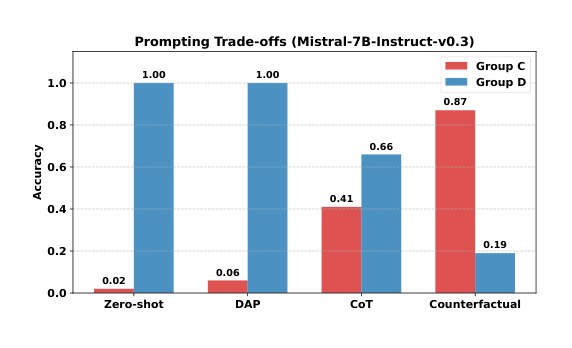
Figure 5: The Trade-off in Prompting (Mistral). The model shows a clear skepticism trap with strong correlations. (Group C: ; Group D: ).
图 5:提示中的权衡(Mistral)。该模型表现出明确的怀疑陷阱,相关很强。(C 组:;D 组:)。
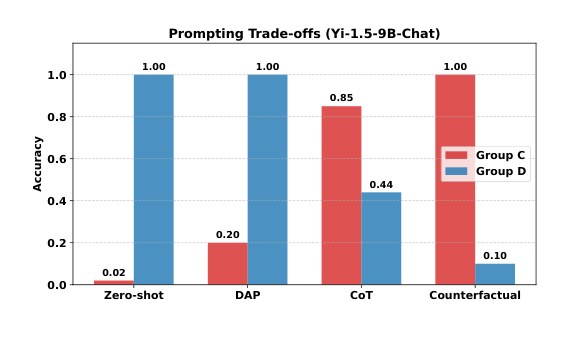
Figure 6: The Trade-off in Prompting (Yi-1.5). Similar to Llama, Yi exhibits a sharp trade-off. (Group C: ; Group D: ).
图 6:提示中的权衡(Yi-1.5)。与 Llama 类似,Yi 表现出急剧的权衡。(C 组:;D 组:)。
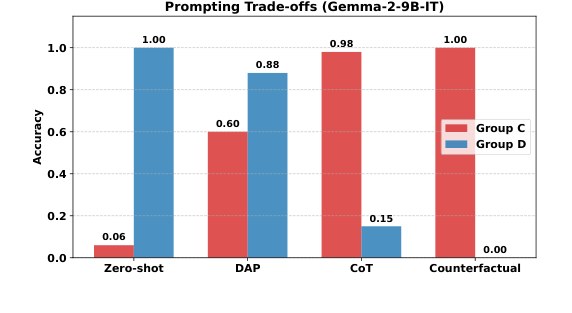
Figure 7: The Trade-off in Prompting (Gemma-2). The model achieves perfect correction on Group C but collapses to zero on Group D. (Group C: ; Group D: ).
图 7:提示中的权衡(Gemma-2)。该模型在 C 组上达到完全纠正,却在 D 组上塌到零。(C 组:;D 组:)。
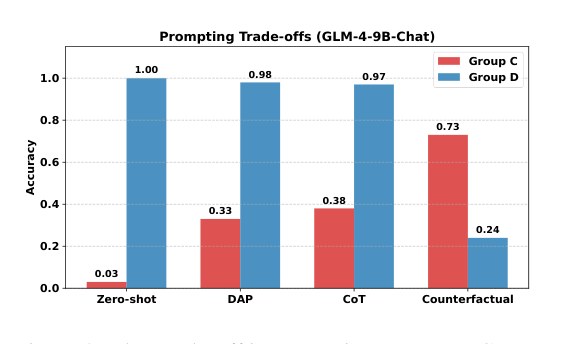
Figure 8: The Trade-off in Prompting (GLM-4). (Group C: ; Group D: ).
图 8:提示中的权衡(GLM-4)。(C 组:;D 组:)。
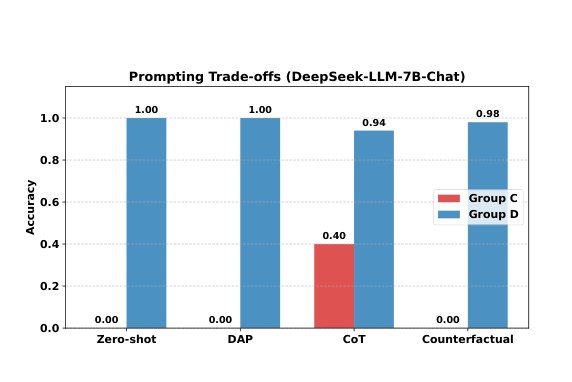
Figure 9: Resistance to Prompting (DeepSeek). Unlike other models, DeepSeek shows weak correlation, indicating rigidity against the counterfactual prompts. (Group C: ; Group D: ).
图 9:对提示的抗拒(DeepSeek)。与其他模型不同,DeepSeek 相关较弱,表明它对反事实提示较为僵硬。(C 组:;D 组:)。
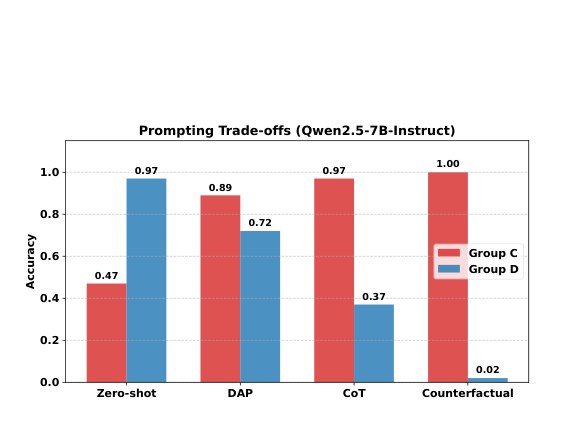
Figure 10: The Trade-off in Prompting (Qwen2.5). (Group C: ; Group D: ).
图 10:提示中的权衡(Qwen2.5)。(C 组:;D 组:)。
| Models | Change of State | Consumption | Creation | Motion to Goal |
|---|---|---|---|---|
| Llama-3.1-8B-Instruct | 0.48 | 0.56 | 0.38 | 0.75 |
| Mistral-7B-Instruct-v0.3 | 0.32 | 0.44 | 0.31 | 0.88 |
| Qwen2.5-7B-Instruct | 0.20 | 0.11 | 0.15 | 0.50 |
| Yi-1.5-9B-Chat | 0.34 | 0.67 | 0.23 | 0.62 |
| deepseek-llm-7b-chat | 0.05 | 0.00 | 0.05 | 0.00 |
| gemma-2-9b-it | 0.02 | 0.00 | 0.05 | 0.00 |
| glm-4-9b-chat-hf | 0.09 | 0.33 | 0.08 | 0.50 |
Table 7: Accuracy Breakdown by Verb Class in Zero-shot (Group A)
| 模型 | 状态变化 | 消耗 | 创造 | 趋向目标的位移 |
|---|---|---|---|---|
| Llama-3.1-8B-Instruct | 0.48 | 0.56 | 0.38 | 0.75 |
| Mistral-7B-Instruct-v0.3 | 0.32 | 0.44 | 0.31 | 0.88 |
| Qwen2.5-7B-Instruct | 0.20 | 0.11 | 0.15 | 0.50 |
| Yi-1.5-9B-Chat | 0.34 | 0.67 | 0.23 | 0.62 |
| deepseek-llm-7b-chat | 0.05 | 0.00 | 0.05 | 0.00 |
| gemma-2-9b-it | 0.02 | 0.00 | 0.05 | 0.00 |
| glm-4-9b-chat-hf | 0.09 | 0.33 | 0.08 | 0.50 |
表 7:零样本下按动词类别的准确率分解(A 组)
| Models | Change of State | Consumption | Creation | Motion to Goal |
|---|---|---|---|---|
| Llama-3.1-8B-Instruct | 0.02 | 0.00 | 0.03 | 0.00 |
| Mistral-7B-Instruct-v0.3 | 0.00 | 0.00 | 0.03 | 0.12 |
| Qwen2.5-7B-Instruct | 0.43 | 0.33 | 0.51 | 0.62 |
| Yi-1.5-9B-Chat | 0.02 | 0.11 | 0.00 | 0.00 |
| deepseek-llm-7b-chat | 0.00 | 0.00 | 0.00 | 0.00 |
| gemma-2-9b-it | 0.02 | 0.11 | 0.05 | 0.25 |
| glm-4-9b-chat-hf | 0.00 | 0.11 | 0.03 | 0.12 |
Table 8: Accuracy Breakdown by Verb Class in Zero-shot (Group C)
| 模型 | 状态变化 | 消耗 | 创造 | 趋向目标的位移 |
|---|---|---|---|---|
| Llama-3.1-8B-Instruct | 0.02 | 0.00 | 0.03 | 0.00 |
| Mistral-7B-Instruct-v0.3 | 0.00 | 0.00 | 0.03 | 0.12 |
| Qwen2.5-7B-Instruct | 0.43 | 0.33 | 0.51 | 0.62 |
| Yi-1.5-9B-Chat | 0.02 | 0.11 | 0.00 | 0.00 |
| deepseek-llm-7b-chat | 0.00 | 0.00 | 0.00 | 0.00 |
| gemma-2-9b-it | 0.02 | 0.11 | 0.05 | 0.25 |
| glm-4-9b-chat-hf | 0.00 | 0.11 | 0.03 | 0.12 |
表 8:零样本下按动词类别的准确率分解(C 组)
| Models | Change of State | Consumption | Creation | Motion to Goal |
|---|---|---|---|---|
| Llama-3.1-8B-Instruct | 0.98 | 1.00 | 0.97 | 1.00 |
| Mistral-7B-Instruct-v0.3 | 1.00 | 1.00 | 0.95 | 0.88 |
| Qwen2.5-7B-Instruct | 0.57 | 0.67 | 0.49 | 0.38 |
| Yi-1.5-9B-Chat | 0.98 | 0.89 | 1.00 | 1.00 |
| deepseek-llm-7b-chat | 1.00 | 1.00 | 1.00 | 1.00 |
| gemma-2-9b-it | 0.98 | 0.89 | 0.95 | 0.75 |
| glm-4-9b-chat-hf | 1.00 | 0.89 | 0.97 | 0.88 |
Table 9: Bias Breakdown by Verb Class in Zero-shot (Group C)
| 模型 | 状态变化 | 消耗 | 创造 | 趋向目标的位移 |
|---|---|---|---|---|
| Llama-3.1-8B-Instruct | 0.98 | 1.00 | 0.97 | 1.00 |
| Mistral-7B-Instruct-v0.3 | 1.00 | 1.00 | 0.95 | 0.88 |
| Qwen2.5-7B-Instruct | 0.57 | 0.67 | 0.49 | 0.38 |
| Yi-1.5-9B-Chat | 0.98 | 0.89 | 1.00 | 1.00 |
| deepseek-llm-7b-chat | 1.00 | 1.00 | 1.00 | 1.00 |
| gemma-2-9b-it | 0.98 | 0.89 | 0.95 | 0.75 |
| glm-4-9b-chat-hf | 1.00 | 0.89 | 0.97 | 0.88 |
表 9:零样本下按动词类别的偏置分解(C 组)
| Models | Change of State | Consumption | Creation | Motion to Goal |
|---|---|---|---|---|
| Llama-3.1-8B-Instruct | 0.66 | 0.56 | 0.49 | 0.88 |
| Mistral-7B-Instruct-v0.3 | 0.55 | 0.67 | 0.44 | 1.00 |
| Qwen2.5-7B-Instruct | 0.34 | 0.33 | 0.28 | 0.75 |
| Yi-1.5-9B-Chat | 0.61 | 0.78 | 0.44 | 0.75 |
| deepseek-llm-7b-chat | 0.11 | 0.11 | 0.15 | 0.00 |
| gemma-2-9b-it | 0.09 | 0.00 | 0.05 | 0.25 |
| glm-4-9b-chat-hf | 0.02 | 0.33 | 0.05 | 0.25 |
Table 10: Accuracy Breakdown by Verb Class in DAP (Group A)
| 模型 | 状态变化 | 消耗 | 创造 | 趋向目标的位移 |
|---|---|---|---|---|
| Llama-3.1-8B-Instruct | 0.66 | 0.56 | 0.49 | 0.88 |
| Mistral-7B-Instruct-v0.3 | 0.55 | 0.67 | 0.44 | 1.00 |
| Qwen2.5-7B-Instruct | 0.34 | 0.33 | 0.28 | 0.75 |
| Yi-1.5-9B-Chat | 0.61 | 0.78 | 0.44 | 0.75 |
| deepseek-llm-7b-chat | 0.11 | 0.11 | 0.15 | 0.00 |
| gemma-2-9b-it | 0.09 | 0.00 | 0.05 | 0.25 |
| glm-4-9b-chat-hf | 0.02 | 0.33 | 0.05 | 0.25 |
表 10:DAP 下按动词类别的准确率分解(A 组)
| Models | Change of State | Consumption | Creation | Motion to Goal |
|---|---|---|---|---|
| Llama-3.1-8B-Instruct | 0.30 | 0.11 | 0.54 | 0.12 |
| Mistral-7B-Instruct-v0.3 | 0.07 | 0.00 | 0.05 | 0.12 |
| Qwen2.5-7B-Instruct | 0.84 | 0.78 | 0.95 | 1.00 |
| Yi-1.5-9B-Chat | 0.20 | 0.22 | 0.15 | 0.38 |
| deepseek-llm-7b-chat | 0.00 | 0.00 | 0.00 | 0.00 |
| gemma-2-9b-it | 0.61 | 0.56 | 0.56 | 0.75 |
| glm-4-9b-chat-hf | 0.34 | 0.44 | 0.28 | 0.38 |
Table 11: Accuracy Breakdown by Verb Class in DAP (Group C)
| 模型 | 状态变化 | 消耗 | 创造 | 趋向目标的位移 |
|---|---|---|---|---|
| Llama-3.1-8B-Instruct | 0.30 | 0.11 | 0.54 | 0.12 |
| Mistral-7B-Instruct-v0.3 | 0.07 | 0.00 | 0.05 | 0.12 |
| Qwen2.5-7B-Instruct | 0.84 | 0.78 | 0.95 | 1.00 |
| Yi-1.5-9B-Chat | 0.20 | 0.22 | 0.15 | 0.38 |
| deepseek-llm-7b-chat | 0.00 | 0.00 | 0.00 | 0.00 |
| gemma-2-9b-it | 0.61 | 0.56 | 0.56 | 0.75 |
| glm-4-9b-chat-hf | 0.34 | 0.44 | 0.28 | 0.38 |
表 11:DAP 下按动词类别的准确率分解(C 组)
| Models | Change of State | Consumption | Creation | Motion to Goal |
|---|---|---|---|---|
| Llama-3.1-8B-Instruct | 0.48 | 0.78 | 0.33 | 0.50 |
| Mistral-7B-Instruct-v0.3 | 0.93 | 1.00 | 0.95 | 0.88 |
| Qwen2.5-7B-Instruct | 0.14 | 0.22 | 0.03 | 0.00 |
| Yi-1.5-9B-Chat | 0.80 | 0.78 | 0.85 | 0.62 |
| deepseek-llm-7b-chat | 1.00 | 1.00 | 1.00 | 1.00 |
| gemma-2-9b-it | 0.39 | 0.44 | 0.44 | 0.25 |
| glm-4-9b-chat-hf | 0.66 | 0.56 | 0.72 | 0.62 |
Table 12: Bias Breakdown by Verb Class in DAP (Group C)
| 模型 | 状态变化 | 消耗 | 创造 | 趋向目标的位移 |
|---|---|---|---|---|
| Llama-3.1-8B-Instruct | 0.48 | 0.78 | 0.33 | 0.50 |
| Mistral-7B-Instruct-v0.3 | 0.93 | 1.00 | 0.95 | 0.88 |
| Qwen2.5-7B-Instruct | 0.14 | 0.22 | 0.03 | 0.00 |
| Yi-1.5-9B-Chat | 0.80 | 0.78 | 0.85 | 0.62 |
| deepseek-llm-7b-chat | 1.00 | 1.00 | 1.00 | 1.00 |
| gemma-2-9b-it | 0.39 | 0.44 | 0.44 | 0.25 |
| glm-4-9b-chat-hf | 0.66 | 0.56 | 0.72 | 0.62 |
表 12:DAP 下按动词类别的偏置分解(C 组)
| Models | Change of State | Consumption | Creation | Motion to Goal |
|---|---|---|---|---|
| Llama-3.1-8B-Instruct | 0.14 | 0.22 | 0.13 | 0.25 |
| Mistral-7B-Instruct-v0.3 | 0.18 | 0.22 | 0.23 | 0.50 |
| Qwen2.5-7B-Instruct | 0.30 | 0.11 | 0.28 | 0.62 |
| Yi-1.5-9B-Chat | 0.64 | 0.67 | 0.38 | 0.88 |
| deepseek-llm-7b-chat | 0.09 | 0.00 | 0.03 | 0.00 |
| gemma-2-9b-it | 0.18 | 0.00 | 0.08 | 0.50 |
| glm-4-9b-chat-hf | 0.20 | 0.44 | 0.21 | 0.38 |
Table 13: Accuracy Breakdown by Verb Class in CoT (Group A)
| 模型 | 状态变化 | 消耗 | 创造 | 趋向目标的位移 |
|---|---|---|---|---|
| Llama-3.1-8B-Instruct | 0.14 | 0.22 | 0.13 | 0.25 |
| Mistral-7B-Instruct-v0.3 | 0.18 | 0.22 | 0.23 | 0.50 |
| Qwen2.5-7B-Instruct | 0.30 | 0.11 | 0.28 | 0.62 |
| Yi-1.5-9B-Chat | 0.64 | 0.67 | 0.38 | 0.88 |
| deepseek-llm-7b-chat | 0.09 | 0.00 | 0.03 | 0.00 |
| gemma-2-9b-it | 0.18 | 0.00 | 0.08 | 0.50 |
| glm-4-9b-chat-hf | 0.20 | 0.44 | 0.21 | 0.38 |
表 13:思维链下按动词类别的准确率分解(A 组)
| Models | Change of State | Consumption | Creation | Motion to Goal |
|---|---|---|---|---|
| Llama-3.1-8B-Instruct | 0.64 | 1.00 | 0.64 | 0.62 |
| Mistral-7B-Instruct-v0.3 | 0.36 | 0.78 | 0.38 | 0.38 |
| Qwen2.5-7B-Instruct | 0.93 | 1.00 | 1.00 | 1.00 |
| Yi-1.5-9B-Chat | 0.89 | 0.78 | 0.82 | 0.88 |
| deepseek-llm-7b-chat | 0.23 | 0.33 | 0.62 | 0.38 |
| gemma-2-9b-it | 1.00 | 1.00 | 0.97 | 0.88 |
| glm-4-9b-chat-hf | 0.30 | 0.44 | 0.46 | 0.38 |
Table 14: Accuracy Breakdown by Verb Class in CoT (Group C)
| 模型 | 状态变化 | 消耗 | 创造 | 趋向目标的位移 |
|---|---|---|---|---|
| Llama-3.1-8B-Instruct | 0.64 | 1.00 | 0.64 | 0.62 |
| Mistral-7B-Instruct-v0.3 | 0.36 | 0.78 | 0.38 | 0.38 |
| Qwen2.5-7B-Instruct | 0.93 | 1.00 | 1.00 | 1.00 |
| Yi-1.5-9B-Chat | 0.89 | 0.78 | 0.82 | 0.88 |
| deepseek-llm-7b-chat | 0.23 | 0.33 | 0.62 | 0.38 |
| gemma-2-9b-it | 1.00 | 1.00 | 0.97 | 0.88 |
| glm-4-9b-chat-hf | 0.30 | 0.44 | 0.46 | 0.38 |
表 14:思维链下按动词类别的准确率分解(C 组)
| Models | Change of State | Consumption | Creation | Motion to Goal |
|---|---|---|---|---|
| Llama-3.1-8B-Instruct | 0.36 | 0.00 | 0.36 | 0.38 |
| Mistral-7B-Instruct-v0.3 | 0.61 | 0.22 | 0.56 | 0.62 |
| Qwen2.5-7B-Instruct | 0.07 | 0.00 | 0.00 | 0.00 |
| Yi-1.5-9B-Chat | 0.09 | 0.11 | 0.18 | 0.12 |
| deepseek-llm-7b-chat | 0.77 | 0.67 | 0.38 | 0.62 |
| gemma-2-9b-it | 0.00 | 0.00 | 0.03 | 0.12 |
| glm-4-9b-chat-hf | 0.70 | 0.56 | 0.54 | 0.62 |
Table 15: Bias Breakdown by Verb Class in CoT (Group C)
| 模型 | 状态变化 | 消耗 | 创造 | 趋向目标的位移 |
|---|---|---|---|---|
| Llama-3.1-8B-Instruct | 0.36 | 0.00 | 0.36 | 0.38 |
| Mistral-7B-Instruct-v0.3 | 0.61 | 0.22 | 0.56 | 0.62 |
| Qwen2.5-7B-Instruct | 0.07 | 0.00 | 0.00 | 0.00 |
| Yi-1.5-9B-Chat | 0.09 | 0.11 | 0.18 | 0.12 |
| deepseek-llm-7b-chat | 0.77 | 0.67 | 0.38 | 0.62 |
| gemma-2-9b-it | 0.00 | 0.00 | 0.03 | 0.12 |
| glm-4-9b-chat-hf | 0.70 | 0.56 | 0.54 | 0.62 |
表 15:思维链下按动词类别的偏置分解(C 组)
| Models | Change of State | Consumption | Creation | Motion to Goal |
|---|---|---|---|---|
| Llama-3.1-8B-Instruct | 0.27 | 0.22 | 0.44 | 0.50 |
| Mistral-7B-Instruct-v0.3 | 0.30 | 0.33 | 0.15 | 0.75 |
| Qwen2.5-7B-Instruct | 0.07 | 0.11 | 0.05 | 0.12 |
| Yi-1.5-9B-Chat | 0.05 | 0.11 | 0.05 | 0.25 |
| deepseek-llm-7b-chat | 0.23 | 0.44 | 0.26 | 0.12 |
| gemma-2-9b-it | 0.02 | 0.00 | 0.05 | 0.00 |
| glm-4-9b-chat-hf | 0.25 | 0.44 | 0.08 | 0.62 |
Table 16: Accuracy Breakdown by Verb Class in Counterfactual (Group A)
| 模型 | 状态变化 | 消耗 | 创造 | 趋向目标的位移 |
|---|---|---|---|---|
| Llama-3.1-8B-Instruct | 0.27 | 0.22 | 0.44 | 0.50 |
| Mistral-7B-Instruct-v0.3 | 0.30 | 0.33 | 0.15 | 0.75 |
| Qwen2.5-7B-Instruct | 0.07 | 0.11 | 0.05 | 0.12 |
| Yi-1.5-9B-Chat | 0.05 | 0.11 | 0.05 | 0.25 |
| deepseek-llm-7b-chat | 0.23 | 0.44 | 0.26 | 0.12 |
| gemma-2-9b-it | 0.02 | 0.00 | 0.05 | 0.00 |
| glm-4-9b-chat-hf | 0.25 | 0.44 | 0.08 | 0.62 |
表 16:反事实下按动词类别的准确率分解(A 组)
| Models | Change of State | Consumption | Creation | Motion to Goal |
|---|---|---|---|---|
| Llama-3.1-8B-Instruct | 1.00 | 0.89 | 1.00 | 0.75 |
| Mistral-7B-Instruct-v0.3 | 0.89 | 0.67 | 0.90 | 0.88 |
| Qwen2.5-7B-Instruct | 1.00 | 1.00 | 1.00 | 1.00 |
| Yi-1.5-9B-Chat | 1.00 | 1.00 | 1.00 | 1.00 |
| deepseek-llm-7b-chat | 0.00 | 0.00 | 0.00 | 0.00 |
| gemma-2-9b-it | 1.00 | 1.00 | 1.00 | 1.00 |
| glm-4-9b-chat-hf | 0.70 | 0.67 | 0.79 | 0.62 |
Table 17: Accuracy Breakdown by Verb Class in Counterfactual (Group C)
| 模型 | 状态变化 | 消耗 | 创造 | 趋向目标的位移 |
|---|---|---|---|---|
| Llama-3.1-8B-Instruct | 1.00 | 0.89 | 1.00 | 0.75 |
| Mistral-7B-Instruct-v0.3 | 0.89 | 0.67 | 0.90 | 0.88 |
| Qwen2.5-7B-Instruct | 1.00 | 1.00 | 1.00 | 1.00 |
| Yi-1.5-9B-Chat | 1.00 | 1.00 | 1.00 | 1.00 |
| deepseek-llm-7b-chat | 0.00 | 0.00 | 0.00 | 0.00 |
| gemma-2-9b-it | 1.00 | 1.00 | 1.00 | 1.00 |
| glm-4-9b-chat-hf | 0.70 | 0.67 | 0.79 | 0.62 |
表 17:反事实下按动词类别的准确率分解(C 组)
| Models | Change of State | Consumption | Creation | Motion to Goal |
|---|---|---|---|---|
| Llama-3.1-8B-Instruct | 0.00 | 0.00 | 0.00 | 0.00 |
| Mistral-7B-Instruct-v0.3 | 0.11 | 0.33 | 0.05 | 0.12 |
| Qwen2.5-7B-Instruct | 0.00 | 0.00 | 0.00 | 0.00 |
| Yi-1.5-9B-Chat | 0.00 | 0.00 | 0.00 | 0.00 |
| deepseek-llm-7b-chat | 1.00 | 1.00 | 1.00 | 1.00 |
| gemma-2-9b-it | 0.00 | 0.00 | 0.00 | 0.00 |
| glm-4-9b-chat-hf | 0.20 | 0.33 | 0.15 | 0.25 |
Table 18: Bias Breakdown by Verb Class in Counterfactual (Group C)
| 模型 | 状态变化 | 消耗 | 创造 | 趋向目标的位移 |
|---|---|---|---|---|
| Llama-3.1-8B-Instruct | 0.00 | 0.00 | 0.00 | 0.00 |
| Mistral-7B-Instruct-v0.3 | 0.11 | 0.33 | 0.05 | 0.12 |
| Qwen2.5-7B-Instruct | 0.00 | 0.00 | 0.00 | 0.00 |
| Yi-1.5-9B-Chat | 0.00 | 0.00 | 0.00 | 0.00 |
| deepseek-llm-7b-chat | 1.00 | 1.00 | 1.00 | 1.00 |
| gemma-2-9b-it | 0.00 | 0.00 | 0.00 | 0.00 |
| glm-4-9b-chat-hf | 0.20 | 0.33 | 0.15 | 0.25 |
表 18:反事实下按动词类别的偏置分解(C 组)