GeoRA: Geometry-Aware Low-Rank Adaptation for RLVR
GeoRA: Geometry-Aware Low-Rank Adaptation for RLVR
GeoRA:面向 RLVR 的几何感知低秩适配
Meituan, Peking University
zhangjy2002@stu.pku.edu.cn
{shilei74, xujun58, gaojiuchong}@meituan.com
Work done during internship at Meituan.
Corresponding authors.
Equal contribution.
Abstract
摘要
Reinforcement Learning with Verifiable Rewards (RLVR) is a key paradigm for improving large-scale reasoning models. Unlike supervised fine-tuning (SFT), RLVR exhibits distinct optimization dynamics and is sensitive to the preservation of pre-trained geometric structures. However, existing parameter-efficient methods face key limitations in this regime. Low-rank adaptation methods, such as PiSSA, are primarily designed for Supervised Fine-Tuning (SFT) and do not account for the distinct optimization dynamics and geometric structures of RLVR. Conversely, directly fine-tuning the unstructured sparse parameter subspace favored by RLVR encounters efficiency bottlenecks on modern hardware. To address these challenges, we propose GeoRA (Geometry-Aware Low-Rank Adaptation), a low-rank adaptation method tailored for RLVR. Specifically, GeoRA exploits the anisotropic and compressible structure of RL update subspace, and extracts its principal directions via Singular Value Decomposition (SVD) to initialize low-rank adapters, while freezing residual components as a structural anchor during training. This design preserves the pre-trained structure and enables efficient dense computation. Experiments on Qwen and Llama models from 1.5B to 32B parameters show that GeoRA consistently outperforms strong low-rank baselines across RLVR settings in mathematics, medicine, and coding, while showing stronger generalization and less forgetting on out-of-domain tasks.
可验证奖励强化学习(RLVR)是改进大规模推理模型的一条关键路径。与监督微调(SFT)不同,RLVR 的优化动态有其自身特点,而且对保持预训练几何结构更为敏感。现有的参数高效方法在这一设定下有明显局限。以 PiSSA 为代表的低秩适配,主要是为监督微调设计的,没有照顾到 RLVR 特有的优化动态和几何结构。反过来,如果直接去微调 RLVR 所偏好的那块无结构稀疏参数子空间,在现代硬件上又会碰到效率瓶颈。针对这些问题,我们提出面向 RLVR 的低秩适配方法 GeoRA(Geometry-Aware Low-Rank Adaptation)。具体来说,GeoRA 利用强化学习更新子空间各向异、可压缩的结构,用奇异值分解(SVD)抽出其主方向来初始化低秩适配器,并在训练中把残差分量冻结为结构锚点。这样既能保持预训练结构,又能做高效的稠密计算。我们在参数量从 1.5B 到 32B 的 Qwen 和 Llama 模型上实验,结果表明:在数学、医学和编程等 RLVR 设定里,GeoRA 都稳定优于强低秩基线,并且在域外任务上泛化更强、遗忘更少。
1 Introduction
1 引言
Large reasoning models, represented by OpenAI-o1 (OpenAI et al., 2024) and DeepSeek-R1 (DeepSeek-AI et al., 2025), have established Reinforcement Learning with Verifiable Rewards (RLVR) as a pivotal paradigm for unlocking complex reasoning capabilities. Unlike supervised fine-tuning (SFT), RLVR is better characterized as a constrained optimization process (Wu et al., 2025) that amplifies latent reasoning behaviors through reward-induced sampling bias (Yue et al., 2025; Zhao et al., 2025). As a result, RLVR is particularly sensitive to update stability and its alignment with pre-trained representation geometry: overly aggressive updates can collapse behavior or degrade general capabilities. Empirically, substantial gains can emerge from modifying only a small fraction of parameters (Mukherjee et al., 2025), and recent mechanistic studies further suggest that effective RLVR updates are geometrically biased toward preserving pre-trained structure (Zhu et al., 2025; Cai et al., 2025).
以 OpenAI-o1(OpenAI et al., 2024)和 DeepSeek-R1(DeepSeek-AI et al., 2025)为代表的大规模推理模型,已经把可验证奖励强化学习(RLVR)确立为释放复杂推理能力的关键范式。与监督微调(SFT)不同,RLVR 更宜看作一种受约束的优化过程(Wu et al., 2025):它通过奖励诱导的采样偏置,把潜在的推理行为放大(Yue et al., 2025; Zhao et al., 2025)。因此,RLVR 对更新是否稳定、是否与预训练表征几何对齐特别敏感:更新过于激进,行为可能崩溃,通用能力也可能被削弱。经验上,只改动一小部分参数就能带来可观收益(Mukherjee et al., 2025);近期的机制研究还进一步表明,有效的 RLVR 更新在几何上偏向于保持预训练结构(Zhu et al., 2025; Cai et al., 2025)。
However, existing PEFT methods face key limitations in this regime. First, SFT-oriented low-rank adaptation methods suffer from a geometric mismatch with RLVR (Yin et al., 2025). PiSSA (Meng et al., 2025), for example, forces updates onto principal components, conflicting with RLVR’s preferred subspace while protecting core features. Second, some sparse fine-tuning methods (Mukherjee et al., 2025; Zhu et al., 2025), although more consistent with RLVR update patterns, struggle to achieve practical efficiency. Because modern hardware provides limited support for unstructured sparsity, these methods often fail to translate theoretical sparsity into real-world speedups, and may even introduce additional overhead.
不过,现有的参数高效微调(PEFT)方法在这一设定下有几处关键局限。第一,面向 SFT 的低秩适配与 RLVR 存在几何错配(Yin et al., 2025)。以 PiSSA(Meng et al., 2025)为例,它把更新强制压到主成分上,这虽然保护了核心特征,却与 RLVR 偏好的子空间相冲突。第二,一些稀疏微调方法(Mukherjee et al., 2025; Zhu et al., 2025)虽然更贴近 RLVR 的更新模式,却很难做到实用的效率。现代硬件对无结构稀疏的支持有限,这些方法往往无法把理论上的稀疏性变成真实加速,有时还会引入额外开销。
To address these challenges, we introduce GeoRA (Geometry-Aware Low-Rank Adaptation), a low-rank adaptation framework tailored to RLVR. Our analysis shows that the effective RLVR update subspace is anisotropic and compressible rather than isotropic, exhibiting a structured low-rank form. Based on this observation, GeoRA extracts dominant trainable directions from a geometry-constrained subspace for initialization, while keeping residual components frozen as a structural anchor. In this way, GeoRA simultaneously aligns adaptation with RLVR-specific optimization geometry and preserves dense matrix computation, achieving both stable optimization and hardware-efficient training. To the best of our knowledge, GeoRA is the first geometry-aware low-rank adaptation framework explicitly designed for RLVR. Our contributions are summarized as follows:
为应对这些挑战,我们提出面向 RLVR 的低秩适配框架 GeoRA(Geometry-Aware Low-Rank Adaptation)。分析表明,有效的 RLVR 更新子空间并不是各向同性的,而是各向异且可压缩的,呈现出有结构的低秩形态。据此,GeoRA 从一个几何约束子空间中抽出占主导的可训练方向用于初始化,同时把残差分量冻结为结构锚点。这样一来,适配既对齐了 RLVR 特有的优化几何,又保留了稠密矩阵计算,从而同时获得稳定优化和硬件高效的训练。据我们所知,GeoRA 是首个明确为 RLVR 设计的几何感知低秩适配框架。贡献概括如下:
- • We propose GeoRA, a geometry-aware, low-rank, and parameter-efficient adaptation framework tailored to RLVR. By aligning low-rank adaptation with RLVR-specific optimization geometry while preserving dense computation, GeoRA overcomes the geometric mismatch of SFT-oriented low-rank methods and the efficiency bottleneck of sparse methods.
- 我们提出面向 RLVR 的几何感知、低秩且参数高效的适配框架 GeoRA。它在对齐 RLVR 优化几何的同时保留稠密计算,从而克服了面向 SFT 的低秩方法的几何错配,以及稀疏方法的效率瓶颈。
- • We show that the effective RL update subspace is directional and admits a compressible low-rank structure. GeoRA extracts dominant trainable directions via SVD within this subspace to initialize low-rank adapters, while a frozen residual component acts as a structural anchor to preserve pre-trained structure.
- 我们表明,有效的强化学习更新子空间是有方向的,并且具有可压缩的低秩结构。GeoRA 在该子空间内用 SVD 抽出占主导的可训练方向,用来初始化低秩适配器;冻结的残差分量则作为结构锚点,用来保持预训练结构。
- • Experiments on Qwen and Llama models from 1.5B to 32B parameters demonstrate that GeoRA improves training stability and consistently outperforms strong low-rank baselines across diverse RLVR settings, while showing stronger generalization and less forgetting on out-of-domain tasks.
- 在参数量从 1.5B 到 32B 的 Qwen 和 Llama 模型上的实验表明,GeoRA 提升了训练稳定性,并在多样的 RLVR 设定中持续优于强低秩基线,同时在域外任务上表现出更强的泛化和更少的遗忘。
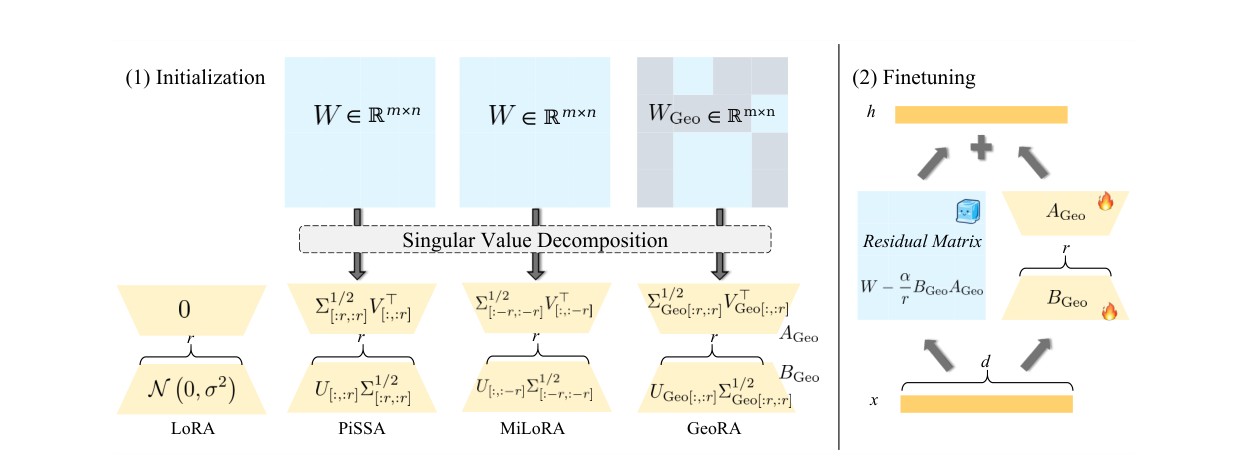
Figure 1: Comparison of adapter initialization and forward architectures. LoRA applies low-rank adaptation on the original weight matrix with standard initialization, while PiSSA initializes adapters from the principal components of . In contrast, GeoRA initializes from a geometry-constrained matrix (a different adaptation target than ). Its forward pass incorporates a frozen Residual Matrix in parallel with the trainable adapter to act as a stability anchor for principal components.
图 1:适配器初始化与前向结构的对比。LoRA 在原始权重矩阵 上做低秩适配,并采用标准初始化;PiSSA 则用 的主成分来初始化适配器。相比之下,GeoRA 从一个几何约束矩阵 出发做初始化(适配目标与 不同)。它的前向过程把冻结的残差矩阵与可训练适配器并行起来,作为主成分的稳定性锚点。
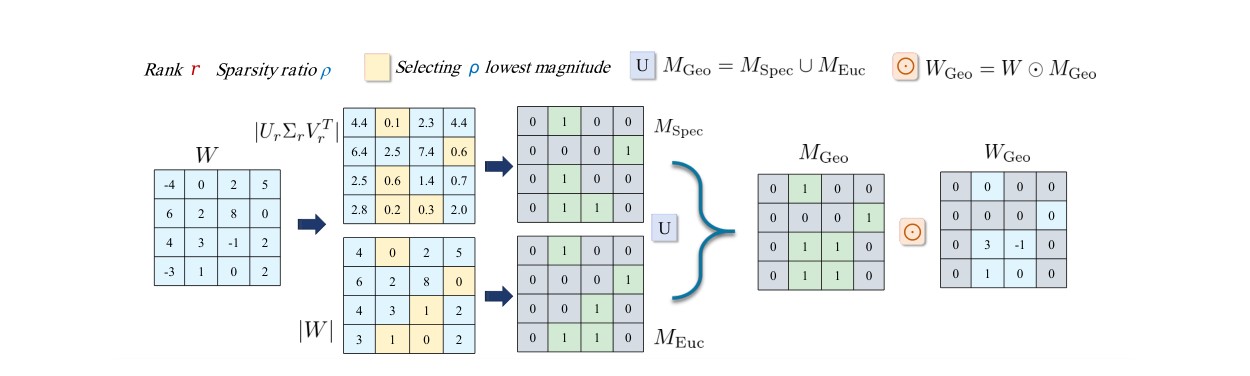
Figure 2: Geometric Prior Construction via Masking. The process of generating by combining Spectral Priors (low-curvature regions) and Euclidean Priors (high-plasticity near-zero weights). The resulting isolates the most stable parameters for RL-native adaptation.
图 2:通过掩码构造几何先验。把谱先验(低曲率区域)与欧几里得先验(可塑性高、接近零的权重)结合起来,得到 。由此得到的 ,把最稳定、适合强化学习原生适配的参数隔离出来。
2 Related Work
2 相关工作
2.1 RLVR and Optimization Geometry
2.1 RLVR 与优化几何
RLVR replaces traditional reward models with deterministic verifiers (e.g., in math or coding) (Zhang et al., 2025; Lambert et al., 2025; Yuan et al., 2025). Through outcome-based feedback, it incentivizes emergent reasoning behaviors like Chain-of-Thought (CoT), establishing itself as a core paradigm for enhancing LLM reasoning (Hu et al., 2025; Liu et al., 2025b).
RLVR 用确定性的校验器(例如在数学或编程中)取代传统的奖励模型(Zhang et al., 2025; Lambert et al., 2025; Yuan et al., 2025)。借助基于结果的反馈,它激励出思维链(CoT)这类涌现的推理行为,从而成为增强大模型推理的核心范式(Hu et al., 2025; Liu et al., 2025b)。
Recent mechanistic analyses have delineated a sharp dichotomy between supervised fine-tuning (SFT) and reinforcement learning with verifiable rewards (RLVR). While SFT primarily injects knowledge by modifying principal weight directions (Chu et al., 2025; Jin et al., 2025b), RLVR is better characterized as a constrained optimization process (Wu et al., 2025) that amplifies latent reasoning behaviors via reward-induced sampling bias rather than introducing new capabilities (Yue et al., 2025; Zhao et al., 2025; Alam and Rastogi, 2025). Theoretically, these updates manifest “off the principals,” favoring low-magnitude directions orthogonal to pre-trained features (Zhu et al., 2025), consistent with the rank-1 dominance observed in early training (Cai et al., 2025). However, this regime faces stability trade-offs. KL-regularization (“RL’s Razor”) attempts to limit forgetting (Shenfeld et al., 2025) but can precipitate the “Reasoning Boundary Paradox,” where aggressive reward maximization collapses exploration diversity (Nguyen et al., 2025). Although capability degradation may be partially reversed via singular vector rotation (Jin et al., 2025a; Jin et al., 2025b), adaptation remains fundamentally constrained by the “Invisible Leash,” which enforces proximity to the pre-training manifold (Wu et al., 2025). Empirically, strong gains can emerge from updating only a small fraction of parameters, suggesting that RL fine-tuning often concentrates on small subnetworks (Mukherjee et al., 2025).
近期的机制分析,把监督微调(SFT)与可验证奖励强化学习(RLVR)划出了一道清晰的分界。SFT 主要靠修改权重的主方向来注入知识(Chu et al., 2025; Jin et al., 2025b);RLVR 则更像一种受约束的优化过程(Wu et al., 2025),它通过奖励诱导的采样偏置放大已有的潜在推理行为,而不是引入新能力(Yue et al., 2025; Zhao et al., 2025; Alam and Rastogi, 2025)。从理论上说,这些更新出现在“主方向之外”,更偏向与预训练特征正交的低幅度方向(Zhu et al., 2025),这与训练早期观察到的秩一主导现象相一致(Cai et al., 2025)。不过,这一机制也带来稳定性上的权衡。KL 正则(所谓 “RL’s Razor”)试图限制遗忘(Shenfeld et al., 2025),却可能触发 “Reasoning Boundary Paradox”:过于追求奖励最大化,探索的多样性会崩溃(Nguyen et al., 2025)。能力退化有时能通过奇异向量旋转得到部分挽回(Jin et al., 2025a,b),但适配本质上仍受 “Invisible Leash” 约束,也就是必须贴近预训练流形(Wu et al., 2025)。经验上,只更新一小部分参数也能获得很强的收益,说明强化学习微调往往集中在较小的子网络上(Mukherjee et al., 2025)。
2.2 PEFT and Spectral Priors
2.2 PEFT 与谱先验
To alleviate the computational demands of scaling LLMs, PEFT (Xu et al., 2023; Han et al., 2024) has emerged as a key paradigm, minimizing memory overhead by updating only a fraction of parameters while matching full fine-tuning performance. Prevailing strategies include partial fine-tuning (Zaken et al., 2022; Lawton et al., 2023), soft prompt tuning (Hambardzumyan et al., 2021), non-linear adapters (Lin et al., 2020), low-rank adaptation (Li et al., 2018), and importance-aware methods like LIFT (Liu et al., 2025c). As a practical paradigm, PEFT has also been effectively adapted to continual learning (Liang et al., 2023) and multi-task learning (Liu et al., 2023) scenarios.
为了减轻扩大语言模型带来的计算负担,PEFT(Xu et al., 2023; Han et al., 2024)成为一条重要路径:只更新一小部分参数,就能在降低显存开销的同时接近全量微调的表现。常见策略包括部分微调(Zaken et al., 2022; Lawton et al., 2023)、软提示调优(Hambardzumyan et al., 2021)、非线性适配器(Lin et al., 2020)、低秩适配(Li et al., 2018),以及 LIFT 这类重要性感知方法(Liu et al., 2025c)。作为一种实用范式,PEFT 也被有效用到持续学习(Liang et al., 2023)和多任务学习(Liu et al., 2023)中。
Among these, LoRA (Hu et al., 2021) and its variants are the de facto standard, yet their initialization strategies often diverge based on spectral priors. For instance, PiSSA (Meng et al., 2025) allocates trainable parameters to principal singular components, imposing a strong inductive bias validated primarily in SFT. However, such SFT-oriented spectral priors can create a fundamental geometric mismatch in RLVR, whose optimization dynamics and effective update patterns differ markedly from SFT (Yin et al., 2025; Zhu et al., 2025; Mukherjee et al., 2025). MiLoRA (Wang et al., 2025) instead targets minor components, but does not explicitly account for RLVR-specific geometry and dynamics. Other variants like DoRA (Liu et al., 2024), AdaLoRA (Zhang et al., 2023), and VeRA (Kopiczko et al., 2024) focus on weight decomposition or budget allocation without integrating these RLVR-native geometric considerations. Building on these observations, GeoRA translates RLVR-specific mechanistic insights into an actionable PEFT paradigm.
在这些方法里,LoRA(Hu et al., 2021)及其变体已是事实上的标准,但它们的初始化策略往往随谱先验而分叉。例如,PiSSA(Meng et al., 2025)把可训练参数分配给主要的奇异分量,从而加上一种主要在 SFT 中得到验证的强归纳偏置。可是,这类面向 SFT 的谱先验,在 RLVR 里会造成根本的几何错配,因为 RLVR 的优化动态和有效更新模式与 SFT 明显不同(Yin et al., 2025; Zhu et al., 2025; Mukherjee et al., 2025)。MiLoRA(Wang et al., 2025)转而瞄准次要分量,但并没有显式考虑 RLVR 特有的几何与动态。DoRA(Liu et al., 2024)、AdaLoRA(Zhang et al., 2023)和 VeRA(Kopiczko et al., 2024)等变体,则把重点放在权重分解或预算分配上,同样没有纳入这些面向 RLVR 的几何考量。基于上述观察,GeoRA 把针对 RLVR 的机制认识,转成一套可执行的 PEFT 方案。
3 Methodology
3 方法
We introduce GeoRA (Geometry-Aware Low-Rank Adaptation), a low-rank adaptation framework tailored for RLVR. GeoRA emphasizes an RL-native, structured low-rank parameterization together with an explicit residual leash for stability. Comparing with classical PEFT baselines like LoRA and PiSSA, we first present the low-rank forward architecture and initialization (Figure 1), and then describe a lightweight masking instantiation that constructs the geometry-constrained matrix used for initialization (Figure 2).
我们提出面向 RLVR 的低秩适配框架 GeoRA(Geometry-Aware Low-Rank Adaptation)。它强调一种强化学习原生的、有结构的低秩参数化,并加上显式的残差牵制以保持稳定。与 LoRA、PiSSA 等经典 PEFT 基线相对照,我们先给出低秩前向结构与初始化(图 1),再说明如何用一种轻量的掩码方法构造用于初始化的几何约束矩阵(图 2)。
3.1 Geometry-Aware Low-Rank Structure
3.1 几何感知的低秩结构
Let denote a geometry-constrained view of the pre-trained weight matrix . Unlike standard LoRA which initializes adapters randomly (or with zero), GeoRA leverages the compressible structure within to derive a structured initialization.
记 为预训练权重矩阵 的一个几何约束视角。标准 LoRA 用随机(或全零)方式初始化适配器;与之不同,GeoRA 利用 内部可压缩的结构,得到有结构的初始化。
We first perform Singular Value Decomposition (SVD) on the geometry-constrained matrix:
我们首先对几何约束矩阵做奇异值分解(SVD):
We extract the top- singular components that capture the principal geometric information. The low-rank adapters and are then initialized to approximate this geometry-aware subspace:
我们取出刻画主要几何信息的前 个奇异分量,再用它们把低秩适配器 和 初始化到对这一几何感知子空间的近似:
By this design, the initial product constructs the rank- approximation of .
按这一设计,初始乘积 就构成了 的秩 近似。
Crucially, to ensure the model’s output remains unchanged at initialization and to preserve core capabilities during training, we follow the standard LoRA scaling and compute a Residual Matrix by subtracting the scaled initialized adapters from the original weights:
关键的是,为了让模型在初始化时输出保持不变,并在训练中保住核心能力,我们沿用标准的 LoRA 缩放,从原始权重中减去缩放后的已初始化适配器,得到残差矩阵 :
During the forward pass, is kept frozen. The hidden state is computed as:
在前向计算中, 保持冻结。隐状态 按下面计算:
This construction keeps the model function-preserving at initialization (since ) and enforces a hard structural constraint: the optimizer can only update the geometry-aligned manifold parameterized by and , while acts as a stability anchor preventing the erosion of pre-trained representations.
这一构造使模型在初始化时保持函数不变(因为 ),同时也加上了一条硬的结构约束:优化器只能更新由 和 参数化的、与几何对齐的流形,而 则作为稳定性锚点,防止预训练表征被侵蚀。
3.2 Geometric Prior Construction
3.2 几何先验的构造
To instantiate a geometry-aware update region, we construct a geometry-constrained matrix using a masking strategy. This masking is consistent with prior observations on spectral and magnitude structure and stability in fine-tuning (Liu et al., 2025c; Zhu et al., 2025).
为了落实一个几何感知的更新区域,我们用掩码策略构造几何约束矩阵 。这种掩码与先前关于谱结构、幅度结构以及微调稳定性的观察是一致的(Liu et al., 2025c; Zhu et al., 2025)。
Table 1: Main results on in-distribution (ID) mathematical RLVR benchmarks and out-of-distribution (OOD) tasks. Base denotes the original model before RLVR. Best results are in bold, and second-best results are underlined.
| Method | AIME24 | AIME25 | MATH500 | OlymMATH | HumanEval | GPQA | MMLU | IFEval | TruthfulQA |
|---|---|---|---|---|---|---|---|---|---|
| In-Distribution (ID) | Out-of-Distribution (OOD) | ||||||||
| Qwen3-8B | |||||||||
| Base | 13.33 | 11.67 | 71.20 | 9.75 | 76.83 | 36.91 | 71.94 | 54.32 | 68.91 |
| FullFT | 23.33 | 22.08 | 78.40 | 11.25 | 76.83 | 36.91 | 71.94 | 50.45 | 65.65 |
| SparseFT | 22.92 | 21.25 | 76.80 | 11.50 | 79.50 | 37.20 | 74.20 | 50.95 | 66.05 |
| LoRA | 19.58 | 19.58 | 75.60 | 10.75 | 81.10 | 37.50 | 75.65 | 52.13 | 66.82 |
| PiSSA | 22.50 | 20.42 | 74.40 | 11.75 | 71.95 | 36.16 | 73.89 | 48.74 | 65.95 |
| MiLoRA | 20.42 | 19.58 | 76.20 | 11.50 | 78.66 | 38.26 | 74.51 | 51.85 | 66.46 |
| GeoRA | 23.75 | 21.67 | 78.00 | 12.75 | 82.93 | 37.92 | 75.96 | 53.73 | 68.85 |
| Llama-3.1-8B | |||||||||
| Base | 9.58 | 2.08 | 51.00 | 3.25 | 65.20 | 31.15 | 68.40 | 79.99 | 62.71 |
| FullFT | 18.33 | 8.25 | 62.40 | 8.50 | 65.20 | 31.15 | 68.40 | 75.92 | 59.40 |
| SparseFT | 17.92 | 8.10 | 61.50 | 8.25 | 67.80 | 31.65 | 69.10 | 76.61 | 60.19 |
| LoRA | 15.42 | 6.25 | 58.20 | 6.75 | 69.80 | 32.10 | 69.80 | 77.93 | 61.76 |
| PiSSA | 17.50 | 7.92 | 60.50 | 7.75 | 67.50 | 31.80 | 69.20 | 74.83 | 59.83 |
| MiLoRA | 16.25 | 7.08 | 59.10 | 7.25 | 68.20 | 32.00 | 70.50 | 78.31 | 61.47 |
| GeoRA | 18.54 | 8.75 | 61.90 | 8.85 | 70.80 | 32.65 | 70.95 | 78.72 | 61.61 |
表 1:分布内(ID)数学 RLVR 基准与分布外(OOD)任务的主要结果。Base 表示做 RLVR 之前的原模型。最优结果加粗,次优结果加下划线。
| 方法 | AIME24 | AIME25 | MATH500 | OlymMATH | HumanEval | GPQA | MMLU | IFEval | TruthfulQA |
|---|---|---|---|---|---|---|---|---|---|
| 分布内(ID) | 分布外(OOD) | ||||||||
| Qwen3-8B | |||||||||
| Base | 13.33 | 11.67 | 71.20 | 9.75 | 76.83 | 36.91 | 71.94 | 54.32 | 68.91 |
| FullFT | 23.33 | 22.08 | 78.40 | 11.25 | 76.83 | 36.91 | 71.94 | 50.45 | 65.65 |
| SparseFT | 22.92 | 21.25 | 76.80 | 11.50 | 79.50 | 37.20 | 74.20 | 50.95 | 66.05 |
| LoRA | 19.58 | 19.58 | 75.60 | 10.75 | 81.10 | 37.50 | 75.65 | 52.13 | 66.82 |
| PiSSA | 22.50 | 20.42 | 74.40 | 11.75 | 71.95 | 36.16 | 73.89 | 48.74 | 65.95 |
| MiLoRA | 20.42 | 19.58 | 76.20 | 11.50 | 78.66 | 38.26 | 74.51 | 51.85 | 66.46 |
| GeoRA | 23.75 | 21.67 | 78.00 | 12.75 | 82.93 | 37.92 | 75.96 | 53.73 | 68.85 |
| Llama-3.1-8B | |||||||||
| Base | 9.58 | 2.08 | 51.00 | 3.25 | 65.20 | 31.15 | 68.40 | 79.99 | 62.71 |
| FullFT | 18.33 | 8.25 | 62.40 | 8.50 | 65.20 | 31.15 | 68.40 | 75.92 | 59.40 |
| SparseFT | 17.92 | 8.10 | 61.50 | 8.25 | 67.80 | 31.65 | 69.10 | 76.61 | 60.19 |
| LoRA | 15.42 | 6.25 | 58.20 | 6.75 | 69.80 | 32.10 | 69.80 | 77.93 | 61.76 |
| PiSSA | 17.50 | 7.92 | 60.50 | 7.75 | 67.50 | 31.80 | 69.20 | 74.83 | 59.83 |
| MiLoRA | 16.25 | 7.08 | 59.10 | 7.25 | 68.20 | 32.00 | 70.50 | 78.31 | 61.47 |
| GeoRA | 18.54 | 8.75 | 61.90 | 8.85 | 70.80 | 32.65 | 70.95 | 78.72 | 61.61 |
Table 2: Results on additional medical and coding RLVR tasks. Best results are in bold, and second-best results are underlined.
| Method | MedQA | MedMCQA | PubMedQA | Average | LiveCodeBench | HumanEval | MBPP | Average |
|---|---|---|---|---|---|---|---|---|
| Medical | Coding | |||||||
| Base | 58.03 | 56.42 | 74.94 | 63.13 | 65.75 | 87.66 | 79.40 | 77.60 |
| FullFT | 75.32 | 64.56 | 80.12 | 73.33 | 67.75 | 90.26 | 81.40 | 79.80 |
| LoRA | 74.23 | 62.12 | 79.54 | 71.96 | 67.25 | 88.96 | 81.00 | 79.07 |
| GeoRA | 76.12 | 64.31 | 80.64 | 73.69 | 67.75 | 89.61 | 81.60 | 79.65 |
表 2:额外的医学与编程 RLVR 任务结果。最优结果加粗,次优结果加下划线。
| 方法 | MedQA | MedMCQA | PubMedQA | Average | LiveCodeBench | HumanEval | MBPP | Average |
|---|---|---|---|---|---|---|---|---|
| 医学 | 编程 | |||||||
| Base | 58.03 | 56.42 | 74.94 | 63.13 | 65.75 | 87.66 | 79.40 | 77.60 |
| FullFT | 75.32 | 64.56 | 80.12 | 73.33 | 67.75 | 90.26 | 81.40 | 79.80 |
| LoRA | 74.23 | 62.12 | 79.54 | 71.96 | 67.25 | 88.96 | 81.00 | 79.07 |
| GeoRA | 76.12 | 64.31 | 80.64 | 73.69 | 67.75 | 89.61 | 81.60 | 79.65 |
The Spectral Prior () promotes geometric stability by selecting the bottom -fraction of entries from the rank- approximation . The mask is defined as:
谱先验()从秩 近似 中选出幅度最低的 比例条目,以促进几何稳定。掩码定义为:
where is the -th quantile of the absolute values in . Intuitively, this mask suppresses high-magnitude (and typically high-curvature) components and constrains updates to a more stable, low-magnitude region, improving spectral stability under RLVR. Similarly, the Euclidean Prior () selects low-magnitude weights to capture parameter plasticity, using the same sparsity ratio :
其中 是 中绝对值的第 分位数。直观上,这一掩码压制了大幅度(通常也是高曲率)的分量,把更新限制在更稳定的低幅度区域,从而改善 RLVR 下的谱稳定性。类似地,欧几里得先验()在相同稀疏率 下选择低幅度权重,以捕捉参数的可塑性:
Here, represents the -th quantile of . The final geometry-constrained matrix is formed by the union of these two stable subspaces:
这里 是 的第 分位数。最终的几何约束矩阵 ,由这两个稳定子空间的并集构成:
This union ensures that the optimized weights retain the flexibility of small parameters while respecting the spectral constraints of the pre-trained model.
这样取并集,是为了让被优化的权重既保留小参数的灵活性,又尊重预训练模型的谱约束。
4 Experiments
4 实验
4.1 Experimental Setup
4.1 实验设置
We compare GeoRA against MiLoRA (Wang et al., 2025), PiSSA (Meng et al., 2025), LoRA (Hu et al., 2021), Sparse Fine-Tuning (SparseFT) (Zhu et al., 2025), and Full Fine-Tuning (FullFT). Our main experiments are conducted on mathematical RLVR, where we fine-tune Qwen3-8B-Base (Yang et al., 2025) and Llama-3.1-8B-Instruct (Grattafiori et al., 2024) on the DeepMath-103K dataset (He et al., 2025) using the GRPO algorithm (Shao et al., 2024), with a fixed rank and sparsity ratio . We include both base and instruction-tuned backbones to evaluate robustness across model variants. In addition, we further validate our method on mathematical RLVR tasks with the 4B and 1.5B models on the GSM8K (Cobbe et al., 2021) dataset; details are provided in the Appendix C.
我们把 GeoRA 与 MiLoRA(Wang et al., 2025)、PiSSA(Meng et al., 2025)、LoRA(Hu et al., 2021)、稀疏微调 SparseFT(Zhu et al., 2025)以及全量微调 FullFT 加以比较。主要实验做在数学 RLVR 上:我们用 GRPO 算法(Shao et al., 2024),在 DeepMath-103K 数据集(He et al., 2025)上微调 Qwen3-8B-Base(Yang et al., 2025)和 Llama-3.1-8B-Instruct(Grattafiori et al., 2024),并固定秩 、稀疏率 。我们同时纳入基座模型和指令微调模型,以考查方法在不同模型变体上是否稳健。此外,我们还在 4B 和 1.5B 模型上,用 GSM8K(Cobbe et al., 2021)验证数学 RLVR 任务;细节见附录 C。
For in-distribution (ID) evaluation, we assess mathematical reasoning performance on AIME24, AIME25 (Patel et al., 2024), MATH-500 (Hendrycks et al., 2021b), and OlymMATH (Sun et al., 2025). For out-of-distribution (OOD) evaluation, we consider HumanEval (Coding) (Chen et al., 2021), GPQA (Science) (Rein et al., 2023), MMLU (General Knowledge) (Hendrycks et al., 2021a), IFEval (Instruction Following) (Zhou et al., 2023), and TruthfulQA (Truthfulness) (Lin et al., 2022) to measure cross-domain generalization and capability preservation. We also report the pre-RLVR Base model performance for direct comparison.
分布内(ID)评测看数学推理,基准包括 AIME24、AIME25(Patel et al., 2024)、MATH-500(Hendrycks et al., 2021b)和 OlymMATH(Sun et al., 2025)。分布外(OOD)评测则用 HumanEval(编程)(Chen et al., 2021)、GPQA(科学)(Rein et al., 2023)、MMLU(综合知识)(Hendrycks et al., 2021a)、IFEval(指令遵循)(Zhou et al., 2023)和 TruthfulQA(真实性)(Lin et al., 2022),用来衡量跨域泛化与能力保持。我们也报告做 RLVR 之前的 Base 模型成绩,便于直接对照。
Beyond the main mathematical setting, we further evaluate GeoRA on additional RLVR domains, including medical reasoning and coding. For medical RLVR, we train Llama-3.1-8B-Instruct on AlphaMed19K (Liu et al., 2025a) and report results on MedQA (Jin et al., 2021), MedMCQA (Pal et al., 2022), and PubMedQA (Jin et al., 2019). For coding, we train Qwen3-32B on Eurus-2-RL-Data (Cui et al., 2025) and evaluate on LiveCodeBench (Jain et al., 2025), HumanEval, and MBPP (Austin et al., 2021). The implementation details and hyperparameter settings are provided in the Appendix C.
在主要的数学设定之外,我们还在医学推理和编程等其他 RLVR 领域评估 GeoRA。医学 RLVR 中,我们在 AlphaMed19K(Liu et al., 2025a)上训练 Llama-3.1-8B-Instruct,并在 MedQA(Jin et al., 2021)、MedMCQA(Pal et al., 2022)和 PubMedQA(Jin et al., 2019)上报告结果。编程任务中,我们在 Eurus-2-RL-Data(Cui et al., 2025)上训练 Qwen3-32B,并在 LiveCodeBench(Jain et al., 2025)、HumanEval 和 MBPP(Austin et al., 2021)上评估。实现细节与超参数见附录 C。
4.2 Main Results
4.2 主要结果
Mathematical Reasoning Performance. Table 1 shows that GeoRA achieves the strongest overall performance on mathematical RLVR benchmarks across both backbones. It obtains the best results on most AIME and OlymMATH settings, while remaining competitive on MATH500. In particular, GeoRA consistently outperforms LoRA, MiLoRA, and PiSSA on challenging competition-style benchmarks, suggesting that geometry-aware initialization provides a more suitable inductive bias for RLVR than classic low-rank initialization.
数学推理表现。 表 1 显示,在两种骨干上,GeoRA 都取得了数学 RLVR 基准上最强的总体成绩。它在多数 AIME 和 OlymMATH 设定中拿到最好结果,在 MATH500 上也保持竞争力。尤其是在有难度的竞赛式基准上,GeoRA 稳定优于 LoRA、MiLoRA 和 PiSSA,说明几何感知初始化给 RLVR 提供了比经典低秩初始化更合适的归纳偏置。
Out-of-Distribution Performance. GeoRA also generalizes favorably to OOD tasks. Across both backbones, it achieves the strongest or near-strongest results on HumanEval, GPQA, and MMLU, while generally retaining higher capability than other fine-tuning baselines on IFEval and TruthfulQA. These results indicate that constraining updates to geometry-aligned subspaces can improve in-domain reasoning performance while reducing interference with pre-existing general capabilities.
分布外表现。 GeoRA 在 OOD 任务上的泛化同样更好。两种骨干上,它都在 HumanEval、GPQA 和 MMLU 上取得最强或接近最强的结果,并且在 IFEval 和 TruthfulQA 上,通常也比其他微调基线更能保住原有能力。这些结果表明:把更新限制在与几何对齐的子空间里,既能提高域内推理成绩,又能减少对已有通用能力的干扰。
Extension Beyond Mathematical RLVR. Beyond the main mathematical RLVR setting, we further evaluate GeoRA on medical and coding RLVR tasks. As shown in Table 2, GeoRA consistently outperforms LoRA across both domains and remains competitive with FullFT, suggesting that its advantage is not limited to mathematical reasoning.
向数学之外的 RLVR 扩展。 在主要的数学 RLVR 设定之外,我们还在医学和编程 RLVR 任务上评估 GeoRA。如表 2 所示,GeoRA 在两个领域都稳定优于 LoRA,并与 FullFT 保持竞争力,说明它的优势并不限于数学推理。
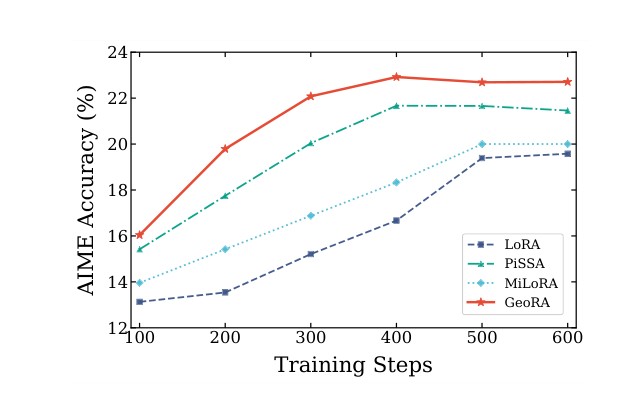
Figure 3: Training dynamics of Qwen3-8B as evaluated on the AIME benchmark (average of 2024 and 2025). GeoRA remains consistently top-performing throughout training.
图 3:在 AIME 基准(2024 与 2025 的平均)上评估 Qwen3-8B 的训练动态。GeoRA 在整个训练过程中都保持领先。
4.3 Training Stability and Efficiency
4.3 训练稳定性与效率
Training Dynamics. Figure 3 shows the training dynamics of Qwen3-8B as evaluated on the AIME benchmark. GeoRA remains consistently top-performing throughout training and reaches strong performance substantially earlier than other low-rank baselines. In contrast, LoRA, MiLoRA, and PiSSA improve more slowly and plateau at lower levels. This indicates that GeoRA not only yields better final accuracy, but also provides a more favorable optimization trajectory under RLVR.
训练动态。 图 3 给出了 Qwen3-8B 在 AIME 基准上的训练动态。GeoRA 在整个训练过程中都保持领先,并且明显更早达到较强成绩。相比之下,LoRA、MiLoRA 和 PiSSA 提升更慢,并在更低的水平上进入平台。这说明 GeoRA 不仅最终精度更好,在 RLVR 下的优化轨迹也更有利。
Hyperparameter Robustness. We first evaluate performance under different learning rates on Qwen3-4B in Figure 4. GeoRA maintains high reward across a broad range of learning rates, while other low-rank baselines are much more sensitive to this choice. In particular, PiSSA and MiLoRA degrade rapidly under larger learning rates, and LoRA also exhibits a clear drop in performance at the high end of the sweep. These results suggest that GeoRA is more robust to hyperparameter variation and requires less delicate tuning in practice. Similar robustness trends are also observed for other hyperparameters, including rank and sparsity, as shown in Appendix D.
超参数稳健性。 我们先在图 4 中考查 Qwen3-4B 在不同学习率下的表现。GeoRA 在较宽的学习率范围内都能保持高奖励,其他低秩基线则对这一选择敏感得多。尤其是 PiSSA 和 MiLoRA 在大学习率下迅速恶化,LoRA 在扫描区间的高端也出现明显下降。这些结果说明,GeoRA 对超参数变化更稳健,实践中也不那么需要精细调参。对秩和稀疏率等其他超参数,附录 D 中也观察到类似的稳健趋势。
Stability Under Aggressive Optimization. To stress-test optimization stability, we further compare reward and KL divergence under an aggressive learning rate in Figure 5. GeoRA maintains the highest reward trajectory without collapse, whereas PiSSA suffers a catastrophic drop late in training. At the same time, GeoRA keeps KL divergence at a low and controlled level throughout training. These results are highly relevant to RLVR optimization, which often requires stable policy updates within trust-region-like boundaries. The combination of higher reward and smoother KL behavior suggests that GeoRA improves exploration and policy refinement without inducing the destabilizing updates caused by geometry-misaligned adaptation.
激进优化下的稳定性。 为了给优化稳定性做压力测试,我们还在图 5 中比较了激进学习率下的奖励和 KL 散度。GeoRA 保持了最高的奖励轨迹且没有崩溃,PiSSA 则在训练后期出现灾难性下跌。与此同时,GeoRA 在整个训练过程中把 KL 散度维持在较低且受控的水平。这一点对 RLVR 优化特别重要,因为这类优化往往要求策略更新稳定地落在类似信任域的边界之内。更高的奖励加上更平滑的 KL 变化,说明 GeoRA 在改进探索和策略精炼的同时,并没有引入由几何错配适配所造成的那些失稳更新。
Efficiency. Table 3 compares the training efficiency of FullFT, SparseFT, and GeoRA. GeoRA updates only a tiny fraction of parameters, reducing trainable parameters by 99.5% relative to FullFT, while also lowering VRAM usage and improving per-iteration training speed. Compared with SparseFT, GeoRA avoids the overhead of unstructured sparse computation and therefore translates its parameter efficiency into actual hardware efficiency. Although GeoRA introduces an SVD-based initialization step, this cost is a one-time preprocessing overhead and is negligible compared with RLVR training; detailed profiling is provided in the appendix. Overall, these results show that GeoRA improves not only effectiveness and stability, but also practical training efficiency.
效率。 表 3 比较了 FullFT、SparseFT 和 GeoRA 的训练效率。GeoRA 只更新极小一部分参数,相对 FullFT 把可训练参数减少了 99.5%,同时还降低了显存占用、加快了每步训练。与 SparseFT 相比,GeoRA 避开了无结构稀疏计算的开销,因而能把参数效率落实为真实的硬件效率。虽然 GeoRA 增加了一次基于 SVD 的初始化,但这只是一次性的预处理,与 RLVR 训练相比可以忽略;详细剖析见附录。总体来看,这些结果说明 GeoRA 不仅提高了效果和稳定性,也提高了实际训练效率。
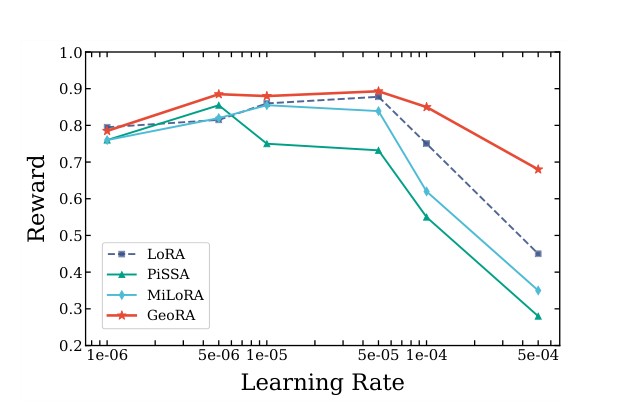
Figure 4: Performance comparison across different learning rates. GeoRA demonstrates superior stability and robust convergence even at higher learning rates.
图 4:不同学习率下的性能对比。即便在较高学习率下,GeoRA 也表现出更强的稳定性和更稳健的收敛。
Table 3: Efficiency Comparison between Full FT, SparseFT, and GeoRA. Relative reductions compared to Full FT are shown in parentheses.
| Method | Params (B) | Time (s/it) | VRAM (%) |
|---|---|---|---|
| Full FT | 8.00 | 231 | 95.73 |
| SparseFT | 2.56 (−68.0%) | 256 (+10.8%) | 81.25 (−15.1%) |
| GeoRA | 0.04 (−99.5%) | 185 (−19.9%) | 68.43 (−28.5%) |
表 3:全量微调、SparseFT 与 GeoRA 的效率对比。括号内为相对全量微调的增减。
| 方法 | 参数量 (B) | 时间 (s/it) | 显存 (%) |
|---|---|---|---|
| Full FT | 8.00 | 231 | 95.73 |
| SparseFT | 2.56(−68.0%) | 256(+10.8%) | 81.25(−15.1%) |
| GeoRA | 0.04(−99.5%) | 185(−19.9%) | 68.43(−28.5%) |
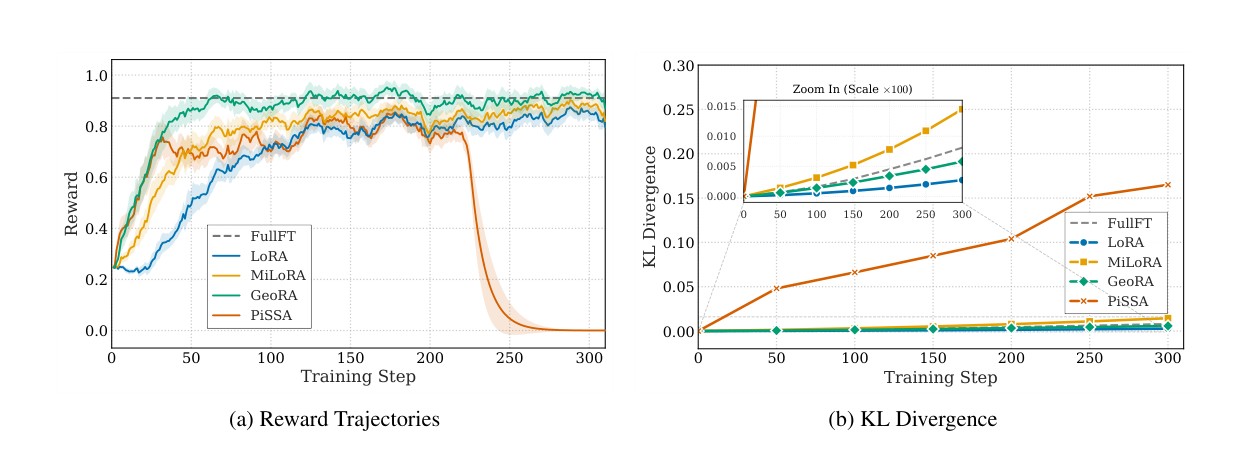
Figure 5: Training Stability and Constraint Adherence. Results on Qwen3-4B show that GeoRA demonstrates superior robustness under aggressive learning rates ().
图 5:训练稳定性与约束遵守情况。Qwen3-4B 上的结果显示,在激进学习率()下,GeoRA 具有更强的稳健性。
Table 4: Ablation study on Qwen3-4B with different initialization strategies and geometric mask variants.
| Method | Reward | AIME24 | AIME25 | MATH-500 | OlymMATH | Average |
|---|---|---|---|---|---|---|
| GeoRA | 0.88 | 13.33 | 9.17 | 73.40 | 5.75 | 25.41 |
| Ablation on Initialization Strategy | ||||||
| Random- Init | 0.85 | 12.50 | 8.50 | 72.10 | 5.25 | 24.60 |
| Tail- Init | 0.82 | 11.67 | 7.50 | 70.80 | 4.50 | 23.40 |
| Ablation on Geometric Masks | ||||||
| w/o | 0.86 | 12.50 | 8.33 | 72.00 | 4.75 | 24.40 |
| w/o | 0.83 | 13.33 | 8.75 | 72.80 | 5.50 | 25.10 |
表 4:在 Qwen3-4B 上对初始化策略与几何掩码变体的消融。
| 方法 | Reward | AIME24 | AIME25 | MATH-500 | OlymMATH | Average |
|---|---|---|---|---|---|---|
| GeoRA | 0.88 | 13.33 | 9.17 | 73.40 | 5.75 | 25.41 |
| 初始化策略消融 | ||||||
| Random- 初始化 | 0.85 | 12.50 | 8.50 | 72.10 | 5.25 | 24.60 |
| Tail- 初始化 | 0.82 | 11.67 | 7.50 | 70.80 | 4.50 | 23.40 |
| 几何掩码消融 | ||||||
| 去掉 | 0.86 | 12.50 | 8.33 | 72.00 | 4.75 | 24.40 |
| 去掉 | 0.83 | 13.33 | 8.75 | 72.80 | 5.50 | 25.10 |
4.4 Ablation and Analysis
4.4 消融与分析
Impact of Initialization Strategy. Table 4 shows that GeoRA’s geometry-aware initialization is critical to its performance. Replacing the proposed initialization with Random- initialization leads to a clear drop across all benchmarks, while Tail- initialization performs even worse. This indicates that the benefit of GeoRA does not come from low-rank adaptation alone, but from aligning the initialization with the effective RLVR update subspace. In particular, the poor performance of Tail- suggests that simply selecting low-energy directions is insufficient; the trainable directions must still capture the dominant structure within the geometry-constrained subspace.
初始化策略的影响。 表 4 表明,GeoRA 的几何感知初始化对其表现至关重要。若把所提出的初始化换成 Random- 初始化,所有基准上都会明显下降;Tail- 初始化则更差。这说明 GeoRA 的好处并不只来自低秩适配本身,而在于让初始化对齐有效的 RLVR 更新子空间。尤其是 Tail- 的不佳表现说明,仅仅选出低能量方向是不够的:可训练方向仍然必须抓住几何约束子空间里的主导结构。
Impact of Geometric Masks. We further ablate the two mask components used to construct the geometry-constrained subspace. Removing either or consistently degrades performance, confirming that both are necessary for strong results. This suggests that the two priors play complementary roles: the spectral mask helps suppress unstable high-energy directions, while the Euclidean mask preserves adaptation flexibility in low-magnitude regions. Their combination therefore provides a better approximation to the effective RLVR update manifold than either component alone.
几何掩码的影响。 我们进一步对构造几何约束子空间所用的两个掩码分量做消融。去掉 或 都会稳定地降低成绩,说明两者对取得强结果都是必要的。这提示两个先验扮演着互补角色:谱掩码帮助压制不稳定的高能量方向,欧几里得掩码则在低幅度区域保留适配的灵活性。二者结合,因此比单独使用其中任一分量,更能逼近有效的 RLVR 更新流形。
Overall Analysis. Taken together, the ablation results show that GeoRA’s gains arise from the full geometry-aware design rather than from any single isolated choice. The geometry-constrained subspace, structured initialization, and frozen residual anchor work together to improve optimization quality while preserving pre-trained structure. This is consistent with the stability and efficiency results in the previous section, and further supports our claim that RLVR benefits from a low-rank parameterization explicitly aligned with its update geometry.
总体分析。 综合来看,消融结果表明,GeoRA 的收益来自完整的几何感知设计,而不是某一项孤立选择。几何约束子空间、有结构的初始化,以及冻结的残差锚点,共同提高了优化质量,同时又保住了预训练结构。这与上一节的稳定性和效率结果相一致,也进一步支持我们的判断:RLVR 受益于一种与其更新几何显式对齐的低秩参数化。
5 Mechanism Analysis
5 机制分析
5.1 Geometric Priors
5.1 几何先验
GeoRA constructs its update subspace from two geometric priors: a spectral prior and a Euclidean prior. The motivation is that RLVR updates are highly selective, tending to exploit under-utilized yet plastic regions of the pre-trained model while avoiding large modifications to dominant principal directions. Accordingly, suppresses high-energy components in the principal subspace, whereas selects low-magnitude parameters in the original weight space. Their union defines a subspace that is both stable and expressive for RLVR adaptation.
GeoRA 用两种几何先验来构造更新子空间:谱先验和欧几里得先验。动机在于,RLVR 更新是高度选择的,倾向于利用预训练模型中尚未被充分利用、却仍有可塑性的区域,同时避免对主导的主方向做大幅度修改。因此, 压制主子空间中的高能量分量,而 则在原始权重空间中选择低幅度参数。二者的并集,定义出一个对 RLVR 适配既稳定又有表达力的子空间。
Table 5: Overlap analysis of the spectral prior and Euclidean prior on Qwen3-8B with .
| Group | Intersection | Jaccard | ||
|---|---|---|---|---|
| MLP | 20.0% | 20.0% | 4.63% | 0.131 |
| Attn | 20.0% | 20.0% | 4.25% | 0.119 |
| All | 20.0% | 20.0% | 4.55% | 0.128 |
表 5:在 Qwen3-8B 上、取 时,谱先验 与欧几里得先验 的重叠分析。
| 分组 | 交集 | Jaccard | ||
|---|---|---|---|---|
| MLP | 20.0% | 20.0% | 4.63% | 0.131 |
| Attn | 20.0% | 20.0% | 4.25% | 0.119 |
| 全部 | 20.0% | 20.0% | 4.55% | 0.128 |
We further verify that these two priors are complementary rather than redundant in Table 5. On Qwen3-8B with , both and select 20.0% of parameters, but their overlap remains small: the overall intersection is only 4.55%, with a Jaccard index of 0.128. Similar patterns are observed in both MLP layers (4.63%, 0.131) and attention layers (4.25%, 0.119). This limited overlap indicates that the two masks capture largely distinct parameter subsets and therefore serve complementary geometric roles. This is also consistent with the ablation results in Table 4: removing either prior leads to a clear performance drop.
我们在表 5 中进一步验证,这两个先验是互补的,而不是彼此重复。在 Qwen3-8B 上取 时, 与 都选出 20.0% 的参数,但重叠很小:总体交集只有 4.55%,Jaccard 指数为 0.128。MLP 层(4.63%,0.131)和注意力层(4.25%,0.119)上也是类似模式。有限的重叠说明,两个掩码捕捉的是大体不同的参数子集,因而承担着互补的几何角色。这与表 4 的消融也一致:去掉任一先验,成绩都会明显下降。
5.2 Low-Rank Structure
5.2 低秩结构
To validate the structural basis of GeoRA, we analyze the singular value spectrum of the geometry-constrained subspace. We compare with the original pre-trained weights, as well as random noise matrices at both full and sparse density. Figure 6(a) yields two key insights. First, sparsity does not by itself induce low-rankness. The spectrum of sparse random noise is nearly indistinguishable from that of dense random noise, and both follow a relatively flat decay pattern. This indicates that unstructured sparsity alone remains essentially isotropic in the spectral domain. Second, preserves a pronounced heavy-tailed spectrum similar to that of the pre-trained weights, with most spectral mass concentrated in a small number of leading components. This shows that the selected update region inherits a structured and compressible low-rank form rather than behaving like random sparse noise.
为了验证 GeoRA 的结构依据,我们分析几何约束子空间的奇异值谱。比较对象包括 、原始预训练权重,以及全密度和稀疏密度的随机噪声矩阵。图 6(a) 给出两点关键认识。第一,稀疏本身并不会带来低秩性。稀疏随机噪声的谱几乎与稠密随机噪声无法区分,二者都呈现相对平缓的衰减。这说明,单靠无结构稀疏,在谱域里本质上仍是各向同性的。第二, 保留了与预训练权重相似的、明显重尾的谱,大部分谱质量集中在少数几个主导分量上。这表明,被选中的更新区域继承的是有结构、可压缩的低秩形态,而不是随机稀疏噪声的行为。
We further find that the actual FullFT update, , exhibits a similarly compressible heavy-tailed spectrum. This strongly supports the low-rank inductive bias of GeoRA: the effective RLVR update space is not isotropic, but already structured and highly compressible. GeoRA therefore captures an intrinsic property of RLVR updates, instead of imposing an artificial low-rank constraint.
我们还发现,实际的 FullFT 更新 同样呈现出可压缩的重尾谱。这有力支持了 GeoRA 的低秩归纳偏置:有效的 RLVR 更新空间并不是各向同性的,而已经是有结构且高度可压缩的。因此,GeoRA 抓住的是 RLVR 更新的内在性质,而不是人为加上一道低秩约束。
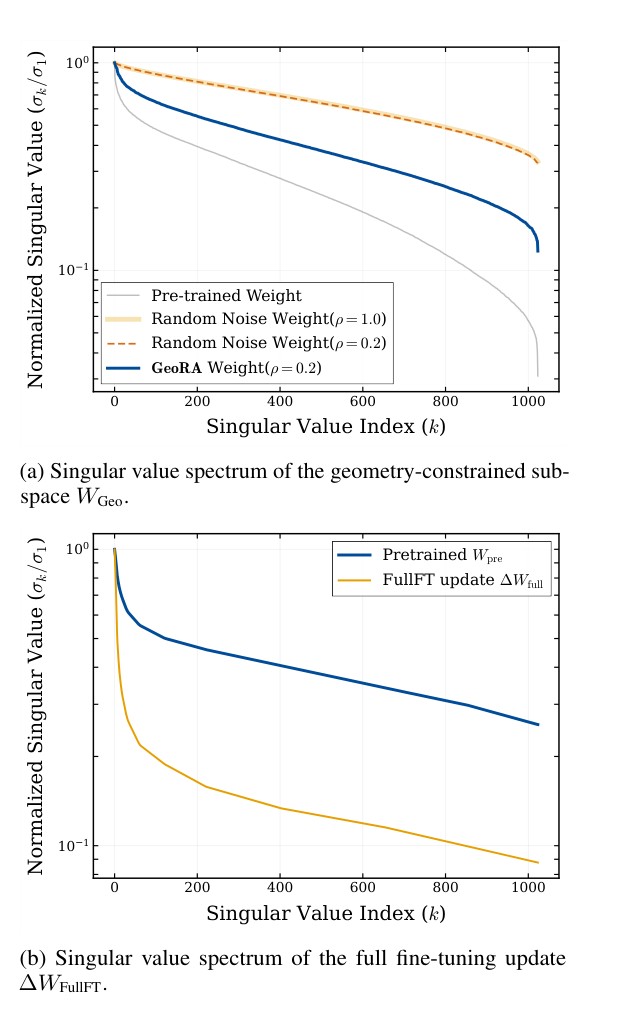
Figure 6: Spectral analysis of RLVR update structure.
图 6:RLVR 更新结构的谱分析。(a)几何约束子空间 的奇异值谱。(b)全量微调更新 的奇异值谱。
Table 6: Geometric mechanism analysis.
| Method | NSS | NSS | ||||
|---|---|---|---|---|---|---|
| Llama-3.1-8B | Qwen3-8B | |||||
| PiSSA | 0.395 | 0.98 | 0.01 | 0.418 | 0.95 | 0.03 |
| LoRA | 0.214 | 0.15 | 0.15 | 0.235 | 0.18 | 0.18 |
| MiLoRA | 0.125 | 0.12 | 0.92 | 0.132 | 0.16 | 0.90 |
| GeoRA | 0.092 | 0.005 | 0.98 | 0.096 | 0.015 | 0.96 |
表 6:几何机制分析。
| 方法 | NSS | NSS | ||||
|---|---|---|---|---|---|---|
| Llama-3.1-8B | Qwen3-8B | |||||
| PiSSA | 0.395 | 0.98 | 0.01 | 0.418 | 0.95 | 0.03 |
| LoRA | 0.214 | 0.15 | 0.15 | 0.235 | 0.18 | 0.18 |
| MiLoRA | 0.125 | 0.12 | 0.92 | 0.132 | 0.16 | 0.90 |
| GeoRA | 0.092 | 0.005 | 0.98 | 0.096 | 0.015 | 0.96 |
5.3 Spectral Efficiency and Alignment
5.3 谱效率与对齐
Building on the low-rank structure of RL updates, we validate GeoRA’s geometric superiority via Normalized Spectral Shift (NSS) and Subspace Alignment(Table 6). First, NSS quantifies the topological distortion of the pre-trained manifold:
在强化学习更新具有低秩结构的基础上,我们用归一化谱偏移(NSS)和子空间对齐(表 6)来验证 GeoRA 在几何上的优势。首先,NSS 量化预训练流形的拓扑畸变:
While PiSSA exhibits high NSS (), indicating aggressive structural modification, GeoRA maintains minimal distortion (), confirming it maximizes reward acquisition while preserving fundamental features.
PiSSA 的 NSS 很高(),说明结构被大幅度改动;GeoRA 则把畸变维持在很低的水平(),表明它在最大化奖励获取的同时,保住了基本特征。
To pinpoint the update locus, we calculate the alignment between and the pre-trained singular vectors :
为了定位更新落在何处,我们计算 与预训练奇异向量 之间的对齐:
GeoRA shows a distinct signature: it avoids the high-energy principal subspace ()—enhancing stability—and efficiently adapts the geometry-constrained tail (). In contrast, PiSSA’s instability is explained by its high overlap with the head subspace ().
GeoRA 呈现出一种独特的模式:它避开高能量的主子空间()——从而增强稳定性——并高效地适配几何约束的尾部()。相比之下,PiSSA 的不稳定性可以用它与头部子空间的高度重叠()来解释。
6 Conclusion
6 结论
In this paper, we bridge the gap between parameter-efficient fine-tuning and the distinctive optimization geometry of RLVR. Our study suggests that existing PEFT methods often yield suboptimal results in RLVR due to a structural mismatch. SFT-oriented low-rank methods prioritize directions that may be misaligned with the geometry-constrained updates favored by RLVR, while some sparse update methods better reflect RLVR dynamics but fail to translate into practical hardware efficiency. GeoRA addresses these challenges by identifying a compressible, geometry-aligned update subspace and parameterizing it through structured SVD initialization with a frozen residual anchor. Experiments on Qwen and Llama models from 1.5B to 32B parameters show that GeoRA consistently improves mathematical RLVR performance, extends effectively to medical and coding RLVR settings, and exhibits stronger generalization with less forgetting on out-of-domain tasks. Overall, GeoRA provides an effective, stable, and hardware-efficient adaptation strategy for RLVR.
本文旨在弥合参数高效微调与 RLVR 独特优化几何之间的差距。我们的研究表明,现有 PEFT 方法在 RLVR 中往往表现不佳,根源是结构上的错配。面向 SFT 的低秩方法所优先选择的方向,可能并不对齐 RLVR 所偏好的几何约束更新;一些稀疏更新方法虽然更贴近 RLVR 的动态,却无法转化成实际的硬件效率。GeoRA 的做法是:先找出一个可压缩、与几何对齐的更新子空间,再通过有结构的 SVD 初始化和冻结的残差锚点来参数化它。在参数量从 1.5B 到 32B 的 Qwen 和 Llama 模型上,实验表明 GeoRA 稳定提升数学 RLVR 成绩,也能有效扩展到医学和编程 RLVR,并在域外任务上表现出更强的泛化和更少的遗忘。总体而言,GeoRA 为 RLVR 提供了一种有效、稳定且硬件高效的适配策略。
Limitations
局限
Despite its effectiveness, GeoRA has certain limitations. First, the initialization process requires performing a truncated SVD and dual-masking operations. While these represent a one-time computational cost at the beginning of training, they introduce an additional pre-processing step compared to the random initialization used in standard LoRA. Second, our experiments primarily focus on RLVR in reasoning domains. Although GeoRA demonstrates strong performance on these tasks, its generalizability needs to be further validated across a broader range of model architectures and diverse reinforcement learning scenarios beyond verifiable rewards.
尽管有效,GeoRA 仍有若干局限。第一,初始化需要做截断 SVD 和双重掩码。这些计算虽然只发生在训练开始时一次,但相对标准 LoRA 的随机初始化,还是多出一步预处理。第二,我们的实验主要集中在推理领域的 RLVR。虽然 GeoRA 在这些任务上表现很好,它在更广的模型架构上,以及在可验证奖励之外的多样强化学习场景中,是否同样适用,仍有待进一步验证。
References
参考文献
Alam and Rastogi (2025) M. T. Alam and N. Rastogi Limits of generalization in rlvr: two case studies in mathematical reasoning.
Austin et al. (2021) J. Austin, A. Odena, M. Nye, M. Bosma, H. Michalewski, D. Dohan, E. Jiang, C. Cai, M. Terry, and Q. Le Program synthesis with large language models. arXiv preprint arXiv:2108.07732.
Cai et al. (2025) Y. Cai, D. Cao, X. Xu, Z. Yao, Y. Huang, Z. Tan, B. Zhang, G. Liu, and J. Fang On predictability of reinforcement learning dynamics for large language models.
Chen et al. (2021) M. Chen, J. Tworek, H. Jun, Q. Yuan, H. P. de Oliveira Pinto, J. Kaplan, H. Edwards, Y. Burda, N. Joseph, G. Brockman, A. Ray, R. Puri, G. Krueger, M. Petrov, H. Khlaaf, G. Sastry, P. Mishkin, B. Chan, S. Gray, N. Ryder, M. Pavlov, A. Power, L. Kaiser, M. Bavarian, C. Winter, P. Tillet, F. P. Such, D. Cummings, M. Plappert, F. Chantzis, E. Barnes, A. Herbert-Voss, W. H. Guss, A. Nichol, A. Paino, N. Tezak, J. Tang, I. Babuschkin, S. Balaji, S. Jain, W. Saunders, C. Hesse, A. N. Carr, J. Leike, J. Achiam, V. Misra, E. Morikawa, A. Radford, M. Knight, M. Brundage, M. Murati, K. Mayer, P. Welinder, B. McGrew, D. Amodei, S. McCandlish, I. Sutskever, and W. Zaremba Evaluating large language models trained on code.
Chu et al. (2025) T. Chu, Y. Zhai, J. Yang, S. Tong, S. Xie, D. Schuurmans, Q. V. Le, S. Levine, and Y. Ma SFT memorizes, rl generalizes: a comparative study of foundation model post-training.
Cobbe et al. (2021) K. Cobbe, V. Kosaraju, M. Bavarian, M. Chen, H. Jun, L. Kaiser, M. Plappert, J. Tworek, J. Hilton, R. Nakano, C. Hesse, and J. Schulman Training verifiers to solve math word problems.
Cui et al. (2025) G. Cui, L. Yuan, Z. Wang, H. Wang, Y. Zhang, J. Chen, W. Li, B. He, Y. Fan, T. Yu, Q. Xu, W. Chen, J. Yuan, H. Chen, K. Zhang, X. Lv, S. Wang, Y. Yao, X. Han, H. Peng, Y. Cheng, Z. Liu, M. Sun, B. Zhou, and N. Ding Process reinforcement through implicit rewards.
DeepSeek-AI et al. (2025) DeepSeek-AI, D. Guo, D. Yang, H. Zhang, J. Song, R. Zhang, R. Xu, Q. Zhu, S. Ma, P. Wang, X. Bi, X. Zhang, X. Yu, Y. Wu, Z. F. Wu, Z. Gou, Z. Shao, Z. Li, Z. Gao, A. Liu, B. Xue, B. Wang, B. Wu, B. Feng, C. Lu, C. Zhao, C. Deng, C. Zhang, C. Ruan, D. Dai, D. Chen, D. Ji, E. Li, F. Lin, F. Dai, F. Luo, G. Hao, G. Chen, G. Li, H. Zhang, H. Bao, H. Xu, H. Wang, H. Ding, H. Xin, H. Gao, H. Qu, H. Li, J. Guo, J. Li, J. Wang, J. Chen, J. Yuan, J. Qiu, J. Li, J. L. Cai, J. Ni, J. Liang, J. Chen, K. Dong, K. Hu, K. Gao, K. Guan, K. Huang, K. Yu, L. Wang, L. Zhang, L. Zhao, L. Wang, L. Zhang, L. Xu, L. Xia, M. Zhang, M. Zhang, M. Tang, M. Li, M. Wang, M. Li, N. Tian, P. Huang, P. Zhang, Q. Wang, Q. Chen, Q. Du, R. Ge, R. Zhang, R. Pan, R. Wang, R. J. Chen, R. L. Jin, R. Chen, S. Lu, S. Zhou, S. Chen, S. Ye, S. Wang, S. Yu, S. Zhou, S. Pan, S. S. Li, S. Zhou, S. Wu, S. Ye, T. Yun, T. Pei, T. Sun, T. Wang, W. Zeng, W. Zhao, W. Liu, W. Liang, W. Gao, W. Yu, W. Zhang, W. L. Xiao, W. An, X. Liu, X. Wang, X. Chen, X. Nie, X. Cheng, X. Liu, X. Xie, X. Liu, X. Yang, X. Li, X. Su, X. Lin, X. Q. Li, X. Jin, X. Shen, X. Chen, X. Sun, X. Wang, X. Song, X. Zhou, X. Wang, X. Shan, Y. K. Li, Y. Q. Wang, Y. X. Wei, Y. Zhang, Y. Xu, Y. Li, Y. Zhao, Y. Sun, Y. Wang, Y. Yu, Y. Zhang, Y. Shi, Y. Xiong, Y. He, Y. Piao, Y. Wang, Y. Tan, Y. Ma, Y. Liu, Y. Guo, Y. Ou, Y. Wang, Y. Gong, Y. Zou, Y. He, Y. Xiong, Y. Luo, Y. You, Y. Liu, Y. Zhou, Y. X. Zhu, Y. Xu, Y. Huang, Y. Li, Y. Zheng, Y. Zhu, Y. Ma, Y. Tang, Y. Zha, Y. Yan, Z. Z. Ren, Z. Ren, Z. Sha, Z. Fu, Z. Xu, Z. Xie, Z. Zhang, Z. Hao, Z. Ma, Z. Yan, Z. Wu, Z. Gu, Z. Zhu, Z. Liu, Z. Li, Z. Xie, Z. Song, Z. Pan, Z. Huang, Z. Xu, Z. Zhang, and Z. Zhang DeepSeek-r1: incentivizing reasoning capability in llms via reinforcement learning.
Grattafiori et al. (2024) A. Grattafiori, A. Dubey, A. Jauhri, A. Pandey, A. Kadian, A. Al-Dahle, A. Letman, A. Mathur, A. Schelten, A. Vaughan, A. Yang, A. Fan, A. Goyal, A. Hartshorn, A. Yang, A. Mitra, A. Sravankumar, A. Korenev, A. Hinsvark, A. Rao, A. Zhang, A. Rodriguez, A. Gregerson, A. Spataru, B. Roziere, B. Biron, B. Tang, B. Chern, C. Caucheteux, C. Nayak, C. Bi, C. Marra, C. McConnell, C. Keller, C. Touret, C. Wu, C. Wong, C. C. Ferrer, C. Nikolaidis, D. Allonsius, D. Song, D. Pintz, D. Livshits, D. Wyatt, D. Esiobu, D. Choudhary, D. Mahajan, D. Garcia-Olano, D. Perino, D. Hupkes, E. Lakomkin, E. AlBadawy, E. Lobanova, E. Dinan, E. M. Smith, F. Radenovic, F. Guzmán, F. Zhang, G. Synnaeve, G. Lee, G. L. Anderson, G. Thattai, G. Nail, G. Mialon, G. Pang, G. Cucurell, H. Nguyen, H. Korevaar, H. Xu, H. Touvron, I. Zarov, I. A. Ibarra, I. Kloumann, I. Misra, I. Evtimov, J. Zhang, J. Copet, J. Lee, J. Geffert, J. Vranes, J. Park, J. Mahadeokar, J. Shah, J. van der Linde, J. Billock, J. Hong, J. Lee, J. Fu, J. Chi, J. Huang, J. Liu, J. Wang, J. Yu, J. Bitton, J. Spisak, J. Park, J. Rocca, J. Johnstun, J. Saxe, J. Jia, K. V. Alwala, K. Prasad, K. Upasani, K. Plawiak, K. Li, K. Heafield, K. Stone, K. El-Arini, K. Iyer, K. Malik, K. Chiu, K. Bhalla, K. Lakhotia, L. Rantala-Yeary, L. van der Maaten, L. Chen, L. Tan, L. Jenkins, L. Martin, L. Madaan, L. Malo, L. Blecher, L. Landzaat, L. de Oliveira, M. Muzzi, M. Pasupuleti, M. Singh, M. Paluri, M. Kardas, M. Tsimpoukelli, M. Oldham, M. Rita, M. Pavlova, M. Kambadur, M. Lewis, M. Si, M. K. Singh, M. Hassan, N. Goyal, N. Torabi, N. Bashlykov, N. Bogoychev, N. Chatterji, N. Zhang, O. Duchenne, O. Çelebi, P. Alrassy, P. Zhang, P. Li, P. Vasic, P. Weng, P. Bhargava, P. Dubal, P. Krishnan, P. S. Koura, P. Xu, Q. He, Q. Dong, R. Srinivasan, R. Ganapathy, R. Calderer, R. S. Cabral, R. Stojnic, R. Raileanu, R. Maheswari, R. Girdhar, R. Patel, R. Sauvestre, R. Polidoro, R. Sumbaly, R. Taylor, R. Silva, R. Hou, R. Wang, S. Hosseini, S. Chennabasappa, S. Singh, S. Bell, S. S. Kim, S. Edunov, S. Nie, S. Narang, S. Raparthy, S. Shen, S. Wan, S. Bhosale, S. Zhang, S. Vandenhende, S. Batra, S. Whitman, S. Sootla, S. Collot, S. Gururangan, S. Borodinsky, T. Herman, T. Fowler, T. Sheasha, T. Georgiou, T. Scialom, T. Speckbacher, T. Mihaylov, T. Xiao, U. Karn, V. Goswami, V. Gupta, V. Ramanathan, V. Kerkez, V. Gonguet, V. Do, V. Vogeti, V. Albiero, V. Petrovic, W. Chu, W. Xiong, W. Fu, W. Meers, X. Martinet, X. Wang, X. Wang, X. E. Tan, X. Xia, X. Xie, X. Jia, X. Wang, Y. Goldschlag, Y. Gaur, Y. Babaei, Y. Wen, Y. Song, Y. Zhang, Y. Li, Y. Mao, Z. D. Coudert, Z. Yan, Z. Chen, Z. Papakipos, A. Singh, A. Srivastava, A. Jain, A. Kelsey, A. Shajnfeld, A. Gangidi, A. Victoria, A. Goldstand, A. Menon, A. Sharma, A. Boesenberg, A. Baevski, A. Feinstein, A. Kallet, A. Sangani, A. Teo, A. Yunus, A. Lupu, A. Alvarado, A. Caples, A. Gu, A. Ho, A. Poulton, A. Ryan, A. Ramchandani, A. Dong, A. Franco, A. Goyal, A. Saraf, A. Chowdhury, A. Gabriel, A. Bharambe, A. Eisenman, A. Yazdan, B. James, B. Maurer, B. Leonhardi, B. Huang, B. Loyd, B. D. Paola, B. Paranjape, B. Liu, B. Wu, B. Ni, B. Hancock, B. Wasti, B. Spence, B. Stojkovic, B. Gamido, B. Montalvo, C. Parker, C. Burton, C. Mejia, C. Liu, C. Wang, C. Kim, C. Zhou, C. Hu, C. Chu, C. Cai, C. Tindal, C. Feichtenhofer, C. Gao, D. Civin, D. Beaty, D. Kreymer, D. Li, D. Adkins, D. Xu, D. Testuggine, D. David, D. Parikh, D. Liskovich, D. Foss, D. Wang, D. Le, D. Holland, E. Dowling, E. Jamil, E. Montgomery, E. Presani, E. Hahn, E. Wood, E. Le, E. Brinkman, E. Arcaute, E. Dunbar, E. Smothers, F. Sun, F. Kreuk, F. Tian, F. Kokkinos, F. Ozgenel, F. Caggioni, F. Kanayet, F. Seide, G. M. Florez, G. Schwarz, G. Badeer, G. Swee, G. Halpern, G. Herman, G. Sizov, Guangyi, Zhang, G. Lakshminarayanan, H. Inan, H. Shojanazeri, H. Zou, H. Wang, H. Zha, H. Habeeb, H. Rudolph, H. Suk, H. Aspegren, H. Goldman, H. Zhan, I. Damlaj, I. Molybog, I. Tufanov, I. Leontiadis, I. Veliche, I. Gat, J. Weissman, J. Geboski, J. Kohli, J. Lam, J. Asher, J. Gaya, J. Marcus, J. Tang, J. Chan, J. Zhen, J. Reizenstein, J. Teboul, J. Zhong, J. Jin, J. Yang, J. Cummings, J. Carvill, J. Shepard, J. McPhie, J. Torres, J. Ginsburg, J. Wang, K. Wu, K. H. U, K. Saxena, K. Khandelwal, K. Zand, K. Matosich, K. Veeraraghavan, K. Michelena, K. Li, K. Jagadeesh, K. Huang, K. Chawla, K. Huang, L. Chen, L. Garg, L. A, L. Silva, L. Bell, L. Zhang, L. Guo, L. Yu, L. Moshkovich, L. Wehrstedt, M. Khabsa, M. Avalani, M. Bhatt, M. Mankus, M. Hasson, M. Lennie, M. Reso, M. Groshev, M. Naumov, M. Lathi, M. Keneally, M. Liu, M. L. Seltzer, M. Valko, M. Restrepo, M. Patel, M. Vyatskov, M. Samvelyan, M. Clark, M. Macey, M. Wang, M. J. Hermoso, M. Metanat, M. Rastegari, M. Bansal, N. Santhanam, N. Parks, N. White, N. Bawa, N. Singhal, N. Egebo, N. Usunier, N. Mehta, N. P. Laptev, N. Dong, N. Cheng, O. Chernoguz, O. Hart, O. Salpekar, O. Kalinli, P. Kent, P. Parekh, P. Saab, P. Balaji, P. Rittner, P. Bontrager, P. Roux, P. Dollar, P. Zvyagina, P. Ratanchandani, P. Yuvraj, Q. Liang, R. Alao, R. Rodriguez, R. Ayub, R. Murthy, R. Nayani, R. Mitra, R. Parthasarathy, R. Li, R. Hogan, R. Battey, R. Wang, R. Howes, R. Rinott, S. Mehta, S. Siby, S. J. Bondu, S. Datta, S. Chugh, S. Hunt, S. Dhillon, S. Sidorov, S. Pan, S. Mahajan, S. Verma, S. Yamamoto, S. Ramaswamy, S. Lindsay, S. Lindsay, S. Feng, S. Lin, S. C. Zha, S. Patil, S. Shankar, S. Zhang, S. Zhang, S. Wang, S. Agarwal, S. Sajuyigbe, S. Chintala, S. Max, S. Chen, S. Kehoe, S. Satterfield, S. Govindaprasad, S. Gupta, S. Deng, S. Cho, S. Virk, S. Subramanian, S. Choudhury, S. Goldman, T. Remez, T. Glaser, T. Best, T. Koehler, T. Robinson, T. Li, T. Zhang, T. Matthews, T. Chou, T. Shaked, V. Vontimitta, V. Ajayi, V. Montanez, V. Mohan, V. S. Kumar, V. Mangla, V. Ionescu, V. Poenaru, V. T. Mihailescu, V. Ivanov, W. Li, W. Wang, W. Jiang, W. Bouaziz, W. Constable, X. Tang, X. Wu, X. Wang, X. Wu, X. Gao, Y. Kleinman, Y. Chen, Y. Hu, Y. Jia, Y. Qi, Y. Li, Y. Zhang, Y. Zhang, Y. Adi, Y. Nam, Yu, Wang, Y. Zhao, Y. Hao, Y. Qian, Y. Li, Y. He, Z. Rait, Z. DeVito, Z. Rosnbrick, Z. Wen, Z. Yang, Z. Zhao, and Z. Ma The llama 3 herd of models.
Hambardzumyan et al. (2021) K. Hambardzumyan, H. Khachatrian, and J. May WARP: word-level adversarial reprogramming.
Han et al. (2024) Z. Han, C. Gao, J. Liu, J. Zhang, and S. Q. Zhang Parameter-efficient fine-tuning for large models: a comprehensive survey.
He et al. (2025) Z. He, T. Liang, J. Xu, Q. Liu, X. Chen, Y. Wang, L. Song, D. Yu, Z. Liang, W. Wang, Z. Zhang, R. Wang, Z. Tu, H. Mi, and D. Yu DeepMath-103k: a large-scale, challenging, decontaminated, and verifiable mathematical dataset for advancing reasoning.
Hendrycks et al. (2021a) D. Hendrycks, C. Burns, S. Basart, A. Zou, M. Mazeika, D. Song, and J. Steinhardt Measuring massive multitask language understanding.
Hendrycks et al. (2021b) D. Hendrycks, C. Burns, S. Kadavath, A. Arora, S. Basart, E. Tang, D. Song, and J. Steinhardt Measuring mathematical problem solving with the math dataset.
Hu et al. (2021) E. J. Hu, Y. Shen, P. Wallis, Z. Allen-Zhu, Y. Li, S. Wang, L. Wang, and W. Chen LoRA: low-rank adaptation of large language models.
Hu et al. (2025) J. Hu, Y. Zhang, Q. Han, D. Jiang, X. Zhang, and H. Shum Open-reasoner-zero: an open source approach to scaling up reinforcement learning on the base model.
Jain et al. (2025) N. Jain, K. Han, A. Gu, W. Li, F. Yan, T. Zhang, S. Wang, A. Solar-Lezama, K. Sen, and I. Stoica LiveCodeBench: holistic and contamination free evaluation of large language models for code. In The Thirteenth International Conference on Learning Representations ,
Jin et al. (2021) D. Jin, E. Pan, N. Oufattole, W. Weng, H. Fang, and P. Szolovits What disease does this patient have? a large-scale open domain question answering dataset from medical exams. Applied Sciences 11 ( 14 ), pp. 6421.
Jin et al. (2025a) H. Jin, S. Luan, S. Lyu, G. Rabusseau, R. Rabbany, D. Precup, and M. Hamdaqa RL fine-tuning heals ood forgetting in sft.
Jin et al. (2025b) H. Jin, S. Lv, S. Wu, and M. Hamdaqa RL is neither a panacea nor a mirage: understanding supervised vs. reinforcement learning fine-tuning for llms.
Jin et al. (2019) Q. Jin, B. Dhingra, Z. Liu, W. Cohen, and X. Lu PubMedQA: a dataset for biomedical research question answering. In Proceedings of the 2019 Conference on Empirical Methods in Natural Language Processing and the 9th International Joint Conference on Natural Language Processing (EMNLP-IJCNLP) , pp. 2567–2577.
Kopiczko et al. (2024) D. J. Kopiczko, T. Blankevoort, and Y. M. Asano VeRA: vector-based random matrix adaptation.
Lambert et al. (2025) N. Lambert, J. Morrison, V. Pyatkin, S. Huang, H. Ivison, F. Brahman, L. J. V. Miranda, A. Liu, N. Dziri, S. Lyu, Y. Gu, S. Malik, V. Graf, J. D. Hwang, J. Yang, R. L. Bras, O. Tafjord, C. Wilhelm, L. Soldaini, N. A. Smith, Y. Wang, P. Dasigi, and H. Hajishirzi Tulu 3: pushing frontiers in open language model post-training.
Lawton et al. (2023) N. Lawton, A. Kumar, G. Thattai, A. Galstyan, and G. V. Steeg Neural architecture search for parameter-efficient fine-tuning of large pre-trained language models.
Li et al. (2018) C. Li, H. Farkhoor, R. Liu, and J. Yosinski Measuring the intrinsic dimension of objective landscapes.
Liang et al. (2023) Z. Liang, F. Wei, Y. Jie, Y. Qian, Z. Hao, and B. Han Prompts can play lottery tickets well: achieving lifelong information extraction via lottery prompt tuning. In Proceedings of the 61st Annual Meeting of the Association for Computational Linguistics (Volume 1: Long Papers) , pp. 277–292.
Lin et al. (2022) S. Lin, J. Hilton, and O. Evans TruthfulQA: measuring how models mimic human falsehoods. In Proceedings of the 60th Annual Meeting of the Association for Computational Linguistics (Volume 1: Long Papers) , pp. 3214–3252.
Lin et al. (2020) Z. Lin, A. Madotto, and P. Fung Exploring versatile generative language model via parameter-efficient transfer learning.
Liu et al. (2025a) C. Liu, H. Wang, J. Pan, Z. Wan, Y. Dai, F. Lin, W. Bai, D. Rueckert, and R. Arcucci Beyond distillation: pushing the limits of medical llm reasoning with minimalist rule-based rl.
Liu et al. (2023) J. Liu, T. Chen, Z. Liang, H. Jiang, Y. Xiao, F. Wei, Y. Qian, Z. Hao, and B. Han Hierarchical prompt tuning for few-shot multi-task learning. In Proceedings of the 32nd ACM International Conference on Information and Knowledge Management , pp. 1556–1565.
Liu et al. (2025b) M. Liu, S. Diao, X. Lu, J. Hu, X. Dong, Y. Choi, J. Kautz, and Y. Dong ProRL: prolonged reinforcement learning expands reasoning boundaries in large language models.
Liu et al. (2024) S. Liu, C. Wang, H. Yin, P. Molchanov, Y. F. Wang, K. Cheng, and M. Chen DoRA: weight-decomposed low-rank adaptation.
Liu et al. (2025c) Z. Liu, T. Pang, O. Balabanov, C. Yang, T. Huang, L. Yin, Y. Yang, and S. Liu LIFT the veil for the truth: principal weights emerge after rank reduction for reasoning-focused supervised fine-tuning.
Meng et al. (2025) F. Meng, Z. Wang, and M. Zhang PiSSA: principal singular values and singular vectors adaptation of large language models.
Mukherjee et al. (2025) S. Mukherjee, L. Yuan, D. Hakkani-Tur, and H. Peng Reinforcement learning finetunes small subnetworks in large language models.
Nguyen et al. (2025) P. M. Nguyen, C. D. La, D. M. H. Nguyen, N. V. Chawla, B. T. Nguyen, and K. D. Doan The reasoning boundary paradox: how reinforcement learning constrains language models.
OpenAI et al. (2024) OpenAI, :, A. Jaech, A. Kalai, A. Lerer, A. Richardson, A. El-Kishky, A. Low, A. Helyar, A. Madry, A. Beutel, A. Carney, A. Iftimie, A. Karpenko, A. T. Passos, A. Neitz, A. Prokofiev, A. Wei, A. Tam, A. Bennett, A. Kumar, A. Saraiva, A. Vallone, A. Duberstein, A. Kondrich, A. Mishchenko, A. Applebaum, A. Jiang, A. Nair, B. Zoph, B. Ghorbani, B. Rossen, B. Sokolowsky, B. Barak, B. McGrew, B. Minaiev, B. Hao, B. Baker, B. Houghton, B. McKinzie, B. Eastman, C. Lugaresi, C. Bassin, C. Hudson, C. M. Li, C. de Bourcy, C. Voss, C. Shen, C. Zhang, C. Koch, C. Orsinger, C. Hesse, C. Fischer, C. Chan, D. Roberts, D. Kappler, D. Levy, D. Selsam, D. Dohan, D. Farhi, D. Mely, D. Robinson, D. Tsipras, D. Li, D. Oprica, E. Freeman, E. Zhang, E. Wong, E. Proehl, E. Cheung, E. Mitchell, E. Wallace, E. Ritter, E. Mays, F. Wang, F. P. Such, F. Raso, F. Leoni, F. Tsimpourlas, F. Song, F. von Lohmann, F. Sulit, G. Salmon, G. Parascandolo, G. Chabot, G. Zhao, G. Brockman, G. Leclerc, H. Salman, H. Bao, H. Sheng, H. Andrin, H. Bagherinezhad, H. Ren, H. Lightman, H. W. Chung, I. Kivlichan, I. O’Connell, I. Osband, I. C. Gilaberte, I. Akkaya, I. Kostrikov, I. Sutskever, I. Kofman, J. Pachocki, J. Lennon, J. Wei, J. Harb, J. Twore, J. Feng, J. Yu, J. Weng, J. Tang, J. Yu, J. Q. Candela, J. Palermo, J. Parish, J. Heidecke, J. Hallman, J. Rizzo, J. Gordon, J. Uesato, J. Ward, J. Huizinga, J. Wang, K. Chen, K. Xiao, K. Singhal, K. Nguyen, K. Cobbe, K. Shi, K. Wood, K. Rimbach, K. Gu-Lemberg, K. Liu, K. Lu, K. Stone, K. Yu, L. Ahmad, L. Yang, L. Liu, L. Maksin, L. Ho, L. Fedus, L. Weng, L. Li, L. McCallum, L. Held, L. Kuhn, L. Kondraciuk, L. Kaiser, L. Metz, M. Boyd, M. Trebacz, M. Joglekar, M. Chen, M. Tintor, M. Meyer, M. Jones, M. Kaufer, M. Schwarzer, M. Shah, M. Yatbaz, M. Y. Guan, M. Xu, M. Yan, M. Glaese, M. Chen, M. Lampe, M. Malek, M. Wang, M. Fradin, M. McClay, M. Pavlov, M. Wang, M. Wang, M. Murati, M. Bavarian, M. Rohaninejad, N. McAleese, N. Chowdhury, N. Chowdhury, N. Ryder, N. Tezak, N. Brown, O. Nachum, O. Boiko, O. Murk, O. Watkins, P. Chao, P. Ashbourne, P. Izmailov, P. Zhokhov, R. Dias, R. Arora, R. Lin, R. G. Lopes, R. Gaon, R. Miyara, R. Leike, R. Hwang, R. Garg, R. Brown, R. James, R. Shu, R. Cheu, R. Greene, S. Jain, S. Altman, S. Toizer, S. Toyer, S. Miserendino, S. Agarwal, S. Hernandez, S. Baker, S. McKinney, S. Yan, S. Zhao, S. Hu, S. Santurkar, S. R. Chaudhuri, S. Zhang, S. Fu, S. Papay, S. Lin, S. Balaji, S. Sanjeev, S. Sidor, T. Broda, A. Clark, T. Wang, T. Gordon, T. Sanders, T. Patwardhan, T. Sottiaux, T. Degry, T. Dimson, T. Zheng, T. Garipov, T. Stasi, T. Bansal, T. Creech, T. Peterson, T. Eloundou, V. Qi, V. Kosaraju, V. Monaco, V. Pong, V. Fomenko, W. Zheng, W. Zhou, W. McCabe, W. Zaremba, Y. Dubois, Y. Lu, Y. Chen, Y. Cha, Y. Bai, Y. He, Y. Zhang, Y. Wang, Z. Shao, and Z. Li OpenAI o1 system card.
Pal et al. (2022) A. Pal, L. K. Umapathi, and M. Sankarasubbu MedMCQA: a large-scale multi-subject multi-choice dataset for medical domain question answering. In Proceedings of the Conference on Health, Inference, and Learning , pp. 248–260.
Patel et al. (2024) B. Patel, S. Chakraborty, W. A. Suttle, M. Wang, A. S. Bedi, and D. Manocha AIME: ai system optimization via multiple llm evaluators.
Rein et al. (2023) D. Rein, B. L. Hou, A. C. Stickland, J. Petty, R. Y. Pang, J. Dirani, J. Michael, and S. R. Bowman GPQA: a graduate-level google-proof q&a benchmark.
Shao et al. (2024) Z. Shao, P. Wang, Q. Zhu, R. Xu, J. Song, X. Bi, H. Zhang, M. Zhang, Y. K. Li, Y. Wu, and D. Guo DeepSeekMath: pushing the limits of mathematical reasoning in open language models.
Shenfeld et al. (2025) I. Shenfeld, J. Pari, and P. Agrawal RL’s razor: why online reinforcement learning forgets less.
Sun et al. (2025) H. Sun, Y. Min, Z. Chen, W. X. Zhao, L. Fang, Z. Liu, Z. Wang, and J. Wen Challenging the boundaries of reasoning: an olympiad-level math benchmark for large language models.
Wang et al. (2025) H. Wang, Y. Li, S. Wang, G. Chen, and Y. Chen MiLoRA: harnessing minor singular components for parameter-efficient llm finetuning.
Wu et al. (2025) F. Wu, W. Xuan, X. Lu, M. Liu, Y. Dong, Z. Harchaoui, and Y. Choi The invisible leash: why rlvr may or may not escape its origin.
Xu et al. (2023) L. Xu, H. Xie, S. J. Qin, X. Tao, and F. L. Wang Parameter-efficient fine-tuning methods for pretrained language models: a critical review and assessment.
Yang et al. (2025) A. Yang, A. Li, B. Yang, B. Zhang, B. Hui, B. Zheng, B. Yu, C. Gao, C. Huang, C. Lv, C. Zheng, D. Liu, F. Zhou, F. Huang, F. Hu, H. Ge, H. Wei, H. Lin, J. Tang, J. Yang, J. Tu, J. Zhang, J. Yang, J. Yang, J. Zhou, J. Zhou, J. Lin, K. Dang, K. Bao, K. Yang, L. Yu, L. Deng, M. Li, M. Xue, M. Li, P. Zhang, P. Wang, Q. Zhu, R. Men, R. Gao, S. Liu, S. Luo, T. Li, T. Tang, W. Yin, X. Ren, X. Wang, X. Zhang, X. Ren, Y. Fan, Y. Su, Y. Zhang, Y. Zhang, Y. Wan, Y. Liu, Z. Wang, Z. Cui, Z. Zhang, Z. Zhou, and Z. Qiu Qwen3 technical report.
Yin et al. (2025) Q. Yin, Y. Wu, Z. Shen, S. Li, Z. Wang, Y. Li, C. T. Leong, J. Kang, and J. Gu Evaluating parameter efficient methods for rlvr.
Yuan et al. (2025) L. Yuan, W. Chen, Y. Zhang, G. Cui, H. Wang, Z. You, N. Ding, Z. Liu, M. Sun, and H. Peng From f ( x ) f(x) and g ( x ) g(x) to f ( g ( x ) ) f(g(x)) : llms learn new skills in rl by composing old ones.
Yue et al. (2025) Y. Yue, Z. Chen, R. Lu, A. Zhao, Z. Wang, Y. Yue, S. Song, and G. Huang Does reinforcement learning really incentivize reasoning capacity in llms beyond the base model?.
Zaken et al. (2022) E. B. Zaken, S. Ravfogel, and Y. Goldberg BitFit: simple parameter-efficient fine-tuning for transformer-based masked language-models.
Zhang et al. (2025) K. Zhang, Y. Zuo, B. He, Y. Sun, R. Liu, C. Jiang, Y. Fan, K. Tian, G. Jia, P. Li, Y. Fu, X. Lv, Y. Zhang, S. Zeng, S. Qu, H. Li, S. Wang, Y. Wang, X. Long, F. Liu, X. Xu, J. Ma, X. Zhu, E. Hua, Y. Liu, Z. Li, H. Chen, X. Qu, Y. Li, W. Chen, Z. Yuan, J. Gao, D. Li, Z. Ma, G. Cui, Z. Liu, B. Qi, N. Ding, and B. Zhou A survey of reinforcement learning for large reasoning models.
Zhang et al. (2023) Q. Zhang, M. Chen, A. Bukharin, N. Karampatziakis, P. He, Y. Cheng, W. Chen, and T. Zhao AdaLoRA: adaptive budget allocation for parameter-efficient fine-tuning.
Zhao et al. (2025) R. Zhao, A. Meterez, S. Kakade, C. Pehlevan, S. Jelassi, and E. Malach Echo chamber: rl post-training amplifies behaviors learned in pretraining.
Zhou et al. (2023) J. Zhou, T. Lu, S. Mishra, S. Brahma, S. Basu, Y. Luan, D. Zhou, and L. Hou Instruction-following evaluation for large language models.
Zhu et al. (2025) H. Zhu, Z. Zhang, H. Huang, D. Su, Z. Liu, J. Zhao, I. Fedorov, H. Pirsiavash, Z. Sha, J. Lee, D. Z. Pan, Z. Wang, Y. Tian, and K. S. Tai The path not taken: rlvr provably learns off the principals.
Appendix A Algorithm
附录 A 算法
Algorithm 1 GeoRA Initialization Algorithm
Require: Pre-trained weights , rank , sparsity ratio .
Ensure: Initialized adapters , , Frozen residual matrix .
- Phase 1: Geometric Prior Construction
- {Compute rank- approximation}
- Determine thresholds and corresponding to bottom quantile
- {Spectral Prior}
- {Euclidean Prior}
- {Union of priors (unconstrained sparsity)}
- Phase 2: Geometry-Aware Decomposition
- Phase 3: Residual Leash Instantiation
- Freeze during training
- return , ,
算法 1 GeoRA 初始化算法
输入: 预训练权重 ,秩 ,稀疏率 。
输出: 初始化后的适配器 、,以及冻结的残差矩阵 。
- 阶段 1:构造几何先验
- {计算秩 近似}
- 按底部 分位数确定阈值 与
- {谱先验}
- {欧几里得先验}
- {先验的并集(不约束稀疏度)}
- 阶段 2:几何感知分解
- 阶段 3:实例化残差牵制
- 训练期间冻结
- 返回 , ,
Appendix B GeoRA Initialization Properties
附录 B GeoRA 的初始化性质
This section provides lightweight theoretical justifications for GeoRA’s initialization and re-parameterization.
本节为 GeoRA 的初始化和再参数化提供若干轻量的理论依据。
B.1 Optimality of the Geo-SVD Initialization
B.1 Geo-SVD 初始化的最优性
Proposition 1 (Eckart–Young optimality within ). Let admit an SVD , and define the truncated reconstruction . Then is the best rank- approximation under the Frobenius norm:
命题 1( 内的 Eckart–Young 最优性)。设 有 SVD ,并定义截断重构 。则在 Frobenius 范数下, 是最好的秩 近似:
With the initialization and , we have .
若取初始化 以及 ,则有 。
B.2 Initialization and Residual Leash
B.2 初始化与残差牵制
Proposition 2 (Function-preserving at initialization). Define and the effective weight . Then for any input , the forward pass satisfies at initialization, hence GeoRA is function-preserving at .
命题 2(初始化时保持函数不变)。定义 ,以及有效权重 。则对任意输入 ,前向过程在初始化时满足 ,因此 GeoRA 在 时是函数保持的。
Gradient mapping (useful for understanding stability). Let denote the gradient w.r.t. the effective weight. By matrix calculus,
梯度映射(有助于理解稳定性)。记 为相对有效权重的梯度。由矩阵微积分,
Freezing constrains learning to the rank- manifold , while the residual leash keeps the model anchored near .
冻结 ,就把学习限制在秩 流形 上,而残差牵制则让模型锚定在 附近。
Table 7: Empirical initialization cost of GeoRA. We compare standard SVD and randomized SVD across model scales, and report the training cost of Qwen3-8B for reference.
| Model | Method | Wall-clock Time (min) | Peak VRAM (GB) |
|---|---|---|---|
| 8B | Training | 838 | 384 |
| 8B | Standard SVD | 18.87 | 16.48 |
| 8B | Rand. SVD | 0.21 | 15.78 |
| 14B | Standard SVD | 25.78 | 29.63 |
| 14B | Rand. SVD | 0.26 | 28.43 |
| 32B | Standard SVD | 35.23 | 64.05 |
| 32B | Rand. SVD | 0.47 | 62.38 |
| 72B | Standard SVD | 97.82 | 146.87 |
| 72B | Rand. SVD | 0.72 | 140.41 |
表 7:GeoRA 初始化成本的实测。我们在不同模型规模上比较标准 SVD 与随机化 SVD,并给出 Qwen3-8B 的训练成本作为参照。
| 模型 | 方法 | 墙钟时间(分钟) | 峰值显存(GB) |
|---|---|---|---|
| 8B | 训练 | 838 | 384 |
| 8B | 标准 SVD | 18.87 | 16.48 |
| 8B | 随机化 SVD | 0.21 | 15.78 |
| 14B | 标准 SVD | 25.78 | 29.63 |
| 14B | 随机化 SVD | 0.26 | 28.43 |
| 32B | 标准 SVD | 35.23 | 64.05 |
| 32B | 随机化 SVD | 0.47 | 62.38 |
| 72B | 标准 SVD | 97.82 | 146.87 |
| 72B | 随机化 SVD | 0.72 | 140.41 |
Table 8: Comprehensive performance comparison on Qwen2.5-1.5B and Qwen3-4B. We report In-Distribution (ID) mathematical reasoning scores and Out-of-Distribution (OOD) generalization scores.
| Method | AIME24 | AIME25 | MATH500 | OlymMATH | HumanEval | GPQA | MMLU |
|---|---|---|---|---|---|---|---|
| In-Distribution (ID) | Out-of-Distribution (OOD) | ||||||
| Qwen2.5-1.5B | |||||||
| Full FT | 7.92 | 1.25 | 53.00 | 4.00 | 45.73 | 25.10 | 55.40 |
| SparseFT | 8.33 | 1.67 | 53.60 | 4.50 | 51.83 | 27.50 | 59.80 |
| LoRA | 7.50 | 0.83 | 52.60 | 3.75 | 59.15 | 29.10 | 62.10 |
| PiSSA | 8.75 | 1.67 | 53.40 | 4.50 | 57.32 | 29.50 | 62.50 |
| MiLoRA | 9.58 | 2.08 | 54.80 | 5.25 | 58.54 | 29.80 | 62.80 |
| GeoRA | 10.83 | 2.50 | 54.60 | 5.50 | 58.54 | 30.23 | 62.40 |
| Qwen3-4B | |||||||
| Full FT | 12.92 | 9.58 | 73.80 | 5.00 | 3.66 | 31.46 | 61.15 |
| SparseFT | 12.92 | 9.17 | 72.20 | 5.25 | 4.27 | 31.96 | 63.50 |
| LoRA | 10.83 | 8.33 | 71.20 | 4.75 | 3.05 | 31.04 | 62.80 |
| PiSSA | 12.50 | 8.75 | 70.00 | 5.25 | 4.88 | 32.47 | 64.95 |
| MiLoRA | 11.25 | 8.33 | 71.80 | 5.25 | 4.88 | 33.22 | 64.80 |
| GeoRA | 13.33 | 9.17 | 73.40 | 5.75 | 5.38 | 33.04 | 65.23 |
表 8:在 Qwen2.5-1.5B 与 Qwen3-4B 上的综合性能比较。我们报告分布内(ID)数学推理分数和分布外(OOD)泛化分数。
| 方法 | AIME24 | AIME25 | MATH500 | OlymMATH | HumanEval | GPQA | MMLU |
|---|---|---|---|---|---|---|---|
| 分布内(ID) | 分布外(OOD) | ||||||
| Qwen2.5-1.5B | |||||||
| Full FT | 7.92 | 1.25 | 53.00 | 4.00 | 45.73 | 25.10 | 55.40 |
| SparseFT | 8.33 | 1.67 | 53.60 | 4.50 | 51.83 | 27.50 | 59.80 |
| LoRA | 7.50 | 0.83 | 52.60 | 3.75 | 59.15 | 29.10 | 62.10 |
| PiSSA | 8.75 | 1.67 | 53.40 | 4.50 | 57.32 | 29.50 | 62.50 |
| MiLoRA | 9.58 | 2.08 | 54.80 | 5.25 | 58.54 | 29.80 | 62.80 |
| GeoRA | 10.83 | 2.50 | 54.60 | 5.50 | 58.54 | 30.23 | 62.40 |
| Qwen3-4B | |||||||
| Full FT | 12.92 | 9.58 | 73.80 | 5.00 | 3.66 | 31.46 | 61.15 |
| SparseFT | 12.92 | 9.17 | 72.20 | 5.25 | 4.27 | 31.96 | 63.50 |
| LoRA | 10.83 | 8.33 | 71.20 | 4.75 | 3.05 | 31.04 | 62.80 |
| PiSSA | 12.50 | 8.75 | 70.00 | 5.25 | 4.88 | 32.47 | 64.95 |
| MiLoRA | 11.25 | 8.33 | 71.80 | 5.25 | 4.88 | 33.22 | 64.80 |
| GeoRA | 13.33 | 9.17 | 73.40 | 5.75 | 5.38 | 33.04 | 65.23 |
B.3 Compute and Memory Complexity
B.3 计算与内存复杂度
The truncated SVD on is a one-off preprocessing step. In practice, one can use truncated or randomized SVD with time roughly linear in (e.g., for dense operators), which substantially reduces the initialization overhead compared with full SVD.
对 做截断 SVD 是一次性的预处理。实践中可以使用截断或随机化 SVD,时间大致随 线性增长(例如,对稠密算子约为 ),从而比完整 SVD 大幅降低初始化开销。
GeoRA uses dense low-rank updates. Computing can be decomposed into two matrix multiplications, costing per layer, which is typically more GPU-friendly than irregular sparse updates at the same parameter budget.
GeoRA 使用稠密的低秩更新。计算 可以拆成两次矩阵乘法,每层代价为 ;在相同参数预算下,这通常比不规则的稀疏更新更适合 GPU。
B.4 Empirical Initialization Cost
B.4 初始化成本的实测
Practical overhead of SVD initialization. Although GeoRA introduces an additional SVD-based preprocessing step, this cost is incurred only once before training. Since GeoRA only requires the top- singular components, the initialization can be accelerated with randomized SVD, whose complexity is approximately linear in for dense operators.
SVD 初始化的实际开销。虽然 GeoRA 增加了一步基于 SVD 的预处理,但这一成本只在训练前发生一次。由于 GeoRA 只需要前 个奇异分量,初始化可以用随机化 SVD 加速,其复杂度对稠密算子近似与 成线性。
Table 7 reports the wall-clock time and peak VRAM of standard SVD and randomized SVD across model scales. For reference, we also include the training cost of Qwen3-8B under our RLVR setting. In practice, randomized SVD reduces initialization time by roughly two orders of magnitude compared with standard SVD, making initialization a sub-minute operation even at 72B scale. Moreover, this memory cost is a one-off preprocessing overhead and can be released before training.
表 7 报告了不同模型规模下,标准 SVD 与随机化 SVD 的墙钟时间和峰值显存。作为参照,我们还列入了 Qwen3-8B 在本 RLVR 设定下的训练成本。实践中,随机化 SVD 把初始化时间相对标准 SVD 缩短了大约两个数量级,即便到 72B 规模,初始化也可以在一分钟以内完成。而且,这笔显存开销是一次性的预处理,可以在训练开始前释放。
Appendix C Implementation Details
附录 C 实现细节
C.1 General Training Setup
C.1 通用训练设置
We adopt GRPO as the default RLVR optimization algorithm for all experiments. To ensure fair comparison, we keep the training data, rollout configuration, and optimization budget identical across compared methods whenever applicable. Specifically, all PEFT methods use rank and scaling factor , with target_modules set to all-linear, i.e., adapters are applied to all linear layers. For GeoRA, we use sparsity ratio unless otherwise specified. We train all models with AdamW in bfloat16 precision on 80GB GPUs. Unless otherwise specified, the learning rate is set to , the global batch size is 128, and the rollout number is 8. When KL regularization is enabled, we use a shared reference policy and set the KL coefficient to 0.001. Unless otherwise specified, all methods are trained under the same decoding configuration and differ only in the adaptation parameterization based on a single random run.
所有实验默认采用 GRPO 作为 RLVR 优化算法。为了公平比较,只要适用,我们就在对比方法之间保持训练数据、rollout 配置和优化预算一致。具体来说,所有 PEFT 方法都使用秩 和缩放因子 ,并把 target_modules 设为 all-linear,也就是对所有线性层都加适配器。对 GeoRA,除非另有说明,稀疏率取 。我们用 AdamW 在 bfloat16 精度下、在 80GB 显存的 GPU 上训练所有模型。除非另有说明,学习率设为 ,全局 batch size 为 128,rollout 数为 8。若启用 KL 正则,我们使用共享的参考策略,并把 KL 系数设为 0.001。除非另有说明,所有方法都在相同的解码配置下训练,彼此只在适配的参数化上不同,并基于单次随机运行。
C.2 Task-Specific Details
C.2 任务相关细节
Mathematical RLVR. For the main mathematical RLVR experiments, we fine-tune Qwen3-8B-Base and Llama-3.1-8B-Instruct on DeepMath-103K using GRPO. In addition, we evaluate smaller-scale settings on Qwen3-4B-Base and Qwen2.5-1.5B-Instruct using GSM8K to verify whether the gains of GeoRA persist across model scales. The maximum prompt length is set to 1024 tokens and the maximum response length is set to 4096 tokens. We train on 1 node with 8 GPUs. For DeepMath-103K, we use math-verify for answer verification by comparing the model output against the boxed ground-truth answer under expression- and LaTeX-based extraction rules. For GSM8K, we extract the final numerical answer from the model output and compare it against the ground-truth answer using exact match. Evaluation is conducted on AIME24, AIME25, MATH500, and OlymMATH.
数学 RLVR。 主要的数学 RLVR 实验中,我们用 GRPO 在 DeepMath-103K 上微调 Qwen3-8B-Base 和 Llama-3.1-8B-Instruct。此外,我们还在 Qwen3-4B-Base 和 Qwen2.5-1.5B-Instruct 上用 GSM8K 评估更小规模的设定,以检验 GeoRA 的收益是否在不同模型规模上仍然成立。最长提示设为 1024 个 token,最长回复设为 4096 个 token。训练在 1 个节点、8 块 GPU 上进行。对 DeepMath-103K,我们用 math-verify 做答案校验,按表达式和 LaTeX 提取规则,把模型输出与 boxed 格式的标准答案比较。对 GSM8K,我们从模型输出中抽出最终数值答案,用精确匹配与标准答案比较。评测在 AIME24、AIME25、MATH500 和 OlymMATH 上进行。
Medical RLVR. For medical reasoning, we train Llama-3.1-8B-Instruct on AlphaMed. We use the AlphaMed training split for RL training and the corresponding test split for validation. The maximum prompt length is set to 1024 tokens and the maximum response length is set to 4096 tokens. We train on 1 node with 8 GPUs. For reward computation, we extract the final predicted option from the model output, primarily using the \boxed{X} format and several common variants, and compare it against the ground-truth choice. A binary reward is assigned, with 1.0 for a correct answer and 0.0 otherwise. We report results on MedQA, MedMCQA, and PubMedQA.
医学 RLVR。 医学推理中,我们在 AlphaMed 上训练 Llama-3.1-8B-Instruct。用 AlphaMed 的训练集做强化学习,用对应的测试集做验证。最长提示设为 1024 个 token,最长回复设为 4096 个 token。训练在 1 个节点、8 块 GPU 上进行。计算奖励时,我们从模型输出中抽出最终预测选项,主要识别 \boxed{X} 格式及若干常见变体,再与标准选项比较。奖励是二元的:答对为 1.0,否则为 0.0。我们在 MedQA、MedMCQA 和 PubMedQA 上报告结果。
Coding RLVR. For coding experiments, we train Qwen3-32B on Eurus-2-RL-Data. The maximum prompt length is set to 1024 tokens and the maximum response length is set to 2048 tokens. We train on 2 nodes with 8 GPUs per node. For reward computation, we extract the generated code from the model output and execute it against the provided test cases in a restricted execution environment. A sample is regarded as correct only when the generated program passes the corresponding test cases within the timeout limit. During evaluation, we follow the official benchmark protocol whenever available, including the same execution environment and decoding configuration across methods. We report results on LiveCodeBench, HumanEval, and MBPP.
编程 RLVR。 编程实验中,我们在 Eurus-2-RL-Data 上训练 Qwen3-32B。最长提示设为 1024 个 token,最长回复设为 2048 个 token。训练在 2 个节点、每节点 8 块 GPU 上进行。计算奖励时,我们从模型输出中抽出生成的代码,在受限的执行环境中对给定测试用例运行。只有当生成程序在时限内通过相应测试用例时,该样本才算正确。评测时,只要官方基准协议可用,我们就加以遵循,包括各方法使用相同的执行环境和解码配置。我们在 LiveCodeBench、HumanEval 和 MBPP 上报告结果。
C.3 Extended Experiments
C.3 扩展实验
We further evaluate GeoRA on additional backbones with different parameter scales (Qwen2.5-1.5B and Qwen3-4B) to assess scalability and generality. Table 8 reports both in-distribution reasoning performance and out-of-distribution generalization under the same evaluation protocol.
为了考查可扩展性与普遍性,我们还在参数规模不同的额外骨干(Qwen2.5-1.5B 和 Qwen3-4B)上评估 GeoRA。表 8 在同一套评测协议下,同时报告分布内推理成绩和分布外泛化成绩。
Appendix D Robustness Analysis
附录 D 稳健性分析
We evaluate the sensitivity of GeoRA’s performance to variations in key hyperparameters on the Qwen3-4B model (Figure 7). (a) Reward trajectories under varying rank (with fixed sparsity ). (b) Reward trajectories under varying sparsity levels (with fixed rank ). In both scenarios, GeoRA demonstrates exceptional robustness, maintaining stable convergence and consistent high reward across a wide range of parameter settings, even at extremely low ranks or high sparsity levels.
我们在 Qwen3-4B 上评估 GeoRA 对关键超参数变化的敏感程度(图 7)。(a)在固定稀疏率 时,秩取 的奖励轨迹。(b)在固定秩 时,稀疏率取 的奖励轨迹。两种情形下,GeoRA 都表现出很强的稳健性:在很宽的参数范围内都能稳定收敛,并保持一致的高奖励,即便秩极低或稀疏率很高也是如此。
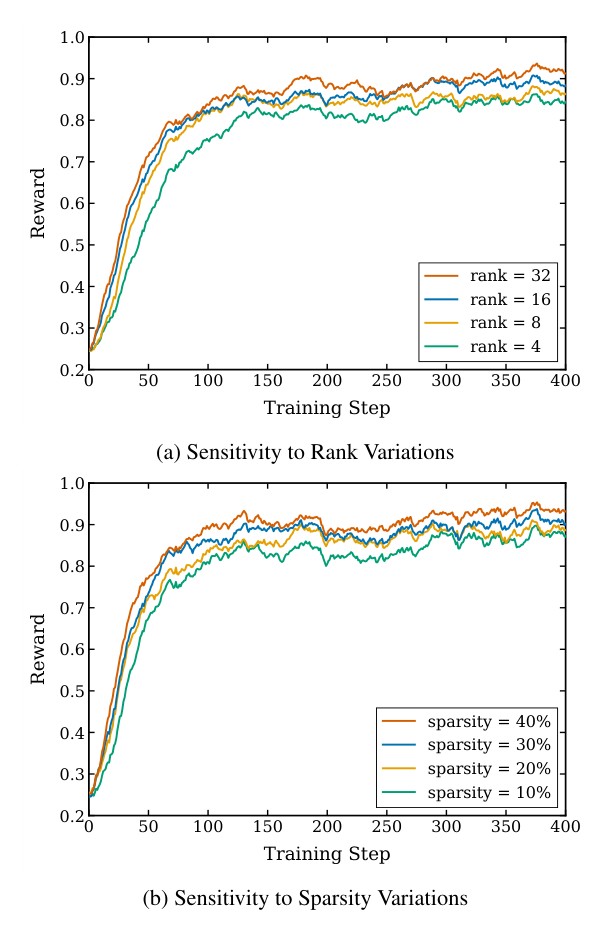
Figure 7: Parameter Robustness Analysis.
图 7:参数稳健性分析。(a)对秩变化的敏感度。(b)对稀疏率变化的敏感度。