FEAST: A Flexible Mealtime-Assistance System Towards In-the-Wild Personalization
FEAST: A Flexible Mealtime-Assistance System Towards In-the-Wild Personalization
FEAST:面向野外场景个性化的灵活进餐辅助系统
Rajat Kumar Jenamani 1 , Tom Silver 1 , Ben Dodson 1 , Shiqin Tong 1 , Anthony Song 1 Affiliation: Yuting Yang 2 , Ziang Liu 1 , Benjamin Howe 3 , Aimee Whitneck 3 , Tapomayukh Bhattacharjee 1 Affiliation: 1 Cornell University, 2 University of Michigan, 3 Independent researcher
Abstract
摘要
Physical caregiving robots hold promise for improving the quality of life of millions worldwide who require assistance with feeding. However, in-home meal assistance remains challenging due to the diversity of activities (e.g., eating, drinking, mouth wiping), contexts (e.g., socializing, watching TV), food items, and user preferences that arise during deployment. In this work, we propose FEAST, a flexible mealtime-assistance system that can be personalized in-the-wild to meet the unique needs of individual care recipients. Developed in collaboration with two community researchers and informed by a formative study with a diverse group of care recipients, our system is guided by three key tenets for in-the-wild personalization: adaptability, transparency, and safety. FEAST embodies these principles through: (i) modular hardware that enables switching between assisted feeding, drinking, and mouth-wiping, (ii) diverse interaction methods, including a web interface, head gestures, and physical buttons, to accommodate diverse functional abilities and preferences, and (iii) parameterized behavior trees that can be safely and transparently adapted using a large language model. We evaluate our system based on the personalization requirements identified in our formative study, demonstrating that FEAST offers a wide range of transparent and safe adaptations and outperforms a state-of-the-art baseline limited to fixed customizations. To demonstrate real-world applicability, we conduct an in-home user study with two care recipients (who are community researchers), feeding them three meals each across three diverse scenarios. We further assess FEAST’s ecological validity by evaluating with an Occupational Therapist previously unfamiliar with the system. In all cases, users successfully personalize FEAST to meet their individual needs and preferences. Supplementary materials and videos can be found at: emprise.cs.cornell.edu/feast.
物理照护机器人有望改善全球数百万需要进食协助者的生活质量。然而,居家进餐辅助仍然困难,因为部署时会遇到活动多样(如进食、饮水、擦嘴)、情境多样(如社交、看电视)、食物种类与用户偏好各异等问题。本文提出 FEAST,一套可在野外场景中个性化的灵活进餐辅助系统,以满足不同受照护者的独特需求。系统与两位社区研究者协作开发,并以一项覆盖多元受照护者的形成性研究为依据,围绕野外个性化的三项核心原则展开:适应性、透明性与安全性。FEAST 通过以下方式体现这些原则:(i)模块化硬件,可在辅助进食、饮水与擦嘴之间切换;(ii)多样交互方式,包括网页界面、头部手势与实体按钮,以适配不同功能能力与偏好;(iii)参数化行为树,可借助大语言模型安全、透明地调整。我们依据形成性研究中识别的个性化需求评估系统,表明 FEAST 能提供大量透明且安全的适配,并优于仅支持固定定制的最先进基线。为展示现实可用性,我们与两位受照护者(亦为社区研究者)开展居家用户研究,在三种不同场景下各协助三餐。我们还请此前不熟悉系统的作业治疗师评估 FEAST 的生态效度。所有情形下,用户都能成功将 FEAST 个性化到自身需求与偏好。补充材料与视频见:emprise.cs.cornell.edu/feast。
Index Terms:
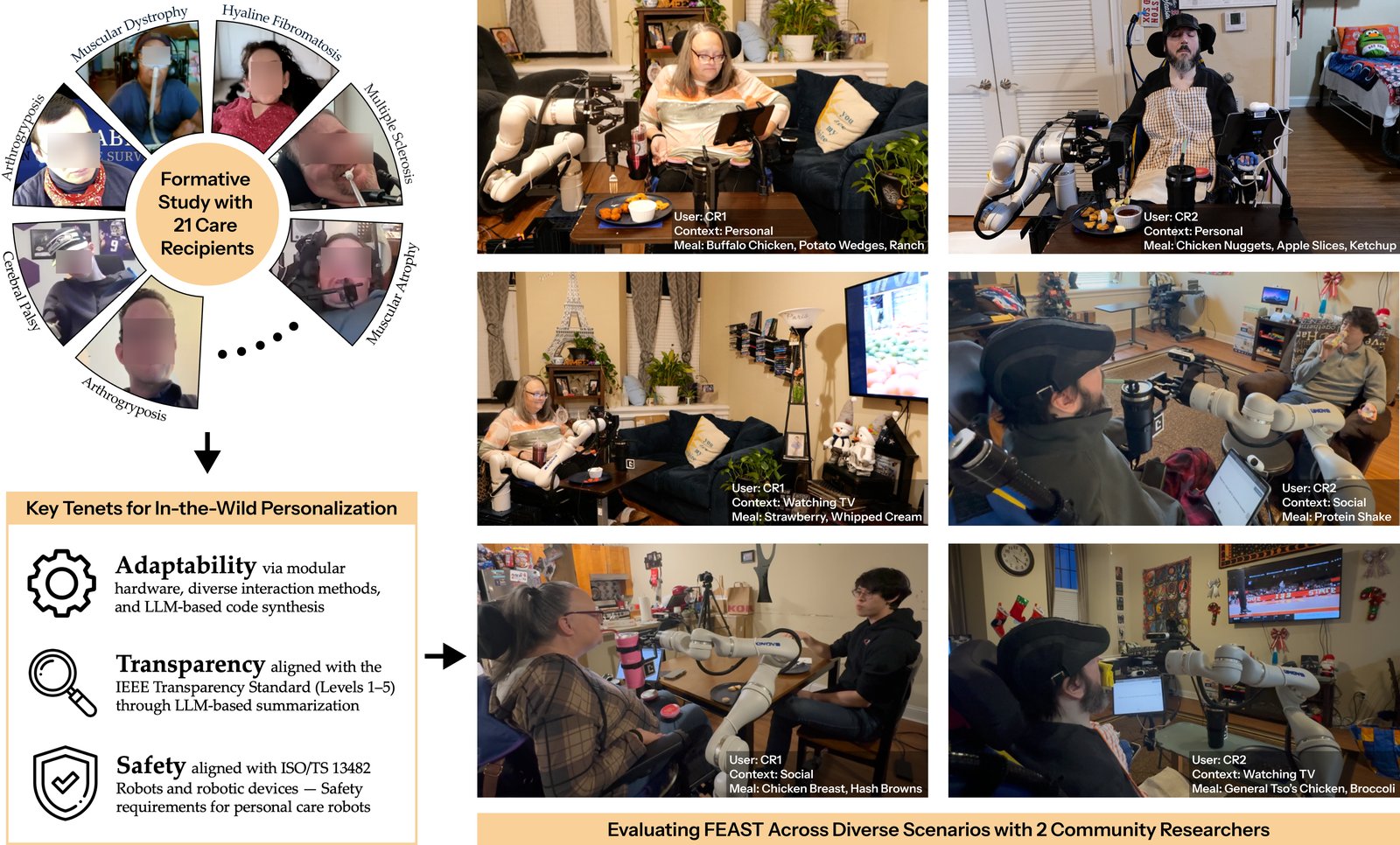
Fig. 1: Informed by a formative study with 19 care recipients and 2 community researchers, we propose FEAST: a flexible mealtime-assistance system grounded in adaptability, transparency, and safety. Through in-home evaluations, we demonstrate that FEAST can personalize to the needs of two care recipients, assisting each with three meals in diverse in-the-wild contexts.
索引词:
图 1:基于对 19 名受照护者与 2 名社区研究者的形成性研究,我们提出 FEAST:以适应性、透明性与安全性为根基的灵活进餐辅助系统。通过居家评估,我们展示 FEAST 可针对两位受照护者的需求进行个性化,并在多样野外情境下为每人协助三餐。
I Introduction
I 引言
Eating is a fundamental part of human life, deeply intertwined with identity and social interaction [1]. The inability to self-feed has been associated with profound emotional impacts, including feelings of shame, diminished self-esteem, and heightened anxiety or fear [2, 3, 4]. Unfortunately, millions worldwide require assistance with feeding due to spinal cord injuries, strokes, cerebral palsy, old age, and other health conditions [5]. For caregivers, feeding is one of the most time-consuming Activities of Daily Living (ADLs) [6], contributing significantly to their already substantial workload [7, 8].
进食是人类生活的基本组成部分,与身份认同和社会交往深度交织[1]。无法自主进食会带来深刻的情绪影响,包括羞耻感、自尊下降以及焦虑或恐惧加剧[2, 3, 4]。不幸的是,全球有数百万人因脊髓损伤、中风、脑瘫、年迈及其他健康状况而需要进食协助[5]。对照护者而言,喂食是最耗时的日常生活活动(ADL)之一[6],显著加重本已繁重的工作负担[7, 8]。
Robot mealtime-assistance systems have the potential to assist care recipients and improve their quality of life [9] while decreasing the physical workload on caregivers [10, 11]. Recent advancements have significantly improved various aspects of mealtime assistance, including food manipulation [12, 13, 14, 15, 16, 17, 18, 19], skill sequencing [20, 21, 22], and bite transfer [23, 24, 25, 26, 11]. Although further progress is needed before these systems can operate long-term without expert supervision, these recent works significantly enhance their robustness and autonomy.
机器人进餐辅助系统有望协助受照护者、改善其生活质量[9],同时减轻照护者的体力负担[10, 11]。近期进展显著提升了进餐辅助的多个方面,包括食物操作[12, 13, 14, 15, 16, 17, 18, 19]、技能编排[20, 21, 22]以及咬送传递[23, 24, 25, 26, 11]。尽管这些系统要在无专家监督下长期运行仍需更多进步,但近期工作已明显增强其鲁棒性与自主性。
Building upon these efforts, this work considers the need for personalization in mealtime assistance. A one-size-fits-all mealtime assistance system is not enough to address the wide range of preferences, functional abilities, behaviors, and environmental contexts that vary between care recipients and between meals [27]. For example, consider the two community researchers (CRs) shown in Figure 1, who are both co-authors on this paper. CR1, who has Multiple Sclerosis, prefers to lean forward to take a bite. CR2, who has a C4-C6 Spinal Cord Injury and very limited head and neck mobility, requires inside-mouth bite transfer [11]. In a social dining scenario, CR1 prefers that the robot retract after bite transfer so they can better see their companion. In another social scenario, CR2 prefers to control the robot using a custom long-continuous-open-mouth gesture that they create themselves through the user interface (a standard open-mouth gesture would be falsely triggered in conversation). These are a few examples among many underscoring the need for a mealtime assistance system that can be personalized in-the-wild by the users themselves.
在上述工作基础上,本文关注进餐辅助中的个性化需求。一刀切的进餐辅助系统不足以应对受照护者之间、乃至不同餐次之间在偏好、功能能力、行为与环境情境上的巨大差异[27]。例如,图 1 所示两位社区研究者(CR)均为本文共同作者。患有多发性硬化的 CR1 更偏好前倾取食;C4–C6 脊髓损伤、头颈活动极度受限的 CR2 则需要口内咬送传递[11]。在社交用餐场景中,CR1 希望机器人在咬送后收回,以便更好地看到同伴;在另一社交场景中,CR2 希望用自己在界面上创建的定制长时持续张嘴手势来控制机器人(标准张嘴手势会在交谈中被误触发)。这些例子只是众多情形中的一部分,凸显了需要一套可由用户自身在野外场景中个性化的进餐辅助系统。
To better understand the nature of personalization in mealtime assistance, we start our work with a formative user study (Section III). We use speculative videos to guide in-depth conversations with 21 care recipients who have diverse medical conditions and mobility limitations. This study has two outcomes. The first is a collection of specific personalization requests that we use to develop our system (Section V-A). The second is the realization of three key tenets crucial for personalization in mealtime assistance: adaptability, transparency, and safety (Section V). Care recipients voice the need for systems that can adapt to their needs and preferences—not just once, but from meal to meal, and over time as their needs change. They also express that any adaptations should be transparent so that they are able to understand and predict system behavior. Finally, they underscore the importance of safety, especially when the system changes.
为更好理解进餐辅助中个性化的本质,我们以一项形成性用户研究开篇(第 III 节)。我们用思辨视频引导与 21 位具有不同医疗状况与行动限制的受照护者深入交流。研究有两项产出:其一是用于开发系统的具体个性化请求集合(第 V-A 节);其二是提炼出进餐辅助个性化的三项关键原则:适应性、透明性与安全性(第 V 节)。受照护者表示系统需要能适应其需求与偏好——不是一次性设置,而是随餐次、随时间与病情变化而调整。他们还希望任何适配都透明,以便理解与预测系统行为。最后,他们强调安全的重要性,尤其是在系统发生变化时。
With these key tenets in mind, we propose FEAST, a flexible mealtime-assistance system towards in-the-wild personalization (Section IV). FEAST is designed for personalization at both the hardware and software level. The hardware features a modular tool-change apparatus so that a single robot arm can assist with feeding, drinking, and mouth wiping. The system also features accessible buttons, status LEDs, cameras, microphones, and speakers to enable a wide range of customizable interactions with the user. We also propose a novel feeding utensil that increases the robot’s workspace and decreases obstructions to the user’s view.
基于这些原则,我们提出 FEAST,一套面向野外个性化的灵活进餐辅助系统(第 IV 节)。FEAST 在硬件与软件层面均支持个性化。硬件采用模块化换刀装置,使单臂机器人可协助进食、饮水与擦嘴;系统还配备无障碍按钮、状态 LED、相机、麦克风与扬声器,以支持多种可定制交互。我们还提出一种新型喂食餐具,扩大机器人工作空间并减少对用户视野的遮挡。
On the software side, to strike a balance between adaptability, transparency, and safety, we propose to sequence together parameterized behavior-tree-based skills to achieve user-specified goals. The parameterized behavior trees provide a mechanism for personalization: user requests, formulated in natural language, are translated with a large language model (LLM) into structured updates to the behavior trees, which can then be statically validated for safety. This structured skill representation can also be analyzed by an LLM in response to user transparency requests. Finally, using the code synthesis capabilities of LLMs, we enable users to create their own custom head gestures that can be added to the behavior trees and used to interact with the robot. Users engage with the robot through a flexible web-based user interface.
在软件侧,为在适应性、透明性与安全性之间取得平衡,我们提出将参数化行为树技能串联起来,以实现用户指定目标。参数化行为树提供了个性化机制:用户以自然语言提出的请求,经大语言模型(LLM)转化为对行为树的结构化更新,并可做静态安全校验。该结构化技能表示也可由 LLM 分析,以响应用户的透明性请求。最后,借助 LLM 的代码合成能力,用户可创建自定义头部手势,加入行为树并用于与机器人交互。用户通过灵活的网页界面与机器人互动。
We develop FEAST using community-based participatory research [28] in collaboration with two CRs (Figure 1). This approach, involving co-design and in-depth evaluation with one or two CRs, is well-established in assistive technology research [29, 30, 31] and increasingly common in assistive robotics [32, 33, 1, 34, 35, 36]. Our collaborations began with introductory video calls in November 2022 and have continued through regular meetings—both virtual and in-person at the CRs’ homes. These sessions have been instrumental in gathering feedback on system design, brainstorming studies to identify personalization needs (Section III), and piloting developments.
我们采用社区参与式研究[28],与两位 CR 协作开发 FEAST(图 1)。这种与一两名 CR 共设计并深入评估的做法,在辅助技术研究中已很成熟[29, 30, 31],在辅助机器人领域也日益常见[32, 33, 1, 34, 35, 36]。合作始于 2022 年 11 月的介绍性视频通话,并持续以定期会议推进——包括线上与在 CR 家中的当面交流。这些环节对收集系统设计反馈、构思识别个性化需求的研究(第 III 节)以及试点开发至关重要。
This iterative process led to a five-day in-home evaluation in January 2025 (Section VI), where CRs fed themselves six meals across three distinct contexts: personal, watching TV, and social (Figure 1). Results show that CRs successfully completed meals with few researcher interventions and personalized the system on the fly to their preferences and abilities while reporting low cognitive workload, as indicated by NASA-TLX surveys [37]. CRs also rated FEAST highly for real-world applicability, as reflected in Technology Acceptance Model [38] survey results. Furthermore, both CRs reported that FEAST provided greater control over their meals and a stronger sense of independence compared to their human caregiver, with one noting that conveying preferences was easier with our system. Finally, to further assess ecological validity, we evaluated FEAST with an Occupational Therapist unfamiliar with the system, who confirms its merits over a no-personalization baseline (Section VII).
这一迭代过程导向了 2025 年 1 月为期五天的居家评估(第 VI 节):CR 在个人、看电视与社交三种情境下共自行进食六餐(图 1)。结果显示,CR 在极少研究者介入下成功完成用餐,并能即时按偏好与能力个性化系统,NASA-TLX 问卷[37]显示认知负荷较低。技术接受模型[38]问卷亦显示 CR 对 FEAST 的现实适用性评价很高。此外,两位 CR 都表示,相较人工照护者,FEAST 让他们对进餐有更强控制感与独立感,其中一位还指出向系统传达偏好比向照护者更容易。最后,为进一步评估生态效度,我们请不熟悉系统的作业治疗师进行评估,其确认了相对无个性化基线的优势(第 VII 节)。
| System | Adaptability | Safety | Transparency | Interface | Autonomous Bite Acquisition | Autonomous Bite Transfer | Minimal Occlusion | Workspace Reachability | Other Tasks | |||
|---|---|---|---|---|---|---|---|---|---|---|---|---|
| Seq. | Pre-acq. | Acq. | Outside | Inside | ||||||||
| Obi [41] | - | ✓ | - | ✓ | - | - | - | - | - | ✓ | - | - |
| Neater Eater [42] | - | ✓ | - | ✓ | - | - | ✓ | - | - | ✓ | - | - |
| Park et al. [25] | - | - | - | ✓ | - | - | ✓ | ✓ | ✓ | - | ✓ | - |
| Bhattacharjee et al. [10] | - | - | - | ✓ | - | - | ✓ | - | ✓ | - | - | - |
| Feel the Bite [11] | - | - | - | - | - | - | - | - | ✓ | - | - | - |
| FLAIR [20] | - | - | - | - | ✓ | ✓ | ✓ | ✓ | ✓ | - | - | - |
| REPEAT [21] | - | - | - | - | - | ✓ | ✓ | - | - | - | - | - |
| Nanavati et al. [36] | - | ✓ | - | ✓ | - | - | ✓ | ✓ | - | - | - | - |
| FEAST (ours) | ✓ | ✓ | ✓ | ✓ | ✓ | ✓ | ✓ | ✓ | ✓ | ✓ | ✓ | ✓ |
TABLE I: Comparison between FEAST and other mealtime assistance systems. Adaptability is assessed based on ability to handle open-ended user requests, safety by self-reported adherence to ISO 13482 [39], and transparency by Levels 1-5 of the IEEE Transparency Standard [40].
| 系统 | 适应性 | 安全性 | 透明性 | 界面 | 自主取食 | 自主咬送 | 低遮挡 | 工作空间可达 | 其他任务 | |||
|---|---|---|---|---|---|---|---|---|---|---|---|---|
| 序列 | 取食前 | 取食 | 口外 | 口内 | ||||||||
| Obi [41] | - | ✓ | - | ✓ | - | - | - | - | - | ✓ | - | - |
| Neater Eater [42] | - | ✓ | - | ✓ | - | - | ✓ | - | - | ✓ | - | - |
| Park et al. [25] | - | - | - | ✓ | - | - | ✓ | ✓ | ✓ | - | ✓ | - |
| Bhattacharjee et al. [10] | - | - | - | ✓ | - | - | ✓ | - | ✓ | - | - | - |
| Feel the Bite [11] | - | - | - | - | - | - | - | - | ✓ | - | - | - |
| FLAIR [20] | - | - | - | - | ✓ | ✓ | ✓ | ✓ | ✓ | - | - | - |
| REPEAT [21] | - | - | - | - | - | ✓ | ✓ | - | - | - | - | - |
| Nanavati et al. [36] | - | ✓ | - | ✓ | - | - | ✓ | ✓ | - | - | - | - |
| FEAST(本文) | ✓ | ✓ | ✓ | ✓ | ✓ | ✓ | ✓ | ✓ | ✓ | ✓ | ✓ | ✓ |
表 I:FEAST 与其他进餐辅助系统对比。适应性按是否能处理开放式用户请求评估;安全性按是否自报符合 ISO 13482[39];透明性按 IEEE 透明性标准[40]的 1–5 级评估。
Overall, our contributions include:
总体而言,我们的贡献包括:
- • FEAST: A flexible mealtime-assistance system built with community-based participatory research, tackling in-the-wild scenarios by integrating diverse skills, custom tools, a flexible interface, and user personalization.
- • FEAST:一套以社区参与式研究构建的灵活进餐辅助系统,通过整合多样技能、定制工具、灵活界面与用户个性化,应对野外场景。
- • A user study involving 21 care recipients, which identifies diverse personalization needs for mealtime assistance.
- • 一项覆盖 21 名受照护者的用户研究,识别进餐辅助中多样的个性化需求。
- • A personalization framework built on three key tenets: (i) adaptability via LLM-based code synthesis, (ii) transparency (Levels 1-5) through LLM summarization, and (iii) safety aligned with ISO/TS 13482 safety principles.
- • 一套基于三项原则的个性化框架:(i)通过基于 LLM 的代码合成实现适应性;(ii)通过 LLM 摘要实现透明性(1–5 级);(iii)安全对齐 ISO/TS 13482 安全原则。
- • A five-day in-the-wild system evaluation with two community researchers, spanning six realistic meals across three distinct environmental contexts, showcasing FEAST’s real-world applicability.
- • 与两位社区研究者的五日野外系统评估,覆盖三种环境情境下的六餐真实用餐,展示 FEAST 的现实可用性。
- • An evaluation with an Occupational Therapist unfamiliar with our system, assessing ecological validity and demonstrating improved performance over a non-personalized baseline.
- • 与不熟悉本系统的作业治疗师评估,检验生态效度,并显示相对非个性化基线的性能提升。
II Related Work
II 相关工作
II-A Mealtime Assistance
II-A 进餐辅助
Research on mealtime-assistance systems dates back to the 1970s, with early examples such as the Morewood Spoon Lifter [43]. Over the years, several commercial systems have been proposed, such as Winsford Feeder, My Spoon, Neater Eater, Bestic Arm, Meal Buddy, and Obi [44]. However, their reliance on manually programmed, fixed food acquisition and transfer actions has limited user adoption, and as of now, only Obi and Neater Eater remain commercially available. To address these limitations, recent research focuses on using sensors, such as in-hand cameras, to perceive the environment, and plan and execute autonomous motions.
进餐辅助系统的研究可追溯到 1970 年代,早期例子如 Morewood Spoon Lifter[43]。此后出现了 Winsford Feeder、My Spoon、Neater Eater、Bestic Arm、Meal Buddy、Obi 等商业系统[44]。然而它们依赖人工编程的固定取食与传递动作,限制了用户采用;目前仅 Obi 与 Neater Eater 仍有市售。为克服这些限制,近期研究关注用传感器(如手内相机)感知环境,并规划、执行自主运动。
Bite Acquisition and Transfer. Recent works have explored autonomous strategies for skewering solid bite-sized foods [45, 13, 14, 15, 12], scooping soft food items [16, 17, 18], twirling and grouping noodle-like dishes [19], and cutting [46]. Building on these works, FLAIR [20] introduces a bite acquisition framework consisting of a library of vision-parameterized food manipulation skills that use a fork-based utensil. This framework leverages the commonsense reasoning and few-shot learning capabilities of foundation models to appropriately sequence these skills, enabling the feeding of complete meals while adhering to bite ordering preferences of the user. Various works also propose autonomous bite transfer methods [23, 47, 25, 24, 11, 26], which can be broadly categorized into two types. Outside-mouth bite transfer methods [23, 47, 24] bring food close to the care recipient’s mouth, requiring them to lean forward to take a bite. For individuals with severe mobility limitations who cannot lean forward, inside-mouth bite transfer methods [25, 26, 11] place food directly inside their mouth.
取食与咬送。 近期工作探索了串刺固体一口量食物[45, 13, 14, 15, 12]、舀取软质食物[16, 17, 18]、搅绕与聚拢面条类菜品[19]以及切割[46]等自主策略。在此基础上,FLAIR[20]提出由视觉参数化食物操作技能库构成的取食框架,使用叉式餐具,并借助基础模型的常识推理与少样本学习能力合理编排技能,从而在遵循用户咬序偏好的同时喂完整餐。亦有多项工作提出自主咬送方法[23, 47, 25, 24, 11, 26],大致分两类:口外咬送[23, 47, 24]将食物送到受照护者嘴边,需其前倾取食;对无法前倾的重度行动受限者,口内咬送[25, 26, 11]则将食物直接送入口中。
Our system builds on FLAIR [20] for bite acquisition and Gallenberger et al. [23] and Feel the Bite [11] for bite transfer, enabling it to feed realistic dishes to users with severe mobility limitations. However, recent studies show that feeding robots often exhibit obtrusive motion [1, 24], limiting their use in social settings, and have restricted workspace [36], constraining plate and user placement. These limitations hinder personalization, as robots must adapt to social contexts with non-obtrusive motion and allow flexible user and plate positioning. Towards addressing these challenges, and based on feedback from community researchers, FEAST adapts these approaches to a novel feeding utensil (Section IV-A) that improves the robot’s workspace and decreases obstruction.
本系统在取食上基于 FLAIR[20],在咬送上基于 Gallenberger 等[23]与 Feel the Bite[11],从而能为重度行动受限用户喂送真实菜品。但近期研究表明,喂食机器人常出现突兀运动[1, 24],限制社交场景使用,且工作空间受限[36],制约餐盘与用户摆位。这些限制阻碍个性化:机器人须以不突兀的运动适配社交情境,并允许灵活的用户与餐盘位置。针对这些挑战,并结合社区研究者反馈,FEAST 将这些方法适配到一种新型喂食餐具(第 IV-A 节),以扩大工作空间并减少遮挡。
Other Essential Mealtime Tasks. Several works have explored assistance with drinking [48, 49], focusing on grasping a cup and having users drink from the rim. We instead focus on drinking from a cup with a straw, aligning with our community researchers’ routines. Unlike prior methods, which assume specific cup colors [48] or pre-grasped cups [49], FEAST emphasizes real-world flexibility, using an adaptable handle that fits various cups without strict shape or color constraints. Some works also propose methods for mouth wiping [50, 51]. Similar to these, FEAST can pick up a custom wiping tool and position it near the user’s mouth, ready for wiping.
其他关键进餐任务。 已有多项工作探索饮水辅助[48, 49],多聚焦于抓取杯子并让用户从杯沿饮用。我们则聚焦用吸管从杯中饮水,以契合社区研究者的日常。不同于假定特定杯色[48]或杯已预抓取[49]的先前方法,FEAST 强调现实灵活性,使用可适配把手,无需严格形状或颜色约束即可适配多种杯子。亦有工作提出擦嘴方法[50, 51]。与之类似,FEAST 可拾取定制擦拭工具并置于用户嘴边,准备擦拭。
Mealtime-Assistance Systems. Most relevant to our work are autonomous systems that demonstrate integration of various components for feeding a complete meal [25, 23, 20, 36] (see Table I). Unlike Park et al. [25], which focuses on feeding yogurt, and Bhattacharjee et al. [23] and Nanavati et al. [36], which limit bite acquisition to skewering, our system employs a range of skills—skewering, scooping, twirling, grouping, and more—to pick up diverse food items and sequence them over a long horizon for feeding an entire meal. Our system differs from FLAIR [20] (which integrates with Feel the Bite [11]) by adapting it to a novel feeding utensil and a web interface for user interaction. More significantly, our system is the first to integrate feeding with other essential mealtime tasks, including drinking and mouth wiping, while also automating user personalization. No prior system has explored feeding in diverse in-the-wild scenarios—except Nanavati et al. [36], which offers customization of limited system parameters.
进餐辅助系统。 与本文最相关的是展示完整用餐各组件集成的自主系统[25, 23, 20, 36](见表 I)。不同于 Park 等[25]主要喂酸奶,以及 Bhattacharjee 等[23]与 Nanavati 等[36]将取食限于串刺,本系统采用串刺、舀取、搅绕、聚拢等多种技能拾取多样食物,并在长时域上编排以喂完整餐。相较集成 Feel the Bite[11] 的 FLAIR[20],本系统将其适配到新型喂食餐具与网页交互界面。更重要的是,本系统首次将进食与饮水、擦嘴等其他关键进餐任务整合,并自动化用户个性化。除 Nanavati 等[36]对有限参数提供定制外,尚无先前系统探索多样野外场景下的喂食。
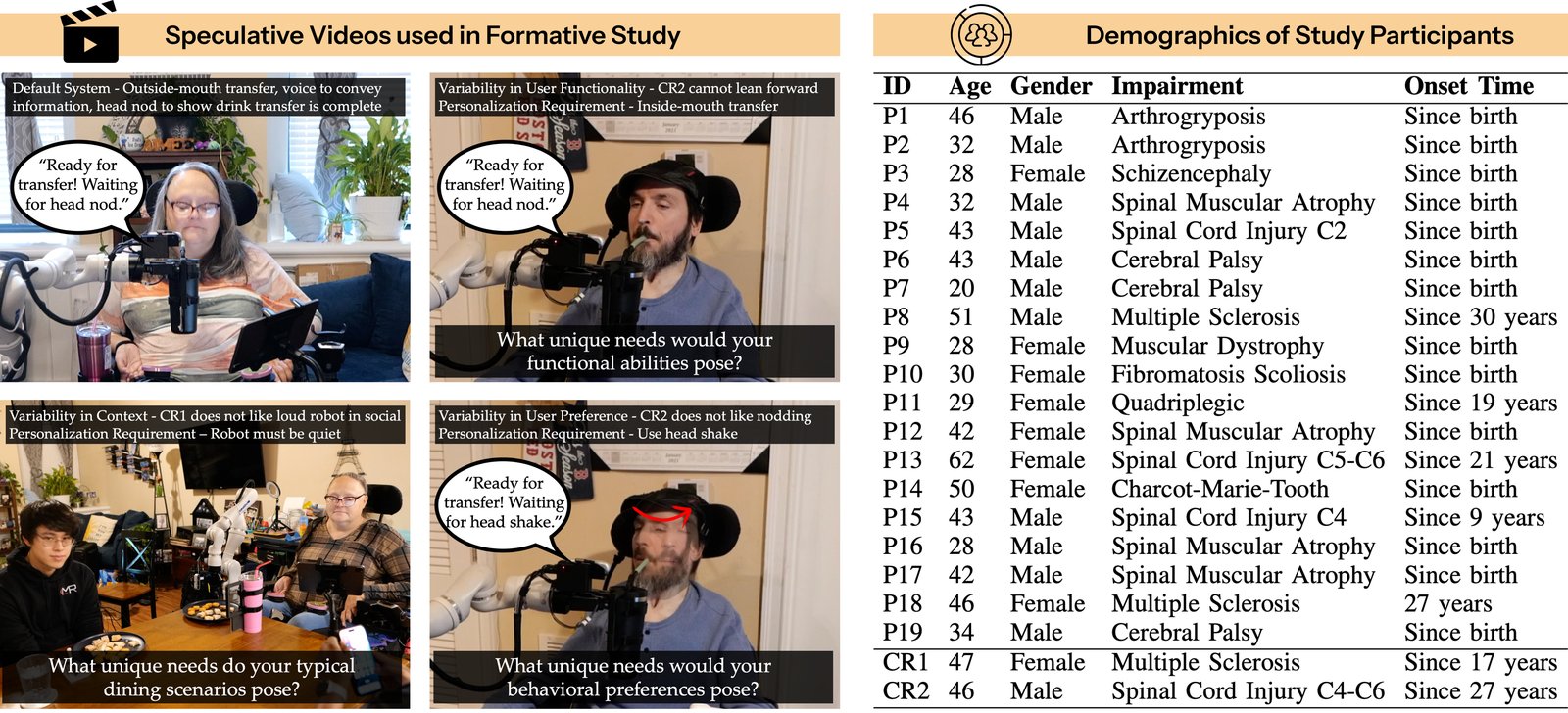
Fig. 2: We use speculative videos recorded with community researchers (left) to conduct a formative study with 19 care recipients and the 2 community researchers (demographics shown on the right), to identify user personalization requirements.
图 2:我们用与社区研究者录制的思辨视频(左)对 19 名受照护者及 2 名社区研究者(人口统计见右)开展形成性研究,以识别用户个性化需求。
II-B Personalization in Assistive Robotics
II-B 辅助机器人中的个性化
Various formative studies in assistive robotics emphasize the importance of user personalization based on factors such as mobility limitations, behavior, and context [52, 53, 1, 54].
辅助机器人领域的多项形成性研究强调,应基于行动限制、行为与情境等因素进行用户个性化[52, 53, 1, 54]。
One approach to achieving personalization is through implicit adaptation, where limited test-time examples guide the system to a specific preference [55, 56, 57, 58, 59]. FEAST aligns with this by generating personalized gesture detectors using a small number of examples from the user. Unlike prior black-box approaches to gesture personalization [60, 61], FEAST takes a more transparent approach by composing functions from our perception library to generate customized detectors. While some studies evaluate gesture detection for care recipients [62, 63], FEAST is the first to consider personalized gesture detection for those with mobility limitations.
一种实现个性化的途径是隐式适配:用少量测试时样例引导系统贴近特定偏好[55, 56, 57, 58, 59]。FEAST 与此一致,用用户少量样例生成个性化手势检测器。不同于先前黑盒式手势个性化[60, 61],FEAST 通过组合感知库中的函数生成定制检测器,更为透明。虽有研究评估受照护者的手势检测[62, 63],FEAST 是首个面向行动受限者考虑个性化手势检测的工作。
Another approach involves explicitly identifying preferences through direct user input. Canal et al. [64] use post-hoc scoring for task planning, but this limits applicability in safety-critical tasks. Nanavati et al. [36] provide predefined customizations for a mealtime-assistance robot through a web interface, while FLAIR [20] uniquely explores bite-ordering preferences using language commands. FEAST leverages FLAIR for bite-ordering preferences and significantly extends personalization to other system components by enabling open-ended customization through language inputs.
另一途径是通过直接用户输入显式识别偏好。Canal 等[64]用事后打分做任务规划,但限制了在安全关键任务中的适用性。Nanavati 等[36]通过网页界面为进餐辅助机器人提供预定义定制,FLAIR[20]则独特地用语言命令探索咬序偏好。FEAST 利用 FLAIR 处理咬序偏好,并通过语言输入的开放式定制,将个性化显著扩展到其他系统组件。
II-C Large Language Models for Human-Robot Interaction
II-C 面向人机交互的大语言模型
Recent advancements in large language models (LLMs) [65, 66] enable the use of language as an interface for human-robot interaction. Some approaches utilize LLMs for high-level planning, allowing systems to generate plans over a fixed library of skills based on user language commands [67, 68, 69, 70, 71, 72, 73]. Others focus on generating low-level skills by training on large vision-language-action datasets [74, 75, 76, 77], synthesizing rewards [78, 79], or inferring skills via code generation [80, 81]. FEAST represents a recent category of approaches that enable users to edit both high-level plans and parameters of low-level skills using LLMs [82, 83, 84]. However, given the physical nature of human-robot interactions in mealtime assistance, FEAST restricts edits to carefully selected operations to ensure safety.
大语言模型(LLM)的近期进展[65, 66]使语言可作为人机交互接口。一些方法用 LLM 做高层规划,使系统基于用户语言命令在固定技能库上生成计划[67, 68, 69, 70, 71, 72, 73]。另一些聚焦生成低层技能:在大型视觉–语言–动作数据上训练[74, 75, 76, 77]、合成奖励[78, 79],或通过代码生成推断技能[80, 81]。FEAST 属于较新一类方法,使用户可用 LLM 同时编辑高层计划与低层技能参数[82, 83, 84]。不过,鉴于进餐辅助中人机交互的物理性,FEAST 将编辑限制在精心选择的操作上以确保安全。
III Identifying Personalization Needs from Care Recipients with Diverse Medical Conditions
III 从不同医疗状况受照护者识别个性化需求
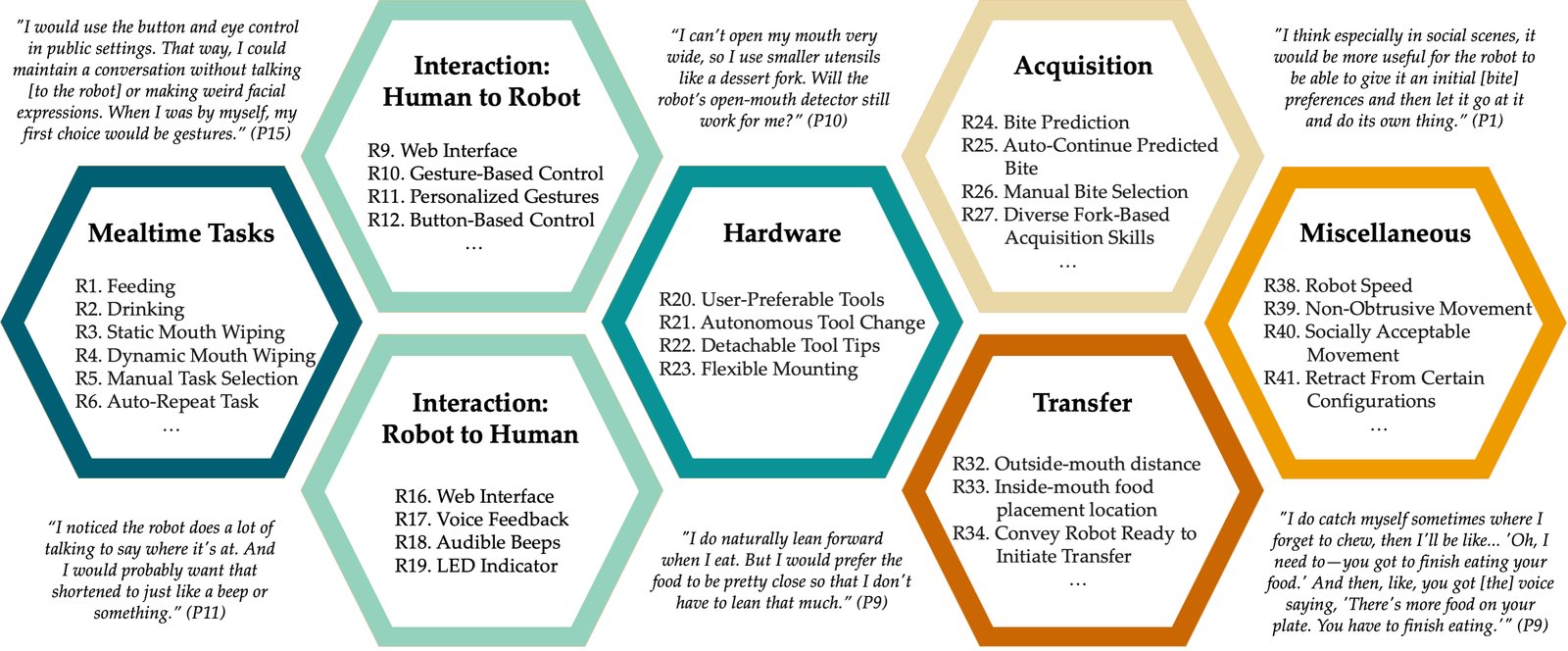
Fig. 3: We extract and categorize personalization requests from our formative study with 21 care recipients. See Appendix A for details.
图 3:我们从覆盖 21 名受照护者的形成性研究中提取并归类个性化请求。详见附录 A。
To guide the development of our flexible mealtime-assistance system, we conducted a formative user study with 21 care recipients (including 2 CRs) with diverse mobility limitations. Our objectives in this study were two-fold: (1) to collect specific personalization requests; and (2) to identify key tenets of personalization in the context of mealtime assistance.
为指导灵活进餐辅助系统的开发,我们对 21 名具有不同行动限制的受照护者(含 2 名 CR)开展了形成性用户研究。研究目标有二:(1)收集具体个性化请求;(2)识别进餐辅助语境下个性化的关键原则。
Participants. We recruited 19 care recipients with diverse medical conditions such as Cerebral Palsy, Multiple Sclerosis, Muscular Dystrophy, Spinal Cord Injury, etc. (Figure 2). There were 8 female and 11 male participants who ranged in age from 20 to 62 years old and who were located throughout the United States. The participants were also diverse in terms of their prior experience with mealtime-assistance systems: some had no experience; others had participated in academic studies; and some had extensive experience (e.g., P6 noted “I had a Winsford Self-Feeder for over 20 years until the second one I had stopped working 4 months ago”).
参与者。 我们招募了 19 名具有脑瘫、多发性硬化、肌营养不良、脊髓损伤等不同医疗状况的受照护者(图 2)。其中女性 8 人、男性 11 人,年龄 20–62 岁,分布在美国各地。他们在进餐辅助系统先验经验上亦多样:有人毫无经验;有人参与过学术研究;有人经验丰富(例如 P6 说*「我用 Winsford 自助喂食器超过 20 年,直到第二台四个月前坏掉」*)。
Design Materials. Previous work [27] has shown that caregiving scenarios vary depending upon (i) care recipient functionality, (ii) care recipient behavior, and (iii) environment. Working with our community researchers, we identified realistic mealtime assistance scenarios where each of these three components vary. We then recorded speculative videos of the scenarios using our robot mealtime-assistance system (see Section IV for system details). The videos were organized into a slideshow and supplemented with conversation prompts (Figure 2). For example, one video showed the robot successfully feeding a care recipient with outside-mouth bite transfer; the next video showed the robot failing to feed a different care recipient who has very limited neck mobility; a final video in the sequence showed the robot successfully feeding the latter care recipient with inside-mouth bite transfer. After these three videos, we posed the question: “What unique needs might your own functional abilities pose for the robot?” Other speculative videos preceded discussion questions including: “What unique needs might your own behavioral preferences pose for the robot?” and “In what scenarios do you typically eat? What unique needs might these scenarios pose for the robot?”
设计材料。 先前工作[27]表明,照护场景随(i)受照护者功能、(ii)受照护者行为与(iii)环境而变化。我们与社区研究者协作,识别这三要素各有变化的真实进餐辅助场景,并用机器人进餐辅助系统录制思辨视频(系统细节见第 IV 节)。视频整理为幻灯片并辅以对话提示(图 2)。例如,一段视频显示机器人以口外咬送成功喂食;下一段显示对颈活动极度受限的另一受照护者喂食失败;序列末段显示以口内咬送成功喂食后者。三段视频后我们提问:「你自身的功能能力可能对机器人提出哪些独特需求?」其他思辨视频前还有讨论问题,包括:「你自身的行为偏好可能对机器人提出哪些独特需求?」以及「你通常在哪些场景进食?这些场景可能对机器人提出哪些独特需求?」
Study Design. To broaden participation in the study, we conducted conversations virtually. Caregivers were also invited to join and actively contribute to the discussion. Each session consisted of the following steps: (1) introductions and agenda; (2) a brief review of recent progress in robot mealtime-assistance systems and an extension of gratitude to the study participants for facilitating this progress; (3) speculative videos and discussion questions; (4) final open-ended discussion and conclusion. Care recipients were compensated $30 USD for their participation in the 90-minute study.
研究设计。 为扩大参与面,对话在线上进行。照护者也可加入并积极讨论。每场流程为:(1)介绍与议程;(2)简要回顾机器人进餐辅助近期进展,并感谢参与者推动该进展;(3)思辨视频与讨论问题;(4)最终开放讨论与结束。受照护者参与 90 分钟研究获 30 美元补偿。
Outcomes. This formative study successfully accomplished its two objectives. First, we collected specific personalization requests, which we group together into various categories and visualize in Figure 3. We detail each of these requests in Appendix A. These diverse requests highlight the need for personalization in a mealtime-assistance system and suggest where we should focus our efforts to meet the needs of users.
结果。 形成性研究成功达成两项目标。首先,我们收集了具体个性化请求,归入多类并可视化于图 3;各请求详见附录 A。这些多样请求凸显进餐辅助系统需要个性化,并提示应把努力集中在何处以满足用户。
Our second objective was to identify key tenets for personalization. From our conversations, we identified three themes: adaptability, transparency, and safety.
第二项目标是识别个性化的关键原则。从对话中我们提炼出三个主题:适应性、透明性与安全性。
- Adaptability: The first clear tenet of personalization is adaptability: changing system behavior in response to user requests. Study participants highlighted the need for adaptability beyond one-time system setup. For example, they requested the ability to customize the system depending on the feeding scenario—when watching TV, controlling the robot with a button may be preferable to verbal commands; or when dining socially, the robot should retract to a resting position immediately after bite transfer. Study participants also described how their preferred interaction with the robot may change throughout the day, depending on their energy level, and over time, as their medical conditions change.
- 适应性: 个性化的首要原则是适应性:按用户请求改变系统行为。参与者强调适应不能止于一次性设置。例如,他们希望按喂食场景定制系统——看电视时用按钮控制可能优于语音命令;社交用餐时,机器人应在咬送后立即收回休息位。参与者还描述,与机器人的偏好交互可能随一天中精力水平变化,并随病情长期演变。
- Transparency: Study participants also emphasized the importance of being able to understand the behavior of the robot, especially if that behavior may change. For example, describing their ideal relationship with the robot, P8 said: “It would be a symbiotic relationship; I would like to understand the robot capabilities and the robot would understand my requirements.”
- 透明性: 参与者还强调要能理解机器人行为,尤其在行为可能变化时。例如,P8 描述理想关系时说:「那会是一种共生关系;我希望理解机器人的能力,机器人也理解我的需求。」
- Safety: A final key tenet of personalization that emerged from the formative study was safety. For example, P12 said: “Safety is the most important part. If I turn my head to look somewhere the robot should not try to feed me at that position which might be unsafe.”
- 安全性: 形成性研究浮现的最后一项关键原则是安全。例如 P12 说:「安全最重要。如果我转头看别处,机器人不应在那个可能不安全的位置试图喂我。」
These specific examples and key tenets informed the design of our mealtime-assistance system, which we describe next.
这些具体例子与关键原则指导了我们接下来介绍的进餐辅助系统设计。
IV FEAST: A Flexible Mealtime-Assistance System Towards In-the-Wild Personalization
IV FEAST:面向野外个性化的灵活进餐辅助系统
In this section, we present FEAST, a mealtime-assistance system that enables users to personalize to in-the-wild eating scenarios commonly encountered in real-world settings. All hardware and software components of FEAST are open-sourced on our website. In the following subsections, we describe our system hardware (Section IV-A), software (Section IV-B), and user interface (Section IV-C), explaining how each component can be personalized while adhering to the tenets of adaptability, transparency, and safety.
本节介绍 FEAST,一套使用户能针对现实中常见野外进食场景进行个性化的进餐辅助系统。FEAST 的全部软硬件组件均在我们的网站开源。 以下各小节分别描述系统硬件(第 IV-A 节)、软件(第 IV-B 节)与用户界面(第 IV-C 节),并说明各组件如何在遵守适应性、透明性与安全性原则的同时支持个性化。
IV-A System Hardware
IV-A 系统硬件
FEAST (see Figure 4) uses a Kinova Gen3 7-DoF robot arm [85] and a Robotiq 2F-85 gripper [86]. It can be flexibly mounted either on the user’s ROVI wheelchair [87], powered by the wheelchair’s battery, or on a movable Vention stand [88], powered by a wall outlet.
FEAST(见图 4)使用 Kinova Gen3 七自由度机械臂[85]与 Robotiq 2F-85 夹爪[86]。它可灵活安装在用户的 ROVI 轮椅[87]上并由轮椅电池供电,或安装在可移动 Vention 支架[88]上并由墙上插座供电。
Tool-Change Apparatus. FEAST employs three custom tools. First, a novel feeding utensil with integrated motors provides wrist-like degrees of freedom, enabling tasks such as twirling, scooping, and maintaining an upright orientation when holding food. The utensil’s fork, made of compliant silicone, is connected to a 6-axis Nano25 ATI force/torque sensor [89]. This default fork is detachable, allowing users to exchange it with a metal fork if desired. To power and control the utensil without dangling wires, the robot’s gripper fingertips are replaced with custom fingertips featuring magnetic electrical connections that engage with complementary connectors on the utensil when grasped. Second, for drinking, FEAST uses an adaptable mug handle inspired by adaptable mug holders [90], which accommodates various cup shapes without strict dimensional constraints and features an ArUco marker [91] for autonomous grasping. Third, for mouth wiping, a custom tool with a removable microfiber cloth provides gentle cleaning. Each tool is mounted and dismounted by the robot opening and closing its finger tips (see Figure 4).
换刀装置。 FEAST 使用三种定制工具。其一,带集成电机的新型喂食餐具提供类腕自由度,可执行搅绕、舀取,并在持食时保持竖直朝向。餐具叉子由柔顺硅胶制成,连接六轴 Nano25 ATI 力/力矩传感器[89]。默认叉子可拆卸,用户可按需换成金属叉。为在无悬垂线缆下为餐具供电与控制,机器人夹爪指尖更换为带磁性电气连接的定制指尖,抓取时与餐具上的互补连接器接合。其二,饮水使用受可适配杯托启发的可适配杯把[90],可容纳多种杯形而无严格尺寸约束,并带有 ArUco 标记[91]以便自主抓取。其三,擦嘴使用带可拆卸超细纤维布的定制工具,可轻柔清洁。各工具由机器人开合指尖完成装卸(见图 4)。
Novel Utensil Orientation and Camera Mount. Previous state-of-the-art feeding systems use forward-facing in-hand cameras and similarly oriented utensils [20, 11, 36, 23]. However, this design restricts the robot’s workspace, requires large movements to transition between acquisition and transfer, and can obstruct the user’s view during feeding. Based on feedback from CRs, FEAST introduces a simple and effective solution: positioning tools at a perpendicular angle, mimicking natural human wrist movements during eating. This change, however, requires the camera to align accordingly. To address this, FEAST employs a custom camera mount with an RGB-D Intel RealSense Camera [92], oriented perpendicularly away.
新型餐具朝向与相机支架。 先前最先进喂食系统使用前向手内相机及同向餐具[20, 11, 36, 23]。但该设计限制工作空间,取食与传递之间需大幅运动,喂食时还可能遮挡用户视野。基于 CR 反馈,FEAST 提出简单有效方案:将工具置于垂直角度,模仿人类进食时自然腕部动作。但这要求相机相应对齐。为此,FEAST 采用带 RGB-D Intel RealSense 相机[92]的定制支架,相机朝向垂直向外。
Compute and Networking. FEAST employs custom controllers, such as a task-space compliant controller operating at approximately 1 kHz. This necessitates a dedicated real-time control system, for which we use an Intel NUC [93]. The primary computing platform is a Lenovo Legion Pro 7i laptop equipped with a 16GB RTX 4090 GPU [94]. Communication between the main compute unit, the NUC, the robot, and the web interface is managed via a Nighthawk RAX43 router [95]. When FEAST is mounted on a wheelchair, these components can also be securely mounted to ensure they move along.
计算与网络。 FEAST 使用定制控制器,例如约 1 kHz 运行的任务空间柔顺控制器。这需要专用实时控制系统,我们使用 Intel NUC[93]。主计算平台为配备 16GB RTX 4090 GPU 的 Lenovo Legion Pro 7i 笔记本[94]。主计算单元、NUC、机器人与网页界面之间的通信由 Nighthawk RAX43 路由器[95]管理。当 FEAST 安装在轮椅上时,这些组件也可牢固安装以便随行。
Accessible Buttons. FEAST utilizes three accessible buttons [96]. Two are intended for the user: one customizable through our personalization pipeline for interactions, and another serving as an emergency stop. The third button functions as an experimenter emergency stop.
无障碍按钮。 FEAST 使用三个无障碍按钮[96]。两个面向用户:一个可通过个性化管线定制交互,另一个作为紧急停止;第三个作为实验者紧急停止。
Status LED. FEAST features a status LED within the camera mount to alert users when their attention is needed, based on feedback from CRs. This is especially useful for users multitasking, such as watching TV while eating.
状态 LED。 基于 CR 反馈,FEAST 在相机支架内设状态 LED,在需要用户注意时提醒。对边看电视边进食等多任务用户尤其有用。
IV-B System Software
IV-B 系统软件
FEAST sequences together skills to accomplish goals given by the user. For example, if the user requests a drink while the robot is holding the utensil, the robot would invoke skills to (1) dismount the utensil; (2) mount the drink; and (3) transfer the drink to the user. We next describe how skills are generally implemented, adapted, and sequenced together, before detailing the specific skills used in this work.
FEAST 将技能串联以完成用户给定目标。例如,若用户在机器人持餐具时请求饮水,机器人会调用技能:(1)卸下餐具;(2)装上饮具;(3)将饮具传递给用户。下文先说明技能的一般实现、适配与编排,再详述本文所用具体技能。
Skills as Parameterized Behavior Trees. We implement skills as behavior trees [97]. As an extension of standard behavior trees, we expose node parameters that can be adapted in response to user requests (see below). For example, the behavior tree for bite acquisition includes three parameters: Speed, TimeToWaitBeforeAutocontinue, and AskUserForConfirmation. Every parameter is associated with a domain of possible values. For example:
技能即参数化行为树。 我们将技能实现为行为树[97]。作为标准行为树的扩展,我们暴露可对用户请求做适配的节点参数(见下)。例如,取食行为树含三个参数:Speed、TimeToWaitBeforeAutocontinue 与 AskUserForConfirmation。每个参数都关联可能取值域。例如:
- •
- •
- •
- • 。
All nodes and parameters are given human-readable names and descriptions to facilitate LLM-based adaptations.
所有节点与参数均赋予可读名称与描述,以便基于 LLM 的适配。
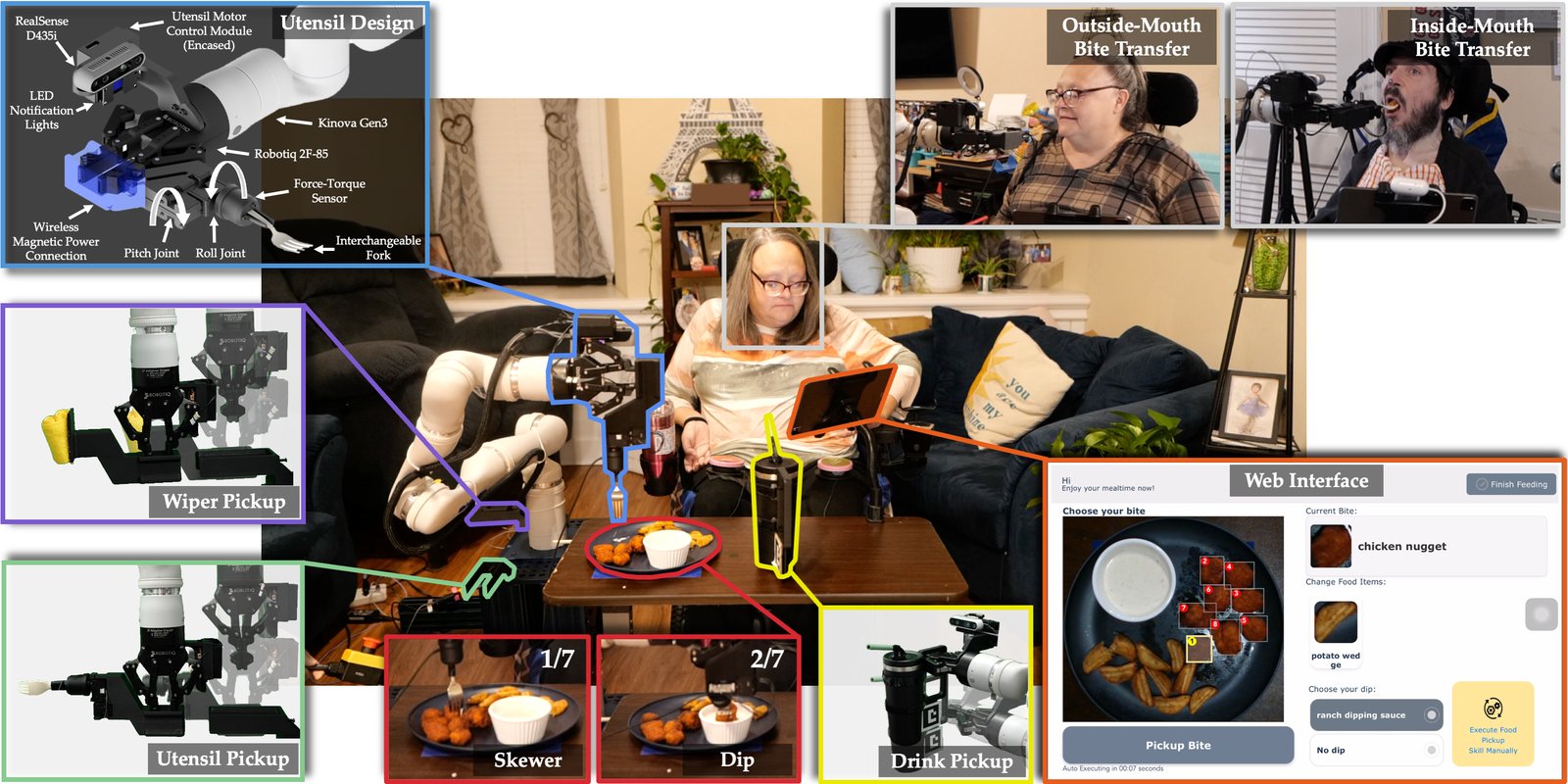
Fig. 4: FEAST features diverse mealtime-assistance skills such as feeding, drinking and mouth wiping, custom tools, and a flexible web interface, all of which can be personalized in-the-wild by end users.
图 4:FEAST 具备喂食、饮水与擦嘴等多样进餐辅助技能、定制工具与灵活网页界面,均可由终端用户在野外场景中个性化。
Personalizing Skills from Natural Language. FEAST users can make personalization requests through spoken or typed natural language. Our pipeline for processing these requests is as follows:
由自然语言个性化技能。 FEAST 用户可通过语音或键入自然语言提出个性化请求。处理流程如下:
- The natural language request is converted into structured behavior tree updates using an LLM. (adaptability)
- 用 LLM 将自然语言请求转为结构化行为树更新。(适应性)
- Each potential update is checked for safety. If the updates are deemed safe, the behavior trees are updated. Otherwise, a failure is reported. (safety)
- 对每项潜在更新做安全检查。若判定安全则更新行为树,否则报告失败。(安全性)
- The updates and outcomes are briefly summarized with an LLM and reported back to the user. (transparency)
- 用 LLM 简要总结更新与结果并反馈给用户。(透明性)
We now describe these steps in more detail.
下面更详细说明这些步骤。
1) Language Structured Updates. We use an LLM (GPT-4o [98]) to translate natural language personalization requests into structured behavior tree updates. The LLM is prompted with a brief explanation of the scenario, the personalization request, the behavior trees, and the form of an expected response.[^1] The output of the LLM is statically checked to ensure that the structured requests are in the expected form and the names of behavior tree nodes and parameters are valid. If any of these checks fail, the LLM is automatically re-prompted (up to 3 times in experiments) with failure information. It is important to note that one personalization request can elicit multiple updates. For example, if the user requests for the robot to “always move as fast as possible,” multiple behavior trees with speed parameters would be updated.
1) 语言 结构化更新。 我们用 LLM(GPT-4o[98])将自然语言个性化请求翻译为结构化行为树更新。提示词包含场景简要说明、个性化请求、行为树,以及期望响应格式。[^1] LLM 输出经静态检查,确保结构化请求符合预期格式,且行为树节点与参数名有效。任一检查失败则自动用失败信息重新提示 LLM(实验中最多 3 次)。需注意,一条个性化请求可触发多项更新。例如,用户要求机器人「始终尽快移动」时,多个带速度参数的行为树都会被更新。
2) Safety Checks. If the structured behavior tree requests pass static checks, we pass them through another round of safety checks. We consider two types of updates: node additions and parameter changes. In this work, to guarantee safety, we permit only three types of node additions: “pause”, “wait for gesture”, and “retract.” We further restrict “retract” node additions to ensure that the robot only retracts from a limited set of configurations that have been empirically tested. For parameter changes, we ensure that the proposed values lie within the parameter domains. These domains are carefully chosen to ensure that safety is guaranteed, while also giving the user enough flexibility to meet their personalization needs.
2) 安全检查。 结构化行为树请求通过静态检查后,再进入一轮安全检查。我们考虑两类更新:节点添加与参数更改。为保证安全,本文仅允许三类节点添加:「暂停」「等待手势」与「收回」。对「收回」节点添加进一步限制,确保机器人只从经经验验证的有限构型收回。对参数更改,确保提议值落在参数域内。这些域经精心选择,在保证安全的同时给用户足够灵活性以满足个性化需求。
3) Update Results Language. Given the history of structured behavior tree updates and the check outcomes, we again use an LLM to generate a brief summary. The LLM is prompted with a brief explanation of the context, the original user request, the structured updates, and the outcomes, and asked to generate a short summary that a non-technical end user would understand. This summary is displayed on the user interface (Section IV-C).
3) 更新结果 语言。 给定结构化行为树更新历史与检查结果,我们再次用 LLM 生成简短摘要。提示词包含上下文说明、原始用户请求、结构化更新与结果,要求生成非技术终端用户可理解的短摘要,并显示在用户界面上(第 IV-C 节)。
This process—converting natural language requests into structured behavior tree updates that can be checked for safety and summarized back to the user—addresses our three key tenets of personalization. By exposing parameters and allowing for certain node additions, the system is adaptable; in summarizing the process, the system is transparent; and by restricting and checking the adaptations, the system is safe.
这一流程——将自然语言请求转为可做安全检查并向用户摘要的结构化行为树更新——回应了个性化三项关键原则。通过暴露参数并允许特定节点添加,系统具有适应性;通过总结流程,系统具有透明性;通过限制并检查适配,系统具有安全性。
Synthesizing New Gestures with LLMs. As an additional step towards open-ended personalization, we allow the user to synthesize new gestures that can then be integrated into the behavior tree—for example, if the user wishes to use a custom head shaking motion to indicate that they are ready for bite transfer. Through the interface (Section IV-C), the user is guided through the process of collecting a few positive and negative examples of their new gesture. The user also gives the gesture a name (e.g., “head shake”) and a brief description (e.g., “shaking my head from right to left”). FEAST then uses LLM-based program synthesis to generate a programmatic gesture detector that takes a head tracking module as input. Our program synthesis pipeline is also able to propose and optimize hyperparameters, e.g., NumberHeadShakes or NoiseTolerance. See Appendix B for details.
用 LLM 合成新手势。 迈向开放式个性化的另一步是允许用户合成新手势并集成到行为树——例如,希望用定制摇头动作表示已准备好咬送。通过界面(第 IV-C 节),用户被引导采集新手势的少量正负样例,并给出名称(如「摇头」)与简短描述(如「从右向左摇头」)。FEAST 随即用基于 LLM 的程序合成生成以头部跟踪模块为输入的程序化手势检测器。程序合成管线还可提出并优化超参数,如 NumberHeadShakes 或 NoiseTolerance。详见附录 B。
Sequencing Skills with PDDL. Towards generating a sequence of skills to achieve a user’s goal, we associate each skill with a PDDL operator [99]. For example:
用 PDDL 编排技能。 为生成达成用户目标的技能序列,我们将每个技能关联一个 PDDL 算子[99]。例如:
where ?tool can be grounded with utensil, mug, or wiper. See McDermott et al. [99] for a formal introduction to PDDL. We use an optimal task planner (FastDownward [100] with alias seq-opt-lmcut) to sequence the skills together given a known initial propositional state and a propositional goal derived from the user’s input. For example, when the user requests a bite, FastDownward generates a three-step plan: PickTool(utensil), AcquireBite(utensil), TransferTool(utensil). The plan is executed open-loop and the propositional state is updated using the operator effects. If the user subsequently requests a drink after requesting a bite, the second plan would be: PlaceTool(utensil), PickTool(mug), TransferTool(mug).
其中 ?tool 可用 utensil、mug 或 wiper 实例化。PDDL 的形式介绍见 McDermott 等[99]。我们用最优任务规划器(FastDownward[100],alias seq-opt-lmcut),在已知初始命题状态与由用户输入导出的命题目标下编排技能。例如,用户请求一口食物时,FastDownward 生成三步计划:PickTool(utensil)、AcquireBite(utensil)、TransferTool(utensil)。计划开环执行,命题状态按算子效果更新。若用户在请求一口后接着请求饮水,第二份计划为:PlaceTool(utensil)、PickTool(mug)、TransferTool(mug)。
Skills Included in FEAST. We now detail the specific skills that are currently implemented in FEAST.
FEAST 中包含的技能。 下面详述 FEAST 当前实现的具体技能。
- • PickTool: Grasping routine for utensil, mug, or wiper. The utensil and wiper are placed in a fixed tool mount relative to the robot’s base, enabling a predefined pickup motion. For the mug, the robot detects the ArUco marker on the adaptable handle and executes an appropriate grasp.
- • PickTool:对 utensil、mug 或 wiper 的抓取例程。餐具与擦拭器相对机器人基座置于固定刀架,可用预定义拾取运动;对杯子,机器人检测可适配把手上的 ArUco 标记并执行相应抓取。
- • PlaceTool: Returns the tool to its last known location. For utensils or wipers, this is a predefined position on the tool mount; for the mug, it is the original pickup position.
- • PlaceTool:将工具放回上次已知位置。餐具或擦拭器为刀架上的预定义位姿;杯子为原始拾取位置。
- • AcquireBite: Picks up food from the plate. FEAST builds on the bite acquisition framework proposed by FLAIR [20], adapting it to our novel utensil. This framework includes a vision-parameterized food manipulation skill library with four pickup actions—skewering, scooping, twirling, and dipping—and three pre-acquisition actions—pushing, grouping, and cutting—to prepare for future pickups. We incorporate force thresholds via the force-torque sensor to ensure safe operation. For each new bite, FEAST processes the plate image using vision-language foundation models to identify plate contents and predict the required skill sequence for each food type. These predictions, along with the user’s bite order preferences and bite history, are provided to an LLM, which determines the next bite while balancing preference adherence and efficiency. The robot then executes the predicted skills to pickup the bite.
- • AcquireBite:从餐盘拾取食物。FEAST 基于 FLAIR[20] 的取食框架并适配到新型餐具。该框架含视觉参数化食物操作技能库:四种拾取动作——串刺、舀取、搅绕与蘸取——以及三种取食前动作——推动、聚拢与切割——为后续拾取做准备。我们通过力/力矩传感器引入力阈值以确保安全运行。对每一新口食物,FEAST 用视觉–语言基础模型处理餐盘图像,识别盘中内容并为各食物类型预测所需技能序列。这些预测连同用户咬序偏好与咬食历史交给 LLM,在遵循偏好与效率之间权衡以决定下一口。机器人随后执行预测技能完成拾取。
- • TransferTool: By default, FEAST performs outside-mouth transfer [23], where it detects the user’s head pose once and moves to a predefined distance outside the mouth. Upon user request, FEAST can switch to inside-mouth transfer [11], using a task-space compliant controller to continuously track the user’s head pose and bring the tool inside the mouth. After detecting that the user has finished taking a bite, sip, or completed mouth wiping, it returns to its initial position. Both transfer methods utilize the head perception pipeline proposed by Feel the Bite [11].
- • TransferTool:默认执行口外传递[23]:检测一次用户头姿,移动到嘴外预定义距离。经用户请求,FEAST 可切换为口内传递[11],用任务空间柔顺控制器持续跟踪头姿并将工具送入口中。检测到用户完成一口、一口饮或擦嘴后,回到初始位姿。两种传递均使用 Feel the Bite[11] 提出的头部感知管线。
- • EmulateTransfer: Moves the gripper to a configuration just in-front of the user’s mouth. Useful for recording and testing new gestures as we detail in the next section.
- • EmulateTransfer:将夹爪移到用户嘴正前方构型。便于录制与测试新手势,详见下节。
- • Retract: Moves the robot to the retract configuration with an empty gripper.
- • Retract:在空爪状态下将机器人移到收回构型。
IV-C User Interface
IV-C 用户界面
FEAST features a web-based interface accessible on personal devices, such as tablets or phones, enabling integration with assistive technologies that care recipients already use. For example, CR2 uses a tracker that follows a reflective dot on their nose [101] (Figure 4). We refine the interface design through multiple iterations with CRs to address their needs; they highlight that the interface should have big buttons that are easy to click, and should support speech to text.
FEAST 提供可在平板或手机等个人设备上访问的网页界面,便于与受照护者已在使用的辅助技术集成。例如,CR2 使用跟踪鼻上反光点的追踪器[101](图 4)。我们与 CR 多轮迭代改进界面设计以满足其需求;他们强调按钮要大、易点,并应支持语音转文字。
We implement the interface using Vue.js [102], an open-source front-end JavaScript framework, while ROS Noetic [103] facilitates communication with the mealtime-assistance skills. FEAST’s web interface displays pages on demand from the robot, automatically updating to reflect system behavior as users personalize it to meet their evolving needs. The interface supports system adaptability and transparency via a personalization webpage, as we detail in Section IV-D.
界面用开源前端 JavaScript 框架 Vue.js[102] 实现,ROS Noetic[103] 负责与进餐辅助技能通信。FEAST 网页界面按机器人请求按需显示页面,并随用户个性化自动更新以反映系统行为。界面通过个性化网页支持系统适应性与透明性,详见第 IV-D 节。
Beyond fully autonomous workflows that can continuously feed users without intervention, FEAST’s interface allows on-demand user control. Users can override the robot’s autonomous predictions, for instance, by manually selecting the next bite or pinpointing key points on a displayed plate image as parameters to bite acquisition skills. Such overrides help users recover from autonomous errors, increasing the robustness of the system in in-the-wild scenarios [104, 105].
除可在无干预下持续喂食的全自主流程外,FEAST 界面还允许按需用户控制。用户可覆盖机器人的自主预测,例如手动选择下一口,或在显示的餐盘图像上指定关键点作为取食技能参数。此类覆盖帮助用户从自主错误中恢复,增强野外场景下的系统鲁棒性[104, 105]。
IV-D Default Mealtime-Assistance Procedure
IV-D 默认进餐辅助流程
Mealtime Assistance. At the start of a new meal, the robot begins in the “retract configuration” without holding any tool. The user is presented with the New Meal Page on the web interface, where they specify the food items on the plate and their preferred bite order (e.g., “Feed me all of X first, then Y”). The interface then transitions to the Task Selection Page, allowing the user to choose from three primary actions: requesting a bite, taking a sip, or wiping their mouth, which sends TransferTool(utensil), TransferTool(mug), and TransferTool(wipe) commands respectively. If the robot is not holding the appropriate tool, the task planner directs it to place the current tool and pick up the correct one. Moreover, for a bite, the task planner invokes , which looks at the plate contents and predicts the next bite in adherence to the user’s ordering preferences. The interface subsequently opens a Bite Acquisition Page, where the user can:
进餐辅助。 新餐开始时,机器人处于「收回构型」且未持任何工具。用户在网页界面看到新餐页面,指定盘中食物及其偏好咬序(如「先全部喂 X,再喂 Y」)。界面随后转到任务选择页面,用户可从三项主要动作中选择:请求一口食物、喝一口或擦嘴,分别发送 TransferTool(utensil)、TransferTool(mug)、TransferTool(wipe) 命令。若机器人未持正确工具,任务规划器会指示其放下当前工具并拾取正确工具。此外,对一口食物,规划器调用 ,查看盘中内容并按用户排序偏好预测下一口。界面随后打开取食页面,用户可以:
- Switch to a different bite of the same or another food type.
- 切换到同种或另一种食物的不同一口。
- Switch to a Manual Bite Acquisition Page to choose a specific skill (e.g., skewering) and set keypoint parameters (e.g., the exact skewering point on the plate image).
- 切换到手动取食页面,选择特定技能(如串刺)并设置关键点参数(如餐盘图像上的精确串刺点)。
If the user clicks “acquire bite” or does not press any button within 10 seconds, the robot proceeds with bite acquisition. For TransferTool, the interface prompts the user to confirm readiness for transfer. Once confirmed, the robot moves to a ready-to-transfer configuration and announces, “Please open your mouth when ready.” It waits for the user to open their mouth and then, moves the fork, straw, or wiping tool tip near the user’s mouth, saying, “Ready for transfer.” After detecting a bite via the force/torque sensor, or a completed sip or wipe through a head nod, the robot retracts to the ready-to-transfer position. It then returns to the Next Task Selection Page, with a 10-second auto-continue countdown to repeat the last task if it was a bite or sip. At any point during the meal, the user can click a “finish eating” button that triggers the skill.
若用户点击「取食」或 10 秒内未按任何按钮,机器人继续取食。对 TransferTool,界面提示用户确认已准备好传递。确认后,机器人移到待传递构型并播报:「准备好时请张嘴。」等待用户张嘴后,将叉、吸管或擦拭工具尖端移近嘴边,并说:「准备传递。」经力/力矩传感器检测到一口,或经点头检测到完成一口饮或擦嘴后,机器人收回至待传递位姿,再返回下一任务选择页,并以 10 秒自动继续倒计时在上一任务为咬食或饮水时重复该任务。用餐任意时刻,用户可点击「结束进食」按钮以触发 技能。
Personalization. Before and during a meal, users can access the Personalization Page, where they can send:
个性化。 餐前与餐中,用户可进入个性化页面,发送:
- Adaptability Requests: Users can input commands to personalize components of the mealtime-assistance system to meet their needs (details in Section V-A).
- 适应性请求:输入命令以个性化进餐辅助系统组件,满足自身需求(详见第 V-A 节)。
- Transparency Requests: Users can ask about the robot’s behavior, and the system responds through textual answers (details in Section V-B).
- 透明性请求:询问机器人行为,系统以文本作答(详见第 V-B 节)。
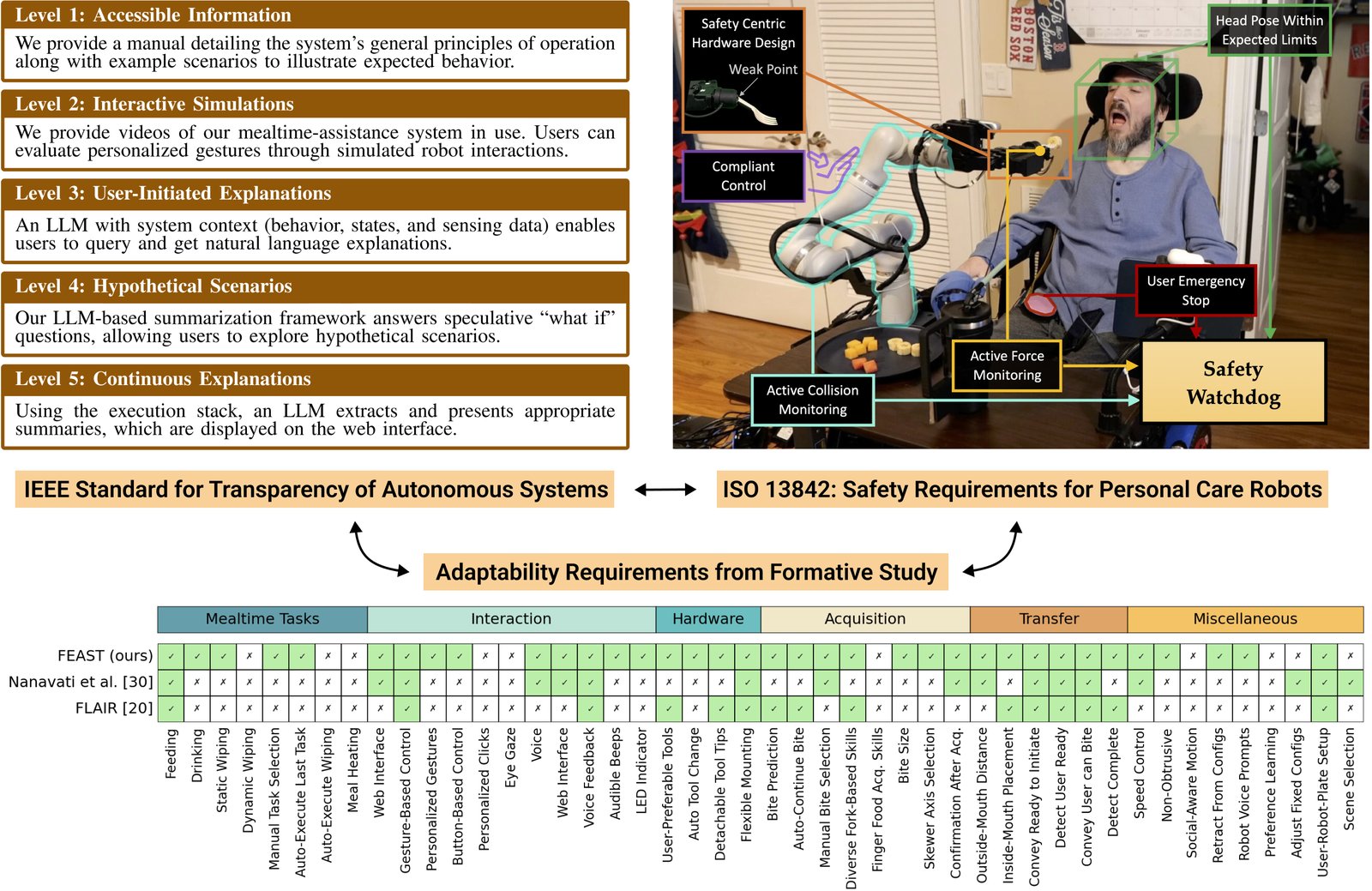
Fig. 5: FEAST proposes a personalization framework for mealtime assistance built on three key tenets: (i) adaptability towards tackling the various request types identified through our formative study, (ii) transparency towards Levels 1-5 on the IEEE Transparency Standard, and (iii) safety aligned with ISO/TS 13482 safety principles.
图 5:FEAST 提出基于三项关键原则的进餐辅助个性化框架:(i)适应性,以应对形成性研究识别的各类请求;(ii)透明性,对齐 IEEE 透明性标准 1–5 级;(iii)安全性,对齐 ISO/TS 13482 安全原则。
The page also allows users to transition to the Gestures Page, which focuses on adding personalized gestures to the system’s library. To add a new gesture, users provide a language label and description. The interface then triggers EmulateTransfer, moving the robot to a position just outside the user’s mouth without holding a utensil to record positive and negative gesture examples. Once the recordings are complete, the robot returns to the ready-to-transfer configuration, and the interface displays the accuracy of the newly trained gesture detector. Users can also test gesture detectors by having the robot move to the position just outside their mouth (without holding a utensil) while the interface displays whether the detector is triggered by their movements. When switching between webpages, the interface displays a white screen with dynamic text, continuously explaining its current actions. Together, these personalization features enhance adaptability and align with the IEEE Transparency framework (Section V-B).
该页还允许用户转到手势页面,专注于向系统库添加个性化手势。添加新手势时,用户提供语言标签与描述。界面随即触发 EmulateTransfer,使机器人在未持餐具时移到用户嘴外位置,以录制正负手势样例。录制完成后,机器人回到待传递构型,界面显示新训练手势检测器的准确率。用户还可让机器人移到嘴外位置(未持餐具)测试检测器,界面显示其动作是否触发检测。切换网页时,界面显示带动态文字的白屏,持续解释当前动作。这些个性化功能共同增强适应性,并与 IEEE 透明性框架对齐(第 V-B 节)。
V FEAST Achieves the Three Tenets of Personalization
V FEAST 达成个性化三项原则
Our formative study affirmed the importance of adaptability, transparency, and safety for a mealtime assistance system that is personalized in-the-wild. In this section, we detail how the system design of FEAST addresses these three tenets.
形成性研究确认了适应性、透明性与安全性对野外个性化进餐辅助系统的重要性。本节详述 FEAST 的系统设计如何回应这三项原则。
V-A Adaptability
V-A 适应性
In our formative user study, care recipients voiced 46 types of adaptability requests across 7 categories (Figure 3). Requests of the same type often differed from user to user. For example, P1 said: “I would want the robot to be fast, as fast as it could go maybe up until those very last moments of moving towards my head,” while P9 said, “I have a trach and have to eat slowly.” P10 said: “It would be useful to give the robot more autonomy during those social situations, to pick the bite or whatever, rather than me specifying something exactly,” and P5 said, “This might be just a personal thing, but the idea of hitting a switch and then waiting for something to happen makes me then feel like I’m no longer in control.” Users also voiced the importance of adapting over time: for example, P8 mentioned, “I’m able to do that right now. But these things might change over time. So you might want to keep updating the robot with the progression of the disease.”
在形成性用户研究中,受照护者提出了跨 7 类共 46 种适应性请求(图 3)。同类请求在用户之间常有差异。例如 P1 说:「我希望机器人尽量快,也许一直快到靠近我头部的最后一刻,」而 P9 说:「我有气管切开,必须慢慢吃。」 P10 说:「在那些社交场合给机器人更多自主权会有用,让它自己选一口之类的,而不是我精确指定,」而 P5 说:「这可能只是我个人的感觉,但按一下开关然后等事情发生会让我觉得不再掌控。」 用户也强调随时间适配的重要性:例如 P8 提到:「我现在还能那样做。但这些事可能随时间变化。所以你可能想随疾病进展不断更新机器人。」
In Figure 5, we compare FEAST to two state-of-the-art feeding systems, Nanavati et al. [36] and FLAIR [20], based on their ability to address the 46 adaptability request types identified in our study. FEAST covers 36, compared to 17 for Nanavati et al. and 15 for FLAIR. Appendix A provides detailed justifications for each system. Appendix B presents an ablation study demonstrating that our LLM-based personalized gesture synthesis outperforms a no-personalization baseline.
在图 5 中,我们按形成性研究识别的 46 种适应性请求类型,比较 FEAST 与两种最先进喂食系统 Nanavati 等[36] 与 FLAIR[20] 的覆盖能力。FEAST 覆盖 36 种,Nanavati 等为 17 种,FLAIR 为 15 种。附录 A 给出各系统的详细论证。附录 B 给出消融研究,表明基于 LLM 的个性化手势合成优于无个性化基线。
V-B Transparency
V-B 透明性
The IEEE Standard for Transparency of Autonomous Systems [40, 106], which explicitly includes care robots within its scope, defines five levels of transparency requirements, ranging from 1 to 5 (Figure 5). FEAST aims to meet all these levels.
IEEE 自主系统透明性标准[40, 106]明确将照护机器人纳入范围,定义了从 1 到 5 的五级透明性要求(图 5)。FEAST 旨在满足所有这些级别。
Level 1 specifies that users must have access to information such as example scenarios and general principles of operation. FEAST satisfies this requirement with an instruction manual provided to new users. Level 2 requires interactive training material, enabling users to rehearse their interactions with the system in virtual scenarios. To address this, we provide demonstration videos of the system across various use cases. Moreover, after adding personalized gestures, users can test them directly on the real robot in isolation.
第 1 级规定用户须能获取示例场景与一般运行原则等信息。FEAST 通过向新用户提供说明书满足该要求。第 2 级要求交互式训练材料,使用户可在虚拟场景中演练与系统的交互。为此我们提供系统在多种用例下的演示视频。此外,添加个性化手势后,用户可在真实机器人上单独测试。
Levels 3 and 4 focus on providing user-initiated explanations. Level 3 requires explanations of the system’s most recent activity, while Level 4 demands answers to “what if” queries about system behavior. FEAST uses LLM summarization to fulfill these requirements. We define the following to encapsulate the current system state:
第 3、4 级聚焦用户发起的解释。第 3 级要求解释系统最近活动,第 4 级要求回答关于系统行为的「如果……会怎样」查询。FEAST 用 LLM 摘要满足这些要求。我们定义以下内容以封装当前系统状态:
- Current Behavior: Current behavior tree encodings for mealtime-assistance skills, with text descriptions for each node and its parameters.
- 当前行为:进餐辅助技能的当前行为树编码,以及各节点及其参数的文本描述。
- Node Execution History: A real-time log of behavior tree nodes in-execution and completed.
- 节点执行历史:正在执行与已完成行为树节点的实时日志。
- Perception Log: A real-time log of perceived data, such as plate contents, drink pose, user head pose, and gestures.
- 感知日志:感知数据的实时日志,如盘中内容、饮具位姿、用户头姿与手势。
- Safety Log: A real-time log of safety checks, including any invalidated specifications.
- 安全日志:安全检查的实时日志,包括任何失效的规范。
On the Personalization Page of the web interface, users can submit language queries. The LLM processes these queries–along with the current system state, detailed descriptions of system operations (as outlined in Section IV), and prior user queries and the corresponding LLM’s responses–to generate concise, understandable explanations for non-expert users.
在网页界面的个性化页面,用户可提交语言查询。LLM 结合这些查询、当前系统状态、系统运行详细描述(如第 IV 节所述)以及先前用户查询与对应 LLM 回复,为非专家用户生成简洁易懂的解释。
Level 5 transparency requires the system to provide continuous explanations of its behavior. FEAST aims to achieve this using LLM summarization. At fixed-time intervals, the system checks for changes in the system state as defined above. If a change is detected, the LLM is queried with detailed descriptions of system operations, the previous state, and the current state, prompting it to generate an explanation of what changed during that period. This explanation is displayed on the web interface whenever no other page is active.
第 5 级透明性要求系统持续解释其行为。FEAST 旨在用 LLM 摘要达成这一点。系统按固定时间间隔检查上述系统状态是否变化;若检测到变化,则以系统运行详细描述、先前状态与当前状态查询 LLM,促使其生成该时段内变化的解释。当无其他页面激活时,该解释显示在网页界面上。
V-C Safety
V-C 安全性
FEAST fits within the scope of ISO 13842: Robots and Robotic Devices–Safety Requirements for Personal Care Robots [39], categorized as a “physical assistant robot”, with the following hardware and software checks (Figure 5):
FEAST 属于 ISO 13842:机器人与机器人装置——个人照护机器人安全要求[39]的适用范围,归类为「物理助手机器人」,具有以下软硬件检查(图 5):
Pose filtering. Our pose detection methods (food, drink, and head pose) use predefined zones based on expected plate, drink, and head positions, initialized at the start of each mealtime assistance scenario. Head pose limits are tailored to the user’s range of motion [107]. If detections occur outside these zones—such as mistakenly identifying a caregiver’s head pose behind the user during feeding (a scenario that can arise in real-world settings)—the robot transitions to a safety state.
位姿过滤。 我们的位姿检测方法(食物、饮具与头姿)使用基于预期餐盘、饮具与头部位置的预定义区域,在每次进餐辅助场景开始时初始化。头姿限制按用户活动范围定制[107]。若检测落在这些区域之外——例如在喂食时误识别用户身后照护者的头姿(现实场景中可能出现)——机器人转入安全状态。
Active collision monitoring. While our robot verifies its motion plans for collisions with known obstacles, it also uses active collision monitoring to handle unexpected collisions when not using compliant control. This is achieved by comparing torque feedback from the joint F/T sensors with torque predictions from a nominal model-based control law [108].
主动碰撞监测。 机器人在校验运动规划与已知障碍碰撞之外,还在未使用柔顺控制时用主动碰撞监测处理意外碰撞:比较关节 F/T 传感器的力矩反馈与基于标称模型控制律的力矩预测[108]。
Compliant control. For inside-mouth transfer, the most physical human-robot interaction intensive aspect of mealtime assistance, our robot switches to a custom Cartesian-space compliant controller that leverages Damped Least Squares [109].
柔顺控制。 对进餐辅助中人机物理交互最密集的口内传递,机器人切换到利用阻尼最小二乘[109]的定制笛卡尔空间柔顺控制器。
Safety-centric hardware design. Within the feeding utensil, the fork is attached to a custom-designed holder with a mechanical weak point that yields under excessive force, breaking the utensil into two pieces. This safety feature ensures that if excessive force is applied while the utensil is in the user’s mouth, only the fork tip remains, halting all physical interaction with the robot. For safety, we restrict outside-mouth bite transfers to the default silicone fork. Similarly, the drinking utensil uses a silicone straw, and the mouth wiper features a soft tip.
以安全为中心的硬件设计。 在喂食餐具中,叉子连接到带机械薄弱点的定制夹持器,在过大外力下屈服,使餐具断成两截。该安全特性确保若餐具在用户口中时施加过大外力,仅叉尖残留,从而停止与机器人的一切物理交互。出于安全,我们将口外咬送限制为默认硅胶叉。饮具同样使用硅胶吸管,擦嘴器带软尖端。
Emergency Stops. At all times, both the user and an experimenter have access to physical emergency stop buttons, which immediately transition the robot into a safety state.
紧急停止。 用户与实验者始终可使用实体紧急停止按钮,立即将机器人转入安全状态。
Watchdog. A watchdog continuously monitors the functionality of all robot sensors and emergency stops, transitioning the robot to a safety state if an issue is detected.
看门狗。 看门狗持续监测所有机器人传感器与紧急停止的功能,发现问题则将机器人转入安全状态。
We provide implementation details for the above and further discuss alignment with ISO 13842 guidelines in Appendix C.
上述实现细节以及对齐 ISO 13842 指南的进一步讨论见附录 C。
VI Five-Day In-the-Wild Evaluation
VI 五日野外评估
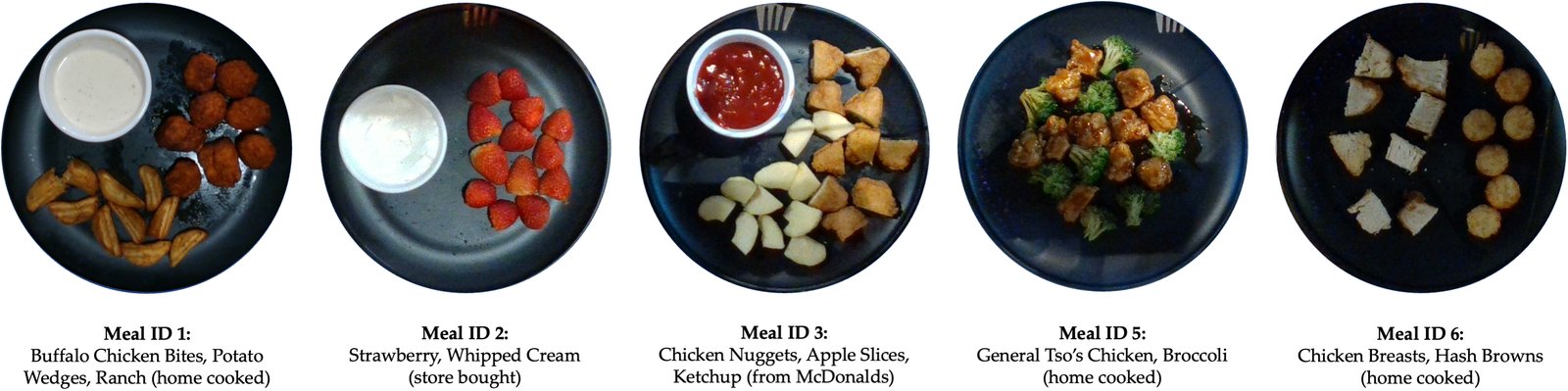
Fig. 6: Meals fed to care recipients. The images, captured by the robot’s in-hand camera, highlight the variability in lighting conditions. Each meal also included water. Meal ID 4 consisted only of a protein shake, which CR2 usually has for lunch.
图 6:喂给受照护者的餐食。图像由机器人手内相机拍摄,突显光照条件变化。每餐还含水。餐次 ID 4 仅为一杯蛋白奶昔,是 CR2 通常的午餐。
To showcase the real-world applicability of FEAST, we evaluate our system with two care recipients (CR1 and CR2) in a five-day in-home study spanning six realistic meals across three distinct environmental contexts:
为展示 FEAST 的现实可用性,我们与两位受照护者(CR1 与 CR2)开展为期五天的居家研究,覆盖三种不同环境情境下的六餐真实用餐:
- Personal context where they focus solely on eating.
- 个人情境,他们只专注于进食。
- Watching television while they are eating.
- 边看电视边进食。
- Social context where they eat with another researcher.
- 社交情境,与另一位研究者一起用餐。
This study asks the question: can end-users effectively personalize FEAST to meet their requirements across various mealtime scenarios?
本研究提出的问题是:终端用户能否在不同进餐场景中有效地将 FEAST 个性化到自身需求?
VI-A Study Procedure
VI-A 研究流程
Introductory Meals and System Familiarization. Before any evaluation meals, we conduct one introductory meal with each care recipient on Day 1 of the study to familiarize them with the system. During these training meals, we explain the components of the mealtime-assistance system, demonstrate its various personalization features, and answer their questions.
介绍性用餐与系统熟悉。 在任何评估餐之前,我们在研究第 1 天与每位受照护者进行一餐介绍性用餐以熟悉系统。训练餐中,我们讲解进餐辅助系统组件、演示各类个性化功能并回答问题。
Evaluation Meals. Over the course of the next 4 days, we feed 3 meals each to the two CRs, in their own homes, in the following chronological order:
评估餐。 随后 4 天内,我们在两位 CR 各自家中各喂 3 餐,时间顺序如下:
- • Meal ID 1 (on Day 2): CR1 Dinner in Personal Context – buffalo chicken bites, potato wedges, and ranch dressing (home cooked meal), served with water.
- • 餐次 ID 1(第 2 天):CR1 个人情境晚餐——水牛城鸡块、薯角与牧场酱(家常菜),配水。
- • Meal ID 2 (on Day 2): CR1 After-dinner dessert while Watching TV - strawberries with whipped cream (store-bought meal), served with water.
- • 餐次 ID 2(第 2 天):CR1 边看电视吃晚饭后甜点——草莓配鲜奶油(店购),配水。
- • Meal ID 3 (on Day 3): CR2 Dinner in Personal Context - chicken nuggets, apple slices, and ketchup purchased from McDonald’s, served with water.
- • 餐次 ID 3(第 3 天):CR2 个人情境晚餐——麦当劳购买的鸡块、苹果片与番茄酱,配水。
- • Meal ID 4 (on Day 4): CR2 Lunch in Social Context - protein shake (CR2’s usual lunch). Mug is cleaned and refilled with water after the shake is finished upon request.
- • 餐次 ID 4(第 4 天):CR2 社交情境午餐——蛋白奶昔(CR2 惯常午餐)。奶昔喝完后按请求清洗杯子并重新装水。
- • Meal ID 5 (on Day 5): CR2 Dinner while Watching TV - General Tso’s Chicken and Broccoli (home cooked meal), served with water.
- • 餐次 ID 5(第 5 天):CR2 边看电视晚餐——左宗棠鸡与西兰花(家常菜),配水。
- • Meal ID 6 (on Day 5): CR1 Dinner in Social Context - chicken breast strips and hash browns (home cooked meal), served with water.
- • 餐次 ID 6(第 5 天):CR1 社交情境晚餐——鸡胸肉条与薯饼(家常菜),配水。
We select the meals for the study based on the care recipient’s eating habits, the robot’s capabilities, and the need for variation. While we validate our system with similar meal types during study preparation, the exact meals naturally vary based on how they are prepared and what is available. Many adjustments were made on the fly; for example, hash browns from CR1’s fridge were added to Meal ID 6 at the last minute.
餐次选择依据受照护者饮食习惯、机器人能力与变化需求。虽在准备阶段用相似餐型验证系统,但具体餐食因准备方式与可得食材自然变化。许多调整是现场做出的;例如最后一刻把 CR1 冰箱里的薯饼加入餐次 ID 6。
Environmental and User-Specific Variability. Care recipients live in different homes and have unique preferences for their environment setup. This leads to variations both across and within the same context (see Figure 1), including:
环境与用户特异性变异。 受照护者住在不同家庭,对环境布置有独特偏好,导致同一情境内外均有差异(见图 1),包括:
- • Tools: CR1 uses a metal fork for all meals and a pink mug for the last meal. CR2 uses a silicone fork (safer for inside-mouth transfer) and a black mug for all meals.
- • 工具: CR1 所有餐次用金属叉,最后一餐用粉色杯子。CR2 所有餐次用硅胶叉(口内传递更安全)与黑色杯子。
- • Web Interface Interaction: Both use iPads. CR1, with limited limb mobility, interacts using their left arm, while CR2, with very limited limb mobility, uses a mouse tracker that follows a reflective dot on their nose.
- • 网页界面交互: 两人均用 iPad。肢体活动受限的 CR1 用左臂操作;肢体活动极度受限的 CR2 用跟踪鼻上反光点的鼠标追踪器。
- • Eating Tables: Different table types include multiple overbed tables, a coffee table, and a dining table.
- • 餐桌: 不同类型包括多张床上桌、咖啡桌与餐桌。
- • Seating Arrangements: While watching TV, both CR1 and CR2 face the screen. In a social setting, CR1’s social partner sits to their right, whereas CR2’s social partner sits directly in front.
- • 座位安排: 看电视时 CR1 与 CR2 都面向屏幕。社交情境中,CR1 的社交伙伴坐在其右侧,CR2 的社交伙伴正对面坐。
Meal Setup and Scene Configuration. For each new scene, experimenters update scene parameters used for safety checks, such as table height (ensuring a lower limit for acquisition actions) and the user’s head pose (used for filtering head perception). They also adjust the fixed configurations that the robot moves to before detecting the plate, drink, and user’s head to ensure their visibility. After the CRs personalize the robot for their personal contexts in their first evaluation meals, we initialize their other contexts with those settings.
餐次布置与场景配置。 每个新场景,实验者更新用于安全检查的场景参数,如桌高(确保取食动作下限)与用户头姿(用于过滤头部感知)。他们还调整机器人在检测餐盘、饮具与用户头部之前移到的固定构型,以确保可见。CR 在首次评估餐中为个人情境个性化机器人后,我们用这些设置初始化其其他情境。
VI-B Evaluation Metrics
VI-B 评估指标
Before the study, participants rate their experiences with human caregivers during mealtime on a 5-point Likert scale, which is later compared to FEAST. To evaluate system performance, we log experimenter interventions for each meal, categorized into hardware, web interface, skills, and personalization. We also track experimenter explanations, recording the number of questions participants ask. Skill success rates are measured for autonomous actions, which rely on perception, such as bite acquisition, bite transfer, drink pickup, drink transfer, and wipe transfer. Fixed-motion actions, such as utensil and mouth wipe pickup from the tool mount and subsequent stow, always succeed. After each meal, participants complete a NASA-TLX [37] survey (7-point Likert scale) to assess cognitive workload. At the end of the study, a Technology Acceptance Model (TAM) [38] survey evaluates overall satisfaction and usability, along with additional questions assessing key personalization tenets: adaptability, transparency, and safety. Full questionnaires are in Appendix D.
研究前,参与者用 5 点李克特量表评价与人工照护者共进餐的体验,随后与 FEAST 对比。为评估系统性能,我们记录每餐实验者介入,分为硬件、网页界面、技能与个性化。我们还跟踪实验者解释,记录参与者提问次数。技能成功率针对依赖感知的自主动作测量,如取食、咬送、饮具拾取、饮具传递与擦拭传递。固定运动动作,如从刀架拾取餐具与擦嘴器及随后归位,始终成功。每餐后,参与者完成 NASA-TLX[37] 问卷(7 点李克特)以评估认知负荷。研究结束时,技术接受模型(TAM)[38] 问卷评估总体满意度与可用性,另有问题评估个性化关键原则:适应性、透明性与安全性。完整问卷见附录 D。
| Meal | Interventions | Explanations | Skill Success Rate | |||||||
|---|---|---|---|---|---|---|---|---|---|---|
| Hardware | Web Interface | Skill | Personalization | Bite Acq. | Bite Transfer | Drink Acq. | Drink Transfer | Wipe Transfer | ||
| #1: CR1 Personal | 4 | 2 | 1 | 0 | 8 | 24/25 | 14/17 | 3/7 | 2/3 | 1/1 |
| #2: CR1 TC | 1 | 1 | 0 | 0 | 1 | 22/27 | 11/11 | 1/1 | 1/1 | - |
| #3: CR2 Personal | 1 | 1 | 0 | 0 | 6 | 29/37 | 15/17 | 3/3 | 3/3 | 1/1 |
| #4: CR2 Social | 1 | 0 | 1 | 0 | 2 | - | - | 2/2 | 5/5 | - |
| #5: CR2 TV | 0 | 4 | 0 | 0 | 1 | 19/21 | 18/19 | 4/4 | 2/2 | 2/2 |
| #6: CR1 Social | 0 | 0 | 0 | 1 | 2 | 12/12 | 12/12 | 2/2 | 2/2 | 1/1 |
TABLE II: Per-meal system performance, including experimenter interventions, explanations, and skill success rates.
| 餐次 | 介入 | 解释 | 技能成功率 | |||||||
|---|---|---|---|---|---|---|---|---|---|---|
| 硬件 | 网页界面 | 技能 | 个性化 | 取食 | 咬送 | 饮具拾取 | 饮具传递 | 擦拭传递 | ||
| #1: CR1 个人 | 4 | 2 | 1 | 0 | 8 | 24/25 | 14/17 | 3/7 | 2/3 | 1/1 |
| #2: CR1 电视 | 1 | 1 | 0 | 0 | 1 | 22/27 | 11/11 | 1/1 | 1/1 | - |
| #3: CR2 个人 | 1 | 1 | 0 | 0 | 6 | 29/37 | 15/17 | 3/3 | 3/3 | 1/1 |
| #4: CR2 社交 | 1 | 0 | 1 | 0 | 2 | - | - | 2/2 | 5/5 | - |
| #5: CR2 电视 | 0 | 4 | 0 | 0 | 1 | 19/21 | 18/19 | 4/4 | 2/2 | 2/2 |
| #6: CR1 社交 | 0 | 0 | 0 | 1 | 2 | 12/12 | 12/12 | 2/2 | 2/2 | 1/1 |
表 II:分餐系统性能,包括实验者介入、解释与技能成功率。
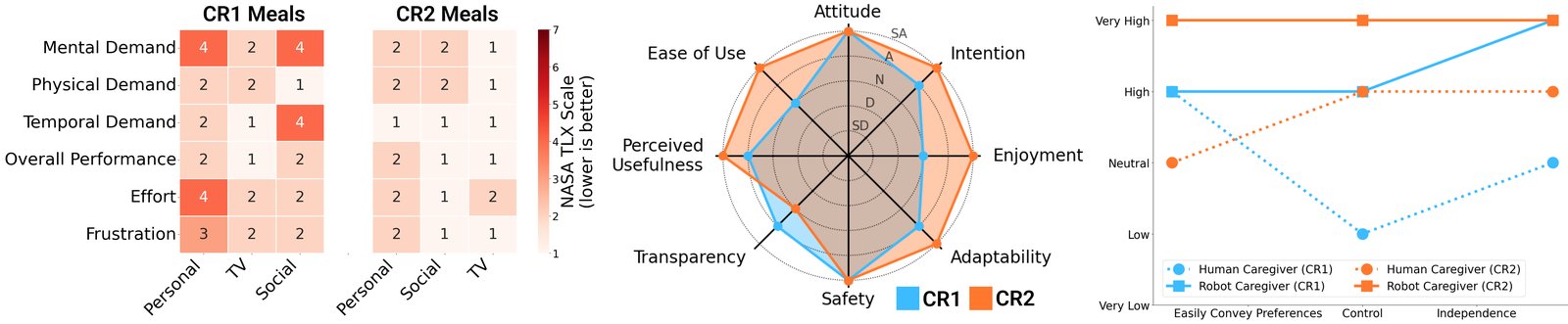
Fig. 7: Left: Per-meal NASA-TLX survey results, with CR1 and CR2 meals shown in chronological order. Center: TAM results, including questions on personalization tenets. Right: Comparison between human caregivers and FEAST.
图 7:左:分餐 NASA-TLX 问卷结果,CR1 与 CR2 餐次按时间顺序展示。中:TAM 结果,含个性化原则相关问题。右:人工照护者与 FEAST 对比。
VI-C Results
VI-C 结果
For each meal, CR1 and CR2 reported either fully clearing their plate or eating until they were full. Table II summarizes objective system performance per meal, whereas Figure 7 shows subjective metrics. Details on each of the interventions, explanations, and personalization requests made during the study can be found in Appendix E.
对每餐,CR1 与 CR2 报告要么清空餐盘,要么吃到饱。表 II 汇总每餐客观系统性能,图 7 展示主观指标。研究中每次介入、解释与个性化请求的细节见附录 E。
Interventions. A total of 18 experimenter interventions occurred across six meals (). Four hardware interventions in the first meal were due to a damaged ArUco marker on the mug handle, which was later replaced. All but one web interface intervention resulted from a recurring network issue that intermittently blocked commands, requiring a refresh.
介入。 六餐共发生 18 次实验者介入()。首餐 4 次硬件介入因杯把上 ArUco 标记损坏,随后更换。除一次外,所有网页界面介入均由间歇阻断命令的反复网络问题引起,需刷新。
Explanations. Users asked experimenters 20 questions across six meals (). Many could have been directed to the robot, but the transparency page was only accessible from the task selection page, underscoring the need for transparency throughout the eating process.
解释。 用户在六餐中共向实验者提问 20 次()。许多本可向机器人提出,但透明性页面仅可从任务选择页进入,凸显整个进食过程都需要透明性。
Skill Success Rates. FEAST demonstrates robustness to different food items, with a bite acquisition success rate of % and a bite transfer success rate of % . Prior work suggests that an 80% acquisition rate is sufficient for use [10]. While drink acquisition success was low for Meal ID 1 due to a damaged marker on the drink handle during transit, it improved significantly after replacement, averaging % across Meal IDs 2-5. Drink and wipe transfers were also highly successful at % and % respectively.
技能成功率。 FEAST 对不同食物表现出鲁棒性,取食成功率 %,咬送成功率 %。先前工作认为 80% 取食率已足以使用[10]。餐次 ID 1 因运输中饮具把手标记损坏导致饮具拾取成功率偏低,更换后显著改善,餐次 ID 2–5 平均 %。饮具与擦拭传递亦很高,分别为 % 与 %。
Cognitive Workload Per Meal. The average workload imposed by FEAST was relatively low. On a 0–100 NASA-TLX scale (where lower scores indicate lower workload), CR1 had a mean of , while CR2 had a mean of , compared to a baseline of 37 [110, 1]. Both care recipients rated their success in achieving mealtime goals very positively: the inverted Performance metric (0–100, lower = better) is for CR1 and for CR2.
分餐认知负荷。 FEAST 施加的平均负荷相对较低。在 0–100 的 NASA-TLX 量表上(分数越低负荷越低),CR1 均值为 ,CR2 为 ,而基线为 37[110, 1]。两位受照护者对达成进餐目标的成功评价很高:倒置的 Performance 指标(0–100,越低越好)CR1 为 ,CR2 为 。
Comparison with Human Caregiver. Both CRs rated FEAST as providing greater control over their meals and a greater sense of independence compared to their professional caregivers. CR2 also reported less effort in conveying preferences to the robot than to their human caregiver.
与人工照护者对比。 两位 CR 都评价 FEAST 相较专业照护者能提供对进餐更大的控制感与独立感。CR2 还报告向机器人传达偏好比向人工照护者更省力。
TAMs and Personalization Tenets. Results from the TAM survey indicate that both CRs rated FEAST highly across all metrics, with a mean score of for Perceived Usefulness, Ease of Use, Attitude, Intention, and Enjoyment. They also rated the system highly for adaptability and safety but noted that transparency could be improved. This may be because the transparency page was only accessible from the task selection page on the web interface, which was not always available, requiring them to ask experimenters for explanations.
TAM 与个性化原则。 TAM 问卷结果显示,两位 CR 在所有指标上对 FEAST 评价都很高,感知有用性、易用性、态度、意向与愉悦感均值 。他们对适应性与安全性评价也高,但指出透明性仍可改进。这可能因为透明性页面仅可从网页界面的任务选择页进入,并非始终可用,因此他们需向实验者寻求解释。
VI-D Lessons Learned
VI-D 经验教训
Across different meals, both CR1 and CR2 made a range of personalization requests. These included adjusting robot speed (“Feed me as fast as you can,” Meal ID 1), modifying skill parameters (“Dip the strawberry deeper into the whipped cream,” Meal ID 2), changing web interface workflows (“Don’t show continue pages on the web interface,” Meal ID 3), and customizing interactions between the robot and user, such as muting the robot (“Be quiet and do not talk at all,” Meal ID 5) or changing how transfers are confirmed (“Use the button to complete a transfer only when taking a sip,” Meal ID 1).
在不同餐次中,CR1 与 CR2 提出了多种个性化请求。包括调整机器人速度(*「尽快喂我,」餐次 ID 1)、修改技能参数(「把草莓更深地蘸进鲜奶油,」餐次 ID 2)、改变网页界面流程(「网页界面不要显示继续页面,」餐次 ID 3),以及定制机器人与用户的交互,例如静音机器人(「安静,完全不要说话,」餐次 ID 5)或改变传递确认方式(「只在喝一口时用按钮完成传递,」*餐次 ID 1)。
Even under similar contexts, the CRs had different personalization needs. For example, CR2 added a “continuous mouth open” personalized gesture detector for initiating transfers in a social setting, to differentiate from when they are talking. On the other hand, CR1 realized the default mouth-open detector required opening their mouth very wide. This design allowed CR1 to talk without inadvertently triggering the robot, and then open their mouth wide when ready to receive a bite. Thus, CR1 continued using it in social settings.
即便在相似情境下,两位 CR 的个性化需求也不同。例如,CR2 在社交情境中添加了*「持续张嘴」*个性化手势检测器以发起传递,以便与说话区分。另一方面,CR1 发现默认张嘴检测器要求张得很开。这一设计让 CR1 可在说话时不误触发机器人,准备好接食时再张大嘴。因此 CR1 在社交情境中继续使用该默认检测器。
The spatial arrangement of people and objects also influenced personalization preferences. In CR2’s social context, the social partner sat across the table, so CR2 rarely felt obstructed by the robot: “I completely forgot about the robot sometimes and had to remember that I had to take a drink.” Conversely, in CR1’s social context, the social partner was seated to the right—directly across from the robot—prompting CR1 to request the robot retract after every bite (“Move to retract position after every bite”) to avoid interference.
人与物的空间安排也影响个性化偏好。在 CR2 的社交情境中,社交伙伴坐在对面,CR2 很少感到被机器人遮挡:「有时我完全忘了机器人,还得提醒自己该喝一口。」 相反,在 CR1 的社交情境中,社交伙伴坐在右侧——正对机器人——促使 CR1 请求每口后收回(「每口后移到收回位」)以避免干扰。
FEAST’s adaptability leverages an LLM to process language commands and update the robot’s behavior. However, LLMs can sometimes hallucinate or make mistakes. For example, when CR1 tried to switch to a button for wipe transfers with the command, “Use button when completing a transfer when taking a sip,” the LLM mistakenly applied this change to all tools, responding, “The robot-assisted feeding system has been updated to use a button to complete actions when transferring drinks, utensils, and wipes.” Despite the error, the system’s transparency features allowed the user to recover. CR1 utilized transparency to verify the transfer completion method by asking, “What is the default action to complete a transfer?” and “What other ways can I end a transfer besides pushing the button?” After several transparency-adaptability iterations, CR1 submitted a detailed adaptability request: “Use sensors to end transactions with utensil use, the button to end transactions when taking a sip, and the button to end transactions for face wipes.” Through these transparent interactions, CR1 was able to iteratively refine the robot’s behavior to match their preferences, even when sometimes the initial adaptability command did not function as intended.
FEAST 的适应性借助 LLM 处理语言命令并更新机器人行为。但 LLM 有时会幻觉或出错。例如,当 CR1 试图用命令*「喝一口时用按钮完成传递」切换到按钮结束擦拭传递时,LLM 误将该更改应用到所有工具,回复「机器人辅助喂食系统已更新为在传递饮具、餐具与擦拭器时用按钮完成动作。」* 尽管出错,系统的透明性功能让用户得以恢复。CR1 用透明性核实传递完成方式,询问*「完成传递的默认动作是什么?」与「除按按钮外还有哪些方式结束传递?」* 经过多轮透明性–适应性迭代,CR1 提交了详细适应性请求:「用餐具时用传感器结束事务,喝一口时用按钮结束事务,擦脸时用按钮结束事务。」 通过这些透明交互,即便初始适应性命令有时未按预期工作,CR1 仍能迭代将机器人行为精炼到符合偏好。
Over multiple days of evaluating a flexible system, users often forgot the robot’s settings and expectations (which gesture it is waiting to detect). FEAST provides transparency through voice prompts and a web interface, with multiple options proving crucial. In social settings, CR1 and CR2 switched off voice prompts and relied on the web interface for guidance. However, in cases where neither was accessible—such as when CR2 used a personalized gesture detector for “keep head still” during mouth wiping—the wiper’s position right at their mouth prevented them from checking the interface. As CR2 noted, “A small display on the gripper would help. I can’t check the web interface while the fork or another tool is at my mouth and the robot expects something. Or maybe I could ask directly, like ‘Hey robot, what am I supposed to do right now?’”
在多日评估灵活系统时,用户常忘记机器人的设置与期望(它在等检测哪种手势)。FEAST 通过语音提示与网页界面提供透明性,多种选项至关重要。社交情境中,CR1 与 CR2 关闭语音提示,依赖网页界面指引。但在两者都不可用时——例如 CR2 擦嘴时使用*「保持头不动」个性化手势检测器——擦拭器正对嘴边使其无法查看界面。正如 CR2 所说:「夹爪上一个小显示会有帮助。叉或其他工具在嘴边、机器人在等我做什么时,我没法看网页界面。或者我可以直接问,比如『嘿机器人,我现在该做什么?』」*
A flexible system allows users to tinker and personalize their experience, but it can also impose cognitive workload. While NASA-TLX surveys indicated that our system did not impose significant cognitive workload during evaluation meals, this may be because introductory meals helped users acclimate. Over three meals, cognitive workload generally trended downward (Figure 7) as users became more familiar with the system, except for Meal ID 6 (a social meal for CR1). CR1 noted that the mental and temporal demand was not caused by the personalization process itself but rather by the specific settings they had chosen, which were not optimal for the context. “I set the [auto-continue task selection] timer to 100 seconds, but that wasn’t enough. I kept watching the countdown while trying to keep up with the conversation, making sure I was ready for my next bite before time ran out. Next time, I’d set it much longer.” Despite this challenge, they acknowledged that familiarity would make the process easier over time: “The more I eat in this setting, the easier it’ll get. I’ll get used to what the robot can do and figure out which settings actually work for me.”
灵活系统允许用户折腾并个性化体验,但也可能带来认知负荷。虽 NASA-TLX 显示评估餐中系统未造成显著认知负荷,这可能因为介绍性用餐帮助用户适应。三餐中认知负荷总体下降(图 7),用户更熟悉系统,惟餐次 ID 6(CR1 的社交餐)例外。CR1 指出心理与时间需求并非来自个性化过程本身,而是来自他们选择的、对该情境并不最优的具体设置。「我把[自动继续任务选择]计时器设成 100 秒,但不够。我一边盯着倒计时一边想跟上对话,确保在时间耗尽前准备好下一口。下次我会设得长得多。」 尽管有此挑战,他们承认熟悉后会更容易:「在这种场合吃得越多就越容易。我会习惯机器人能做什么,并弄清哪些设置真正适合我。」
During our in-home evaluation, several unexpected skill failures occurred. For example, varying lighting conditions affected food perception, making it difficult for the robot to detect food items on the plate. However, the system provided a manual skill execution option on the web interface, allowing users to pick up undetected bites by selecting the skewering skill and a keypoint on a plate image. In cases where bite transfer failed and the robot was unaware, it would return to the plate to reacquire food, even though a food item was already on the fork. To recover, users switched to manual skill selection, skewering an empty space on the plate to retain the same food item on the fork and retry bite transfer.
居家评估中发生了若干意外技能失败。例如,变化的光照影响食物感知,使机器人难以检测盘中食物。但系统在网页界面提供手动技能执行选项,用户可通过选择串刺技能与餐盘图像上的关键点拾取未检出的一口。在咬送失败且机器人未察觉时,它会回到餐盘重新取食,尽管叉上已有食物。为恢复,用户切换到手动技能选择,串刺盘上空白处以保留叉上同一食物并重试咬送。
Similarly, the default head nod detector—used to detect when a user was finished drinking or wiping their mouth—did not work well for CR1. When leaning forward to take a sip or wipe, they inadvertently leaned downward, which the system misinterpreted as a nod, causing the robot to move away too soon. However, because the system was flexible, CR1 was able to switch from gesture detection to a button for this task.
类似地,用于检测用户是否喝完或擦完嘴的默认点头检测器对 CR1 效果不佳。他们前倾喝一口或擦嘴时无意中向下倾,系统误判为点头,导致机器人过早离开。但因系统灵活,CR1 能将该任务从手势检测切换为按钮。
These examples highlight how system flexibility, combined with user involvement, allows the robot to recover from difficult to predict failures that arise in the real world.
这些例子表明,系统灵活性结合用户参与,使机器人能从现实中难以预测的失败中恢复。
VII Assessing Ecological Validity with an Occupational Therapist
VII 与作业治疗师评估生态效度
To assess FEAST’s performance beyond the two community researchers, we evaluate our system with an Occupational Therapist (OT) not involved in system development procedure. Since OTs work with diverse care recipients with varying mobility limitations, their evaluation offers a comprehensive measure of the system’s ecological validity. The OT was introduced to FEAST as in our in-the-wild evaluations—through the training manual and a training meal. After reviewing personalization categories from our formative study, the OT independently created 10 realistic personalization scenarios. For each scenario, they personalized the default FEAST system to their requirements using adaptability and transparency requests. We report: (1) user-reported personalization success rated at , averaged across scenarios; (2) user-reported ease of personalization rated at out of 5, averaged across scenarios; (3) a preference for the personalized system over the default (no-personalization) system in all 10 scenarios; (4) a total of 13 adaptability and 2 transparency requests across all scenarios; and (5) a total of 2 experimenter interventions and 1 experimenter explanation throughout the evaluation. User ratings are on a 1–5 Likert scale (1 = Strongly Disagree, 5 = Strongly Agree). Appendix F details the personalization scenarios, including the adaptability and transparency requests made and any experimenter interventions or explanations. The OT also offered feedback on the interface design, stating: “Visually, it looks really good; the contrast is good, it should work for most care recipients… having speech-to-text is helpful because that is how many communicate with their devices.”
为评估 FEAST 在两位社区研究者之外的表现,我们请一位未参与系统开发流程的作业治疗师(OT)评估。由于 OT 与具有不同行动限制的多样受照护者共事,其评估可全面衡量系统生态效度。OT 的引入方式与野外评估相同——通过培训手册与一餐训练餐。在审阅形成性研究中的个性化类别后,OT 独立创建了 10 个现实个性化场景。对每个场景,他们用适应性与透明性请求将默认 FEAST 系统个性化到自身要求。我们报告:(1)用户报告的个性化成功在各场景平均为 ;(2)用户报告的个性化容易度平均为 (满分 5);(3)全部 10 个场景都偏好个性化系统而非默认(无个性化)系统;(4)所有场景共 13 次适应性与 2 次透明性请求;(5)整个评估共 2 次实验者介入与 1 次实验者解释。用户评分为 1–5 李克特量表(1=强烈不同意,5=强烈同意)。附录 F 详述个性化场景,包括所做适应性与透明性请求及任何实验者介入或解释。OT 还对界面设计给出反馈:「视觉上很好;对比度好,应对大多数受照护者可用……有语音转文字很有帮助,因为许多人就是这样与设备沟通的。」
VIII Limitations and Future Work
VIII 局限与未来工作
Open-Set Food Detection. FEAST receives user input about food items on the plate and uses an open-set object detector to locate them. However, the detector often mislabels items, particularly when plates contain multiple food types (e.g., chicken nuggets and potato wedges). During evaluation, additional qualifiers like “yellow potato wedge piece” or “cut-up chicken nugget piece” were required. While users could potentially provide such qualifiers to improve detection accuracy, the effectiveness of this approach remains to be evaluated. In the future, more accurate open-set detectors are needed to address this limitation.
开放集食物检测。 FEAST 接收用户关于盘中食物的输入,并用开放集目标检测器定位。但检测器常误标,尤其当盘中有多种食物(如鸡块与薯角)时。评估中需要「黄色薯角块」或「切碎鸡块」等额外限定语。用户或可提供此类限定语以提高检测准确率,但该方法有效性仍待评估。未来需要更准确的开放集检测器以解决此局限。
Adaptability Based on Plate Context: Some user adaptability requests required the system to have additional context about plate contents and selectively adjust behavior tree parameters. For instance, in Meal ID 1, CR1 requested more ranch for potato wedges and less for chicken bites. However, since FEAST currently uses a single dipping parameter, this required constant adjustments between bites. Future work should explore adaptability mechanisms that dynamically adjust behavior based on real-time plate contents.
基于餐盘情境的适应性:一些用户适应性请求要求系统具备关于盘中内容的额外情境,并有选择地调整行为树参数。例如在餐次 ID 1,CR1 要求薯角多蘸牧场酱、鸡块少蘸。但因 FEAST 当前使用单一蘸取参数,这需要在各口之间不断调整。未来工作应探索能基于实时盘中内容动态调整行为的适应性机制。
LLM Hallucinations. FEAST leverages LLMs to interpret user requests and modify robot behavior, but hallucinations can lead to incorrect or incomplete adaptations, causing user confusion. While FEAST’s transparency features help users identify and correct such errors, these features themselves rely on LLMs, which may also hallucinate. Future research should focus on reducing LLM-induced errors and exploring fallback mechanisms to ensure reliability.
LLM 幻觉。 FEAST 借助 LLM 解释用户请求并修改机器人行为,但幻觉可导致错误或不完整适配,造成用户困惑。虽 FEAST 的透明性功能帮助用户识别并纠正此类错误,这些功能本身也依赖可能幻觉的 LLM。未来研究应聚焦减少 LLM 诱导错误,并探索后备机制以确保可靠性。
Long-term Preference Learning: CR1 noted that generating a full set of personalization requests from scratch for a new setting could impose unnecessary cognitive workload. They suggested allowing users to describe their dining environment so that the system could initialize a relevant configuration, from which they could make refinements. Achieving this would require long-horizon preference learning, where FEAST analyzes past user preferences to propose suitable initial settings for different contexts.
长期偏好学习:CR1 指出,为新场景从零生成全套个性化请求可能带来不必要的认知负荷。他们建议允许用户描述用餐环境,使系统可初始化相关配置,再由用户精炼。实现这一点需要长时域偏好学习,由 FEAST 分析既往用户偏好,为不同情境提出合适初始设置。
Evaluation Beyond Community Researchers. Our evaluation involved two care recipients who are also community researchers. Since they were familiar with FEAST’s development, they may have had a lower cognitive workload than other users. Future studies should evaluate FEAST with care recipients who are not community researchers to better understand how unfamiliar users perceive the system’s usability.
超出社区研究者的评估。 我们的评估涉及两位同为社区研究者的受照护者。由于他们熟悉 FEAST 开发,认知负荷可能低于其他用户。未来研究应与非社区研究者的受照护者评估 FEAST,以更好理解不熟悉用户如何感知系统可用性。
Open-Loop Skill Limitations. FEAST employs open-loop skills for bite acquisition, which can fail when food items slip. Moreover, while users can adjust skill parameters to control bite size—such as scooping more or less—these settings often require frequent adjustments within a single meal as food properties change over time. For example, the same scooping distance may yield smaller portions as food consistency shifts. Incorporating closed-loop approaches to bite acquisition could improve robustness, allowing the system to adapt dynamically to food slippage and changing food properties.
开环技能局限。 FEAST 对取食采用开环技能,食物滑落时可能失败。此外,虽用户可调整技能参数控制一口大小——如多舀或少舀——但这些设置常需在同一餐内频繁调整,因为食物属性随时间变化。例如,同一舀取距离可能随食物稠度变化而得到更小份量。将闭环方法引入取食可提高鲁棒性,使系统动态适配食物滑落与变化的食物属性。
IX Acknowledgement
IX 致谢
All data collection and user studies described in this paper were approved by the Cornell University Institutional Review Board. This work was partly funded by the National Science Foundation under grants IIS #2132846 and CAREER #2238792. We are deeply grateful to Aimee Whitneck (CR1) and Benjamin Howe (CR2) for their involvement throughout this work. We also thank Amal Nanavati for assisting with participant recruitment for the formative user study, and all formative study participants for their valuable feedback, which guided system development. Finally, we thank the anonymous reviewers for their insightful feedback.
本文所述全部数据收集与用户研究均经康奈尔大学机构审查委员会批准。本工作部分由美国国家科学基金会资助,资助号 IIS #2132846 与 CAREER #2238792。我们衷心感谢 Aimee Whitneck(CR1)与 Benjamin Howe(CR2)全程参与。亦感谢 Amal Nanavati 协助形成性用户研究的参与者招募,以及所有形成性研究参与者的宝贵反馈,它们指导了系统开发。最后感谢匿名审稿人富有洞见的反馈。
References
参考文献
Appendix FEAST: A Flexible Mealtime-Assistance System Towards In-the-Wild Personalization http://emprise.cs.cornell.edu/feast
附录 FEAST:面向野外场景个性化的灵活进餐辅助系统 http://emprise.cs.cornell.edu/feast
[1] A. Nanavati, P. Alves-Oliveira, T. Schrenk, E. K. Gordon, M. Cakmak, and S. S. Srinivasa, “Design principles for robot-assisted feeding in social contexts,” in Proceedings of the 2023 ACM/IEEE International Conference on Human-Robot Interaction , 2023, pp. 24–33.
[2] A. Mandy, T. Sims, G. Stew, and D. Onions, “Manual feeding device experiences of people with a neurodisability,” The American Journal of Occupational Therapy , vol. 72, no. 3, pp. 7 203 345 010p1–7 203 345 010p5, 2018.
[3] C. Jacobsson, K. Axelsson, P. O. Österlind, and A. Norberg, “How people with stroke and healthy older people experience the eating process,” Journal of Clinical Nursing , vol. 9, no. 2, pp. 255–264, 2000. [Online]. Available: https://onlinelibrary.wiley.com/doi/abs/10.1046/j.1365-2702.2000.00355.x
[4] S. E. Shune, “An altered eating experience: Attitudes toward feeding assistance among younger and older adults,” Rehabilitation nursing : the official journal of the Association of Rehabilitation Nurses , 2020.
[5] D. M. Taylor, “Americans with disabilities: 2014,” US Census Bureau , pp. 1–32, 2018.
[6] A. Chiò, A. Gauthier, A. Vignola, A. Calvo, P. Ghiglione, E. Cavallo, A. Terreni, and R. Mutani, “Caregiver time use in als,” Neurology , vol. 67, no. 5, pp. 902–904, 2006.
[7] K. C. Fleming, J. M. Evans, and D. S. Chutka, “Caregiver and clinician shortages in an aging nation,” in Mayo Clinic Proceedings , vol. 78, no. 8. Elsevier, 2003, pp. 1026–1040.
[8] R. Zenker, C. Pardell, A. Gilmore-Bykovskyi, A. J. Kind, and N. Werner, “Exploring workload among informal caregivers of persons with dementia,” in proceedings of the human factors and ergonomics society annual meeting , vol. 61, no. 1. SAGE Publications Sage CA: Los Angeles, CA, 2017, pp. 1297–1297.
[9] S. W. Brose, D. J. Weber, B. A. Salatin, G. G. Grindle, H. Wang, J. J. Vazquez, and R. A. Cooper, “The role of assistive robotics in the lives of persons with disability,” American Journal of Physical Medicine & Rehabilitation , vol. 89, no. 6, pp. 509–521, 2010.
[10] T. Bhattacharjee, E. K. Gordon, R. Scalise, M. E. Cabrera, A. Caspi, M. Cakmak, and S. S. Srinivasa, “Is more autonomy always better? exploring preferences of users with mobility impairments in robot-assisted feeding,” in 2020 15th ACM/IEEE International Conference on Human-Robot Interaction (HRI) . IEEE, 2020, pp. 181–190.
[11] R. K. Jenamani, D. Stabile, Z. Liu, A. Anwar, K. Dimitropoulou, and T. Bhattacharjee, “Feel the bite: Robot-assisted inside-mouth bite transfer using robust mouth perception and physical interaction-aware control,” in Proceedings of the 2024 ACM/IEEE International Conference on Human-Robot Interaction , 2024, pp. 313–322.
[12] R. Feng, Y. Kim, G. Lee, E. K. Gordon, M. Schmittle, S. Kumar, T. Bhattacharjee, and S. S. Srinivasa, “Robot-assisted feeding: Generalizing skewering strategies across food items on a plate,” in The International Symposium of Robotics Research . Springer, 2019, pp. 427–442.
[13] E. K. Gordon, X. Meng, T. Bhattacharjee, M. Barnes, and S. S. Srinivasa, “Adaptive robot-assisted feeding: An online learning framework for acquiring previously unseen food items,” in 2020 IEEE/RSJ International Conference on Intelligent Robots and Systems (IROS) . IEEE, 2020, pp. 9659–9666.
[14] E. K. Gordon, S. Roychowdhury, T. Bhattacharjee, K. Jamieson, and S. S. Srinivasa, “Leveraging post hoc context for faster learning in bandit settings with applications in robot-assisted feeding,” in 2021 IEEE International Conference on Robotics and Automation (ICRA) . IEEE, 2021, pp. 10 528–10 535.
[15] E. K. Gordon, A. Nanavati, R. Challa, B. H. Zhu, T. A. K. Faulkner, and S. Srinivasa, “Towards general single-utensil food acquisition with human-informed actions,” in Conference on Robot Learning . PMLR, 2023, pp. 2414–2428.
[16] J. Grannen, Y. Wu, S. Belkhale, and D. Sadigh, “Learning bimanual scooping policies for food acquisition,” in 6th Annual Conference on Robot Learning , 2022. [Online]. Available: https://openreview.net/forum?id=qDtbMK67PJG
[17] Y.-L. Tai, Y. C. Chiu, Y.-W. Chao, and Y.-T. Chen, “Scone: A food scooping robot learning framework with active perception,” in Conference on Robot Learning . PMLR, 2023, pp. 849–865.
[18] R. Liu, Z. Mahammad, A. Bhaskar, and P. Tokekar, “Imrl: Integrating visual, physical, temporal, and geometric representations for enhanced food acquisition,” arXiv preprint arXiv:2409.12092 , 2024.
[19] P. Sundaresan, J. Wu, and D. Sadigh, “Learning sequential acquisition policies for robot-assisted feeding,” in Conference on Robot Learning . PMLR, 2023, pp. 1282–1299.
[20] R. K. Jenamani, P. Sundaresan, M. Sakr, T. Bhattacharjee, and D. Sadigh, “Flair: Feeding via long-horizon acquisition of realistic dishes,” arXiv preprint arXiv:2407.07561 , 2024.
[21] N. Ha, R. Ye, Z. Liu, S. Sinha, and T. Bhattacharjee, “Repeat: A real2sim2real approach for pre-acquisition of soft food items in robot-assisted feeding,” IEEE International Conference on Intelligent Robots and Systems (IROS) , 2024.
[22] A. Bhaskar, R. Liu, V. D. Sharma, G. Shi, and P. Tokekar, “Lava: Long-horizon visual action based food acquisition,” arXiv preprint arXiv:2403.12876 , 2024.
[23] D. Gallenberger, T. Bhattacharjee, Y. Kim, and S. S. Srinivasa, “Transfer depends on acquisition: Analyzing manipulation strategies for robotic feeding,” in 2019 14th ACM/IEEE International Conference on Human-Robot Interaction (HRI) . IEEE, 2019, pp. 267–276.
[24] S. Belkhale, E. K. Gordon, Y. Chen, S. Srinivasa, T. Bhattacharjee, and D. Sadigh, “Balancing efficiency and comfort in robot-assisted bite transfer,” in 2022 International Conference on Robotics and Automation (ICRA) . IEEE, 2022, pp. 4757–4763.
[25] D. Park, Y. Hoshi, H. P. Mahajan, H. K. Kim, Z. Erickson, W. A. Rogers, and C. C. Kemp, “Active robot-assisted feeding with a general-purpose mobile manipulator: Design, evaluation, and lessons learned,” Robotics and Autonomous Systems , vol. 124, p. 103344, 2020. [Online]. Available: https://www.sciencedirect.com/science/article/pii/S0921889018307061
[26] L. Shaikewitz, Y. Wu, S. Belkhale, J. Grannen, P. Sundaresan, and D. Sadigh, “In-mouth robotic bite transfer with visual and haptic sensing,” arXiv preprint arXiv:2211.12705 , 2022.
[27] R. Madan, R. K. Jenamani, V. T. Nguyen, A. Moustafa, X. Hu, K. Dimitropoulou, and T. Bhattacharjee, “Sparcs: Structuring physically assistive robotics for caregiving with stakeholders-in-the-loop,” in 2022 IEEE/RSJ International Conference on Intelligent Robots and Systems (IROS) . IEEE, 2022, pp. 641–648.
[28] K. Hacker, Community-based participatory research . Sage publications, 2013.
[29] R. S. Kushalnagar and C. Vogler, “Teleconference accessibility and guidelines for deaf and hard of hearing users,” in Proceedings of the 22nd International ACM SIGACCESS Conference on Computers and Accessibility , 2020, pp. 1–6.
[30] C. Haidenhofer, L. Sitbon, C. P. Beaumont, M. Hoogstrate, and J. L. Korte, “From research participant to co-researcher: Chloe’s story on co-designing inclusive technologies with people with intellectual disability,” in Proceedings of the 26th International ACM SIGACCESS Conference on Computers and Accessibility , 2024, pp. 1–6.
[31] F. Fussenegger and K. Spiel, “Depending on independence an autoethnographic account of daily use of assistive technologies,” in Proceedings of the 24th International ACM SIGACCESS Conference on Computers and Accessibility , 2022, pp. 1–6.
[32] T. L. Chen, M. Ciocarlie, S. Cousins, P. Grice, K. Hawkins, K. Hsiao, C. C. Kemp, C.-H. King, D. A. Lazewatsky, A. Leeper et al. , “Robots for humanity: User-centered design for assistive mobile manipulation,” in 2012 IEEE/RSJ International Conference on Intelligent Robots and Systems . IEEE, 2012, pp. 5434–5435.
[33] S. Moharana, A. E. Panduro, H. R. Lee, and L. D. Riek, “Robots for joy, robots for sorrow: community based robot design for dementia caregivers,” in 2019 14th ACM/IEEE International Conference on Human-Robot Interaction (HRI) . IEEE, 2019, pp. 458–467.
[34] A. Padmanabha, J. Gupta, C. Chen, J. Yang, V. Nguyen, D. J. Weber, C. Majidi, and Z. Erickson, “Independence in the home: A wearable interface for a person with quadriplegia to teleoperate a mobile manipulator,” in Proceedings of the 2024 ACM/IEEE International Conference on Human-Robot Interaction , 2024, pp. 542–551.
[35] V. Ranganeni, V. Nguyen, H. Evans, J. Evans, J. Mehu, S. Olatunji, W. Rogers, A. Edsinger, C. Kemp, and M. Cakmak, “Robots for humanity: In-home deployment of stretch re2,” in Companion of the 2024 ACM/IEEE International Conference on Human-Robot Interaction , 2024, pp. 1299–1301.
[36] A. Nanavati, E. K. Gordon, T. A. Kessler Faulkner, Y. R. Song, J. Ko, T. Schrenk, V. Nguyen, B. H. Zhu, H. Bolotski, A. Kashyap, S. Kutty, R. Karim, L. Rainbolt, R. Scalise, H. Song, R. Qu, M. Cakmak, and S. S. Srinivasa, “Lessons learned from designing and evaluating a robot-assisted feeding system for out-of-lab use,” in Proceedings of the 2025 ACM/IEEE International Conference on Human-Robot Interaction , 2025.
[37] S. Hart, “Development of nasa-tlx (task load index): Results of empirical and theoretical research,” Human mental workload/Elsevier , 1988.
[38] F. D. Davis, R. P. Bagozzi, and P. R. Warshaw, “User acceptance of computer technology: A comparison of two theoretical models,” Management science , vol. 35, no. 8, pp. 982–1003, 1989.
[39] I. O. for Standardization, Robots and Robotic Devices: Safety Requirements for Personal Care Robots , 2014.
[40] I. T. S. C. of the IEEE Vehicular Technology Society, the Standing Committee for Standards of the IEEE Robotics, and A. Society, “Ieee standard for transparency of autonomous systems,” IEEE Std 7001-2021 , 2022.
[41] “Meet Obi,” https://meetobi.com/ , [Online; accessed 1-Jan-2025].
[42] “Neater eater robot,” 2024, (Accessed: 1st January, 2025). [Online]. Available: https://www.neater.co.uk/neater-eater-robotic
[43] A. Staros and E. Peizer, “Veterans administration prosthetics center research report,” Bulletin of Prosthetics Research , 1977.
[44] I. Naotunna, C. J. Perera, C. Sandaruwan, R. Gopura, and T. D. Lalitharatne, “Meal assistance robots: A review on current status, challenges and future directions,” in IEEE/SICE International Symposium on System Integration , 2015, pp. 211–216.
[45] P. Sundaresan, S. Belkhale, and D. Sadigh, “Learning visuo-haptic skewering strategies for robot-assisted feeding,” in 6th Annual Conference on Robot Learning , 2022. [Online]. Available: https://openreview.net/forum?id=lLq09gVoaTE
[46] K. Zhang, M. Sharma, M. Veloso, and O. Kroemer, “Leveraging multimodal haptic sensory data for robust cutting,” in 2019 IEEE-RAS 19th International Conference on Humanoid Robots (Humanoids) , 2019.
[47] A. Candeias, T. Rhodes, M. Marques, M. Veloso et al. , “Vision augmented robot feeding,” in Proceedings of the European Conference on Computer Vision (ECCV) Workshops , 2018, pp. 0–0.
[48] F. F. Goldau, T. K. Shastha, M. Kyrarini, and A. Gräser, “Autonomous multi-sensory robotic assistant for a drinking task,” in 2019 IEEE 16th International Conference on Rehabilitation Robotics (ICORR) . IEEE, 2019, pp. 210–216.
[49] S. Schröer, I. Killmann, B. Frank, M. Völker, L. Fiederer, T. Ball, and W. Burgard, “An autonomous robotic assistant for drinking,” in 2015 IEEE international conference on robotics and automation (ICRA) . IEEE, 2015, pp. 6482–6487.
[50] T. Ikeda, T. Makino, S. Furuno, and F. Nagata, “Wiping the mouth using the robot arm with information of rgb-d sensor,” Artificial Life and Robotics , vol. 24, pp. 360–367, 2019.
[51] K. P. Hawkins, C.-H. King, T. L. Chen, and C. C. Kemp, “Informing assistive robots with models of contact forces from able-bodied face wiping and shaving,” in 2012 IEEE RO-MAN: The 21st IEEE International Symposium on Robot and Human Interactive Communication . IEEE, 2012, pp. 251–258.
[52] T. Bhattacharjee, M. E. Cabrera, A. Caspi, M. Cakmak, and S. S. Srinivasa, “A community-centered design framework for robot-assisted feeding systems,” in Proceedings of the 21st International ACM SIGACCESS Conference on Computers and Accessibility , 2019, pp. 482–494.
[53] G. Canal, C. Torras, and G. Alenyà, “Are preferences useful for better assistance? a physically assistive robotics user study,” THRI , 2021.
[54] A. Nanavati, V. Ranganeni, and M. Cakmak, “Physically assistive robots: A systematic review of mobile and manipulator robots that physically assist people with disabilities,” Annual Review of Control, Robotics, and Autonomous Systems , vol. 7, 2023.
[55] G. Yang, S. Wang, J. Yang, and P. Shi, “Desire-driven reasoning considering personalized care preferences,” Transactions on Systems, Man, and Cybernetics: Systems , 2021.
[56] J. Z.-Y. He, Z. Erickson, D. S. Brown, A. Raghunathan, and A. Dragan, “Learning representations that enable generalization in assistive tasks,” in Conference on Robot Learning . PMLR, 2023, pp. 2105–2114.
[57] Y. Gao, H. J. Chang, and Y. Demiris, “Grace: Generalizing robot-assisted caregiving with user functionality embeddings,” in 2015 IEEE/RSJ International Conference on Intelligent Robots and Systems (IROS) . IEEE, 2015, pp. 1840–1845.
[58] J. Wu, R. Antonova, A. Kan, M. Lepert, A. Zeng, S. Song, J. Bohg, S. Rusinkiewicz, and T. Funkhouser, “Tidybot: Personalized robot assistance with large language models,” arXiv preprint arXiv:2305.05658 , 2023.
[59] Z. Liu, Y. Ju, Y. Da, T. Silver, P. N. Thakkar, J. Li, J. Guo, K. Dimitropoulou, and T. Bhattacharjee, “Grace: Generalizing robot-assisted caregiving with user functionality embeddings,” arXiv preprint arXiv:2501.17855 , 2025.
[60] A. Joshi, S. Ghosh, M. Betke, S. Sclaroff, and H. Pfister, “Personalizing gesture recognition using hierarchical bayesian neural networks,” in Proceedings of the IEEE Conference on Computer Vision and Pattern Recognition , 2017, pp. 6513–6522.
[61] H. Brock and R. Gomez, “Personalization of human-robot gestural communication through voice interaction grounding,” in 2021 IEEE/RSJ International Conference on Intelligent Robots and Systems (IROS) . IEEE, 2021, pp. 846–853.
[62] A. Taheri and Z. Weissman, “Designing a first person shooter game for quadriplegics,” in Extended Abstracts of the 2021 CHI Conference on Human Factors in Computing Systems , 2021, pp. 1–6.
[63] A. Jackowski, M. Gebhard, and R. Thietje, “Head motion and head gesture-based robot control: A usability study,” IEEE Transactions on Neural Systems and Rehabilitation Engineering , vol. 26, no. 1, pp. 161–170, 2017.
[64] G. Canal, G. Alenyà, and C. Torras, “Adapting robot task planning to user preferences: an assistive shoe dressing example,” Autonomous Robots , 2019.
[65] J. Achiam, S. Adler, S. Agarwal, L. Ahmad, I. Akkaya, F. L. Aleman, D. Almeida, J. Altenschmidt, S. Altman, S. Anadkat et al. , “Gpt-4 technical report,” arXiv preprint arXiv:2303.08774 , 2023.
[66] A. Chowdhery, S. Narang, J. Devlin, M. Bosma, G. Mishra, A. Roberts, P. Barham, H. W. Chung, C. Sutton, S. Gehrmann et al. , “Palm: Scaling language modeling with pathways,” Journal of Machine Learning Research , vol. 24, no. 240, pp. 1–113, 2023.
[67] S. Kambhampati, “Can large language models reason and plan?” Annals of the New York Academy of Sciences , 2024.
[68] A. Padmanabha, J. Yuan, J. Gupta, Z. Karachiwalla, C. Majidi, H. Admoni, and Z. Erickson, “Voicepilot: Harnessing llms as speech interfaces for physically assistive robots,” arXiv preprint arXiv:2404.04066 , 2024.
[69] Y. Chen, J. Arkin, Y. Zhang, N. Roy, and C. Fan, “Autotamp: Autoregressive task and motion planning with llms as translators and checkers,” arXiv preprint arXiv:2306.06531 , 2023.
[70] W. Huang, F. Xia, T. Xiao, H. Chan, J. Liang, P. Florence, A. Zeng, J. Tompson, I. Mordatch, Y. Chebotar et al. , “Inner monologue: Embodied reasoning through planning with language models,” arXiv preprint arXiv:2207.05608 , 2022.
[71] C. Agia, T. Migimatsu, J. Wu, and J. Bohg, “Taps: Task-agnostic policy sequencing,” arXiv preprint arXiv:2210.12250 , 2022.
[72] K. Lin, C. Agia, T. Migimatsu, M. Pavone, and J. Bohg, “Text2motion: From natural language instructions to feasible plans,” Autonomous Robots , vol. 47, no. 8, pp. 1345–1365, 2023.
[73] I. Singh, V. Blukis, A. Mousavian, A. Goyal, D. Xu, J. Tremblay, D. Fox, J. Thomason, and A. Garg, “Progprompt: Generating situated robot task plans using large language models,” in 2023 IEEE International Conference on Robotics and Automation (ICRA) . IEEE, 2023, pp. 11 523–11 530.
[74] A. Brohan, N. Brown, J. Carbajal, Y. Chebotar, J. Dabis, C. Finn, K. Gopalakrishnan, K. Hausman, A. Herzog, J. Hsu et al. , “Rt-1: Robotics transformer for real-world control at scale,” arXiv preprint arXiv:2212.06817 , 2022.
[75] A. Brohan, N. Brown, J. Carbajal, Y. Chebotar, X. Chen, K. Choromanski, T. Ding, D. Driess, A. Dubey, C. Finn et al. , “Rt-2: Vision-language-action models transfer web knowledge to robotic control,” arXiv preprint arXiv:2307.15818 , 2023.
[76] A. Padalkar, A. Pooley, A. Jain, A. Bewley, A. Herzog, A. Irpan, A. Khazatsky, A. Rai, A. Singh, A. Brohan et al. , “Open x-embodiment: Robotic learning datasets and rt-x models,” arXiv preprint arXiv:2310.08864 , 2023.
[77] M. J. Kim, K. Pertsch, S. Karamcheti, T. Xiao, A. Balakrishna, S. Nair, R. Rafailov, E. Foster, G. Lam, P. Sanketi et al. , “Openvla: An open-source vision-language-action model,” arXiv preprint arXiv:2406.09246 , 2024.
[78] W. Yu, N. Gileadi, C. Fu, S. Kirmani, K.-H. Lee, M. G. Arenas, H.-T. L. Chiang, T. Erez, L. Hasenclever, J. Humplik et al. , “Language to rewards for robotic skill synthesis,” arXiv preprint arXiv:2306.08647 , 2023.
[79] Y. J. Ma, W. Liang, G. Wang, D.-A. Huang, O. Bastani, D. Jayaraman, Y. Zhu, L. Fan, and A. Anandkumar, “Eureka: Human-level reward design via coding large language models,” arXiv preprint arXiv:2310.12931 , 2023.
[80] J. Liang, W. Huang, F. Xia, P. Xu, K. Hausman, B. Ichter, P. Florence, and A. Zeng, “Code as policies: Language model programs for embodied control,” in 2023 IEEE International Conference on Robotics and Automation (ICRA) . IEEE, 2023, pp. 9493–9500.
[81] M. G. Arenas, T. Xiao, S. Singh, V. Jain, A. Ren, Q. Vuong, J. Varley, A. Herzog, I. Leal, S. Kirmani et al. , “How to prompt your robot: A promptbook for manipulation skills with code as policies,” in 2024 IEEE International Conference on Robotics and Automation (ICRA) . IEEE, 2024, pp. 4340–4348.
[82] J. Grannen, S. Karamcheti, S. Mirchandani, P. Liang, and D. Sadigh, “Vocal sandbox: Continual learning and adaptation for situated human-robot collaboration,” arXiv preprint arXiv:2411.02599 , 2024.
[83] S. Belkhale, T. Ding, T. Xiao, P. Sermanet, Q. Vuong, J. Tompson, Y. Chebotar, D. Dwibedi, and D. Sadigh, “Rt-h: Action hierarchies using language,” arXiv preprint arXiv:2403.01823 , 2024.
[84] L. X. Shi, Z. Hu, T. Z. Zhao, A. Sharma, K. Pertsch, J. Luo, S. Levine, and C. Finn, “Yell at your robot: Improving on-the-fly from language corrections,” arXiv preprint arXiv:2403.12910 , 2024.
[85] “Kinova gen3 7dof robotic arm,” 2025, (Accessed: 1st January, 2025). [Online]. Available: https://www.kinovarobotics.com/uploads/User-Guide-Gen3-R07.pdf
[86] “Robotic 2f-85 gripper,” 2025, (Accessed: 1st January, 2025). [Online]. Available: https://robotiq.com/products/2f85-140-adaptive-robot-gripper
[87] “Rovi wheelchair,” 2025, (Accessed: 1st January, 2025). [Online]. Available: https://www.rovimobility.com/
[88] “Vention stand,” 2025, (Accessed: 1st January, 2025). [Online]. Available: https://vention.io/designs/heavy-duty-robot-pedestal-mobile-130889
[89] “Ati f/t sensor,” 2025, (Accessed: 1st January, 2025). [Online]. Available: https://www.ati-ia.com/products/ft/sensors.aspx
[90] “Anti slip adjustable mug holder,” 2025, (Accessed: 1st January, 2025). [Online]. Available: https://www.amazon.com/YOUCOX-Anti-Slip-Adjustable-Tumbler-SUNWILL/dp/B0936XNR2C
[91] S. Garrido-Jurado, R. Muñoz-Salinas, F. J. Madrid-Cuevas, and M. J. Marín-Jiménez, “Automatic generation and detection of highly reliable fiducial markers under occlusion,” Pattern Recognition , vol. 47, no. 6, pp. 2280–2292, 2014.
[92] “Intel realsense d435i,” 2025, (Accessed: 1st January, 2025). [Online]. Available: https://www.intelrealsense.com/depth-camera-d435i/
[93] “Intel nuc 12 (nuc12wshi7),” 2025, (Accessed: 1st January, 2025). [Online]. Available: IntelNUC12ProMiniPCKitNUC12WSHi7
[94] “Legion pro 7i gen 9 intel (16”) with rtxtm 4090 (83de000aus),” 2025, (Accessed: 1st January, 2025). [Online]. Available: https://www.lenovo.com/us/en/p/laptops/legion-laptops/legion-pro-series/lenovo-legion-pro-7i-gen-9-16-inch-intel/83de000aus
[95] “Netgear nighthawk wifi router (rax43),” 2025, (Accessed: 1st January, 2025). [Online]. Available: https://www.amazon.com/NETGEAR-Nighthawk-5-Stream-Router-RAX43/dp/B08JY6RMG9/
[96] “Glassouse press switch,” 2025, (Accessed: 1st January, 2025). [Online]. Available: https://glassouse.com/product/press-switch-100gr-glassouse-assistive-device/
[97] M. Colledanchise and P. Ögren, Behavior trees in robotics and AI: An introduction . CRC Press, 2018.
[98] A. Hurst, A. Lerer, A. P. Goucher, A. Perelman, A. Ramesh, A. Clark, A. Ostrow, A. Welihinda, A. Hayes, A. Radford et al. , “Gpt-4o system card,” arXiv preprint arXiv:2410.21276 , 2024.
[99] D. M. McDermott, “The 1998 ai planning systems competition,” AI magazine , vol. 21, no. 2, pp. 35–35, 2000.
[100] M. Helmert, “The fast downward planning system,” Journal of Artificial Intelligence Research , vol. 26, pp. 191–246, 2006.
[101] “Tracker pro 2,” 2025, (Accessed: 1st January, 2025). [Online]. Available: https://www.schoolhealth.com/tracker-pro-2
[102] E. You, “Vue.js,” 2025, (Accessed: 1st January, 2025). [Online]. Available: https://vuejs.org
[103] “Ros noetic,” May Accessed 2022. [Online]. Available: https://wiki.ros.org/noetic
[104] N. Hawes, C. Burbridge, F. Jovan, L. Kunze, B. Lacerda, L. Mudrova, J. Young, J. Wyatt, D. Hebesberger, T. Kortner et al. , “The strands project: Long-term autonomy in everyday environments,” IEEE Robotics & Automation Magazine , vol. 24, no. 3, pp. 146–156, 2017.
[105] S. Wang and H. I. Christensen, “Tritonbot: First lessons learned from deployment of a long-term autonomy tour guide robot,” in 2018 27th IEEE International Symposium on Robot and Human Interactive Communication (RO-MAN) . IEEE, 2018, pp. 158–165.
[106] A. F. Winfield, S. Booth, L. A. Dennis, T. Egawa, H. Hastie, N. Jacobs, R. I. Muttram, J. I. Olszewska, F. Rajabiyazdi, A. Theodorou et al. , “Ieee p7001: A proposed standard on transparency,” Frontiers in Robotics and AI , vol. 8, p. 665729, 2021.
[107] N. B. Reese and W. D. Bandy, Joint range of motion and muscle length testing-E-book . Elsevier Health Sciences, 2016.
[108] S. Haddadin, A. De Luca, and A. Albu-Schäffer, “Robot collisions: A survey on detection, isolation, and identification,” IEEE Transactions on Robotics , vol. 33, no. 6, pp. 1292–1312, 2017.
[109] Y. Nakamura and H. Hanafusa, “Inverse kinematic solutions with singularity robustness for robot manipulator control,” Journal of dynamic systems, measurement, and control , vol. 108, no. 3, pp. 163–171, 1986.
[110] M. Hertzum, “Reference values and subscale patterns for the task load index (tlx): a meta-analytic review,” Ergonomics , vol. 64, no. 7, pp. 869–878, 2021.
A Caregiving Requirements Identified from Formative Study
A 形成性研究识别的照护需求
Refer to Table III.
见表 III。
| ID | Requirement | Description | FEAST | Nanavati et al. | FLAIR | Explanation |
|---|---|---|---|---|---|---|
| Mealtime Tasks | ||||||
| R1 | Feeding | Assist with eating solid food. | ✓ | ✓ | ✓ | All three systems can perform feeding tasks. |
| R2 | Drinking | Assist with consuming liquids. | ✓ | ✗ | ✗ | Only FEAST supports drinking. |
| R3 | Static Mouth Wiping | Assist with moving a wiper to near the user’s mouth. | ✓ | ✗ | ✗ | Only FEAST supports static mouth wiping. |
| R4 | Dynamic Mouth Wiping | Dynamically wipe a user’s mouth who remains stationary. | ✗ | ✗ | ✗ | None of the systems support this. |
| R5 | Manual Task Selection | Allows the user to choose which mealtime task (feeding, drinking, wiping) to perform. | ✓ | - | - | Nanavati et al. and FLAIR only consider feeding. |
| R6 | Auto-Execute Last Task | Repeat the previous mealtime action if re-selection does not occur until a certain timeout. | ✓ | - | - | Nanavati et al. and FLAIR only consider feeding. |
| R7 | Auto-Detect Mouth Wiping Requirement | Perceive residue on users mouth to trigger mouth wiping. | ✗ | ✗ | ✗ | None of the systems support this. |
| R8 | Meal Heating | Keeps food warm or at a desirable temperature. | ✗ | ✗ | ✗ | None of the systems support this. |
| Interaction: Human to Robot | ||||||
| R9 | Web Interface | Provides a screen-based control option accessible via a web browser. | ✓ | ✓ | ✗ | Both FEAST and Nanavati et al. can be operated via a web interface. FLAIR does not one. |
| R10 | Gesture-Based Control | Supports head gestures for interactions. | ✓ | ✓ | ✓ | FLAIR and Nanavati et al. use an open-mouth gesture to signal readiness for a bite. FEAST uses open-mouth or head-nod gestures by default. |
| R11 | Personalized Gestures | Enables customization of gestures based on individual user capabilities and preferences, for example, mouth open with a smaller threshold, head shake, blinking, etc. | ✓ | ✗ | ✗ | FEAST allows adding custom gestures by providing a language description, a few positive examples, and a few negative examples, leveraging LLM-based code synthesis. |
| R12 | Button-Based Control | Supports a button for interactions. | ✓ | ✗ | ✗ | Only FEAST supports a non e-stop button. |
| R13 | Personalized Button Clicks | Users request different button click patterns (e.g., three quick presses, one long press) to correspond to different aspects of the system. | ✗ | ✗ | ✗ | None of the systems support this, but the code synthesis capabilities of FEAST given positive and negative examples could be extended to support this. |
| R14 | Eye Gaze | Supports eye gaze for interactions. | ✗ | ✗ | ✗ | None of the systems support this. |
| R15 | Voice | Supports voice for interactions. | ✓ | ✓ | ✗ | Both FEAST and Nanavati et al. feature web interfaces which support speech-to-text / speech-based control. |
| Interaction: Robot to Human | ||||||
| R16 | Web Interface | Allows the system to present information visually on a browser. | ✓ | ✓ | ✗ | FEAST and Nanavati et al. display information on a web interface; FLAIR does not. |
| R17 | Voice Feedback | Speaks out the robot’s status or actions. | ✓ | ✓ | ✓ | All systems can provide fixed spoken prompts. Moreover, FEAST can generate feedback adaptable to current system behavior. |
| R18 | Audible Beeps | Offers simple sound-based signals if voice feedback is undesirable. | ✓ | ✗ | ✗ | FEAST can use beeps to signal robot readiness; the other two systems do not. |
| R19 | LED Indicator | Provides a visual cue of robot state or readiness. | ✓ | ✗ | ✗ | FEAST features an LED near the camera mount that can be customized to indicate readiness. |
| Hardware | ||||||
| R20 | User-Preferable Tools | Enables users to choose eating tools that suit their preferences or physical needs, such as smaller tips for those with narrow mouth openings. | ✓ | ✗ | ✓ | FEAST supports switchable-tip silicone and metal utensils, a Velcro-attached replaceable mouth wiper, and an adaptable handle for user-provided mugs with fixed straws. Nanavati et al. use a fixed 3D-printed fork, while FLAIR also supports switchable-tip silicone or metal utensils. |
| R21 | Autonomous Tool Change | Reduces the need for caregiver intervention when switching between tools for different tasks. | ✓ | ✗ | ✗ | FEAST can switch between tools (feeding utensil and mouth wiper) in its mount and also pick up a drink from a table. |
| R22 | Detachable Tool Tips | Facilitates easier cleaning, maintenance, or replacement of utensils. | ✓ | ✗ | ✓ | FEAST and FLAIR tool tips can be removed easily for cleaning. Nanavati et al. use a 3D-printed metal utensil that must be intricately screwed onto the mount with three screws. |
| R23 | Flexible Mounting | Allows system installation on various supports (e.g., a wheelchair or stand) for user convenience. | ✓ | ✓ | ✓ | FEAST mounts on a wheelchair or Vention stand, Nanavati et al. on a wheelchair or movable table, and FLAIR on a Vention stand or table. |
TABLE III: Key personalization requirements for in-the-wild mealtime assistance (Part I: Requirements R1–R23). Identified from a formative study with 19 care recipients and 2 community researchers, along with a comparison of how FEAST and prior feeding systems (Nanavati et al. [1] and FLAIR [20]) address them.
| ID | 需求 | 描述 | FEAST | Nanavati 等 | FLAIR | 说明 |
|---|---|---|---|---|---|---|
| 进餐任务 | ||||||
| R1 | 喂食 | 协助进食固体食物。 | ✓ | ✓ | ✓ | 三套系统均可执行喂食任务。 |
| R2 | 饮水 | 协助摄入液体。 | ✓ | ✗ | ✗ | 仅 FEAST 支持饮水。 |
| R3 | 静态擦嘴 | 协助将擦拭器移到用户嘴边。 | ✓ | ✗ | ✗ | 仅 FEAST 支持静态擦嘴。 |
| R4 | 动态擦嘴 | 在用户保持静止时动态擦嘴。 | ✗ | ✗ | ✗ | 均不支持。 |
| R5 | 手动任务选择 | 允许用户选择执行哪项进餐任务(喂食、饮水、擦拭)。 | ✓ | - | - | Nanavati 等与 FLAIR 仅考虑喂食。 |
| R6 | 自动执行上一任务 | 若在超时前未重选,则重复上一进餐动作。 | ✓ | - | - | Nanavati 等与 FLAIR 仅考虑喂食。 |
| R7 | 自动检测擦嘴需求 | 感知嘴边残留以触发擦嘴。 | ✗ | ✗ | ✗ | 均不支持。 |
| R8 | 餐食加热 | 保持食物温热或在理想温度。 | ✗ | ✗ | ✗ | 均不支持。 |
| 交互:人到机器人 | ||||||
| R9 | 网页界面 | 提供经浏览器访问的屏幕控制选项。 | ✓ | ✓ | ✗ | FEAST 与 Nanavati 等均可经网页界面操作;FLAIR 无。 |
| R10 | 基于手势的控制 | 支持头部手势交互。 | ✓ | ✓ | ✓ | FLAIR 与 Nanavati 等用张嘴手势表示准备好接食;FEAST 默认用张嘴或点头。 |
| R11 | 个性化手势 | 可按个人能力与偏好定制手势,如更小阈值的张嘴、摇头、眨眼等。 | ✓ | ✗ | ✗ | FEAST 可通过语言描述与少量正负样例,借助基于 LLM 的代码合成添加定制手势。 |
| R12 | 基于按钮的控制 | 支持按钮交互。 | ✓ | ✗ | ✗ | 仅 FEAST 支持非紧急停止按钮。 |
| R13 | 个性化按钮点击 | 用户请求不同点击模式(如连按三次、长按一次)对应系统不同方面。 | ✗ | ✗ | ✗ | 均不支持,但 FEAST 给定正负样例的代码合成能力可扩展至此。 |
| R14 | 眼动注视 | 支持眼动交互。 | ✗ | ✗ | ✗ | 均不支持。 |
| R15 | 语音 | 支持语音交互。 | ✓ | ✓ | ✗ | FEAST 与 Nanavati 等的网页界面均支持语音转文字/语音控制。 |
| 交互:机器人到人 | ||||||
| R16 | 网页界面 | 允许系统在浏览器上以视觉呈现信息。 | ✓ | ✓ | ✗ | FEAST 与 Nanavati 等在网页界面显示信息;FLAIR 无。 |
| R17 | 语音反馈 | 播报机器人状态或动作。 | ✓ | ✓ | ✓ | 各系统均可提供固定语音提示;此外 FEAST 可生成适配当前系统行为的反馈。 |
| R18 | 可听蜂鸣 | 在不希望语音反馈时提供简单声音信号。 | ✓ | ✗ | ✗ | FEAST 可用蜂鸣表示机器人就绪;另两套系统无。 |
| R19 | LED 指示 | 提供机器人状态或就绪的视觉提示。 | ✓ | ✗ | ✗ | FEAST 在相机支架附近设可定制表示就绪的 LED。 |
| 硬件 | ||||||
| R20 | 用户可选工具 | 使用户能选择适合偏好或身体需求的进食工具,如嘴开口窄者用更小尖端。 | ✓ | ✗ | ✓ | FEAST 支持可换尖硅胶与金属餐具、魔术贴可换擦嘴器,以及带固定吸管、适配用户自备杯的把手。Nanavati 等用固定 3D 打印叉;FLAIR 亦支持可换尖硅胶或金属餐具。 |
| R21 | 自主换刀 | 减少在不同任务工具间切换时对照护者的依赖。 | ✓ | ✗ | ✗ | FEAST 可在刀架中切换工具(喂食餐具与擦嘴器),也可从桌上拾取饮具。 |
| R22 | 可拆卸工具尖端 | 便于清洁、维护或更换餐具。 | ✓ | ✗ | ✓ | FEAST 与 FLAIR 工具尖端可轻松拆下清洁。Nanavati 等用需用三颗螺丝精细拧到支架上的 3D 打印金属餐具。 |
| R23 | 灵活安装 | 允许将系统安装在多种支撑上(如轮椅或支架)以方便用户。 | ✓ | ✓ | ✓ | FEAST 可装在轮椅或 Vention 支架;Nanavati 等在轮椅或可移动桌上;FLAIR 在 Vention 支架或桌上。 |
表 III:野外进餐辅助的关键个性化需求(第一部分:需求 R1–R23)。来自对 19 名受照护者与 2 名社区研究者的形成性研究,并比较 FEAST 与先前喂食系统(Nanavati 等[1] 与 FLAIR[20])如何满足这些需求。
| ID | Requirement | Description | FEAST | Nanavati et al. | FLAIR | Explanation |
|---|---|---|---|---|---|---|
| Acquisition | ||||||
| R24 | Bite Prediction | Automated selection of which food item to acquire next based on user preferences. | ✓ | ✗ | ✓ | FEAST and FLAIR use a bite-ordering preference (e.g., “feed all of X, then Y”) for bite prediction. Nanavati et al. require manual bite selection. |
| R25 | Auto-Continue Predicted Bite | Automatically continue with predicted next bite after a timeout. | ✓ | ✗ | ✓ | Nanavati et al. do not predict bites, so they cannot auto-continue them. |
| R26 | Manual Bite Selection | Allows the user to specifically choose which piece of food to pick up. | ✓ | ✓ | ✗ | FLAIR does not feature any user interface for bite selection. Users can override FEAST’s autonomously predicted bite via the web interface. |
| R27 | Diverse Fork-Based Acquisition Skills | Supports various acquisition (skewering, scooping, twirling, dipping, etc.) and pre-acquisition actions (pushing, grouping, cutting, etc.). | ✓ | ✗ | ✓ | Both FLAIR and FEAST can skewer, scoop, dip, and perform limited cutting of soft foods. Nanavati et al. only support skewering. |
| R28 | Finger Food Acquisition Skills | Supports picking up finger foods. | ✗ | ✗ | ✗ | None of the systems support this. |
| R29 | Bite Size Customization | Enables adjustments to the portion size for each bite. | ✓ | ✗ | ✗ | FEAST allows commands like “Scoop more” or “Dip more” to change bite size for scooping or dipping. For skewering, it autonomously selects smaller food pieces. Caregivers must provide bite-sized portions for hard items. |
| R30 | Skewering Axis Selection | Allows adjusting fork orientation to tradeoff between easy food acquisition and transfer through narrow mouth openings. | ✓ | ✗ | ✗ | FEAST enables users to change the skewering axis via adaptability commands. |
| R31 | Ask Confirmation After Acquisition | Allows users to confirm moving to transfer after acquisition. | ✓ | ✓ | ✗ | FEAST lets users enable or disable confirmation prompts. Nanavati et al. always ask for confirmation with a fixed auto-continue time. |
| Transfer | ||||||
| R32 | Adjust Outside-Mouth Distance | Lets users define how close the tool should come to their mouth for outside-mouth transfers. | ✓ | ✓ | ✗ | Users can specify this distance in FEAST via adaptability commands. Nanavati et al. adjust it in a settings page. |
| R33 | Adjust Inside-Mouth Placement | Allows customizing how far the utensil enters the mouth for comfort. | ✓ | ✗ | ✓ | Both FEAST and FLAIR let users calibrate the inside-mouth position. Nanavati et al. do not do inside-mouth transfer. |
| R34 | Convey Robot Ready to Initiate Transfer | Notify user when robot is ready to intiatate transfer | ✓ | ✓ | ✓ | All systems support this, but FEAST offers more interchangeable interfaces (e.g., voice, LED). |
| R35 | Detect User Ready for Transfer | Perceive if the user is ready to initiate transfer | ✓ | ✓ | ✓ | All systems support this, but FEAST offers more interchangeable interfaces (e.g., button, gestures). |
| R36 | Convey User can Take Bite / Sip / Mouth Wipe | Notify user that they can take complete transfer | ✓ | ✓ | ✓ | All systems support this, but FEAST offers more interchangeable interfaces (e.g., voice, LED). |
| R37 | Detect Transfer Complete | Perceive that the user has completed transfer | ✓ | ✗ | ✓ | All systems support this, but FEAST offers more interchangeable interfaces (e.g., force-torque sensing for detecting bites, button, gestures). |
| Miscellaneous | ||||||
| R38 | Speed Control | Allows adjusting the robot’s movement speed for safety or efficiency. | ✓ | ✓ | ✗ | FEAST uses language commands to update speed globally or for specific skills. Nanavati et al. can change bite transfer speed in settings. |
| R39 | Non-Obtrusive Movement | Minimizes intrusion into the user’s personal space or field of view. | ✓ | ✗ | ✗ | FEAST’s custom tools can be held from the side, like humans do, reducing occlusion compared to Nanavati et al. and FLAIR. |
| R40 | Socially Acceptable Movement | Ensures the robot’s motions appear natural and comfortable in social settings. | ✗ | ✗ | ✗ | None of the systems explicitly address social acceptability of movement. |
| R41 | Retract From Certain Configurations | Allows the user to retract the robot from certain poses for safety or convenience. | ✓ | ✗ | ✗ | FEAST lets users add a retract node via adaptability commands at specific arm configurations. |
| R42 | Robot Voice Prompts | Enables custom voice prompts for guidance or reminders. | ✓ | ✗ | ✗ | FEAST allows adding custom voice prompts at any node through adaptability commands. |
| R43 | Long-Term Preference Learning | Learn user preferences over time to improve assistance. | ✗ | ✗ | ✗ | None of the systems support this. |
| R44 | Adjust Fixed Configurations | Allows editing fixed configurations (e.g. above plate config). | ✗ | ✓ | ✗ | Nanavati et al. let users adjust fixed configurations; Others require experimenters to do so. |
| R45 | Adapt to User-Robot-Plate Setup | Ensures the system can function with different user seating and plate placements. | ✓ | ✓ | ✓ | All systems adapt to variations in user-robot-plate arrangement leveraging perception. |
| R46 | Scene Selection | Enables recalling and switching between saved settings for different scenes. | ✗ | ✓ | ✗ | Nanavati et al. let users switch between pre-configured scenes. FLAIR does not consider different scenes. Users can adapt FEAST to new scenes, but need experimenter help to load settings from prior scenes. |
TABLE IV: Key personalization requirements for in-the-wild mealtime assistance (Part II: Requirements R24–R46).
| ID | 需求 | 描述 | FEAST | Nanavati 等 | FLAIR | 说明 |
|---|---|---|---|---|---|---|
| 取食 | ||||||
| R24 | 咬序预测 | 基于用户偏好自动选择下一口食物。 | ✓ | ✗ | ✓ | FEAST 与 FLAIR 用咬序偏好(如「先全部喂 X,再喂 Y」)做预测;Nanavati 等需手动选口。 |
| R25 | 自动继续预测的一口 | 超时后自动继续预测的下一口。 | ✓ | ✗ | ✓ | Nanavati 等不预测一口,故无法自动继续。 |
| R26 | 手动选口 | 允许用户具体选择拾取哪块食物。 | ✓ | ✓ | ✗ | FLAIR 无可用于选口的用户界面;用户可经网页界面覆盖 FEAST 的自主预测。 |
| R27 | 多样基于叉的取食技能 | 支持多种取食(串刺、舀取、搅绕、蘸取等)与取食前动作(推动、聚拢、切割等)。 | ✓ | ✗ | ✓ | FLAIR 与 FEAST 均可串刺、舀取、蘸取,并对软食做有限切割;Nanavati 等仅支持串刺。 |
| R28 | 手指食物取食技能 | 支持拾取手指食物。 | ✗ | ✗ | ✗ | 均不支持。 |
| R29 | 一口大小定制 | 可调整每口份量。 | ✓ | ✗ | ✗ | FEAST 允许「多舀」「多蘸」等命令改变舀取或蘸取的一口大小;串刺时自主选择较小食物块。硬质食物需照护者提供一口量份。 |
| R30 | 串刺轴选择 | 可调整叉朝向,以在易取食与经窄嘴开口传递之间权衡。 | ✓ | ✗ | ✗ | FEAST 允许用户经适应性命令改变串刺轴。 |
| R31 | 取食后请求确认 | 允许用户在取食后确认再进入传递。 | ✓ | ✓ | ✗ | FEAST 可启用或禁用确认提示;Nanavati 等始终以固定自动继续时间请求确认。 |
| 传递 | ||||||
| R32 | 调整口外距离 | 让用户定义口外传递时工具靠近嘴的距离。 | ✓ | ✓ | ✗ | FEAST 可通过适应性命令指定该距离;Nanavati 等在设置页调整。 |
| R33 | 调整口内放置 | 可定制餐具入口深度以提高舒适度。 | ✓ | ✗ | ✓ | FEAST 与 FLAIR 均可标定口内位置;Nanavati 等不做口内传递。 |
| R34 | 传达机器人已准备发起传递 | 在机器人准备发起传递时通知用户 | ✓ | ✓ | ✓ | 各系统均支持,但 FEAST 提供更多可互换界面(如语音、LED)。 |
| R35 | 检测用户已准备传递 | 感知用户是否准备发起传递 | ✓ | ✓ | ✓ | 各系统均支持,但 FEAST 提供更多可互换界面(如按钮、手势)。 |
| R36 | 传达用户可取食/喝一口/擦嘴 | 通知用户可以完成传递 | ✓ | ✓ | ✓ | 各系统均支持,但 FEAST 提供更多可互换界面(如语音、LED)。 |
| R37 | 检测传递完成 | 感知用户已完成传递 | ✓ | ✗ | ✓ | 各系统均支持,但 FEAST 提供更多可互换界面(如检测一口的力/力矩传感、按钮、手势)。 |
| 杂项 | ||||||
| R38 | 速度控制 | 可调整机器人运动速度以兼顾安全或效率。 | ✓ | ✓ | ✗ | FEAST 用语言命令全局或针对特定技能更新速度;Nanavati 等可在设置中改变咬送速度。 |
| R39 | 非突兀运动 | 尽量减少侵入用户个人空间或视野。 | ✓ | ✗ | ✗ | FEAST 定制工具可像人一样从侧面持握,相较 Nanavati 等与 FLAIR 减少遮挡。 |
| R40 | 社交可接受运动 | 确保机器人动作在社交场景中显得自然舒适。 | ✗ | ✗ | ✗ | 均未显式处理运动的社交可接受性。 |
| R41 | 从特定构型收回 | 允许用户出于安全或便利从特定位姿收回机器人。 | ✓ | ✗ | ✗ | FEAST 允许用户经适应性命令在特定手臂构型添加收回节点。 |
| R42 | 机器人语音提示 | 可定制引导或提醒的语音提示。 | ✓ | ✗ | ✗ | FEAST 允许经适应性命令在任意节点添加定制语音提示。 |
| R43 | 长期偏好学习 | 随时间学习用户偏好以改进辅助。 | ✗ | ✗ | ✗ | 均不支持。 |
| R44 | 调整固定构型 | 允许编辑固定构型(如盘上方构型)。 | ✗ | ✓ | ✗ | Nanavati 等允许用户调整固定构型;其他需实验者操作。 |
| R45 | 适配用户–机器人–餐盘布置 | 确保系统可在不同用户座位与餐盘摆放下运行。 | ✓ | ✓ | ✓ | 各系统均借助感知适配用户–机器人–餐盘布置变化。 |
| R46 | 场景选择 | 可回忆并在不同场景的已存设置间切换。 | ✗ | ✓ | ✗ | Nanavati 等允许用户在预配置场景间切换;FLAIR 不考虑不同场景。用户可使 FEAST 适配新场景,但需实验者帮助加载先前场景设置。 |
表 IV:野外进餐辅助的关键个性化需求(第二部分:需求 R24–R46)。
B Gesture Synthesis using Large Language Models
B 用大语言模型合成手势
We now describe our custom gesture synthesizer in more detail. The synthesizer takes a natural language description of the gesture (e.g., “shaking my head from left to right”), 3-5 positive examples, and 3-5 negative examples supplied by the user. Each of these training examples comprises a time series of head poses and facial key points, which are obtained from the our head perception. The user controls data collection through the interface. In practice, the examples are sampled at a rate of roughly 10Hz and typically last for 5-10 seconds.
下面更详细描述我们的定制手势合成器。合成器接收手势的自然语言描述(如「从左向右摇头」)、用户提供的 3–5 个正样例与 3–5 个负样例。每个训练样例由头部感知得到的头姿与面部关键点时间序列组成。用户通过界面控制数据采集。实践中,样例约以 10Hz 采样,通常持续 5–10 秒。
Given these inputs, we use an LLM (GPT-4o [98]) to generate a Python function capable of detecting specific gestures. The Python function takes input from the head perception model, external events that may shut down the detector, and a timeout counter; it outputs if the gesture has been detected. We prompt the LLM with two in-context examples: one for detecting “mouth open”, and the other for detecting “head nod”. We also provide a description of the head perception module that is available to the Python function. Each Python function proposed by the LLM is validated with respect to the positive and negative examples. If evaluating any of the examples raises an exception, or if the Python classification misclassifies the example, we automatically re-prompt the LLM up to 3 times with failure information before returning the best-seen program.
给定这些输入,我们用 LLM(GPT-4o[98])生成能检测特定手势的 Python 函数。该函数接收头部感知模型输入、可能关闭检测器的外部事件以及超时计数;输出是否已检测到手势。我们用两个上下文内样例提示 LLM:一个检测「张嘴」,另一个检测「点头」。我们还提供可供 Python 函数使用的头部感知模块描述。LLM 提出的每个 Python 函数都相对正负样例做验证。若评估任一样例抛出异常,或 Python 分类误判样例,我们自动用失败信息重新提示 LLM 最多 3 次,再返回所见最佳程序。
As an additional extension, we allow the LLM to propose real-valued hyperparameters for the Python function detector. For example, in the case of “shaking my head from left to right”, the LLM automatically proposes a hyperparameter for head yaw angle from left to right, . Following the in-context examples, each hyperparameter is proposed along with a lower and upper bound. We then optimize these hyperparameters for each proposed program using a grid search with 10 values per dimension. The objective for optimization is classification accuracy with respect to the user-provided positive and negative examples.
作为额外扩展,我们允许 LLM 为 Python 函数检测器提出实值超参数。例如,对「从左向右摇头」,LLM 自动提出左右偏航角超参数 。依上下文内样例,每个超参数连同上下界一起提出。随后我们用每维 10 个值的网格搜索优化每个候选程序的超参数,优化目标为相对用户正负样例的分类准确率。
Once synthesized, the gesture can be tested by the user through the interface and added to behavior trees through the natural-language-based personalization procedure described in the main paper. When the generated function is invoked, it is dynamically executed within a separate memory-controlled-workspace for safety.
合成后,用户可通过界面测试手势,并经正文所述基于自然语言的个性化流程加入行为树。生成函数被调用时,在独立的内存受控工作区中动态执行以确保安全。
To evaluate FEAST’s gesture personalization capabilities against a baseline that doesn’t use personalized parameters, we conduct an ablation study. We compile 8 gesture types from the formative study:
为评估 FEAST 的手势个性化能力相对不使用个性化参数的基线,我们开展消融研究。我们从形成性研究整理出 8 类手势:
- • Head nod (up-down)
- • 点头(上下)
- • Head shake (left-right)
- • 摇头(左右)
- • Head tilt (left-right)
- • 歪头(左右)
- • Head still (5 seconds)
- • 头保持静止(5 秒)
- • Mouth open
- • 张嘴
- • Mouth continuously open (5 seconds)
- • 持续张嘴(5 秒)
- • Three successive eye blinks
- • 连续三次眨眼
- • Three successive eyebrow raises
- • 连续三次抬眉
Three individuals without mobility limitations emulate each gesture over a prescribed range of motion while secured to a wheelchair with restraint bands—a technique OTs routinely use to simulate mobility limitations. These emulations are post-validated by an occupational therapist referencing Zoom-recorded snippets from our formative study. Following the FEAST setup, we collect 5 positive and 5 negative examples per individual and gesture, along with corresponding language descriptions, to synthesize gesture detectors with personalized parameters. The personalized gesture detector achieves an F1-score of on the examples, compared to for no personalized parameters.
三名无行动限制者用约束带固定在轮椅上,在规定活动范围内模拟各手势——这是 OT 常用的模拟行动限制手法。这些模拟由作业治疗师参照形成性研究的 Zoom 录像片段事后验证。按 FEAST 设置,我们为每人每手势采集 5 个正样例与 5 个负样例及对应语言描述,以合成带个性化参数的手势检测器。个性化手势检测器在样例上达到 的 F1,而无个性化参数为 。
C Adherence to ISO 13842:2014
C 对 ISO 13842:2014 的符合性
Transferring food, drinks inside the mouth and wiping requires nuanced physical interactions. These physical interactions, if completed in an unsafe manner, may lead to hazards during human-robot collaboration. The ISO 13842:2014, Robots and robotic devices — Safety requirements for personal care robots, is a guideline developed by the International Organization for Standardization to identify possible hazards and address them. We show that our mealtime-assistance system adheres to 13842:2014.
口内传递食物、饮品以及擦拭需要细腻的物理交互。若以不安全方式完成,这些交互可能在人机协作中带来危害。ISO 13842:2014《机器人与机器人装置——个人照护机器人的安全要求》是国际标准化组织制定的指南,用于识别并应对可能危害。我们表明进餐辅助系统符合 13842:2014。
Our system uses a Kinova Gen3 7DoF which, per its user guide, adheres to ISO / TS 15066 Collaborative robots certification, ISO 12100 Safety of machinery, ISO 13849 Safety-related parts of control systems, ISO 10218-1 Industrial robots, IEC 60204-1 Safety of machinery – Electrical, and IEC 60950-1: Information Technology Equipment – Safety. Some of these are also requirements in 13842:2014.
本系统使用 Kinova Gen3 七自由度机械臂,按其用户指南符合 ISO/TS 15066 协作机器人认证、ISO 12100 机械安全、ISO 13849 控制系统安全相关部件、ISO 10218-1 工业机器人、IEC 60204-1 机械电气安全以及 IEC 60950-1 信息技术设备安全。其中若干亦为 13842:2014 的要求。
Below is a summary of all the robot’s safety features. We will reference them when explaining how we satisfy the requirements listed in 13842:2014. We will refer to pose filtering as A, compliant control as B, active collision monitoring as C, safety-centric hardware design as D, emergency stops as E, and watchdog as F. These are described in detail in the paper.
以下汇总机器人全部安全特性。在说明如何满足 13842:2014 所列要求时将引用它们。我们将位姿过滤记为 A,柔顺控制记为 B,主动碰撞监测记为 C,以安全为中心的硬件设计记为 D,紧急停止记为 E,看门狗记为 F。正文有详细描述。
C.1 ISO Guidelines
C.1 ISO 指南
4 Risk assessment: 4.1 General: The system adheres to ISO 12100 as per the Kinova Gen3 7DoF user guide. 4.2 Hazard identification & 4.3 Risk estimation: (a) uncertainty of autonomous decisions made by the robot and possible hazards from wrong decisions; Autonomous decisions made by the robot are the movements to pickup food, acquisition, and path the robot takes to feed an operator. A reduces hazards a controlled zone. C monitors for collisions with this zone, further reducing risk of danger to operator. (b) different levels of knowledge, experience and physical conditions of users and other exposed persons; Will provide transparency so that users know the details about how the robot works as well as all safety features at the beginning of each study. May have varying physical conditions that our robot can adjust too. (c) normal but unexpected movement of the personal care robot; We will demonstrate robot’s movements to user pre-experiment to minimize this. (d) unexpected movement (e.g. jumping in front of the personal care robot from the side or from a higher level) of humans, domestic animals and other safety-related objects; During velocity control, we have C to stop the robot in the case of unexpected movements. During B, users can push the robot with minimal force to move it away. (e) unintended movement of the personal care robot; Unintended movements of the robot would be in the pre-defined zone by A and robot system has C and B. (f) unexpected travel surfaces and environmental conditions in the case of mobile robots; The system has two options for mounting. It can be mounted to a wheelchair system or to a vention stand. For vention stands, operator dictates movement by hand. For wheelchair, as products in the market, they must satisfy the ISO 7176 which regulates wheelchair safety. (g) uncertainty of safety-related objects to be handled in the case of mobile servant robots; C & B (h) conformity to the human anatomy and its variability in the case of physical assistant robots and person carrier robots; System detects head poses and dimensions, creating a custom model that fits the user that is currently being fed.
4 风险评估: 4.1 总则: 系统按 Kinova Gen3 七自由度用户指南符合 ISO 12100。4.2 危害识别与 4.3 风险估计: (a) 机器人自主决策的不确定性及错误决策可能带来的危害;自主决策包括取食移动、拾取路径与喂食路径。A 将危害限制在受控区域内。C 监测该区域内碰撞,进一步降低对操作者的危险。(b) 用户及其他暴露人员在知识、经验与身体状况上的差异;将在每项研究开始时提供透明性,使用户了解机器人工作方式与全部安全特性;系统可适配不同身体状况。(c) 个人照护机器人正常但意外的运动;实验前向用户演示机器人运动以尽量降低。(d) 人、家畜及其他安全相关物体的意外运动(如从侧面或更高处跳到机器人前);速度控制时用 C 在意外运动时停止机器人;B 下用户可用很小力推开机器人。(e) 个人照护机器人的非预期运动;非预期运动落在 A 预定义区域内,且系统具有 C 与 B。(f) 移动机器人情况下意外行驶表面与环境条件;系统有两种安装选项:轮椅或 Vention 支架。支架由操作者手动移动;轮椅作为市售产品须满足规范轮椅安全的 ISO 7176。(g) 移动服务机器人情况下待处理安全相关物体的不确定性;C 与 B。(h) 物理助手机器人与载人机器人情况下对人体解剖及其变异的符合性;系统检测头姿与尺寸,为当前被喂食用户创建定制模型。
5 Safety requirements and protective measures: 5.1 General: (a) inherently safe design; (b) protective measures; (c) information for use; are explained in (5.2.2), (5.2.3), (5.2.4). 5.2 Hazards related to charging battery: (5.2.1) The Kinova Gen3 7DoF robotic arm operates on an external power supply not a built-in battery charging system. Thus we do not need to satisfy requirements mentioned in 5.2.1. (5.2.2) As per the Kinova Gen3 7DoF user guide, the system satisfies IEC 60204-1. All live parts are covered in the system. (5.2.3) (a) charging systems shall be designed in such a way that the charging connections are only activated when the personal care robot is connected to them; Battery and charging are all external and not in the robotic arm. (b) batteries show status of charge, and that charging connections are only activated if the personal care robot is connected. (5.2.4) Provided in the Kinova 3Gen 7DoF user guide and in the user guide for the operator’s wheelchair if arm is connected to one. 5.3 Hazards due to energy storage and supply: All parts of 5.3 are satisfied as (a) the system uses a external battery, (b) system does not have pneumatic equipment or hydraulic equipment, (c) the system follows IEC 60204-1, IEC 60950-1, ISO 10218-1, and ISO 12100. The aforementioned IECs and ISOs are extensions or incorporate all the IEC and ISO requirements mentioned in 5.3. 5.4 Robot start-up and restart of regular operation: (5.4.1) System has two start-ups. One is hardware start-up and the other is the feeding algorithm start-up. On both start-ups, the robot stays in a neutral position away from any operator. (5.4.2) (a) During start-up the personal care robot shall perform internal control tests to ensure that all safety-related functions are available. Failure to do so shall avoid any hazardous operation: Kinova arm does internal control tests and won’t move if anything fails. Our feeding system also has the F to check other safety features and on start-up a script also checks to ensure F is running. (b) If the personal care robot’s safety-related functions cannot be performed correctly after start up, then it shall immediately perform a protective stop: If the script detects that F is not running, robot doesn’t start up. If F finds any other safety features are not working, stops the robot and enters a safe state. (c) The personal care robot shall start up in a state of restricted speed, force, etc. (see 6.4 and 6.7) and shall only return to normal levels of control by means of a mode change (see 6.11).: System follows 6.4, 6.7, and 6.11. (d) The personal care robot shall always start up in manual mode, and shall only continue operation in autonomous mode by means of a mode change as specified in 6.11.1: System follows 6.11.1. (5.4.3) (a) Manipulators, mobile platforms and other moving parts shall be de-activated by safety-related functions at start-up (to prevent any unintended actions). Application functions shall only be enabled if it can be positively established, via sensors, that no hazardous situation exists. This measure shall be applied if the robot is intended to enter autonomous mode immediately after start-up: Our system does (a). (b) The personal care robot shall always start up in a monitored standstill and shall only return to normal operation by means of a user action: System also satisfies (b). 5.6 Hazards due to robot shape: (5.6.1 & 5.6.2) Robot system satisfies ISO 12100, ISO 13854, and ISO 15534 as per the user guide. (5.6.3) (a) cushioning on sharp edges and points shall be provided to eliminate shearing, stabbing, cutting hazards and reduce impact hazards (see 4.3, Note 2): D satisfies this. (b) use of fixed or movable guards to cover hazardous moving parts: Done as per Kinova user guide. Added a dynamixel motors, but these are compliant and can be easily forced around. (c) adjustment of the robot speed and behaviour, if hazardous loads (e.g. sharp or pointed objects) are being carried: F monitors speed, force, etc., keeping them at safe levels, at all times. (5.6.4) system adheres to ISO 12100 and ISO 7010. 5.7 Hazards due to emission & 5.8 Hazards due to electromagnetic interference: Kinova satisfies requirements in 5.7 & 5.8 and our added features due not release new emissions or add new features that would be impacted due to electromagnetic interference. 5.9 Hazards due to stress, posture and usage: 5.9.2 addresses physical while 5.9.3 addresses mental stress. (5.9.2.1) (a) A personal care robot shall be designed to minimize or reduce physical stress or strain to its user due to continuous use, including but not limited to uncomfortable posture, operational environments that would directly cause physical discomfort, e.g. fatigue and tendon inflammation: We allow users to specify inside mouth or outside mouth bite transfer, with the algorithm being tuned to their preferences, to maximize comfort. (b) The design of the personal care robot shall take into account typical body sizes of the intended user population in order to avoid physically demanding body postures or to ensure easy operation. ISO 14738 describes how principles of ergonomic factors, by construction of workstations and machinery, should be applied. This should be considered when building a personal care robot, where somebody sits on or stands in front of the robot: System design ISO 14738 into account and has A to account for human variability in comfort. (5.9.2.2) (a) the design and location of manual control devices, which should ensure that they can be operated without physical stress or discomfort; Emergency stop buttons are close to user and take minimal force to press. (b) the proper ergonomic design and location of the seat, which should ensure that good posture can be maintained during operation of the personal care robot: We attach to user’s wheelchair, so it should already be adjusted to user’s comfort. (c) command devices that are detachable or hand-held instead of being permanently attached to the personal care robot in an inappropriate position: E is detachable and one is velcroed within immediate reach of the user while the other is always close to the experimenter so that both can reach in an emergency. User’s web interface’s smart device is attached to a stand that will connect to the wheelchair. (5.9.3.1) (a) a personal care robot shall be designed to minimize or reduce mental stress to its user due to continuous use; Robot is controled via a user web-interface where buttons are clicked to control the robot’s next move. The user’s web-interface was designed so that it’s interactive buttons are large and easily to click. (b) user interfaces such as controls, signalling or data display elements, shall be designed to be easily understood so that clear and unambiguous interaction between the human and the personal care robot is possible: Our user interface’s buttons is clearly labeled in large font. (c) the personal care robot shall conform to ergonomics standards appropriate to its intended purpose (see ISO/TR 9241-100, ISO 9241-210, ISO 9241-400, ISO 9241-920 and ISO 11228): Conforms to the above ISOs. (5.9.3.2) Design of the user interface was created with user’s in loop, so user’s know what to expect in terms of signals, display design, etc. 5.10 Hazards due to robot motion: (5.10.2.1, 5.10.2.2, & 5.10.2.3) Kinova is mechanically stable and follows the inherently safe design points in 5.10.2.2. Have F which satisfies the protective measures mentioned in 5.10.2.3. (5.10.3) The user’s wheelchair should adhere to the requirements about instability during travel discussed in 5.10.3. (5.10.4) There is no instability while carrying the fork and food in velocity control mode. In B, we appropriately change the dynamic properties of the robot arm, so that there is no hazards while carrying the utensils and food. (5.10.5.1) (a) Risk assessment shall determine the allowable maximum values of the appropriate parameters (e.g. contact force) that have an influence on the risk caused by contact over the entire operational range: covered in ISO 12100 and ISO 10218-1. (b) A personal care robot shall be designed to ensure that it does not cause any hazardous rollovers,runaways, or detachment of robot body parts, even when it receives any collision forces or safety-related obstacle detection signals during its motion, up to the limits specified for its intended operation: covered in ISO 12100 and ISO 10218-1. (5.10.5.2 & 5.10.5.3) Implementations to Kinova arm that satisfy requirements in 5.10.5.2 & 5.10.5.3 can be found in Kinova 3Gen 7DoF user guide. Furthermore, we have C that stops robot when anomally is detected. (5.10.6) Irrelevant as robot is not a restraint type physical assistant robot. (5.10.7) Irrelevant as robot is not a person carrier robot. (5.10.8 & 5.10.9) The system has F that monitor and control velocity/force and C that watches for obstacles in surrounding area to minimize collisions. All requirements listed in 5.10.8 & 5.10.9 are satisfied by these safety features. Furthermore, the only safety-related obstacle is the user in our system environment and robot is only near user when doing bite, drink transfer or mouth wiping which is when the robot is in B. (5.10.9) Information to satisfy requirements in 5.10.9 can be found in Kinova user guide. 5.11 Hazards due to insufficient durability: Information to satisfy requirements in 5.11 can be found in Kinova user guide. 5.12 Hazards due to incorrect autonomous decisions and actions: (5.12.1) System can correctly detect what is food and what is not food. Has powerful force sensors, velocity sensors, etc. that are closely monitored to keep hazards during autonomous movements to a minimum. (5.12.2) (a) constraining the operational scenarios to reduce risk of harm due to incorrect actions: A satisfies (a). (b) use of unique identifiers for safety-related objects, travel paths, etc: A also satisfies (b). (5.12.3) The system uses multiple checks to make sure a autonomous decision is correct and allows user input to stop any process if something goes around. 5.13 Hazards due to moving components: Requirements here are satisfied by A, C, and E. Furthermore, D makes sure that even in the instance of a collision, little harm is done to a person. 5.14 Hazards due to lack of awareness of robots by humans: Points listed in 5.13 and detector for when a user may not be paying attention to the robot when some form of transfer is occurring satisfying requirements to 5.14. 5.15 Hazardous environmental conditions & 15.6 Hazards due to localization and navigation errors: Satisfied by the points listed in 5.13.
5 安全要求与防护措施: 5.1 总则: (a) 本质安全设计;(b) 防护措施;(c) 使用信息;见 (5.2.2)、(5.2.3)、(5.2.4)。5.2 与电池充电相关的危害: (5.2.1) Kinova Gen3 使用外部电源而非内置充电系统,故无需满足 5.2.1。(5.2.2) 按用户指南系统满足 IEC 60204-1,所有带电部分均有覆盖。(5.2.3) 电池与充电均外置、不在机械臂内。(5.2.4) 见 Kinova 用户指南,以及若臂装在轮椅上时操作者轮椅的用户指南。5.3 储能与供电危害: 5.3 各点均满足:(a)使用外部电池;(b)无气动或液压设备;(c)遵循 IEC 60204-1、IEC 60950-1、ISO 10218-1 与 ISO 12100。5.4 机器人启动与恢复常规运行: (5.4.1) 系统有硬件启动与喂食算法启动;两者启动时机器人均保持远离操作者的中立位姿。(5.4.2) Kinova 臂做内部控制测试,失败则不动;喂食系统有 F 检查其他安全特性,启动脚本亦检查 F 是否运行;若 F 未运行则不启动,若发现其他安全特性异常则停止并进入安全状态;系统遵循 6.4、6.7 与 6.11;遵循 6.11.1。(5.4.3) 系统满足启动时停用运动部件并经传感器确认无危害后才启用应用功能,且以受监控静止启动、经用户动作才恢复。5.6 因机器人形状产生的危害: 系统按用户指南满足 ISO 12100、ISO 13854、ISO 15534;D 消除剪切、刺割危害并降低冲击;按 Kinova 指南使用防护;添加的 Dynamixel 电机柔顺可轻松外力推移;F 始终监测速度、力等保持安全水平。5.7 排放危害与 5.8 电磁干扰危害: Kinova 满足 5.7 与 5.8,我们添加的功能不引入新排放或受电磁干扰影响的新特性。5.9 因应力、姿势与使用产生的危害: 允许用户指定口内或口外咬送并按偏好调参以最大化舒适;设计考虑 ISO 14738 并用 A 应对人体变异;紧急停止按钮靠近用户且所需按压力小;安装在用户已按舒适调整的轮椅上;E 可拆卸,一个用魔术贴置于用户触手可及处,另一个始终靠近实验者;网页界面智能设备装在连接轮椅的支架上;界面按钮大而易点、标签清晰大字体;符合相关人因 ISO。5.10 因机器人运动产生的危害: Kinova 机械稳定并遵循本质安全设计;F 满足防护措施;轮椅应符合行驶不稳定性要求;速度控制下持叉与食物无不稳定,B 下适当改变动力学特性以避免持工具与食物时的危害;碰撞相关要求由 ISO 12100、ISO 10218-1 与 C 覆盖;F 监测速度/力,C 监视周围障碍;唯一安全相关障碍是用户,机器人仅在咬送、饮水传递或擦嘴时靠近用户,此时处于 B。5.11 耐久性不足危害: 见 Kinova 用户指南。5.12 因错误自主决策与动作产生的危害: 系统可正确区分食物与非食物,并紧密监测力、速度等传感器;A 约束运行场景并使用唯一标识;多重检查确保自主决策正确,并允许用户输入以停止异常过程。5.13 因运动部件产生的危害: 由 A、C 与 E 满足;D 确保即便碰撞对人伤害也很小。5.14 因人对机器人缺乏察觉产生的危害: 5.13 所述要点加上对用户在传递时可能未注意机器人的检测满足 5.14。5.15 有害环境条件与定位导航错误危害: 由 5.13 所述要点满足。
6 Safety-related control system requirements: 6.1 General: Requires (a) emergency stop: Kinova arm provides a emergency stop (experimenter only), (b) protective stops: F & E (both user and experimenter), (c) limits to workspace: A, (d) safety-related speed control: F, (e) safety-related force control: F, (f) hazardous collision avoidance: C & B, and (g) stability control (including overload protection): description for these can be found in Kinova user guide & D. 6.1.2 Irrelevant as robot is not restraint type or person carrier type. 6.1.3 System is a physical assistant robot of type 2.4, with safety features listed above satisfying the type requirements (d) in 6.2.2.2, (c) in 6.2.2.3, (d) in 6.3, (d) in 6.4, (b) in 6.7, and (d) in 6.5.2.1, 6.5.2.2, 6.6, & 6.7.
6 安全相关控制系统要求: 6.1 总则: 要求 (a) 紧急停止:Kinova 臂提供紧急停止(仅实验者);(b) 防护停止:F 与 E(用户与实验者);(c) 工作空间限制:A;(d) 安全相关速度控制:F;(e) 安全相关力控制:F;(f) 有害碰撞避免:C 与 B;(g) 稳定性控制(含过载保护):见 Kinova 用户指南与 D。6.1.2 不适用(非约束型或载人型)。6.1.3 系统为 2.4 型物理助手机器人,上述安全特性满足类型要求中 6.2.2.2(d)、6.2.2.3(c)、6.3(d)、6.4(d)、6.7(b) 以及 6.5.2.1、6.5.2.2、6.6、6.7 中的 (d)。
D In-the-wild Evaluation Questions
D 野外评估问卷
D.1 Pre-Study Questionnaire.
D.1 研究前问卷。
- • What is your age?
- • 你的年龄?
- • What is your gender?
- • 你的性别?
- • What is your race?
- • 你的种族?
- • What is your medical condition?
- • 你的医疗状况?
- • How long have you had this medical condition?
- • 该医疗状况已持续多久?
- • What are your daily challenges with getting fed by your caregiver?
- • 由照护者喂食时你日常面临哪些挑战?
- • Do you have any familiarity with robotic/assistive technologies? If yes, please share your experience.
- • 你是否熟悉机器人/辅助技术?若是,请分享经历。
D.2 Pre/post study caregiving comparison (1 - 5 scale, very low to very high).
D.2 研究前/后照护对比(1–5 分,很低到很高)。
- • Effort: I have to put in significant effort to communicate my preferences during meals when assisted by my caregiver/the robot.
- • 努力: 在照护者/机器人协助进餐时,我需付出很大努力才能传达偏好。
- • Control: I feel in control of my feeding experience when assisted by my caregiver/the robot.
- • 控制感: 在照护者/机器人协助时,我感到能掌控自己的进食体验。
- • Independence: I feel a sense of independence when I receive assistance from my caregiver/the robot.
- • 独立感: 接受照护者/机器人协助时,我感到有独立感。
D.3 NASA TLX (1 - 7 scale, very low to very high).
D.3 NASA TLX(1–7 分,很低到很高)。
- • Mental Demand: How mentally demanding was using the meal-assistance system?
- • 心理需求: 使用进餐辅助系统有多费脑?
- • Physical Demand: How physically demanding was using the meal-assistance system?
- • 体力需求: 使用进餐辅助系统有多费力?
- • Temporal Demand: How much time pressure did you feel when using the meal-assistance system?
- • 时间需求: 使用进餐辅助系统时你感到多大时间压力?
- • Performance: How successful were you in using the meal-assistance system to achieve your goals? (We flip this while reporting scores.)
- • 绩效: 你用进餐辅助系统达成目标有多成功?(报告分数时我们会翻转该项。)
- • Effort: How hard did you have to work to use the meal-assistance system effectively?
- • 努力: 你需多努力才能有效使用进餐辅助系统?
- • Frustration: How frustrated were you while using the meal-assistance system?
- • 挫败感: 使用进餐辅助系统时你有多挫败?
D.4 Technology Acceptance Model (1 - 5 scale, Strongly Disagree - Strongly Agree).
D.4 技术接受模型(1–5 分,强烈不同意—强烈同意)。
- • Perceived Usefulness: Using this meal-assistance system will make me more independent in eating.
- • 感知有用性: 使用该进餐辅助系统将使我在进食上更独立。
- • Perceived Ease of Use: This meal-assistance system is easy to use.
- • 感知易用性: 该进餐辅助系统易于使用。
- • Attitude Toward Using: Using the meal-assistance system for improving my independence is a good idea.
- • 使用态度: 用进餐辅助系统提升我的独立性是个好主意。
- • Behavioral Intention to Use: Assuming I have access to this meal-assistance system, I predict that I would use it in my daily life.
- • 使用行为意向: 若我能使用该进餐辅助系统,我预计会在日常生活中使用它。
- • Perceived Enjoyment: I find using this meal-assistance system to be enjoyable.
- • 感知愉悦: 我发现使用该进餐辅助系统令人愉快。
- • Adaptability: I find this meal-assistance system adaptable to my requirements.
- • 适应性: 我发现该进餐辅助系统可适配我的需求。
- • Transparency: I find this meal-assistance system to be transparent.
- • 透明性: 我发现该进餐辅助系统是透明的。
- • Safety: I find this meal-assistance system to be safe.
- • 安全性: 我发现该进餐辅助系统是安全的。
E Personalization Requests During in-the-wild Evaluation
E 野外评估中的个性化请求
E.1 Meal ID 1: CR1 in Personal Context
E.1 餐次 ID 1:CR1 个人情境
Meal: Chicken Nuggets and Potato Wedges
餐食: 鸡块与薯角
Bite Ordering Preference: Chicken nugget dipped in ranch dipping sauce then potato wedge without dipping
咬序偏好: 鸡块蘸牧场酱,然后薯角不蘸
Adaptability Request: Feed me As fast as you can Adaptability Response: The robot’s speed for handling drinks and wipes has been successfully increased to make the feeding process faster. However, attempts to speed up the process for using utensils were not successful.
适应性请求: 尽快喂我 适应性回复: 机器人处理饮具与擦拭器的速度已成功提高以使喂食更快。但试图加快使用餐具的过程未成功。
Transparency Request: How can I speed up Feeding me with a utensil Transparency Response: To speed up the process of feeding you with a utensil, you can adjust the “Speed” parameter for the relevant behaviors. Specifically, you can change the speed to “high” for the following actions:
透明性请求: 如何加快用餐具喂我 透明性回复: 要加快用餐具喂你的过程,可调整相关行为的「Speed」参数。具体地,可将以下动作的速度改为「high」:
- • PickUtensil: This will make the robot pick up the utensil faster.
- • PickUtensil:使机器人更快拾取餐具。
- • AcquireBite: This will speed up the process of picking up the food item.
- • AcquireBite:加快拾取食物的过程。
- • TransferUtensil: This will make the robot bring the utensil to your mouth more quickly.
- • TransferUtensil:使机器人更快将餐具送到嘴边。
- • StowUtensil: This will speed up placing the utensil back in the tool mount.
- • StowUtensil:加快将餐具放回刀架。
You can adjust these settings through the user interface where these parameters are available.
可在提供这些参数的用户界面中调整这些设置。
Adaptability Request: Increase speed to high when feeding with a utensil Adaptability Response: The feeding system was updated to increase the speed to high when using a utensil to acquire a bite.
适应性请求:用餐具喂食时把速度提高到 high 适应性回复: 喂食系统已更新,在用餐具取食时将速度提高到 high。
Adaptability Request: Skip confirmation screens Adaptability Response: The robot-assisted feeding system was updated to skip confirmation screens when acquiring a bite with a utensil, transferring a drink, and transferring a wipe. However, skipping the confirmation screen for transferring a utensil was not successful due to an invalid parameter.
适应性请求:跳过确认屏幕 适应性回复: 机器人辅助喂食系统已更新,在用餐具取食、传递饮具与传递擦拭器时跳过确认屏幕。但因无效参数,跳过传递餐具的确认屏幕未成功。
Adaptability Request: Bring everything as close to my mouth as possible Adaptability Response: The robot feeding system was adjusted to bring utensils, drinks, and wipes closer to the user’s mouth, with a new distance of 0.07 units.
适应性请求:把所有东西尽量靠近我的嘴 适应性回复: 机器人喂食系统已调整为将餐具、饮具与擦拭器更靠近用户嘴边,新距离为 0.07 单位。
Adaptability Request: Use button when completing a transfer when taking a sip Adaptability Response: The robot-assisted feeding system has been updated to use a button to complete actions when transferring drinks, utensils, and wipes.
适应性请求:喝一口时用按钮完成传递 适应性回复: 机器人辅助喂食系统已更新为在传递饮具、餐具与擦拭器时用按钮完成动作。
Transparency Request: What is the default action to complete a transfer Transparency Response: The default action to complete a transfer is to use a button interaction. This means the robot waits for a button press to confirm that the transfer is complete.
透明性请求:完成传递的默认动作是什么 透明性回复: 完成传递的默认动作是使用按钮交互。这意味着机器人等待按钮按下以确认传递完成。
Transparency Request: What other ways can I end a transfer besides pushing the button Transparency Response: Besides pushing the button, you can end a transfer by using the “sense” interaction, where the robot detects completion automatically, or by setting it to “auto_timeout,” where the transfer ends after a set time.
透明性请求:除按按钮外还有哪些方式结束传递 透明性回复: 除按按钮外,可用「sense」交互结束传递——机器人自动检测完成;或设为「auto_timeout」,在设定时间后结束传递。
Adaptability Request: Use the sense interaction when completing a transfer Bite Adaptability Response: The robot-assisted feeding system has been updated to use sensory feedback when completing the transfer of utensils, drinks, and wipes.
适应性请求:完成咬送传递时使用感知交互 适应性回复: 机器人辅助喂食系统已更新为在完成餐具、饮具与擦拭器传递时使用传感反馈。
Adaptability Request: Use the button to complete a transfer only when taking a sip Adaptability Response: The system was updated so that a button is now used to complete the transfer when taking a sip, using utensils, or wiping.
适应性请求:只在喝一口时用按钮完成传递 适应性回复: 系统已更新,使喝一口、用餐具或擦拭时均用按钮完成传递。
Adaptability Request: Use sensory to complete bite transactions but not for sips or face wiping Adaptability Response: The robot feeding system was updated to automatically complete actions for drinking and face wiping, while using sensors to ensure successful bites when using utensils.
适应性请求:用传感完成咬食事务,但不用于喝一口或擦脸 适应性回复: 机器人喂食系统已更新为对饮水与擦脸自动完成动作,而用餐具时用传感器确保咬食成功。
Adaptability Request: Use sensors to end transaction with utensil use the button to end transactions when taking a sip use the button to end transaction for face wipe Adaptability Response: The robot-assisted feeding system has been updated to improve how it completes tasks:
适应性请求:用餐具时用传感器结束事务,喝一口时用按钮结束,擦脸时用按钮结束 适应性回复: 机器人辅助喂食系统已更新以改进任务完成方式:
- When using a utensil, the system now automatically senses when the task is done.
- 用餐具时,系统现在自动感知任务何时完成。
- When taking a sip or wiping the face, the user needs to press a button to indicate the task is complete.
- 喝一口或擦脸时,用户需按按钮表示任务完成。
Adaptability Request: Initiate transfers with open mouth gesture Adaptability Response: The robot-assisted feeding system has been updated to start transferring utensils, drinks, and wipes when it detects an open mouth gesture.
适应性请求:用张嘴手势发起传递 适应性回复: 机器人辅助喂食系统已更新为在检测到张嘴手势时开始传递。
Explanation: Needed to rephrase and send speed requests to accelerate all tools. Pseudo-Intervention: Had to reset because “close mouth” was not enabled (experimenter oversight). Intervention (Web Interface): Web app failed to send information correctly, resulting in no predicted bites. Explanation: Navigating the “Select Bite” page to override user commands. Intervention (Skill): Lowered safety limits for outside-mouth transfers from 7cm to 6cm (necessary for CR1). Pseudo-Intervention: Food moved away while CR1 was taking a bite. Stopped the robot but CR1 will attempt manual skill selection. Explanation: Acquisition can fail if the selected keypoint’s depth is invalid. Will need to retry. Intervention (Hardware): Drink acquisition failed—robot moved to a seemingly random position. Had to reposition the drink. Intervention (Hardware): Drink acquisition failed again—missed the drink during pickup. Repositioned the drink again. Explanation: Can switch to button control for drink transfer if CR1 prefers. Explanation: Dipping can fail due to unreliable depth detection for liquids. Will need to retry. Explanation: How to use adaptability through prompt engineering for button/sensor-based transfers. Intervention (Hardware): Drink acquisition failed again—robot moved to a random position. Need to check the AR tag and detection. Intervention (Web Interface): Webpage failed to receive plate image. Page didn’t populate and couldn’t recover through manual pickup. Reset and refreshed the page. Explanation: Difference in wording between “initiate transfer” and “end transfer” in adaptability settings. Explanation: Prompt engineering for alternative bite selection. Intervention (Hardware): Drink acquisition failed again—robot offset to the left and bumped the handle. Reset and retried.
解释: 需改述并发送速度请求以加速所有工具。伪介入: 因「闭嘴」未被识别为「张嘴」手势的负样例而需重置。
E.2 Meal ID 2: CR1 Watching TV
E.2 餐次 ID 2:CR1 看电视
Meal: Strawberries and whipped cream
餐食: 草莓与鲜奶油
Bite Ordering Preference: Please feed me strawberries dipped and whipped cream
咬序偏好: 请喂我蘸了鲜奶油的草莓
Adaptability Request: Dip the strawberry deeper into the whipped cream Adaptability Response: The system was updated to dip the strawberry deeper into the whipped cream by adjusting the dipping depth to 0.03.
适应性请求:把草莓更深地蘸进鲜奶油 适应性回复: 系统已更新为将草莓更深地蘸入鲜奶油。
Adaptability Request: Be silent Adaptability Response: The robot-assisted feeding system has been updated to operate silently when transferring drinks, utensils, and wipes.
适应性请求:保持安静 适应性回复: 机器人辅助喂食系统已更新为在传递饮具、餐具与擦拭器时静默运行。
Adaptability Request: Change automatic timer to every five seconds Adaptability Response: The robot-assisted feeding system was updated to automatically proceed every five seconds when acquiring a bite with a utensil and transferring a utensil or drink. However, the change could not be applied to the wiping action.
适应性请求:把自动计时器改为每五秒 适应性回复: 机器人辅助喂食系统已更新为每五秒自动继续。
Intervention (Hardware): Strawberry got stuck in whipped cream. Simultaneously, camera anomaly due to CR1 looking away. Explanation: How to get around webpage population error. Intervention (Web Interface): Interface died when trying to finish the meal. Needed to refresh.
介入(硬件): 草莓卡在鲜奶油里。同时因 CR1 看向别处出现相机异常。解释: 如何取出卡住的草莓;如何在看向别处时恢复。
E.3 Meal ID 3: CR2 in Personal Context
E.3 餐次 ID 3:CR2 个人情境
Meal: Chicken nuggets ketchup and apple slices
餐食: 鸡块、番茄酱与苹果片
Bite Ordering Preference: Dip chicken nuggets and ketchup and give apple slices after two bites of chicken nuggets
咬序偏好: 鸡块蘸番茄酱,两口鸡块后给苹果片
Adaptability Request: Don’t show continue after picking up apples or chicken nuggets on plate or drink Adaptability Response: The system was requested to stop showing a “continue” prompt after picking up apples, chicken nuggets, or a drink. However, the changes could not be made because the requested settings were not allowed.
适应性请求:拾取盘上苹果或鸡块或饮具后不要显示继续 适应性回复: 系统被请求在拾取后跳过继续确认。
Adaptability Request: Top show continue confirmation pages on the web interface Adaptability Response: The robot-assisted feeding system has been updated to ask for confirmation before performing actions like acquiring a bite with a utensil, transferring a drink, and using a wipe.
适应性请求:网页界面顶部显示继续确认页 适应性回复: 机器人辅助喂食系统已更新以在网页界面显示继续确认页。
Adaptability Request: Don’t show continue pages on the web interface Adaptability Response: The robot-assisted feeding system has been updated to no longer ask for confirmation when acquiring a bite with a utensil, transferring a drink, or using a wipe.
适应性请求:网页界面不要显示继续页面 适应性回复: 机器人辅助喂食系统已更新为不显示继续页面。
Adaptability Request: Dip chicken and ketchup more Adaptability Response: The robot’s feeding system was adjusted to dip the chicken deeper into the ketchup, enhancing the dipping action.
适应性请求:鸡块多蘸番茄酱 适应性回复: 机器人喂食系统已调整为将鸡块更深地蘸入番茄酱。
Adaptability Request: Go faster in between picking up bites of apple Adaptability Response: The robot’s speed has been increased when picking up and transferring bites of apple.
适应性请求:拾取苹果各口之间更快 适应性回复: 拾取苹果片时机器人速度已提高。
Adaptability Request: Do not dip apple and ketchup Adaptability Response: The system was updated to ensure that when using a utensil to serve food, apples are only lightly dipped in sauces like ketchup, with minimal depth.
适应性请求:不要把苹果蘸番茄酱 适应性回复: 系统已更新,确保用餐具上食物时苹果片不蘸番茄酱。
Explanation: Can’t go back to bite pickup after dropped bite, what bite ordering should be, and how it can be personalized. Explanation: Difference between continue on web interface and otherwise. CR2 is trying to remove confirmation pages. Explanation: Gesture programming. Explanation: Why it’s dipping apple slices in ketchup, CR2 did not notice that he is selecting ketchup by mistake manually. Intervention (Hardware): Bite stuck in ketchup, had to remove it. Explanation: How to dip more ketchup. Intervention (Web Interface): Webpage not sending message in adaptability, had to refresh web interface. Explanation: Dipping and depth not functioning all the time.
解释: 掉落后无法回到取食,咬序应如何,以及如何个性化。解释: 网页界面上的继续与其他情况的差异。CR2 正试图去掉确认页。解释: 手势编程。解释: 为何把苹果片蘸番茄酱,CR2 未注意自己手动误选了番茄酱。介入(硬件): 一口卡在番茄酱里,需取出。解释: 如何多蘸番茄酱。介入(网页界面): 网页未发送适应性消息,需刷新界面。解释: 蘸取与深度并非始终生效。
E.4 Meal ID 4: CR2 in Social Context
E.4 餐次 ID 4:CR2 社交情境
**Add Gesture:**Name: Continuous mouth open Description: Mouth open for five seconds Accuracy: 83.33%
添加手势: 名称:持续张嘴 描述:张嘴五秒 准确率:83.33%
Adaptability Request: Show confirmation page before transfer Adaptability Response: Confirmation pages have been successfully added before transferring drinks and wipes. However, there was an issue adding a confirmation page for utensils.
适应性请求:传递前显示确认页 适应性回复: 已成功在传递饮具与擦拭器前添加确认页。但为餐具添加确认页时出现问题。
Adaptability Request: Turn off voice Adaptability Response: The robot’s voice has been turned off for all interactions involving drinks, utensils, and wipes.
适应性请求:关闭语音 适应性回复: 机器人在涉及饮具、餐具与擦拭器的所有交互中已关闭语音。
Adaptability Request: Use continuous mouth to detect I’m ready for a drink Adaptability Response: A user requested a change to the robot’s feeding system to recognize when they are ready for a drink using continuous mouth detection. However, there was an issue with the system recognizing the specified command.
适应性请求:用持续张嘴检测我已准备好喝一口 适应性回复: 用户请求用持续张嘴检测识别其已准备喝一口。但系统识别该指定命令时出现问题。
Adaptability Request: Use continuous mouth open to detect for transfers Adaptability Response: The robot-assisted feeding system has been updated to use continuous mouth opening as a signal for transferring drinks, utensils, and wipes.
适应性请求:用持续张嘴检测传递 适应性回复: 机器人辅助喂食系统已更新为用持续张嘴作为传递饮具、餐具与擦拭器的信号。
Explanation: Be silent vs lower voice. Explanation: Use continuous mouth open to show ready for a drink. Pseudo-Intervention: Had to code back continuous transfer in (experimenter fault). Intervention (Skill): Head perception returned none bug. Not an Intervention, but: Went and refilled the mug with water upon CR2 request. Intervention (Hardware): Robot fell while switching controllers after drink transfer, possibly due to a robot minimum voltage error.
解释: 安静与降低音量。解释: 用持续张嘴表示准备喝一口。伪介入: 需把持续传递写回代码(实验者过失)。介入(技能): 头部感知返回 none 的 bug。非介入,但: 按 CR2 请求去给杯子重新装水。介入(硬件): 饮水传递后切换控制器时机器人摔倒,可能因机器人最低电压错误。
E.5 Meal ID 5: CR2 Watching TV
E.5 餐次 ID 5:CR2 看电视
**Add Gesture:**Name: Head still Description: Hold head still for five seconds Accuracy: 83.33%
添加手势: 名称:头保持静止 描述:头保持静止五秒 准确率:83.33%
Adaptability Request: Head still for transfer completion of mouth wiping but do not make this change for drinking and eating Adaptability Response: The robot-assisted feeding system was updated to keep the user’s head still when wiping their mouth. However, the system will not keep the head still when the user is eating or drinking.
适应性请求:擦嘴传递完成时用头保持静止,但不要对饮水与进食做此更改 适应性回复: 机器人辅助喂食系统已更新为擦嘴时保持用户头静止。但用户进食或饮水时系统不会保持头静止。
Adaptability Request: Be quiet and do not talk at all Adaptability Response: The robot-assisted feeding system has been updated to operate silently when transferring drinks, utensils, and wipes.
适应性请求:安静,完全不要说话 适应性回复: 机器人辅助喂食系统已更新为在传递饮具、餐具与擦拭器时静默运行。
Adaptability Request: Bring back confirmation page Adaptability Response: The system now includes a confirmation step before using utensils to acquire food, transferring drinks, and using wipes.
适应性请求:恢复确认页 适应性回复: 系统现在在用餐具取食、传递饮具与使用擦拭器前包含确认步骤。
Intervention: CR2 Requested that his food be warmed up. Intervention to heat the food in the microwave. Explanation: Auto bites got reset because of ghost clicks. Intervention (Web Interface): Had to refresh webpage to send transfer continue for drink. Intervention (Web Interface): Nose pointer interface CR2 uses stopped working. Intervention (Web Interface): Web interface refresh for pickup bite.
介入: CR2 请求把食物加热。介入:用微波炉加热食物。解释: 因幽灵点击导致自动咬序被重置。介入(网页界面): 需刷新网页以发送饮水传递继续。介入(网页界面): CR2 使用的鼻部指针界面停止工作。介入(网页界面): 为取食刷新网页界面。
E.6 Meal ID 6: CR1 in Social Context
E.6 餐次 ID 6:CR1 社交情境
Meal: Chicken and Hash Browns
餐食: 鸡肉与薯饼
Bite Ordering Preference: Alternate one bite of each
咬序偏好: 交替各一口
Adaptability Request: Move to retract position after every bite Adaptability Response: A new step was successfully added to the system to move the utensil back after each use. However, this step could not be added for drinks or wipes.
适应性请求:每口后移到收回位 适应性回复: 已成功向系统添加每用一次餐具后移回的新步骤。但无法为饮具或擦拭器添加该步骤。
Adaptability Request: Increase auto continue time On the webpage to 100 seconds Adaptability Response: The system was updated to increase the wait time to 100 seconds for acquiring a bite with a utensil and transferring a drink. However, changes could not be made for transferring a wipe due to an issue with the parameter name.
适应性请求:把网页上的自动继续时间增加到 100 秒 适应性回复: 系统已更新,将用餐具取食与传递饮具的等待时间增至 100 秒。但因参数名问题,无法更改传递擦拭器。
Adaptability Request: Be quiet Adaptability Response: The robot-assisted feeding system has been updated to operate more quietly when transferring utensils, drinks, and wipes.
适应性请求:安静 适应性回复: 机器人辅助喂食系统已更新为在传递餐具、饮具与擦拭器时更安静地运行。
Explanation: Auto continue time on the web interface. Intervention (Personalization): Bug in behavior tree param for bite acquisition auto-continue for bite task selection page, manually updated to 100. Explanation: Can move to adaptability page from task selection and back to switch off auto continue.
解释: 网页界面上的自动继续时间。介入(个性化): 咬食任务选择页取食自动继续的行为树参数有 bug,手动更新为 100。解释: 可从任务选择页进入适应性页再返回以关闭自动继续。
E.7 Other Meals
E.7 其他餐次
Training Meal 1: A training meal conducted with CR1 to explain basic usage of the system. This meal allowed the user to become acquainted with the system.
训练餐 1: 与 CR1 进行的训练餐,讲解系统基本用法,使用户熟悉系统。
Training Meal 2: A training meal conducted with CR2 to explain basic usage of the system. This meal allowed the user to become acquainted with the system.
训练餐 2: 与 CR2 进行的训练餐,讲解系统基本用法,使用户熟悉系统。
Aborted Meal 1: A meal was aborted part-way through due to personal time constraints of CR2.
中止餐 1: 因 CR2 个人时间限制,餐次中途中止。
Aborted Meal 2: A meal with CR2 was aborted part-way through due to a robot falling error. Our hypothesis for this failure is a voltage drop, reported by the robot firmware, was caused by interference between a router and a power supply. Although the robot remained safe, we determined this error to be significant enough to warrant further testing and mitigation. Thorough testing confirmed the system’s safety before we continued.
中止餐 2: 与 CR2 的一餐因机器人摔倒错误中途中止。我们假设该失败是固件报告的电压跌落,由路由器与电源干扰引起。虽机器人仍保持安全,但我们认为该错误足够严重,需进一步测试与缓解。在继续前经充分测试确认了系统安全。
F OT Evaluation Details
F OT 评估细节
F.1 Evaluation Questions
F.1 评估问题
- • I was able to personalize the mealtime-assistance system to my requirements for this scenario (5 point Likert scale ranging from Strongly Disagree to Strongly Agree).
- • 我能够将该进餐辅助系统个性化到本场景下的需求(5 点李克特量表,从强烈不同意到强烈同意)。
- • Personalizing the mealtime-assistance system was easy for this scenario (5 point Likert scale ranging from Strongly Disagree to Strongly Agree)
- • 在本场景下个性化进餐辅助系统很容易(5 点李克特量表,从强烈不同意到强烈同意)
- • I would choose the personalized version of the system over the default version for this scenario (Yes / No).
- • 对本场景,我会选择个性化版本而非默认版本(是/否)。
F.2 Personalization Requests
F.2 个性化请求
Scenario 1: User has limited head mobility and cannot lean the default amount to take a bite. They prefer outside-mouth transfer over inside-mouth, and thus would still prefer to lean some amount. Adaptability Request: Move robot closer for transfer. Adaptability Response: The robot was moved closer to you when offering utensils, drinks, and wipes.
场景 1: 用户头活动受限,无法按默认幅度前倾取食。他们偏好口外传递而非口内,因此仍希望有一定前倾。适应性请求: 传递时把机器人移近。适应性回复: 递送餐具、饮具与擦拭器时机器人已移近你。
Scenario 2: User prefers to dip the food item less. Adaptability Request: Dip food item less in ketchup. Adaptability Response: Reduced how far the robot dips food into ketchup.
场景 2: 用户希望食物少蘸一些。适应性请求: 食物少蘸番茄酱。适应性回复: 已减少机器人将食物蘸入番茄酱的深度。
Scenario 3: User has limited mouth opening and prefers the robot to skewer food with fork tines along the longer axis to avoid wide mouth opening when the fork is horizontal. Adaptability Request: Skewer item vertically. Adaptability Response: The robot feeding system was updated to skewer food vertically.
场景 3: 用户嘴开口有限,希望机器人沿长轴串刺食物,避免叉水平时需张大嘴。适应性请求: 竖直串刺。适应性回复: 机器人喂食系统已更新为竖直串刺食物。
Scenario 4: User is eating in a personal setting and wants to be done quickly, so they choose to decrease the auto-continue time for bite pickup. Adaptability Request: Decrease auto continue time for bite pick up to five seconds. Adaptability Response: The automatic wait time before picking up a bite has been reduced to five seconds, as requested.
场景 4: 用户在个人情境进食并希望尽快完成,因此选择缩短取食自动继续时间。适应性请求: 将取食自动继续时间减至五秒。适应性回复: 按请求,拾取一口前的自动等待时间已减至五秒。
Scenario 5: User is eating in a social setting and prefers using a button for transfer interactions instead of gestures that may interfere with social interaction. Adaptability Request: Used button to initiate and show completion of transfer. Adaptability Response: The robot feeding system now uses a button to start and confirm when handing you utensils, drinks, or wipes.
场景 5: 用户在社交情境进食,偏好用按钮做传递交互,而非可能干扰社交的手势。适应性请求: 用按钮发起并显示传递完成。适应性回复: 机器人喂食系统现在用按钮开始并确认递送餐具、饮具或擦拭器。
Scenario 6: User is watching TV while eating and wants to minimize interactions with the web app by removing confirmation pages. Adaptability Request: Get rid of confirmation page for bite transfer. Adaptability Response: Removed the confirmation step when transferring a bite, making feeding quicker and smoother.
场景 6: 用户边看电视边进食,希望通过去掉确认页尽量减少与网页应用的交互。适应性请求: 去掉咬送传递的确认页。适应性回复: 已去掉咬送传递的确认步骤,使喂食更快更顺畅。
Scenario 7: User is eating in a personal setting and wants bite transfer to initiate automatically without waiting for user’s open-mouth cues. Adaptability Request: Continue initiating bite transfer without my signal. Adaptability Response: The system was updated to automatically continue feeding without waiting for your confirmation signal. *Note: Robot confuses request with removing the confirmation page from the web application.*Adaptability Request: Don’t wait for my signal to transfer the bite. Adaptability Response: The robot was updated to automatically feed you each bite without waiting for your confirmation. Note: Robot confuses again. Transparency Request: Do I need to signal with opening my mouth to have it transfer a bite or can it automatically transfer with no signal from me. Transparency Response: You need to signal by opening your mouth to let the robot know you’re ready for a bite transfer. Currently, the robot does not automatically transfer bites without your signal. Adaptability Request: Auto initiate bite transfer instead of waiting for me to open my mouth. Adaptability Response: The feeding system was updated to automatically start bringing food toward your mouth without waiting for you to open it.
场景 7: 用户在个人情境进食,希望咬送自动发起而不等待张嘴提示。适应性请求: 继续在无我信号时发起咬送。适应性回复: 系统已更新为自动继续喂食而不等待你的确认信号。*注:机器人将该请求与去掉网页应用确认页混淆。*适应性请求: 不要等我的信号再传递一口。适应性回复: 机器人已更新为自动喂你每一口而不等待确认。注:再次混淆。 透明性请求: 我是否需要用张嘴示意才能让它传递一口,还是可以在无我信号时自动传递。透明性回复: 你需要用张嘴示意,让机器人知道你已准备好咬送。目前机器人不会在无你信号时自动传递。适应性请求: 自动发起咬送,而不是等我张嘴。适应性回复: 喂食系统已更新为自动开始把食物移向你的嘴,而不等待你张嘴。
Scenario 8: User wants the mouth wiper to be closer to their mouth, but other tools to remain at their previous distance. Adaptability Request: Bring wipe 3 cm from my face before transfer. Adaptability Response: You requested bringing the wipe closer (3 cm) to your face before transferring, but this distance was outside the allowed safety limits. The system did not accept this change. Transparency Request: How close can you bring the wipe to my mouth before transfer. Transparency Response: I can bring the wipe as close as 15 centimeters (about 6 inches) from your mouth before you start cleaning. Adaptability Request: Bring the wipe as close as possible to my mouth before transfer. Adaptability Response: The wipe will now be brought closer to your mouth before transferring it.
场景 8: 用户希望擦嘴器更靠近嘴,但其他工具保持先前距离。适应性请求: 传递前把擦拭器移到距脸 3 cm。适应性回复: 你请求传递前把擦拭器移近(3 cm),但该距离超出允许安全限制。系统未接受此更改。透明性请求: 传递前你能把擦拭器移到距嘴多近。透明性回复: 在你开始清洁前,我可以把擦拭器移到距嘴最近 15 厘米(约 6 英寸)。适应性请求: 传递前把擦拭器尽量靠近我的嘴。适应性回复: 擦拭器现在会在传递前移得更靠近你的嘴。
Scenario 9: User prefers the robot to move quickly. Adaptability Request: Make the robot as fast as possible. Adaptability Response: The robot’s movements for picking up, using, and putting away utensils, drinks, and wipes have all been set to the fastest possible speed.
场景 9: 用户希望机器人尽快移动。适应性请求: 让机器人尽可能快。适应性回复: 机器人拾取、使用与归还餐具、饮具与擦拭器的运动均已设为最快速度。
Scenario 10: User is eating in a social setting and the robot’s bite acquisition and transfer configurations occlude their social partner. They want the robot to reposition to a non-occluding configuration between bites. Adaptability Request: Retract after every bite transfer. Adaptability Response: The robot now moves back after every bite it gives you.
场景 10: 用户在社交情境进食,机器人的取食与传递构型遮挡了社交伙伴。他们希望机器人在各口之间重新定位到不遮挡的构型。适应性请求: 每次咬送后收回。适应性回复: 机器人现在在给你每一口后都会移回。