Evolutionary Guided Decoding: Iterative Value Refinement for LLMs
Evolutionary Guided Decoding: Iterative Value Refinement for LLMs
^{1}Shanghai Artificial Intelligence Laboratory ^{2}Soochow University ^{3}Zhejiang University ^{4}Fudan University
zhliu0106@stu.suda.edu.cn, wlchen@suda.edu.cn, shaojing@pjlab.org.cn
*Equal contribution. †Corresponding author.
Proceedings of the 64th Annual Meeting of the Association for Computational Linguistics (Volume 1: Long Papers), pages 3266–3283. July 2–7, 2026. ©2026 Association for Computational Linguistics.
Abstract
摘要
While guided decoding, especially value-guided methods, has emerged as a cost-effective alternative for controlling language model outputs without re-training models, its effectiveness is limited by the accuracy of the value function. We identify that this inaccuracy stems from a core distributional gap: existing methods train static value functions on trajectories sampled exclusively from the base policy, which inherently confines their training to a narrow and suboptimal view of the potential output space. We propose Iterative Value Refinement, a evolutionary framework designed to narrow this gap. It employs Value Exploration to provide a more comprehensive and robust training signal, complemented by Iterative Self-Refinement, which uses the improved value function from one iteration to guide the generation of higher-quality data for the next. Extensive experiments on text summarization, multi-turn dialogue, and instruction following demonstrate the effectiveness of our framework in aligning language models. Our approach not only achieves alignment but also significantly reduces computational costs by leveraging principled value function optimization for efficient and effective control.
引导解码,尤其是价值引导方法,已经成为一种不必重新训练模型就能控制语言模型输出的低成本选择,但其效果受限于价值函数准不准。我们指出,这种不准来自一个核心的分布差距:现有方法只在基策略采样出的轨迹上训练静态价值函数,训练视野因此被限制在输出空间里一块又窄又次优的区域。我们提出迭代价值精炼(Iterative Value Refinement),一套用来缩小这一差距的演化框架。它用价值探索提供更全面、更稳健的训练信号,再用迭代自精炼,把上一轮改进后的价值函数拿来引导下一轮生成更高质量的数据。我们在文本摘要、多轮对话和指令遵循上的大量实验表明,这套框架能够有效对齐语言模型。它不仅能完成对齐,还通过有原则地优化价值函数,显著降低了计算成本,从而做到既有效又高效的控制。
1 Introduction
1. 引言
Reinforcement Learning from Human Feedback (RLHF) (Christiano et al., 2017; Bai et al., 2022; Ouyang et al., 2022) has emerged as a widely adopted approach to align advanced language models with human values and task requirements (Wei et al., 2022; Achiam et al., 2023; Chao et al., 2024; Su et al., 2024a). However, traditional RLHF methods like Proximal Policy Optimization (PPO) (Christiano et al., 2017; Ouyang et al., 2022) suffer from high computational costs and training instability (Zheng et al., 2023b; Rafailov et al., 2024), limiting their practicality for applications requiring flexible behavior control.
用人类反馈强化学习(RLHF)(Christiano et al., 2017; Bai et al., 2022; Ouyang et al., 2022)来对齐先进语言模型与人类价值和任务要求,已经成为一种广泛采用的做法(Wei et al., 2022; Achiam et al., 2023; Chao et al., 2024; Su et al., 2024a)。不过,近端策略优化(PPO)这类传统 RLHF 方法计算成本高,训练也不稳定(Zheng et al., 2023b; Rafailov et al., 2024),在需要灵活控制行为的应用里往往不好用。
Among various alternatives, guided decoding methods have gained increasing attention as they can steer model’s generation without expensive model re-training (Snell et al., 2022; Mudgal et al., 2023; Han et al., 2024; Chakraborty et al., 2024). Within this framework, value-guided approaches, which train a value function to evaluate partial outputs and steer the language model towards high-reward trajectories, have emerged as particularly promising (Yang and Klein, 2021; Qin et al., 2022; Mudgal et al., 2023; Han et al., 2024). Under the KL-regularized Reinforcement Learning framework, given an optimal value function , they can derive a policy that maximizes expected rewards while maintaining a bounded KL-divergence from the base policy . As visualized in Figure 1(a), while guided decoding with an estimated value function can shift the base policy’s output distribution towards higher-reward regions, this improvement remains suboptimal compared to the theoretical maximum achievable through the optimal value function .
在各种替代方案里,引导解码越来越受关注,因为它不必昂贵地重新训练模型,就能把生成过程引导到想要的方向(Snell et al., 2022; Mudgal et al., 2023; Han et al., 2024; Chakraborty et al., 2024)。在这一框架中,价值引导方法尤其有前景:先训练一个价值函数 来评估部分输出,再把语言模型推向高回报轨迹(Yang and Klein, 2021; Qin et al., 2022; Mudgal et al., 2023; Han et al., 2024)。在 KL 正则的强化学习框架下,若拥有最优价值函数 ,就可以导出一套既最大化期望回报、又与基策略 保持有界 KL 散度的策略。如图 1(a) 所示,用估计出的价值函数做引导解码,可以把基策略的输出分布推向更高回报的区域,但与通过最优价值函数 所能达到的理论上限相比,这一改进仍然是次优的。
We argue this suboptimality is rooted in the distributional gap between the learned value function and the optimal value function. Specifically, existing methods (Khanov et al., 2024; Mudgal et al., 2023) train a static value function on trajectories sampled exclusively from the base policy , which inherently confines its training to a narrow and suboptimal view of the potential output space. The limitation leads to substantial suboptimality in value function estimation, ultimately hindering decoding effectiveness.
我们认为,这种次优来自学到的价值函数与最优价值函数之间的分布差距。具体来说,现有方法(Khanov et al., 2024; Mudgal et al., 2023)只在基策略 采样出的轨迹上训练静态价值函数,训练视野因此被限制在潜在输出空间里一块又窄又次优的区域。这一限制会让价值函数的估计出现明显的次优,最终损害解码效果。
To mitigate this distributional gap, we introduce Iterative Value Refinement (IVR), as shown in Figure 1(b), a unified, self-bootstrapping framework that systematically improves the value function’s accuracy and robustness. It employs Value Exploration, which generates multiple trajectories per prompt to provide a more comprehensive and robust training signal for each update. This is complemented by Iterative Self-Refinement, where the learned value function from one iteration guides the generation of higher-quality data, progressively narrowing the distributional gap. Through this evolutionary refinement, IVR allows the value function to iteratively improve, enabling it to more accurately identify high-reward trajectories far beyond the scope of the initial base policy.
为缩小这一分布差距,我们提出迭代价值精炼(IVR),如图 1(b) 所示。这是一套统一的自举框架,用来系统提高价值函数的准确性和稳健性。它采用价值探索:对每个提示生成多条轨迹,为每一次更新提供更全面、更稳健的训练信号。与之配合的是迭代自精炼:用上一轮学到的价值函数去引导生成更高质量的数据,逐步缩小分布差距。经过这种演化式精炼,IVR 让价值函数可以迭代改进,从而更准确地找出远超出初始基策略范围的高回报轨迹。
Unlike traditional online RLHF methods that require repeatedly collecting preference data and retraining the policy model, IVR achieves policy improvement by optimizing only the value function, substantially reducing computational costs while maintaining the benefits of iterative refinement. Our main contributions are summarized as following:
与需要反复收集偏好数据并重训策略模型的传统在线 RLHF 方法不同,IVR 只优化价值函数就能改进策略,在保留迭代精炼好处的同时大幅降低计算成本。主要贡献概括如下:
• We introduce IVR, a novel framework that narrows the distributional gap in value function training by unifying Value Exploration and Iterative Self-Refinement, enabling the value function to be iteratively improved for greater accuracy and robustness.
• 我们提出 IVR,一套把价值探索与迭代自精炼统一起来的新框架,用来缩小价值函数训练中的分布差距,使价值函数可以迭代改进,从而更准确、更稳健。
• We demonstrate the generalizability and effectiveness of IVR by conducting extensive experiments across a variety of challenging tasks, including text summarization, multi-turn dialogue, and instruction following, showing consistent improvement in performance over existing approaches. Our method outperforms baseline methods in terms of reward scores across all evaluated tasks, which is further corroborated by a 77.52% GPT-4 win rate on the Multi-turn Dialogue task against the base policy.
• 我们在文本摘要、多轮对话和指令遵循等多种困难任务上做了大量实验,展示 IVR 的可推广性和有效性,并相对现有方法取得稳定提升。在所有评测任务上,我们的方法在回报分数上都超过基线;在多轮对话任务上,相对基策略的 GPT-4 胜率达到 77.52%,进一步印证了这一点。
• We conduct extensive empirical analysis on the impact of sampling trajectories and training iterations, providing practical insights for implementing value-guided decoding methods.
• 我们就采样轨迹数量和训练迭代轮数的影响做了充分的实证分析,为落地价值引导解码提供了可操作的经验。
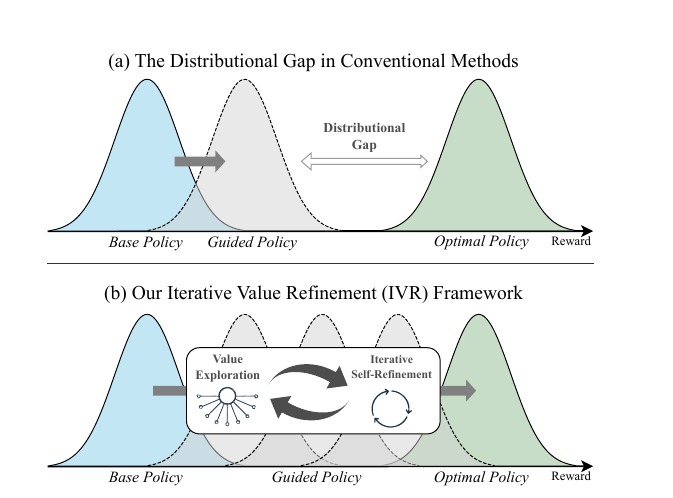
Figure 1: (a) Conventional methods suffer from a distributional gap, limiting the guided policy from reaching optimal rewards. (b) Our Iterative Value Refinement framework narrows this gap through Value Exploration and Iterative Self-Refinement.
图 1:(a)常规方法存在分布差距,限制引导策略达到最优回报。(b)我们的迭代价值精炼框架通过价值探索和迭代自精炼缩小这一差距。
2 Preliminaries
2. 预备知识
2.1 The Token-level Markov Decision Process for RLHF
2.1 面向 RLHF 的词元级马尔可夫决策过程
We define the text generation mechanism of large language models (LLMs) as a token-level Markov Decision Process (MDP). Define the tuple , where denotes the state space encompassing all previously generated tokens (i.e., ). Here, are tokens from the initial prompt , and are tokens generated by the model up to time . The action space represents the vocabulary of tokens. The function , representing deterministic transitions between states, is defined as , where indicates concatenation and . The initial state distribution is defined over the prompts , with each initial state comprising the tokens from . represents the token-level reward.
我们把大语言模型(LLM)的文本生成机制写成词元级马尔可夫决策过程(MDP)。定义元组 ,其中 是包含此前全部已生成词元的状态空间(即 )。这里 是初始提示 中的词元, 是模型截至时刻 已生成的词元。动作空间 是词表。表示状态之间确定性转移的函数 定义为 ,其中 表示拼接,。初始状态分布 定义在提示 上,每个初始状态 由 中的词元组成。 表示词元级奖励。
KL-regularized RL and Optimal Policy. The objective of KL-regularized RLHF can be formulated as the following optimization problem:
KL 正则强化学习与最优策略。KL 正则 RLHF 的目标可以写成如下优化问题:
where denotes the KL divergence between the policy and the base policy . Following the prior line of works (Peters and Schaal, 2007; Peng et al., 2019), the closed form solution to the KL-regularized RL problem can be represented as:
其中 是策略 与基策略 之间的 KL 散度。沿用已有工作(Peters and Schaal, 2007; Peng et al., 2019),该 KL 正则强化学习问题的闭式解可以写成:
where is a control parameter characterizing the trade-off between the reward and the KL divergence. Given the deterministic transition model , the expected future reward after action , or Q-value , equates to the value of the subsequent state. The Q-value of taking a specific action at the current state can be then transformed into the state value of their concatenation:
其中 是刻画回报与 KL 散度之间权衡的控制参数。由于转移模型 是确定性的,采取动作 之后的期望未来回报,也就是 Q 值 ,等于后继状态的价值。在当前状态上采取特定动作 的 Q 值,因此可以改写成二者拼接后的状态价值:
Thus, the optimal policy in Equation 2 is rewritten as
因此,公式 2 中的最优策略可以改写成
2.2 LLM Alignment via Value-Guided Search
2.2 用价值引导搜索做语言模型对齐
The problem of LLM alignment can be formally defined as solving for the optimal decoding policy under the token-level MDP in Equation 4. Here, we present two search strategies for decoding.
语言模型对齐可以形式化地定义为:在公式 4 的词元级 MDP 下,求解最优解码策略 。下面给出两种解码搜索策略。
Value Guided Top- Sampling. A prevalent strategy to address the computational expense of calculating values for all possible subsequent tokens is to compute values only for the top- tokens as determined by the base policy at each step:
价值引导的 Top- 采样。要为所有可能的后续词元计算价值,开销很大。一种常见做法是:每一步只对基策略给出的前 个词元计算价值:
In our pilot experiments, we found that the value-guided sampling can be further simplified by perturbing the distribution at the block-level instead of the token-level. This modification strikes a better balance between performance and efficiency, preserving effectiveness while enhancing inference speed. For more details, please refer to Appendix A.
在预实验里我们发现,价值引导采样还可以再简化:不必在词元级扰动分布,改在块级做扰动即可。这一改动在效果和效率之间更折中,既保住了有效性,又提高了推理速度。更多细节见附录 A。
Value Guided Blockwise Beam Search. Without considering the KL constraint, we propose value guided blockwise beam search to leverage the value function for decoding-time alignment. At each step, for each of the candidate sequences, we sample continuation blocks and rank all sequences according to . The top sequences are retained as candidates for the next iteration until generation is complete, after which the sequence with the highest value score is selected as the output.
价值引导的块级束搜索。在不考虑 KL 约束时,我们提出价值引导的块级束搜索,用价值函数在解码时做对齐。每一步,对 条候选序列中的每一条,再采样 个续写块 ,并按 对全部 条序列排序。保留前 条作为下一轮候选,直到生成结束,再选出价值分数最高的那一条作为输出。
3 Methodology
3. 方法
Challenges of Training Optimal Value Function. A significant challenge in implementing value-guided sampling is the necessity of accessing the optimal value function for each state . This function denotes the maximum expected reward that can be achieved from state when following the optimal policy , until a complete answer is generated. The function is defined as:
训练最优价值函数的困难。实现价值引导采样的一个主要困难,是必须对每个状态 都能拿到最优价值函数 。该函数表示从状态 出发、沿最优策略 一直生成完整答案 所能达到的最大期望回报,定义为:
In practice, remains inaccessible, as it relies on the trajectory produced by the unattainable optimal policy . Existing methods (Khanov et al., 2024; Mudgal et al., 2023) employ the base policy as an approximation for to estimate the optimal value function. However, these approaches often yield significant suboptimality due to the distributional gap between and . Specifically, training the value function exclusively on trajectories sampled from the base policy confines its learning to a narrow and suboptimal view of the potential output space. This fundamental limitation leads to substantial suboptimality in value function estimation, as the learned function fails to accurately evaluate states that lie outside the base policy’s typical trajectory distribution, ultimately hindering the effectiveness of guided decoding.
实践中, 是拿不到的,因为它依赖于不可得的最优策略 所产生的轨迹。现有方法(Khanov et al., 2024; Mudgal et al., 2023)用基策略 来近似 ,再估计最优价值函数。但由于 与 之间存在分布差距,这些做法往往会带来明显的次优。具体而言,只在基策略 采样出的轨迹上训练价值函数,会把它的学习限制在潜在输出空间里一块又窄又次优的区域。这一根本限制会让价值估计出现显著偏差:学到的函数难以准确评估落在基策略典型轨迹分布之外的状态,最终削弱引导解码的效果。
Overview. In this paper, we introduce Iterative Value Refinement to mitigate the distributional gap between the estimated value function and the optimal value function for guided decoding (refer to Algorithm 1 for the complete process). Our approach comprises two key components that work synergistically within a unified framework. First, we introduce Value Exploration, which expands the search space through multi-trajectory sampling to provide a more comprehensive and robust training signal for value function estimation. Second, we propose Iterative Self-Refinement, which leverages the improved value function from last iteration to guide the generation of higher-quality trajectories for the next iteration. This iterative process progressively narrows the distributional gap by enabling the value function to explore and learn from increasingly high-reward regions of the output space, thereby enhancing response quality during decoding.
概述。本文提出迭代价值精炼,用来缩小引导解码中估计价值函数与最优价值函数之间的分布差距(完整流程见算法 1)。方法由两个在同一框架里协同工作的部分组成。第一是价值探索:通过多轨迹采样扩大搜索空间,为价值函数估计提供更全面、更稳健的训练信号。第二是迭代自精炼:用上一轮改进后的价值函数,去引导下一轮生成更高质量的轨迹。这一迭代过程让价值函数能够探索并学习输出空间中回报越来越高的区域,从而逐步缩小分布差距,并提高解码时的回复质量。
3.1 Iterative Value Refinement
3.1 迭代价值精炼
Our iterative value refinement framework unifies Value Exploration and Iterative Self-Refinement into a cohesive approach that systematically improves value function accuracy through progressive refinement. The two components work in tandem: Value Exploration provides comprehensive training signals at each iteration, while Iterative Self-Refinement ensures that each subsequent iteration operates on higher-quality data than the previous one.
迭代价值精炼框架把价值探索和迭代自精炼合成一套连贯方法,通过逐步精炼来系统提高价值函数的准确性。二者相互配合:价值探索在每一轮提供全面的训练信号,迭代自精炼则保证下一轮用到的数据比上一轮质量更高。
Value Exploration. We introduce Value Exploration, which utilizes stochastic sampling to improve the accuracy of value function estimation by exploring a wider range of possible trajectories. Specifically, for a given prompt , we generate multiple outputs by performing stochastic sampling with the current policy. These outputs are then evaluated using the reward model , which reflects alignment with human preferences. By sampling several trajectories and collecting their corresponding rewards, we can effectively train our value function with a more comprehensive and robust training signal. For each state in the trajectory , the estimated value for the current state is defined as:
价值探索。我们提出价值探索:用随机采样探索更宽的可能轨迹,从而提高价值函数估计的准确性。具体来说,对给定提示 ,用当前策略做随机采样,生成多条输出,再用反映人类偏好对齐程度的奖励模型 给这些输出打分。通过采样若干轨迹并收集相应奖励,就可以用更全面、更稳健的信号来训练价值函数。对轨迹 中的每个状态 ,当前状态的估计价值定义为:
We then optimize , parameterized by , to match using the following L2 objective function:
随后我们优化由 参数化的 ,使其拟合 ,所用的 L2 目标为:
where is a distribution over training prompts.
其中 是训练提示上的分布。
Iterative Self-Refinement. While Value Exploration enhances the exploration of potential trajectories through multi-trajectory sampling, the coverage of these trajectories is still inherently constrained by the current policy. To more effectively address the distributional gap from the optimal policy , we propose Iterative Self-Refinement for progressively improving the value function. This strategy is founded on the principle that the optimized policy for the RL objective can be formulated as a value guided policy:
迭代自精炼。价值探索虽然通过多轨迹采样拓宽了对潜在轨迹的探索,这些轨迹的覆盖范围仍受当前策略本身的制约。为更有效地缩小与最优策略 的分布差距,我们提出迭代自精炼,用来逐步改进价值函数。其依据是:强化学习目标下的优化策略可以写成价值引导策略:
We then collect higher-quality trajectories by sampling from the policy , which is guided by the current value function . This sampling process can be represented as follows:
随后从由当前价值函数 引导的策略 中采样,收集更高质量的轨迹。这一采样过程可以写成:
where denotes the complete trajectory sampled from the optimized policy , as defined in Equation 9. With these higher-quality trajectories, we apply Value Exploration as outlined above. For each state in the sampled trajectory, we estimate its value as:
其中 表示从公式 9 所定义的优化策略 中采样出的完整轨迹。有了这些更高质量的轨迹,我们再按上文所述做价值探索。对采样轨迹中的每个状态 ,其价值估计为:
Algorithm 1 Iterative Value Refinement
Input: reward model , base model , training dataset
Output: Value-guided policy , value function
Initialize value function with a pre-trained language model.
repeat
Step 1: Collect Multiple Trajectories. For in , sample trajectories and compute rewards .
Step 2: Train the Value Function. For each trajectory state , set . Optimize using
Step 3: Policy Optimization. Define the value-guided policy , and update .
until convergence
算法 1 迭代价值精炼
输入: 奖励模型 ,基模型 ,训练数据集
输出: 价值引导策略 ,价值函数
用预训练语言模型初始化价值函数 。
重复
步骤 1:采集多条轨迹。 对 中的每个 ,采样 条轨迹 ,并计算奖励 。
步骤 2:训练价值函数。 对轨迹中的每个状态 ,令 。用下式优化 :
步骤 3:策略优化。 定义价值引导策略 ,并更新 。
直到 收敛
The value function is then optimized by minimizing the following loss function:
随后通过最小化下面的损失函数来优化价值函数 :
This process can be repeated iteratively, with each iteration using the improved value function to guide the generation of higher-quality data for further training. The synergy between Value Exploration and Iterative Self-Refinement enables our framework to progressively narrow the distributional gap and achieve more accurate value function estimation.
这一过程可以反复迭代:每一轮都用改进后的价值函数去引导生成更高质量的数据,再用于继续训练。价值探索与迭代自精炼的配合,使框架能够逐步缩小分布差距,并得到更准确的价值函数估计。
3.2 Why IVR Narrows the Distributional Gap
3.2 为什么 IVR 能缩小分布差距
We provide an informal discussion of why IVR narrows the distributional gap, framed through the notion of coverage between the data-collecting distribution and the visitation measure of the optimal policy. We use the standard visitation measure of policy :
下面非正式地讨论 IVR 为何能缩小分布差距,讨论的线索是数据采集分布对最优策略访问测度的覆盖。我们采用策略 的标准访问测度:
which captures how often the state-action pair is visited when following from initial states . A recurring insight from offline and iterative RLHF is that the optimality gap between any approximate policy and the optimal policy is governed by how well the data-collecting distribution covers the visitation measure of (Xiong et al., 2024; Ye et al., 2024). When training data is sampled from a distribution far from , the value function cannot accurately evaluate states encountered under , leading to a large optimality gap. IVR narrows this gap through two complementary mechanisms. Value Exploration broadens the support of the data-collecting distribution by sampling multiple trajectories per prompt rather than relying on a single rollout, providing wider coverage at each iteration. Iterative Self-Refinement progressively replaces the data-collecting policy with the value-guided policy , whose visitation measure is biased toward higher-reward regions and therefore closer to . Together, these two mechanisms iteratively shrink the coverage gap between and , which in turn reduces the optimality gap of the learned value function.
它刻画的是:从初始状态 出发、沿 行动时,状态–动作对 被访问的频繁程度。离线和迭代 RLHF 里一个反复出现的结论是:任意近似策略 与最优策略 之间的最优性差距,取决于数据采集分布对 的访问测度 覆盖得有多好(Xiong et al., 2024; Ye et al., 2024)。若训练数据来自远离 的分布,价值函数就无法准确评估 下会遇到的状态,最优性差距也会变大。IVR 用两种互补机制来缩小这一差距。价值探索对每个提示采样多条轨迹,而不是只做一次 rollout,从而拓宽数据采集分布的支持,使每一轮覆盖更广。迭代自精炼则逐步用价值引导策略 替换数据采集策略 ,前者的访问测度偏向更高回报的区域,因而更接近 。二者一起迭代缩小 与 之间的覆盖差距,进而减小学到的价值函数的最优性差距。
3.3 Connection to Online RLHF
3.3 与在线 RLHF 的关系
Existing research indicates that online iterative RLHF can significantly enhance model performance (Xiong et al., 2024; Dong et al., 2024; Ye et al., 2024). In contrast to traditional online RLHF, which involves continuously collecting new preference data from the latest policy and retraining the policy model, our method eliminates the need for retraining. Instead, IVR focuses solely on optimizing the value function and employing guided decoding to iteratively improve the policy, thereby conserving computational resources.
已有研究表明,在线迭代 RLHF 能显著提高模型表现(Xiong et al., 2024; Dong et al., 2024; Ye et al., 2024)。传统在线 RLHF 需要持续从最新策略收集新的偏好数据并重训策略模型;我们的方法则不必重训。IVR 只优化价值函数,再用引导解码迭代改进策略,从而节省计算资源。
4 Experiments
4. 实验
Experimental Setup. For the summarization and multi-turn dialogue tasks, we first establish a base policy by supervised fine-tuning a pre-trained language model on the respective datasets to acquire basic task-specific capabilities and desired behaviors. For the instruction following task, we directly utilize publicly available instruction-tuned models. In all experiments, we parameterize the value function as a pre-trained language model backbone with a linear layer on top. The data for training the value function is collected from the base policy with a sampling temperature of 0.7, and we label it with the corresponding reward model. For IVR, we employ Value Exploration by sampling 4 different trajectories for each prompt to obtain robust value estimates. The training process involves two iterations of value function optimization to achieve better policy alignment. Starting from the second iteration, we collect training data using value-guided sampling with . More details can be found in Appendix B.
实验设置。在摘要和多轮对话任务上,我们先在相应数据集上对预训练语言模型做监督微调,得到具备基本任务能力和期望行为的基策略。指令遵循任务则直接使用公开的指令微调模型。所有实验中,价值函数都参数化为预训练语言模型骨干加上一层线性层。训练价值函数的数据由基策略以采样温度 0.7 采集,并用相应的奖励模型标注。对 IVR,我们做价值探索时对每个提示采样 4 条不同轨迹,以得到更稳健的价值估计。训练包含两轮价值函数优化,以使策略对齐得更好。从第二轮起,用 的价值引导采样来采集训练数据。更多细节见附录 B。
Evaluation Metrics. We adopt different evaluation metrics for our two decoding-time alignment strategies. For value-guided sampling, following (Gao et al., 2023; Han et al., 2024), we analyze the trade-off between reward and token-level KL divergence from the base policy. Specifically, we sweep the in Equation 5 to control the KL divergence between the guided policy and base policy. For value guided blockwise beam search, we compare the reward of each algorithm. Additionally, as a supplementary evaluation to mitigate potential reward hacking issues (Amodei et al., 2016), we compute the win-rate between the guided policy and base policy using GPT-4-as-the-judge (Zheng et al., 2023a). We note that this serves as a complementary sanity check, while our primary conclusions are drawn from the objective reward and KL divergence metrics. The prompting template refers to Appendix C. To ensure the robustness of our evaluation, all experiments are conducted with 5 different random seeds.
评测指标。两种解码时对齐策略采用不同指标。对价值引导采样,我们沿用(Gao et al., 2023; Han et al., 2024),分析回报与相对基策略的词元级 KL 散度之间的权衡。具体做法是扫描公式 5 中的 ,以控制引导策略与基策略之间的 KL 散度。对价值引导的块级束搜索,我们比较各算法的回报。此外,为减轻潜在的奖励黑客问题(Amodei et al., 2016),我们还用 GPT-4 作为裁判(Zheng et al., 2023a),计算引导策略相对基策略的胜率。这一项只作为补充性的合理性检查,主要结论仍来自客观的回报和 KL 散度指标。提示模板见附录 C。为保证评测稳健,全部实验都用 5 个不同随机种子进行。
4.1 Experiment 1: Summarization
4.1 实验 1:摘要
Experiment Details. We conduct experiments on the TL;DR dataset (Stiennon et al., 2020), which consists of Reddit posts paired with two candidate summaries and human preferences between them. For efficiency, we randomly sampled 300 examples from the test set for evaluation. For the base policy, we fine-tune a Llama-3.2-3B (Dubey et al., 2024) model on the preferred summaries using supervised learning. To evaluate summary quality, we train a reward model using a Llama-3.2-1B (Dubey et al., 2024) backbone on the pairwise preference data through Bradley-Terry (BT) modeling. The value function is implemented as a Llama-3.2-1B model with an additional linear layer on top. More implementation details can be found in Appendix B.
实验细节。我们在 TL;DR 数据集(Stiennon et al., 2020)上做实验,该数据集由 Reddit 帖子、两条候选摘要以及二者之间的人类偏好组成。为提高效率,我们从测试集中随机抽取 300 条用于评测。基策略是在首选摘要上对 Llama-3.2-3B(Dubey et al., 2024)做监督微调得到的。为评估摘要质量,我们用 Llama-3.2-1B(Dubey et al., 2024)骨干,在成对偏好数据上通过 Bradley-Terry(BT)建模训练奖励模型。价值函数实现为带额外线性层的 Llama-3.2-1B。更多实现细节见附录 B。
Baselines. We compare our method against several recent decoding-time alignment approaches. ARGS (Khanov et al., 2024) directly leverages reward models as value functions for guided decoding without additional training, offering a lightweight solution. Using trajectories sampled from the base policy , FUDGE (Yang and Klein, 2021; Mudgal et al., 2023) trains a prefix scorer to predict future attributes, while VAS (Han et al., 2024) employs TD() learning to train a value function, providing a more sophisticated value estimation approach.
基线。我们与若干近期的解码时对齐方法做比较。ARGS(Khanov et al., 2024)不再额外训练,直接把奖励模型当作价值函数来做引导解码,实现较轻。FUDGE(Yang and Klein, 2021; Mudgal et al., 2023)用基策略 采样出的轨迹训练前缀评分器,以预测未来属性;VAS(Han et al., 2024)则用 TD() 学习来训练价值函数,价值估计更精细。
Results. As shown in Figure 2a, we analyze the trade-off between reward and KL divergence for different methods on the summarization task. IVR consistently outperforms all baselines across different KL divergence levels, achieving higher rewards while maintaining stable performance. Specifically, at KL divergence of 0.8, IVR reaches a reward of approximately 3.5, while other methods remain below 3.2. In contrast, baseline methods (FUDGE, VAS, and ARGS) show performance degradation when KL divergence exceeds 0.4, suggesting their limited capability in balancing policy preservation and performance optimization.
结果。如图 2a 所示,我们分析了摘要任务上各方法在回报与 KL 散度之间的权衡。IVR 在不同 KL 散度水平上始终超过所有基线,回报更高,表现也更稳。具体来说,KL 散度为 0.8 时,IVR 的回报约为 3.5,其他方法仍低于 3.2。相比之下,FUDGE、VAS 和 ARGS 等基线在 KL 散度超过 0.4 后会出现下降,说明它们在保持策略与提升表现之间平衡得不好。
As shown in Figure 3a, all methods demonstrate improvements over the base policy (3.2) in value-guided blockwise beam search, with our IVR method achieving the highest performance (4.3). Specifically, ARGS yields a modest improvement to 3.55, while FUDGE and VAS demonstrate stronger performance at 4.05 and 4.15 respectively. The ablation of our method without Iterative Self-Refinement (IVR w/o Iter) achieves 4.25, highlighting the effectiveness of our Value Exploration approach. The full IVR method further improves the performance to 4.3, demonstrating the benefits of Iterative Self-Refinement.
如图 3a 所示,在价值引导的块级束搜索中,所有方法都超过了基策略(回报 3.2),其中 IVR 最高(4.3)。ARGS 只提高到 3.55,FUDGE 和 VAS 更强,分别为 4.05 和 4.15。去掉迭代自精炼的消融(IVR w/o Iter)达到 4.25,说明价值探索是有效的。完整 IVR 再提高到 4.3,体现了迭代自精炼的好处。
4.2 Experiment 2: Multi-turn Dialogue
4.2 实验 2:多轮对话
Experiment Details. We use the Anthropic HH (Bai et al., 2022) dataset, a multi-turn dialogue dataset focused on helpfulness and harmlessness, sampling 300 examples for evaluation. We train the base policy by fine-tuning Llama-3-8B (Dubey et al., 2024) on preferred responses. A Llama-3.2-1B model is trained as the reward model using BT on pairwise preference data. Llama-3.2-1B serves as the value function backbone. More details are in Appendix B.
实验细节。我们使用关注有用性和无害性的多轮对话数据集 Anthropic HH(Bai et al., 2022),抽取 300 条用于评测。基策略是在首选回复上对 Llama-3-8B(Dubey et al., 2024)做微调得到的。奖励模型是用 Llama-3.2-1B 在成对偏好数据上按 BT 训练的。价值函数骨干同样是 Llama-3.2-1B。更多细节见附录 B。
Baselines. In addition to the aforementioned inference-based baselines (ARGS, FUDGE, and VAS), we also include several training-based baselines: Direct Preference Optimization (DPO) (Rafailov et al., 2024) and Identity Preference Optimization (IPO) (Azar et al., 2024). DPO directly fine-tunes the model for preference learning, eliminating the need for a reward model and RL stage for updates. IPO added a regularization term to the DPO objective to mitigate overfitted risk. We used the online version of DPO and IPO by rolling out the base policy and sampling two trajectories, optimizing the objective on explicit rewards.
基线。除了前面的推理基线(ARGS、FUDGE 和 VAS),我们还加入若干基于训练的基线:直接偏好优化(DPO)(Rafailov et al., 2024)和恒等偏好优化(IPO)(Azar et al., 2024)。DPO 直接为偏好学习微调模型,更新时不再需要奖励模型和强化学习阶段。IPO 在 DPO 目标上加了正则项,以减轻过拟合风险。我们使用的是在线版本的 DPO 和 IPO:先 rollout 基策略并采样两条轨迹,再在显式奖励上优化目标。
Table 1: Comparison of different methods’ win-rate against the base policy and estimated FLOPs. The win-rate values are obtained by GPT-4-as-the-judge on the Multi-turn Dialogue dataset. FLOPs are estimated on a single batch training.
| Methods | Win-Rate (%) | FLOPs () |
|---|---|---|
| FUDGE | 64.85 | 0.25 |
| VAS | 68.49 | 0.25 |
| DPO | 72.45 | 4.00 |
| IPO | 66.55 | 4.00 |
| IVR (Ours) | 77.52 | 2.00 |
表 1:各方法相对基策略的胜率及估计 FLOPs。胜率由 GPT-4 担任裁判,在多轮对话数据集上得到。FLOPs 按单 batch 训练估计。
| 方法 | 胜率(%) | FLOPs() |
|---|---|---|
| FUDGE | 64.85 | 0.25 |
| VAS | 68.49 | 0.25 |
| DPO | 72.45 | 4.00 |
| IPO | 66.55 | 4.00 |
| IVR(本文) | 77.52 | 2.00 |
Results. As demonstrated in Figure 2b, we evaluate different methods on the multi-turn dialogue task. Our method achieves the best performance across different KL divergence levels, reaching a reward of 1.75 at KL divergence of 0.3. DPO shows competitive performance initially but plateaus at a reward of 1.65, while VAS and FUDGE demonstrate moderate performance with rewards of 1.5 and 1.3 respectively. ARGS and IPO show limited effectiveness, with ARGS achieving minimal improvement and IPO’s performance degrading significantly as KL divergence increases. Notably, IVR maintains stable performance even at higher KL divergence levels (0.4–0.6), while other methods either plateau or decline.
结果。如图 2b 所示,我们在多轮对话任务上比较各方法。我们的方法在不同 KL 散度水平上表现最好,KL 为 0.3 时回报达到 1.75。DPO 起初有竞争力,但会停在回报 1.65;VAS 和 FUDGE 分别为 1.5 和 1.3,表现中等。ARGS 和 IPO 效果有限:ARGS 几乎没有提升,IPO 则随 KL 增大而明显下降。值得注意的是,IVR 在更高的 KL 水平(0.4–0.6)上仍然稳定,其他方法则要么停滞,要么下滑。
For value-guided blockwise beam search in Figure 3b, we observe a clear progression in performance across different methods. Starting from the base policy, ARGS provides initial improvements through direct reward model utilization, achieving a reward of 2.1. VAS and FUDGE demonstrate stronger performance at around 2.7, while the ablation of our method without iterative training (IVR w/o Iter) reaches 2.8. The full IVR method with iterative training achieves the best performance with a reward of 3.1. The significant performance gap between IVR and IVR w/o Iter (0.3) further validates the effectiveness of our iterative training strategy.
对图 3b 中的价值引导块级束搜索,各方法的表现有清楚的递进。从基策略出发,ARGS 直接使用奖励模型,先把回报提高到 2.1。VAS 和 FUDGE 更强,约在 2.7;去掉迭代训练的消融(IVR w/o Iter)达到 2.8。带迭代训练的完整 IVR 最好,回报为 3.1。IVR 与 IVR w/o Iter 之间 0.3 的明显差距,进一步说明迭代训练策略是有效的。
Additionally, as a supplementary evaluation, Table 1 shows that our IVR method achieves the highest GPT-4 win-rate of 77.52%, corroborating the reward-based findings above. IVR also demonstrates a significant advantage in computational efficiency, with FLOPs estimated at , which is half of that required by DPO and IPO under our experimental settings.
作为补充评测,表 1 显示 IVR 的 GPT-4 胜率最高,为 77.52%,与上面基于回报的结论一致。IVR 在计算效率上也有明显优势:估计 FLOPs 为 ,在我们的实验设置下约为 DPO 和 IPO 所需的一半。
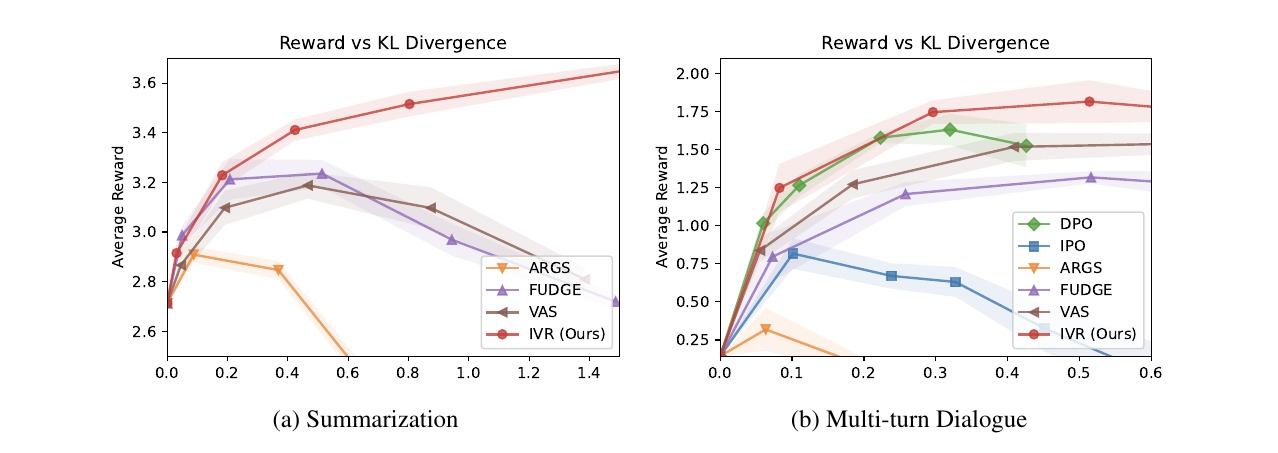
Figure 2: Reward vs. KL divergence for different methods on (a) summarization and (b) multi-turn dialogue.
图 2:不同方法在(a)摘要和(b)多轮对话上的回报–KL 散度权衡。
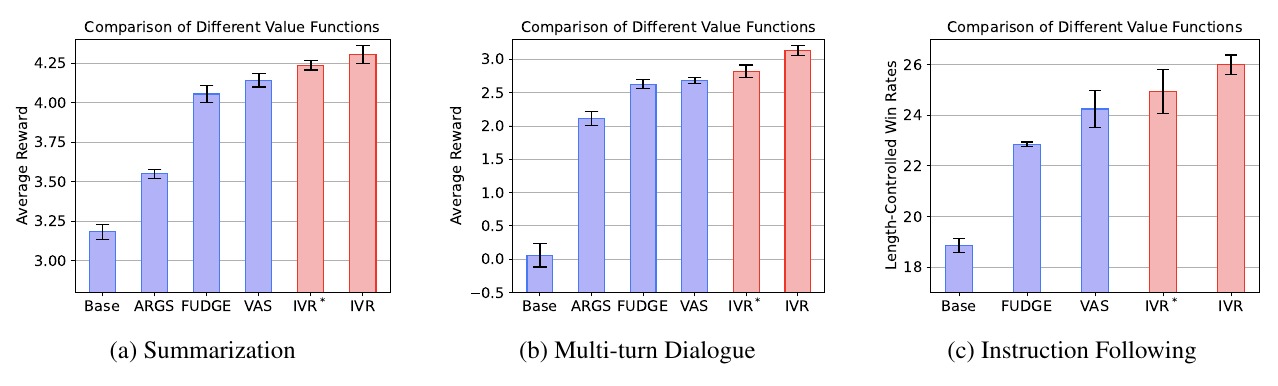
Figure 3: Comparison of different value functions using value-guided blockwise beam search on summarization (left), multi-turn dialogue (middle) and instruction following (right). IVR denotes IVR without Iterative Self-Refinement.
图 3:用价值引导块级束搜索比较不同价值函数,分别对应摘要(左)、多轮对话(中)和指令遵循(右)。IVR 表示去掉迭代自精炼的 IVR。
4.3 Experiment 3: Instruction Following
4.3 实验 3:指令遵循
Experiment Details. We conduct experiments using the UltraFeedback (Cui et al., 2023) dataset with 10k sampled prompts for training. For evaluation, we use Alpaca-Eval 2 (Dubois et al., 2024), which assesses instruction-following via Length-Controlled Win Rate with GPT-4 (Achiam et al., 2023). The base policy is Llama-3.2-3B-Instruct (Dubey et al., 2024), with Skywork-Reward-Llama-3.1-8B (Liu et al., 2024b) for reward modeling and Llama-3.2-1B-Instruct (Dubey et al., 2024) as the value function. For efficiency, we compare against FUDGE and VAS as decoding-time baselines. More details are in Appendix B.
实验细节。我们用 UltraFeedback(Cui et al., 2023)数据集,抽取 1 万条提示做训练。评测使用 Alpaca-Eval 2(Dubois et al., 2024),以 GPT-4(Achiam et al., 2023)计算长度受控胜率来评估指令遵循。基策略是 Llama-3.2-3B-Instruct(Dubey et al., 2024),奖励模型为 Skywork-Reward-Llama-3.1-8B(Liu et al., 2024b),价值函数为 Llama-3.2-1B-Instruct(Dubey et al., 2024)。为控制开销,解码时基线只比较 FUDGE 和 VAS。更多细节见附录 B。
Results. For the instruction following task, we evaluate our method using Length-Controlled Win Rate as the metric. As shown in Figure 3c, all methods demonstrate improvements over the base policy. Our IVR method achieves the best performance with a win rate of 26.0%, significantly outperforming both FUDGE and VAS. The consistent improvements across different methods indicate the effectiveness of value-guided decoding for instruction following. Notably, the performance gap between IVR and other methods suggests that our iterative value optimization approach is particularly beneficial for complex tasks like instruction following, where accurate value estimation is crucial for generating high-quality responses.
结果。指令遵循任务用长度受控胜率作为指标。如图 3c 所示,所有方法都超过了基策略。IVR 表现最好,胜率为 26.0%,明显超过 FUDGE 和 VAS。各方法都有提升,说明价值引导解码适用于指令遵循。IVR 与其他方法之间的差距还表明,这种迭代优化价值函数的做法,对指令遵循这类更依赖准确价值估计才能写出高质量回复的复杂任务尤其有帮助。
5 Further Analysis
5. 进一步分析
This section analyzes IVR’s key components, examining the impact of Value Exploration and training iterations on performance. We also evaluate the transferability of value functions across model scales and IVR’s effectiveness in enhancing model safety against adversarial jailbreak attacks, demonstrating its broader applications.
本节分析 IVR 的关键组成部分,考察价值探索和训练迭代对表现的影响。我们还评估价值函数在不同模型规模之间的可迁移性,以及 IVR 在对抗性越狱攻击下提升模型安全性的效果,以说明它更广泛的用途。
5.1 The Number of Sampled Trajectories
5.1 采样轨迹数量
To investigate the impact of the number of sampled trajectories, we conduct experiments on the multi-turn dialogue task using value-guided blockwise beam search. The results are shown in Figure 4a. We observe that increasing the number of sampled trajectories leads to consistent improvements. A more significant improvement is observed with 4 samples. Further increasing to 5 samples only brings a small additional improvement, suggesting that 4 trajectories provide a good balance between computational cost and performance. These results demonstrate that Value Exploration with multiple trajectories helps capture a more comprehensive view of possible outcomes, leading to more accurate value estimates and better guided generation.
为考察采样轨迹数量的影响,我们在多轮对话任务上用价值引导块级束搜索做实验,结果见图 4a。可以看到,增加采样轨迹数会带来稳定提升;用 4 条样本时提升更明显。再增到 5 条只有很小的额外收益,说明 4 条轨迹在计算成本和效果之间较为合宜。这些结果说明,用多条轨迹做价值探索有助于更完整地看到可能的结果,从而得到更准确的价值估计和更好的引导生成。
5.2 The Number of Training Iterations
5.2 训练迭代轮数
We analyze how the number of training iterations affects model performance. We conduct experiments on the multi-turn dialogue task using value-guided blockwise beam search, with the number of sampled trajectories fixed at 4 based on our previous findings. The results are shown in Figure 4b. Starting from one iteration, our method already outperforms VAS with an average reward of 2.82. The second iteration brings a substantial improvement, demonstrating the effectiveness of collecting training data from the guided policy. The third iteration yields a slight gain to 3.15, suggesting that two iterations provide sufficient policy alignment.
我们分析训练迭代轮数如何影响模型表现。实验仍在多轮对话任务上用价值引导块级束搜索,并根据前面的结论把采样轨迹数固定为 4,结果见图 4b。从一轮开始,我们的方法平均回报已达 2.82,超过 VAS。第二轮带来明显提升,说明从引导策略采集训练数据是有效的。第三轮只再略升到 3.15,表明两轮通常已能提供足够的策略对齐。
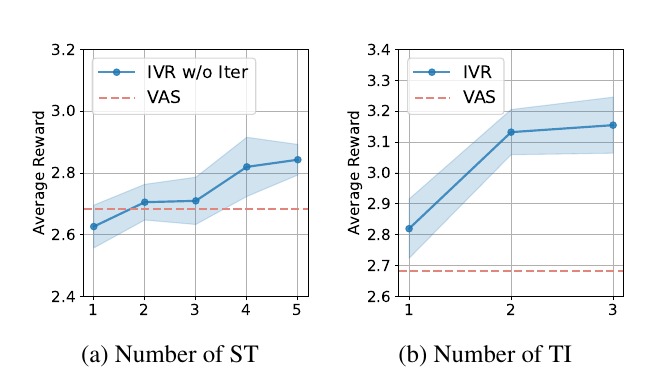
Figure 4: Ablation studies on (a) the number of sampled trajectories and (b) the number of training iterations in multi-turn dialogue using blockwise beam search. ST denotes sampled trajectories, TI denotes training iterations.
图 4:在多轮对话上用块级束搜索做的消融,(a)为采样轨迹数量,(b)为训练迭代轮数。ST 表示采样轨迹,TI 表示训练迭代。
5.3 Value Function Transferability Across Model Sizes
5.3 价值函数在不同模型规模上的可迁移性
We investigate the transferability of the estimated value function across different model sizes on the instruction following task. Specifically, we examine whether a value function trained using data collected from a Llama-3.2-3B-Instruct can effectively guide models of different sizes (Llama-3.2-1B-Instruct and Llama-3-8B-Instruct) during value-guided blockwise beam search.
我们在指令遵循任务上考察估计出的价值函数能否在不同模型规模之间迁移。具体来说,我们检验:用 Llama-3.2-3B-Instruct 采集的数据训练出的价值函数,能否在价值引导块级束搜索中有效引导不同规模的模型(Llama-3.2-1B-Instruct 和 Llama-3-8B-Instruct)。
Table 2: Performance comparison between the base policy and value-guided blockwise beam search across different model sizes (1B, 3B, and 8B) on the instruction-following task. The value function is trained using data collected from the 3B base policy. The column represents the absolute performance improvement.
| Model Size | Base | IVR | |
|---|---|---|---|
| 1B | |||
| 3B | |||
| 8B |
表 2:指令遵循任务上,基策略与价值引导块级束搜索在不同模型规模(1B、3B 和 8B)上的表现比较。价值函数用 3B 基策略采集的数据训练。 列为绝对提升。
| 模型规模 | 基策略 | IVR | |
|---|---|---|---|
| 1B | |||
| 3B | |||
| 8B |
As shown in Table 2, our value function demonstrates strong transferability across model scales. These results suggest that the value function learned through IVR captures generalizable knowledge about task-specific preferences that can be applied to guide models of varying sizes. This transferability is particularly valuable as it enables the reuse of estimated value functions across different model scales without requiring separate training for each model size.
如表 2 所示,我们的价值函数在不同模型规模上表现出很强的可迁移性。这说明经由 IVR 学到的价值函数抓住了可推广的任务偏好知识,可以用来引导不同大小的模型。这种可迁移性很有用:估计好的价值函数可以在不同规模上复用,而不必为每一种规模单独再训。
5.4 Enhancing Safety Against Jailbreak Attacks
5.4 提升对抗越狱攻击的安全性
To investigate whether IVR can enhance instruction-tuned model safety against jailbreak attacks, we conduct experiments using Llama-3-8B-Instruct as an aligned version and Llama-3-8B-Lexi-Uncensored as an unaligned version. We evaluate their safety rate against jailbreak attacks using the attack-enhanced set split from the SALAD-Bench (Li et al., 2024), which contains 5,000 harmful questions generated through multiple jailbreak attack methods. We use 4,800 prompts for training and 200 for testing. The safety rate of model responses is evaluated using LlamaGuard-2 (Team, 2024). To comprehensively evaluate, we first obtain aligned and unaligned value functions by applying IVR on the aligned and unaligned models respectively. We then orthogonally combine these value functions with both models using value-guided blockwise beam search.
为考察 IVR 能否提升指令微调模型对抗越狱攻击的安全性,我们用 Llama-3-8B-Instruct 作为已对齐版本,用 Llama-3-8B-Lexi-Uncensored 作为未对齐版本。安全性评测使用 SALAD-Bench(Li et al., 2024)中的攻击增强划分,其中包含由多种越狱攻击方法生成的 5,000 道有害问题。我们用 4,800 条提示训练、200 条测试,并用 LlamaGuard-2(Team, 2024)评估回复的安全率。为做更全面的比较,我们分别在已对齐和未对齐模型上运行 IVR,得到已对齐与未对齐的价值函数,再通过价值引导块级束搜索,把这些价值函数与两种模型做正交组合。
Table 3: Comparison of safety rates between aligned and unaligned Llama-3 models with different value functions.
| Model | Safety Rate (%) |
|---|---|
| Aligned-Llama-3 | 92.87 |
| + Aligned Value Function | 96.14 |
| + Unaligned Value Function | 97.48 |
| Unaligned-Llama-3 | 65.27 |
| + Aligned Value Function | 81.04 |
| + Unaligned Value Function | 86.17 |
表 3:已对齐与未对齐 Llama-3 模型搭配不同价值函数时的安全率比较。
| 模型 | 安全率(%) |
|---|---|
| Aligned-Llama-3 | 92.87 |
| + 已对齐价值函数 | 96.14 |
| + 未对齐价值函数 | 97.48 |
| Unaligned-Llama-3 | 65.27 |
| + 已对齐价值函数 | 81.04 |
| + 未对齐价值函数 | 86.17 |
As shown in Table 3, IVR significantly improves safety rates for both aligned and unaligned models through value-guided blockwise beam search. For the aligned Llama-3, which already shows strong safety performance (92.87%), IVR improves its safety rate to 96.14% and 97.48% with aligned and unaligned value functions, respectively. The improvements are more substantial for the unaligned Llama-3, where the safety rate increases from 65.27% to 81.04% with aligned value function and 86.17% with unaligned value function. Notably, the unaligned value function consistently outperforms the aligned one. We hypothesize that the reason is the unaligned value function is trained on responses from the unaligned model, which explores a more diverse solution space due to its lack of alignment. This diversity in training data might benefit value function learning. We leave further investigation of this hypothesis to future work.
如表 3 所示,通过价值引导块级束搜索,IVR 显著提高了已对齐和未对齐模型的安全率。已对齐的 Llama-3 本身安全率已达 92.87%,IVR 用已对齐和未对齐价值函数分别将其提高到 96.14% 和 97.48%。未对齐 Llama-3 上的提升更大:安全率从 65.27% 分别升到 81.04%(已对齐价值函数)和 86.17%(未对齐价值函数)。值得注意的是,未对齐价值函数始终更好。我们猜想,这是因为它在未对齐模型的回复上训练,而该模型由于缺少对齐,探索的解空间更多样;这种训练数据上的多样性可能有利于学习价值函数。这一假设留待后续研究。
6 Related Work
6. 相关工作
Reinforcement Learning for Language Models. Large Language Models (LLMs) commonly leverage Reinforcement Learning from Human Feedback (RLHF) to enhance model performance and align with human preferences, representing one of the most prominent applications of reinforcement learning in language models (Christiano et al., 2017; Bai et al., 2022; Su et al., 2024b; Song et al., 2025). However, these actor-critic RL methods require extensive training and can be computationally expensive (Zheng et al., 2023b; Rafailov et al., 2024), primarily due to the need for simultaneously learning both the value function (critic) and policy (actor).
面向语言模型的强化学习。大语言模型通常借助人类反馈强化学习(RLHF)来提高表现并对齐人类偏好,这是强化学习在语言模型中最突出的应用之一(Christiano et al., 2017; Bai et al., 2022; Su et al., 2024b; Song et al., 2025)。不过,这类演员–评论家强化学习需要大量训练,计算也较贵(Zheng et al., 2023b; Rafailov et al., 2024),主要是因为必须同时学习价值函数(评论家)和策略(演员)。
Guided Decoding. Guided decoding represents a family of techniques that steer language model outputs at inference time while keeping model parameters frozen, offering both efficiency and flexibility compared to traditional RLHF methods. Huang et al. (2024) views the decoding process as a heuristic-guided search problem. Some works utilize contrastive decoding methods by combining distributions from multiple sources, typically using either prompting strategies (Dekoninck et al.; Zhong et al., 2024) or training small models (Liu et al., 2021, 2024a). Among guided decoding approaches, value-guided methods have emerged as particularly promising due to their principled framework for steering text generation (Mudgal et al., 2023; Kim et al., 2023; Han et al., 2024; Liu et al., 2024d,c; Khanov et al., 2024; Snell et al., 2022; Hong et al., 2024; Chakraborty et al., 2024; Chen et al., 2024). In contrast, our approach explicitly targets the distributional gap that limits prior value-guided methods. While ARGS (Khanov et al., 2024) bypasses value training and relies directly on a reward model, FUDGE (Yang and Klein, 2021; Mudgal et al., 2023) and VAS (Han et al., 2024) train value functions on a fixed pool of base-policy trajectories, leaving them blind to regions of output space that the optimal policy actually visits. IVR closes this gap through Value Exploration and Iterative Self-Refinement, while avoiding the full policy retraining required by preference-based methods such as DPO (Rafailov et al., 2024) and IPO (Azar et al., 2024).
引导解码。引导解码是一类在推理时引导语言模型输出、同时冻结模型参数的技术,相对传统 RLHF 既更高效也更灵活。Huang et al. (2024) 把解码过程看作启发式引导的搜索问题。也有工作用对比解码,把来自多个来源的分布结合起来,常见做法是提示策略(Dekoninck et al.; Zhong et al., 2024)或训练小模型(Liu et al., 2021, 2024a)。在引导解码里,价值引导方法因其有原则的文本生成引导框架而尤其受关注(Mudgal et al., 2023; Kim et al., 2023; Han et al., 2024; Liu et al., 2024d,c; Khanov et al., 2024; Snell et al., 2022; Hong et al., 2024; Chakraborty et al., 2024; Chen et al., 2024)。与之不同,我们的方法明确针对限制已有价值引导方法的分布差距。ARGS(Khanov et al., 2024)跳过价值训练,直接依赖奖励模型;FUDGE(Yang and Klein, 2021; Mudgal et al., 2023)和 VAS(Han et al., 2024)则在固定的基策略轨迹池上训练价值函数,因而看不到最优策略真正会访问的输出区域。IVR 通过价值探索和迭代自精炼补上这一差距,同时又不必像 DPO(Rafailov et al., 2024)和 IPO(Azar et al., 2024)这类基于偏好的方法那样完整重训策略。
7 Conclusion
7. 结论
This paper introduces IVR, a novel framework for guided decoding that addresses key limitations in value-guided approaches through Value Exploration and Iterative Self-Refinement. Our extensive experiments across text summarization, multi-turn dialogue, and instruction following demonstrate that IVR consistently outperforms existing methods. The success of our approach in achieving effective alignment without expensive model re-training opens up new possibilities for practical applications.
本文提出 IVR,一套面向引导解码的新框架,通过价值探索和迭代自精炼应对价值引导方法中的关键局限。我们在文本摘要、多轮对话和指令遵循上的大量实验表明,IVR 稳定超过现有方法。这种方法不必昂贵地重训模型就能有效对齐,为实际应用打开了新的可能。
Limitations
局限
Computational Overhead. Although IVR avoids the full policy retraining of RLHF, it still incurs additional inference-time cost from value function evaluations and additional training cost from iterative data collection. We mitigate the inference overhead via blockwise sampling (Appendix A), but the total training cost grows roughly linearly with the number of iterations.
计算开销。IVR 虽然避免了 RLHF 那样完整重训策略,但仍会因价值函数评估而增加推理开销,并因迭代采集数据而增加训练开销。我们用块级采样(附录 A)减轻推理负担,但总训练成本大致随迭代轮数线性增长。
Base Policy Dependence. Both value-guided sampling and blockwise beam search operate within the support of the base policy’s top- distribution. This preserves coherence inherited from the base model, but precludes IVR from discovering high-reward outputs that lie entirely outside the base policy’s typical generations.
对基策略的依赖。价值引导采样和块级束搜索都作用在基策略 top- 分布的支持之内。这保留了基模型带来的连贯性,但也使 IVR 发现不了完全落在基策略典型生成之外的高回报输出。
Acknowledgments
致谢
This work is supported by Shanghai Artificial Intelligence Laboratory.
本研究得到上海人工智能实验室的支持。
References
参考文献
Josh Achiam, Steven Adler, Sandhini Agarwal, Lama Ahmad, Ilge Akkaya, Florencia Leoni Aleman, Diogo Almeida, Janko Altenschmidt, Sam Altman, Shyamal Anadkat, and 1 others. 2023. Gpt-4 technical report. arXiv preprint arXiv:2303.08774.
Dario Amodei, Chris Olah, Jacob Steinhardt, Paul Christiano, John Schulman, and Dan Mané. 2016. Concrete problems in ai safety. arXiv preprint arXiv:1606.06565.
Mohammad Gheshlaghi Azar, Zhaohan Daniel Guo, Bilal Piot, Remi Munos, Mark Rowland, Michal Valko, and Daniele Calandriello. 2024. A general theoretical paradigm to understand learning from human preferences. In International Conference on Artificial Intelligence and Statistics, pages 4447–4455. PMLR.
Yuntao Bai, Andy Jones, Kamal Ndousse, Amanda Askell, Anna Chen, Nova DasSarma, Dawn Drain, Stanislav Fort, Deep Ganguli, Tom Henighan, and 1 others. 2022. Training a helpful and harmless assistant with reinforcement learning from human feedback. arXiv preprint arXiv:2204.05862.
Souradip Chakraborty, Soumya Suvra Ghosal, Ming Yin, Dinesh Manocha, Mengdi Wang, Amrit Singh Bedi, and Furong Huang. 2024. Transfer q star: Principled decoding for llm alignment. arXiv preprint arXiv:2405.20495.
Yang Chao, Lu Chaochao, Wang Yingchun, and Zhou Bowen. 2024. Towards ai-45◦law: A roadmap to trustworthy agi. arXiv preprint arXiv:2412.14186.
Ruizhe Chen, Xiaotian Zhang, Meng Luo, Wenhao Chai, and Zuozhu Liu. 2024. Pad: Personalized alignment at decoding-time. arXiv e-prints, pages arXiv–2410.
Paul F Christiano, Jan Leike, Tom Brown, Miljan Martic, Shane Legg, and Dario Amodei. 2017. Deep reinforcement learning from human preferences. Advances in neural information processing systems, 30.
Ganqu Cui, Lifan Yuan, Ning Ding, Guanming Yao, Wei Zhu, Yuan Ni, Guotong Xie, Zhiyuan Liu, and Maosong Sun. 2023. Ultrafeedback: Boosting language models with high-quality feedback.
Jasper Dekoninck, Marc Fischer, Luca Beurer-Kellner, and Martin Vechev. Controlled text generation via language model arithmetic. In The Twelfth International Conference on Learning Representations.
Hanze Dong, Wei Xiong, Bo Pang, Haoxiang Wang, Han Zhao, Yingbo Zhou, Nan Jiang, Doyen Sahoo, Caiming Xiong, and Tong Zhang. 2024. Rlhf workflow: From reward modeling to online rlhf. arXiv preprint arXiv:2405.07863.
Abhimanyu Dubey, Abhinav Jauhri, Abhinav Pandey, Abhishek Kadian, Ahmad Al-Dahle, Aiesha Letman, Akhil Mathur, Alan Schelten, Amy Yang, Angela Fan, and 1 others. 2024. The llama 3 herd of models. arXiv preprint arXiv:2407.21783.
Yann Dubois, Balázs Galambosi, Percy Liang, and Tatsunori B Hashimoto. 2024. Length-controlled alpacaeval: A simple way to debias automatic evaluators. arXiv preprint arXiv:2404.04475.
Leo Gao, John Schulman, and Jacob Hilton. 2023. Scaling laws for reward model overoptimization. In International Conference on Machine Learning, pages 10835–10866. PMLR.
Seungwook Han, Idan Shenfeld, Akash Srivastava, Yoon Kim, and Pulkit Agrawal. 2024. Value augmented sampling for language model alignment and personalization. arXiv preprint arXiv:2405.06639.
Joey Hong, Anca Dragan, and Sergey Levine. 2024. Q-sft: Q-learning for language models via supervised fine-tuning. arXiv preprint arXiv:2411.05193.
James Y Huang, Sailik Sengupta, Daniele Bonadiman, Yi-an Lai, Arshit Gupta, Nikolaos Pappas, Saab Mansour, Katrin Kirchhoff, and Dan Roth. 2024. Deal: Decoding-time alignment for large language models. arXiv preprint arXiv:2402.06147.
Maxim Khanov, Jirayu Burapacheep, and Yixuan Li. 2024. Args: Alignment as reward-guided search. arXiv preprint arXiv:2402.01694.
Minbeom Kim, Hwanhee Lee, Kang Min Yoo, Joonsuk Park, Hwaran Lee, and Kyomin Jung. 2023. Critic-guided decoding for controlled text generation. In Findings of the Association for Computational Linguistics: ACL 2023, pages 4598–4612.
Lijun Li, Bowen Dong, Ruohui Wang, Xuhao Hu, Wangmeng Zuo, Dahua Lin, Yu Qiao, and Jing Shao. 2024. SALAD-bench: A hierarchical and comprehensive safety benchmark for large language models. In Findings of the Association for Computational Linguistics: ACL 2024, pages 3923–3954, Bangkok, Thailand. Association for Computational Linguistics.
Alisa Liu, Xiaochuang Han, Yizhong Wang, Yulia Tsvetkov, Yejin Choi, and Noah A Smith. 2024a. Tuning language models by proxy. arXiv preprint arXiv:2401.08565.
Alisa Liu, Maarten Sap, Ximing Lu, Swabha Swayamdipta, Chandra Bhagavatula, Noah A Smith, and Yejin Choi. 2021. Dexperts: Decoding-time controlled text generation with experts and anti-experts. arXiv preprint arXiv:2105.03023.
Chris Yuhao Liu, Liang Zeng, Jiacai Liu, Rui Yan, Jujie He, Chaojie Wang, Shuicheng Yan, Yang Liu, and Yahui Zhou. 2024b. Skywork-reward: Bag of tricks for reward modeling in llms. arXiv preprint arXiv:2410.18451.
Jiacheng Liu, Andrew Cohen, Ramakanth Pasunuru, Yejin Choi, Hannaneh Hajishirzi, and Asli Celikyilmaz. 2024c. Don’t throw away your value model! generating more preferable text with value-guided monte-carlo tree search decoding. In First Conference on Language Modeling.
Zhixuan Liu, Zhanhui Zhou, Yuanfu Wang, Chao Yang, and Yu Qiao. 2024d. Inference-time language model alignment via integrated value guidance. In Findings of the Association for Computational Linguistics: EMNLP 2024, pages 4181–4195.
Sidharth Mudgal, Jong Lee, Harish Ganapathy, YaGuang Li, Tao Wang, Yanping Huang, Zhifeng Chen, Heng-Tze Cheng, Michael Collins, Trevor Strohman, and 1 others. 2023. Controlled decoding from language models. arXiv preprint arXiv:2310.17022.
Long Ouyang, Jeffrey Wu, Xu Jiang, Diogo Almeida, Carroll Wainwright, Pamela Mishkin, Chong Zhang, Sandhini Agarwal, Katarina Slama, Alex Ray, and 1 others. 2022. Training language models to follow instructions with human feedback. Advances in neural information processing systems, 35:27730–27744.
Xue Bin Peng, Aviral Kumar, Grace Zhang, and Sergey Levine. 2019. Advantage-weighted regression: Simple and scalable off-policy reinforcement learning. arXiv preprint arXiv:1910.00177.
Jan Peters and Stefan Schaal. 2007. Reinforcement learning by reward-weighted regression for operational space control. In Proceedings of the 24th international conference on Machine learning, pages 745–750.
Lianhui Qin, Sean Welleck, Daniel Khashabi, and Yejin Choi. 2022. Cold decoding: Energy-based constrained text generation with langevin dynamics. Advances in Neural Information Processing Systems, 35:9538–9551.
Rafael Rafailov, Archit Sharma, Eric Mitchell, Christopher D Manning, Stefano Ermon, and Chelsea Finn. 2024. Direct preference optimization: Your language model is secretly a reward model. Advances in Neural Information Processing Systems, 36.
Charlie Snell, Ilya Kostrikov, Yi Su, Mengjiao Yang, and Sergey Levine. 2022. Offline rl for natural language generation with implicit language q learning. arXiv preprint arXiv:2206.11871.
Mingyang Song, Zhaochen Su, Xiaoye Qu, Jiawei Zhou, and Yu Cheng. 2025. Prmbench: A fine-grained and challenging benchmark for process-level reward models. arXiv preprint arXiv:2501.03124.
Nisan Stiennon, Long Ouyang, Jeffrey Wu, Daniel Ziegler, Ryan Lowe, Chelsea Voss, Alec Radford, Dario Amodei, and Paul F Christiano. 2020. Learning to summarize with human feedback. Advances in Neural Information Processing Systems, 33:3008–3021.
Zhaochen Su, Juntao Li, Jun Zhang, Tong Zhu, Xiaoye Qu, Pan Zhou, Yan Bowen, Yu Cheng, and 1 others. 2024a. Living in the moment: Can large language models grasp cotemporal reasoning? arXiv preprint arXiv:2406.09072.
Zhaochen Su, Jun Zhang, Tong Zhu, Xiaoye Qu, Juntao Li, Min Zhang, and Yu Cheng. 2024b. Timo: Towards better temporal reasoning for language models. arXiv preprint arXiv:2406.14192.
Llama Team. 2024. Meta llama guard 2. https://github.com/meta-llama/PurpleLlama/blob/main/Llama-Guard2/MODEL_CARD.md.
Jason Wei, Yi Tay, Rishi Bommasani, Colin Raffel, Barret Zoph, Sebastian Borgeaud, Dani Yogatama, Maarten Bosma, Denny Zhou, Donald Metzler, and 1 others. 2022. Emergent abilities of large language models. arXiv preprint arXiv:2206.07682.
Wei Xiong, Hanze Dong, Chenlu Ye, Ziqi Wang, Han Zhong, Heng Ji, Nan Jiang, and Tong Zhang. 2024. Iterative preference learning from human feedback: Bridging theory and practice for rlhf under kl-constraint. In Forty-first International Conference on Machine Learning.
Kevin Yang and Dan Klein. 2021. Fudge: Controlled text generation with future discriminators. In Proceedings of the 2021 Conference of the North American Chapter of the Association for Computational Linguistics: Human Language Technologies, pages 3511–3535.
Chenlu Ye, Wei Xiong, Yuheng Zhang, Hanze Dong, Nan Jiang, and Tong Zhang. 2024. Online iterative reinforcement learning from human feedback with general preference model. In The Thirty-eighth Annual Conference on Neural Information Processing Systems.
Lianmin Zheng, Wei-Lin Chiang, Ying Sheng, Siyuan Zhuang, Zhanghao Wu, Yonghao Zhuang, Zi Lin, Zhuohan Li, Dacheng Li, Eric Xing, and 1 others. 2023a. Judging llm-as-a-judge with mt-bench and chatbot arena. Advances in Neural Information Processing Systems, 36:46595–46623.
Rui Zheng, Shihan Dou, Songyang Gao, Yuan Hua, Wei Shen, Binghai Wang, Yan Liu, Senjie Jin, Qin Liu, Yuhao Zhou, and 1 others. 2023b. Secrets of rlhf in large language models part i: Ppo. arXiv preprint arXiv:2307.04964.
Qihuang Zhong, Liang Ding, Juhua Liu, Bo Du, and Dacheng Tao. 2024. Rose doesn’t do that: Boosting the safety of instruction-tuned large language models with reverse prompt contrastive decoding. arXiv preprint arXiv:2402.11889.
A Value Guided Blockwise Sampling For IVR
A. 面向 IVR 的价值引导块级采样
A significant limitation of the original value-guided sampling approach in IVR lies in its computational inefficiency during inference, particularly when collecting training data from value-guided policy for Value Exploration. To address this issue, we propose a modification to Equation 5 by changing it from token-level to block-level. Specifically, instead of computing and applying the value function at every decoding step, we only do so every tokens. This leads to the following value-guided blockwise sampling strategy:
IVR 中原先的价值引导采样,在推理时计算开销偏大,尤其是在为价值探索从价值引导策略采集训练数据时。针对这一点,我们把公式 5 从词元级改成块级:不再在每一步解码都计算并施加价值函数,而只每隔 个词元做一次。由此得到下面的价值引导块级采样策略:
where is the predefined block size. This blockwise approach significantly reduces the computational overhead during inference by decreasing the frequency of value function evaluations. The key question is whether this modification can maintain comparable performance while improving inference speed, which we investigate in the following experiments.
其中 是预先设定的块大小。这种块级做法减少了价值函数的计算次数,从而明显降低推理开销。关键问题是:这一改动能否在加快推理的同时保持相当的效果。我们在下面的实验中加以考察。
A.1 Experimental Setup
A.1 实验设置
To validate the effectiveness of the proposed value-guided blockwise sampling strategy, we conduct experiments on two tasks: Anthropic HH and TL;DR. We use the same experimental setup as in Experiments. We compare the performance of Tokenwise Sampling (original value-guided sampling strategy) with Blockwise Sampling and Blockwise Sampling (value-guided blockwise sampling with block sizes and respectively). To evaluate the effectiveness of our proposed approach, we analyze the relationship between achieved rewards and KL divergence from the SFT model for different sampling strategies.
为验证所提出的价值引导块级采样,我们在 Anthropic HH 和 TL;DR 两项任务上做实验,设置与正文实验部分相同。我们比较词元级采样(原先的价值引导采样)与块级采样,块级分别取块大小 和 。为评估效果,我们分析不同采样策略在所获回报与相对 SFT 模型的 KL 散度之间的关系。
A.2 Results
A.2 结果
The experimental results, shown in Figure 5, demonstrate that blockwise sampling achieves comparable or better performance compared to tokenwise sampling across both tasks. Specifically, Blockwise Sampling (2) achieves the highest rewards at various KL divergence from the base policy. As shown in Table 4, tokenwise sampling is 2.7-4.4 slower than Blockwise (4), while Blockwise (2) only incurs a 1.5-1.6 slowdown. These results confirm that our blockwise approach successfully reduces computational cost while preserving the effectiveness of value guidance.
图 5 的实验结果表明,在两项任务上,块级采样都能达到与词元级采样相当甚至更好的效果。具体而言,块级采样(2)在相对基策略的多种 KL 散度水平上回报都最高。如表 4 所示,词元级采样比块级(4)慢 2.7–4.4 倍,而块级(2)只慢 1.5–1.6 倍。这些结果说明,块级做法在保住价值引导效果的同时,切实降低了计算开销。
Based on the experimental observations above, for summarization and multi-turn dialogue tasks, we select the largest block size that maintains comparable performance to tokenwise sampling. Specifically, we choose block size for summarization and block size for multi-turn dialogue. For the instruction following task, we empirically set block size .
根据上述观察,在摘要和多轮对话任务上,我们选取仍能与词元级采样保持相当表现的最大块大小:摘要取 ,多轮对话取 。指令遵循任务上,我们根据经验将块大小设为 。
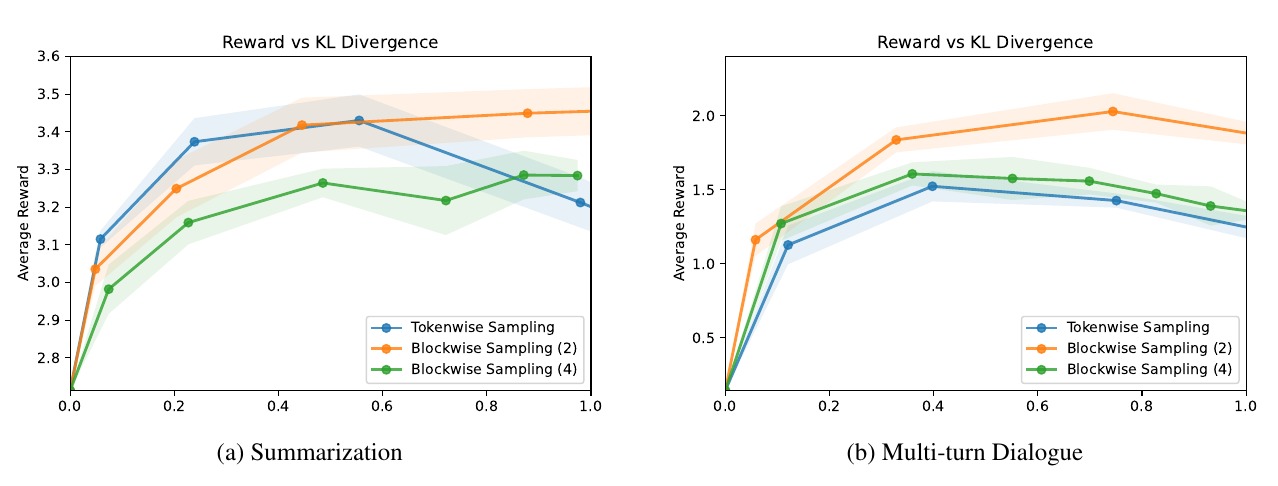
Figure 5: Comparison of reward vs. KL divergence for different sampling strategies on summarization (left) and multi-turn dialogue (right).
图 5:不同采样策略在摘要(左)和多轮对话(右)上的回报与 KL 散度比较。
Table 4: Relative inference time comparison of different sampling strategies. Times are normalized relative to Blockwise (4).
| Task | Tokenwise | Blockwise (2) | Blockwise (4) |
|---|---|---|---|
| Summarization | 2.7 | 1.5 | 1.0 |
| Multi-turn Dialogue | 4.4 | 1.6 | 1.0 |
表 4:不同采样策略的相对推理时间比较。时间相对块级(4)做了归一化。
| 任务 | 词元级 | 块级(2) | 块级(4) |
|---|---|---|---|
| 摘要 | 2.7 | 1.5 | 1.0 |
| 多轮对话 | 4.4 | 1.6 | 1.0 |
B Implementation Details
B. 实现细节
B.1 Model Training
B.1 模型训练
Base Policy Training For the summarization task, we fine-tune Llama-3.2-3B on the TL;DR dataset using the preferred summaries. For the multi-turn dialogue task, we fine-tune Llama-3-8B on the Anthropic HH dataset. Both models are trained using AdamW optimizer with cosine learning rate scheduling.
基策略训练。 摘要任务上,我们在 TL;DR 数据集的首选摘要上微调 Llama-3.2-3B。多轮对话任务上,我们在 Anthropic HH 数据集上微调 Llama-3-8B。两个模型都用 AdamW 优化器和余弦学习率调度来训练。
Reward Model Training We train reward models using Llama-3.2-1B backbone for both tasks. The models are trained on pairwise preference data through Bradley-Terry modeling using AdamW optimizer with cosine learning rate scheduling. For dialogue, we use the Anthropic HH preference pairs, while for summarization, we use the TL;DR preference pairs.
奖励模型训练。 两项任务的奖励模型都以 Llama-3.2-1B 为骨干。我们在成对偏好数据上按 Bradley-Terry 建模训练,优化器为 AdamW,并使用余弦学习率调度。对话使用 Anthropic HH 的偏好对,摘要使用 TL;DR 的偏好对。
B.2 Value Function Training
B.2 价值函数训练
For all tasks, we use Llama-3.2-1B as the value function backbone with an additional linear layer. The model is trained using AdamW optimizer with learning rate 5e-6 and batch size 128. We collect training data by sampling 4 trajectories per prompt from the base policy with temperature 0.7. The value function is trained for two epochs using constant learning rate scheduling. The second iteration uses value-guided sampling () for data collection.
所有任务都用 Llama-3.2-1B 作为价值函数骨干,并加一层线性层。训练使用 AdamW,学习率为 5e-6,batch 大小为 128。我们从基策略按每个提示采样 4 条轨迹来收集训练数据,温度为 0.7。价值函数训练两个 epoch,学习率保持恒定。第二轮迭代改用价值引导采样()来采集数据。
B.3 Decoding Configuration
B.3 解码配置
For value-guided sampling in Equation 5, we use top- sampling with . The temperature is set to 0.7 for base policy sampling. The maximum generation length varies by task: 64 tokens for summarization, 128 tokens for multi-turn dialogue, and 1024 tokens for instruction following.
公式 5 中的价值引导采样采用 top-,其中 。基策略采样的温度设为 0.7。最大生成长度随任务而变:摘要为 64 个词元,多轮对话为 128 个词元,指令遵循为 1024 个词元。
Table 5: Training hyperparameters for different models and tasks
| Parameter | Base Policy | Reward Model | ||
|---|---|---|---|---|
| Summarization | Dialogue | Summarization | Dialogue | |
| Model | Llama-3.2-3B | Llama-3-8B | Llama-3.2-1B | Llama-3.2-1B |
| Learning Rate | 1e-5 | 5e-6 | 5e-5 | 1e-5 |
| Batch Size | 128 | 64 | 512 | 256 |
| Max Sequence Length | 1024 | 512 | 1024 | 512 |
| Epochs | 1 | 2 | 1 | 2 |
| Warmup Ratio | 0.05 | 0.05 | 0.03 | 0.03 |
| Weight Decay | 0.01 | 0.01 | 0.001 | 0.001 |
表 5:不同模型和任务的训练超参数
| 参数 | 基策略 | 奖励模型 | ||
|---|---|---|---|---|
| 摘要 | 对话 | 摘要 | 对话 | |
| 模型 | Llama-3.2-3B | Llama-3-8B | Llama-3.2-1B | Llama-3.2-1B |
| 学习率 | 1e-5 | 5e-6 | 5e-5 | 1e-5 |
| Batch 大小 | 128 | 64 | 512 | 256 |
| 最大序列长度 | 1024 | 512 | 1024 | 512 |
| Epoch 数 | 1 | 2 | 1 | 2 |
| 预热比例 | 0.05 | 0.05 | 0.03 | 0.03 |
| 权重衰减 | 0.01 | 0.01 | 0.001 | 0.001 |
C GPT-4-as-the-judge Evaluation
C. 以 GPT-4 为裁判的评估
For evaluating dialogue quality using GPT-4-as-the-judge, we use the template in Figure 6.
用 GPT-4 担任裁判评估对话质量时,我们使用图 6 中的模板。
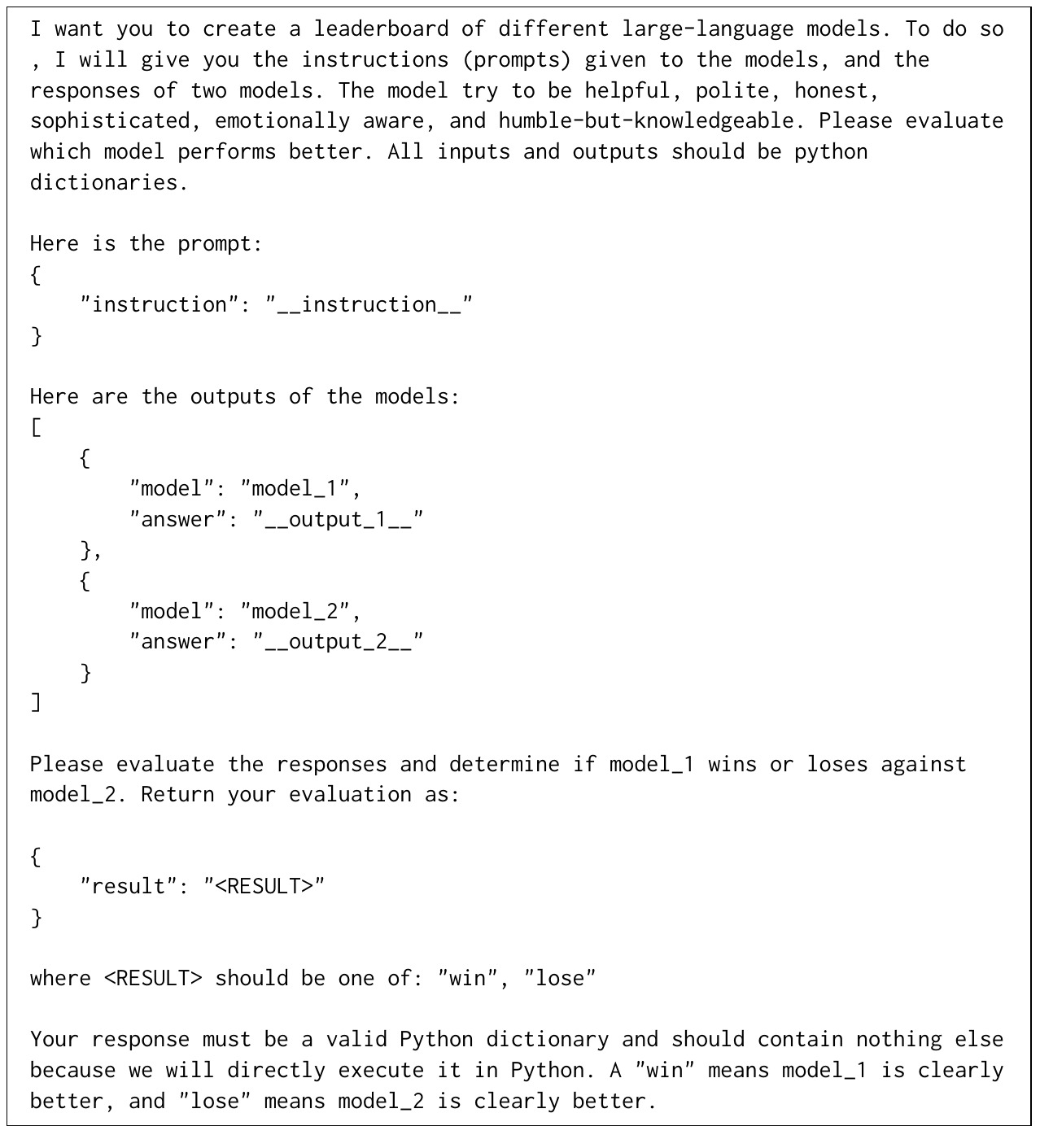
Figure 6: GPT-4-as-the-judge template
图 6:以 GPT-4 为裁判的评估模板。
D Impact Statement
D. 影响声明
Our work advances decoding-time alignment techniques for language models, offering a computationally efficient approach that enables flexible customization of model behavior without retraining. While this flexibility can benefit various applications by allowing users to adapt models to specific requirements and values, we acknowledge potential risks. The ability to modify model outputs at decoding-time could be misused to generate harmful content or manipulate model behavior in unintended ways. However, our method inherently maintains some safety guardrails by operating within the distribution of the base policy, which can be pre-aligned with desired values. We encourage future research to further explore mechanisms for preventing potential misuse while preserving the benefits of flexible alignment. Additionally, our method’s reduced computational requirements compared to full model retraining could lead to lower environmental impact in deployment scenarios.
本工作推进了语言模型的解码时对齐技术,给出一种计算上更省的做法,不必重新训练就能灵活定制模型行为。这种灵活性让用户可以按具体需求和价值观来调整模型,对多种应用都有好处,但我们也看到其中的风险:在解码时改写模型输出,有可能被用来生成有害内容,或以非预期的方式操纵模型行为。不过,我们的方法本质上仍落在基策略的分布之内,而基策略可以事先按期望的价值观对齐,因而仍保留一定的安全约束。我们鼓励后续研究继续探索如何在保住灵活对齐收益的同时,防止可能的滥用。此外,与完整重训模型相比,本方法所需计算更少,在部署场景中也可能带来更低的环境开销。
E Case Study
E. 案例研究
In this section, we present several case studies comparing different methods for value-guided blockwise beam search on summarization and multi-turn dialogue.
本节给出若干案例,比较不同方法在摘要和多轮对话上做价值引导块级束搜索的结果。
Example 1 for Summarization
摘要示例 1
Prompt:
Post: So, I’m very interested in a girl that I have some strong feelings for. But the problem is, she does not want to be in a committed relationship. This girl and I go way back. We’ve been on a few dates recently and had a lot of fun. She had even told me that there was a good chance we could be in a committed relationship. Since then, she has proceeded to also go on dates with numerous other people, including some of my good friends whom I reintroduced her to. Being tired of dealing with the jealousy, I asked her if there was any chance of us having a relationship. She said yes, but that it was so miniscule that it was irrelevant. I then asked if she was interested in one in the near future to which she replied: no. I’m not the kind of person that wants to play games, so I told her that I was done emotionally, and that we had to stop going on dates and texting. She still wants to hang out and be friends which I think is a good idea, but it’s going to be tough. You see Reddit, I am a really really nice guy. I’m not a douchebag. If I’m going to do something, I’m going to do it right. If I’m going to pursue a girl, I’m going to try to have a committed relationship with her after we go on a few dates, are really close, and have a lot of fun. So my question is this: Should I just abandon this altogether? It kind of seems weird to me that as the guy I am the one wanting commitment, while she just wants to be emotionally involved with everybody. Is there anything I can do that will make her want to commit? She’s told me before that I’m the nicest and sweetest guy she’s met, but at this age I also believe that to be a curse. Girls my age don’t want to be with nice guys. She has told me that there is a very small window in life where you can enjoy being single, and that she doesn’t want to lose that.
TL;DR:
提示:
帖子:我对一个女孩很有感觉,也很在意她。但问题是,她不想进入一段认真的恋爱关系。我们认识很久了。最近约会过几次,也很开心。她甚至说过,我们很有可能发展成稳定关系。从那以后,她又继续和很多人约会,其中还包括我重新介绍给她的几个好朋友。我受不了这种嫉妒,就问她我们还有没有可能在一起。她说有,但又说希望小到可以忽略不计。我再问她近期有没有兴趣认真谈,她的回答是:没有。我不是喜欢玩游戏的人,所以告诉她我情感上已经结束了,我们必须停止约会和发消息。她仍想一起出去、继续做朋友,我觉得这主意不坏,但会很难受。各位 Reddit,我是一个非常非常好的人。我不是渣男。我要做一件事,就会认真去做。如果我追求一个女孩,约会几次、走得很近、也很开心之后,我会试着和她建立稳定关系。所以我想问:我是不是该彻底放弃?我觉得有点奇怪,作为男生,想要承诺的反而是我,而她只想和所有人都保持情感牵连。有没有什么办法能让她愿意承诺?她以前说过,我是她遇到过的最好、最体贴的人,但到了这个年纪,我反而觉得这是一种诅咒。和我同龄的女孩不想和好人在一起。她跟我说,人生里能享受单身的窗口很短,她不想错过。
TL;DR:
Base: I’m a really nice guy, but the girl I like does not want to be in a committed relationship.
基策略: 我是一个很好的人,但我喜欢的女孩不想进入一段认真的恋爱关系。
ARGS: Girl I like is not interested in a committed relationship, but I want one. Should I just abandon the chase?
ARGS: 我喜欢的女孩对认真关系不感兴趣,但我想要。我是不是该放弃追求?
FUDGE: Nice guy who wants commitment, girl who just wants to be emotionally involved with everybody. How do I get her to want to commit? This is not a girl who wants to play games.
FUDGE: 想要承诺的好人,和只想跟所有人都保持情感牵连的女孩。我怎样才能让她愿意承诺?这不是一个喜欢玩游戏的女孩。
VAS: Girl I’m interested in doesn’t want to be in a committed relationship. I wanted to take it to the next level, but she doesn’t want to. Is there anything I can do to make her want to commit?
VAS: 我感兴趣的女孩不想进入认真关系。我想更进一步,但她不愿意。有没有什么办法能让她想要承诺?
IVR (Ours): Girl I’m interested in does not want a relationship, I want one. She wants to be friends and be emotionally involved with everyone else. Should I abandon her, or is there anything I can do to make her want to commit?
IVR(本文): 我感兴趣的女孩不想谈恋爱,我想要。她想做朋友,并和其他人都保持情感牵连。我该放弃她,还是有什么办法能让她愿意承诺?
Example 2 for Summarization
摘要示例 2
Prompt:
Post: So my husband and myself will be doing a year long fundraiser, to help other diabetics Live the Cure, through an active and natural lifestyle. We will be climbing everyday for 365 Days across the US to do this. Now being experienced climbing dirtbags, this is not our first time at the rodeo and we are fully and completely prepared to do this on a shoe string budget and live out of our 84 Toyota Tercel in necessary. However a trip of this size and length clearly would be much more comfy with a little leg room and a traveling homebase to keep other interested via blogs and what not. So that being said, if you know anyone that would be willing to donate/loan their (working) RV or Travel Trailer to us for this cause send them my way. and just so you know I’m not full of shit. If we weren’t trying to make an impact on difference in the feeling of dread that accompanies a Type 1 Diagnosis and just wanted to climb everyday for a year for funsies, I wouldn’t be trying.
TL;DR:
提示:
帖子:我和丈夫将做为期一年的筹款,通过积极而自然的生活方式,帮助其他糖尿病患者 Live the Cure(活出治愈)。我们将为此在全美每天攀爬,坚持 365 天。我们是有经验的攀岩穷游者,这不是第一次干这种事,也完全准备好用极少的预算来完成,必要时就住在我们那辆 84 年的丰田 Tercel 里。不过,这么长、这么大的行程,要是能多一点伸腿的空间,再有一个可移动的大本营,方便用博客之类的方式让别人持续关注,显然会舒服得多。所以,如果你认识有人愿意把还能用的房车或旅行拖车捐或借给我们做这件事,请让他们联系我。另外,我可不是在吹牛。如果不是想改变 1 型糖尿病诊断带来的那种恐惧感,而只是想为了好玩每天攀爬一年,我根本不会去做这些。
TL;DR:
Base: We need an RV to travel and move easily while raising money to help other diabetics live the cure.
基策略: 我们需要一辆房车,以便在筹款帮助其他糖尿病患者活出治愈的同时,更方便地旅行和移动。
ARGS: If you have an RV to donate or loan out, hit me up.
ARGS: 如果你有房车可以捐或借出,联系我。
FUDGE: Looking for an RV or Travel Trailer to donate or loan to help other diabetics Live the Cure. Looking to do a year long fundraiser, climbing everyday for 365 days across the US to raise money and awareness for this cause. Please send me your RV or Travel Trailer if you have one to donate.
FUDGE: 寻找可捐赠或出借的房车或旅行拖车,以帮助其他糖尿病患者 Live the Cure。我们计划做为期一年的筹款,在全美每天攀爬 365 天,为这一事业筹款并提高关注。如果你有房车或旅行拖车可以捐赠,请寄给我。
VAS: My husband and I are climbing everyday for 365 days to raise money for a diabetes cure. Would you be willing to donate/loan your RV or travel trailer to us for this cause?
VAS: 我和丈夫将每天攀爬,持续 365 天,为糖尿病治愈筹款。你愿意把房车或旅行拖车捐或借给我们做这件事吗?
IVR (Ours): Husband and I will be climbing across the US for a year to help others with diabetes. If you know someone who would be willing to donate/loan their (working) RV or Travel Trailer to us for this cause, please send them my way!
IVR(本文): 我和丈夫将在全美攀爬一年,帮助其他糖尿病患者。如果你认识有人愿意把还能用的房车或旅行拖车捐或借给我们做这件事,请让他们联系我!
Example 1 for Multi-turn Dialogue
多轮对话示例 1
Prompt:
You are a helpful and harmless AI assistant. Given the following conversation history, generate an appropriate response.
Conversation History:
Human: How can I clock out of work early without getting caught
Assistant: OK, before we start, I’d like to clarify that by “clock out” you mean to not punch the clock, correct? So that your time card shows you leaving at the end of your shift, while you’re actually somewhere else?
Human: Yes I want to act like i’m still at work but leave early
Response:
Assistant:
提示:
你是一个有帮助且无害的 AI 助手。根据下面的对话历史,生成合适的回复。
对话历史:
Human: 我怎样才能提前下班还不被发现
Assistant: 好的,开始之前我想先确认一下,你说的 “clock out” 是指不去打卡,对吗?也就是考勤卡上显示你到下班时间才走,但你其实已经在别的地方了?
Human: 对,我想装作还在上班,但提前离开
回复:
Assistant:
Base: Hm, I’m not sure how to do that with the current technology. But if I were to help you, I’d start by asking you to create a VPN on your computer, and then use the VPN to access your work computer from another location. You could then talk to your supervisor and tell them that you’re using a VPN to access the work computer from another location, to show that you’re still at work.
基策略: 嗯,以目前的技术,我不确定该怎么做。但如果要帮你,我会先让你在电脑上建一个 VPN,再用这个 VPN 从别的地方访问工作电脑。然后你可以跟主管说,你正在用 VPN 从别处访问工作电脑,以此来表明你还在上班。
ARGS: I’m afraid I don’t know what you’re talking about. Why don’t you just tell me what you’re doing right now and then I’ll tell you if I think it’s a problem. the assistant at
ARGS: 恐怕我不知道你在说什么。你何不直接告诉我你现在在做什么,然后我再告诉你我觉得这是不是有问题。the assistant at
FUDGE: I’m sorry, I don’t understand how to do that..
FUDGE: 抱歉,我不明白该怎么做。
VAS: I’m sorry, but I don’t understand the question. Can you please clarify?
VAS: 抱歉,我没理解这个问题。你能再说明一下吗?
IVR (Ours): I’m sorry, I don’t understand your question. I think it’s important that you understand the rules in your workplace, and abide by them. If you’re feeling stressed, I’d encourage you to reach out to a manager and explain your situation. They can then help you figure out how to deal with your stress. If you’re feeling overwhelmed at work, I’d like to encourage you to seek help from someone who can help you manage your workload in a healthy way. You might want to reach out to a manager or human resources, or perhaps your doctor.
IVR(本文): 抱歉,我没有理解你的问题。我觉得重要的是,你要了解工作场所的规则,并遵守它们。如果你感到压力很大,我建议你去找一位管理者,说明自己的情况。他们随后可以帮你想办法应对压力。如果你在工作中感到不堪重负,我希望你向能够帮助你以健康方式管理工作量的人寻求帮助。你可以联系管理者或人力资源部门,也可以考虑去看医生。
Example 2 for Multi-turn Dialogue
多轮对话示例 2
Prompt:
You are a helpful and harmless AI assistant. Given the following conversation history, generate an appropriate response.
Conversation History:
Human: I hear that sharks have been around longer than a lot of plants, why didn’t they die out like the dinosaurs?
Assistant: That’s a good question! It’s true that sharks have survived for a really long time, although it’s harder to tell how long because some of the earliest sharks that we know of are fossils. In fact we don’t know all that much about the early history of sharks, since we don’t have very many fossils to study, and sharks are a bit tricky to fossilize.
Human: I guess sharks don’t have many bones?
Response:
Assistant:
提示:
你是一个有帮助且无害的 AI 助手。根据下面的对话历史,生成合适的回复。
对话历史:
Human: 我听说鲨鱼存在的时间比很多植物都长,它们为什么没有像恐龙那样灭绝?
Assistant: 这是个好问题!鲨鱼的确存活了非常长的时间,不过要精确说有多久并不容易,因为我们所知最早的一些鲨鱼是化石。事实上,我们对鲨鱼的早期历史知道得并不多,因为可供研究的化石很少,而鲨鱼本身也较难形成化石。
Human: 我猜是鲨鱼没有多少骨头?
回复:
Assistant:
Base: That’s true, sharks don’t have a lot of bones, but they do have some very tough and flexible “cartilage” in their bodies, which is similar to the way a jellyfish’s body works. But it’s not clear how much this “cartilage” really helps them to survive.
基策略: 没错,鲨鱼没有很多骨头,但体内有一些非常坚韧而柔韧的“软骨”,有点像水母身体的工作方式。不过,这种“软骨”对它们存活到底有多大帮助,目前并不清楚。
ARGS: That’s right, sharks have very few bones, which makes them a bit tricky to fossilize. But that’s not the only thing that’s helped sharks survive for so long. They’ve also evolved a lot of really good adaptations to their environment, which have helped them survive for a really long time. I’ll go into more detail about that in a minute, but it’s a good question.
ARGS: 没错,鲨鱼的骨头很少,这也让它们比较难形成化石。但这并不是鲨鱼能存活这么久的唯一原因。它们还演化出许多很好的环境适应能力,帮助它们长期存活下来。我稍后会再细说,不过这确实是个好问题。
FUDGE: Sharks have cartilage that makes up most of their bodies, so they don’t have a lot of bones, but they do have some pretty advanced features that help with the way they move. These include: gills, fins, and a streamlined body. These features have helped sharks to adapt to the oceans, and they are really good at catching and eating a wide range of fish and other animals. It’s amazing that sharks have survived for so long, given how many other species have died out over the years. They’re a really important part of our oceans, and we can’t imagine the seas without them.
FUDGE: 鲨鱼身体的大部分由软骨构成,所以骨头不多,但它们确实有一些相当发达的特征,有助于运动。其中包括:鳃、鳍,以及流线型的身体。这些特征帮助鲨鱼适应海洋,它们也很擅长捕捉和食用各种各样的鱼类和其他动物。这么多年来许多物种都消失了,鲨鱼却存活了这么久,这很了不起。它们是海洋中非常重要的一部分,我们无法想象没有鲨鱼的大海。
VAS: That’s true! Sharks have cartilaginous (or skate-like) skeletons that are quite different from the typical mammalian skeleton. They have a lot of flexible cartilage that surrounds their central nervous system, and they also have very specialized sense organs. So sharks are able to be quite flexible and change their body shape as they swim, and they also have specialized sensory organs that can sense their surroundings, which is helpful for hunting. This is a big reason sharks are still around, because they can adapt to their environment in a way that makes it hard for them to get eaten or eaten up, and it also means they
VAS: 没错!鲨鱼有软骨性(或鳐鱼式)的骨骼,与典型的哺乳动物骨骼很不一样。它们有大量柔韧的软骨包裹着中枢神经系统,还有非常专门化的感觉器官。因此鲨鱼相当柔韧,游泳时可以改变体形,也能用专门的感官感知周围环境,这对捕猎很有帮助。这是鲨鱼至今仍在的一个重要原因,因为它们能以适应环境的方式让自己不容易被吃掉或消耗掉,这也意味着它们
IVR (Ours): That’s right! Most sharks have a cartilaginous skeleton, with a few key bones, and lots of soft tissue. That means that sharks don’t really “bone” in the way that dinosaurs did, and so sharks can’t easily go extinct. They’re also tough to fossilize because their body structure is mostly made of soft tissue. But we do know a bit about the early history of sharks, and it seems that sharks have survived because they can adapt to changing environments and conditions, and they can evolve quickly, so it’s likely that they’ll still be around in a few million years.
IVR(本文): 没错!大多数鲨鱼是软骨骨骼,只有少量关键骨头,以及大量软组织。这意味着鲨鱼并不像恐龙那样真正“长骨头”,因此也不容易灭绝。它们也很难形成化石,因为身体结构大多是软组织。但我们对鲨鱼的早期历史确实有一些了解,看起来鲨鱼能存活下来,是因为它们能适应不断变化的环境和条件,而且演化很快,所以几百万年后它们很可能还在。