CAD2RL: Real Single-Image Flight Without a Single Real Image
CADRL: Real Single-Image Flight Without a Single Real Image
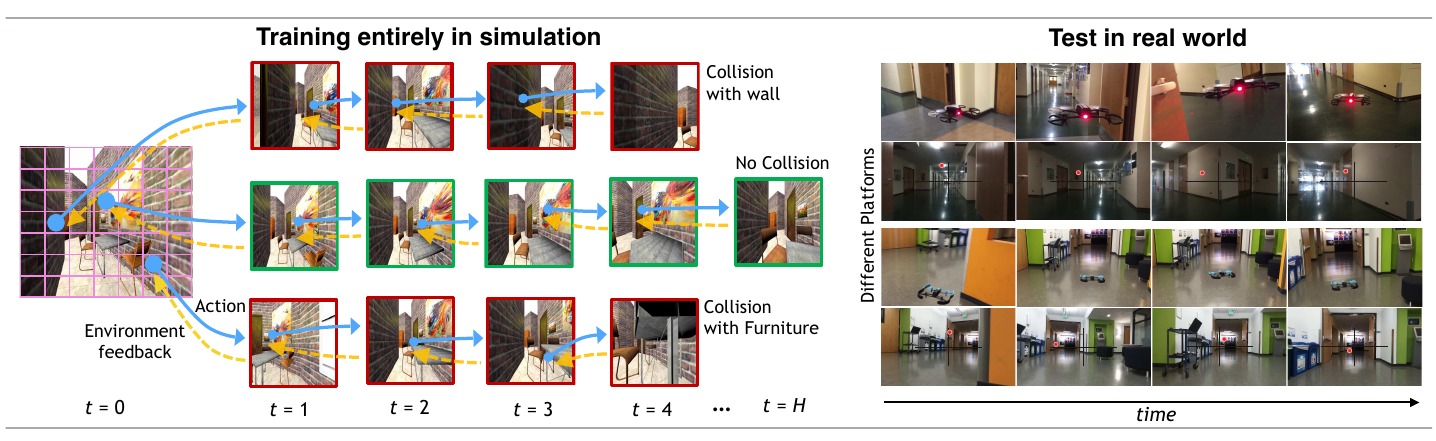
Fig. 1. We propose the Collision Avoidance via Deep Reinforcement Learning algorithm for indoor flight which is entirely trained in a simulated CAD environment. Left: CADRL uses single image inputs from a monocular camera, is exclusively trained in simulation, and does not see any real images at training time. Training is performed using a Monte Carlo policy evaluation method, which performs rollouts for multiple actions from each initial state and trains a deep network to predict long-horizon collision probabilities of each action. Right: CADRL generalizes to real indoor flight.
图 1. 我们提出用于室内飞行的 Collision Avoidance via Deep Reinforcement Learning 算法,它完全在仿真 CAD 环境中训练。左:CADRL 使用来自单目相机的单张图像输入,只在仿真中训练,训练时看不到任何真实图像。训练采用蒙特卡洛策略评估:从每个初始状态对多个动作做 rollout,并训练深度网络来预测每个动作的长时程碰撞概率。右:CADRL 可泛化到真实室内飞行。
Abstract—
摘要—
Deep reinforcement learning has emerged as a promising and powerful technique for automatically acquiring control policies that can process raw sensory inputs, such as images, and perform complex behaviors. However, extending deep RL to real-world robotic tasks has proven challenging, particularly in safety-critical domains such as autonomous flight, where a trial-and-error learning process is often impractical. In this paper, we explore the following question: can we train vision-based navigation policies entirely in simulation, and then transfer them into the real world to achieve real-world flight without a single real training image? We propose a learning method that we call CADRL, which can be used to perform collision-free indoor flight in the real world while being trained entirely on 3D CAD models. Our method uses single RGB images from a monocular camera, without needing to explicitly reconstruct the 3D geometry of the environment or perform explicit motion planning. Our learned collision avoidance policy is represented by a deep convolutional neural network that directly processes raw monocular images and outputs velocity commands. This policy is trained entirely on simulated images, with a Monte Carlo policy evaluation algorithm that directly optimizes the network’s ability to produce collision-free flight. By highly randomizing the rendering settings for our simulated training set, we show that we can train a policy that generalizes to the real world, without requiring the simulator to be particularly realistic or high-fidelity. We evaluate our method by flying a real quadrotor through indoor environments, and further evaluate the design choices in our simulator through a series of ablation studies on depth prediction. For supplementary video see: https://youtu.be/nXBWmzFrj5s
深度强化学习已成为一种有前景且有力的技术,可以自动获得能够处理图像等原始感官输入并执行复杂行为的控制策略。然而,把深度强化学习扩展到真实世界的机器人任务已被证明相当困难,在自主飞行这类安全关键领域尤其如此,因为试错式学习过程往往并不现实。本文探讨如下问题:我们能否完全在仿真中训练基于视觉的导航策略,再把它们迁移到真实世界,从而在没有一张真实训练图像的情况下实现真实飞行?我们提出一种称为 CADRL 的学习方法,它可以完全在三维 CAD 模型上训练,却用于真实世界中的无碰室内飞行。该方法使用来自单目相机的单张 RGB 图像,无需显式重建环境的三维几何,也不做显式运动规划。学到的避障策略由一个深度卷积神经网络表示,它直接处理原始单目图像并输出速度指令。该策略完全在仿真图像上训练,所用的蒙特卡洛策略评估算法直接优化网络产生无碰飞行的能力。通过对仿真训练集的渲染设置做高度随机化,我们表明可以训练出能泛化到真实世界的策略,而不要求仿真器特别逼真或具有很高的视觉保真度。我们通过让真实四旋翼在室内环境中飞行来评估该方法,并在深度预测上做了一系列消融,以评估仿真器中的设计选择。补充视频见:https://youtu.be/nXBWmzFrj5s
I. INTRODUCTION
I. 引言
Indoor navigation and collision avoidance is one of the basic requirements for robotic systems that must operate in unstructured open-world environments, including quadrotors, mobile manipulators, and other mobile robots. Many of the most successful approaches to indoor navigation have used mapping and localization techniques based on 3D perception, including SLAM [3], depth sensors [44], stereo cameras [37], and monocular cameras using structure from motion [8]. The use of sophisticated sensors and specially mounting multiple cameras on the robot imposes additional costs on a robotic platform, which is a particularly prominent issue for weight and power constrained systems such as lightweight aerial vehicles. Monocular cameras, on the other hand, require 3D estimation from motion, which remains a challenging open problem despite considerable recent progress [13, 20]. In this paper, we explore a learning-based approach for indoor navigation, which directly predicts collision-free motor commands from monocular images, without attempting to explicitly model or represent the 3D structure of the environment. In contrast to previous learning-based navigation work [5], our method uses reinforcement learning to obtain supervision that accurately reflects the actual probabilities of collision, instead of separating out obstacle detection and control. The probability of future collision is predicted from raw monocular images using deep convolutional neural networks.
对于必须在非结构化开放环境中运行的机器人系统——包括四旋翼、移动机械臂和其他移动机器人——室内导航与避障是基本要求之一。许多最成功的室内导航方法使用基于三维感知的建图与定位技术,包括 SLAM [3]、深度传感器 [44]、双目相机 [37],以及利用运动恢复结构的单目相机 [8]。使用复杂传感器、并在机器人上专门安装多台相机,会给平台增加额外成本;对重量和功耗受限的轻型飞行器来说,这一点尤为突出。另一方面,单目相机需要从运动中估计三维,尽管近来已有不少进展 [13, 20],这仍是一个有挑战性的开放问题。本文探索一种基于学习的室内导航方法:直接从单目图像预测无碰的电机指令,而不试图显式建模或表示环境的三维结构。与先前基于学习的导航工作 [5] 不同,我们的方法用强化学习获得能够准确反映实际碰撞概率的监督,而不是把障碍检测和控制分开。未来碰撞的概率由深度卷积神经网络从原始单目图像中预测。
Using reinforcement learning (RL) to learn collision avoidance, especially with high-dimensional representations such as deep neural networks, presents a number of major challenges. First, RL tends to be data-intensive, making it difficult to use with platforms such as aerial vehicles, which have limited flight time and require time-consuming battery changes. Second, RL relies on trial-and-error, which means that, in order to learn to avoid collisions, the vehicle must experience at least a limited number of collisions during training. This can be extremely problematic for fragile robots such as quadrotors.
用强化学习(RL)来学习避障,尤其是在深度神经网络这类高维表示下,会带来若干主要挑战。第一,强化学习往往很耗数据,因而难以用在飞行时间有限、还需要耗时更换电池的飞行器上。第二,强化学习依赖试错,这意味着为了学会避障,飞行器在训练中至少要经历有限次数的碰撞。这对四旋翼这类脆弱的机器人可能极为麻烦。
A promising avenue for addressing these challenges is to train policies in simulation, but it remains an open question whether simulated training of vision-based policies can generalize effectively to the real world. In this work, we show that we can transfer indoor obstacle avoidance policies based on monocular RGB images from simulation to the real world by using a randomized renderer, without relying on an extremely high degree of realism or visual fidelity. Our renderer forces the network to handle a variety of obstacle appearances and lighting conditions, which makes the learned representations invariant to surface appearance. As the result, the network learns geometric features and can robustly detect open spaces.
应对这些挑战的一条有前景的途径是在仿真中训练策略,但基于视觉的策略经仿真训练后能否有效泛化到真实世界,仍是一个开放问题。在本工作中,我们表明,通过使用随机化渲染器,可以把基于单目 RGB 图像的室内避障策略从仿真迁移到真实世界,而不依赖极高的逼真度或视觉保真度。我们的渲染器迫使网络处理多种多样的障碍外观和光照条件,从而使学到的表示对表面外观保持不变。结果是,网络学到了几何特征,并能稳健地检测开阔空间。
In contrast to prior work on domain adaptation [35, 41], our method does not require any real images during training. We demonstrate that our approach can enable navigation of real-world hallways by a real quadrotor using only a monocular camera, without depth or stereo. By training entirely in simulation, we can also use a simple and stable RL algorithm that exploits the ability to reset the environment to any state. Figure 1 shows a diagram of our CADRL algorithm. The algorithm evaluates multiple actions at each state using the current policy, producing dense supervision for the Q-values at that state. Training the Q-function to regress onto these Q-values then corresponds to simple supervised learning. This algorithm sidesteps many of the hyperparameter tuning challenges associated with conventional online RL methods, and is easy to parallelize for efficient simulated training.
与先前关于域适应的工作 [35, 41] 不同,我们的方法在训练时不需要任何真实图像。我们表明,该方法可以让真实四旋翼只用单目相机、不靠深度或双目,就能在真实世界的走廊中导航。由于完全在仿真中训练,我们还可以使用一种简单而稳定的强化学习算法,它利用了可以把环境重置到任意状态的能力。图 1 给出了我们的 CADRL 算法示意图。该算法在每个状态上用当前策略评估多个动作,从而为该状态的 Q 值提供稠密监督。再让 Q 函数回归到这些 Q 值,就相当于简单的监督学习。这一算法避开了常规在线强化学习方法中的许多超参数调节困难,也容易并行化,以便高效地在仿真中训练。
The main contribution of our work is an approach for training collision avoidance policies for indoor flight using randomized synthetic environments and deep RL. We designed a set of synthetic 3D hallways that can be used to generate large datasets of randomized scenes, with variable furniture placement, lighting, and textures. Our synthetic data is designed for the task of indoor robot navigation and can also be used as a testbed for RL algorithms. Our proposed RL method is also a novel contribution of this work, and is particularly simple and well-suited for simulated training.
本工作的主要贡献,是一种利用随机化合成环境和深度强化学习来训练室内飞行避障策略的方法。我们设计了一组合成三维走廊,可用于生成大规模随机化场景数据集,其中家具摆放、光照和纹理都可以变化。这些合成数据是为室内机器人导航任务设计的,也可以用作强化学习算法的测试平台。我们提出的强化学习方法同样是本工作的一项新贡献,它特别简单,也非常适合在仿真中训练。
We present an extensive empirical evaluation that assesses generalization to the real world, as well as ablations on a supervised proxy task that studies which aspects of the randomized simulation are most important for generalization. Our simulated comparative evaluation shows that our approach outperforms several baselines, as well as a prior learning-based method that predicts turning directions [14]. Our real-world experiments demonstrate the potential for purely simulation-based training of deep neural network navigation policies. Although the policies trained entirely in simulation do experience some collisions in the real world, they outperform baseline methods and are able to navigate effectively around many kinds of obstacles, using only monocular images as input. We therefore conclude that simulated training is a promising direction for learning real-world navigation for aerial vehicles as well as other types of mobile robots.
我们做了广泛的实验评估,既检验向真实世界的泛化,也在一个有监督的代理任务上做消融,以研究随机化仿真中哪些方面对泛化最重要。仿真中的比较表明,我们的方法超过了若干基线,以及一种预测转向的既有基于学习的方法 [14]。真实世界实验展示了完全基于仿真来训练深度神经网络导航策略的潜力。尽管完全在仿真中训练的策略在真实世界中仍会遇到一些碰撞,但它们超过了基线方法,并且能够只用单目图像作为输入,有效地绕过多种障碍。因此我们的结论是:对飞行器以及其他类型的移动机器人而言,仿真训练是学习真实世界导航的一条有前景的方向。
II. RELATED WORK
II. 相关工作
Any robotic system that must traverse indoor environments is required to perform basic collision avoidance. Standard methods for collision-free indoor navigation take a two step approach to the problem: first map out the local environment and determine its geometry, and then compute a collision-free path for reaching the destination [39]. This approach benefits from independent developments in mapping and localization as well as motion planning [38, 27, 4]. The 3D geometry of the local environment can be deduced using SLAM with range sensors [3], consumer depth sensors [44, 16], stereo camera pairs [37], as well as monocular cameras [8]. In [25], laser range scanned real images are used to estimate depth in a supervised learning approach and then the output is used to learn control policies. In [15] simultaneous mapping and planning using RGB-D images is done via a memory network. Reconstruction from monocular images is particularly challenging, and despite considerable progress [20, 13], remains a difficult open problem. In a recent approach, IM2CAD, CAD model of a room is generated from a single RGB image [18]. While the synthetic data generated by [18] could be used for various robotics simulations, the computational overhead makes it less suitable for autonomous indoor flight, where quick inference for finding open spaces is more critical than categorical exact 3D models.
任何必须穿越室内环境的机器人系统都需要进行基本的避障。无碰室内导航的标准方法分两步:先对局部环境建图并确定其几何,再计算到达目的地的无碰路径 [39]。这种方法得益于建图与定位以及运动规划各自的独立进展 [38, 27, 4]。局部环境的三维几何可以用带测距传感器的 SLAM [3]、消费级深度传感器 [44, 16]、双目相机对 [37] 以及单目相机 [8] 来推断。在 [25] 中,用激光扫描得到的真实图像以监督学习的方式估计深度,再把输出用于学习控制策略。在 [15] 中,利用记忆网络,基于 RGB-D 图像同时进行建图与规划。从单目图像重建尤其困难,尽管已有不少进展 [20, 13],这仍是一个困难的开放问题。在最近的 IM2CAD 方法中,可以从单张 RGB 图像生成房间的 CAD 模型 [18]。虽然 [18] 生成的合成数据可用于各种机器人仿真,但其计算开销使它不太适合自主室内飞行:在这种场合,快速推断以寻找开阔空间,要比得到类别精确的三维模型更为关键。
In our work, we sidestep the challenges of 3D reconstruction by proposing a learning algorithm that can directly predict the probability of collision, without an explicit mapping phase. Learning has previously been used to detect obstacles for indoor flight [5, 19], as well as to directly learn a turn classifier for outdoor forest trail following [14]. In contrast to the work of [5], our method directly learns to predict the probability of collision, given an image and a candidate action, without attempting to explicitly detect obstacles. However, our approach still affords considerable flexibility in choosing the action: a higher-level decision making system can choose any collision-free action based, for example, on a higher-level navigational goal. This is in contrast to the prior work, which simply predicts the action that will cause the vehicle to follow a trail [14]. Unlike [14], our method does not require any human demonstrations or teleoperation.
在我们的工作中,我们提出一种学习算法,可以直接预测碰撞概率,而不需要显式的建图阶段,从而避开三维重建的困难。学习此前已被用于室内飞行中的障碍检测 [5, 19],以及直接学习用于户外林间小路跟随的转向分类器 [14]。与 [5] 的工作不同,我们的方法在给定图像和候选动作时,直接学习预测碰撞概率,而不试图显式检测障碍。不过,我们的方法在选择动作上仍有相当大的灵活性:更高层的决策系统可以根据例如更高层的导航目标,选择任意无碰动作。这与先前只是预测使飞行器沿小路前进的动作的工作 [14] 形成对比。与 [14] 不同,我们的方法不需要任何人类示范或遥操作。
Besides presenting a deep RL approach for collision avoidance, we describe how this method can be used to learn a generalizable collision predictor in simulation, such that it can then generalize to the real world. Simulated training has been addressed independently in the computer vision and robotics communities in recent years. In computer vision, a number of domain adaptation methods have been proposed that aim to generalize perception systems trained in a source domain into a target domain [42, 17]. In robotics, simulation to real-world generalization has been addressed using hierarchies of multi-fidelity simulators [12], priors imposed on Bayesian dynamics models [11]. At the intersection of robotics and computer vision, several works have recently applied domain adaptation techniques to perform transfer for robotic perception systems [41, 35, 34]. In contrast to these works, our method does not use any explicit domain adaptation. Instead, we show how the source domain itself can be suitably randomized in order to train a more generalizable model, which we experimentally show can make effective predictions on a range of systematically different target domains.
除了提出一种用于避障的深度强化学习方法,我们还说明如何用它在仿真中学习一个可泛化的碰撞预测器,进而泛化到真实世界。近年来,计算机视觉和机器人领域都独立讨论过仿真训练。在计算机视觉中,已有若干域适应方法,旨在把源域上训练的感知系统泛化到目标域 [42, 17]。在机器人学中,仿真到真实世界的泛化则通过多保真度仿真器的层次结构 [12]、以及加在贝叶斯动力学模型上的先验 [11] 来处理。在机器人与计算机视觉的交叉处,最近有若干工作把域适应技术用于机器人感知系统的迁移 [41, 35, 34]。与这些工作不同,我们的方法不使用任何显式的域适应。相反,我们表明可以对源域本身做适当的随机化,从而训练出更可泛化的模型;实验表明,它能在一系列与训练有系统性差异的目标域上做出有效预测。
Our method combines deep neural networks for processing raw camera images [22] with RL. In the seminal work of Pomerleau [29], a fully connected neural network is used for generating steering commands for the task of road following using raw pixels and laser range finder. Recently, a similar approach was proposed by [7] for a self-driving car. We also generate direction commands from raw visual inputs. However, unlike these prior works, we use RL and do not require any human demonstration data. Furthermore, our method commands the vehicle in 3D, allowing it to change both heading and altitude. Vision-based RL has previously been explored in the context of Q-iteration [33], and more recently for online Q-learning using temporal-difference algorithms [26]. However, these methods were evaluated primarily on synthetic video game domains. Several recent works have extended deep RL methods to real-world robotics applications using either low-dimensional estimated state [10] or by collecting an exhaustive real-world dataset under gridworld-like assumptions [43]. In contrast, we propose a simple and stable deep RL algorithm that learns a policy from raw monocular images and does not require seeing any images of the real-world test environment.
我们的方法把用于处理原始相机图像的深度神经网络 [22] 与强化学习结合起来。在 Pomerleau 的开创性工作 [29] 中,一个全连接神经网络根据原始像素和激光测距仪,为道路跟随任务生成转向指令。最近,[7] 为自动驾驶汽车提出了类似方法。我们也从原始视觉输入生成方向指令。不过,与这些先前工作不同,我们使用强化学习,并且不需要任何人类示范数据。此外,我们的方法在三维中指挥飞行器,既可以改变航向,也可以改变高度。基于视觉的强化学习此前已在 Q-iteration 的语境中被探讨 [33],最近也有人用时序差分算法做在线 Q 学习 [26]。不过,这些方法主要是在合成电子游戏领域中评估的。若干近期工作把深度强化学习扩展到真实世界的机器人应用,所用的要么是低维估计状态 [10],要么是在类似网格世界的假定下采集穷尽式的真实数据集 [43]。相比之下,我们提出一种简单而稳定的深度强化学习算法,它从原始单目图像学习策略,并且不需要看到真实世界测试环境中的任何图像。
III. COLLISION AVOIDANCE VIA DEEP RL
III. 用深度强化学习避障
Our aim is to choose actions for indoor navigation that avoid collisions with obstacles, such as walls and furniture. While we do not explicitly consider the overall navigation objective (e.g. the direction that the vehicle should fly to reach a goal), we present a general and flexible collision avoidance method that predicts which actions are more or less likely to result in collisions, which is straightforward to combine with higher-level navigational objectives. The input to our model consists only of monocular RGB images, without depth or other sensors, making it suitable for low-cost, low-power platforms, though additional sensory inputs could be added in future work. Formally, let denote the camera observation at time , and let denote the action, which we will define in Section III-A. The goal of the model is to predict the Q-function :
我们的目标是为室内导航选择能够避开墙壁、家具等障碍的动作。我们并不显式考虑总体导航目标(例如飞行器应朝哪个方向飞才能到达目标),而是提出一种通用、灵活的避障方法,预测哪些动作更可能或更不可能导致碰撞,因而很容易与更高层的导航目标结合。模型的输入只包含单目 RGB 图像,没有深度或其他传感器,因而适合低成本、低功耗平台,不过未来工作也可以加入额外的感官输入。形式上,令 表示时刻 的相机观测, 表示动作(将在第 III-A 节定义)。模型的目标是预测 Q 函数 :
where is the discount factor, and actions are assumed to be chosen by the current policy , which we discuss in Section III-A. The horizon should ideally be , but in practice is chosen such that is small. is the reward function and is equal to zero if collision event happens. Collisions are assumed to end the episode, and therefore can occur only once. Otherwise, the reward at time is defined as , where is the radius of the vehicle, is the distance to the nearest obstacle at time , and is a small threshold distance. This reward function encourages the vehicle to stay far from any obstacles. We could also use the latest Q-function estimate to label the last time step , but we found this to be unnecessary to obtain good results. is learned using reinforcement learning, from the agent’s own experience of navigating and avoiding collisions. Once learned, the model can be used to choose collision-free actions simply by maximizing the Q-function. Training is performed entirely in simulation, where we can easily obtain distances to obstacles and simulate multiple different actions to determine the best one. By randomizing the simulated environment, we can train a model that generalizes effectively to domains with systematic discrepancies from our training environment. We will first describe the formulation of our model and reinforcement learning algorithm, and then present details of our simulated training environment.
其中 是折扣因子,并假定动作由当前策略 选择,该策略将在第 III-A 节讨论。时程 理想情况下应为 ,但实践中会选得使 很小。 是回报函数,若发生碰撞事件则为零。假定碰撞会结束该回合,因此碰撞最多发生一次。否则,时刻 的回报定义为 ,其中 是飞行器半径, 是时刻 到最近障碍的距离, 是一个较小的阈值距离。这一回报函数鼓励飞行器远离任何障碍。我们也可以用最新的 Q 函数估计来标注最后一步 ,但我们发现要获得良好结果并不需要这样做。 用强化学习,从智能体自身导航和避障的经验中学习。一旦学会,只需最大化 Q 函数即可选择无碰动作 。训练完全在仿真中进行,在那里我们可以方便地得到到障碍的距离,并仿真多个不同动作以确定最好的一个。通过随机化仿真环境,我们可以训练出能够有效泛化到与训练环境存在系统性差异的领域的模型。我们将先描述模型与强化学习算法的形式,再介绍仿真训练环境的细节。
A. Perception-Based Control
A. 基于感知的控制
Our perception-based policy uses an action representation that corresponds to positions in image space. The image is discretized into an grid of bins, and each bin has a corresponding action, such that is simply the choice of bin. Once chosen, the bin is transformed into a velocity command , which corresponds to a vector from the camera location through the image plane at the center of the bin , normalized to a constant target speed. Intuitively, choosing a bin causes the vehicle to fly in the direction of this bin in image space. A greedy policy can use the model to choose the action with the highest expected reward. We will use to denote this policy.
我们基于感知的策略使用一种与图像空间中位置相对应的动作表示。图像 被离散成 的格子,每个格子对应一个动作,因而 就是对格子的选择。一旦选定,该格子被转换成速度指令 ,它对应于从相机位置穿过图像平面上格子 中心的向量,并归一化到恒定的目标速率。直观上,选择格子 会使飞行器朝着图像空间中该格子的方向飞。贪心策略可以用模型 选择期望回报最高的动作。我们将用 表示这一策略。
This representation provides the vehicle with enough freedom to choose any desired navigation direction, ascend and descent to avoid obstacles, and navigate tight turns. One advantage of this image-space grid action representation is the flexibility that it provides for general navigational objectives, since we could easily choose the bin using a higher-level navigational controller, subject to the constraint that the probability of collision not exceed some user-chosen threshold. However, in order to evaluate the method in our experiments, we simply follow the greedy strategy.
这种表示给飞行器足够的自由度,以选择任意所需的导航方向,通过上升和下降来避开障碍,并完成急转弯。这种图像空间网格动作表示的一个优点,是它为一般导航目标提供了灵活性:我们可以用更高层的导航控制器来选择格子,只需满足碰撞概率不超过用户选定阈值这一约束。不过,为了在实验中评估该方法,我们只采用贪心策略。
B. Initialization via Free Space Detection
B. 通过自由空间检测做初始化
In order to initialize our model with a reasonable starting policy, we use a heuristic pre-training phase based on free space detection. In this pretraining phase, the model is trained to predict , where is a label that indicates whether a collision detection raycast in the direction corresponding to intersects an obstacle. The raycast has a fixed length of 1 meter. This is essentially equivalent to thresholding the depth map by one meter. This initialization phase roughly corresponds to the assumption that the vehicle will maintain a predefined constant velocity . The model, which is represented by a fully convolutional neural network as described in Section III-D, is trained to label each bin with the collision label , analogously to recent work in image segmentation [9]. The labels are obtained from our simulation engine, as described in Section IV.
为了用一个合理的起始策略初始化模型,我们使用基于自由空间检测的启发式预训练阶段。在这一预训练阶段,模型被训练来预测 ,其中 是一个标签,表示沿与 对应的方向 做碰撞检测射线投射时是否与障碍相交。射线长度固定为 1 米。这本质上等价于把深度图按 1 米取阈值。这一初始化阶段大致对应于飞行器将保持预定义恒定速度 的假定。如第 III-D 节所述,模型由全卷积神经网络表示,并被训练为给每个格子标上碰撞标签 ,这与近期的图像分割工作类似 [9]。标签由我们的仿真引擎得到,见第 IV 节。
C. Reinforcing Collision Avoidance
C. 用强化学习强化避障
The initial model can estimate free space in front of the vehicle, but this does not necessarily correspond directly to the likelihood of a collision: the vehicle might be able to maneuver out of the way before striking an obstacle within 1 meter, or it may collide later in the future even if there is sufficient free space at the current time step, for example because of a narrow dead-end. We therefore use deep reinforcement learning to finetune our pretrained model to accurately represent , rather than . To this end, we simulate multiple rollouts by flying through a set of training environments using our latest policy. Our score map of bins, explained in III-A, determines the space of actions. Based on our score map, we consider a total of actions that can be taken after perceiving each observation . To generate the training set at each iteration, we sample a collection of states by placing the agent at a random location and with random orientation and generate a rollout of size , given by . These states should in principle be obtained from the state distribution of the current policy. Using the model obtained from our pretraining step, the initial policy is simply . We found that we could obtain good performance by sampling the states independently at random, though simply running the latest policy starting from an initial state distribution would also be a simple way to obtain the training states. Once the training states are obtained, we perform rollouts from each training state using the policy for every possible action , and evaluate the return of according to Equation (1). Since evaluating Equation (1) requires rolling out the policy for steps for every action, we choose to reduce computation costs, and instead use a simple approximation to provide smooth target values for .
初始模型可以估计飞行器前方的自由空间,但这并不一定直接对应于碰撞的可能性:飞行器或许能在撞上 1 米内的障碍之前机动躲开,也可能当前时刻前方虽有足够自由空间,却会在更晚的时候碰撞,例如因为遇到狭窄的死胡同。因此,我们用深度强化学习来微调预训练模型,使其准确表示 ,而不是 。为此,我们用最新策略在一组训练环境中飞行,仿真多次 rollout。第 III-A 节说明的 格子分数图决定了动作空间。根据该分数图,在感知到每个观测 之后,我们考虑总共 个可行动作 。为在每次迭代生成训练集,我们把智能体放在随机位置、随机朝向上来采样一组状态,并生成长度为 的 rollout,记为 。这些状态原则上应从当前策略的状态分布中得到。利用预训练得到的模型,初始策略就是 。我们发现,独立随机采样这些状态也能获得良好性能;当然,从某一初始状态分布出发直接运行最新策略,也是得到训练状态的一种简单办法。得到训练状态后,我们从每个训练状态出发,对每个可能的动作 ()用策略 做 次 rollout,并按式 (1) 评估 的回报。由于评估式 (1) 需要对每个动作把策略展开 步,我们取 以降低计算成本,并改用一种简单近似,为 提供平滑的目标值。
This policy evaluation phase provides us with a dataset of observation, action, and return tuples , which we can use to update the policy. Since we evaluate every action for each image , the dataset consists of densely labeled images with Q values reflecting the expected sum of future rewards for the current policy .
这一策略评估阶段为我们提供了由观测、动作和回报组成的元组数据集 ,可用于更新策略。由于我们对每张图像 评估每一个动作,该数据集由稠密标注的图像组成,其中的 Q 值反映当前策略 的期望未来回报之和。
Our method can be interpreted as a modification of fitted Q-iteration [33], in the sense that we iteratively refit a Q-function estimator to samples, as well as a variant of modified policy iteration (MPI) [31] or Monte Carlo policy evaluation, in the sense that we estimate Q-values using multi-step rollouts of the current policy. To our knowledge, ours is the first algorithm of this class to be extended to deep reinforcement learning with raw image inputs. The particular details of the approach, including the evaluation of each action at each state, are specifically designed for our simulated training setup to exploit the capabilities of the simulation and provide for a simple and stable learning algorithm. We perform rollouts in simulated training hallways. This allows us to perform multiple rollouts from the state at each time step, perform ground truth collision detection raycasts for pretraining, and removes concerns about training-time collisions. Unlike conventional RL methods that perform rollouts directly in the test environment [26], we perform rollouts in simulated training hallways. However, this also means that our model must have generalization from the simulated training hallways to real-world environments at test time. To that, we developed a randomized simulated training environment, which we describe in the next section.
我们的方法可以理解为拟合 Q 迭代 [33] 的一种改写,因为我们迭代地把 Q 函数估计器重新拟合到样本上;也可以看作修正策略迭代(MPI)[31] 或蒙特卡洛策略评估的一种变体,因为我们用当前策略的多步 rollout 来估计 Q 值。据我们所知,这是这类算法中第一个被扩展到以原始图像为输入的深度强化学习的算法。该方法的具体细节,包括在每个状态上评估每一个动作,都是专门为仿真训练设置设计的,以便利用仿真的能力,并提供简单而稳定的学习算法。我们在仿真训练走廊中做 rollout。这使得我们可以在每个时间步的状态上做多次 rollout,为预训练做带真实标签的碰撞检测射线投射,并且不必担心训练时发生碰撞。与直接在测试环境中做 rollout 的常规强化学习方法 [26] 不同,我们在仿真训练走廊中做 rollout。不过,这也意味着我们的模型必须能够从仿真训练走廊泛化到测试时的真实世界环境。为此,我们开发了一个随机化的仿真训练环境,将在下一节描述。
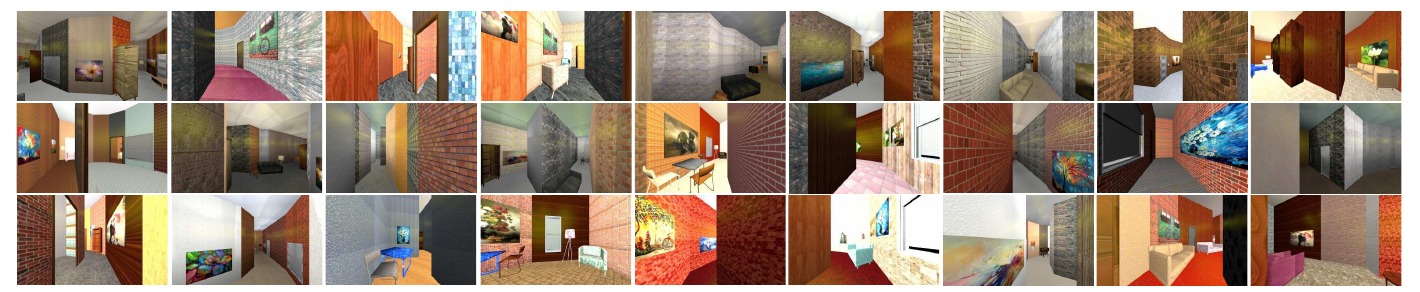
Fig. 2. Examples of rendered images using our simulator. We randomize textures, lighting and furniture placement to create a visually diverse set of scenes.
图 2. 用我们的仿真器渲染的图像示例。我们随机化纹理、光照和家具摆放,以创建视觉上多样的场景集合。

Fig. 3. We use a fully convolutional neural network to learn the Q-function. Our network, shown above, is based on VGG16 with dilated operations.
图 3. 我们用全卷积神经网络来学习 Q 函数。上图所示的网络基于带膨胀运算的 VGG16。
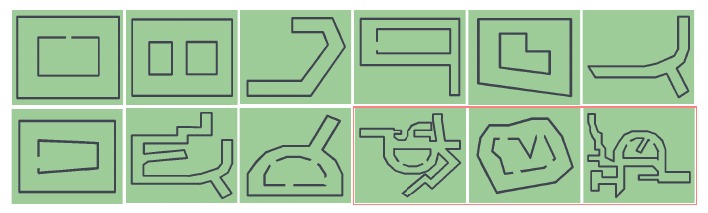
Fig. 4. Floor plans of the synthetic hallways. The last three hallways are used for evaluation while the first 9 are used during training.
图 4. 合成走廊的平面图。最后三条走廊用于评估,前 9 条用于训练。
D. Network Architecture
D. 网络架构
In order to represent the Q-function and the initial open space predictor, we use a deep fully convolutional neural network with dilation operations, built on the VGG16 [40] architecture following [9] as shown in Figure 3. The output score map corresponds to a grid of bins, which constitutes the action space for deep reinforcement learning. The network is trained with stochastic gradient descent (SGD), with a cross-entropy loss function.
为了表示 Q 函数和最初的开阔空间预测器,我们使用带膨胀运算的深度全卷积神经网络,它建立在 VGG16 [40] 架构之上,并遵循 [9],如图 3 所示。输出分数图对应 的格子,构成深度强化学习的动作空间。网络用随机梯度下降(SGD)训练,损失函数为交叉熵。
IV. LEARNING FROM SIMULATION
IV. 从仿真中学习
Conventionally, learning-based approaches to autonomous flight have relied on learning from demonstration [2, 1, 30, 34]. Although the learning by demonstration approach has been successfully applied to a number of flight scenarios, the requirement for human-provided demonstrations limits the quantity and diversity of data that can be used for training. Since dataset size has been demonstrated to be critical for the success of learning methods, this likely severely limits the generalization capacity of purely demonstration-based methods. If we can train flight controllers using larger and more diverse datasets collected autonomously, we can in principle achieve substantially better generalization. However, in order to autonomously learn effective collision prediction models, the vehicle needs to see enough examples of collisions during training to build an accurate estimator. This is problematic in real physical environments, where even a single collision can lead to damage or loss of the vehicle. To get the benefits of an autonomous learning from the agent’s own experience and overcome the limitations of data collection in learning from demonstration method, we use a simulated training environment that is specifically designed to enable effective transfer to real-world settings.
传统上,基于学习的自主飞行方法依赖从示范中学习 [2, 1, 30, 34]。虽然示范学习已成功用于多种飞行场景,但需要由人提供示范,这限制了可用于训练的数据数量和多样性。既然数据集规模已被证明对学习方法的成功至关重要,这很可能会严重限制纯示范方法的泛化能力。如果我们能用自主采集的、更大且更多样的数据集来训练飞行控制器,原则上就可以获得明显更好的泛化。然而,为了从智能体自身经验中自主学到有效的碰撞预测模型,飞行器在训练中需要看到足够多的碰撞例子,才能建立起准确的估计器。这在真实物理环境中很成问题,因为即使一次碰撞也可能导致飞行器损坏或损失。为了获得从智能体自身经验中自主学习的好处,并克服示范学习中数据采集的限制,我们使用一个专门设计的仿真训练环境,以便有效迁移到真实世界设定。
We manually designed a collection of 3D indoor environments to form the basis of our simulated training setup. The environments were built using the Blender [6] open-source 3D modeling suite. Our synthetic dataset contains different hallways, shown in Figure 4, and represent a variety of structures that can be seen in real hallways, such as long straight or circular segments with multiple junction connectivity, as well as side rooms with open or closed doors. We use furnitures with various type and size to populate the hallways. The walls are textured with randomly chosen textures (e.g. wood, metal, textile, carpet, stone, glass, etc.), and illuminated with lights that are placed and oriented at random. In order to provide a diversity of viewpoints we render pretraining images by flying a simulated camera with randomized height and random camera orientation.
我们手工设计了一组三维室内环境,作为仿真训练设置的基础。这些环境用开源三维建模套件 Blender [6] 搭建。我们的合成数据集包含图 4 所示的不同走廊,并表现了真实走廊中可见的多种结构,例如带有多个路口连通的长直段或环形段,以及门开或门关的侧间。我们用类型和尺寸各异的家具来布置走廊。墙壁贴上随机选取的纹理(例如木头、金属、织物、地毯、石头、玻璃等),并用位置和朝向随机的灯光照明。为了提供多样的视点,我们让仿真相机以随机高度和随机朝向飞行,来渲染预训练图像。
The randomization of the hallway parameters produces a very large diversity of training scenes, a sample of which can be seen in Figure 2. Although the training hallways are far from being photo-realistic, the large variety of appearances allows us to train highly generalizable models, as we will discuss in the experimental evaluation. The intuition behind this idea is that, by forcing the model to handle a greater degree of variation than is typical in real hallways (e.g., wide ranges of lighting conditions and textures, some of which are realistic, and some not), we can produce a model that generalizes also to real-world scenes, which might be systematically different from our renderings. That is, the wider we vary the parameters in simulation, the more likely we are to capture properties of the real world somewhere in the set of all possible scenes we consider. Our findings in this regard are aligned with the results obtained in other recent works [32], which also used only synthetic renderings to train visual models, but did not explicitly consider wide-ranging randomization of the training scenes.
走廊参数的随机化产生了非常多样的训练场景,其中一些样本可见图 2。尽管训练走廊远谈不上照片级逼真,但外观上的巨大变化使我们能够训练出高度可泛化的模型,这一点将在实验评估中讨论。这一想法背后的直觉是:通过迫使模型处理比真实走廊中典型情况更大的变化(例如范围很宽的光照条件和纹理,其中有些逼真,有些并不逼真),我们可以得到也能泛化到真实世界场景的模型,而这些真实场景可能与我们的渲染存在系统性差异。也就是说,我们在仿真中把参数变化得越宽,就越有可能在所考虑的全部可能场景集合中的某处捕捉到真实世界的性质。我们在这方面的发现与其他近期工作 [32] 的结果一致,那些工作也只用合成渲染来训练视觉模型,但没有显式考虑对训练场景做大范围随机化。
V. EXPERIMENTAL RESULTS
V. 实验结果
Despite that reinforcement learning evaluations emphasize mastery over generalization here our focus is on to evaluate the generalization capability of our proposed approach. Testing generalization is specially important from robotics perspective since the autonomous agent should be able to generalize to the diverse real-world settings. To this end, we evaluate our performance by running several experiments both in synthetic and real environments none of which had been seen during the training time. We compared our results against a set of baselines and also qualitatively evaluate our performance in various real-world scenarios. Additionally, we present an ablation study on a real-world RGB-D dataset to quantitatively evaluate our proposed randomized simulator for simulation to real-world transfer. In all the experiments (synthetic and real-world flights), CADRL is trained on a fixed set of synthetic 3D models of hallways and in a fully simulated environment without being exposed to any real images.
尽管强化学习评估往往更强调掌握而非泛化,这里我们的重点是评估所提方法的泛化能力。从机器人学的角度看,检验泛化尤为重要,因为自主智能体应当能够泛化到多样的真实世界设定。为此,我们在训练时从未见过的合成环境和真实环境中做了多项实验。我们将结果与一组基线比较,并在多种真实世界场景中定性评估表现。此外,我们在真实世界 RGB-D 数据集上做了消融,以定量评估所提出的随机化仿真器对仿真到真实世界迁移的作用。在所有实验(合成与真实世界飞行)中,CADRL 都在固定的一组合成三维走廊模型上、完全仿真的环境中训练,没有接触过任何真实图像。
A. Realistic Environment Evaluation
A. 真实感环境评估
In order to evaluate how well such a model might transfer to a realistic environment, we used a realistic 3D mesh provided by [21]. Testing on this data can provide us a close proxy of our performance in a real indoor environment and also evaluates the generalization capability of our method in a systematically different environment than our training environments. Figure 6 shows the floorplan of this hallway, as well as several samples of its interior view. We generated 60 random initialization point from various locations in the hallways. These points are fixed and all baselines are evaluated on the same set of points so that their performance is directly comparable. Figure 6.a depicts the initialization points as red dots. The velocity of the quadrotor is fixed to 0.2 meters per time step in this experiment, and the maximum number of steps is set to 6000 which is equal to 1.2 kilometers.
为了评估这样的模型向真实感环境迁移得如何,我们使用了 [21] 提供的真实感三维网格。在这些数据上测试,可以近似反映我们在真实室内环境中的表现,也评估了该方法在与训练环境有系统性差异的环境中的泛化能力。图 6 给出了这条走廊的平面图以及若干内部视图样本。我们在走廊中的不同位置生成了 60 个随机初始化点。这些点是固定的,所有基线都在同一组点上评估,以便直接比较。图 6.a 用红点标出初始化点。本实验中四旋翼的速度固定为每个时间步 0.2 米,最大步数设为 6000,相当于 1.2 公里。
Our aim is to evaluate the performance of our trained policy in terms of the duration of collision free flight. To do this, we run continuous episodes that terminate upon experiencing a collision, and count how many steps are taken before a collision takes place. We set the maximum number of steps to a fixed number throughout each experiment. We evaluate performance in terms of the percentage of trials that reached a particular flight length. To that end, we report the results using a curve that plots the distance traveled along the horizontal axis, and the percentage of trials that reached that distance before a collision on the vertical axis. This provides an accurate and rigorous evaluation of each policy, and allows us to interpret for each method whether it is prone to collide early in the flight, or can maintain collision-free flight at length. Note that achieving completely collision-free flight in all cases from completely randomized initial configurations is exceptionally difficult.
我们的目标是从无碰飞行持续时间来评估所训练策略的表现。为此,我们运行在发生碰撞时终止的连续回合,并统计碰撞发生前所走的步数。每个实验中把最大步数设为固定值。我们用到达某一飞行长度的试验百分比来评估性能。为此,我们用一条曲线报告结果:横轴是飞行距离,纵轴是在碰撞前到达该距离的试验百分比。这为每个策略提供了准确而严格的评估,也让我们能够判断每种方法是容易在飞行早期碰撞,还是能够长时间保持无碰飞行。需要说明的是,在完全随机的初始配置下让所有情况都做到完全无碰飞行,是极其困难的。
In this experiment, we compare against two baselines explained below. We also report the performance of our base Free Space prediction (FS-pred) controller to analyze the improvement obtained by incorporating deep reinforcement learning. In the FS-pred, the model described in III-B is used.
在本实验中,我们与下面说明的两个基线比较。我们还报告基础的自由空间预测(FS-pred)控制器的表现,以分析引入深度强化学习带来的改进。FS-pred 使用第 III-B 节所述的模型。
Straight Controller This lower bound baseline flies in a straight line without turning. In a long straight hallway, this baseline establishes how far the vehicle can fly without any perception, allowing us to ascertain the difficulty of the initialization conditions.
直线控制器。这一作为下界的基线沿直线飞行、不做转弯。在长直走廊中,该基线给出飞行器在没有任何感知时能飞多远,从而帮助我们判断初始化条件的难度。
Left, Right, and Straight (LRS) Controller This baseline, based on [14], directly predicts the flight direction from images. The commands are discretized into three bins: “left,” “right,” or “straight,” and the predictions are made by a deep convolutional neural network from raw images. For training the model, prior work used real-world images collected from three cameras pointing left, right and straight that were carried manually through forest trails. We simulated the same training setup in our training environments. We finetuned a VGG16 [40] model, pretrained with ImageNet classification. This method can be considered a human-supervised alternative to our autonomous collision avoidance policy.
左、右与直行(LRS)控制器。这一基于 [14] 的基线直接从图像预测飞行方向。指令被离散成三个格子:“左”“右”或“直行”,预测由深度卷积神经网络从原始图像给出。为了训练该模型,先前工作使用了由三台分别朝向左、右和前方的相机在林间小路上人工携带采集的真实图像。我们在自己的训练环境中仿真了同一训练设置,并微调了一个用 ImageNet 分类预训练的 VGG16 [40] 模型。该方法可以看作对我们自主避障策略的一种有人类监督的替代。
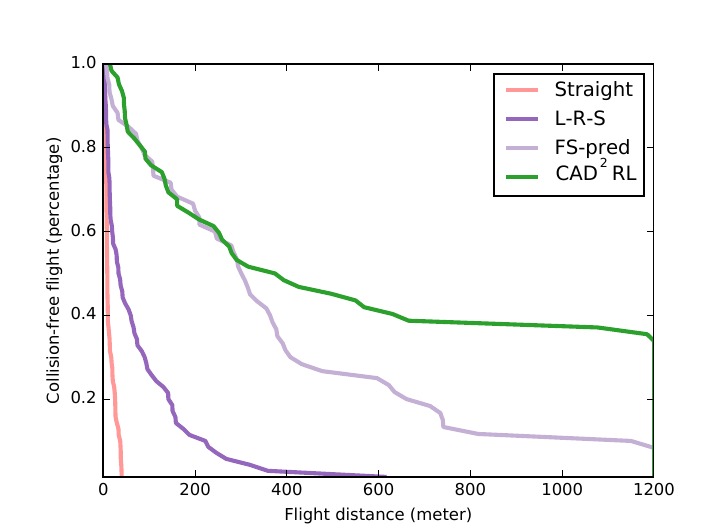
Fig. 5. Quantitative results on a realistically textured hallway. Our approach, CADRL, outperforms the prior method (L-R-S) and other baselines.
图 5. 在一条具有真实感纹理的走廊上的定量结果。我们的方法 CADRL 超过了先前方法(L-R-S)以及其他基线。
- Quantitative Evaluation: Figure 5 summarizes the performance of our proposed CADRL method compared with other baselines. Our method outperforms the prior methods and baselines by a substantial margin. Qualitatively, we found that the LRS method tends to make poor decisions at intersections, and the coarse granularity of its action representation also makes it difficult for it to maneuver near obstacles. CADRL is able to maintain a collision-free flight of 1.2 kilometers in about 40% of the cases, and substantially outperforms the model that is simply trained with supervised learning to predict 1 meter of free space in front of the vehicle. This experiment shows that although we did not use real images during training, our learned model can generalize to substantially different and more realistic environments, and can maintain collision-free flight for relatively long periods.
- 定量评估:图 5 汇总了所提出的 CADRL 方法与其他基线的表现。我们的方法以明显优势超过先前方法和基线。从定性上看,我们发现 LRS 方法往往在路口做出较差的决策,其动作表示较粗,也使它难以在障碍附近机动。CADRL 能够在约 40% 的情形中保持 1.2 公里的无碰飞行,并明显超过只用监督学习来预测飞行器前方 1 米自由空间的模型。这一实验表明,尽管训练时没有使用真实图像,学到的模型仍能泛化到明显不同、也更逼真的环境,并在相对较长的时间内保持无碰飞行。
- Qualitative Evaluation: To be able to qualitatively compare the performance and behavior of CADRL with our perception based controller and the LRS method, we visualized the trajectory of the flights overlaid on the floor-plan of the hallway as shown in Figure 6. For this purpose, we sorted the trajectories of each method based on the traveled distance and selected the top 25 longest flights from each method. The trajectory colors show the flight direction at each point. The black dots indicate the locations of the hallway where collisions occurred. This visualization shows that CADRL could maintain a collision-free flight in various locations in the hallway and has fewer collisions at the dead-ends, corners, and junctions compared with the other two methods. LRS often experienced collisions in corners and is more vulnerable to bad initial locations. The policy trained with free space prediction outperformed the LRS method, but often is trapped in rooms or fail near junctions and corners. This illustrates that the controller trained with RL was able to acquire a better strategy for medium-horizon planning, compared to the directly supervised greedy methods.
- 定性评估:为了定性比较 CADRL 与我们基于感知的控制器以及 LRS 方法的表现和行为,我们把飞行轨迹叠在走廊平面图上可视化,如图 6 所示。为此,我们按飞行距离对每种方法的轨迹排序,并从每种方法中选出最长的 25 次飞行。轨迹颜色表示每个点上的飞行方向。黑点标出走廊中发生碰撞的位置。这一可视化表明,CADRL 能在走廊中的不同位置保持无碰飞行,并且在死胡同、拐角和路口的碰撞比另外两种方法更少。LRS 常常在拐角处碰撞,也更容易受较差初始位置的影响。用自由空间预测训练的策略超过了 LRS 方法,但常常被困在房间里,或在路口和拐角附近失败。这说明,用强化学习训练的控制器能够获得更好的中等时程规划策略,相比之下,直接受监督的贪心方法则不足。
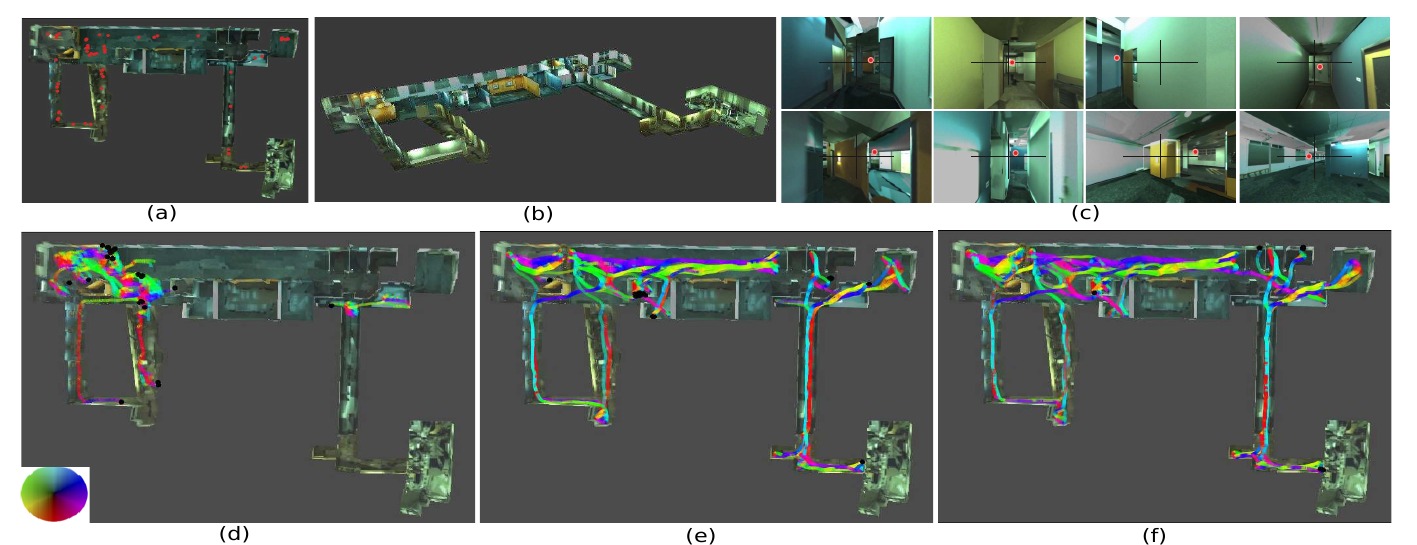
Fig. 6. Qualitative results on a realistically textured hallway. Colors correspond to the direction of trajectory movement at each point in the hallway as per the color wheel. (a) Red dots show flight initialization points (b) Overlook view of the hallway (c) Red dots show the control points produced by CADRL. (d) LRS trajectories (e) Perception controller (FS-pred) trajectories (f) CADRL trajectories.
图 6. 在一条具有真实感纹理的走廊上的定性结果。颜色按色轮表示走廊中每个点上的轨迹运动方向。(a) 红点表示飞行初始化点;(b) 走廊俯视图;(c) 红点表示 CADRL 产生的控制点;(d) LRS 的轨迹;(e) 感知控制器(FS-pred)的轨迹;(f) CADRL 的轨迹。
B. Real World Flight Experiments
B. 真实世界飞行实验
We evaluated our learned collision avoidance model by flying a drone in real world indoor environments. These flights required flying through open spaces, navigating hallways, and taking sharp turns, while avoiding collisions with furniture, walls, and fixtures. We used two different drone platforms: the Parrot Bebop 1.0 and the Bebop 2.0, both controlled via the ROS Bebop autonomy package [28]. We perform real-world flight in several different scenarios and evaluate our performance both quantitatively and qualitatively.
我们通过在真实世界室内环境中飞行无人机,评估所学的避障模型。这些飞行需要穿越开阔空间、在走廊中导航并做急转弯,同时避开家具、墙壁和固定装置。我们使用了两种不同的无人机平台:Parrot Bebop 1.0 和 Bebop 2.0,都通过 ROS Bebop autonomy 软件包 [28] 控制。我们在若干不同场景中进行真实世界飞行,并从定量和定性两方面评估表现。
- Quantitative Evaluation: For quantitative evaluation, we ran controlled experiments on the task of hallway following. We fixed all the testing conditions while navigating the drone with either of the CADRL and a baseline controller. The testing conditions include the initial velocity, angular speed, drone platform and the test environment. As was concluded from the experiments in section V-A, FS-pred was the strongest baseline, and we therefore included it as a comparison in this experiment. We ran experiments in two different buildings, Cory Hall and SDH (Sutardja Dai Hall), both located on the UC Berkeley campus. These buildings have considerably different floor plans, wall textures, and lighting conditions, as can be seen in Figure 7.c and Figure 7.d. Our testing environment in Cory Hall contained three turns and two junctions, while the SDH test environment had one turn and one junction. The width of the Cory hall hallway is meters while the SDH hallway is meters wide.
- 定量评估:为了定量评估,我们在走廊跟随任务上做了受控实验。在用 CADRL 或基线控制器导航无人机时,我们固定了全部测试条件。测试条件包括初始速度、角速度、无人机平台和测试环境。由第 V-A 节的实验可知,FS-pred 是最强的基线,因此在本实验中把它纳入比较。我们在两栋不同的建筑中做实验:Cory Hall 和 SDH(Sutardja Dai Hall),都位于加州大学伯克利分校校园内。这两栋建筑的平面布局、墙面纹理和光照条件有相当大的差别,如图 7.c 和图 7.d 所示。Cory Hall 的测试环境包含三个转弯和两个路口,SDH 的测试环境则有一个转弯和一个路口。Cory Hall 走廊宽约 3 米,SDH 走廊宽约 2 米。
TABLE I
REAL WORLD FLIGHT RESULTS.
| Environment | Traveled Distance (meters) | Travel Time (minutes) | Collision (per meter) | Collision (per minute) | Safe Flight (meters) | Safe Flight (minutes) | Total Collisions |
|---|---|---|---|---|---|---|---|
| Cory FS-pred | 162.458 | 12.01 | 0.080 | 1.081 | 12.496 | 0.924 | 13 |
| Cory CADRL | 163.779 | 11.950 | 0.0366 | 0.502 | 27.296 | 1.991 | 6 |
| SDH FS-pred | 53.492 | 4.016 | 0.130 | 1.742 | 7.641 | 0.573 | 7 |
| SDH CADRL | 54.813 | 4.183 | 0.072 | 0.956 | 13.703 | 1.045 | 4 |
表 I
真实世界飞行结果。
| 环境 | 飞行距离(米) | 飞行时间(分钟) | 碰撞(每米) | 碰撞(每分钟) | 安全飞行(米) | 安全飞行(分钟) | 总碰撞次数 |
|---|---|---|---|---|---|---|---|
| Cory FS-pred | 162.458 | 12.01 | 0.080 | 1.081 | 12.496 | 0.924 | 13 |
| Cory CADRL | 163.779 | 11.950 | 0.0366 | 0.502 | 27.296 | 1.991 | 6 |
| SDH FS-pred | 53.492 | 4.016 | 0.130 | 1.742 | 7.641 | 0.573 | 7 |
| SDH CADRL | 54.813 | 4.183 | 0.072 | 0.956 | 13.703 | 1.045 | 4 |
Table V-B1 summarizes the results. The safe flight time is given by the average length of a collision free flight in terms of distance or time between collisions. CADRL experienced fewer collisions and has longer expected safe flight. This suggests that the CADRL policy makes fewer mistakes and is more robust to perturbations and drift. Both methods performed better in Cory, since SDH has narrower hallways with glossy textureless walls as well as stronger air currents. While we fixed the test environment and the flying speed, the traveled distance and time is slightly different from one algorithm to another due to the fact that the algorithms generated different commands and navigated the drone to slightly different locations in the hallways.
表 V-B1 汇总了这些结果。安全飞行时间由无碰飞行的平均长度给出,以碰撞之间的距离或时间计。CADRL 碰撞更少,期望安全飞行也更长。这表明 CADRL 策略犯错更少,对扰动和漂移也更稳健。两种方法在 Cory 中都表现更好,因为 SDH 的走廊更窄,墙面光滑且缺少纹理,气流也更强。虽然我们固定了测试环境和飞行速度,不同算法的飞行距离和时间仍略有差别,因为它们生成了不同的指令,并把无人机导航到走廊中略有不同的位置。
- Qualitative Evaluation: We performed real world flight in various indoor scenarios. We briefly explain each scenario and sequence snapshots are shown in Figure 7.
- 定性评估:我们在多种室内场景中进行了真实世界飞行。下面简要说明每个场景,序列快照见图 7。
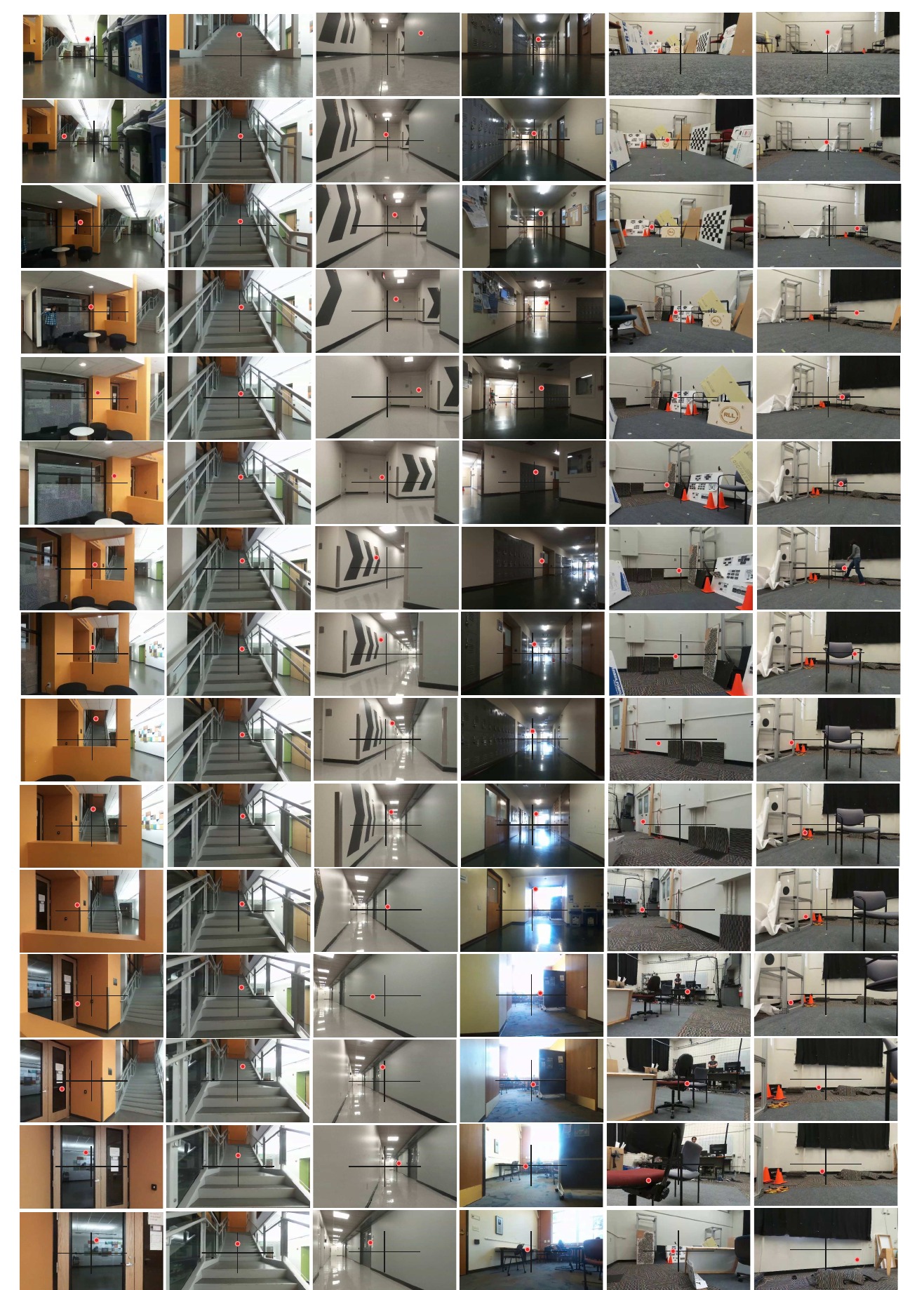
Fig. 7. Snapshots of autonomous flight in various real indoor scenarios. Frames ordered from top to bottom. Red dots show the commanded flight direction by CADRL. (a) Flying near furniture, around corners, through a window; (b) Flying up a staircase; (c) Navigating in narrow corridors; (d) Navigating through junctions, fly through rooms; (e) Flying through a maze of random obstacles in a confined space; (f) Avoiding dynamic obstacles.
图 7. 在多种真实室内场景中自主飞行的快照。帧按从上到下排列。红点表示 CADRL 给出的指令飞行方向。(a) 在家具附近、绕过拐角、穿过窗口飞行;(b) 沿楼梯向上飞;(c) 在狭窄走廊中导航;(d) 穿越路口,飞过房间;(e) 在受限空间中穿过由随机障碍构成的迷宫;(f) 避开动态障碍。
(a) Flying near furniture, around corners, and through a window: As shown in Figure 7.a. the drone starts from one end of a hallway connected to a small lounge area with furniture. The drone first flies toward the open lounge area, and then turns toward a corner of the room. There, it detects an opening in the wall which is visually similar to an open doorway or window, and adjust its height to fly through it. The drone then encounters a reflective glass door, which reflects the hallway behind it. Since no such structures were present during training, the reflective door fools the controller, causing the drone to crash into the door. Note that the controller navigates multiple structures that are substantially different, both visually and geometrically, from the ones encountered during simulated training.
(a) 在家具附近、绕过拐角并穿过窗口飞行:如图 7.a 所示,无人机从一条与带家具的小休息区相连的走廊一端出发。它先飞向开阔的休息区,再转向房间的一个角落。在那里,它检测到墙上一个在视觉上类似开着的门口或窗口的开口,并调整高度飞过去。随后无人机遇到一扇反射玻璃门,门上映出它身后的走廊。由于训练中没有出现过这类结构,反光门把控制器骗了,导致无人机撞上门。需要说明的是,控制器已经穿越了在视觉和几何上都与仿真训练中遇到的结构有明显差别的多种结构。
(b) Flying up a staircase: Here, our goal is to evaluate the generalization capability of the controller to changes in elevation. A staircase provides a good example of this. To avoid colliding with the stairs, the drone must continuously increase altitude. As can be seen from the snapshots in the Figure 7.b, the controller produces actions that increase the altitude of the drone at each step along the staircase. Since we used an altitude limit for safety reasons, the drone only flew halfway up the staircase, but this experiment shows that the controller could effectively generalize to structures such as staircases that were not present during training.
(b) 沿楼梯向上飞:这里,我们的目标是评估控制器对高度变化的泛化能力。楼梯是一个很好的例子。为了不撞上楼梯,无人机必须不断升高。从图 7.b 的快照可以看出,控制器在沿楼梯的每一步都产生使无人机升高的动作。出于安全原因我们设置了高度限制,因此无人机只飞到了楼梯中途,但这一实验表明,控制器能够有效泛化到训练中没有出现过的楼梯这类结构。
(c) Navigating through narrow corridors: In this scenario, the drone flies through a corridor. The drone successfully takes a turn at Frames 1-4 in Figuree 7.c to avoid flying into a dead end. The corridors in this test scenario are narrow ( meters) and have strong air currents due to air conditioning.
(c) 在狭窄走廊中导航:在这一场景中,无人机飞过一条走廊。它在 Figuree 7.c 的第 1–4 帧成功转弯,以避免飞进死胡同。该测试场景中的走廊较窄(约 2 米),并因空调而有较强气流。
(d) Flying through junctions and rooms: Here, the drone navigates through a long hallway with junctions. At the end it enters a doorway which is connected to a study room. The controller successfully navigates the drone through the narrow door and into the room without colliding with the chairs.
(d) 穿越路口和房间:这里,无人机沿一条带路口的长走廊导航。最后它进入一个通向书房的门口。控制器成功地让无人机穿过狭窄的门进入房间,没有撞到椅子。
(e) Flying through a maze of random obstacles in a confined space: We built a small U-shaped maze out of low obstacles in the lab. This maze is built using chairs and pieces of board with various appearance and colors. To prevent the drone from simply flying over the obstacles, we limited the altitude to 3 feet. Note that flying the drone at low altitude is challenging, as the air turbulence becomes significant and affects the drone’s stability. The cardboard shifts due to air turbulence, and the open area is very narrow ( meter), making this a challenging test environment. The sequence in Figure 7.e shows that the controller successfully navigates the drone throughout the maze, making a turn near the red chair and turning back into the maze, without colliding.
(e) 在受限空间中穿过由随机障碍构成的迷宫:我们在实验室里用低矮障碍搭了一个小型 U 形迷宫。迷宫由外观和颜色各异的椅子和板材构成。为了防止无人机直接从障碍上方飞过,我们把高度限制在 3 英尺。需要说明的是,低空飞行很有挑战性,因为气流扰动会变得显著并影响无人机的稳定性。纸板会因气流扰动而移动,开阔区域非常窄(约 1 米),使这成为一个有挑战性的测试环境。图 7.e 中的序列显示,控制器成功地让无人机穿过整个迷宫,在红椅子附近转弯并折回迷宫,没有发生碰撞。
(f) Avoiding dynamic obstacles: In this scenario, the drone begins in the lab with no obstacles and an altitude of around 3 feet. We then place a chair in the path of the drone, as seen in frames 3-4 of Figure 7.f. The controller recovers and avoids an imminent collision with the chair, passing it on the left.
(f) 避开动态障碍:在这一场景中,无人机从实验室中没有障碍、高度约 3 英尺的状态开始。随后我们把一把椅子放到无人机的路径上,如图 7.f 的第 3–4 帧所示。控制器恢复过来,避开了即将与椅子发生的碰撞,并从左侧绕过。
The above qualitative evaluation study shows the generalization capability of our trained model and demonstrates the extent of the maneuvering skills learned by CADRL. Although our model is specifically trained for the task of hallway navigation, the limited number of furniture items present in simulation also force the policy to be robust to oddly shaped obstacles, and train it to change altitude to avoid collisions. Navigating through the obstacles in the scenarios (a), (b), (e), and (f) required collision avoidance with general obstacles and other than just walls. We observed that our model could perform reasonably well in these cases, and could often recover from its mistakes, though particularly novel situations proved confusing.
上述定性评估展示了训练模型的泛化能力,也表明了 CADRL 所学到的机动技能的范围。尽管我们的模型是专门为走廊导航任务训练的,仿真中数量有限的家具也迫使策略对形状奇特的障碍保持稳健,并训练它通过改变高度来避障。在场景 (a)、(b)、(e) 和 (f) 中穿越障碍,需要避开的是一般障碍,而不仅仅是墙壁。我们观察到,模型在这些情形中表现尚可,并且常常能够从错误中恢复,不过特别新颖的情况仍会把它们弄糊涂。
C. Ablation Study for Real World Transfer
C. 面向真实世界迁移的消融研究
In this section, we present an ablation study to identify how important the randomization of the environment is for effective simulation to real-world transfer. Since conducting statistically significant real-world flight trials for many training conditions is time-consuming and subject to confounding factors (air currents, lighting conditions, etc.), we instead opted for a proxy task that corresponds to free-space prediction from real RGB images, with ground truth labels obtained via a depth camera. The goal in this task is to predict, for each point in the image, whether there is an obstacle within a certain threshold distance of the camera or if the pixel corresponds to free space. Although this proxy task does not directly correspond to collision-free flight, the reduced variance of the evaluation (since all methods are tested on exactly the same images) makes this a good choice for the ablation study. While we obtained reasonably good performance for avoiding collisions in the hallways, more detailed depth estimation [36, 24, 23] could also be used without loss of generality.
在这一节中,我们做一项消融研究,以确定环境随机化对有效的仿真到真实世界迁移有多重要。由于在许多训练条件下做具有统计显著性的真实世界飞行试验既耗时,又会受气流、光照等混杂因素影响,我们改用一个代理任务:从真实 RGB 图像预测自由空间,真实标签由深度相机得到。该任务的目标是对图像中的每个点预测:在相机某一阈值距离内是否有障碍,或者该像素是否对应自由空间。虽然这一代理任务并不直接对应于无碰飞行,但由于评估方差更小(所有方法都在完全相同的图像上测试),它适合用于消融研究。虽然我们在走廊避障上已经获得了相当不错的表现,更细致的深度估计 [36, 24, 23] 也可以在不失一般性的前提下使用。
We used the same architecture as in Section III-B for the free-space prediction network and trained free-space predictors using rendered images from different simulated setups. We compared the obtained results against a similar network trained using our proposed randomized simulation. We used the same number of images sampled similarly from various locations in the hallways. The ablated networks are trained with images rendered from (a) a simulator that used Fixed Textures and lighting, and only 3 of our training hallways (FT3); (b) Fixed Textures and lighting using all 9 training hallways (FT9); (c) the more Realistic Textures and Geometry hallway provided by [21] (RTG) and (d) our approach, with randomized textures and lighting from 9 hallways. While (a), (b), and (d) are captured from synthetic hallways, in (c) the data is captured via a SLAM-based reconstruction system from the Cory Hall in the UC Berkeley campus. Therefore, this data has realistic geometry textured with natural images, and allows us to understand how the method would perform if trained on reconstructed RGBD data.
自由空间预测网络使用与第 III-B 节相同的架构,我们用不同仿真设置渲染的图像来训练自由空间预测器,并把结果与用所提出的随机化仿真训练的类似网络比较。我们使用数量相同、同样从走廊中不同位置采样的图像。消融网络分别用以下渲染图像训练:(a) 使用固定纹理和光照、且只用 3 条训练走廊的仿真器(FT3);(b) 使用固定纹理和光照、并用全部 9 条训练走廊(FT9);(c) [21] 提供的更具真实感纹理和几何的走廊(RTG);以及 (d) 我们的方法,对 9 条走廊做纹理和光照随机化。(a)、(b) 和 (d) 取自合成走廊,而 (c) 的数据来自加州大学伯克利分校校园内 Cory Hall 的基于 SLAM 的重建系统。因此,这些数据具有用自然图像贴纹理的真实几何,使我们能够了解若在重建的 RGB-D 数据上训练,该方法会有怎样的表现。
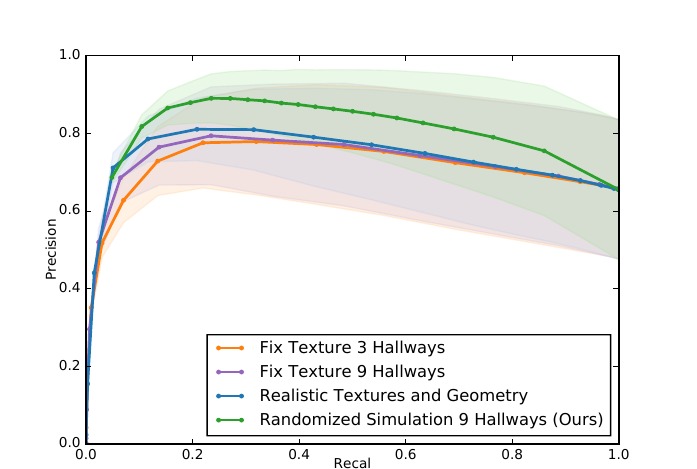
Fig. 8. Quantitative results for free-space prediction with different simulators. The network trained on randomized hallways outperforms networks trained on less randomized simulations and even on realistic textured hallways.
图 8. 用不同仿真器做自由空间预测的定量结果。在随机化走廊上训练的网络,超过了在随机化程度更低的仿真上训练的网络,甚至超过了在具有真实感纹理的走廊上训练的网络。
Our dataset contains RGB-D images captured from 5 hallways, in Cory Hall and SDH (Sutardja Dai Hall) located in UC Berkeley, with various lighting and texture conditions. We used a Kinect v2 and our dataset contains a total of 620 RGB-D images. Several example images of this data are shown in Figure 9. We used the depth channel to automatically annotate the images with free-space vs. non-free-space labels.
我们的数据集包含在加州大学伯克利分校的 Cory Hall 和 SDH(Sutardja Dai Hall)的 5 条走廊中采集的 RGB-D 图像,具有多种光照和纹理条件。我们使用 Kinect v2,数据集共有 620 张 RGB-D 图像。图 9 给出了若干示例。我们用深度通道自动为图像标注自由空间与非自由空间标签。
For each pixel in the input image, the network produces a probability value for free-space prediction. To evaluate the accuracy of free-space prediction we sweep a threshold from 0 to 1 to label each pixel using our prediction network. We compute the precision and recall at each threshold and plot the precision-recall curve as the performance metric. Precision is the number pixels correctly labeled as free-space divided by the total number of pixels predicted as free-space, while recall is the the number pixels correctly labeled as free-space divided by the total number pixels belonging to the free-space according to the ground truth. Since we use monocular images, there is a scale ambiguity in the size of hallways as well as in the range of sensible depths, which may not match between the simulated and real images. To overcome this ambiguity and to make a fair comparison, we labeled image pixels (for free-space vs non-free-space) by varying the depth threshold from 1 to 4 meters (steps of cm) and computed the average precision/recall corresponding for each threshold over 13 runs.
对输入图像中的每个像素,网络产生一个自由空间预测的概率值。为了评估自由空间预测的准确性,我们将阈值从 0 扫到 1,用预测网络给每个像素打标签。我们计算每个阈值下的精确率和召回率,并画出精确率–召回率曲线作为性能指标。精确率是被正确标为自由空间的像素数除以被预测为自由空间的像素总数;召回率是被正确标为自由空间的像素数除以根据真实标注属于自由空间的像素总数。由于我们使用单目图像,走廊尺寸以及合理深度范围存在尺度歧义,仿真图像与真实图像之间可能并不匹配。为克服这一歧义并做公平比较,我们把深度阈值从 1 米变到 4 米(步长约 30 厘米)来标注图像像素(自由空间与非自由空间),并对每个阈值在 13 次运行上计算平均精确率/召回率。
Figure 8 shows the results, with shaded areas showing the standard deviation in precision. The network trained with the synthetic data rendered by our proposed randomized simulator outperforms the other networks. The images used for FT3 and FT9 are rendered on the same hallways as RT9, except that the textures and lighting are not randomized. As a result, these networks do not learn texture and color invariant features and cannot generalize well to the real images. In RTG, the images are rendered with realistic geometry and textures, and thus they are less affected by the scale ambiguity. Furthermore, the realistic textures in RTG are obtained from similar hallways as the one we used for our RGB-D test set. Despite this, the network trained on a realistic rendering of the same hallway actually performs worse than the network trained on our randomized simulator, by a substantial margin. For qualitative analyis, we show the probability map of free-space prediction obtained from our approach in the last row of Figure 8. We see that high probabilities are assigned to free spaces. Although the free-space prediction proxy task is not a perfect analogue for collision-free flight, these results suggest that randomization is important for good generalization, and that more realistic renderings should not necessarily be preferred to ones that are less realistic but more diverse.
图 8 给出了结果,阴影区域表示精确率的标准差。用我们提出的随机化仿真器渲染的合成数据训练的网络超过了其他网络。FT3 和 FT9 所用的图像是在与 RT9 相同的走廊上渲染的,只是纹理和光照没有随机化。结果是,这些网络没有学到对纹理和颜色不变的特征,因而不能很好地泛化到真实图像。在 RTG 中,图像是用真实感几何和纹理渲染的,因而较少受尺度歧义影响。此外,RTG 中的真实感纹理来自与我们 RGB-D 测试集所用走廊相似的走廊。尽管如此,在同一条走廊的真实感渲染上训练的网络,实际上仍明显差于在我们的随机化仿真器上训练的网络。为了做定性分析(原文作 analyis),我们在图 8 的最后一行展示了本方法得到的自由空间预测概率图。可以看到,高概率被赋给了自由空间。虽然自由空间预测这一代理任务并非无碰飞行的完美对应,这些结果仍然表明,随机化对良好泛化很重要,而且更逼真的渲染并不一定就优于不那么逼真但更多样的渲染。
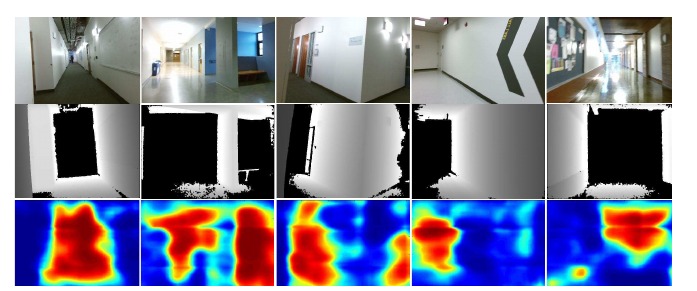
Fig. 9. Examples of the collected pairs of RGB (top row) and depth (mid row) data for the free-space test set. The free-space probability map predicted by our approach is shown in the bottom row.
图 9. 自由空间测试集中采集的 RGB(上排)与深度(中排)成对数据示例。本方法预测的自由空间概率图见下排。
VI. DISCUSSION
VI. 讨论
We presented a method for training deep neural network policies for obstacle avoidance and hallway following, using only simulated monocular RGB images. We described a new simple and stable deep reinforcement learning algorithm for learning in simulation. We also demonstrate that training on randomized simulated scenes produces a model that can successfully fly and avoid obstacles in the real world, and quantitatively evaluated our randomized scenes on a proxy free-space prediction task to show the importance of randomization for real-world transfer. Our simulated evaluation further shows that our method outperforms several baselines, as well as a prior end-to-end learning-based method. Our aim in this work is to evaluate the potential of policies trained entirely in simulation to transfer to the real world, so as to understand the benefits and limitations of simulated training. To attain the best results in real environments, future work could combine simulated training with real data. Extending our approach via finetuning or domain adaptation is therefore a promising direction for future work that is likely to improve performance substantially, and lead to effective learned real-world visual navigation policies using only modest amounts of real-world training. Our approach could incorporate data from other sensors, such as depth cameras, which should improve the performance of the learned policies.
我们提出了一种只用仿真单目 RGB 图像、训练用于避障和走廊跟随的深度神经网络策略的方法。我们描述了一种新的、简单而稳定的、用于在仿真中学习的深度强化学习算法。我们还表明,在随机化的仿真场景上训练,可以得到能够在真实世界中成功飞行并避开障碍的模型,并在自由空间预测这一代理任务上定量评估了随机化场景,以说明随机化对真实世界迁移的重要性。仿真评估还表明,我们的方法超过了若干基线,以及一种既有的端到端基于学习的方法。本工作的目的,是评估完全在仿真中训练的策略向真实世界迁移的潜力,以便理解仿真训练的好处与局限。要在真实环境中取得最好结果,未来工作可以把仿真训练与真实数据结合起来。因此,通过微调或域适应来扩展我们的方法,是一条有前景的未来方向,很可能会明显提升性能,并在只用适量真实世界训练的情况下,得到有效的、学成的真实世界视觉导航策略。我们的方法也可以纳入深度相机等其他传感器的数据,这应当会提升所学策略的表现。
ACKNOWLEDGMENT
致谢
The authors would like to thank Larry Zitnick for helpful discussions and insightful remarks. This work was made possible by an ONR Young Investigator Program Award and support from Google, NVIDIA, and Berkeley DeepDrive.
作者感谢 Larry Zitnick 的有益讨论和深刻评论。本工作由 ONR Young Investigator Program Award 以及 Google、NVIDIA 和 Berkeley DeepDrive 的支持才得以完成。
References
参考文献
[1] P. Abbeel, A. Coates, M. Quigley, and A. Ng. An application of reinforcement learning to aerobatic helicopter flight. In NIPS, 2006.
[2] Pieter Abbeel, Adam Coates, and Andrew Y. Ng. Autonomous helicopter aerobatics through apprenticeship learning. IJRR, 2010.
[3] Abraham Bachrach, Ruijie He, and Nicholas Roy. Autonomous flight in unstructured and unknown indoor environments. In EMAV, 2009.
[4] Andrew J Barry and Russ Tedrake. Pushbroom stereo for high-speed navigation in cluttered environments. In ICRA. IEEE, 2015.
[5] Cooper Bills, Joyce Chen, and Ashutosh Saxena. Autonomous mav flight in indoor environments using single image perspective cues. In ICRA, 2011.
[6] Blender Community. Blender: Open Source 3D modeling suit. http://www.blender.org.
[7] Mariusz Bojarski, Davide Del Testa, Daniel Dworakowski, Bernhard Firner, Beat Flepp, Prasoon Goyal, Lawrence D Jackel, Mathew Monfort, Urs Muller, Jiakai Zhang, et al. End to end learning for self-driving cars. arXiv preprint arXiv:1604.07316, 2016.
[8] K. Celik, S.J. Chung, M. Clausman, and A. Somani. Monocular vision SLAM for indoor aerial vehicles. In IROS, 2009.
[9] Liang-Chieh Chen, George Papandreou, Iasonas Kokkinos, Kevin Murphy, and Alan L Yuille. Semantic image segmentation with deep convolutional nets and fully connected crfs. In ICLR, 2015.
[10] Yu Fan Chen, Miao Liu, Michael Everett, and Jonathan How. Decentralized non-communicating multiagent collision avoidance with deep reinforcement learning. arXiv preprint arXiv:1609.07845, 2016.
[11] Mark Cutler and Jonathan P How. Efficient reinforcement learning for robots using informative simulated priors. In ICRA, 2015.
[12] Mark Cutler, Thomas J Walsh, and Jonathan P How. Reinforcement learning with multi-fidelity simulators. In ICRA, 2014.
[13] Jakob Engel, Thomas Sch¨ops, and Daniel Cremers. Lsd-slam: Large-scale direct monocular slam. In ECCV, 2014.
[14] Alessandro Giusti, J´erˆome Guzzi, Dan C Cires¸an, Fang-Lin He, Juan P Rodr´ıguez, Flavio Fontana, Matthias Faessler, Christian Forster, J¨urgen Schmidhuber, Gianni Di Caro, et al. A machine learning approach to visual perception of forest trails for mobile robots. IEEE Robotics and Automation Letters, 2016.
[15] Saurabh Gupta, James Davidson, Sergey Levine, Rahul Sukthankar, and Jitendra Malik. Cognitive mapping and planning for visual navigation. arXiv preprint arXiv:1702.03920, 2017.
[16] P. Henry, M. Krainin, E. Herbst, X. Ren, and D. Fox. RGB- D mapping: Using kinect-style depth cameras for dense 3d modeling of indoor environments. International Journal of Robotics Research, 2012.
[17] Judy Hoffman, Sergio Guadarrama, Eric S Tzeng, Ronghang Hu, Jeff Donahue, Ross Girshick, Trevor Darrell, and Kate Saenko. Lsda: Large scale detection through adaptation. In Z. Ghahramani, M. Welling, C. Cortes, N. D. Lawrence, and K. Q. Weinberger, editors, NIPS. 2014.
[18] Hamid Izadinia, Qi Shan, and Steven M Seitz. Im2cad. In CVPR, 2017.
[19] Dong Ki Kim and Tsuhan Chen. Deep neural network for real-time autonomous indoor navigation. arXiv preprint arXiv:1511.04668, 2015.
[20] Georg Klein and David Murray. Parallel tracking and mapping for small ar workspaces. In Mixed and Augmented Reality ACM International Symposium on. IEEE, 2007.
[21] John Kua, Nicholas Corso, and Avideh Zakhor. Automatic loop closure detection using multiple cameras for 3d indoor localization. In IS&T/SPIE Electronic Imaging, 2012.
[22] Yann LeCun, Bernhard Boser, John S Denker, Donnie Henderson, Richard E Howard, Wayne Hubbard, and Lawrence D Jackel. Backpropagation applied to handwritten zip code recognition. Neural computation, 1989.
[23] Fayao Liu, Chunhua Shen, and Guosheng Lin. Deep convolutional neural fields for depth estimation from a single image. In CVPR, 2015.
[24] Fayao Liu, Chunhua Shen, Guosheng Lin, and Ian Reid. Learning depth from single monocular images using deep convolutional neural fields. IEEE transactions on pattern analysis and machine intelligence, 2016.
[25] Jeff Michels, Ashutosh Saxena, and Andrew Y Ng. High speed obstacle avoidance using monocular vision and reinforcement learning. In ICML. ACM, 2005.
[26] Volodymyr Mnih, Koray Kavukcuoglu, David Silver, Andrei A Rusu, Joel Veness, Marc G Bellemare, Alex Graves, Martin Riedmiller, Andreas K Fidjeland, Georg Ostrovski, et al. Human-level control through deep reinforcement learning. Nature, 2015.
[27] K. Mohta, V. Kumar, and K. Daniilidis. Vision based control of a quadrotor for perching on planes and lines. In ICRA, 2014.
[28] Mani Monajjemi. Bebop autonomy. http://bebop-autonomy. readthedocs.io.
[29] Dean A Pomerleau. Alvinn, an autonomous land vehicle in a neural network. Technical report, Carnegie Mellon University, Computer Science Department, 1989.
[30] A. Punjani and P. Abbeel. Deep learning helicopter dynamics models. In ICRA, 2015.
[31] Martin L Puterman and Moon Chirl Shin. Modified policy iteration algorithms for discounted markov decision problems. Management Science, 1978.
[32] Stephan R Richter, Vibhav Vineet, Stefan Roth, and Vladlen Koltun. Playing for data: Ground truth from computer games. arXiv preprint arXiv:1608.02192, 2016.
[33] Martin Riedmiller. Neural fitted q iteration – first experiences with a data efficient neural reinforcement learning method. In European Conference on Machine Learning (ECML), 2005.
[34] St´ephane Ross, Narek Melik-Barkhudarov, Kumar Shaurya Shankar, Andreas Wendel, Debadeepta Dey, J Andrew Bagnell, and Martial Hebert. Learning monocular reactive uav control in cluttered natural environments. In ICRA. IEEE, 2013.
[35] Andrei A Rusu, Matej Vecerik, Thomas Roth¨orl, Nicolas Heess, Razvan Pascanu, and Raia Hadsell. Sim-to-real robot learning from pixels with progressive nets. arXiv preprint arXiv:1610.04286, 2016.
[36] Ashutosh Saxena, Sung H Chung, and Andrew Y Ng. Learning depth from single monocular images. In NIPS, 2005.
[37] Korbinian Schmid, Teodor Tomic, Felix Ruess, Heiko Hirschmller, and Michael Suppa. Stereo vision based indoor/outdoor navigation for flying robots. In IROS, 2013.
[38] S. Shen, Y. Mulgaonkar, N. Michael, and V. Kumar. Visionbased state estimation for autonomous rotorcraft mavs in complex environments. In ICRA, 2013.
[39] Bruno Siciliano and Oussama Khatib. Springer handbook of robotics. Springer Science & Business Media, 2008.
[40] Karen Simonyan and Andrew Zisserman. Very deep convolutional networks for large-scale image recognition. arXiv preprint arXiv:1409.1556, 2014.
[41] Eric Tzeng, Coline Devin, Judy Hoffman, Chelsea Finn, Xingchao Peng, Sergey Levine, Kate Saenko, and Trevor Darrell. Towards adapting deep visuomotor representations from simulated to real environments. arXiv preprint arXiv:1511.07111, 2015.
[42] Eric Tzeng, Judy Hoffman, Trevor Darrell, and Kate Saenko. Simultaneous deep transfer across domains and tasks. In ICCV, 2015.
[43] Jingwei Zhang, Jost Tobias Springenberg, Joschka Boedecker, and Wolfram Burgard. Deep reinforcement learning with successor features for navigation across similar environments. arXiv preprint arXiv:1612.05533, 2016.
[44] Zhengyou Zhang. Microsoft kinect sensor and its effect. IEEE multimedia, 2012.