Asymmetric Actor Critic for Image-Based Robot Learning
Asymmetric Actor Critic for Image-Based Robot Learning
Abstract
摘要
Deep reinforcement learning (RL) has proven a powerful technique in many sequential decision making domains. However, robotics poses many challenges for RL, most notably training on a physical system can be expensive and dangerous, which has sparked significant interest in learning control policies using a physics simulator. While several recent works have shown promising results in transferring policies trained in simulation to the real world, they often do not fully utilize the advantage of working with a simulator. In this work, we propose the Asymmetric Actor Critic, which learns a vision-based control policy while taking advantage of access to the underlying state to significantly speed up training. Concretely, our algorithm employs an actor-critic training algorithm in which the critic is trained on full states while the actor (or policy) is trained on images. We show that using these asymmetric inputs improves performance on a range of simulated tasks. Finally, we combine this method with domain randomization and show real robot experiments for several tasks like picking, pushing, and moving a block. We achieve this simulation to real-world transfer without training on any real-world data. Videos of these experiments can be found in www.goo.gl/b57WTs.
深度强化学习(RL)已在许多序贯决策领域被证明是一种有力的技术。然而,机器人学给强化学习带来了不少挑战,最突出的是在物理系统上训练既昂贵又危险,这激发了用物理仿真器学习控制策略的广泛兴趣。虽然近期若干工作已表明,把在仿真中训练的策略迁移到真实世界是可行的,但它们往往没有充分利用在仿真器中工作的优势。本文提出 Asymmetric Actor Critic,在学习基于视觉的控制策略的同时,利用对底层状态的访问来显著加快训练。具体而言,我们的算法采用 actor-critic 训练框架:评论家在完整状态上训练,执行器(即策略)在图像上训练。我们表明,使用这些非对称输入能提升一系列仿真任务上的性能。最后,我们将该方法与域随机化结合,并在抓取、推动和搬移木块等若干任务上给出真机实验。这一从仿真到真实世界的迁移,全程没有在任何真实世界数据上训练。实验视频见 www.goo.gl/b57WTs。
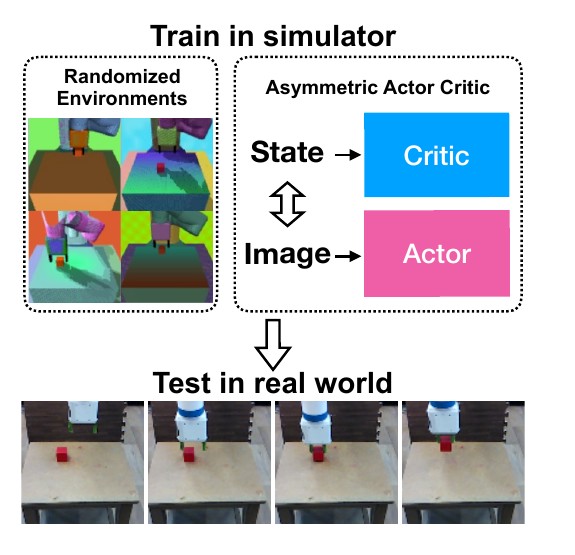
Fig. 1. By training policies with asymmetric inputs for actor-critic along with domain randomization, we learn complex visual policies that can operate in the real world without having seen any real world data in training.
图 1:通过用非对称输入训练 actor-critic,并配合域随机化,我们学到了复杂的视觉策略,这些策略可以在真实世界中运行,而训练时从未见过任何真实世界数据。
I. INTRODUCTION
I. 引言
Reinforcement learning (RL) coupled with deep neural networks has recently led to successes on a wide range of control problems, including achieving superhuman performance on Atari games [26] and beating the world champion in the classic game of Go [45]. In physics simulators, complex behaviours like walking, running, hopping and jumping have also been shown to emerge [43, 23].
强化学习(RL)与深度神经网络结合,近来在广泛的控制问题上取得了成功,包括在 Atari 游戏上达到超人类水平 [26],以及在经典的围棋中击败世界冠军 [45]。在物理仿真器中,行走、奔跑、单足跳和跳跃等复杂行为也被证明可以涌现出来 [43, 23]。
However, in the context of robotics, learning complex behaviours faces two unique challenges: scalability and safety. Robots are slow and expensive, which makes existing data intensive learning algorithms hard to scale. These physical robots could also damage themselves and their environment while exploring these behaviours. A recent approach to circumvent these challenges is to train on a simulated version of the robot and then transfer the learned policy to the real robot [8, 12, 18, 39, 7, 52, 40, 13].
然而,在机器人学的语境下,学习复杂行为面临着两个独特的挑战:可扩展性与安全性。机器人既慢又昂贵,使得现有的数据密集型学习算法难以扩展。这些物理机器人在探索这些行为时,还可能损伤自身及其环境。近期一种绕开这些挑战的做法,是在机器人的仿真版本上训练,再把学到的策略迁移到真机 [8, 12, 18, 39, 7, 52, 40, 13]。
One common method for robot learning using simulators is by training a visual policy on rendered images and then transferring it to a real robot [40, 39, 47]. These visual policies allow for easy instrumentation on the robot's end. However, this comes at the increased cost of learning from high dimensional visual observations. Other methods first learn state-based policies in the simulator. Then, these state-based policies can be behaviour cloned or imitation learned to a visual policy [15]. This allows for faster learning, but behaviour cloning does not work well when the observation domain is different between the expert and the cloned policy (see Section V-D). Instead of behaviour cloning, one could also perform explicit state estimation from visual observations and employ a state based policy. However, as demonstrated in Andrychowicz et al. [3] the errors in estimation often leads to failure with complex policies. This leads us to a conundrum, i.e., training on images is hard because of their high dimensionality, on the other hand learned state-based policies are hard to use on a robot.
利用仿真器做机器人学习的一种常见方法,是在渲染图像上训练视觉策略,再把它迁移到真机 [40, 39, 47]。这类视觉策略在机器人端易于部署。但这带来了从高维视觉观测中学习的更高代价。另一些方法先在仿真器中学习基于状态的策略,再把这些基于状态的策略通过行为克隆或模仿学习转到视觉策略 [15]。这样学得更快,可一旦专家与被克隆策略的观测域不同,行为克隆往往效果不好(见第 V-D 节)。除了行为克隆,也可以从视觉观测中做显式状态估计,再使用基于状态的策略。然而,正如 Andrychowicz 等人 [3] 所表明的,估计误差常常会让复杂策略失败。这就带来了一个两难:在图像上训练很难,因为维度太高;另一方面,学到的基于状态的策略又很难用在真机上。
We solve this conundrum by learning a policy that operates only on visual observations (RGBD images), but accesses full state during training. Physics simulators give us access to both the full state of the system and the rendered images of the scene. But how can we combine these observations to train complex behaviours faster? In this work, we exploit the access to states and train an actor-critic algorithm [19, 23] that uses asymmetric inputs, i.e. the actor takes visual partial observations as input while the critic takes the underlying full state as input. Since the critic works on the low dimensional full state, it learns the state-action value function much faster. This also allows for better updates for the actor. During testing, the actor is employed on the high dimensional visual observations and does not depend on the full state (the full state is only used during training). This novel technique allows us to train an actor/policy network on visual observations while exploiting the availability of full states to train the critic.
我们解决这一两难的办法是:学习一个只在视觉观测(RGBD 图像)上运行的策略,但在训练时可以访问完整状态。物理仿真器同时给出系统的完整状态和场景的渲染图像。但怎样把这两路观测结合起来,更快地训练出复杂行为?本文利用对状态的访问,训练一种使用非对称输入的 actor-critic 算法 [19, 23]:执行器以视觉部分观测为输入,评论家则以底层完整状态为输入。由于评论家作用在低维完整状态上,它能更快地学到状态-动作价值函数。这也给执行器带来更好的更新。测试时,执行器作用在高维视觉观测上,并不依赖完整状态(完整状态只在训练时使用)。这一新做法使我们能在视觉观测上训练执行器/策略网络,同时利用完整状态来训练评论家。
However, simulators are not perfect representations of the real world. The domain of observations in the real world (real camera images) significantly differs from rendered images from a simulator. This makes directly transferring policies from the simulator to the real world difficult. However, Sadeghi and Levine [40] and other researchers [47, 49] show how randomizing textures and lighting allows for effective transfer to the real world. We employ these domain randomization techniques to transfer to a real robot.
然而,仿真器并不是真实世界的完美再现。真实世界中的观测域(真实相机图像)与仿真器渲染出的图像有明显差异,这使得把策略直接从仿真器迁到真实世界变得困难。不过,Sadeghi 和 Levine [40] 以及其他研究者 [47, 49] 表明,随机化纹理和光照可以有效实现向真实世界的迁移。我们采用这些域随机化技术,把策略迁移到真机。
Our experimental evaluations on 2D environments such as Particle and Reacher and 3D robot environments such as Fetch Pick show that Asymmetric Actor Critic significantly improves over both learning with only visual observations [23] and cloning from a state based expert [15]. By combining our Asymmetric Actor Critic training with domain randomization [47], we show that these visual policies can Pick, Push and Move a block using a real robot without any training on the physical system (see Figure 1).
我们在 Particle、Reacher 等二维环境以及 Fetch Pick 等三维机器人环境上的实验评估表明,Asymmetric Actor Critic 明显优于只用视觉观测学习 [23],也优于从基于状态的专家做克隆 [15]。把 Asymmetric Actor Critic 训练与域随机化 [47] 结合起来后,我们表明这些视觉策略可以在真机上完成抓取、推动和搬移木块,而无需在物理系统上做任何训练(见图 1)。
In summary, this paper presents three main contributions:
概括起来,本文有三项主要贡献:
(a) We propose a novel technique for learning visual policies by exploiting low dimensional full state observations in a simulator.
(a)我们提出一种新方法:利用仿真器中的低维完整状态观测来学习视觉策略。
(b) We show that this asymmetric training significantly speeds up training.
(b)我们表明,这种非对称训练能显著加快训练。
(c) We can use these policies on real robots without any training on the physical system.
(c)我们可以在真机上使用这些策略,而无需在物理系统上训练。
II. RELATED WORK
II. 相关工作
A. Reinforcement Learning
A. 强化学习
Recent work in deep reinforcement learning (deep RL) has shown impressive results in the domain of games [26, 45] and simulated control tasks [43, 23]. The class of RL algorithms our method employs are called actor-critic algorithms [19]. Deep Deterministic Policy Gradients (DDPG) [23] is a popular actor-critic algorithm that has shown impressive results in continuous control tasks. Although we use DDPG for our base optimizer, our method is applicable to arbitrary actor-critic algorithms.
近期的深度强化学习(deep RL)工作已在游戏 [26, 45] 和仿真控制任务 [43, 23] 上取得了令人印象深刻的结果。我们方法所采用的一类强化学习算法称为 actor-critic 算法 [19]。Deep Deterministic Policy Gradients(DDPG)[23] 是一种流行的 actor-critic 算法,已在连续控制任务上取得很好的结果。虽然我们用 DDPG 作为基础优化器,但我们的方法适用于任意 actor-critic 算法。
Learning policies in an environment that provides only sparse rewards is a challenging problem due to a very limited feedback signal. However it has been shown that sparse rewards often allow for better policies when trained appropriately [3]. Moreover having sparse rewards allows us to circumvent manual shaping of the reward function.
在只提供稀疏奖励的环境中学习策略是一个困难问题,因为反馈信号非常有限。不过已有工作表明,只要训练得当,稀疏奖励往往能得到更好的策略 [3]。此外,采用稀疏奖励还可以避开对奖励函数的手工塑形。
Foerster et al. [10] and Lowe et al. [24] have trained actor-critic algorithms for multi-agent environments. Here a single critic is trained with information from all the agents while multiple actors are trained for each agent using each agent's observation. However we use asymmetric inputs in the context of speeding up learning of visual policies.
Foerster 等人 [10] 和 Lowe 等人 [24] 曾在多智能体环境中训练 actor-critic 算法。那里用所有智能体的信息训练一个评论家,同时为每个智能体用各自的观测训练多个执行器。而我们使用非对称输入,是为了加快视觉策略的学习。
B. End-to-end robot learning
B. 端到端机器人学习
Learning policies directly from observations [21, 28, 2, 22] has received significant attention over the last few years. These works have shown that without explicit modeling and state estimation, complex manipulation behaviors can be learned. Reducing the error-prone aspects of modeling and estimation also allows for easier deployment of robots. However, these end-to-end learning methods often require significant amounts of real world robot data [28, 2, 22] which makes it difficult to scale and dangerous to the environment. Simulators hold promise in alleviating both these challenges since simulators are orders of magnitude faster than the real world and do not perform physical interactions. This paper looks to improve robot learning by training completely in a simulator without seeing any real world robot data.
直接从观测学习策略 [21, 28, 2, 22] 在过去几年受到了广泛关注。这些工作表明,不必做显式建模和状态估计,也可以学到复杂的操作行为。减少建模和估计中容易出错的环节,也让机器人更易于部署。然而,这些端到端学习方法往往需要大量真实世界的机器人数据 [28, 2, 22],因而难以扩展,也对环境有危险。仿真器有望缓解这两个问题,因为它比真实世界快几个数量级,而且不会发生物理接触。本文希望完全在仿真器中训练、不见任何真实世界机器人数据,来改进机器人学习。
C. Transfer from simulation to the real world
C. 从仿真到真实世界的迁移
Bridging the reality gap in transferring policies trained in a simulator to the real world is an active area of research in the robot learning community. Apart from being faster, simulators are also safer than real robots [11, 13]. One approach to transfer simulator policies to the real world is to make the simulator as close to the real world as possible [14, 33, 37]. But these methods have had limited success due to hard system identification problems.
弥合把仿真中训练的策略迁到真实世界时的现实差距,是机器人学习社区中一个活跃的研究方向。仿真器除了更快,也比真机更安全 [11, 13]。把仿真策略迁到真实世界的一条路,是让仿真器尽可能接近真实世界 [14, 33, 37]。但这些方法因困难的系统辨识问题,成功有限。
Another approach is domain adaptation from the simulator [8, 12, 18, 39, 7, 52], since it may be easier to fine tune from a simulator policy than training in the real world. However if the simulator differs from the real world, the policy trained in simulation can perform very poorly in the real world and fine tuning may not be any easier than training from scratch. This limits most of these works to learning simple behaviours. Making policies robust for physics adaptation [36, 32, 51] is also receiving interest, but these methods haven't been shown to be powerful enough to work on real robots. Using bottlenecks [52] has been shown to help domain adaptation for simple tasks like reaching. In this work, we show how bottlenecks can be exploited for more complex fine manipulation tasks. We also note that our method is complementary to actor-critic versions of several of these domain adaptation methods.
另一条路是从仿真器做域适应 [8, 12, 18, 39, 7, 52],因为从仿真策略微调可能比在真实世界中从零训练更容易。可一旦仿真器与真实世界差别较大,仿真中训出的策略在真实世界中可能表现得很差,微调也不见得比从头训练更容易。这限制了其中大多数工作只能学到简单行为。让策略对物理适应保持稳健 [36, 32, 51] 也正在受到关注,但这些方法尚未被证明强大到足以在真机上工作。使用瓶颈 [52] 已被表明有助于像伸手够物这类简单任务的域适应。本文表明,瓶颈也可以用于更复杂的精细操作任务。我们还指出,我们的方法与若干这类域适应方法的 actor-critic 版本是互补的。
A promising approach is domain adaptation by domain randomization [47, 40]. Here the key idea is to train on randomized renderings of the scene, which supports learning robust policies for transfer. However these works do not show transfer to precise manipulation behaviours. We show that this idea of randomization can be extended to complex behaviours when coupled with our asymmetric actor critic.
一条有希望的路是通过域随机化做域适应 [47, 40]。其核心想法是在场景的随机化渲染上训练,以支持学到可用于迁移的稳健策略。不过这些工作并未展示向精确操作行为的迁移。我们表明,把随机化与我们的非对称 actor-critic 结合起来,可以把这一想法扩展到复杂行为。
D. Robotic tasks
D. 机器人任务
We perform real robot experiments on tasks like picking, pushing, and moving a block. The Picking task is similar to grasping objects [6, 28, 31, 25], however in this work we learn a visual end-to-end policy that moves to the object, grasps it and moves the grasped object to its desired position. The focus is on learning the fine manipulation behaviour directly from visual inputs. The tasks of Forward Pushing and Block Move are similar to pushing objects [5, 2, 29, 30], however as in the case of Picking, this paper focuses on the visual learning of the fine pushing behaviour.
我们在抓取、推动和搬移木块等任务上做了真机实验。抓取任务类似于抓物体 [6, 28, 31, 25],但本文学习的是一个视觉端到端策略:移向物体、抓住它,再把抓住的物体移到目标位置。重点是直接从视觉输入学习精细操作行为。前推和搬移木块这两项任务类似于推物体 [5, 2, 29, 30],不过与抓取一样,本文关注的是精细推动行为的视觉学习。
III. BACKGROUND
III. 背景
Before we discuss our method, we briefly introduce some background and formalism for the RL algorithms used. A more comprehensive introduction can be found in Kaelbling et al. [16] and Sutton and Barto [46].
在讨论我们的方法之前,我们先简要介绍所用强化学习算法的背景和形式化。更全面的介绍可见 Kaelbling 等人 [16] 以及 Sutton 和 Barto [46]。
A. Reinforcement Learning
A. 强化学习
In this paper we deal with continuous space Markov Decision Processes that can be represented as the tuple , where is a set of continuous states and is a set of continuous actions, is the transition probability function, is the reward function, is the discount factor, and is the initial state distribution. is a set of continuous partial observations corresponding to states in .
本文处理连续空间马尔可夫决策过程,可表示为元组 ,其中 是连续状态的集合, 是连续动作的集合, 是转移概率函数, 是奖励函数, 是折扣因子, 是初始状态分布。 是与 中状态相对应的连续部分观测的集合。
An episode for the agent begins with sampling from the initial state distribution . At every timestep , the agent takes an action according to a policy . At every timestep , the agent gets a reward , and the state transitions to , which is sampled according to probabilities . The goal of the agent is to maximize the expected return , where the return is the discounted sum of the future rewards . The -function is defined as . In the partial observability case, the agent takes actions based on the partial observation, , where is the observation corresponding to the full state .
智能体的一个回合从初始状态分布 中采样 开始。在每个时刻 ,智能体按策略 采取动作 。在每个时刻 ,智能体得到奖励 ,状态转移到 ,该状态按概率 采样。智能体的目标是最大化期望回报 ,其中回报是未来奖励的折扣和 。 函数定义为 。在部分可观测情形下,智能体根据部分观测采取动作,,其中 是与完整状态 相对应的观测。
B. Deep Deterministic Policy Gradients (DDPG)
B. 深度确定性策略梯度(DDPG)
Deep Deterministic Policy Gradients (DDPG) [23] is an actor-critic RL algorithm that learns a deterministic continuous action policy. The algorithm maintains two neural networks: the policy (also called the actor) (with neural network parameters ) and a -function approximator (also called the critic) (with neural network parameters ).
深度确定性策略梯度(DDPG)[23] 是一种学习确定性连续动作策略的 actor-critic 强化学习算法。该算法维护两个神经网络:策略(也称为执行器)(网络参数为 ),以及 函数逼近器(也称为评论家)(网络参数为 )。
During training, episodes are generated using a noisy version of the policy (called behaviour policy), e.g. , where is the Normal distribution noise. The transition tuples encountered during training are stored in a replay buffer [26]. Training examples sampled from the replay buffer are used to optimize the critic. By minimizing the Bellman error loss , where , the critic is optimized to approximate the -function. The actor is optimized by minimizing the loss . The gradient of with respect to the actor parameters is called the deterministic policy gradient [44] and can be computed by backpropagating through the combined critic and actor networks. To stabilize the training, the targets for the actor and the critic are computed on separate versions of the actor and critic networks, which change at a slower rate than the main networks. A common practice is to use a Polyak averaged [34] version of the main network.
训练时,回合由策略的带噪声版本(称为行为策略)生成,例如 ,其中 是正态分布噪声。训练中遇到的转移元组 存入回放缓冲区 [26]。从回放缓冲区采样的训练样本用来优化评论家。通过最小化贝尔曼误差损失 ,其中 ,评论家被优化以逼近 函数。执行器则通过最小化损失 来优化。 对执行器参数的梯度称为确定性策略梯度 [44],可通过在评论家与执行器的组合网络上回传计算得到。为稳定训练,执行器和评论家的目标 在另一套变化更慢的执行器与评论家网络上计算。常见做法是使用主网络的 Polyak 平均 [34] 版本。
In this actor-critic framework, the role of the critic is to improve the policy gradient estimates by providing a value function () estimate. The only way the critic interacts with the learning is through the value estimate. The more accurate the value estimate, the better the policy gradient is estimated. In Asymmetric Actor Critic this critic is trained on state information, which allows the value estimates to be more accurate compared to a critic trained on images. Furthermore, since the policy only depends on value estimates, a visual policy can be learned.
在这一 actor-critic 框架中,评论家的作用是通过提供价值函数()估计来改进策略梯度估计。评论家与学习过程交互的唯一途径就是价值估计。价值估计越准确,策略梯度的估计也就越好。在 Asymmetric Actor Critic 中,评论家在状态信息上训练,因而与在图像上训练的评论家相比,价值估计可以更准确。此外,由于策略只依赖于价值估计,因此可以学到视觉策略。
C. Multigoal RL
C. 多目标强化学习
We are interested in learning policies that can achieve multiple goals (a universal policy). One way of doing this is by training policies and -functions that take as an additional input a goal [41, 3], e.g. . A universal policy can hence be trained by using arbitrary RL algorithms. Following UVFA [41], the sparse reward formulation will be used in this work, where the agent gets a positive reward when the distance between the current state and the goal is less than . In the context of a robot performing the task of picking and placing an object, this means that the robot gets a reward only if the object is within Euclidean distance of the desired goal location of the object. Having a sparse reward overcomes the limitation of hand engineering the reward function, which often requires extensive domain knowledge. However, sparse rewards are not very informative and makes it hard to optimize. In order to overcome the difficulties with sparse rewards, we employ a recent method: Hindsight Experience Replay (HER) [3].
我们希望学习能够达成多个目标的策略(通用策略)。一种做法是训练额外接收目标 作为输入的策略和 函数 [41, 3],例如 。因此,通用策略可以用任意强化学习算法来训练。遵循 UVFA [41],本文将使用稀疏奖励形式 :当当前状态与目标之间的距离 小于 时,智能体得到正奖励。对执行抓取并放置物体的机器人而言,这意味着只有当物体处于目标位置的 欧氏距离之内时,机器人才得到奖励。采用稀疏奖励可以克服手工设计奖励函数的局限,后者往往需要大量领域知识。不过,稀疏奖励信息量不大,也更难优化。为克服稀疏奖励的困难,我们采用一种近期方法:后见经验回放(Hindsight Experience Replay,HER)[3]。
D. Hindsight Experience Replay (HER)
D. 后见经验回放(HER)
HER [3] is a simple method of manipulating the replay buffer used in off-policy RL algorithms that allows it to learn universal policies more efficiently with sparse rewards. After experiencing some episode , every transition along with the goal for this episode is usually stored in the replay buffer. However with HER, the experienced transitions are also stored in the replay buffer with different goals. These additional goals are states that were achieved later in the episode. Since the goal being pursued does not influence the environment dynamics, we can replay each trajectory using arbitrary goals assuming we use an off-policy RL algorithm to optimize [35].
HER [3] 是一种在离策略强化学习算法中操作回放缓冲区的简单方法,使算法能在稀疏奖励下更高效地学习通用策略。在经历某个回合 之后,通常会把每个转移 连同该回合的目标一起存入回放缓冲区。而采用 HER 时,这些经历过的转移还会以不同的目标再存入回放缓冲区。这些额外目标是该回合中后来实际达到的状态。由于正在追求的目标并不影响环境动力学,只要用离策略强化学习算法来优化,就可以用任意目标回放每条轨迹 [35]。
IV. METHOD
IV. 方法
We now describe our method along with the technique of bottlenecks to speed up training. Following this, we also describe domain randomization for transferring simulator learned policies to the real robot.
下面描述我们的方法,以及用瓶颈来加快训练的技术。随后,我们再说明如何用域随机化,把在仿真器中学到的策略迁移到真机。
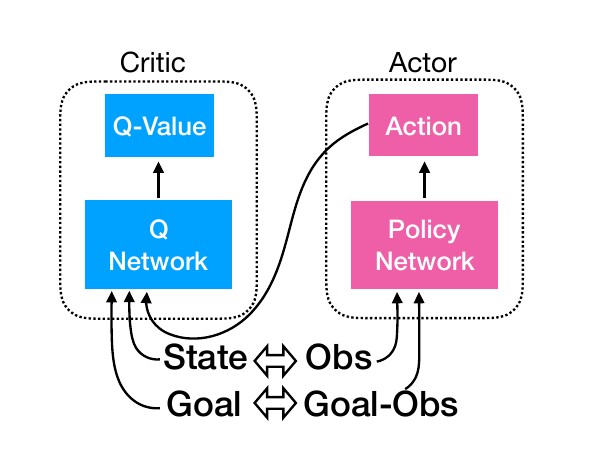
Fig. 2. Having asymmetric inputs, i.e. full states for the critic and partial observations for the actor improves training. In the multi goal setting, the critic additionally requires full goal states while the actor additionally requires partial observations for the goal.
图 2:采用非对称输入,即评论家使用完整状态、执行器使用部分观测,可以改进训练。在多目标设定下,评论家还需要完整的目标状态,执行器还需要目标的部分观测。
A. Asymmetric Actor Critic
A. 非对称 Actor Critic
In its essence our method builds on actor-critic algorithms [19] by using the full state to train the critic, while using partial observation to train the actor (see Figure 2). Note that is the underlying full state for the observation . In our experiments, observations are images taken by an external camera.
就其本质而言,我们的方法建立在 actor-critic 算法 [19] 之上:用完整状态 训练评论家,用部分观测 训练执行器(见图 2)。注意 是观测 所对应的底层完整状态。在我们的实验中,观测 是由外部相机拍摄的图像。
Algorithm 1 Asymmetric Actor Critic
Initialize actor-critic algorithm
Initialize replay buffer
for episode do
Sample a goal and an initial state
Render goal observation
for do
Render image observation
Obtain action using behavioural policy:
Execute action , receive reward and transition to
Store in
end for
for do
Sample minibatch from
Optimize critic using with
Optimize actor using with
end for
end for
算法 1 非对称 Actor Critic
初始化 actor-critic 算法
初始化回放缓冲区
for episode do
采样一个目标 和一个初始状态
渲染目标观测
for do
渲染图像观测
用行为策略得到动作 :
执行动作 ,接收奖励 并转移到
将 存入
end for
for do
从 中采样小批量
用 与 优化评论家
用 与 优化执行器
end for
end for
The algorithm (described in Algorithm 1), begins with initializing the networks for an off-policy actor-critic algorithm [35]. In this paper, we use DDPG [23] as the actor-critic algorithm. The replay buffer used by this algorithm is initialized with no data. For each episode, a goal and an initial state are sampled before the rollout begins. is the rendered goal observation. At every timestep of the episode, a partially observable image of the scene is rendered from the simulator at the full state . The behavioural policy from , which is usually a noisy version of the actor is used to generate the action for the agent/robot to take. After taking this action, the environment transitions to the next state , with its corresponding rendered image .
该算法(见算法 1)首先为离策略 actor-critic 算法 [35] 初始化网络。本文使用 DDPG [23] 作为这一 actor-critic 算法。该算法所用的回放缓冲区 初始化时不含数据。对每个回合,在展开开始前采样一个目标 和一个初始状态 。 是渲染得到的目标观测。在回合的每个时刻 ,从仿真器在完整状态 处渲染出场景的部分可观测图像 。用 中的行为策略(通常是执行器的带噪声版本)生成智能体/机器人要采取的动作 。采取该动作后,环境转移到下一状态 ,并得到相应的渲染图像 。
Since DDPG relies on a replay buffer to sample training data, we build the replay buffer from the episodic experience . To improve performance for the sparse reward case, we augment the standard replay buffer by adding hindsight experiences [3].
由于 DDPG 依靠回放缓冲区来采样训练数据,我们用回合经验 来构建回放缓冲区。为改进稀疏奖励情形下的性能,我们通过加入后见经验来增强标准回放缓冲区 [3]。
After the episodic experience has been added to the replay buffer , we can now train our actor-critic algorithm from a sampled minibatch of size from . This minibatch can be represented as , where and are the next step full state and next step observation respectively. Since the critic takes full states as input, it is trained on . Since the actor takes observations as input, it is trained on . We experimentally show that asymmetric inputs for the critic and actor significantly improves performance and supports transfer of more complex manipulation behaviours to real robots.
把回合经验加入回放缓冲区 之后,就可以从 中采样大小为 的小批量,来训练我们的 actor-critic 算法 。该小批量可表示为 ,其中 和 分别是下一步的完整状态和下一步的观测。由于评论家以完整状态为输入,它在 上训练。由于执行器以观测为输入,它在 上训练。我们用实验表明,评论家与执行器的非对称输入能显著提升性能,并支持把更复杂的操作行为迁移到真机。
B. Improvements with bottlenecks
B. 用瓶颈改进
One way of improving the efficiency of training is to use bottlenecks [52]. The key idea is to constrain one of the actor network's intermediary layers to predict the full state. Since the full state is often of a smaller dimension than the other layers of the network, this state predictive layer is called the bottleneck layer.
提高训练效率的一种办法是使用瓶颈 [52]。核心想法是约束执行器网络的某一中间层去预测完整状态。由于完整状态的维度往往小于网络中其他层,这一预测状态的层被称为瓶颈层。
C. Randomization for transfer
C. 用于迁移的随机化
A powerful technique for domain transfer of policies from rendered images to real world images is domain randomization [47, 40]. The key idea is to randomize visual elements in the scene during the rendering. Learning policies with this randomization allows the policy to generalize to sources of error in the real world and latch on to the important aspects of the observation.
把策略从渲染图像迁移到真实世界图像的一种有力技术是域随机化 [47, 40]。核心想法是在渲染时随机化场景中的视觉要素。在这种随机化下学习策略,可以使策略对真实世界中的误差来源具有泛化能力,并抓住观测中的重要方面。
For the purposes of this paper, we randomize the following aspects: texture, lighting, camera location and depth. For textures, random textures are chosen among random RGB values, gradient textures and checker patterns. These random textures are applied on the different physical objects in the scene, like the robot and the table. For lighting randomization, we randomly switch on lighting sources in the scene and also randomize the position, orientation and the specular characteristics of the light. For camera location, we randomize the location of the monocular camera in a box around the expected location of the real world camera. Furthermore, we randomize the orientation and focal length of the camera and add uniform noise to the depth. RGB samples of randomization on the Fetch Pick environment can be seen in Figure 3.
就本文而言,我们随机化以下几个方面:纹理、光照、相机位置和深度。对于纹理,从随机 RGB 值、渐变纹理和棋盘图案中选取随机纹理,并把这些随机纹理施加到场景中的不同物理物体上,例如机器人和桌子。对于光照随机化,我们随机打开场景中的光源,并随机化灯光的位置、朝向和镜面反射特性。对于相机位置,我们在真实世界相机预期位置周围的一个盒子内随机化单目相机的位置。此外,我们还随机化相机的朝向和焦距,并在深度上加入均匀噪声。Fetch Pick 环境上随机化的 RGB 样本见图 3。
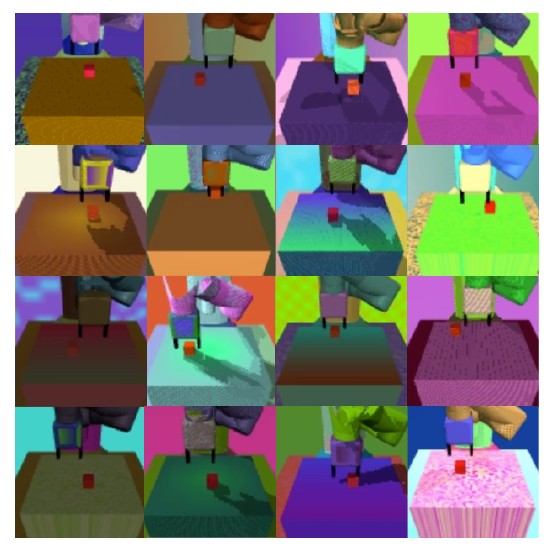
Fig. 3. To enable transfer of policies from the simulator to the real world, we randomize various aspects of the renderer during training. These aspects include textures, lighting and the position of the camera.
图 3:为了把策略从仿真器迁移到真实世界,我们在训练时随机化渲染器的多个方面。这些方面包括纹理、光照和相机位置。
V. RESULTS
V. 结果
To show the effectiveness of our method, we experiment on a range of simulated and real robot environments. In this section we first describe the environments. Following this, we discuss comparisons of our methods to baselines and show the utility of our method for improving training. Finally, we discuss real robot experiments.
为展示方法的有效性,我们在一系列仿真和真机环境上做了实验。本节先描述环境,随后讨论我们的方法与基线的比较,并说明该方法对改进训练的作用,最后讨论真机实验。
A. Environments
A. 环境
Since there are no standard environments for multi-goal RL, we create three of our own simulated environments to test our method. The first two environments, Particle and Reacher are in a 2D workspace. The third environment Fetch Pick is in a 3D workspace with a simulated version of the Fetch robot picking up and placing a block. All these environments are simulated in the MuJoCo [48] physics simulator.
由于没有用于多目标强化学习的标准环境,我们自建了三个仿真环境来测试方法。前两个环境 Particle 和 Reacher 处于二维工作空间。第三个环境 Fetch Pick 处于三维工作空间,用仿真版 Fetch 机器人抓起并放置木块。这些环境均在 MuJoCo [48] 物理仿真器中仿真。
(a) Particle: In this 2D environment the goal for the agent is to move a 2D particle to a given location. The state space is 2D and consists of the particle's location. The observation space is RGB images from a camera placed above the scene. The action space is the 2D velocity of the particle. This action space allows for control on single RGB observations without requiring memory for velocity (since velocity cannot be inferred from a single RGB frame). The agent gets a sparse reward if the particle is within of the desired goal position and no reward otherwise. The observation for the goal is an image of the particle in its desired goal position.
(a)Particle:在这个二维环境中,智能体的目标是把一个二维质点移到给定位置。状态空间是二维的,由质点位置组成。观测空间是置于场景上方的相机给出的 RGB 图像()。动作空间是质点的二维速度。这一动作空间允许在单张 RGB 观测上做控制,而不需要为速度保留记忆(因为速度无法从单张 RGB 帧推断)。若质点位于目标位置的 之内,智能体得到稀疏奖励(),否则没有奖励()。目标的观测是质点处于其目标位置时的图像。
(b) Reacher: In this 2D environment the goal for the agent is to move the end-effector of a two-link robot arm to a target location. The state space is 2D and consists of the joint positions. The observation space is RGB images from a camera placed above the scene. The action space is the 2D velocities for the joints. The agent gets a sparse reward if the end-effector is within of the desired goal position and no reward otherwise. The observation for the goal is an image of the reacher in its desired goal end-effector position.
(b)Reacher:在这个二维环境中,智能体的目标是把一个两连杆机器人臂的末端执行器移到目标位置。状态空间是二维的,由关节位置组成。观测空间是置于场景上方的相机给出的 RGB 图像()。动作空间是关节的二维速度。若末端执行器位于目标位置的 之内,智能体得到稀疏奖励(),否则没有奖励()。目标的观测是到达器处于其目标末端执行器位置时的图像。
(c) Fetch Pick: In this 3D environment with the simulated Fetch robot, the goal for the agent is to pick up the block on the table and move it to a given location in the air. The state space consists of the joint positions of the robot and the location of the block on the table. The observation space is RGBD images from a camera placed in front of the robot. The action space is 4D. Since this problem does not require gripper rotation, we keep it fixed. Three of the four dimensions of the action space specify the desired relative position for the gripper. The last dimension specifies the desired distance between the fingers of the gripper. The agent gets a sparse reward if the block is within of the desired goal block position. The observation for the goal is an image of the block in its desired goal block position and the Fetch arm in a random position. To make exploration in this task easier following [3], we record a single state in which the box is grasped and start half of the training episodes from this state.
(c)Fetch Pick:在这个带有仿真 Fetch 机器人的三维环境中,智能体的目标是抓起桌上的木块,并把它移到空中的给定位置。状态空间由机器人的关节位置和桌上木块的位置组成。观测空间是置于机器人前方的相机给出的 RGBD 图像()。动作空间是四维的。由于该问题不需要夹爪旋转,我们将其固定。动作空间四维中的三维指定夹爪的期望相对位置。最后一维指定夹爪两指之间的期望距离。若木块位于目标木块位置的 之内,智能体得到稀疏奖励()。目标的观测是木块处于其目标位置、Fetch 手臂处于随机位置时的图像。为使该任务中的探索更容易,我们遵循 [3],记录一个木块已被抓住的状态,并让一半训练回合从这一状态开始。
B. Robot evaluation
B. 真机评估
For our real world experiments we use a 7-DOF Fetch robotic arm, which is equipped with a two fingered parallel gripper. The camera observations for the real world experiments is an off the shelf Intel RealSense R200 camera that can provide aligned RGBD images. Since real depth often contains holes [27], we employ nearest neighbour hole filling to get better depth images [50]. To further improve the depth, we cover/recolor parts of the robot that are black like parts of the torso and parts of the gripper.
真机实验中,我们使用一台 7 自由度 Fetch 机械臂,配有两指平行夹爪。真机实验的相机观测来自现成的 Intel RealSense R200 相机,可以提供对齐的 RGBD 图像。由于真实深度常常含有孔洞 [27],我们采用最近邻补洞以得到更好的深度图像 [50]。为进一步改善深度,我们覆盖/重新着色机器人上黑色的部分,例如躯干的一部分以及夹爪的一部分。
We experiment on three tasks for the real robot. The first task is Pick which is similar to the simulated task of Fetch Pick described in Section V-A(c). The second task is Forward Push, where the robot needs to push a block forward. The third task is Block Move, where the robot needs to move the block to the target position on the table. In all tasks the goal is specified by an image of the block in the target location. The manipulation behaviour is considered to be successful if the block is within of the desired target location. A video of these experiments can be found in the supplementary video and sample successes from our method in Figure 7.
我们在真机上实验了三项任务。第一项是 Pick,类似于第 V-A(c) 节描述的仿真任务 Fetch Pick。第二项是 Forward Push,机器人需要把木块向前推。第三项是 Block Move,机器人需要把木块移到桌上的目标位置。在所有任务中,目标由木块处于目标位置时的图像给出。若木块位于期望目标位置的 之内,则认为操作行为成功。这些实验的视频见补充视频,我们方法的成功样本见图 7。
The observations for the real robot tasks is an RGBD image from the physical camera placed in front of the robot. The goal observation for the actor is a simulated image describing the desired goal. We note that giving real world observations for the goal observation also works, however for consistency in evaluation, we use a simulated goal observation.
真机任务的观测是置于机器人前方的物理相机给出的 RGBD 图像。执行器的目标观测是描述期望目标的仿真图像。我们注意到,给目标观测使用真实世界观测也可以,但为了评估时保持一致,我们使用仿真的目标观测。
The desired gripper position is relative to the current gripper position.
期望的夹爪位置是相对于当前夹爪位置的。
fetchrobotics.com/platforms-research-development/
The fingers are blocked for this task to avoid grasping.
该任务中手指被锁住,以避免抓取。
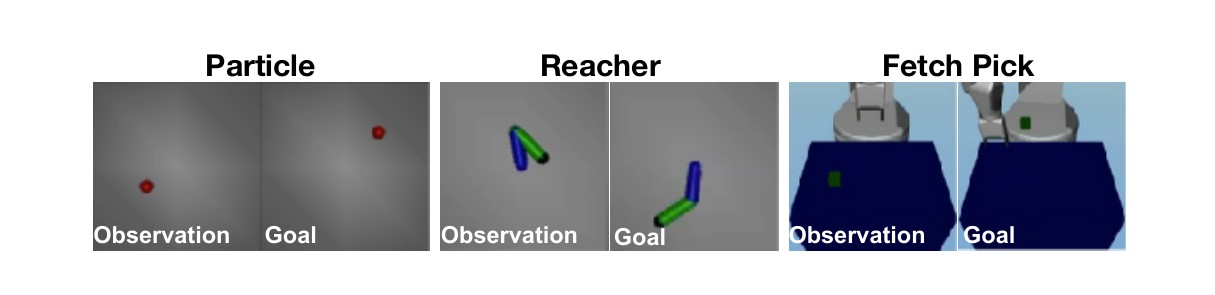
Fig. 4. To evaluate our method, we test on three different environments: Particle, Reacher and Fetch Pick. Since we learn multi goal policies, the policy takes in both the observation at timestep and the desired goal for the episode.
图 4:为评估我们的方法,我们在三个不同环境上测试:Particle、Reacher 和 Fetch Pick。由于我们学习的是多目标策略,策略同时接收时刻 的观测以及该回合的期望目标。
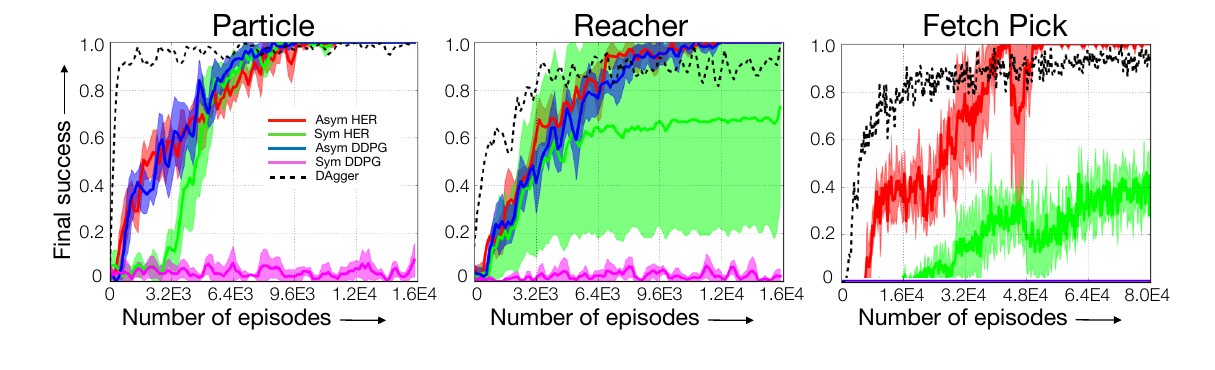
Fig. 5. We show that asymmetric inputs for training outperforms symmetric inputs by significant margins on our simulated environments. The shaded region corresponds to standard deviation across 5 random seeds. The y-axis corresponds to the sparse reward obtained at the end of an episode averaged over 100 runs. Although the behaviour cloning (BC) by expert imitation baseline (dashed lines) learns faster initially, it saturates to a sub-optimal value compared to asymmetric HER. Also note that the BC baseline doesn't include the iterations the expert policy was trained on.
图 5:我们表明,在仿真环境上,用非对称输入训练明显优于对称输入。阴影区域对应 5 个随机种子上的 标准差。纵轴对应回合结束时获得的稀疏奖励,对 100 次运行取平均。虽然通过专家模仿的行为克隆(BC)基线(虚线)起初学得更快,但与非对称 HER 相比,它会饱和在一个次优值。还需说明,BC 基线并不包含专家策略本身的训练迭代。
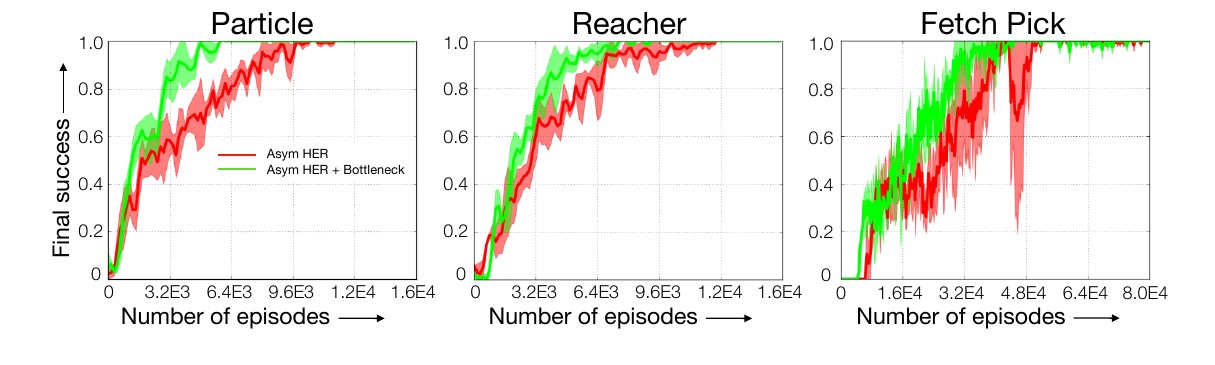
Fig. 6. We show that bottlenecks can be used to further improve training of our method. The shaded region corresponds to standard deviation across 5 random seeds. The y-axis corresponds to the sparse reward obtained at the end of an episode averaged over 100 runs. On the Particle and Reacher, the improvements are quite significant. On Fetch Pick, we observe more stable training (lower variance denoted by shaded regions).
图 6:我们表明,瓶颈可以进一步改进我们方法的训练。阴影区域对应 5 个随机种子上的 标准差。纵轴对应回合结束时获得的稀疏奖励,对 100 次运行取平均。在 Particle 和 Reacher 上,提升相当明显。在 Fetch Pick 上,我们观察到训练更稳定(阴影区域所表示的方差更低)。
C. Do asymmetric inputs to the actor critic help?
C. 给 actor-critic 使用非对称输入有帮助吗?
To study the effect of asymmetric inputs, we compare to the baseline of using symmetric inputs (images for both the actor and the critic networks). Figure 5 shows a summary of the final episodic rewards, with the x-axis being the number of episodes the agent experiences. As evident from the Particle results, asymmetric input versions of both DDPG and HER perform much better than their symmetric counterparts. The simplicity of the Particle may explain the similar performance between asymmetric DDPG and HER. Fetch Pick is a much harder sparse reward task, which shows the importance of using HER over DDPG. In this case as well, the asymmetric version of HER performs significantly better than the symmetric version. This experiment hence demonstrates the significant utility of asymmetric training for learning visual policies.
为研究非对称输入的效果,我们与使用对称输入(执行器和评论家网络都使用图像)的基线进行比较。图 5 汇总了最终的回合奖励,横轴是智能体经历的回合数。从 Particle 的结果可以明显看出,DDPG 和 HER 的非对称输入版本都远好于它们的对称对照。Particle 的简单性或许可以解释非对称 DDPG 与 HER 表现相近。Fetch Pick 是一项困难得多的稀疏奖励任务,它显示出使用 HER 而非 DDPG 的重要性。在这种情形下,HER 的非对称版本也明显好于对称版本。因此,这一实验表明,非对称训练对学习视觉策略有显著作用。
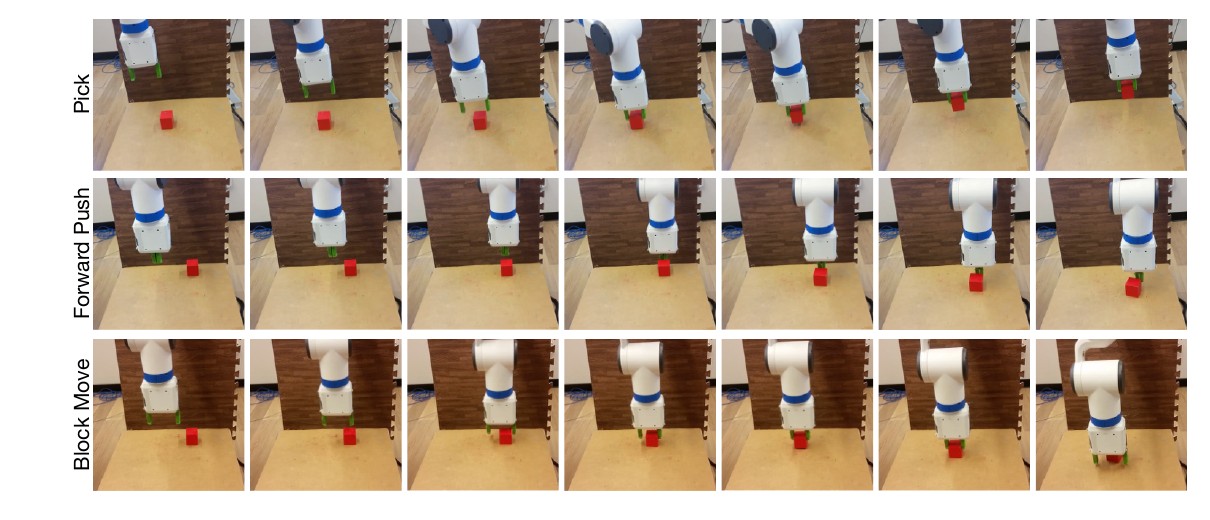
Fig. 7. Successive frames of our asymmetric HER policies on three real robot tasks show how our method can be successfully used for simulation to real transfer of complex policies. Full length experiments can be found in the supplementary video.
图 7:我们的非对称 HER 策略在三项真机任务上的连续帧表明,该方法可以成功地用于复杂策略的仿真到真机迁移。完整实验见补充视频。
TABLE I
COMPARISON OF ASYMMETRIC HER WITH BASELINES AND ABLATIONS
Baselines: Asym DDPG, Sym HER, Vanilla BC, DAgger BC. Randomization ablations: Without any, Without viewpoints.
| Asym HER | Asym DDPG | Sym HER | Vanilla BC | DAgger BC | Without any | Without viewpoints | |
|---|---|---|---|---|---|---|---|
| Pick | 5/5 | 0/5 | 0/5 | 0/5 | 3/5 | 0/5 | 0/5 |
| Forward Push | 5/5 | 0/5 | 0/5 | 1/5 | 0/5 | 0/5 | 0/5 |
| Block Move | 5/5 | 0/5 | 0/5 | 0/5 | 0/5 | 0/5 | 4/5 |
表 I
非对称 HER 与基线及消融的比较
基线:Asym DDPG、Sym HER、Vanilla BC、DAgger BC。随机化消融:Without any、Without viewpoints。
| Asym HER | Asym DDPG | Sym HER | Vanilla BC | DAgger BC | Without any | Without viewpoints | |
|---|---|---|---|---|---|---|---|
| Pick | 5/5 | 0/5 | 0/5 | 0/5 | 3/5 | 0/5 | 0/5 |
| Forward Push | 5/5 | 0/5 | 0/5 | 1/5 | 0/5 | 0/5 | 0/5 |
| Block Move | 5/5 | 0/5 | 0/5 | 0/5 | 0/5 | 0/5 | 4/5 |
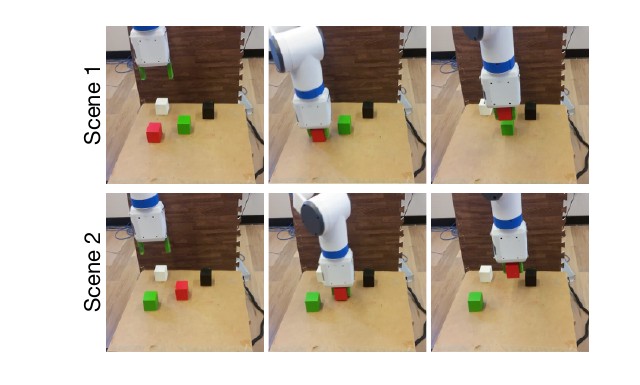
Fig. 8. Domain randomization during training allows the learned policies to be robust to distractors. Here we see how a policy trained to Pick the red block is robust to distractor blocks. The difference in the two scenes shown here is that inspite of changing the initial location of the red block, the arm still picks the red block.
图 8:训练时的域随机化使学到的策略对干扰物更为稳健。这里可以看到,一个被训练去抓取红色木块的策略,对干扰木块仍然稳健。这里给出的两个场景的差别在于:尽管改变了红色木块的初始位置,手臂仍然抓取红色木块。
D. Would state-based learning followed by visual behavioral cloning succeed?
D. 先做基于状态的学习、再做视觉行为克隆,会成功吗?
Imitation learning is a powerful technique in robotics [4]. Hence a much stronger baseline is to behaviour clone from an expert policy. To do this we first train an expert policy [4] on full states that performs the task perfectly. Now given this expert policy, we behaviour clone to a policy that takes the visual observations as input [15]. Furthermore, since we have access to the expert state-based policy, we can improve the imitated visual policy using DAgger [38].
模仿学习是机器人学中一种有力的技术 [4]。因此,一个强得多的基线是从专家策略做行为克隆。为此,我们先在完整状态上训练一个能完美完成任务的专家策略 [4]。有了这个专家策略后,再行为克隆到一个以视觉观测为输入的策略 [15]。此外,由于我们可以访问基于状态的专家策略,还可以用 DAgger [38] 来改进被模仿的视觉策略。
Figure 5 shows the final episodic rewards of the behaviour cloned policy (in dashed lines) with the x-axis being the number of demonstrations. As expected, the DAgger policy learns much faster initially (since it receives supervision from a much stronger expert policy). However in all the environments, it saturates in performance and is lower than our method (asymmetric HER) for a large number of rollouts. One reason for this is that behaviour cloning would fail if the expert policy depends on information contained in the full state but not in the partial observation. This experiment shows that although behaviour cloning can help speed up visual learning, it cannot overcome the domain mismatch between the expert and cloned policy. These findings are consistent with the results in James et al. [15]. Asymmetric Actor Critic does not face this challenge since state information is used only in the training of the critic.
图 5 给出了行为克隆策略的最终回合奖励(虚线),横轴是演示次数。正如所料,DAgger 策略起初学得快得多(因为它从更强的专家策略获得监督)。然而在所有环境中,它的性能都会饱和,并且在大量展开之后低于我们的方法(非对称 HER)。一个原因是:如果专家策略依赖于完整状态中有、但部分观测中没有的信息,行为克隆就会失败。这一实验表明,虽然行为克隆可以帮助加快视觉学习,但它无法克服专家与被克隆策略之间的域不匹配。这些发现与 James 等人 [15] 的结果一致。Asymmetric Actor Critic 不会遇到这一困难,因为状态信息只用于评论家的训练。
E. Does the bottleneck layer speed up training?
E. 瓶颈层会加快训练吗?
Another way of incorporating the full state from the simulator is by adding an auxiliary task of predicting the full state from partial observations. By adding a bottleneck layer [52] in the actor and adding an additional loss between the bottleneck output and the full state, we further speed up training. On our simulated tasks, these bottlenecks in the policy network improve the stability and speed of training (as seen in Figure 6).
把仿真器中的完整状态纳入进来的另一种办法,是增加一项从部分观测预测完整状态的辅助任务。通过在执行器中加入瓶颈层 [52],并在瓶颈输出与完整状态之间增加一项额外的 损失,我们进一步加快了训练。在我们的仿真任务上,策略网络中的这些瓶颈改进了训练的稳定性和速度(见图 6)。
F. How well do these policies transfer to a real robot?
F. 这些策略迁移到真机上表现如何?
By combining asymmetric HER with domain randomization [47], we show significant performance gains (see Table I) compared to baselines previously mentioned. Note that we measure success if the block is within of the desired target position. Our method succeeds on all the three tasks for all the 5 times the policy were run with different block initializations and goals. We also note that behaviours like push-grasping [9] and re-grasping [42] emerge from these trained policies which can be seen in the www.goo.gl/b57WTs. Among the baselines we evaluate against, we note that behaviour cloning with DAgger is the only one that performs reasonably (as seen in the video and Table I).
把非对称 HER 与域随机化 [47] 结合起来后,我们相对于前面提到的基线取得了显著的性能提升(见表 I)。注意,我们以木块位于期望目标位置 之内来衡量成功。我们的方法在全部三项任务上,都以不同的木块初始位置和目标把策略运行了 5 次,全部成功。我们还注意到,这些训练出的策略中涌现出了推抓 [9] 和再抓取 [42] 等行为,可见于 www.goo.gl/b57WTs。在我们评估的基线中,与 DAgger 结合的行为克隆是唯一表现尚可的(见视频和表 I)。
This experiment demonstrates the utility of our method on robots with minimal instrumentation. Using RGBD inputs in this fashion means that error-prone aspects like state estimation or precise camera calibration aren't required. Moreover, since the goal is defined by an image, this can be given by showing the camera the desired scene. Alternatively, if it is easier to describe the goal by the state of the block, a rendered image of the block in the desired state can be used as the goal.
这一实验表明,我们的方法适用于只需最少仪器配置的机器人。以这种方式使用 RGBD 输入,意味着不需要状态估计或精确的相机标定这类容易出错的环节。此外,由于目标由图像定义,可以通过把期望场景展示给相机来给出目标。或者,如果用木块的状态来描述目标更方便,也可以把木块处于期望状态时的渲染图像用作目标。
G. How important is domain randomization?
G. 域随机化有多重要?
To show the importance of randomization, we perform ablations (last two columns of Table I) by training policies without any randomization and testing them in the real world. We notice that without any randomization, the policies fail to perform on the real robot while performing perfectly in the simulator. Another randomization ablation is by removing the viewpoint randomization while keeping the texture and lighting randomization during training. We notice that apart from the Block Move task, removing viewpoint randomization severely affects performance.
为说明随机化的重要性,我们做了消融(表 I 的最后两列):在没有任何随机化的情况下训练策略,再在真实世界中测试。我们注意到,没有任何随机化时,这些策略在仿真器中表现完美,但在真机上失败。另一项随机化消融是在训练时去掉视点随机化,同时保留纹理和光照随机化。我们注意到,除了 Block Move 任务之外,去掉视点随机化会严重损害性能。
Randomizing the observations in training also gives us an added benefit: robustness to distractors. Figure 8 shows the performance of our Pick policy, which was trained on a single red block, work even in the presence of distractor blocks.
在训练中随机化观测还有一个额外好处:对干扰物的稳健性。图 8 展示了我们的 Pick 策略的表现:该策略是在单个红色木块上训练的,但在存在干扰木块时仍然有效。
H. Implementation Details
H. 实现细节
In this section we provide more details on our training setup. The critic is a fully connected neural network with 3 hidden layers; each with 512 hidden units. The hidden layers use ReLU [20] for the non linear activation. The input to the critic is the concatenation of the current state , the desired goal state and the current action . The actor is a convolutional neural network (CNN) with 4 convolutional layers with 64 filters each and kernel size of . This network is applied to both the current observation and the goal observation . The outputs of both CNNs are then concatenated and passed through a fully connected neural network with 3 hidden layers. Similar to the critic, the hidden layers have 512 hidden units each with ReLU activation. The output of this actor network is normalized by a tanh activation and rescaled to match the limits of the environment's action space. In order to prevent tanh saturation, we penalize the preactivations in the actor's cost.
本节提供更多关于训练设置的细节。评论家是一个有 3 个隐层的全连接神经网络,每层有 512 个隐单元。隐层使用 ReLU [20] 作为非线性激活。评论家的输入是当前状态 、期望目标状态 和当前动作 的拼接。执行器是一个卷积神经网络(CNN),有 4 个卷积层,每层 64 个滤波器,核大小为 。该网络同时应用于当前观测 和目标观测 。两个 CNN 的输出再拼接起来,送入一个有 3 个隐层的全连接神经网络。与评论家类似,这些隐层每层有 512 个隐单元,并使用 ReLU 激活。该执行器网络的输出经过 tanh 激活归一化,再缩放到与环境动作空间的界限相匹配。为防止 tanh 饱和,我们在执行器的代价中对预激活加以惩罚。
During each iteration of DDPG, we sample 16 parallel rollouts of the actor. Following this we perform 40 optimization steps on minibatches of size 128 from the replay buffer of size transitions. The target actor and critic networks are updated every iteration with a Polyak averaging of 0.98. We use Adam [17] optimization with a learning rate of 0.001 and the default Tensorflow [1] values for the other hyperparameters. We use a discount factor of and use a fixed horizon of steps. For efficient learning, we also normalize the input states by running averages of the means and standard deviations of encountered states.
在 DDPG 的每次迭代中,我们采样 16 条并行的执行器展开。随后,我们从大小为 条转移的回放缓冲区中,对大小为 128 的小批量做 40 步优化。目标执行器和评论家网络在每次迭代中以 0.98 的 Polyak 平均更新。我们使用 Adam [17] 优化,学习率为 0.001,其余超参数采用 Tensorflow [1] 的默认值。我们使用折扣因子 ,并使用固定视界 步。为了高效学习,我们还用所遇状态的均值和标准差的运行平均来归一化输入状态。
The behavioural policy chosen for exploration chooses a uniform random action from the space of valid actions with probability 20%. For the rest 80% probability, the output of the actor is added with coordinate independent Normal noise with standard deviation equal to 5% of the action range.
用于探索的行为策略以 20% 的概率从合法动作空间中选择一个均匀随机动作。对其余 80% 的概率,在执行器的输出上加入坐标独立的正态噪声,标准差等于动作范围的 5%。
VI. CONCLUSION
VI. 结论
In this work we introduce asymmetric actor-critic, a powerful way of utilizing the full state observability in a simulator. By training the critic on full states while training its actor on rendered images, we learn vision-based policies for complex manipulation tasks. Extensive evaluation both in the simulator and on our real world robot shows significant improvements over standard actor-critic baselines. This method's performance is also superior to the much stronger imitation learning with DAgger baseline, even though it was trained without an expert. Coupled with domain randomization, our method is able to learn visual policies that works in the real world while being trained solely in a simulator.
本文引入非对称 actor-critic,这是一种利用仿真器中完整状态可观测性的有力方法。通过在完整状态上训练评论家、在渲染图像上训练执行器,我们为复杂操作任务学到了基于视觉的策略。在仿真器和真机上的广泛评估表明,它明显优于标准的 actor-critic 基线。该方法的性能也优于更强的、结合 DAgger 的模仿学习基线,尽管它的训练并没有使用专家。与域随机化结合后,我们的方法能够学到在真实世界中有效的视觉策略,而训练完全在仿真器中完成。
REFERENCES
参考文献
[1] Martín Abadi et al. Tensorflow: Large-scale machine learning on heterogeneous distributed systems. arXiv preprint arXiv:1603.04467, 2016.
[2] Pulkit Agrawal, Ashvin V Nair, Pieter Abbeel, Jitendra Malik, and Sergey Levine. Learning to poke by poking: Experiential learning of intuitive physics. In Advances in Neural Information Processing Systems, pages 5074–5082, 2016.
[3] Marcin Andrychowicz, Filip Wolski, Alex Ray, Jonas Schneider, Rachel Fong, Peter Welinder, Bob McGrew, Josh Tobin, Pieter Abbeel, and Wojciech Zaremba. Hindsight experience replay. NIPS, 2017.
[4] Brenna D Argall, Sonia Chernova, Manuela Veloso, and Brett Browning. A survey of robot learning from demonstration. Robotics and autonomous systems, 2009.
[5] Zdravko Balorda. Reducing uncertainty of objects by robot pushing. In ICRA 1990.
[6] A Bicchi and V Kumar. Robotic grasping and contact: a review. In ICRA 2000.
[7] Paul Christiano, Zain Shah, Igor Mordatch, Jonas Schneider, Trevor Blackwell, Joshua Tobin, Pieter Abbeel, and Wojciech Zaremba. Transfer from simulation to real world through learning deep inverse dynamics model. arXiv preprint arXiv:1610.03518, 2016.
[8] Mark Cutler and Jonathan P How. Efficient reinforcement learning for robots using informative simulated priors. In ICRA 2015.
[9] Mehmet Dogar and Siddhartha Srinivasa. A framework for push-grasping in clutter. Robotics: Science and Systems (RSS), 2011.
[10] Jakob Foerster, Gregory Farquhar, Triantafyllos Afouras, Nantas Nardelli, and Shimon Whiteson. Counterfactual multi-agent policy gradients. arXiv preprint arXiv:1705.08926, 2017.
[11] Javier García and Fernando Fernández. A comprehensive survey on safe reinforcement learning. Journal of Machine Learning Research, 16(1):1437–1480, 2015.
[12] Ali Ghadirzadeh, Atsuto Maki, Danica Kragic, and Mårten Björkman. Deep predictive policy training using reinforcement learning. arXiv preprint arXiv:1703.00727, 2017.
[13] David Held, Zoe McCarthy, Michael Zhang, Fred Shentu, and Pieter Abbeel. Probabilistically safe policy transfer. ICRA 2017.
[14] Stephen James and Edward Johns. 3d simulation for robot arm control with deep q-learning. arXiv preprint arXiv:1609.03759, 2016.
[15] Stephen James, Andrew J Davison, and Edward Johns. Transferring end-to-end visuomotor control from simulation to real world for a multi-stage task. arXiv preprint arXiv:1707.02267, 2017.
[16] Leslie Pack Kaelbling, Michael L Littman, and Andrew W Moore. Reinforcement learning: A survey. Journal of artificial intelligence research, 1996.
[17] Diederik Kingma and Jimmy Ba. Adam: A method for stochastic optimization. arXiv preprint arXiv:1412.6980, 2014.
[18] J Zico Kolter and Andrew Y Ng. Learning omnidirectional path following using dimensionality reduction. In RSS, 2007.
[19] Vijay R Konda and John N Tsitsiklis. Actor-critic algorithms. In Advances in neural information processing systems, pages 1008–1014, 2000.
[20] Alex Krizhevsky, Ilya Sutskever, and Geoffrey E Hinton. Imagenet classification with deep convolutional neural networks. In NIPS 2012.
[21] Sergey Levine, Chelsea Finn, Trevor Darrell, and Pieter Abbeel. End-to-end training of deep visuomotor policies. JMLR 2016.
[22] Sergey Levine, Peter Pastor, Alex Krizhevsky, and Deirdre Quillen. Learning hand-eye coordination for robotic grasping with deep learning and large-scale data collection. ISER, 2016.
[23] Timothy P Lillicrap, Jonathan J Hunt, Alexander Pritzel, Nicolas Heess, Tom Erez, Yuval Tassa, David Silver, and Daan Wierstra. Continuous control with deep reinforcement learning. arXiv preprint arXiv:1509.02971, 2015.
[24] Ryan Lowe, Yi Wu, Aviv Tamar, Jean Harb, Pieter Abbeel, and Igor Mordatch. Multi-agent actor-critic for mixed cooperative-competitive environments. arXiv preprint arXiv:1706.02275, 2017.
[25] Jeffrey Mahler, Jacky Liang, Sherdil Niyaz, Michael Laskey, Richard Doan, Xinyu Liu, Juan Aparicio Ojea, and Ken Goldberg. Dex-net 2.0: Deep learning to plan robust grasps with synthetic point clouds and analytic grasp metrics. arXiv preprint arXiv:1703.09312, 2017.
[26] Volodymyr Mnih et al. Human-level control through deep reinforcement learning. Nature, 2015.
[27] Kwan-Jung Oh, Sehoon Yea, and Yo-Sung Ho. Hole filling method using depth based in-painting for view synthesis in free viewpoint television and 3-d video. In PCS 2009.
[28] Lerrel Pinto and Abhinav Gupta. Supersizing self-supervision: Learning to grasp from 50k tries and 700 robot hours. ICRA 2016, .
[29] Lerrel Pinto and Abhinav Gupta. Learning to push by grasping: Using multiple tasks for effective learning. In ICRA 2017, .
[30] Lerrel Pinto, Dhiraj Gandhi, Yuanfeng Han, Yong-Lae Park, and Abhinav Gupta. The curious robot: Learning visual representations via physical interactions. In European Conference on Computer Vision, pages 3–18. Springer, 2016.
[31] Lerrel Pinto, James Davidson, and Abhinav Gupta. Supervision via competition: Robot adversaries for learning tasks. In Robotics and Automation (ICRA), 2017 IEEE International Conference on, pages 1601–1608. IEEE, 2017.
[32] Lerrel Pinto, James Davidson, Rahul Sukthankar, and Abhinav Gupta. Robust adversarial reinforcement learning. ICML, 2017.
[33] Benjamin Planche, Ziyan Wu, Kai Ma, Shanhui Sun, Stefan Kluckner, Terrence Chen, Andreas Hutter, Sergey Zakharov, Harald Kosch, and Jan Ernst. Depthsynth: Real-time realistic synthetic data generation from cad models for 2.5 d recognition. arXiv preprint arXiv:1702.08558, 2017.
[34] Boris T Polyak and Anatoli B Juditsky. Acceleration of stochastic approximation by averaging. SIAM Journal on Control and Optimization, 1992.
[35] Doina Precup, Richard S Sutton, and Sanjoy Dasgupta. Off-policy temporal-difference learning with function approximation. In ICML, 2001.
[36] Aravind Rajeswaran, Sarvjeet Ghotra, Sergey Levine, and Balaraman Ravindran. Epopt: Learning robust neural network policies using model ensembles. ICLR, 2017.
[37] Stephan R Richter, Vibhav Vineet, Stefan Roth, and Vladlen Koltun. Playing for data: Ground truth from computer games. In ECCV 2016.
[38] Stéphane Ross, Geoffrey J Gordon, and Drew Bagnell. A reduction of imitation learning and structured prediction to no-regret online learning. In International Conference on Artificial Intelligence and Statistics, 2011.
[39] Andrei A Rusu, Matej Vecerik, Thomas Rothörl, Nicolas Heess, Razvan Pascanu, and Raia Hadsell. Sim-to-real robot learning from pixels with progressive nets. arXiv preprint arXiv:1610.04286, 2016.
[40] Fereshteh Sadeghi and Sergey Levine. (cad)rl: Real single-image flight without a single real image. arXiv preprint arXiv:1611.04201, 2016.
[41] Tom Schaul, Daniel Horgan, Karol Gregor, and David Silver. Universal value function approximators. In ICML 2015.
[42] Thomas Schlegl, Martin Buss, Toru Omata, and Günther Schmidt. Fast dextrous re-grasping with optimal contact forces and contact sensor-based impedance control. In ICRA 2001.
[43] John Schulman, Sergey Levine, Pieter Abbeel, Michael Jordan, and Philipp Moritz. Trust region policy optimization. In ICML 2015.
[44] David Silver, Guy Lever, Nicolas Heess, Thomas Degris, Daan Wierstra, and Martin Riedmiller. Deterministic policy gradient algorithms. In ICML 2014.
[45] David Silver et al. Mastering the game of go with deep neural networks and tree search. Nature, 2016.
[46] Richard S Sutton and Andrew G Barto. Reinforcement learning: An introduction, volume 1. MIT press Cambridge, 1998.
[47] Josh Tobin, Rachel Fong, Alex Ray, Jonas Schneider, Wojciech Zaremba, and Pieter Abbeel. Domain randomization for transferring deep neural networks from simulation to the real world. IROS, 2017.
[48] Emanuel Todorov, Tom Erez, and Yuval Tassa. Mujoco: A physics engine for model-based control. In IROS, 2012.
[49] Ulrich Viereck, Andreas ten Pas, Kate Saenko, and Robert Platt. Learning a visuomotor controller for real world robotic grasping using easily simulated depth images. arXiv preprint arXiv:1706.04652, 2017.
[50] Na-Eun Yang, Yong-Gon Kim, and Rae-Hong Park. Depth hole filling using the depth distribution of neighboring regions of depth holes in the kinect sensor. In ICSPCC 2012.
[51] Wenhao Yu, C Karen Liu, and Greg Turk. Preparing for the unknown: Learning a universal policy with online system identification. arXiv preprint arXiv:1702.02453, 2017.
[52] Fangyi Zhang, Jürgen Leitner, Ben Upcroft, and Peter Corke. Vision-based reaching using modular deep networks: from simulation to the real world. arXiv preprint arXiv:1610.06781, 2016.