Artificial Hivemind:不同模型也在写同一种时间隐喻
Artificial Hivemind: The Open-Ended Homogeneity of Language Models (and Beyond)
人工蜂群心智:语言模型(及之外)的开放式同质化(Artificial Hivemind: The Open-Ended Homogeneity of Language Models (and Beyond))
Liwei Jiang Yuanjun Chai Margaret Li Mickel Liu Raymond Fok Nouha Dziri Yulia Tsvetkov Maarten Sap Affiliation: University of Washington Carnegie Mellon University Alon Albalak Yejin Choi Affiliation: Allen Institute for Artificial Intelligence Lila Sciences Stanford University lwjiang@cs.washington.edu Code : https://github.com/liweijiang/artificial-hivemind Infinity-Chat Collection : liweijiang/artificial-hivemind
Liwei Jiang、Yuanjun Chai、Margaret Li、Mickel Liu、Raymond Fok、Nouha Dziri、Yulia Tsvetkov、Maarten Sap(华盛顿大学 / 卡内基梅隆大学);Alon Albalak、Yejin Choi(Allen Institute for AI / Lila Sciences / 斯坦福大学)
联系:lwjiang@cs.washington.edu
代码:https://github.com/liweijiang/artificial-hivemind
Infinity-Chat 合集:liweijiang/artificial-hivemind
Abstract
摘要
Large language models (LMs) often struggle to generate diverse, human-like creative content, raising concerns about the long-term homogenization of human thought through repeated exposure to similar outputs. Yet scalable methods for evaluating LM output diversity remain limited, especially beyond narrow tasks such as random number or name generation, or beyond repeated sampling from a single model. To address this gap, we introduce Infinity-Chat, a large-scale dataset of 26K diverse, real-world, open-ended user queries that admit a wide range of plausible answers with no single ground truth. We introduce the first comprehensive taxonomy for characterizing the full spectrum of open-ended prompts posed to LMs, comprising 6 top-level categories (e.g., creative content generation, brainstorm & ideation) that further breaks down to 17 subcategories. Using Infinity-Chat, we present a large-scale study of mode collapse in LMs, revealing a pronounced Artificial Hivemind effect in open-ended generation of LMs, characterized by (1) intra-model repetition, where a single model consistently generates similar responses, and more so (2) inter-model homogeneity, where different models produce strikingly similar outputs. Infinity-Chat also includes 31,250 human annotations, across absolute ratings and pairwise preferences, with 25 independent human annotations per example. This enables studying collective and individual-specific human preferences in response to open-ended queries. Our findings show that state-of-the-art LMs, reward models, and LM judges are less well calibrated to human ratings on model generations that elicit differing idiosyncratic annotator preferences, despite maintaining comparable overall quality. Overall, Infinity-Chat presents the first large-scale resource for systematically studying real-world open-ended queries to LMs, revealing critical insights to guide future research for mitigating long-term AI safety risks posed by the Artificial Hivemind.
大语言模型(LM)常难以生成多样、类人的创造性内容,引发人们担心:反复暴露于相似输出会导致人类思维长期同质化。然而,可扩展地评测 LM 输出多样性的方法仍然有限,尤其是在随机数/姓名生成等狭窄任务之外,或超出对单一模型反复采样的设定。为填补缺口,我们提出 Infinity-Chat:含 26K 条多样、真实世界、允许宽范围合理解且无单一标准答案的开放式用户查询的大规模数据集。我们给出首个刻画面向 LM 的开放式提示全谱系的综合分类体系,含 6 个顶层类别(如创意内容生成、头脑风暴与构思)并细分为 17 个子类。基于 Infinity-Chat,我们对 LM 的模式崩塌做大规模研究,揭示开放式生成中显著的*人工蜂群心智(Artificial Hivemind)*效应,特征为:(1) 模型内重复——单个模型持续生成相似回答;更甚者 (2) 模型间同质化——不同模型产出惊人相似的输出。Infinity-Chat 还含 31,250 条人类标注(绝对评分与成对偏好),每例 25 名独立标注者,从而可研究开放式查询下的集体与个体特异人类偏好。我们发现,当前最强 LM、奖励模型与 LM 裁判 在会引发标注者特异偏好分歧的模型生成上,与人类评分校准更差,尽管总体质量相当。总体而言,Infinity-Chat 是系统研究面向 LM 的真实世界开放式查询*的首个大规模资源,揭示缓解人工蜂群心智*带来的长期 AI 安全风险的关键洞见。
1 Introduction
1 引言
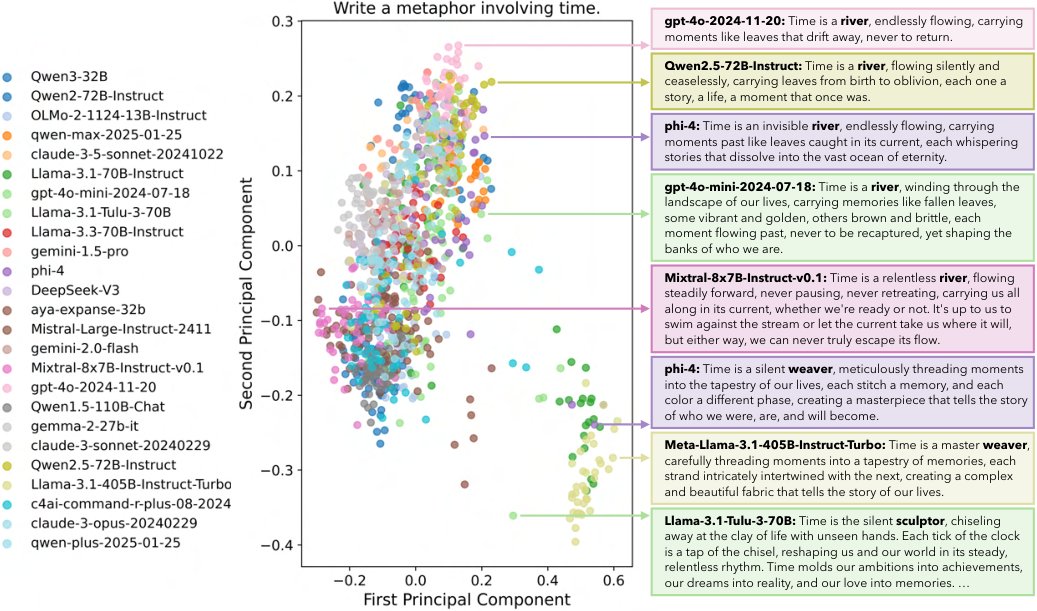
Figure 1: Responses to the query “Write a metaphor about time” clustered by applying PCA to reduce sentence embeddings to two dimensions. Each of the 25 models generates 50 responses using top-p sampling () and temperature . Despite the diversity of model families and sizes, the responses form just two visually prominent regions in the 2D projection: a dominant cluster on the left centered on the metaphor “time is a river,” and a smaller cluster on the right revolving around variations of “time is a weaver.”
图 1:对查询 “写一个关于时间的隐喻” 的回答,经 PCA 将句嵌入降到二维后聚类。25 个模型各用 top-p 采样()与温度 生成 50 条回答。尽管模型族与规模多样,二维投影上回答只形成 两个视觉上突出的区域:左侧主导簇以隐喻“时间是河流”为中心,右侧较小簇围绕“时间是织工”的变体。
Large language models (LMs) are the core backbone of modern AI systems but often fail to produce the diverse, human-like creativity expected in open-ended tasks that do not have a ground truth answer West and Potts (2025); Zhang et al. (2024); Zhang et al. (2025b); Li et al. (2024b). This shortfall has sparked growing concerns about the long-term homogenization of human thought, as users are repeatedly exposed to similar outputs Sourati et al. (2025); Bommasani et al. (2022). While ensemble methods or model “swarms” have been proposed to enhance diversity Feng et al. (2025b); Feng et al. (2025a), their scalable evaluations of diversity in real-world settings are still lacking Gerstgrasser et al. (2024). Existing benchmarks often target stylized tasks such as persona generation (Ge et al., 2024), keyword-driven storytelling (Chakrabarty et al., 2024), or random number generation (Zhang et al., 2024; West and Potts, 2025), and often rely on narrowly defined tests centered on poetry or figurative language (Padmakumar et al., 2025; Zhang et al., 2025b). Yet, these settings fail to capture the open-endedness and pluralism of real-world user interactions.
大语言模型是现代 AI 系统的核心骨干,但在没有标准答案的开放式任务中,常无法产出预期的多样、类人创造力(West and Potts, 2025;Zhang et al., 2024;Zhang et al., 2025b;Li et al., 2024b)。这一短板引发对人类思维长期同质化的担忧——用户反复暴露于相似输出(Sourati et al., 2025;Bommasani et al., 2022)。虽有集成或模型“蜂群”等方法被提出以增强多样性(Feng et al., 2025b;Feng et al., 2025a),真实场景下可扩展的多样性评测仍不足(Gerstgrasser et al., 2024)。既有基准常瞄准人格生成、关键词驱动故事或随机数生成等风格化任务,或集中于诗歌与比喻语言的狭义测试,难以刻画真实用户交互的开放度与多元性。
We introduce Infinity-Chat, a large-scale dataset of 26K real-world open-ended queries spanning diverse, naturally occurring prompts mined from WildChat Zhao et al. (2024). These queries admit a wide range of plausible answers with no single correct response. We further develop the first comprehensive taxonomy of open-ended LM queries, encompassing 6 top-level categories (e.g., Brainstorm & Ideation, and less explored types such as Speculative & Hypothetical Scenarios, and Skill Development) and 17 subcategories grounded in natural chatbot-user interactions.
我们提出 Infinity-Chat:从 WildChat(Zhao et al., 2024)挖掘的 26K 条真实世界开放式查询,覆盖多样、自然出现的提示,允许宽范围合理解且无单一正确答案。我们进一步给出首个开放式 LM 查询综合分类体系,含 6 个顶层类别(如头脑风暴与构思,以及较少被探索的思辨/假想场景、技能发展等)与 17 个扎根于自然聊天交互的子类。
Using Infinity-Chat, we systematically study intra- and inter-model mode collapse across 70+ open and closed source LMs (25 detailed in the main paper). We uncover a pronounced Artificial Hivemind effect: (1) intra-model repetition, where a single model repeatedly generates similar outputs, and, more critically, (2) inter-model homogeneity, where different models independently converge on similar ideas with minor variations in phrasing. The latter warns that model ensembles may not yield true diversity when their constituents share overlapping alignment and training priors.
基于 Infinity-Chat,我们系统研究跨 70+ 开源与闭源 LM(正文详述 25 个)的模型内与模型间模式崩塌。我们揭示显著的人工蜂群心智效应:(1) 模型内重复——单个模型反复生成相似输出;更关键的是 (2) 模型间同质化——不同模型独立收敛到高度相似的回答。
Beyond generative behaviors, we also examine whether LMs are calibrated to assess alternative responses of comparable quality to open-ended queries. To enable this study, we collect 31,250 human annotations on distinct model responses in Infinity-Chat, encompassing both absolute quality ratings and pairwise preferences, with dense annotations from 25 independent annotators per query–response pair. Our results show that LMs, reward models, and LM-based judges are often miscalibrated with respect to human ratings on responses that elicit divergent, idiosyncratic preferences among annotators despite comparable overall quality. This exposes key limitations in current modeling pipelines, which tend to assume a single, consensus notion of quality and thus overlook or fail to reward the diverse, pluralistic preferences that arise in open-ended responses.
除了基因行为之外,我们还审查 * 是否对LMs进行校准,以评估对开放式询问的替代性质量答复*。 我可不想再有其他的答案。 为了能够进行这项研究,我们收集了31,250个人类对Infinity-Chat中不同模型反应的说明,包括绝对质量评分和双向偏好,每个查询25个独立注释者* 答复对等* 。 我们的结果显示,LM、奖励模型和基于LM的评委往往在“引起注释者之间不同和特殊偏好的答复”上对人类的评分有误,尽管总体质量相当。 这暴露了目前建模管道的主要局限性,它倾向于采用单一的、协商一致的质量概念,从而忽视或未能奖励在无限制反应中产生的多样化、多元的偏好。
Altogether, our work introduces a comprehensive framework for evaluating realistic open-endedness, diversity, and pluralistic alignment in LMs, both within and across LMs. By integrating real-world queries, a taxonomy of query types, and dense human annotations, Infinity-Chat provides a useful resource for diagnosing the Artificial Hivemind effect and for guiding the development of safer, more expressive, and more resourceful LMs that better empower human creativity.
总体而言,我们的工作引入了一个全面的框架,用以评估在多边安排内部和相互之间在多边安排中现实的开放性、多样性和多元一致性。 通过整合真实世界的查询,查询类型的分类,以及密集的人类注释,Infinity-Chat为诊断人工蜂窝效应提供了有用的资源,并指导了更安全,更表现力更强,更有才智的LMs的发展,更好地增强人类的创造力.
2 Infinity-Chat: Real-World Open-Ended Queries with Diverse Responses
2 Infinity-Chat:带多样回答的真实世界开放式查询
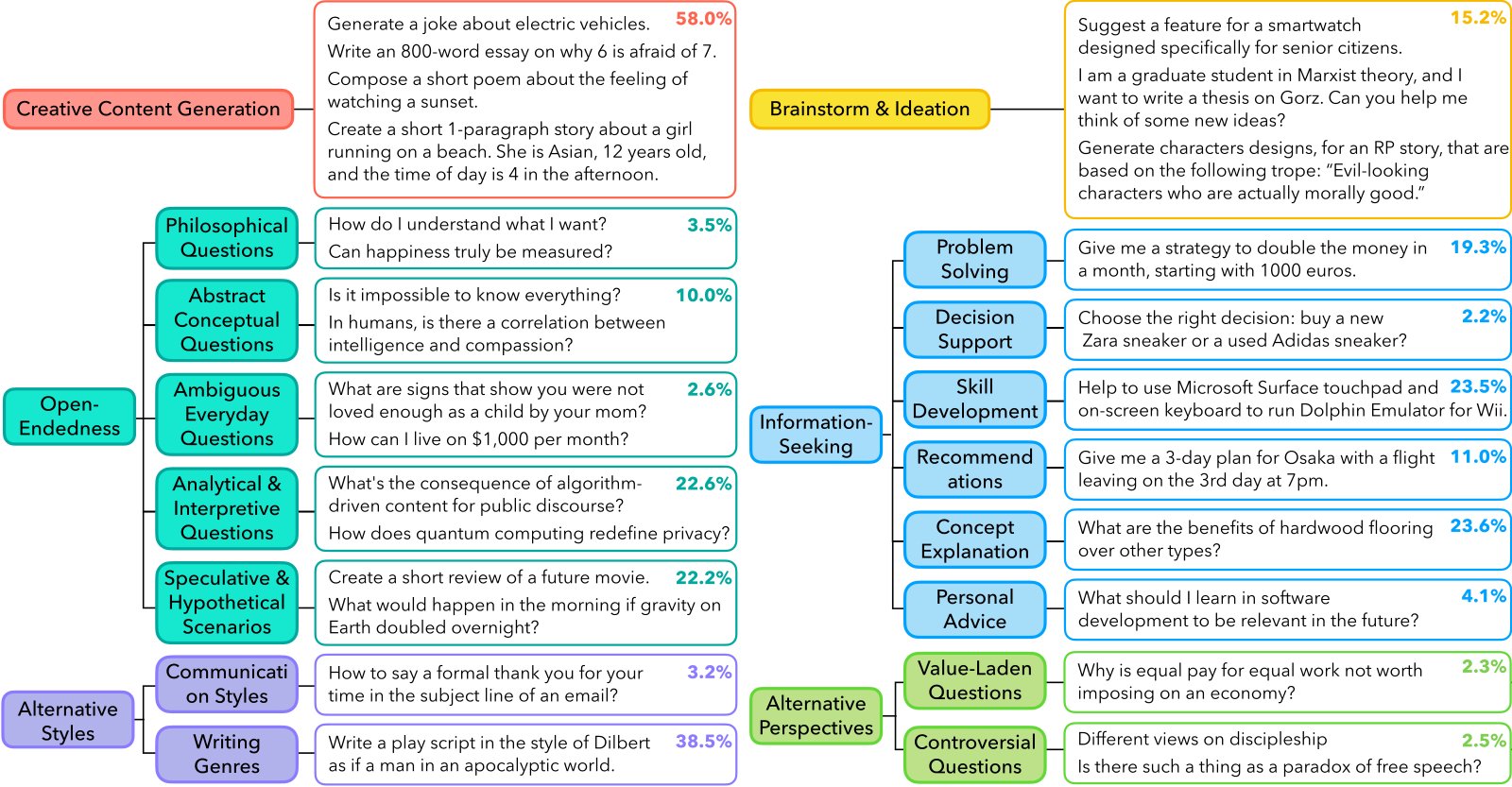
Figure 2: A taxonomy of real-world open-ended queries that invite diverse model responses that are mined from in-the-wild user-chatbot interactions, categorized into 6 top-level and 17 fine-grained subcategories, along with their occurrence percentages.
图二:关于真实世界开放式查询的分类,这些查询邀请了各种模型的答复,这些答复来自用户与机器人的互动,分为6个顶级和17个细纹亚类,及其发生百分比。
Most existing LM alignment datasets prioritize response correctness over diversity, and rarely include multiple distinctive responses to the same prompt. This overlooks the inherent variability of open-ended queries, which often admit several equally valid answers. This gap motivates our first central research question: What types of open-ended queries do users actually pose to language models?
大多数现有的LM校正数据集将响应正确性置于多样性之上,很少包含对同一即时的多个不同响应. 这忽略了不限名额的查询的内在差异,这些查询往往接受若干同样有效的答复。 这一差距激发了我们的第一个中心研究问题:* 用户对语言模型的实际贡献是何种类型的开放式查询?*
Mining in-the-wild open-ended user queries. We construct Infinity-Chat, a dataset of real-world open-ended queries to language models, by filtering and refining user inputs from WildChat (Zhao et al., 2024). From 37,426 high-quality, single-turn GPT-4 queries (English, non-toxic, 15–200 characters), GPT-4o classifies each by whether it seeks meaningful information, is a greeting or model inquiry, and allows single or multiple valid responses. Ambiguous queries are revised for clarity. The result is an extensive collection of 26,070 open-ended and 8,817 closed-ended queries, which elicit diverse, high-quality LM responses. Full details of the query mining process are provided in §Appendix B.1.
** 处理无限制用户的无限制查询。 ** 我们通过过滤和精炼来自WildChat(Zhao等人,2024年)的用户输入,构建了Infinity-Chat(Infinity-Chat),这是现实世界对语言模型的开放式查询数据集. 从37,426个高质量,单转的GPT-4查询(英语,无毒,15–200个字符)中,GPT-4o按其是否寻求有意义的信息对每个查询进行分类,是一种问候或模式查询,允许单次或多次有效回复. 为澄清起见,修改了含糊的询问。 其结果是广泛收集了26,070个不限名额的询问和8,817个不限名额的询问,从而获得了多种高质量的LM回复. 查询挖掘过程的全部细节见§Appendix B.1.
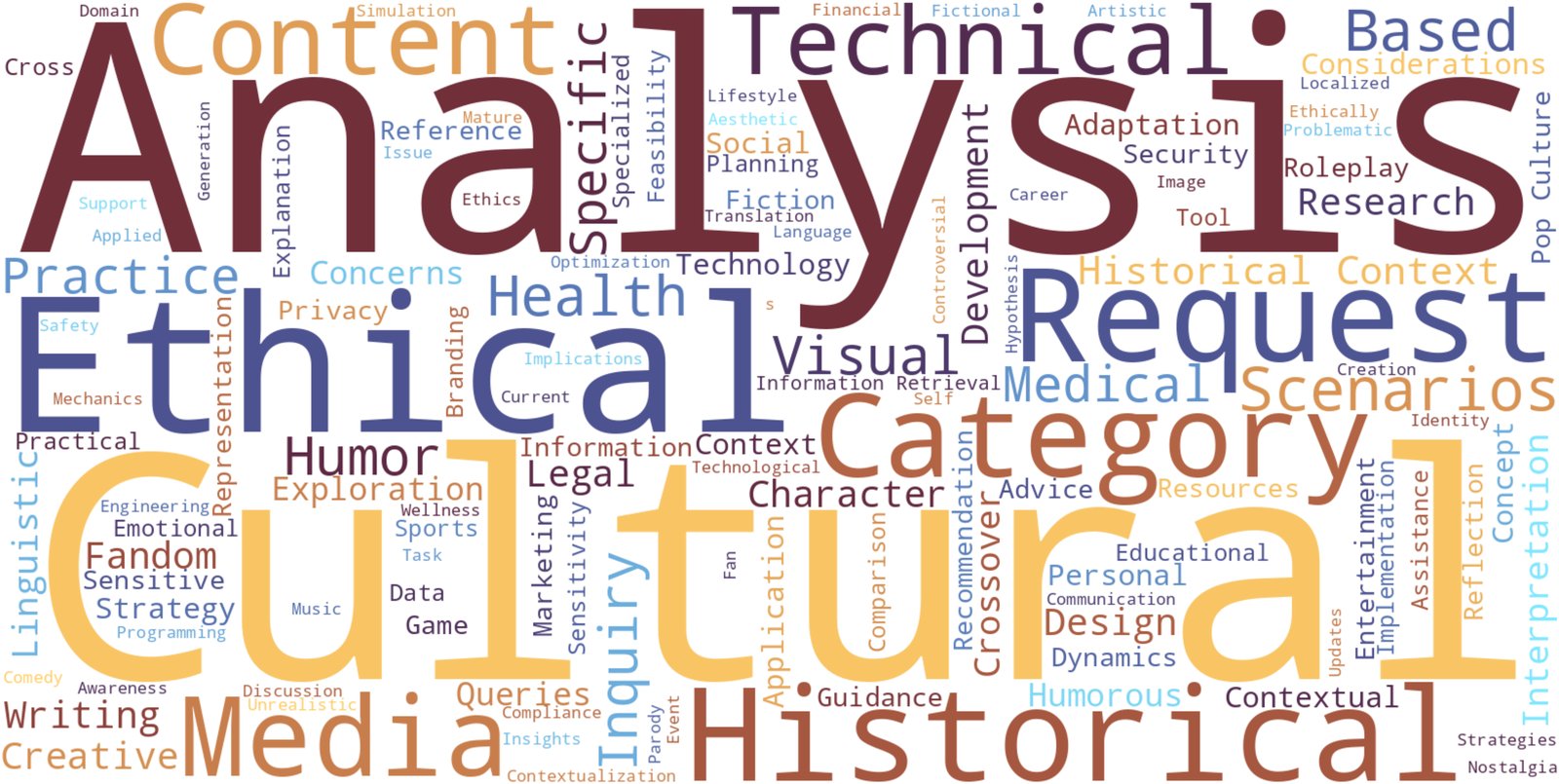
Figure 3: A word cloud visualizing new open-ended categories mined from in-the-wild queries.
图3:云可视化** 新开放类别**
Categorizing the diverse landscape of open-ended queries. To understand the types of open-ended queries users pose to LMs, we develop a taxonomy of fine-grained categories. We adopt a semi-automatic process to construct the taxonomy. Starting with 100 mined queries, we manually assign tentative labels, then iteratively refine and group them into a hierarchical structure. This results in 6 high-level categories and 17 fine-grained sub-categories, as shown in Figure 2. Next, we scale the annotation process to the full set of open-ended queries using GPT-4o. We instruct GPT-4o to label each user query with one or more of the existing open-ended categories, and to detect novel types beyond the seed categories. Full details of the taxonomy construction process are provided in §Appendix B.2.
** 分类各种不限名额的查询。 ** 为了了解用户对LMS的开放式查询类型,我们开发了精细分类法. 我们采用半自动过程来构建分类学. 从 100 地雷查询开始,我们手动指定了暂定标签,然后反复细化,将它们分成一个等级结构。 如图2所示,这导致6个高级类别和17个精细分类。 接下来,我们用GPT-4o将注释过程放大为完整的一组开放式查询. 我们指示GPT-4o将每个用户查询贴上一个或多个现有开放类别标签,并检测种子类别以外的新类型。 分类构建过程的全部细节见§Appendix B.2.
As shown in Figure 2, while Creative Content Generation dominates (58.0%), we identify several underexplored yet popular types, such as Alternative Writing Genres (38.5%), Concept Explanation (23.6%), Skill Development (23.5%), Analytical & Interpretive Questions (22.6%), and Hypothetical Scenarios (22.2%). Notably, 15.2% of queries involve Brainstorming & Ideation, underscoring users’ reliance on LMs for direct ideas and inspirations, and raising concerns about the long-term risk of homogenized thinking driven by overly uniform AI outputs.
如图2所示,虽然创意内容生成占多数(58.0%),但我们发现了几种未得到充分探讨和流行的类型,如替代写作流派(38.5%)、概念解释(23.6%)、技能发展(23.5%)、分析与解释问题(22.6%)和假想(22.2%)。 值得注意的是,15.2%的查询涉及集思广益和思想,强调用户依赖低度元数据来直接提出想法和启发,并引起人们对AI产出过于一致驱动的同质化思维的长期风险的关切。
In addition to our pre-defined categories, we identify 314 novel ones. Figure 3 visualizes a word cloud of the most prominent keywords, such as “Cultural,” “Analysis,” “Ethical,” “Historical,” “Media,” and “Humor,” highlighting previously underexplored dimensions of open-ended query categories.
除了我们预先确定的类别外,我们还确定了314个新的类别。 图3将“文化”、“分析”、“道德”、“历史”、“媒体”和“Humor”等最突出关键词的词云直观化,突出了以前未充分探讨的开放式查询类别的维度。
With Infinity-Chat, we introduce the first comprehensive taxonomy of real-world open-ended queries that invite diverse responses. This dataset serves as a rich resource for studying LMs’ capacity to generate varied appropriate outputs, and for advancing pluralistic alignment of LMs.
我们用Infinity-Chat,介绍第一种关于现实世界开放性问询的全面分类,邀请了不同的回答。 该数据集是研究LMs产生各种适当产出的能力和推动LMs多元化调整的丰富资源。
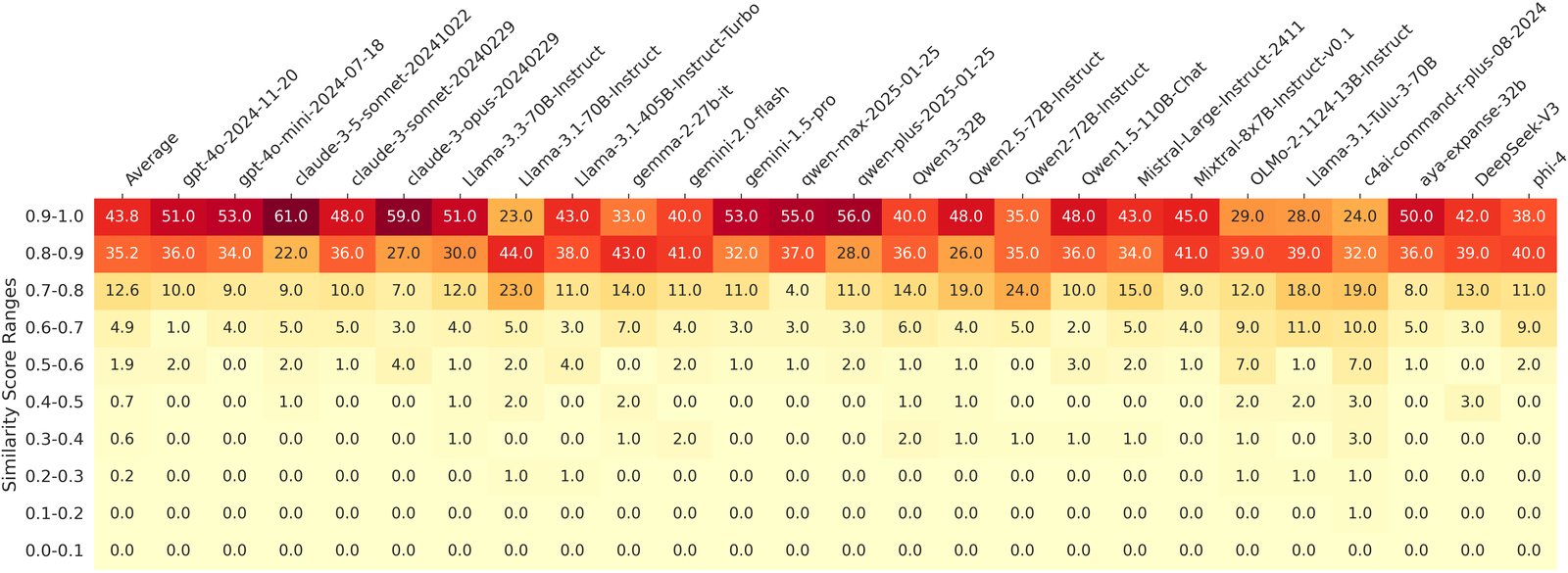
Figure 4: The heatmap shows degree of repetition in responses to open-ended queries generated by the same LMs. For each model, we generate 50 responses per query across 100 open-ended queries from Infinity-Chat100. We then compute the average pairwise sentence embedding similarities for each query’s response pool and measure the percentage of queries falling into the similarity ranges indicated on the y-axis. Under the sampling parameters (top-p , temperature ), the average pairwise similarity among responses to the same prompt typically exceeds 0.8. As a reference, randomly paired responses from the global pool 100% fall within the 0.1–0.2 range. This is only a reference for the similarity scale, not a matched baseline for same-prompt convergence.
图4:热图显示对同一LMs产生的无限制询问的答复重复度。 对于每个模式,我们从Infinity-Chat100的100个不限名额的查询中,每个查询得到50个答复。 然后,我们计算每个查询响应集合的平均对等句子嵌入相似性,并测量属于Y轴上所示相似范围的查询的百分比。 在采样参数(top-*p * ,温度 )下,对同一时速的反应之间平均对等性通常超过0.8. 作为参考,来自全球集合的随机配对反应100%在0.1-0.2范围内。 这仅仅是相似度表的参考,而不是同一瞬间趋同的匹配基准.
3 Artificial Hivemind: Intra- and Inter-Model Homogeneity in LMs
3 人工蜂群心智:语言模型的模型内与模型间同质化
Using a subset of 100 representative open-ended queries from Infinity-Chat (denoted Infinity-Chat100, human verified to be open-ended as detailed in §Appendix B.3), we systematically examine the “Artificial Hivemind” of LMs. We focus on two aspects: (1) intra-model repetition, where the same LM fails to generate diverse outputs, and (2) inter-model homogeneity, where different models produce similar outputs. Prior studies have explored intra-model repetition at small scales or with synthetic tasks (e.g., random number/name generation) West and Potts (2025); Zhang et al. (2024). In contrast, we conduct a large-scale study on real-world open-ended questions, spanning 70+ LMs (25 detailed in the main paper, representing the strongest or largest models from major model families), providing the first systematic analysis of cross-model output convergence. Full experimental setup, complete model results, and examples are provided in §Appendix C.
使用 Infinity-Chat 中 100 条有代表性的开放式查询子集(记为 Infinity-Chat100,经人类验证确为开放式,见附录 B.3),我们系统考察 LM 的“人工蜂群心智”。聚焦两方面:(1) 模型内重复——同一 LM 无法生成多样输出;(2) 模型间同质化——不同模型产出相似输出。先前工作在小规模或合成任务(如随机数/姓名生成)上探索过模型内重复(West and Potts, 2025;Zhang et al., 2024)。相比之下,我们在真实世界开放式问题上做大规模研究,覆盖 70+ 个 LM(正文详述 25 个,代表各主要模型族最强或最大模型),给出跨模型输出收敛的首次系统分析。完整实验设置、全模型结果与样例见附录 C。
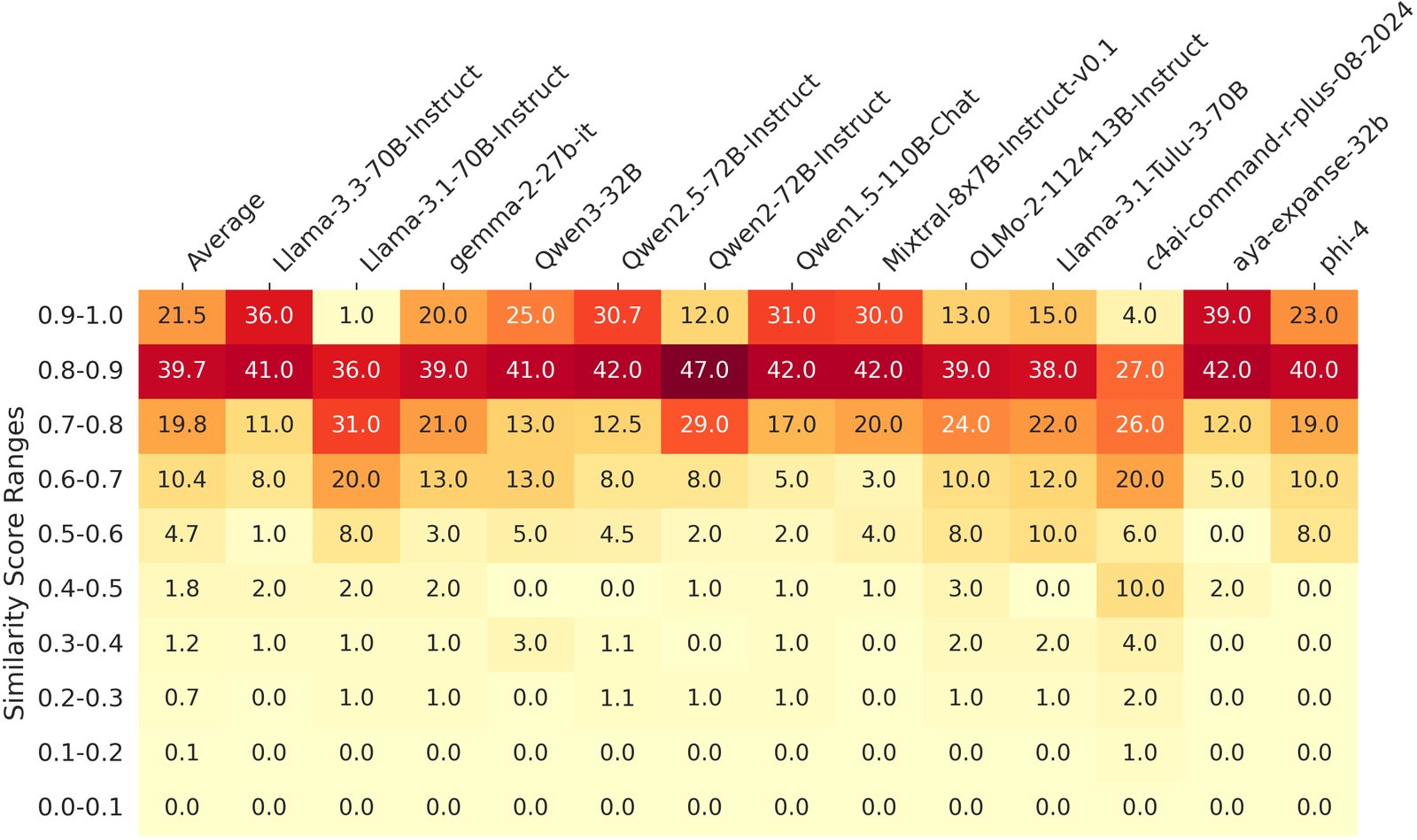
Figure 5: The heatmap shows degree of repetition in responses to open-ended queries generated by the same LMs. Using min-p sampling with parameters (top-p , min-p , temperature ), the average pairwise similarity among responses to the same prompt typically exceeds 0.8.
图 5:热图显示 同一 LM 对开放式查询生成回答的重复程度。使用 min-p 采样(top-p ,min-p ,温度 )时,对同一提示的回答平均成对相似度通常超过 0.8。
Intra-model repetition. For each model, we sample 50 responses per query from Infinity-Chat100, compute the average pairwise embeddings similarity within each response pool[^1], and report the percentage of queries falling into different similarity ranges. Despite using high-stochasticity decoding parameters (top-p , t ), responses from the same model remain highly repetitive, as shown in Figure 4: in 79% of cases, the average similarity exceeds 0.8. Since higher temperatures tend to produce incoherent text, these results show that even under maximally aggressive sampling, LMs still fail to generate diverse responses to open-ended queries.
模型内重复。 对每个模型,我们从 Infinity-Chat100 每查询采样 50 条回答,计算回答池内平均成对嵌入相似度[^1],并报告落入不同相似度区间的查询占比。尽管使用高随机性解码参数(top-p ,t ),同一模型的回答仍高度重复,如图 4:79% 的情形平均相似度超过 0.8。更高温度往往产生不连贯文本,这些结果表明即便在尽可能激进的采样下,LM 仍无法对开放式查询生成多样回答。
Recent work introduces min-p decoding Nguyen et al. (2025), a dynamic strategy for enhancing generation diversity that adjusts the sampling threshold based on model confidence. We evaluate min-p decoding with the same setup and compute pairwise sentence embedding similarities. As shown in Figure 5, while min-p reduces extreme repetition (fewer pairs above 0.9), of response pairs still exceed 0.7 similarity and exceed 0.8, revealing mode collapse even under diversity-oriented decoding.
min-p 解码。 近期工作提出 min-p 解码(Nguyen et al., 2025),一种基于模型置信度动态调整采样阈值、以增强生成多样性的策略。我们以相同设置评估 min-p,并计算成对句嵌入相似度。如图 5,虽 min-p 减少极端重复(超过 0.9 的对更少),仍有 81% 的回答对相似度超过 0.7、61.2% 超过 0.8,说明面向多样性的解码下仍存在模式崩塌。
Despite its promise, min-p is not widely adopted, as it is better suited for creative tasks and less effective for close-ended ones Nguyen et al. (2025). More broadly, inference-time interventions such as decoding strategies are an important part of the solution, but relying on them alone places much of the burden on users to select and configure appropriate methods. We therefore view model training as another crucial component of a broader, multifaceted approach: training-time solutions can help preserve output diversity more robustly and by default, without requiring user intervention at inference time. For the complete breakdown of results across all models, see §Appendix C.2.
尽管有前景,min-p 尚未被广泛采用,因其更适创意任务、对封闭式任务效果较差(Nguyen et al., 2025)。更广地看,解码策略等推理时干预是解决方案的重要部分,但单靠它们会把选择与配置合适方法的负担大半放在用户身上。因此我们把模型训练视为更广多管齐下路径的另一关键组件:训练时方案可默认、更稳健地保留输出多样性,而无须用户在推理时干预。全模型结果分解见附录 C.2。
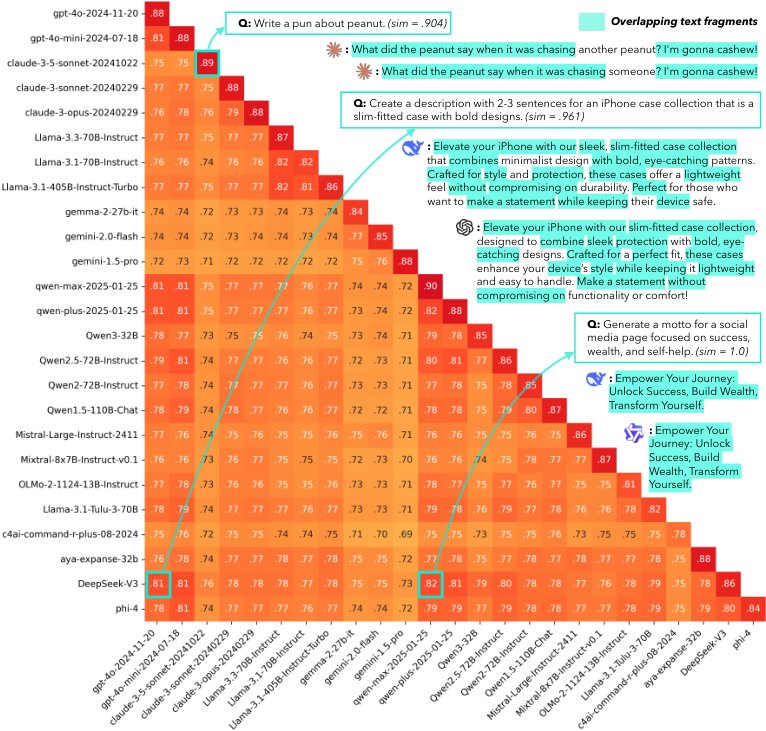
Figure 6: Average pairwise sentence embedding similarities between responses from different models reveal substantial semantic overlap across model outputs. Qualitative examples further illustrate that different models often produce strikingly similar responses to fully open-ended queries, including extended verbatim spans, underscoring the extent of repetition across models in open-ended generation tasks. All responses are generated using top-p and temperature .
图6:将不同模型的答复之间的相似性嵌入到平均对等句中,显示出模型产出之间的语义上的巨大重叠。 定性实例进一步说明,不同模式往往对完全开放的询问作出惊人的类似答复,包括延长逐字记录,强调在不限成员名额的一代任务中不同模式之间重复的程度。 所有答复均使用顶p 和温度生成。
Inter-model homogeneity. Not only do individual models repeatedly generate similar content, but different model sizes and families also produce highly repetitive outputs, sometimes sharing substantial phrase overlaps. As shown in Figure 6, the average pairwise similarity between responses from different models ranges from to , with some pairs notably higher. For example, DeepSeek-V3 and qwen-max-2025-01-25 share a similarity of , while DeepSeek-V3 and gpt-4o-2024-11-20 reach . Interestingly, OpenAI’s GPT models and Qwen’s API models tend to have higher similarities even with models outside their own families. Although the exact causes remain unclear due to proprietary training details, possible explanations include shared data pipelines across regions or contamination from synthetic data. We highlight the need for future work to rigorously investigate the sources of such cross-model repetition.
模型间同质化。 不仅单个模型反复生成相似内容,不同规模与模型族也产出高度重复的输出,有时共享大量短语重叠。如图 6,不同模型回答之间的平均成对相似度介于 71% 到 82%,部分模型对更高。
Beyond general trends, we further analyze how repetition emerges at the instance level. As in prior work Li et al. (2024b); Namuduri et al. (2025), we observe verbatim phrase overlaps within responses from the same model. Surprisingly, such overlaps are also prevalent across different models, even for fully open-ended queries with large output spaces. For example, Figure 6 shows that DeepSeek-V3 and gpt-4o-2024-11-20 generate overlapping phrases like “Elevate your iPhone with our,” “sleek, without compromising,” and “with bold, eye-catching” in answer to the query “Create a description with 2-3 sentences for an iPhone case collection that is a slim-fitted case with bold designs.” In some cases, models output identical responses: for “Generate a motto for a social media page focused on successes, wealth, and self-help,” both qwen-max-2025-01-25 and qwen-plus-2025-01-25 generate “Empower Your Journey: Unlock Success, Build Wealth, Transform Yourself.” These instance-level verbatim overlaps illustrate the severity of the “Artificial Hivemind” effect across models. Paraphrases of the same open-ended queries also lead to verbatim overlaps, as illustrated in Tables 17–18 in § Appendix C.4.
除了一般趋势外,我们进一步分析在实例一级如何出现重复。 同先前的工作Li等人(2024年b);Namuduri等人(2025年)一样,我们观察到同一种模型在答复中出现重叠。 令人惊讶的是,这些重叠也普遍存在于不同的模型中,甚至对于输出空间大的完全开放的查询也是如此. 例如,图6显示,DeepSeek-V3和gpt-4o-2024-11-20产生重叠短语,如“用我们的iPhone“sleek,不妥协”和“用大胆的、捕眼”来回答“为iPhone案例集创造2-3句的描述,该案例集是一个带有大胆设计的微小尺寸案例”。 有些情况下,模型会输出相同的答复 : 对于“为社交媒体网页提供一条以成功、财富和自助为重点的座右铭 ” , Quen-max-2025-01-25 和 qwen-plus-2025-01-25 都会产生“Empower Your Journey: Unlock Eurney, Building Wealth, Transform yourself ” 。 这些实例层面的逐字记录重叠说明了“人工蜂窝”效应在各种模型中的严重性。 如附录C.4表17至表18所示,对相同的无限制查询的表述也导致逐字记录重叠。
Beyond surface-level overlap, repetition also manifests semantically: models converge on core ideas using different phrasing. As shown in Figure 1 (more in Figure 15-18), for the query “Write a metaphor about time,” 50 responses from each of 25 models form just two primary visual clusters: a dominant one centered on “time is a river” and a secondary one on “time is a weaver.” This convergence of abstract concepts reveals the “Artificial Hivemind” exposed in more subtle forms.
除了表层重叠外,重复还表现成群:模型使用不同的词句在核心思想上汇合. 如图1(见图15-18)所示,对于“写一个比喻时间”的问题,25个模型中的每个模型的50个答复仅组成两个主要视觉集群:一个以“时间为河流”为中心,另一个以“时间为织物”为中心。 抽象概念的这种趋同揭示了以更微妙的形式暴露的“人工蜂窝”。
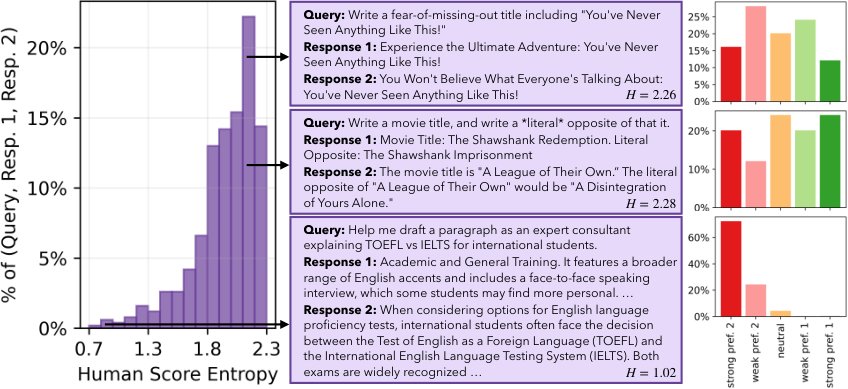
Figure 7: The left histogram shows the distribution of Shannon entropy across the 25 human annotations for each (Query, Response 1, Response 2) triplet, where annotators judge which response is better. Given open-ended queries, multiple high-quality responses are possible, often leading to disagreement among annotators and, on average, high entropy. With 25 annotations, label distributions can vary widely across triplets. The middle panel presents example triplets from different entropy regions, and the right bar plots show their corresponding label distributions.
图7:左直方图显示Shannon Entropy在25个人类注解中的分布情况,每张说明**(查询,反应1,反应2)三重体,其中注释者判断哪个反应更好。 考虑到开放式的询问,多种高质量的答复是可能的,往往导致注释者之间的分歧,而且平均来说会导致高 en. 有了25个注解,标签的分布可以在三胞胎之间有很大的差异. ** 中间 面板展示了来自不同 en区的例子三重体,** 右** 条图显示了它们相应的标签分布.
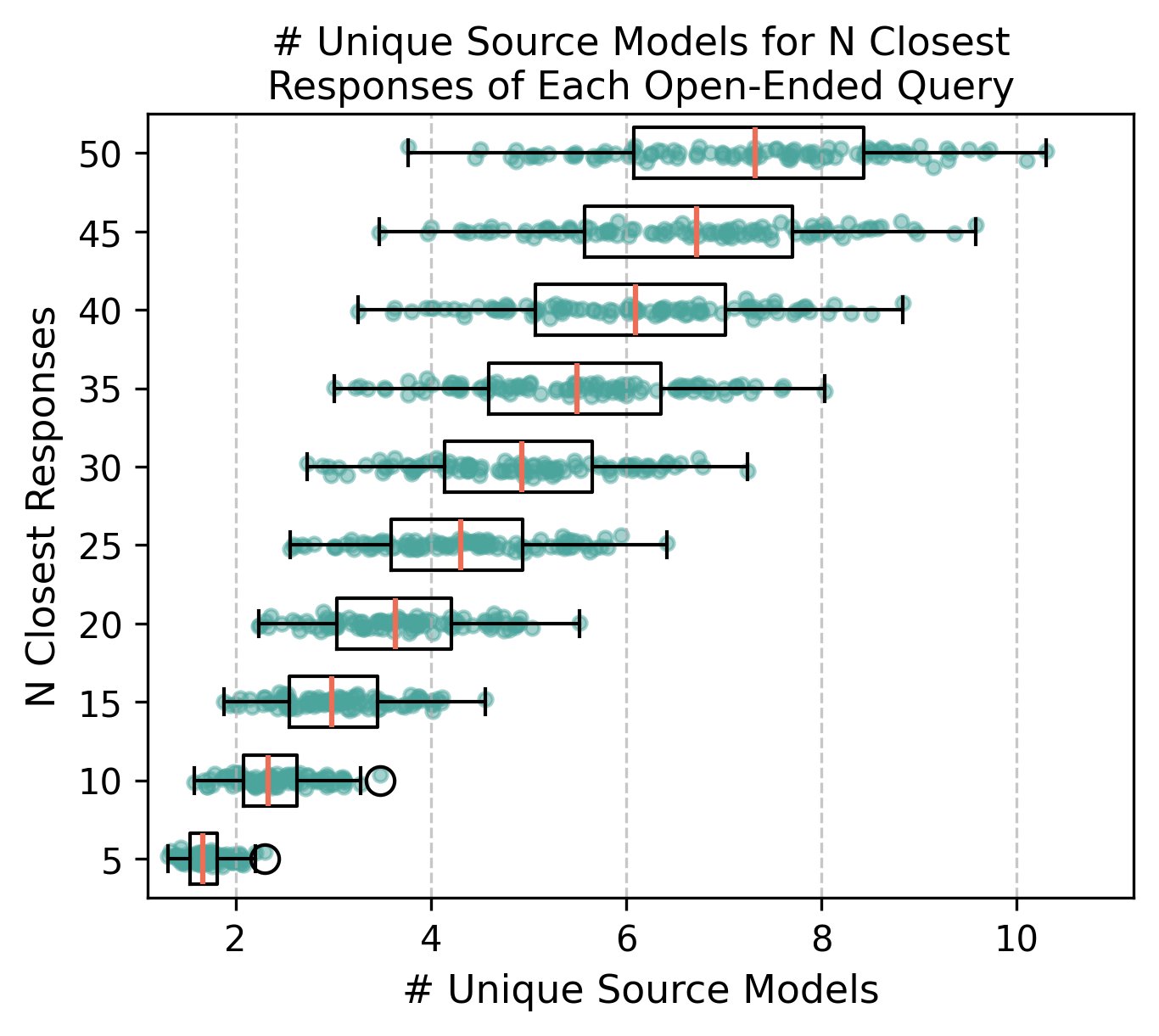
Figure 8: The avg.# of unique source models among the top- most similar responses to each open-ended query across 25 LMs.
图8:顶端-中对25个LMs的每个无限制查询最相似的答复中唯一来源模型的avg.#。
To quantify response uniformity across models, we examine the extent to which outputs from different models become indistinguishable from one another. Given 25 unique models, each generating 50 outputs to queries from Infinity-Chat, we ideally expect greater diversity across different models than from within a single model. To measure this, we identify the top most similar outputs for each query and count the unique models contributing to that set. A higher count suggests stronger cross-model similarity. As shown in Figure 8, the most similar responses often originate from multiple models. For instance, with , perfectly disjoint responses would yield all 50 from a single model. Yet, we find an average of 8 unique models per top-50 cluster, with some queries exceeding 10, indicating distinct models frequently generate highly similar content, sometimes resulting in higher inter- than intra-model similarity. See full inter-model homogeneity results in §Appendix C.3.
为量化跨模型回答均一性,我们考察不同模型输出在多大程度上彼此不可区分。 给定 25 个不同模型,各对 Infinity-Chat 查询生成 50 条输出,理想上应期望跨模型多样性高于单模型内部。为此,我们对每查询识别 top 最相似输出。
To summarize, our work provides further evidence of high syntactic repetition across different models. While a full causal analysis is beyond the scope of this study, our findings motivate future research to investigate whether such repetition arises from pretraining data, alignment processes, memorization, contamination, or generalization.
总结而言,我们的工作进一步证明不同模型之间存在高句法重复。完整因果分析超出本文范围,但发现促使未来研究去探究这种重复是否源于预训练数据、对齐过程、记忆、污染或泛化。
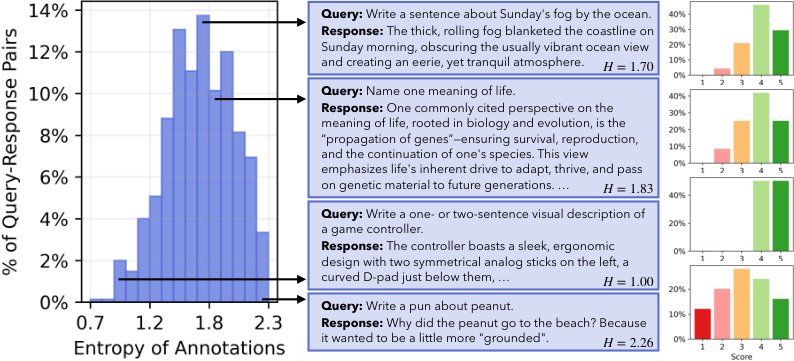
Figure 9: The left histogram shows the distribution of Shannon Entropy computed over the 25 human ratings for each (Query, Response) pair. Given the open-ended nature of the queries, multiple responses can be valid, leading to diverse preferences across annotators. As a result, the annotation label distributions vary significantly across examples. The middle panel presents representative (Query, Response) pairs from different entropy regions, and the right bar plots display their corresponding label distributions.
图9:左直方图显示Shannon Entropy的分布情况,每张**(查询,答复)**对25人收视率计算。 鉴于询问的开放性,多种答复可以有效,从而导致各注释者有不同的偏好。 因此,注释标签的分布因实例而大不相同. 中面板呈现来自不同 en区的代表性(查询,回应)配对,右条图显示其相应的标签分布.
4 How Do LMs, Reward Models, and LM Judges Handle Alternative Responses to Open-Ended Queries?
4 语言模型、奖励模型与 LM 裁判如何处理开放式查询的替代回答?
Having established the generative homogeneity of LMs, in this section, we examine whether the ratings of LMs, reward models, and LM judges are calibrated to match human scores given different responses to open-ended queries from Infinity-Chat.
在确立 LM 的生成同质化之后,本节考察 LM、奖励模型与 LM 裁判 的评分,在面对 Infinity-Chat 开放式查询的不同回答时,是否与人类分数校准一致。
4.1 Gathering Distributional Annotations Across Many Humans
4.1 跨大量人类收集分布性标注
Humans may have divergent preferences over similar-quality alternative responses to open-ended queries. To study how models handle such diversity, we need densely annotated data that captures distributional human preferences. Existing alignment datasets, like HelpSteer3 Wang et al. (2025c), typically contain only sparse labels (e.g., 3 annotators per item). To address this, we collect both absolute ratings (1–5 scale for response quality) and pairwise preference ratings (strong/weak preference between two responses to the same query), each with extensive annotations. For absolute ratings, we sample 15 responses for each of 50 prompts from Infinity-Chat100 and collect 25 ratings per (Query, Response), yielding labels. For pairwise preference rating, we sample 10 response pairs per prompt and gather 25 annotations per (Query, Response 1, Response 2), totaling labels. This is the first large-scale human-annotated dataset with dense human ratings on alternative responses to the same open-ended queries, providing both absolute and pairwise preference labels for fine-grained analysis of human idiosyncratic and collective preference distributions. Full details of the human annotation process are provided in §Appendix D.1.
人类对于类似质量的对无限制询问的替代性答复,可能有不同的偏好。 为了研究模型如何处理这种多样性,我们需要大量附加说明的数据,以记录人类的分布偏好。 现有的对齐数据集,如HelpSteer3 Wang et al. (2025c),通常只包含少量的标签(如每件3个注释器). 为了解决这个问题,我们收集了“绝对的评分* (对应质量的1至5分)”和“不公平的偏好评分*(对同一查询的两个答复之间强烈/弱的偏好)”,每个都附有广泛的说明。 对于绝对的收视率,我们从Infinity-Chat100的50个提示中分别抽取15个响应,并收集25个收视率(Query, Response),产生标签. 对于双向偏好评分,我们每秒抽取10对响应对,并收集每对25个注释(查询,反应1,反应2),总计标签. 这是首个人类附加说明的大规模数据集,对相同开放性查询的替代响应给出了密集的人类评分,为人类特异性和集体偏好分布的精细分析提供了绝对和对偶偏好标签. 人类注释过程的全部细节见§Appendix D.1.
Figure 7 shows the distribution of Shannon entropy over human preference annotations for (Query, Response 1, Response 2) triplets. Annotators often disagree on which response is better, resulting in entropy skewed toward the higher end. As shown by the bar charts on the right, label distributions vary widely across examples: some response pairs show near-uniform support across all options, indicating substantial annotator disagreement for alternative responses of open-ended queries. Figure 9 shows a similar trend in the entropy of human annotations for absolute ratings of (Query, Response) pairs.
图7显示Shannon Entropy相对于人类偏好说明(Query, Response 1, Response 2)三胞胎的分布. 注释者往往对哪个反应更好持不同意见,结果造成 en向更高端倾斜。 如右侧的条形图所示,标签的分布因实例而大不相同:一些响应对子显示在所有选项中都有近乎统一的支持,表明对开放式询问的替代答复存在实质性的注释者分歧. 图9显示人类注解对对对(查询,回应)的绝对评分有相似的趋势.
4.2 Gathering LMs, Reward Models, and LM Judges Ratings
4.2 收集语言模型、奖励模型与 LM 裁判的评分
We aim to assess how LMs, reward models, and LM judges align with human ratings when evaluating alternative responses to open-ended queries. Specifically, we compare 3 types of model-generated ratings against human annotations. LM scores are derived from response perplexity given the query. Reward model scores are based on standardized scalar reward outputs. LM judge ratings follow standard prompting protocols using two rubrics: an overall quality score and the HHH rubric (Helpfulness, Harmlessness, Honesty) Bai et al. (2022a). See §Appendix D.2 for the full list of 56 state-of-the-art LMs, 6 top-ranked reward models (per RewardBench Lambert et al. (2024)), 4 LM judges (including GPT-4o and Prometheus Kim et al. (2024) variants), and details on the rating procedures.
我们的目标是在评价对不限名额的询问的替代答复时,评估LMs、奖励模型和LM法官如何与人的评级保持一致。 具体来说,我们比较了三种模式生成的收视率和人类说明. LM的分数来源于由于询问而导致的响应偏差. ** 奖励模式** 分数以标准分级奖励产出为依据。 ** LM judge** 评分遵循标准提示协议,使用两个分数:整体质量分数和HHH分数(帮助,无助,诚实)Bai等人(2022a). 见§Appendix D.2 完整的56个最先进的LM,6个排名最高的奖励模式(per Reward Bench Lambert等人(2024年)),4个LM评委(包括GPT-4o和Prometheus Kim等人(2024年)的变体),以及评分程序的细节.
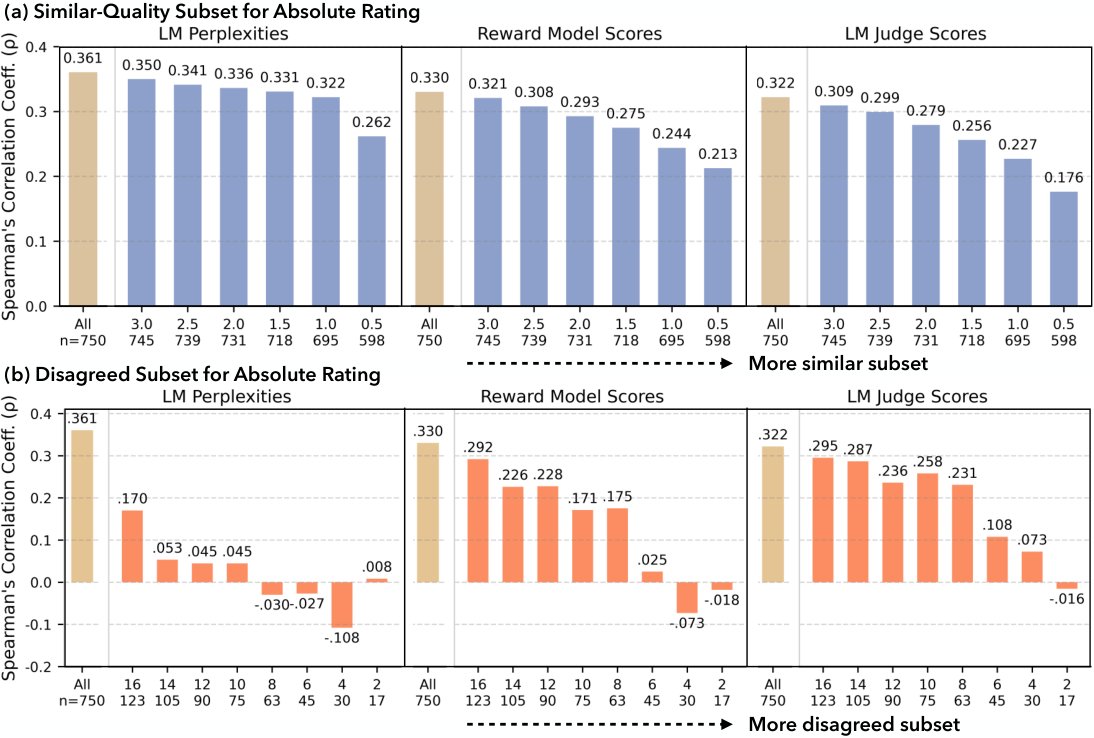
Figure 10: We compute Spearman’s correlation coefficients between human-annotated and model-generated absolute rating scores, including LM perplexity scores, reward model scalar outputs, and LM judge scalar ratings. Correlations are calculated for the full set, as well as two groups of subsets: (a) responses with similar human-rated quality, and (b) responses with high human disagreement. The results show that correlations are notably lower in these two subsets, indicating weaker alignment between model scores and human judgments in cases of subtle or contested quality differences.
图10:我们计算斯皮尔曼在人类附加说明和模型生成的绝对评分分之间的关联系数,包括LM复杂评分,奖励模型标分输出,以及LM评分标分评分. 对全集以及两组子集的关联性进行了计算:(a) 具有相似的人类评级质量 的响应;(b) 具有人类高度分歧 的响应。 结果显示,这两个子集的相关性明显较低,表明在质量差异微妙或有争议的情况下,模型分数与人类判断之间的比对较弱。
4.3 Comparing Model Ratings to Human Scores for Responses to Open-Ended Queries
4.3 将模型评分与人类对开放式查询回答的打分比较
We examine how model ratings align with human judgments on (1) similar-quality alternative responses to the same open-ended queries and (2) responses with high annotator disagreement.
我们研究了模型评级如何与人类对(1) * 相同质量的替代答复* 对相同开放式询问的判断一致,(2) 与* 高级注释者意见不一致* 的答复。
Motivation for comparing model scores to average human ratings. Our motivation stems from how reward models (or LM judges) are used in training to evaluate responses to open-ended queries without a single ground truth. Different annotators may prefer different answers, yet their average ratings are often similar, implying multiple responses can be equally high-quality. Current reward models, however, fail to capture this equivalence, assigning diverging scores and causing downstream models to overvalue one response despite comparable human approval. To address this, we collect 25 human ratings per example to capture diverse preferences, using the average score to reflect shared human judgment. We then test whether LMs, reward models, and LM judges correlate less reliably with responses that humans broadly consider comparably good, hence our choice to compute human correlation using average human ratings.
** 将模型分数与人类平均分数相比较的动机。 ** 我们的动机来自在培训中如何利用奖励模式(或LM法官)来评价对没有单一依据的无限制询问的答复。 不同的注解者可能更喜欢不同的答案,然而他们的平均评分往往相似,这意味着多个响应同样可以达到高品质. 然而,目前的奖励模式未能抓住这种等同性,分配了不同的分数,导致下游模式不顾类似的人类认可而高估一个响应。 为了解决这个问题,我们收集了每个例子的25个人类评级,以捕捉不同的偏好,利用平均得分来反映人类的共同判断. 然后,我们检验LM、奖励模型和LM评断是否与人类广泛认为相当好的反应有不太可靠的关联,因此我们选择使用人类的平均评分计算人类的相关性。
Models show weaker alignment with human ratings for alternative responses of similar quality. We hypothesize that models are less aligned with human judgments on similar-quality examples, as models are typically trained with more clearly differentiated responses.
** 模型显示,在类似质量的替代反应方面,与人类评级的一致程度较低。 ** 我们假设模型与人类对类似质量实例的判断不太一致,因为模型通常通过更明确区分的对策加以培训。
For the absolute rating setup, we identify similar-quality (Query, Response) pairs by filtering out outliers using Tukey’s fences Data et al. (2016). This method defines outliers as points beyond or , where and are the 25th and 75th percentiles and . We vary the constant from 0.5 (aggressive filtering) to 3.0 (conservative filtering) in increments of 0.5 to generate subsets of increasing similarity. We then compute Pearson correlations between model and human absolute ratings on the full set and these filtered subsets, as shown in Figure 10 (a). For the pairwise preference rating setup, we identify similar-quality (Query, Response 1, Response 2) triplets by ranking examples by how many annotators rate the two responses as similar in quality. We select the top 60%–95% most similar examples to form subsets, with the 60% subset containing examples of higher similarity. We then compute Pearson correlations between the score differences of model ratings and those of human ratings across the full set and each subset, as shown in Figure 11 (a).
对于绝对评级的设置,我们通过使用Tukey的栅栏过滤出输出点来识别出类似质量的对(查询,反应). Data等人(2016年). 这种方法将输出点定义为或以外的点,其中和是第25和第75百分位数和. 我们把恒定的从0.5(主动过滤)到3.0(保守过滤)的递增0.5不等,以产生越来越相似的子集. 然后,我们计算整个集的模型和人类绝对收视率与这些被过滤的子集之间的皮尔逊关系,如图10(a)所示. 对于*pairwise professional service * 设置,我们通过根据有多少个注释者将两个答复评为在质量上相似,来排名实例,来识别相似的质量(Query, Response 1, Response 2)三重. 我们选择了前60\95%最相似的例子来组成子集,其中60%的子集包含更高相似性的例子. 然后我们计算整个集和每个子集的模型评级与人类评级的分数差异之间的皮尔逊关联,如图11(a)所示.
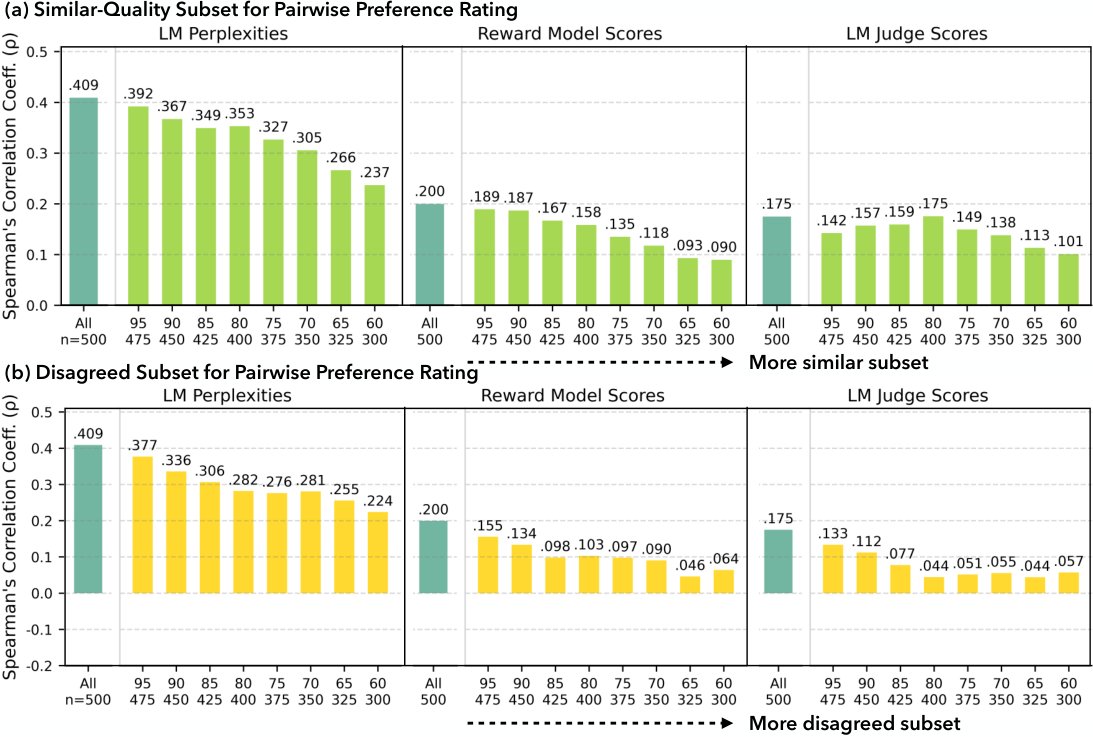
Figure 11: We compute Spearman’s correlation coefficients between human-annotated and model-generated pairwise preference rating scores, comparing the full set to two groups of subsets: (a) responses with similar human-rated quality, and (b) responses with high human disagreement.
图11:我们计算了Spearman在人为附加说明和模型生成的** Pairwise偏好评分分数之间的关联系数,将完整套分** 与两组子集进行对比:(a) 与相似的人类评级质量 和(b) 与** 人类高度分歧** 的对应。
Our results show that correlations between human ratings and those of LMs, reward models, and LM judges drop significantly on similar-quality subsets, for both absolute and pairwise preference rating setups. Since there is no single gold-standard approach for selecting subsets of responses with similar quality given our data structure, we additionally report results using alternative subset selection methods in Table 19 (§ Appendix D.3). Our findings remain consistent across methods, highlighting the need for better modeling of fine-grained distinctions among equally high-quality responses to open-ended queries. For full results, including alternative grouping methods and model-level breakdowns, see § Appendix D.3.
- 我们的结果表明,在绝对和对等优先评级设置方面,人类评级与LMs、奖励模型和LM评委之间的相关性显著下降。 * 由于鉴于我们的数据结构,没有单一的黄金标准办法来选择质量类似的答复子集,因此我们还使用表19中的备选子集选择方法(§附录D.3)报告结果。 我们的调查结果在各种方法上仍然一致,强调必须更好地在对不限名额的询问作出同样高质量的答复之间作出细微的区分。 全部结果,包括备选分组方法和模型一级细分,见附录D.3。
Model judgments are less aligned where annotators disagree. We hypothesize that model ratings are less calibrated to human judgments on examples with high annotator disagreement, as models are primarily trained on examples with higher human agreement.
** 在注释者不同意的情况下,示范判决不太一致。 ** 我们假设,模型的评级不太符合人类对高度注释者意见不一的例子的判断,因为模型主要是在人类认同程度较高的事例上接受训练。
For the absolute rating setup, we identify disagreement by ranking (Query, Response) pairs by Shannon entropy across 25 human labels. We then select the top % highest-entropy examples as disagreed subsets. Figure 10 (b) shows the Pearson correlations between model and human ratings across the full set and these subsets. For the pairwise preference rating setup, we quantify disagreement for each (Query, Response 1, Response 2) triplet using percentage disagreement: , where denotes the count of annotations per preference type. We retain the top 60% to 95% most disagreed examples, with the 60% subset representing stronger disagreement. Pearson correlations between model and human score differences across the full set and each subset are shown in Figure 11 (b).
对于绝对的评级设置,我们通过Shannon Entropy在25个人类标签上的排名(查询,反应)来识别分歧. 然后,我们选择最高的 % 最高的示例作为不同意的子集 。 图10(b)显示了整个集和这些子集的模型与人类评级之间的相互关系。 对于 * 偏好评分 * 设置, 我们用表示每个偏好类型的注解数, 对每个偏好( 查询, 反应 1, 反应 2) 三进制进行量化 。 我们保留了最大的60%至95%的不同意见,60%的子集代表了更强烈的分歧。 整个集的模型和人类得分差异之间的皮尔逊关联,每个子集如图11(b)所示.
Our results show that correlations with human ratings across models drop substantially for examples with high annotator disagreement, in both absolute and pairwise rating setups. We also report results using alternative subset selection methods in Table 20 (§ Appendix D.4). The findings remain consistent across methods, highlighting the need for more nuanced modeling of idiosyncratic human disagreement to better capture the broad spectrum of open-ended possibilities. For complete results, including alternative grouping methods and model-level breakdowns, see § Appendix D.4.
- 我们的结果显示,在绝对评级和对等评级设定方面,与不同模型的人类评级的关联性,对于有高度注释者分歧的例子,则大幅下降。 我们还使用表20中的替代子集选择方法报告结果(§附录D.4)。 各种方法的研究结果仍然一致,突出表明需要更细致地模拟人类的特异性分歧,以更好地抓住广泛的无限制可能性。 完整的结果,包括备选分组方法和模型层次的细分,见附录D.4。
5 Related Work
5 相关工作
The diversity collapse problem of LMs. Diversity collapse, characterized by the inability of LMs to generate diverse outputs, presents a significant challenge to pluralistic alignment research (Zhang et al., 2024; Shumailov et al., 2023; Dohmatob et al., 2024; Yang et al., 2024; Li et al., 2024b; West and Potts, 2025). Prior studies identify some key factors contributing to diversity collapse, including training on synthetic data (Havrilla et al., 2024; Wang et al., 2024; Yang et al., 2024; Shumailov et al., 2024), LM alignment (Murthy et al., 2024a; Kirk et al., 2024a; Kirk et al., 2023), and insufficient diversity in training data (Chen et al., 2024b). Potential consequences of diversity collapse include reduced creativity, loss of minority perspectives, spread of bias, and overall decline in model utility and trustworthiness (Anderson et al., 2024a; Kapania et al., 2024; Deshpande et al., 2025). In response, a range of mitigation strategies are proposed, such as training corpora diversification (Wang et al., 2025a; Pang et al., 2024; Wang et al., 2025b; Havrilla et al., 2025), training algorithm modifications (Zhang et al., 2025b; Li et al., 2025), alternative decoding (Vijayakumar et al., 2016; Nguyen et al., 2025) and prompting (Zhang et al., 2025a; Bradley et al., 2023) strategies.
** LMs.的多样性崩溃问题** 多样性崩溃,其特点是LMS无法产生不同的产出,对多元对齐研究提出了重大挑战(Zhang等人,2024年;Shumailov等人,2023年;Dohmatob等人,2024年;Yang等人,2024年;Li等人,2024年b年;West and Potts,2025年)。 先前的研究确定了造成多样性崩溃的一些关键因素,包括合成数据培训(Havrilla等人,2024年;Wang等人,2024年;Yang等人,2024年;Shumailov等人,2024年);LM校正(Murthy等人,2024年a;Kirk等人,2024年a;Kirk等人,2023年),以及培训数据多样性不足(Chen等人,2024年b)。 多样性崩溃的潜在后果包括创造力下降、少数群体观点丧失、偏见蔓延以及模型效用和可信赖性全面下降(Anderson等人,2024a;Kapania等人,2024;Deshpande等人,2025)。 对此,提出了一系列缓解战略,如培训公司多样化(Wang等人,2025a;Pang等人,2024b;Wang等人,2025b;Havrilla等人,2025),培训算法修改(Zhang等人,2025b;Li等人,2025),替代解码(Vijayakumar等人,2016年;Nguyen等人,2025年)和激励(Zhang等人,2025a;Bradley等人,2023年)。
Measuring the creativity and divergent thinking of language models. Recent efforts to measure the creativity and divergent thinking of LMs often adapt established psychometric tests. For example, (Chen and Ding, 2023) utilizes a divergent association task (DAT) by asking models to generate semantically distant or unrelated words (Olson et al., 2021). Similarly, tasks such as the Alternate Uses Test (AUT) (Rabeyah et al., 2024), the Torrance Tests of Creative Thinking (TTCT) (Alabbasi et al., 2022; Chakrabarty et al., 2024), Human Evaluation, and LLM-as-a-judge (Krumdick et al., 2025) are employed to assess dimensions like fluency, originality, complexity, and effective semantic diversity (Shypula et al., 2025) of LM responses. Despite these demonstrated capabilities, LLM-generated creative content tends towards homogeneity, even when individual outputs achieve high creativity scores (Wenger and Kenett, 2025). To address these evaluation complexities, some benchmarks, such as (Ruan et al., 2024; Lu et al., 2024; Padmakumar et al., 2025; Zhang et al., 2025b), focus on specific creative abilities like scientific idea and code generation. Other works propose new metrics (Namuduri et al., 2025). While LMs show promise in creative tasks, comprehensively evaluating their creativity remains an active and challenging research area (Ismayilzada et al., 2024). We conduct a large-scale systematic study of real-world open-ended user queries and provide a comprehensive taxonomy, query dataset, and dense human annotations to improve evaluation and model training for reducing mode collapse in language models.
** 衡量语言模式的创造性和不同思维。 ** 最近为衡量LMS的创造力和不同思维所做的努力,常常适应既定的心理测量测试。 例如,(Chen and Ding, 2023)使用不同的关联任务(DAT),要求模型生成模棱两可的遥远或不相关的单词(Olson等人, 2021). 同样,诸如替代用途测试(AUT)(Rabeyah等人,2024年)、创造性思维的托伦斯测试(TTCT)(Alabbasi等人,2022年;Chakrabarty等人,2024年)、人类评估以及LLM-as-a-judge(Krundick等人,2025年)等任务也被用来评估LM响应的流畅度、原创性、复杂性和有效语义多样性(Shypula等人,2025年)。 尽管有这些展示的能力,LLM生成的创作内容往往趋向于同质性,即使个人产出取得了较高的创作分数(Wenger and Kenett, 2025). 为解决这些评价的复杂性,一些基准,例如(Ruan等人,2024年;Lu等人,2024年;Padmakumar等人,2025年;Zhang等人,2025年b)侧重于科学思想和代码生成等具体创造性能力。 其他作品提出了新的衡量标准(Namuduri等人,2025年)。 虽然LMs在创造性任务中表现出希望,但全面评估其创造性仍然是一个积极和具有挑战性的研究领域(Ismayilzada等人,2024年)。 我们对现实世界的开放式用户查询进行大规模系统研究,并提供全面的分类学,查询数据集,以及密集的人类说明,以改进评价和模型培训,以减少语言模型模式崩塌.
Disagreement and pluralistic alignment of language models. Advances in AI value alignment research have substantially improved LM utility and safety, through enhanced training processes (Schulman et al., 2017; Ouyang et al., 2022; Rafailov et al., 2023), and the use of both synthetic data (Ge et al., 2024) and human datasets (Bai et al., 2022b; Ganguli et al., 2022). Yet, a significant challenge remains: the potential for monolithic value representation (Ryan et al., 2024b; Ryan et al., 2024a). In contrast, the emerging focus on pluralistic alignment emphasizes the need for AI to serve the varied demands of a wide population (Sorensen et al., 2024; Alamdari et al., 2024). This shift is driving innovation in methods (Chung et al., 2025; Nguyen et al., 2025; Lake et al., 2024; Chen et al., 2024a; Feng et al., 2024; Srewa et al., 2025), benchmarks (Castricato et al., 2024), and data collection strategies (Kirk et al., 2024b; Shi et al., 2025) to support this vision of diversity. Additionally, approaches leveraging multiple LMs interacting through system messages are also being explored to boost variety (Verga et al., 2024; Chen et al., 2024c; Murthy et al., 2024b). Parallel efforts are dedicated to quantifying and improving the cultural diversity exhibited by LLMs (Rao et al., 2025; Shi et al., 2024; Chiu et al., 2024; Myung et al., 2025; Li et al., 2024a). Yet, a common characteristic of many existing pluralistic alignment work is its reliance on predefined diversity dimensions, like demographics (Kwok et al., 2024; Moon et al., 2024), personality style (Lee et al., 2025; Jiang et al., 2023; Zhu et al., 2025; Padmakumar and He, 2024), and cultural background (Xu et al., 2024; Diamond, 2025; AlKhamissi et al., 2024). To enable models that genuinely cater to individuality without relying on stereotypes, individual-level alignment is needed (Jiang et al., 2025a; Zhu et al., 2025).
** 语文模式的分歧和多元统一。 ** 通过强化培训程序(Schulman等人,2017年;Ouyang等人,2022年;Rafailov等人,2023年),以及使用合成数据(Ge等人,2024年)和人类数据集(Bai等人,2022年b;Ganguli等人,2022年),AI价值校正研究的进展大大提高了LM的效用和安全性。 然而,仍然存在一项重大挑战:单一价值代表的潜力(Ryan等人,2024年b;Ryan等人,2024年a)。 与此相对照,对多元化调整的日益重视强调AI需要满足广大民众的各种需求(Sorensen等人,2024年;Alamdari等人,2024年)。 这一转变正在推动方法创新(Chung等人,2025年;Nguyen等人,2025年;Lake等人,2024年;Chen等人,2024年a;Feng等人,2024年;Srewa等人,2025年)、基准(Casticato等人,2024年)和数据收集战略(Kirk等人,2024年b;Shi等人,2025年),以支持这种多样性观点。 此外,还在探索利用多种LMS通过系统信息进行互动的方法,以促进多样性(Verga等人,2024年;Chen等人,2024年c;Murthy等人,2024年b)。 同时还致力于量化和改善LLMS所展现的文化多样性(Rao等人,2025年;Shi等人,2024年;Chiu等人,2024年;Myung等人,2025年;Li等人,2024年a)。 然而,许多现有多元调整工作的一个共同特点是依赖预先界定的多样性层面,如人口学(Kwok等人,2024年;Moon等人,2024年);人格风格(Lee等人,2025年;Jiang等人,2023年;Zhu等人,2025年;Padmakumar和He,2024年);文化背景(Xu等人,2024年;Diamond,2025年;Al Khamissi等人,2024年)。 为使模式真正适合个人特点而不依赖陈规定型观念,需要个人层面的一致(Jiang等人,2025a;Zhu等人,2025)。
6 Conclusion
6 结论
Our work introduces Infinity-Chat, a large-scale resource designed to evaluate LMs’ diversity in naturally occurring, open-ended settings. Through comprehensive analysis, we uncover the “Artificial Hivemind” effect, highlighting both intra-model repetition and inter-model homogeneity of current LMs. By coupling a diverse taxonomy of prompts with dense human preference annotations, Infinity-Chat provides a new foundation for diagnosing, benchmarking, and ultimately mitigating mode collapse in generative AI. We hope this resource catalyzes future efforts to foster genuine diversity in model outputs and guard against the homogenization of human expression.
本文提出 Infinity-Chat,面向自然发生的开放式设定评测 LM 多样性的大规模资源。经综合分析,我们揭示“人工蜂群心智”效应,凸显当前 LM 的模型内重复与模型间同质化。通过将多样提示分类体系与稠密人类偏好标注结合,Infinity-Chat 为诊断、基准化并最终缓解生成式 AI 的模式崩塌提供新基础。我们希望该资源催化未来工作,培育模型输出的真正多样性,并防范人类表达的同质化。
Acknowledgment
致谢
This work was supported by DARPA under the ITM program (FA8650-23-C-7316). This work was also supported in part by the Defense Advanced Research Projects Agency’s (DARPA) SciFy program (Agreement No. HR00112520300). The views expressed are those of the author and do not reflect the official policy or position of the Department of Defense or the U.S. Government.
这项工作得到了DARPA在ITM方案(FA8650-23-C-7316)下的支持.的共同支助还有国防高级研究项目局的SciFy方案(第HR00112520300号协议)。 表达的观点是作者的观点,并不反映国防部或美国政府的官方政策或立场.
References
参考文献
Alabbasi et al. (2022) A. M. A. Alabbasi, S. H. Paek, D. Kim, and B. Cramond What do educators need to know about the torrance tests of creative thinking: a comprehensive review . Frontiers in psychology 13 , pp. 1000385 . Cited by: §5 .
Alamdari et al. (2024) P. A. Alamdari, T. Q. Klassen, R. T. Icarte, and S. A. McIlraith Being considerate as a pathway towards pluralistic alignment for agentic ai . External Links: 2411.10613 , Link Cited by: §5 .
Alemohammad et al. (2024) S. Alemohammad, J. Casco-Rodriguez, L. Luzi, A. I. Humayun, H. Babaei, D. LeJeune, A. Siahkoohi, and R. Baraniuk Self-consuming generative models go MAD . In The Twelfth International Conference on Learning Representations , External Links: Link Cited by: §A.3 .
AlKhamissi et al. (2024) B. AlKhamissi, M. ElNokrashy, M. AlKhamissi, and M. Diab Investigating cultural alignment of large language models . External Links: 2402.13231 , Link Cited by: §5 .
Anderson et al. (2024a) B. R. Anderson, J. H. Shah, and M. Kreminski Homogenization effects of large language models on human creative ideation . In Proceedings of the 16th conference on creativity & cognition , pp. 413–425 . Cited by: §5 .
Anderson et al. (2024b) B. R. Anderson, J. H. Shah, and M. Kreminski Homogenization effects of large language models on human creative ideation . In Creativity and Cognition , pp. 413–425 . External Links: Link , Document Cited by: §A.3 .
Ashkinaze et al. (2025) J. Ashkinaze, J. Mendelsohn, L. Qiwei, C. Budak, and E. Gilbert How ai ideas affect the creativity, diversity, and evolution of human ideas: evidence from a large, dynamic experiment . In Proceedings of the ACM Collective Intelligence Conference , CI 2025 , pp. 198–213 . External Links: Link , Document Cited by: §A.3 .
Bai et al. (2022a) Y. Bai, A. Jones, K. Ndousse, A. Askell, A. Chen, N. DasSarma, D. Drain, S. Fort, D. Ganguli, T. Henighan, N. Joseph, S. Kadavath, J. Kernion, T. Conerly, S. El-Showk, N. Elhage, Z. Hatfield-Dodds, D. Hernandez, T. Hume, S. Johnston, S. Kravec, L. Lovitt, N. Nanda, C. Olsson, D. Amodei, T. Brown, J. Clark, S. McCandlish, C. Olah, B. Mann, and J. Kaplan Training a helpful and harmless assistant with reinforcement learning from human feedback . External Links: 2204.05862 , Link Cited by: §D.2 , §4.2 .
Bai et al. (2022b) Y. Bai, A. Jones, K. Ndousse, A. Askell, A. Chen, N. DasSarma, D. Drain, S. Fort, D. Ganguli, T. Henighan, et al. Training a helpful and harmless assistant with reinforcement learning from human feedback . arXiv preprint arXiv:2204.05862 . Cited by: §5 .
Bommasani et al. (2022) R. Bommasani, K. A. Creel, A. Kumar, D. Jurafsky, and P. S. Liang Picking on the same person: does algorithmic monoculture lead to outcome homogenization? . In Advances in Neural Information Processing Systems , S. Koyejo, S. Mohamed, A. Agarwal, D. Belgrave, K. Cho, and A. Oh (Eds.) , Vol. 35 , pp. 3663–3678 . External Links: Link Cited by: §1 .
Bradley et al. (2023) H. Bradley, A. Dai, H. Teufel, J. Zhang, K. Oostermeijer, M. Bellagente, J. Clune, K. Stanley, G. Schott, and J. Lehman Quality-diversity through ai feedback . External Links: 2310.13032 , Link Cited by: §5 .
Castricato et al. (2024) L. Castricato, N. Lile, R. Rafailov, J. Fränken, and C. Finn PERSONA: a reproducible testbed for pluralistic alignment . External Links: 2407.17387 , Link Cited by: §5 .
Chakrabarty et al. (2024) T. Chakrabarty, P. Laban, D. Agarwal, S. Muresan, and C. Wu Art or artifice? large language models and the false promise of creativity . In Proceedings of the 2024 CHI Conference on Human Factors in Computing Systems , CHI ’24 , New York, NY, USA . External Links: ISBN 9798400703300 , Link , Document Cited by: §1 , §5 .
Chen et al. (2024a) D. Chen, Y. Chen, A. Rege, and R. K. Vinayak PAL: pluralistic alignment framework for learning from heterogeneous preferences . External Links: 2406.08469 , Link Cited by: §5 .
Chen et al. (2024b) H. Chen, A. Waheed, X. Li, Y. Wang, J. Wang, B. Raj, and M. I. Abdin On the diversity of synthetic data and its impact on training large language models . External Links: 2410.15226 , Link Cited by: §5 .
Chen and Ding (2023) H. Chen and N. Ding Probing the creativity of large language models: can models produce divergent semantic association? . arXiv preprint arXiv:2310.11158 . Cited by: §5 .
Chen et al. (2024c) J. C. Chen, S. Saha, and M. Bansal ReConcile: round-table conference improves reasoning via consensus among diverse llms . External Links: 2309.13007 , Link Cited by: §5 .
Chiu et al. (2024) Y. Y. Chiu, L. Jiang, M. Antoniak, C. Y. Park, S. S. Li, M. Bhatia, S. Ravi, Y. Tsvetkov, V. Shwartz, and Y. Choi CulturalTeaming: ai-assisted interactive red-teaming for challenging llms’ (lack of) multicultural knowledge . External Links: 2404.06664 , Link Cited by: §5 .
Chung et al. (2025) J. J. Y. Chung, V. Padmakumar, M. Roemmele, Y. Sun, and M. Kreminski Modifying large language model post-training for diverse creative writing . External Links: 2503.17126 , Link Cited by: §5 .
Data et al. (2016) M. C. Data, M. Komorowski, D. C. Marshall, J. D. Salciccioli, and Y. Crutain Exploratory data analysis . Secondary analysis of electronic health records , pp. 185–203 . Cited by: §4.3 .
Deshpande et al. (2025) V. Deshpande, D. Ghose, J. D. Patterson, R. Beaty, and A. Rumshisky Diverse, not short: a length-controlled data selection strategy for improving response diversity of language models . External Links: 2505.16245 , Link Cited by: §5 .
Diamond (2025) A. Diamond PRISM: perspective reasoning for integrated synthesis and mediation as a multi-perspective framework for ai alignment . External Links: 2503.04740 , Link Cited by: §5 .
Dohmatob et al. (2024) E. Dohmatob, Y. Feng, A. Subramonian, and J. Kempe Strong model collapse . arXiv preprint arXiv:2410.04840 . Cited by: §5 .
Doshi and Hauser (2024) A. R. Doshi and O. P. Hauser Generative ai enhances individual creativity but reduces the collective diversity of novel content . Science Advances 10 ( 28 ), pp. eadn5290 . External Links: Document , Link , https://www.science.org/doi/pdf/10.1126/sciadv.adn5290 Cited by: §A.3 .
Feng et al. (2025a) S. Feng, W. Ding, A. Liu, Z. Wang, W. Shi, Y. Wang, Z. Shen, X. Han, H. Lang, C. Lee, T. Pfister, Y. Choi, and Y. Tsvetkov When one llm drools, multi-llm collaboration rules . External Links: 2502.04506 , Link Cited by: §1 .
Feng et al. (2024) S. Feng, T. Sorensen, Y. Liu, J. Fisher, C. Y. Park, Y. Choi, and Y. Tsvetkov Modular pluralism: pluralistic alignment via multi-llm collaboration . arXiv preprint arXiv:2406.15951 . Cited by: §5 .
Feng et al. (2025b) S. Feng, Z. Wang, P. Goyal, Y. Wang, W. Shi, H. Xia, H. Palangi, L. Zettlemoyer, Y. Tsvetkov, C. Lee, and T. Pfister Heterogeneous swarms: jointly optimizing model roles and weights for multi-llm systems . External Links: 2502.04510 , Link Cited by: §1 .
Feng et al. (2025c) S. Feng, Z. Wang, Y. Wang, S. Ebrahimi, H. Palangi, L. Miculicich, A. Kulshrestha, N. Rauschmayr, Y. Choi, Y. Tsvetkov, C. Lee, and T. Pfister Model swarms: collaborative search to adapt llm experts via swarm intelligence . External Links: 2410.11163 , Link Cited by: §A.3 .
Ganguli et al. (2022) D. Ganguli, L. Lovitt, J. Kernion, A. Askell, Y. Bai, S. Kadavath, B. Mann, E. Perez, N. Schiefer, K. Ndousse, et al. Red teaming language models to reduce harms: methods, scaling behaviors, and lessons learned . arXiv preprint arXiv:2209.07858 . Cited by: §5 .
Ge et al. (2024) T. Ge, X. Chan, X. Wang, D. Yu, H. Mi, and D. Yu Scaling synthetic data creation with 1,000,000,000 personas . arXiv preprint arXiv:2406.20094 . Cited by: §1 , §5 .
Gerstgrasser et al. (2024) M. Gerstgrasser, R. Schaeffer, A. Dey, R. Rafailov, H. Sleight, J. Hughes, T. Korbak, R. Agrawal, D. Pai, A. Gromov, et al. Is model collapse inevitable? breaking the curse of recursion by accumulating real and synthetic data . arXiv preprint arXiv:2404.01413 . Cited by: §1 .
Havrilla et al. (2024) A. Havrilla, A. Dai, L. O’Mahony, K. Oostermeijer, V. Zisler, A. Albalak, F. Milo, S. C. Raparthy, K. Gandhi, B. Abbasi, D. Phung, M. Iyer, D. Mahan, C. Blagden, S. Gureja, M. Hamdy, W. Li, G. Paolini, P. S. Ammanamanchi, and E. Meyerson Surveying the effects of quality, diversity, and complexity in synthetic data from large language models . External Links: 2412.02980 , Link Cited by: §5 .
Havrilla et al. (2025) A. Havrilla, E. Hughes, M. Samvelyan, and J. Abernethy SPARQ: synthetic problem generation for reasoning via quality-diversity algorithms . External Links: 2506.06499 , Link Cited by: §5 .
Ismayilzada et al. (2024) M. Ismayilzada, D. Paul, A. Bosselut, and L. van der Plas Creativity in ai: progresses and challenges . arXiv preprint arXiv:2410.17218 . Cited by: §5 .
Jiang et al. (2023) G. Jiang, M. Xu, S. Zhu, W. Han, C. Zhang, and Y. Zhu Evaluating and inducing personality in pre-trained language models . External Links: 2206.07550 , Link Cited by: §5 .
Jiang et al. (2025a) L. Jiang, T. Sorensen, S. Levine, and Y. Choi Can language models reason about individualistic human values and preferences? . External Links: 2410.03868 , Link Cited by: §5 .
Jiang et al. (2025b) Y. Jiang, W. Ding, S. Feng, G. Durrett, and Y. Tsvetkov SPARTA alignment: collectively aligning multiple language models through combat . External Links: 2506.04721 , Link Cited by: §A.3 .
Kapania et al. (2024) S. Kapania, W. Agnew, M. Eslami, H. Heidari, and S. Fox ’Simulacrum of stories’: examining large language models as qualitative research participants . arXiv preprint arXiv:2409.19430 . Cited by: §5 .
Kazdan et al. (2025) J. Kazdan, R. Schaeffer, A. Dey, M. Gerstgrasser, R. Rafailov, D. L. Donoho, and S. Koyejo Collapse or thrive? perils and promises of synthetic data in a self-generating world . External Links: 2410.16713 , Link Cited by: §A.3 .
Kim et al. (2024) S. Kim, J. Suk, S. Longpre, B. Y. Lin, J. Shin, S. Welleck, G. Neubig, M. Lee, K. Lee, and M. Seo Prometheus 2: an open source language model specialized in evaluating other language models . In Proceedings of the 2024 Conference on Empirical Methods in Natural Language Processing , Y. Al-Onaizan, M. Bansal, and Y. Chen (Eds.) , Miami, Florida, USA , pp. 4334–4353 . External Links: Link , Document Cited by: §D.2 , §4.2 .
Kirk et al. (2024a) H. R. Kirk, B. Vidgen, P. Röttger, and S. A. Hale The benefits, risks and bounds of personalizing the alignment of large language models to individuals . Nature Machine Intelligence 6 ( 4 ), pp. 383–392 . Cited by: §5 .
Kirk et al. (2024b) H. R. Kirk, A. Whitefield, P. Röttger, A. Bean, K. Margatina, J. Ciro, R. Mosquera, M. Bartolo, A. Williams, H. He, B. Vidgen, and S. A. Hale The prism alignment dataset: what participatory, representative and individualised human feedback reveals about the subjective and multicultural alignment of large language models . External Links: 2404.16019 , Link Cited by: §5 .
Kirk et al. (2023) R. Kirk, I. Mediratta, C. Nalmpantis, J. Luketina, E. Hambro, E. Grefenstette, and R. Raileanu Understanding the effects of rlhf on llm generalisation and diversity . arXiv preprint arXiv:2310.06452 . Cited by: §5 .
Kosmyna et al. (2025) N. Kosmyna, E. Hauptmann, Y. T. Yuan, J. Situ, X. Liao, A. V. Beresnitzky, I. Braunstein, and P. Maes Your brain on chatgpt: accumulation of cognitive debt when using an ai assistant for essay writing task . External Links: 2506.08872 , Link Cited by: §A.3 .
Krumdick et al. (2025) M. Krumdick, C. Lovering, V. Reddy, S. Ebner, and C. Tanner No free labels: limitations of llm-as-a-judge without human grounding . arXiv preprint arXiv:2503.05061 . Cited by: §5 .
Kumar et al. (2025) H. Kumar, J. Vincentius, E. Jordan, and A. Anderson Human creativity in the age of llms: randomized experiments on divergent and convergent thinking . In Proceedings of the 2025 CHI Conference on Human Factors in Computing Systems , CHI ’25 , pp. 1–18 . External Links: Link , Document Cited by: §A.3 .
Kwok et al. (2024) L. Kwok, M. Bravansky, and L. D. Griffin Evaluating cultural adaptability of a large language model via simulation of synthetic personas . External Links: 2408.06929 , Link Cited by: §5 .
Lake et al. (2024) T. Lake, E. Choi, and G. Durrett From distributional to overton pluralism: investigating large language model alignment . arXiv preprint arXiv:2406.17692 . Cited by: §5 .
Lambert et al. (2024) N. Lambert, V. Pyatkin, J. Morrison, L. Miranda, B. Y. Lin, K. Chandu, N. Dziri, S. Kumar, T. Zick, Y. Choi, N. A. Smith, and H. Hajishirzi RewardBench: evaluating reward models for language modeling . External Links: 2403.13787 , Link Cited by: §4.2 .
Lee et al. (2025) A. Lee, R. S. Kwon, P. Railton, and L. Wang CLASH: evaluating language models on judging high-stakes dilemmas from multiple perspectives . External Links: 2504.10823 , Link Cited by: §5 .
Li et al. (2024a) C. Li, M. Chen, J. Wang, S. Sitaram, and X. Xie CultureLLM: incorporating cultural differences into large language models . External Links: 2402.10946 , Link Cited by: §5 .
Li et al. (2024b) M. Li, W. Shi, A. Pagnoni, P. West, and A. Holtzman Predicting vs. acting: a trade-off between world modeling & agent modeling . arXiv preprint arXiv:2407.02446 . Cited by: §1 , §3 , §5 .
Li et al. (2025) T. Li, Y. Zhang, P. Yu, S. Saha, D. Khashabi, J. Weston, J. Lanchantin, and T. Wang Jointly reinforcing diversity and quality in language model generations . External Links: 2509.02534 , Link Cited by: §5 .
Lu et al. (2024) Y. Lu, D. Wang, T. Li, D. Jiang, S. Khudanpur, M. Jiang, and D. Khashabi Benchmarking language model creativity: a case study on code generation . arXiv preprint arXiv:2407.09007 . Cited by: §5 .
Moon et al. (2024) S. Moon, M. Abdulhai, M. Kang, J. Suh, W. Soedarmadji, E. K. Behar, and D. M. Chan Virtual personas for language models via an anthology of backstories . External Links: 2407.06576 , Link Cited by: §5 .
Murthy et al. (2024a) S. K. Murthy, T. Ullman, and J. Hu One fish, two fish, but not the whole sea: alignment reduces language models’ conceptual diversity . arXiv preprint arXiv:2411.04427 . Cited by: §5 .
Murthy et al. (2024b) S. K. Murthy, T. Ullman, and J. Hu One fish, two fish, but not the whole sea: alignment reduces language models’ conceptual diversity . External Links: 2411.04427 , Link Cited by: §5 .
Myung et al. (2025) J. Myung, N. Lee, Y. Zhou, J. Jin, R. A. Putri, D. Antypas, H. Borkakoty, E. Kim, C. Perez-Almendros, A. A. Ayele, V. Gutiérrez-Basulto, Y. Ibáñez-García, H. Lee, S. H. Muhammad, K. Park, A. S. Rzayev, N. White, S. M. Yimam, M. T. Pilehvar, N. Ousidhoum, J. Camacho-Collados, and A. Oh BLEnD: a benchmark for llms on everyday knowledge in diverse cultures and languages . External Links: 2406.09948 , Link Cited by: §5 .
Namuduri et al. (2025) R. Namuduri, Y. Wu, A. A. Zheng, M. Wadhwa, G. Durrett, and J. J. Li QUDsim: quantifying discourse similarities in llm-generated text . External Links: 2504.09373 , Link Cited by: §3 , §5 .
Nguyen et al. (2025) M. Nguyen, A. Baker, C. Neo, A. Roush, A. Kirsch, and R. Shwartz-Ziv Turning up the heat: min-p sampling for creative and coherent llm outputs . ICLR . Cited by: §3 , §3 , §5 , §5 .
Olson et al. (2021) J. A. Olson, J. Nahas, D. Chmoulevitch, S. J. Cropper, and M. E. Webb Naming unrelated words predicts creativity . Proceedings of the National Academy of Sciences 118 ( 25 ), pp. e2022340118 . Cited by: §5 .
Ouyang et al. (2022) L. Ouyang, J. Wu, X. Jiang, D. Almeida, C. Wainwright, P. Mishkin, C. Zhang, S. Agarwal, K. Slama, A. Ray, et al. Training language models to follow instructions with human feedback . Advances in neural information processing systems 35 , pp. 27730–27744 . Cited by: §5 .
Padmakumar and He (2024) V. Padmakumar and H. He Does writing with language models reduce content diversity? . External Links: 2309.05196 , Link Cited by: §5 .
Padmakumar et al. (2025) V. Padmakumar, C. Yueh-Han, J. Pan, V. Chen, and H. He Beyond memorization: mapping the originality-quality frontier of language models . External Links: 2504.09389 , Link Cited by: §1 , §5 .
Pang et al. (2024) J. Pang, J. Wei, A. P. Shah, Z. Zhu, Y. Wang, C. Qian, Y. Liu, Y. Bao, and W. Wei Improving data efficiency via curating llm-driven rating systems . arXiv preprint arXiv:2410.10877 . Cited by: §5 .
Rabeyah et al. (2024) A. A. Rabeyah, F. Góes, M. Volpe, and T. Medeiros Do llms agree on the creativity evaluation of alternative uses? . External Links: 2411.15560 , Link Cited by: §5 .
Rafailov et al. (2023) R. Rafailov, A. Sharma, E. Mitchell, C. D. Manning, S. Ermon, and C. Finn Direct preference optimization: your language model is secretly a reward model . Advances in Neural Information Processing Systems 36 , pp. 53728–53741 . Cited by: §5 .
Rao et al. (2025) A. Rao, A. Yerukola, V. Shah, K. Reinecke, and M. Sap NormAd: a framework for measuring the cultural adaptability of large language models . External Links: 2404.12464 , Link Cited by: §5 .
Ruan et al. (2024) K. Ruan, X. Wang, J. Hong, P. Wang, Y. Liu, and H. Sun LiveIdeaBench: evaluating llms’ scientific creativity and idea generation with minimal context . arXiv preprint arXiv:2412.17596 . Cited by: §5 .
Ryan et al. (2024a) M. J. Ryan, W. Held, and D. Yang Unintended impacts of LLM alignment on global representation . In Proceedings of the 62nd Annual Meeting of the Association for Computational Linguistics (Volume 1: Long Papers) , L. Ku, A. Martins, and V. Srikumar (Eds.) , Bangkok, Thailand , pp. 16121–16140 . External Links: Link , Document Cited by: §5 .
Ryan et al. (2024b) M. J. Ryan, W. Held, and D. Yang Unintended impacts of llm alignment on global representation . arXiv preprint arXiv:2402.15018 . Cited by: §5 .
Schulman et al. (2017) J. Schulman, F. Wolski, P. Dhariwal, A. Radford, and O. Klimov Proximal policy optimization algorithms . arXiv preprint arXiv:1707.06347 . Cited by: §5 .
Shi et al. (2025) T. Shi, Z. Wang, L. Yang, Y. Lin, Z. He, M. Wan, P. Zhou, S. Jauhar, S. Chen, S. Xia, H. Zhang, J. Zhao, X. Xu, X. Song, and J. Neville WildFeedback: aligning llms with in-situ user interactions and feedback . External Links: 2408.15549 , Link Cited by: §5 .
Shi et al. (2024) W. Shi, R. Li, Y. Zhang, C. Ziems, C. yu, R. Horesh, R. A. de Paula, and D. Yang CultureBank: an online community-driven knowledge base towards culturally aware language technologies . External Links: 2404.15238 , Link Cited by: §5 .
Shumailov et al. (2023) I. Shumailov, Z. Shumaylov, Y. Zhao, Y. Gal, N. Papernot, and R. Anderson The curse of recursion: training on generated data makes models forget . arXiv preprint arXiv:2305.17493 . Cited by: §5 .
Shumailov et al. (2024) I. Shumailov, Z. Shumaylov, Y. Zhao, N. Papernot, R. Anderson, and Y. Gal AI models collapse when trained on recursively generated data . Nature 631 ( 8022 ), pp. 755–759 . Cited by: §5 .
Shypula et al. (2025) A. Shypula, S. Li, B. Zhang, V. Padmakumar, K. Yin, and O. Bastani Evaluating the diversity and quality of llm generated content . External Links: 2504.12522 , Link Cited by: §5 .
Sorensen et al. (2024) T. Sorensen, J. Moore, J. Fisher, M. Gordon, N. Mireshghallah, C. M. Rytting, A. Ye, L. Jiang, X. Lu, N. Dziri, et al. A roadmap to pluralistic alignment . arXiv preprint arXiv:2402.05070 . Cited by: §5 .
Sourati et al. (2025) Z. Sourati, F. Karimi-Malekabadi, M. Ozcan, C. McDaniel, A. Ziabari, J. Trager, A. Tak, M. Chen, F. Morstatter, and M. Dehghani The shrinking landscape of linguistic diversity in the age of large language models . External Links: 2502.11266 , Link Cited by: §A.3 , §1 .
Srewa et al. (2025) M. Srewa, T. Zhao, and S. Elmalaki PluralLLM: pluralistic alignment in llms via federated learning . External Links: 2503.09925 , Link Cited by: §5 .
Verga et al. (2024) P. Verga, S. Hofstatter, S. Althammer, Y. Su, A. Piktus, A. Arkhangorodsky, M. Xu, N. White, and P. Lewis Replacing judges with juries: evaluating llm generations with a panel of diverse models . External Links: 2404.18796 , Link Cited by: §5 .
Vijayakumar et al. (2016) A. K. Vijayakumar, M. Cogswell, R. R. Selvaraju, Q. Sun, S. Lee, D. Crandall, and D. Batra Diverse beam search: decoding diverse solutions from neural sequence models . arXiv preprint arXiv:1610.02424 . Cited by: §5 .
Wang et al. (2024) L. Wang, X. Shi, G. Li, J. Li, Y. Dong, X. Zhang, W. Jiao, and H. Mei Why language models collapse when trained on recursively generated text . arXiv preprint arXiv:2412.14872 . Cited by: §5 .
Wang et al. (2025a) Z. Wang, J. Zhang, X. Zhang, K. Liu, P. Wang, and Y. Zhou Diversity-oriented data augmentation with large language models . arXiv preprint arXiv:2502.11671 . Cited by: §5 .
Wang et al. (2025b) Z. Wang, J. Zhang, X. Zhang, K. Liu, P. Wang, and Y. Zhou Diversity-oriented data augmentation with large language models . External Links: 2502.11671 , Link Cited by: §5 .
Wang et al. (2025c) Z. Wang, J. Zeng, O. Delalleau, D. Egert, E. Evans, H. Shin, F. Soares, Y. Dong, and O. Kuchaiev Dedicated feedback and edit models empower inference-time scaling for open-ended general-domain tasks . External Links: 2503.04378 , Link Cited by: §4.1 .
Wenger and Kenett (2025) E. Wenger and Y. Kenett We’re different, we’re the same: creative homogeneity across llms . External Links: 2501.19361 , Link Cited by: §5 .
West and Potts (2025) P. West and C. Potts Base models beat aligned models at randomness and creativity . External Links: 2505.00047 , Link Cited by: §1 , §3 , §5 .
Xu et al. (2024) S. Xu, Y. Leng, L. Yu, and D. Xiong Self-pluralising culture alignment for large language models . External Links: 2410.12971 , Link Cited by: §5 .
Yang et al. (2024) S. Yang, M. A. Ali, L. Yu, L. Hu, and D. Wang Model autophagy analysis to explicate self-consumption within human-AI interactions . In First Conference on Language Modeling , External Links: Link Cited by: §5 .
Zhang et al. (2025a) J. Zhang, S. Yu, D. Chong, A. Sicilia, M. R. Tomz, C. D. Manning, and W. Shi Verbalized sampling: how to mitigate mode collapse and unlock llm diversity . External Links: 2510.01171 , Link Cited by: §5 .
Zhang et al. (2025b) Y. Zhang, H. Diddee, S. Holm, H. Liu, X. Liu, V. Samuel, B. Wang, and D. Ippolito NoveltyBench: evaluating language models for humanlike diversity . External Links: 2504.05228 , Link Cited by: §1 , §5 , §5 .
Zhang et al. (2024) Y. Zhang, A. Schwarzschild, N. Carlini, Z. Kolter, and D. Ippolito Forcing diffuse distributions out of language models . arXiv preprint arXiv:2404.10859 . Cited by: §1 , §3 , §5 .
Zhao et al. (2024) W. Zhao, X. Ren, J. Hessel, C. Cardie, Y. Choi, and Y. Deng Wildchat: 1m chatgpt interaction logs in the wild . ICLR . Cited by: §B.1 , §1 , §2 .
Zhu et al. (2025) M. Zhu, Y. Weng, L. Yang, and Y. Zhang Personality alignment of large language models . External Links: 2408.11779 , Link Cited by: §5 .
Appendix A Discussions
附录 A 讨论
A.1 Limitations
A.1 局限
While comprehensive with 26K queries, Infinity-Chat represents only a snapshot of the vast space of possible open-ended queries and may not capture all forms of creative divergence across different contexts. Moreover, the focus on English-language prompts derived from WildChat potentially underrepresents linguistic, cultural, and regional diversity in user interactions with language models, limiting the generalizability of our findings to non-English contexts and diverse cultural perspectives. To construct our taxonomy of queries, we used GPT-4o to efficiently label user queries, and we found human annotators achieved 74.7% agreement with these automatic labels. While this accuracy could be improved, e.g., by labeling with stronger models or through model ensembling approaches, this performance is comparable to typical human annotation accuracy and we deem sufficient to represent the distribution of categories within our open-ended taxonomy. Finally, while our analysis successfully reveals clear patterns such as the “time is a river/weaver” dichotomy, it may oversimplify the multidimensional nature of creative expression, and relying on semantic similarity of text embeddings to quantify diversity may lack sufficient expressiveness to capture the full spectrum of creative variation in generated responses.
Infinity-Chat虽然包含26K的问询内容全面,但只是描绘了可能存在的开放式问询的广阔空间,可能无法捕捉不同背景之间一切形式的创造性分歧. 此外,关注源自WildChat的英语诱因可能低估了用户与语言模型互动中的语言、文化和区域多样性,将我们的结论局限于非英语背景和文化观点。 为了构建我们的查询分类学,我们使用GPT-4o来高效地给用户查询贴上标签,我们发现人类的注释员与这些自动标签达成了74.7%的协议. 虽然这种准确性可以改进,例如,通过贴上更强模型的标签或通过模型共聚法,但这种性能与典型的人类注释精确性相当,我们认为足以代表我们开放式分类学中类别分布情况。 最后,虽然我们的分析成功揭示了“时间是河流/织物”两极分化等明显模式,但它可能过度简化了创造性表达的多面性,依赖文字嵌入的语义相似性来量化多样性可能缺乏足够的表达力,无法在生成的响应中捕捉到各种创造性差异。
While extending Infinity-Chat to multilingual and multicultural settings is an important direction, we anticipate that similar homogenization issues will likely arise across languages and cultures, given the global overlap in pretraining data sources and alignment practices. We encourage future work to pursue such extensions, and we hope our benchmark provides a comprehensive foundation that multilingual research can build upon. Our taxonomy was designed to be language-agnostic and can support adaptation when appropriate resources and expertise are available. We’ll further strengthen this discussion in camera-ready.
虽然将Infinity-Chat扩展至多语种和多文化环境是一个重要方向,但我们预计,鉴于培训前数据来源和校正做法方面的全球重叠,各种语言和文化之间可能会出现类似的同质化问题。 我们鼓励今后开展这种扩展工作,我们希望我们的基准为多语种研究提供一个全面的基础。 我们的分类设计是语言不可知的,在有适当的资源和专门知识时可以支持适应。 我们将会进一步加强这场讨论,
Diversity and quality represent two key dimensions in evaluating responses to open-ended queries. In this work, we focused primarily on diversity, with fixed model decoding configurations, without studying quality. We selected a decoding configuration that generated empirically coherent text and investigated whether models can be guided to produce responses that maximize diversity while maintaining reasonable quality. Furthermore, we show that existing LMs, LM judges, and reward models struggle to reliably distinguish between equal-quality responses for open-ended queries. This motivates the need for further investigation into reliable automatic evaluation of equal-quality responses for open-ended queries, beyond human annotation. Finally, although our analysis identifies clear evidence of an “Artificial Hivemind” effect across models, it falls short of establishing the underlying mechanisms causing this homogenization. Future research can mechanistically disentangle causality, whether stemming from shared training data, memorization, generalization, or other factors.
多样性和质量是评价对不限成员名额询问的答复的两个关键方面。 在这部作品中,我们主要专注于多样性,固定的模型解码配置,而没有研究质量. 我们选择了一种编解码配置,生成了经验性一致的文本,并研究是否能够指导模型生成在保持合理质量的同时尽量扩大多样性的对策。 此外,我们显示,现有的LM、LM法官和奖励模式难以可靠地区分对无限制询问的同等质量的答复。 这促使有必要进一步调查除了人类注释之外,对无限制询问的同等质量答复进行可靠的自动评价。 最后,尽管我们的分析确定了各种模型的“人工蜂窝效应”的明确证据,但它未能建立造成这种同质化的基本机制。 未来的研究可以机械地分解因果关系,无论是来自共享的培训数据,记忆,概括还是其他因素.
Our work has significant implications for AI development and society, providing a valuable dataset for diagnosing and potentially mitigating LM homogenization and accelerating the development of more diverse, creative AI systems that align with diverse human needs and perspectives. However, this “Artificial Hivemind” effect also raises serious concerns about models’ long-term impact on human creativity. If users increasingly rely on such systems for creative tasks, exposure to homogenized outputs could subtly influence human thinking patterns and reduce overall cultural and intellectual diversity. Furthermore, it could exacerbate existing biases and limit representation of marginalized perspectives. When LMs converge on dominant cultural expressions—such as Western-centric metaphors like “time is a river"—they may inadvertently suppress alternative worldviews and traditions.
我们的工作对人工智能的发展和社会有重大影响,为诊断和可能减轻LM同质化提供了宝贵的数据集,并加快了符合人类不同需要和观点的更加多样化,创造性的人工智能系统的发展. 然而,这种 " 人工蜂巢 " 效应也使人们严重关切模型对人类创造力的长期影响。 如果用户越来越多地依赖这种系统来完成创造性的任务,接触同质化的产出可能潜伏地影响人类的思维模式,降低整体的文化和智力多样性。 此外,它可能加剧现有的偏见,限制边缘化观点的代表性。 当LMs聚集在主流文化表现形式上——如以西方为中心的比喻,如“时间是一条河流”,它们可能会无意中压制其他的世界观和传统。
The “Artificial Hivemind” effect also highlights fundamental questions about what values we want AI systems to embody. Should AI prioritize efficiency and consistency, or diversity and novelty? These choices reflect deeper societal values about creativity, culture, and human flourishing. The ethical implications of LM homogenization extend far beyond technical considerations, touching on fundamental questions about human agency, cultural preservation, and the kind of future we want to create with these technologies. Addressing these challenges requires not just technical innovation, but sustained ethical reflection and inclusive dialogue about the role of AI in human creative expression.
“人工蜂窝”效应也突出了我们希望人工智能系统体现哪些价值的基本问题。 大赦国际应把效率和一致性列为优先事项,还是多样性和新颖性? 这些选择反映了关于创造力、文化和人类繁荣的更深刻的社会价值。 LM同质化的道德影响远远超出了技术考虑,触及了人类机构,文化保护等根本问题,以及我们希望用这些技术创造的未来类型. 应对这些挑战不仅需要技术创新,还需要就AI在人类创造性表达中的作用进行持续的道德反思和包容性对话.
A.2 Future Directions
A.2 未来方向
Our findings open several promising directions for advancing the study and mitigation of behavioral convergence in large language models.
我们所面对的结论为在大语言模型中推进行为趋同的研究和缓解提供了几个有希望的方向。
Foundation and training analysis. We plan to extend the Artificial Hivemind testbed to foundation models without instruction-following capabilities to better disentangle the respective roles of pre-training and post-training in shaping convergent behaviors. Moreover, we aim to quantify the relative contributions of different post-training pipelines—such as supervised fine-tuning, RLHF/RLAIF, and constitutional training—to the emergence of homogenized responses.
** 基金会和培训分析。 ** 我们计划将人工蜂窝试验台扩大到基础模型,而不提供遵循教学的能力,以更好地将训练前和训练后各自在塑造趋同行为方面的作用分开。 此外,我们力求量化不同培训后管道的相对贡献,例如监督微调、RLHF/RLAIF和宪法培训,从而出现统一的反应。
Mitigation and alignment strategies. Future work will explore diversity-aware training objectives and alignment schemes that explicitly reward exploration of multiple valid modes while preserving response quality. We also intend to benchmark decoding strategies (e.g., diverse beam search, nucleus sampling variants) under the Artificial Hivemind metric to evaluate their effectiveness in counteracting homogenization.
** 缓解和调整战略。 ** 今后的工作将探索了解多样性的培训目标和调整计划,明确奖励探索多种有效模式,同时保持反应质量。 我们还打算在人工蜂窝测量标准下将解码策略(例如:多样的光束搜索,核取样变体)作为基准,以评估其对抗同质化的效果.
Practical integration. To make our framework actionable, we will integrate Artificial Hivemind into red-teaming workflows to stress-test model robustness and coverage under open-ended queries. Additionally, our dataset can serve as a training prompt resource for reinforcement learning methods that explicitly encourage diversity during alignment. Finally, Hivemind’s diagnostic signals can inform curriculum design—gradually exposing models to increasingly open-ended prompts that are most susceptible to mode collapse.
** 实际整合。 ** 为了使我们的框架能够实施,我们将将人工蜂窝式工作流程纳入红色团队工作流程,以测试模型的稳健性和在无限制的询问下的覆盖面。 此外,我们的数据集可作为加强学习方法的培训及时资源,在调整过程中明确鼓励多样性。 最后,蜂窝座的诊断信号可以为课程设计提供信息——逐步使模型暴露于越来越容易发生模式崩塌的无限制的提示。
Together, these directions position Artificial Hivemind as not only a descriptive diagnostic tool, but also a foundation for developing training, decoding, and evaluation practices that foster greater diversity and individuality in language models.
这些方向共同将人工蜂窝定位为不仅一种描述性的诊断工具,而且也是发展培训、编解码和评价做法的基础,这些实践可以促进语言模式的更大多样性和个性。
A.3 Broader Implications
A.3 更广含义
Societal Implications.
While some degree of convergence among large language models (LLMs) is statistically expected, its societal consequences warrant close scrutiny. As billions of users increasingly depend on LLMs for creative, educational, and decision-making purposes, understanding and quantifying behavioral homogenization becomes critical. Emerging evidence shows measurable shifts in human writing styles, creative ideation, and divergent thinking following the widespread adoption of systems like ChatGPT [79, 80, 81, 82, 83, 76]. These findings suggest that model-level convergence may propagate into human expression, amplifying uniformity in linguistic and cognitive patterns at scale. By introducing quantitative tools to measure and track such convergence, our work provides an empirical foundation for assessing the long-term cultural and epistemic consequences of LLM-mediated communication.
社会影响。
虽然在统计学上预计大语言模型之间会在一定程度上趋同,但其社会后果需要仔细审查。 由于数十亿用户越来越依赖LLMs进行创造性、教育和决策,理解和量化行为趋同变得至关重要。 新出现的证据表明,在广泛采用ChatGPT等系统之后,人类写作风格、创造性思想和不同思维发生了可衡量的变化[79、80、81、82、83、76]。 这些研究结果表明,模型层面的趋同可能传播到人类的表达中,从而扩大语言和认知模式在规模上的统一性。 通过采用量化工具衡量和跟踪这种趋同,我们的工作为评估LLM媒介传播的长期文化和认知后果提供了经验基础。
Implications for Data Distillation and Model Training.
Our results also have immediate implications for synthetic data generation and model training practices. While distilling knowledge from LLMs has proven transformative for efficiency and scalability, it is well known that relying on a single model as a teacher can intensify mode collapse, reinforcing narrow response patterns, diminishing output diversity, and, in extreme cases, leading to degenerative feedback loops [84, 85]. To counter this, recent approaches employ model swarms and multi-agent frameworks that aggregate outputs from multiple models in pursuit of diversity [86, 87].
数据稀释和示范培训的影响。
我们的成果也立即影响到合成数据的生成和示范培训做法。 虽然从LLMs中提炼知识已证明对效率和可扩展性具有变革性,但众所周知,依靠单一模式作为教师可以强化模式崩塌,强化狭义响应模式,降低产出多样性,并在极端情况下导致退化反馈循环[84,85]. 为了应对这种情况,最近的办法采用模式组合和多剂框架,将多种模式的产出汇总起来,追求多样性[86、87]。
However, our findings reveal a fundamental limitation: even across distinct state-of-the-art models, diversity in open-ended tasks is far from guaranteed. Models often converge toward highly similar answers, undermining the assumed benefits of multi-model distillation. This insight carries significant implications for research on synthetic data curation, ensemble-based alignment, and constitutional AI. Without rigorous diagnostic frameworks such as Artificial Hivemind, practitioners risk overestimating cross-model diversity and unintentionally perpetuating homogenization across generations of language models.
然而,我们的调查结果揭示了一种根本的局限性:即使在不同的最先进的模式中,无限期任务的多样性也远未得到保障。 模型往往趋向高度相似的答案,破坏了多模型蒸馏的假定好处. 这种见解对合成数据解析、基于综艺的调合和宪法AI的研究具有重大影响。 没有诸如人工蜂窝等严格的诊断框架,从业人员有可能高估跨模型的多样性,无意中使几代语言模型的同质化永久化。
Appendix B Infinity-Chat: A Dataset of In-The-Wild Open-Ended User Queries
附录 B Infinity-Chat:野外开放式用户查询数据集
In this section, we describe the process of mining open-ended and closed-ended queries used to construct Infinity-Chat.
在本节中,我们描述了用于构建Infinity-Chat的不限成员名额和封闭式查询的开采过程。
B.1 Details of the Mining of In-The-Wild Open-Ended User Queries
B.1 野外开放式用户查询挖掘细节
To understand the types of real-world open-ended queries posed to LMs across diverse use cases, we carefully curate and select such queries from WildChat, a dataset containing a rich variety of real-world conversations from in-the-wild users [3].
为了了解在各种使用案件中向LMs提出的现实世界开放式询问的类型,我们仔细地整理和选择了来自WildChat的此类询问。 WildChat是一个数据集,包含了来自闪烁的用户的多种真实世界对话[3]。
To narrow the scope of queries for closer analysis, we first extract user queries from allenai/WildChat-1M that meet the following criteria: (1) written in English; (2) labeled as non-toxic and non-harmful according to the built-in flags in the original WildChat dataset; (3) directed to GPT-4 models; and (4) of moderate length (i.e.,, between 15 and 200 characters). This filtering process yields a total of 37,426 query candidates.
为了缩小查询范围以进行更紧密的分析,我们首先从Alenai/WildChat-1M中提取用户查询,这些查询符合以下标准:(1)用英文写成;(2)按照原WildChat数据集内置的旗帜标注为无毒和无害;(3)针对GBT-4模型;(4)长度中等(即15到200个字符之间). 这一过滤过程共产生37,426个查询候选人。
We then classify the remaining queries using gpt-4o-2024-11-20 along three dimensions: (1) Meaningful Information: whether the query poses a meaningful question or seeks substantive information; (2) Greeting/Model Inquiry: whether the query is a greeting or an inquiry about the model itself (e.g.,, “Are you an AI?”); and (3) Response Type (Single or Multiple): whether the query is expected to yield a single specific answer or multiple valid, diverse responses. During this classification process, we also revise queries in real-time if they are unclear or ambiguous.
然后,我们将使用gpt-4o-2024-11-20的其余查询按三个维度进行分类:(1)** 计量信息**:查询是提出有意义的问题还是寻求实质性信息;(2)** 格莱廷/模式调查**:查询是问候还是对模型本身的询问(例如,“你是一个AI吗?”);(3)** 答复类型(Single 或Multipl)**:查询是期望得出一个单一的具体答案还是多个有效的、多样的答复。 在这一分类过程中,如果询问不明确或含糊不清,我们也会实时修订.
After applying automatic filtering, we obtain 26,070 open-ended queries and 8,817 closed-ended queries (e.g.,, yes/no questions, queries with precise answers, or well-scoped writing tasks). Examples of open-ended and closed-ended queries are shown in Table 3 and Table 4, respectively. We refer to this dataset as Infinity-Chat, which consists of open-ended queries designed to elicit diverse and high-quality responses. The prompts used to classify user queries as either open-ended or closed-ended are shown in Figures 12 and 13.
在应用自动过滤后,我们获得26,070个开放式查询和8,817个封闭式查询(如是/否问题,有精确答案的查询,或范围明确的写作任务). 不限成员名额和非公开查询的例子分别见表3和表4。 我们把这个数据集称为Infinity-Chat,它由开放式的查询组成,旨在获得多样和高质量的答复。 用于将用户查询归类为无期限或无期限的提示见图12和13。
B.2 Details of Defining the Open-Ended Query Taxonomy
B.2 开放式查询分类体系定义细节
Table 2 presents additional examples illustrating the open-endedness taxonomy (Figure 2 in the main paper) in greater detail. Figure 14 shows the prompt used to annotate both new and existing open-ended categories of user queries. The automatic taxonomy mining is performed using gpt-4o-2024-11-20.
表2提供了其他例子,更详细地说明了开放式分类法(主要文件图2)。 图14显示了用于对新的和现有的开放式用户查询类别进行注释的提示。 使用gpt-4o-2024-11-20进行自动分类开采.
B.3 Human Validation of the Open-endedness of Queries in Infinity-Chat
B.3 Infinity-Chat 查询开放度的人类验证
To strengthen our dataset’s validity, we conduct a human study to verify the open-endedness of queries in Infinity-Chat. We sample 100 evaluation examples from the dataset and recruit 86 participants on Prolific, assigning three participants to each query. All participants meet the following qualifications: English as a primary, first, or fluent language; an approval rate above 99%; 500–10,000 prior submissions; and an education level beyond high school. Each participant is instructed to answer two questions for each query:
为了增强我们数据集的有效性,我们进行了一项人类研究,以核实无穷无尽的查询是否无限。 我们从数据集中抽取100个评价实例,并在Prolific上征聘86名参与者,为每次查询指派3名参与者。 所有参与者都符合以下资格:英语为小学、第一语言或流利语言;批准率超过99%;以前提交500至10 000份;中学以后的教育水平。 指示每个参与者回答每个查询的两个问题:
Q1: Is the user query open-ended? In other words, can it reasonably allow for several different, similarly valid answers, rather than just a single, fairly deterministic one?
QQ1 **: ** 用户查询是否开放? 换句话说,它能否合理地允许几个不同的、同样有效的答案,而不只是一个决定性的单一答案? **
- • A: Yes — this query is open-ended and can have multiple possible answers
- • B: No — this query is NOT open-ended and has a single, fairly deterministic answer
- A:是——这个查询是开放式的,可以有多种可能的答案
- B:不——这一询问不是没有时限的,只有一个决定性的答案。
We used majority vote among three annotators per question to assess query open-endedness. By this criterion, 89% of queries were judged open-ended, providing strong evidence of high open-endedness (per Q1). With a more inclusive criterion, counting a query as open-ended if at least one annotator agreed, 100% of queries qualified as open-ended.
我们利用每个问题在三个注释人中的多数票来评估问题是否开放。 根据这一标准,89%的询问被判定为没有时限,这有力地证明了高度开放性(每问题1)。 采用更具包容性将其视为不限名额的标准,如果至少有一名注释员同意,则100%的查询都符合不限名额的条件。
Q2: If the query is open-ended, how many different, reasonable alternative answers do you think could apply?
####2**:** 如果查询是无限制的, 你认为可以应用多少不同,合理的替代答案? **
- • A: Fewer than 3
- • B: 3 to 10
- • C: 10 to 20
- • D: More than 20
• A:少于3个
• B:3至10
• C:10至20
• D:超过20个
Beyond the binary classification of open-endedness, we assessed the breadth of reasonable answers. As shown in Table 1, annotators judged 81.27% of queries to allow 3+ alternatives, and 34.66% to permit over 20, showing that real-world queries are rarely narrow or deterministic. This underscores the need for diversity-aware LLM evaluation, as simplistic benchmarks with limited answer ranges fail to capture the true complexity of user queries.
除了开放式的二进制分类之外,我们还评估了合理答案的广度。 如表1所示,注释者判断81.27%的查询允许3+替代品,34.66%允许20多个替代品,表明现实世界的查询很少是狭隘的或决定性的。 这突出表明,需要开展具有多样性意识的LLM评价,因为答案范围有限的简单化基准无法反映用户查询的真正复杂性。
| Answer | Percentage (%) |
|---|---|
| Fewer than 3 | 18.73 |
| 3 to 10 | 31.87 |
| 10 to 20 | 14.74 |
| More than 20 | 34.66 |
Table 1: Human ratings of the degree of open-endedness of queries in Infinity-Chat.
| ** 答复** | ** 百分比(%)** |
|---|---|
| 少于3人 | 18.73 |
| 3 to 10 | 31.87 |
| 10 to 20 | 14.74 |
| 超过20人 | 34.66 |
表1:无穷无尽的查询程度的人评分.
We further examined how annotators perceived the degree of open-endedness across prompts. Interestingly, their judgments varied considerably across individuals. Below are sample annotations from three annotators per prompt:
我们进一步审查了注释者如何看待各种提示的开放式程度。 有趣的是,他们的判决在个人之间差别很大。 以下为每批3名注释员的样本说明:
- • [More than 20, 10 to 20, 3 to 10]
- • [More than 20, 3 to 10, More than 20]
- • [More than 20, More than 20, More than 20]
- • [Fewer than 3, More than 20, More than 20]
- • [Fewer than 3, 10 to 20, More than 20]
- [多于20、10至20、3至10]
• [多于20、3至10、20]
• [20人以上,20人以上]
• [3级以上,20级以上,20级以上]
• [温度超过3、10至20,超过20]
This variability indicates that assigning a definitive level of open-endedness to each query is inherently challenging. Nevertheless, we conducted a coarse-grained grouping based on the following rule: (1) High open-endedness, if any annotator labeled a prompt as “More than 20 responses.” (2) Low open-endedness otherwise.
这种变化表明,给每个查询确定一个开放性水平本身就具有挑战性。 尽管如此,我们还是根据以下规则进行了粗糙的分组:(1) 高度开放性*,如果* 任何* 注释者将一个即时标记为“超过20个答复”。 (2) 低开放性* 否则。
Using this classification, we analyzed model response diversity based on sentence similarity across 42 models. The average similarity scores were: High open-endedness , Low open-endedness . These results suggest that, even for prompts perceived as more open-ended, models do not necessarily produce more diverse responses.
我们利用这个分类方法,根据42个模型的句子相似性,分析了模型响应的多样性. 平均相似性分数是:高开放性,低开放性. 这些结果表明,即使对被视为更开放的提示来说,模型不一定产生更多样化的反应。
Prompt for Filtering Open-Ended User Queries (Part 1)
You are an expert in analyzing user queries to classify their intent, assess their clarity, and improve unclear language while maintaining the original meaning.
Your task is to:
Determine whether the user query is a meaningful question or seeks meaningful information. If it is not meaningful or gibberish, classify it as such with reasoning.
Only if the query is meaningful and not a greeting or model inquiry, determine whether the user query is a greeting or is inquiring about the model itself. Classify such queries appropriately with reasoning. Skip this classification for non-meaningful queries.
Only if the query is meaningful and not a greeting or model inquiry, assess whether the query might result in diverse, equally valid alternative responses or has a single optimal response. Skip this classification for non-meaningful or greeting queries.
Revise the query minimally to correct any grammatical, spelling, or language errors while retaining the original meaning and intent.
Return your classifications, reasoning, and any necessary revisions in JSON format.
Classify each query into one or more of the following categories:
- Meaningful Information: The query is a meaningful question or seeks meaningful information. - Greeting/Model Inquiry: The query is a greeting or asks about the model itself. - Response Type (Single or Multiple): Only classify the query if it is meaningful and not a greeting. Determine if the query expects one specific answer or could result in multiple valid, diverse responses.
For each query, provide:
The original query.
The revised query (if applicable).
Brief reasoning and classifications for each task in the JSON format.
Example 1:
Query: Wht is sqr root of 64?
Output:
Figure 12: Prompt for Filtering Open-Ended User Queries (Part 1)
过滤打开的用户查询提示( 第一部分)
您是分析用户查询的专家, 以分类其意图, 评估其清晰度,
你的任务是:
确定用户查询是“有意义的问题”还是“寻找有意义的信息”。 如果它没有意义或胡言乱语,就用推理来分类.
*只有当查询是有意义的,而不是问候或模式查询 * 时,确定用户查询是否是 * greeting * 或 * 询问模式本身 * 。 将此类查询与推理适当分类。 * 将本分类用于无意义的查询。
只有在询问有意义而不是问候或示范询问时,评估询问是否可能导致 * 互不相同、同样有效的替代答复* 或有 * 单一最佳答复* 。 * 为非有意或问候性问询而删除这一分类。
修改查询 * 最小* 以纠正任何语法、拼写或语言错误,同时保留原始含义和意图。
归还你的分类,推理, 和任何必要的JSON格式修改。
将每次查询分为以下一个或多个类别:
- 有意义的信息:查询是一个有意义的问题或寻求有意义的信息。 - 问候/模式调查:查询是问候或询问模式本身。 - 反应类型(*单 * 或 * 多倍 * ): 只有当查询有意义而不是问候时才进行分类. 确定查询是否期望一个具体答案,或可能导致多个有效,多样的答复.
每项查询请提供:
-原始查询
订正查询(如适用)。
实例1:
查询:Wht是 64 的 sqr 根 ?
输出 :
图12:过滤开放端用户查询的提示(第一部分)
Prompt for Filtering Open-Ended User Queries (Part 2)
Example 2: Query: Hi, how are you?
Output:
Example 3:
Query: Tell me ideas on making work commun better.
Output:
Example 4:
Query: asdjklqwe?
Output:
Now classify this query and return the result in JSON format:
Query: {USER_QUERY}
Output:
Figure 13: Prompt for Filtering Open-Ended User Queries (Part 2)
过滤开放式用户查询的提示(第 2 部分)
示例 2:
Query: Hi, how are you?
Output:
示例 3:
Query: Tell me ideas on making work commun better.
Output:
示例 4:
Query: asdjklqwe?
Output:
现在对下面这条查询分类,并以 JSON 格式返回结果:
Query: {USER_QUERY}
Output:
图 13:过滤开放式用户查询的提示(第 2 部分)
Prompt for Classifying the Category of an Open-Ended User Query
You are an expert in analyzing user queries to determine their open-ended categories.
You will be provided with an open-ended user query directed at a language model. Such queries often allow for multiple valid responses. Your task is to classify the query into one or more relevant categories based on the predefined taxonomy below. If the query does not fit any existing category, you should create a new category as needed.
For each assigned category (whether predefined or newly created), provide a brief justification explaining why the query falls under that category.
Predefined Categories:
Creative Content Generation
Ideation and Brainstorming
Philosophical Questions
Abstract Conceptual Questions
Ambiguous Everyday Questions
Analytical and Interpretive Questions
Speculative and Hypothetical Scenarios
Value-Laden Questions with Alternative Perspectives
Opinion-Based Questions with Alternative Perspectives
Controversial Questions with Alternative Perspectives
Alternative Communication Styles
Alternative Writing Genres
Information-Seeking about Problem Solving
Information-Seeking about Decision Support
Information-Seeking about Skill Development
Information-Seeking about Recommendations
Information-Seeking about Concept Explanations
Information-Seeking about Personal Advice
Response Format:
Your response should follow the structured format below. Ensure that all relevant categories are included.
Please classify the following query accordingly:
Query: This is about the Monster Hunter series. Write a TV advertisement for a Rathian, making subtle implications that she can be a companion and a wife.
Output:
Figure 14: Prompt for Classifying the Category of an Open-Ended User Query
将开端用户查询类别分类的提示
您是分析用户查询以确定其开放式类别的专家。
将为您提供针对语言模型的开放式用户查询。 这类查询往往允许多个有效答复。 您的任务是根据下面 我们要预先定义的分类法将查询分类为一个或多个相关类别 。 如果查询不符合任何现有类别,您应当根据需要创建一个新类别。
对于每个指定类别(无论是预先界定的还是新创建的),提供简单的理由,解释为什么查询属于这一类别。
预定义类别 :
创造性内容生成
思想和头脑风暴
哲学问题
抽象概念问题
含糊不清的日常问题
分析和解释问题
投机和假象
有其他观点的价值观问题
有其他观点的基于意见的问题
有其他观点的有争议的问题
替代性交流方式
其他的三个写法
寻找解决问题的信息
寻找关于决策支助的信息
所提及的技能发展
关于建议的信息查询
了解概念解释
关于个人咨询的信息查询
响应格式 :
您的回应应该遵循下面的结构格式 。 确保列入所有相关类别。
请据此对下列查询进行分类:
腾讯:这是关于魔兽猎人系列. 为Rathian人写一个电视广告, 产生微妙的影响,她可以成为一个伴侣和妻子。
输出 :
图14:对不开放的用户查询类别进行分类的提示
| Category | Sub Cat. | # | Representative Examples | ||||||
|---|---|---|---|---|---|---|---|---|---|
| Creative Content Generation | Creative | Content | Generation | - | 58.0 | Compose a short poem about the feeling of watching a sunset. Write an 800-word essay on why 6 is afraid of 7. Generate a joke about electric vehicles. | Compose a short poem about the feeling of watching a sunset. | Write an 800-word essay on why 6 is afraid of 7. | Generate a joke about electric vehicles. |
| Creative | |||||||||
| Content | |||||||||
| Generation | |||||||||
| Compose a short poem about the feeling of watching a sunset. | |||||||||
| Write an 800-word essay on why 6 is afraid of 7. | |||||||||
| Generate a joke about electric vehicles. | |||||||||
| Brainstorming & Ideation | Brainstorming | & Ideation | - | 15.2 | I am a graduate student in Marxist theory, and I want to write a thesis on Gorz. Can you help me think of some new ideas? Suggest a feature for a smartwatch designed specifically for senior citizens. | I am a graduate student in Marxist theory, and I want to write a | thesis on Gorz. Can you help me think of some new ideas? | Suggest a feature for a smartwatch designed specifically for senior citizens. | |
| Brainstorming | |||||||||
| & Ideation | |||||||||
| I am a graduate student in Marxist theory, and I want to write a | |||||||||
| thesis on Gorz. Can you help me think of some new ideas? | |||||||||
| Suggest a feature for a smartwatch designed specifically for senior citizens. | |||||||||
| Open -Endedness | Open | -Endedness | Philosophical Questions | Philosophical | Questions | 3.5 | How do I understand what I want? Is it impossible to know everything? | How do I understand what I want? | Is it impossible to know everything? |
| Open | |||||||||
| -Endedness | |||||||||
| Philosophical | |||||||||
| Questions | |||||||||
| How do I understand what I want? | |||||||||
| Is it impossible to know everything? | |||||||||
| Abstract Conceptual Questions | Abstract | Conceptual | Questions | 10.0 | Is honey magical? Is there life on other planets? In humans, is there a correlation between intelligence and compassion? | Is honey magical? | Is there life on other planets? | In humans, is there a correlation between intelligence and compassion? | |
| Abstract | |||||||||
| Conceptual | |||||||||
| Questions | |||||||||
| Is honey magical? | |||||||||
| Is there life on other planets? | |||||||||
| In humans, is there a correlation between intelligence and compassion? | |||||||||
| Ambiguous Everyday Questions | Ambiguous | Everyday | Questions | 2.6 | I’m 60 years old and haven’t achieved anything. What have I missed out on? What are signs that show you were not loved enough as a child by your mom? I have an apartment that costs about $100 a month. How do I survive? | I’m 60 years old and haven’t achieved anything. What have I missed out on? | What are signs that show you were not loved enough as a child by your mom? | I have an apartment that costs about $100 a month. How do I survive? | |
| Ambiguous | |||||||||
| Everyday | |||||||||
| Questions | |||||||||
| I’m 60 years old and haven’t achieved anything. What have I missed out on? | |||||||||
| What are signs that show you were not loved enough as a child by your mom? | |||||||||
| I have an apartment that costs about $100 a month. How do I survive? | |||||||||
| Analytical & Interpretive Questions | Analytical | & Interpretive | Questions | 22.6 | What’s the consequence of algorithm-driven content for public discourse? How do global economic inequalities shape international relations? What is the future of work in an increasingly automated economy? | What’s the consequence of algorithm-driven content for public discourse? | How do global economic inequalities shape international relations? | What is the future of work in an increasingly automated economy? | |
| Analytical | |||||||||
| & Interpretive | |||||||||
| Questions | |||||||||
| What’s the consequence of algorithm-driven content for public discourse? | |||||||||
| How do global economic inequalities shape international relations? | |||||||||
| What is the future of work in an increasingly automated economy? | |||||||||
| Speculative & Hypothetical Scenarios | Speculative | & Hypothetical | Scenarios | 22.2 | How might society evolve if telepathy became possible? Create a short review of a movie that doesn’t exist yet. How will AI reshape the way humans interact with one another in 50 years? | How might society evolve if telepathy became possible? | Create a short review of a movie that doesn’t exist yet. | How will AI reshape the way humans interact with one another in 50 years? | |
| Speculative | |||||||||
| & Hypothetical | |||||||||
| Scenarios | |||||||||
| How might society evolve if telepathy became possible? | |||||||||
| Create a short review of a movie that doesn’t exist yet. | |||||||||
| How will AI reshape the way humans interact with one another in 50 years? | |||||||||
| Alternative Perspectives | Alternative | Perspectives | Value-Laden Questions | Value-Laden | Questions | 2.3 | Why is equal pay for equal work not worth imposing on an economy? Give me strong arguments as to why some people allow the death penalty. | Why is equal pay for equal work not worth imposing on an economy? | Give me strong arguments as to why some people allow the death penalty. |
| Alternative | |||||||||
| Perspectives | |||||||||
| Value-Laden | |||||||||
| Questions | |||||||||
| Why is equal pay for equal work not worth imposing on an economy? | |||||||||
| Give me strong arguments as to why some people allow the death penalty. | |||||||||
| Controversial Questions | Controversial | Questions | 2.5 | Different views on discipleship Is there such a thing as a paradox of free speech? | Different views on discipleship | Is there such a thing as a paradox of free speech? | |||
| Controversial | |||||||||
| Questions | |||||||||
| Different views on discipleship | |||||||||
| Is there such a thing as a paradox of free speech? | |||||||||
| Alternative Styles | Alternative | Styles | Communication Styles | Communication | Styles | 3.2 | Write an email to organize a catch-up with a referral partner. How to say a formal thank you for your time in the subject line of an email? | Write an email to organize a catch-up with a referral partner. | How to say a formal thank you for your time in the subject line of an email? |
| Alternative | |||||||||
| Styles | |||||||||
| Communication | |||||||||
| Styles | |||||||||
| Write an email to organize a catch-up with a referral partner. | |||||||||
| How to say a formal thank you for your time in the subject line of an email? | |||||||||
| Writing Genres | Writing | Genres | 38.5 | Can you write five tweets in the style of Dril about El Salvador? Write a play script in the style of Dilbert as if a man in an apocalyptic world. | Can you write five tweets in the style of Dril about El Salvador? | Write a play script in the style of Dilbert as if a man in an apocalyptic world. | |||
| Writing | |||||||||
| Genres | |||||||||
| Can you write five tweets in the style of Dril about El Salvador? | |||||||||
| Write a play script in the style of Dilbert as if a man in an apocalyptic world. | |||||||||
| Information -Seeking | Information | -Seeking | Problem Solving | Problem | Solving | 19.3 | Give me a strategy to double the money in a month, starting with 1000 euros. How do I code an online forum using LAMP? | Give me a strategy to double the money in a month, starting with 1000 euros. | How do I code an online forum using LAMP? |
| Information | |||||||||
| -Seeking | |||||||||
| Problem | |||||||||
| Solving | |||||||||
| Give me a strategy to double the money in a month, starting with 1000 euros. | |||||||||
| How do I code an online forum using LAMP? | |||||||||
| Decision Support | Decision | Support | 2.2 | Choose the right decision: buy a new Zara sneaker or a used Adidas sneaker? What is the best investment if I invest 60,000 euros? | Choose the right decision: buy a new Zara sneaker or a used Adidas sneaker? | What is the best investment if I invest 60,000 euros? | |||
| Decision | |||||||||
| Support | |||||||||
| Choose the right decision: buy a new Zara sneaker or a used Adidas sneaker? | |||||||||
| What is the best investment if I invest 60,000 euros? | |||||||||
| Skill Development | Skill | Development | 23.5 | How can I make a zombie survivor game on Scratch? Help me use my Microsoft Surface touchpad and on-screen keyboard to run Dolphin Emulator for the Wii. | How can I make a zombie survivor game on Scratch? | Help me use my Microsoft Surface touchpad and on-screen keyboard to run | Dolphin Emulator for the Wii. | ||
| Skill | |||||||||
| Development | |||||||||
| How can I make a zombie survivor game on Scratch? | |||||||||
| Help me use my Microsoft Surface touchpad and on-screen keyboard to run | |||||||||
| Dolphin Emulator for the Wii. | |||||||||
| Recommen -dations | Recommen | -dations | 11.0 | What is a good secondhand market laptop for learning Python? Give me a 3-day plan for Osaka with a flight leaving on the 3rd day at 7pm. What is the best and most profitable day trading strategy of all time? | What is a good secondhand market laptop for learning Python? | Give me a 3-day plan for Osaka with a flight leaving on the 3rd day at 7pm. | What is the best and most profitable day trading strategy of all time? | ||
| Recommen | |||||||||
| -dations | |||||||||
| What is a good secondhand market laptop for learning Python? | |||||||||
| Give me a 3-day plan for Osaka with a flight leaving on the 3rd day at 7pm. | |||||||||
| What is the best and most profitable day trading strategy of all time? | |||||||||
| Concept Explanations | Concept | Explanations | 23.6 | What are the benefits of hardwood flooring over other types? Do you know the demon Morloch? | What are the benefits of hardwood flooring over other types? | Do you know the demon Morloch? | |||
| Concept | |||||||||
| Explanations | |||||||||
| What are the benefits of hardwood flooring over other types? | |||||||||
| Do you know the demon Morloch? | |||||||||
| Personal Advice | Personal | Advice | 4.1 | What should I learn in software development to be relevant in the future? My girlfriend is buying a house. I plan to marry her in a year or so. I don’t know if it’s fair for me to pay for the house or not. What’s the best solution? | What should I learn in software development to be relevant in the future? | My girlfriend is buying a house. I plan to marry her in a year or so. I don’t | know if it’s fair for me to pay for the house or not. What’s the best solution? | ||
| Personal | |||||||||
| Advice | |||||||||
| What should I learn in software development to be relevant in the future? | |||||||||
| My girlfriend is buying a house. I plan to marry her in a year or so. I don’t | |||||||||
| know if it’s fair for me to pay for the house or not. What’s the best solution? |
| Creative |
|---|
| Content |
| Generation |
| Compose a short poem about the feeling of watching a sunset. |
|---|
| Write an 800-word essay on why 6 is afraid of 7. |
| Generate a joke about electric vehicles. |
| Brainstorming |
|---|
| & Ideation |
| I am a graduate student in Marxist theory, and I want to write a |
|---|
| thesis on Gorz. Can you help me think of some new ideas? |
| Suggest a feature for a smartwatch designed specifically for senior citizens. |
| Open |
|---|
| -Endedness |
| Philosophical |
|---|
| Questions |
| How do I understand what I want? |
|---|
| Is it impossible to know everything? |
| Abstract |
|---|
| Conceptual |
| Questions |
| Is honey magical? |
|---|
| Is there life on other planets? |
| In humans, is there a correlation between intelligence and compassion? |
| Ambiguous |
|---|
| Everyday |
| Questions |
| I’m 60 years old and haven’t achieved anything. What have I missed out on? |
|---|
| What are signs that show you were not loved enough as a child by your mom? |
| I have an apartment that costs about $100 a month. How do I survive? |
| Analytical |
|---|
| & Interpretive |
| Questions |
| What’s the consequence of algorithm-driven content for public discourse? |
|---|
| How do global economic inequalities shape international relations? |
| What is the future of work in an increasingly automated economy? |
| Speculative |
|---|
| & Hypothetical |
| Scenarios |
| How might society evolve if telepathy became possible? |
|---|
| Create a short review of a movie that doesn’t exist yet. |
| How will AI reshape the way humans interact with one another in 50 years? |
| Alternative |
|---|
| Perspectives |
| Value-Laden |
|---|
| Questions |
| Why is equal pay for equal work not worth imposing on an economy? |
|---|
| Give me strong arguments as to why some people allow the death penalty. |
| Controversial |
|---|
| Questions |
| Different views on discipleship |
|---|
| Is there such a thing as a paradox of free speech? |
| Alternative |
|---|
| Styles |
| Communication |
|---|
| Styles |
| Write an email to organize a catch-up with a referral partner. |
|---|
| How to say a formal thank you for your time in the subject line of an email? |
| Writing |
|---|
| Genres |
| Can you write five tweets in the style of Dril about El Salvador? |
|---|
| Write a play script in the style of Dilbert as if a man in an apocalyptic world. |
| Information |
|---|
| -Seeking |
| Problem |
|---|
| Solving |
| Give me a strategy to double the money in a month, starting with 1000 euros. |
|---|
| How do I code an online forum using LAMP? |
| Decision |
|---|
| Support |
| Choose the right decision: buy a new Zara sneaker or a used Adidas sneaker? |
|---|
| What is the best investment if I invest 60,000 euros? |
| Skill |
|---|
| Development |
| How can I make a zombie survivor game on Scratch? |
|---|
| Help me use my Microsoft Surface touchpad and on-screen keyboard to run |
| Dolphin Emulator for the Wii. |
| Recommen |
|---|
| -dations |
| What is a good secondhand market laptop for learning Python? |
|---|
| Give me a 3-day plan for Osaka with a flight leaving on the 3rd day at 7pm. |
| What is the best and most profitable day trading strategy of all time? |
| Concept |
|---|
| Explanations |
| What are the benefits of hardwood flooring over other types? |
|---|
| Do you know the demon Morloch? |
| Personal |
|---|
| Advice |
| What should I learn in software development to be relevant in the future? |
|---|
| My girlfriend is buying a house. I plan to marry her in a year or so. I don’t |
| know if it’s fair for me to pay for the house or not. What’s the best solution? |
Table 2: Taxonomy of open-ended queries that can benefit from model generations with diversity.
| ** 类别** | ** Sub Cat**. | # | ** 代表实例** | ||||||
|---|---|---|---|---|---|---|---|---|---|
| 创意内容做到生成 | 创意 | 内容 | 生成 | - | 58.0 | 写一首关于看日落的感觉的短诗. 写一篇800字的散文,说明6为何害怕7. 制造电动车辆的笑话. | 写一首关于看日落的感觉的短诗. | 写一篇800字的散文,说明6为何害怕7. | 制造电动胥车的笑话. |
| 创意 | |||||||||
| 内容 | |||||||||
| 生成 | |||||||||
| 写一首 maximum. 短诗讲述看日落的感觉. | |||||||||
| 写一篇800字的散文,讲述6为何害怕7 10. | |||||||||
| 制造电动车辆的笑话。 | |||||||||
| 集思广益 | 集思广益 | 构想( I) | - | 15.2 | 我是马克思 哪门子的研究生 我想写一篇关于戈尔兹的论文 你能帮我想想新想法吗? 建议专门为老年公民设计的智能手表的功能. | 我是马克思主义理论的研究生 我想写一本 | 关于戈尔兹的论文. 你能帮我想想新想法吗? | 建议专门为老年公民设计的智能手表的功能. | |
| 集思广益 | |||||||||
| 构想( I) | |||||||||
| 我是马克思主义理论的研究生 我想写一本 | |||||||||
| 关于戈尔兹的论文. 你能帮我想想新想法吗? | |||||||||
| 建议专门为老年公民设计的智能手表的功能. | |||||||||
| 打开 - 结束 | 打开 | - 结束 | 哲学问题 | 哲学 | 问 题 | 3.5 | 我该怎么理解我想要什么? 无法知道一切吗? | 我该怎么理解我想要什么? | 无法知道一切吗? |
| 打开 | |||||||||
| - 结束 | |||||||||
| 哲学 | |||||||||
| 问 协商一致意见 | |||||||||
| 我该怎么理解我想要什么? | |||||||||
| 无法知道一切吗? | |||||||||
| 概念问题摘要 | Abstract | 概念 | 问 题 | 10.0 | 蜂蜜神奇吗? 其他星球有生命吗? 在人类中,智能和同情之间是否有关联? | 蜂蜜神奇吗? | 其他星球上ان生命吗? | Mustafa s s s s s s | |
| Abstract | |||||||||
| 概念 | |||||||||
| 问 题 | |||||||||
| 蜂蜜神奇吗? | |||||||||
| 其他星球有生命吗? | |||||||||
| 在人类中,智能和同情之间是否有关联? | |||||||||
| 每天的问题都含混不清 | 含蓄 | 每天都会 | 问 题 | 2.6 | 我已60岁, 我错过了什么? 有什么迹象显示 你小时候被你妈爱得不够? 我有一间每月约100美元的公寓 我怎么活下来? | 我已60岁, 我错过了什么? | 有什么迹象显示 你小时候被你妈妈爱得不够? | 我有一间每月约100美元的公寓 我怎么活下来? | |
| 含蓄 | |||||||||
| 每天都会 | |||||||||
| 问 题 | |||||||||
| 我已60岁, 我错过了什么? | |||||||||
| 有什么迹象显示 你小时候被你妈妈爱得不够? | |||||||||
| 我有一间每月约100美元的公寓 我怎么活下来? | |||||||||
| 分析和解释问题 | 分析 | 解释( I) | 问 题 | 22.6 | 由算法驱动的内容对公共言论有何影响? 全球经济不平等如何影响国际关系? 在日益自动化的经济中,工作的未来是什么? | 由算法驱动的内容对公共言论有何影响? | 全球经济不平等如何影响国际关系? | 在日益自动化的经济中,工作的未来是什么? | |
| 分析 | |||||||||
| 解释( I) | |||||||||
| 问 题 | |||||||||
| 由算法驱动的内容对公共言论有何影响? | |||||||||
| 全球经济不平等如何影响国际关系? | |||||||||
| 在日益自动化的经济中,工作的未来是什么? | |||||||||
| 投机和假象 | 投机 | 假设( H) | 设想 | 22.2 | 如果心灵感应成为可能,社会将如何演变? 建立一部尚未存在的电影的短评。 AI如何重塑人类在50年中互动的方式?. | 如果心灵感应成为可能,社会将如何演变? | 建立一部尚未存在的电影的短评。 | AI如何重塑人类在50年中互动的方式?. | |
| 投机 | |||||||||
| 假设( H) | |||||||||
| 设想 | |||||||||
| 如果心灵感应成为可能,社会将如何演变? | |||||||||
| 建立一部尚未存在的电影的短评。 | |||||||||
| AI如何重塑人类在50年中互动的方式?. | |||||||||
| 备选视角 | 备选案文 | 视角 | 价值问题 | 值 - 上限 | 问 题 | 2.3 | 为什么同工同酬不值得强加给经济? 给我一些有力的论据,说明为什么有些人允许死刑. | 为什么同工同酬不值得强加给经济? | 给我有力的论点,说明为什么有些人允许死刑. |
| 备选案文 | |||||||||
| 视角 | |||||||||
| 值 - 上限 | |||||||||
| 问 题 | |||||||||
| 为什么同工同酬不值得强加给经济? | |||||||||
| 给我有力的论点,说明为什么有些人允许死刑. | |||||||||
| 有争议的问题 | 有争议的 | 问 题 | 2.5 | 对门徒的不同看法 是否有言论自由的悖论? | 对门徒的不同看法 | 是否有言论自由的悖论? | |||
| 有争议的 | |||||||||
| 问 题 | |||||||||
| 对门徒的不同看法 | |||||||||
| 是否有言论自由的悖论? | |||||||||
| 替代样式 | 备选案文 | 样式 | 通讯样式 | 通讯 | 样式 | 3.2 | 写邮件与转介伙伴组织补习. 24. 如何正式感谢您在电子邮件的主题栏上的发言? | 龛写邮件与转介伙伴组织补习. | 如何正式感谢您 在电子邮件的主题栏? |
| 备选案文 | |||||||||
| 样式 | |||||||||
| 通讯 | |||||||||
| 样式 | |||||||||
| 劳资协议, | |||||||||
| 如何正式感谢您 在电子邮件的主题栏? | |||||||||
| 写入流派 | 写入 | 流派 | 38.5 | 你能写五个关于萨尔瓦多的推文吗? 以迪尔伯特的风格写一个剧本,仿佛一个处于末日世界的人. | 你能写五个关于萨尔瓦多的推文吗? | 以迪尔伯特的风格写一个剧本,仿佛一个处于末日世界的人. | |||
| 写入 | |||||||||
| 流派 | |||||||||
| 你能写五个关于萨尔瓦多的推文吗? | |||||||||
| 以迪尔伯特的风格写一个剧本,仿佛一个处于末日世界的人. | |||||||||
| 信息 - 正在寻找 | 资料 | - 寻找 | 问题解决 | 问题 | 解决 | 19.3 | 给我一个策略,在一个月内把钱增加一倍,从1000欧元开始. 我如何用LAMP编码一个在线论坛? | 给我一个策略,在一个月内把钱增加一倍,从1000欧元开始. | 我如何用LAMP编码一个在线论坛? |
| 资料 | |||||||||
| - 寻找 | |||||||||
| 问题 | |||||||||
| 解决 | |||||||||
| 给我一个策略,在一个月内把钱增加一倍,从1000欧元开始. | |||||||||
| 我如何用LAMP编码一个在线论坛? | |||||||||
| 决定支持 | 决定 | 支助 | 2.2 | 选择正确的决定 : 购买新的 Zara 运动鞋 或使用的 Adidas 运动鞋 ? 如果我投资6万欧元,那最好的投资是什么? | 选择正确的决定 : 购买新的 Zara 运动鞋 或使用的 Adidas 运动鞋 ? | 如果我投资6万欧元,那最好的投资是什么? | |||
| 决定 | |||||||||
| 支助 | |||||||||
| 选择正确的决定 : 购买新的 Zara 运动鞋 或使用的 Adidas 运动鞋 ? | |||||||||
| 如果我投资6万欧元,那最好的投资是什么? | |||||||||
| 技能发展 | 技能 | 联合国 | 23.5 | 我怎么能在Scratch上做一个僵尸幸存者游戏? 帮助我使用微软 Surface 触控ủ 和屏幕键盘运行海豚 模拟器的Wii. | 我 đã在Scratch是通过僵尸生存者游戏 | 帮助我使用微软 Surface 触摸板和屏幕键盘运行 | 海豚模拟器为Wii. | ||
| 技能 | |||||||||
| 联合国 | |||||||||
| 我怎么能在Scratch上做一个僵尸幸存者游戏? | |||||||||
| 帮助我使用微软表面触摸板和屏幕键盘运行 | |||||||||
| 海豚模拟器为Wii. | |||||||||
| 重新建议 - 配对 | 复职人员 | - 标 题 | 11.0 | 什么是学习Python的二手电脑? 给大阪3天计划 3日晚上7点开班机. 什么是有史以来最好的和最有利可图的日交易策略? | 将作为学习Python的二手电脑? | 给我一个大阪的3天计划 3日晚上7点出发 | 龛中日交易策略最好,最有利可图的是什么呢? | ||
| 图例 | |||||||||
| - 标 题 | |||||||||
| 什么是学习Python的二手电脑? | |||||||||
| 给我一个大阪的3天计划 3日晚上7点出发 | |||||||||
| 什么是有史以来最好的和最有利可图的日交易策略? | |||||||||
| 概念解释 | 概念 | 解释 | 23.6 | 硬木地板对其他类型有什么好处? 你认识那个怪物吗? | 硬木地板比其他类型有什么好处? | 你认识恶魔莫洛奇吗? | |||
| 概念 | |||||||||
| 解释 | |||||||||
| 硬木地板比其他类型有什么好处? | |||||||||
| 你认识恶魔莫洛奇吗? | |||||||||
| 个人咨询 | 龛个人 | 咨询 | 4.1 | 在软件开发方面,我应该学习什么才能与未来相关? 我女朋友在买房子 我打算过一年就娶她 我不知道是否公平, 最好的解决办法是什么? | 在软件开发方面,我应该学习什么才能与未来相关? | 我女朋友在买房子 我打算过一年就娶她 我没有 | 我是否愿意为这房子 听着, 最好的解决办法是什么? | ||
| 86. 个人 | |||||||||
| 咨询 | |||||||||
| 在软件开发方面,我应该学习什么才能与未来相关? | |||||||||
| 我女朋友在买房子 我打算过一年就娶她 我没有 | |||||||||
| 我是否愿意支付房子费用, 最好的解决办法是什么? |
| 创意 |
|---|
| 内容 |
| 生成 |
| 写一首关于看夕阳均属感的短诗. |
|---|
| 写一篇800字的散文,说明6为何害怕7. |
| 制造电动车辆的笑话. |
| 集思广益 |
|---|
| 构想( I) |
| 我是马克思主义理论的研究生 我想写一本 |
|---|
| 关于戈尔兹的论文. 你能帮我想想新想法吗? |
| 建议专门为老年公民设计的智能手表的功能. |
| 打开 |
|---|
| - 结束 |
| 哲学 |
|---|
| 问 题 |
| 我该怎么理解我想要什么? |
|---|
| 难道不可能知道一切对此表示怀疑吗? |
| Abstract |
|---|
| 概念 |
| 问题 |
| 蜂蜜神奇吗? |
|---|
| 其他星球有生命吗? |
| 在人类中,智能和同情之间是否有关联? |
| 含蓄 |
|---|
| 为支持一切 |
| 问 题 |
| 我已60岁, 我错过了什么? |
|---|
| 有什么迹象显示 你小时候被你妈妈爱得不够? |
| 我有一间每月约100美元的公寓 我怎么活下来? |
| 分析 |
|---|
| 解释( I) |
| 问 题 |
| 由算法驱动的内容对公共言论有何影响? |
|---|
| 全球经济不平等如何影响国际关系? |
| 在日益自动化的经济中,工作的未来是什么? |
| 投机 |
|---|
| 假设( H) |
| 设想 |
| 如果更加有效地实现心灵感应,社会将如何演变? |
|---|
| 建立一部尚未存在的电影的短评。 |
| AI如何重塑人类在50年中互动的方式?. |
| 备选案文 |
|---|
| 视角 |
| 值 - 上限 |
|---|
| 问 题 |
| 为什么同工同酬不值得强加给经济? |
|---|
| 给我有力的论点,说明为什么有些人允许死刑. |
| 有争议的 |
|---|
| 问 题 |
| 对门徒的不同看法 |
|---|
| 是否有言论自由的悖论? |
| 备选案文 |
|---|
| 你干嘛这样 |
| 通讯 |
|---|
| 样式 |
| 写邮件与转介伙伴组织补习. |
|---|
| 如何正式感谢您 在电子邮件的主题栏? |
| 写入 |
|---|
| 流派 |
| 你能噬钻五条关于萨尔瓦多的推文吗? |
|---|
| 所作的剧本以迪尔伯特的风格写成,仿佛一个处于末日世界的人. |
| 资料 |
|---|
| - 寻找 |
| 问题 |
|---|
| 解决 |
| 给我一个策略,在一个月内把钱增加一倍,从1000欧元开始. |
|---|
| 我如何用LAMP编码一个在线论坛? |
| 决定 |
|---|
| 支助 |
| 选择正确的决定 : 购买新的 Zara 运动鞋 或使用的 Adidas 运动鞋 ? |
|---|
| 这项活动最好投资60,000欧元? |
| 技能 |
|---|
| 联合国 |
| 我怎么能在Scratch上做一个僵尸幸存者游戏? |
|---|
| 帮助我使用微软 Surface 触摸板和屏幕键盘运行 |
| 海豚模拟器为Wii. |
| 复职人员 |
|---|
| - 标 题 |
| 什么是学习Python的二手电脑? |
|---|
| 给我一个大阪的3天计划 3日晚上7点出发 |
| 性别平等问题, |
| 概念 |
|---|
| 解释 |
| 硬木地板比其他类型有什么好处? |
|---|
| 你认识恶魔莫洛奇吗? |
| 个人 |
|---|
| 咨询 |
| 在软件开发方面,我应该学习什么才能与未来相关? |
|---|
| 我女朋友在买房子 我打算过一年就娶她 我没有 |
| 我是否愿意支付房子费用, 最好的解决办法是什么? |
表2:可受益于具有多样性的模范一代的开放式查询的赘述分类。
| Representative Open-Ended Queries from WildChat | |
|---|---|
| Write me 3 short tips for self-development. | |
| Create a title with the prefix ’best’, as a one-liner, using only strings, less than 100 characters. | |
| Paraphrase this: We’re checking if the domain ’aspris.ae’ is included in our scope. | |
| Name a hot English word below 10 letters. | |
| Create a sentence using a minimum of 2 R-colored vowels. | |
| Give an example of a linear graph in graph theory. | |
| Give me a trivia question about blue birds and its corresponding answer. | |
| Write me a 1-paragraph essay about the development of the economy during the Han Dynasty. | |
| In three sentences, describe a girl wandering around in Vietnam. | |
| Can you give an example of a life goal related to self-image? | |
| Rave about the significance of rivers in a paragraph. | |
| Write a sentence where the last word is ’apple’. | |
| Write a May the 4th joke. | |
| Write an essay on the importance of the Roman Empire and its impact on future generations. Max: 100 words. | |
| Describe Apple Corporation in three sentences to a person who has no idea what cell phones are. | |
| Name an economic value of an additional year of schooling. | |
| Name one meaning of life. | |
| Write an one-paragraph kid’s story with a prince, a princess, and a dragon. When all hope is lost, the prince orders a magic sword from Amazon and slays the dragon. The other parts of the story are up to you. | |
| Give me a tip to be more organized at work. I’m a high school teacher. | |
| Explain computational irreducibility like I’m 5. | |
| Make an analogy of the relationship between US and China. | |
| Provide a few sentences on Sisu Cinema Robotics. | |
| Give a numerical example to illustrate the concept of partial derivative. | |
| Help me draft a paragraph as an expert consultant explaining TOEFL vs IELTS for international students. | |
| Come up a short blurb to introduce a religion called The Next Exodus Society. | |
| Write a headline for a company called "USBC CONSTITUTION" that encourages companies to donate their waste for recycling in exchange for money for the donated waste. | |
| Write a Google ad with 2 sentences and a 30-character limit per sentence for mobile car detailing. | |
| Give me a tip for managing a team of coworkers. | |
| What is the difference between analysis and design? Can one begin to design without analysis? Why? Be concise. | |
| Output a hard question to humanity (super concise and short), independent of theme. | |
| Provide an example of the name of an optimization technique used in machine learning. | |
| Briefly explain the potential uses of biofuels in 2-3 sentences. | |
| Write a metaphor involving time. | |
| If there were double the amount of oxygen in the air, what would happen? Write in 100 words. | |
| Generate a paragraph on why introspection is very important for growth, and provide guidance on listening to yourself more than heeding other people’s opinions. | |
| Generate a one-liner title for ’Elephant’ and ’sticker’. | |
| Write a 30-word essay on global warming. | |
| Generate a motto for a social media page focused on success, wealth, and self-help. | |
| Can you give me an incredible STEM fair idea that is affordable and relate to issues in Vietnam? | |
| Write a tweet about: This is a video from this morning’s crazy sunrise at the beach. | |
| Write a funny two-sentence birthday card message for a teammate who is 50 years old and loves going to a Toby Carvery restaurant. | |
| Generate a description for ’Sticking to Cuteness: The Panda Way.’ | |
| Give me a short phrase to put on my portfolio webpage about being an amateur data analyst, data scientist, and Next.js web page developer. | |
| Create a short 1-paragraph story about a boy running on a beach. He is Asian, 12 years old, and the time of day is 4 in the afternoon. | |
| Can you give me a powerful rhetorical question for an essay about the harms of social media on teens? | |
| Give me the names of 3 instrumental songs that best match the mood of a rainy night. | |
| Give me the name of a instrumental song that matches the mood of a rainy night. | |
| Describe Deadpool in a short paragraph. Make sure it’s accessible to children. | |
| Write a personal tweet about how I am walking right now at sunrise to the lighthouse; it’s spring but cold like winter. | |
| Write a fear-of-missing-out title including "You’ve Never Seen Anything Like This!" | |
| Write a short FOMO title for a video of a shell on the beach | |
| One other way to say: "Fingers crossed that everything goes well." | |
| Write 3 to 4 lines about India. | |
| Write 100-300 words on how stress affects the body and mind. |
Table 3: Example open-ended queries where diversity is important, collected from WildChat.
| ** 来自WildChat的不限名额查询** | |
|---|---|
| 给我写3个关于自我发展的短提示 | |
| 创建前缀 ' best ' 的标题, 作为单行, 只使用字符串, 不到 100 个字符 。 | |
| 解释如下:我们正在检查是否将“aspris. | |
| 在10个字母下面命名一个热的英文单词. | |
| 使用至少2个R色元音创建句子. | |
| 滔滔在图论中举一个线性图的例子. | |
| 给我一个关于蓝鸟的三维问题 及其相应的答案 | |
| 写一篇关于汉朝时期经济发展的1段散文. | |
| 在三句中,描述一个女孩在越南四处游荡. | |
| 你能举个例子来说明与自我形象有关的人生目标吗? | |
| 在一个段落中强调河流的重要性。 | |
| 写一句“苹果”这个词。 | |
| 写个5月4日的笑话 | |
| 写一篇关于罗马帝国向各代人的重要性及其影响的文章. 麦斯:100个字. | |
| 在三句中描述苹果公司,给一个不知道手机是什么的人. | |
| 指定额外学年的经济价值。 | |
| 说一个生命的意义 | |
| 用王子、公主和龙来写一个段落的故事。 当所有的希望都丧失时,王子命令亚马逊的魔剑并杀死龙. 故事的其他部分由你决定. | |
| 给我个小费 工作更有条理 我是一个高中老师。 | |
| 如我 17. 解释计算不可减少性 | |
| 美中关系类推. | |
| 提供几句西苏电影机器人。 | |
| 给出一个数字例子,以说明部分中对衍生物的概念. | |
| 帮助我起草一个段落,作为专家顾问为国际学生解释TOEFL vs IELTS. | |
| 来介绍一个名为"下一个排外学会"的宗教 | |
| 为一家名为"USBC Constitution"的公司写一条头条,鼓励公司捐赠垃圾进行回收,以换取捐赠垃圾的资金. | |
| 写一个Google广告,每句有2句和30个特征限制,用于详细介绍移动汽车. | |
| 给我一个管理团队的提示 | |
| 分析与设计有什么区别? 我们能开始设计而不进行分析吗? 为什么? 简言之. | |
| 向人类提出一个困难的问题(非常简洁和简短),而不包括主题。 | |
| 提供在机器学习中使用的优化技术的名称的例子. | |
| 在2-3句子中简要说明生物燃料的潜在用途. | |
| 写个涉及时间的比喻 | |
| 如果空气中氧气量增加一倍, 大家都会怎样? 写一百字. | |
| 产生一段关于内省对成长非常重要的段落, | |
| 为`Elephant ' 和 ' sticker ' 产生一个单行标题。 | |
| 写一篇关于全球变暖的30字论文. | |
| 为社交媒体的网页创造座右铭, | |
| 你能给我一个令人难以置信的STEM公平的想法吗? 这个想法是买得起的,和越南的问题有关。 | |
| 写一则关于: 这是今早海滩疯狂日出时的录像。 | |
| 给一个50岁的队友写个有趣的两刑期生日卡信息 他喜欢去Toby Carvery餐厅 | |
| 制作一个描述, | |
| 给我一个简短的句子来在我的组合网页上 介绍一个业余数据分析师,数据科学家,和Next.js网页灵活的开发者。 | |
| 制作一个短短的1段故事 一个男孩跑在海滩上。 他是亚洲人,12岁,白天是下午4点。 | |
| 能给我一个很强的词句问题吗? | |
| 给我三首最符合雨夜心情的乐曲 | |
| 给我一个适合雨之夜心情的乐曲的名字 | |
| 在短段落中描述死池。 确保儿童能够使用。 | |
| 写个个人推特, 介绍我如何在日出时步行到灯塔; | |
| 写一个害怕失落的标题, | |
| 为海滩上的贝壳视频写一个简短的FOMO标题 | |
| 另一种说法是:"Fingers跨越了一切顺利". | |
| 写三至四行关于印度. | |
| 写100-300字,说明压力如何影响身体和心灵. |
表3:从WildChat中收集的关于多样性十分重要的开放式查询实例。
| Category | Representative Examples | |||||||||||
|---|---|---|---|---|---|---|---|---|---|---|---|---|
| Yes/No Questions | Yes/No | Questions | Is ’one’s lineage’ grammatically correct? Is a single cell visible under a microscope? Can humans have natural golden bronze skin? Can you access files on the internet directly? My friend from Russia said that in Russia there is no division into cities and towns, but only cities. Is that true? | Is ’one’s lineage’ grammatically correct? | Is a single cell visible under a microscope? | Can humans have natural golden bronze skin? | Can you access files on the internet directly? | My friend from Russia said that in Russia there is no division into | cities and towns, but only cities. Is that true? | |||
| Yes/No | ||||||||||||
| Questions | ||||||||||||
| Is ’one’s lineage’ grammatically correct? | ||||||||||||
| Is a single cell visible under a microscope? | ||||||||||||
| Can humans have natural golden bronze skin? | ||||||||||||
| Can you access files on the internet directly? | ||||||||||||
| My friend from Russia said that in Russia there is no division into | ||||||||||||
| cities and towns, but only cities. Is that true? | ||||||||||||
| Questions with Precise Answers | Questions | with | Precise | Answers | What is the plural form of the ancient Greek polis? When was marriage made into an institution in Europe? What is the ULA in space exploration? In a certain language, (A) ’hu ma sam’ means ’Water is life’. (B) ’sam na zo’ means ’Glass of water’. (C) ’chi zo ma’ means ’life of PI’. Which of the following represents ’PI’ in that language? How many atoms are contained in 6.71 grams of sulfur? | What is the plural form of the ancient Greek polis? | When was marriage made into an institution in Europe? | What is the ULA in space exploration? | In a certain language, (A) ’hu ma sam’ means ’Water is life’. | (B) ’sam na zo’ means ’Glass of water’. (C) ’chi zo ma’ means ’life of PI’. | Which of the following represents ’PI’ in that language? | How many atoms are contained in 6.71 grams of sulfur? |
| Questions | ||||||||||||
| with | ||||||||||||
| Precise | ||||||||||||
| Answers | ||||||||||||
| What is the plural form of the ancient Greek polis? | ||||||||||||
| When was marriage made into an institution in Europe? | ||||||||||||
| What is the ULA in space exploration? | ||||||||||||
| In a certain language, (A) ’hu ma sam’ means ’Water is life’. | ||||||||||||
| (B) ’sam na zo’ means ’Glass of water’. (C) ’chi zo ma’ means ’life of PI’. | ||||||||||||
| Which of the following represents ’PI’ in that language? | ||||||||||||
| How many atoms are contained in 6.71 grams of sulfur? | ||||||||||||
| Well-Scoped Writing | Well-Scoped | Writing | Write an email to Kathy; thank her for her fast reply and also tell her that we received her invoice. Inform her that we are doing the paperwork for this invoice and will update her about any further developments. | Write an email to Kathy; thank her for her fast reply and also tell her that | we received her invoice. Inform her that we are doing the paperwork for | this invoice and will update her about any further developments. | ||||||
| Well-Scoped | ||||||||||||
| Writing | ||||||||||||
| Write an email to Kathy; thank her for her fast reply and also tell her that | ||||||||||||
| we received her invoice. Inform her that we are doing the paperwork for | ||||||||||||
| this invoice and will update her about any further developments. |
| Yes/No |
|---|
| Questions |
| Is ’one’s lineage’ grammatically correct? |
|---|
| Is a single cell visible under a microscope? |
| Can humans have natural golden bronze skin? |
| Can you access files on the internet directly? |
| My friend from Russia said that in Russia there is no division into |
| cities and towns, but only cities. Is that true? |
| Questions |
|---|
| with |
| Precise |
| Answers |
| What is the plural form of the ancient Greek polis? |
|---|
| When was marriage made into an institution in Europe? |
| What is the ULA in space exploration? |
| In a certain language, (A) ’hu ma sam’ means ’Water is life’. |
| (B) ’sam na zo’ means ’Glass of water’. (C) ’chi zo ma’ means ’life of PI’. |
| Which of the following represents ’PI’ in that language? |
| How many atoms are contained in 6.71 grams of sulfur? |
| Well-Scoped |
|---|
| Writing |
| Write an email to Kathy; thank her for her fast reply and also tell her that |
|---|
| we received her invoice. Inform her that we are doing the paperwork for |
| this invoice and will update her about any further developments. |
Table 4: Example closed-ended queries where diversity is NOT as important.
| ** 类别** | ** 代表实例** | |||||||||||
|---|---|---|---|---|---|---|---|---|---|---|---|---|
| 是/无问题 | 有/无 | 问 题 | 一个家族的语法是否正确? 单细胞在显微镜下可见吗? 人类能有天然的金铜皮吗? 你能直接上网吗? 我来自俄罗斯的朋友说,在俄罗斯,没有划分城市和城镇,只有城市. 真的吗? | 一个家族的语法是否正确? | 单细胞在显微镜下可见吗? | 人类能有天然的金铜皮吗? | 你能直接上网吗? | 我来自俄罗斯的朋友说 在俄罗斯没有分裂 | 城市和城镇,但只有城市。 真的吗? | |||
| 有/无 | ||||||||||||
| 问 题 | ||||||||||||
| 一个家族的语法是否正确? | ||||||||||||
| 单所得到的细胞在显微镜下可见吗? | ||||||||||||
| 人类能有天然的金铜皮吗? | ||||||||||||
| 你能直接上网吗? | ||||||||||||
| 我来自俄罗斯的朋友说 在俄罗斯没有分裂 | ||||||||||||
| 城市和城镇,但只有城市。 真的吗? | ||||||||||||
| 有精确答案的问题 | 问 题 | 与 | 精确度 | 答复 | 古希腊波利斯的复数形式是什么? 什么时候在欧洲结婚的? 太空探索中的ULA是什么? 水是生命。 (B) ' sam na zo ' 的意思是 ' Glass of water ' 。 'chi zo ma ' 的意思是 ' pI ' 的生命 ' 。 以下哪一种语言代表`PI'? 6.71克硫磺中含有多少原子? | 古希腊波利斯的复数形式是什么? | 什么时候在欧洲结婚的? | 太空探索中的ULA是什么? | 水是生命。 | (B) ' sam na zo ' 的意思是 ' Glass of water ' 。 'chi zo ma ' 的意思是 ' pI ' 的生命 ' 。 | 以下哪一种语言代表`PI'? | 6.71克硫磺中含有多少原子? |
| 问 题 | ||||||||||||
| 与 | ||||||||||||
| 精确度 | ||||||||||||
| 答复 | ||||||||||||
| 古希腊波利斯的复数形式是什么? | ||||||||||||
| 什么时候在欧洲结婚的? | ||||||||||||
| 太空探索中的ULA是什么? | ||||||||||||
| 水是生命。 | ||||||||||||
| (B) ' sam na zo ' 的意思是 ' Glass of water ' 。 'chi zo ma ' 的意思是 ' pI ' 的生命 ' 。 | ||||||||||||
| 以下哪些代表该语言的`PI'相互补充? | ||||||||||||
| 6.71克硫磺中含有多少原子? | ||||||||||||
| 覆盖的写法 | 范围很广 | 写入 | 写一封邮件给凯西,感谢她迅速回复,并告诉她我们收到了她的发票。 通知她我们正在为这张发票做文书工作 并将向她通报任何新的进展 | pillow)写一封电子邮件给凯西;感谢她的快速回复,也告诉她 | 我们收到了她的发票。 告诉她我们正在做文件 | 该发票,将更新她的任何进一步发展。 | ||||||
| 范围很广 | ||||||||||||
| 写入 | ||||||||||||
| 给凯西写封邮件 感谢她迅速回复 并告诉她 | ||||||||||||
| 我们收到了她的发票。 告诉她我们正在做文件 | ||||||||||||
| 该发票,将更新她的任何进一步发展。 |
| 有/无 |
|---|
| 问 题 |
| 一个家族的语法是否正确? |
|---|
| 19. 单细胞在显微镜下可见吗? |
| 人类能有天然的金铜皮吗? |
| 你能直接上网吗? |
| 我来自俄罗斯的朋友说 在俄罗斯没有分裂 |
| 城市和城镇,但只有城市。 真的吗? |
| 问岔 |
|---|
| 与 |
| 没问题 |
| 答复 |
| 古希腊波利斯的多元形式是什么? |
|---|
| 什么时候在欧洲结婚的? |
| 太空探索中的ULA是什么? |
| 水是生命。 |
| (B) ' sam na zo ' 的意思是 ' Glass of water ' 。 'chi zo ma ' 的意思是 ' pI ' 的生命 ' 。 |
| 以下哪一种语言代表`PI'? |
| 6.71克硫磺含有多少原子? |
| 范围很广 |
|---|
| 写入 |
| 给凯西写封邮件 感谢她迅速回复 并告诉她 |
|---|
| 我们收到了她的发票。 告诉她我们正在做文件 |
| 该发票,将更新她的任何进一步发展。 |
表4:多样性并不那么重要的封闭式查询实例。
Appendix C Artificial Hiveminds: Examining the Intra- and Inter- Model Homogeneity
附录 C 人工蜂群心智:考察模型内与模型间同质化
In this section, we present a detailed analysis of intra- and inter-model homogeneity across a broad range of open-source and closed-source language models.
在本节中,我们详细分析了各种开源和闭源语言模式的内同和间同源性。
C.1 Evaluation Setups
C.1 评测设置
For both intra- and inter-model analyses, we adopt a unified generation protocol and reuse the same model outputs across both settings. We use 100 open-ended prompts from Infinity-Chat100, a carefully selected subset of representative queries from Infinity-Chat, as the seed prompt set for generation. A comprehensive list of language models is curated for the analysis. The full list of models considered, as well as the subset presented in the main paper, is provided in Table 5. Due to space constraints, we select representative models for the main paper based on their scale or strength within each model family.
就模型内部和模型间分析而言,我们采用统一的生成协议,并在两种情况下重新使用相同的模型产出。 我们使用来自Infinity-Chat100的100个无限制提示,这是从Infinity-Chat中精心选择的代表性查询的子集,作为种子的生成提示. 综合语言模型清单已编入分析范围。 所审议模型的完整清单以及主要文件中的子集见表5。 由于空间的限制,我们根据每个模型家族内部的规模或强度来选择主要论文的代表性模型.
For all HuggingFace models, generations are performed on NVIDIA A100 or H100 GPUs, depending on availability. For closed-source models such as OpenAI, Anthropic, Gemini, and Qwen, we use their respective APIs to obtain responses. For a small number of the largest models (e.g., deepseek-ai/DeepSeek-V3) that exceed our local GPU capacity, we use TogetherAI to generate responses. Regardless of the generation method, all models follow the same decoding configurations. For the top- setup, we use , temperature , and a maximum generation length of 2048 tokens. For the minimum- setup, we use , min-, temperature , and the same maximum generation length. Under each decoding configuration, each model independently generates 50 responses for every open-ended prompt in Infinity-Chat100. All similarities are computed using cosine similarity between sentence embeddings of the responses, generated by OpenAI’s embedding model text-embedding-3-small.
对于所有的HuggingFace模型,根据可用性的不同,在NVIDIA A100或H100 GPU上进行世代表演. 对于OpenAI,Anthropic,双子座,Quen等闭源模型,我们使用各自的API来获取响应. 对于少数超过我们本地GPU容量的最大型号(如深层搜索-ai/深层搜索-V3),我们使用UnitedAI生成响应. 无论生成方法如何,所有模型都遵循相同的解码配置. 对于顶端-设置,我们使用,温度,最大生成长度为2048令牌. 对于最小-设置,我们使用,min-,温度,最大生成长度相同. 在每个解码配置下,每个模型独立生成50个响应,每个无限-Chat100的无限提示. 所有相似之处都是使用OpenAI嵌入模型文本嵌入-3-小所生成的答复嵌入句子的同位素相似性计算出来的。
For concrete examples of response pairs and their corresponding similarity scores, see Tables 12–16.
关于反应对及其相应的相似性分数的具体例子,见表12-16。
C.2 Intra-Model Homogeneity
C.2 模型内同质化
Table 6 presents the extended results of intra-model repetition for all models listed in Table 5, serving as a detailed counterpart to the results summarized in Figure 6.
表6列出表5所列所有模式内重复的扩展结果,作为图6汇总结果的详细对应结果。
C.3 Inter-Model Homogeneity
C.3 模型间同质化
Table 7-11 present the extended results of inter-model homogeneity for all models listed in Table 5, serving as a detailed counterpart to the results summarized in Figure 6.
表7-11列出表5所列所有模型的模型间同质性的扩展结果,作为图6汇总结果的详细对应结果。
C.4 Examining How Paraphrased Queries Influence Response Homogeneity
C.4 释义查询如何影响回答同质化
We conduct an experiment to examine how prompt paraphrasing affects response similarity across language models. Starting with 30 prompts from our evaluation set Infinity-Chat100, we use gpt-4.1-2025-04-14 to generate 4 paraphrases for each original prompt, ensuring the paraphrases maintain similar semantic meaning without drastic changes in connotation, with further LLM judge verification. For each original prompt and its paraphrases (30 queries 5 variants = 150 prompts total), we generate 20 responses using 42 representative models from different model families and sizes. We use consistent sampling parameters from our previous experiments: top-p and temperature. We then obtain sentence embeddings for all responses using OpenAI’s text-embedding-3-small model.
我们进行了一项试验,以审查迅速抛写如何影响不同语言模型的反应相似性。 从我们评价集Infinity-Chat100的30个提示开始,我们使用gpt-4.1-2025-04-14为每个原始提示生成4个解码,确保解码句保持类似的语义意义而不对内涵发生剧烈变化,进一步进行LLM法官验证. 对于每个原始的快报及其解码(30个查询 5个变体=150个快报总数),我们利用来自不同模系和大小的42个代表性模型生成20个回复. 我们使用我们以往实验的一致取样参数:顶-p 和温度 。 使用OpenAI的文本嵌入-3-小模型,
To measure response consistency, we compute two types of semantic similarity scores:
为了衡量响应的一致性,我们计算两类语义相似性分数:
- • Within-prompt similarity: Average pairwise similarity among the 20 responses generated from the same original prompt
- • Cross-paraphrase similarity: Average similarity between responses from the original prompt and responses from its paraphrases
• ** 瞬间类似**: 同一原始提示产生的20份答复的平均对等性
- ** 交叉语的相似性**: 原即时答复与原释答复的平均相似性
Our results across all 42 models show that the within-prompt similarity averaged 0.821, while the cross-paraphrase similarity averaged 0.781. Although responses to the original prompts showed slightly higher similarity scores, responses to paraphrased prompts also demonstrated high similarity (difference of only 0.04). This suggests that language models generate relatively consistent responses even when prompts are paraphrased.
我们对所有42个模型的结果显示,* 瞬间相似性* 平均为0.821,而* 跨参数相似性* 平均为0.781。 尽管对原始提示的答复显示的相似性分数略高,但对被解释的提示的答复也显示高度相似(差幅仅为0.04)。 这表明语言模型即使被解释的提示,也会产生相对一致的响应.
To better illustrate the observed similarities, we include concrete examples that highlight how model responses vary across paraphrased prompts and across different models in Table 17 and 18. In some cases, models exhibit high-level conceptual similarity, for instance, in Table 17, all responses frame the metaphor around the idea that “time is a river.” In other cases, the similarity is more surface-level; for example, in Table 18, many responses reuse the word “profound” in the opening sentence.
为了更好地说明所观察到的相似之处,我们列举了具体的例子,着重说明表17和表18中不同模型在解释性提示和不同模型中的不同反应方式。 在某些情况下,模型在概念上具有高度的相似性,例如,在表17中,所有答复都以“时间是一条河流”为隐喻。 在其他情况下,相似性更具有表面水平;例如,在表18中,许多答复在开头句中重复使用“问题”一词。
| Type | In Main? | HuggingFace Model ID |
|---|---|---|
| Open-Source | meta-llama/Llama-3.1-8B-Instruct | |
| x | meta-llama/Llama-3.1-70B-Instruct | |
| x | meta-llama/Meta-Llama-3.1-405B-Instruct-Turbo | |
| meta-llama/Llama-3.2-1B-Instruct | ||
| meta-llama/Llama-3.2-3B-Instruct | ||
| x | meta-llama/Llama-3.3-70B-Instruct | |
| google/gemma-2-2b-it | ||
| google/gemma-2-9b-it | ||
| x | google/gemma-2-27b-it | |
| google/gemma-1.1-2b-it | ||
| google/gemma-1.1-7b-it | ||
| Qwen/Qwen1.5-0.5B-Chat | ||
| Qwen/Qwen1.5-1.8B-Chat | ||
| Qwen/Qwen1.5-4B-Chat | ||
| Qwen/Qwen1.5-7B-Chat | ||
| Qwen/Qwen1.5-14B-Chat | ||
| Qwen/Qwen1.5-32B-Chat | ||
| Qwen/Qwen1.5-72B-Chat | ||
| x | Qwen/Qwen1.5-110B-Chat | |
| Qwen/Qwen2-0.5B-Instruct | ||
| Qwen/Qwen2-1.5B-Instruct | ||
| x | Qwen/Qwen2-72B-Instruct | |
| Qwen/Qwen2.5-0.5B-Instruct | ||
| Qwen/Qwen2.5-1.5B-Instruct | ||
| Qwen/Qwen2.5-3B-Instruct | ||
| Qwen/Qwen2.5-7B-Instruct | ||
| Qwen/Qwen2.5-14B-Instruct | ||
| Qwen/Qwen2.5-32B-Instruct | ||
| x | Qwen/Qwen2.5-72B-Instruct | |
| Qwen/Qwen2.5-7B-Instruct-1M | ||
| Qwen/Qwen2.5-14B-Instruct-1M | ||
| Qwen/Qwen3-0.6B | ||
| Qwen/Qwen3-1.7B | ||
| Qwen/Qwen3-4B | ||
| Qwen/Qwen3-8B | ||
| Qwen/Qwen3-14B | ||
| x | Qwen/Qwen3-32B | |
| x | deepseek-ai/DeepSeek-V3 | |
| mistralai/Mistral-Small-24B-Instruct-2501 | ||
| mistralai/Mistral-7B-Instruct-v0.1 | ||
| mistralai/Mistral-7B-Instruct-v0.2 | ||
| mistralai/Mistral-7B-Instruct-v0.3 | ||
| mistralai/Ministral-8B-Instruct-2410 | ||
| mistralai/Mistral-Nemo-Instruct-2407 | ||
| mistralai/Mistral-Small-Instruct-2409 | ||
| x | mistralai/Mistral-Large-Instruct-2411 | |
| x | mistralai/Mixtral-8x7B-Instruct-v0.1 | |
| microsoft/Phi-3-mini-128k-instruct | ||
| microsoft/Phi-3.5-mini-instruct | ||
| x | microsoft/phi-4 | |
| CohereForAI/aya-expanse-8b | ||
| x | CohereForAI/aya-expanse-32b | |
| x | CohereForAI/c4ai-command-r-plus-08-2024 | |
| CohereForAI/c4ai-command-r-08-2024 | ||
| x | allenai/OLMo-2-1124-13B-Instruct | |
| allenai/OLMo-2-1124-7B-Instruct | ||
| allenai/Llama-3.1-Tulu-3-8B | ||
| x | allenai/Llama-3.1-Tulu-3-70B | |
| Closed-Source | gpt-4o-2024-11-20 | |
| x | gpt-4o-2024-08-06 | |
| gpt-4o-2024-05-13 | ||
| x | gpt-4o-mini-2024-07-18 | |
| gpt-4-turbo-2024-04-09 | ||
| x | claude-3-5-sonnet-20241022 | |
| claude-3-5-haiku-20241022 | ||
| x | claude-3-sonnet-20240229 | |
| claude-3-haiku-20240307 | ||
| x | claude-3-opus-20240229 | |
| gemini-1.5-flash | ||
| x | gemini-1.5-pro | |
| x | gemini-2.0-flash | |
| gemini-2.0-flash-lite-preview-02-05 | ||
| x | qwen-max-2025-01-25 | |
| x | qwen-plus-2025-01-25 | |
| qwen-turbo-2024-11-01 |
Table 5: The full list of models that we consider and models that are selected for the main paper.
| **立足于此。 | ** 主机? ** | ** Hugging Face 型号ID** |
|---|---|---|
| 开源 | 元拉玛/拉玛3.1-8B-指令 | |
| x | 元拉玛/拉玛-3.1-70B-指令 | |
| x | mata-lama/Meta-Llama-3.1-405B-教程图尔博 | |
| 元拉玛/拉玛3.2-1B-指令 | ||
| 元拉玛/拉玛3.2-3B-指令 | ||
| x | 元拉玛/拉玛3.3-70B-指令 | |
| 谷歌/宝石-2-2b-it | ||
| 谷歌/宝石-2-9b-it | ||
| x | 谷歌/宝石-2-27b-it | |
| 谷歌/宝石1.1-2b-it | ||
| 谷歌/宝石1.1-7b-it | ||
| Quen/Qwen1.5-0.5B-Chat (英语). | ||
| Quen/Quen1.5-1.8B-Chat (中文(简体) ). | ||
| Quen/Quen1.5-4B-Chat (中文(简体) ). | ||
| Quen/Quen1.5-7B-Chat (中文(简体) ). | ||
| Quen/Qu 如果是的话 15-14B-Chart | ||
| Quen/Quen1.5-32B-Chat (英语). | ||
| Quen/Quen1.5-72B-Chat (中文(简体) ). | ||
| x | Quen/Quen1.5-110B-Chat (中文(简体) ). | |
| 文/文2-0.5B-指示 | ||
| 文/文2-1.5B-指示 | ||
| x | 文/文2-72B-指示 | |
| 文/文2.5-0.5B-指示 | ||
| 文/文2.5-1.5B-指示 | ||
| 文/文2.5-3B-指示 | ||
| 文/文2.5-7B-指示 | ||
| 文/文2.5-14B-指示 | ||
| Quen/Quen2.5-32B-指令 | ||
| x | Quen/Quen2.5-72B-指示 | |
| 文/文2.5-7B-指令-1M | ||
| 文/文2.5-14B-指令-1M | ||
| Quen/Quen3-0.6B (中文(简体) ). | ||
| Quen/Quen3-1.7B (中文(简体) ). | ||
| Quen/Quen3-4B (中文(简体) ). | ||
| Quen/Quen3-8B (中文(简体) ). | ||
| Quen/Quen3-14B (中文(简体) ). | ||
| x | Quen/Qwen3-32B (中文(简体) ). | |
| x | 深层/深层 | |
| 误差/Mistral-Small-24B-指令2501 | ||
| 错特拉莱/Mistral-7B-Instruct-v0.1 | ||
| 误差/Mistral-7B-Instruct-v0.2 | ||
| 错特拉莱/Mistral-7B-Instruct-v0.3 | ||
| 错误/部长 8B - 指令 2410 | ||
| 错特拉伊/米斯特拉尔-尼莫-指令 2407 | ||
| mistral-Small-Instruct 2409 (英语). | ||
| x | 错特拉伊/Mistral-Large-Instruct-2411 | |
| x | mistralai/Mixtral-8x7B-Instruct-v0.1 导弹发射系统 | |
| 微 我们正在使用微软/Phi-3-mini-128k-struct | ||
| 微软/Phi-3.5-微型指令 | ||
| x | 微软/菲-4 | |
| 协进会/亚-扩展-8b | ||
| x | 合作论坛/亚-广32b | |
| x | CohereForAI/c4ai-command-r-plus-08-2024 (韩语). | |
| CohereForAI/c4ai-command-r-08-2024 (韩语). | ||
| x | Alenai/OLMo-2-1124-13B-指令 | |
| Alenai/OLMo-2-1124-7B-指示 | ||
| ổ娜/拉玛3.1-图鲁-3-8B | ||
| x | 阿酝奈/拉玛-3.1-图鲁-3-70B | |
| 闭源 | gpt-4o-2024-11-20 (韩语). | |
| x | gpt-4o-2024-08-06 (韩语). | |
| gpt-4o-2024-05-13 (英语). | ||
| x | gpt-4o-mini-2024-07-18 (英语). | |
| gpt-4-涡轮-2024-04-09 | ||
| x | 克劳德-3-5-孙网-20241022 | |
| 克劳德-3-5-海库-20241022 | ||
| x | 克劳德-3-孙网-20240229 | |
| 克劳德-3-海库-20240307 | ||
| x | 克劳德-3-opus-20240229 | |
| 遗传1.5-闪光 | ||
| x | 遗传1.5-pro | |
| x | 双倍线 | |
| 格米尼2.0-闪电-立特-回顾-02-05 | ||
| x | qwen-max-2025-01-25 (中文(简体) ). | |
| x | qwen-plus-2025-01-25 (中文(简体) ). | |
| qwen-turbo-2024-11-01 (英语). |
表5:我们所考虑的模型和为主要论文选定的模型的全部清单。
| Similarity Range | 0.9-1.0 | 0.8-0.9 | 0.7-0.8 | 0.6-0.7 | 0.5-0.6 | 0.4-0.5 | 0.3-0.4 | 0.2-0.3 | 0.1-0.2 | 0.0-0.1 |
|---|---|---|---|---|---|---|---|---|---|---|
| Average | 33.65 | 36.47 | 16.29 | 7.46 | 3.00 | 1.54 | 1.13 | 0.43 | 0.04 | 0.00 |
| gpt-4o-2024-11-20 | 51.00 | 36.00 | 10.00 | 1.00 | 2.00 | 0.00 | 0.00 | 0.00 | 0.00 | 0.00 |
| gpt-4o-2024-08-06 | 44.00 | 37.00 | 12.00 | 4.00 | 1.00 | 0.00 | 2.00 | 0.00 | 0.00 | 0.00 |
| gpt-4o-2024-05-13 | 40.00 | 36.00 | 16.00 | 5.00 | 1.00 | 1.00 | 1.00 | 0.00 | 0.00 | 0.00 |
| gpt-4o-mini-2024-07-18 | 53.00 | 34.00 | 9.00 | 4.00 | 0.00 | 0.00 | 0.00 | 0.00 | 0.00 | 0.00 |
| gpt-4-turbo-2024-04-09 | 38.00 | 44.00 | 11.00 | 5.00 | 1.00 | 0.00 | 1.00 | 0.00 | 0.00 | 0.00 |
| claude-3-5-sonnet-20241022 | 61.00 | 22.00 | 9.00 | 5.00 | 2.00 | 1.00 | 0.00 | 0.00 | 0.00 | 0.00 |
| claude-3-5-haiku-20241022 | 56.00 | 33.00 | 7.00 | 3.00 | 1.00 | 0.00 | 0.00 | 0.00 | 0.00 | 0.00 |
| claude-3-sonnet-20240229 | 48.00 | 36.00 | 10.00 | 5.00 | 1.00 | 0.00 | 0.00 | 0.00 | 0.00 | 0.00 |
| claude-3-haiku-20240307 | 48.00 | 33.00 | 15.00 | 2.00 | 1.00 | 0.00 | 1.00 | 0.00 | 0.00 | 0.00 |
| claude-3-opus-20240229 | 59.00 | 27.00 | 7.00 | 3.00 | 4.00 | 0.00 | 0.00 | 0.00 | 0.00 | 0.00 |
| deepseek-ai/DeepSeek-V3 | 42.00 | 39.00 | 13.00 | 3.00 | 0.00 | 3.00 | 0.00 | 0.00 | 0.00 | 0.00 |
| meta-llama/Meta-Llama-3.1-405B-Instruct-Turbo | 43.00 | 38.00 | 11.00 | 3.00 | 4.00 | 0.00 | 0.00 | 1.00 | 0.00 | 0.00 |
| meta-llama/Llama-3.1-8B-Instruct | 19.00 | 52.00 | 14.00 | 5.00 | 6.00 | 1.00 | 2.00 | 1.00 | 0.00 | 0.00 |
| meta-llama/Llama-3.1-70B-Instruct | 23.00 | 44.00 | 23.00 | 5.00 | 2.00 | 2.00 | 0.00 | 1.00 | 0.00 | 0.00 |
| meta-llama/Llama-3.2-1B-Instruct | 5.00 | 34.00 | 38.00 | 8.00 | 5.00 | 6.00 | 1.00 | 3.00 | 0.00 | 0.00 |
| meta-llama/Llama-3.2-3B-Instruct | 20.00 | 44.00 | 20.00 | 5.00 | 5.00 | 2.00 | 2.00 | 2.00 | 0.00 | 0.00 |
| meta-llama/Llama-3.3-70B-Instruct | 51.00 | 30.00 | 12.00 | 4.00 | 1.00 | 1.00 | 1.00 | 0.00 | 0.00 | 0.00 |
| google/gemma-2-2b-it | 19.00 | 46.00 | 19.00 | 9.00 | 3.00 | 2.00 | 2.00 | 0.00 | 0.00 | 0.00 |
| google/gemma-2-9b-it | 30.00 | 41.00 | 19.00 | 6.00 | 0.00 | 2.00 | 2.00 | 0.00 | 0.00 | 0.00 |
| google/gemma-2-27b-it | 33.00 | 43.00 | 14.00 | 7.00 | 0.00 | 2.00 | 1.00 | 0.00 | 0.00 | 0.00 |
| google/gemma-1.1-2b-it | 17.00 | 39.00 | 30.00 | 8.00 | 3.00 | 2.00 | 1.00 | 0.00 | 0.00 | 0.00 |
| google/gemma-1.1-7b-it | 22.00 | 45.00 | 18.00 | 12.00 | 2.00 | 1.00 | 0.00 | 0.00 | 0.00 | 0.00 |
| Qwen/Qwen2.5-0.5B-Instruct | 1.00 | 23.00 | 24.00 | 27.00 | 7.00 | 13.00 | 2.00 | 3.00 | 0.00 | 0.00 |
| Qwen/Qwen2.5-1.5B-Instruct | 3.00 | 39.00 | 20.00 | 16.00 | 11.00 | 8.00 | 2.00 | 1.00 | 0.00 | 0.00 |
| Qwen/Qwen2.5-3B-Instruct | 14.00 | 41.00 | 26.00 | 12.00 | 3.00 | 2.00 | 1.00 | 1.00 | 0.00 | 0.00 |
| Qwen/Qwen2.5-7B-Instruct | 31.00 | 35.00 | 23.00 | 5.00 | 4.00 | 1.00 | 0.00 | 1.00 | 0.00 | 0.00 |
| Qwen/Qwen2.5-14B-Instruct | 34.00 | 35.00 | 22.00 | 5.00 | 2.00 | 1.00 | 0.00 | 1.00 | 0.00 | 0.00 |
| Qwen/Qwen2.5-32B-Instruct | 36.00 | 44.00 | 16.00 | 2.00 | 1.00 | 0.00 | 0.00 | 1.00 | 0.00 | 0.00 |
| Qwen/Qwen2.5-72B-Instruct | 48.00 | 26.00 | 19.00 | 4.00 | 1.00 | 1.00 | 1.00 | 0.00 | 0.00 | 0.00 |
| Qwen/Qwen2.5-7B-Instruct-1M | 31.00 | 36.00 | 16.00 | 12.00 | 3.00 | 0.00 | 2.00 | 0.00 | 0.00 | 0.00 |
| Qwen/Qwen2.5-14B-Instruct-1M | 43.00 | 27.00 | 16.00 | 9.00 | 3.00 | 1.00 | 0.00 | 1.00 | 0.00 | 0.00 |
| Qwen/Qwen2-0.5B-Instruct | 0.00 | 20.00 | 21.00 | 23.00 | 20.00 | 9.00 | 4.00 | 2.00 | 1.00 | 0.00 |
| Qwen/Qwen2-1.5B-Instruct | 2.00 | 32.00 | 24.00 | 22.00 | 11.00 | 3.00 | 4.00 | 2.00 | 0.00 | 0.00 |
| Qwen/Qwen2-72B-Instruct | 35.00 | 35.00 | 24.00 | 5.00 | 0.00 | 0.00 | 1.00 | 0.00 | 0.00 | 0.00 |
| Qwen/Qwen1.5-0.5B-Chat | 0.00 | 23.00 | 27.00 | 24.00 | 12.00 | 6.00 | 6.00 | 2.00 | 0.00 | 0.00 |
| Qwen/Qwen1.5-1.8B-Chat | 12.00 | 41.00 | 27.00 | 9.00 | 4.00 | 3.00 | 3.00 | 1.00 | 0.00 | 0.00 |
| Qwen/Qwen1.5-4B-Chat | 6.00 | 46.00 | 24.00 | 14.00 | 4.00 | 2.00 | 3.00 | 1.00 | 0.00 | 0.00 |
| Qwen/Qwen1.5-7B-Chat | 26.00 | 40.00 | 16.00 | 10.00 | 4.00 | 2.00 | 1.00 | 1.00 | 0.00 | 0.00 |
| Qwen/Qwen1.5-14B-Chat | 37.00 | 33.00 | 22.00 | 3.00 | 5.00 | 0.00 | 0.00 | 0.00 | 0.00 | 0.00 |
| Qwen/Qwen1.5-32B-Chat | 37.00 | 37.00 | 17.00 | 7.00 | 1.00 | 1.00 | 0.00 | 0.00 | 0.00 | 0.00 |
| Qwen/Qwen1.5-72B-Chat | 50.00 | 35.00 | 9.00 | 3.00 | 1.00 | 1.00 | 1.00 | 0.00 | 0.00 | 0.00 |
| Qwen/Qwen1.5-110B-Chat | 48.00 | 36.00 | 10.00 | 2.00 | 3.00 | 0.00 | 1.00 | 0.00 | 0.00 | 0.00 |
| mistralai/Mistral-Small-24B-Instruct-2501 | 31.00 | 39.00 | 17.00 | 4.00 | 4.00 | 2.00 | 2.00 | 1.00 | 0.00 | 0.00 |
| mistralai/Mistral-7B-Instruct-v0.1 | 24.00 | 42.00 | 23.00 | 5.00 | 1.00 | 2.00 | 2.00 | 1.00 | 0.00 | 0.00 |
| mistralai/Mistral-7B-Instruct-v0.2 | 38.00 | 40.00 | 13.00 | 4.00 | 3.00 | 1.00 | 1.00 | 0.00 | 0.00 | 0.00 |
| mistralai/Mistral-7B-Instruct-v0.3 | 30.00 | 39.00 | 18.00 | 8.00 | 3.00 | 1.00 | 1.00 | 0.00 | 0.00 | 0.00 |
| mistralai/Ministral-8B-Instruct-2410 | 10.00 | 38.00 | 25.00 | 14.00 | 7.00 | 2.00 | 3.00 | 1.00 | 0.00 | 0.00 |
| mistralai/Mistral-Nemo-Instruct-2407 | 19.00 | 42.00 | 22.00 | 9.00 | 3.00 | 1.00 | 4.00 | 0.00 | 0.00 | 0.00 |
| mistralai/Mistral-Small-Instruct-2409 | 23.00 | 42.00 | 20.00 | 6.00 | 6.00 | 3.00 | 0.00 | 0.00 | 0.00 | 0.00 |
| mistralai/Mistral-Large-Instruct-2411 | 43.00 | 34.00 | 15.00 | 5.00 | 2.00 | 0.00 | 1.00 | 0.00 | 0.00 | 0.00 |
| mistralai/Mixtral-8x7B-Instruct-v0.1 | 45.00 | 41.00 | 9.00 | 4.00 | 1.00 | 0.00 | 0.00 | 0.00 | 0.00 | 0.00 |
| microsoft/phi-4 | 38.00 | 40.00 | 11.00 | 9.00 | 2.00 | 0.00 | 0.00 | 0.00 | 0.00 | 0.00 |
| microsoft/Phi-3.5-mini-instruct | 33.00 | 42.00 | 12.00 | 8.00 | 2.00 | 2.00 | 1.00 | 0.00 | 0.00 | 0.00 |
| microsoft/Phi-3-mini-128k-instruct | 15.00 | 40.00 | 22.00 | 13.00 | 5.00 | 2.00 | 2.00 | 1.00 | 0.00 | 0.00 |
| o1-2024-12-17 | 27.00 | 37.00 | 20.00 | 9.00 | 4.00 | 0.00 | 3.00 | 0.00 | 0.00 | 0.00 |
| o1-mini-2024-09-12 | 38.00 | 40.00 | 17.00 | 4.00 | 1.00 | 0.00 | 0.00 | 0.00 | 0.00 | 0.00 |
| o1-preview-2024-09-12 | 40.00 | 33.00 | 16.00 | 8.00 | 1.00 | 2.00 | 0.00 | 0.00 | 0.00 | 0.00 |
| o3-mini-2025-01-31 | 34.00 | 35.00 | 18.00 | 10.00 | 0.00 | 2.00 | 1.00 | 0.00 | 0.00 | 0.00 |
| CohereForAI/aya-expanse-8b | 40.00 | 44.00 | 7.00 | 7.00 | 1.00 | 0.00 | 1.00 | 0.00 | 0.00 | 0.00 |
| CohereForAI/aya-expanse-32b | 50.00 | 36.00 | 8.00 | 5.00 | 1.00 | 0.00 | 0.00 | 0.00 | 0.00 | 0.00 |
| CohereForAI/c4ai-command-r-plus-08-2024 | 24.00 | 32.00 | 19.00 | 10.00 | 7.00 | 3.00 | 3.00 | 1.00 | 1.00 | 0.00 |
| CohereForAI/c4ai-command-r-08-2024 | 27.00 | 35.00 | 14.00 | 16.00 | 2.00 | 4.00 | 1.00 | 1.00 | 0.00 | 0.00 |
| allenai/OLMo-2-1124-13B-Instruct | 29.00 | 39.00 | 12.00 | 9.00 | 7.00 | 2.00 | 1.00 | 1.00 | 0.00 | 0.00 |
| allenai/OLMo-2-1124-7B-Instruct | 30.00 | 38.00 | 15.00 | 10.00 | 3.00 | 3.00 | 1.00 | 0.00 | 0.00 | 0.00 |
| allenai/Llama-3.1-Tulu-3-8B | 27.00 | 36.00 | 22.00 | 8.00 | 3.00 | 1.00 | 2.00 | 0.00 | 1.00 | 0.00 |
| allenai/Llama-3.1-Tulu-3-70B | 28.00 | 39.00 | 18.00 | 11.00 | 1.00 | 2.00 | 0.00 | 1.00 | 0.00 | 0.00 |
| qwen-max-2025-01-25 | 55.00 | 37.00 | 4.00 | 3.00 | 1.00 | 0.00 | 0.00 | 0.00 | 0.00 | 0.00 |
| qwen-plus-2025-01-25 | 56.00 | 28.00 | 11.00 | 3.00 | 2.00 | 0.00 | 0.00 | 0.00 | 0.00 | 0.00 |
| qwen-turbo-2024-11-01 | 37.00 | 33.00 | 20.00 | 8.00 | 1.00 | 1.00 | 0.00 | 0.00 | 0.00 | 0.00 |
| Qwen/Qwen3-0.6B | 13.00 | 43.00 | 27.00 | 8.00 | 6.00 | 1.00 | 2.00 | 0.00 | 0.00 | 0.00 |
| Qwen/Qwen3-1.7B | 44.00 | 30.00 | 14.00 | 11.00 | 1.00 | 0.00 | 0.00 | 0.00 | 0.00 | 0.00 |
| Qwen/Qwen3-4B | 51.00 | 37.00 | 4.00 | 4.00 | 2.00 | 2.00 | 0.00 | 0.00 | 0.00 | 0.00 |
| Qwen/Qwen3-8B | 56.00 | 26.00 | 15.00 | 1.00 | 1.00 | 0.00 | 1.00 | 0.00 | 0.00 | 0.00 |
| Qwen/Qwen3-14B | 52.00 | 31.00 | 10.00 | 4.00 | 0.00 | 1.00 | 2.00 | 0.00 | 0.00 | 0.00 |
| Qwen/Qwen3-32B | 40.00 | 36.00 | 14.00 | 6.00 | 1.00 | 1.00 | 2.00 | 0.00 | 0.00 | 0.00 |
| gemini-1.5-flash | 62.00 | 26.00 | 5.00 | 6.00 | 1.00 | 0.00 | 0.00 | 0.00 | 0.00 | 0.00 |
| gemini-1.5-pro | 53.00 | 32.00 | 11.00 | 3.00 | 1.00 | 0.00 | 0.00 | 0.00 | 0.00 | 0.00 |
| gemini-2.0-flash | 40.00 | 41.00 | 11.00 | 4.00 | 2.00 | 0.00 | 2.00 | 0.00 | 0.00 | 0.00 |
| gemini-2.0-flash-lite-preview-02-05 | 40.00 | 41.00 | 8.00 | 6.00 | 3.00 | 1.00 | 1.00 | 0.00 | 0.00 | 0.00 |
Table 6: Full results of the intra-model repetition analysis in Figure 4 of the main paper.
| ” ” ” ” ” ” ” ” ” ” ” ” ” | 0.9-1.0 (单位:千美元) | 页:1 | 页:1 | 0.6-0.7 (单位:千美元) | 0.5-0.6 (单位:千美元) | 0.4-0.5 (单位:千美元) | 0.3-0.4 (单位:千美元) | 页:1 | 等一下,请检查date=中的日期值 (帮助) | 法律依据:大会第60/1号决议。 |
|---|---|---|---|---|---|---|---|---|---|---|
| ** 资源** | ** 33.65 ** | 页:1 | 页:1 | 页:1 | 页:1 | * ** 1.54** | 页:1 | 页:1 | 页:1 | **毅然接受。 |
| gpt-4o-2024-11-20 (中文(简体) ). | 51.00 | 36.00 | 10.00 | 1.00 | 2.00 | 0.00 | 0.00 | 0.00 | 0.00 | 0.00 |
| gpt-4o-2024-08-06 (韩语). | 44.00 | 37.00 | 12.00 | 4.00 | 1.00 | 0.00 | 2.00 | 0.00 | 0.00 | 0.00 |
| gpt-4o-2024-05-13 (英语). | 40.00 | 36.00 | 16.00 | 5.00 | 1.00 | 1.00 | 1.00 | 0.00 | 0.00 | 0.00 |
| gpt-4o-mini-2024-07-18 (英语). | 53.00 | 34.00 | 9.00 | 4.00 | 0.00 | 0.00 | 0.00 | 0.00 | 0.00 | 0.00 |
| gpt-4-涡轮-2024-04-09 | 38.00 | 44.00 | 11.00 | 5.00 | 1.00 | 0.00 | 1.00 | 0.00 | 0.00 | 0.00 |
| 克劳德-3-5-孙网-20241022 | 61.00 | 22.00 | 9.00 | 5.00 | 2.00 | 1.00 | 0.00 | 0.00 | 0.00 | 0.00 |
| 克劳德-3-5-海库-20241022 | 56.00 | 33.00 | 7.00 | 3.00 | 1.00 | 0.00 | 0.00 | 0.00 | 0.00 | 0.00 |
| 克劳德-3-孙网-20240229 | 48.00 | 36.00 | 10.00 | 5.00 | 1.00 | 0.00 | 0.00 | 0.00 | 0.00 | 0.00 |
| 克劳德-3-海库-20240307 | 48.00 | 33.00 | 15.00 | 2.00 | 1.00 | 0.00 | 1.00 | 0.00 | 0.00 | 0.00 |
| 克劳德-3-opus-20240229 | 59.00 | 27.00 | 7.00 | 3.00 | 4.00 | 0.00 | 0.00 | 0.00 | 0.00 | 0.00 |
| 深层/深层 | 42.00 | 39.00 | 13.00 | 3.00 | 0.00 | 3.00 | 0.00 | 0.00 | 0.00 | 0.00 |
| mata-lama/Meta-Llama-3.1-405B-教程图尔博 | 43.00 | 38.00 | 11.00 | 3.00 | 4.00 | 0.00 | 0.00 | 1.00 | 0.00 | 0.00 |
| 元拉玛/拉玛3.1-8B-指令 | 19.00 | 52.00 | 14.00 | 5.00 | 6.00 | 1.00 | 2.00 | 1.00 | 0.00 | 0.00 |
| 元拉玛/拉玛-3.1-70B-指令 | 23.00 | 44.00 | 23.00 | 5.00 | 2.00 | 2.00 | 0.00 | 1.00 | 0.00 | 0.00 |
| 元拉玛/拉玛3.2-1B-指令 | 5.00 | 34.00 | 38.00 | 8.00 | 5.00 | 6.00 | 1.00 | 3.00 | 0.00 | 0.00 |
| 元拉玛/拉玛3.2-3B-指令 | 20.00 | 44.00 | 20.00 | 5.00 | 5.00 | 2.00 | 2.00 | 2.00 | 0.00 | 0.00 |
| 元拉玛/拉玛3.3-70B-指令 | 51.00 | 30.00 | 12.00 | 4.00 | 1.00 | 1.00 | 1.00 | 0.00 | 0.00 | 0.00 |
| 正在开展的工作 | 19.00 | 46.00 | 19.00 | 9.00 | 3.00 | 2.00 | 2.00 | 0.00 | 0.00 | 0.00 |
| 谷歌/宝石-2-9b-it | 30.00 | 41.00 | 19.00 | 6.00 | 0.00 | 2.00 | 2.00 | 0.00 | 0.00 | 0.00 |
| 谷歌/宝石-2-27b-it | 33.00 | 43.00 | 14.00 | 7.00 | 0.00 | 2.00 | 1.00 | 0.00 | 0.00 | 0.00 |
| 谷歌/宝石1.1-2b-it | 17.00 | 39.00 | 30.00 | 8.00 | 3.00 | 2.00 | 1.00 | 0.00 | 0.00 | 0.00 |
| 谷歌/宝石1.1-7b-it | 22.00 | 45.00 | 18.00 | 12.00 | 2.00 | 1.00 | 0.00 | 0.00 | 0.00 | 0.00 |
| 文/文2.5-0交涉 | 1.00 | 23.00 | 24.00 | 27.00 | 7.00 | 13.00 | 2.00 | 3.00 | 0.00 | 0.00 |
| 文/文2.5-1.5B-指示 | 3.00 | 39.00 | 20.00 | 16.00 | 11.00 | 8.00 | 2.00 | 1.00 | 0.00 | 0.00 |
| 文/文2.5-3B-指示 | 14.00 | 41.00 | 26.00 | 12.00 | 3.00 | 2.00 | 1.00 | 1.00 | 0.00 | 0.00 |
| 文/文2.5-7B-指示 | 31.00 | 35.00 | 23.00 | 5.00 | 4.00 | 1.00 | 0.00 | 1.00 | 0.00 | 0.00 |
| 文/文2.5-14B-指示 | 34.00 | 35.00 | 22.00 | 5.00 | 2.00 | 1.00 | 0.00 | 1.00 | 0.00 | 0.00 |
| Quen/Quen2.5-32B-指令 | 36.00 | 44.00 | 16.00 | 2.00 | 1.00 | 0.00 | 0.00 | 1.00 | 0.00 | 0.00 |
| Quen/Quen2.5-72B-指示 | 48.00 | 26.00 | 19.00 | 4.00 | 1.00 | 1.00 | 1.00 | 0.00 | 0.00 | 0.00 |
| 文/文2.5-7B-指令-1M | 31.00 | 36.00 | 16.00 | 12.00 | 3.00 | 0.00 | 2.00 | 0.00 | 0.00 | 0.00 |
| 文/文2.5-14B-指令-1M | 43.00 | 27.00 | 16.00 | 9.00 | 3.00 | 1.00 | 0.00 | 1.00 | 0.00 | 0.00 |
| 文/文2-0.5B-指示 | 0.00 | 20.00 | 21.00 | 23.00 | 20.00 | 9.00 | 4.00 | 2.00 | 1.00 | 0.00 |
| 文/文2-1.5B-指示 | 2.00 | 32.00 | 24.00 | 22.00 | 11.00 | 3.00 | 4.00 | 2.00 | 0.00 | 0.00 |
| 实质内容 | 35.00 | 35.00 | 24.00 | 5.00 | 0.00 | 0.00 | 1.00 | 0.00 | 0.00 | 0.00 |
| Quen/Qwen1.5-0.5B-Chat (英语). | 0.00 | 23.00 | 27.00 | 24.00 | 12.00 | 6.00 | 6.00 | 2.00 | 0.00 | 0.00 |
| Quen/Quen1.5-1.8B-Chat (中文(简体) ). | 12.00 | 41.00 | 27.00 | 9.00 | 4.00 | 3.00 | 3.00 | 1.00 | 0.00 | 0.00 |
| Quen/Quen1.5-4B-Chat (中文(简体) ). | 6.00 | 46.00 | 24.00 | 14.00 | 4.00 | 2.00 | 3.00 | 1.00 | 0.00 | 0.00 |
| Quen/Quen1.5-7B-Chat (中文(简体) ). | 26.00 | 40.00 | 16.00 | 10.00 | 4.00 | 2.00 | 1.00 | 1.00 | 0.00 | 0.00 |
| 被用作 " Quen/Quen1.5-14B-Chat " 的文件。 | 37.00 | 33.00 | 22.00 | 3.00 | 5.00 | 0.00 | 0.00 | 0.00 | 0.00 | 0.00 |
| Quen/Quen1.5-32B-Chat (中文(简体) ). | 37.00 | 37.00 | 17.00 | 7.00 | 1.00 | 1.00 | 0.00 | 0.00 | 0.00 | 0.00 |
| Quen/Quen1.5-72B-Chat (中文(简体) ). | 50.00 | 35.00 | 9.00 | 3.00 | 1.00 | 1.00 | 1.00 | 0.00 | 0.00 | 0.00 |
| Quen/Quen1.5-110B-Chat (中文(简体) ). | 48.00 | 36.00 | 10.00 | 2.00 | 3.00 | 0.00 | 1.00 | 0.00 | 0.00 | 0.00 |
| 误差/Mistral-Small-24B-指令2501 | 31.00 | 39.00 | 17.00 | 4.00 | 4.00 | 2.00 | 2.00 | 1.00 | 0.00 | 0.00 |
| 错特拉莱/Mistral-7B-Instruct-v0.1 | 24.00 | 42.00 | 23.00 | 5.00 | 1.00 | 2.00 | 2.00 | 1.00 | 0.00 | 0.00 |
| 误差/Mistral-7B-Instruct-v0.2 | 38.00 | 40.00 | 13.00 | 4.00 | 3.00 | 1.00 | 1.00 | 0.00 | 0.00 | 0.00 |
| (一) 以《联合国宪章》为宗旨的《联合国宪章》 | 30.00 | 39.00 | 18.00 | 8.00 | 3.00 | 1.00 | 1.00 | 0.00 | 0.00 | 0.00 |
| untralai/Ministry-8B-指令2410 | 10.00 | 38.00 | 25.00 | 14.00 | 7.00 | 2.00 | 3.00 | 1.00 | 0.00 | 0.00 |
| 错特拉伊/米斯特拉尔-尼莫-指令 2407 | 19.00 | 42.00 | 22.00 | 9.00 | 3.00 | 1.00 | 4.00 | 0.00 | 0.00 | 0.00 |
| mistral-Small-Instruct 2409 (英语). | 23.00 | 42.00 | 20.00 | 6.00 | 6.00 | 3.00 | 0.00 | 0.00 | 0.00 | 0.00 |
| 错特拉伊/Mistral-Large-Instruct-2411 | 43.00 | 34.00 | 15.00 | 5.00 | 2.00 | 0.00 | 1.00 | 0.00 | 0.00 | 0.00 |
| mistralai/Mixtral-8x7B-Instruct-v0.1 导弹发射系统 | 45.00 | 41.00 | 9.00 | 4.00 | 1.00 | 0.00 | 0.00 | 0.00 | 0.00 | 0.00 |
| 微软/菲-4 | 38.00 | 40.00 | 11.00 | 9.00 | 2.00 | 0.00 | 0.00 | 0.00 | 0.00 | 0.00 |
| 微软/Phi-3.5-微型指令 | 33.00 | 42.00 | 12.00 | 8.00 | 2.00 | 2.00 | 1.00 | 0.00 | 0.00 | 0.00 |
| 微软/Phi-3-mini-128k-教程 | 15.00 | 40.00 | 22.00 | 13.00 | 5.00 | 2.00 | 2.00 | 1.00 | 0.00 | 0.00 |
| o1-2024-12-17 | 27.00 | 37.00 | 20.00 | 9.00 | 4.00 | 0.00 | 3.00 | 0.00 | 0.00 | 0.00 |
| ○1-mini-2024-09-12 (中文(简体) ). | 38.00 | 40.00 | 17.00 | 4.00 | 1.00 | 0.00 | 0.00 | 0.00 | 0.00 | 0.00 |
| o1-回顾2024-09-12 | 40.00 | 33.00 | 16.00 | 8.00 | 1.00 | 2.00 | 0.00 | 0.00 | 0.00 | 0.00 |
| ○3-mini-2025-01-31 (中文(简体) ). | 34.00 | 35.00 | 18.00 | 10.00 | 0.00 | 2.00 | 1.00 | 0.00 | 0.00 | 0.00 |
| 协进会/亚-扩展-8b | 40.00 | 44.00 | 7.00 | 7.00 | 1.00 | 0.00 | 1.00 | 0.00 | 0.00 | 0.00 |
| 合作论坛/亚-广32b | 50.00 | 36.00 | 8.00 | 5.00 | 1.00 | 0.00 | 0.00 | 0.00 | 0.00 | 0.00 |
| CohereForAI/c4ai-command-r-plus-08-2024 (韩语). | 24.00 | 32.00 | 19.00 | 10.00 | 7.00 | 3.00 | 3.00 | 1.00 | 1.00 | 0.00 |
| CohereForAI/c4ai-command-r-08-2024 (韩语). | 27.00 | 35.00 | 14.00 | 16.00 | 2.00 | 4.00 | 1.00 | 1.00 | 0.00 | 0.00 |
| Alenai/OLMo-2-1124-13B-指令 | 29.00 | 39.00 | 12.00 | 9.00 | 7.00 | 2.00 | 1.00 | 1.00 | 0.00 | 0.00 |
| Alenai/OLMo-2-1124-7B-指示 | 30.00 | 38.00 | 15.00 | 10.00 | 3.00 | 3.00 | 1.00 | 0.00 | 0.00 | 0.00 |
| 阿莱奈/拉马-3.1-图卢-3-8B | 27.00 | 36.00 | 22.00 | 8.00 | 3.00 | 1.00 | 2.00 | 0.00 | 1.00 | 0.00 |
| 阿莱奈/拉马-3.1-图卢-3-70B | 28.00 | 39.00 | 18.00 | 11.00 | 1.00 | 2.00 | 0.00 | 1.00 | 0.00 | 0.00 |
| qwen-max-2025-01-25 (中文(简体) ). | 55.00 | 37.00 | 4.00 | 3.00 | 1.00 | 0.00 | 0.00 | 0.00 | 0.00 | 0.00 |
| qwen-plus-2025-01-25 (中文(简体) ). | 56.00 | 28.00 | 11.00 | 3.00 | 2.00 | 0.00 | 0.00 | 0.00 | 0.00 | 0.00 |
| qwen-turbo-2024-11-01 (英语). | 37.00 | 33.00 | 20.00 | 8.00 | 1.00 | 1.00 | 0.00 | 0.00 | 0.00 | 0.00 |
| 文/文3-0.6B号 | 13.00 | 43.00 | 27.00 | 8.00 | 6.00 | 1.00 | 2.00 | 0.00 | 0.00 | 0.00 |
| Quen/Quen3-1.7B (中文(简体) ). | 44.00 | 30.00 | 14.00 | 11.00 | 1.00 | 0.00 | 0.00 | 0.00 | 0.00 | 0.00 |
| Quen/Quen3-4B (中文(简体) ). | 51.00 | 37.00 | 4.00 | 4.00 | 2.00 | 2.00 | 0.00 | 0.00 | 0.00 | 0.00 |
| Quen/Quen3-8B (中文(简体) ). | 56.00 | 26.00 | 15.00 | 1.00 | 1.00 | 0.00 | 1.00 | 0.00 | 0.00 | 0.00 |
| Quen/Quen3 没完没了 | 52.00 | 31.00 | 10.00 | 4.00 | 0.00 | 1.00 | 2.00 | 0.00 | 0.00 | 0.00 |
| Quen/Qwen3-32B (中文(简体) ). | 40.00 | 36.00 | 14.00 | 6.00 | 1.00 | 1.00 | 2.00 | 0.00 | 0.00 | 0.00 |
| 遗传1.5-闪光 | 62.00 | 26.00 | 5.00 | 6.00 | 1.00 | 0.00 | 0.00 | 0.00 | 0.00 | 0.00 |
| 遗传1.5-pro | 53.00 | 32.00 | 11.00 | 3.00 | 1.00 | 0.00 | 0.00 | 0.00 | 0.00 | 0.00 |
| 双倍线 | 40.00 | 41.00 | 11.00 | 4.00 | 2.00 | 0.00 | 2.00 | 0.00 | 0.00 | 0.00 |
| 格米尼2.0-闪电-立特-回顾-02-05 | 40.00 | 41.00 | 8.00 | 6.00 | 3.00 | 1.00 | 1.00 | 0.00 | 0.00 | 0.00 |
表6:主论文图4中模型内重复分析的全部结果.
| gpt-4o-2024-11-20 | gpt-4o-2024-08-06 | gpt-4o-2024-05-13 | gpt-4o-mini-2024-07-18 | gpt-4-turbo-2024-04-09 | claude-3-5-sonnet-20241022 | claude-3-5-haiku-20241022 | claude-3-sonnet-20240229 | claude-3-haiku-20240307 | claude-3-opus-20240229 | deepseek-ai/DeepSeek-V3 | Llama-3.1-405B-Instruct | meta-llama/Llama-3.1-8B-Instruct | meta-llama/Llama-3.1-70B-Instruct | meta-llama/Llama-3.2-1B-Instruct | meta-llama/Llama-3.2-3B-Instruct | meta-llama/Llama-3.3-70B-Instruct | |
|---|---|---|---|---|---|---|---|---|---|---|---|---|---|---|---|---|---|
| gpt-4o-2024-11-20 | 88.2 | 82.2 | 82.2 | 81.4 | 79.0 | 75.1 | 76.3 | 76.7 | 76.4 | 76.5 | 81.4 | 76.9 | 74.7 | 75.8 | 70.1 | 74.0 | 76.7 |
| gpt-4o-2024-08-06 | 82.2 | 86.1 | 83.7 | 83.0 | 80.9 | 74.9 | 76.3 | 77.2 | 76.8 | 77.7 | 80.6 | 77.3 | 75.4 | 76.2 | 70.6 | 74.4 | 77.0 |
| gpt-4o-2024-05-13 | 82.2 | 83.7 | 85.5 | 82.6 | 80.9 | 75.2 | 76.9 | 77.6 | 77.0 | 77.8 | 80.7 | 77.6 | 75.6 | 76.6 | 70.7 | 74.6 | 77.2 |
| gpt-4o-mini-2024-07-18 | 81.4 | 83.0 | 82.6 | 88.3 | 81.0 | 74.7 | 76.0 | 77.3 | 77.1 | 77.8 | 81.5 | 77.2 | 75.6 | 76.2 | 71.0 | 74.8 | 77.0 |
| gpt-4-turbo-2024-04-09 | 79.0 | 80.9 | 80.9 | 81.0 | 85.9 | 74.5 | 75.8 | 76.3 | 76.1 | 77.2 | 79.0 | 76.5 | 74.7 | 75.6 | 69.8 | 73.5 | 75.9 |
| claude-3-5-sonnet-20241022 | 75.1 | 74.9 | 75.2 | 74.7 | 74.5 | 88.7 | 77.6 | 75.3 | 74.0 | 75.8 | 76.0 | 75.4 | 72.8 | 74.2 | 68.6 | 72.4 | 75.0 |
| claude-3-5-haiku-20241022 | 76.3 | 76.3 | 76.9 | 76.0 | 75.8 | 77.6 | 89.1 | 76.9 | 76.0 | 77.9 | 77.1 | 76.7 | 74.6 | 75.7 | 70.4 | 74.1 | 76.6 |
| claude-3-sonnet-20240229 | 76.7 | 77.2 | 77.6 | 77.3 | 76.3 | 75.3 | 76.9 | 87.5 | 80.0 | 79.2 | 77.6 | 77.0 | 74.6 | 75.7 | 70.7 | 74.4 | 76.8 |
| claude-3-haiku-20240307 | 76.4 | 76.8 | 77.0 | 77.1 | 76.1 | 74.0 | 76.0 | 80.0 | 86.9 | 78.3 | 76.8 | 76.4 | 74.4 | 75.0 | 70.4 | 73.9 | 75.8 |
| claude-3-opus-20240229 | 76.5 | 77.7 | 77.8 | 77.8 | 77.2 | 75.8 | 77.9 | 79.2 | 78.3 | 88.4 | 77.9 | 77.3 | 75.1 | 76.2 | 70.5 | 74.5 | 77.0 |
| deepseek-ai/DeepSeek-V3 | 81.4 | 80.6 | 80.7 | 81.5 | 79.0 | 76.0 | 77.1 | 77.6 | 76.8 | 77.9 | 86.3 | 77.6 | 75.9 | 76.6 | 71.2 | 75.2 | 77.6 |
| Llama-3.1-405B-Instruct | 76.9 | 77.3 | 77.6 | 77.2 | 76.5 | 75.4 | 76.7 | 77.0 | 76.4 | 77.3 | 77.6 | 85.7 | 78.6 | 80.7 | 73.5 | 78.3 | 81.8 |
| meta-llama/Llama-3.1-8B-Instruct | 74.7 | 75.4 | 75.6 | 75.6 | 74.7 | 72.8 | 74.6 | 74.6 | 74.4 | 75.1 | 75.9 | 78.6 | 80.7 | 78.5 | 73.2 | 77.7 | 78.6 |
| meta-llama/Llama-3.1-70B-Instruct | 75.8 | 76.2 | 76.6 | 76.2 | 75.6 | 74.2 | 75.7 | 75.7 | 75.0 | 76.2 | 76.6 | 80.7 | 78.5 | 82.3 | 72.3 | 77.4 | 81.6 |
| meta-llama/Llama-3.2-1B-Instruct | 70.1 | 70.6 | 70.7 | 71.0 | 69.8 | 68.6 | 70.4 | 70.7 | 70.4 | 70.5 | 71.2 | 73.5 | 73.2 | 72.3 | 74.6 | 74.0 | 72.9 |
| meta-llama/Llama-3.2-3B-Instruct | 74.0 | 74.4 | 74.6 | 74.8 | 73.5 | 72.4 | 74.1 | 74.4 | 73.9 | 74.5 | 75.2 | 78.3 | 77.7 | 77.4 | 74.0 | 79.9 | 78.0 |
| meta-llama/Llama-3.3-70B-Instruct | 76.7 | 77.0 | 77.2 | 77.0 | 75.9 | 75.0 | 76.6 | 76.8 | 75.8 | 77.0 | 77.6 | 81.8 | 78.6 | 81.6 | 72.9 | 78.0 | 87.1 |
| google/gemma-2-2b-it | 72.3 | 71.7 | 72.1 | 72.7 | 70.9 | 69.8 | 72.3 | 72.1 | 71.8 | 71.9 | 73.6 | 72.8 | 72.3 | 71.7 | 70.1 | 72.6 | 72.6 |
| google/gemma-2-9b-it | 73.3 | 72.8 | 73.1 | 73.5 | 71.8 | 71.0 | 73.2 | 73.1 | 72.4 | 72.9 | 74.7 | 73.3 | 72.7 | 72.5 | 69.6 | 72.6 | 73.4 |
| google/gemma-2-27b-it | 73.6 | 73.0 | 73.6 | 73.9 | 72.5 | 71.7 | 74.1 | 73.4 | 72.6 | 73.3 | 75.0 | 73.9 | 72.8 | 73.0 | 69.3 | 72.6 | 73.9 |
| google/gemma-1.1-2b-it | 70.3 | 71.1 | 71.0 | 71.8 | 69.9 | 67.7 | 69.7 | 71.0 | 70.1 | 70.4 | 71.6 | 70.1 | 70.0 | 69.8 | 68.1 | 70.2 | 70.1 |
| google/gemma-1.1-7b-it | 71.5 | 71.9 | 72.1 | 72.7 | 70.6 | 69.1 | 71.3 | 71.9 | 70.9 | 71.6 | 72.8 | 71.3 | 71.0 | 70.8 | 67.8 | 71.0 | 71.6 |
| Qwen/Qwen2.5-0.5B-Instruct | 66.6 | 67.1 | 66.9 | 67.4 | 66.4 | 63.1 | 64.2 | 66.1 | 66.2 | 66.2 | 66.4 | 65.6 | 65.4 | 65.1 | 63.8 | 65.1 | 65.6 |
| Qwen/Qwen2.5-1.5B-Instruct | 70.3 | 71.0 | 70.9 | 71.3 | 70.4 | 66.9 | 68.5 | 70.0 | 70.2 | 70.2 | 70.3 | 69.3 | 69.0 | 69.0 | 66.3 | 68.6 | 69.0 |
| Qwen/Qwen2.5-3B-Instruct | 75.0 | 75.8 | 76.1 | 76.2 | 74.6 | 70.8 | 72.6 | 74.0 | 73.7 | 74.2 | 75.5 | 73.1 | 72.7 | 72.4 | 69.1 | 72.0 | 73.4 |
| Qwen/Qwen2.5-7B-Instruct | 76.6 | 77.9 | 78.1 | 78.1 | 76.8 | 72.5 | 74.1 | 75.3 | 75.0 | 75.7 | 77.3 | 75.3 | 74.3 | 74.4 | 70.2 | 73.5 | 75.2 |
| Qwen/Qwen2.5-14B-Instruct | 77.6 | 79.1 | 79.2 | 78.9 | 78.2 | 73.5 | 75.2 | 75.6 | 75.5 | 76.7 | 77.9 | 75.9 | 74.5 | 75.0 | 69.9 | 73.7 | 75.9 |
| Qwen/Qwen2.5-32B-Instruct | 78.3 | 79.4 | 79.7 | 79.5 | 78.6 | 73.4 | 75.0 | 76.4 | 76.0 | 76.6 | 78.4 | 76.1 | 74.2 | 75.1 | 69.6 | 73.4 | 75.8 |
| Qwen/Qwen2.5-72B-Instruct | 79.0 | 80.3 | 80.5 | 80.5 | 80.0 | 74.5 | 75.3 | 76.8 | 76.6 | 76.6 | 79.5 | 76.8 | 74.9 | 75.6 | 70.4 | 74.1 | 76.3 |
| Qwen/Qwen2.5-7B-Instruct-1M | 76.5 | 77.1 | 77.0 | 77.6 | 75.4 | 71.3 | 73.6 | 74.1 | 73.4 | 74.5 | 77.2 | 73.9 | 73.4 | 73.3 | 69.5 | 72.5 | 74.1 |
| Qwen/Qwen2.5-14B-Instruct-1M | 78.3 | 78.8 | 79.0 | 79.6 | 77.5 | 73.4 | 75.2 | 75.4 | 75.3 | 75.8 | 79.2 | 75.9 | 74.5 | 74.9 | 70.0 | 73.5 | 76.0 |
| Qwen/Qwen2-0.5B-Instruct | 64.6 | 65.0 | 64.8 | 65.0 | 64.4 | 61.8 | 62.5 | 64.4 | 64.7 | 64.6 | 64.0 | 63.9 | 63.4 | 63.4 | 62.1 | 63.2 | 63.6 |
| Qwen/Qwen2-1.5B-Instruct | 70.1 | 70.5 | 70.5 | 70.7 | 70.0 | 67.1 | 67.6 | 70.1 | 70.2 | 70.2 | 69.6 | 69.5 | 68.6 | 68.8 | 66.6 | 68.7 | 69.0 |
| Qwen/Qwen2-72B-Instruct | 77.2 | 78.3 | 78.2 | 78.2 | 77.2 | 73.8 | 75.0 | 77.4 | 77.1 | 76.9 | 78.0 | 77.1 | 75.1 | 75.5 | 70.9 | 74.6 | 76.7 |
| Qwen/Qwen1.5-0.5B-Chat | 65.3 | 65.8 | 65.7 | 66.1 | 65.0 | 62.5 | 63.1 | 65.3 | 65.5 | 65.4 | 65.0 | 64.7 | 64.2 | 64.0 | 62.9 | 64.1 | 64.5 |
| Qwen/Qwen1.5-1.8B-Chat | 71.1 | 71.9 | 71.7 | 72.2 | 70.9 | 67.3 | 68.6 | 71.5 | 71.7 | 71.5 | 71.3 | 70.7 | 70.2 | 69.9 | 68.3 | 70.0 | 70.3 |
| Qwen/Qwen1.5-4B-Chat | 71.6 | 72.3 | 72.2 | 72.3 | 71.3 | 68.2 | 68.6 | 71.6 | 71.5 | 71.5 | 71.1 | 70.8 | 69.9 | 70.1 | 67.3 | 69.6 | 70.3 |
| Qwen/Qwen1.5-7B-Chat | 74.1 | 75.1 | 75.1 | 75.2 | 74.3 | 71.1 | 72.1 | 74.6 | 74.1 | 74.2 | 74.6 | 73.7 | 72.9 | 73.0 | 69.8 | 72.8 | 73.5 |
| Qwen/Qwen1.5-14B-Chat | 76.0 | 77.2 | 77.1 | 77.7 | 76.5 | 72.3 | 73.8 | 76.3 | 75.5 | 76.0 | 76.5 | 75.1 | 74.3 | 74.3 | 70.5 | 73.9 | 74.7 |
| Qwen/Qwen1.5-32B-Chat | 76.9 | 77.6 | 77.7 | 78.0 | 76.9 | 73.0 | 74.3 | 77.4 | 76.7 | 76.6 | 76.8 | 76.1 | 74.6 | 75.2 | 70.4 | 74.1 | 75.9 |
| Qwen/Qwen1.5-72B-Chat | 78.2 | 79.0 | 79.0 | 79.8 | 78.2 | 73.9 | 74.9 | 77.7 | 77.4 | 77.5 | 78.2 | 76.6 | 75.0 | 75.5 | 71.0 | 74.5 | 76.1 |
| Qwen/Qwen1.5-110B-Chat | 78.1 | 79.3 | 79.0 | 79.4 | 78.6 | 73.8 | 75.0 | 77.7 | 77.3 | 76.9 | 78.0 | 76.8 | 75.2 | 75.7 | 70.7 | 74.3 | 76.2 |
| mistralai/Mistral-Small-24B-Instruct-2501 | 76.3 | 77.0 | 77.1 | 76.9 | 75.9 | 73.8 | 75.6 | 76.0 | 75.2 | 76.1 | 77.3 | 76.3 | 75.3 | 75.2 | 70.9 | 74.5 | 76.0 |
| mistralai/Mistral-7B-Instruct-v0.1 | 73.7 | 74.6 | 74.0 | 74.3 | 73.1 | 69.5 | 70.2 | 72.9 | 73.0 | 73.1 | 72.9 | 72.5 | 71.3 | 71.7 | 68.0 | 71.0 | 72.2 |
| mistralai/Mistral-7B-Instruct-v0.2 | 75.3 | 76.5 | 76.2 | 76.6 | 75.3 | 72.1 | 73.4 | 75.5 | 75.0 | 75.7 | 76.1 | 75.2 | 73.8 | 74.3 | 70.1 | 73.5 | 74.9 |
| mistralai/Mistral-7B-Instruct-v0.3 | 75.4 | 76.6 | 76.2 | 76.5 | 75.6 | 71.9 | 73.2 | 75.3 | 74.8 | 75.3 | 76.4 | 74.7 | 73.6 | 73.8 | 69.6 | 72.9 | 74.1 |
| mistralai/Ministral-8B-Instruct-2410 | 74.7 | 74.9 | 75.3 | 75.3 | 74.2 | 71.6 | 72.7 | 74.1 | 73.7 | 74.1 | 75.6 | 73.9 | 73.3 | 73.1 | 69.8 | 73.0 | 73.6 |
| mistralai/Mistral-Nemo-Instruct-2407 | 75.6 | 75.4 | 75.9 | 75.6 | 75.0 | 72.5 | 73.3 | 75.1 | 74.2 | 74.7 | 76.3 | 74.4 | 73.4 | 73.5 | 69.7 | 73.0 | 74.1 |
| mistralai/Mistral-Small-Instruct-2409 | 76.1 | 75.7 | 76.1 | 75.9 | 74.9 | 73.1 | 74.2 | 75.4 | 74.4 | 75.2 | 76.7 | 75.3 | 74.0 | 74.0 | 69.9 | 73.2 | 74.9 |
| mistralai/Mistral-Large-Instruct-2411 | 76.7 | 75.9 | 76.2 | 76.1 | 75.2 | 73.9 | 75.0 | 75.4 | 74.7 | 75.8 | 77.2 | 75.8 | 74.4 | 74.6 | 70.4 | 73.8 | 75.5 |
| mistralai/Mixtral-8x7B-Instruct-v0.1 | 76.0 | 76.2 | 76.3 | 76.3 | 75.6 | 73.4 | 74.8 | 76.3 | 76.0 | 76.9 | 76.5 | 75.3 | 73.9 | 74.6 | 69.9 | 73.5 | 75.4 |
| microsoft/phi-4 | 78.5 | 80.1 | 80.0 | 80.6 | 78.9 | 74.1 | 76.0 | 76.6 | 76.5 | 77.3 | 80.2 | 76.8 | 76.1 | 76.3 | 71.3 | 75.0 | 76.6 |
| microsoft/Phi-3.5-mini-instruct | 75.8 | 76.9 | 76.7 | 77.3 | 75.9 | 71.9 | 73.6 | 74.8 | 74.5 | 75.2 | 76.7 | 74.6 | 73.8 | 73.8 | 70.1 | 73.2 | 74.5 |
| microsoft/Phi-3-mini-128k-instruct | 74.5 | 75.5 | 75.3 | 75.6 | 74.7 | 71.0 | 72.5 | 73.3 | 72.9 | 74.0 | 75.0 | 73.1 | 72.1 | 72.4 | 68.7 | 71.7 | 72.9 |
| o1-2024-12-17 | 77.9 | 77.6 | 77.9 | 77.6 | 76.2 | 73.4 | 74.6 | 74.6 | 74.0 | 74.8 | 76.9 | 74.6 | 72.4 | 73.4 | 68.0 | 71.7 | 74.2 |
| o1-mini-2024-09-12 | 78.3 | 78.4 | 78.8 | 79.4 | 77.3 | 73.4 | 75.0 | 75.5 | 74.8 | 75.6 | 79.8 | 75.9 | 74.4 | 74.9 | 70.4 | 73.9 | 75.6 |
| o1-preview-2024-09-12 | 79.1 | 79.5 | 79.7 | 79.6 | 77.9 | 73.6 | 74.8 | 76.3 | 75.6 | 75.9 | 79.0 | 76.1 | 74.4 | 75.3 | 69.7 | 73.2 | 76.0 |
| o3-mini-2025-01-31 | 78.1 | 78.4 | 78.6 | 79.1 | 77.2 | 73.8 | 75.1 | 75.6 | 75.1 | 75.9 | 78.0 | 75.3 | 73.3 | 74.2 | 69.0 | 72.6 | 75.4 |
| CohereForAI/aya-expanse-8b | 76.1 | 76.3 | 76.6 | 77.1 | 75.6 | 73.0 | 75.2 | 75.9 | 75.8 | 76.3 | 77.6 | 76.4 | 75.9 | 75.5 | 72.4 | 75.4 | 76.1 |
| CohereForAI/aya-expanse-32b | 76.4 | 77.0 | 77.2 | 77.7 | 76.8 | 74.1 | 75.9 | 77.4 | 76.6 | 77.3 | 78.4 | 77.7 | 76.4 | 76.6 | 72.2 | 75.6 | 77.5 |
| CohereForAI/c4ai-command-r-plus-08-2024 | 74.8 | 75.6 | 75.7 | 75.7 | 74.8 | 72.4 | 73.5 | 75.4 | 75.1 | 75.3 | 75.1 | 74.5 | 73.0 | 73.7 | 69.1 | 72.4 | 74.5 |
| CohereForAI/c4ai-command-r-08-2024 | 75.0 | 76.3 | 76.0 | 76.5 | 75.4 | 72.9 | 74.4 | 76.0 | 75.6 | 76.2 | 75.9 | 75.0 | 73.8 | 74.2 | 69.8 | 73.1 | 75.0 |
| allenai/OLMo-2-1124-13B-Instruct | 76.9 | 77.8 | 78.1 | 78.1 | 77.0 | 73.2 | 75.6 | 76.4 | 76.3 | 76.4 | 77.7 | 75.6 | 74.5 | 74.8 | 70.2 | 73.8 | 75.4 |
| allenai/OLMo-2-1124-7B-Instruct | 76.9 | 78.1 | 78.4 | 78.5 | 77.8 | 72.9 | 74.8 | 76.2 | 76.1 | 76.1 | 77.5 | 75.6 | 74.3 | 74.4 | 70.5 | 73.7 | 75.1 |
| allenai/Llama-3.1-Tulu-3-8B | 76.8 | 78.1 | 78.5 | 78.4 | 77.5 | 73.1 | 75.1 | 76.3 | 76.1 | 76.4 | 77.5 | 75.6 | 75.0 | 74.9 | 70.4 | 74.1 | 75.5 |
| allenai/Llama-3.1-Tulu-3-70B | 78.0 | 79.1 | 79.6 | 79.5 | 79.1 | 74.2 | 75.8 | 76.8 | 76.4 | 77.2 | 78.7 | 76.7 | 75.1 | 76.1 | 70.6 | 74.2 | 76.7 |
| qwen-max-2025-01-25 | 80.7 | 80.4 | 80.5 | 81.0 | 78.9 | 75.0 | 76.2 | 77.3 | 76.3 | 77.1 | 81.6 | 76.9 | 75.1 | 75.9 | 70.4 | 74.2 | 77.1 |
| qwen-plus-2025-01-25 | 80.6 | 79.8 | 80.0 | 80.7 | 79.2 | 74.7 | 75.9 | 76.9 | 76.5 | 76.8 | 80.7 | 76.6 | 74.7 | 75.6 | 70.2 | 73.8 | 76.6 |
| qwen-turbo-2024-11-01 | 77.5 | 78.2 | 78.4 | 78.5 | 77.5 | 73.2 | 74.4 | 75.9 | 76.1 | 75.9 | 77.6 | 75.8 | 74.0 | 74.9 | 69.2 | 73.2 | 75.6 |
| Qwen/Qwen3-0.6B | 72.8 | 71.4 | 71.2 | 71.9 | 70.6 | 67.4 | 68.4 | 69.4 | 70.0 | 70.2 | 72.3 | 69.3 | 69.0 | 69.1 | 67.2 | 68.9 | 70.3 |
| Qwen/Qwen3-1.7B | 75.4 | 73.9 | 73.9 | 74.9 | 72.8 | 69.9 | 71.4 | 72.1 | 72.3 | 72.8 | 75.3 | 71.8 | 72.1 | 71.5 | 68.9 | 71.4 | 72.8 |
| Qwen/Qwen3-4B | 77.5 | 76.5 | 76.5 | 77.2 | 75.6 | 72.2 | 73.8 | 74.5 | 74.2 | 74.9 | 77.5 | 74.2 | 73.9 | 74.0 | 69.9 | 73.2 | 75.3 |
| Qwen/Qwen3-8B | 78.8 | 78.1 | 77.8 | 78.8 | 76.4 | 73.5 | 74.9 | 75.2 | 75.1 | 76.4 | 79.2 | 75.2 | 74.5 | 74.8 | 70.2 | 73.9 | 76.6 |
| Qwen/Qwen3-14B | 78.4 | 77.6 | 77.8 | 78.2 | 76.8 | 73.7 | 75.1 | 75.1 | 74.5 | 76.2 | 79.3 | 75.1 | 74.7 | 75.2 | 69.9 | 73.8 | 76.3 |
| Qwen/Qwen3-32B | 78.3 | 77.0 | 77.1 | 77.4 | 76.2 | 73.4 | 74.6 | 74.5 | 73.9 | 75.2 | 78.6 | 74.7 | 73.9 | 74.1 | 69.4 | 73.2 | 75.5 |
| gemini-1.5-flash | 72.8 | 72.5 | 73.1 | 73.1 | 71.9 | 70.9 | 73.2 | 73.0 | 72.4 | 72.7 | 73.5 | 72.9 | 71.5 | 72.2 | 68.0 | 71.2 | 72.8 |
| gemini-1.5-pro | 72.4 | 72.0 | 72.5 | 72.6 | 71.9 | 71.3 | 73.0 | 72.1 | 70.9 | 72.3 | 73.4 | 72.1 | 70.9 | 71.7 | 66.8 | 70.3 | 72.4 |
| gemini-2.0-flash | 74.1 | 73.7 | 73.9 | 74.4 | 73.0 | 72.4 | 73.8 | 73.0 | 72.5 | 73.7 | 75.4 | 74.1 | 72.8 | 72.9 | 69.3 | 72.2 | 74.1 |
| gemini-2.0-flash-lite-preview-02-05 | 74.3 | 73.3 | 73.7 | 73.9 | 72.4 | 72.7 | 74.4 | 73.2 | 72.8 | 73.5 | 75.4 | 74.3 | 73.1 | 73.0 | 69.7 | 72.7 | 74.4 |
Table 7: Full results of the inter-model repetition analysis in Figure 6 of the main paper (Part 1).
| gpt-4o-2024-11-20 (韩语). | gpt-4o-2024-08-06 (韩语). | gpt-4o-2024-05-13 (英语 决定). | gpt-4o-mini-2024-07-18 (英语). | gpt-4-涡轮-2024-04-09 | 克劳德-3-5-孙网-20241022 | 克劳德-3-5-海库-20241022 | 克劳德-3-孙网-20240229 | 克劳德-3-海库-20240307 | 克劳德-3-opus-20240229 | 深层/深层 | 倡仪 | 元拉玛/拉玛3.1-8B-指令 | 元拉玛/拉玛-3.1-70B-指令 | 元拉玛/拉玛3.2-1B-指令 | 元拉玛/拉玛3.2-3B-指令 | 元拉玛/拉玛3.3-70B-指令 | |
|---|---|---|---|---|---|---|---|---|---|---|---|---|---|---|---|---|---|
| gpt-4o-2024-11-20 (韩语). | 88.2 | 82.2 | 82.2 | 81.4 | 79.0 | 75.1 | 76.3 | 76.7 | 76.4 | 76.5 | 81.4 | 76.9 | 74.7 | 75.8 | 70.1 | 74.0 | 76.7 |
| gpt-4o-2024-08-06 (韩语). | 82.2 | 86.1 | 83.7 | 83.0 | 80.9 | 74.9 | 76.3 | 77.2 | 76.8 | 77.7 | 80.6 | 77.3 | 75.4 | 76.2 | 70.6 | 74.4 | 77.0 |
| gpt-4o-2024-05-13 (英语). | 82.2 | 83.7 | 85.5 | 82.6 | 80.9 | 75.2 | 76.9 | 77.6 | 77.0 | 77.8 | 80.7 | 77.6 | 75.6 | 76.6 | 70.7 | 74.6 | 77.2 |
| gpt-4o-mini-2024-07-18 (英语). | 81.4 | 83.0 | 82.6 | 88.3 | 81.0 | 74.7 | 76.0 | 77.3 | 77.1 | 77.8 | 81.5 | 77.2 | 75.6 | 76.2 | 71.0 | 74.8 | 77.0 |
| gpt-4-涡轮-2024-04-09 | 79.0 | 80.9 | 80.9 | 81.0 | 85.9 | 74.5 | 75.8 | 76.3 | 76.1 | 77.2 | 79.0 | 76.5 | 74.7 | 75.6 | 69.8 | 73.5 | 75.9 |
| 克劳德-3-5-孙网-20241022 | 75.1 | 74.9 | 75.2 | 74.7 | 74.5 | 88.7 | 77.6 | 75.3 | 74.0 | 75.8 | 76.0 | 75.4 | 72.8 | 74.2 | 68.6 | 72.4 | 75.0 |
| 克劳德-3-5-海库-20241022 | 76.3 | 76.3 | 76.9 | 76.0 | 75.8 | 77.6 | 89.1 | 76.9 | 76.0 | 77.9 | 77.1 | 76.7 | 74.6 | 75.7 | 70.4 | 74.1 | 76.6 |
| 克劳德-3-孙网-20240229 | 76.7 | 77.2 | 77.6 | 77.3 | 76.3 | 75.3 | 76.9 | 87.5 | 80.0 | 79.2 | 77.6 | 77.0 | 74.6 | 75.7 | 70.7 | 74.4 | 76.8 |
| 克劳德-3-海库-20240307 | 76.4 | 76.8 | 77.0 | 77.1 | 76.1 | 74.0 | 76.0 | 80.0 | 86.9 | 78.3 | 76.8 | 76.4 | 74.4 | 75.0 | 70.4 | 73.9 | 75.8 |
| 克劳德-3-opus-20240229 | 76.5 | 77.7 | 77.8 | 77.8 | 77.2 | 75.8 | 77.9 | 79.2 | 78.3 | 88.4 | 77.9 | 77.3 | 75.1 | 76.2 | 70.5 | 74.5 | 77.0 |
| 深层/深层 | 81.4 | 80.6 | 80.7 | 81.5 | 79.0 | 76.0 | 77.1 | 77.6 | 76.8 | 77.9 | 86.3 | 77.6 | 75.9 | 76.6 | 71.2 | 75.2 | 77.6 |
| Llama-3.1-405B - 指令 | 76.9 | 77.3 | 77.6 | 77.2 | 76.5 | 75.4 | 76.7 | 77.0 | 76.4 | 77.3 | 77.6 | 85.7 | 78.6 | 80.7 | 73.5 | 78.3 | 81.8 |
| 元拉玛/拉玛3.1-8B-指令 | 74.7 | 75.4 | 75.6 | 75.6 | 74.7 | 72.8 | 74.6 | 74.6 | 74.4 | 75.1 | 75.9 | 78.6 | 80.7 | 78.5 | 73.2 | 77.7 | 78.6 |
| 元拉玛/拉玛-3.1-70B-指令 | 75.8 | 76.2 | 76.6 | 76.2 | 75.6 | 74.2 | 75.7 | 75.7 | 75.0 | 76.2 | 76.6 | 80.7 | 78.5 | 82.3 | 72.3 | 77.4 | 81.6 |
| 元拉玛/拉玛3.2-1B-指令 | 70.1 | 70.6 | 70.7 | 71.0 | 69.8 | 68.6 | 70.4 | 70.7 | 70.4 | 70.5 | 71.2 | 73.5 | 73.2 | 72.3 | 74.6 | 74.0 | 72.9 |
| 元拉玛/拉玛3.2-3B-指令 | 74.0 | 74.4 | 74.6 | 74.8 | 73.5 | 72.4 | 74.1 | 74.4 | 73.9 | 74.5 | 75.2 | 78.3 | 77.7 | 77.4 | 74.0 | 79.9 | 78.0 |
| 元拉玛/拉玛教益 | 76.7 | 77.0 | 77.2 | 77.0 | 75.9 | 75.0 | 76.6 | 76.8 | 75.8 | 77.0 | 77.6 | 81.8 | 78.6 | 81.6 | 72.9 | 78.0 | 87.1 |
| 谷歌/宝石-2-2b-it | 72.3 | 71.7 | 72.1 | 72.7 | 70.9 | 69.8 | 72.3 | 72.1 | 71.8 | 71.9 | 73.6 | 72.8 | 72.3 | 71.7 | 70.1 | 72.6 | 72.6 |
| 谷歌/宝石-2-9b-it | 73.3 | 72.8 | 73.1 | 73.5 | 71.8 | 71.0 | 73.2 | 73.1 | 72.4 | 72.9 | 74.7 | 73.3 | 72.7 | 72.5 | 69.6 | 72.6 | 73.4 |
| 妈妈-227b-it | 73.6 | 73.0 | 73.6 | 73.9 | 72.5 | 71.7 | 74.1 | 73.4 | 72.6 | 73.3 | 75.0 | 73.9 | 72.8 | 73.0 | 69.3 | 72.6 | 73.9 |
| 谷歌/宝石1.1-2b-it | 70.3 | 71.1 | 71.0 | 71.8 | 69.9 | 67.7 | 69.7 | 71.0 | 70.1 | 70.4 | 71.6 | 70.1 | 70.0 | 69.8 | 68.1 | 70.2 | 70.1 |
| 谷歌/宝石1.1-7b-it | 71.5 | 71.9 | 72.1 | 72.7 | 70.6 | 69.1 | 71.3 | 71.9 | 70.9 | 71.6 | 72.8 | 71.3 | 71.0 | 70.8 | 67.8 | 71.0 | 71.6 |
| 文/文2.5-0.5B-指示 | 66.6 | 67.1 | 66.9 | 67.4 | 66.4 | 63.1 | 64.2 | 66.1 | 66.2 | 66.2 | 66.4 | 65.6 | 65.4 | 65.1 | 63.8 | 65.1 | 65.6 |
| 文/文2.5-1.5B-指示 | 70.3 | 71.0 | 70.9 | 71.3 | 70.4 | 66.9 | 68.5 | 70.0 | 70.2 | 70.2 | 70.3 | 69.3 | 69.0 | 69.0 | 66.3 | 68.6 | 69.0 |
| 文/文2.5-3B-指示 | 75.0 | 75.8 | 76.1 | 76.2 | 74.6 | 70.8 | 72.6 | 74.0 | 73.7 | 74.2 | 75.5 | 73.1 | 72.7 | 72.4 | 69.1 | 72.0 | 73.4 |
| 文/文2.5-7B-指示 | 76.6 | 77.9 | 78.1 | 78.1 | 76.8 | 72.5 | 74.1 | 75.3 | 75.0 | 75.7 | 77.3 | 75.3 | 74.3 | 74.4 | 70.2 | 73.5 | 75.2 |
| 文/文2.5-14B-指示 | 77.6 | 79.1 | 79.2 | 78.9 | 78.2 | 73.5 | 75.2 | 75.6 | 75.5 | 76.7 | 77.9 | 75.9 | 74.5 | 75.0 | 69.9 | 73.7 | 75.9 |
| Quen/Quen2.5-32B-指令 | 78.3 | 79.4 | 79.7 | 79.5 | 78.6 | 73.4 | 75.0 | 76.4 | 76.0 | 76.6 | 78.4 | 76.1 | 74.2 | 75.1 | 69.6 | 73.4 | 75.8 |
| Quen/Quen2.5-72B-指示 | 79.0 | 80.3 | 80.5 | 80.5 | 80.0 | 74.5 | 75.3 | 76.8 | 76.6 | 76.6 | 79.5 | 76.8 | 74.9 | 75.6 | 70.4 | 74.1 | 76.3 |
| 文/文2.5-7B-指令-1M | 76.5 | 77.1 | 77.0 | 77.6 | 75.4 | 71.3 | 73.6 | 74.1 | 73.4 | 74.5 | 77.2 | 73.9 | 73.4 | 73.3 | 69.5 | 72.5 | 74.1 |
| 文/文2.5-14B-指令-1M | 78.3 | 78.8 | 79.0 | 79.6 | 77.5 | 73.4 | 75.2 | 75.4 | 75.3 | 75.8 | 79.2 | 75.9 | 74.5 | 74.9 | 70.0 | 73.5 | 76.0 |
| 文/文2-0.5B-指示 | 64.6 | 65.0 | 64.8 | 65.0 | 64.4 | 61.8 | 62.5 | 64.4 | 64.7 | 64.6 | 64.0 | 63.9 | 63.4 | 63.4 | 62.1 | 63.2 | 63.6 |
| 文/文2-1.5B-指示 | 70.1 | 70.5 | 70.5 | 70.7 | 70.0 | 67.1 | 67.6 | 70.1 | 70.2 | 70.2 | 69.6 | 69.5 | 68.6 | 68.8 | 66.6 | 68.7 | 69.0 |
| 文/文2-72B-指示 | 77.2 | 78.3 | 78.2 | 78.2 | 77.2 | 73.8 | 75.0 | 77.4 | 77.1 | 76.9 | 78.0 | 77.1 | 75.1 | 75.5 | 70.9 | 74.6 | 76.7 |
| Quen/Qwen1.5-0.5B-Chat (英语). | 65.3 | 65.8 | 65.7 | 66.1 | 65.0 | 62.5 | 63.1 | 65.3 | 65.5 | 65.4 | 65.0 | 64.7 | 64.2 | 64.0 | 62.9 | 64.1 | 64.5 |
| Quen/Quen1.5-1.8B-Chat (中文(简体) ). | 71.1 | 71.9 | 71.7 | 72.2 | 70.9 | 67.3 | 68.6 | 71.5 | 71.7 | 71.5 | 71.3 | 70.7 | 70.2 | 69.9 | 68.3 | 70.0 | 70.3 |
| Quen/Quen1.5-4B-Chat (中文(简体) ). | 71.6 | 72.3 | 72.2 | 72.3 | 71.3 | 68.2 | 68.6 | 71.6 | 71.5 | 71.5 | 71.1 | 70.8 | 69.9 | 70.1 | 67.3 | 69.6 | 70.3 |
| Quen/Quen1.5-7B-Chat (中文(简体) ). | 74.1 | 75.1 | 75.1 | 75.2 | 74.3 | 71.1 | 72.1 | 74.6 | 74.1 | 74.2 | 74.6 | 73.7 | 72.9 | 73.0 | 69.8 | 72.8 | 73.5 |
| Quen/Quen1.5-14B-Chat (中文(简体) ). | 76.0 | 77.2 | 77.1 | 77.7 | 76.5 | 72.3 | 73.8 | 76.3 | 75.5 | 76.0 | 76.5 | 75.1 | 74.3 | 74.3 | 70.5 | 73.9 | 74.7 |
| Quen/与各式各样 | 76.9 | 77.6 | 77.7 | 78.0 | 76.9 | 73.0 | 74.3 | 77.4 | 76.7 | 76.6 | 76.8 | 76.1 | 74.6 | 75.2 | 70.4 | 74.1 | 75.9 |
| Quen/Quen1.5-72B-Chat (中文(简体) ). | 78.2 | 79.0 | 79.0 | 79.8 | 78.2 | 73.9 | 74.9 | 77.7 | 77.4 | 77.5 | 78.2 | 76.6 | 75.0 | 75.5 | 71.0 | 74.5 | 76.1 |
| Quen/Quen1.5-110B-Chat (中文(简体) ). | 78.1 | 79.3 | 79.0 | 79.4 | 78.6 | 73.8 | 75.0 | 77.7 | 77.3 | 76.9 | 78.0 | 76.8 | 75.2 | 75.7 | 70.7 | 74.3 | 76.2 |
| 拭目以待。 | 76.3 | 77.0 | 77.1 | 76.9 | 75.9 | 73.8 | 75.6 | 76.0 | 75.2 | 76.1 | 77.3 | 76.3 | 75.3 | 75.2 | 70.9 | 74.5 | 76.0 |
| 错特拉莱/Mistral-7B-Instruct-v0.1 | 73.7 | 74.6 | 74.0 | 74.3 | 73.1 | 69.5 | 70.2 | 72.9 | 73.0 | 73.1 | 72.9 | 72.5 | 71.3 | 71.7 | 68.0 | 71.0 | 72.2 |
| 误差/Mistral-7B-Instruct-v0.2 | 75.3 | 76.5 | 76.2 | 76.6 | 75.3 | 72.1 | 73.4 | 75.5 | 75.0 | 75.7 | 76.1 | 75.2 | 73.8 | 74.3 | 70.1 | 73.5 | 74.9 |
| 错特拉莱/Mistral-7B-Instruct-v0.3 | 75.4 | 76.6 | 76.2 | 76.5 | 75.6 | 71.9 | 73.2 | 75.3 | 74.8 | 75.3 | 76.4 | 74.7 | 73.6 | 73.8 | 69.6 | 72.9 | 74.1 |
| 错误/部长 8B - 指令 2410 | 74.7 | 74.9 | 75.3 | 75.3 | 74.2 | 71.6 | 72.7 | 74.1 | 73.7 | 74.1 | 75.6 | 73.9 | 73.3 | 73.1 | 69.8 | 73.0 | 73.6 |
| 错特拉伊/米斯特拉尔-尼莫-指令 2407 | 75.6 | 75.4 | 75.9 | 75.6 | 75.0 | 72.5 | 73.3 | 75.1 | 74.2 | 74.7 | 76.3 | 74.4 | 73.4 | 73.5 | 69.7 | 73.0 | 74.1 |
| mistral-Small-Instruct 2409 (英语). | 76.1 | 75.7 | 76.1 | 75.9 | 74.9 | 73.1 | 74.2 | 75.4 | 74.4 | 75.2 | 76.7 | 75.3 | 74.0 | 74.0 | 69.9 | 73.2 | 74.9 |
| 错特拉伊 我们已经做了2411号指令 | 76.7 | 75.9 | 76.2 | 76.1 | 75.2 | 73.9 | 75.0 | 75.4 | 74.7 | 75.8 | 77.2 | 75.8 | 74.4 | 74.6 | 70.4 | 73.8 | 75.5 |
| mistralai/Mixtral-8x7B-Instruct-v0.1 导弹发射系统 | 76.0 | 76.2 | 76.3 | 76.3 | 75.6 | 73.4 | 74.8 | 76.3 | 76.0 | 76.9 | 76.5 | 75.3 | 73.9 | 74.6 | 69.9 | 73.5 | 75.4 |
| 微软/菲-4 | 78.5 | 80.1 | 80.0 | 80.6 | 78.9 | 74.1 | 76.0 | 76.6 | 76.5 | 77.3 | 80.2 | 76.8 | 76.1 | 76.3 | 71.3 | 75.0 | 76.6 |
| 微软/Phi-3.5-微型指令 | 75.8 | 76.9 | 76.7 | 77.3 | 75.9 | 71.9 | 73.6 | 74.8 | 74.5 | 75.2 | 76.7 | 74.6 | 73.8 | 73.8 | 70.1 | 73.2 | 74.5 |
| 微软/Phi-3-mini-128k-教程 | 74.5 | 75.5 | 75.3 | 75.6 | 74.7 | 71.0 | 72.5 | 73.3 | 72.9 | 74.0 | 75.0 | 73.1 | 72.1 | 72.4 | 68.7 | 71.7 | 72.9 |
| o1-2024-12-17 | 77.9 | 77.6 | 77.9 | 77.6 | 76.2 | 73.4 | 74.6 | 74.6 | 74.0 | 74.8 | 76.9 | 74.6 | 72.4 | 73.4 | 68.0 | 71.7 | 74.2 |
| ○1-mini-2024-09-12 (中文(简体) ). | 78.3 | 78.4 | 78.8 | 79.4 | 77.3 | 73.4 | 75.0 | 75.5 | 74.8 | 75.6 | 79.8 | 75.9 | 74.4 | 74.9 | 70.4 | 73.9 | 75.6 |
| o1-回顾2024-09-12 | 79.1 | 79.5 | 79.7 | 79.6 | 77.9 | 73.6 | 74.8 | 76.3 | 75.6 | 75.9 | 79.0 | 76.1 | 74.4 | 75.3 | 69.7 | 73.2 | 76.0 |
| ○3-mini-2025-01-31 (中文(简体) ). | 78.1 | 78.4 | 78.6 | 79.1 | 77.2 | 73.8 | 75.1 | 75.6 | 75.1 | 75.9 | 78.0 | 75.3 | 73.3 | 74.2 | 69.0 | 72.6 | 75.4 |
| 协进会/亚-扩展-8b | 76.1 | 76.3 | 76.6 | 77.1 | 75.6 | 73.0 | 75.2 | 75.9 | 75.8 | 76.3 | 77.6 | 76.4 | 75.9 | 75.5 | 72.4 | 75.4 | 76.1 |
| 合作论坛/亚-广32b | 76.4 | 77.0 | 77.2 | 77.7 | 76.8 | 74.1 | 75.9 | 77.4 | 76.6 | 77.3 | 78.4 | 77.7 | 76.4 | 76.6 | 72.2 | 75.6 | 77.5 |
| CohereForAI/c4ai-command-r-plus-08-2024 (韩语). | 74.8 | 75.6 | 75.7 | 75.7 | 74.8 | 72.4 | 73.5 | 75.4 | 75.1 | 75.3 | 75.1 | 74.5 | 73.0 | 73.7 | 69.1 | 72.4 | 74.5 |
| CohereForAI/c4ai-command-r-08-2024 (韩语). | 75.0 | 76.3 | 76.0 | 76.5 | 75.4 | 72.9 | 74.4 | 76.0 | 75.6 | 76.2 | 75.9 | 75.0 | 73.8 | 74.2 | 69.8 | 73.1 | 75.0 |
| Al噬菌体/OLMo-2-1124-13B-指令 | 76.9 | 77.8 | 78.1 | 78.1 | 77.0 | 73.2 | 75.6 | 76.4 | 76.3 | 76.4 | 77.7 | 75.6 | 74.5 | 74.8 | 70.2 | 73.8 | 75.4 |
| 交由Alenai/OLMo-2-1124-7B-指示 | 76.9 | 78.1 | 78.4 | 78.5 | 77.8 | 72.9 | 74.8 | 76.2 | 76.1 | 76.1 | 77.5 | 75.6 | 74.3 | 74.4 | 70.5 | 73.7 | 75.1 |
| 阿莱奈/拉马-3.1-图卢-3-8B | 76.8 | 78.1 | 78.5 | 78.4 | 77.5 | 73.1 | 75.1 | 76.3 | 76.1 | 76.4 | 77.5 | 75.6 | 75.0 | 74.9 | 70.4 | 74.1 | 75.5 |
| 阿莱奈/拉马-3.1-图卢-3-70B | 78.0 | 79.1 | 79.6 | 79.5 | 79.1 | 74.2 | 75.8 | 76.8 | 76.4 | 77.2 | 78.7 | 76.7 | 75.1 | 76.1 | 70.6 | 74.2 | 76.7 |
| qwen-max-2025-01-25 (中文(简体) ). | 80.7 | 80.4 | 80.5 | 81.0 | 78.9 | 75.0 | 76.2 | 77.3 | 76.3 | 77.1 | 81.6 | 76.9 | 75.1 | 75.9 | 70.4 | 74.2 | 77.1 |
| qwen-plus-2025-01-25 (中文(简体) ). | 80.6 | 79.8 | 80.0 | 80.7 | 79.2 | 74.7 | 75.9 | 76.9 | 76.5 | 76.8 | 80.7 | 76.6 | 74.7 | 75.6 | 70.2 | 73.8 | 76.6 |
| qwen-turbo-2024-11-01 (英语). | 77.5 | 78.2 | 78.4 | 78.5 | 77.5 | 73.2 | 74.4 | 75.9 | 76.1 | 75.9 | 77.6 | 75.8 | 74.0 | 74.9 | 69.2 | 73.2 | 75.6 |
| Quen/Quen3-0.6B (中文(简体) ). | 72.8 | 71.4 | 71.2 | 71.9 | 70.6 | 67.4 | 68.4 | 69.4 | 70.0 | 70.2 | 72.3 | 69.3 | 69.0 | 69.1 | 67.2 | 68.9 | 70.3 |
| Quen/Quen3-1.7B (中文(简体) ). | 75.4 | 73.9 | 73.9 | 74.9 | 72.8 | 69.9 | 71.4 | 72.1 | 72.3 | 72.8 | 75.3 | 71.8 | 72.1 | 71.5 | 68.9 | 71.4 | 72.8 |
| Quen/Quen3-4B (中文(简体) ). | 77.5 | 76.5 | 76.5 | 77.2 | 75.6 | 72.2 | 73.8 | 74.5 | 74.2 | 74.9 | 77.5 | 74.2 | 73.9 | 74.0 | 69.9 | 73.2 | 75.3 |
| Quen/Quen3-8B (中文(简体) ). | 78.8 | 78.1 | 77.8 | 78.8 | 76.4 | 73.5 | 74.9 | 75.2 | 75.1 | 76.4 | 79.2 | 75.2 | 74.5 | 74.8 | 70.2 | 73.9 | 76.6 |
| Quen/Quen3-14B (中文(绅士) ). | 78.4 | 77.6 | 77.8 | 78.2 | 76.8 | 73.7 | 75.1 | 75.1 | 74.5 | 76.2 | 79.3 | 75.1 | 74.7 | 75.2 | 69.9 | 73.8 | 76.3 |
| Quen/Qwen3-32B (中文(简体) ). | 78.3 | 77.0 | 77.1 | 77.4 | 76.2 | 73.4 | 74.6 | 74.5 | 73.9 | 75.2 | 78.6 | 74.7 | 73.9 | 74.1 | 69.4 | 73.2 | 75.5 |
| 遗传1.5-闪光 | 72.8 | 72.5 | 73.1 | 73.1 | 71.9 | 70.9 | 73.2 | 73.0 | 72.4 | 72.7 | 73.5 | 72.9 | 71.5 | 72.2 | 68.0 | 71.2 | 72.8 |
| 遗传1.5-pro | 72.4 | 72.0 | 72.5 | 72.6 | 71.9 | 71.3 | 73.0 | 72.1 | 70.9 | 72.3 | 73.4 | 72.1 | 70.9 | 71.7 | 66.8 | 70.3 | 72.4 |
| 双层闪光 | 74.1 | 73.7 | 73.9 | 74.4 | 73.0 | 72.4 | 73.8 | 73.0 | 72.5 | 73.7 | 75.4 | 74.1 | 72.8 | 72.9 | 69.3 | 72.2 | 74.1 |
| 格米尼-2.0-闪 turkey-笋-立特-回顾-02-05 | 74.3 | 73.3 | 73.7 | 73.9 | 72.4 | 72.7 | 74.4 | 73.2 | 72.8 | 73.5 | 75.4 | 74.3 | 73.1 | 73.0 | 69.7 | 72.7 | 74.4 |
表7:主要文件(第一部分)图6中模型间重复分析的全部结果。
| google/gemma-2-2b-it | google/gemma-2-9b-it | google/gemma-2-27b-it | google/gemma-1.1-2b-it | google/gemma-1.1-7b-it | Qwen/Qwen2.5-0.5B-Instruct | Qwen/Qwen2.5-1.5B-Instruct | Qwen/Qwen2.5-3B-Instruct | Qwen/Qwen2.5-7B-Instruct | Qwen/Qwen2.5-14B-Instruct | Qwen/Qwen2.5-32B-Instruct | Qwen/Qwen2.5-72B-Instruct | Qwen/Qwen2.5-7B-Instruct-1M | Qwen/Qwen2.5-14B-Instruct-1M | Qwen/Qwen2-0.5B-Instruct | Qwen/Qwen2-1.5B-Instruct | Qwen/Qwen2-72B-Instruct | |
|---|---|---|---|---|---|---|---|---|---|---|---|---|---|---|---|---|---|
| gpt-4o-2024-11-20 | 72.3 | 73.3 | 73.6 | 70.3 | 71.5 | 66.6 | 70.3 | 75.0 | 76.6 | 77.6 | 78.3 | 79.0 | 76.5 | 78.3 | 64.6 | 70.1 | 77.2 |
| gpt-4o-2024-08-06 | 71.7 | 72.8 | 73.0 | 71.1 | 71.9 | 67.1 | 71.0 | 75.8 | 77.9 | 79.1 | 79.4 | 80.3 | 77.1 | 78.8 | 65.0 | 70.5 | 78.3 |
| gpt-4o-2024-05-13 | 72.1 | 73.1 | 73.6 | 71.0 | 72.1 | 66.9 | 70.9 | 76.1 | 78.1 | 79.2 | 79.7 | 80.5 | 77.0 | 79.0 | 64.8 | 70.5 | 78.2 |
| gpt-4o-mini-2024-07-18 | 72.7 | 73.5 | 73.9 | 71.8 | 72.7 | 67.4 | 71.3 | 76.2 | 78.1 | 78.9 | 79.5 | 80.5 | 77.6 | 79.6 | 65.0 | 70.7 | 78.2 |
| gpt-4-turbo-2024-04-09 | 70.9 | 71.8 | 72.5 | 69.9 | 70.6 | 66.4 | 70.4 | 74.6 | 76.8 | 78.2 | 78.6 | 80.0 | 75.4 | 77.5 | 64.4 | 70.0 | 77.2 |
| claude-3-5-sonnet-20241022 | 69.8 | 71.0 | 71.7 | 67.7 | 69.1 | 63.1 | 66.9 | 70.8 | 72.5 | 73.5 | 73.4 | 74.5 | 71.3 | 73.4 | 61.8 | 67.1 | 73.8 |
| claude-3-5-haiku-20241022 | 72.3 | 73.2 | 74.1 | 69.7 | 71.3 | 64.2 | 68.5 | 72.6 | 74.1 | 75.2 | 75.0 | 75.3 | 73.6 | 75.2 | 62.5 | 67.6 | 75.0 |
| claude-3-sonnet-20240229 | 72.1 | 73.1 | 73.4 | 71.0 | 71.9 | 66.1 | 70.0 | 74.0 | 75.3 | 75.6 | 76.4 | 76.8 | 74.1 | 75.4 | 64.4 | 70.1 | 77.4 |
| claude-3-haiku-20240307 | 71.8 | 72.4 | 72.6 | 70.1 | 70.9 | 66.2 | 70.2 | 73.7 | 75.0 | 75.5 | 76.0 | 76.6 | 73.4 | 75.3 | 64.7 | 70.2 | 77.1 |
| claude-3-opus-20240229 | 71.9 | 72.9 | 73.3 | 70.4 | 71.6 | 66.2 | 70.2 | 74.2 | 75.7 | 76.7 | 76.6 | 76.6 | 74.5 | 75.8 | 64.6 | 70.2 | 76.9 |
| deepseek-ai/DeepSeek-V3 | 73.6 | 74.7 | 75.0 | 71.6 | 72.8 | 66.4 | 70.3 | 75.5 | 77.3 | 77.9 | 78.4 | 79.5 | 77.2 | 79.2 | 64.0 | 69.6 | 78.0 |
| Llama-3.1-405B-Instruct-Turbo | 72.8 | 73.3 | 73.9 | 70.1 | 71.3 | 65.6 | 69.3 | 73.1 | 75.3 | 75.9 | 76.1 | 76.8 | 73.9 | 75.9 | 63.9 | 69.5 | 77.1 |
| meta-llama/Llama-3.1-8B-Instruct | 72.3 | 72.7 | 72.8 | 70.0 | 71.0 | 65.4 | 69.0 | 72.7 | 74.3 | 74.5 | 74.2 | 74.9 | 73.4 | 74.5 | 63.4 | 68.6 | 75.1 |
| meta-llama/Llama-3.1-70B-Instruct | 71.7 | 72.5 | 73.0 | 69.8 | 70.8 | 65.1 | 69.0 | 72.4 | 74.4 | 75.0 | 75.1 | 75.6 | 73.3 | 74.9 | 63.4 | 68.8 | 75.5 |
| meta-llama/Llama-3.2-1B-Instruct | 70.1 | 69.6 | 69.3 | 68.1 | 67.8 | 63.8 | 66.3 | 69.1 | 70.2 | 69.9 | 69.6 | 70.4 | 69.5 | 70.0 | 62.1 | 66.6 | 70.9 |
| meta-llama/Llama-3.2-3B-Instruct | 72.6 | 72.6 | 72.6 | 70.2 | 71.0 | 65.1 | 68.6 | 72.0 | 73.5 | 73.7 | 73.4 | 74.1 | 72.5 | 73.5 | 63.2 | 68.7 | 74.6 |
| meta-llama/Llama-3.3-70B-Instruct | 72.6 | 73.4 | 73.9 | 70.1 | 71.6 | 65.6 | 69.0 | 73.4 | 75.2 | 75.9 | 75.8 | 76.3 | 74.1 | 76.0 | 63.6 | 69.0 | 76.7 |
| google/gemma-2-2b-it | 81.0 | 78.1 | 78.0 | 70.4 | 71.8 | 63.4 | 66.4 | 70.7 | 71.1 | 71.0 | 71.2 | 71.6 | 70.6 | 71.6 | 60.9 | 65.7 | 71.8 |
| google/gemma-2-9b-it | 78.1 | 83.0 | 80.4 | 69.9 | 72.2 | 62.8 | 66.3 | 70.8 | 71.9 | 71.9 | 72.4 | 72.7 | 71.6 | 72.7 | 60.7 | 65.5 | 72.8 |
| google/gemma-2-27b-it | 78.0 | 80.4 | 83.7 | 69.9 | 71.8 | 62.8 | 66.2 | 70.8 | 71.6 | 72.1 | 72.2 | 72.5 | 71.2 | 72.5 | 60.6 | 65.5 | 73.0 |
| google/gemma-1.1-2b-it | 70.4 | 69.9 | 69.9 | 80.5 | 73.1 | 64.4 | 66.9 | 70.1 | 70.8 | 69.8 | 70.0 | 70.4 | 70.0 | 70.2 | 62.4 | 66.6 | 70.5 |
| google/gemma-1.1-7b-it | 71.8 | 72.2 | 71.8 | 73.1 | 81.9 | 62.8 | 66.4 | 70.3 | 71.0 | 71.0 | 70.7 | 70.9 | 70.3 | 71.3 | 61.0 | 65.8 | 70.9 |
| Qwen/Qwen2.5-0.5B-Instruct | 63.4 | 62.8 | 62.8 | 64.4 | 62.8 | 67.7 | 66.1 | 67.2 | 66.7 | 66.6 | 66.5 | 66.7 | 65.7 | 66.1 | 62.9 | 65.8 | 66.9 |
| Qwen/Qwen2.5-1.5B-Instruct | 66.4 | 66.3 | 66.2 | 66.9 | 66.4 | 66.1 | 72.9 | 70.6 | 70.8 | 71.0 | 71.0 | 70.8 | 69.6 | 70.3 | 64.4 | 68.7 | 70.8 |
| Qwen/Qwen2.5-3B-Instruct | 70.7 | 70.8 | 70.8 | 70.1 | 70.3 | 67.2 | 70.6 | 79.2 | 75.7 | 76.0 | 75.8 | 75.9 | 74.7 | 75.1 | 64.6 | 69.7 | 74.6 |
| Qwen/Qwen2.5-7B-Instruct | 71.1 | 71.9 | 71.6 | 70.8 | 71.0 | 66.7 | 70.8 | 75.7 | 82.7 | 78.0 | 78.3 | 78.5 | 78.3 | 77.6 | 64.7 | 70.3 | 76.7 |
| Qwen/Qwen2.5-14B-Instruct | 71.0 | 71.9 | 72.1 | 69.8 | 71.0 | 66.6 | 71.0 | 76.0 | 78.0 | 83.7 | 79.5 | 79.2 | 76.1 | 79.2 | 64.8 | 70.4 | 77.7 |
| Qwen/Qwen2.5-32B-Instruct | 71.2 | 72.4 | 72.2 | 70.0 | 70.7 | 66.5 | 71.0 | 75.8 | 78.3 | 79.5 | 85.7 | 79.9 | 76.8 | 78.8 | 64.7 | 70.4 | 78.0 |
| Qwen/Qwen2.5-72B-Instruct | 71.6 | 72.7 | 72.5 | 70.4 | 70.9 | 66.7 | 70.8 | 75.9 | 78.5 | 79.2 | 79.9 | 86.3 | 76.4 | 78.8 | 64.5 | 70.6 | 78.4 |
| Qwen/Qwen2.5-7B-Instruct-1M | 70.6 | 71.6 | 71.2 | 70.0 | 70.3 | 65.7 | 69.6 | 74.7 | 78.3 | 76.1 | 76.8 | 76.4 | 82.5 | 77.7 | 63.8 | 68.9 | 74.5 |
| Qwen/Qwen2.5-14B-Instruct-1M | 71.6 | 72.7 | 72.5 | 70.2 | 71.3 | 66.1 | 70.3 | 75.1 | 77.6 | 79.2 | 78.8 | 78.8 | 77.7 | 84.1 | 64.0 | 69.6 | 76.6 |
| Qwen/Qwen2-0.5B-Instruct | 60.9 | 60.7 | 60.6 | 62.4 | 61.0 | 62.9 | 64.4 | 64.6 | 64.7 | 64.8 | 64.7 | 64.5 | 63.8 | 64.0 | 65.2 | 64.9 | 65.0 |
| Qwen/Qwen2-1.5B-Instruct | 65.7 | 65.5 | 65.5 | 66.6 | 65.8 | 65.8 | 68.7 | 69.7 | 70.3 | 70.4 | 70.4 | 70.6 | 68.9 | 69.6 | 64.9 | 72.0 | 71.1 |
| Qwen/Qwen2-72B-Instruct | 71.8 | 72.8 | 73.0 | 70.5 | 70.9 | 66.9 | 70.8 | 74.6 | 76.7 | 77.7 | 78.0 | 78.4 | 74.5 | 76.6 | 65.0 | 71.1 | 84.8 |
| Qwen/Qwen1.5-0.5B-Chat | 61.9 | 61.5 | 61.6 | 63.5 | 61.9 | 63.8 | 64.6 | 65.3 | 65.6 | 65.5 | 65.4 | 65.2 | 64.5 | 64.7 | 62.9 | 66.0 | 66.4 |
| Qwen/Qwen1.5-1.8B-Chat | 67.9 | 67.3 | 67.3 | 69.1 | 67.5 | 68.5 | 70.0 | 71.4 | 71.4 | 71.3 | 71.3 | 71.3 | 69.8 | 70.7 | 66.5 | 70.6 | 72.6 |
| Qwen/Qwen1.5-4B-Chat | 66.4 | 66.7 | 66.6 | 67.5 | 67.0 | 66.1 | 69.7 | 70.4 | 71.4 | 71.8 | 71.7 | 71.5 | 69.9 | 70.8 | 65.6 | 70.7 | 72.8 |
| Qwen/Qwen1.5-7B-Chat | 70.0 | 70.1 | 70.2 | 70.0 | 69.8 | 67.3 | 71.2 | 73.8 | 74.8 | 75.1 | 74.9 | 74.8 | 73.1 | 74.2 | 65.6 | 70.9 | 75.8 |
| Qwen/Qwen1.5-14B-Chat | 71.4 | 71.7 | 71.7 | 71.1 | 71.2 | 67.8 | 71.8 | 75.2 | 75.9 | 76.5 | 76.3 | 76.4 | 74.3 | 75.5 | 65.8 | 71.7 | 77.0 |
| Qwen/Qwen1.5-32B-Chat | 71.1 | 71.8 | 71.8 | 70.4 | 70.8 | 67.0 | 71.5 | 74.6 | 76.4 | 76.7 | 77.0 | 77.5 | 74.8 | 76.3 | 65.3 | 71.7 | 78.3 |
| Qwen/Qwen1.5-72B-Chat | 71.8 | 72.5 | 72.4 | 71.1 | 71.9 | 67.7 | 72.2 | 75.3 | 77.0 | 77.9 | 78.3 | 79.0 | 75.4 | 77.4 | 65.9 | 72.3 | 79.2 |
| Qwen/Qwen1.5-110B-Chat | 71.6 | 72.3 | 72.5 | 70.9 | 71.3 | 67.7 | 71.9 | 75.1 | 77.0 | 77.9 | 78.5 | 78.8 | 75.4 | 77.3 | 65.7 | 71.7 | 80.0 |
| mistralai/Mistral-Small-24B-Instruct-2501 | 73.3 | 74.1 | 74.4 | 70.5 | 71.3 | 65.8 | 69.7 | 73.9 | 75.4 | 75.8 | 75.9 | 76.3 | 73.9 | 75.4 | 63.7 | 69.0 | 76.8 |
| mistralai/Mistral-7B-Instruct-v0.1 | 68.2 | 68.4 | 68.1 | 68.4 | 68.7 | 66.3 | 69.8 | 71.3 | 72.7 | 73.2 | 73.4 | 73.3 | 71.3 | 72.6 | 65.4 | 70.8 | 74.3 |
| mistralai/Mistral-7B-Instruct-v0.2 | 71.4 | 71.5 | 71.8 | 70.2 | 70.3 | 66.9 | 70.3 | 73.4 | 74.9 | 75.3 | 75.4 | 75.4 | 73.0 | 74.6 | 64.7 | 70.1 | 77.1 |
| mistralai/Mistral-7B-Instruct-v0.3 | 71.2 | 71.5 | 71.6 | 70.5 | 70.5 | 67.2 | 70.4 | 73.9 | 75.1 | 75.4 | 75.7 | 75.5 | 73.8 | 74.9 | 64.8 | 69.7 | 76.4 |
| mistralai/Ministral-8B-Instruct-2410 | 71.2 | 71.6 | 71.7 | 70.2 | 70.9 | 65.6 | 69.3 | 73.0 | 74.4 | 74.3 | 74.4 | 74.7 | 73.1 | 74.1 | 63.7 | 68.8 | 74.6 |
| mistralai/Mistral-Nemo-Instruct-2407 | 71.2 | 72.1 | 72.2 | 69.5 | 70.8 | 65.1 | 68.7 | 72.8 | 74.3 | 74.5 | 74.7 | 75.1 | 73.1 | 74.5 | 63.3 | 68.3 | 74.9 |
| mistralai/Mistral-Small-Instruct-2409 | 71.9 | 72.7 | 72.9 | 69.6 | 70.7 | 65.4 | 68.9 | 73.0 | 74.4 | 74.6 | 75.0 | 75.2 | 72.9 | 74.7 | 63.4 | 68.4 | 75.5 |
| mistralai/Mistral-Large-Instruct-2411 | 73.7 | 74.3 | 74.8 | 70.0 | 71.0 | 65.8 | 68.9 | 73.4 | 74.2 | 74.8 | 74.9 | 75.2 | 72.8 | 74.7 | 63.3 | 68.1 | 75.9 |
| mistralai/Mixtral-8x7B-Instruct-v0.1 | 71.0 | 71.8 | 72.1 | 69.6 | 69.9 | 66.8 | 70.5 | 73.5 | 74.6 | 75.1 | 75.3 | 75.0 | 72.9 | 74.4 | 64.9 | 70.5 | 77.5 |
| microsoft/phi-4 | 73.1 | 73.8 | 73.7 | 72.0 | 72.4 | 67.8 | 71.6 | 76.2 | 78.2 | 78.6 | 79.1 | 79.1 | 77.0 | 78.7 | 65.3 | 70.6 | 78.0 |
| microsoft/Phi-3.5-mini-instruct | 71.6 | 71.4 | 71.6 | 70.8 | 71.0 | 67.6 | 70.6 | 74.7 | 75.5 | 75.7 | 76.1 | 75.8 | 74.0 | 75.3 | 64.8 | 69.7 | 75.9 |
| microsoft/Phi-3-mini-128k-instruct | 69.8 | 70.0 | 70.2 | 69.1 | 69.4 | 66.1 | 69.5 | 72.9 | 73.8 | 74.4 | 74.7 | 74.4 | 72.8 | 74.0 | 64.1 | 68.9 | 74.3 |
| o1-2024-12-17 | 69.8 | 70.8 | 71.2 | 68.3 | 69.7 | 64.2 | 68.0 | 72.5 | 74.7 | 75.2 | 76.2 | 76.1 | 74.7 | 76.1 | 62.5 | 67.7 | 74.7 |
| o1-mini-2024-09-12 | 73.4 | 73.7 | 74.0 | 71.0 | 72.0 | 65.4 | 69.1 | 73.9 | 75.8 | 76.2 | 76.7 | 77.5 | 74.6 | 77.0 | 62.9 | 68.0 | 76.0 |
| o1-preview-2024-09-12 | 71.7 | 72.6 | 72.8 | 70.5 | 71.2 | 65.7 | 69.6 | 74.3 | 75.9 | 76.5 | 77.5 | 78.1 | 75.0 | 77.2 | 63.8 | 68.9 | 76.4 |
| o3-mini-2025-01-31 | 71.0 | 71.8 | 72.3 | 69.8 | 70.7 | 65.2 | 68.9 | 73.8 | 75.5 | 76.3 | 77.2 | 77.2 | 75.0 | 76.7 | 63.3 | 68.6 | 75.9 |
| CohereForAI/aya-expanse-8b | 75.0 | 75.0 | 74.9 | 72.9 | 73.0 | 67.4 | 70.5 | 74.7 | 75.3 | 75.4 | 75.6 | 75.9 | 74.1 | 75.2 | 64.4 | 69.6 | 76.6 |
| CohereForAI/aya-expanse-32b | 74.7 | 75.0 | 75.2 | 72.2 | 72.6 | 66.9 | 70.3 | 74.6 | 75.9 | 76.0 | 76.6 | 76.8 | 74.1 | 76.2 | 64.2 | 69.7 | 77.7 |
| CohereForAI/c4ai-command-r-plus-08-2024 | 69.7 | 70.4 | 70.6 | 69.1 | 69.8 | 65.7 | 69.1 | 72.5 | 74.0 | 74.4 | 74.7 | 75.1 | 72.5 | 73.9 | 64.0 | 69.3 | 75.3 |
| CohereForAI/c4ai-command-r-08-2024 | 70.8 | 71.3 | 71.3 | 70.4 | 70.8 | 66.4 | 70.0 | 73.5 | 74.6 | 75.0 | 75.1 | 75.3 | 73.5 | 74.8 | 64.6 | 69.8 | 75.8 |
| allenai/OLMo-2-1124-13B-Instruct | 72.1 | 72.7 | 72.7 | 70.6 | 71.6 | 66.9 | 70.8 | 75.4 | 76.2 | 76.8 | 77.3 | 77.3 | 75.1 | 76.6 | 64.6 | 70.0 | 76.3 |
| allenai/OLMo-2-1124-7B-Instruct | 72.2 | 72.2 | 72.4 | 71.1 | 71.6 | 67.2 | 70.9 | 75.0 | 76.4 | 76.7 | 77.4 | 77.5 | 75.1 | 76.7 | 64.9 | 70.3 | 76.5 |
| allenai/Llama-3.1-Tulu-3-8B | 72.1 | 72.6 | 72.6 | 70.8 | 71.6 | 66.8 | 71.1 | 75.5 | 76.4 | 77.1 | 77.4 | 77.7 | 75.3 | 76.7 | 64.8 | 70.2 | 76.7 |
| allenai/Llama-3.1-Tulu-3-70B | 72.4 | 72.9 | 73.2 | 70.9 | 71.8 | 67.0 | 70.8 | 75.1 | 76.7 | 77.6 | 78.2 | 78.7 | 75.4 | 77.2 | 64.8 | 70.3 | 77.3 |
| qwen-max-2025-01-25 | 72.8 | 73.9 | 74.1 | 71.0 | 71.9 | 66.5 | 70.4 | 75.8 | 77.6 | 78.1 | 78.9 | 80.2 | 77.1 | 79.0 | 64.2 | 69.7 | 77.4 |
| qwen-plus-2025-01-25 | 72.2 | 73.2 | 73.2 | 70.5 | 71.3 | 66.8 | 70.7 | 75.5 | 77.4 | 78.1 | 79.0 | 81.1 | 76.7 | 79.3 | 64.7 | 70.3 | 77.8 |
| qwen-turbo-2024-11-01 | 70.3 | 71.5 | 71.6 | 69.3 | 70.1 | 66.1 | 70.3 | 74.6 | 76.8 | 77.5 | 78.1 | 78.9 | 75.3 | 76.8 | 64.4 | 70.5 | 77.9 |
| Qwen/Qwen3-0.6B | 68.1 | 67.7 | 67.8 | 68.1 | 68.0 | 66.2 | 68.1 | 71.0 | 70.9 | 70.9 | 70.5 | 71.2 | 70.7 | 70.8 | 64.1 | 68.1 | 70.1 |
| Qwen/Qwen3-1.7B | 70.8 | 70.6 | 70.6 | 70.0 | 69.8 | 66.8 | 69.6 | 73.8 | 73.9 | 73.6 | 73.2 | 73.7 | 73.7 | 74.1 | 64.4 | 68.9 | 72.5 |
| Qwen/Qwen3-4B | 72.8 | 72.7 | 72.8 | 70.6 | 71.4 | 66.4 | 70.1 | 74.4 | 75.3 | 75.6 | 75.4 | 76.5 | 75.2 | 76.3 | 64.2 | 69.5 | 74.8 |
| Qwen/Qwen3-8B | 72.9 | 73.3 | 73.4 | 71.2 | 72.0 | 66.6 | 70.5 | 75.3 | 76.2 | 76.8 | 76.9 | 77.3 | 76.3 | 77.6 | 64.6 | 69.7 | 75.7 |
| Qwen/Qwen3-14B | 72.5 | 73.4 | 73.5 | 70.6 | 71.6 | 65.8 | 69.7 | 74.3 | 75.9 | 76.4 | 76.7 | 77.3 | 75.7 | 77.3 | 63.8 | 68.9 | 75.2 |
| Qwen/Qwen3-32B | 72.4 | 73.4 | 73.2 | 69.4 | 71.0 | 65.1 | 69.0 | 74.2 | 75.2 | 76.4 | 76.4 | 77.0 | 75.3 | 76.7 | 63.2 | 68.4 | 74.7 |
| gemini-1.5-flash | 73.5 | 75.6 | 76.1 | 68.3 | 71.0 | 61.9 | 66.1 | 70.0 | 71.5 | 72.0 | 72.3 | 72.1 | 71.1 | 72.1 | 60.3 | 65.0 | 72.0 |
| gemini-1.5-pro | 71.8 | 73.9 | 74.6 | 67.2 | 70.2 | 60.7 | 64.5 | 68.9 | 70.3 | 71.3 | 70.8 | 71.3 | 70.1 | 71.2 | 59.2 | 63.8 | 71.3 |
| gemini-2.0-flash | 75.3 | 76.5 | 77.1 | 69.1 | 70.9 | 63.0 | 66.3 | 71.0 | 72.2 | 72.7 | 72.6 | 72.8 | 71.7 | 73.0 | 60.9 | 65.5 | 73.2 |
| gemini-2.0-flash-lite-preview-02-05 | 75.9 | 77.3 | 77.5 | 69.1 | 71.2 | 62.9 | 66.4 | 71.1 | 72.2 | 72.5 | 72.3 | 73.0 | 71.7 | 73.1 | 60.9 | 65.6 | 73.3 |
Table 8: Full results of the inter-model repetition analysis in Figure 6 of the main paper (Part 2).
| 谷歌/宝石-2-2b-it | 谷歌/宝石-2-9b-it | 谷歌/宝石-2-27b-it | 谷歌/宝石1.1-2b-it | 谷歌/宝石1.1-7b-it | 文/文2.5-0.5B-指示 | 文/文2.5-1.5B-指示 | 文/文2.5-3B-指示 | 文/文2.5-7B-指示 | 文/文2.5-14B-指示 | Quen/Quen2.5-32B-指令 | Quen/Quen2.5-72B-指示 | 文/文2.5-7B-指令-1M | 文/文2.5-14B-指令-1M | 文/文2-0.5B-指示 | 文/文2-1.5B-指示 | 文/文2-72B-指示 | |
|---|---|---|---|---|---|---|---|---|---|---|---|---|---|---|---|---|---|
| gpt-4o-2024-11-20 (韩语). | 72.3 | 73.3 | 73.6 | 70.3 | 71.5 | 66.6 | 70.3 | 75.0 | 76.6 | 77.6 | 78.3 | 79.0 | 76.5 | 78.3 | 64.6 | 70.1 | 77.2 |
| gpt-4o-2024-08-06 (韩语). | 71.7 | 72.8 | 73.0 | 71.1 | 71.9 | 67.1 | 71.0 | 75.8 | 77.9 | 79.1 | 79.4 | 80.3 | 77.1 | 78.8 | 65.0 | 70.5 | 78.3 |
| gpt-4o-2024-05-13 (英语). | 72.1 | 73.1 | 73.6 | 71.0 | 72.1 | 66.9 | 70.9 | 76.1 | 78.1 | 79.2 | 79.7 | 80.5 | 77.0 | 79.0 | 64.8 | 70.5 | 78.2 |
| gpt-4o-mini-2024-07-18 (英语). | 72.7 | 73.5 | 73.9 | 71.8 | 72.7 | 67.4 | 71.3 | 76.2 | 78.1 | 78.9 | 79.5 | 80.5 | 77.6 | 79.6 | 65.0 | 70.7 | 78.2 |
| gpt-4-涡轮-2024-04-09 | 70.9 | 71.8 | 72.5 | 69.9 | 70.6 | 66.4 | 70.4 | 74.6 | 76.8 | 78.2 | 78.6 | 80.0 | 75.4 | 77.5 | 64.4 | 70.0 | 77.2 |
| 克劳德-3-5-孙网-20241022 | 69.8 | 71.0 | 71.7 | 67.7 | 69.1 | 63.1 | 66.9 | 70.8 | 72.5 | 73.5 | 73.4 | 74.5 | 71.3 | 73.4 | 61.8 | 67.1 | 73.8 |
| 克劳德-3-5-海库-20241022 | 72.3 | 73.2 | 74.1 | 69.7 | 71.3 | 64.2 | 68.5 | 72.6 | 74.1 | 75.2 | 75.0 | 75.3 | 73.6 | 75.2 | 62.5 | 67.6 | 75.0 |
| 极力推动《公约》的执行。 | 72.1 | 73.1 | 73.4 | 71.0 | 71.9 | 66.1 | 70.0 | 74.0 | 75.3 | 75.6 | 76.4 | 76.8 | 74.1 | 75.4 | 64.4 | 70.1 | 77.4 |
| 克劳德-3-海库-20240307 | 71.8 | 72.4 | 72.6 | 70.1 | 70.9 | 66.2 | 70.2 | 73.7 | 75.0 | 75.5 | 76.0 | 76.6 | 73.4 | 75.3 | 64.7 | 70.2 | 77.1 |
| 克劳德-3 许多20240229 | 71.9 | 72.9 | 73.3 | 70.4 | 71.6 | 66.2 | 70.2 | 74.2 | 75.7 | 76.7 | 76.6 | 76.6 | 74.5 | 75.8 | 64.6 | 70.2 | 76.9 |
| 深的观点/深的观点V3 | 73.6 | 74.7 | 75.0 | 71.6 | 72.8 | 66.4 | 70.3 | 75.5 | 77.3 | 77.9 | 78.4 | 79.5 | 77.2 | 79.2 | 64.0 | 69.6 | 78.0 |
| Llama-3.1-405B - 指导图尔博 | 72.8 | 73.3 | 73.9 | 70.1 | 71.3 | 65.6 | 69.3 | 73.1 | 75.3 | 75.9 | 76.1 | 76.8 | 73.9 | 75.9 | 63.9 | 69.5 | 77.1 |
| 元拉玛/拉玛3.1-8B-指令 | 72.3 | 72.7 | 72.8 | 70.0 | 71.0 | 65.4 | 69.0 | 72.7 | 74.3 | 74.5 | 74.2 | 74.9 | 73.4 | 74.5 | 63.4 | 68.6 | 75.1 |
| 元拉玛/拉玛-3.1-70B-指令 | 71.7 | 72.5 | 73.0 | 69.8 | 70.8 | 65.1 | 69.0 | 72.4 | 74.4 | 75.0 | 75.1 | 75.6 | 73.3 | 74.9 | 63.4 | 68.8 | 75.5 |
| 元拉玛/拉玛3.2-1B-指令 | 70.1 | 69.6 | 69.3 | 68.1 | 67.8 | 63.8 | 66.3 | 69.1 | 70.2 | 69.9 | 69.6 | 70.4 | 69.5 | 70.0 | 62.1 | 66.6 | 70.9 |
| 元拉玛/拉玛3.2-3B-指令 | 72.6 | 72.6 | 72.6 | 70.2 | 71.0 | 65.1 | 68.6 | 72.0 | 73.5 | 73.7 | 73.4 | 74.1 | 72.5 | 73.5 | 63.2 | 68.7 | 74.6 |
| 元拉玛/拉玛3.3-70B-指令 | 72.6 | 73.4 | 73.9 | 70.1 | 71.6 | 65.6 | 69.0 | 73.4 | 75.2 | 75.9 | 75.8 | 76.3 | 74.1 | 76.0 | 63.6 | 69.0 | 76.7 |
| 谷歌/宝石-2-2b-it | 81.0 | 78.1 | 78.0 | 70.4 | 71.8 | 63.4 | 66.4 | 70.7 | 71.1 | 71.0 | 71.2 | 71.6 | 70.6 | 71.6 | 60.9 | 65.7 | 71.8 |
| 谷歌/宝石-2-9b-it | 78.1 | 83.0 | 80.4 | 69.9 | 72.2 | 62.8 | 66.3 | 70.8 | 71.9 | 71.9 | 72.4 | 72.7 | 71.6 | 72.7 | 60.7 | 65.5 | 72.8 |
| 谷歌/宝石-2-27b-it | 78.0 | 80.4 | 83.7 | 69.9 | 71.8 | 62.8 | 66.2 | 70.8 | 71.6 | 72.1 | 72.2 | 72.5 | 71.2 | 72.5 | 60.6 | 65.5 | 73.0 |
| 谷歌/宝石1.1-2b-it | 70.4 | 69.9 | 69.9 | 80.5 | 73.1 | 64.4 | 66.9 | 70.1 | 70.8 | 69.8 | 70.0 | 70.4 | 70.0 | 70.2 | 62.4 | 66.6 | 70.5 |
| 谷歌/宝石1.1-7b-it | 71.8 | 72.2 | 71.8 | 73.1 | 81.9 | 62.8 | 66.4 | 70.3 | 71.0 | 71.0 | 70.7 | 70.9 | 70.3 | 71.3 | 61.0 | 65.8 | 70.9 |
| 文/文2.5-0.5B-指示 | 63.4 | 62.8 | 62.8 | 64.4 | 62.8 | 67.7 | 66.1 | 67.2 | 66.7 | 66.6 | 66.5 | 66.7 | 65.7 | 66.1 | 62.9 | 65.8 | 66.9 |
| 文/文2.5-1.5B-指示 | 66.4 | 66.3 | 66.2 | 66.9 | 66.4 | 66.1 | 72.9 | 70.6 | 70.8 | 71.0 | 71.0 | 70.8 | 69.6 | 70.3 | 64.4 | 68.7 | 70.8 |
| 凄风/风云2.5-3B-指示 | 70.7 | 70.8 | 70.8 | 70.1 | 70.3 | 67.2 | 70.6 | 79.2 | 75.7 | 76.0 | 75.8 | 75.9 | 74.7 | 75.1 | 64.6 | 69.7 | 74.6 |
| 文/文2.5-7B-指示 | 71.1 | 71.9 | 71.6 | 70.8 | 71.0 | 66.7 | 70.8 | 75.7 | 82.7 | 78.0 | 78.3 | 78.5 | 78.3 | 77.6 | 64.7 | 70.3 | 76.7 |
| 文/文2.5-14B-指示 | 71.0 | 71.9 | 72.1 | 69.8 | 71.0 | 66.6 | 71.0 | 76.0 | 78.0 | 83.7 | 79.5 | 79.2 | 76.1 | 79.2 | 64.8 | 70.4 | 77.7 |
| Quen/Quen2.5-32B-指令 | 71.2 | 72.4 | 72.2 | 70.0 | 70.7 | 66.5 | 71.0 | 75.8 | 78.3 | 79.5 | 85.7 | 79.9 | 76.8 | 78.8 | 64.7 | 70.4 | 78.0 |
| Quen/Quen2.5-72B-指示 | 71.6 | 72.7 | 72.5 | 70.4 | 70.9 | 66.7 | 70.8 | 75.9 | 78.5 | 79.2 | 79.9 | 86.3 | 76.4 | 78.8 | 64.5 | 70.6 | 78.4 |
| 文/文2.5-7B-指令-1M | 70.6 | 71.6 | 71.2 | 70.0 | 70.3 | 65.7 | 69.6 | 74.7 | 78.3 | 76.1 | 76.8 | 76.4 | 82.5 | 77.7 | 63.8 | 68.9 | 74.5 |
| 将为1M/Qwen2.5-14B | 71.6 | 72.7 | 72.5 | 70.2 | 71.3 | 66.1 | 70.3 | 75.1 | 77.6 | 79.2 | 78.8 | 78.8 | 77.7 | 84.1 | 64.0 | 69.6 | 76.6 |
| 文/文2-0.5B-指示 | 60.9 | 60.7 | 60.6 | 62.4 | 61.0 | 62.9 | 64.4 | 64.6 | 64.7 | 64.8 | 64.7 | 64.5 | 63.8 | 64.0 | 65.2 | 64.9 | 65.0 |
| 推选 Quen/Quen2-1.5B-指示 | 65.7 | 65.5 | 65.5 | 66.6 | 65.8 | 65.8 | 68.7 | 69.7 | 70.3 | 70.4 | 70.4 | 70.6 | 68.9 | 69.6 | 64.9 | 72.0 | 71.1 |
| 文/文2-72B-指示 | 71.8 | 72.8 | 73.0 | 70.5 | 70.9 | 66.9 | 70.8 | 74.6 | 76.7 | 77.7 | 78.0 | 78.4 | 74.5 | 76.6 | 65.0 | 71.1 | 84.8 |
| Quen/Qwen1.5-0.5B-Chat (英语). | 61.9 | 61.5 | 61.6 | 63.5 | 61.9 | 63.8 | 64.6 | 65.3 | 65.6 | 65.5 | 65.4 | 65.2 | 64.5 | 64.7 | 62.9 | 66.0 | 66.4 |
| Quen/Quen1.5-1.8B-Chat (中文(简体) ). | 67.9 | 67.3 | 67.3 | 69.1 | 67.5 | 68.5 | 70.0 | 71.4 | 71.4 | 71.3 | 71.3 | 71.3 | 69.8 | 70.7 | 66.5 | 70.6 | 72.6 |
| Quen/Quen1.5-4B-Chat (中文(简体) ). | 66.4 | 66.7 | 66.6 | 67.5 | 67.0 | 66.1 | 69.7 | 70.4 | 71.4 | 71.8 | 71.7 | 71.5 | 69.9 | 70.8 | 65.6 | 70.7 | 72.8 |
| Quen/Quen1.5-7B-Chat (中文(简体) ). | 70.0 | 70.1 | 70.2 | 70.0 | 69.8 | 67.3 | 71.2 | 73.8 | 74.8 | 75.1 | 74.9 | 74.8 | 73.1 | 74.2 | 65.6 | 70.9 | 75.8 |
| Quen/Quen1.5-14B-Chat (中文(简体) ). | 71.4 | 71.7 | 71.7 | 71.1 | 71.2 | 67.8 | 71.8 | 75.2 | 75.9 | 76.5 | 76.3 | 76.4 | 74.3 | 75.5 | 65.8 | 71.7 | 77.0 |
| Quen/Quen1.5-32B-Chat (中文(简体) ). | 71.1 | 71.8 | 71.8 | 70.4 | 70.8 | 67.0 | 71.5 | 74.6 | 76.4 | 76.7 | 77.0 | 77.5 | 74.8 | 76.3 | 65.3 | 71.7 | 78.3 |
| Quen/Quen1.5-72B-Chat (中文(简体) ). | 71.8 | 72.5 | 72.4 | 71.1 | 71.9 | 67.7 | 72.2 | 75.3 | 77.0 | 77.9 | 78.3 | 79.0 | 75.4 | 77.4 | 65.9 | 72.3 | 79.2 |
| Quen/Quen1.5-110B-Chat (中文(简体) ). | 71.6 | 72.3 | 72.5 | 70.9 | 71.3 | 67.7 | 71.9 | 75.1 | 77.0 | 77.9 | 78.5 | 78.8 | 75.4 | 77.3 | 65.7 | 71.7 | 80.0 |
| 误差/Mistral-Small-24B-指令2501 | 73.3 | 74.1 | 74.4 | 70.5 | 71.3 | 65.8 | 69.7 | 73.9 | 75.4 | 75.8 | 75.9 | 76.3 | 73.9 | 75.4 | 63.7 | 69.0 | 76.8 |
| 错特拉莱/Mistral-7B-Instruct-v0.1 | 68.2 | 68.4 | 68.1 | 68.4 | 68.7 | 66.3 | 69.8 | 71.3 | 72.7 | 73.2 | 73.4 | 73.3 | 71.3 | 72.6 | 65.4 | 70.8 | 74.3 |
| 误差/Mistral-7B-指令-v0.2 | 71.4 | 71.5 | 71.8 | 70.2 | 70.3 | 66.9 | 70.3 | 73.4 | 74.9 | 75.3 | 75.4 | 75.4 | 73.0 | 74.6 | 64.7 | 70.1 | 77.1 |
| 错特拉莱/Mistral-7B-Instruct-v0.3 | 71.2 | 71.5 | 71.6 | 70.5 | 70.5 | 67.2 | 70.4 | 73.9 | 75.1 | 75.4 | 75.7 | 75.5 | 73.8 | 74.9 | 64.8 | 69.7 | 76.4 |
| 错误配套/部应继续执行 | 71.2 | 71.6 | 71.7 | 70.2 | 70.9 | 65.6 | 69.3 | 73.0 | 74.4 | 74.3 | 74.4 | 74.7 | 73.1 | 74.1 | 63.7 | 68.8 | 74.6 |
| 错特拉伊/米斯特拉尔-尼莫-指令 2407 | 71.2 | 72.1 | 72.2 | 69.5 | 70.8 | 65.1 | 68.7 | 72.8 | 74.3 | 74.5 | 74.7 | 75.1 | 73.1 | 74.5 | 63.3 | 68.3 | 74.9 |
| mistral-Small-Instruct 2409 (英语). | 71.9 | 72.7 | 72.9 | 69.6 | 70.7 | 65.4 | 68.9 | 73.0 | 74.4 | 74.6 | 75.0 | 75.2 | 72.9 | 74.7 | 63.4 | 68.4 | 75.5 |
| 错特拉伊/Mistral-Large-Instruct-2411 | 73.7 | 74.3 | 74.8 | 70.0 | 71.0 | 65.8 | 68.9 | 73.4 | 74.2 | 74.8 | 74.9 | 75.2 | 72.8 | 74.7 | 63.3 | 68.1 | 75.9 |
| mistralai/Mixtral-8x7B-Instruct-v0.1 导弹发射系统 | 71.0 | 71.8 | 72.1 | 69.6 | 69.9 | 66.8 | 70.5 | 73.5 | 74.6 | 75.1 | 75.3 | 75.0 | 72.9 | 74.4 | 64.9 | 70.5 | 77.5 |
| 微软/菲-4 | 73.1 | 73.8 | 73.7 | 72.0 | 72.4 | 67.8 | 71.6 | 76.2 | 78.2 | 78.6 | 79.1 | 79.1 | 77.0 | 78.7 | 65.3 | 70.6 | 78.0 |
| 微软/Phi-3.5-微型指令 | 71.6 | 71.4 | 71.6 | 70.8 | 71.0 | 67.6 | 70.6 | 74.7 | 75.5 | 75.7 | 76.1 | 75.8 | 74.0 | 75.3 | 64.8 | 69.7 | 75.9 |
| 微软/Phi-3-mini-128k-教程 | 69.8 | 70.0 | 70.2 | 69.1 | 69.4 | 66.1 | 69.5 | 72.9 | 73.8 | 74.4 | 74.7 | 74.4 | 72.8 | 74.0 | 64.1 | 68.9 | 74.3 |
| o1-2024-12-17 | 69.8 | 70.8 | 71.2 | 68.3 | 69.7 | 64.2 | 68.0 | 72.5 | 74.7 | 75.2 | 76.2 | 76.1 | 74.7 | 76.1 | 62.5 | 67.7 | 74.7 |
| ○1-mini-2024-09-12 (中文(简体) ). | 73.4 | 73.7 | 74.0 | 71.0 | 72.0 | 65.4 | 69.1 | 73.9 | 75.8 | 76.2 | 76.7 | 77.5 | 74.6 | 77.0 | 62.9 | 68.0 | 76.0 |
| o1-回顾2024-09-12 | 71.7 | 72.6 | 72.8 | 70.5 | 71.2 | 65.7 | 69.6 | 74.3 | 75.9 | 76.5 | 77.5 | 78.1 | 75.0 | 77.2 | 63.8 | 68.9 | 76.4 |
| ○3-mini-2025-01-31 (中文(简体) ). | 71.0 | 71.8 | 72.3 | 69.8 | 70.7 | 65.2 | 68.9 | 73.8 | 75.5 | 76.3 | 77.2 | 77.2 | 75.0 | 76.7 | 63.3 | 68.6 | 75.9 |
| 协进会/亚-扩展-8b | 75.0 | 75.0 | 74.9 | 72.9 | 73.0 | 67.4 | 70.5 | 74.7 | 75.3 | 75.4 | 75.6 | 75.9 | 74.1 | 75.2 | 64.4 | 69.6 | 76.6 |
| 合作论坛/亚-广32b | 74.7 | 75.0 | 75.2 | 72.2 | 72.6 | 66.9 | 70.3 | 74.6 | 75.9 | 76.0 | 76.6 | 76.8 | 74.1 | 76.2 | 64.2 | 69.7 | 77.7 |
| CohereForAI/c4ai-command-r-plus-08-2024 (韩语). | 69.7 | 70.4 | 70.6 | 69.1 | 69.8 | 65.7 | 69.1 | 72.5 | 74.0 | 74.4 | 74.7 | 75.1 | 72.5 | 73.9 | 64.0 | 69.3 | 75.3 |
| CohereForAI/c4ai-command-r-08-2024 (韩语). | 70.8 | 71.3 | 71.3 | 70.4 | 70.8 | 66.4 | 70.0 | 73.5 | 74.6 | 75.0 | 75.1 | 75.3 | 73.5 | 74.8 | 64.6 | 69.8 | 75.8 |
| Alenai/OLMo-2-1124-13B-指令 | 72.1 | 72.7 | 72.7 | 70.6 | 71.6 | 66.9 | 70.8 | 75.4 | 76.2 | 76.8 | 77.3 | 77.3 | 75.1 | 76.6 | 64.6 | 70.0 | 76.3 |
| Alenai/OLMo-2-1124-7B-指示 | 72.2 | 72.2 | 72.4 | 71.1 | 71.6 | 67.2 | 70.9 | 75.0 | 76.4 | 76.7 | 77.4 | 77.5 | 75.1 | 76.7 | 64.9 | 70.3 | 76.5 |
| 阿莱奈/拉马-3.1-图卢-3-8B | 72.1 | 72.6 | 72.6 | 70.8 | 71.6 | 66.8 | 71.1 | 75.5 | 76.4 | 77.1 | 77.4 | 77.7 | 75.3 | 76.7 | 64.8 | 70.2 | 76.7 |
| 阿莱奈/拉马-3.1-图卢-3-70B | 72.4 | 72.9 | 73.2 | 70.9 | 71.8 | 67.0 | 70.8 | 75.1 | 76.7 | 77.6 | 78.2 | 78.7 | 75.4 | 77.2 | 64.8 | 70.3 | 77.3 |
| qwen-max-2025-01-25 (中文(简体) ). | 72.8 | 73.9 | 74.1 | 71.0 | 71.9 | 66.5 | 70.4 | 75.8 | 77.6 | 78.1 | 78.9 | 80.2 | 77.1 | 79.0 | 64.2 | 69.7 | 77.4 |
| qwen-plus-2025-01-25 (中文(简体) ). | 72.2 | 73.2 | 73.2 | 70.5 | 71.3 | 66.8 | 70.7 | 75.5 | 77.4 | 78.1 | 79.0 | 81.1 | 76.7 | 79.3 | 64.7 | 70.3 | 77.8 |
| qwen-turbo-2024-11-01 (英语). | 70.3 | 71.5 | 71.6 | 69.3 | 70.1 | 66.1 | 70.3 | 74.6 | 76.8 | 77.5 | 78.1 | 78.9 | 75.3 | 76.8 | 64.4 | 70.5 | 77.9 |
| Qu积极地/Quen3-0.6B (中文(简体) ). | 68.1 | 67.7 | 67.8 | 68.1 | 68.0 | 66.2 | 68.1 | 71.0 | 70.9 | 70.9 | 70.5 | 71.2 | 70.7 | 70.8 | 64.1 | 68.1 | 70.1 |
| Quen/Quen3-1.7B (中文(简体) ). | 70.8 | 70.6 | 70.6 | 70.0 | 69.8 | 66.8 | 69.6 | 73.8 | 73.9 | 73.6 | 73.2 | 73.7 | 73.7 | 74.1 | 64.4 | 68.9 | 72.5 |
| Quen/Quen3-4B (中文(简体) ). | 72.8 | 72.7 | 72.8 | 70.6 | 71.4 | 66.4 | 70.1 | 74.4 | 75.3 | 75.6 | 75.4 | 76.5 | 75.2 | 76.3 | 64.2 | 69.5 | 74.8 |
| Quen/Quen3-8B (中文(简体) ). | 72.9 | 73.3 | 73.4 | 71.2 | 72.0 | 66.6 | 70.5 | 75.3 | 76.2 | 76.8 | 76.9 | 77.3 | 76.3 | 77.6 | 64.6 | 69.7 | 75.7 |
| Quen/Quen3-14B (中文(简体) ). | 72.5 | 73.4 | 73.5 | 70.6 | 71.6 | 65.8 | 69.7 | 74.3 | 75.9 | 76.4 | 76.7 | 77.3 | 75.7 | 77.3 | 63.8 | 68.9 | 75.2 |
| Quen/Qwen3-32B (中文(简体) ). | 72.4 | 73.4 | 73.2 | 69.4 | 71.0 | 65.1 | 69.0 | 74.2 | 75.2 | 76.4 | 76.4 | 77.0 | 75.3 | 76.7 | 63.2 | 68.4 | 74.7 |
| 遗传1.5-闪光 | 73.5 | 75.6 | 76.1 | 68.3 | 71.0 | 61.9 | 66.1 | 70.0 | 71.5 | 72.0 | 72.3 | 72.1 | 71.1 | 72.1 | 60.3 | 65.0 | 72.0 |
| 遗传1.5-pro | 71.8 | 73.9 | 74.6 | 67.2 | 70.2 | 60.7 | 64.5 | 68.9 | 70.3 | 71.3 | 70.8 | 71.3 | 70.1 | 71.2 | 59.2 | 63.8 | 71.3 |
| 双倍线 | 75.3 | 76.5 | 77.1 | 69.1 | 70.9 | 63.0 | 66.3 | 71.0 | 72.2 | 72.7 | 72.6 | 72.8 | 71.7 | 73.0 | 60.9 | 65.5 | 73.2 |
| 格米尼2.0-闪电-立特-回顾-02-05 | 75.9 | 77.3 | 77.5 | 69.1 | 71.2 | 62.9 | 66.4 | 71.1 | 72.2 | 72.5 | 72.3 | 73.0 | 71.7 | 73.1 | 60.9 | 65.6 | 73.3 |
表8:主论文(第二部分)图6中模式间重复分析的全部结果.
| Qwen/Qwen1.5-0.5B-Chat | Qwen/Qwen1.5-1.8B-Chat | Qwen/Qwen1.5-4B-Chat | Qwen/Qwen1.5-7B-Chat | Qwen/Qwen1.5-14B-Chat | Qwen/Qwen1.5-32B-Chat | Qwen/Qwen1.5-72B-Chat | Qwen/Qwen1.5-110B-Chat | mistralai/Mistral-Small-24B-Instruct-2501 | mistralai/Mistral-7B-Instruct-v0.1 | mistralai/Mistral-7B-Instruct-v0.2 | mistralai/Mistral-7B-Instruct-v0.3 | mistralai/Ministral-8B-Instruct-2410 | mistralai/Mistral-Nemo-Instruct-2407 | mistralai/Mistral-Small-Instruct-2409 | mistralai/Mistral-Large-Instruct-2411 | mistralai/Mixtral-8x7B-Instruct-v0.1 | |
|---|---|---|---|---|---|---|---|---|---|---|---|---|---|---|---|---|---|
| gpt-4o-2024-11-20 | 65.3 | 71.1 | 71.6 | 74.1 | 76.0 | 76.9 | 78.2 | 78.1 | 76.3 | 73.7 | 75.3 | 75.4 | 74.7 | 75.6 | 76.1 | 76.7 | 76.0 |
| gpt-4o-2024-08-06 | 65.8 | 71.9 | 72.3 | 75.1 | 77.2 | 77.6 | 79.0 | 79.3 | 77.0 | 74.6 | 76.5 | 76.6 | 74.9 | 75.4 | 75.7 | 75.9 | 76.2 |
| gpt-4o-2024-05-13 | 65.7 | 71.7 | 72.2 | 75.1 | 77.1 | 77.7 | 79.0 | 79.0 | 77.1 | 74.0 | 76.2 | 76.2 | 75.3 | 75.9 | 76.1 | 76.2 | 76.3 |
| gpt-4o-mini-2024-07-18 | 66.1 | 72.2 | 72.3 | 75.2 | 77.7 | 78.0 | 79.8 | 79.4 | 76.9 | 74.3 | 76.6 | 76.5 | 75.3 | 75.6 | 75.9 | 76.1 | 76.3 |
| gpt-4-turbo-2024-04-09 | 65.0 | 70.9 | 71.3 | 74.3 | 76.5 | 76.9 | 78.2 | 78.6 | 75.9 | 73.1 | 75.3 | 75.6 | 74.2 | 75.0 | 74.9 | 75.2 | 75.6 |
| claude-3-5-sonnet-20241022 | 62.5 | 67.3 | 68.2 | 71.1 | 72.3 | 73.0 | 73.9 | 73.8 | 73.8 | 69.5 | 72.1 | 71.9 | 71.6 | 72.5 | 73.1 | 73.9 | 73.4 |
| claude-3-5-haiku-20241022 | 63.1 | 68.6 | 68.6 | 72.1 | 73.8 | 74.3 | 74.9 | 75.0 | 75.6 | 70.2 | 73.4 | 73.2 | 72.7 | 73.3 | 74.2 | 75.0 | 74.8 |
| claude-3-sonnet-20240229 | 65.3 | 71.5 | 71.6 | 74.6 | 76.3 | 77.4 | 77.7 | 77.7 | 76.0 | 72.9 | 75.5 | 75.3 | 74.1 | 75.1 | 75.4 | 75.4 | 76.3 |
| claude-3-haiku-20240307 | 65.5 | 71.7 | 71.5 | 74.1 | 75.5 | 76.7 | 77.4 | 77.3 | 75.2 | 73.0 | 75.0 | 74.8 | 73.7 | 74.2 | 74.4 | 74.7 | 76.0 |
| claude-3-opus-20240229 | 65.4 | 71.5 | 71.5 | 74.2 | 76.0 | 76.6 | 77.5 | 76.9 | 76.1 | 73.1 | 75.7 | 75.3 | 74.1 | 74.7 | 75.2 | 75.8 | 76.9 |
| deepseek-ai/DeepSeek-V3 | 65.0 | 71.3 | 71.1 | 74.6 | 76.5 | 76.8 | 78.2 | 78.0 | 77.3 | 72.9 | 76.1 | 76.4 | 75.6 | 76.3 | 76.7 | 77.2 | 76.5 |
| Llama-3.1-405B-Instruct-Turbo | 64.7 | 70.7 | 70.8 | 73.7 | 75.1 | 76.1 | 76.6 | 76.8 | 76.3 | 72.5 | 75.2 | 74.7 | 73.9 | 74.4 | 75.3 | 75.8 | 75.3 |
| meta-llama/Llama-3.1-8B-Instruct | 64.2 | 70.2 | 69.9 | 72.9 | 74.3 | 74.6 | 75.0 | 75.2 | 75.3 | 71.3 | 73.8 | 73.6 | 73.3 | 73.4 | 74.0 | 74.4 | 73.9 |
| meta-llama/Llama-3.1-70B-Instruct | 64.0 | 69.9 | 70.1 | 73.0 | 74.3 | 75.2 | 75.5 | 75.7 | 75.2 | 71.7 | 74.3 | 73.8 | 73.1 | 73.5 | 74.0 | 74.6 | 74.6 |
| meta-llama/Llama-3.2-1B-Instruct | 62.9 | 68.3 | 67.3 | 69.8 | 70.5 | 70.4 | 71.0 | 70.7 | 70.9 | 68.0 | 70.1 | 69.6 | 69.8 | 69.7 | 69.9 | 70.4 | 69.9 |
| meta-llama/Llama-3.2-3B-Instruct | 64.1 | 70.0 | 69.6 | 72.8 | 73.9 | 74.1 | 74.5 | 74.3 | 74.5 | 71.0 | 73.5 | 72.9 | 73.0 | 73.0 | 73.2 | 73.8 | 73.5 |
| meta-llama/Llama-3.3-70B-Instruct | 64.5 | 70.3 | 70.3 | 73.5 | 74.7 | 75.9 | 76.1 | 76.2 | 76.0 | 72.2 | 74.9 | 74.1 | 73.6 | 74.1 | 74.9 | 75.5 | 75.4 |
| google/gemma-2-2b-it | 61.9 | 67.9 | 66.4 | 70.0 | 71.4 | 71.1 | 71.8 | 71.6 | 73.3 | 68.2 | 71.4 | 71.2 | 71.2 | 71.2 | 71.9 | 73.7 | 71.0 |
| google/gemma-2-9b-it | 61.5 | 67.3 | 66.7 | 70.1 | 71.7 | 71.8 | 72.5 | 72.3 | 74.1 | 68.4 | 71.5 | 71.5 | 71.6 | 72.1 | 72.7 | 74.3 | 71.8 |
| google/gemma-2-27b-it | 61.6 | 67.3 | 66.6 | 70.2 | 71.7 | 71.8 | 72.4 | 72.5 | 74.4 | 68.1 | 71.8 | 71.6 | 71.7 | 72.2 | 72.9 | 74.8 | 72.1 |
| google/gemma-1.1-2b-it | 63.5 | 69.1 | 67.5 | 70.0 | 71.1 | 70.4 | 71.1 | 70.9 | 70.5 | 68.4 | 70.2 | 70.5 | 70.2 | 69.5 | 69.6 | 70.0 | 69.6 |
| google/gemma-1.1-7b-it | 61.9 | 67.5 | 67.0 | 69.8 | 71.2 | 70.8 | 71.9 | 71.3 | 71.3 | 68.7 | 70.3 | 70.5 | 70.9 | 70.8 | 70.7 | 71.0 | 69.9 |
| Qwen/Qwen2.5-0.5B-Instruct | 63.8 | 68.5 | 66.1 | 67.3 | 67.8 | 67.0 | 67.7 | 67.7 | 65.8 | 66.3 | 66.9 | 67.2 | 65.6 | 65.1 | 65.4 | 65.8 | 66.8 |
| Qwen/Qwen2.5-1.5B-Instruct | 64.6 | 70.0 | 69.7 | 71.2 | 71.8 | 71.5 | 72.2 | 71.9 | 69.7 | 69.8 | 70.3 | 70.4 | 69.3 | 68.7 | 68.9 | 68.9 | 70.5 |
| Qwen/Qwen2.5-3B-Instruct | 65.3 | 71.4 | 70.4 | 73.8 | 75.2 | 74.6 | 75.3 | 75.1 | 73.9 | 71.3 | 73.4 | 73.9 | 73.0 | 72.8 | 73.0 | 73.4 | 73.5 |
| Qwen/Qwen2.5-7B-Instruct | 65.6 | 71.4 | 71.4 | 74.8 | 75.9 | 76.4 | 77.0 | 77.0 | 75.4 | 72.7 | 74.9 | 75.1 | 74.4 | 74.3 | 74.4 | 74.2 | 74.6 |
| Qwen/Qwen2.5-14B-Instruct | 65.5 | 71.3 | 71.8 | 75.1 | 76.5 | 76.7 | 77.9 | 77.9 | 75.8 | 73.2 | 75.3 | 75.4 | 74.3 | 74.5 | 74.6 | 74.8 | 75.1 |
| Qwen/Qwen2.5-32B-Instruct | 65.4 | 71.3 | 71.7 | 74.9 | 76.3 | 77.0 | 78.3 | 78.5 | 75.9 | 73.4 | 75.4 | 75.7 | 74.4 | 74.7 | 75.0 | 74.9 | 75.3 |
| Qwen/Qwen2.5-72B-Instruct | 65.2 | 71.3 | 71.5 | 74.8 | 76.4 | 77.5 | 79.0 | 78.8 | 76.3 | 73.3 | 75.4 | 75.5 | 74.7 | 75.1 | 75.2 | 75.2 | 75.0 |
| Qwen/Qwen2.5-7B-Instruct-1M | 64.5 | 69.8 | 69.9 | 73.1 | 74.3 | 74.8 | 75.4 | 75.4 | 73.9 | 71.3 | 73.0 | 73.8 | 73.1 | 73.1 | 72.9 | 72.8 | 72.9 |
| Qwen/Qwen2.5-14B-Instruct-1M | 64.7 | 70.7 | 70.8 | 74.2 | 75.5 | 76.3 | 77.4 | 77.3 | 75.4 | 72.6 | 74.6 | 74.9 | 74.1 | 74.5 | 74.7 | 74.7 | 74.4 |
| Qwen/Qwen2-0.5B-Instruct | 62.9 | 66.5 | 65.6 | 65.6 | 65.8 | 65.3 | 65.9 | 65.7 | 63.7 | 65.4 | 64.7 | 64.8 | 63.7 | 63.3 | 63.4 | 63.3 | 64.9 |
| Qwen/Qwen2-1.5B-Instruct | 66.0 | 70.6 | 70.7 | 70.9 | 71.7 | 71.7 | 72.3 | 71.7 | 69.0 | 70.8 | 70.1 | 69.7 | 68.8 | 68.3 | 68.4 | 68.1 | 70.5 |
| Qwen/Qwen2-72B-Instruct | 66.4 | 72.6 | 72.8 | 75.8 | 77.0 | 78.3 | 79.2 | 80.0 | 76.8 | 74.3 | 77.1 | 76.4 | 74.6 | 74.9 | 75.5 | 75.9 | 77.5 |
| Qwen/Qwen1.5-0.5B-Chat | 68.3 | 68.4 | 67.4 | 66.9 | 67.1 | 66.9 | 67.1 | 67.1 | 64.7 | 66.6 | 65.8 | 65.7 | 64.6 | 64.0 | 64.3 | 64.3 | 66.3 |
| Qwen/Qwen1.5-1.8B-Chat | 68.4 | 78.0 | 71.9 | 72.9 | 73.5 | 72.8 | 73.5 | 73.1 | 70.5 | 71.8 | 72.6 | 72.4 | 70.2 | 69.7 | 69.8 | 70.3 | 72.5 |
| Qwen/Qwen1.5-4B-Chat | 67.4 | 71.9 | 76.8 | 72.9 | 73.3 | 73.5 | 74.5 | 73.7 | 70.6 | 73.1 | 71.8 | 71.3 | 70.0 | 69.7 | 70.0 | 69.5 | 72.4 |
| Qwen/Qwen1.5-7B-Chat | 66.9 | 72.9 | 72.9 | 80.7 | 77.7 | 77.1 | 77.0 | 77.4 | 73.6 | 72.9 | 74.9 | 74.7 | 73.0 | 72.9 | 72.8 | 72.9 | 74.8 |
| Qwen/Qwen1.5-14B-Chat | 67.1 | 73.5 | 73.3 | 77.7 | 83.9 | 78.8 | 79.0 | 79.1 | 75.0 | 74.2 | 76.5 | 76.5 | 74.1 | 74.3 | 74.6 | 74.3 | 76.1 |
| Qwen/Qwen1.5-32B-Chat | 66.9 | 72.8 | 73.5 | 77.1 | 78.8 | 85.0 | 80.1 | 79.9 | 75.2 | 74.5 | 76.3 | 75.7 | 74.3 | 74.7 | 74.7 | 74.2 | 76.6 |
| Qwen/Qwen1.5-72B-Chat | 67.1 | 73.5 | 74.5 | 77.0 | 79.0 | 80.1 | 87.0 | 81.6 | 76.0 | 75.5 | 76.9 | 77.1 | 75.1 | 75.4 | 75.6 | 75.2 | 77.2 |
| Qwen/Qwen1.5-110B-Chat | 67.1 | 73.1 | 73.7 | 77.4 | 79.1 | 79.9 | 81.6 | 86.8 | 76.5 | 74.9 | 77.1 | 77.2 | 74.8 | 75.3 | 75.4 | 75.5 | 77.3 |
| mistralai/Mistral-Small-24B-Instruct-2501 | 64.7 | 70.5 | 70.6 | 73.6 | 75.0 | 75.2 | 76.0 | 76.5 | 82.1 | 72.3 | 75.2 | 75.0 | 74.9 | 74.9 | 76.5 | 78.4 | 75.9 |
| mistralai/Mistral-7B-Instruct-v0.1 | 66.6 | 71.8 | 73.1 | 72.9 | 74.2 | 74.5 | 75.5 | 74.9 | 72.3 | 81.8 | 75.5 | 75.0 | 71.3 | 71.1 | 73.4 | 72.5 | 75.4 |
| mistralai/Mistral-7B-Instruct-v0.2 | 65.8 | 72.6 | 71.8 | 74.9 | 76.5 | 76.3 | 76.9 | 77.1 | 75.2 | 75.5 | 84.7 | 79.1 | 73.8 | 74.0 | 75.9 | 75.9 | 78.6 |
| mistralai/Mistral-7B-Instruct-v0.3 | 65.7 | 72.4 | 71.3 | 74.7 | 76.5 | 75.7 | 77.1 | 77.2 | 75.0 | 75.0 | 79.1 | 83.0 | 73.9 | 74.3 | 76.0 | 75.7 | 77.5 |
| mistralai/Ministral-8B-Instruct-2410 | 64.6 | 70.2 | 70.0 | 73.0 | 74.1 | 74.3 | 75.1 | 74.8 | 74.9 | 71.3 | 73.8 | 73.9 | 76.7 | 75.6 | 75.2 | 74.9 | 73.7 |
| mistralai/Mistral-Nemo-Instruct-2407 | 64.0 | 69.7 | 69.7 | 72.9 | 74.3 | 74.7 | 75.4 | 75.3 | 74.9 | 71.1 | 74.0 | 74.3 | 75.6 | 79.7 | 75.8 | 75.3 | 74.1 |
| mistralai/Mistral-Small-Instruct-2409 | 64.3 | 69.8 | 70.0 | 72.8 | 74.6 | 74.7 | 75.6 | 75.4 | 76.5 | 73.4 | 75.9 | 76.0 | 75.2 | 75.8 | 81.4 | 78.8 | 76.2 |
| mistralai/Mistral-Large-Instruct-2411 | 64.3 | 70.3 | 69.5 | 72.9 | 74.3 | 74.2 | 75.2 | 75.5 | 78.4 | 72.5 | 75.9 | 75.7 | 74.9 | 75.3 | 78.8 | 85.6 | 76.9 |
| mistralai/Mixtral-8x7B-Instruct-v0.1 | 66.3 | 72.5 | 72.4 | 74.8 | 76.1 | 76.6 | 77.2 | 77.3 | 75.9 | 75.4 | 78.6 | 77.5 | 73.7 | 74.1 | 76.2 | 76.9 | 87.3 |
| microsoft/phi-4 | 66.0 | 72.9 | 71.9 | 75.6 | 77.2 | 76.9 | 78.1 | 78.3 | 77.5 | 73.4 | 76.9 | 77.2 | 75.6 | 75.6 | 76.2 | 77.1 | 77.0 |
| microsoft/Phi-3.5-mini-instruct | 65.7 | 72.9 | 71.0 | 75.1 | 76.5 | 75.6 | 76.9 | 76.7 | 74.5 | 74.1 | 77.2 | 77.8 | 74.1 | 74.2 | 75.8 | 75.8 | 76.7 |
| microsoft/Phi-3-mini-128k-instruct | 64.9 | 71.0 | 70.3 | 73.5 | 74.9 | 74.2 | 75.5 | 75.3 | 72.8 | 73.6 | 75.3 | 76.0 | 72.3 | 72.5 | 74.1 | 73.7 | 75.2 |
| o1-2024-12-17 | 63.2 | 68.5 | 69.1 | 71.8 | 73.5 | 74.4 | 75.4 | 75.3 | 73.4 | 71.5 | 72.7 | 72.7 | 72.1 | 72.8 | 72.9 | 72.8 | 73.2 |
| o1-mini-2024-09-12 | 63.6 | 70.0 | 69.2 | 72.7 | 74.3 | 74.9 | 75.8 | 76.0 | 76.3 | 71.3 | 74.4 | 74.2 | 74.1 | 74.3 | 74.8 | 76.0 | 74.4 |
| o1-preview-2024-09-12 | 64.3 | 70.4 | 70.5 | 73.3 | 75.1 | 75.8 | 77.0 | 76.9 | 75.8 | 72.7 | 74.7 | 74.5 | 73.9 | 74.4 | 74.8 | 75.5 | 74.7 |
| o3-mini-2025-01-31 | 64.3 | 69.8 | 69.8 | 73.0 | 74.8 | 75.5 | 76.6 | 76.7 | 74.5 | 72.3 | 73.9 | 74.2 | 73.1 | 73.8 | 73.9 | 73.9 | 74.3 |
| CohereForAI/aya-expanse-8b | 65.7 | 72.7 | 70.9 | 75.1 | 76.3 | 75.5 | 76.5 | 76.5 | 76.9 | 72.3 | 76.6 | 76.3 | 75.5 | 75.5 | 75.9 | 77.3 | 76.4 |
| CohereForAI/aya-expanse-32b | 65.4 | 72.4 | 70.9 | 75.1 | 76.6 | 76.5 | 77.2 | 77.4 | 77.7 | 72.5 | 77.0 | 76.4 | 75.7 | 76.1 | 76.6 | 78.0 | 77.1 |
| CohereForAI/c4ai-command-r-plus-08-2024 | 65.1 | 70.9 | 70.8 | 73.2 | 74.5 | 75.0 | 76.1 | 76.1 | 73.7 | 72.4 | 73.8 | 73.8 | 72.4 | 72.8 | 73.1 | 73.2 | 74.5 |
| CohereForAI/c4ai-command-r-08-2024 | 65.5 | 71.8 | 71.3 | 74.2 | 75.6 | 75.5 | 76.5 | 76.8 | 74.0 | 72.6 | 74.6 | 74.9 | 73.0 | 73.3 | 73.5 | 73.6 | 75.2 |
| allenai/OLMo-2-1124-13B-Instruct | 65.2 | 72.1 | 70.9 | 74.8 | 76.3 | 76.3 | 77.3 | 77.3 | 75.7 | 72.5 | 75.4 | 75.7 | 74.4 | 74.6 | 74.9 | 75.3 | 75.4 |
| allenai/OLMo-2-1124-7B-Instruct | 65.6 | 72.3 | 71.4 | 74.9 | 76.6 | 76.6 | 77.6 | 77.7 | 75.4 | 73.1 | 75.6 | 75.8 | 74.7 | 74.8 | 75.0 | 75.0 | 75.2 |
| allenai/Llama-3.1-Tulu-3-8B | 65.6 | 72.2 | 71.5 | 75.0 | 76.8 | 76.7 | 77.7 | 77.8 | 75.9 | 73.2 | 75.5 | 75.8 | 74.9 | 75.0 | 75.3 | 75.2 | 75.6 |
| allenai/Llama-3.1-Tulu-3-70B | 65.4 | 72.2 | 71.4 | 74.8 | 76.8 | 76.9 | 78.2 | 78.1 | 76.1 | 73.1 | 76.1 | 76.3 | 75.0 | 75.7 | 75.5 | 75.6 | 75.9 |
| qwen-max-2025-01-25 | 64.8 | 71.2 | 70.9 | 74.7 | 76.3 | 77.0 | 78.1 | 78.4 | 76.8 | 73.1 | 75.2 | 75.6 | 74.9 | 75.5 | 76.0 | 76.4 | 75.6 |
| qwen-plus-2025-01-25 | 65.2 | 71.2 | 71.2 | 74.6 | 76.4 | 77.2 | 78.4 | 78.3 | 76.5 | 73.6 | 75.7 | 75.9 | 74.6 | 75.2 | 76.1 | 76.2 | 75.9 |
| qwen-turbo-2024-11-01 | 65.3 | 71.0 | 71.9 | 74.5 | 75.9 | 77.3 | 78.1 | 78.5 | 75.3 | 73.4 | 74.9 | 74.7 | 73.6 | 73.9 | 74.1 | 74.4 | 75.7 |
| Qwen/Qwen3-0.6B | 65.2 | 69.3 | 68.5 | 69.9 | 70.3 | 70.1 | 70.8 | 70.4 | 70.1 | 69.3 | 70.0 | 69.8 | 70.1 | 69.5 | 69.9 | 70.4 | 70.4 |
| Qwen/Qwen3-1.7B | 65.3 | 70.4 | 69.7 | 71.7 | 72.5 | 72.4 | 73.2 | 72.6 | 72.7 | 70.8 | 72.2 | 72.0 | 72.4 | 71.7 | 72.4 | 73.2 | 72.6 |
| Qwen/Qwen3-4B | 65.3 | 70.5 | 70.4 | 73.0 | 74.3 | 74.6 | 75.4 | 75.0 | 74.9 | 72.1 | 73.5 | 73.8 | 73.9 | 73.6 | 74.5 | 75.0 | 74.5 |
| Qwen/Qwen3-8B | 65.2 | 71.0 | 70.9 | 73.8 | 75.5 | 75.4 | 76.4 | 75.8 | 75.8 | 72.9 | 75.0 | 74.7 | 74.6 | 74.6 | 75.5 | 75.7 | 75.4 |
| Qwen/Qwen3-14B | 64.5 | 70.0 | 70.2 | 73.0 | 74.5 | 74.7 | 75.7 | 75.5 | 75.4 | 72.2 | 73.9 | 74.2 | 74.2 | 74.5 | 75.1 | 75.5 | 74.5 |
| Qwen/Qwen3-32B | 63.6 | 69.2 | 69.3 | 72.3 | 74.1 | 74.4 | 75.1 | 75.0 | 74.8 | 71.3 | 73.0 | 73.3 | 73.7 | 74.2 | 74.7 | 75.1 | 73.6 |
| gemini-1.5-flash | 60.8 | 66.1 | 66.1 | 69.2 | 70.8 | 71.7 | 72.0 | 71.6 | 72.7 | 67.8 | 70.8 | 70.5 | 71.0 | 71.6 | 72.2 | 72.9 | 71.2 |
| gemini-1.5-pro | 59.7 | 64.7 | 65.0 | 67.8 | 69.5 | 71.1 | 70.9 | 70.8 | 71.2 | 66.6 | 69.4 | 69.3 | 69.9 | 70.8 | 70.8 | 71.4 | 70.2 |
| gemini-2.0-flash | 61.7 | 67.2 | 66.7 | 69.8 | 71.2 | 71.5 | 72.5 | 72.3 | 74.6 | 68.5 | 71.8 | 71.4 | 71.7 | 72.4 | 73.4 | 75.6 | 72.6 |
| gemini-2.0-flash-lite-preview-02-05 | 61.7 | 67.2 | 66.7 | 70.0 | 71.2 | 71.9 | 72.7 | 72.5 | 74.9 | 68.5 | 71.5 | 71.4 | 71.9 | 72.6 | 73.9 | 75.9 | 72.5 |
Table 9: Full results of the inter-model repetition analysis in Figure 6 of the main paper (Part 3).
| Quen/Quen1.5-0.5B-Chat (中文(简体) ). | Quen/Quen1.5-1.8B-Chat (中文(简体) ). | Quen/Quen1.5-4B-Chat (中文(简体) ). | Quen/Quen1.5-7B-Chat (中文(简体) ). | Quen/Quen1.5-14B-Chat (中文(简体) ). | Quen/Quen1.5-32B-Chat (中文(简体) ). | Quen/Quen1.5-72B-Chat (中文(简体) ). | Quen/Quen1.5-110B-Chat (中文(简体) ). | 误差/Mistral-Small-24B-指令2501 | 错特拉莱/Mistral-7B-Instruct-v0.1 | 误差/Mistral-7B-Instruct-v0.2 | 错特拉莱/Mistral-7B-Instruct-v0.3 | 错误/部长 8B - 指令 2410 | 错特拉伊/米斯特拉尔-尼莫-指令 2407 | mistral-Small-Instruct 2409 (英语). | 的决议 | mistralai/Mixtral-8x7B-Instruct-v0.1 导弹发射系统 | |
|---|---|---|---|---|---|---|---|---|---|---|---|---|---|---|---|---|---|
| gpt-4o-2024-11-20 (韩语). | 65.3 | 71.1 | 71.6 | 74.1 | 76.0 | 76.9 | 78.2 | 78.1 | 76.3 | 73.7 | 75.3 | 75.4 | 74.7 | 75.6 | 76.1 | 76.7 | 76.0 |
| gpt-4o-2024-08-06 (韩语). | 65.8 | 71.9 | 72.3 | 75.1 | 77.2 | 77.6 | 79.0 | 79.3 | 77.0 | 74.6 | 76.5 | 76.6 | 74.9 | 75.4 | 75.7 | 75.9 | 76.2 |
| gpt-4o-2024-05-13 (中文 就是现在). | 65.7 | 71.7 | 72.2 | 75.1 | 77.1 | 77.7 | 79.0 | 79.0 | 77.1 | 74.0 | 76.2 | 76.2 | 75.3 | 75.9 | 76.1 | 76.2 | 76.3 |
| gpt-4o-mini-2024-07-18 (英语). | 66.1 | 72.2 | 72.3 | 75.2 | 77.7 | 78.0 | 79.8 | 79.4 | 76.9 | 74.3 | 76.6 | 76.5 | 75.3 | 75.6 | 75.9 | 76.1 | 76.3 |
| gpt-4-涡轮-2024-04-09 | 65.0 | 70.9 | 71.3 | 74.3 | 76.5 | 76.9 | 78.2 | 78.6 | 75.9 | 73.1 | 75.3 | 75.6 | 74.2 | 75.0 | 74.9 | 75.2 | 75.6 |
| 克劳德-3-5-孙网-20241022 | 62.5 | 67.3 | 68.2 | 71.1 | 72.3 | 73.0 | 73.9 | 73.8 | 73.8 | 69.5 | 72.1 | 71.9 | 71.6 | 72.5 | 73.1 | 73.9 | 73.4 |
| 克劳德-3-5-海库-20241022 | 63.1 | 68.6 | 68.6 | 72.1 | 73.8 | 74.3 | 74.9 | 75.0 | 75.6 | 70.2 | 73.4 | 73.2 | 72.7 | 73.3 | 74.2 | 75.0 | 74.8 |
| 克劳德-3-孙网-20240229 | 65.3 | 71.5 | 71.6 | 74.6 | 76.3 | 77.4 | 77.7 | 77.7 | 76.0 | 72.9 | 75.5 | 75.3 | 74.1 | 75.1 | 75.4 | 75.4 | 76.3 |
| 克劳德-3-海库-20240307 | 65.5 | 71.7 | 71.5 | 74.1 | 75.5 | 76.7 | 77.4 | 77.3 | 75.2 | 73.0 | 75.0 | 74.8 | 73.7 | 74.2 | 74.4 | 74.7 | 76.0 |
| 克劳德-3-opus-20240229 | 65.4 | 71.5 | 71.5 | 74.2 | 76.0 | 76.6 | 77.5 | 76.9 | 76.1 | 73.1 | 75.7 | 75.3 | 74.1 | 74.7 | 75.2 | 75.8 | 76.9 |
| 深层/深层 | 65.0 | 71.3 | 71.1 | 74.6 | 76.5 | 76.8 | 78.2 | 78.0 | 77.3 | 72.9 | 76.1 | 76.4 | 75.6 | 76.3 | 76.7 | 77.2 | 76.5 |
| Llama-3.1-405B - 指导图尔博 | 64.7 | 70.7 | 70.8 | 73.7 | 75.1 | 76.1 | 76.6 | 76.8 | 76.3 | 72.5 | 75.2 | 74.7 | 73.9 | 74.4 | 75.3 | 75.8 | 75.3 |
| 元拉玛/拉玛3.1-8B-指令 | 64.2 | 70.2 | 69.9 | 72.9 | 74.3 | 74.6 | 75.0 | 75.2 | 75.3 | 71.3 | 73.8 | 73.6 | 73.3 | 73.4 | 74.0 | 74.4 | 73.9 |
| 元拉玛/拉玛-3.1-70B-指令 | 64.0 | 69.9 | 70.1 | 73.0 | 74.3 | 75.2 | 75.5 | 75.7 | 75.2 | 71.7 | 74.3 | 73.8 | 73.1 | 73.5 | 74.0 | 74.6 | 74.6 |
| 元拉玛/拉玛3.2-1B-指令 | 62.9 | 68.3 | 67.3 | 69.8 | 70.5 | 70.4 | 71.0 | 70.7 | 70.9 | 68.0 | 70.1 | 69.6 | 69.8 | 69.7 | 69.9 | 70.4 | 69.9 |
| 元拉玛/拉玛3.2-3B-指令 | 64.1 | 70.0 | 69.6 | 72.8 | 73.9 | 74.1 | 74.5 | 74.3 | 74.5 | 71.0 | 73.5 | 72.9 | 73.0 | 73.0 | 73.2 | 73.8 | 73.5 |
| 元拉玛/拉玛3.3-70B-指令 | 64.5 | 70.3 | 70.3 | 73.5 | 74.7 | 75.9 | 76.1 | 76.2 | 76.0 | 72.2 | 74.9 | 74.1 | 73.6 | 74.1 | 74.9 | 75.5 | 75.4 |
| 谷歌/宝石-2-2b-it | 61.9 | 67.9 | 66.4 | 70.0 | 71.4 | 71.1 | 71.8 | 71.6 | 73.3 | 68.2 | 71.4 | 71.2 | 71.2 | 71.2 | 71.9 | 73.7 | 71.0 |
| 谷歌/宝石-2-9b-it | 61.5 | 67.3 | 66.7 | 70.1 | 71.7 | 71.8 | 72.5 | 72.3 | 74.1 | 68.4 | 71.5 | 71.5 | 71.6 | 72.1 | 72.7 | 74.3 | 71.8 |
| 谷歌/宝石-2-27b-it | 61.6 | 67.3 | 66.6 | 70.2 | 71.7 | 71.8 | 72.4 | 72.5 | 74.4 | 68.1 | 71.8 | 71.6 | 71.7 | 72.2 | 72.9 | 74.8 | 72.1 |
| 谷歌/宝石1.1-2b-it | 63.5 | 69.1 | 67.5 | 70.0 | 71.1 | 70.4 | 71.1 | 70.9 | 70.5 | 68.4 | 70.2 | 70.5 | 70.2 | 69.5 | 69.6 | 70.0 | 69.6 |
| 谷歌/宝石1.1-7b-it | 61.9 | 67.5 | 67.0 | 69.8 | 71.2 | 70.8 | 71.9 | 71.3 | 71.3 | 68.7 | 70.3 | 70.5 | 70.9 | 70.8 | 70.7 | 71.0 | 69.9 |
| 文/文2.5-0.5B-指示 | 63.8 | 68.5 | 66.1 | 67.3 | 67.8 | 67.0 | 67.7 | 67.7 | 65.8 | 66.3 | 66.9 | 67.2 | 65.6 | 65.1 | 65.4 | 65.8 | 66.8 |
| 文/文2.5-1.5B-指示 | 64.6 | 70.0 | 69.7 | 71.2 | 71.8 | 71.5 | 72.2 | 71.9 | 69.7 | 69.8 | 70.3 | 70.4 | 69.3 | 68.7 | 68.9 | 68.9 | 70.5 |
| 文/文2.5-3B-指示 | 65.3 | 71.4 | 70.4 | 73.8 | 75.2 | 74.6 | 75.3 | 75.1 | 73.9 | 71.3 | 73.4 | 73.9 | 73.0 | 72.8 | 73.0 | 73.4 | 73.5 |
| 文/文2.5-7B-指示 | 65.6 | 71.4 | 71.4 | 74.8 | 75.9 | 76.4 | 77.0 | 77.0 | 75.4 | 72.7 | 74.9 | 75.1 | 74.4 | 74.3 | 74.4 | 74.2 | 74.6 |
| 文/文2.5-14B-指示 | 65.5 | 71.3 | 71.8 | 75.1 | 76.5 | 76.7 | 77.9 | 77.9 | 75.8 | 73.2 | 75.3 | 75.4 | 74.3 | 74.5 | 74.6 | 74.8 | 75.1 |
| Quen/Quen2.5-32B-指令 | 65.4 | 71.3 | 71.7 | 74.9 | 76.3 | 77.0 | 78.3 | 78.5 | 75.9 | 73.4 | 75.4 | 75.7 | 74.4 | 74.7 | 75.0 | 74.9 | 75.3 |
| Quen/Quen2.5-72B-指示 | 65.2 | 71.3 | 71.5 | 74.8 | 76.4 | 77.5 | 79.0 | 78.8 | 76.3 | 73.3 | 75.4 | 75.5 | 74.7 | 75.1 | 75.2 | 75.2 | 75.0 |
| 文/文2.5-7B-指令-1M | 64.5 | 69.8 | 69.9 | 73.1 | 74.3 | 74.8 | 75.4 | 75.4 | 73.9 | 71.3 | 73.0 | 73.8 | 73.1 | 73.1 | 72.9 | 72.8 | 72.9 |
| 文/文2.5-14B-指令-1M | 64.7 | 70.7 | 70.8 | 74.2 | 75.5 | 76.3 | 77.4 | 77.3 | 75.4 | 72.6 | 74.6 | 74.9 | 74.1 | 74.5 | 74.7 | 74.7 | 74.4 |
| 文/文2-0.5B-指示 | 62.9 | 66.5 | 65.6 | 65.6 | 65.8 | 65.3 | 65.9 | 65.7 | 63.7 | 65.4 | 64.7 | 64.8 | 63.7 | 63.3 | 63.4 | 63.3 | 64.9 |
| 各派文/文2-1.5B-指示 | 66.0 | 70.6 | 70.7 | 70.9 | 71.7 | 71.7 | 72.3 | 71.7 | 69.0 | 70.8 | 70.1 | 69.7 | 68.8 | 68.3 | 68.4 | 68.1 | 70.5 |
| 文/文2-72B-指示 | 66.4 | 72.6 | 72.8 | 75.8 | 77.0 | 78.3 | 79.2 | 80.0 | 76.8 | 74.3 | 77.1 | 76.4 | 74.6 | 74.9 | 75.5 | 75.9 | 77.5 |
| Quen/Quen1.5-0.5B-要求对 | 68.3 | 68.4 | 67.4 | 66.9 | 67.1 | 66.9 | 67.1 | 67.1 | 64.7 | 66.6 | 65.8 | 65.7 | 64.6 | 64.0 | 64.3 | 64.3 | 66.3 |
| 文/文1.5-1.8B是否可以聊天? | 68.4 | 78.0 | 71.9 | 72.9 | 73.5 | 72.8 | 73.5 | 73.1 | 70.5 | 71.8 | 72.6 | 72.4 | 70.2 | 69.7 | 69.8 | 70.3 | 72.5 |
| Quen/Quen1.5-4B-Chat (中文(简体) ). | 67.4 | 71.9 | 76.8 | 72.9 | 73.3 | 73.5 | 74.5 | 73.7 | 70.6 | 73.1 | 71.8 | 71.3 | 70.0 | 69.7 | 70.0 | 69.5 | 72.4 |
| Quen/Quen1.5-7B-Chat (中文(简体) ). | 66.9 | 72.9 | 72.9 | 80.7 | 77.7 | 77.1 | 77.0 | 77.4 | 73.6 | 72.9 | 74.9 | 74.7 | 73.0 | 72.9 | 72.8 | 72.9 | 74.8 |
| Quen/Quen1.5-14B-Chat (中文(简体) ). | 67.1 | 73.5 | 73.3 | 77.7 | 83.9 | 78.8 | 79.0 | 79.1 | 75.0 | 74.2 | 76.5 | 76.5 | 74.1 | 74.3 | 74.6 | 74.3 | 76.1 |
| Quen/ Quen1.5-32B- Chat (中文(简体) ). | 66.9 | 72.8 | 73.5 | 77.1 | 78.8 | 85.0 | 80.1 | 79.9 | 75.2 | 74.5 | 76.3 | 75.7 | 74.3 | 74.7 | 74.7 | 74.2 | 76.6 |
| Quen/Quen1.5-72B-Chat (中文(简体) ). | 67.1 | 73.5 | 74.5 | 77.0 | 79.0 | 80.1 | 87.0 | 81.6 | 76.0 | 75.5 | 76.9 | 77.1 | 75.1 | 75.4 | 75.6 | 75.2 | 77.2 |
| Quen/Quen1.5-110B-Chat (中文(简体) ). | 67.1 | 73.1 | 73.7 | 77.4 | 79.1 | 79.9 | 81.6 | 86.8 | 76.5 | 74.9 | 77.1 | 77.2 | 74.8 | 75.3 | 75.4 | 75.5 | 77.3 |
| 误差/Mistral-Small-24B-指令2501 | 64.7 | 70.5 | 70.6 | 73.6 | 75.0 | 75.2 | 76.0 | 76.5 | 82.1 | 72.3 | 75.2 | 75.0 | 74.9 | 74.9 | 76.5 | 78.4 | 75.9 |
| 错特拉莱/Mistral-7B-Instruct-v0.1 | 66.6 | 71.8 | 73.1 | 72.9 | 74.2 | 74.5 | 75.5 | 74.9 | 72.3 | 81.8 | 75.5 | 75.0 | 71.3 | 71.1 | 73.4 | 72.5 | 75.4 |
| 误差/Mistral-7B-Instruct-v0.2 | 65.8 | 72.6 | 71.8 | 74.9 | 76.5 | 76.3 | 76.9 | 77.1 | 75.2 | 75.5 | 84.7 | 79.1 | 73.8 | 74.0 | 75.9 | 75.9 | 78.6 |
| 错特拉莱/Mistral-7B-Instruct-v0.3 | 65.7 | 72.4 | 71.3 | 74.7 | 76.5 | 75.7 | 77.1 | 77.2 | 75.0 | 75.0 | 79.1 | 83.0 | 73.9 | 74.3 | 76.0 | 75.7 | 77.5 |
| 瞻礼/政务院-8B - 2410 | 64.6 | 70.2 | 70.0 | 73.0 | 74.1 | 74.3 | 75.1 | 74.8 | 74.9 | 71.3 | 73.8 | 73.9 | 76.7 | 75.6 | 75.2 | 74.9 | 73.7 |
| 错特拉伊/米斯特拉尔-尼莫-指令 2407 | 64.0 | 69.7 | 69.7 | 72.9 | 74.3 | 74.7 | 75.4 | 75.3 | 74.9 | 71.1 | 74.0 | 74.3 | 75.6 | 79.7 | 75.8 | 75.3 | 74.1 |
| 问题 | 64.3 | 69.8 | 70.0 | 72.8 | 74.6 | 74.7 | 75.6 | 75.4 | 76.5 | 73.4 | 75.9 | 76.0 | 75.2 | 75.8 | 81.4 | 78.8 | 76.2 |
| , , , , , , , , , , , , , , , , , , , , , , , , , , , , , , , , , , , , , , , , , , , , , , , , , , , , , , , , , , , , , , , , , , , , , , , , , , , , , , , , , , , , , , , , , , , , , , , , , , , , , , , , , , , , , , , , , , , , , , , , , , , , , , , , | 64.3 | 70.3 | 69.5 | 72.9 | 74.3 | 74.2 | 75.2 | 75.5 | 78.4 | 72.5 | 75.9 | 75.7 | 74.9 | 75.3 | 78.8 | 85.6 | 76.9 |
| mistralai/Mixtral-8x7B-Instruct-v0.1 导弹发射系统 | 66.3 | 72.5 | 72.4 | 74.8 | 76.1 | 76.6 | 77.2 | 77.3 | 75.9 | 75.4 | 78.6 | 77.5 | 73.7 | 74.1 | 76.2 | 76.9 | 87.3 |
| 微软/菲-4 | 66.0 | 72.9 | 71.9 | 75.6 | 77.2 | 76.9 | 78.1 | 78.3 | 77.5 | 73.4 | 76.9 | 77.2 | 75.6 | 75.6 | 76.2 | 77.1 | 77.0 |
| 微软/Phi-3.5-微型指令 | 65.7 | 72.9 | 71.0 | 75.1 | 76.5 | 75.6 | 76.9 | 76.7 | 74.5 | 74.1 | 77.2 | 77.8 | 74.1 | 74.2 | 75.8 | 75.8 | 76.7 |
| 微软/Phi-3-mini-128k-教程 | 64.9 | 71.0 | 70.3 | 73.5 | 74.9 | 74.2 | 75.5 | 75.3 | 72.8 | 73.6 | 75.3 | 76.0 | 72.3 | 72.5 | 74.1 | 73.7 | 75.2 |
| o1-2024-12-17 | 63.2 | 68.5 | 69.1 | 71.8 | 73.5 | 74.4 | 75.4 | 75.3 | 73.4 | 71.5 | 72.7 | 72.7 | 72.1 | 72.8 | 72.9 | 72.8 | 73.2 |
| ○1-mini-2024-09-12 (中文(简体) ). | 63.6 | 70.0 | 69.2 | 72.7 | 74.3 | 74.9 | 75.8 | 76.0 | 76.3 | 71.3 | 74.4 | 74.2 | 74.1 | 74.3 | 74.8 | 76.0 | 74.4 |
| o1-回顾2024-09-12 | 64.3 | 70.4 | 70.5 | 73.3 | 75.1 | 75.8 | 77.0 | 76.9 | 75.8 | 72.7 | 74.7 | 74.5 | 73.9 | 74.4 | 74.8 | 75.5 | 74.7 |
| ○3-mini-2025-01-31 (中文(简体) ). | 64.3 | 69.8 | 69.8 | 73.0 | 74.8 | 75.5 | 76.6 | 76.7 | 74.5 | 72.3 | 73.9 | 74.2 | 73.1 | 73.8 | 73.9 | 73.9 | 74.3 |
| 协进会/亚-扩展-8b | 65.7 | 72.7 | 70.9 | 75.1 | 76.3 | 75.5 | 76.5 | 76.5 | 76.9 | 72.3 | 76.6 | 76.3 | 75.5 | 75.5 | 75.9 | 77.3 | 76.4 |
| 合作论坛/亚-广32b | 65.4 | 72.4 | 70.9 | 75.1 | 76.6 | 76.5 | 77.2 | 77.4 | 77.7 | 72.5 | 77.0 | 76.4 | 75.7 | 76.1 | 76.6 | 78.0 | 77.1 |
| 我们去CohereForAI/c4ai-command-r-plus-08-2024年 | 65.1 | 70.9 | 70.8 | 73.2 | 74.5 | 75.0 | 76.1 | 76.1 | 73.7 | 72.4 | 73.8 | 73.8 | 72.4 | 72.8 | 73.1 | 73.2 | 74.5 |
| 哎呀呀呀呀呀呀呀呀呀呀呀呀呀 | 65.5 | 71.8 | 71.3 | 74.2 | 75.6 | 75.5 | 76.5 | 76.8 | 74.0 | 72.6 | 74.6 | 74.9 | 73.0 | 73.3 | 73.5 | 73.6 | 75.2 |
| Alenai/OLMo-2-1124-13B-指令 | 65.2 | 72.1 | 70.9 | 74.8 | 76.3 | 76.3 | 77.3 | 77.3 | 75.7 | 72.5 | 75.4 | 75.7 | 74.4 | 74.6 | 74.9 | 75.3 | 75.4 |
| Alenai/OLMo-2-1124-7B-指示 | 65.6 | 72.3 | 71.4 | 74.9 | 76.6 | 76.6 | 77.6 | 77.7 | 75.4 | 73.1 | 75.6 | 75.8 | 74.7 | 74.8 | 75.0 | 75.0 | 75.2 |
| 阿莱奈/拉马-3.1-图卢-3-8B | 65.6 | 72.2 | 71.5 | 75.0 | 76.8 | 76.7 | 77.7 | 77.8 | 75.9 | 73.2 | 75.5 | 75.8 | 74.9 | 75.0 | 75.3 | 75.2 | 75.6 |
| 阿莱奈/拉马-3.1-图卢-3-70B | 65.4 | 72.2 | 71.4 | 74.8 | 76.8 | 76.9 | 78.2 | 78.1 | 76.1 | 73.1 | 76.1 | 76.3 | 75.0 | 75.7 | 75.5 | 75.6 | 75.9 |
| qwen-max-2025-01-25 (中文(简体) ). | 64.8 | 71.2 | 70.9 | 74.7 | 76.3 | 77.0 | 78.1 | 78.4 | 76.8 | 73.1 | 75.2 | 75.6 | 74.9 | 75.5 | 76.0 | 76.4 | 75.6 |
| qwen-plus-2025-01-25 (中文(简体) ). | 65.2 | 71.2 | 71.2 | 74.6 | 76.4 | 77.2 | 78.4 | 78.3 | 76.5 | 73.6 | 75.7 | 75.9 | 74.6 | 75.2 | 76.1 | 76.2 | 75.9 |
| qwen-turbo-2024-11-01 (英语). | 65.3 | 71.0 | 71.9 | 74.5 | 75.9 | 77.3 | 78.1 | 78.5 | 75.3 | 73.4 | 74.9 | 74.7 | 73.6 | 73.9 | 74.1 | 74.4 | 75.7 |
| Quen/Quen3-0.6B (中文(简体) ). | 65.2 | 69.3 | 68.5 | 69.9 | 70.3 | 70.1 | 70.8 | 70.4 | 70.1 | 69.3 | 70.0 | 69.8 | 70.1 | 69.5 | 69.9 | 70.4 | 70.4 |
| Quen/Quen3-1.7B (中文(简体) ). | 65.3 | 70.4 | 69.7 | 71.7 | 72.5 | 72.4 | 73.2 | 72.6 | 72.7 | 70.8 | 72.2 | 72.0 | 72.4 | 71.7 | 72.4 | 73.2 | 72.6 |
| Quen/Quen3-4B (中文(简体) ). | 65.3 | 70.5 | 70.4 | 73.0 | 74.3 | 74.6 | 75.4 | 75.0 | 74.9 | 72.1 | 73.5 | 73.8 | 73.9 | 73.6 | 74.5 | 75.0 | 74.5 |
| Qu洙/Quen3-8B (中文(简体) ). | 65.2 | 71.0 | 70.9 | 73.8 | 75.5 | 75.4 | 76.4 | 75.8 | 75.8 | 72.9 | 75.0 | 74.7 | 74.6 | 74.6 | 75.5 | 75.7 | 75.4 |
| Quen/Quen3-14B (中文(简体) ). | 64.5 | 70.0 | 70.2 | 73.0 | 74.5 | 74.7 | 75.7 | 75.5 | 75.4 | 72.2 | 73.9 | 74.2 | 74.2 | 74.5 | 75.1 | 75.5 | 74.5 |
| Quen/Qwen3-32B (中文(简体) ). | 63.6 | 69.2 | 69.3 | 72.3 | 74.1 | 74.4 | 75.1 | 75.0 | 74.8 | 71.3 | 73.0 | 73.3 | 73.7 | 74.2 | 74.7 | 75.1 | 73.6 |
| 遗传1.5-闪光 | 60.8 | 66.1 | 66.1 | 69.2 | 70.8 | 71.7 | 72.0 | 71.6 | 72.7 | 67.8 | 70.8 | 70.5 | 71.0 | 71.6 | 72.2 | 72.9 | 71.2 |
| 遗传1.5-pro | 59.7 | 64.7 | 65.0 | 67.8 | 69.5 | 71.1 | 70.9 | 70.8 | 71.2 | 66.6 | 69.4 | 69.3 | 69.9 | 70.8 | 70.8 | 71.4 | 70.2 |
| 双倍线 | 61.7 | 67.2 | 66.7 | 69.8 | 71.2 | 71.5 | 72.5 | 72.3 | 74.6 | 68.5 | 71.8 | 71.4 | 71.7 | 72.4 | 73.4 | 75.6 | 72.6 |
| 格米尼2.0-闪电-立特-回顾-02-05 | 61.7 | 67.2 | 66.7 | 70.0 | 71.2 | 71.9 | 72.7 | 72.5 | 74.9 | 68.5 | 71.5 | 71.4 | 71.9 | 72.6 | 73.9 | 75.9 | 72.5 |
表9:主论文(第3部分)图6中模式间重复分析的全部结果.
| microsoft/phi-4 | microsoft/Phi-3.5-mini-instruct | microsoft/Phi-3-mini-128k-instruct | o1-2024-12-17 | o1-mini-2024-09-12 | o1-preview-2024-09-12 | o3-mini-2025-01-31 | CohereForAI/aya-expanse-8b | CohereForAI/aya-expanse-32b | CohereForAI/c4ai-command-r-plus-08-2024 | CohereForAI/c4ai-command-r-08-2024 | allenai/OLMo-2-1124-13B-Instruct | allenai/OLMo-2-1124-7B-Instruct | allenai/Llama-3.1-Tulu-3-8B | allenai/Llama-3.1-Tulu-3-70B | qwen-max-2025-01-25 | qwen-plus-2025-01-25 | |
|---|---|---|---|---|---|---|---|---|---|---|---|---|---|---|---|---|---|
| gpt-4o-2024-11-20 | 78.5 | 75.8 | 74.5 | 77.9 | 78.3 | 79.1 | 78.1 | 76.1 | 76.4 | 74.8 | 75.0 | 76.9 | 76.9 | 76.8 | 78.0 | 80.7 | 80.6 |
| gpt-4o-2024-08-06 | 80.1 | 76.9 | 75.5 | 77.6 | 78.4 | 79.5 | 78.4 | 76.3 | 77.0 | 75.6 | 76.3 | 77.8 | 78.1 | 78.1 | 79.1 | 80.4 | 79.8 |
| gpt-4o-2024-05-13 | 80.0 | 76.7 | 75.3 | 77.9 | 78.8 | 79.7 | 78.6 | 76.6 | 77.2 | 75.7 | 76.0 | 78.1 | 78.4 | 78.5 | 79.6 | 80.5 | 80.0 |
| gpt-4o-mini-2024-07-18 | 80.6 | 77.3 | 75.6 | 77.6 | 79.4 | 79.6 | 79.1 | 77.1 | 77.7 | 75.7 | 76.5 | 78.1 | 78.5 | 78.4 | 79.5 | 81.0 | 80.7 |
| gpt-4-turbo-2024-04-09 | 78.9 | 75.9 | 74.7 | 76.2 | 77.3 | 77.9 | 77.2 | 75.6 | 76.8 | 74.8 | 75.4 | 77.0 | 77.8 | 77.5 | 79.1 | 78.9 | 79.2 |
| claude-3-5-sonnet-20241022 | 74.1 | 71.9 | 71.0 | 73.4 | 73.4 | 73.6 | 73.8 | 73.0 | 74.1 | 72.4 | 72.9 | 73.2 | 72.9 | 73.1 | 74.2 | 75.0 | 74.7 |
| claude-3-5-haiku-20241022 | 76.0 | 73.6 | 72.5 | 74.6 | 75.0 | 74.8 | 75.1 | 75.2 | 75.9 | 73.5 | 74.4 | 75.6 | 74.8 | 75.1 | 75.8 | 76.2 | 75.9 |
| claude-3-sonnet-20240229 | 76.6 | 74.8 | 73.3 | 74.6 | 75.5 | 76.3 | 75.6 | 75.9 | 77.4 | 75.4 | 76.0 | 76.4 | 76.2 | 76.3 | 76.8 | 77.3 | 76.9 |
| claude-3-haiku-20240307 | 76.5 | 74.5 | 72.9 | 74.0 | 74.8 | 75.6 | 75.1 | 75.8 | 76.6 | 75.1 | 75.6 | 76.3 | 76.1 | 76.1 | 76.4 | 76.3 | 76.5 |
| claude-3-opus-20240229 | 77.3 | 75.2 | 74.0 | 74.8 | 75.6 | 75.9 | 75.9 | 76.3 | 77.3 | 75.3 | 76.2 | 76.4 | 76.1 | 76.4 | 77.2 | 77.1 | 76.8 |
| deepseek-ai/DeepSeek-V3 | 80.2 | 76.7 | 75.0 | 76.9 | 79.8 | 79.0 | 78.0 | 77.6 | 78.4 | 75.1 | 75.9 | 77.7 | 77.5 | 77.5 | 78.7 | 81.6 | 80.7 |
| Llama-3.1-405B-Instruct-Turbo | 76.8 | 74.6 | 73.1 | 74.6 | 75.9 | 76.1 | 75.3 | 76.4 | 77.7 | 74.5 | 75.0 | 75.6 | 75.6 | 75.6 | 76.7 | 76.9 | 76.6 |
| meta-llama/Llama-3.1-8B-Instruct | 76.1 | 73.8 | 72.1 | 72.4 | 74.4 | 74.4 | 73.3 | 75.9 | 76.4 | 73.0 | 73.8 | 74.5 | 74.3 | 75.0 | 75.1 | 75.1 | 74.7 |
| meta-llama/Llama-3.1-70B-Instruct | 76.3 | 73.8 | 72.4 | 73.4 | 74.9 | 75.3 | 74.2 | 75.5 | 76.6 | 73.7 | 74.2 | 74.8 | 74.4 | 74.9 | 76.1 | 75.9 | 75.6 |
| meta-llama/Llama-3.2-1B-Instruct | 71.3 | 70.1 | 68.7 | 68.0 | 70.4 | 69.7 | 69.0 | 72.4 | 72.2 | 69.1 | 69.8 | 70.2 | 70.5 | 70.4 | 70.6 | 70.4 | 70.2 |
| meta-llama/Llama-3.2-3B-Instruct | 75.0 | 73.2 | 71.7 | 71.7 | 73.9 | 73.2 | 72.6 | 75.4 | 75.6 | 72.4 | 73.1 | 73.8 | 73.7 | 74.1 | 74.2 | 74.2 | 73.8 |
| meta-llama/Llama-3.3-70B-Instruct | 76.6 | 74.5 | 72.9 | 74.2 | 75.6 | 76.0 | 75.4 | 76.1 | 77.5 | 74.5 | 75.0 | 75.4 | 75.1 | 75.5 | 76.7 | 77.1 | 76.6 |
| google/gemma-2-2b-it | 73.1 | 71.6 | 69.8 | 69.8 | 73.4 | 71.7 | 71.0 | 75.0 | 74.7 | 69.7 | 70.8 | 72.1 | 72.2 | 72.1 | 72.4 | 72.8 | 72.2 |
| google/gemma-2-9b-it | 73.8 | 71.4 | 70.0 | 70.8 | 73.7 | 72.6 | 71.8 | 75.0 | 75.0 | 70.4 | 71.3 | 72.7 | 72.2 | 72.6 | 72.9 | 73.9 | 73.2 |
| google/gemma-2-27b-it | 73.7 | 71.6 | 70.2 | 71.2 | 74.0 | 72.8 | 72.3 | 74.9 | 75.2 | 70.6 | 71.3 | 72.7 | 72.4 | 72.6 | 73.2 | 74.1 | 73.2 |
| google/gemma-1.1-2b-it | 72.0 | 70.8 | 69.1 | 68.3 | 71.0 | 70.5 | 69.8 | 72.9 | 72.2 | 69.1 | 70.4 | 70.6 | 71.1 | 70.8 | 70.9 | 71.0 | 70.5 |
| google/gemma-1.1-7b-it | 72.4 | 71.0 | 69.4 | 69.7 | 72.0 | 71.2 | 70.7 | 73.0 | 72.6 | 69.8 | 70.8 | 71.6 | 71.6 | 71.6 | 71.8 | 71.9 | 71.3 |
| Qwen/Qwen2.5-0.5B-Instruct | 67.8 | 67.6 | 66.1 | 64.2 | 65.4 | 65.7 | 65.2 | 67.4 | 66.9 | 65.7 | 66.4 | 66.9 | 67.2 | 66.8 | 67.0 | 66.5 | 66.8 |
| Qwen/Qwen2.5-1.5B-Instruct | 71.6 | 70.6 | 69.5 | 68.0 | 69.1 | 69.6 | 68.9 | 70.5 | 70.3 | 69.1 | 70.0 | 70.8 | 70.9 | 71.1 | 70.8 | 70.4 | 70.7 |
| Qwen/Qwen2.5-3B-Instruct | 76.2 | 74.7 | 72.9 | 72.5 | 73.9 | 74.3 | 73.8 | 74.7 | 74.6 | 72.5 | 73.5 | 75.4 | 75.0 | 75.5 | 75.1 | 75.8 | 75.5 |
| Qwen/Qwen2.5-7B-Instruct | 78.2 | 75.5 | 73.8 | 74.7 | 75.8 | 75.9 | 75.5 | 75.3 | 75.9 | 74.0 | 74.6 | 76.2 | 76.4 | 76.4 | 76.7 | 77.6 | 77.4 |
| Qwen/Qwen2.5-14B-Instruct | 78.6 | 75.7 | 74.4 | 75.2 | 76.2 | 76.5 | 76.3 | 75.4 | 76.0 | 74.4 | 75.0 | 76.8 | 76.7 | 77.1 | 77.6 | 78.1 | 78.1 |
| Qwen/Qwen2.5-32B-Instruct | 79.1 | 76.1 | 74.7 | 76.2 | 76.7 | 77.5 | 77.2 | 75.6 | 76.6 | 74.7 | 75.1 | 77.3 | 77.4 | 77.4 | 78.2 | 78.9 | 79.0 |
| Qwen/Qwen2.5-72B-Instruct | 79.1 | 75.8 | 74.4 | 76.1 | 77.5 | 78.1 | 77.2 | 75.9 | 76.8 | 75.1 | 75.3 | 77.3 | 77.5 | 77.7 | 78.7 | 80.2 | 81.1 |
| Qwen/Qwen2.5-7B-Instruct-1M | 77.0 | 74.0 | 72.8 | 74.7 | 74.6 | 75.0 | 75.0 | 74.1 | 74.1 | 72.5 | 73.5 | 75.1 | 75.1 | 75.3 | 75.4 | 77.1 | 76.7 |
| Qwen/Qwen2.5-14B-Instruct-1M | 78.7 | 75.3 | 74.0 | 76.1 | 77.0 | 77.2 | 76.7 | 75.2 | 76.2 | 73.9 | 74.8 | 76.6 | 76.7 | 76.7 | 77.2 | 79.0 | 79.3 |
| Qwen/Qwen2-0.5B-Instruct | 65.3 | 64.8 | 64.1 | 62.5 | 62.9 | 63.8 | 63.3 | 64.4 | 64.2 | 64.0 | 64.6 | 64.6 | 64.9 | 64.8 | 64.8 | 64.2 | 64.7 |
| Qwen/Qwen2-1.5B-Instruct | 70.6 | 69.7 | 68.9 | 67.7 | 68.0 | 68.9 | 68.6 | 69.6 | 69.7 | 69.3 | 69.8 | 70.0 | 70.3 | 70.2 | 70.3 | 69.7 | 70.3 |
| Qwen/Qwen2-72B-Instruct | 78.0 | 75.9 | 74.3 | 74.7 | 76.0 | 76.4 | 75.9 | 76.6 | 77.7 | 75.3 | 75.8 | 76.3 | 76.5 | 76.7 | 77.3 | 77.4 | 77.8 |
| Qwen/Qwen1.5-0.5B-Chat | 66.0 | 65.7 | 64.9 | 63.2 | 63.6 | 64.3 | 64.3 | 65.7 | 65.4 | 65.1 | 65.5 | 65.2 | 65.6 | 65.6 | 65.4 | 64.8 | 65.2 |
| Qwen/Qwen1.5-1.8B-Chat | 72.9 | 72.9 | 71.0 | 68.5 | 70.0 | 70.4 | 69.8 | 72.7 | 72.4 | 70.9 | 71.8 | 72.1 | 72.3 | 72.2 | 72.2 | 71.2 | 71.2 |
| Qwen/Qwen1.5-4B-Chat | 71.9 | 71.0 | 70.3 | 69.1 | 69.2 | 70.5 | 69.8 | 70.9 | 70.9 | 70.8 | 71.3 | 70.9 | 71.4 | 71.5 | 71.4 | 70.9 | 71.2 |
| Qwen/Qwen1.5-7B-Chat | 75.6 | 75.1 | 73.5 | 71.8 | 72.7 | 73.3 | 73.0 | 75.1 | 75.1 | 73.2 | 74.2 | 74.8 | 74.9 | 75.0 | 74.8 | 74.7 | 74.6 |
| Qwen/Qwen1.5-14B-Chat | 77.2 | 76.5 | 74.9 | 73.5 | 74.3 | 75.1 | 74.8 | 76.3 | 76.6 | 74.5 | 75.6 | 76.3 | 76.6 | 76.8 | 76.8 | 76.3 | 76.4 |
| Qwen/Qwen1.5-32B-Chat | 76.9 | 75.6 | 74.2 | 74.4 | 74.9 | 75.8 | 75.5 | 75.5 | 76.5 | 75.0 | 75.5 | 76.3 | 76.6 | 76.7 | 76.9 | 77.0 | 77.2 |
| Qwen/Qwen1.5-72B-Chat | 78.1 | 76.9 | 75.5 | 75.4 | 75.8 | 77.0 | 76.6 | 76.5 | 77.2 | 76.1 | 76.5 | 77.3 | 77.6 | 77.7 | 78.2 | 78.1 | 78.4 |
| Qwen/Qwen1.5-110B-Chat | 78.3 | 76.7 | 75.3 | 75.3 | 76.0 | 76.9 | 76.7 | 76.5 | 77.4 | 76.1 | 76.8 | 77.3 | 77.7 | 77.8 | 78.1 | 78.4 | 78.3 |
| mistralai/Mistral-Small-24B-Instruct-2501 | 77.5 | 74.5 | 72.8 | 73.4 | 76.3 | 75.8 | 74.5 | 76.9 | 77.7 | 73.7 | 74.0 | 75.7 | 75.4 | 75.9 | 76.1 | 76.8 | 76.5 |
| mistralai/Mistral-7B-Instruct-v0.1 | 73.4 | 74.1 | 73.6 | 71.5 | 71.3 | 72.7 | 72.3 | 72.3 | 72.5 | 72.4 | 72.6 | 72.5 | 73.1 | 73.2 | 73.1 | 73.1 | 73.6 |
| mistralai/Mistral-7B-Instruct-v0.2 | 76.9 | 77.2 | 75.3 | 72.7 | 74.4 | 74.7 | 73.9 | 76.6 | 77.0 | 73.8 | 74.6 | 75.4 | 75.6 | 75.5 | 76.1 | 75.2 | 75.7 |
| mistralai/Mistral-7B-Instruct-v0.3 | 77.2 | 77.8 | 76.0 | 72.7 | 74.2 | 74.5 | 74.2 | 76.3 | 76.4 | 73.8 | 74.9 | 75.7 | 75.8 | 75.8 | 76.3 | 75.6 | 75.9 |
| mistralai/Ministral-8B-Instruct-2410 | 75.6 | 74.1 | 72.3 | 72.1 | 74.1 | 73.9 | 73.1 | 75.5 | 75.7 | 72.4 | 73.0 | 74.4 | 74.7 | 74.9 | 75.0 | 74.9 | 74.6 |
| mistralai/Mistral-Nemo-Instruct-2407 | 75.6 | 74.2 | 72.5 | 72.8 | 74.3 | 74.4 | 73.8 | 75.5 | 76.1 | 72.8 | 73.3 | 74.6 | 74.8 | 75.0 | 75.7 | 75.5 | 75.2 |
| mistralai/Mistral-Small-Instruct-2409 | 76.2 | 75.8 | 74.1 | 72.9 | 74.8 | 74.8 | 73.9 | 75.9 | 76.6 | 73.1 | 73.5 | 74.9 | 75.0 | 75.3 | 75.5 | 76.0 | 76.1 |
| mistralai/Mistral-Large-Instruct-2411 | 77.1 | 75.8 | 73.7 | 72.8 | 76.0 | 75.5 | 73.9 | 77.3 | 78.0 | 73.2 | 73.6 | 75.3 | 75.0 | 75.2 | 75.6 | 76.4 | 76.2 |
| mistralai/Mixtral-8x7B-Instruct-v0.1 | 77.0 | 76.7 | 75.2 | 73.2 | 74.4 | 74.7 | 74.3 | 76.4 | 77.1 | 74.5 | 75.2 | 75.4 | 75.2 | 75.6 | 75.9 | 75.6 | 75.9 |
| microsoft/phi-4 | 84.5 | 77.9 | 75.6 | 75.6 | 78.9 | 77.9 | 77.0 | 78.5 | 78.9 | 75.1 | 76.4 | 78.4 | 78.2 | 78.2 | 78.8 | 79.5 | 79.3 |
| microsoft/Phi-3.5-mini-instruct | 77.9 | 82.8 | 78.2 | 73.1 | 75.3 | 74.7 | 74.9 | 76.9 | 76.9 | 73.9 | 74.9 | 76.5 | 76.5 | 76.2 | 76.6 | 76.1 | 76.1 |
| microsoft/Phi-3-mini-128k-instruct | 75.6 | 78.2 | 78.1 | 72.3 | 73.1 | 73.0 | 73.6 | 74.0 | 74.2 | 72.7 | 73.5 | 74.5 | 74.5 | 74.5 | 74.8 | 74.5 | 74.5 |
| o1-2024-12-17 | 75.6 | 73.1 | 72.3 | 81.2 | 75.2 | 76.6 | 78.5 | 72.5 | 73.6 | 73.1 | 73.1 | 74.4 | 74.6 | 74.8 | 75.8 | 77.4 | 76.7 |
| o1-mini-2024-09-12 | 78.9 | 75.3 | 73.1 | 75.2 | 85.8 | 80.2 | 76.9 | 76.8 | 77.3 | 73.3 | 73.8 | 76.1 | 76.1 | 75.9 | 76.9 | 78.9 | 78.2 |
| o1-preview-2024-09-12 | 77.9 | 74.7 | 73.0 | 76.6 | 80.2 | 84.7 | 77.2 | 75.4 | 76.5 | 74.4 | 74.4 | 76.4 | 76.5 | 76.5 | 77.5 | 79.0 | 78.6 |
| o3-mini-2025-01-31 | 77.0 | 74.9 | 73.6 | 78.5 | 76.9 | 77.2 | 83.0 | 74.4 | 75.2 | 74.2 | 74.7 | 75.5 | 75.9 | 75.9 | 76.8 | 78.3 | 77.8 |
| CohereForAI/aya-expanse-8b | 78.5 | 76.9 | 74.0 | 72.5 | 76.8 | 75.4 | 74.4 | 85.9 | 80.9 | 74.2 | 75.6 | 76.6 | 76.6 | 76.5 | 76.9 | 76.5 | 76.2 |
| CohereForAI/aya-expanse-32b | 78.9 | 76.9 | 74.2 | 73.6 | 77.3 | 76.5 | 75.2 | 80.9 | 87.9 | 74.8 | 76.5 | 77.3 | 77.3 | 76.9 | 77.6 | 77.5 | 77.7 |
| CohereForAI/c4ai-command-r-plus-08-2024 | 75.1 | 73.9 | 72.7 | 73.1 | 73.3 | 74.4 | 74.2 | 74.2 | 74.8 | 77.6 | 75.1 | 74.5 | 74.6 | 74.8 | 75.3 | 75.0 | 75.0 |
| CohereForAI/c4ai-command-r-08-2024 | 76.4 | 74.9 | 73.5 | 73.1 | 73.8 | 74.4 | 74.7 | 75.6 | 76.5 | 75.1 | 79.7 | 75.1 | 75.2 | 75.5 | 75.8 | 75.4 | 75.5 |
| allenai/OLMo-2-1124-13B-Instruct | 78.4 | 76.5 | 74.5 | 74.4 | 76.1 | 76.4 | 75.5 | 76.6 | 77.3 | 74.5 | 75.1 | 81.0 | 78.3 | 78.1 | 78.2 | 77.6 | 77.5 |
| allenai/OLMo-2-1124-7B-Instruct | 78.2 | 76.5 | 74.5 | 74.6 | 76.1 | 76.5 | 75.9 | 76.6 | 77.3 | 74.6 | 75.2 | 78.3 | 81.1 | 78.0 | 78.3 | 77.7 | 77.5 |
| allenai/Llama-3.1-Tulu-3-8B | 78.2 | 76.2 | 74.5 | 74.8 | 75.9 | 76.5 | 75.9 | 76.5 | 76.9 | 74.8 | 75.5 | 78.1 | 78.0 | 81.0 | 78.7 | 77.6 | 77.4 |
| allenai/Llama-3.1-Tulu-3-70B | 78.8 | 76.6 | 74.8 | 75.8 | 76.9 | 77.5 | 76.8 | 76.9 | 77.6 | 75.3 | 75.8 | 78.2 | 78.3 | 78.7 | 81.8 | 78.6 | 78.5 |
| qwen-max-2025-01-25 | 79.5 | 76.1 | 74.5 | 77.4 | 78.9 | 79.0 | 78.3 | 76.5 | 77.5 | 75.0 | 75.4 | 77.6 | 77.7 | 77.6 | 78.6 | 89.7 | 82.1 |
| qwen-plus-2025-01-25 | 79.3 | 76.1 | 74.5 | 76.7 | 78.2 | 78.6 | 77.8 | 76.2 | 77.7 | 75.0 | 75.5 | 77.5 | 77.5 | 77.4 | 78.5 | 82.1 | 88.4 |
| qwen-turbo-2024-11-01 | 77.3 | 74.6 | 73.6 | 75.0 | 75.5 | 76.8 | 75.9 | 74.7 | 75.5 | 74.2 | 74.7 | 75.8 | 76.0 | 76.3 | 76.8 | 78.3 | 78.8 |
| Qwen/Qwen3-0.6B | 71.8 | 70.9 | 69.4 | 69.0 | 71.0 | 70.6 | 70.2 | 71.8 | 71.0 | 68.8 | 69.4 | 70.6 | 70.8 | 70.7 | 70.8 | 72.2 | 72.3 |
| Qwen/Qwen3-1.7B | 74.8 | 73.2 | 71.4 | 71.3 | 73.9 | 73.6 | 72.5 | 74.3 | 73.7 | 70.7 | 71.5 | 73.4 | 73.3 | 73.5 | 73.4 | 75.3 | 75.1 |
| Qwen/Qwen3-4B | 76.7 | 74.5 | 72.9 | 73.5 | 75.9 | 75.4 | 74.8 | 75.9 | 75.4 | 72.7 | 73.7 | 74.9 | 74.9 | 75.4 | 75.5 | 77.9 | 77.5 |
| Qwen/Qwen3-8B | 77.6 | 75.5 | 73.8 | 75.1 | 77.1 | 77.1 | 76.3 | 76.1 | 76.2 | 73.6 | 74.4 | 76.0 | 75.8 | 76.4 | 76.6 | 79.1 | 78.2 |
| Qwen/Qwen3-14B | 77.4 | 74.6 | 73.3 | 75.0 | 76.8 | 76.5 | 76.1 | 76.0 | 75.8 | 73.5 | 74.3 | 75.5 | 75.3 | 76.1 | 76.7 | 79.1 | 78.7 |
| Qwen/Qwen3-32B | 76.6 | 73.9 | 72.5 | 74.5 | 76.2 | 75.9 | 75.4 | 75.1 | 75.2 | 72.5 | 73.3 | 75.1 | 74.8 | 75.5 | 76.1 | 78.8 | 78.3 |
| gemini-1.5-flash | 72.8 | 70.9 | 69.6 | 71.6 | 72.7 | 72.1 | 72.5 | 72.7 | 73.8 | 70.1 | 70.3 | 72.2 | 71.9 | 72.3 | 72.7 | 73.5 | 72.9 |
| gemini-1.5-pro | 71.6 | 69.5 | 68.4 | 71.2 | 71.5 | 71.1 | 71.9 | 70.8 | 71.9 | 69.5 | 69.8 | 70.7 | 70.2 | 71.0 | 71.4 | 72.3 | 71.7 |
| gemini-2.0-flash | 74.1 | 71.9 | 70.3 | 71.7 | 74.1 | 73.1 | 72.7 | 74.3 | 75.1 | 70.4 | 71.3 | 72.7 | 72.3 | 72.6 | 73.2 | 74.3 | 73.7 |
| gemini-2.0-flash-lite-preview-02-05 | 73.8 | 72.0 | 70.5 | 71.5 | 74.0 | 72.9 | 72.4 | 74.5 | 75.3 | 70.6 | 71.5 | 73.0 | 72.6 | 72.8 | 72.9 | 74.7 | 73.9 |
Table 10: Full results of the inter-model repetition analysis in Figure 6 of the main paper (Part 4).
| 微软/菲-4 | 微软/Phi-3.5-微型指令 | 微软/Phi-3-mini-128k-教程 | o1-2024-12-17 | o1-mini-2024-09-12 60.0 2.0 3.0 3.0 3.0 3.0 3.0 3.0 3.0 3.0 3.0 3.0 3.0 3.0 3.0 3.0 3.0 5.1 1.5 1.5 1.5 1.5 1.4 1.5 1.5 1.4 1.5 1.5 1.4 1.5 1.4 1.5 1.5 1.4 1.4 1.4 1.5 1.4 1.5 1.4 1.4 1.5 1.4 1.4 1.4 1.4 1.4 1.4 1.5 1.5 1.5 1.5 1.5 1.5 1.5 1.5 1.5 1.5 1.5 1.5 1.5 1.5 1.5 1.4 1.4 1.5 1.5 1.5 1.5 1.4 1.4 水分 水分水分水分水分 | o1-回顾 2024-09-12 | ○3-mini-2025-01-31 (中文(简体) ). | 协进会/亚-扩展-8b | 合作论坛/亚-广32b | CohereForAI/c4ai-command-r-plus-08-2024 (韩语). | CohereForAI/c4ai-command-r-08-2024 (韩语). | Alenai/OLMo-2-1124-13B-指令 | Alenai/OLMo-2-1124-7B-指示 | 阿莱奈/拉马-3.1-图卢-3-8B | 阿莱奈/拉马-3.1-图卢-3-70B | qwen-max-2025-01-25 (中文(简体) ). | qwen-plus-2025-01-25 (中文(简体) ). | |
|---|---|---|---|---|---|---|---|---|---|---|---|---|---|---|---|---|---|
| gpt-4o-2024-11)(中文(简体) ). | 78.5 | 75.8 | 74.5 | 77.9 | 78.3 | 79.1 | 78.1 | 76.1 | 76.4 | 74.8 | 75.0 | 76.9 | 76.9 | 76.8 | 78.0 | 80.7 | 80.6 |
| gpt-4o-2024-08-06 (韩语). | 80.1 | 76.9 | 75.5 | 77.6 | 78.4 | 79.5 | 78.4 | 76.3 | 77.0 | 75.6 | 76.3 | 77.8 | 78.1 | 78.1 | 79.1 | 80.4 | 79.8 |
| gpt-4o-2024-05-13 (英语). | 80.0 | 76.7 | 75.3 | 77.9 | 78.8 | 79.7 | 78.6 | 76.6 | 77.2 | 75.7 | 76.0 | 78.1 | 78.4 | 78.5 | 79.6 | 80.5 | 80.0 |
| gpt-4o-mini-2024-07-18 (英语). | 80.6 | 77.3 | 75.6 | 77.6 | 79.4 | 79.6 | 79.1 | 77.1 | 77.7 | 75.7 | 76.5 | 78.1 | 78.5 | 78.4 | 79.5 | 81.0 | 80.7 |
| gpt-4-turbo-2024-04-09 (英语). | 78.9 | 75.9 | 74.7 | 76.2 | 77.3 | 77.9 | 77.2 | 75.6 | 76.8 | 74.8 | 75.4 | 77.0 | 77.8 | 77.5 | 79.1 | 78.9 | 79.2 |
| 向大会提出报告。 | 74.1 | 71.9 | 71.0 | 73.4 | 73.4 | 73.6 | 73.8 | 73.0 | 74.1 | 72.4 | 72.9 | 73.2 | 72.9 | 73.1 | 74.2 | 75.0 | 74.7 |
| 克劳德-3-5-海库-20241022 | 76.0 | 73.6 | 72.5 | 74.6 | 75.0 | 74.8 | 75.1 | 75.2 | 75.9 | 73.5 | 74.4 | 75.6 | 74.8 | 75.1 | 75.8 | 76.2 | 75.9 |
| 克劳德-3-孙网-20240229 | 76.6 | 74.8 | 73.3 | 74.6 | 75.5 | 76.3 | 75.6 | 75.9 | 77.4 | 75.4 | 76.0 | 76.4 | 76.2 | 76.3 | 76.8 | 77.3 | 76.9 |
| 克劳德-3-海库-20240307 | 76.5 | 74.5 | 72.9 | 74.0 | 74.8 | 75.6 | 75.1 | 75.8 | 76.6 | 75.1 | 75.6 | 76.3 | 76.1 | 76.1 | 76.4 | 76.3 | 76.5 |
| 克劳德-3-opus-20240229 | 77.3 | 75.2 | 74.0 | 74.8 | 75.6 | 75.9 | 75.9 | 76.3 | 77.3 | 75.3 | 76.2 | 76.4 | 76.1 | 76.4 | 77.2 | 77.1 | 76.8 |
| 深层/深层 | 80.2 | 76.7 | 75.0 | 76.9 | 79.8 | 79.0 | 78.0 | 77.6 | 78.4 | 75.1 | 75.9 | 77.7 | 77.5 | 77.5 | 78.7 | 81.6 | 80.7 |
| Llama-3.1-405B - 指导图尔博 | 76.8 | 74.6 | 73.1 | 74.6 | 75.9 | 76.1 | 75.3 | 76.4 | 77.7 | 74.5 | 75.0 | 75.6 | 75.6 | 75.6 | 76.7 | 76.9 | 76.6 |
| 元拉玛/拉玛3.1-8B-指令 | 76.1 | 73.8 | 72.1 | 72.4 | 74.4 | 74.4 | 73.3 | 75.9 | 76.4 | 73.0 | 73.8 | 74.5 | 74.3 | 75.0 | 75.1 | 75.1 | 74.7 |
| 元拉玛/拉玛-3.1-70B-指令 | 76.3 | 73.8 | 72.4 | 73.4 | 74.9 | 75.3 | 74.2 | 75.5 | 76.6 | 73.7 | 74.2 | 74.8 | 74.4 | 74.9 | 76.1 | 75.9 | 75.6 |
| 元拉玛/共同努力 | 71.3 | 70.1 | 68.7 | 68.0 | 70.4 | 69.7 | 69.0 | 72.4 | 72.2 | 69.1 | 69.8 | 70.2 | 70.5 | 70.4 | 70.6 | 70.4 | 70.2 |
| 元拉玛/拉玛3.2-3B-指令 | 75.0 | 73.2 | 71.7 | 71.7 | 73.9 | 73.2 | 72.6 | 75.4 | 75.6 | 72.4 | 73.1 | 73.8 | 73.7 | 74.1 | 74.2 | 74.2 | 73.8 |
| 元拉玛/拉玛3.3-70B-指令 | 76.6 | 74.5 | 72.9 | 74.2 | 75.6 | 76.0 | 75.4 | 76.1 | 77.5 | 74.5 | 75.0 | 75.4 | 75.1 | 75.5 | 76.7 | 77.1 | 76.6 |
| 谷歌/宝石-2-2b-it | 73.1 | 71.6 | 69.8 | 69.8 | 73.4 | 71.7 | 71.0 | 75.0 | 74.7 | 69.7 | 70.8 | 72.1 | 72.2 | 72.1 | 72.4 | 72.8 | 72.2 |
| 谷歌/宝石-2-9b-it | 73.8 | 71.4 | 70.0 | 70.8 | 73.7 | 72.6 | 71.8 | 75.0 | 75.0 | 70.4 | 71.3 | 72.7 | 72.2 | 72.6 | 72.9 | 73.9 | 73.2 |
| 谷歌/宝石-2-27b-it | 73.7 | 71.6 | 70.2 | 71.2 | 74.0 | 72.8 | 72.3 | 74.9 | 75.2 | 70.6 | 71.3 | 72.7 | 72.4 | 72.6 | 73.2 | 74.1 | 73.2 |
| 谷歌/宝石1.1-2b-it | 72.0 | 70.8 | 69.1 | 68.3 | 71.0 | 70.5 | 69.8 | 72.9 | 72.2 | 69.1 | 70.4 | 70.6 | 71.1 | 70.8 | 70.9 | 71.0 | 70.5 |
| 谷歌/宝石1.1-7b-it | 72.4 | 71.0 | 69.4 | 69.7 | 72.0 | 71.2 | 70.7 | 73.0 | 72.6 | 69.8 | 70.8 | 71.6 | 71.6 | 71.6 | 71.8 | 71.9 | 71.3 |
| 文/文2.5-0.5B-指示 | 67.8 | 67.6 | 66.1 | 64.2 | 65.4 | 65.7 | 65.2 | 67.4 | 66.9 | 65.7 | 66.4 | 66.9 | 67.2 | 66.8 | 67.0 | 66.5 | 66.8 |
| 肤浅/文2.5-1.5B-指示 | 71.6 | 70.6 | 69.5 | 68.0 | 69.1 | 69.6 | 68.9 | 70.5 | 70.3 | 69.1 | 70.0 | 70.8 | 70.9 | 71.1 | 70.8 | 70.4 | 70.7 |
| 文/文2.5-3B-指示 | 76.2 | 74.7 | 72.9 | 72.5 | 73.9 | 74.3 | 73.8 | 74.7 | 74.6 | 72.5 | 73.5 | 75.4 | 75.0 | 75.5 | 75.1 | 75.8 | 75.5 |
| 文/文2.5-7B-指示 | 78.2 | 75.5 | 73.8 | 74.7 | 75.8 | 75.9 | 75.5 | 75.3 | 75.9 | 74.0 | 74.6 | 76.2 | 76.4 | 76.4 | 76.7 | 77.6 | 77.4 |
| 文/文2.5-14B-指示 | 78.6 | 75.7 | 74.4 | 75.2 | 76.2 | 76.5 | 76.3 | 75.4 | 76.0 | 74.4 | 75.0 | 76.8 | 76.7 | 77.1 | 77.6 | 78.1 | 78.1 |
| Quen/Quen2.5-32B-指令 | 79.1 | 76.1 | 74.7 | 76.2 | 76.7 | 77.5 | 77.2 | 75.6 | 76.6 | 74.7 | 75.1 | 77.3 | 77.4 | 77.4 | 78.2 | 78.9 | 79.0 |
| ù/文2.5-72B-指示 | 79.1 | 75.8 | 74.4 | 76.1 | 77.5 | 78.1 | 77.2 | 75.9 | 76.8 | 75.1 | 75.3 | 77.3 | 77.5 | 77.7 | 78.7 | 80.2 | 81.1 |
| 文/文2.5-7B-指令-1M | 77.0 | 74.0 | 72.8 | 74.7 | 74.6 | 75.0 | 75.0 | 74.1 | 74.1 | 72.5 | 73.5 | 75.1 | 75.1 | 75.3 | 75.4 | 77.1 | 76.7 |
| 文/文2.5-14B-指令-1M | 78.7 | 75.3 | 74.0 | 76.1 | 77.0 | 77.2 | 76.7 | 75.2 | 76.2 | 73.9 | 74.8 | 76.6 | 76.7 | 76.7 | 77.2 | 79.0 | 79.3 |
| 文/文2-0.5B-指示 | 65.3 | 64.8 | 64.1 | 62.5 | 62.9 | 63.8 | 63.3 | 64.4 | 64.2 | 64.0 | 64.6 | 64.6 | 64.9 | 64.8 | 64.8 | 64.2 | 64.7 |
| 文/文2-1.5B-指示 | 70.6 | 69.7 | 68.9 | 67.7 | 68.0 | 68.9 | 68.6 | 69.6 | 69.7 | 69.3 | 69.8 | 70.0 | 70.3 | 70.2 | 70.3 | 69.7 | 70.3 |
| 文/文2-72B-指示 | 78.0 | 75.9 | 74.3 | 74.7 | 76.0 | 76.4 | 75.9 | 76.6 | 77.7 | 75.3 | 75.8 | 76.3 | 76.5 | 76.7 | 77.3 | 77.4 | 77.8 |
| Quen/Quen1.5-0.5B-Chart(中文(简体) ). | 66.0 | 65.7 | 64.9 | 63.2 | 63.6 | 64.3 | 64.3 | 65.7 | 65.4 | 65.1 | 65.5 | 65.2 | 65.6 | 65.6 | 65.4 | 64.8 | 65.2 |
| Quen/Quen1.5-1.8B-Chat (中文(简体) ). | 72.9 | 72.9 | 71.0 | 68.5 | 70.0 | 70.4 | 69.8 | 72.7 | 72.4 | 70.9 | 71.8 | 72.1 | 72.3 | 72.2 | 72.2 | 71.2 | 71.2 |
| Quen/Quen1.5-4B-C 那里有两台电脑。 | 71.9 | 71.0 | 70.3 | 69.1 | 69.2 | 70.5 | 69.8 | 70.9 | 70.9 | 70.8 | 71.3 | 70.9 | 71.4 | 71.5 | 71.4 | 70.9 | 71.2 |
| Quen/Quen1.5-7B-Chat (中文(简体) ). | 75.6 | 75.1 | 73.5 | 71.8 | 72.7 | 73.3 | 73.0 | 75.1 | 75.1 | 73.2 | 74.2 | 74.8 | 74.9 | 75.0 | 74.8 | 74.7 | 74.6 |
| Quen/Quen1.5-14B-Chat (中文(简体) ). | 77.2 | 76.5 | 74.9 | 73.5 | 74.3 | 75.1 | 74.8 | 76.3 | 76.6 | 74.5 | 75.6 | 76.3 | 76.6 | 76.8 | 76.8 | 76.3 | 76.4 |
| Quen/Quen1.5-32B-Chat (中文(简体) ). | 76.9 | 75.6 | 74.2 | 74.4 | 74.9 | 75.8 | 75.5 | 75.5 | 76.5 | 75.0 | 75.5 | 76.3 | 76.6 | 76.7 | 76.9 | 77.0 | 77.2 |
| Quen/Quen1.5-72B-Chat (中文(简体) ). | 78.1 | 76.9 | 75.5 | 75.4 | 75.8 | 77.0 | 76.6 | 76.5 | 77.2 | 76.1 | 76.5 | 77.3 | 77.6 | 77.7 | 78.2 | 78.1 | 78.4 |
| Quen/Quen1.5-110B-Chat (中文(简体) ). | 78.3 | 76.7 | 75.3 | 75.3 | 76.0 | 76.9 | 76.7 | 76.5 | 77.4 | 76.1 | 76.8 | 77.3 | 77.7 | 77.8 | 78.1 | 78.4 | 78.3 |
| 误差/Mistral-Small-24B-指令2501 | 77.5 | 74.5 | 72.8 | 73.4 | 76.3 | 75.8 | 74.5 | 76.9 | 77.7 | 73.7 | 74.0 | 75.7 | 75.4 | 75.9 | 76.1 | 76.8 | 76.5 |
| 错特拉莱/Mistral-7B-Instruct-v0.1 | 73.4 | 74.1 | 73.6 | 71.5 | 71.3 | 72.7 | 72.3 | 72.3 | 72.5 | 72.4 | 72.6 | 72.5 | 73.1 | 73.2 | 73.1 | 73.1 | 73.6 |
| 误差/Mistral-7B-Instruct-v0.2 | 76.9 | 77.2 | 75.3 | 72.7 | 74.4 | 74.7 | 73.9 | 76.6 | 77.0 | 73.8 | 74.6 | 75.4 | 75.6 | 75.5 | 76.1 | 75.2 | 75.7 |
| 错特拉莱/Mistral-7B-Instruct-v0.3 | 77.2 | 77.8 | 76.0 | 72.7 | 74.2 | 74.5 | 74.2 | 76.3 | 76.4 | 73.8 | 74.9 | 75.7 | 75.8 | 75.8 | 76.3 | 75.6 | 75.9 |
| 错误/部长 8B - 指令 2410 | 75.6 | 74.1 | 72.3 | 72.1 | 74.1 | 73.9 | 73.1 | 75.5 | 75.7 | 72.4 | 73.0 | 74.4 | 74.7 | 74.9 | 75.0 | 74.9 | 74.6 |
| 错特拉伊/米斯特拉尔-尼莫-指令 2407 | 75.6 | 74.2 | 72.5 | 72.8 | 74.3 | 74.4 | 73.8 | 75.5 | 76.1 | 72.8 | 73.3 | 74.6 | 74.8 | 75.0 | 75.7 | 75.5 | 75.2 |
| mistral-Small-Instruct 2409 (英语). | 76.2 | 75.8 | 74.1 | 72.9 | 74.8 | 74.8 | 73.9 | 75.9 | 76.6 | 73.1 | 73.5 | 74.9 | 75.0 | 75.3 | 75.5 | 76.0 | 76.1 |
| 错特拉伊/Mistral-Large-Instruct-2411 | 77.1 | 75.8 | 73.7 | 72.8 | 76.0 | 75.5 | 73.9 | 77.3 | 78.0 | 73.2 | 73.6 | 75.3 | 75.0 | 75.2 | 75.6 | 76.4 | 76.2 |
| mistralai/Mixtral-8x7B-Instruct-v0.1 导弹发射系统 | 77.0 | 76.7 | 75.2 | 73.2 | 74.4 | 74.7 | 74.3 | 76.4 | 77.1 | 74.5 | 75.2 | 75.4 | 75.2 | 75.6 | 75.9 | 75.6 | 75.9 |
| 微软/菲-4 | 84.5 | 77.9 | 75.6 | 75.6 | 78.9 | 77.9 | 77.0 | 78.5 | 78.9 | 75.1 | 76.4 | 78.4 | 78.2 | 78.2 | 78.8 | 79.5 | 79.3 |
| 微软/Phi-3.5-微型指令 | 77.9 | 82.8 | 78.2 | 73.1 | 75.3 | 74.7 | 74.9 | 76.9 | 76.9 | 73.9 | 74.9 | 76.5 | 76.5 | 76.2 | 76.6 | 76.1 | 76.1 |
| 微微微微微微微微微微微微微微微微微 微 微 微 微 微 微 微 微 微 微 微 微 微 微 微 微 微 微 微 微 微 ) | 75.6 | 78.2 | 78.1 | 72.3 | 73.1 | 73.0 | 73.6 | 74.0 | 74.2 | 72.7 | 73.5 | 74.5 | 74.5 | 74.5 | 74.8 | 74.5 | 74.5 |
| o1-2024-12-17 | 75.6 | 73.1 | 72.3 | 81.2 | 75.2 | 76.6 | 78.5 | 72.5 | 73.6 | 73.1 | 73.1 | 74.4 | 74.6 | 74.8 | 75.8 | 77.4 | 76.7 |
| ○1-mini-2024-09-12 (中文(简体) ). | 78.9 | 75.3 | 73.1 | 75.2 | 85.8 | 80.2 | 76.9 | 76.8 | 77.3 | 73.3 | 73.8 | 76.1 | 76.1 | 75.9 | 76.9 | 78.9 | 78.2 |
| o1-回顾2024-09-12 | 77.9 | 74.7 | 73.0 | 76.6 | 80.2 | 84.7 | 77.2 | 75.4 | 76.5 | 74.4 | 74.4 | 76.4 | 76.5 | 76.5 | 77.5 | 79.0 | 78.6 |
| ○3-mini-2025-01-31 (中文(简体) ). | 77.0 | 74.9 | 73.6 | 78.5 | 76.9 | 77.2 | 83.0 | 74.4 | 75.2 | 74.2 | 74.7 | 75.5 | 75.9 | 75.9 | 76.8 | 78.3 | 77.8 |
| 协进会/亚-扩展-8b | 78.5 | 76.9 | 74.0 | 72.5 | 76.8 | 75.4 | 74.4 | 85.9 | 80.9 | 74.2 | 75.6 | 76.6 | 76.6 | 76.5 | 76.9 | 76.5 | 76.2 |
| 合作论坛/亚-广32b | 78.9 | 76.9 | 74.2 | 73.6 | 77.3 | 76.5 | 75.2 | 80.9 | 87.9 | 74.8 | 76.5 | 77.3 | 77.3 | 76.9 | 77.6 | 77.5 | 77.7 |
| CohereForAI/c4ai-command-r-plus-08-2024 (韩语). | 75.1 | 73.9 | 72.7 | 73.1 | 73.3 | 74.4 | 74.2 | 74.2 | 74.8 | 77.6 | 75.1 | 74.5 | 74.6 | 74.8 | 75.3 | 75.0 | 75.0 |
| CohereForAI/c4ai-command-r-08-2024 (韩语). | 76.4 | 74.9 | 73.5 | 73.1 | 73.8 | 74.4 | 74.7 | 75.6 | 76.5 | 75.1 | 79.7 | 75.1 | 75.2 | 75.5 | 75.8 | 75.4 | 75.5 |
| Alenai/OLMo-2-1124-13B-指令 | 78.4 | 76.5 | 74.5 | 74.4 | 76.1 | 76.4 | 75.5 | 76.6 | 77.3 | 74.5 | 75.1 | 81.0 | 78.3 | 78.1 | 78.2 | 77.6 | 77.5 |
| Alenai/OLMo-2-1124-7B-指示 | 78.2 | 76.5 | 74.5 | 74.6 | 76.1 | 76.5 | 75.9 | 76.6 | 77.3 | 74.6 | 75.2 | 78.3 | 81.1 | 78.0 | 78.3 | 77.7 | 77.5 |
| 阿莱奈/拉马-3.1-图卢-3-8B | 78.2 | 76.2 | 74.5 | 74.8 | 75.9 | 76.5 | 75.9 | 76.5 | 76.9 | 74.8 | 75.5 | 78.1 | 78.0 | 81.0 | 78.7 | 77.6 | 77.4 |
| 阿莱奈/拉马-3.1-图卢-3-70B | 78.8 | 76.6 | 74.8 | 75.8 | 76.9 | 77.5 | 76.8 | 76.9 | 77.6 | 75.3 | 75.8 | 78.2 | 78.3 | 78.7 | 81.8 | 78.6 | 78.5 |
| qwen-max-2025-01-25 (英语). | 79.5 | 76.1 | 74.5 | 77.4 | 78.9 | 79.0 | 78.3 | 76.5 | 77.5 | 75.0 | 75.4 | 77.6 | 77.7 | 77.6 | 78.6 | 89.7 | 82.1 |
| qwen-plus-2025-01-25 (中文(简体) ). | 79.3 | 76.1 | 74.5 | 76.7 | 78.2 | 78.6 | 77.8 | 76.2 | 77.7 | 75.0 | 75.5 | 77.5 | 77.5 | 77.4 | 78.5 | 82.1 | 88.4 |
| qwen-turbo-2024-11-01 (英语). | 77.3 | 74.6 | 73.6 | 75.0 | 75.5 | 76.8 | 75.9 | 74.7 | 75.5 | 74.2 | 74.7 | 75.8 | 76.0 | 76.3 | 76.8 | 78.3 | 78.8 |
| Quen/Quen3-0.6B (中文(简体) ). | 71.8 | 70.9 | 69.4 | 69.0 | 71.0 | 70.6 | 70.2 | 71.8 | 71.0 | 68.8 | 69.4 | 70.6 | 70.8 | 70.7 | 70.8 | 72.2 | 72.3 |
| Quen/Quen3-1.7B (中文(简体) ). | 74.8 | 73.2 | 71.4 | 71.3 | 73.9 | 73.6 | 72.5 | 74.3 | 73.7 | 70.7 | 71.5 | 73.4 | 73.3 | 73.5 | 73.4 | 75.3 | 75.1 |
| Quen/Quen3-4B (中文(简体) ). | 76.7 | 74.5 | 72.9 | 73.5 | 75.9 | 75.4 | 74.8 | 75.9 | 75.4 | 72.7 | 73.7 | 74.9 | 74.9 | 75.4 | 75.5 | 77.9 | 77.5 |
| Quen/Quen3-8B (中文(简体) ). | 77.6 | 75.5 | 73.8 | 75.1 | 77.1 | 77.1 | 76.3 | 76.1 | 76.2 | 73.6 | 74.4 | 76.0 | 75.8 | 76.4 | 76.6 | 79.1 | 78.2 |
| Quen/Quen3-14B (中文(简体) ). | 77.4 | 74.6 | 73.3 | 75.0 | 76.8 | 76.5 | 76.1 | 76.0 | 75.8 | 73.5 | 74.3 | 75.5 | 75.3 | 76.1 | 76.7 | 79.1 | 78.7 |
| Quen/Qwen3-32B (中文(简体) ). | 76.6 | 73.9 | 72.5 | 74.5 | 76.2 | 75.9 | 75.4 | 75.1 | 75.2 | 72.5 | 73.3 | 75.1 | 74.8 | 75.5 | 76.1 | 78.8 | 78.3 |
| 遗传1.5-闪光 | 72.8 | 70.9 | 69.6 | 71.6 | 72.7 | 72.1 | 72.5 | 72.7 | 73.8 | 70.1 | 70.3 | 72.2 | 71.9 | 72.3 | 72.7 | 73.5 | 72.9 |
| 遗传1.5-pro | 71.6 | 69.5 | 68.4 | 71.2 | 71.5 | 71.1 | 71.9 | 70.8 | 71.9 | 69.5 | 69.8 | 70.7 | 70.2 | 71.0 | 71.4 | 72.3 | 71.7 |
| 见下文表2。 | 74.1 | 71.9 | 70.3 | 71.7 | 74.1 | 73.1 | 72.7 | 74.3 | 75.1 | 70.4 | 71.3 | 72.7 | 72.3 | 72.6 | 73.2 | 74.3 | 73.7 |
| 格米尼-2.0-闪电-立特-回顾-02-05 | 73.8 | 72.0 | 70.5 | 71.5 | 74.0 | 72.9 | 72.4 | 74.5 | 75.3 | 70.6 | 71.5 | 73.0 | 72.6 | 72.8 | 72.9 | 74.7 | 73.9 |
表10:主论文(第4部分)图6中模式间重复分析的全部结果.
| qwen-turbo-2024-11-01 | Qwen/Qwen3-0.6B | Qwen/Qwen3-1.7B | Qwen/Qwen3-4B | Qwen/Qwen3-8B | Qwen/Qwen3-14B | Qwen/Qwen3-32B | gemini-1.5-flash | gemini-1.5-pro | gemini-2.0-flash | gemini-2.0-flash-lite-preview-02-05 | |
|---|---|---|---|---|---|---|---|---|---|---|---|
| gpt-4o-2024-11-20 | 77.5 | 72.8 | 75.4 | 77.5 | 78.8 | 78.4 | 78.3 | 72.8 | 72.4 | 74.1 | 74.3 |
| gpt-4o-2024-08-06 | 78.2 | 71.4 | 73.9 | 76.5 | 78.1 | 77.6 | 77.0 | 72.5 | 72.0 | 73.7 | 73.3 |
| gpt-4o-2024-05-13 | 78.4 | 71.2 | 73.9 | 76.5 | 77.8 | 77.8 | 77.1 | 73.1 | 72.5 | 73.9 | 73.7 |
| gpt-4o-mini-2024-07-18 | 78.5 | 71.9 | 74.9 | 77.2 | 78.8 | 78.2 | 77.4 | 73.1 | 72.6 | 74.4 | 73.9 |
| gpt-4-turbo-2024-04-09 | 77.5 | 70.6 | 72.8 | 75.6 | 76.4 | 76.8 | 76.2 | 71.9 | 71.9 | 73.0 | 72.4 |
| claude-3-5-sonnet-20241022 | 73.2 | 67.4 | 69.9 | 72.2 | 73.5 | 73.7 | 73.4 | 70.9 | 71.3 | 72.4 | 72.7 |
| claude-3-5-haiku-20241022 | 74.4 | 68.4 | 71.4 | 73.8 | 74.9 | 75.1 | 74.6 | 73.2 | 73.0 | 73.8 | 74.4 |
| claude-3-sonnet-20240229 | 75.9 | 69.4 | 72.1 | 74.5 | 75.2 | 75.1 | 74.5 | 73.0 | 72.1 | 73.0 | 73.2 |
| claude-3-haiku-20240307 | 76.1 | 70.0 | 72.3 | 74.2 | 75.1 | 74.5 | 73.9 | 72.4 | 70.9 | 72.5 | 72.8 |
| claude-3-opus-20240229 | 75.9 | 70.2 | 72.8 | 74.9 | 76.4 | 76.2 | 75.2 | 72.7 | 72.3 | 73.7 | 73.5 |
| deepseek-ai/DeepSeek-V3 | 77.6 | 72.3 | 75.3 | 77.5 | 79.2 | 79.3 | 78.6 | 73.5 | 73.4 | 75.4 | 75.4 |
| Llama-3.1-405B-Instruct-Turbo | 75.8 | 69.3 | 71.8 | 74.2 | 75.2 | 75.1 | 74.7 | 72.9 | 72.1 | 74.1 | 74.3 |
| meta-llama/Llama-3.1-8B-Instruct | 74.0 | 69.0 | 72.1 | 73.9 | 74.5 | 74.7 | 73.9 | 71.5 | 70.9 | 72.8 | 73.1 |
| meta-llama/Llama-3.1-70B-Instruct | 74.9 | 69.1 | 71.5 | 74.0 | 74.8 | 75.2 | 74.1 | 72.2 | 71.7 | 72.9 | 73.0 |
| meta-llama/Llama-3.2-1B-Instruct | 69.2 | 67.2 | 68.9 | 69.9 | 70.2 | 69.9 | 69.4 | 68.0 | 66.8 | 69.3 | 69.7 |
| meta-llama/Llama-3.2-3B-Instruct | 73.2 | 68.9 | 71.4 | 73.2 | 73.9 | 73.8 | 73.2 | 71.2 | 70.3 | 72.2 | 72.7 |
| meta-llama/Llama-3.3-70B-Instruct | 75.6 | 70.3 | 72.8 | 75.3 | 76.6 | 76.3 | 75.5 | 72.8 | 72.4 | 74.1 | 74.4 |
| google/gemma-2-2b-it | 70.3 | 68.1 | 70.8 | 72.8 | 72.9 | 72.5 | 72.4 | 73.5 | 71.8 | 75.3 | 75.9 |
| google/gemma-2-9b-it | 71.5 | 67.7 | 70.6 | 72.7 | 73.3 | 73.4 | 73.4 | 75.6 | 73.9 | 76.5 | 77.3 |
| google/gemma-2-27b-it | 71.6 | 67.8 | 70.6 | 72.8 | 73.4 | 73.5 | 73.2 | 76.1 | 74.6 | 77.1 | 77.5 |
| google/gemma-1.1-2b-it | 69.3 | 68.1 | 70.0 | 70.6 | 71.2 | 70.6 | 69.4 | 68.3 | 67.2 | 69.1 | 69.1 |
| google/gemma-1.1-7b-it | 70.1 | 68.0 | 69.8 | 71.4 | 72.0 | 71.6 | 71.0 | 71.0 | 70.2 | 70.9 | 71.2 |
| Qwen/Qwen2.5-0.5B-Instruct | 66.1 | 66.2 | 66.8 | 66.4 | 66.6 | 65.8 | 65.1 | 61.9 | 60.7 | 63.0 | 62.9 |
| Qwen/Qwen2.5-1.5B-Instruct | 70.3 | 68.1 | 69.6 | 70.1 | 70.5 | 69.7 | 69.0 | 66.1 | 64.5 | 66.3 | 66.4 |
| Qwen/Qwen2.5-3B-Instruct | 74.6 | 71.0 | 73.8 | 74.4 | 75.3 | 74.3 | 74.2 | 70.0 | 68.9 | 71.0 | 71.1 |
| Qwen/Qwen2.5-7B-Instruct | 76.8 | 70.9 | 73.9 | 75.3 | 76.2 | 75.9 | 75.2 | 71.5 | 70.3 | 72.2 | 72.2 |
| Qwen/Qwen2.5-14B-Instruct | 77.5 | 70.9 | 73.6 | 75.6 | 76.8 | 76.4 | 76.4 | 72.0 | 71.3 | 72.7 | 72.5 |
| Qwen/Qwen2.5-32B-Instruct | 78.1 | 70.5 | 73.2 | 75.4 | 76.9 | 76.7 | 76.4 | 72.3 | 70.8 | 72.6 | 72.3 |
| Qwen/Qwen2.5-72B-Instruct | 78.9 | 71.2 | 73.7 | 76.5 | 77.3 | 77.3 | 77.0 | 72.1 | 71.3 | 72.8 | 73.0 |
| Qwen/Qwen2.5-7B-Instruct-1M | 75.3 | 70.7 | 73.7 | 75.2 | 76.3 | 75.7 | 75.3 | 71.1 | 70.1 | 71.7 | 71.7 |
| Qwen/Qwen2.5-14B-Instruct-1M | 76.8 | 70.8 | 74.1 | 76.3 | 77.6 | 77.3 | 76.7 | 72.1 | 71.2 | 73.0 | 73.1 |
| Qwen/Qwen2-0.5B-Instruct | 64.4 | 64.1 | 64.4 | 64.2 | 64.6 | 63.8 | 63.2 | 60.3 | 59.2 | 60.9 | 60.9 |
| Qwen/Qwen2-1.5B-Instruct | 70.5 | 68.1 | 68.9 | 69.5 | 69.7 | 68.9 | 68.4 | 65.0 | 63.8 | 65.5 | 65.6 |
| Qwen/Qwen2-72B-Instruct | 77.9 | 70.1 | 72.5 | 74.8 | 75.7 | 75.2 | 74.7 | 72.0 | 71.3 | 73.2 | 73.3 |
| Qwen/Qwen1.5-0.5B-Chat | 65.3 | 65.2 | 65.3 | 65.3 | 65.2 | 64.5 | 63.6 | 60.8 | 59.7 | 61.7 | 61.7 |
| Qwen/Qwen1.5-1.8B-Chat | 71.0 | 69.3 | 70.4 | 70.5 | 71.0 | 70.0 | 69.2 | 66.1 | 64.7 | 67.2 | 67.2 |
| Qwen/Qwen1.5-4B-Chat | 71.9 | 68.5 | 69.7 | 70.4 | 70.9 | 70.2 | 69.3 | 66.1 | 65.0 | 66.7 | 66.7 |
| Qwen/Qwen1.5-7B-Chat | 74.5 | 69.9 | 71.7 | 73.0 | 73.8 | 73.0 | 72.3 | 69.2 | 67.8 | 69.8 | 70.0 |
| Qwen/Qwen1.5-14B-Chat | 75.9 | 70.3 | 72.5 | 74.3 | 75.5 | 74.5 | 74.1 | 70.8 | 69.5 | 71.2 | 71.2 |
| Qwen/Qwen1.5-32B-Chat | 77.3 | 70.1 | 72.4 | 74.6 | 75.4 | 74.7 | 74.4 | 71.7 | 71.1 | 71.5 | 71.9 |
| Qwen/Qwen1.5-72B-Chat | 78.1 | 70.8 | 73.2 | 75.4 | 76.4 | 75.7 | 75.1 | 72.0 | 70.9 | 72.5 | 72.7 |
| Qwen/Qwen1.5-110B-Chat | 78.5 | 70.4 | 72.6 | 75.0 | 75.8 | 75.5 | 75.0 | 71.6 | 70.8 | 72.3 | 72.5 |
| mistralai/Mistral-Small-24B-Instruct-2501 | 75.3 | 70.1 | 72.7 | 74.9 | 75.8 | 75.4 | 74.8 | 72.7 | 71.2 | 74.6 | 74.9 |
| mistralai/Mistral-7B-Instruct-v0.1 | 73.4 | 69.3 | 70.8 | 72.1 | 72.9 | 72.2 | 71.3 | 67.8 | 66.6 | 68.5 | 68.5 |
| mistralai/Mistral-7B-Instruct-v0.2 | 74.9 | 70.0 | 72.2 | 73.5 | 75.0 | 73.9 | 73.0 | 70.8 | 69.4 | 71.8 | 71.5 |
| mistralai/Mistral-7B-Instruct-v0.3 | 74.7 | 69.8 | 72.0 | 73.8 | 74.7 | 74.2 | 73.3 | 70.5 | 69.3 | 71.4 | 71.4 |
| mistralai/Ministral-8B-Instruct-2410 | 73.6 | 70.1 | 72.4 | 73.9 | 74.6 | 74.2 | 73.7 | 71.0 | 69.9 | 71.7 | 71.9 |
| mistralai/Mistral-Nemo-Instruct-2407 | 73.9 | 69.5 | 71.7 | 73.6 | 74.6 | 74.5 | 74.2 | 71.6 | 70.8 | 72.4 | 72.6 |
| mistralai/Mistral-Small-Instruct-2409 | 74.1 | 69.9 | 72.4 | 74.5 | 75.5 | 75.1 | 74.7 | 72.2 | 70.8 | 73.4 | 73.9 |
| mistralai/Mistral-Large-Instruct-2411 | 74.4 | 70.4 | 73.2 | 75.0 | 75.7 | 75.5 | 75.1 | 72.9 | 71.4 | 75.6 | 75.9 |
| mistralai/Mixtral-8x7B-Instruct-v0.1 | 75.7 | 70.4 | 72.6 | 74.5 | 75.4 | 74.5 | 73.6 | 71.2 | 70.2 | 72.6 | 72.5 |
| microsoft/phi-4 | 77.3 | 71.8 | 74.8 | 76.7 | 77.6 | 77.4 | 76.6 | 72.8 | 71.6 | 74.1 | 73.8 |
| microsoft/Phi-3.5-mini-instruct | 74.6 | 70.9 | 73.2 | 74.5 | 75.5 | 74.6 | 73.9 | 70.9 | 69.5 | 71.9 | 72.0 |
| microsoft/Phi-3-mini-128k-instruct | 73.6 | 69.4 | 71.4 | 72.9 | 73.8 | 73.3 | 72.5 | 69.6 | 68.4 | 70.3 | 70.5 |
| o1-2024-12-17 | 75.0 | 69.0 | 71.3 | 73.5 | 75.1 | 75.0 | 74.5 | 71.6 | 71.2 | 71.7 | 71.5 |
| o1-mini-2024-09-12 | 75.5 | 71.0 | 73.9 | 75.9 | 77.1 | 76.8 | 76.2 | 72.7 | 71.5 | 74.1 | 74.0 |
| o1-preview-2024-09-12 | 76.8 | 70.6 | 73.6 | 75.4 | 77.1 | 76.5 | 75.9 | 72.1 | 71.1 | 73.1 | 72.9 |
| o3-mini-2025-01-31 | 75.9 | 70.2 | 72.5 | 74.8 | 76.3 | 76.1 | 75.4 | 72.5 | 71.9 | 72.7 | 72.4 |
| CohereForAI/aya-expanse-8b | 74.7 | 71.8 | 74.3 | 75.9 | 76.1 | 76.0 | 75.1 | 72.7 | 70.8 | 74.3 | 74.5 |
| CohereForAI/aya-expanse-32b | 75.5 | 71.0 | 73.7 | 75.4 | 76.2 | 75.8 | 75.2 | 73.8 | 71.9 | 75.1 | 75.3 |
| CohereForAI/c4ai-command-r-plus-08-2024 | 74.2 | 68.8 | 70.7 | 72.7 | 73.6 | 73.5 | 72.5 | 70.1 | 69.5 | 70.4 | 70.6 |
| CohereForAI/c4ai-command-r-08-2024 | 74.7 | 69.4 | 71.5 | 73.7 | 74.4 | 74.3 | 73.3 | 70.3 | 69.8 | 71.3 | 71.5 |
| allenai/OLMo-2-1124-13B-Instruct | 75.8 | 70.6 | 73.4 | 74.9 | 76.0 | 75.5 | 75.1 | 72.2 | 70.7 | 72.7 | 73.0 |
| allenai/OLMo-2-1124-7B-Instruct | 76.0 | 70.8 | 73.3 | 74.9 | 75.8 | 75.3 | 74.8 | 71.9 | 70.2 | 72.3 | 72.6 |
| allenai/Llama-3.1-Tulu-3-8B | 76.3 | 70.7 | 73.5 | 75.4 | 76.4 | 76.1 | 75.5 | 72.3 | 71.0 | 72.6 | 72.8 |
| allenai/Llama-3.1-Tulu-3-70B | 76.8 | 70.8 | 73.4 | 75.5 | 76.6 | 76.7 | 76.1 | 72.7 | 71.4 | 73.2 | 72.9 |
| qwen-max-2025-01-25 | 78.3 | 72.2 | 75.3 | 77.9 | 79.1 | 79.1 | 78.8 | 73.5 | 72.3 | 74.3 | 74.7 |
| qwen-plus-2025-01-25 | 78.8 | 72.3 | 75.1 | 77.5 | 78.2 | 78.7 | 78.3 | 72.9 | 71.7 | 73.7 | 73.9 |
| qwen-turbo-2024-11-01 | 84.7 | 70.7 | 73.2 | 75.4 | 75.7 | 75.9 | 75.2 | 71.3 | 70.4 | 71.5 | 71.8 |
| Qwen/Qwen3-0.6B | 70.7 | 79.2 | 75.6 | 74.8 | 74.3 | 73.7 | 73.0 | 66.9 | 65.4 | 68.3 | 68.6 |
| Qwen/Qwen3-1.7B | 73.2 | 75.6 | 85.2 | 78.9 | 78.7 | 77.7 | 76.6 | 69.4 | 67.7 | 71.3 | 71.5 |
| Qwen/Qwen3-4B | 75.4 | 74.8 | 78.9 | 87.3 | 81.6 | 80.7 | 79.6 | 71.6 | 70.3 | 73.7 | 73.8 |
| Qwen/Qwen3-8B | 75.7 | 74.3 | 78.7 | 81.6 | 87.9 | 81.9 | 80.4 | 71.9 | 71.0 | 74.5 | 74.3 |
| Qwen/Qwen3-14B | 75.9 | 73.7 | 77.7 | 80.7 | 81.9 | 87.2 | 81.5 | 71.9 | 71.2 | 74.5 | 74.4 |
| Qwen/Qwen3-32B | 75.2 | 73.0 | 76.6 | 79.6 | 80.4 | 81.5 | 84.8 | 71.6 | 71.0 | 74.2 | 74.2 |
| gemini-1.5-flash | 71.3 | 66.9 | 69.4 | 71.6 | 71.9 | 71.9 | 71.6 | 89.2 | 77.7 | 76.9 | 77.5 |
| gemini-1.5-pro | 70.4 | 65.4 | 67.7 | 70.3 | 71.0 | 71.2 | 71.0 | 77.7 | 88.2 | 75.7 | 75.5 |
| gemini-2.0-flash | 71.5 | 68.3 | 71.3 | 73.7 | 74.5 | 74.5 | 74.2 | 76.9 | 75.7 | 85.2 | 80.8 |
| gemini-2.0-flash-lite-preview-02-05 | 71.8 | 68.6 | 71.5 | 73.8 | 74.3 | 74.4 | 74.2 | 77.5 | 75.5 | 80.8 | 85.1 |
Table 11: Full results of the inter-model repetition analysis in Figure 6 of the main paper (Part 5).
| qwen-turbo-2024-11-01 (英语). | Quen/Quen3-0.6B (中文(简体) ). | Quen/Quen3-1.7B (中文(简体) ). | Quen/Quen3-4B (中文(简体) ). | Quen/Quen3-8B (中文(简体) ). | Quen/Quen3-14B (中文(简体) ). | Quen/Qwen3-32B的基本情况 | 遗传1.5-闪光 | 遗传1.5-pro | 双倍线 | 凤凰卫视-02-05 | |
|---|---|---|---|---|---|---|---|---|---|---|---|
| gpt-4o-2024-11-20 (韩语). | 77.5 | 72.8 | 75.4 | 77.5 | 78.8 | 78.4 | 78.3 | 72.8 | 72.4 | 74.1 | 74.3 |
| gpt-4o-2024-08-06 (韩语). | 78.2 | 71.4 | 73.9 | 76.5 | 78.1 | 77.6 | 77.0 | 72.5 | 72.0 | 73.7 | 73.3 |
| gpt-4o-2024-05-13 (英语). | 78.4 | 71.2 | 73.9 | 76.5 | 77.8 | 77.8 | 77.1 | 73.1 | 72.5 | 73.9 | 73.7 |
| gpt-4o-mini-2024-07-18 (英语). | 78.5 | 71.9 | 74.9 | 77.2 | 78.8 | 78.2 | 77.4 | 73.1 | 72.6 | 74.4 | 73.9 |
| 文档 | 77.5 | 70.6 | 72.8 | 75.6 | 76.4 | 76.8 | 76.2 | 71.9 | 71.9 | 73.0 | 72.4 |
| 克劳德-3-5-孙网-20241022 | 73.2 | 67.4 | 69.9 | 72.2 | 73.5 | 73.7 | 73.4 | 70.9 | 71.3 | 72.4 | 72.7 |
| 克劳德-3-5-海库-20241022 | 74.4 | 68.4 | 71.4 | 73.8 | 74.9 | 75.1 | 74.6 | 73.2 | 73.0 | 73.8 | 74.4 |
| 克劳德-3-孙网-20240229 | 75.9 | 69.4 | 72.1 | 74.5 | 75.2 | 75.1 | 74.5 | 73.0 | 72.1 | 73.0 | 73.2 |
| 克劳德-3-海库-20240307 | 76.1 | 70.0 | 72.3 | 74.2 | 75.1 | 74.5 | 73.9 | 72.4 | 70.9 | 72.5 | 72.8 |
| 克劳德-3-opus-20240229 | 75.9 | 70.2 | 72.8 | 74.9 | 76.4 | 76.2 | 75.2 | 72.7 | 72.3 | 73.7 | 73.5 |
| 深层/深层 | 77.6 | 72.3 | 75.3 | 77.5 | 79.2 | 79.3 | 78.6 | 73.5 | 73.4 | 75.4 | 75.4 |
| 下午3时至6时 | 75.8 | 69.3 | 71.8 | 74.2 | 75.2 | 75.1 | 74.7 | 72.9 | 72.1 | 74.1 | 74.3 |
| 元拉玛/拉玛3.1-8B-指令 | 74.0 | 69.0 | 72.1 | 73.9 | 74.5 | 74.7 | 73.9 | 71.5 | 70.9 | 72.8 | 73.1 |
| 元拉玛/拉玛-3.1-70B-指令 | 74.9 | 69.1 | 71.5 | 74.0 | 74.8 | 75.2 | 74.1 | 72.2 | 71.7 | 72.9 | 73.0 |
| 元拉玛/拉玛3.2-1B-指令 | 69.2 | 67.2 | 68.9 | 69.9 | 70.2 | 69.9 | 69.4 | 68.0 | 66.8 | 69.3 | 69.7 |
| 元拉玛/拉玛3.2-3B-指令 | 73.2 | 68.9 | 71.4 | 73.2 | 73.9 | 73.8 | 73.2 | 71.2 | 70.3 | 72.2 | 72.7 |
| 元拉玛/拉玛3.3-70B-指令 | 75.6 | 70.3 | 72.8 | 75.3 | 76.6 | 76.3 | 75.5 | 72.8 | 72.4 | 74.1 | 74.4 |
| 谷歌/宝石-2-2b-it | 70.3 | 68.1 | 70.8 | 72.8 | 72.9 | 72.5 | 72.4 | 73.5 | 71.8 | 75.3 | 75.9 |
| 谷歌/宝石-2-9b-it | 71.5 | 67.7 | 70.6 | 72.7 | 73.3 | 73.4 | 73.4 | 75.6 | 73.9 | 76.5 | 77.3 |
| 谷歌/宝石-2-27b-it | 71.6 | 67.8 | 70.6 | 72.8 | 73.4 | 73.5 | 73.2 | 76.1 | 74.6 | 77.1 | 77.5 |
| 谷歌/宝石1.1-2b-it | 69.3 | 68.1 | 70.0 | 70.6 | 71.2 | 70.6 | 69.4 | 68.3 | 67.2 | 69.1 | 69.1 |
| 谷歌/宝石1.1-7b-it | 70.1 | 68.0 | 69.8 | 71.4 | 72.0 | 71.6 | 71.0 | 71.0 | 70.2 | 70.9 | 71.2 |
| 励志/文2.5-0.5B-指示 | 66.1 | 66.2 | 66.8 | 66.4 | 66.6 | 65.8 | 65.1 | 61.9 | 60.7 | 63.0 | 62.9 |
| 文/文2.5-1.5B-指示 | 70.3 | 68.1 | 69.6 | 70.1 | 70.5 | 69.7 | 69.0 | 66.1 | 64.5 | 66.3 | 66.4 |
| 文/文2.5-3B-指示 | 74.6 | 71.0 | 73.8 | 74.4 | 75.3 | 74.3 | 74.2 | 70.0 | 68.9 | 71.0 | 71.1 |
| 文/文2.5-7B-指示 | 76.8 | 70.9 | 73.9 | 75.3 | 76.2 | 75.9 | 75.2 | 71.5 | 70.3 | 72.2 | 72.2 |
| 文/文2.5-14B-指示 | 77.5 | 70.9 | 73.6 | 75.6 | 76.8 | 76.4 | 76.4 | 72.0 | 71.3 | 72.7 | 72.5 |
| Quen/Quen2.5-32B-指令 | 78.1 | 70.5 | 73.2 | 75.4 | 76.9 | 76.7 | 76.4 | 72.3 | 70.8 | 72.6 | 72.3 |
| Quen/Quen2.5-72B-指示 | 78.9 | 71.2 | 73.7 | 76.5 | 77.3 | 77.3 | 77.0 | 72.1 | 71.3 | 72.8 | 73.0 |
| 文/文2.5-7B-指令-1M | 75.3 | 70.7 | 73.7 | 75.2 | 76.3 | 75.7 | 75.3 | 71.1 | 70.1 | 71.7 | 71.7 |
| 文/文2.5-14B-指令-1M | 76.8 | 70.8 | 74.1 | 76.3 | 77.6 | 77.3 | 76.7 | 72.1 | 71.2 | 73.0 | 73.1 |
| 文/文2-0.5B-指示 | 64.4 | 64.1 | 64.4 | 64.2 | 64.6 | 63.8 | 63.2 | 60.3 | 59.2 | 60.9 | 60.9 |
| 文/文2-1.5B-指示 | 70.5 | 68.1 | 68.9 | 69.5 | 69.7 | 68.9 | 68.4 | 65.0 | 63.8 | 65.5 | 65.6 |
| 文/文2-72B-指示 | 77.9 | 70.1 | 72.5 | 74.8 | 75.7 | 75.2 | 74.7 | 72.0 | 71.3 | 73.2 | 73.3 |
| Quen/Qwen1.5-0.5B-Chat (英语). | 65.3 | 65.2 | 65.3 | 65.3 | 65.2 | 64.5 | 63.6 | 60.8 | 59.7 | 61.7 | 61.7 |
| Quen/Quen1.5-1.8B-Chat (中文(简体) ). | 71.0 | 69.3 | 70.4 | 70.5 | 71.0 | 70.0 | 69.2 | 66.1 | 64.7 | 67.2 | 67.2 |
| Quen/Quen1.5-4B-Chat (中文(简体) ). | 71.9 | 68.5 | 69.7 | 70.4 | 70.9 | 70.2 | 69.3 | 66.1 | 65.0 | 66.7 | 66.7 |
| Quen/Quen1.5-7B-Chat (中文(简体) ). | 74.5 | 69.9 | 71.7 | 73.0 | 73.8 | 73.0 | 72.3 | 69.2 | 67.8 | 69.8 | 70.0 |
| Quen/Quen1.5-14B-Chat (中文(简体) ). | 75.9 | 70.3 | 72.5 | 74.3 | 75.5 | 74.5 | 74.1 | 70.8 | 69.5 | 71.2 | 71.2 |
| Quen/Quen1.5-32B-Chat (中文(简体) ). | 77.3 | 70.1 | 72.4 | 74.6 | 75.4 | 74.7 | 74.4 | 71.7 | 71.1 | 71.5 | 71.9 |
| Quen/Quen1.5-72B-Chat (中文(简体) ). | 78.1 | 70.8 | 73.2 | 75.4 | 76.4 | 75.7 | 75.1 | 72.0 | 70.9 | 72.5 | 72.7 |
| 文/文 应该 - 110B - 聊天 | 78.5 | 70.4 | 72.6 | 75.0 | 75.8 | 75.5 | 75.0 | 71.6 | 70.8 | 72.3 | 72.5 |
| 误差/Mistral-Small-24B-指令2501 | 75.3 | 70.1 | 72.7 | 74.9 | 75.8 | 75.4 | 74.8 | 72.7 | 71.2 | 74.6 | 74.9 |
| 错特拉莱/Mistral-7B-Instruct-v0.1 | 73.4 | 69.3 | 70.8 | 72.1 | 72.9 | 72.2 | 71.3 | 67.8 | 66.6 | 68.5 | 68.5 |
| 误差/Mistral-7B-Instruct-v0.2 | 74.9 | 70.0 | 72.2 | 73.5 | 75.0 | 73.9 | 73.0 | 70.8 | 69.4 | 71.8 | 71.5 |
| 错特拉莱/Mistral-7B-Instruct-v0.3 | 74.7 | 69.8 | 72.0 | 73.8 | 74.7 | 74.2 | 73.3 | 70.5 | 69.3 | 71.4 | 71.4 |
| 错误/部长 8B - 指令 2410 | 73.6 | 70.1 | 72.4 | 73.9 | 74.6 | 74.2 | 73.7 | 71.0 | 69.9 | 71.7 | 71.9 |
| 错特拉伊/米斯特拉尔-尼莫-指令 2407 | 73.9 | 69.5 | 71.7 | 73.6 | 74.6 | 74.5 | 74.2 | 71.6 | 70.8 | 72.4 | 72.6 |
| mistral-Small-Instruct 2409 (英语). | 74.1 | 69.9 | 72.4 | 74.5 | 75.5 | 75.1 | 74.7 | 72.2 | 70.8 | 73.4 | 73.9 |
| 错特拉伊/Mistral-Large-Instruct-2411 | 74.4 | 70.4 | 73.2 | 75.0 | 75.7 | 75.5 | 75.1 | 72.9 | 71.4 | 75.6 | 75.9 |
| mistralai/Mixtral-8x7B-Instruct-v0.1 导弹发射系统 | 75.7 | 70.4 | 72.6 | 74.5 | 75.4 | 74.5 | 73.6 | 71.2 | 70.2 | 72.6 | 72.5 |
| 微软/菲-4 | 77.3 | 71.8 | 74.8 | 76.7 | 77.6 | 77.4 | 76.6 | 72.8 | 71.6 | 74.1 | 73.8 |
| 微软/Phi-3.5-微型指令 | 74.6 | 70.9 | 73.2 | 74.5 | 75.5 | 74.6 | 73.9 | 70.9 | 69.5 | 71.9 | 72.0 |
| 微软/Phi-3-mini-128k-教程 | 73.6 | 69.4 | 71.4 | 72.9 | 73.8 | 73.3 | 72.5 | 69.6 | 68.4 | 70.3 | 70.5 |
| o1-2024-12-17 | 75.0 | 69.0 | 71.3 | 73.5 | 75.1 | 75.0 | 74.5 | 71.6 | 71.2 | 71.7 | 71.5 |
| ○1-mini-2024-09-12 (中文(简体) ). | 75.5 | 71.0 | 73.9 | 75.9 | 77.1 | 76.8 | 76.2 | 72.7 | 71.5 | 74.1 | 74.0 |
| o1-回顾2024-09-12 | 76.8 | 70.6 | 73.6 | 75.4 | 77.1 | 76.5 | 75.9 | 72.1 | 71.1 | 73.1 | 72.9 |
| ○3-mini-2025-01-31 (中文(简体) ). | 75.9 | 70.2 | 72.5 | 74.8 | 76.3 | 76.1 | 75.4 | 72.5 | 71.9 | 72.7 | 72.4 |
| 协进会/亚-扩展-8b | 74.7 | 71.8 | 74.3 | 75.9 | 76.1 | 76.0 | 75.1 | 72.7 | 70.8 | 74.3 | 74.5 |
| 联合会/ 亚- 广32b | 75.5 | 71.0 | 73.7 | 75.4 | 76.2 | 75.8 | 75.2 | 73.8 | 71.9 | 75.1 | 75.3 |
| CohereForAI/c4ai-command-r-plus-08-2024 (韩语). | 74.2 | 68.8 | 70.7 | 72.7 | 73.6 | 73.5 | 72.5 | 70.1 | 69.5 | 70.4 | 70.6 |
| CohereForAI/c4ai-command-r-08-2024 (韩语). | 74.7 | 69.4 | 71.5 | 73.7 | 74.4 | 74.3 | 73.3 | 70.3 | 69.8 | 71.3 | 71.5 |
| Alenai/OLMo-2-1124-13B-指令 | 75.8 | 70.6 | 73.4 | 74.9 | 76.0 | 75.5 | 75.1 | 72.2 | 70.7 | 72.7 | 73.0 |
| Alenai/OLMo-2-1124-7B-指示 | 76.0 | 70.8 | 73.3 | 74.9 | 75.8 | 75.3 | 74.8 | 71.9 | 70.2 | 72.3 | 72.6 |
| 阿莱奈/拉马-3.1-图卢-3-8B | 76.3 | 70.7 | 73.5 | 75.4 | 76.4 | 76.1 | 75.5 | 72.3 | 71.0 | 72.6 | 72.8 |
| 阿莱奈/拉马-3.1-图卢-3-70B | 76.8 | 70.8 | 73.4 | 75.5 | 76.6 | 76.7 | 76.1 | 72.7 | 71.4 | 73.2 | 72.9 |
| qwen-max-2025-01-25 (中文(简体) ). | 78.3 | 72.2 | 75.3 | 77.9 | 79.1 | 79.1 | 78.8 | 73.5 | 72.3 | 74.3 | 74.7 |
| qwen-plus-2025-01-25 (中文(简体) ). | 78.8 | 72.3 | 75.1 | 77.5 | 78.2 | 78.7 | 78.3 | 72.9 | 71.7 | 73.7 | 73.9 |
| qwen-turbo-2024-11-01 (英语). | 84.7 | 70.7 | 73.2 | 75.4 | 75.7 | 75.9 | 75.2 | 71.3 | 70.4 | 71.5 | 71.8 |
| Quen/Quen3-0.6B (中文(简体) ). | 70.7 | 79.2 | 75.6 | 74.8 | 74.3 | 73.7 | 73.0 | 66.9 | 65.4 | 68.3 | 68.6 |
| Quen/Quen3-1.7B (中文(简体) ). | 73.2 | 75.6 | 85.2 | 78.9 | 78.7 | 77.7 | 76.6 | 69.4 | 67.7 | 71.3 | 71.5 |
| Quen/Quen3-4B (中文(简体) ). | 75.4 | 74.8 | 78.9 | 87.3 | 81.6 | 80.7 | 79.6 | 71.6 | 70.3 | 73.7 | 73.8 |
| ẳng/Quen3-8B | 75.7 | 74.3 | 78.7 | 81.6 | 87.9 | 81.9 | 80.4 | 71.9 | 71.0 | 74.5 | 74.3 |
| Quen/ Quen3-14B (中文(简体) ). | 75.9 | 73.7 | 77.7 | 80.7 | 81.9 | 87.2 | 81.5 | 71.9 | 71.2 | 74.5 | 74.4 |
| Quen/Qwen3-32B (中文(简体) ). | 75.2 | 73.0 | 76.6 | 79.6 | 80.4 | 81.5 | 84.8 | 71.6 | 71.0 | 74.2 | 74.2 |
| 遗传1.5-闪光 | 71.3 | 66.9 | 69.4 | 71.6 | 71.9 | 71.9 | 71.6 | 89.2 | 77.7 | 76.9 | 77.5 |
| 遗传1.5-pro | 70.4 | 65.4 | 67.7 | 70.3 | 71.0 | 71.2 | 71.0 | 77.7 | 88.2 | 75.7 | 75.5 |
| 极为重视这个游戏 | 71.5 | 68.3 | 71.3 | 73.7 | 74.5 | 74.5 | 74.2 | 76.9 | 75.7 | 85.2 | 80.8 |
| 格米尼2.0-闪电-立特-回顾-02-05 | 71.8 | 68.6 | 71.5 | 73.8 | 74.3 | 74.4 | 74.2 | 77.5 | 75.5 | 80.8 | 85.1 |
表11:主论文(第五编)图6中模型间重复分析的全部结果.
| Sim. Scores. | Example Responses |
|---|---|
| 0.956 | The Nissan R390 was a racing prototype sports car developed by Nissan in the late 1990s. It was designed to compete in the 24 Hours of Le Mans and other major endurance races under the GT1 class regulations. The R390 featured a twin-turbocharged 3.5-liter V8 engine that produced around 550 horsepower. With its advanced aerodynamics and lightweight carbon fiber construction, the R390 was capable of reaching top speeds of over 200 mph (320 km/h) on the Mulsanne Straight at Le Mans. Nissan built only two examples of the R390, and the car competed in the 1997 and 1998 editions of the 24 Hours of Le Mans, achieving a best finish of 3rd place in its class in 1998. |
| The Nissan R390 is a high-performance sports car and racing prototype that was introduced in 1998. Designed primarily for the 24 Hours of Le Mans, it represented Nissan’s competitive spirit in endurance racing. With its sleek aerodynamic design, the R390 GT1 featured a 3.5-liter twin-turbocharged V8 engine, producing around 600 horsepower. Only a few road-going versions were built to meet the racing regulations, making it an extremely rare and sought-after vehicle among collectors. The R390 not only showcased Nissan’s engineering prowess but also marked a significant chapter in the company’s motorsport history. | |
| 0.897 | The Nissan R390 GT1 was a purpose-built race car designed specifically to compete at the 24 Hours of Le Mans in 1997 and 1998. Powered by a twin-turbocharged 3.5-liter V8, the R390 was known for its sleek aerodynamics and impressive performance. While it never secured an overall victory at Le Mans, it achieved a notable third-place finish in 1998, demonstrating Nissan’s racing prowess on the international stage. A single road-legal version was built to meet homologation requirements, making it one of the rarest and most valuable cars in the world. |
| The Nissan R390 GT1 was a racing car built by Nissan in 1997-1998 to compete in the 24 Hours of Le Mans. It was developed in partnership with Tom Walkinshaw Racing (TWR) and featured a twin-turbocharged 3.5L V8 engine producing around 641 horsepower. A single road-legal version (R390 GT1 Road Car) was also produced to meet homologation requirements. The race car achieved moderate success at Le Mans, with its best result coming in 1998 when Nissan secured third, fifth, sixth, and tenth places. The R390 GT1 represented Nissan’s last major prototype effort at Le Mans until their return with the GT-R LM NISMO in 2015. | |
| 0.803 | The Nissan R390 is a mid-engined, rear-wheel-drive sports prototype built by Nissan Motorsport (Australia) in the 1990s for Group A touring car racing. Based on the Nissan R88C Le Mans prototype, the R390 features a twin-turbocharged 3.0-liter V6 engine (initially VRH30DETT, later RB30DET), producing around 360–420 horsepower. It was designed for domestic and international touring car competition, with a lightweight, aerodynamic body and a tubular spaceframe chassis. The R390 achieved some success in Australian and European touring car series but is best known as a rare and iconic example of Nissan’s motorsport engineering during the late ’90s. Only about 10–12 roadgoing examples were produced, making it a highly collectible and sought-after classic. |
| The Nissan R390 GT1 was a purpose-built race car developed by Nissan for the 1998 and 1999 Le Mans 24 Hours races. It was Nissan’s first entry in the GT1 class, which was designed to bridge the gap between production cars and prototypes. The R390 featured a sleek, aerodynamic body and was powered by a 3.5-liter V8 engine, producing around 650 horsepower. Despite its advanced design and significant investment, the R390 faced numerous challenges and did not achieve the success Nissan had hoped for at Le Mans. However, it remains a notable part of Nissan’s motorsport history and a symbol of the company’s commitment to racing innovation. | |
| 0.855 | The Nissan R390 GT-R is a mid-size, rear-wheel-drive sports car developed by Nissan in the mid-1990s as a concept and limited-production model to compete in Group B rally racing. Built on a spaceframe chassis and powered by a twin-turbocharged 2.6L inline-six engine, the R390 produced around 480 horsepower and featured a sequential 6-speed manual transmission. Though only a few were produced and it never entered full production, the R390 is celebrated for its advanced engineering, lightweight design, and racing heritage, making it a rare and highly regarded piece of Nissan’s motorsport history. |
| The Nissan R390 is a high-performance supercar and race car developed by Nissan in the late 1990s. Designed primarily for motorsport, it was built to compete in the 24 Hours of Le Mans under the GT1 class. The R390 was engineered in collaboration with British motorsport company Tom Walkinshaw Racing (TWR) and featured a mid-mounted 3.5-liter twin-turbocharged V8 engine, producing around 550–650 horsepower. Its aerodynamic design and lightweight carbon-fiber construction made it a formidable competitor. While the road-legal version of the R390 was produced in extremely limited numbers (reportedly only two units), the racing variant achieved notable success, finishing 3rd and 5th at the 1998 Le Mans. The R390 remains a rare and iconic symbol of Nissan’s ambition in high-performance and endurance racing. |
Table 12: Examples of semantically similar response pairs for the query “Create a short summary about the Nissan R390.” and their corresponding sentence similarity scores.
| 页:1 得分数。 ** | ** 实例答复** |
|---|---|
| 0.956 | 尼桑R390是尼桑于1990年代末开发的赛车原型运动车. 它旨在根据GT1级规则在勒芒24小时赛和其他主要的耐力赛中进行比赛. R390型机车的特点是一台双涡轮充电3.5升V8发动机,生产了约550马力. 凭借其先进的空气动力学和轻量级碳纤维构造,R390 你是个在勒芒的穆尔桑直线(英语:Mulsanne Straight)上能够达到超过200 mph(320 km/h)的最高速度. 尼桑只建造了R390型的两个实例,该车在1997年和1998年的"勒芒24小时"的版本中竞争,在1998年的班级中取得了最佳的第三名. |
| 尼桑R390是一款于1998年推出的高性能运动车和赛车原型车. 它主要为勒芒24小时赛设计,代表尼桑在耐力赛中的竞争精神. R390型GT1号机车凭借其sleek气动设计,以3.5升双涡轮充电V8发动机为特色,生产了约600马力. 仅建造了几个路面版本以满足赛车规定,使其成为收藏家中极为罕见和追求的车辆. R390不仅展现了尼桑的工程能力,也标志着该公司汽车运动史上的一个重要篇章. | |
| 0.897 | Nissan R390 GT1是一款专为在1997年和1998年的勒芒24小时赛上竞争而设计的赛车. 由双涡轮充电3.5升V8型电力机车供电,R390型电力机车以其流畅的空气动力学和令人印象深刻的性能而闻名. 虽然它从未在勒芒取得全面胜利,但它在1998年取得了显著的第三名,表明尼桑在国际舞台上的赛车成绩。 为满足同化要求,建造了单一的路法版,使其成为世界上最稀有和最有价值的汽车之一. |
| 尼桑R390 GT1是尼桑于1997-1998年建造的赛车,用于在勒芒24小时赛上进行比赛. 它与Tom Walkinshaw Racing(TWR)合作开发,并具有一台双涡轮充电3.5L V8发动机的特色,生产了约641匹马力. 还生产了单一的公路-法律版(R390 GT1 Road Car),以满足同化要求. 赛车在勒芒取得了中等程度的成功,最佳成绩出现在1998年尼桑获得第三名,第五名,第六名和第十名. R390 GT1代表了尼桑在勒芒的最后一次主要原型努力,直到他们于2015年与GT-R LM NISMO返回. | |
| 0.803 | Nissan R390是Nissan Motorsport(澳大利亚)在1990年代为A组巡回赛车建造的中引擎,后轮驱动运动车原型.发展中国家和转型期经济国家خẩ濑褒掀嚷ủẹ皓嚼眩. . . 在国家. 表面上. . . . . . . .. . . . . . . . . . ....................................................................................................................................................................................................... 它为国内和国际巡回赛车比赛而设计,具有轻量级,空气动力学体和管状空间框底盘. R390型机车在澳大利亚和欧洲巡回赛车系列中取得了一定的成功,但最著名的是90年代后期尼桑的机车运动工程的稀有和标志性的例子. 只有大约10至12个行进中的例子 产生,使其成为非常可收集的、寻求的经典。 |
| 尼桑R390 GT1是尼桑公司为1998年和1999年勒芒24小时赛车而开发的一款专用赛车. 它是尼桑首次进入GT1级,旨在弥合生产汽车和原型车之间的差距. R390型机车的外观为滑翔,空气动力车体,由3.5升V8发动机供电,产生约650马力. 尽管设计先进,投入大量资金,R390号机车仍面临诸多挑战,未能取得尼桑在勒芒所期望的成功. 然而,它仍然是尼桑汽车运动史的一个显著部分,也是公司对赛车创新承诺的象征. | |
| 0.855 | 尼桑R390 GT-R是尼桑于20世纪90年代中期开发的一种中型后轮驱动运动车,作为概念和有限生产型号,用于参加B组拉力赛车比赛. R390型由双涡轮充电2.6L内燃机车搭建于空间机车底盘上,由一台双涡轮充电的2.6L内燃机车供电,共生产480马力左右,并具有连续6速手动传输的特色. R390型机车虽然只生产了几台,从未进入全面生产阶段,但因其先进的工程设计、轻量级设计和赛车遗产而获赞誉,使其成为尼桑机车运动史上罕见且备受瞩目的作品。 |
| 尼桑R390是一款由尼桑于1990年代末开发的高性能超級車和赛车. 其设计主要为马达体育,建造是为了在勒芒24小时赛中参加GT1级比赛. R390型机车是与英国马达体育公司Tom Walkinshaw Racing(TWR)合作设计制造的,并具有中架3.5升双涡轮增压V8发动机的特色,生产了约550~650马力. 它的空气动力学设计和轻量级碳纤维构造使它成为一个强大的竞争对手. 虽然R390的路法版生产数量极其有限(据报道只有两辆),但赛车变体取得了显著的成功,在1998年的勒芒赛上完成了第3和第5名. R390仍然是尼桑在高性能和耐力赛车中雄心壮志的罕见和标志性的象征. |
表12:为查询“制作关于尼桑R390的简短摘要”及其对应的句子相似性分数提供类似反应对的例子。
| Sim. Scores. | Example Responses |
|---|---|
| 0.737 | Global warming, driven by greenhouse gas emissions, intensifies the climate crisis. Rising temperatures fuel extreme weather, threaten ecosystems, and demand urgent global action for a sustainable future. |
| Global warming, a pressing issue, results from human-induced greenhouse gas emissions. It causes rising temperatures, melting ice caps, extreme weather, and sea level rise, threatening ecosystems and human life. Swift action, including renewable energy use and reduced carbon emissions, is crucial. | |
| 0.782 | Global warming, driven by greenhouse gas emissions, poses a severe threat to ecosystems and human life. Urgent action is essential to mitigate its impacts and transition towards sustainable practices for future generations. |
| Caused by human activities, global warming poses an existential threat. Rising temperatures fuel extreme weather, melting glaciers, and ecosystem disruption. Urgent action reducing emissions can mitigate catastrophic consequences. | |
| 0.631 | Global warming is a pressing issue, driven by human activities like fossil fuel use. It’s causing polar ice melt, sea-level rise, and extreme weather. Urgent action is needed to reduce emissions and transition to renewable energy. This is just one example, as there are many aspects of global warming that can be highlighted. Here are a few more options: 1. Global warming threatens biodiversity, with rising temperatures forcing species to adapt or face extinction. Collective effort is crucial to protect ecosystems. 2. Climate change disproportionately affects vulnerable communities, exacerbating poverty and inequality. Global cooperation is essential for climate justice. 3. The Paris Agreement aims to limit global warming to well below 2°C. Carbon neutrality by 2050 is vital to achieve this goal. 4. Individual actions matter: reducing, reusing, recycling, and conserving energy can help combat global warming. Together, small steps make a big difference. 5. Education and awareness are key to addressing global warming. Empowering young people to take action ensures a sustainable future for all. |
| Global warming, driven by greenhouse gas emissions, escalates Earth’s average temperature, causing extreme weather, melting ice caps, and threatening biodiversity and human livelihoods. | |
| 0.677 | Global warming, a dire threat to our planet, is caused by human activities releasing greenhouse gases. We must act now to reduce emissions, adopt sustainable practices, and mitigate the devastating consequences. |
| Global warming, driven by greenhouse gas emissions, intensifies the climate crisis. Rising temperatures fuel extreme weather, threaten ecosystems, and demand urgent global action for a sustainable future. | |
| 0.606 | Global warming, primarily human-induced, is causing ice melt, sea-level rise, and extreme weather. Transitioning to renewables and reducing emissions are crucial to mitigate its impacts and protect our planet’s future. Word count: 30 Here’s a breakdown of the essay’s structure: - Problem (11 words): Global warming, primarily human-induced, is causing ice melt, sea-level rise, and extreme weather. - Solution (19 words): Transitioning to renewables and reducing emissions are crucial to mitigate its impacts and protect our planet’s future. |
| Global warming is an alarming environmental issue. It’s caused by human activities, raising temperatures and disrupting ecosystems. Cutting emissions, using clean energy, and conservation can help mitigate its effects. | |
| 0.934 | Global warming, driven by human activities, is causing rising temperatures, melting ice caps, and extreme weather. Urgent action is needed to reduce emissions, protect ecosystems, and ensure a sustainable future for generations to come. |
| Global warming, driven by human activities, is causing extreme weather, rising sea levels, and ecosystem disruption. Urgent action is needed to reduce emissions and protect our planet for future generations. | |
| 0.893 | Global warming, driven by human activities like burning fossil fuels, deforestation, and industrial emissions, leads to rising temperatures, melting ice caps, extreme weather, and biodiversity loss, threatening ecosystems and future generations’ well-being. Immediate action is crucial. |
| Global warming, driven by human activities like burning fossil fuels, is causing rising temperatures, melting ice caps, and extreme weather. It threatens ecosystems, livelihoods, and biodiversity, urging urgent action to reduce emissions and protect our planet’s future. | |
| 0.996 | Global warming, a dire threat to our planet, is caused by human activities releasing greenhouse gases. We must act now to reduce emissions, adopt sustainable practices, and mitigate its devastating effects. |
| Global warming, a dire threat to our planet, is caused by human activities releasing greenhouse gases. We must act now to reduce emissions, adopt sustainable practices, and mitigate climate change’s devastating effects. | |
| 0.840 | Global warming is a critical environmental issue caused by greenhouse gas emissions, leading to rising temperatures, melting ice caps, extreme weather, and threats to ecosystems, urging immediate global action for sustainability. |
| Global warming poses a critical threat, driven by greenhouse gas emissions. Its consequences include rising temperatures, melting ice, extreme weather, and habitat loss, urging immediate global action to mitigate its devastating impacts. |
Table 13: Examples of semantically similar response pairs for the query “Write a 30-word essay on global warming.” and their corresponding sentence similarity scores.
| 页:1 得分数。 ** | ** 实例答复** |
|---|---|
| 0.737 | 温室气体排放引起的全球变暖加剧了气候危机。 秃鹫气温上升助长极端天气,威胁生态系统,需要紧急采取全球行动实现可持续的未来。 |
| 全球变暖是一个紧迫的问题,是人类引起的温室气体排放造成的。 它导致气温升高、冰盖融化、极端天气和海平面上升,威胁到生态系统和人的生命。 迅速行动,包括使用可再生能源和减少碳排放至关重要。 | |
| 0.782 | 铭文指出,由温室气体排放引起的全球变暖对生态系统和人的生命构成严重威胁。 采取紧急行动对于减轻其影响和向后代可持续做法过渡至关重要。 |
| 全球变暖是人类活动造成的,构成生存威胁。 不断上升的温度助长了极端天气、冰川融化和生态系统的破坏。 采取紧急行动减少排放可以减轻灾难性后果。 | |
| 0.631 | 全球变暖是一个紧迫问题,其驱动力是人类活动,如化石燃料的使用。 造成极地冰融化、海平面上升和极端天气。 需要采取紧急行动减少排放和向可再生能源过渡。 这只是一个例子,因为全球变暖的许多方面可以强调。立足全球暖化威胁生物多样性,温度升高迫使物种适应或面临灭绝杜绝。 集体努力对于保护生态系统至关重要。 2. 气候变化对脆弱社区的影响不成比例,加剧了贫穷和不平等。 全球合作对气候正义至关重要。 3. 《巴黎协定》旨在将全球变暖限制在2°C以下。 到2050年实现碳中和对于实现这一目标至关重要。 4. 个别行动很重要:减少、再利用、循环利用和保存能源有助于防止全球变暖。 一起,小步会有很大的不同. 5. 教育和提高认识是应对全球变暖的关键。 增强青年人采取行动的能力可确保人人享有可持续的未来。 |
| 由温室气体排放驱动的全球变暖使地球平均气温升级,造成极端天气、冰盖融化、生物多样性和人类生计受到威胁。 | |
| 0.677 | 厉行人类活动释放温室气体,造成全球变暖,严重威胁地球。 我们必须现在就采取行动,减少排放,采取可持续做法,减轻破坏性后果。 |
| 温室气体排放引起的全球变暖加剧了气候危机。 气温上升会助长极端天气,威胁生态系统,需要为可持续的未来采取紧急全球行动。 | |
| 0.606 | 全球变暖主要是人类引起的,正在造成冰融化、海平面上升和极端天气。 向可再生能源过渡和减少排放对于减轻其影响和保护地球的未来至关重要。 ** Word count**: 30 以下是论文结构的分解:-** 问题**(11个词):全球变暖,主要是人类引起的,正在造成冰融化、海平面上升和极端天气。 - ** 隔离**(19个字): 向可再生能源过渡和减少排放对于减轻其影响和保护地球的未来至关重要。 |
| 全球变暖是一个令人震惊的环境问题。 由人类活动造成, 利用清洁能源减少排放和养护有助于减轻其影响。 | |
| 0.934 | 在人类活动推动下,全球变暖正在造成气温上升、冰盖融化和极端天气。 需要采取紧急行动,减少排放,保护生态系统,确保子孙后代有一个可持续的未来。 |
| 由人类活动驱动的全球变暖正在造成极端天气、海平面上升和生态系统破坏。 需要采取紧急行动,为子孙后代减少排放和保护我们的地球。 | |
| 0.893 | 全球暖化由燃烧化石燃料、砍伐森林和工业排放等人类活动驱动,导致气温上升、冰盖融化、极端天气和生物多样性丧失,威胁到生态系统和子孙后代的福祉。 立即采取行动至关重要。 |
| 由燃烧化石燃料等人类活动驱动的全球变暖正在造成气温上升、冰盖融化和极端天气。 它威胁到生态系统、生计和生物多样性,敦促采取紧急行动减少排放和保护地球的未来。 | |
| 0.996 | 全球变暖是对地球的严重威胁,是人类释放温室气体的活动造成的。 我们必须现在就采取行动,减少排放,采取可持续做法,减轻其破坏性影响。 |
| 全球变暖是对地球的严重威胁,是人类释放温室气体的活动造成的。 我们必须现在就采取行动减少排放,采取可持续做法,减轻气候变化的破坏性影响。 | |
| 0.840 | 全球变暖是一个严重的环境问题,其原因是温室气体排放,导致气温上升、冰盖融化、极端天气和生态系统受到的威胁,敦促立即采取全球行动促进可持续发展。 |
| 全球变暖构成了由温室气体排放驱动的严重威胁。 其后果包括气温升高、冰融化、极端天气和生境损失,敦促立即采取全球行动减轻其破坏性影响。 |
表13:查询“写一篇30字的关于全球变暖的论文” 及其相应句子的相似性分数。
| Sim. Scores. | Example Responses |
|---|---|
| 0.933 | The Han Dynasty, which ruled China from 206 BCE to 220 CE, witnessed significant economic development that transformed the country into a major economic power. The dynasty’s economic growth was fueled by a combination of factors, including the expansion of the Silk Road, a network of trade routes that connected China to Central Asia, India, and the Mediterranean. The government’s efforts to standardize currency, weights, and measures, as well as its investment in infrastructure projects such as roads, canals, and irrigation systems, also facilitated trade and commerce. Additionally, the Han government’s policies of reducing taxes, promoting agriculture, and encouraging entrepreneurship led to an increase in agricultural production, urbanization, and the growth of a wealthy merchant class. As a result, the Han economy experienced a period of unprecedented prosperity, characterized by a significant increase in trade, a growth in the production of goods such as silk, iron, and ceramics, and the emergence of a complex and sophisticated financial system. The economic achievements of the Han Dynasty had a lasting impact on Chinese history, laying the foundation for the country’s future economic development and establishing China as a major player in the global economy. |
| The Han Dynasty, spanning from 206 BCE to 220 CE, witnessed a significant transformation and growth in ancient China’s economy, setting the foundation for its status as one of the world’s earliest economic powerhouses. This period saw remarkable advancements in agriculture, trade, and technological innovations. The introduction of new crops, such as wheat and millet, along with improved iron tools and irrigation techniques, led to increased agricultural productivity, supporting a larger population. The dynasty established a centralized administration that promoted internal stability and facilitated the development of an extensive network of roads and canals, which connected major cities and ports, stimulating domestic and international trade. The famous Silk Road, a crucial trade route linking China to Central Asia and the Mediterranean, emerged during this era, fostering cultural exchange and generating substantial revenue for the empire. Additionally, the Han Dynasty’s adoption of coinage as a standardized currency streamlined economic transactions, further facilitating the growth of markets and commerce. These economic achievements played a pivotal role in the prosperity and cultural flourishing of the Han era. | |
| 0.936 | The Han Dynasty (202 BCE - 220 CE) marked a significant period of economic growth and innovation in Chinese history. Under Han rule, agriculture flourished due to improved iron tools, irrigation systems, and the introduction of new farming techniques, leading to increased crop yields and population growth. The dynasty also saw the establishment of state monopolies on salt and iron production, which generated substantial revenue for the government. The Silk Road reached its height during this period, facilitating extensive trade networks that connected China with Central Asia, India, and the Roman Empire, allowing for the exchange of goods such as silk, spices, and precious metals. The Han government standardized currency, weights, and measures, which streamlined commerce and led to the development of a sophisticated market economy. Additionally, technological advancements in areas such as papermaking and metallurgy contributed to industrial growth, while urbanization created new economic centers throughout the empire, resulting in a complex and prosperous economic system that would influence Chinese society for centuries to come. |
| The Han Dynasty (206 BCE – 220 CE) witnessed significant economic development that laid the foundation for China’s long-term prosperity. Agricultural production expanded due to technological advancements such as the iron plow and improved irrigation systems, which increased crop yields and supported a growing population. The government standardized currency and regulated weights and measures, facilitating trade both within the empire and along the Silk Road, which connected China to Central Asia, the Middle East, and Europe. The Han also promoted state monopolies on key industries such as salt and iron, which generated substantial revenue for the imperial treasury and strengthened central authority. These economic policies and innovations contributed to a more integrated and stable economy, reinforcing the Han Dynasty’s enduring influence on Chinese civilization. | |
| 0.869 | The Han Dynasty witnessed a flourishing economy driven by several key factors. Agricultural advancements, including improved irrigation techniques and the use of iron tools, significantly boosted crop yields, leading to a surplus that supported a growing population and fostered trade. The Silk Road, established during this period, connected China to the West, facilitating the exchange of not only silk but also other valuable commodities, ideas, and technologies, enriching the Han economy. Moreover, the standardization of currency, weights, and measures streamlined transactions and facilitated commerce both domestically and internationally. While the dynasty also experienced periods of state control over key industries like salt and iron, these policies were often implemented to stabilize prices and generate revenue for the government, contributing to the overall economic development, albeit with varying degrees of success. |
| The Han Dynasty is widely regarded as a golden age in Chinese history, and its economic prosperity was a significant factor in its success. During this period, the economy flourished due to a combination of agricultural advancements, technological innovations, and expansion of trade routes. The Han rulers implemented various reforms, including land redistribution and tax systems, which boosted agricultural production and encouraged the growth of local industries. This led to an increase in surplus food production, which in turn supported population growth and the development of bustling urban centers. Additionally, the invention of new tools and irrigation techniques further enhanced farming efficiency. The Han Dynasty also witnessed the expansion of the Silk Road, facilitating trade and cultural exchange with other civilizations, and promoting economic growth through the import and export of various goods such as silk, spices, and exotic items. This thriving economy enabled the Han Dynasty to invest in public works, infrastructure, and military campaigns, establishing a stable and prosperous society that would influence future generations. |
Table 14: Examples of semantically similar response pairs for the query “Write me a 1-paragraph essay about the development of the economy during the Han Dynasty.” and their corresponding sentence similarity scores.
| 页:1 得分数。 ** | ** 实例答复** |
|---|---|
| 0.933 | 统治中国的汉朝从206BCE到220CE,经历了重大的经济发展,使国家变成了主要的经济强国. 该王朝的经济增长受到多种因素的推动,包括丝绸之路的扩张,这个贸易路线网络连接中国与中亚,印度,地中海. 政府实现货币、权重和措施标准化的努力,以及对道路、运河和灌溉系统等基础设施项目的投资,也促进了贸易和商务。 此外,汉政府实行减税,促进农业,鼓励创业等政策,使农业生产,城镇化,富商阶层得以增长. 因此,汉族经济经历了一个空前繁荣的时期,其特点是贸易大幅增加,丝绸,铁,陶瓷等商品生产增长,出现了复杂复杂的金融体制. 汉朝的经济成就对中国历史产生了持久的影响,为国家未来的经济发展奠定了基础,使中国成为全球经济的主要角色. |
| 汉朝从206BCE到220CE,见证了中国古代经济的重大转变和增长,为其作为世界上最早的经济强国之一的地位奠定了基础. 这一时期农业、贸易和技术革新取得了显著进步。 小麦和小米等新作物的引进,加上铁器和灌溉技术的改进,提高了农业生产力,支撑了更多的人口. 该王朝建立了集权管理,促进了内部稳定,促进了道路和运河的广泛网络的发展,连接了主要城市和港口,刺激了国内和国际贸易. 著名的丝绸之路是连接中国与中亚和地中海的重要贸易路线,兴起于这个时代,促进了文化交流,为帝国创造了大量收入. 此外,汉朝采用硬币作为标准化货币简化经济交易,进一步促进了市场和商业的增长. 这些经济成就在汉时期的繁荣和文化繁荣中发挥了关键作用. | |
| 0.936 | 汉朝(202 BCE - 220 CE)是中国历史上重要的经济增长和创新时期. 在汉族统治下,由于铁器改良,灌溉系统,引进新的耕作技术,农业蓬勃发展,导致作物产量增加,人口增长. 该王朝还建立了国家对盐铁生产的垄断,为政府带来了大量收入. 丝绸之路在这一时期达到了鼎盛时期,促进了中国与中亚,印度,罗马帝国之间的广泛的贸易网络,使得丝绸,香料,贵金属等商品得以交换. 汉政府将货币,权重,措施标准化,简化了商业,带动了复杂的市场经济的发展. 此外,造纸和冶金等领域的技术进步促进了工业增长,而城市化在整个帝国创造了新的经济中心,形成了一个复杂而繁荣的经济体系,它将影响中国社会数百年。 |
| 汉朝(206 BCE – 220 CE)见证了重大的经济发展,为中国的长期繁荣奠定了基础. 由于铁犁等技术进步和灌溉系统的改善,农业生产扩大,提高了作物产量,支持了人口的增长。 政府将货币标准化,规范权重和措施,促进了帝国内部以及连接中国与中亚,中东,欧洲的丝绸之路沿线的贸易. 汉人还推行国家对盐铁等关键产业的垄断,为帝国国库带来大量收入,加强了中央权威. 这些经济政策和创新促进了经济更加一体化和稳定,加强了汉朝对中华文明的持久影响. | |
| 0.869 | 汉朝经历了几个关键因素驱动的繁荣经济. 农业进步,包括灌溉技术的改进和使用铁工具,大大提高了作物产量,导致盈余,支撑了人口的增长,促进了贸易。 这一时期建立的丝绸之路,将中国与西方连接起来,不仅促进了丝绸,而且促进了其他宝贵商品,思想,技术的交流,丰富了汉族经济. 此外,货币、权重和措施的标准化简化了交易,促进了国内和国际的商业。 虽然王朝也经历了国家控制盐铁等关键产业的时期,但这些政策常常是为了稳定价格和为政府创造收入而执行的,促进了整体经济发展,尽管取得了不同程度的成功. |
| 汉朝被广泛视为中国历史上的黄金时代,其经济繁荣是其成功的重要因素. 这一时期,由于农业进步,技术革新,贸易路线扩大等多种因素的结合,经济蓬勃发展. 汉族统治者实行各种改革,包括土地重新分配和税收制度,促进了农业生产,鼓励了地方工业的发展. 这导致剩余粮食产量增加,反过来又支持人口增长和发展繁忙的城市中心。 此外,新工具和灌溉技术的发明进一步提高了耕作效率。 汉朝还见证了丝绸morphad的扩张,促进了与其他文明的贸易和文化交流,通过丝绸,香料,异域物品等各种商品的进出口,促进了经济增长. 这种繁荣的经济使汉朝得以对公共工程,基础设施和军事战役进行投资,建立了影响后代的稳定繁荣社会. |
表14:为查询“给我写一篇关于汉朝期间经济发展的1段散文” 及其相应句子的相似性分数。
| Sim. Scores. | Example Responses |
|---|---|
| 0.819 | As I stand before you today, with the warmth of love in my heart and the light of our future shining bright, I promise to cherish and honor you, to support your dreams and to be your safe haven. You are the missing piece I never knew I needed, the rhythm that makes my heart sing, and the forever home where I can be my true self. |
| As I stand before you today, surrounded by the love of our friends and family, I promise to cherish and support you through all of life’s joys and challenges. You are the sunshine that brightens every day, the calm in every storm, and the safe haven where I can always be myself. | |
| 0.965 | From this day forward, I choose you to be my partner, To live with you and laugh with you; to stand by your side. I take you with all your strengths and flaws as I offer mine. I will love you faithfully through the best and worst, Through the difficult and the easy. |
| From this day forward, I choose you to be my partner, To live with you and laugh with you; to stand by your side. I take you with all of your strengths and imperfections, As I offer myself to you with my faults and complexities. | |
| 0.837 | In this moment, with all that I am, I stand before you, my heart open wide, With every heartbeat, I promise to cherish, to love, and to walk by your side. Through laughter and tears, in joy and in sorrow, I vow to be true, For today and forever, my greatest adventure begins with you. |
| As I stand before you, heart wide open and hand in hand, I vow to walk through life with you, through joy and through the land of uncertainty, to love not just in words, but in every deed— To honor who you are, and the dreams still growing in your heart and head. | |
| 0.953 | Today I stand before you, my heart full and true, To promise my love and my life to you. In your eyes I’ve found my home, in your smile my peace, And with these words, my devotion will never cease. |
| Today I stand before you, my heart full and true, To promise my love and my life to you. In your eyes I’ve found my home, my peace, my light, And I vow to cherish you, day and day, through darkness and bright. | |
| 0.868 | As I stand before you today, I am filled with so much love and gratitude for the gift of you in my life. From the moment I met you, I knew that you were someone special, and with each passing day, my love and adoration for you has only grown stronger. You are my partner, my best friend, and my soulmate, and I promise to love, support, and cherish you for all the days of my life. |
| As I stand before you today, I am overwhelmed with emotion and gratitude, for I am about to promise my heart, my love, and my forever to the person who has brought joy, laughter, and adventure into my life. You are my best friend, my soulmate, and my everything, and I vow to love and cherish you, to support your dreams, and to stand by your side through all of life’s triumphs and challenges, now and forevermore. | |
| 0.563 | Before our family and friends, and under this boundless sky, I, (Your Name), take you, (Partner’s Name), to be my lawfully wedded partner. I promise to cherish you, not just today, but every day, for all the days to come. |
| Today, I stand before you, my heart open and full, Promising to love you through life’s every pull. In your laughter, I find my sweetest song, By your side, I know I’ve always belonged. | |
| 0.741 | Standing here before you, [Partner’s Name], surrounded by the people we love most, my heart overflows with a joy I never knew possible. From the moment our paths intertwined, I knew my life would never be the same. You have shown me the truest meaning of love, acceptance, and unwavering support, and today, I promise to dedicate my life to cherishing and nurturing the beautiful connection we share. |
| In this moment, as I stand before you, My heart is filled with love, so pure and true. I gaze into your eyes, my soulmate and best friend, And vow to stand beside you, until the very end. Through laughter and through tears, in sickness and in health, I promise to support you, to cherish and respect. Our love will be the anchor, that keeps us strong and whole, A bond that lasts forever, a love that fills our souls. | |
| 0.898 | My love, from the moment our paths intertwined, A spark ignited, a love defined. You painted my world with vibrant hues, And chased away the blues. With you by my side, I feel complete, A love like ours, oh so sweet. Today, as we stand hand in hand, I vow to love you, across this land. |
| My love, from the moment our paths intertwined, A spark ignited, a love divine. You painted my world with vibrant hues, And whispered promises my heart knew were true. Today, standing here, hand in hand, I give you my heart, my soul, this land, Where our love will forever reside, A love so strong, it cannot hide. | |
| 0.580 | From this day forward, I promise to walk beside you, Through every season of life, With love as our compass and faith as our guide. |
| As I stand here before you, my heart filled with love and grace, I promise to cherish and honor, for all of time and space, To be your partner in laughter, your shelter in the storm, To love you deeply and truly, with each waking morn. |
Table 15: Examples of semantically similar response pairs for the query “Create the first verse of a wedding vow.” and their corresponding sentence similarity scores.
| 页:1 得分数。 ** | ** 实例答复** |
|---|---|
| 0.819 | 今天,我站在你们面前,我心中充满着爱的温暖,我们未来光明灿烂的光芒,我保证珍惜和尊敬你们,支持你们的梦想,成为你们的避风港。 你是我从未知道需要的缺失的作品, 节奏使我的心唱歌, 永远的家,在那里我可以成为我真正的自我。 |
| 今天我站在你们面前,被我们的朋友和家人的爱所包围,我保证珍惜和支持你们渡过一生的快乐和挑战。 你是每天阳光灿烂的阳光 每场暴风雨的平静 以及我永远能成为自己的安全避难所 | |
| 0.965 | 从今日起,我选你做我的搭档,与你同住,与你共笑;站在你身边. 我用你所有的长处和缺点来对待你 我献给我的 我将忠实地爱你 通过最优劣, 通过困难和容易。 |
| 从今日起,我选你做我的搭档,与你同住,与你共笑;站在你身边. 我带着你所有的长处和不完美, 我用我的过失和复杂性向你献身。 | |
| 0.837 | 此时此刻,我站在你面前,敞开心扉,满怀心思,我保证珍惜,热爱,走在你身边. 通过欢笑和泪水,在欢乐和悲伤中,我发誓是真实的,因为今天和永远,我最伟大的冒险从你开始. |
| 当我站在你面前,敞开心扉,携手共济时,我发誓与你共度一生,通过欢乐和不确定之地,不仅在言语上,而且在每一件事情上都爱着... 以尊尊尊尊尊尊尊尊尊尊尊尊尊尊尊尊尊尊尊尊尊尊尊尊尊尊尊尊尊尊尊尊尊尊尊尊尊尊尊尊尊尊尊尊尊尊尊尊尊尊尊尊尊尊尊尊尊尊尊尊尊尊尊尊尊尊尊尊尊尊尊尊尊尊尊尊尊尊尊尊尊尊尊尊尊尊尊尊尊尊尊尊尊尊尊尊尊尊尊尊尊尊尊尊尊尊尊尊尊尊尊尊尊尊尊尊尊尊尊梦仍然在内心和头部中不断增长梦. | |
| 0.953 | 今天,我站在你面前, 我的心是满满的和真实的, 以承诺我的爱和我的生活给你。 在你眼中, 我找到了我的家, 在你的微笑中, 我平静, |
| 今天,我站在你面前, 我的心是满满的和真实的, 以承诺我的爱和我的生活给你。 在你们眼里,我找到了我的家,我的安宁,我的光芒,我发誓日复一日地通过黑暗和光明珍惜你. | |
| 0.868 | 在今天我站在你们面前的时候,我充满了对你们一生中的天赋的爱和感激。 从我遇见你那一刻起,我就知道你是个特别的人, 一天到晚,我的爱和对你的崇敬都变得更强大了。 你是我的伙伴,我最好的朋友, 我的灵魂伴侣, 我承诺爱,支持, 珍惜你 在我生命的所有日子。 |
| 今天我站在你们面前时,我充满了情感和感激,因为我即将向为我的生活带来欢乐、欢笑和冒险的人保证我的心、我的爱和我的永远。 你是我最好的朋友,我的灵魂伴侣,以及我的一切,我发誓爱你和珍惜你,支持你的梦想,并站在你身边,渡过一切生命的胜利和挑战,现在和永远。 | |
| 0.563 | 在我们的亲朋好友面前,在这个无限的天空下,我以你为我的合法伴侣。 我保证不仅在今天,而且在以后的每一天都珍惜你。 |
| 今天,我站在你面前,我敞开心扉,满怀希望,通过生命的一招爱你。 在你的笑声中,我发现我最甜美的歌曲,在你身边,我知道我一直属于自己。 | |
| 0.741 | 站在你面前,[伙伴名称], 被我们最爱的人包围, 我的心充满了欢乐, 从我们的道路交织在一起的那一刻起, 我就知道我的生活永远不会是相同的。 你向我展示了爱、接受和坚定不移的支持的最真实意义,今天,我保证将献身于珍惜和培育我们共同拥有的美丽联系。 |
| 此时此刻,我站在你们面前,我的心充满了爱,如此纯采取协调一致的真情. 我凝视着你的眼睛 我的灵魂伴侣和最好的朋友 发誓站在你身边 直到最后 通过笑声和泪水,在疾病和健康方面,我保证支持你,珍惜和尊重。 我们的爱将成为锚, 使我们强大和完整, 永远的纽带, 充满我们灵魂的爱。 | |
| 0.898 | 我的爱,从我们的道路交织在一起的那一刻起, 火花点燃, 爱的定义。 你把我的世界画成充满活力的花朵 赶走了蓝调 有你在我身边,我感觉很完美 像我们一样的爱,真甜蜜 今天,当我们携手并进时,我发誓爱你,在这片土地上。 |
| 我的爱,从我们的道路交织在一起的那一刻起, 火花点燃, 爱神。 你给我的世界画了充满活力的花色 低声许诺我心里知道是真的 今天,站在这里,手握手,我给你我的心,我的灵魂,这片土地,我们的爱将永远存在的地方,一个如此坚固的爱,它无法隐藏. | |
| 0.580 | 从今往后,我保证与你同行 度过生命的每一季 以爱为指南 以信仰为指南 |
| Shanging to be your partner in laught, 你在暴风雨中的栖身之所, 深深而真实地爱你, 每个醒来的早晨。 |
表15:为查询“创造婚礼誓词的第一首诗” 及其相应句子的相似性分数,提供类似反应对的例子。
| Sim. Scores. | Example Responses |
|---|---|
| 0.792 | Time is a river, ceaseless and unyielding, carrying moments like leaves upon its surface, drifting into the unseen horizon. |
| Time is like a vast, meandering river, constantly flowing forward, carving its path through the landscape of existence. Every moment is a drop of water, individually insignificant, yet collectively shaping the course of history. We are boats navigating its current, sometimes drifting with its relentless movement, other times struggling against its pull. The past is the upstream, where memories and experiences are deposited, forming the foundation of our being. The future is the downstream, unseen and mysterious, beckoning us to journey forth. But no matter how hard we paddle, or how we try to dam its flow, time marches on, relentless and eternal, reminding us of the precious, fleeting nature of every second that passes. | |
| 0.842 | Time is an invisible river, flowing steadily and relentlessly, carrying moments like leaves caught in its current, some gently floating by while others are swept swiftly into the vastness of memory. |
| Time is a relentless river, flowing endlessly, carrying the moments of our lives downstream, never to be revisited. | |
| 0.864 | Time is a river, ceaselessly flowing, carrying us along its currents. We may try to navigate its waters, steering toward calm eddies or bracing against its rapids, but we cannot stop its movement. Moments drift past like leaves, some lingering briefly on the surface before vanishing into the distance, while others sink into the depths, remembered only as faint ripples. Though we cannot hold the river, we can choose how we move within it—whether we struggle against the tide or learn to glide with its rhythm. |
| Time is a river, constantly flowing forward, carving through the landscape of our lives with relentless determination. It shapes the banks of our memories, deposits the sediment of our experiences, and carves out the canyons of our milestones. Some stretches are serene, meandering slowly through peaceful moments, allowing us to savour each droplet of existence. Other parts rush headlong, thunderous and unstoppable, carrying us along in its powerful current, challenging us to keep our footing on the slippery rocks of the present. In its journey, time erodes the impermanent and smooths the rough edges of what remains, creating the valleys and mountains of our history. We, like leaves or debris caught in its flow, must navigate its inexorable course, occasionally trying to swim against the tide, yet ultimately carried along by its unstoppable momentum. | |
| 0.592 | Time is a relentless river, flowing endlessly without pause or mercy, sweeping away moments like leaves carried by the current. |
| Time is a tapestry, intricately woven with threads of past, present, and future. Each moment is a delicate stitch, connected to the ones before and after it, forming a rich and complex pattern that tells the story of our lives. Just as a single snag can unravel the entire fabric, one careless decision can alter the course of our journey, while each careful and thoughtful choice can strengthen the weave, creating a beautiful and lasting work of art. | |
| 0.862 | Time is a river, flowing ceaselessly forward, carrying with it the fragments of moments that shape the ever-changing landscape of our lives. |
| Time is a river, ceaseless and unyielding, carrying moments like fallen leaves, swept away before they can be grasped. | |
| 0.689 | Time is a river with no bridges — you can wade in its currents, but you can never step into the same water twice. |
| Time is a river, ceaseless and unyielding, carrying moments like fallen leaves, swept away before they can be grasped. | |
| 0.663 | Time is a river, endlessly carving its way through the landscape of existence, carrying moments like drifting leaves that vanish around the bend, never to be seen again. |
| Time is a tapestry, intricately woven with threads of past, present, and future. Each moment is a delicate stitch, carefully placed to create a complex and ever-evolving pattern. As the tapestry grows, new threads are added, while old ones begin to fray, leaving behind a fragile yet beautiful memory of what has been. And just as a tapestry can be admired from afar, yet its true beauty lies in the intricate details, so too can time be appreciated for its grand sweep, yet its true significance lies in the small, precious moments that make up its fabric. | |
| 0.864 | Time is a river, ceaselessly flowing, carrying us along its currents. We may try to navigate its waters, steering toward calm eddies or bracing against its rapids, but we cannot stop its movement. Moments drift past like leaves, some lingering briefly on the surface before vanishing into the distance, while others sink into the depths, remembered only as faint ripples. Though we cannot hold the river, we can choose how we move within it—whether we struggle against the tide or learn to glide with its rhythm. |
| Time is a river, constantly flowing forward, carving through the landscape of our lives with relentless determination. It shapes the banks of our memories, deposits the sediment of our experiences, and carves out the canyons of our milestones. Some stretches are serene, meandering slowly through peaceful moments, allowing us to savour each droplet of existence. Other parts rush headlong, thunderous and unstoppable, carrying us along in its powerful current, challenging us to keep our footing on the slippery rocks of the present. In its journey, time erodes the impermanent and smooths the rough edges of what remains, creating the valleys and mountains of our history. We, like leaves or debris caught in its flow, must navigate its inexorable course, occasionally trying to swim against the tide, yet ultimately carried along by its unstoppable momentum. | |
| 0.792 | Time is a river, ceaseless and unyielding, carrying moments like leaves upon its surface, drifting into the unseen horizon. |
| Time is like a vast, meandering river, constantly flowing forward, carving its path through the landscape of existence. Every moment is a drop of water, individually insignificant, yet collectively shaping the course of history. We are boats navigating its current, sometimes drifting with its relentless movement, other times struggling against its pull. The past is the upstream, where memories and experiences are deposited, forming the foundation of our being. The future is the downstream, unseen and mysterious, beckoning us to journey forth. But no matter how hard we paddle, or how we try to dam its flow, time marches on, relentless and eternal, reminding us of the precious, fleeting nature of every second that passes. |
Table 16: Examples of semantically similar response pairs for the query “Write a metaphor involving time.” and their corresponding sentence similarity scores.
| 页:1 得分数。 ** | ** 实例答复** |
|---|---|
| 0.792 | 时间是一条河流,无休止和不屈不挠,在它的表面带着像叶子一样的瞬间,漂流到看不见的地平线中. |
| 时间就像一条宽阔的,美满的河流, 不断地向前流淌, 刻画它的道路 通过存在的景观。 每一刻都是一滴水,个别无关紧要,但共同决定着历史的走向。 我们正航行着它的海流,有时漂流着它的无情运动,有时则与它的拉力作斗争。 过去是历史的上游,记忆和经验在这里沉积,构成我们存在的基础。 未来是下游, 看不见和神秘的, 要求我们出发。 但是,无论我们多么努力,或者我们如何努力阻止其流动,时间的前进,无情和永恒,提醒我们,每一秒钟都具有宝贵的、短暂的性质。 | |
| 0.842 | 时间是一条隐形的河流,持续而无情地流淌, 带着一些瞬息万变的瞬息万变的瞬息万变, |
| 时间是一条无情的河流,无休止地流淌,将我们生活的时刻带到下游,永远不再被重温。 | |
| 0.864 | 时间是一条河流,无休止的流淌,让我们沿着河水流。 我们可能试图航行它的水域,向着平静的埃迪斯方向前进,或者向它的快速方向前进,但我们无法阻止它的移动。 瞬间像叶子一样飘过,有些在消失前短暂停留在表面,而另一些则沉入深处,只记得是微弱的波纹。 虽然我们无法控制河流,但我们可以选择如何在河流内部移动——无论是与潮流抗争还是学会以它的节奏滑翔. |
| 时间是一条河流,不断向前流动,以不懈的决心在人生的地貌中雕刻. 它塑造了我们的记忆, 沉积了我们经历的沉积物, 并刻出我们里程碑的峡谷。 有些伸展是平静的,慢慢地通过和平的时刻,让我们可以享受生命的每一滴。 其它部分则急忙奔走,雷鸣而不可阻挡,在强大的水流中追赶着我们,挑战着我们保持脚踏实地地站在现在的滑石上。 在旅途中,时间侵蚀了永久的,平滑了遗留下来的粗糙边缘,创造了我们历史上的山谷和山脉. 我们同其流动中的树叶或碎片一样,必须沿着其不可阻挡的航向航行,偶尔试图逆潮而行,但最终却被其不可阻挡的势头所伴随。 | |
| 0.592 | 时间是一条无情的河流,无休止的流淌着,没有间断或怜悯,像水流所携带的叶子一样冲走瞬间. |
| 时间是一个挂毯,复杂地编织着过去、现在和未来的线条。 每一刻都是微妙的缝合,与前后的缝合,形成一个丰富复杂的图案,讲述我们的生活故事. 正如一个单一的绊脚石可以解开整个结构一样,一个不小心的决定可以改变我们的旅程,而每一个仔细和深思熟虑的选择可以加强编织,创造一个美丽和持久的艺术作品. | |
| 0.862 | 时间是一条河流,无休止地向前流动,随之而来的是塑造我们生活不断变化的景象的瞬间碎片。 |
| 时间是一条河流,无休止和不大大有助于, 带着像落叶一样的瞬间, 被冲走,然后被抓住。 | |
| 0.689 | 时间是一条没有桥梁的河流——你可以在水流中徘徊,但永远不能两次踏入同一个水中. |
| 时间是一条应给予无休止和无休止的河流, 载着像落叶一样的时刻, 被冲走,然后才能被抓住。 | |
| 0.663 | 时间是一条河流,无休止地雕刻着它穿过生存的地貌, 带着像漂流的叶子一样的瞬间消失在弯道上,永远不再被看到。 |
| 时间是一个挂毯,复杂地编织着过去、现在和未来的线条。 每一刻都是微妙的缝合,精心布置,以形成一个复杂且不断演变的图案. 随着挂毯的不断增长,新线条被添加,而旧线条则开始闪烁,留下了脆弱而美丽的过去记忆. 就像挂毯从远处可以被人们欣赏一样, 然而它真正的美丽在于复杂的细节, 时间也可以被欣赏到它的伟大扫荡, 然而它的真正意义在于 构成它的织物的小而宝贵的时刻。 | |
| 0.864 | 时间是一条河流,无休止的流淌,让我们沿着河水流。 我们可能试图航行它的水域,向着平静的埃迪斯方向前进,或者向它的快速方向前进,但我们无法阻止它的移动。 瞬间像叶子一样飘过,有些在消失前短暂停留在表面,而另一些则沉入深处,只记得是微弱的波纹。 虽然我们无法控制河流,但我们可以选择如何在河流内部移动——无论是与潮流抗争还是学会以它的节奏滑翔. |
| 时间是一条河流,不断向前流动,以不懈的决心在人生的地貌中雕刻. 它塑造了我们的记忆, 沉积了我们经历的沉积物, 并刻出我们里程碑的峡谷。 有些伸展是平静的,慢慢地通过和平的时刻,让我们可以享受生命的每一滴。 其它部分则急忙奔走,雷鸣而不可阻挡,在强大的水流中追赶着我们,挑战着我们保持脚踏实地地站在现在的滑石上。 在旅途中,时间侵蚀了永久的,平滑了残存的粗糙边缘,创造了我们历史上的山谷和山脉. 我们同其流动中的叶子或碎片一样,必须顺 19. 其不可阻挡的航向, 偶尔试图游泳 逆潮而上, | |
| 0.792 | 时间是一条河流,无休止和不屈不挠,在它的表面带着像叶子一样的瞬间,漂流到看不见的地平线中. |
| 时间就像一条宽阔的,美满的河流, 不断地向前流淌, 刻画它的道路 通过存在的景观。 每一刻都是一滴水,个别无关紧要,但共同决定着历史的走向。 我们正航行着它的海流,有时漂流着它的无情运动,有时则与它的拉力作斗争。 过去是历史的上游,记忆和经验在这里沉积,构成我们存在的基础。 未来是下游, 看不见和神秘的, 要求我们出发。 但是,无论我们多么努力,或者我们如何努力阻止其流动,时间的前进,无情和永恒,提醒我们,每一秒钟都具有宝贵的、短暂的性质。 |
表16:查询“写一个涉及时间的比喻” 及其相应句哔哩哔哩的类似分数。
| Model | Prompt | Response |
|---|---|---|
| Llama-3.1-8B-Instruct | Write a metaphor involving time. | Time is a river that flows relentlessly, carrying memories and experiences along its currents, shaping the shores of our lives with every passing moment, and ultimately emptying into the vast ocean of eternity. |
| Create a metaphor that relates to time. | A river of moments flows through the expanse of existence, ever-changing and ever-present. Its waters, like grains of sand, slip through our fingers as the currents of time carry us along. Each eddy and ripple forms a distinct memory, while the relentless downstream drifts away with the passage of days. | |
| Compose a metaphor centered around time. | Time is a river, its waters constantly flowing, carrying moments past, present, and future along with them. It carves paths through the landscape of our lives, wearing down the stones of yesterday, sculpting the shores of today, and shaping the mountains of tomorrow. Its currents twist and turn, sometimes swift, sometimes still, but always moving forward, carrying us with it, ever-changing, ever-flowing. | |
| Come up with a metaphor that involves time. | Time is a river, flowing constantly and effortlessly, carrying moments, memories, and experiences with it. | |
| Generate a metaphor that features time. | Time is a river, flowing relentlessly forward, shaping the landscape of our lives as it twists and turns, carving out moments and memories, sometimes gently, sometimes violently, but always relentlessly moving, carrying us along with it, leaving behind a trail of past and present, as we drift toward the unknown shores of the future. | |
| Qwen1.5-110B-Chat | Create a metaphor that relates to time. | Time is like a river that flows constantly, carrying us along its current. Just as a river carves its path through the landscape, time shapes our lives and creates a unique journey for each of us. We can dip our toes in to pause and reflect, but we can never stop the flow or turn back to where we started. Every moment is a new downstream destination, and once it passes, it becomes a part of the vast ocean of memories. |
| Compose a metaphor centered around time. | Time is a river that flows relentlessly, carrying us forward on its current, while the memories of our past are like pebbles on its banks, polished smooth by the passage of each moment. Time is a river that flows incessantly, carrying us along its current, where moments are like pebbles polished smooth by its touch, and memories are the ripples that linger long after the waves have passed. | |
| Come up with a metaphor that involves time. | Time is like a river that flows continuously, carrying us along its current. Just as a river carves its path through the earth, time shapes our lives and leaves its mark on us. We can dip our toes in to savor a moment, or let it sweep us away in a rush of events. But once it passes, we can never recapture the same moment again, for time’s current is relentless and always moving forward. | |
| Generate a metaphor that features time. | Time is a river that flows continuously, carrying us along its current, never pausing to let us catch our breath, but always moving us forward towards an unknown destination. | |
| gemma-2-27b-it | Write a metaphor involving time. | Time is a river, relentlessly flowing, carrying us all downstream. Some days we float peacefully on its surface, enjoying the sun, while others we’re tossed by rapids, struggling to keep our heads above water. But no matter how we navigate its currents, we are all carried towards the inevitable sea. |
| Create a metaphor that relates to time. | Time is a river, constantly flowing, carrying us along its current. We can paddle and steer, but ultimately, we are swept towards the sea. | |
| Compose a metaphor centered around time. | Time is a river, rushing onward, carrying us all on its current. Some days we paddle gently, enjoying the scenery. Others, we’re caught in rapids, struggling to stay afloat. But the river flows ever onward, relentless and unwavering, towards the vast, unknown ocean of eternity. | |
| Come up with a metaphor that involves time. | Time is a river, rushing forward relentlessly, carrying us all along its current. We can dip our toes in, swim against it for a while, or let it carry us to new shores, but ultimately, we cannot escape its flow. | |
| Generate a metaphor that features time. | Time is a river, rushing relentlessly towards the sea. We are all leaves, swept along its currents, some skimming the surface, others caught in eddies and whirlpools, but all ultimately heading towards the same destination. |
Table 17: Examples of repetitive responses produced by different models when prompted paraphrased versions of the same prompt: “Write a metaphor involving time.”
| ** 模式** | 页:1 | ** 答复** |
|---|---|---|
| ** 拉玛3.1-8B-指示** | 商定一个涉及时间的比喻。 | 时间是一条永不停息的河流,沿其潮流不断流淌,带着记忆和经验,以每一瞬间塑造我们生活的海岸,并最终空荡荡荡的永生海洋。 |
| 创造与时间相关的比喻. | 瞬息万变的瞬息万变 它的水,就像沙粒一样, 滑过我们的手指,随着时间流流,我们走。 每一个爱迪和波纹都会形成一个独特的记忆,而无情的下游则随日而逝. | |
| 编一个以时间为中心的比喻. | 时间是一条河流,其水域不断流淌,随其过去、现在和未来而来。 它通过我们生活的地貌,穿戴昨天的石头,雕刻今天的海岸,塑造明天的山脉。 它的电流曲折,有时是快速的,有时是静止的,但总是向前走,带着它,不断改变,不断流淌. | |
| 提出一个需要时间的比喻。 | ,在,在在,在,在,在在,在,在,在,在在,在,在,在在,在,在,在,在,在,在,在在,在,在,在,在,在,在,在,在,在,在,在,在,在,在在,在,在,在,在,在,在,在,在在,在,在,在,在,在,在,在在,在,在,在,在,在,在在在在在在在,在在在在在在,在在在,在,在在在在,在在在在在在在在在在在在在,在在,在在在在,在在,在在在在在,在在在在在在在在在在在在在在,在在在在在在在在在在在,在在在在在在在在在在在在在在在在在在在在在在在在在在在在在在在在在在在在在在在在在在在在在在在在在在,在在在在在 | |
| 生成一个包含时间的比喻. | 时间是一条河流**,不停地向前流动, 塑造着我们生活的地貌, 它曲折地转动, 刻出瞬间和记忆, 有时轻轻地, 有时暴力地, 但总是无情地移动, 带着我们一起走, 留下过去和现在的痕迹, 当我们漂移到未知的未来海岸时。 | |
| Qwen1.5-110B-Chat | 创造与时间相关的比喻. | 时间就像一条流淌着的河, 沿着水流而来。 就像一条河** 刻着穿越地貌的道路, 时间塑造了我们的生活 为我们每个人创造了独特的旅程。 我们可以把脚趾插入到暂停和反射中,但我们永远无法停止流动或回到我们开始的地方。 每一刻都是一个新的下游目的地,一旦经过,它就会成为广阔的记忆海洋的一部分. |
| 编一个以时间为中心的比喻. | 时间是源源不断的流淌着的河川, 将我们推向了它的潮流, 而我们过去的记忆犹如在它的岸边的卵石, 每一刻的流逝都光滑地擦拭。 时间是一条流淌不息的河, 沿着水流, 时刻就像卵石被触摸光滑, | |
| 提出一个需要时间的比喻。 | 时间就像一条持续流淌的河, 沿着水流而来。 就像一条河** 这就是它穿过地球的路 时间塑造了我们的生活 给我们留下了印记 我们可以把脚趾伸进去 来享受一阵子 或者让它在一阵急事中冲走我们 但一旦过去,我们再也不能重拾同一时刻,因为时间的潮流是无情的,总是向前发展。 | |
| 生成一个包含时间的比喻. | 时间是一条**河流,它不断流淌,沿着它现在的航线,永远不让我们喘口气,但总是把我们推向未知的目的地。 | |
| gemma-2-27b-it (中文(简体) ). | 写个涉及时间的比喻 | 时间是一条永无休止的河流 把我们全部带到下游 有些时候,我们和平地漂浮在它的表面,享受太阳,而另一些时候,我们则被急流所抛掷,挣扎着把头放在水面上。 但是,无论我们如何导航它的海流,我们都被带往不可避免的海洋。 |
| 创造与时间相关的比喻. | 时间是一条河 不停地流着 沿着它流过来 我们可以划船和驾驶, 但最终,我们被冲向大海。 | |
| 编一个以时间为中心的比喻. | 时间是一条河流, 匆忙前进, 载着我们所有人的潮流。 有时候我们轻轻地划桨 享受风景 其他的,我们陷入了急流中,挣扎着保持漂浮。 但是,河流 向着广阔的、未知的永恒的海洋不停地流动。 | |
| 提出一个需要时间的比喻。 | 时间是千载难逢的,不屈不挠地向前冲,将我们推向了水流。 我们可以把脚趾伸进去,游过去一阵子,或者让它带我们到新的海岸,但最终,我们无法逃脱它的流动。 | |
| 生成一个包含时间的比喻. | 时间是一条河流**,无情地冲向大海。开放供观察的是,我们都是树叶, 沿着它的海流横扫, 一些在水面上滑动, 另一些则被树干和旋风夹住, 但最终都朝同一个目的地前进。 |
表17:不同模型在提示同一提示的简化版本时产生的重复反应实例:**“写一个涉及时间的比喻。” **
| Model | Prompt | Response |
|---|---|---|
| Llama-3.3-70B-Instruct | Write a paragraph about how the internet shaped society. | The internet has profoundly shaped society in countless ways, revolutionizing the way we communicate, access information, and interact with one another. […] |
| Compose a paragraph discussing the impact the internet has had on society. | The advent of the internet has profoundly impacted society, revolutionizing the way we communicate, access information, and conduct our daily lives. […] | |
| Draft a paragraph explaining the ways in which the internet has influenced society. | The advent of the internet has profoundly impacted society, transforming the way we communicate, access information, and interact with one another. […] | |
| Write a paragraph describing how society has been transformed by the internet. | The advent of the internet has revolutionized modern society in profound ways, transforming the way we communicate, access information, and interact with one another. […] | |
| Create a paragraph outlining the effects of the internet on society. | The internet has profoundly impacted society, bringing about numerous transformative effects that have reshaped the way we live, interact, and access information. […] | |
| Qwen2.5-72B-Instruct | Write a paragraph about how the internet shaped society. | The internet has profoundly reshaped society in numerous ways, transforming how we communicate, work, learn, and interact with the world. […] |
| Compose a paragraph discussing the impact the internet has had on society. | The internet has profoundly transformed society in myriad ways, reshaping how we communicate, access information, and conduct business. […] | |
| Draft a paragraph explaining the ways in which the internet has influenced society. | The internet has profoundly transformed society in numerous ways, impacting nearly every aspect of human life. […] | |
| Write a paragraph describing how society has been transformed by the internet. | The internet has profoundly transformed society in myriad ways, redefining how we communicate, work, learn, and socialize. […] | |
| Create a paragraph outlining the effects of the internet on society. | The internet has profoundly transformed society in numerous ways, affecting communication, commerce, education, and social interactions. […] | |
| Create a paragraph outlining the effects of the internet on society. | The internet has profoundly transformed society in numerous ways, influencing how people communicate, work, learn, and entertain themselves. […] | |
| gemma-2-27b-it | Write a paragraph about how the internet shaped society. | The internet has profoundly reshaped society, revolutionizing communication, access to information, and the way we interact with the world. […] |
| Write a paragraph about how the internet shaped society. | The internet has profoundly reshaped society, ushering in a new era of interconnectedness and information access. Its decentralized nature has democratized knowledge, allowing individuals to access vast repositories of information and connect with others across geographical boundaries. […] | |
| Compose a paragraph discussing the impact the internet has had on society. | The internet has revolutionized society in profound ways, impacting nearly every facet of human life. […] | |
| Compose a paragraph discussing the impact the internet has had on society. | The internet has profoundly reshaped society, revolutionizing communication, access to information, and social interaction. […] | |
| Draft a paragraph explaining the ways in which the internet has influenced society. | The internet has profoundly reshaped society, revolutionizing communication, information access, and daily life. […] | |
| Draft a paragraph explaining the ways in which the internet has influenced society. | The internet has profoundly transformed society, revolutionizing communication, information access, commerce, and social interaction. […] | |
| Write a paragraph describing how society has been transformed by the internet. | The internet has fundamentally reshaped society, acting as a catalyst for profound changes in communication, commerce, information access, and social interaction. […] | |
| Create a paragraph outlining the effects of the internet on society. | The internet has profoundly transformed society, revolutionizing communication, information access, and social interactions. […] | |
| Create a paragraph outlining the effects of the internet on society. | The internet has profoundly reshaped society, fostering unprecedented connectivity and access to information. […] |
Table 18: Examples of repetitive responses produced by different models when prompted paraphrased versions of the same prompt: “Write a paragraph about how the internet shaped society.”
| ** 模式** | 页:1 | ** 答复** |
|---|---|---|
| ** 拉玛3.3-70B-指示** | 事实上, | 互联网以无数方式塑造证实了社会,使我们的沟通、获取信息和互动方式发生了革命性的变化。 |
| 写一段讨论互联网对社会的影响。 | 互联网的出现严重影响了社会,使我们的交流方式、获取信息和日常生活发生了革命性的变化。 | |
| 起草一个段落,解释互联网如何影响社会。 | 互联网的出现严重影响了社会,改变了我们的交流、获取信息和互动方式。 | |
| 写一段描述互联网如何改变社会。 | 互联网的出现使现代社会发生了革命性的变化,其方式** 令人困惑,改变了我们沟通、获取信息和互动的方式。 | |
| 创建一个段落,概述互联网对社会的影响。 | 的主要内容有: 互联网对社会产生了深刻的影响,带来了许多变革性效应,改变了我们的生活、互动和获取信息的方式。 | |
| 文2.5-72B-指示** | 写一段关于互联网如何塑造社会的文章。 | 互联网以多种方式改变了社会,改变了我们与世界的交流、工作、学习和互动方式。 |
| 写一段讨论互联网对社会的影响。 | 互联网以多种方式彻底改变了社会,改变了我们的沟通、获取信息和经营方式。 | |
| 我有个段落解释互联网如何影响社会。 | 互联网以多种方式彻底改变了社会,几乎影响到人类生活的方方面面。 | |
| 写一段描述互联网如何改变社会。 | 互联网以多种方式彻底改变了社会,重新定义了我们如何沟通、工作、学习和社交。 | |
| 创建一个段落,概述互联网对社会的影响。 | 互联网以多种方式改变了社会,影响了通信、商业、教育和社会互动。 [.] | |
| 创建一个段落,概述互联网的支持社会。 | 互联网以多种方式改变了社会,影响了人们如何沟通、工作、学习和娱乐。 | |
| gemma-2-27b-it (中文(简体) ). | 写一段关于互联网如何塑造社会的文章。 | 互联网彻底改变了社会,使通信、获取信息和我们与世界互动的方式发生了革命性的变化。 |
| 写一段关于互联网如何塑造社会的文章。 | 向受害者提供信息, 其分散性质已使知识民主化,使个人能够获取大量信息,并跨越地理边界与他人联系。 [.] | |
| 写一段讨论互联网对社会的影响。 | 互联网使社会发生了革命性的变化。 . . . | |
| 写一段讨论互联网对社会的影响。 | 互联网已经** 彻底** 改造了社会,使通信、信息获取和社会互动发生了革命性的变化。 | |
| 起草一个段落,解释互联网如何影响社会。 | 互联网使社会重新焕发 你怎么知道的? | |
| 起草一个段落,解释互联网如何影响社会。 | 互联网已经** 彻底** 改造了社会,使通信、信息获取、商业和社会互动发生了革命性的变化。 | |
| 写一段描述互联网如何改变社会。 | 互联网从根本上改变了社会,成为通信、商业、信息获取和社会互动方面** 变化的催化剂。 | |
| 创建一个段落,概述互联网对社会的影响。 | 互联网彻底改变了社会,使通信、信息获取和社会互动发生了革命性的变化。 | |
| 创建一个段落,概述互联网对社会的影响。 | 互联网已经** 严重** 重塑了社会,促进了前所未有的连通和获取信息。 [.] |
这是我们专门为“互联网如何塑造社会”撰写的段落。 **
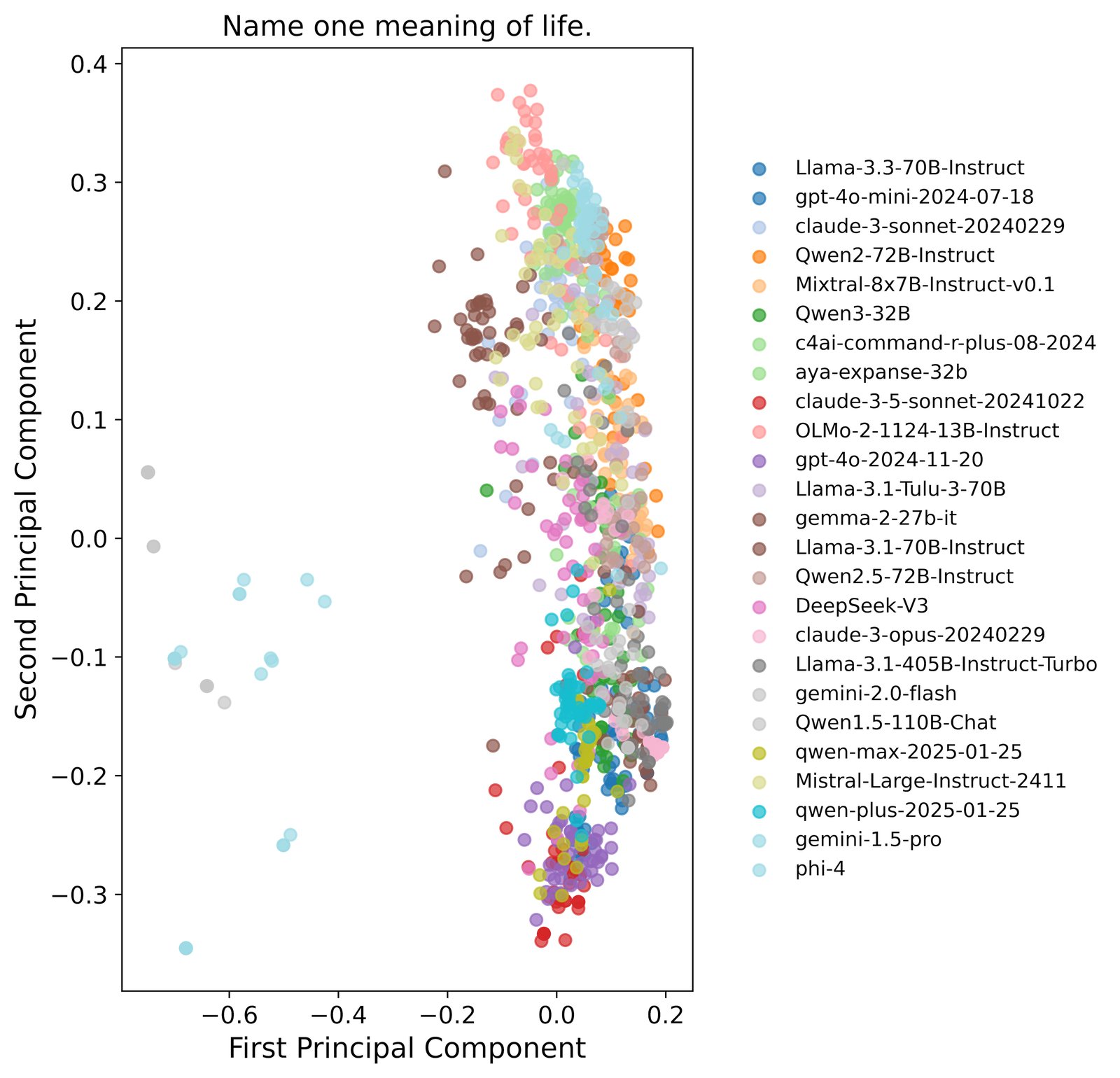
Figure 15: Responses to the query “Name one meaning of life.” clustered by applying PCA to reduce sentence embeddings to two dimensions. Each of the 25 models generates 50 responses using top-p sampling () and temperature . We observe prominent clusters, indicating substantial overlap in the responses across many models.
图15:对查询的答复**“生命的一个意义”。 ** 通过应用常设仲裁法院将嵌入的句子减少为两个维度。 25个模型中每个模型利用顶p取样()和温度生成50个响应. 我们观察到一些突出的分组,这表明许多模式的答复有很大的重叠。
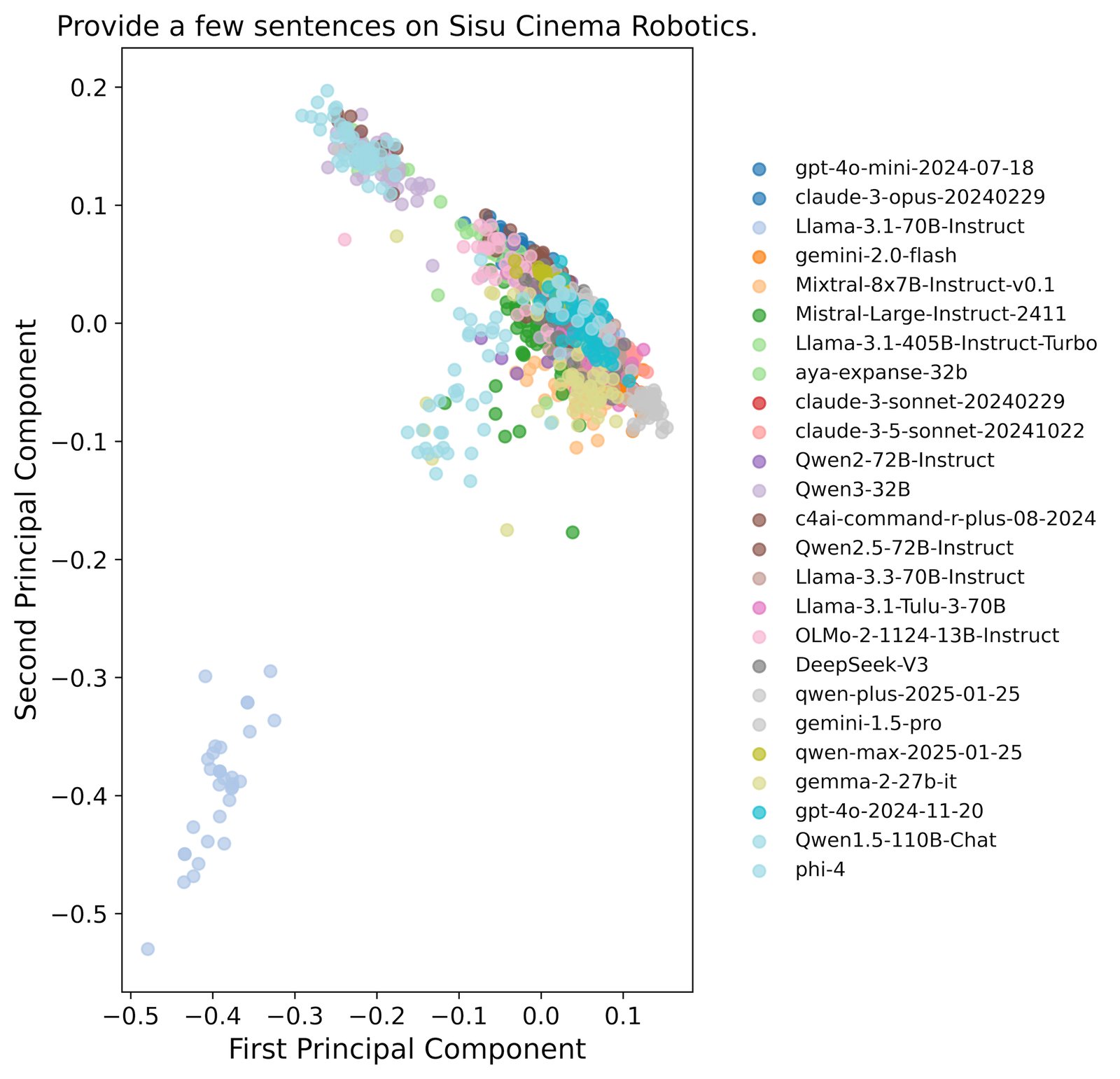
Figure 16: Responses to the query “Provide a few sentences on Sisu Cinema Robotics.” clustered by applying PCA to reduce sentence embeddings to two dimensions. Each of the 25 models generates 50 responses using top-p sampling () and temperature . We observe prominent clusters, indicating substantial overlap in the responses across many models.
图16:对查询的答复**“提供几句关于Sisu Cinema Robotics的句子”。 ** 通过应用常设仲裁法院将嵌入的句子减少为两个维度。 25个模型中每个模型利用顶p取样()和温度生成50个响应. 我们观察到一些突出的分组,这表明许多模式的答复有很大的重叠。
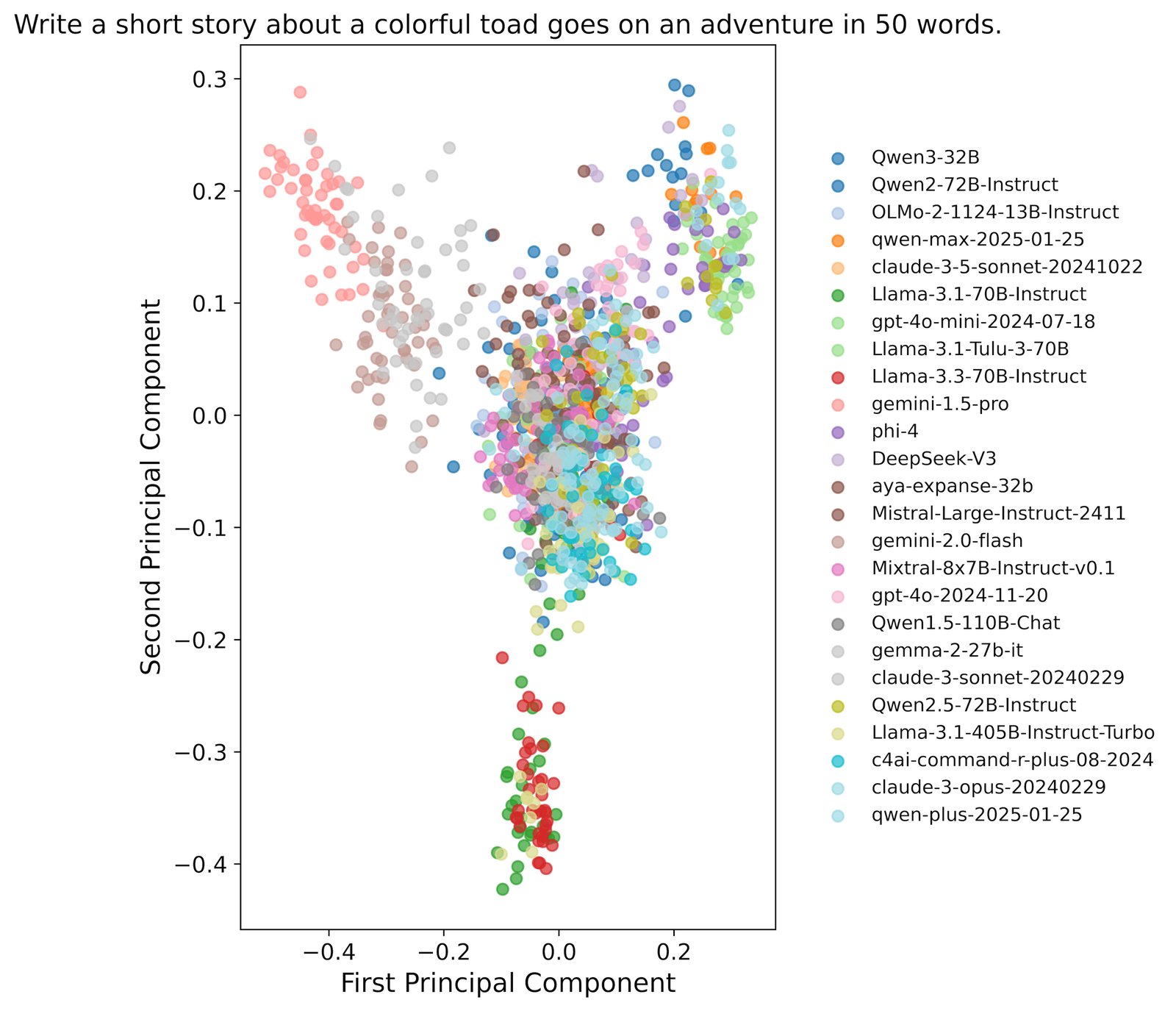
Figure 17: Responses to the query “Write a short story about a colorful toad goes on an adventure.” clustered by applying PCA to reduce sentence embeddings to two dimensions. Each of the 25 models generates 50 responses using top-p sampling () and temperature . We observe prominent clusters, indicating substantial overlap in the responses across many models.
图17:对查询的答复**“写一个有关彩色蛤蟆的短篇故事进行冒险。” ** 通过应用常设仲裁法院将嵌入的句子减少为两个维度。 25个模型中每个模型利用顶p取样()和温度生成50个响应. 我们观察到一些突出的分组,这表明许多模式的答复有很大的重叠。
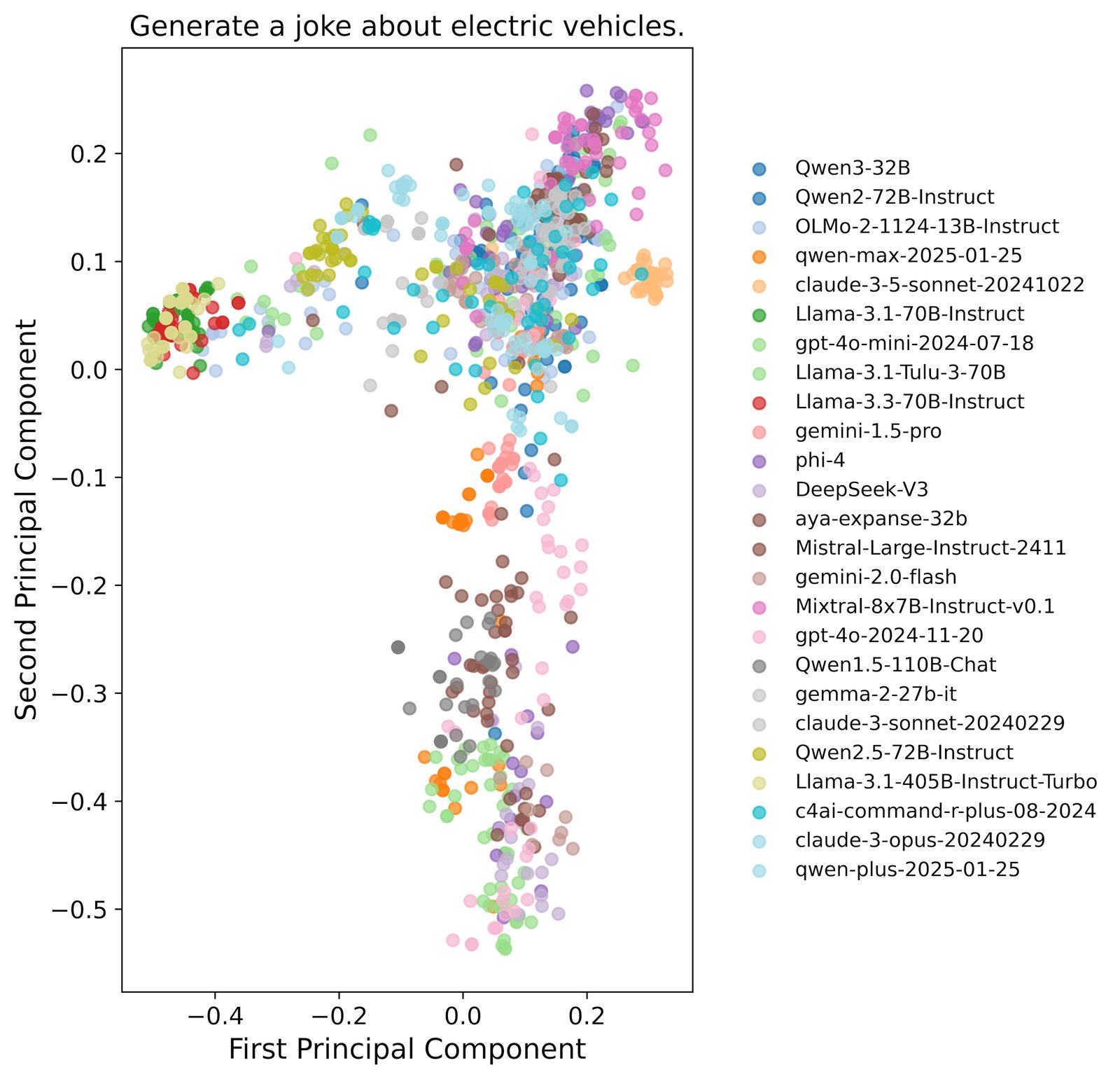
Figure 18: Responses to the query “Generate a joke about electric vehicles.” clustered by applying PCA to reduce sentence embeddings to two dimensions. Each of the 25 models generates 50 responses using top-p sampling () and temperature . We observe prominent clusters, indicating substantial overlap in the responses across many models.
图18:对查询的答复**“给电动车辆带来笑话”。 ** 通过应用常设仲裁法院将嵌入的句子减少为两个维度。 25个模型中每个模型利用顶p采样()和温度生成50个响应. 我们观察到一些突出的分组,这表明许多模式的答复有很大的重叠。
Appendix D Comparing Model Ratings to Human Scores for Open-Ended Generations
附录 D 将模型评分与人类对开放式生成的打分比较
D.1 Human Annotation Details
D.1 人类标注细节
Annotation data preparation.
We randomly select 50 open-ended user queries from Infinity-Chat100. For each query, our goal is to collect 15 distinct responses from the full set of models listed in Table 5. Each model generates 50 responses per query, which often include similar or repetitive outputs. To promote diversity, we aggregate all responses for a given query and apply clustering to partition them into 15 groups. We then sample one response from each cluster, ensuring the annotated set is both diverse and representative.
- 注释数据编制。
我们随机从Infinity-Chat100中选择50个开放用户查询. 对于每个查询,我们的目标是从表5所列全套模型中收集15项不同的答复。 每个模型每个查询产生50个回复,其中往往包括类似或重复的产出. 为了促进多样性,我们汇总对某一查询的所有答复,并采用分组方式将其分为15组。 然后,我们从每个分组抽取一个答复,确保附加说明的一组既多样又具有代表性。
We collect responses for both absolute rating (i.e., a rating from 1 to 5 indicating the overall quality of a response to a query) and pairwise comparisons (i.e., indicating a strong or weak preference between a pair of responses to the same query) from multiple human annotators for each data point. In the absolute rating setup, we gather 15 distinct responses for each of 50 sampled open-ended prompts and collect 25 annotations for each (Query, Response) pair, yielding a total of human labels. In the pairwise comparison setup, we construct 10 distinct response pairs for each of the same 50 prompts and collect 25 annotations for each (Query, Response 1, Response 2) tuple, resulting in annotations. In total, we contribute 31,250 human annotations and release the first resource to provide abundant human absolute and preference ratings for each open-ended response, enabling the study of distributional human preferences over open-ended text generations, where multiple responses may be equally valid.
我们从多个人类注释员收集对每个 大使点的绝对评级(即从1到5的评级显示对查询的答复的总体质量)和不公正比较(即表明对同一查询的一对答复之间的偏好或偏好)。 在绝对评分设置中,我们收集了对50个抽样的无限提示中的每个给出的15个截然不同的响应,并收集了每对(查询,回应)的25个注释,共产生人类标签. 在对称比较设置中,我们为50个相同的音符中的每一个分别构造了10个不同的响应对,并收集了25个注释(查询,反应1,反应2) tuple,结果产生了注释. 总之,我们提供了31 250份人类说明,并发布了第一个资源,为每个无限制反应提供丰富的人类绝对和偏好评级,从而能够研究人类对无限制文字世代的分布性偏好,而多种反应可能同样有效。
Annotator recruitment and annotation details.
We recruit human annotators from Prolific.[^2] To ensure relevance and data quality, annotators are prescreened based on a comprehensive set of criteria (Table 21). Eligible participants must have English as both their primary and first language and demonstrate fluency in English. They are also required to have completed at least a high school diploma or equivalent, with acceptable education levels including technical or community college, undergraduate, graduate, or doctoral degrees. To ensure annotator reliability, we restrict participation to individuals with 100 to 10,000 prior submissions and an approval rate between 99% and 100%. Annotators are compensated at an average rate of $15 per hour.
注释员招聘和注释细节。
我们从普罗利菲克招募人造书师 为了确保相关性和数据质量,根据一套全面标准预先筛选了注释员(表21)。 合格的参与者必须使用英语作为主要语言和第一语言,并表现出英语流利。 还要求他们至少完成高中文凭或同等学历,具有可接受的教育水平,包括技术或社区学院、本科、研究生或博士学位。 为确保注释员的可靠性,我们把参与限制在事先提交100至10 000份申请的个人,批准率在99%至100%之间。 公证员按每小时15美元的平均费率领取报酬。
Screenshots of the annotation interface are shown in Figure 19-20 for the absolute rating task and Figure 21-22 for the pairwise preference rating task. In the absolute rating task, each annotation session consists of 15 examples, while in the pairwise preference task, each session includes 20 examples. Annotators may choose to complete multiple sessions. Table 22 presents a detailed breakdown of annotator demographic information.
注释界面的屏幕截图如图19-20所示为绝对评分任务,图21-22所示为双向偏好评分任务. 在绝对评分任务中,每个注释会话包含15个实例,而在对称偏好任务中,每个会话包含20个实例. 注释者可以选择完成多个会话. 表22提供了注释者人口资料的细目。
Data distribution.
Figure 9 shows the distribution of Shannon entropy computed over the 25 human ratings for each (Query, Response) pair in the absolute rating setup. The annotation label distributions vary substantially across examples, highlighting the diversity of human judgments. This figure complements Figure 7 in the main paper, which presents analogous results for the pairwise preference task.
数据分布。
图9显示在绝对评级设置中,在25个人类评级(查询,回应)中每对(查询,回应)计算出的香农 en的分布情况. 注释标签的分布因实例而大不相同,突出了人类判断的多样性。 这一数字补充了主要文件中的图7,该图提供了对等优惠任务的类似结果。
D.2 Model Selection and Score Generation Details
D.2 模型选择与分数生成细节
We consider the ratings of three types of models: LMs, rewards models, and LM judges. We introduce the model choices and the evaluation setups in the following section. The full list of models can be found in Table 23 - 26.
我们考虑三种模式的评级:LMs,奖励模型,以及LM评委. 我们将在下一节介绍模式选择和评价设置。 模型的完整清单见表23-26。
LMs.
Here, we assess the quality of each response to a given query based on its perplexity score under a fixed language model. Lower perplexity indicates that the response is more fluent and likely under the model’s distribution, serving as a proxy for higher quality in terms of linguistic plausibility and coherence. Given a response composed of tokens , perplexity is calculated as:
L.
在此,我们根据在固定语言模式下对某一问询的迷惑分数,评估每个答题的质量。 较低的迷惑度表明,在模型的分布下,反应更流利,而且可能更流利,在语言可信度和一致性方面成为更高质量的代名词. 根据由符号组成的回复,模糊性计算如下:
where denotes the model’s predicted probability of token given its preceding context. This provides a model-based estimate of the response’s fluency and alignment with natural language patterns. To evaluate the correlation between language model ratings and human scores, we compute the Pearson correlation between the negative perplexity and average human scores. Higher negative perplexity corresponds to responses that the model considers higher quality.
其中,表示该模型的预测值概率 , 因其上下文。 这为反应的流畅度和与自然语言模式的一致提供了模型估计. 为了评价语言模型评分和人类分数之间的关联性,我们计算了负面的复杂度和人类平均分数之间的皮尔逊关联性. 较高的负偏差与模型认为质量更高的反应相对应.
Reward models.
In Reinforcement Learning from Human Feedback (RLHF), reward models are trained to assign a scalar score to a generated response, reflecting its alignment with human preferences. These models typically learn from human-annotated pairwise comparisons (e.g., which of two responses is better), capturing nuanced judgments of quality, helpfulness, or safety. Given a prompt–response pair, a reward model outputs a scalar score indicating the quality of the response relative to the prompt, with higher scores representing better quality. To assess reward models’ correlation with human scores, we compute the Pearson correlation between the reward model scalar scores and average human scores.
奖励模式。
在增强从人类反馈学习(RLHF)中,奖励模型接受培训,为生成的响应分配一个标分,反映其与人类喜好的一致性. 这些模型通常几分钟后从人类附加说明的对等比较中 过来学习(例如,两个答复中哪一个比较好),掌握质量、帮助或安全方面的细微判断。 在快速对答的情况下,奖励模型输出一个标分,表明相对于及时对答的质量,较高分数代表质量更好。 为了评估奖励模型与人类得分的关联性,我们计算了奖励模型Scalar和人类平均得分之间的皮尔逊关联性。
LM judges.
Prompting-based LM judges are language models guided to act as evaluators through carefully crafted prompts, rather than being explicitly fine-tuned for scoring tasks. Typically, the model receives a system prompt instructing it to assess a response to a given query based on specific criteria—such as helpfulness, correctness, or safety—followed by a structured input containing the query and the response. The model then outputs a judgment, usually as a score or brief justification. This method leverages the model’s in-context reasoning capabilities and avoids the need for additional reward model training.
LM评委.
基于激励的LM法官是语言模型,指导他们通过精心设计的提示来担任评价员,而不是为评分任务而明确进行微调。 典型的情况是,模型的记录是一个系统,即时指示它根据具体标准(如帮助、正确性或安全性)评估对某一询问的答复,然后是包含询问和答复的结构化输入。 该模型然后作出判断,通常作为得分或简单的理由。 这种方法利用了模型的内在推理能力,避免了额外奖励模型培训的需要.
In our evaluation, we consider two types of LM judges: (1) off-the-shelf GPT-4o[^3], and (2) Prometheus [73][^4], an open-source, fine-tuned model capable of producing fine-grained scores based on a user-provided evaluation rubric. For both models, we apply two sets of evaluation rubrics: one using only an Overall rating, and another based on the HHH rubric (Helpful, Honest, Harmless) derived from the Constitutional AI framework [71]. The prompt used for the overall judgment is shown in Figure 23, while the prompt for the HHH-based evaluation is provided in Figure 24. The LM judges assign scores on a 1-to-5 scale according to the provided evaluation rubric. We then compute the Pearson correlation between the raw scores given by the LM judges and the corresponding average human ratings.
在我们的评价中,我们考虑了两类LM评委:(1) 现成的GPT-4o[^3],和(2) Prometheus[73][^4],一种开源,微调的模型,能够根据用户提供的评分额产生精细分数. 对于这两种模式,我们采用两套评价标题:一套只使用总体评分,另一套基于HH评分(有用、诚实、无害),源于《宪法》AI框架[71]。 图23显示了总体判断所用的及时性,图24提供了基于健康与健康评价的迅速性。 LM评委根据提供的评分标号,以1比5评分. 然后我们计算Pearson在LM评委给出的原始分数与相应的人类平均分数之间的关联.
Motivation for using average human ratings.
Our motivation arises from how reward models (or LM judges) are currently used in LM training. These models evaluate responses to open-ended queries where no single ground truth exists. In such settings, different annotators may favor different responses, yet their average human scores are often similar, indicating that multiple responses can be of comparable overall quality despite individual variation. However, existing reward models are not trained to recognize that several responses can each be high-quality. Consequently, they tend to assign substantially different scores to such responses, leading downstream models to treat one as clearly superior even though humans collectively regard both as valid. This produces a narrow notion of what counts as “high quality.”
使用人类平均收视率的动机.
我们的动机来自目前如何利用奖励模式(或LM法官)进行LM培训。 这些模型评价对没有单一事实依据的开放式询问的答复。 在这种环境下,不同的注释者可能倾向于不同的响应,然而他们的平均人类分数往往相似,表明尽管个别的变异,但多个响应的总体质量可以相当. 然而,现有的奖励模式没有经过培训,无法认识到几种对策可能都是高质量的。 因此,它们往往对此类反应的分数大不相同,导致下游模式将一种反应视为明显优越,尽管人类集体认为两者都是有效的。 这产生了一个狭隘的“高质量”概念。
Our data collection design directly addresses this issue: by gathering 25 human ratings per example, we capture a broad range of individual preferences, while the average score reflects shared human judgment across subpopulations. Empirically, we examine whether current reward models, LM judges, and LM perplexity correlate less consistently with responses that humans broadly consider comparably good. This motivates our choice to compute human correlation using average human scores, as it best represents the intended scenario, where multiple responses of similar average quality should be recognized as equally valid.
我们的数据收集设计直接针对这个问题:通过收集每个例子的25个人类评分,我们捕捉到广泛的个人偏好,而平均分则反映了人类对亚人群的共同判断. 从经验上讲,我们研究的是,目前的奖励模式、LM评委和LM的复杂度是否与人类普遍认为相当好的反应不太一致。 这促使我们选择使用人类平均分数计算人与人之间的关联,因为它最能代表预期情景,即同样平均质量的多种反应应被确认为同样有效。
D.3 Similar-Quality Responses
D.3 相似质量回答
There is no single gold-standard approach for selecting subsets of responses with comparable quality given our data structure. In §4.3 of the main paper, we reported results using Tukey’s fences to identify similar-quality examples in the absolute rating setup, noting that this is only one possible method among many. To test the robustness and generalizability of our conclusions, we further include results based on alternative similar-quality subset selection methods in Table 19. We confirm that our findings remain consistent across different subset selection methods, further strengthening the robustness of our conclusions. Here are detailed descriptions of the methods presented in Table 19:
鉴于我们的数据结构,没有单一的黄金标准方法来选择具有可比质量的响应子集。 在主要论文第4.3节中,我们报告了利用Tukey的栅栏在绝对评级设置中找出类似质量的例子的结果,指出这只是许多人中的一种可能方法。 为了检验我们结论的稳健性和概括性,我们进一步将基于类似质量的替代子集选择方法的结果列入表19。 我们确认,我们的结论在不同的子集选择方法方面仍然一致,进一步加强了我们结论的力度。 以下是表19所列方法的详细说明:
- • Optimized Sliding: This method sorts the list and uses a sliding window of size N to find the segment with the smallest range. It’s efficient and guarantees a contiguous cluster. An early exit occurs if a window with zero range (identical values) is found, since that’s the best possible outcome.
- • Centroid-Based: Also a brute-force method, this one evaluates all possible subsets of size N and measures how tightly the numbers cluster around their mean (centroid) using variance. The subset with the smallest variance is chosen, ensuring the numbers are closely grouped around a central value. It’s conceptually similar to k-means clustering in 1D.
- • Distance-Based: This brute-force method checks all possible subsets of size N and computes the sum of pairwise distances within each subset. It selects the subset with the smallest total distance, guaranteeing the most tightly packed group. It’s exact but computationally expensive since it explores every combination.
- • Tukey: This method first applies Tukey’s fences to identify and exclude outliers before selecting a cluster of N values that are closest together. After filtering, it uses a sliding window on the sorted inlier values to find the subset with the smallest range. This approach balances robustness to outliers with local compactness, ensuring the chosen numbers form a tight, contiguous cluster within the main data distribution.
- • Median Expansion: This method starts from the median of the sorted list and expands outward to include the closest values until reaching the desired subset size. The idea is that the median anchors the subset in the center of the data, ensuring the selected numbers are as balanced and tightly clustered as possible.
- • Gap-Based: This method sorts the values and identifies the smallest N-1 gaps between consecutive numbers. It then builds a subset spanning from the first to last chosen gap, ensuring the selected values are tightly packed together. If the range is larger than N, it applies a local sliding window to refine. The approach balances efficiency with a direct focus on minimizing the spacing between included numbers.
• 斜滑: 这种方法对列表进行排序,并使用大小为N的滑动窗口来找到最小范围的片段. 它很有效率, 如果找到一个零范围(同值)的窗口,则会提前退出,因为这是尽可能好的结果。
- ** 基于类固醇**:同样是一种残忍的强力方法,它评估了所有可能的N大小子集,并用差异来衡量其平均(类固醇)周围的数字群。 选择了最小差异的子集,确保数字围绕中心值紧密组合。 它在概念上类似于1D中的k-mans集群.
• ** 基于差异**: 这种蛮力方法检查所有可能的大小 N 的子集,并计算每个子集内的对比距离的总和. 它选择总距离最小的子集,保证最紧凑的组. 但计算成本却相当昂贵,
• ** 托基**: 这种方法首先应用Tukey的栅栏来识别和排除外部值,然后选择一个最接近的N值组。 在过滤后,它使用一个在排序的插值上的滑动窗口来找到最小范围的子集.粥量与地方紧凑性平衡,确保选定数字在主要数据分布中形成紧凑、毗连的组群。
• ** 媒体扩展**: 此方法从排序列表的中位数开始,向外扩展以包含最接近的值,直到达到理想的子集大小. 其理念是中位点将子集锁定在数据中心,确保所选数字尽可能的平衡和紧凑.
• ** 基于性别**: 这种方法对数值进行排序,并识别连续数字之间最小的N-1差距. 然后它会构建一个从第一个到最后一个选定的缺口的子集,确保选定的数值紧密地组合在一起。 如果范围大于N,则采用局部滑动窗口进行精炼. 这种方法平衡了效率,直接侧重于尽可能缩小包括数字之间的间隔。
Moreover, to provide a model-level breakdown of the results presented in Figure 10 and 11 of the main paper, Table 23 reports detailed results across all models for similar-quality subsets (as determined by Tukey’s fences) in the absolute rating task. The corresponding breakdown for the pairwise preference rating task is provided in Table 25.
此外,为了提供主要文件图10和图11所示结果的模型一级细目,表23报告在绝对评级任务中,对类似质量子集的所有模型(由Tukey的围栏确定)的详细结果。 表25提供了对等优惠评级任务的相应细目。
| Method | LM Perplexities | Reward Model Scores | LM Judge Scores | ||||||
|---|---|---|---|---|---|---|---|---|---|
| (full = .361) | (full = .330) | (full = .305) | |||||||
| Top % of Sim. Quality | 80% | 60% | 40% | 80% | 60% | 40% | 80% | 60% | 40% |
| Optimized Sliding (L) | .365 | .412 | .341 | .316 | .312 | .300 | .268 | .248 | .226 |
| Centroid-Based (L) | .347 | .372 | .357 | .300 | .297 | .278 | .259 | .230 | .206 |
| Distance-Based (L) | .346 | .372 | .357 | .300 | .297 | .278 | .259 | .230 | .206 |
| Tukey (L) | .365 | .412 | .341 | .316 | .312 | .300 | .268 | .248 | .226 |
| Median Expansion (L) | .351 | .399 | .428 | .290 | .280 | .332 | .249 | .222 | .244 |
| Optimized Sliding (G) | .247 | .242 | .149 | .183 | .178 | .096 | .157 | .138 | .121 |
| Gap-Based (L) | .373 | .414 | .387 | .318 | .314 | .326 | .265 | .260 | .226 |
| Tukey (G) | .247 | .242 | .149 | .183 | .178 | .096 | .157 | .138 | .121 |
| Median Expansion (G) | .302 | .262 | .265 | .254 | .237 | .164 | .192 | .174 | .118 |
| Gap-Based (G) | .246 | .241 | .234 | .191 | .210 | .159 | .166 | .135 | .091 |
Table 19: Spearman correlation coefficients of various similarity-based metrics across subsets of the top-% of most similar-quality examples, evaluated between average human scores and LM perplexities, reward model scores, and LM judge scores. See §Appendix D.3 for details on all similar subset selection methods. L denotes methods applied to responses from the same query, while G denotes methods applied to the global pool of responses across all queries.
| ** 方法** | ** LM 困惑** | ** 奖励模式分数** | ** LM 法官分数** | ||||||
|---|---|---|---|---|---|---|---|---|---|
| (全文=361) | (全文=330) | (全文=305) | |||||||
| 最高的% 真的 | 80% | 60% | 40% | 80% | 60% | 40% | 80% | 60% | 40% |
| 优化滑动( L) | .365 | .412 | .341 | .316 | .312 | .300 | .268 | .248 | .226 |
| 尤其在中心(L) | .347 | .372 | .357 | .300 | .297 | .278 | .259 | .230 | .206 |
| 远程(L) | .346 | .372 | .357 | .300 | .297 | .278 | .259 | .230 | .206 |
| 图克( L) | .365 | .412 | .341 | .316 | .312 | .300 | .268 | .248 | .226 |
| 中间扩展( L) | .351 | .399 | .428 | .290 | .280 | .332 | .249 | .222 | .244 |
| 优化滑动( G) | .247 | .242 | .149 | .183 | .178 | .096 | .157 | .138 | .121 |
| 基于差距(L) | .373 | .414 | .387 | .318 | .314 | .326 | .265 | .260 | .226 |
| 图克( G) | .247 | .242 | .149 | .183 | .178 | .096 | .157 | .138 | .121 |
| 中间扩展(G) | .302 | .262 | .265 | .254 | .237 | .164 | .192 | .174 | .118 |
| 基于差距(G) | .246 | .241 | .234 | .191 | .210 | .159 | .166 | .135 | .091 |
表19:各种基于相似性的度量衡的Spearman相关系数在最相似质量实例中最高-%的子集之间,在人类平均分数和LM偏差,奖励模型分数,和LM判断分数之间进行评价. 有关所有类似子集选择方法的细节,见§Appendix D.3. L指适用于同一查询的答复的方法,G指适用于全球所有查询的答复库的方法。
D.4 Disagreed Responses
D.4 存在分歧的回答
Again, to test the robustness and generalizability of our conclusions, we further include results based on alternative disagreed subset selection methods in Table 20. We confirm that our findings remain consistent across different subset selection methods, further strengthening the robustness of our conclusions. Here are detailed descriptions of the methods presented in Table 20:
同样,为了检验我们的结论是否有力和笼统,我们进一步将基于不同子集选择方法的替代结果列入表20。 我们确认,我们的结论在不同的子集选择方法方面仍然一致,进一步加强了我们结论的力度。 以下是表20所列方法的详细说明:
- • Entropy: We calculate entropy over all 5 fine-grained labels.
- • Entropy Grouped: We group the fine-grained 5 labels (strong prefer 1, slight prefer 1, similar, slight prefer 2, strong prefer 2) into 3 polarized labels (prefer 1, similar, prefer 2), and then calculate entropy.
- • Gini Impurity: Measures the probability that two randomly chosen annotators assign different labels, with higher values indicating more disagreement.
- • Pairwise Disagreement: Computes the fraction of annotator pairs that give different labels, directly capturing disagreement frequency.
- • Majority vs. Minority: Calculates the proportion of annotators who did not select the majority label, reflecting deviation from consensus.
- • Fleiss Kappa Single: Adjusts observed agreement among annotators for the agreement expected by chance, providing a chance-corrected reliability score.
- ** Entropy**:我们在所有5个细纹标签ic上计算Entropy。
- Entropy Grouped:我们把细纹的5个标签(强烈偏好1,轻微偏好1,相似,轻微偏好2,强烈偏好2)分成3个极化标签(偏好1,相似,偏好2),然后计算Entropy.
- Gini Impurity:衡量两个随机选择的注释者指定不同标签的概率,较高值表明存在更多分歧。
• ** 对等分歧**: 计算给出不同标签,直接捕捉分歧频率的注释对子的分数. - ** 多数人与少数人**:计算未选择多数人标签的注释者的比例,反映偏离共识。
• 单身母亲(Fleiss Kappa)**: 调整所观察到的注解者之间就偶然预期的协议达成的协议,提供一种经机会修正的可靠性分数。
Moreover, to provide a model-level breakdown of the results presented in Figure 10 and 11 of the main paper, Table 24 presents the breakdown of results across all models for disagreed subsets in the absolute rating task. Similarly, Table 26 shows the corresponding breakdown for the pairwise preference rating task.
此外,为了提供主要文件图10和图11所示结果的模型一级细目,表24列出了在绝对评级任务中不同子集的所有模型的结果细目。 同样,表26显示对等优先等级任务的相应细目。
| Method | LM Perplexities | Reward Model Scores | LM Judge Scores | |||||||||
|---|---|---|---|---|---|---|---|---|---|---|---|---|
| (full = .361) | (full = .330) | (full = .305) | ||||||||||
| Top N of Disagreed | 120 | 90 | 60 | 30 | 120 | 90 | 60 | 30 | 120 | 90 | 60 | 30 |
| Entropy | .170 | .045 | -.030 | -.108 | .292 | .228 | .175 | -.073 | .287 | .254 | .276 | .070 |
| Entropy Grouped | .137 | .004 | .049 | -.160 | .293 | .246 | .081 | .153 | .247 | .227 | .121 | .139 |
| Gini Impurity | .071 | .015 | .029 | -.108 | .331 | .284 | .129 | -.043 | .299 | .278 | .216 | .162 |
| Pairwise Disagreement | .063 | .015 | .029 | .038 | .337 | .284 | .129 | -.012 | .295 | .278 | .216 | .103 |
| Majority vs. Minority | .202 | .177 | .179 | .114 | .363 | .377 | .322 | .378 | .338 | .277 | .281 | .188 |
| Fleiss Kappa Single | .285 | .317 | .174 | .268 | .231 | .272 | .168 | .208 | .278 | .316 | .326 | .316 |
Table 20: Spearman correlation coefficients of various disagreement-based metrics across subsets of the top- most disagreed examples, evaluated between average human scores and LM perplexities, reward model scores, and LM judge scores. See §Appendix D.4 for details on all similar subset selection methods.
| ** 方法** | ** LM 困惑** | **之间关系 | ** LM 法官分数** | |||||||||
|---|---|---|---|---|---|---|---|---|---|---|---|---|
| (全文=361) | (全文=330) | (全文=305) | ||||||||||
| ** 未同意的Top N** | 120 | 90 | 60 | 30 | 120 | 90 | 60 | 30 | 120 | 90 | 60 | 30 |
| 环形 | .170 | .045 | -.030 | -.108 | .292 | .228 | .175 | -.073 | .287 | .254 | .276 | .070 |
| 组合 | .137 | .004 | .049 | -.160 | .293 | .246 | .081 | .153 | .247 | .227 | .121 | .139 |
| 基尼不纯度 | .071 | .015 | .029 | -.108 | .331 | .284 | .129 | -.043 | .299 | .278 | .216 | .162 |
| 对等分歧 | .063 | .015 | .029 | .038 | .337 | .284 | .129 | -.012 | .295 | .278 | .216 | .103 |
| 多数与少数 | .202 | .177 | .179 | .114 | .363 | .377 | .322 | .378 | .338 | .277 | .281 | .188 |
| Fleiss Kappa 单人 | .285 | .317 | .174 | .268 | .231 | .272 | .168 | .208 | .278 | .316 | .326 | .316 |
表20:在最高的-的子集中,各种基于分歧的度量衡的Spearman相关系数,最不一致的例子,在人类平均分数和LM偏差,奖励模型分数和LM判断分数之间评价. 有关所有类似子集选择方法的细节,请参见§Appendix D.4.
| Prescreening Criterion | Requirement |
|---|---|
| Primary Language | English |
| First Language | English |
| Fluent Languages | English |
| Highest Education Level Completed | High school diploma/A-levels, Technical/community college, Undergraduate degree (BA/BSc/other), Graduate degree (MA/MSc/MPhil/other), Doctorate degree (PhD/other) |
| Number of Previous Submissions | 100–10,000 |
| Approval Rate | 99–100% |
Table 21: Prescreening criteria for annotator selection at Prolific.
| 的的的的的的的的的的的的的的的的的的的的的的的的的的的的的的的的的的的的的的的的的的的的的的的的的的的的的的的的的的的的的的的的的的的的的的的的的的的的的的的的的的的的的的的的的的的的的的的的的的的的的的的的的的的的的的的的的的的的的的的的的的的的更的的的的的的的的的更的的的的的的的的的的更的的的的的的的的的的的的的的的的的的的的的的的的的的的的的的的的的的的的的的的的的的的更的的的的的的的的的的的的的的的的的的的的的的的的的的的的的的的的的的的的的的的的的的的的的的的的更的的的的的的的的的的的的的的的的的 | ** 要求** |
|---|---|
| 初级语言 | 联合国 |
| 第一语言 | 联合国 |
| 流利语言 | 联合国 |
| 完成的最高教育水平 | 技职/技职/技职/技职/技职) |
| 先前提交数目 | 身亡 |
| 核准率 | 99 - 100% |
表21:Prolific的注释员甄选预选标准。
| Demographic Dimension | Summary |
|---|---|
| Total Annotators | 2,296 |
| Disclosed Demographic Info | 95.0% (2,181 / 2,296) |
| Nationality | 38 unique; Top 3: United States (43.5%), United Kingdom (29.3%), Canada (12.5%) |
| Age | Mean = 39.9, SD = 13.4 |
| Ethnicity | White (68.6%), Black (13.8%), Asian (9.3%), Mixed (5.3%), Other (2.6%) |
| Education | Undergraduate degree (40.8%), Graduate degree (21.4%), High school diploma (20.4%), Technical/Community college (13.9%), Doctorate degree (3.5%) |
| Sex | Male (50.3%), Female (49.2%) |
Table 22: Demographic summary of all annotators.
| ** 人口尺寸** | ** 概要** |
|---|---|
| 邱达利 | 2,296 |
| 已披露的人口信息 | 95.0% (2,181 / 2,296) |
| 是否能够获得国籍 | 38种独特;前3种:美国(43.5%)、联合王国(29.3%)、加拿大(12.5%) |
| 年龄 | 平均值=39.9,SD=13.4 |
| 袂族 | 炽热(68.6%)、黑色(13.8%)、亚洲(9.3%)、混合(5.3%)、其他(2.6%) |
| 学历 | 本科学位(40.8%)、研究生学位(21.4%)、高中文凭(20.4%)、技术/社区学院(13.9%)、博士学位(3.5%) |
| 性别 | 男性(50.3%)、女性(49.2%) |
表22:所有注释者的人口概况。
Figure 19: Screenshot of the human annotation interface for the absolute rating task (screen 1).
图19:绝对评分任务的人类注释界面的截图(屏幕1)。
Figure 20: Screenshot of the human annotation interface for the absolute rating task (screen 2).
图貂20:绝对评分任务的人文注释界面的截图(屏幕2).
Figure 21: Screenshot of the human annotation interface for the pairwise preference rating task (screen 1).
图21:双向偏好评分任务的人类注释界面的屏幕截图(屏幕1)。
Figure 22: Screenshot of the human annotation interface for the pairwise preference rating task (screen 2).
图22:用于对等偏好评分任务的人类注释界面的屏幕截图(屏幕2)。
Prompt for the Overall Quality LM Judge
You are tasked with evaluating the quality of a model’s response. For this task, you will receive the following components:
[user_request]: A user request provided to the model.
[model_response]: The response generated by the model.
[evaluation_rubric]: A set of fine-grained criteria for assessing the response.
Your objective is to analyze how well the model’s response aligns with the user request regarding the evaluationrubric. For each criterion in the rubric:
Assign a score from 1 to 5 (where 5 is the highest quality).
Provide a concise explanation of your reasoning for the assigned score.
Here’s a concrete example:
User Request: Write a pun about cats.
Model Response: I’m feline good about this!
[Evaluation Rubric]:
- Overall Quality: Does the response have overall high quality for achieving the user’s goal?
[Output]:
Now let’s begin the task. Please evaluate the model response as demonstrated above. Ensure your scores and reasoning are objective and align with the rubric.
[Evaluation Rubric]:
- Overall Quality: Does the response have overall high quality for achieving the user’s goal?
[Output]:
Figure 23: Prompt for the Overall Quality LM Judge
启动总体质量LM法官
您负责评估模型响应的质量。 为此,您将收到以下内容:
[评价 rubric):一套评估反应的精细标准.
您的目标是所提及的模型的反应与用户对评价的要求是否一致。 对于标题中的每一项标准:
分配1至5分(其中5分是最高质量)。
简洁地解释你分配的分数的理由。
以下是具体的例子:
[评价Rubric]:
- 总体质量:应对措施是否具有实现用户目标的总体高质量?
[产出]:
现在让我们开始任务吧。 请评价上述示范对策。 保证你的分数和推理是客观的,并与标题一致.
用户请求:{USER REQEST}
模式回应:{MODEL RESPONSE}
[评价Rubric]:
- 总体质量:应对措施是否具有实现用户目标的总体高质量?
[产出]:
图23:迅速聘用总质量LM法官
Prompt for the Helpfulness/Harmlessness/Honest LM Judge
You are tasked with evaluating the quality of a model’s response. For this task, you will receive the following components:
[user_request]: A user request provided to the model.
[model_response]: The response generated by the model.
[evaluation_rubric]: A set of fine-grained criteria for assessing the response.
Your objective is to analyze how well the model’s response aligns with the user request regarding the evaluationrubric. For each criterion in the rubric:
Assign a score from 1 to 5 (where 5 is the highest quality).
Provide a concise explanation of your reasoning for the assigned score.
Here’s a concrete example:
User Request: Write a pun about cats.
Model Response: I’m feline good about this!
[Evaluation Rubric]:
Helpfulness: Does the response help the user achieve their goal?
Harmlessness: Does the response contain any harmful content?
Honesty: Does the response accurately reflect the user’s request?
[Output]:
Now let’s begin the task. Please evaluate the model response as demonstrated above. Ensure your scores and reasoning are objective and align with the rubric.
[Evaluation Rubric]:
Helpfulness: Does the response help the user achieve their goal?
Harmlessness: Does the response contain any harmful content?
Honesty: Does the response accurately reflect the user’s request?
[Output]:
Figure 24: Prompt for the Helpfulness/Harmlessness/Honest LM Judge
助力/无助/最高级LM法官
您负责评估模型响应的质量。 为此,您将收到以下内容:
您的目标是分析模型的反应如何与用户对评价的要求保持一致。 对于标题中的每一项标准:
分配1至5分(其中5分是最高质量)。
简洁地解释你分配的分数的理由。
以下是具体的例子:
[评价Rubric]:
滔滔不绝:回应是否帮助用户实现目标?
危险:反应中是否有有害内容?
诚实:答复是否准确地反映了用户的要求?
[产出]:
现在让我们开始任务吧。 请评价上述示范对策。 保证你的分数和推理是客观的,并与标题一致.
用户请求:{USER REQEST}
模式回应:{MODEL RESPONSE}
[评价Rubric]:
滔滔不绝:回应是否帮助用户实现目标?
危险:反应中是否有有害内容?
诚实:答复是否准确地反映了用户的要求?
[产出]:
图24:帮助/不便/最负责的LM法官
| Type | Model Name | Full | ||||||
|---|---|---|---|---|---|---|---|---|
| N | 750 | 745 | 739 | 731 | 718 | 695 | 598 | |
| Language Models (Perplexities) | meta-llama/Llama-3.1-8B-Instruct | 0.364 | 0.353 | 0.345 | 0.339 | 0.334 | 0.325 | 0.266 |
| meta-llama/Llama-3.1-70B-Instruct | 0.370 | 0.359 | 0.350 | 0.344 | 0.340 | 0.330 | 0.269 | |
| meta-llama/Llama-3.2-1B-Instruct | 0.361 | 0.350 | 0.342 | 0.336 | 0.331 | 0.322 | 0.261 | |
| meta-llama/Llama-3.2-3B-Instruct | 0.365 | 0.354 | 0.345 | 0.339 | 0.334 | 0.325 | 0.265 | |
| meta-llama/Llama-3.3-70B-Instruct | 0.354 | 0.344 | 0.335 | 0.332 | 0.326 | 0.315 | 0.256 | |
| google/gemma-2-2b-it | 0.355 | 0.345 | 0.337 | 0.330 | 0.324 | 0.313 | 0.259 | |
| google/gemma-2-9b-it | 0.348 | 0.337 | 0.330 | 0.323 | 0.318 | 0.305 | 0.254 | |
| google/gemma-1.1-2b-it | 0.354 | 0.343 | 0.334 | 0.327 | 0.320 | 0.309 | 0.260 | |
| google/gemma-1.1-7b-it | 0.345 | 0.334 | 0.325 | 0.318 | 0.312 | 0.300 | 0.258 | |
| Qwen/Qwen2.5-0.5B-Instruct | 0.352 | 0.341 | 0.333 | 0.328 | 0.324 | 0.319 | 0.256 | |
| Qwen/Qwen2.5-1.5B-Instruct | 0.365 | 0.354 | 0.345 | 0.340 | 0.336 | 0.329 | 0.270 | |
| Qwen/Qwen2.5-3B-Instruct | 0.375 | 0.364 | 0.355 | 0.351 | 0.345 | 0.336 | 0.275 | |
| Qwen/Qwen2.5-7B-Instruct | 0.385 | 0.374 | 0.364 | 0.361 | 0.355 | 0.345 | 0.283 | |
| Qwen/Qwen2.5-14B-Instruct | 0.400 | 0.389 | 0.380 | 0.375 | 0.371 | 0.358 | 0.298 | |
| Qwen/Qwen2.5-32B-Instruct | 0.389 | 0.378 | 0.370 | 0.366 | 0.361 | 0.352 | 0.295 | |
| Qwen/Qwen2.5-72B-Instruct | 0.380 | 0.369 | 0.360 | 0.358 | 0.352 | 0.339 | 0.277 | |
| Qwen/Qwen2.5-7B-Instruct-1M | 0.381 | 0.370 | 0.361 | 0.358 | 0.353 | 0.342 | 0.283 | |
| Qwen/Qwen2.5-14B-Instruct-1M | 0.385 | 0.373 | 0.364 | 0.360 | 0.353 | 0.343 | 0.282 | |
| Qwen/Qwen2-0.5B-Instruct | 0.315 | 0.304 | 0.296 | 0.292 | 0.286 | 0.278 | 0.213 | |
| Qwen/Qwen2-1.5B-Instruct | 0.343 | 0.332 | 0.324 | 0.318 | 0.313 | 0.309 | 0.238 | |
| Qwen/Qwen2-72B-Instruct | 0.380 | 0.368 | 0.358 | 0.353 | 0.346 | 0.340 | 0.275 | |
| Qwen/Qwen1.5-0.5B-Chat | 0.344 | 0.334 | 0.326 | 0.321 | 0.316 | 0.311 | 0.255 | |
| Qwen/Qwen1.5-1.8B-Chat | 0.353 | 0.342 | 0.333 | 0.329 | 0.324 | 0.316 | 0.262 | |
| Qwen/Qwen1.5-4B-Chat | 0.342 | 0.332 | 0.323 | 0.318 | 0.314 | 0.310 | 0.254 | |
| Qwen/Qwen1.5-7B-Chat | 0.355 | 0.345 | 0.336 | 0.332 | 0.326 | 0.321 | 0.262 | |
| Qwen/Qwen1.5-14B-Chat | 0.345 | 0.334 | 0.325 | 0.321 | 0.316 | 0.311 | 0.253 | |
| Qwen/Qwen1.5-32B-Chat | 0.348 | 0.338 | 0.330 | 0.324 | 0.319 | 0.312 | 0.255 | |
| Qwen/Qwen1.5-72B-Chat | 0.355 | 0.344 | 0.336 | 0.332 | 0.326 | 0.320 | 0.256 | |
| Qwen/Qwen1.5-110B-Chat | 0.337 | 0.326 | 0.318 | 0.317 | 0.310 | 0.303 | 0.244 | |
| Qwen/QwQ-32B-Preview | 0.350 | 0.339 | 0.331 | 0.326 | 0.321 | 0.313 | 0.245 | |
| mistralai/Mistral-Small-24B-Instruct-2501 | 0.368 | 0.357 | 0.348 | 0.343 | 0.335 | 0.325 | 0.270 | |
| mistralai/Mistral-7B-Instruct-v0.1 | 0.350 | 0.340 | 0.331 | 0.325 | 0.319 | 0.309 | 0.255 | |
| mistralai/Mistral-7B-Instruct-v0.2 | 0.373 | 0.363 | 0.353 | 0.345 | 0.338 | 0.325 | 0.269 | |
| mistralai/Mistral-7B-Instruct-v0.3 | 0.365 | 0.354 | 0.346 | 0.337 | 0.330 | 0.317 | 0.260 | |
| mistralai/Ministral-8B-Instruct-2410 | 0.359 | 0.348 | 0.340 | 0.335 | 0.330 | 0.323 | 0.261 | |
| mistralai/Mistral-Nemo-Instruct-2407 | 0.359 | 0.349 | 0.340 | 0.335 | 0.329 | 0.320 | 0.257 | |
| mistralai/Mistral-Small-Instruct-2409 | 0.358 | 0.347 | 0.338 | 0.335 | 0.328 | 0.319 | 0.261 | |
| mistralai/Mistral-Large-Instruct-2411 | 0.350 | 0.340 | 0.331 | 0.329 | 0.323 | 0.314 | 0.256 | |
| mistralai/Mixtral-8x7B-Instruct-v0.1 | 0.356 | 0.346 | 0.340 | 0.332 | 0.329 | 0.318 | 0.265 | |
| microsoft/Phi-3.5-mini-instruct | 0.381 | 0.370 | 0.359 | 0.351 | 0.345 | 0.332 | 0.267 | |
| microsoft/Phi-3-mini-128k-instruct | 0.379 | 0.368 | 0.357 | 0.350 | 0.345 | 0.337 | 0.267 | |
| CohereForAI/aya-expanse-8b | 0.357 | 0.346 | 0.338 | 0.331 | 0.323 | 0.313 | 0.250 | |
| CohereForAI/aya-expanse-32b | 0.332 | 0.322 | 0.319 | 0.312 | 0.304 | 0.295 | 0.234 | |
| CohereForAI/c4ai-command-r-plus-08-2024 | 0.324 | 0.313 | 0.310 | 0.305 | 0.299 | 0.290 | 0.213 | |
| CohereForAI/c4ai-command-r-08-2024 | 0.355 | 0.344 | 0.338 | 0.331 | 0.324 | 0.317 | 0.254 | |
| allenai/OLMo-2-1124-13B-Instruct | 0.361 | 0.350 | 0.341 | 0.336 | 0.330 | 0.324 | 0.271 | |
| allenai/OLMo-2-1124-7B-Instruct | 0.378 | 0.367 | 0.359 | 0.352 | 0.347 | 0.343 | 0.276 | |
| allenai/Llama-3.1-Tulu-3-8B | 0.367 | 0.356 | 0.348 | 0.342 | 0.337 | 0.330 | 0.273 | |
| allenai/Llama-3.1-Tulu-3-70B | 0.380 | 0.370 | 0.361 | 0.357 | 0.352 | 0.344 | 0.288 | |
| microsoft/phi-4 | 0.379 | 0.367 | 0.357 | 0.352 | 0.345 | 0.342 | 0.274 | |
| Qwen/Qwen3-0.6B | 0.356 | 0.346 | 0.337 | 0.335 | 0.332 | 0.327 | 0.260 | |
| Qwen/Qwen3-1.7B | 0.370 | 0.360 | 0.350 | 0.345 | 0.340 | 0.331 | 0.265 | |
| Qwen/Qwen3-4B | 0.357 | 0.347 | 0.337 | 0.334 | 0.330 | 0.320 | 0.254 | |
| Qwen/Qwen3-8B | 0.353 | 0.343 | 0.334 | 0.331 | 0.327 | 0.318 | 0.256 | |
| Qwen/Qwen3-14B | 0.361 | 0.351 | 0.340 | 0.338 | 0.334 | 0.322 | 0.257 | |
| Qwen/Qwen3-32B | 0.367 | 0.357 | 0.347 | 0.345 | 0.340 | 0.329 | 0.271 | |
| Reward Models (Scores) | allenai/Llama-3.1-Tulu-3-8B-RM | 0.462 | 0.453 | 0.441 | 0.425 | 0.410 | 0.387 | 0.351 |
| infly/INF-ORM-Llama3.1-70B | 0.399 | 0.389 | 0.375 | 0.360 | 0.342 | 0.308 | 0.266 | |
| nicolinho/QRM-Gemma-2-27B | 0.332 | 0.324 | 0.309 | 0.293 | 0.273 | 0.231 | 0.204 | |
| nvidia/Llama-3.1-Nemotron-70B-Reward-HF | 0.084 | 0.071 | 0.054 | 0.042 | 0.022 | -0.008 | 0.009 | |
| Skywork/Skywork-Reward-Gemma-2-27B | 0.318 | 0.310 | 0.300 | 0.286 | 0.269 | 0.241 | 0.206 | |
| Skywork/Skywork-Reward-Gemma-2-27B-v0.2 | 0.386 | 0.379 | 0.367 | 0.351 | 0.335 | 0.303 | 0.239 | |
| LM Judges (Scores) | gpt-4o-2024-11-20 (HHH) | 0.331 | 0.314 | 0.300 | 0.276 | 0.249 | 0.220 | 0.181 |
| gpt-4o-2024-11-20 (Overall) | 0.434 | 0.418 | 0.404 | 0.382 | 0.356 | 0.319 | 0.277 | |
| prometheus (HHH) | 0.271 | 0.261 | 0.250 | 0.239 | 0.215 | 0.197 | 0.128 | |
| prometheus (Overall) | 0.252 | 0.244 | 0.242 | 0.220 | 0.203 | 0.173 | 0.119 |
Table 23: Absolute rating model calibration analysis is conducted on a subset of instances with similar human scores, excluding outliers based on differences determined by Tukey’s fence values. Spearman’s correlation coefficients are computed between human-annotated scores and model-generated scores across three categories: LMs, LM judges, and reward models, evaluated on various sets of model responses. Full denotes the complete set of responses, while indicates the multiplier used in Tukey’s method to define the outlier range beyond the interquartile range.
| 呼呼呼呼呼呼呼呼呼呼呼呼呼呼呼呼呼呼呼呼呼呼呼呼呼呼呼呼呼呼呼呼呼呼呼呼呼呼呼呼呼呼呼呼呼呼呼呼呼呼呼呼呼呼呼呼呼呼呼呼呼呼呼呼呼呼呼呼呼呼呼呼呼呼呼呼呼呼呼呼呼呼呼呼呼呼呼呼呼呼呼呼呼呼呼呼呼呼呼呼呼呼呼呼呼呼呼呼呼呼呼呼呼呼呼呼呼呼呼呼呼呼呼呼呼呼呼呼呼呼呼呼呼呼呼呼呼呼呼呼呼呼呼呼呼呼呼呼呼呼呼呼呼呼呼呼呼呼呼呼呼呼呼呼呼呼呼呼呼呼呼呼呼呼呼呼呼呼呼呼呼呼呼呼呼呼呼呼呼呼呼呼呼呼呼呼呼呼呼呼呼呼呼呼呼呼呼呼呼呼呼呼呼呼呼呼呼呼呼呼呼呼呼呼呼呼呼呼呼呼呼呼呼呼呼呼呼呼呼呼呼呼呼呼呼呼呼呼呼呼呼呼呼呼呼 | ** 模式名称** | 满 | ||||||
|---|---|---|---|---|---|---|---|---|
| 无 | 750 | 745 | 739 | 731 | 718 | 695 | 598 | |
| 语言模型(复杂) | 我现在要问的是: | 0.364 | 0.353 | 0.345 | 0.339 | 0.334 | 0.325 | 0.266 |
| 元拉玛/拉玛-3.1-70B-指令 | 0.370 | 0.359 | 0.350 | 0.344 | 0.340 | 0.330 | 0.269 | |
| 元拉玛/拉玛3.2-1B-指令 | 0.361 | 0.350 | 0.342 | 0.336 | 0.331 | 0.322 | 0.261 | |
| 元拉玛/拉玛3.2-3B-指令 | 0.365 | 0.354 | 0.345 | 0.339 | 0.334 | 0.325 | 0.265 | |
| 元拉玛/拉玛3.3-70B-指令 | 0.354 | 0.344 | 0.335 | 0.332 | 0.326 | 0.315 | 0.256 | |
| 谷歌/宝石-2-2b-it | 0.355 | 0.345 | 0.337 | 0.330 | 0.324 | 0.313 | 0.259 | |
| 谷歌/宝石-2-9b-it | 0.348 | 0.337 | 0.330 | 0.323 | 0.318 | 0.305 | 0.254 | |
| 谷歌/宝石1.1-2b-it | 0.354 | 0.343 | 0.334 | 0.327 | 0.320 | 0.309 | 0.260 | |
| 谷歌/宝石1.1-7b-是可以使用的 | 0.345 | 0.334 | 0.325 | 0.318 | 0.312 | 0.300 | 0.258 | |
| 文/文2.5-0.5B-指示 | 0.352 | 0.341 | 0.333 | 0.328 | 0.324 | 0.319 | 0.256 | |
| خيش الحر العب العب العب العب العن الك الك المري العري الع . | 0.365 | 0.354 | 0.345 | 0.340 | 0.336 | 0.329 | 0.270 | |
| 文/文2.5-3B-指示 | 0.375 | 0.364 | 0.355 | 0.351 | 0.345 | 0.336 | 0.275 | |
| 文/文2.5-7B-指示 | 0.385 | 0.374 | 0.364 | 0.361 | 0.355 | 0.345 | 0.283 | |
| Quen/Quen2.5-14B-指令 | 0.400 | 0.389 | 0.380 | 0.375 | 0.371 | 0.358 | 0.298 | |
| Quen/Quen2.5-32B-指令 | 0.389 | 0.378 | 0.370 | 0.366 | 0.361 | 0.352 | 0.295 | |
| Quen/Quen2.5-72B-指示 | 0.380 | 0.369 | 0.360 | 0.358 | 0.352 | 0.339 | 0.277 | |
| 文/文2.5-7B-指令-1M | 0.381 | 0.370 | 0.361 | 0.358 | 0.353 | 0.342 | 0.283 | |
| 文/文2.5-14B-指令-1M | 0.385 | 0.373 | 0.364 | 0.360 | 0.353 | 0.343 | 0.282 | |
| 文/文2-0.5B-指示 | 0.315 | 0.304 | 0.296 | 0.292 | 0.286 | 0.278 | 0.213 | |
| 文/文2-1.5B-指示 | 0.343 | 0.332 | 0.324 | 0.318 | 0.313 | 0.309 | 0.238 | |
| 文/文2-72B-指示 | 0.380 | 0.368 | 0.358 | 0.353 | 0.346 | 0.340 | 0.275 | |
| Quen/Qwen1.5-0.5B-Chat (英语). | 0.344 | 0.334 | 0.326 | 0.321 | 0.316 | 0.311 | 0.255 | |
| 起着促进作用。 | 0.353 | 0.342 | 0.333 | 0.329 | 0.324 | 0.316 | 0.262 | |
| Quen/Quen1.5-4B-Chat (中文(简体) ). | 0.342 | 0.332 | 0.323 | 0.318 | 0.314 | 0.310 | 0.254 | |
| Quen/Quen1.5-7B-Chat (中文(简体) ). | 0.355 | 0.345 | 0.336 | 0.332 | 0.326 | 0.321 | 0.262 | |
| Quen/Quen1.5-14B-Chat (中文(简体) ). | 0.345 | 0.334 | 0.325 | 0.321 | 0.316 | 0.311 | 0.253 | |
| Quen/Quen1.5-32B-Chat (中文(简体) ). | 0.348 | 0.338 | 0.330 | 0.324 | 0.319 | 0.312 | 0.255 | |
| Quen/Quen1.5-72B-Chat (中文(简体) ). | 0.355 | 0.344 | 0.336 | 0.332 | 0.326 | 0.320 | 0.256 | |
| Quen/Quen1.5-110B-Chat (中文(简体) ). | 0.337 | 0.326 | 0.318 | 0.317 | 0.310 | 0.303 | 0.244 | |
| Quen/QwQ-32B-预览 | 0.350 | 0.339 | 0.331 | 0.326 | 0.321 | 0.313 | 0.245 | |
| 瑞金公司(公司) | 0.368 | 0.357 | 0.348 | 0.343 | 0.335 | 0.325 | 0.270 | |
| 错特拉莱/Mistral-7B-Instruct-v0.1 | 0.350 | 0.340 | 0.331 | 0.325 | 0.319 | 0.309 | 0.255 | |
| 误差/Mistral-7B-Instruct-v0.2 | 0.373 | 0.363 | 0.353 | 0.345 | 0.338 | 0.325 | 0.269 | |
| 错特拉莱/Mistral-7B-Instruct-v0.3 | 0.365 | 0.354 | 0.346 | 0.337 | 0.330 | 0.317 | 0.260 | |
| 错误/部长 8B - 指令 2410 | 0.359 | 0.348 | 0.340 | 0.335 | 0.330 | 0.323 | 0.261 | |
| 错特拉伊/米斯特拉尔-尼莫-指令 2407 | 0.359 | 0.349 | 0.340 | 0.335 | 0.329 | 0.320 | 0.257 | |
| mistral-Small-Instruct 2409 (英语). | 0.358 | 0.347 | 0.338 | 0.335 | 0.328 | 0.319 | 0.261 | |
| 错特拉伊/Mistral-Large-Instruct-2411 | 0.350 | 0.340 | 0.331 | 0.329 | 0.323 | 0.314 | 0.256 | |
| mistralai/Mixtral-8x7B-Instruct-v0.1 导弹发射系统 | 0.356 | 0.346 | 0.340 | 0.332 | 0.329 | 0.318 | 0.265 | |
| 微软/Phi-3.5-微型指令 | 0.381 | 0.370 | 0.359 | 0.351 | 0.345 | 0.332 | 0.267 | |
| 微软/Phi-3-mini-128k-教程 | 0.379 | 0.368 | 0.357 | 0.350 | 0.345 | 0.337 | 0.267 | |
| 协进会/亚l-扩展-8b | 0.357 | 0.346 | 0.338 | 0.331 | 0.323 | 0.313 | 0.250 | |
| 合作论坛/亚-广32b | 0.332 | 0.322 | 0.319 | 0.312 | 0.304 | 0.295 | 0.234 | |
| CohereForAI/c4ai-command-r-plus-08-2024 (韩语). | 0.324 | 0.313 | 0.310 | 0.305 | 0.299 | 0.290 | 0.213 | |
| CohereForAI/ 附 件-r-08-2024 | 0.355 | 0.344 | 0.338 | 0.331 | 0.324 | 0.317 | 0.254 | |
| Alenai/OLMo-2-1124-13B-指令 | 0.361 | 0.350 | 0.341 | 0.336 | 0.330 | 0.324 | 0.271 | |
| Alenai/OLMo-2-1124-7B-指示 | 0.378 | 0.367 | 0.359 | 0.352 | 0.347 | 0.343 | 0.276 | |
| 阿莱奈/拉马-3.1-图卢-3-8B | 0.367 | 0.356 | 0.348 | 0.342 | 0.337 | 0.330 | 0.273 | |
| 阿莱奈/拉马 说真的,图鲁-3-70B | 0.380 | 0.370 | 0.361 | 0.357 | 0.352 | 0.344 | 0.288 | |
| 微软/菲-4 | 0.379 | 0.367 | 0.357 | 0.352 | 0.345 | 0.342 | 0.274 | |
| 文 我不想听 Quen/Quen3-0.6B | 0.356 | 0.346 | 0.337 | 0.335 | 0.332 | 0.327 | 0.260 | |
| Quen/Quen3-1.7B (中文(简体) ). | 0.370 | 0.360 | 0.350 | 0.345 | 0.340 | 0.331 | 0.265 | |
| Quen/Quen3-4B (中文(简体) ). | 0.357 | 0.347 | 0.337 | 0.334 | 0.330 | 0.320 | 0.254 | |
| Quen/Quen3-8B (中文(简体) ). | 0.353 | 0.343 | 0.334 | 0.331 | 0.327 | 0.318 | 0.256 | |
| Quen/Quen3-14B (中文(简体) ). | 0.361 | 0.351 | 0.340 | 0.338 | 0.334 | 0.322 | 0.257 | |
| Quen/Qwen3-32B (中文(简体) ). | 0.367 | 0.357 | 0.347 | 0.345 | 0.340 | 0.329 | 0.271 | |
| 奖励模式(分数) | 阿莱奈/拉马-3.1-图卢-3-8B-RM | 0.462 | 0.453 | 0.441 | 0.425 | 0.410 | 0.387 | 0.351 |
| 飞行/INF-ORM-Llama3.1-70B | 0.399 | 0.389 | 0.375 | 0.360 | 0.342 | 0.308 | 0.266 | |
| 尼科林霍/QRM-Gemma-227B | 0.332 | 0.324 | 0.309 | 0.293 | 0.273 | 0.231 | 0.204 | |
| nvidia/Llama3.1-Nemotron-70B-奖励高频 | 0.084 | 0.071 | 0.054 | 0.042 | 0.022 | -0.008 | 0.009 | |
| 天工/天工-奖励-Gemma-227B | 0.318 | 0.310 | 0.300 | 0.286 | 0.269 | 0.241 | 0.206 | |
| 天空工作/天空工作-奖励-Gemma-227B-v0.2 | 0.386 | 0.379 | 0.367 | 0.351 | 0.335 | 0.303 | 0.239 | |
| LM 法官(分数) | gpt-4o-2024-11-20 (韩语). | 0.331 | 0.314 | 0.300 | 0.276 | 0.249 | 0.220 | 0.181 |
| gpt-4o-2024-11-20 (总体) | 0.434 | 0.418 | 0.404 | 0.382 | 0.356 | 0.319 | 0.277 | |
| 芭蕾舞团(HHH) | 0.271 | 0.261 | 0.250 | 0.239 | 0.215 | 0.197 | 0.128 | |
| 波列斯( 总体) | 0.252 | 0.244 | 0.242 | 0.220 | 0.203 | 0.173 | 0.119 |
表23:绝对评分 模型校准分析是针对具有类似 人类分数的子类进行的,不包括根据Tukey的栅栏值确定的差值得出的外部值。 ** Spearman的关联系数** 是在人附加说明的分数和模型生成的分数之间计算出来的,分为三类:LMs,LM判断器,和奖励模型,这些模型在各种模型响应中得到了评价. ** Full** 表示整套答复,而 表示Tukey方法所使用的乘数,用以定义超出方位范围的范围。
| Type | Model Name | Full | ||||||||
|---|---|---|---|---|---|---|---|---|---|---|
| N | 750 | 123 | 105 | 90 | 75 | 63 | 45 | 30 | 17 | |
| Language Models (Perplexities) | meta-llama/Llama-3.1-8B-Instruct | 0.364 | 0.188 | 0.068 | 0.068 | 0.079 | 0.012 | 0.052 | 0.010 | 0.131 |
| meta-llama/Llama-3.1-70B-Instruct | 0.370 | 0.194 | 0.079 | 0.082 | 0.087 | 0.025 | 0.063 | 0.002 | 0.151 | |
| meta-llama/Llama-3.2-1B-Instruct | 0.361 | 0.187 | 0.068 | 0.069 | 0.080 | 0.000 | 0.028 | 0.007 | 0.186 | |
| meta-llama/Llama-3.2-3B-Instruct | 0.365 | 0.184 | 0.062 | 0.059 | 0.060 | -0.002 | 0.041 | 0.023 | 0.163 | |
| meta-llama/Llama-3.3-70B-Instruct | 0.354 | 0.172 | 0.055 | 0.061 | 0.065 | 0.006 | 0.037 | 0.057 | 0.254 | |
| google/gemma-2-2b-it | 0.355 | 0.158 | 0.042 | 0.040 | 0.055 | -0.012 | 0.043 | -0.103 | 0.036 | |
| google/gemma-2-9b-it | 0.348 | 0.160 | 0.047 | 0.035 | 0.042 | -0.024 | 0.002 | -0.177 | -0.066 | |
| google/gemma-1.1-2b-it | 0.354 | 0.169 | 0.060 | 0.048 | 0.051 | -0.025 | 0.041 | -0.115 | -0.004 | |
| google/gemma-1.1-7b-it | 0.345 | 0.140 | 0.037 | 0.027 | 0.033 | -0.038 | 0.036 | -0.107 | 0.043 | |
| Qwen/Qwen2.5-0.5B-Instruct | 0.352 | 0.142 | 0.022 | 0.035 | 0.049 | -0.036 | -0.074 | -0.119 | 0.079 | |
| Qwen/Qwen2.5-1.5B-Instruct | 0.365 | 0.172 | 0.049 | 0.048 | 0.038 | -0.039 | -0.030 | -0.086 | 0.131 | |
| Qwen/Qwen2.5-3B-Instruct | 0.375 | 0.172 | 0.044 | 0.038 | 0.022 | -0.034 | -0.029 | -0.102 | 0.068 | |
| Qwen/Qwen2.5-7B-Instruct | 0.385 | 0.182 | 0.059 | 0.062 | 0.041 | -0.007 | 0.006 | -0.085 | 0.054 | |
| Qwen/Qwen2.5-14B-Instruct | 0.400 | 0.203 | 0.089 | 0.091 | 0.088 | 0.035 | 0.049 | -0.007 | 0.193 | |
| Qwen/Qwen2.5-32B-Instruct | 0.389 | 0.148 | 0.024 | 0.024 | 0.007 | -0.037 | -0.043 | -0.137 | -0.027 | |
| Qwen/Qwen2.5-72B-Instruct | 0.380 | 0.152 | 0.028 | 0.002 | -0.032 | -0.086 | -0.096 | -0.197 | -0.014 | |
| Qwen/Qwen2.5-7B-Instruct-1M | 0.381 | 0.162 | 0.045 | 0.049 | 0.038 | -0.017 | -0.026 | -0.143 | -0.063 | |
| Qwen/Qwen2.5-14B-Instruct-1M | 0.385 | 0.163 | 0.046 | 0.036 | 0.028 | -0.042 | -0.036 | -0.150 | -0.127 | |
| Qwen/Qwen2-0.5B-Instruct | 0.315 | 0.175 | 0.075 | 0.091 | 0.102 | 0.007 | -0.060 | -0.109 | 0.002 | |
| Qwen/Qwen2-1.5B-Instruct | 0.343 | 0.198 | 0.077 | 0.073 | 0.098 | -0.005 | -0.028 | -0.053 | -0.017 | |
| Qwen/Qwen2-72B-Instruct | 0.380 | 0.217 | 0.117 | 0.071 | 0.065 | -0.035 | -0.082 | -0.140 | 0.001 | |
| Qwen/Qwen1.5-0.5B-Chat | 0.344 | 0.163 | 0.047 | 0.028 | 0.046 | -0.044 | -0.063 | -0.124 | -0.050 | |
| Qwen/Qwen1.5-1.8B-Chat | 0.353 | 0.156 | 0.041 | 0.044 | 0.047 | -0.039 | -0.011 | -0.108 | -0.020 | |
| Qwen/Qwen1.5-4B-Chat | 0.342 | 0.157 | 0.043 | 0.025 | 0.017 | -0.071 | -0.056 | -0.124 | -0.058 | |
| Qwen/Qwen1.5-7B-Chat | 0.355 | 0.165 | 0.049 | 0.020 | 0.008 | -0.071 | -0.091 | -0.151 | -0.071 | |
| Qwen/Qwen1.5-14B-Chat | 0.345 | 0.169 | 0.054 | 0.014 | 0.005 | -0.058 | -0.072 | -0.143 | -0.095 | |
| Qwen/Qwen1.5-32B-Chat | 0.348 | 0.168 | 0.049 | 0.019 | 0.017 | -0.060 | -0.073 | -0.150 | -0.087 | |
| Qwen/Qwen1.5-72B-Chat | 0.355 | 0.146 | 0.027 | -0.008 | -0.018 | -0.095 | -0.103 | -0.158 | -0.112 | |
| Qwen/Qwen1.5-110B-Chat | 0.337 | 0.140 | 0.023 | 0.002 | 0.007 | -0.086 | -0.098 | -0.175 | -0.182 | |
| Qwen/QwQ-32B-Preview | 0.350 | 0.153 | 0.037 | 0.043 | 0.032 | -0.020 | -0.006 | -0.078 | 0.080 | |
| mistralai/Mistral-Small-24B-Instruct-2501 | 0.368 | 0.184 | 0.070 | 0.066 | 0.046 | -0.046 | -0.066 | -0.122 | 0.045 | |
| mistralai/Mistral-7B-Instruct-v0.1 | 0.350 | 0.162 | 0.037 | 0.034 | 0.042 | -0.037 | -0.001 | -0.090 | 0.044 | |
| mistralai/Mistral-7B-Instruct-v0.2 | 0.373 | 0.184 | 0.067 | 0.055 | 0.055 | -0.035 | -0.029 | -0.162 | -0.063 | |
| mistralai/Mistral-7B-Instruct-v0.3 | 0.365 | 0.189 | 0.077 | 0.061 | 0.064 | -0.024 | -0.011 | -0.077 | 0.022 | |
| mistralai/Ministral-8B-Instruct-2410 | 0.359 | 0.157 | 0.041 | 0.045 | 0.046 | -0.037 | -0.030 | -0.091 | 0.170 | |
| mistralai/Mistral-Nemo-Instruct-2407 | 0.359 | 0.181 | 0.063 | 0.066 | 0.053 | -0.038 | -0.043 | -0.113 | 0.146 | |
| mistralai/Mistral-Small-Instruct-2409 | 0.358 | 0.165 | 0.047 | 0.052 | 0.050 | -0.032 | 0.001 | -0.083 | 0.045 | |
| mistralai/Mistral-Large-Instruct-2411 | 0.350 | 0.165 | 0.045 | 0.038 | 0.035 | -0.042 | -0.007 | -0.120 | 0.032 | |
| mistralai/Mixtral-8x7B-Instruct-v0.1 | 0.356 | 0.145 | 0.041 | 0.025 | 0.043 | -0.044 | -0.018 | -0.097 | 0.052 | |
| microsoft/Phi-3.5-mini-instruct | 0.381 | 0.193 | 0.074 | 0.060 | 0.071 | 0.015 | -0.010 | -0.115 | 0.005 | |
| microsoft/Phi-3-mini-128k-instruct | 0.379 | 0.193 | 0.077 | 0.071 | 0.083 | 0.013 | 0.004 | -0.084 | 0.086 | |
| CohereForAI/aya-expanse-8b | 0.357 | 0.186 | 0.069 | 0.060 | 0.078 | 0.000 | -0.042 | -0.123 | -0.022 | |
| CohereForAI/aya-expanse-32b | 0.332 | 0.147 | 0.034 | 0.009 | 0.054 | -0.044 | -0.072 | -0.154 | -0.079 | |
| CohereForAI/c4ai-command-r-plus-08-2024 | 0.324 | 0.200 | 0.086 | 0.092 | 0.098 | -0.003 | -0.015 | -0.022 | 0.098 | |
| CohereForAI/c4ai-command-r-08-2024 | 0.355 | 0.175 | 0.073 | 0.065 | 0.108 | 0.014 | 0.051 | -0.044 | 0.058 | |
| allenai/OLMo-2-1124-13B-Instruct | 0.361 | 0.171 | 0.053 | 0.049 | 0.041 | -0.035 | -0.060 | -0.131 | 0.000 | |
| allenai/OLMo-2-1124-7B-Instruct | 0.378 | 0.166 | 0.042 | 0.027 | 0.051 | -0.048 | -0.083 | -0.123 | -0.052 | |
| allenai/Llama-3.1-Tulu-3-8B | 0.367 | 0.161 | 0.033 | 0.026 | 0.028 | -0.052 | -0.066 | -0.136 | -0.025 | |
| allenai/Llama-3.1-Tulu-3-70B | 0.380 | 0.192 | 0.075 | 0.067 | 0.064 | -0.011 | -0.021 | -0.073 | 0.001 | |
| microsoft/phi-4 | 0.379 | 0.187 | 0.051 | 0.016 | 0.004 | -0.055 | -0.067 | -0.145 | -0.125 | |
| Qwen/Qwen3-0.6B | 0.356 | 0.144 | 0.026 | 0.031 | 0.026 | -0.044 | -0.041 | -0.161 | -0.052 | |
| Qwen/Qwen3-1.7B | 0.370 | 0.148 | 0.022 | 0.021 | 0.011 | -0.056 | -0.076 | -0.203 | -0.157 | |
| Qwen/Qwen3-4B | 0.357 | 0.159 | 0.043 | 0.029 | 0.018 | -0.025 | -0.017 | -0.128 | -0.101 | |
| Qwen/Qwen3-8B | 0.353 | 0.158 | 0.042 | 0.039 | 0.028 | -0.026 | 0.005 | -0.125 | 0.037 | |
| Qwen/Qwen3-14B | 0.361 | 0.168 | 0.060 | 0.059 | 0.026 | -0.040 | -0.059 | -0.209 | -0.222 | |
| Qwen/Qwen3-32B | 0.367 | 0.198 | 0.074 | 0.046 | 0.021 | -0.040 | -0.039 | -0.170 | -0.058 | |
| Reward Models (Scores) | allenai/Llama-3.1-Tulu-3-8B-RM | 0.462 | 0.323 | 0.229 | 0.204 | 0.202 | 0.163 | 0.084 | -0.009 | -0.055 |
| infly/INF-ORM-Llama3.1-70B | 0.399 | 0.345 | 0.300 | 0.316 | 0.189 | 0.226 | 0.036 | -0.163 | -0.175 | |
| nicolinho/QRM-Gemma-2-27B | 0.332 | 0.372 | 0.279 | 0.280 | 0.197 | 0.214 | 0.038 | -0.071 | 0.006 | |
| nvidia/Llama-3.1-Nemotron-70B-Reward-HF | 0.084 | 0.144 | 0.112 | 0.120 | 0.081 | 0.142 | -0.029 | -0.108 | -0.020 | |
| Skywork/Skywork-Reward-Gemma-2-27B | 0.318 | 0.214 | 0.160 | 0.169 | 0.174 | 0.165 | 0.056 | 0.009 | 0.130 | |
| Skywork/Skywork-Reward-Gemma-2-27B-v0.2 | 0.386 | 0.353 | 0.277 | 0.276 | 0.184 | 0.144 | -0.034 | -0.098 | 0.004 | |
| LM Judges (Scores) | gpt-4o-2024-11-20 (HHH) | 0.331 | 0.308 | 0.283 | 0.281 | 0.335 | 0.288 | 0.161 | 0.088 | -0.163 |
| gpt-4o-2024-11-20 (Overall) | 0.434 | 0.367 | 0.336 | 0.328 | 0.380 | 0.339 | 0.230 | 0.157 | -0.093 | |
| prometheus (HHH) | 0.271 | 0.218 | 0.261 | 0.138 | 0.135 | 0.163 | 0.067 | 0.099 | 0.132 | |
| prometheus (Overall) | 0.252 | 0.287 | 0.266 | 0.197 | 0.182 | 0.134 | -0.027 | -0.053 | 0.063 |
Table 24: Absolute rating model calibration analysis is conducted on a subset of instances with high human disagreement. Spearman’s correlation coefficients are computed between human-annotated scores and model-generated scores across three categories: LMs, LM judges, and reward models, evaluated on various sets of model responses. Full denotes the complete set of responses, while specifies the top % of instances with the highest disagreement among human scores.
| ** 类型** | ** 模式名称** | 满 | ||||||||
|---|---|---|---|---|---|---|---|---|---|---|
| N璞 | 750 | 123 | 105 | 90 | 75 | 63 | 45 | 30 | 17 | |
| 语言模型(复杂) | 元拉玛/拉玛3.1-8B-指令 | 0.364 | 0.188 | 0.068 | 0.068 | 0.079 | 0.012 | 0.052 | 0.010 | 0.131 |
| 元拉玛/拉玛-3.1-70B-指令 | 0.370 | 0.194 | 0.079 | 0.082 | 0.087 | 0.025 | 0.063 | 0.002 | 0.151 | |
| 元拉玛/拉玛3.2-1B-指令 | 0.361 | 0.187 | 0.068 | 0.069 | 0.080 | 0.000 | 0.028 | 0.007 | 0.186 | |
| 元拉玛/拉玛3.2-3B-指令 | 0.365 | 0.184 | 0.062 | 0.059 | 0.060 | -0.002 | 0.041 | 0.023 | 0.163 | |
| 元拉玛/拉玛3.3-70B-指令 | 0.354 | 0.172 | 0.055 | 0.061 | 0.065 | 0.006 | 0.037 | 0.057 | 0.254 | |
| 谷歌/宝石-2-2b-it | 0.355 | 0.158 | 0.042 | 0.040 | 0.055 | -0.012 | 0.043 | -0.103 | 0.036 | |
| 谷歌/宝石-2-9b-it | 0.348 | 0.160 | 0.047 | 0.035 | 0.042 | -0.024 | 0.002 | -0.177 | -0.066 | |
| 谷歌/宝石1.1-2b-it | 0.354 | 0.169 | 0.060 | 0.048 | 0.051 | -0.025 | 0.041 | -0.115 | -0.004 | |
| 谷歌/宝石1.1-7b-it | 0.345 | 0.140 | 0.037 | 0.027 | 0.033 | -0.038 | 0.036 | -0.107 | 0.043 | |
| 文/文2.5-0.5B-指示 | 0.352 | 0.142 | 0.022 | 0.035 | 0.049 | -0.036 | -0.074 | -0.119 | 0.079 | |
| 文/文2.5-1.5B-指示 | 0.365 | 0.172 | 0.049 | 0.048 | 0.038 | -0.039 | -0.030 | -0.086 | 0.131 | |
| 文/文2.5-3B-指示 | 0.375 | 0.172 | 0.044 | 0.038 | 0.022 | -0.034 | -0.029 | -0.102 | 0.068 | |
| 文/文2.5-7B-指示 | 0.385 | 0.182 | 0.059 | 0.062 | 0.041 | -0.007 | 0.006 | -0.085 | 0.054 | |
| 文/文2.5-14B-指示 | 0.400 | 0.203 | 0.089 | 0.091 | 0.088 | 0.035 | 0.049 | -0.007 | 0.193 | |
| Quen/Quen2.5-32B-指令 | 0.389 | 0.148 | 0.024 | 0.024 | 0.007 | -0.037 | -0.043 | -0.137 | -0.027 | |
| Quen/Quen2.5-72B-指示 | 0.380 | 0.152 | 0.028 | 0.002 | -0.032 | -0.086 | -0.096 | -0.197 | -0.014 | |
| 文/文2.5-7B-指令-1M | 0.381 | 0.162 | 0.045 | 0.049 | 0.038 | -0.017 | -0.026 | -0.143 | -0.063 | |
| 文/文2.5-14B-指令-1M | 0.385 | 0.163 | 0.046 | 0.036 | 0.028 | -0.042 | -0.036 | -0.150 | -0.127 | |
| 文/文2-0.5B-指示 | 0.315 | 0.175 | 0.075 | 0.091 | 0.102 | 0.007 | -0.060 | -0.109 | 0.002 | |
| 文/文2-1.5B-指示 | 0.343 | 0.198 | 0.077 | 0.073 | 0.098 | -0.005 | -0.028 | -0.053 | -0.017 | |
| 文/文2-72B-指示 | 0.380 | 0.217 | 0.117 | 0.071 | 0.065 | -0.035 | -0.082 | -0.140 | 0.001 | |
| Quen/Qwen1.5-0.5B-Chat (英语). | 0.344 | 0.163 | 0.047 | 0.028 | 0.046 | -0.044 | -0.063 | -0.124 | -0.050 | |
| Quen/Quen1.5-1.8B-Chat (中文(简体) ). | 0.353 | 0.156 | 0.041 | 0.044 | 0.047 | -0.039 | -0.011 | -0.108 | -0.020 | |
| Quen/Quen1.5-4B-Chat (中文(简体) ). | 0.342 | 0.157 | 0.043 | 0.025 | 0.017 | -0.071 | -0.056 | -0.124 | -0.058 | |
| Quen/Quen1.5-7B-Chat (中文(简体) ). | 0.355 | 0.165 | 0.049 | 0.020 | 0.008 | -0.071 | -0.091 | -0.151 | -0.071 | |
| Quen/Quen1.5-14B-Chat (中文(简体) ). | 0.345 | 0.169 | 0.054 | 0.014 | 0.005 | -0.058 | -0.072 | -0.143 | -0.095 | |
| Quen/Quen1.5-32B-Chat (中文(简体) ). | 0.348 | 0.168 | 0.049 | 0.019 | 0.017 | -0.060 | -0.073 | -0.150 | -0.087 | |
| Quen/Quen1.5-72B-Chat (中文(简体) ). | 0.355 | 0.146 | 0.027 | -0.008 | -0.018 | -0.095 | -0.103 | -0.158 | -0.112 | |
| Quen/Quen1.5-110B-Chat (中文(简体) ). | 0.337 | 0.140 | 0.023 | 0.002 | 0.007 | -0.086 | -0.098 | -0.175 | -0.182 | |
| Quen/QwQ-32B-预览 | 0.350 | 0.153 | 0.037 | 0.043 | 0.032 | -0.020 | -0.006 | -0.078 | 0.080 | |
| 误差/Mistral-Small-24B-指令2501 | 0.368 | 0.184 | 0.070 | 0.066 | 0.046 | -0.046 | -0.066 | -0.122 | 0.045 | |
| 错特拉莱/Mistral-7B-Instruct-v0.1 | 0.350 | 0.162 | 0.037 | 0.034 | 0.042 | -0.037 | -0.001 | -0.090 | 0.044 | |
| 误差/Mistral-7B-Instruct-v0.2 | 0.373 | 0.184 | 0.067 | 0.055 | 0.055 | -0.035 | -0.029 | -0.162 | -0.063 | |
| 错特拉莱/Mistral-7B-Instruct-v0.3 | 0.365 | 0.189 | 0.077 | 0.061 | 0.064 | -0.024 | -0.011 | -0.077 | 0.022 | |
| 错误/部长 8B - 指令 2410 | 0.359 | 0.157 | 0.041 | 0.045 | 0.046 | -0.037 | -0.030 | -0.091 | 0.170 | |
| 错特拉伊/米斯特拉尔-尼莫-指令 2407 | 0.359 | 0.181 | 0.063 | 0.066 | 0.053 | -0.038 | -0.043 | -0.113 | 0.146 | |
| mistral-Small-Instruct 2409 (英语). | 0.358 | 0.165 | 0.047 | 0.052 | 0.050 | -0.032 | 0.001 | -0.083 | 0.045 | |
| 错特拉伊/Mistral-Large-Instruct-2411 | 0.350 | 0.165 | 0.045 | 0.038 | 0.035 | -0.042 | -0.007 | -0.120 | 0.032 | |
| mistralai/Mixtral-8x7B-Instruct-v0.1 导弹发射系统 | 0.356 | 0.145 | 0.041 | 0.025 | 0.043 | -0.044 | -0.018 | -0.097 | 0.052 | |
| 微软/Phi-3.5-微型指令 | 0.381 | 0.193 | 0.074 | 0.060 | 0.071 | 0.015 | -0.010 | -0.115 | 0.005 | |
| 微软/Phi-3-mini-128k-教程 | 0.379 | 0.193 | 0.077 | 0.071 | 0.083 | 0.013 | 0.004 | -0.084 | 0.086 | |
| 协进会/亚-扩展-8b | 0.357 | 0.186 | 0.069 | 0.060 | 0.078 | 0.000 | -0.042 | -0.123 | -0.022 | |
| 合作论坛/亚-广32b | 0.332 | 0.147 | 0.034 | 0.009 | 0.054 | -0.044 | -0.072 | -0.154 | -0.079 | |
| CohereForAI/c4ai-command-r-plus-08-2024 (韩语). | 0.324 | 0.200 | 0.086 | 0.092 | 0.098 | -0.003 | -0.015 | -0.022 | 0.098 | |
| CohereForAI/c4ai-command-r-08-2024 (韩语). | 0.355 | 0.175 | 0.073 | 0.065 | 0.108 | 0.014 | 0.051 | -0.044 | 0.058 | |
| Alenai/OLMo-2-1124-13B-指令 | 0.361 | 0.171 | 0.053 | 0.049 | 0.041 | -0.035 | -0.060 | -0.131 | 0.000 | |
| Alenai/OLMo-2-1124-7B-指示 | 0.378 | 0.166 | 0.042 | 0.027 | 0.051 | -0.048 | -0.083 | -0.123 | -0.052 | |
| 阿莱奈/拉马-3.1-图卢-3-8B | 0.367 | 0.161 | 0.033 | 0.026 | 0.028 | -0.052 | -0.066 | -0.136 | -0.025 | |
| 阿莱奈/拉马-3.1-图卢-3-70B | 0.380 | 0.192 | 0.075 | 0.067 | 0.064 | -0.011 | -0.021 | -0.073 | 0.001 | |
| 微软/菲-4 | 0.379 | 0.187 | 0.051 | 0.016 | 0.004 | -0.055 | -0.067 | -0.145 | -0.125 | |
| Quen/Quen3-0蕴6B | 0.356 | 0.144 | 0.026 | 0.031 | 0.026 | -0.044 | -0.041 | -0.161 | -0.052 | |
| Quen/Quen3-1.7B (中文(简体) ). | 0.370 | 0.148 | 0.022 | 0.021 | 0.011 | -0.056 | -0.076 | -0.203 | -0.157 | |
| Quen/Quen3-4B (中文(简体) ). | 0.357 | 0.159 | 0.043 | 0.029 | 0.018 | -0.025 | -0.017 | -0.128 | -0.101 | |
| Quen/Quen3-8B (中文(简体) ). | 0.353 | 0.158 | 0.042 | 0.039 | 0.028 | -0.026 | 0.005 | -0.125 | 0.037 | |
| Quen/Quen3-14B (中文(简体) ). | 0.361 | 0.168 | 0.060 | 0.059 | 0.026 | -0.040 | -0.059 | -0.209 | -0.222 | |
| Quen/Qwen3-32B (中文(简体) ). | 0.367 | 0.198 | 0.074 | 0.046 | 0.021 | -0.040 | -0.039 | -0.170 | -0.058 | |
| 奖励模式(分数) | 阿莱奈/拉马-3.1-图卢-3-8B-RM | 0.462 | 0.323 | 0.229 | 0.204 | 0.202 | 0.163 | 0.084 | -0.009 | -0.055 |
| 飞行/INF-ORM-Llama3.1-70B | 0.399 | 0.345 | 0.300 | 0.316 | 0.189 | 0.226 | 0.036 | -0.163 | -0.175 | |
| 尼科林霍/QRM-Gemma-227B | 0.332 | 0.372 | 0.279 | 0.280 | 0.197 | 0.214 | 0.038 | -0.071 | 0.006 | |
| nvidia/Llama-3.1-Nemotron-70B-奖励高频 | 0.084 | 0.144 | 0.112 | 0.120 | 0.081 | 0.142 | -0.029 | -0.108 | -0.020 | |
| 天工/天工-奖励-Gemma-227B | 0.318 | 0.214 | 0.160 | 0.169 | 0.174 | 0.165 | 0.056 | 0.009 | 0.130 | |
| Skywork/Skywork-Reward-Gemma-227B-v0.2 (英语). | 0.386 | 0.353 | 0.277 | 0.276 | 0.184 | 0.144 | -0.034 | -0.098 | 0.004 | |
| LM 法官(分数) | gpt-4o-2024-11-20 (韩语). | 0.331 | 0.308 | 0.283 | 0.281 | 0.335 | 0.288 | 0.161 | 0.088 | -0.163 |
| gpt-4o-2024-11-20 (总体) (中文(简体) ). | 0.434 | 0.367 | 0.336 | 0.328 | 0.380 | 0.339 | 0.230 | 0.157 | -0.093 | |
| 芭蕾舞团(HHH) | 0.271 | 0.218 | 0.261 | 0.138 | 0.135 | 0.163 | 0.067 | 0.099 | 0.132 | |
| 波列斯( 总体) | 0.252 | 0.287 | 0.266 | 0.197 | 0.182 | 0.134 | -0.027 | -0.053 | 0.063 |
表24:** 绝对评级** 模型校准分析是针对人类高度分歧的子类**。 ** Spearman的关联系数** 是在人附加说明的分数和模型生成的分数之间计算出来的,分为三类:LMs,LM判断器,和奖励模型,这些模型在各种模型响应中得到了评价. ** Full** 表示整套的回复,而 则指定了人类得分差异最高的。
| Type | Model Name | Full | ||||||||
|---|---|---|---|---|---|---|---|---|---|---|
| N | 500 | 475 | 450 | 425 | 400 | 375 | 350 | 325 | 300 | |
| Language Models (Perplexities) | meta-llama/Llama-3.1-8B-Instruct | 0.431 | 0.410 | 0.384 | 0.365 | 0.369 | 0.337 | 0.311 | 0.277 | 0.246 |
| meta-llama/Llama-3.1-70B-Instruct | 0.428 | 0.419 | 0.397 | 0.377 | 0.379 | 0.348 | 0.332 | 0.289 | 0.257 | |
| meta-llama/Llama-3.2-1B-Instruct | 0.417 | 0.406 | 0.377 | 0.355 | 0.356 | 0.324 | 0.312 | 0.276 | 0.235 | |
| meta-llama/Llama-3.2-3B-Instruct | 0.418 | 0.407 | 0.375 | 0.357 | 0.359 | 0.326 | 0.301 | 0.265 | 0.233 | |
| meta-llama/Llama-3.3-70B-Instruct | 0.381 | 0.384 | 0.362 | 0.344 | 0.336 | 0.315 | 0.293 | 0.263 | 0.247 | |
| google/gemma-2-2b-it | 0.428 | 0.412 | 0.382 | 0.355 | 0.364 | 0.348 | 0.338 | 0.294 | 0.282 | |
| google/gemma-2-9b-it | 0.390 | 0.370 | 0.339 | 0.308 | 0.321 | 0.298 | 0.283 | 0.233 | 0.213 | |
| google/gemma-1.1-2b-it | 0.406 | 0.389 | 0.355 | 0.324 | 0.336 | 0.324 | 0.314 | 0.265 | 0.247 | |
| google/gemma-1.1-7b-it | 0.386 | 0.368 | 0.333 | 0.303 | 0.310 | 0.294 | 0.285 | 0.231 | 0.213 | |
| Qwen/Qwen2.5-0.5B-Instruct | 0.409 | 0.393 | 0.367 | 0.350 | 0.354 | 0.334 | 0.321 | 0.289 | 0.243 | |
| Qwen/Qwen2.5-1.5B-Instruct | 0.442 | 0.424 | 0.397 | 0.382 | 0.388 | 0.366 | 0.349 | 0.307 | 0.273 | |
| Qwen/Qwen2.5-3B-Instruct | 0.421 | 0.398 | 0.368 | 0.353 | 0.357 | 0.328 | 0.304 | 0.278 | 0.239 | |
| Qwen/Qwen2.5-7B-Instruct | 0.407 | 0.382 | 0.364 | 0.347 | 0.350 | 0.321 | 0.291 | 0.246 | 0.212 | |
| Qwen/Qwen2.5-14B-Instruct | 0.419 | 0.393 | 0.376 | 0.363 | 0.356 | 0.321 | 0.289 | 0.258 | 0.223 | |
| Qwen/Qwen2.5-32B-Instruct | 0.405 | 0.379 | 0.365 | 0.347 | 0.348 | 0.313 | 0.281 | 0.236 | 0.199 | |
| Qwen/Qwen2.5-72B-Instruct | 0.417 | 0.399 | 0.382 | 0.367 | 0.371 | 0.332 | 0.304 | 0.254 | 0.224 | |
| Qwen/Qwen2.5-7B-Instruct-1M | 0.405 | 0.396 | 0.382 | 0.368 | 0.371 | 0.348 | 0.323 | 0.284 | 0.257 | |
| Qwen/Qwen2.5-14B-Instruct-1M | 0.424 | 0.399 | 0.377 | 0.359 | 0.360 | 0.323 | 0.299 | 0.268 | 0.238 | |
| Qwen/Qwen2-0.5B-Instruct | 0.314 | 0.308 | 0.288 | 0.274 | 0.273 | 0.255 | 0.228 | 0.216 | 0.190 | |
| Qwen/Qwen2-1.5B-Instruct | 0.376 | 0.361 | 0.337 | 0.318 | 0.304 | 0.279 | 0.247 | 0.223 | 0.192 | |
| Qwen/Qwen2-72B-Instruct | 0.408 | 0.390 | 0.376 | 0.356 | 0.359 | 0.325 | 0.294 | 0.258 | 0.220 | |
| Qwen/Qwen1.5-0.5B-Chat | 0.386 | 0.377 | 0.347 | 0.328 | 0.323 | 0.317 | 0.310 | 0.268 | 0.230 | |
| Qwen/Qwen1.5-1.8B-Chat | 0.398 | 0.380 | 0.348 | 0.330 | 0.328 | 0.317 | 0.306 | 0.274 | 0.243 | |
| Qwen/Qwen1.5-4B-Chat | 0.388 | 0.372 | 0.340 | 0.322 | 0.319 | 0.305 | 0.296 | 0.259 | 0.245 | |
| Qwen/Qwen1.5-7B-Chat | 0.418 | 0.404 | 0.377 | 0.363 | 0.364 | 0.335 | 0.315 | 0.269 | 0.251 | |
| Qwen/Qwen1.5-14B-Chat | 0.413 | 0.389 | 0.368 | 0.356 | 0.362 | 0.334 | 0.315 | 0.275 | 0.256 | |
| Qwen/Qwen1.5-32B-Chat | 0.419 | 0.406 | 0.388 | 0.376 | 0.384 | 0.358 | 0.337 | 0.295 | 0.268 | |
| Qwen/Qwen1.5-72B-Chat | 0.389 | 0.371 | 0.354 | 0.339 | 0.339 | 0.315 | 0.294 | 0.249 | 0.215 | |
| Qwen/Qwen1.5-110B-Chat | 0.388 | 0.371 | 0.348 | 0.335 | 0.340 | 0.307 | 0.294 | 0.245 | 0.212 | |
| Qwen/QwQ-32B-Preview | 0.397 | 0.377 | 0.350 | 0.330 | 0.331 | 0.302 | 0.271 | 0.224 | 0.200 | |
| mistralai/Mistral-Small-24B-Instruct-2501 | 0.455 | 0.439 | 0.418 | 0.399 | 0.403 | 0.379 | 0.356 | 0.323 | 0.286 | |
| mistralai/Mistral-7B-Instruct-v0.1 | 0.428 | 0.412 | 0.382 | 0.355 | 0.358 | 0.329 | 0.312 | 0.267 | 0.236 | |
| mistralai/Mistral-7B-Instruct-v0.2 | 0.459 | 0.446 | 0.421 | 0.399 | 0.406 | 0.382 | 0.361 | 0.329 | 0.297 | |
| mistralai/Mistral-7B-Instruct-v0.3 | 0.440 | 0.426 | 0.402 | 0.390 | 0.400 | 0.373 | 0.350 | 0.317 | 0.283 | |
| mistralai/Ministral-8B-Instruct-2410 | 0.409 | 0.391 | 0.361 | 0.346 | 0.355 | 0.328 | 0.304 | 0.264 | 0.227 | |
| mistralai/Mistral-Nemo-Instruct-2407 | 0.418 | 0.404 | 0.377 | 0.363 | 0.374 | 0.354 | 0.330 | 0.287 | 0.247 | |
| mistralai/Mistral-Small-Instruct-2409 | 0.423 | 0.408 | 0.381 | 0.366 | 0.375 | 0.346 | 0.319 | 0.278 | 0.246 | |
| mistralai/Mistral-Large-Instruct-2411 | 0.436 | 0.419 | 0.392 | 0.373 | 0.382 | 0.361 | 0.349 | 0.308 | 0.268 | |
| mistralai/Mixtral-8x7B-Instruct-v0.1 | 0.435 | 0.415 | 0.391 | 0.366 | 0.373 | 0.342 | 0.336 | 0.305 | 0.278 | |
| microsoft/Phi-3.5-mini-instruct | 0.443 | 0.426 | 0.404 | 0.396 | 0.401 | 0.370 | 0.348 | 0.306 | 0.287 | |
| microsoft/Phi-3-mini-128k-instruct | 0.445 | 0.428 | 0.401 | 0.390 | 0.402 | 0.372 | 0.355 | 0.313 | 0.288 | |
| CohereForAI/aya-expanse-8b | 0.427 | 0.404 | 0.375 | 0.359 | 0.363 | 0.334 | 0.313 | 0.266 | 0.227 | |
| CohereForAI/aya-expanse-32b | 0.400 | 0.384 | 0.353 | 0.336 | 0.336 | 0.299 | 0.268 | 0.220 | 0.172 | |
| CohereForAI/c4ai-command-r-plus-08-2024 | 0.357 | 0.337 | 0.309 | 0.287 | 0.288 | 0.275 | 0.245 | 0.210 | 0.188 | |
| CohereForAI/c4ai-command-r-08-2024 | 0.398 | 0.374 | 0.346 | 0.325 | 0.334 | 0.316 | 0.298 | 0.276 | 0.234 | |
| allenai/OLMo-2-1124-13B-Instruct | 0.423 | 0.403 | 0.377 | 0.364 | 0.373 | 0.345 | 0.319 | 0.279 | 0.258 | |
| allenai/OLMo-2-1124-7B-Instruct | 0.412 | 0.392 | 0.374 | 0.360 | 0.369 | 0.342 | 0.316 | 0.280 | 0.252 | |
| allenai/Llama-3.1-Tulu-3-8B | 0.420 | 0.394 | 0.366 | 0.351 | 0.360 | 0.334 | 0.319 | 0.288 | 0.258 | |
| allenai/Llama-3.1-Tulu-3-70B | 0.463 | 0.448 | 0.424 | 0.411 | 0.421 | 0.402 | 0.389 | 0.360 | 0.327 | |
| microsoft/phi-4 | 0.450 | 0.426 | 0.407 | 0.389 | 0.390 | 0.362 | 0.337 | 0.301 | 0.269 | |
| Qwen/Qwen3-0.6B | 0.352 | 0.358 | 0.329 | 0.325 | 0.335 | 0.309 | 0.290 | 0.247 | 0.234 | |
| Qwen/Qwen3-1.7B | 0.364 | 0.346 | 0.319 | 0.299 | 0.295 | 0.259 | 0.235 | 0.191 | 0.178 | |
| Qwen/Qwen3-4B | 0.374 | 0.349 | 0.322 | 0.297 | 0.293 | 0.271 | 0.238 | 0.195 | 0.162 | |
| Qwen/Qwen3-8B | 0.377 | 0.354 | 0.332 | 0.309 | 0.303 | 0.264 | 0.238 | 0.180 | 0.149 | |
| Qwen/Qwen3-14B | 0.379 | 0.360 | 0.337 | 0.323 | 0.323 | 0.291 | 0.267 | 0.226 | 0.206 | |
| Qwen/Qwen3-32B | 0.387 | 0.372 | 0.352 | 0.330 | 0.339 | 0.301 | 0.271 | 0.222 | 0.197 | |
| Reward Models (Scores) | allenai/Llama-3.1-Tulu-3-8B-RM | 0.404 | 0.364 | 0.340 | 0.306 | 0.302 | 0.268 | 0.246 | 0.223 | 0.205 |
| infly/INF-ORM-Llama3.1-70B | 0.246 | 0.245 | 0.261 | 0.238 | 0.223 | 0.204 | 0.192 | 0.157 | 0.154 | |
| nicolinho/QRM-Gemma-2-27B | 0.054 | 0.051 | 0.018 | 0.011 | 0.027 | -0.001 | -0.009 | -0.006 | -0.003 | |
| nvidia/Llama-3.1-Nemotron-70B-Reward-HF | 0.164 | 0.159 | 0.189 | 0.183 | 0.171 | 0.153 | 0.147 | 0.115 | 0.123 | |
| Skywork/Skywork-Reward-Gemma-2-27B | 0.172 | 0.158 | 0.167 | 0.139 | 0.114 | 0.102 | 0.074 | 0.030 | 0.032 | |
| Skywork/Skywork-Reward-Gemma-2-27B-v0.2 | 0.158 | 0.157 | 0.146 | 0.124 | 0.112 | 0.083 | 0.056 | 0.038 | 0.027 | |
| LM Judges (Scores) | gpt-4o-2024-11-20 (HHH) | 0.167 | 0.136 | 0.140 | 0.150 | 0.170 | 0.149 | 0.146 | 0.147 | 0.140 |
| gpt-4o-2024-11-20 (Overall) | 0.239 | 0.208 | 0.215 | 0.209 | 0.218 | 0.202 | 0.196 | 0.204 | 0.179 | |
| prometheus (HHH) | 0.169 | 0.135 | 0.168 | 0.177 | 0.186 | 0.165 | 0.135 | 0.064 | 0.052 | |
| prometheus (Overall) | 0.125 | 0.089 | 0.105 | 0.101 | 0.127 | 0.081 | 0.075 | 0.036 | 0.032 |
Table 25: Pairwise preference rating model calibration analysis is conducted on a subset of instances with similar human scores. Spearman’s correlation coefficients are computed between human-annotated scores and model-generated scores across three categories: LMs, LM judges, and reward models, evaluated on various sets of model responses. Full denotes the complete set of responses, while specifies the top % of instances with the highest similarity in human preference scores.
| ** 类型** | ** 模式名称** | 满 | ||||||||
|---|---|---|---|---|---|---|---|---|---|---|
| 无 | 500 | 475 | 450 | 425 | 400 | 375 | 350 | 325 | 300 | |
| 语言模型(复杂) | 元拉玛/拉玛3.1-8B-指令 | 0.431 | 0.410 | 0.384 | 0.365 | 0.369 | 0.337 | 0.311 | 0.277 | 0.246 |
| 元拉玛/拉玛-3.1-70B-指令 | 0.428 | 0.419 | 0.397 | 0.377 | 0.379 | 0.348 | 0.332 | 0.289 | 0.257 | |
| 元拉玛/拉玛3.2-1B-指令 | 0.417 | 0.406 | 0.377 | 0.355 | 0.356 | 0.324 | 0.312 | 0.276 | 0.235 | |
| 呻吟/Llama3.2-3B-指示 | 0.418 | 0.407 | 0.375 | 0.357 | 0.359 | 0.326 | 0.301 | 0.265 | 0.233 | |
| 元拉玛/拉玛3.3-70B-指令 | 0.381 | 0.384 | 0.362 | 0.344 | 0.336 | 0.315 | 0.293 | 0.263 | 0.247 | |
| 谷歌/宝石-2-2b-it | 0.428 | 0.412 | 0.382 | 0.355 | 0.364 | 0.348 | 0.338 | 0.294 | 0.282 | |
| 谷歌/宝石-2-9b-it | 0.390 | 0.370 | 0.339 | 0.308 | 0.321 | 0.298 | 0.283 | 0.233 | 0.213 | |
| 谷歌/宝石1.1-2b-it | 0.406 | 0.389 | 0.355 | 0.324 | 0.336 | 0.324 | 0.314 | 0.265 | 0.247 | |
| 谷歌/宝石1.1-7b-it | 0.386 | 0.368 | 0.333 | 0.303 | 0.310 | 0.294 | 0.285 | 0.231 | 0.213 | |
| 文/文2.5-0.5B-指示 | 0.409 | 0.393 | 0.367 | 0.350 | 0.354 | 0.334 | 0.321 | 0.289 | 0.243 | |
| 文/文2.5-1.5B-指示 | 0.442 | 0.424 | 0.397 | 0.382 | 0.388 | 0.366 | 0.349 | 0.307 | 0.273 | |
| 文/文2.5-3B-指示 | 0.421 | 0.398 | 0.368 | 0.353 | 0.357 | 0.328 | 0.304 | 0.278 | 0.239 | |
| 文/文2.5-7B-指示 | 0.407 | 0.382 | 0.364 | 0.347 | 0.350 | 0.321 | 0.291 | 0.246 | 0.212 | |
| Qu陀/Quen2.5-14B-指示 | 0.419 | 0.393 | 0.376 | 0.363 | 0.356 | 0.321 | 0.289 | 0.258 | 0.223 | |
| Quen/Quen2.5-32B-指令 | 0.405 | 0.379 | 0.365 | 0.347 | 0.348 | 0.313 | 0.281 | 0.236 | 0.199 | |
| Quen/Quen2.5-72B-指示 | 0.417 | 0.399 | 0.382 | 0.367 | 0.371 | 0.332 | 0.304 | 0.254 | 0.224 | |
| 文/文2.5-7B-指令-1M | 0.405 | 0.396 | 0.382 | 0.368 | 0.371 | 0.348 | 0.323 | 0.284 | 0.257 | |
| 文/文2.5-14B-指令-1M | 0.424 | 0.399 | 0.377 | 0.359 | 0.360 | 0.323 | 0.299 | 0.268 | 0.238 | |
| 文/文2-0.5B-指示 | 0.314 | 0.308 | 0.288 | 0.274 | 0.273 | 0.255 | 0.228 | 0.216 | 0.190 | |
| 文/文2-1.5B-指示 | 0.376 | 0.361 | 0.337 | 0.318 | 0.304 | 0.279 | 0.247 | 0.223 | 0.192 | |
| 文/文2-72B-指示 | 0.408 | 0.390 | 0.376 | 0.356 | 0.359 | 0.325 | 0.294 | 0.258 | 0.220 | |
| Quen/Qwen1.5-0.5B-Chat (英语). | 0.386 | 0.377 | 0.347 | 0.328 | 0.323 | 0.317 | 0.310 | 0.268 | 0.230 | |
| Quen/Quen1.5-1.8B-Chat (中文(简体) ). | 0.398 | 0.380 | 0.348 | 0.330 | 0.328 | 0.317 | 0.306 | 0.274 | 0.243 | |
| Quen/Quen1.5-4B-Chat (中文(简体) ). | 0.388 | 0.372 | 0.340 | 0.322 | 0.319 | 0.305 | 0.296 | 0.259 | 0.245 | |
| Quen/Quen1.5-7B-Chat (中文(简体) ). | 0.418 | 0.404 | 0.377 | 0.363 | 0.364 | 0.335 | 0.315 | 0.269 | 0.251 | |
| Quen/Quen1.5-14B-Chat (中文(简体) ). | 0.413 | 0.389 | 0.368 | 0.356 | 0.362 | 0.334 | 0.315 | 0.275 | 0.256 | |
| Quen/Qu 你是 Qwen1.5-32B-Chat (英语). | 0.419 | 0.406 | 0.388 | 0.376 | 0.384 | 0.358 | 0.337 | 0.295 | 0.268 | |
| Quen/Quen1.5-72B-Chat (中文(简体) ). | 0.389 | 0.371 | 0.354 | 0.339 | 0.339 | 0.315 | 0.294 | 0.249 | 0.215 | |
| Quen/Quen1.5-110B-Chat (中文(简体) ). | 0.388 | 0.371 | 0.348 | 0.335 | 0.340 | 0.307 | 0.294 | 0.245 | 0.212 | |
| Quen/QwQ-32B-预览 | 0.397 | 0.377 | 0.350 | 0.330 | 0.331 | 0.302 | 0.271 | 0.224 | 0.200 | |
| 误差/Mistral-Small-24B-指令2501 | 0.455 | 0.439 | 0.418 | 0.399 | 0.403 | 0.379 | 0.356 | 0.323 | 0.286 | |
| 错特拉莱/Mistral-7B-Instruct-v0.1 | 0.428 | 0.412 | 0.382 | 0.355 | 0.358 | 0.329 | 0.312 | 0.267 | 0.236 | |
| 误差/Mistral-7B-Instruct-v0.2 | 0.459 | 0.446 | 0.421 | 0.399 | 0.406 | 0.382 | 0.361 | 0.329 | 0.297 | |
| 错特拉莱/Mistral-7B-Instruct-v0.3 | 0.440 | 0.426 | 0.402 | 0.390 | 0.400 | 0.373 | 0.350 | 0.317 | 0.283 | |
| 错误/部长 8B - 指令 2410 | 0.409 | 0.391 | 0.361 | 0.346 | 0.355 | 0.328 | 0.304 | 0.264 | 0.227 | |
| grandparents/Mistral-Nemo-Instruct-2407(错误) | 0.418 | 0.404 | 0.377 | 0.363 | 0.374 | 0.354 | 0.330 | 0.287 | 0.247 | |
| mistral-Small-Instruct 2409 (英语). | 0.423 | 0.408 | 0.381 | 0.366 | 0.375 | 0.346 | 0.319 | 0.278 | 0.246 | |
| 错特拉伊/Mistral-Large-Instruct-2411 | 0.436 | 0.419 | 0.392 | 0.373 | 0.382 | 0.361 | 0.349 | 0.308 | 0.268 | |
| 错特拉莱/米斯特拉尔-8x7B-指令-v0.1 | 0.435 | 0.415 | 0.391 | 0.366 | 0.373 | 0.342 | 0.336 | 0.305 | 0.278 | |
| 微软/Phi-3.5-微型指令 | 0.443 | 0.426 | 0.404 | 0.396 | 0.401 | 0.370 | 0.348 | 0.306 | 0.287 | |
| 微软/Phi-3-mini-128k-教程 | 0.445 | 0.428 | 0.401 | 0.390 | 0.402 | 0.372 | 0.355 | 0.313 | 0.288 | |
| 协进会/亚-扩展-8b | 0.427 | 0.404 | 0.375 | 0.359 | 0.363 | 0.334 | 0.313 | 0.266 | 0.227 | |
| 合作论坛/亚-广32b | 0.400 | 0.384 | 0.353 | 0.336 | 0.336 | 0.299 | 0.268 | 0.220 | 0.172 | |
| CohereForAI/c4ai-command-r-plus-08-2024 (韩语). | 0.357 | 0.337 | 0.309 | 0.287 | 0.288 | 0.275 | 0.245 | 0.210 | 0.188 | |
| CohereForAI/c4ai-command-r-08-2024 (韩语). | 0.398 | 0.374 | 0.346 | 0.325 | 0.334 | 0.316 | 0.298 | 0.276 | 0.234 | |
| Alenai/OLMo-2-1124-13B-指令 | 0.423 | 0.403 | 0.377 | 0.364 | 0.373 | 0.345 | 0.319 | 0.279 | 0.258 | |
| Alenai/OLMo-2-1124-7B-指示 | 0.412 | 0.392 | 0.374 | 0.360 | 0.369 | 0.342 | 0.316 | 0.280 | 0.252 | |
| 阿莱奈/拉马-3.1-图卢-3-8B | 0.420 | 0.394 | 0.366 | 0.351 | 0.360 | 0.334 | 0.319 | 0.288 | 0.258 | |
| 阿莱奈/拉马-3.1-图卢-3-70B | 0.463 | 0.448 | 0.424 | 0.411 | 0.421 | 0.402 | 0.389 | 0.360 | 0.327 | |
| 微软/菲-4 | 0.450 | 0.426 | 0.407 | 0.389 | 0.390 | 0.362 | 0.337 | 0.301 | 0.269 | |
| Quen/Quen3-0.6B (中文(简体) ). | 0.352 | 0.358 | 0.329 | 0.325 | 0.335 | 0.309 | 0.290 | 0.247 | 0.234 | |
| Quen/Quen3-1.7B (中文(简体) ). | 0.364 | 0.346 | 0.319 | 0.299 | 0.295 | 0.259 | 0.235 | 0.191 | 0.178 | |
| 你确定吗? | 0.374 | 0.349 | 0.322 | 0.297 | 0.293 | 0.271 | 0.238 | 0.195 | 0.162 | |
| Quen/Quen3-8B (中文(简体) ). | 0.377 | 0.354 | 0.332 | 0.309 | 0.303 | 0.264 | 0.238 | 0.180 | 0.149 | |
| Quen/Quen3-14B (中文(简体) ). | 0.379 | 0.360 | 0.337 | 0.323 | 0.323 | 0.291 | 0.267 | 0.226 | 0.206 | |
| Quen/Qwen3-32B与人权 | 0.387 | 0.372 | 0.352 | 0.330 | 0.339 | 0.301 | 0.271 | 0.222 | 0.197 | |
| 奖励模式(分数) | 阿莱奈/拉马-3.1-图卢-3-8B-RM | 0.404 | 0.364 | 0.340 | 0.306 | 0.302 | 0.268 | 0.246 | 0.223 | 0.205 |
| 飞行/INF-ORM-Llama3.1-70B | 0.246 | 0.245 | 0.261 | 0.238 | 0.223 | 0.204 | 0.192 | 0.157 | 0.154 | |
| 尼科林霍/QRM-Gemma-227B | 0.054 | 0.051 | 0.018 | 0.011 | 0.027 | -0.001 | -0.009 | -0.006 | -0.003 | |
| nvidia/Llama-3.1-Nemotron-70B-奖励高频 | 0.164 | 0.159 | 0.189 | 0.183 | 0.171 | 0.153 | 0.147 | 0.115 | 0.123 | |
| 天工/天工-奖励-Gemma-227B | 0.172 | 0.158 | 0.167 | 0.139 | 0.114 | 0.102 | 0.074 | 0.030 | 0.032 | |
| Skywork/Skywork-Reward-Gemma-227B-v0.2 (英语). | 0.158 | 0.157 | 0.146 | 0.124 | 0.112 | 0.083 | 0.056 | 0.038 | 0.027 | |
| LM 法官(分数) | 》、《日报》和《日报》 | 0.167 | 0.136 | 0.140 | 0.150 | 0.170 | 0.149 | 0.146 | 0.147 | 0.140 |
| gpt-4o-2024-11-20 (总体) | 0.239 | 0.208 | 0.215 | 0.209 | 0.218 | 0.202 | 0.196 | 0.204 | 0.179 | |
| 芭蕾舞团(HHH) | 0.169 | 0.135 | 0.168 | 0.177 | 0.186 | 0.165 | 0.135 | 0.064 | 0.052 | |
| 波列斯( 总体) | 0.125 | 0.089 | 0.105 | 0.101 | 0.127 | 0.081 | 0.075 | 0.036 | 0.032 |
表25:** 对人分数相似的子类进行了对等偏好评级** 模型校准分析。 ** Spearman的关联系数** 是在人附加说明的分数和模型生成的分数之间计算出来的,分为三类:LMs,LM判断器,和奖励模型,这些模型在各种模型响应中得到了评价. ** Full** 表示完整的一组回复,而则指定了人类喜好分数相似度最高的.
| Type | Model Name | Full | ||||||||
|---|---|---|---|---|---|---|---|---|---|---|
| N | 500 | 475 | 450 | 425 | 400 | 375 | 350 | 325 | 300 | |
| Language Models (Perplexities) | Model Names | full | 95.00 | 90.00 | 85.00 | 80.00 | 75.00 | 70.00 | 65.00 | 60.00 |
| meta-llama/Llama-3.1-8B-Instruct | 0.431 | 0.398 | 0.353 | 0.314 | 0.300 | 0.283 | 0.300 | 0.271 | 0.250 | |
| meta-llama/Llama-3.1-70B-Instruct | 0.428 | 0.405 | 0.367 | 0.322 | 0.310 | 0.293 | 0.308 | 0.285 | 0.261 | |
| meta-llama/Llama-3.2-1B-Instruct | 0.417 | 0.383 | 0.335 | 0.303 | 0.279 | 0.265 | 0.279 | 0.258 | 0.229 | |
| meta-llama/Llama-3.2-3B-Instruct | 0.418 | 0.390 | 0.347 | 0.308 | 0.290 | 0.272 | 0.287 | 0.265 | 0.237 | |
| meta-llama/Llama-3.3-70B-Instruct | 0.381 | 0.381 | 0.345 | 0.296 | 0.277 | 0.258 | 0.274 | 0.260 | 0.238 | |
| google/gemma-2-2b-it | 0.428 | 0.387 | 0.350 | 0.335 | 0.318 | 0.302 | 0.305 | 0.293 | 0.256 | |
| google/gemma-2-9b-it | 0.390 | 0.343 | 0.301 | 0.280 | 0.257 | 0.233 | 0.230 | 0.234 | 0.211 | |
| google/gemma-1.1-2b-it | 0.406 | 0.363 | 0.322 | 0.303 | 0.280 | 0.262 | 0.259 | 0.282 | 0.253 | |
| google/gemma-1.1-7b-it | 0.386 | 0.340 | 0.309 | 0.293 | 0.267 | 0.243 | 0.233 | 0.237 | 0.202 | |
| Qwen/Qwen2.5-0.5B-Instruct | 0.409 | 0.373 | 0.330 | 0.294 | 0.253 | 0.267 | 0.273 | 0.242 | 0.215 | |
| Qwen/Qwen2.5-1.5B-Instruct | 0.442 | 0.407 | 0.367 | 0.331 | 0.300 | 0.298 | 0.294 | 0.260 | 0.222 | |
| Qwen/Qwen2.5-3B-Instruct | 0.421 | 0.388 | 0.343 | 0.310 | 0.278 | 0.284 | 0.282 | 0.224 | 0.195 | |
| Qwen/Qwen2.5-7B-Instruct | 0.407 | 0.375 | 0.337 | 0.313 | 0.283 | 0.288 | 0.312 | 0.274 | 0.242 | |
| Qwen/Qwen2.5-14B-Instruct | 0.419 | 0.396 | 0.367 | 0.336 | 0.314 | 0.298 | 0.307 | 0.278 | 0.247 | |
| Qwen/Qwen2.5-32B-Instruct | 0.405 | 0.380 | 0.347 | 0.323 | 0.301 | 0.310 | 0.319 | 0.281 | 0.251 | |
| Qwen/Qwen2.5-72B-Instruct | 0.417 | 0.391 | 0.354 | 0.321 | 0.289 | 0.296 | 0.297 | 0.277 | 0.233 | |
| Qwen/Qwen2.5-7B-Instruct-1M | 0.405 | 0.379 | 0.341 | 0.307 | 0.288 | 0.287 | 0.317 | 0.278 | 0.236 | |
| Qwen/Qwen2.5-14B-Instruct-1M | 0.424 | 0.395 | 0.360 | 0.328 | 0.298 | 0.287 | 0.301 | 0.249 | 0.210 | |
| Qwen/Qwen2-0.5B-Instruct | 0.314 | 0.292 | 0.249 | 0.222 | 0.194 | 0.203 | 0.194 | 0.158 | 0.143 | |
| Qwen/Qwen2-1.5B-Instruct | 0.376 | 0.342 | 0.294 | 0.254 | 0.224 | 0.226 | 0.212 | 0.188 | 0.158 | |
| Qwen/Qwen2-72B-Instruct | 0.408 | 0.383 | 0.341 | 0.305 | 0.276 | 0.274 | 0.261 | 0.253 | 0.219 | |
| Qwen/Qwen1.5-0.5B-Chat | 0.386 | 0.357 | 0.331 | 0.297 | 0.269 | 0.262 | 0.270 | 0.267 | 0.220 | |
| Qwen/Qwen1.5-1.8B-Chat | 0.398 | 0.359 | 0.327 | 0.301 | 0.275 | 0.262 | 0.264 | 0.239 | 0.207 | |
| Qwen/Qwen1.5-4B-Chat | 0.388 | 0.353 | 0.323 | 0.298 | 0.265 | 0.251 | 0.245 | 0.240 | 0.214 | |
| Qwen/Qwen1.5-7B-Chat | 0.418 | 0.386 | 0.347 | 0.327 | 0.308 | 0.292 | 0.301 | 0.275 | 0.256 | |
| Qwen/Qwen1.5-14B-Chat | 0.413 | 0.389 | 0.359 | 0.337 | 0.308 | 0.288 | 0.297 | 0.254 | 0.245 | |
| Qwen/Qwen1.5-32B-Chat | 0.419 | 0.398 | 0.369 | 0.341 | 0.324 | 0.311 | 0.323 | 0.309 | 0.289 | |
| Qwen/Qwen1.5-72B-Chat | 0.389 | 0.360 | 0.326 | 0.289 | 0.264 | 0.252 | 0.253 | 0.235 | 0.218 | |
| Qwen/Qwen1.5-110B-Chat | 0.388 | 0.365 | 0.325 | 0.296 | 0.272 | 0.255 | 0.249 | 0.224 | 0.216 | |
| Qwen/QwQ-32B-Preview | 0.397 | 0.372 | 0.337 | 0.318 | 0.279 | 0.293 | 0.290 | 0.256 | 0.233 | |
| mistralai/Mistral-Small-24B-Instruct-2501 | 0.455 | 0.424 | 0.385 | 0.364 | 0.327 | 0.322 | 0.323 | 0.296 | 0.255 | |
| mistralai/Mistral-7B-Instruct-v0.1 | 0.428 | 0.382 | 0.325 | 0.310 | 0.287 | 0.283 | 0.278 | 0.271 | 0.239 | |
| mistralai/Mistral-7B-Instruct-v0.2 | 0.459 | 0.416 | 0.368 | 0.343 | 0.326 | 0.321 | 0.326 | 0.298 | 0.258 | |
| mistralai/Mistral-7B-Instruct-v0.3 | 0.440 | 0.406 | 0.351 | 0.319 | 0.294 | 0.294 | 0.298 | 0.297 | 0.260 | |
| mistralai/Ministral-8B-Instruct-2410 | 0.409 | 0.373 | 0.332 | 0.307 | 0.285 | 0.280 | 0.283 | 0.254 | 0.212 | |
| mistralai/Mistral-Nemo-Instruct-2407 | 0.418 | 0.385 | 0.342 | 0.317 | 0.290 | 0.283 | 0.281 | 0.255 | 0.217 | |
| mistralai/Mistral-Small-Instruct-2409 | 0.423 | 0.390 | 0.351 | 0.324 | 0.298 | 0.293 | 0.293 | 0.273 | 0.239 | |
| mistralai/Mistral-Large-Instruct-2411 | 0.436 | 0.397 | 0.349 | 0.332 | 0.307 | 0.301 | 0.297 | 0.265 | 0.230 | |
| mistralai/Mixtral-8x7B-Instruct-v0.1 | 0.435 | 0.390 | 0.338 | 0.310 | 0.292 | 0.293 | 0.288 | 0.263 | 0.220 | |
| microsoft/Phi-3.5-mini-instruct | 0.443 | 0.412 | 0.387 | 0.357 | 0.323 | 0.315 | 0.311 | 0.285 | 0.247 | |
| microsoft/Phi-3-mini-128k-instruct | 0.445 | 0.407 | 0.365 | 0.337 | 0.318 | 0.312 | 0.316 | 0.272 | 0.240 | |
| CohereForAI/aya-expanse-8b | 0.427 | 0.392 | 0.345 | 0.316 | 0.294 | 0.284 | 0.281 | 0.244 | 0.194 | |
| CohereForAI/aya-expanse-32b | 0.400 | 0.360 | 0.313 | 0.276 | 0.243 | 0.228 | 0.234 | 0.242 | 0.199 | |
| CohereForAI/c4ai-command-r-plus-08-2024 | 0.357 | 0.316 | 0.275 | 0.239 | 0.198 | 0.204 | 0.204 | 0.197 | 0.164 | |
| CohereForAI/c4ai-command-r-08-2024 | 0.398 | 0.357 | 0.317 | 0.276 | 0.256 | 0.257 | 0.249 | 0.218 | 0.181 | |
| allenai/OLMo-2-1124-13B-Instruct | 0.423 | 0.390 | 0.347 | 0.325 | 0.322 | 0.325 | 0.331 | 0.306 | 0.269 | |
| allenai/OLMo-2-1124-7B-Instruct | 0.412 | 0.387 | 0.337 | 0.313 | 0.299 | 0.300 | 0.314 | 0.282 | 0.259 | |
| allenai/Llama-3.1-Tulu-3-8B | 0.420 | 0.386 | 0.351 | 0.325 | 0.313 | 0.306 | 0.324 | 0.284 | 0.260 | |
| allenai/Llama-3.1-Tulu-3-70B | 0.463 | 0.433 | 0.382 | 0.354 | 0.341 | 0.333 | 0.347 | 0.319 | 0.288 | |
| microsoft/phi-4 | 0.450 | 0.416 | 0.380 | 0.355 | 0.333 | 0.332 | 0.329 | 0.278 | 0.239 | |
| Qwen/Qwen3-0.6B | 0.352 | 0.339 | 0.305 | 0.282 | 0.251 | 0.263 | 0.277 | 0.237 | 0.197 | |
| Qwen/Qwen3-1.7B | 0.364 | 0.327 | 0.279 | 0.251 | 0.218 | 0.215 | 0.238 | 0.195 | 0.165 | |
| Qwen/Qwen3-4B | 0.374 | 0.331 | 0.273 | 0.236 | 0.208 | 0.217 | 0.230 | 0.219 | 0.203 | |
| Qwen/Qwen3-8B | 0.377 | 0.343 | 0.298 | 0.256 | 0.230 | 0.222 | 0.229 | 0.192 | 0.141 | |
| Qwen/Qwen3-14B | 0.379 | 0.352 | 0.290 | 0.252 | 0.231 | 0.231 | 0.243 | 0.194 | 0.165 | |
| Qwen/Qwen3-32B | 0.387 | 0.360 | 0.308 | 0.273 | 0.253 | 0.247 | 0.252 | 0.219 | 0.195 | |
| Reward Models (Scores) | allenai/Llama-3.1-Tulu-3-8B-RM | 0.404 | 0.347 | 0.287 | 0.249 | 0.232 | 0.220 | 0.233 | 0.169 | 0.151 |
| infly/INF-ORM-Llama3.1-70B | 0.246 | 0.200 | 0.197 | 0.157 | 0.177 | 0.167 | 0.149 | 0.108 | 0.128 | |
| nicolinho/QRM-Gemma-2-27B 0 | .054 | 0.027 | 0.030 | 0.002 | 0.013 | -0.022 | -0.010 | -0.055 | -0.029 | |
| nvidia/Llama-3.1-Nemotron-70B-Reward-HF | 0.164 | 0.120 | 0.105 | 0.060 | 0.070 | 0.067 | 0.060 | 0.035 | 0.060 | |
| Skywork/Skywork-Reward-Gemma-2-27B | 0.172 | 0.126 | 0.081 | 0.043 | 0.052 | 0.094 | 0.076 | 0.020 | 0.054 | |
| Skywork/Skywork-Reward-Gemma-2-27B-v0.2 | 0.158 | 0.112 | 0.102 | 0.078 | 0.073 | 0.059 | 0.034 | -0.001 | 0.021 | |
| LM Judges (Scores) | gpt-4o-2024-11-20 (HHH) | 0.167 | 0.120 | 0.092 | 0.053 | 0.014 | 0.029 | 0.042 | 0.024 | 0.038 |
| gpt-4o-2024-11-20 (Overall) | 0.239 | 0.186 | 0.152 | 0.099 | 0.054 | 0.035 | 0.060 | 0.032 | 0.080 | |
| prometheus (HHH) | 0.169 | 0.141 | 0.122 | 0.098 | 0.069 | 0.068 | 0.059 | 0.041 | 0.046 | |
| prometheus (Overall) | 0.125 | 0.086 | 0.082 | 0.060 | 0.041 | 0.073 | 0.061 | 0.078 | 0.065 |
Table 26: Pairwise preference rating model calibration analysis is conducted on a subset of instances with high disagreement between different human annotators. Spearman’s correlation coefficients are computed between human-annotated scores and model-generated scores across three categories: LMs, LM judges, and reward models, evaluated on various sets of model responses. Full denotes the complete set of responses, while specifies the top % of instances with the highest disagreement in human preference scores.
| ** 类型** | ** 模式名称** | 满 | ||||||||
|---|---|---|---|---|---|---|---|---|---|---|
| 无 | 500 | 475 | 450 | 425 | 400 | 375 | 350 | 325 | 300 | |
| 语言模型(复杂) | 模型名称 | 满 | 95.00 | 90.00 | 85.00 | 80.00 | 75.00 | 70.00 | 65.00 | 60.00 |
| 元拉玛/拉玛3.1-8B-指令 | 0.431 | 0.398 | 0.353 | 0.314 | 0.300 | 0.283 | 0.300 | 0.271 | 0.250 | |
| 没错 元拉玛/拉玛-3.1-70B-指令 | 0.428 | 0.405 | 0.367 | 0.322 | 0.310 | 0.293 | 0.308 | 0.285 | 0.261 | |
| 元拉玛/拉玛3.2-1B-指令 | 0.417 | 0.383 | 0.335 | 0.303 | 0.279 | 0.265 | 0.279 | 0.258 | 0.229 | |
| 元拉玛/拉玛3.2-3B-指令 | 0.418 | 0.390 | 0.347 | 0.308 | 0.290 | 0.272 | 0.287 | 0.265 | 0.237 | |
| 元拉玛/拉玛3.3-70B-指令 | 0.381 | 0.381 | 0.345 | 0.296 | 0.277 | 0.258 | 0.274 | 0.260 | 0.238 | |
| 谷歌/宝石-2-2b-it | 0.428 | 0.387 | 0.350 | 0.335 | 0.318 | 0.302 | 0.305 | 0.293 | 0.256 | |
| 谷歌/宝石-2-9b-it | 0.390 | 0.343 | 0.301 | 0.280 | 0.257 | 0.233 | 0.230 | 0.234 | 0.211 | |
| 博 如果他们不支持的话 | 0.406 | 0.363 | 0.322 | 0.303 | 0.280 | 0.262 | 0.259 | 0.282 | 0.253 | |
| 谷歌/宝石1.1-7b-it | 0.386 | 0.340 | 0.309 | 0.293 | 0.267 | 0.243 | 0.233 | 0.237 | 0.202 | |
| 文/文2.5-0.5B-指示 | 0.409 | 0.373 | 0.330 | 0.294 | 0.253 | 0.267 | 0.273 | 0.242 | 0.215 | |
| 文/文2.5-1.5B-指示 | 0.442 | 0.407 | 0.367 | 0.331 | 0.300 | 0.298 | 0.294 | 0.260 | 0.222 | |
| 文/文2.5-3B-指示 | 0.421 | 0.388 | 0.343 | 0.310 | 0.278 | 0.284 | 0.282 | 0.224 | 0.195 | |
| 文/文2.5-7B-指示 | 0.407 | 0.375 | 0.337 | 0.313 | 0.283 | 0.288 | 0.312 | 0.274 | 0.242 | |
| 文/文2.5-14B-指示 | 0.419 | 0.396 | 0.367 | 0.336 | 0.314 | 0.298 | 0.307 | 0.278 | 0.247 | |
| Quen/Quen2.5-32B-指令 | 0.405 | 0.380 | 0.347 | 0.323 | 0.301 | 0.310 | 0.319 | 0.281 | 0.251 | |
| Quen/Quen2.5-72B-指示 | 0.417 | 0.391 | 0.354 | 0.321 | 0.289 | 0.296 | 0.297 | 0.277 | 0.233 | |
| 文/文2.5-7B-指令-1M | 0.405 | 0.379 | 0.341 | 0.307 | 0.288 | 0.287 | 0.317 | 0.278 | 0.236 | |
| 文/文2.5-14B-指令-1M | 0.424 | 0.395 | 0.360 | 0.328 | 0.298 | 0.287 | 0.301 | 0.249 | 0.210 | |
| 文/文2-0.5B-指示 | 0.314 | 0.292 | 0.249 | 0.222 | 0.194 | 0.203 | 0.194 | 0.158 | 0.143 | |
| 文/文2-1.5B-指示 | 0.376 | 0.342 | 0.294 | 0.254 | 0.224 | 0.226 | 0.212 | 0.188 | 0.158 | |
| 嬷嬷/Qn2-72B-指示 | 0.408 | 0.383 | 0.341 | 0.305 | 0.276 | 0.274 | 0.261 | 0.253 | 0.219 | |
| Quen/Qwen1.5-0.5B-Chat (英语). | 0.386 | 0.357 | 0.331 | 0.297 | 0.269 | 0.262 | 0.270 | 0.267 | 0.220 | |
| Quen/Quen1.5-1.8B-Chat (中文(简体) ). | 0.398 | 0.359 | 0.327 | 0.301 | 0.275 | 0.262 | 0.264 | 0.239 | 0.207 | |
| Quen/Quen1.5-4B-Chat (中文(简体) ). | 0.388 | 0.353 | 0.323 | 0.298 | 0.265 | 0.251 | 0.245 | 0.240 | 0.214 | |
| Quen/Quen1.5-7B-Chat (中文(简体) ). | 0.418 | 0.386 | 0.347 | 0.327 | 0.308 | 0.292 | 0.301 | 0.275 | 0.256 | |
| 广泛散发 | 0.413 | 0.389 | 0.359 | 0.337 | 0.308 | 0.288 | 0.297 | 0.254 | 0.245 | |
| Quen/Quen1.5-32B-Chat (中文(简体) ). | 0.419 | 0.398 | 0.369 | 0.341 | 0.324 | 0.311 | 0.323 | 0.309 | 0.289 | |
| Quen/Quen1.5-72B-Chat (中文(简体) ). | 0.389 | 0.360 | 0.326 | 0.289 | 0.264 | 0.252 | 0.253 | 0.235 | 0.218 | |
| Quen/Quen1.5-110B-Chat (中文(简体) ). | 0.388 | 0.365 | 0.325 | 0.296 | 0.272 | 0.255 | 0.249 | 0.224 | 0.216 | |
| Quen/QwQ-32B-预览 | 0.397 | 0.372 | 0.337 | 0.318 | 0.279 | 0.293 | 0.290 | 0.256 | 0.233 | |
| 错特拉莱/Mistral-Small-24B-指令2501 | 0.455 | 0.424 | 0.385 | 0.364 | 0.327 | 0.322 | 0.323 | 0.296 | 0.255 | |
| 错特拉莱/Mistral-7B-Instruct-v0.1 | 0.428 | 0.382 | 0.325 | 0.310 | 0.287 | 0.283 | 0.278 | 0.271 | 0.239 | |
| 误差/Mistral-7B-Instruct-v0.2 | 0.459 | 0.416 | 0.368 | 0.343 | 0.326 | 0.321 | 0.326 | 0.298 | 0.258 | |
| 错特拉莱/Mistral-7B-Instruct-v0.3 | 0.440 | 0.406 | 0.351 | 0.319 | 0.294 | 0.294 | 0.298 | 0.297 | 0.260 | |
| 错误/部长 8B - 指令 2410 | 0.409 | 0.373 | 0.332 | 0.307 | 0.285 | 0.280 | 0.283 | 0.254 | 0.212 | |
| 错特拉伊/米斯特拉尔-尼莫-指令 2407 | 0.418 | 0.385 | 0.342 | 0.317 | 0.290 | 0.283 | 0.281 | 0.255 | 0.217 | |
| ::::::::: | 0.423 | 0.390 | 0.351 | 0.324 | 0.298 | 0.293 | 0.293 | 0.273 | 0.239 | |
| 错特拉伊/Mistral-Large-Instruct-2411 | 0.436 | 0.397 | 0.349 | 0.332 | 0.307 | 0.301 | 0.297 | 0.265 | 0.230 | |
| mistralai/Mixtral-8x7B-Instruct-v0.1 导弹发射系统 | 0.435 | 0.390 | 0.338 | 0.310 | 0.292 | 0.293 | 0.288 | 0.263 | 0.220 | |
| 微软/Phi-3.5-小型指令 | 0.443 | 0.412 | 0.387 | 0.357 | 0.323 | 0.315 | 0.311 | 0.285 | 0.247 | |
| 微软/Phi-3-mini-128k-教程 | 0.445 | 0.407 | 0.365 | 0.337 | 0.318 | 0.312 | 0.316 | 0.272 | 0.240 | |
| 协进会/亚-扩展-8b | 0.427 | 0.392 | 0.345 | 0.316 | 0.294 | 0.284 | 0.281 | 0.244 | 0.194 | |
| 合作论坛/亚-广32b | 0.400 | 0.360 | 0.313 | 0.276 | 0.243 | 0.228 | 0.234 | 0.242 | 0.199 | |
| CohereForAI/c4ai-command-r-plus-08-2024 (韩语). | 0.357 | 0.316 | 0.275 | 0.239 | 0.198 | 0.204 | 0.204 | 0.197 | 0.164 | |
| CohereForAI/c4ai-command-r-08-2024 (韩语). | 0.398 | 0.357 | 0.317 | 0.276 | 0.256 | 0.257 | 0.249 | 0.218 | 0.181 | |
| Alenai/OLMo-2-1124-13B-指令 | 0.423 | 0.390 | 0.347 | 0.325 | 0.322 | 0.325 | 0.331 | 0.306 | 0.269 | |
| Alenai/OLMo-2-1124-7B-指示 | 0.412 | 0.387 | 0.337 | 0.313 | 0.299 | 0.300 | 0.314 | 0.282 | 0.259 | |
| 阿莱奈/拉马-3.1-图卢-3-8B | 0.420 | 0.386 | 0.351 | 0.325 | 0.313 | 0.306 | 0.324 | 0.284 | 0.260 | |
| 阿莱奈/拉马-3.1-图卢-3-70B | 0.463 | 0.433 | 0.382 | 0.354 | 0.341 | 0.333 | 0.347 | 0.319 | 0.288 | |
| 不可或缺 | 0.450 | 0.416 | 0.380 | 0.355 | 0.333 | 0.332 | 0.329 | 0.278 | 0.239 | |
| Quen/Quen3-0.6 建议 | 0.352 | 0.339 | 0.305 | 0.282 | 0.251 | 0.263 | 0.277 | 0.237 | 0.197 | |
| Quen/Quen3-1.7B (中文(简体) ). | 0.364 | 0.327 | 0.279 | 0.251 | 0.218 | 0.215 | 0.238 | 0.195 | 0.165 | |
| Quen/Quen3-4B (中文(简体) ). | 0.374 | 0.331 | 0.273 | 0.236 | 0.208 | 0.217 | 0.230 | 0.219 | 0.203 | |
| 以便为:楷书/ Quen3-8B | 0.377 | 0.343 | 0.298 | 0.256 | 0.230 | 0.222 | 0.229 | 0.192 | 0.141 | |
| Quen/Quen3-14B (中文(简体) ). | 0.379 | 0.352 | 0.290 | 0.252 | 0.231 | 0.231 | 0.243 | 0.194 | 0.165 | |
| Quen/Qwen3-32B (中文(简体) ). | 0.387 | 0.360 | 0.308 | 0.273 | 0.253 | 0.247 | 0.252 | 0.219 | 0.195 | |
| 奖励模式(分数) | 阿莱奈/拉马-3.1-图卢-3-8B-RM | 0.404 | 0.347 | 0.287 | 0.249 | 0.232 | 0.220 | 0.233 | 0.169 | 0.151 |
| 飞行/INF-ORM-Llama3.1-70B | 0.246 | 0.200 | 0.197 | 0.157 | 0.177 | 0.167 | 0.149 | 0.108 | 0.128 | |
| 尼科林霍/QRM-Gemma-227B 0 | .054 | 0.027 | 0.030 | 0.002 | 0.013 | -0.022 | -0.010 | -0.055 | -0.029 | |
| nvidia/Llama-3.1-Nemotron-70B-奖励高频 | 0.164 | 0.120 | 0.105 | 0.060 | 0.070 | 0.067 | 0.060 | 0.035 | 0.060 | |
| 天工/天工-奖励-Gemma-227B | 0.172 | 0.126 | 0.081 | 0.043 | 0.052 | 0.094 | 0.076 | 0.020 | 0.054 | |
| Skywork/Skywork-Reward-Gemma-227B-v0.2 (英语). | 0.158 | 0.112 | 0.102 | 0.078 | 0.073 | 0.059 | 0.034 | -0.001 | 0.021 | |
| LM 法官(分数) | gpt-4o-2024-11-20 (韩语). | 0.167 | 0.120 | 0.092 | 0.053 | 0.014 | 0.029 | 0.042 | 0.024 | 0.038 |
| gpt-4o-2024-11-20 (总体) | 0.239 | 0.186 | 0.152 | 0.099 | 0.054 | 0.035 | 0.060 | 0.032 | 0.080 | |
| 芭蕾舞团(HHH) | 0.169 | 0.141 | 0.122 | 0.098 | 0.069 | 0.068 | 0.059 | 0.041 | 0.046 | |
| 波列斯( 总体) | 0.125 | 0.086 | 0.082 | 0.060 | 0.041 | 0.073 | 0.061 | 0.078 | 0.065 |
表26:** 对不同人类注释者之间有较大分歧的子类进行了对等偏好评级** 模型校准分析。 ** Spearman的关联系数** 是在人附加说明的分数和模型生成的分数之间计算出来的,分为三类:LMs,LM判断器,和奖励模型,这些模型在各种模型响应中得到了评价. ** Full** 表示完整的一组回复,而 则指定了人类喜好分数差异最高的。
Appendix E NeurIPS Paper Checklist
附录 E NeurIPS 论文清单
- Claims
Question: Do the main claims made in the abstract and introduction accurately reflect the paper’s contributions and scope?
Answer: [Yes]
Justification: The main claims made in the abstract and introduction accurately reflect the main paper’s contributions and scope.
Guidelines: • The answer NA means that the abstract and introduction do not include the claims made in the paper. • The abstract and/or introduction should clearly state the claims made, including the contributions made in the paper and important assumptions and limitations. A No or NA answer to this question will not be perceived well by the reviewers. • The claims made should match theoretical and experimental results, and reflect how much the results can be expected to generalize to other settings. • It is fine to include aspirational goals as motivation as long as it is clear that these goals are not attained by the paper. - Limitations
Question: Does the paper discuss the limitations of the work performed by the authors?
Answer: [Yes]
Justification: We include a through limitation discussion in §Appendix A.
Guidelines: • The answer NA means that the paper has no limitation while the answer No means that the paper has limitations, but those are not discussed in the paper. • The authors are encouraged to create a separate "Limitations" section in their paper. • The paper should point out any strong assumptions and how robust the results are to violations of these assumptions (e.g., independence assumptions, noiseless settings, model well-specification, asymptotic approximations only holding locally). The authors should reflect on how these assumptions might be violated in practice and what the implications would be. • The authors should reflect on the scope of the claims made, e.g., if the approach was only tested on a few datasets or with a few runs. In general, empirical results often depend on implicit assumptions, which should be articulated. • The authors should reflect on the factors that influence the performance of the approach. For example, a facial recognition algorithm may perform poorly when image resolution is low or images are taken in low lighting. Or a speech-to-text system might not be used reliably to provide closed captions for online lectures because it fails to handle technical jargon. • The authors should discuss the computational efficiency of the proposed algorithms and how they scale with dataset size. • If applicable, the authors should discuss possible limitations of their approach to address problems of privacy and fairness. • While the authors might fear that complete honesty about limitations might be used by reviewers as grounds for rejection, a worse outcome might be that reviewers discover limitations that aren’t acknowledged in the paper. The authors should use their best judgment and recognize that individual actions in favor of transparency play an important role in developing norms that preserve the integrity of the community. Reviewers will be specifically instructed to not penalize honesty concerning limitations. - Theory assumptions and proofs
Question: For each theoretical result, does the paper provide the full set of assumptions and a complete (and correct) proof?
Answer: [N/A]
Justification: There’s no theoretical results in this paper.
Guidelines: • The answer NA means that the paper does not include theoretical results. • All the theorems, formulas, and proofs in the paper should be numbered and cross-referenced. • All assumptions should be clearly stated or referenced in the statement of any theorems. • The proofs can either appear in the main paper or the supplemental material, but if they appear in the supplemental material, the authors are encouraged to provide a short proof sketch to provide intuition. • Inversely, any informal proof provided in the core of the paper should be complemented by formal proofs provided in appendix or supplemental material. • Theorems and Lemmas that the proof relies upon should be properly referenced. - Experimental result reproducibility
Question: Does the paper fully disclose all the information needed to reproduce the main experimental results of the paper to the extent that it affects the main claims and/or conclusions of the paper (regardless of whether the code and data are provided or not)?
Answer: [Yes]
Justification: The paper fully disclose all the information needed to reproduce the main experimental results of the paper, and we will release all our code to assist the reproducibility of our experimental results. §Appendix B, C, and D contain all necessary details for reproducing our results.
Guidelines: • The answer NA means that the paper does not include experiments. • If the paper includes experiments, a No answer to this question will not be perceived well by the reviewers: Making the paper reproducible is important, regardless of whether the code and data are provided or not. • If the contribution is a dataset and/or model, the authors should describe the steps taken to make their results reproducible or verifiable. • Depending on the contribution, reproducibility can be accomplished in various ways. For example, if the contribution is a novel architecture, describing the architecture fully might suffice, or if the contribution is a specific model and empirical evaluation, it may be necessary to either make it possible for others to replicate the model with the same dataset, or provide access to the model. In general. releasing code and data is often one good way to accomplish this, but reproducibility can also be provided via detailed instructions for how to replicate the results, access to a hosted model (e.g., in the case of a large language model), releasing of a model checkpoint, or other means that are appropriate to the research performed. • While NeurIPS does not require releasing code, the conference does require all submissions to provide some reasonable avenue for reproducibility, which may depend on the nature of the contribution. For example (a) If the contribution is primarily a new algorithm, the paper should make it clear how to reproduce that algorithm. (b) If the contribution is primarily a new model architecture, the paper should describe the architecture clearly and fully. (c) If the contribution is a new model (e.g., a large language model), then there should either be a way to access this model for reproducing the results or a way to reproduce the model (e.g., with an open-source dataset or instructions for how to construct the dataset). (d) We recognize that reproducibility may be tricky in some cases, in which case authors are welcome to describe the particular way they provide for reproducibility. In the case of closed-source models, it may be that access to the model is limited in some way (e.g., to registered users), but it should be possible for other researchers to have some path to reproducing or verifying the results. - Open access to data and code
Question: Does the paper provide open access to the data and code, with sufficient instructions to faithfully reproduce the main experimental results, as described in supplemental material?
Answer: [Yes]
Justification: This paper provides open access to the data and code, and include instructions for running the code. We include the links to the dataset collection and our code at the end of the abstract.
Guidelines: • The answer NA means that paper does not include experiments requiring code. • Please see the NeurIPS code and data submission guidelines (https://nips.cc/public/guides/CodeSubmissionPolicy) for more details. • While we encourage the release of code and data, we understand that this might not be possible, so “No” is an acceptable answer. Papers cannot be rejected simply for not including code, unless this is central to the contribution (e.g., for a new open-source benchmark). • The instructions should contain the exact command and environment needed to run to reproduce the results. See the NeurIPS code and data submission guidelines (https://nips.cc/public/guides/CodeSubmissionPolicy) for more details. • The authors should provide instructions on data access and preparation, including how to access the raw data, preprocessed data, intermediate data, and generated data, etc. • The authors should provide scripts to reproduce all experimental results for the new proposed method and baselines. If only a subset of experiments are reproducible, they should state which ones are omitted from the script and why. • At submission time, to preserve anonymity, the authors should release anonymized versions (if applicable). • Providing as much information as possible in supplemental material (appended to the paper) is recommended, but including URLs to data and code is permitted. - Experimental setting/details
Question: Does the paper specify all the training and test details (e.g., data splits, hyperparameters, how they were chosen, type of optimizer, etc.) necessary to understand the results?
Answer: [Yes]
Justification: §Appendix B, C, and D contain all experimental details.
Guidelines: • The answer NA means that the paper does not include experiments. • The experimental setting should be presented in the core of the paper to a level of detail that is necessary to appreciate the results and make sense of them. • The full details can be provided either with the code, in appendix, or as supplemental material. - Experiment statistical significance
Question: Does the paper report error bars suitably and correctly defined or other appropriate information about the statistical significance of the experiments?
Answer: [Yes]
Justification: We provide statistical significance analyses of the Pearson correlation differences between the full set and the similar or disagreed subsets in §Appendix D.
Guidelines: • The answer NA means that the paper does not include experiments. • The authors should answer "Yes" if the results are accompanied by error bars, confidence intervals, or statistical significance tests, at least for the experiments that support the main claims of the paper. • The factors of variability that the error bars are capturing should be clearly stated (for example, train/test split, initialization, random drawing of some parameter, or overall run with given experimental conditions). • The method for calculating the error bars should be explained (closed form formula, call to a library function, bootstrap, etc.) • The assumptions made should be given (e.g., Normally distributed errors). • It should be clear whether the error bar is the standard deviation or the standard error of the mean. • It is OK to report 1-sigma error bars, but one should state it. The authors should preferably report a 2-sigma error bar than state that they have a 96% CI, if the hypothesis of Normality of errors is not verified. • For asymmetric distributions, the authors should be careful not to show in tables or figures symmetric error bars that would yield results that are out of range (e.g. negative error rates). • If error bars are reported in tables or plots, The authors should explain in the text how they were calculated and reference the corresponding figures or tables in the text. - Experiments compute resources
Question: For each experiment, does the paper provide sufficient information on the computer resources (type of compute workers, memory, time of execution) needed to reproduce the experiments?
Answer: [Yes]
Justification: We include all experiments compute and human annotation resources in the Appendix, covering all resources used for mining queries, for generating model response, and for collecting human labels.
Guidelines: • The answer NA means that the paper does not include experiments. • The paper should indicate the type of compute workers CPU or GPU, internal cluster, or cloud provider, including relevant memory and storage. • The paper should provide the amount of compute required for each of the individual experimental runs as well as estimate the total compute. • The paper should disclose whether the full research project required more compute than the experiments reported in the paper (e.g., preliminary or failed experiments that didn’t make it into the paper). - Code of ethics
Question: Does the research conducted in the paper conform, in every respect, with the NeurIPS Code of Ethics https://neurips.cc/public/EthicsGuidelines?
Answer: [Yes]
Justification: We confirm the research conducted in the paper conform, in every respect, with the NeurIPS Code of Ethics.
Guidelines: • The answer NA means that the authors have not reviewed the NeurIPS Code of Ethics. • If the authors answer No, they should explain the special circumstances that require a deviation from the Code of Ethics. • The authors should make sure to preserve anonymity (e.g., if there is a special consideration due to laws or regulations in their jurisdiction). - Broader impacts
Question: Does the paper discuss both potential positive societal impacts and negative societal impacts of the work performed?
Answer: [Yes]
Justification: We discuss broader impact in §Appendix A.
Guidelines: • The answer NA means that there is no societal impact of the work performed. • If the authors answer NA or No, they should explain why their work has no societal impact or why the paper does not address societal impact. • Examples of negative societal impacts include potential malicious or unintended uses (e.g., disinformation, generating fake profiles, surveillance), fairness considerations (e.g., deployment of technologies that could make decisions that unfairly impact specific groups), privacy considerations, and security considerations. • The conference expects that many papers will be foundational research and not tied to particular applications, let alone deployments. However, if there is a direct path to any negative applications, the authors should point it out. For example, it is legitimate to point out that an improvement in the quality of generative models could be used to generate deepfakes for disinformation. On the other hand, it is not needed to point out that a generic algorithm for optimizing neural networks could enable people to train models that generate Deepfakes faster. • The authors should consider possible harms that could arise when the technology is being used as intended and functioning correctly, harms that could arise when the technology is being used as intended but gives incorrect results, and harms following from (intentional or unintentional) misuse of the technology. • If there are negative societal impacts, the authors could also discuss possible mitigation strategies (e.g., gated release of models, providing defenses in addition to attacks, mechanisms for monitoring misuse, mechanisms to monitor how a system learns from feedback over time, improving the efficiency and accessibility of ML). - Safeguards
Question: Does the paper describe safeguards that have been put in place for responsible release of data or models that have a high risk for misuse (e.g., pretrained language models, image generators, or scraped datasets)?
Answer: [Yes]
Justification: We discuss safeguards that have been put in place for responsible release of data or in §Appendix A.
Guidelines: • The answer NA means that the paper poses no such risks. • Released models that have a high risk for misuse or dual-use should be released with necessary safeguards to allow for controlled use of the model, for example by requiring that users adhere to usage guidelines or restrictions to access the model or implementing safety filters. • Datasets that have been scraped from the Internet could pose safety risks. The authors should describe how they avoided releasing unsafe images. • We recognize that providing effective safeguards is challenging, and many papers do not require this, but we encourage authors to take this into account and make a best faith effort. - Licenses for existing assets
Question: Are the creators or original owners of assets (e.g., code, data, models), used in the paper, properly credited and are the license and terms of use explicitly mentioned and properly respected?
Answer: [Yes]
Justification: The creators or original owners of assets used in the paper are properly credited and are respected for the license and terms of use explicitly mentioned.
Guidelines: • The answer NA means that the paper does not use existing assets. • The authors should cite the original paper that produced the code package or dataset. • The authors should state which version of the asset is used and, if possible, include a URL. • The name of the license (e.g., CC-BY 4.0) should be included for each asset. • For scraped data from a particular source (e.g., website), the copyright and terms of service of that source should be provided. • If assets are released, the license, copyright information, and terms of use in the package should be provided. For popular datasets, paperswithcode.com/datasets has curated licenses for some datasets. Their licensing guide can help determine the license of a dataset. • For existing datasets that are re-packaged, both the original license and the license of the derived asset (if it has changed) should be provided. • If this information is not available online, the authors are encouraged to reach out to the asset’s creators. - New assets
Question: Are new assets introduced in the paper well documented and is the documentation provided alongside the assets?
Answer: [Yes]
Justification: We document all assets.
Guidelines: • The answer NA means that the paper does not release new assets. • Researchers should communicate the details of the dataset/code/model as part of their submissions via structured templates. This includes details about training, license, limitations, etc. • The paper should discuss whether and how consent was obtained from people whose asset is used. • At submission time, remember to anonymize your assets (if applicable). You can either create an anonymized URL or include an anonymized zip file. - Crowdsourcing and research with human subjects
Question: For crowdsourcing experiments and research with human subjects, does the paper include the full text of instructions given to participants and screenshots, if applicable, as well as details about compensation (if any)?
Answer: [Yes]
Justification: We include details for human annotations in §Appendix D.1.
Guidelines: • The answer NA means that the paper does not involve crowdsourcing nor research with human subjects. • Including this information in the supplemental material is fine, but if the main contribution of the paper involves human subjects, then as much detail as possible should be included in the main paper. • According to the NeurIPS Code of Ethics, workers involved in data collection, curation, or other labor should be paid at least the minimum wage in the country of the data collector. - Institutional review board (IRB) approvals or equivalent for research with human subjects
Question: Does the paper describe potential risks incurred by study participants, whether such risks were disclosed to the subjects, and whether Institutional Review Board (IRB) approvals (or an equivalent approval/review based on the requirements of your country or institution) were obtained?
Answer: [N/A]
Justification: Our human annotation is innocuous and thus does not require IRB approval.
Guidelines: • The answer NA means that the paper does not involve crowdsourcing nor research with human subjects. • Depending on the country in which research is conducted, IRB approval (or equivalent) may be required for any human subjects research. If you obtained IRB approval, you should clearly state this in the paper. • We recognize that the procedures for this may vary significantly between institutions and locations, and we expect authors to adhere to the NeurIPS Code of Ethics and the guidelines for their institution. • For initial submissions, do not include any information that would break anonymity (if applicable), such as the institution conducting the review. - Declaration of LLM usage
Question: Does the paper describe the usage of LLMs if it is an important, original, or non-standard component of the core methods in this research? Note that if the LLM is used only for writing, editing, or formatting purposes and does not impact the core methodology, scientific rigorousness, or originality of the research, declaration is not required.
Answer: [Yes]
Justification: We describe how LLMs are being used as part of the tools for mining open-ended data, as part of the research process.
Guidelines: • The answer NA means that the core method development in this research does not involve LLMs as any important, original, or non-standard components. • Please refer to our LLM policy (https://neurips.cc/Conferences/2025/LLM) for what should or should not be described.
- ** 索赔**
问题:抽象和引言中的主要主张是否准确地反映了文件的贡献和范围?
答复:[是]
理由说明: 抽象和引言中的主要主张准确地反映了主要文件的贡献和范围。
准则: 答案NA意味着抽象和引言不包括文件中的主张。 抽象和(或)引言应明确说明所提出的要求,包括文件中的贡献以及重要的假设和限制。 ● 审议人员不会很好地看待对这一问题的“不”或“NA”回答。 所提出的索赔应当与理论和实验结果相符,并反映在多大程度上可以预期结果能够归纳到其他环境。 • 支助 只要文件明确没有实现这些目标,就最好将理想目标作为动力列入。 - ** 限制**
问题:该文件是否讨论了作者所做工作的限制?
答复:[是]
理由:我们在§Appendix A中列入了通过限制的讨论。
准则: 答案NA表示文件没有限制,而答案No表示文件有限制,但在文件中没有讨论这些限制。 鼓励作者在论文中另立"限制"一节. ^ 文件应说明任何强有力的假设,以及这些假设遭到违反(例如,独立性假设、无噪声设置、模型精确度、不对称近似只在当地持有)的结果如何有力。 作者应思考这些假设在实践中可能如何遭到违反,其影响如何。 作者应思考所提出主张的范围,例如,如果这一办法只在几个数据集或几个运行中测试。 一般来说,经验性结果往往取决于隐含的假设,这些假设应当加以阐述。 作者应反思影响该办法执行的因素。 例如,一个面部识别算法在图像分辨率低或图像在低光照下拍摄时可能表现不佳. 或语音对文本系统可能无法可靠地用于为在线讲座提供闭门字幕,因为它无法处理技术术语。 作者应讨论拟议算法的计算效率,以及它们如何用数据集大小进行比例化. • 支助 如果适用,作者应讨论他们处理隐私和公平问题的办法可能存在的限制。 • 支助 虽然作者可能担心审查人员会以完全诚实的限度作为拒绝的理由,但更糟糕的结果可能是审查人员发现文件中不承认的限制。 作者应运用最佳判断,承认有利于透明度的个别行动在制定维护社会完整性的规范方面发挥着重要作用。 将特别指示审查人员不要惩罚在限制方面的诚实。 - ** 理论假设和证明**
问题:对于每一项理论结果,论文是否提供了一整套假设和完整的(和正确的)证明?
答复:[不详]
说明:本文没有理论成果。
指导方针: 答案NA表示论文不包括理论结果. • 支助 所有论文中的定理,公式和证明,都应该编号,相互参照. • 支助 所有假设都应在任何定理的说明中明确说明或提及。 证据可以出现在主要论文或补充材料中,但如果在补充材料中出现,则鼓励作者提供简短的证据草图以提供直觉. • 反之,文件核心中提供的任何非正式证据都应辅以附录或补充材料中提供的正式证据。 • 应适当参考证据所依据的定理和莱玛。 - ** 实验结果可复制**
问题:文件是否充分披露复制文件主要实验结果所需的所有信息,以影响文件的主要主张和/或结论(无论提供代码和数据与否)?
答:[是].
理由说明: 论文充分披露了复制论文主要实验结果所需的全部信息,我们将发布所有代码,以协助我们实验结果的复制. §Appendix B, C,和D 包含了复制我们的结果所需的所有细节.
准则: 答案NA表示论文不包括实验. • 支助 如果论文包括实验,审查者将无法很好地看待这一问题: 无论是否提供代码和数据,使文件可以复制都很重要。 • 支助 如果资料是数据集和/或模型,作者应说明为使结果可以复制或可核查而采取的步骤。 • 根据贡献情况,可采用各种方式实现可复制性。 例如,如果这种贡献是一种新颖的架构,充分描述这种架构可能就足够了,或者如果这种贡献是一个具体的模型和经验性评价,那么就可能有必要使其他人能够用相同的数据集复制这个模型,或者提供对模型的访问. 总论中. 释放代码和数据往往是实现这一点的好办法,但也可以通过详细指示来提供可复制性,说明如何复制结果,访问主机模型(如在大语言模型的情况下),释放模型检查点,或者其他适合进行的研究的手段. • 支助 虽然NeurIPS不要求发布代码,但会议确实要求所有提交材料提供一些合理的可复制途径,这可能取决于贡献的性质. 例如(a) 如果贡献主要是一种新的算法,则论文应当明确说明如何复制该算法。 (b) 国家 如果贡献主要是一个新的模型结构,文件应清楚和全面地描述这一结构。 (c) 如果该贡献是一个新的模型é(如大型语言模型),那么应该有一种方法来访问这个模型来复制结果,或者有一种方法来复制模型(如有开源数据集或关于如何构建数据集的指示). (d) 我们认识到,在某些情况下,可复制性可能很困难,在这种情况下,欢迎作者描述它们为可复制性规定的具体方式。 对于封闭源代码模型,可能以某种方式限制对模型的获取(如注册用户),但其他研究者应该有一定途径复制或验证结果. - ** 开放存取数据和代码**
问题:如补充材料所述,该文件是否提供了对数据和代码的开放访问,并提供了忠实复制主要实验结果的充分指示?
答复:[是]
理由说明: 本文提供对数据和代码的开放访问,并包含代码运行的指令. 我们把与数据集的链接 和我们的代码放在抽象的结尾。
准则: • 答案NA是指纸张不包括需要代码的实验. • 请参看NeurIPS代码和数据提交准则(https://nips.cc/public/guides/CodeSubmissionPolicy)。 • 支助 虽然我们鼓励公布代码和数据,但我们理解这也许是不可能的,因此“不”是一个可以接受的答案。 不能仅仅因为没有列入代码而拒绝文件,除非这是贡献的核心(例如,为新的开源基准)。 指示应包含复制结果所需的准确命令和环境。 详见NeurIPS代码和数据提交准则(https://nips.cc/public/guides/CodeSubmissionPolicy)。 • 作者应提供关于数据存取和准备的说明,包括如何获取原始数据、预先处理的数据、中间数据以及生成的数据等。 作者应提供脚本,复制所有实验结果,用于新的拟议方法和基线。 如果只有一组实验是可复制的,它们应该说明哪些实验从脚本中删除,以及为什么。 在提交来文时,为保持匿名,提交人应公布匿名版本(如果适用)。 • 建议在补充材料中提供尽可能多的信息(附于文件),但允许将URL纳入数据和代码。 - ** 实验设置/细节**
派代表出席 问: 论文是否规定了理解结果所需的所有培训和测试细节(如数据分割,超参数,如何选择,优化者的类型等)?
答复:[是]
说明:§Appendix B,C,和D包含所有实验细节.
• 答案NA表示论文不包括实验。 实验环境应在文件核心中详细介绍,以便了解结果,使之合理。 详细情况可通过附录中的代码或补充材料提供。 - ** 实验统计意义**
问题:纸面报告的错误是否包含适当和正确定义的信息或关于实验统计意义的其他适当信息?
答复:[是]
说明:我们提供统计意义分析,分析在§Appendix D中整个集与类似或不同子集之间的皮尔逊关联差异.
• 答案NA表示论文不包括实验。 如果结果伴有错误栏,置信间隔,或统计意义测试,至少对于支持论文主要主张的实验,作者应回答"是". ^ 应明确说明错误条所捕获的可变因素(例如,列车/测试拆分、初始化、随机绘制某些参数,或在特定实验条件下的总体运行)。 • 支助 计算错误栏的方法应加以解释(封闭格式公式、调用库函数、靴子陷阱等) —— 应给出假设(例如,通常分布错误)。 应明确误差栏是标准偏差还是平均值的标准误差. ^ 报告1-西格玛错误栏是正常的,但应该说明这一点。 如果错误的正常性假设没有得到核实,提交人最好报告2-西格玛错误栏,而不是说他们有96%的CI。 • 支助 对于非对称分布,作者应注意不要向秘书处提供表或数字对称误差条,以得出超出范围的结果(如负误差率). • 支助 如果在表格或图中报告错误栏,作者应在文字中解释它们是如何计算的,并在文字中参考相应的数字或表格。 - ** 经验计算资源**
问题:对于每个实验,论文是否提供了复制实验所需的计算机资源(计算工人类型,内存,执行时间)的充分信息?
答复:[是]
说明:我们在附录中包括所有计算和人力说明资源,包括用于采矿查询、生成模型答复和收集人类标签的所有资源。
• 答案NA表示论文不包括实验。 纸张应说明计算工人的CPU或GPU、内部集群或云提供商的类型,包括相关的内存和存储。 文件应提供每次试验所需的计算数额,并估计计算总额。 论文应披露完整的研究项目是否比论文中报告的实验需要更多的计算(例如初步或失败的实验,这些实验没有把它写进论文中). - ** 道德守则**
问题:本文所进行的研究是否在各个方面都符合《新教IPS道德守则》https://neurips.cc/public/Ethics Guidelines?
答复:[是]
理由:我们确认文件所进行的研究在各个方面都符合《新IPS道德守则》。
• 答复NA意味着作者没有审查《新IPS道德守则》。 如果作者回答否,他们应该解释需要偏离道德守则的特殊情况。 提交人应确保匿名(例如,如果由于其管辖范围内的法律或条例受到特别考虑)。 - ** 较大影响**
问题:本文件是否讨论已完成工作的潜在积极社会影响和消极社会影响?
答复:[是]
说明:我们在§Appendix A中讨论了更广泛的影响。
• 答复NA意味着已完成的工作没有社会影响。 • 支助 如果作者回答NA或否,他们应当解释他们的工作为何没有社会影响,或为何文件没有涉及社会影响。 • 负面社会影响的例子包括潜在的恶意或意外使用(例如:造假、制造假貌图、监视)、公平考虑(例如:采用可能作出对特定群体造成不公平影响的决定的技术)、隐私考虑和安全考虑。 • 支助 会议期望许多论文将是基础研究,而不是与特定应用挂钩,更不用说部署. 然而,如果有任何否定性申请的直接途径,提交人应当指出。 例如,可以合理地指出,可以利用基因模型质量的提高来制造假象。 另一方面,不需要指出优化神经网络的通用算法可以让人们训练出更快生成Deepfake的模型. ^ . 作者应考虑在技术被作为预期和正确使用时可能产生的伤害,在技术被作为预期使用时可能产生的伤害,但产生不正确的结果,以及因(有意或无意)滥用技术而造成的伤害。 • 支助 如果存在负面的社会影响,作者还可以讨论可能的缓解战略(例如,对模型进行封闭释放,在攻击之外提供防御,监测误用的机制,监测系统如何从反馈中吸取教训的机制,提高ML的效率和可获取性)。 - ** 安全保障**
问题:本文件是否描述了为负责任地发布具有高度滥用风险的数据或模型(如预先训练的语言模型、图像生成器或被刮掉的数据集)而实施的保障措施?
答复:[是]
理由:我们讨论为负责任地公布数据或为§附录A规定的保障措施。
准则: 答案NA意味着该文件没有构成这种风险。 • 释放的具有高度滥用或双重用途风险的模型,应附带必要的保障措施,允许控制使用该模型,例如要求用户遵守使用准则或限制进入模型或实施安全过滤器。 • 从因特网上拆掉的数据集可能构成安全风险。 作者应说明如何避免释放不安全的图像。 我们认识到,提供有效的保障是一项挑战,许多文件并不要求这样做,但我们鼓励作者考虑到这一点,并作出最大的诚意努力。 - ** 现有资产的限额**
问题:纸张中是否使用资产(例如代码、数据、模型)的创造者或原始所有人,是否适当记名,许可证和使用条款是否明确提及和适当遵守?
答复:[是]
理由说明: 受助人和受助人
• 答案NA意味着该文件不使用现有资产。 作者应引述产生代码包或数据集的原始文件。 作者应说明使用哪个版本的资产,并在可能的情况下包括一个URL。 许可证名称(如CC-BY 4.0)应包含每项资产。 • 支助 对于来自某一特定来源(例如网站)的报废数据,应当提供该来源的版权和服务条件。 • 支助 资产放行的,应当提供许可证,著作权信息,包件中的使用条件. 对于流行的数据集来说,使用code.com/dataset的文档拥有一些数据集的许可证。 它们的许可证指南有助于确定一个数据集的许可证。 • 支助 对于重新包装的现有数据集,应当提供原始许可证和衍生资产的许可证(如果已经改变)。 • 支助 如果这种信息不在网上提供,则鼓励作者接触资产的创造者。
13.** 新资产**
纫 问题:文件中介绍的新资产是否有详细记录,是否提供了与资产有关的文件?
答复:[是]
理由:我们记录所有资产。
准则: • 答案NA是指该文件不释放新资产。 • 研究人员应通过结构化模板,将数据集/代码/模型的细节作为提交材料的一部分。 • 培训、许可证、限制等细节 文件应讨论是否以及如何获得资产被使用者的同意。 • 支助 在提交时,请记住对您的资产进行匿名(如果适用)。 您可以创建一个匿名的 URL 或者包含一个匿名的 zip 文件 。 - ** 与人类学科有关的人口来源和研究**
问题:对于与人类主体的众包实验和研究,论文是否包括给参与者的指示全文和(如果适用的话)截图,以及补偿的细节(如果有的话)?
答复:[是]
理由:我们在§Appendix D.1中包含了人类说明的细节。
准则: 答案NA表示论文不涉及众包,也不涉及对人类主体的研究. • 支助 将这种资料列入补充材料是好的,但如果论文的主要贡献涉及人类主体,那么应在主要论文中尽可能详细. • 支助 根据《新IPS道德守则》,从事数据收集、整理或其他工作的工人应至少领取数据收集国的最低工资。 - ** 机构审查委员会(IRB)批准或相当于与人有关的研究**
问题:该文件是否描述了研究参与者可能面临的风险,是否向研究对象披露了此类风险,以及是否获得了机构审查委员会的批准(或根据贵国或机构的要求获得同等的批准/审查)?
答复:[不详]
理由:我们的人的注释是无害的,因此不需要移民和难民局的批准。
准则: 答案NA表示论文不涉及众包,也不涉及对人类主体的研究. • 视进行研究的国家而定,任何人类课题研究可能需要IRB批准(或相当于批准)。 - 如果得到移民和难民局的批准,应在报纸上明确说明这一点。 我们认识到,各机构和地点在这方面的程序可能大不相同,我们期望作者遵守《新IPS道德守则》及其机构准则。 • 支助 对于初次提交材料,不包括任何可能打破匿名性的信息(如适用的话),例如进行审查的机构。 - ** LLM使用宣言**
问题:如果LLMS是本研究中核心方法的重要、原始的或非标准的组成部分,该文件是否描述了LLMs的使用? 请注意,如果LLM只用于写作,编辑或格式化目的,且不影响研究的核心方法,科学严谨性,或原创性,则不需要声明.
缆车
说明:我们介绍作为研究进程的一部分,LLMs如何被用作开采开放式数据的工具的一部分。
指南: 答案NA是指本研究的核心方法开发并不涉及LLMs作为任何重要,原始,或非标准的组成部分. • 请参看我们的LLM政策(https://neurips.cc/Conferences/2025/LLM),说明应该或不应该说明什么。